An Explicit Model for Optimal Siting and Sizing of Electric Truck Charging Stations


Abstract
1. Introduction
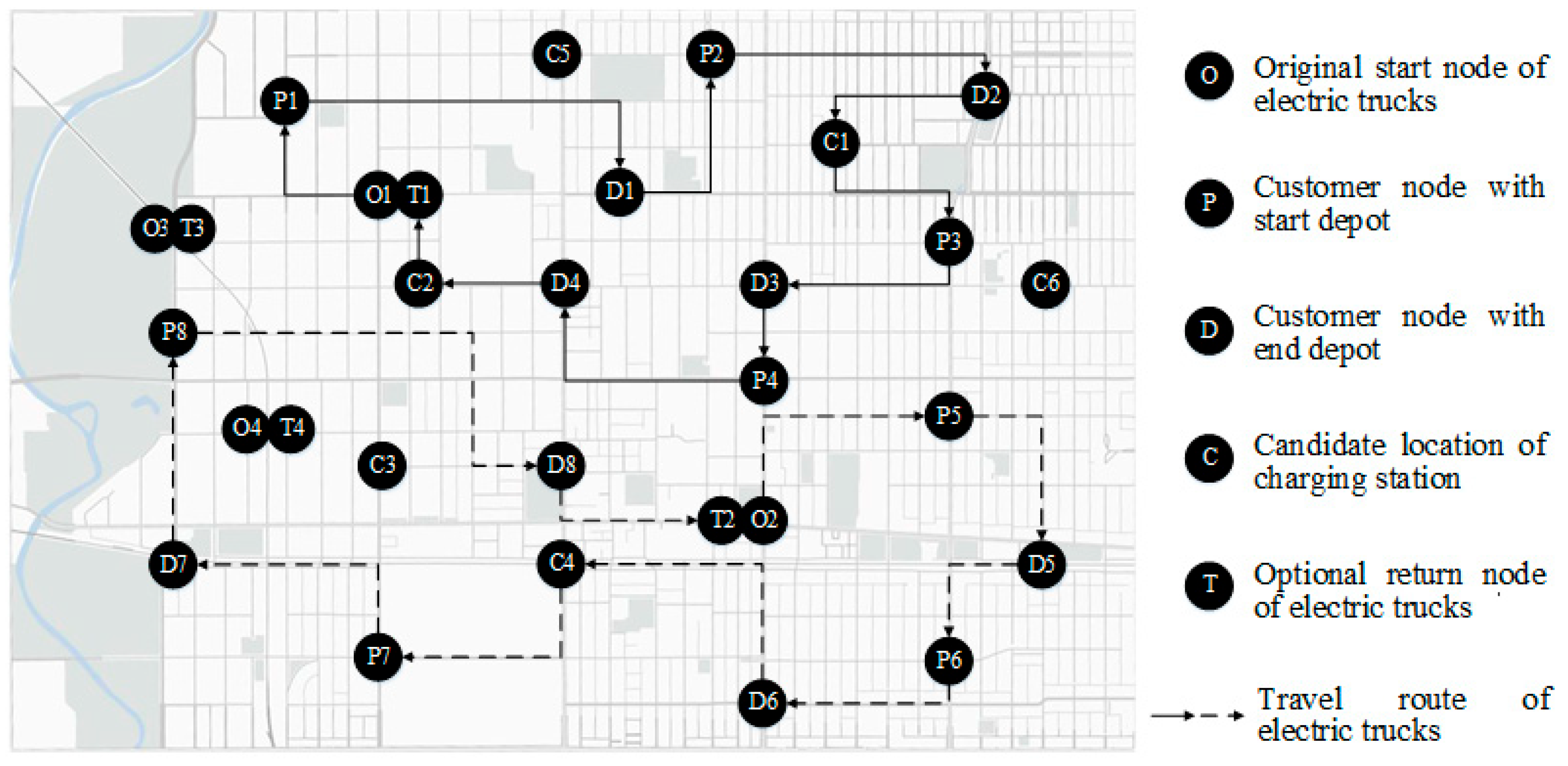
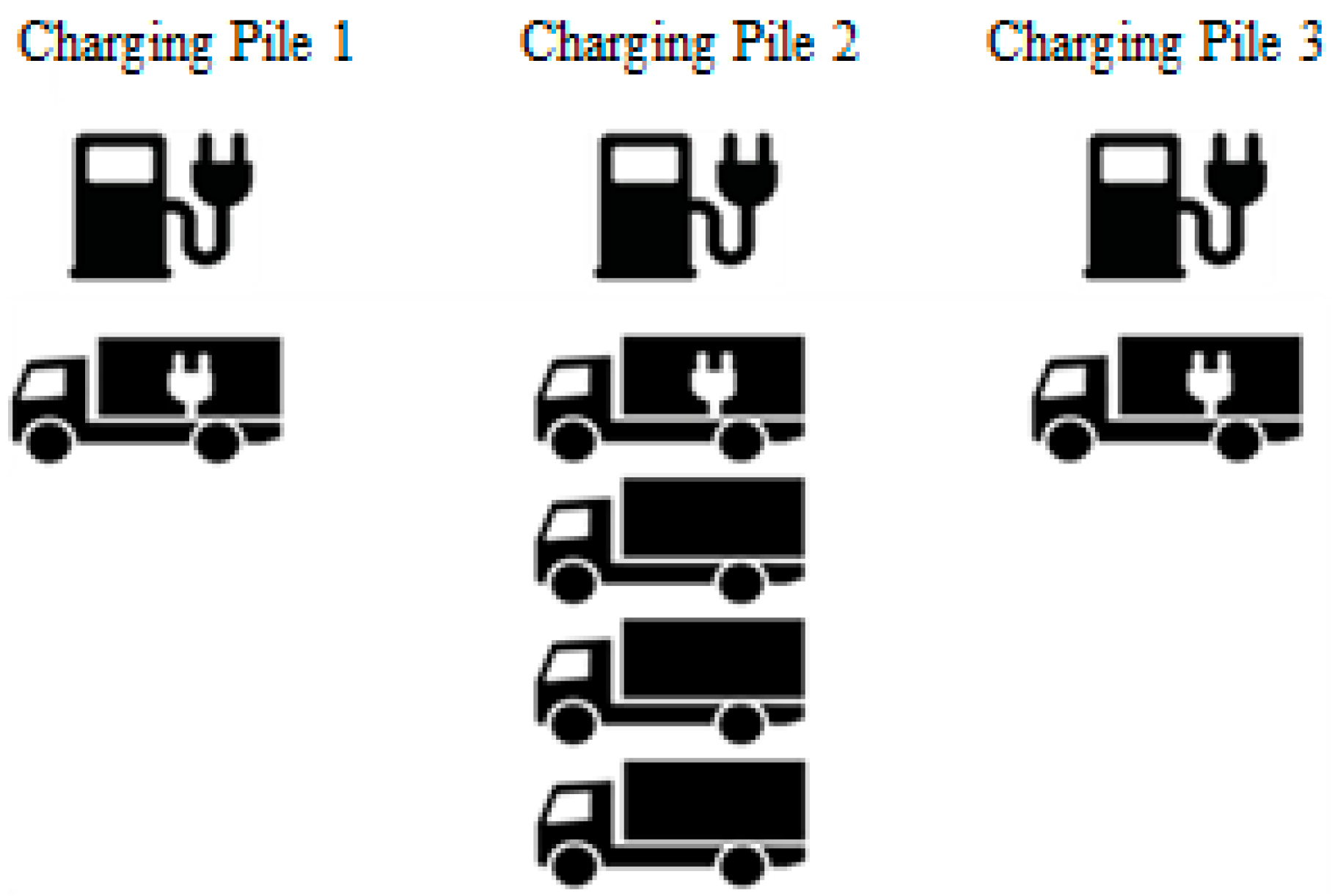
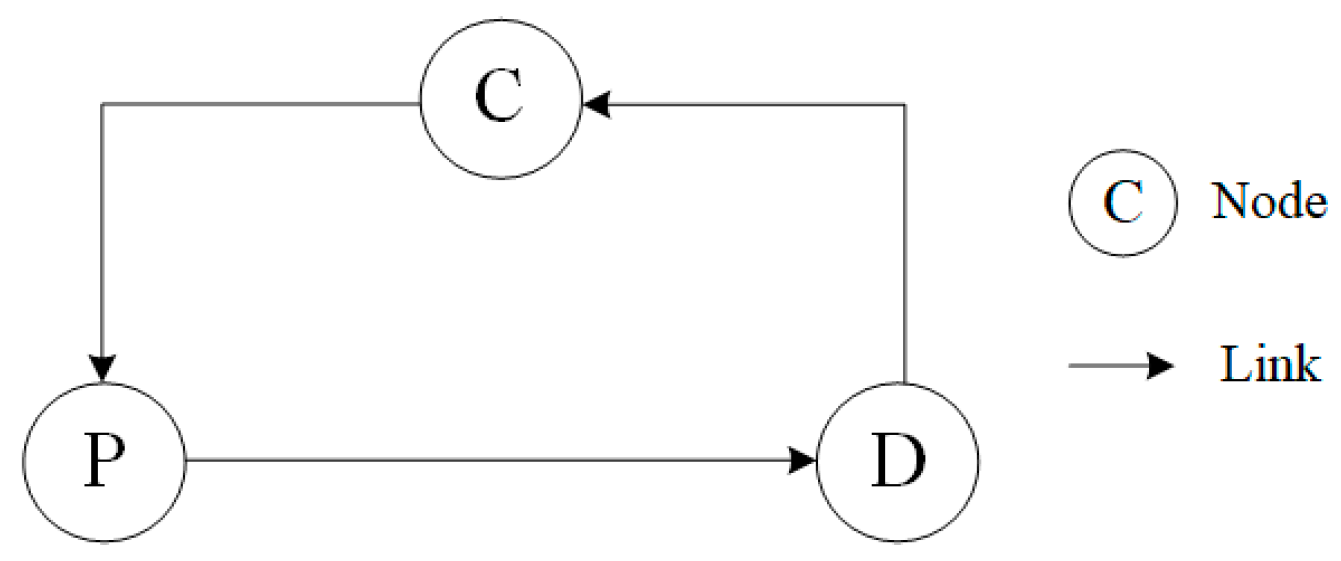
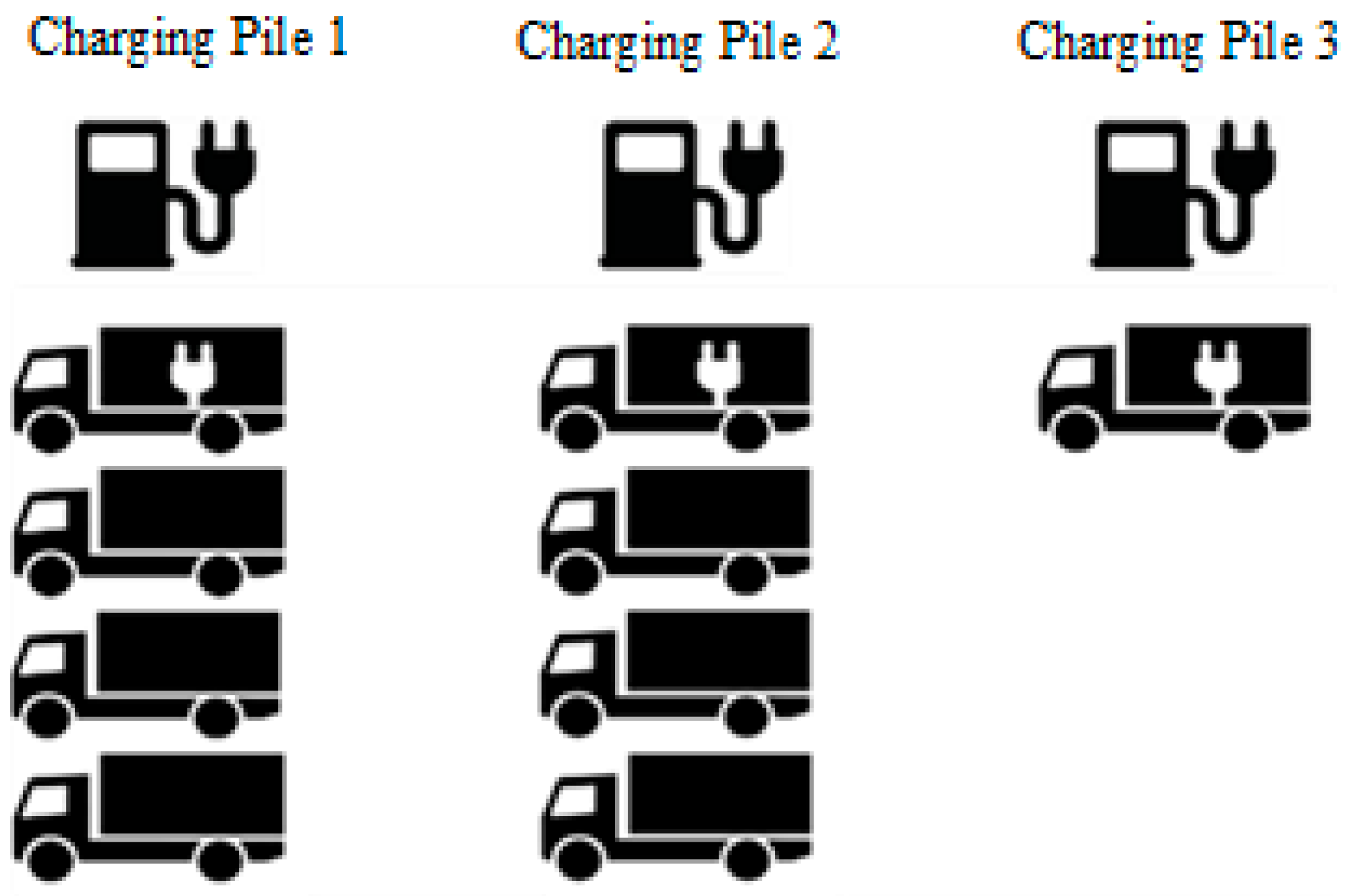
2. Problem Statement
3. Model Formulation
3.1. Objective Function
3.2. Constraints
3.2.1. Travel Route Constraints
3.2.2. Operation Time Constraints
3.2.3. Charging Principle Constraints
3.2.4. Battery Dynamics Constraints
3.2.5. Budget Constraints
3.3. Model Summary
4. Constraint Validation Tests
- Case 1
- Case 2
- Cases 3–5
5. Numerical Test on Falls Network
6. Hybrid Heuristic for Large Scale Networks
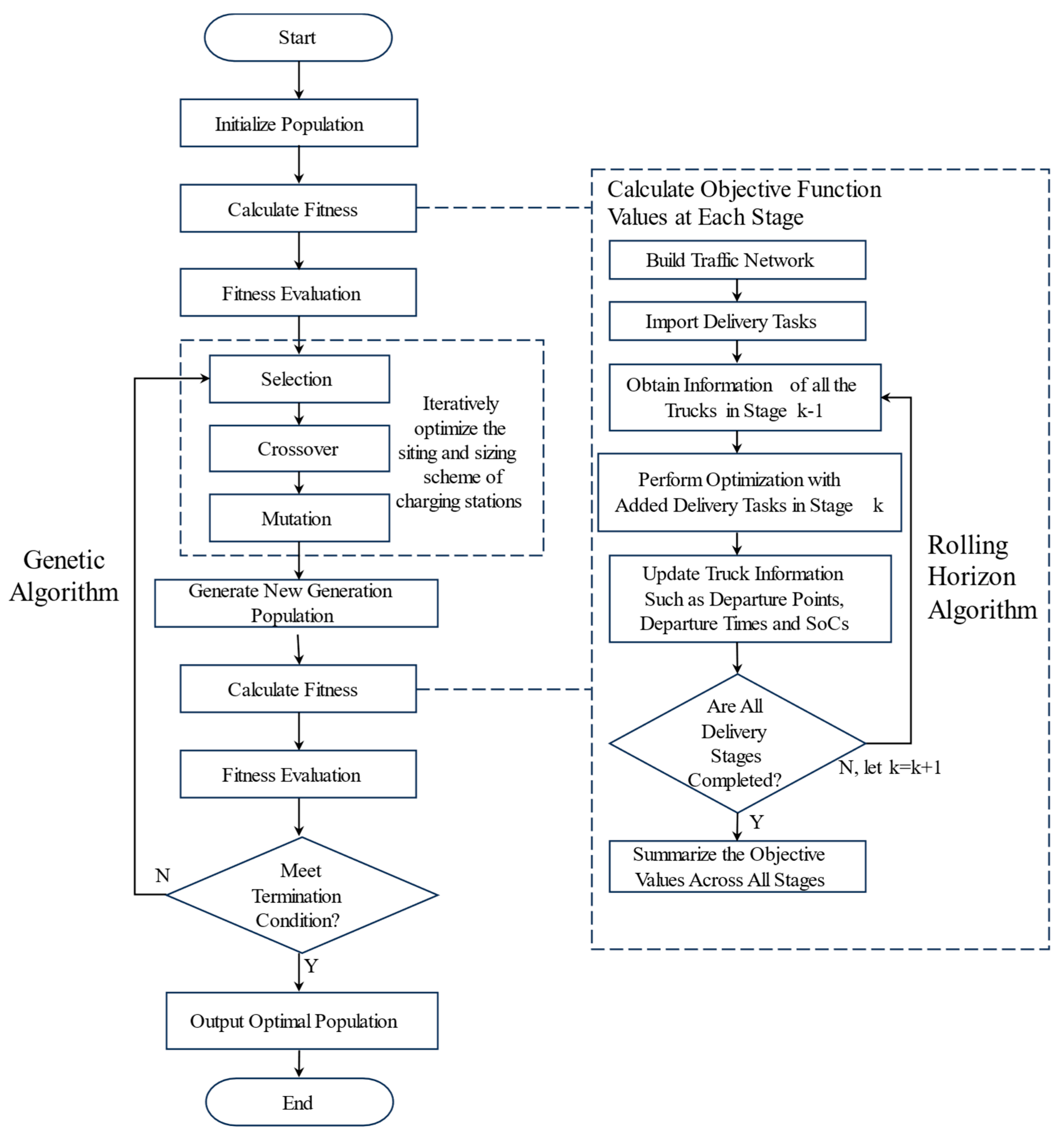
| Algorithm 1. A Siting and Sizing Algorithm for Charging Facilities in Large-Scale Road Networks |
| Step 1: Initialization |
| Step 1.1: Import Basic Data Import the road network data, delivery order data, electric truck (ET) departure/return points, candidate sites for charging stations, and the shortest paths for all node pairs. |
| Step 1.2: Time Window Division Divide the m-hour modeling horizon into s periods, each with a duration of t seconds. Allocate the delivery orders into these s periods based on the order start times. |
| Step 1.3: Parameter Setting Initialize parameters including travel speed, , , , , , , , , , and . |
| Step 1.4: Population Initialization |
| Set the number of generations to be 0, i.e., gen = 0. Generate an initial population containing 10 individuals, i.e., the population size is 10. Implement binary encoding, where 0 represents no charging station/pile is to be built at the node, and 1 represents one charging station/pile is to be built at the node. |
| Step 1.5: Truck Fleet Initialization |
| Initialize the states of all the electric trucks. |
| Step 2: Fitness Evaluation For each individual siting and sizing scheme in the population: Set the total system cost for completing all delivery tasks be zero, i.e., cost = 0 |
| For each time period k: |
| Step 2.1: Construct Transport Network Import the delivery tasks for period k. Updated vehicle origin set . Construct the node sets for the transport network and update the shortest paths for all node pairs. |
| Step 2.2: Execute Period-k Optimization Solve the proposed MILP for time period k, to obtain the optimal vehicle routing plans, fleet size, and charging schemes for all the trucks in service, as well as the objective value k_cost. Update cost = cost + k_cost. Step 2.3: Acquire Period-k Vehicle Information |
| Retrieve information for trucks operating in period k, including the vehicles in service, their start points, end points, SoCs, arrival times, and the charging piles used. Step 2.4: Update Truck Departure Points Send the locations of trucks at the end of period k to set as their start points in the next period k + 1. Update the set O. |
| End For Record the fitness value, i.e., the total system cost, for each individual siting and sizing scheme. Update the best fitness value fitbest for each generation. |
| End For |
| Step 3 Population Update with Genetic Algorithm |
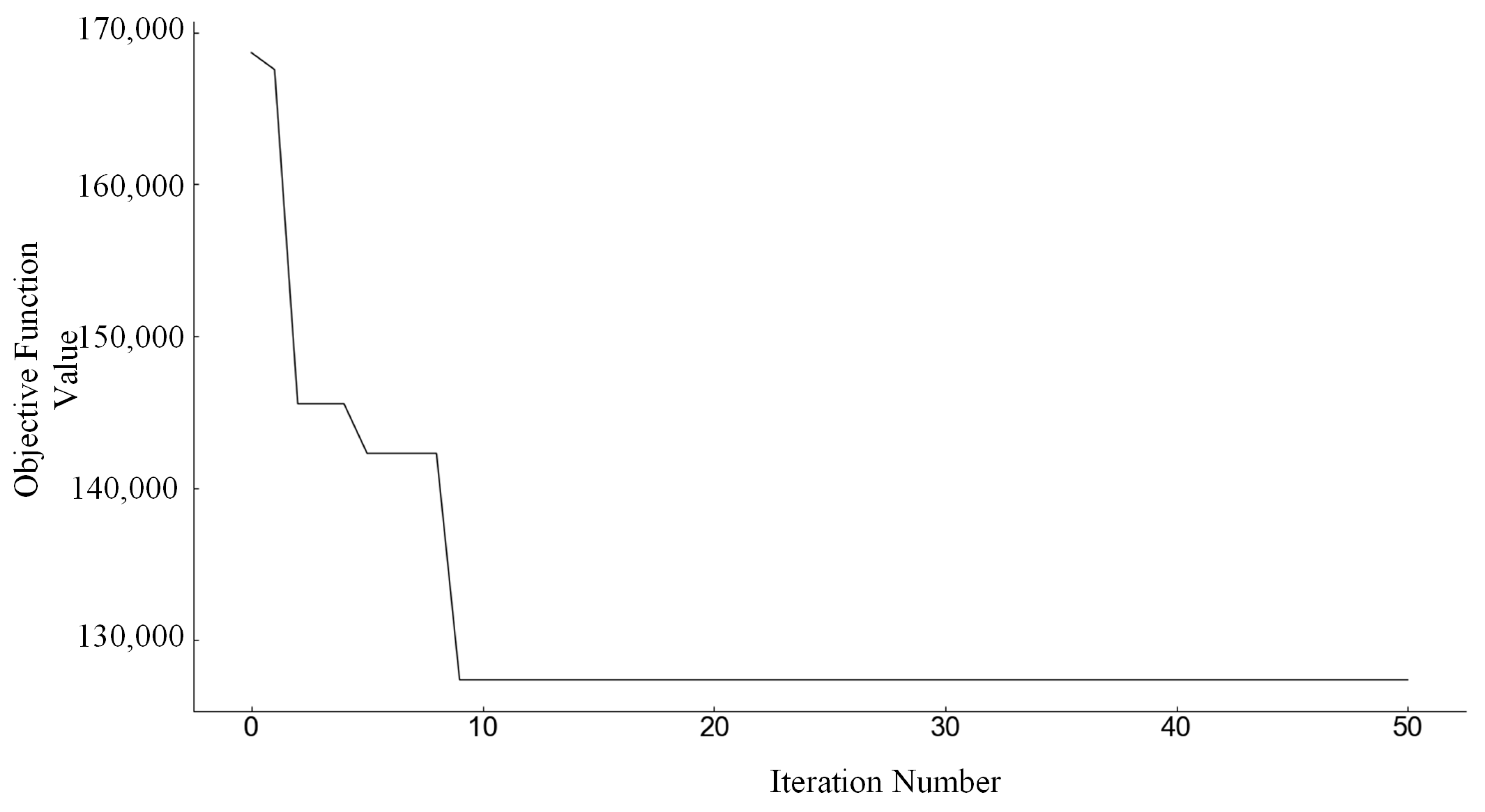
| Update gen = gen + 1. If gen > genmax = 50, terminate; otherwise: Keep the best two individuals in the last population. |
| Step 3.1: Crossover Select two individuals from the last population. The selection probability is proportional to the fitness value. Perform uniform crossover on the two selected individuals to generate offspring. A crossover probability of 90% is applied. Repeat crossover until enough valid offspring are generated. Step 3.2: Mutation Perform scramble mutation on individuals after crossover. A mutation rate of 10% is applied. Repeat crossover until enough valid offspring are generated. |
| Return to Step 2. |
| (Algorithm End) |
7. Numerical Test on Chicago Network
8. Conclusions
Author Contributions
Funding
Institutional Review Board Statement
Informed Consent Statement
Data Availability Statement
Acknowledgments
Conflicts of Interest
References
- Soulopoulos, N.; McKerracher, C.; Fisher, R.; Yang, M. Zero-Emission Commercial Vehicles: The Time Is Now; Bloomberg New Energy Finance: London, UK, 2024. [Google Scholar]
- Dua, R.; Almutairi, S. A perspective on emerging policy and economics research priorities for enabling low-carbon trucking. Energy Res. Soc. Sci. 2025, 124, 104025. [Google Scholar] [CrossRef]
- Al-Hanahi, B.; Ahmad, I.; Habibi, D.; Masoum, M.A.S. Charging infrastructure for commercial electric vehicles: Challenges and future works. IEEE Access 2021, 9, 121476–121492. [Google Scholar] [CrossRef]
- Link, S.; Stephan, A.; Speth, D.; Plötz, P. Rapidly declining costs of truck batteries and fuel cells enable large-scale road freight electrification. Nat. Energy 2024, 9, 1032–1039. [Google Scholar] [CrossRef]
- Song, Y. Optimization of Electric Vehicles’ Charging Station Location. Master’s Thesis, Southwest Jiaotong University, Chengdu, China, 2016. [Google Scholar]
- Zhu, Z.-H.; Gao, Z.-Y.; Zheng, J.-F.; Du, H.-M. Charging station location problem of plug-in electric vehicles. J. Transp. Geogr. 2016, 52, 11–22. [Google Scholar] [CrossRef]
- Seifeddine, B.; Layeb, S.B. Determining optimal deployment of electric vehicles charging stations: Case of Tunis City, Tunisia. Case Stud. Transp. Policy 2019, 7, 628–642. [Google Scholar] [CrossRef]
- Shang, X.; Wang, M.-J.; Xu, L.-X.; Zhang, L.-H. Configuration optimization of electric vehicle charging facilities in urban areas. J. Zhejiang Univ. (Eng. Sci.) 2020, 54, 1210–1217. [Google Scholar]
- Xiao, B.; Gao, F. Optimization method of electric vehicle charging stations’ site selection and capacity determination considering charging piles with different capacities. Electr. Power Autom. Equip. 2022, 42, 157–166. [Google Scholar]
- Zhu, S.Y.; Yang, B.; Zhu, X.L. Location and capacity of electric vehicle charging stations considering deviation path. J. Shanghai Marit. Univ. 2019, 40, 44–50. [Google Scholar]
- Sun, S.Z. Study on the Layout Planning of Charging Facilities and Optimization of Distribution Route for Pure Electric Logistics Vehicles. Master’s Thesis, Jilin University, Changchun, China, 2020. [Google Scholar]
- Wang, Y.; Zhou, J.; Sun, Y.; Wang, X.; Zhe, J.; Wang, H. Electric vehicle charging station location-routing problem with time windows and resource sharing. Sustainability 2022, 14, 11681. [Google Scholar] [CrossRef]
- Wu, T.; Li, Z.; Wang, G.; Zhang, X.; Qiu, J. Low-carbon charging facilities planning for electric vehicles based on a novel travel route choice model. IEEE Trans. Intell. Transp. Syst. 2023, 24, 5908–5922. [Google Scholar] [CrossRef]
- Kınay Ö, B.; Gzara, F.; Alumur, S.A. Charging station location and sizing for electric vehicles under congestion. Transp. Sci. 2023, 57, 1433–1451. [Google Scholar] [CrossRef]
- Yi, Z.; Bauer, P.H. Optimal stochastic eco-routing solutions for electric vehicles. IEEE Trans. Intell. Transp. Syst. 2018, 19, 3807–3817. [Google Scholar] [CrossRef]
- Owais, M.; Alshehri, A. Pareto optimal path generation algorithm in stochastic transportation networks. IEEE Access 2020, 8, 58970–58981. [Google Scholar] [CrossRef]
- Almutairi, A.; Owais, M. Reliable Vehicle Routing Problem Using Traffic Sensors Augmented Information. Sensors 2025, 25, 2262. [Google Scholar] [CrossRef] [PubMed]
- Setak, M.; Karimpour, A. A mathematical model for the electric vehicle routing with time windows considering queuing system at charging stations and alternative paths. J. Ind. Syst. Eng. 2019, 12, 284–306. [Google Scholar]
- Li, B.; Jha, S.S.; Lau, H.C. Route planning for a fleet of electric vehicles with waiting times at charging stations. In Proceedings of the European Conference on Evolutionary Computation in Combinatorial Optimization (Part of EvoStar), Trieste, Italy, 23–25 April 2025; Springer International Publishing: Cham, Switzerland, 2019; pp. 66–82. [Google Scholar]
- Chen, R.; Qian, X.W.; Miao, L.X.; Ukkusuri, S.V. Optimal charging facility location and capacity for electric vehicles considering route choice and charging time equilibrium. Comput. Oper. Res. 2020, 113, 104776. [Google Scholar] [CrossRef]
- Uslu, T.; Kaya, O. Location and capacity decisions for electric bus charging stations considering waiting times. Transp. Res. Part D Transp. Environ. 2021, 90, 102645. [Google Scholar] [CrossRef]
- Schoenberg, S.; Buse, D.S.; Dressler, F. Siting and sizing charging infrastructure for electric vehicles with coordinated recharging. IEEE Trans. Intell. Veh. 2022, 8, 1425–1438. [Google Scholar] [CrossRef]
- Fortin, F.; De Rainville, F.; Gardner, M.; Parizeau, M.; Gagne, C. DEAP: Evolutionary algorithms made easy. J. Mach. Learn. Res. 2022, 31, 2171–2175. [Google Scholar]



| Symbol | Description | |
|---|---|---|
| Sets | Set of original start points of electric trucks. There are in total σ optional start points, so O = {1, 2, …, σ} | |
| Set of customer nodes with start depots. There are δ delivery demands, so | ||
| Set of customer nodes with end depots. Each delivery task corresponds to a node pair of origin and destination, so | ||
| Set of candidate charging pile nodes at station n. The allowed maximum number of charging piles at station n is Rn,max, so | ||
| Set of all candidate charging pile nodes across all stations. The allowed maximum number of charging piles is | ||
| Set of optional return points of electric trucks, which can be the same as their original start points, so | ||
| Parameters | ||
| divided by the average driving speed | ||
| Unit travel time cost of electric trucks | ||
| Unit electricity consumption cost | ||
| Procurement and maintenance cost of each electric truck | ||
| Construction and maintenance cost of each charging station | ||
| Construction and maintenance cost of each charging pile | ||
| Unit waiting time cost of electric trucks queuing at charging stations | ||
| Unit waiting time penalty for late arrival of trucks at the start depots of delivery tasks | ||
| Charging rate of charging piles, i.e., the electricity charged per unit time | ||
| Electricity consumption rate of electric trucks, i.e., the electricity consumed per unit time | ||
| Battery capacity of electric trucks | ||
| A sufficiently large positive number | ||
| Number of candidate charging stations | ||
| Maximum number of charging piles that can be installed at charging station n | ||
| Maximum number of electric trucks allowed to procured | ||
| Maximum number of charging stations allowed to be constructed in the area | ||
| Total number of charging piles allowed to be installed across all charging stations | ||
| Variables | ||
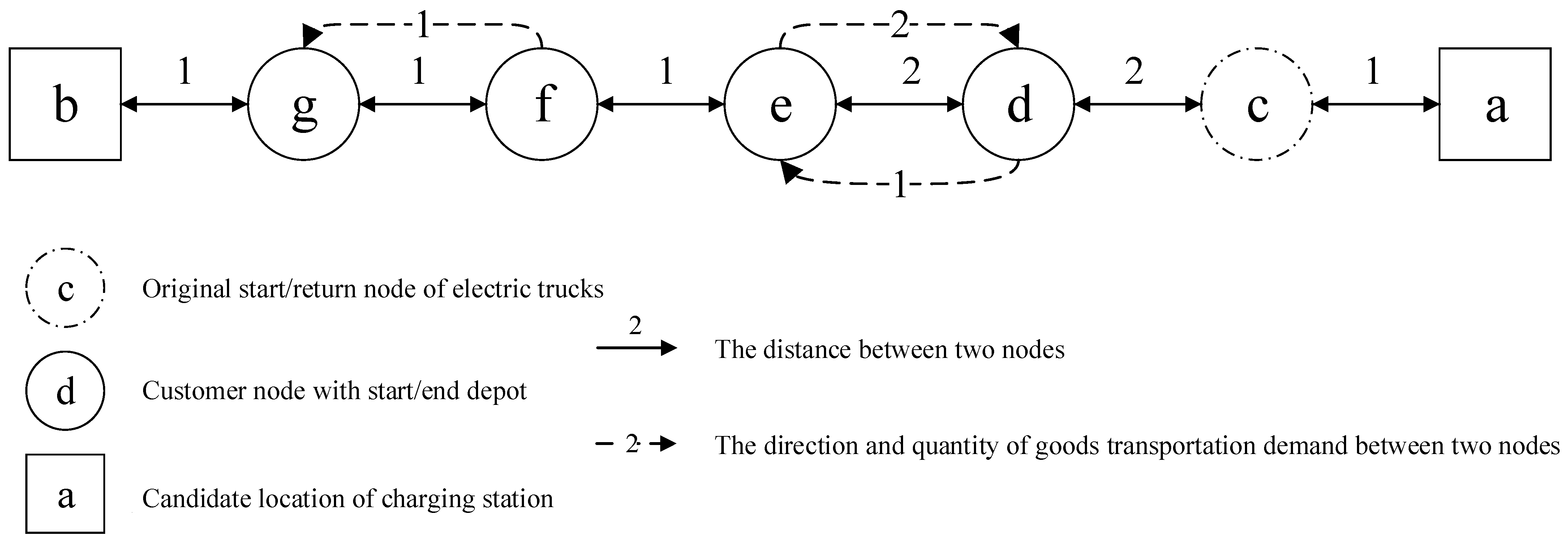
| Number | Pickup Node | Drop-Off Node | Start Time |
|---|---|---|---|
| 1 | f | g | 4 |
| 2 | e | d | 15 |
| 3 | e | d | 18 |
| 4 | d | e | 23 |
| Node | e | d | b | c |
| 4.0 | 23.0 | 28.0 | 58.0 | |
| - | - | 40.0 | - | |
| 21.0 | - | - | - | |
| 160.0 | 140.0 | 90.0 | 190.0 | |
| Node | f | g | b | c |
| 5.0 | 6.0 | 7.0 | 21.0 | |
| - | - | 7.0 | - | |
| 5.0 | - | - | - | |
| 150.0 | 140.0 | 130.0 | 190.0 | |
| Node | d | e | b | c |
| 2.0 | 25.0 | 28.0 | 47.0 | |
| - | - | 33.0 | - | |
| 23.0 | - | - | - | |
| 180.0 | 160.0 | 130.0 | 190.0 | |
| Node | e | d | b | c |
| 4.0 | 17.0 | 22.0 | 40.0 | |
| - | - | 22.0 | - | |
| 15.0 | - | - | - | |
| 160.0 | 140.0 | 90.0 | 190.0 |
| e | d | b | c | |
| 4.0 | 20.0 | 25.0 | 51.0 | |
| - | - | 33.0 | - | |
| 18.0 | - | - | - | |
| 160.0 | 140.0 | 90.0 | 190.0 | |
| f | g | b | c | |
| 5.0 | 6.0 | 7.0 | 21.0 | |
| - | - | 7.0 | - | |
| 5.0 | - | - | - | |
| 150.0 | 140.0 | 130.0 | 190.0 | |
| d | e | b | c | |
| 2.0 | 25.0 | 28.0 | 58.0 | |
| - | - | 44.0 | - | |
| 23.0 | - | - | - | |
| 180.0 | 160.0 | 130.0 | 190.0 | |
| e | d | b | c | |
| 4.0 | 17.0 | 22.0 | 40.0 | |
| - | - | 22.0 | - | |
| 15.0 | - | - | - | |
| 160.0 | 140.0 | 90.0 | 190.0 |
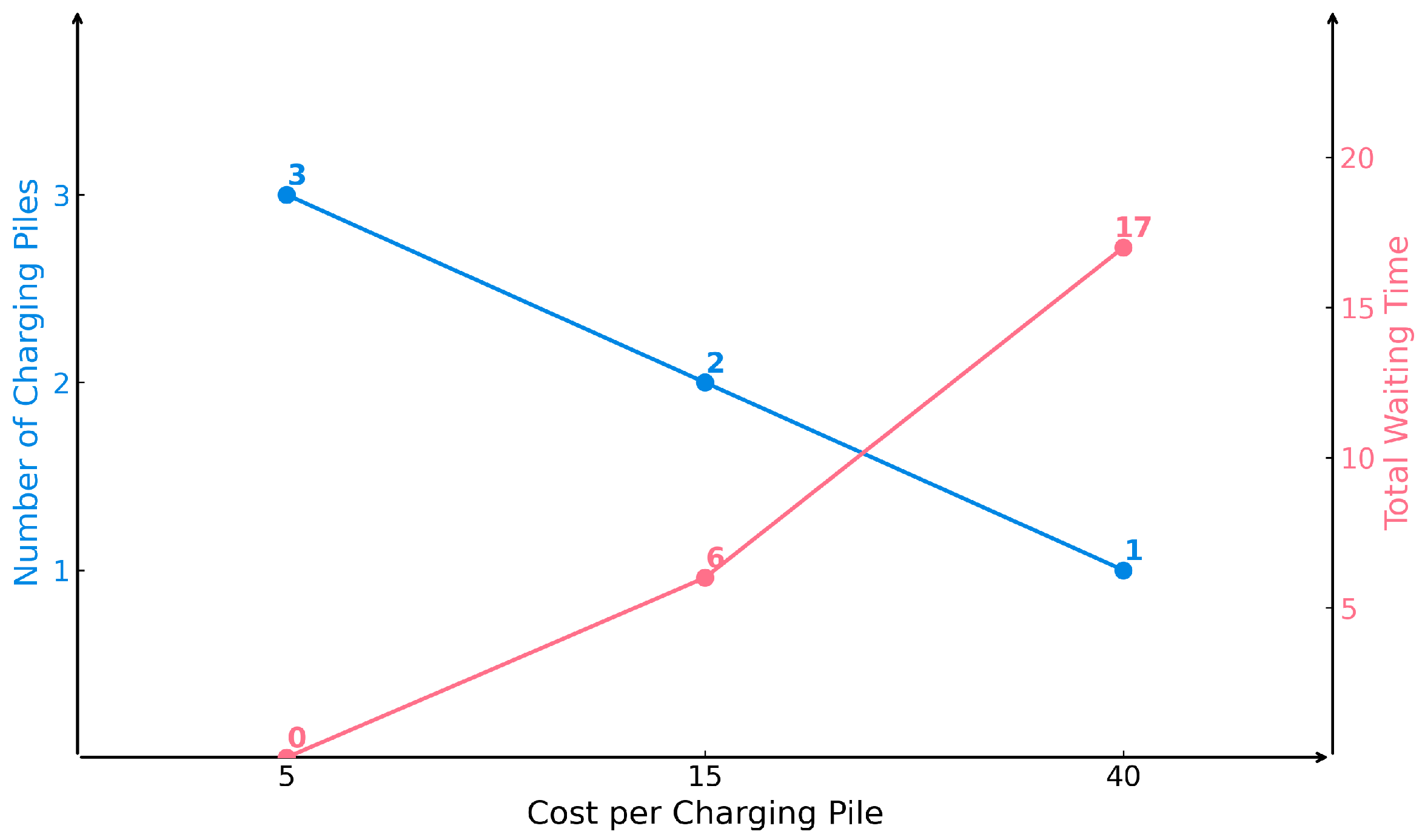
| Case 3 | Charging Station | a | b | ||
| Charging Pile | 1 | 2 | 3 | ||
| Electric Truck | |||||
| 23 | 20 | 28 | 7 | ||
| 23 | 20 | 28 | 7 | ||
| 110 | 110 | 130 | 130 | ||
| Case 4 | Charging Station | a | b | ||
| Charging Pile | 1 | 2 | |||
| Electric Truck | |||||
| 20 | 23 | 7 | 28 | ||
| 20 | 29 | 7 | 28 | ||
| 110 | 110 | 130 | 130 | ||
| Case 5 | Charging Station | b | |||
| Charging Pile | 1 | ||||
| Electric Truck | |||||
| 22 | 28 | 28 | 7 | ||
| 22 | 33 | 40 | 7 | ||
| 90 | 130 | 90 | 130 | ||
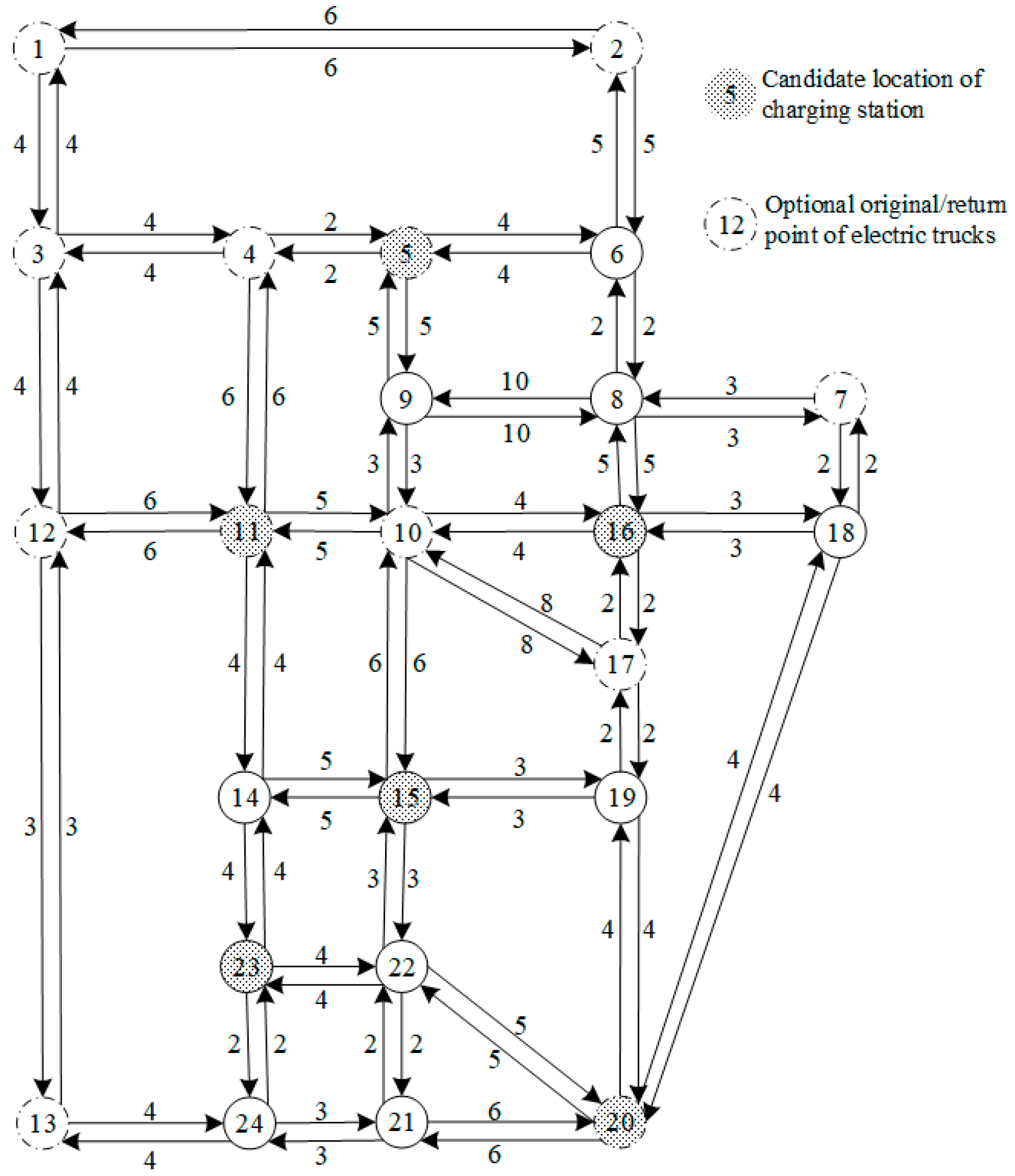
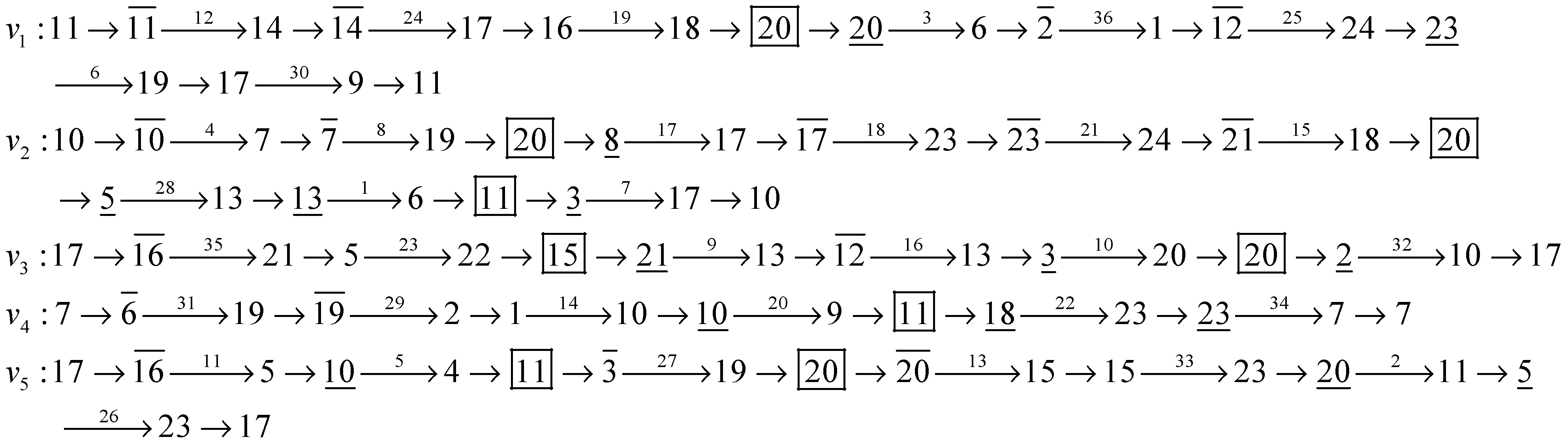
| Number | Pickup Node | Drop-Off Node | Start Time | Number | Pickup Node | Drop-Off Node | Travel Time |
|---|---|---|---|---|---|---|---|
| 1 | 13 | 6 | 132 | 19 | 16 | 18 | 23 |
| 2 | 20 | 11 | 149 | 20 | 10 | 9 | 112 |
| 3 | 20 | 6 | 46 | 21 | 23 | 24 | 85 |
| 4 | 10 | 7 | 4 | 22 | 18 | 23 | 137 |
| 5 | 10 | 4 | 9 | 23 | 5 | 22 | 35 |
| 6 | 23 | 19 | 93 | 24 | 14 | 17 | 26 |
| 7 | 3 | 17 | 91 | 25 | 12 | 24 | 125 |
| 8 | 7 | 19 | 13 | 26 | 5 | 23 | 169 |
| 9 | 21 | 13 | 93 | 27 | 3 | 19 | 97 |
| 10 | 3 | 20 | 44 | 28 | 5 | 13 | 121 |
| 11 | 16 | 5 | 7 | 29 | 19 | 2 | 134 |
| 12 | 11 | 14 | 19 | 30 | 17 | 9 | 139 |
| 13 | 20 | 15 | 160 | 31 | 6 | 19 | 107 |
| 14 | 1 | 10 | 152 | 32 | 2 | 10 | 158 |
| 15 | 21 | 18 | 128 | 33 | 15 | 23 | 164 |
| 16 | 12 | 13 | 133 | 34 | 23 | 7 | 157 |
| 17 | 8 | 17 | 40 | 35 | 16 | 21 | 8 |
| 18 | 17 | 23 | 66 | 36 | 2 | 1 | 88 |
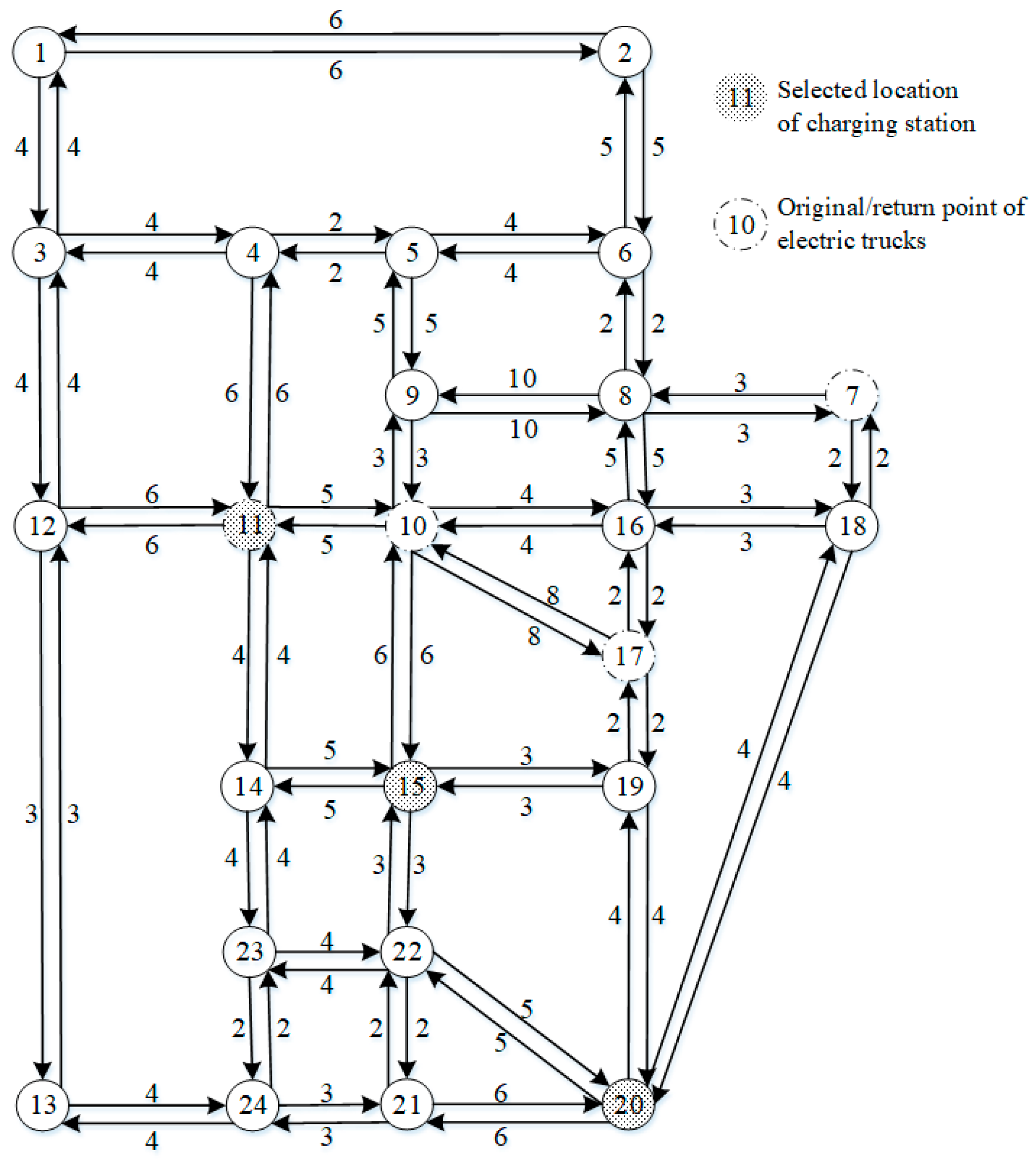
| Station Node | Charged Vehicles | Numbers of Charging |
|---|---|---|
| 11 | 2 | 1 |
| 4 | 1 | |
| 5 | 1 | |
| 15 | 3 | 1 |
| 20 | 1 | 1 |
| 2 | 2 | |
| 3 | 1 | |
| 5 | 1 |
| Number | X-Coordinate | Y-Coordinate | Number | X-Coordinate | Y-Coordinate |
|---|---|---|---|---|---|
| 367 | 10.37 | 63.623 | 47 | 55.083 | 79.727 |
| 240 | 18.239 | 96.0749 | 100 | 56.852 | 48.373 |
| 237 | 30.073 | 101.6869 | 10 | 57.157 | 66.49 |
| 170 | 30.256 | 73.932 | 346 | 51.85 | 14.579 |
| 38 | 36.051 | 78.3849 | 89 | 50.813 | 54.107 |
| 320 | 28.975 | 49.044 | 116 | 60.146 | 39.406 |
| 335 | 29.768 | 19.52 | 122 | 66.185 | 36.478 |
| 273 | 36.295 | 41.785 | 360 | 80.0929 | 35.38 |
| 689 | 42.517 | 60.451 | 23 | 62.342 | 58.682 |
| 67 | 50.447 | 74.3589 | 205 | 49.349 | 97.2339 |
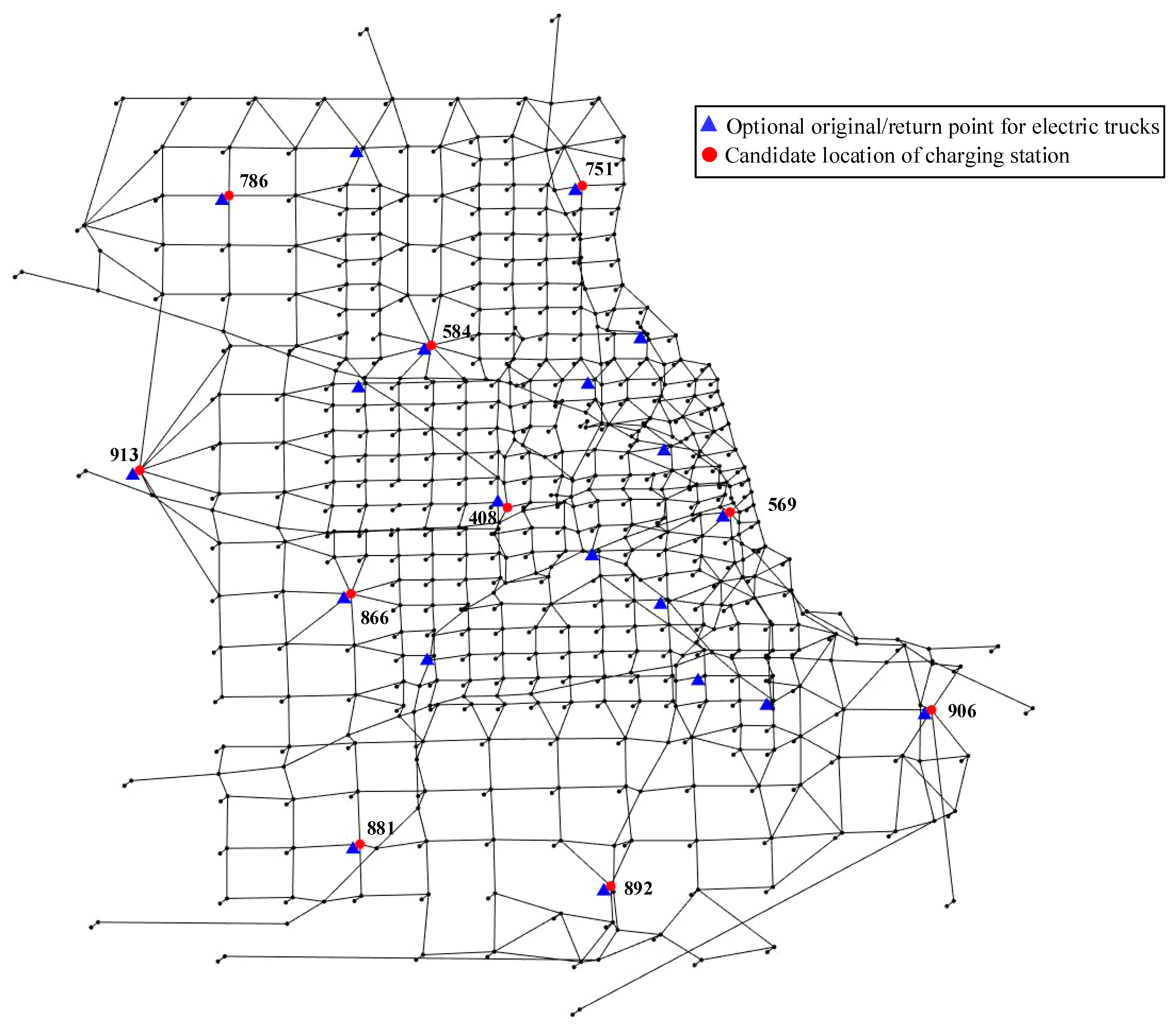
| Number | X-Coordinate | Y-Coordinate |
|---|---|---|
| 408 | 43.371 | 59.841 |
| 569 | 62.952 | 59.292 |
| 892 | 52.46 | 15.189 |
| 906 | 80.7029 | 35.99 |
| 866 | 29.585 | 49.654 |
| 881 | 30.378 | 20.13 |
| 751 | 49.959 | 97.8439 |
| 786 | 18.849 | 96.6849 |
| 584 | 36.661 | 78.9949 |
| 913 | 10.98 | 64.233 |
Disclaimer/Publisher’s Note: The statements, opinions and data contained in all publications are solely those of the individual author(s) and contributor(s) and not of MDPI and/or the editor(s). MDPI and/or the editor(s) disclaim responsibility for any injury to people or property resulting from any ideas, methods, instructions or products referred to in the content. |
© 2025 by the authors. Licensee MDPI, Basel, Switzerland. This article is an open access article distributed under the terms and conditions of the Creative Commons Attribution (CC BY) license (https://creativecommons.org/licenses/by/4.0/).
Share and Cite
Xu, Y.; Shang, X.; Wang, Y.; Zhang, L. An Explicit Model for Optimal Siting and Sizing of Electric Truck Charging Stations. Sustainability 2025, 17, 10708. https://doi.org/10.3390/su172310708
Xu Y, Shang X, Wang Y, Zhang L. An Explicit Model for Optimal Siting and Sizing of Electric Truck Charging Stations. Sustainability. 2025; 17(23):10708. https://doi.org/10.3390/su172310708
Chicago/Turabian StyleXu, Yang, Xia Shang, Yeying Wang, and Lihui Zhang. 2025. "An Explicit Model for Optimal Siting and Sizing of Electric Truck Charging Stations" Sustainability 17, no. 23: 10708. https://doi.org/10.3390/su172310708
APA StyleXu, Y., Shang, X., Wang, Y., & Zhang, L. (2025). An Explicit Model for Optimal Siting and Sizing of Electric Truck Charging Stations. Sustainability, 17(23), 10708. https://doi.org/10.3390/su172310708