Spatiotemporal Evolution and Transformation Mechanism of China’s “Dual Circulation” Economy


Abstract
1. Introduction
2. Materials and Methods
2.1. Indicator System Construction
2.1.1. Theoretical Basis
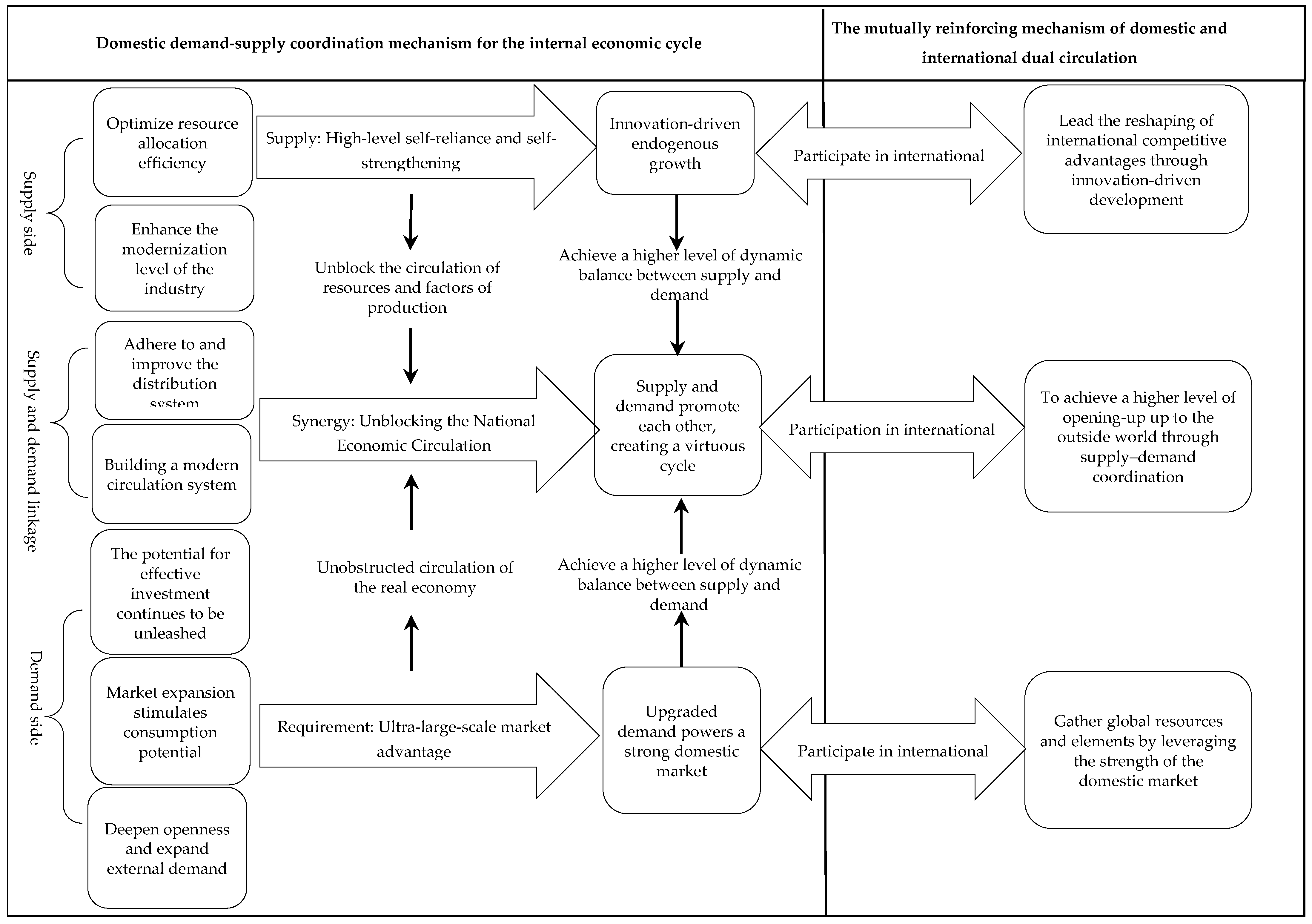
2.1.2. Theoretical Framework
- (1)
- Supply Side
- (2)
- Demand Side
- (3)
- Supply and Demand Coordination
2.2. Indicator System Construction for the Development Level of the “Dual Circulation” Strategy
2.3. Methods
2.3.1. Entropy Weight Method-TOPSIS Combined Weight Model
2.3.2. Kernel Density Estimation Method
2.3.3. ESTDA
2.4. Data Source
3. Analysis of the Spatiotemporal Evolution Characteristics of China’s “Dual Circulation” Economy
3.1. Dynamic Evolution Analysis of China’s “Dual Circulation” Economy
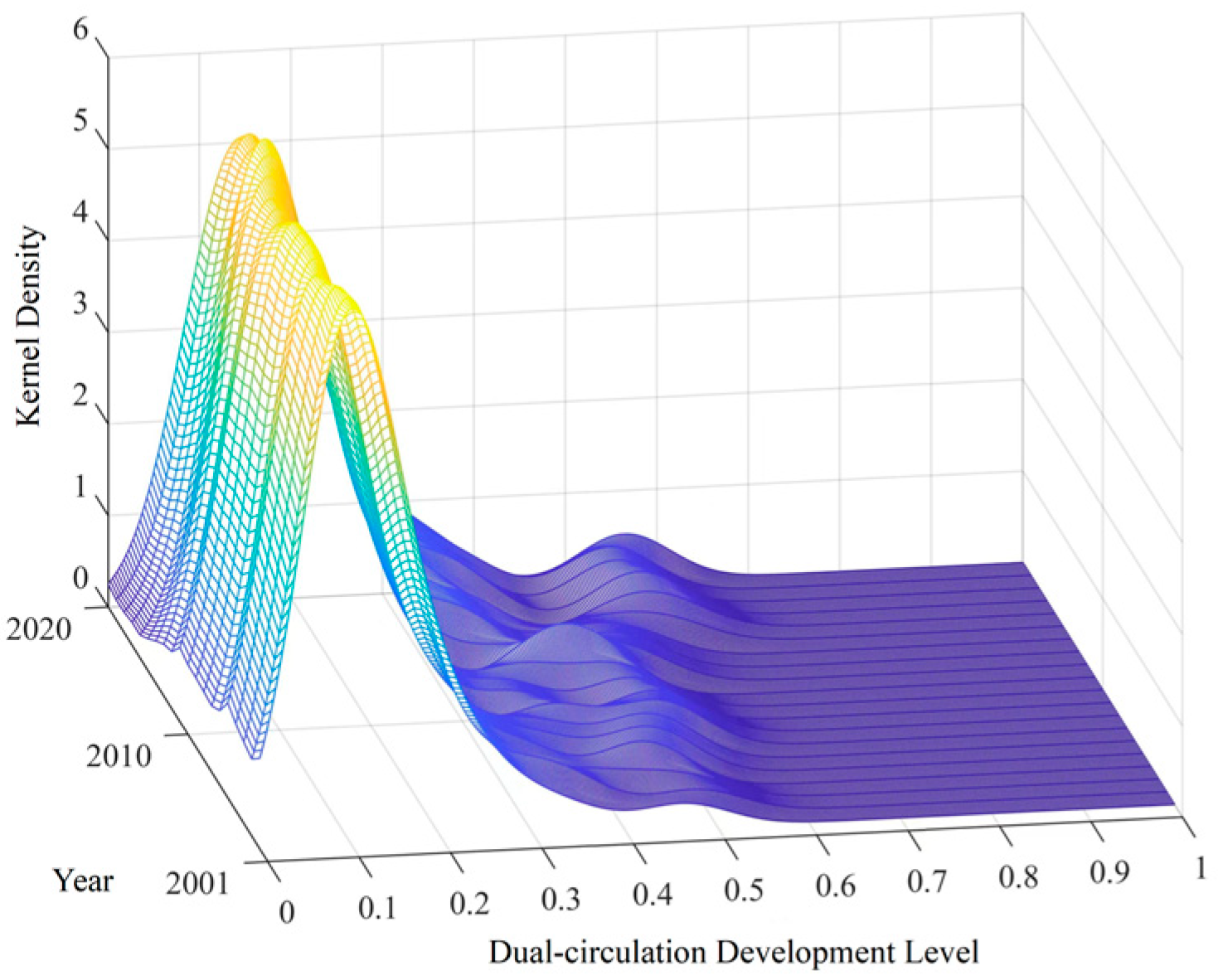
3.1.1. National Level
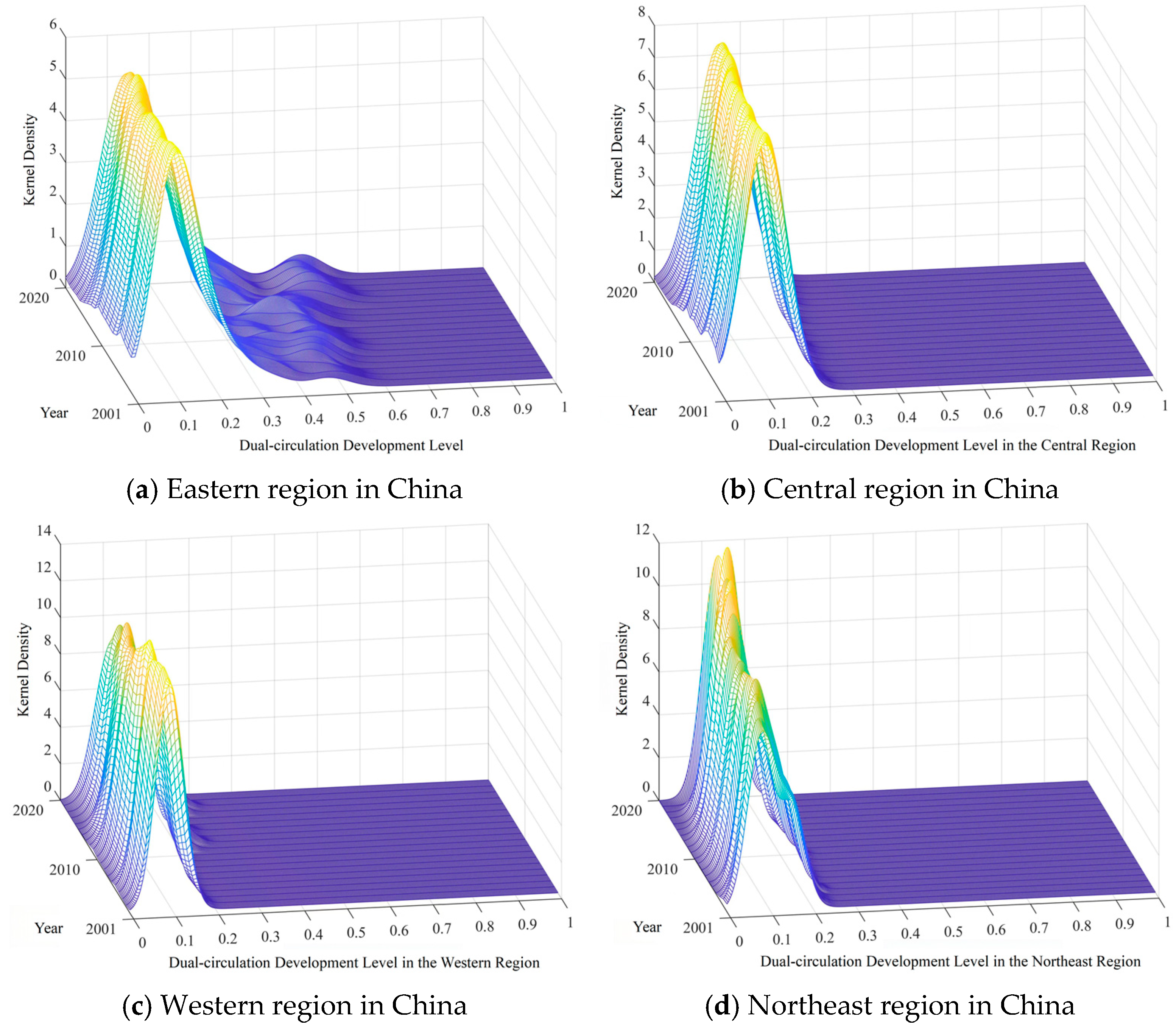
3.1.2. Regional Level
3.2. Analysis of the Evolutionary Trends of China’s “Dual Circulation” Economy
3.3. Analysis of the Spatiotemporal Trends of China’s “Dual Circulation” Economy
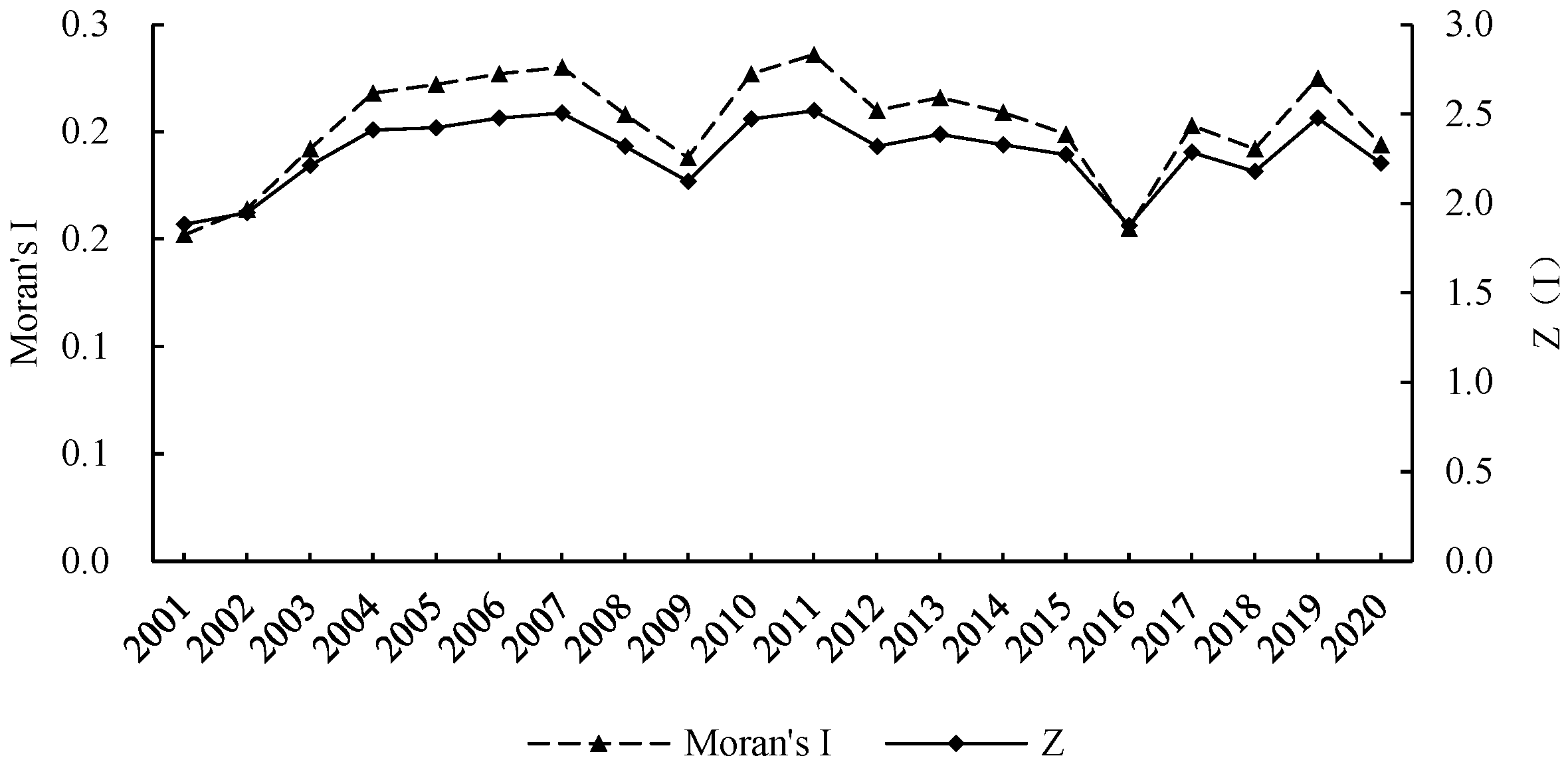
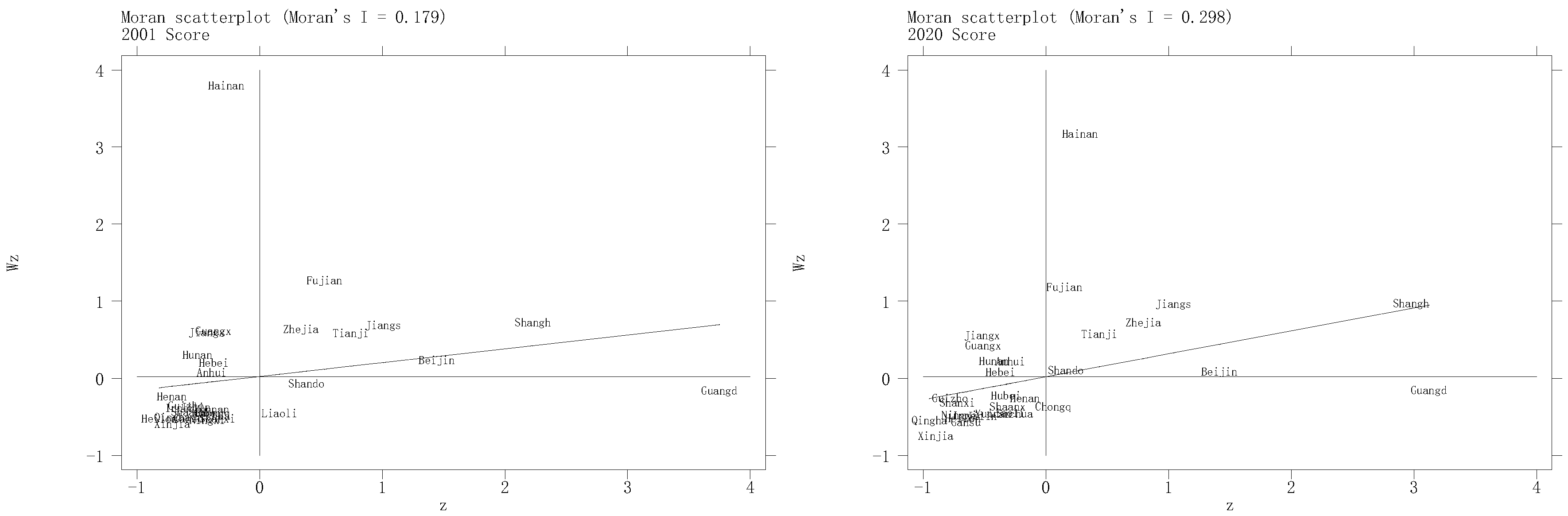
3.3.1. Global Spatial Autocorrelation Analysis
3.3.2. Local Spatial Autocorrelation Analysis
3.4. Types of Spatiotemporal Transitions in China’s “Dual Circulation” Economy
4. Quantile Regression Analysis of the Influencing Factors of China’s “Dual Circulation” Economy
4.1. Quantile Regression Model
4.2. Variable Selection
4.3. Quantile Regression Results
5. Analysis of the Spatiotemporal Evolution and Leapfrogging Mechanism of China’s “Dual Circulation” Economy
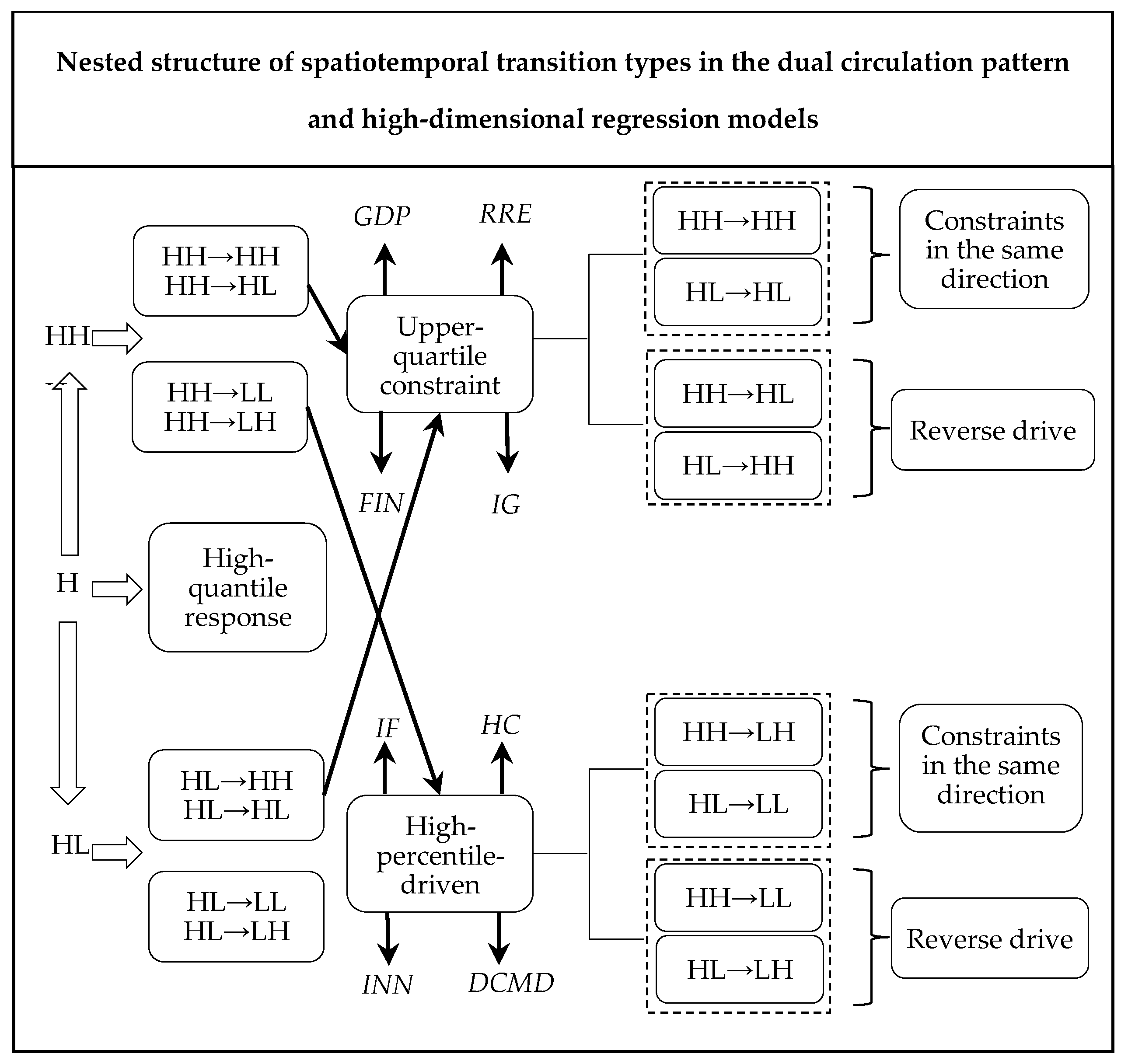
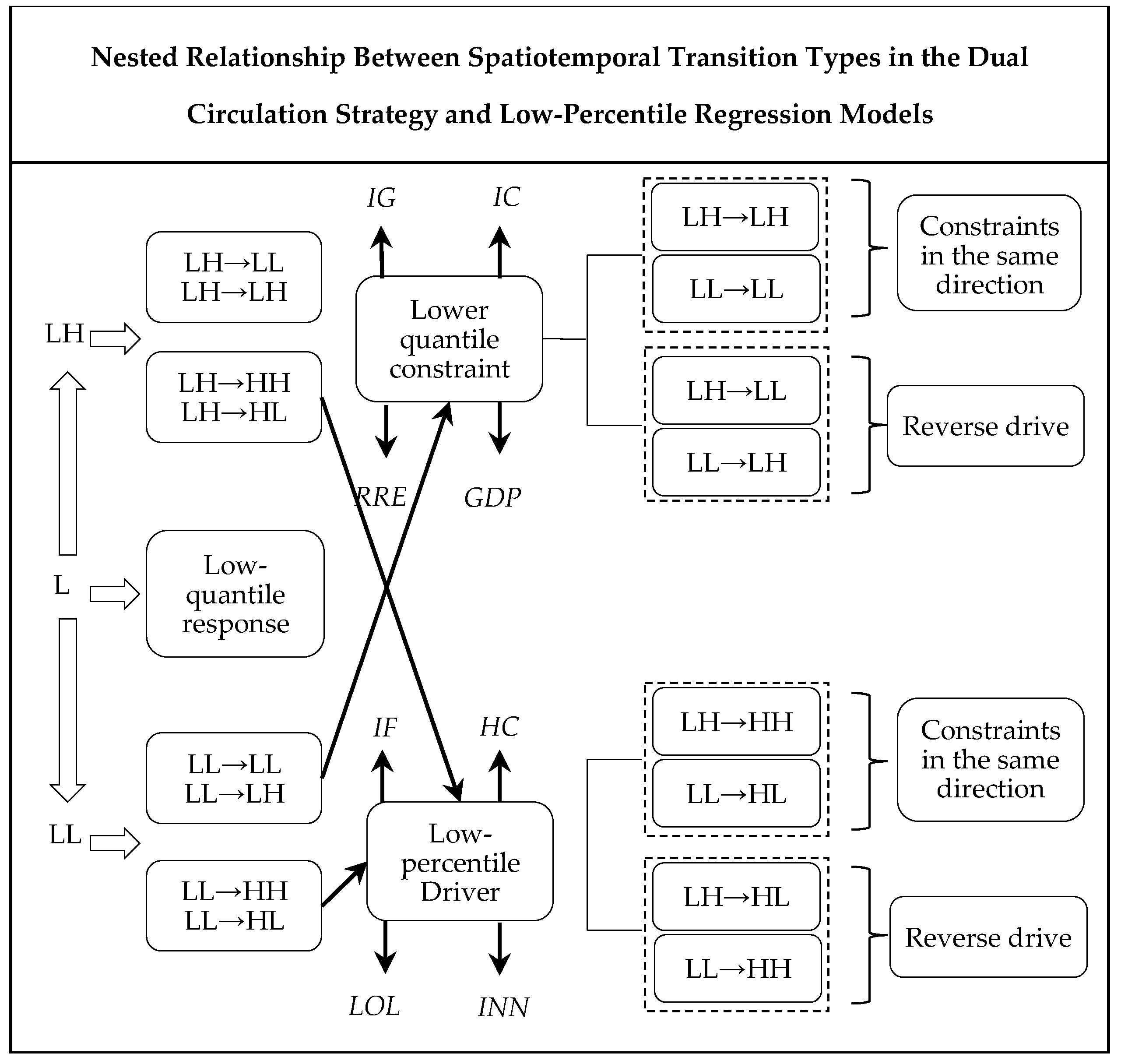
5.1. The Nesting of Spatiotemporal Transitions and Quantile Regression Results
5.2. The Development Level of the “Dual Circulation” Strategy Fosters Coordinated Regional Development
5.2.1. Promote the Stable Development of High-Level Regions in the “Dual Circulation” Strategy
5.2.2. Constraints on Changes in High-Level Regional Development Under the “Dual Circulation” Strategy

| Province Name | Types of Spatiotemporal Transitions | Factors Driving Changes in the Region |
|---|---|---|
| Liaoning | Local region transition—Adjacent region transition (HL→LL) | IF, HC, INN, and DCMD |
5.2.3. Break Through the Constraints of Low-Level Regions Locked in by the “Dual Circulation” Development Model
| Province Name | Types of Spatiotemporal Transitions | Factors Driving Regional Lock-In |
|---|---|---|
| Jiangxi, Guangxi, Hunan, Hebei, Anhui | Stability in this region—Stability in the adjacent areas (LH→LH) | GDP, IG, IC, and RRE |
| Henan, Shaanxi, Hubei, Shanxi, Guizhou, Sichuan, Yunnan, Jilin, Heilongjiang, Gansu, Xinjiang, Inner Mongolia, Ningxia, Qinghai | Stability in this region—Stability in the adjacent areas (LL→LL) | GDP, IG, IC, and RRE |
5.2.4. Encouraging Low-Level Regions to Leapfrog in the Development of the “Dual Circulation” Strategy
| Province Name | Types of Spatiotemporal Transitions | Factors Driving Transformation in This Region |
|---|---|---|
| Hainan | Transition in this region—Stability in the adjacent areas (LH→HH) | IF, HC, LOL, and INN |
| Chongqing | Transition in this region—Stability in the adjacent areas (LL→HL) | IF, HC, LOL, and INN |
6. Conclusions and Policy Implications
6.1. Conclusions
6.2. Policy Implications and Expectation
Author Contributions
Funding
Institutional Review Board Statement
Informed Consent Statement
Data Availability Statement
Conflicts of Interest
Appendix A
| Tertiary Indicators | Data Sources | Unit of Measure | Expected Sign |
|---|---|---|---|
| Capital misallocation | China Statistical Yearbook and provincial statistical yearbook provincial statistical yearbook | Dimensionless | − |
| Labor misallocation | China Statistical Yearbook and provincial statistical yearbook | Dimensionless | − |
| Introduction of foreign technology | China National Bureau of statistics and China high tech statistical yearbook | Dimensionless | + |
| Capital inflow | The China Foreign Economic and Trade Statistical Yearbook Trade Statistical Yearbook | Dimensionless | + |
| Rationalization of industrial structure | China’s National Bureau of statistics, provincial statistical yearbook population and Employment Statistical Yearbooks | Dimensionless | + |
| Upgrading of industrial structure | China National Bureau of statistics, provincial Statistical Yearbooks | Dimensionless | + |
| Proportion of tertiary industry output value | China National Bureau of statistics Statistical yearbook of China’s tertiary industry | Dimensionless | + |
| Foreign trade upgrade | Statistical yearbook of China’s urban and rural construction | Dimensionless | + |
| Fixed Asset Investment Index | provincial statistical yearbook | Dimensionless | + |
| Productive Investment Index | China Statistical Yearbook and provincial statistical yearbook | Dimensionless | + |
| Outbound Direct Investment | Wind databases | Dimensionless | + |
| Proportion of foreign-invested enterprises enterprises | Wind databases | Dimensionless | + |
| Consumption Contribution | Wind databases | Dimensionless | + |
| Consumption upgrade | Wind databases | Dimensionless | + |
| International tourism departure rate | provincial statistical yearbook and CSMAR databases | Dimensionless | + |
| Per capita international tourism revenue | China Statistical Yearbook and provincial statistical bulletins | Dimensionless | + |
| Degree of regional marketization | Wind databases | Dimensionless | + |
| Market segmentation degree | China National Bureau of statistics, provincial statistical yearbook and provincial statistical bulletins | Dimensionless | + |
| Import dependence | China Statistical Yearbook, provincial statistical yearbook And China Economic Information Network | Dimensionless | + |
| Export dependency rate | China Statistical Yearbook, provincial statistical yearbook And China Economic Information Network | Dimensionless | + |
| Fiscal transfer payment rate | China Statistical Yearbook and China fiscal Yearbook | Dimensionless | − |
| Fairness of distribution | Macrodatas | Dimensionless | + |
| Income distribution relations | China Statistical Yearbook and provincial statistical yearbook | Dimensionless | + |
| Trade balance | provincial statistical yearbook | Dimensionless | / |
| Contribution to the development of the logistics industry | China Statistical Yearbook and Research Report and published data of China Express Industry Association | Dimensionless | + |
| Highway network density | China urban statistical yearbook | Dimensionless | + |
| Online circulation convenience | Research Report and published data of China Express Industry Association | Dimensionless | + |
| Efficiency of Foreign Trade Circulation | Wind databases | Dimensionless | + |
References
- Li, L.; Lyu, J. Spatial Path for Building New Development Paradigm and Realizing Chinese-style Modernization—Reflections Based on Marxist Space Theory. Contemp. Econ. Res. 2023, 4, 14–24. [Google Scholar]
- Kang, O. The belt and road initiative’in the changing landscape of global governance. Soc. Sci. China 2018, 8, 5–16. [Google Scholar]
- Ma, J.; Zhao, C. Use the New Development Pattern Theory to Guide Economic Work in the New Stage of Development. J. Manag. World 2020, 36, 1–6+231. [Google Scholar]
- Xie, F.; Liu, W.; Wang, G.; Zhang, Z.; Huang, Q.; Wei, H.; Zhang, C.; Zhang, X.; Zheng, W.; Tong, J.; et al. Striving in the New Era and Embarking on a New Journey—Notes on Studying and Implementing the Spirit of the Fifth Plenary Session of the 19th CPC Central Committee (Part 1). Econ. Res. J. 2020, 55, 4–45. [Google Scholar]
- Blanchard, J.; Zeng, K. China’s role in global economic governance revisited: Evidence from a comparative analysis of Chinese and Japanese BITs. Chin. J. Int. Politics 2020, 13, 553–575. [Google Scholar] [CrossRef]
- Javed, S.; Bo, Y.; Tao, L.; Dong, W. The ‘Dual Circulation’ development model of China: Background and insights. Rajagiri Manag. J. 2021, 17, 2–20. [Google Scholar] [CrossRef]
- Golley, J.; Laurenceson, J. The Chinese Economy: Crisis, Control, Recovery, Refocus; Crisis ANU Press: Canberra, Australia, 2021. [Google Scholar]
- Runde, D.; Savoy, C.; Murphy, O. Post-Pandemic Infrastructure and Digital Connectivity in the Indo-Pacific; Center for Strategic and International Studies (CSIS): Washington, DC, USA, 2022. [Google Scholar]
- Buckley, C. Xi’s Post-Virus Economic Strategy for China Looks Inward. New York Times, 8 September 2020. [Google Scholar]
- Teece, D. A wider-aperture lens for global strategic management: The multinational enterprise in a bifurcated global economy. Glob. Strategy J. 2022, 12, 488–519. [Google Scholar] [CrossRef]
- Huang, Q. The Theoretical Logic, Strategic Implication and Policy System of the New Development Pattern: An Economic Modernization Perspective. Econ. Res. J. 2021, 56, 4–23. [Google Scholar]
- Huang, Q.; Ni, H. Measurement of Domestic and International Double Cycle of China’s Economy: The Essential Characteristics of the New Development Pattern. J. Manag. World 2021, 37, 40–58. [Google Scholar]
- Hong, Y.; Wang, H.; Geng, Z. Strengthening the Foundation of the New Development Pattern from both the Supply-side and Demand-side. Econ. Perspect. 2023, 6, 3–14. [Google Scholar]
- Chen, Q.; Xu, J.; Xia, Y.; Ji, K.X. The Measurement and Trend Analysis of Domestic and International Dural Circulation. Chin. J. Manag. Sci. 2022, 30, 12–19. [Google Scholar]
- Huang, R.; Li, C. Measurement and Growth Dynamics of the Domestic and International Dual Circulation of China’s Economy. J. Quant. Technol. Econ. 2022, 39, 80–99. [Google Scholar]
- Wang, W. Opportunities and challenges facing China’s economic “external circulation”. China Int. Strategy Rev. 2022, 4, 108–128. [Google Scholar] [CrossRef]
- Ding, X.; Zhang, S. Measurement and analysis of China’s economic double cycle. Economist 2022, 2, 74–85. [Google Scholar]
- Li, R.; Zhang, Y.; Li, N. Performance measurement and spatial convergence analysis of China’s provincial dual cycle new development pattern. J. Stat. Inf. 2022, 37, 36–51. [Google Scholar]
- Liu, C.; Chen, Y.; Chen, Q. The evolution of China’s dual cycle coordinated development level and the driving mechanism of temporal and spatial evolution. Econ. Geogr. 2022, 42, 1–8. [Google Scholar]
- Zhao, W.; Zhang, Z. Research on the dynamic distribution, spatial difference and convergence of the degree of coordination of China’s economic double cycle coupling. J. Quant. Technol. Econ. 2022, 39, 23–42. [Google Scholar]
- Zou, W. Theoretical connotation, dynamic measurement and practical path of accelerating the construction of a new development pattern. J. Beijing Technol. Bus. Univ. (Soc. Sci.) 2023, 38, 47–61. [Google Scholar]
- Wang, S.; Sun, Y. Research on the Measurement and Application of the Effective Linkage of Domestic Economic Cycle and International Economic Cycle. J. Stat. Inf. 2023, 38, 28–42. [Google Scholar]
- Wang, W.; Chen, Y. Explanation of New Development Paradigm of “Dual Circulation”—From the Overall Perspective of Marxist Political Economy. Stud. Social. Chin. Charact. 2021, 1, 36–43. [Google Scholar]
- Cheng, E.; Zhang, F. Political and economic analysis of the new development paradigm of “dual circulation”. Seeker 2021, 1, 108–115. [Google Scholar]
- Yu, D.; Wang, S. East-West disparities, North-South polarization, and the new development paradigm of dual circulation. Rev. Econ. Manag. 2022, 38, 15–29. [Google Scholar]
- Pu, Q.; Yang, C. Realisticlogic, implementation path and era value of constructing the new development pattern of “dual circulation”. J. Chongqing Univ. (Soc. Sci. Ed.) 2020, 26, 24–34. [Google Scholar]
- Wang, Y. Changes Unseen in a Century, High-Quality Development, and the Construction of a New Development Pattern. J. Manag. World. 2020, 36, 1–13. [Google Scholar]
- Ou, J.; He, L. Opportunity or challenge? carbon emissions reduction under new development pattern of dual circulation. Sustainability 2023, 15, 1757. [Google Scholar] [CrossRef]
- Marx, K.; Engels, F. Selected Works of Marx and Engels; People’s Publishing House: Beijing, China, 2012; Volume 2, pp. 689–691. [Google Scholar]
- Marx, K.; Engels, F. Collected Works of Marx and Engels; People’s Publishing House: Beijing, China, 2009; Volume 8. [Google Scholar]
- Wei, M.; Li, S. Study on the Measurement of Economic High-Quality Development Level in China in the New Era. J. Quant. Technol. Econ. 2018, 35, 3–20. [Google Scholar]
- Cui, S.; Li, G.; Dou, J. Research on Resource Misallocation Effect of Industrial Co-Agglomeration. Stat. Res. 2019, 36, 76–87. [Google Scholar]
- Zhang, Q.; Bai, W. Technological Innovation, Foreign Capital and Capital Allocation Efficiency—Analysis Based on Epidemic Crisis and Financial Crisis. Res. Res. Econ. Manag. 2020, 41, 92–107. [Google Scholar]
- Gan, C.; Zheng, R.; Yu, D. An Empirical Study on the Effects of Industrial Structure on Economic Growth and Fluctuations in China. Econ. Res. J. 2011, 46, 4–16+31. [Google Scholar]
- Fu, H.; Mao, Y.; Song, L. Empirical Analysis on the Effect of Innovation on Advancement of Industrial Structure Process—Based on Panel Data of Provinces from 2000 to 2011. China Ind. Econ. 2013, 9, 56–68. [Google Scholar]
- Song, X. Empirical Analysis of Digital Inclusive Finance Bridging the Urban-Rural Residents’ Income Gap. Financ. Econ. 2017, 6, 14–25. [Google Scholar]
- Xing, T.; Zhang, M. Economic Volatility, Financial Friction and Fixed Asset Investment—Evidences from the Samples of China’s Prefecture-Level Cities. J. Mod. Financ. 2018, 23, 10–20. [Google Scholar]
- Han, F. Productive Social Investment: Theoretical Discussion and Practical Consideration. Public Financ. Res. 2019, 11, 17–26. [Google Scholar]
- Zhang, J.; Wang, B. OFDI, Market Segmentation and Quality of Economic Growth. J. Int. Trade 2022, 472, 56–72. [Google Scholar]
- Ge, J.; Wang, M.; Tang, Y. Rural Industrial Integration, Consumption of Urban and Rural Residents and Urban-Rural Income Gap: Can Both Efficiency and Fairness Be Achieved? China Rural Econ. 2022, 3, 50–66. [Google Scholar]
- Fan, G.; Wang, X.; Zhang, L.; Zhu, H. Marketization Index for China’s Provinces. Econ. Res. J. 2003, 3, 9–18+89. [Google Scholar]
- Yu, D.; Zhang, K. Factor Market Segmentation, Convergence of Industrial Structure and Advanced Development of Manufacturing Industry. Res. Econ. Manag. 2020, 41, 36–47. [Google Scholar]
- Gong, F.; Tao, P. Fiscal Transfer Payment and Local Tax Competition: Evidence from County Level in China. Econ. Rev. 2022, 3, 39–55. [Google Scholar]
- Ye, X.; Sun, J. A Study on the Coordinated Measurement of Distributional Fairness, Economic Efficiency, and Social Stability. Economist 2015, 2, 5–15. [Google Scholar]
- Dai, X.; Wang, R.; Tan, D. A Study of the Influence of Smooth Domestic Circulation on Reshaping New Competition Advantage: An Empirical Analysis Based on the Study of Yangtze River Delta. Forum World Econ. Politics 2021, 6, 28–54. [Google Scholar]
- Zhao, G.; Zhao, G.; Chen, L.; Sun, H. Research on Spatial and Temporal Evolution of Carbon Emission Intensity and Its Transition Mechanism in China. China Popul. Resour. Environ. 2017, 27, 84–93. [Google Scholar]
- Anselin, L.; Florax, R.J. Small Sample Properties of Tests for Spatial Dependence in Regression Models: Some Further Results; Springer: Berlin/Heidelberg, Germany, 1995; pp. 21–74. [Google Scholar]
- Koenker, R.; Bassett, G. Regression Quantiles. Econometrica 1978, 46, 33–50. [Google Scholar] [CrossRef]
- Shen, S.; Shen, K. The Government Intervention, the Economic Agglomeration and the Energy Efficiency. J. Manag. World 2013, 10, 6–18, 187. [Google Scholar]
- Chen, W.; Wu, Y. Digital Economy’s Development, Digital Divide and the Income Gap Between Urban and Rural Residents. South China J. Econ. 2021, 11, 1–17. [Google Scholar]
- Xie, H.; Wu, X. Impact and Its Mechanism of Urban-Rural Integration on the Efficiency of Agricultural Carbon Emissions in China. Resour. Sci. 2023, 45, 48–61. [Google Scholar] [CrossRef]
- Yang, R.; Wei, Q. Research on the Impact of Business Environment on Urban Innovation Capability—Based on the Empirical Test of Mediation Effect. World Surv. Res. 2021, 10, 35–43. [Google Scholar]
- Zhang, G.; Wen, J.; Tang, X. Human Capital, Human Capital Structure and Industry Structure Upgrading. China Popul. Resour. Environ. 2011, 21, 138–146. [Google Scholar]
- Cai, C.; Zheng, K.; Wang, P. The Research on the Effect of Government Environmental Auditing on Corporate Environment Governance. Audit. Res. 2021, 4, 3–13. [Google Scholar]
- Chang, Z.; Jiang, K.; Wei, S. Influence of Population Aging on Technological Innovation. Financ. Trade Res. 2022, 33, 55–68. [Google Scholar]
- Wang, H.; Zhang, W.; Xia, Z. Scale Preference in Industry and Firm’s TFP: Evidence from Five-Year Plan Texts of Local Governments. Econ. Res. J. 2023, 58, 153–171. [Google Scholar]
- Li, Y. The Change of Urban Industrial Structure and Its Endogenous Motivation. Mod. Financ. Econ.—J. Tianjin Univ. Financ. Econ. 2017, 37, 105–118. [Google Scholar]


| Primary Indicator | Secondary Indicator | Tertiary Indicators | Indicator Description | Attribute |
|---|---|---|---|---|
| Supply side | Resources | Capital misallocation | Capital Misallocation Index [32] | − |
| Labor misallocation | Labor Misallocation Index [32] | − | ||
| Introduction of foreign technology | Amount of foreign technology import contracts/Total amount of foreign technology import contracts nationwide [21] | + | ||
| Capital inflow | Utilized foreign investment amount/Nationally attracted foreign investment amount [33] | + | ||
| Industry | Rationalization of industrial structure | Gan Chunhui Taier Index [34] | + | |
| Upgrading of industrial structure | Added value of the tertiary industry/Added value of the secondary industry [35] | + | ||
| Proportion of tertiary industry output value | Value added of the tertiary industry/GDP for the same period [36] | + | ||
| Foreign trade upgrade | High-tech products import and export value/total import and export value [32] | + | ||
| Demand side | Investment | Fixed Asset Investment Index | Fixed asset investment amount/GDP for the same period [37] | + |
| Productive Investment Index | Productive social investment/public fiscal expenditure [38] | + | ||
| Outbound Direct Investment | Outward Direct Investment/GDP for the Same Period [39] | + | ||
| Proportion of foreign-invested enterprises | Number of foreign-invested enterprises registered/Total number of foreign enterprises registered nationwide [21] | + | ||
| Consumption | Consumption Contribution | Household consumption expenditure/GDP for the same period [18] | + | |
| Consumption upgrade | Non-material consumption/Household consumption expenditure [40] | + | ||
| International tourism departure rate | Number of inbound tourists/Total year-end population by region [21] | + | ||
| Per capita international tourism revenue | International tourism revenue/total year-end population of the region [21] | + | ||
| Open | Degree of regional marketization | Marketization Index [41] | + | |
| Market segmentation degree | Market Segmentation Index [42] | + | ||
| Import dependence | Import amount to domestic destinations/GDP for the same period [21] | + | ||
| Export dependency rate | Export value based on domestic sources/GDP for the same period [21] | − | ||
| Supply and demand linkage | Allocation | Fiscal transfer payment rate | Transfer payments/public fiscal expenditure [43] | − |
| Fairness of distribution | 1- Gini coefficient [44] | + | ||
| Income distribution relations | Per capita disposable income/per capita GDP [18] | + | ||
| Trade balance | Trade balance/total trade [18] | / | ||
| Circulation | Contribution to the development of the logistics industry | Value added of the transportation, storage, and postal industry/GDP for the same period [18] | + | |
| Highway network density | Total highway mileage/land area [45] | + | ||
| Online circulation convenience | Express delivery volume/national total express delivery volume | + | ||
| Efficiency of Foreign Trade Circulation | Total import and export value of goods by foreign-invested enterprises/National total import and export value of goods by foreign enterprises [21] | + |
| Year | Low Level | Low to Intermediate Level | Intermediate Level | Intermediate to High Level | High Level |
|---|---|---|---|---|---|
| 2005 | Xinjiang, Gansu, Qinghai, Ningxia, Shanxi, Inner Mongolia, Heilongjiang, Guizhou | Yunnan, Guangxi, Hainan, Hunan, Jiangxi, Henan, Shanxi | Sichuan, Chongqing, Hubei, Anhui, Hebei, Jilin | Zhejiang, Tianjin, Fujian, Shandong, Liaoning | Shanghai, Guangdong, Beijing, Jiangsu |
| 2010 | Xinjiang, Qinghai, Ningxia, Guizhou | Inner Mongolia, Heilongjiang, Guangxi | Gansu, Sichuan, Yunnan, Hunan, Jiangxi, Shaanxi, Hubei, Henan, Shanxi, Hebei, Jilin | Tianjin, Fujian, Shandong, Liaoning, Chongqing, Hainan, Anhui | Shanghai, Guangdong, Beijing, Jiangsu, Zhejiang |
| 2015 | — | Qinghai, Inner Mongolia | Xinjiang, Gansu, Ningxia, Shanxi, Jilin, Heilongjiang, Guizhou, Guangxi | Fujian, Shandong, Liaoning, Chongqing, Hainan, Anhui, Sichuan, Yunnan, Hunan, Jiangxi, Shaanxi, Hubei, Henan, Hebei | Guangdong, Shanghai, Zhejiang, Jiangsu, Beijing, Tianjin |
| 2020 | Qinghai | Xinjiang | Gansu, Guizhou, Ningxia, Shanxi, Heilongjiang | Fujian, Shandong, Liaoning, Chongqing, Hainan, Anhui, Sichuan, Yunnan, Hunan, Jiangxi, Shaanxi, Hubei, Henan, Hebei, Jilin, Inner Mongolia, Guangxi | Guangdong, Shanghai, Zhejiang, Jiangsu, Beijing, Tianjin |
| Year | First Quadrant (H-H) | Second Quadrant (L-H) | Third Quadrant (L-L) | Fourth Quadrant (H-L) |
|---|---|---|---|---|
| 2001 | Shanghai, Beijing, Jiangsu, Zhejiang, Tianjin, Fujian | Hainan, Jiangxi, Guangxi, Anhui, Hebei, Hunan | Hubei, Henan, Sichuan, Chongqing, Jilin, Heilongjiang, Shaanxi, Gansu, Inner Mongolia, Xinjiang, Shanxi, Ningxia, Qinghai, Yunnan, Guizhou | Guangdong, Shandong, Liaoning |
| 2020 | Shanghai, Jiangsu, Zhejiang, Tianjin, Fujian, Shandong, Hainan | Jiangxi, Guangxi, Anhui, Hebei, Hunan | Hubei, Henan, Sichuan, Jilin, Heilongjiang, Shaanxi, Gansu, Inner Mongolia, Xinjiang, Shanxi, Ningxia, Qinghai, Yunnan, Guizhou, Liaoning | Guangdong, Beijing, Chongqing |
| Spatial Association Pattern | HHt+1 | LHt+1 | LLt+1 | HLt+1 |
|---|---|---|---|---|
| HHt | Type IV Spatiotemporal Transition (Fujian, Zhejiang, Tianjin, Jiangsu, Beijing, Shanghai) | Type I Spatiotemporal Transition | Type III Spatiotemporal Transition | Type II Spatiotemporal Transition |
| LHt | Type I Spatiotemporal Transition (Hainan) | Type IV Spatiotemporal Transition (Jiangxi, Guangxi, Hunan, Hebei, Anhui) | Type II Spatiotemporal Transition | Type III Spatiotemporal Transition |
| LLt | Type III Spatiotemporal Transition | Type II Spatiotemporal Transition | Type IV Spatiotemporal Transition (Henan, Shaanxi, Hubei, Shanxi, Guizhou, Sichuan, Yunnan, Jilin, Heilongjiang, Gansu, Xinjiang, Inner Mongolia, Ningxia, Qinghai) | Type I Spatiotemporal Transition (Chongqing) |
| HLt | Type II Spatiotemporal Transition (Shandong) | Type III Spatiotemporal Transition | Type I Spatiotemporal Transition (Liaoning) | Type IV Spatiotemporal Transition (Guangdong) |
| Quantile Regression | 0.1 | 0.2 | 0.3 | 0.4 | 0.5 | 0.6 | 0.7 | 0.8 | 0.9 |
|---|---|---|---|---|---|---|---|---|---|
| GDP | −0.007 | −0.012 ** | −0.012 *** | −0.012 ** | −0.011 ** | −0.011 ** | −0.016 *** | −0.020 *** | −0.024 *** |
| FIN | −0.005 | −0.004 | −0.003 | −0.008 | −0.008 * | −0.005 | −0.011 *** | −0.010 | −0.010 ** |
| IG | 0.023 | −0.113 ** | −0.123 *** | −0.195 *** | −0.210 *** | −0.216 *** | −0.177 *** | −0.133 * | −0.189 *** |
| IF | 0.004 *** | 0.004 *** | 0.002 *** | 0.002 *** | 0.002 *** | 0.002 ** | 0.002 *** | 0.002 * | 0.001 |
| IC | −0.092 *** | −0.042 ** | −0.006 | −0.024 | −0.009 | 0.001 | −0.016 | −0.016 | −0.015 |
| HC | 0.006 | 0.006 | 0.006 * | 0.008 ** | 0.010 *** | 0.008 * | 0.010 *** | 0.011 ** | 0.014 *** |
| LOL | 0.000 | 0.000 | 0.001 * | 0.001 * | 0.002 ** | 0.001 | 0.001 * | 0.001 | 0.001 |
| INN | 0.017 *** | 0.012 *** | 0.009 *** | 0.008 *** | 0.005 * | 0.005 * | 0.009 *** | 0.012 *** | 0.013 *** |
| RRE | −0.000 ** | −0.000 *** | −0.000 ** | −0.000 ** | −0.000 *** | −0.000 ** | −0.000 *** | −0.000 ** | −0.001 *** |
| DCMD | 0.001 | 0.001 | 0.000 | 0.001 | 0.001 | 0.001 * | 0.001 * | 0.002 | 0.002 *** |
| DS | 0.035 | 0.027 | 0.024 | 0.023 | 0.019 | 0.015 | 0.021 | 0.034 | 0.047 *** |
| N | 600 | 600 | 600 | 600 | 600 | 600 | 600 | 600 | 600 |
| Quantile Response Type | Transition Type | Drive Type | Provinces in Transition |
|---|---|---|---|
| Low quantile constraint | Remains unchanged at the low state (LHt→LLt+1, LHt→LHt+1, LLt→LLt+1, LLt→LHt+1) | Constraints in the Same Direction (LHt→LHt+1, LLt→LLt+1) | LHt→LHt+1 (Jiangxi, Guangxi, Hunan, Hebei, Anhui) LLt→LLt+1 (Henan, Shaanxi, Hubei, Shanxi, Guizhou, Sichuan, Yunnan, Jilin, Heilongjiang, Gansu, Xinjiang, Inner Mongolia, Ningxia, Qinghai) |
| Reverse drive (LHt→LLt+1, LLt→LHt+1) | LHt→LLt+1 (None) LLt→LHt+1 (None) | ||
| Low quantile-driven | State transition from low to high (LHt→HLt+1, LHt→HHt+1, LLt→HLt+1, LLt→HHt+1) | Constraints in the Same Direction (LHt→HHt+1, LLt→HLt+1) | LHt→HHt+1 (Hainan) LLt→HLt+1 (Chongqing) |
| Reverse drive (LHt→HLt+1, LLt→HHt+1) | LHt→HLt+1 (None) LLt→HHt+1 (None) | ||
| High quantile constraint | Remains in a high state (HLt→HLt+1, HLt→HHt+1, HHt→HLt+1, HHt→HHt+1) | Constraints in the Same Direction (HHt→HHt+1, HLt→HLt+1) | HHt→HHt+1 (Fujian, Zhejiang, Tianjin, Jiangsu, Beijing, Shanghai) HLt→HLt+1 (Guangdong) |
| Reverse drive (HHt→HLt+1, HLt→HHt+1) | HHt→HLt+1 (None) HLt→HHt+1 (Shandong) | ||
| High quantile-driven | State transition from high to low (HLt→LLt+1, HLt→LHt+1, HHt→LLt+1, HHt→LHt+1) | Constraints in the Same Direction (HHt→LHt+1, HLt→LLt+1) | HHt→LHt+1 (None) HLt→LLt+1 (Liaoning) |
| Reverse drive (HHt→LLt+1, HLt→LHt+1) | HHt→LLt+1 (None) HLt→LHt+1 (None) |
| Province Name | Types of Spatiotemporal Transitions | Factors Restricting the Stability of This Region |
|---|---|---|
| Shandong | Stability in this region—Adjacent area transition (HL→HH) | GDP, FIN, IG, and RRE |
| Fujian, Zhejiang, Tianjin, Jiangsu, Beijing, Shanghai | Stability in this region—Stability in the adjacent areas (HH→HH) | GDP, FIN, IG, and RRE |
| Guangdong | Stability in this region—Stability in the adjacent areas (HL→HL) | GDP, FIN, IG, and RRE |
Disclaimer/Publisher’s Note: The statements, opinions and data contained in all publications are solely those of the individual author(s) and contributor(s) and not of MDPI and/or the editor(s). MDPI and/or the editor(s) disclaim responsibility for any injury to people or property resulting from any ideas, methods, instructions or products referred to in the content. |
© 2025 by the authors. Licensee MDPI, Basel, Switzerland. This article is an open access article distributed under the terms and conditions of the Creative Commons Attribution (CC BY) license (https://creativecommons.org/licenses/by/4.0/).
Share and Cite
Wu, Y.; He, F.; Shi, F. Spatiotemporal Evolution and Transformation Mechanism of China’s “Dual Circulation” Economy. Sustainability 2025, 17, 9769. https://doi.org/10.3390/su17219769
Wu Y, He F, Shi F. Spatiotemporal Evolution and Transformation Mechanism of China’s “Dual Circulation” Economy. Sustainability. 2025; 17(21):9769. https://doi.org/10.3390/su17219769
Chicago/Turabian StyleWu, Yubin, Feiyang He, and Fu’an Shi. 2025. "Spatiotemporal Evolution and Transformation Mechanism of China’s “Dual Circulation” Economy" Sustainability 17, no. 21: 9769. https://doi.org/10.3390/su17219769
APA StyleWu, Y., He, F., & Shi, F. (2025). Spatiotemporal Evolution and Transformation Mechanism of China’s “Dual Circulation” Economy. Sustainability, 17(21), 9769. https://doi.org/10.3390/su17219769