Article

The Dynamic Interplay of Renewable Energy Investment: Unpacking the Spillover Effects on Renewable Energy Tokens, Fossil Fuel, and Clean Energy Stocks

by
Amirreza Attarzadeh
Faculty of Economic and Administrative Science, Final International University, Turkish Republic of Northern Cyprus, 99320 Girne, Turkey
Sustainability 2025, 17(21), 9735; https://doi.org/10.3390/su17219735
Submission received: 28 September 2025 / Revised: 27 October 2025 / Accepted: 29 October 2025 / Published: 31 October 2025

Abstract

The urgency of transitioning to sustainable energy has accelerated amid climate change concerns and fossil fuel depletion. This study introduces a novel comparative framework that integrates Time-Varying Parameter Vector Autoregression (TVP-VAR) and Quantile Vector Autoregression (QVAR) models to examine both returns and realized volatility across renewable-energy tokens (Powerledger and Wepower), clean-energy stocks, and crude oil. This dual-method approach uniquely captures time-varying and tail-specific spillovers, extending previous studies that relied on a single model or ignored volatility interactions. Using daily data from February 2018 to January 2023, we reveal moderate but significant interconnectedness—about 30% on average—with stronger linkages during global crises such as COVID-19 and the Russia–Ukraine conflict. Renewable-energy tokens act mainly as net receivers of shocks, implying their role as protective diversification assets, while clean-energy stocks are net transmitters and oil alternates between both roles. These results highlight how digital assets interact with traditional energy markets under varying conditions. The study offers practical implications for portfolio diversification and emphasizes the need for transparent, supportive regulation to prevent tokens from amplifying systemic risk while promoting the stability of sustainable-energy investment markets.

1. Introduction

The global demand for sustainable and renewable energy has been growing steadily in recent years due to concerns about climate change and the shortage of fossil fuels [1]. This has led researchers and investors to focus on alternative energy sources such as solar, wind, hydrogen, and bioenergy, which are harnessed through technologies like photovoltaic systems, wind turbines, and hybrid fuel-cell–electrolyser energy conversion systems that enable efficient generation and storage of clean power [2,3,4]. The concept of digital tokens has emerged in the renewable energy market alongside this trend, owing to the rapid growth of digitalization and the creation of decentralized energy production models [5].
Cryptocurrencies, or digital tokens, are digital assets that use blockchain technology to facilitate safe, decentralized transactions. Digital tokens have a wide range of potential uses in the renewable energy industry, including the facilitation of peer-to-peer energy trading and the simplification of clean energy project funding and management [6,7]. Nevertheless, it can be difficult to comprehend the possible effects of investing in renewable energy tokens due to the market’s intrinsic complexity and interconnectivity, which encompass fossil fuels, and clean energy stocks. Despite the steady growth in renewable energy investments and the advent of digital tokens, limited research has explored their interconnected dynamics and the potential advantages of incorporating these digital assets into traditional investment strategies.
While prior research extensively explores the interconnectedness between fossil fuels, clean energy stocks, and financial markets, the role of renewable energy tokens remains largely unexamined. Studies have analyzed the diversification benefits of clean energy stocks (e.g., [8,9,10,11]), the spillover effects between traditional energy assets and stock markets (e.g., [12,13,14,15]), and the price dynamics and volatility of fossil fuel markets (e.g., [16,17,18]). However, little attention has been given to how renewable energy tokens interact with conventional energy markets, particularly under different market conditions.
The interdependence among clean energy stocks, digital tokens, and conventional energy sources varies with market conditions [19]. During risk-off periods, investors prefer stable traditional energy sources over clean energy stocks and digital tokens. Conversely, heightened awareness of sustainability and climate change increases demand for clean energy investments and digital tokens. Additionally, dramatic oil price fluctuations and rapid technological advancements introduce uncertainties, affecting long-term strategies and market performance, making it essential for investors in renewable energy tokens to understand these dynamics for informed decision-making.
This paper aims to fill major gaps in the existing academic literature by providing a thorough understanding of the renewable energy markets and the potential role of renewable energy tokens within them. Specifically, it seeks to uncover the dynamic interconnections and the influences of market conditions on renewable energy tokens, clean energy stocks, and conventional energy sources. Understanding the complexities and interdependencies of these markets is crucial, particularly given the pivotal role renewable energy plays in the transition to a more sustainable future. Additionally, innovative financial tools such as digital tokens may facilitate this shift. The primary objective of this research is to elucidate the dynamic interconnections and effects of market conditions on renewable energy tokens, clean energy stocks, and conventional energy sources. By doing so, it highlights the potential risks associated with investing in green energy tokens and seeks to clarify the variations in realized volatility and return behavior that stem from the unique characteristics of these assets.
Building on this foundation, the paper addresses several research questions to deepen our understanding of the renewable energy market and its implications for investors and policymakers. Specifically, it aims to answer: 1. How do dynamic connectedness fluctuations among renewable energy tokens, clean energy stocks, and oil prices contribute to our understanding of market behavior? 2. What patterns of extreme connectedness are observed among these variables and the factors driving such interconnectivity? 3. How do these patterns of extreme connectedness evolve over different time periods, providing insights into the temporal stability or variability of market relationships? 4. What novel insights into market dynamics and risk exposure can be gained by constructing spillover effects from different methodologies, thereby enriching our comprehension of the market and contributing to more informed decision-making?
To answer these questions, we use the Time-Varying Parameter-VAR (TVP-VAR) framework, extending Diebold and Yilmaz approach [20], to analyze market interconnectedness dynamically and statically, avoiding issues with dynamic window size selection. TVP-VAR outperforms other GARCH frameworks by computing static and time-rolling connectedness. Additionally, we employ the QVAR model to study asset relationships in extreme downturns, normal conditions, and upturns, aiding investors in hedging and optimizing asset allocation during market volatility [21].
This study contributes to the literature in several important ways. First, it provides the first direct comparative analysis of the Time-Varying Parameter Vector Autoregression (TVP-VAR) and Quantile VAR (QVAR) models in the context of renewable-energy tokens. This dual-framework approach allows us to capture both time-varying and quantile-specific spillovers that prior single-model studies could not identify.
Second, the analysis jointly considers the returns and realized volatility of renewable-energy tokens (Powerledger and Wepower), clean-energy indices, and crude oil, thereby revealing the mechanisms of risk transmission across assets. Earlier studies typically focused only on return co-movements without incorporating realized volatility.
Third, the paper interprets these dynamic interactions through the lens of energy-transition policy and crisis behavior, examining how renewable-energy tokens respond to systemic shocks such as the COVID-19 pandemic and the Russia–Ukraine conflict. For example, Yousaf et al. [22] and Ustaoglu [23] analyzed connectedness between renewable-energy tokens and fossil-fuel markets using a single QVAR model. By directly comparing both frameworks and extending the analysis to realized volatility, this study bridges those gaps and advances the empirical understanding of energy-market spillovers.
This paper is structured as follows: Section 2 presents a comprehensive review of existing research. Section 3 outlines the data collection process and research methodology. In Section 4, the findings of the study are presented and analyzed. Section 5 provides a thorough discussion of the results. Finally, in Section 6, the main conclusions and recommendations for policy are highlighted.

2. Literature Review

The global transition to renewable energy is crucial for mitigating climate change and sustaining economic growth. Renewable sources such as solar, wind, and hydro power reduce greenhouse gas emissions and enhance long-term energy security [24,25,26]. Heightened environmental awareness and global policy initiatives have intensified investment in these technologies, making renewable energy a cornerstone of sustainable economic strategy [27].

2.1. Importance and Future of Renewable Energy

Renewable energy adoption remains central to emission reduction and sustainable development. Studies confirm that renewable energy sources are decisive for achieving energy sustainability and long-run growth [28,29,30]. Hassan et al. [31] forecast that renewables could account for nearly two-thirds of global primary energy supply by 2050, driven by their environmental advantages and supporting policies that stimulate green economic expansion.

2.2. Digital Tokens and Renewable Energy

The rise of blockchain-based digital tokens has introduced new mechanisms for financing and promoting renewable energy projects Omid and Silvia [32]. Tokens such as Powerledger and Wepower facilitate peer-to-peer energy trading and provide alternative funding models through decentralized platforms [33,34]. While these tokens enhance investment accessibility, their volatility remains a key challenge [33].
Recent evidence indicates that renewable energy tokens are increasingly integrated with clean-energy investments, revealing interconnected dynamics between token and stock markets [23,34]. However, most studies rely solely on quantile approaches, overlooking time-varying behavior that can be captured through TVP-VAR modeling [35]. The combination of these methods therefore provides deeper insights into diversification and market interdependence.
Recent research deepens understanding of blockchain-enabled renewable-energy assets, showing that tokenized Renewable Energy Certificates (RECs) and multi-token standards (e.g., ERC-1155 (https://eips.ethereum.org/EIPS/eip-1155, accessed on 1 May 2023)) can streamline peer-to-peer electricity trading and flexibility exchanges [36,37]. Within this growing universe, Powerledger and Wepower remain the most mature and liquid tokens directly linked to real-world renewable-energy platforms, offering verifiable data and active market capitalization [23,33,35]. Their selection ensures comparability with recent connectedness studies and captures the most representative models of blockchain-based energy trading. Broader tokens were excluded because they lack consistent trading history or operational linkage to actual renewable-energy systems.

2.3. Interconnectedness of Asset Classes

Growing research explores the links between renewable energy and other asset classes, including bonds, equities, carbon markets, and cryptocurrencies [38,39,40,41,42,43]. Green bonds offer diversification benefits [41], while clean-energy stocks significantly influence spillovers between fossil-fuel and renewable-energy indices [44]. Mahammad et al. [45] highlight that financial and economic uncertainty amplifies connectedness between energy cryptocurrencies and clean-energy assets. Recent studies indicate that the connectedness among cryptocurrencies, green investments, and fossil fuels is asymmetric and time-dependent, especially during periods of economic turmoil [46]. Despite these advances, research specifically combining renewable-energy tokens, clean-energy stocks, and crude oil remains limited.

2.4. Impact of Green Finance

Green finance plays a pivotal role in promoting environmental sustainability. Studies by H. Li [47] and T. Li [48] advocate for the adoption of green strategies and policies to encourage investments in green financing and effectively manage natural resource extraction. Li and Meng [49] identified green energy stocks as the core sources of spillovers during the COVID-19 pandemic. The literature underscores the importance of green finance in driving the transition to renewable energy and supporting sustainable development. The role of blockchain in enhancing the efficiency and security of green finance transactions has also been highlighted, emphasizing its potential to streamline REC trading and promote broader adoption of renewable energy [50].

2.5. Cryptocurrencies and Energy Markets

Early cryptocurrency studies treated all assets uniformly, but later research differentiated “clean” and “dirty” energy coins. Ren and Lucey [51] found that dirty-energy cryptos show stronger herding in bearish markets, unlike clean-energy cryptos. X Wang et al. [52] observed asymmetric volatility spillovers between cryptocurrencies and energy markets, while Anshul [53] noted crypto’s potential as a hedge against energy-market risk. These findings highlight the importance of renewable energy-focused cryptocurrencies like Powerledger (PWR) and Wepower (WPR) in promoting sustainable energy trading and contributing to a greener future.

2.6. Emerging Assets and Portfolio Management

The emergence of green tokens and other sustainable assets has diversified portfolio-management opportunities. During the COVID-19 shock, renewable-energy assets functioned as partial safe havens amid oil-price collapse [54]. Prior studies show that new asset classes drive portfolio realignment as investors balance return potential against volatility risk [55,56].
This study addresses a critical gap by analyzing the interconnectedness among renewable-energy tokens, clean-energy stocks, and crude oil, While previous studies have explored the relationship between renewable energy markets and various asset classes [57,58,59], the present research extends this work by uncovering new channels of information transmission among these emerging digital and traditional assets. By jointly analyzing return and volatility linkages through the Time-Varying Parameter Vector Autoregression (TVP-VAR) and Quantile VAR (QVAR) frameworks, the study captures both time-varying and quantile-specific dynamics. This dual approach provides a comprehensive understanding of how renewable-energy tokens, clean-energy stocks, and oil interact under different market conditions, offering new insights for investors, regulators, and policymakers seeking effective diversification and evidence-based sustainable-finance strategies.

3. Data and Methodology

3.1. Data

In this investigation, we examine five distinct types of assets in order to gain insight into their behavior and connections in the market. These assets include Powerledger (PWR) and Wepower (WPR), which are digital tokens representing ownership of renewable energy assets, as well as the Wilder Hill Clean Energy Index (ECO), the S&P 500 Global Clean Energy (SPGCE) index, and the West Texas Intermediate crude oil price (OIL). These tokens provide investors with a new avenue to participate in the renewable energy market and displayed similar dynamics [22]. The Wilder Hill Clean Energy Index (ECO) was selected as a measurement of the performance of green investments, allowing for a broader understanding of the clean energy sector. Additionally, the S&P 500 Global Clean Energy (SPGCE) index provides a global perspective on the performance of clean energy. Along with these green investments, the West Texas Intermediate crude oil price is also included as a benchmark. Given the high activity and volatility of crude oil prices, any fluctuations in its value can significantly impact other markets. The data used in this study covers the period from 27 February 2018 to 12 January 2023, with a daily frequency for both return and volatility and it was collected from Fusion Media [60].
The selection of both the sample period and the assets was based on clear empirical and economic considerations. First, February 2018 was chosen as the starting point because it marks the period when both renewable-energy tokens, Powerledger (PWR) and Wepower (WPR), became actively traded with stable and continuous market data across major exchanges. Data before this point were incomplete and inconsistent, making earlier observations unsuitable for robust analysis. Second, the sample extends to January 2023 to include major global events such as the COVID-19 pandemic and the Russia–Ukraine conflict, allowing the study to capture different market phases—pre-crisis, crisis, and recovery. Third, combining PWR and WPR with the Wilder Hill Clean Energy Index (ECO), the S&P Global Clean Energy Index (SPGCE), and West Texas Intermediate (WTI) crude oil provides a balanced representation of digital, renewable, and traditional energy markets. This structured selection ensures that the dataset is both reliable and relevant, offering an appropriate foundation for applying time-varying and quantile-based econometric models.
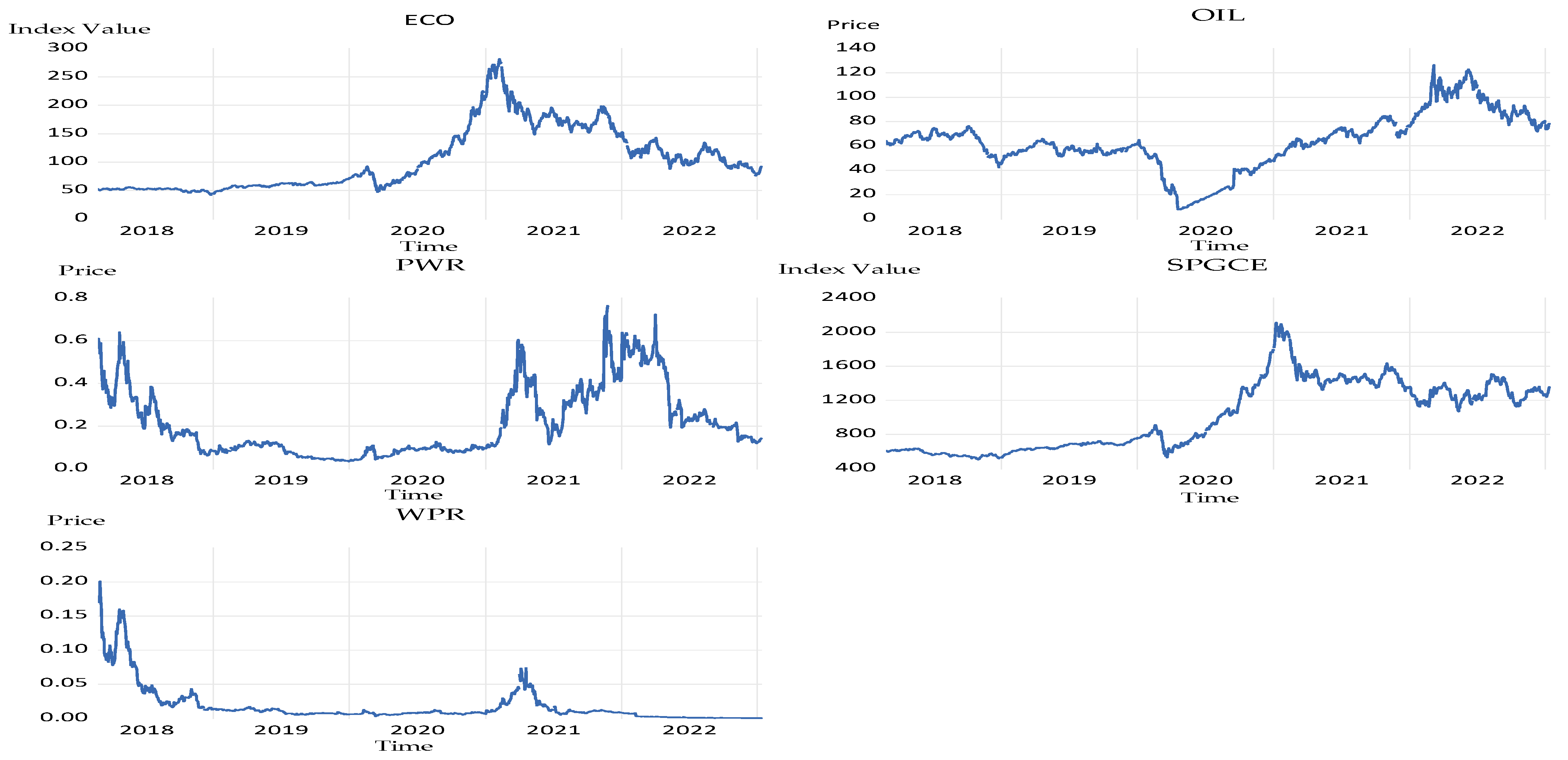
Figure 1 shows the daily trends of various assets related to clean energy and sustainability, as well as the price of oil. At the beginning of 2020, there was a sudden increase in the prices of these assets, likely due to the global pandemic causing a shift in focus towards sustainable solutions. However, two tokens specifically, Powerledger and Wepower, showed a delayed response and had significant price movements around 6–7 months later. This could be because green tokens are a newer type of asset and are still emerging. As for the price of oil, it slowly recovered from its lowest point during the pandemic and reached a new record high in 2022 at $126. The clean energy sectors also saw a surge in prices, reaching new peaks and then gradually declining. Interestingly, the green tokens had dramatic price movements in 2018 during the cryptocurrency crash and again in 2021 when the clean energy index reached its highest point.
The visual representations underscore the volatility inherent in these sectors and hint at the potential for cross-market influences. For instance, significant price movements in the OIL segment may correlate with or precipitate reactions in the ECO and SPGCE plots, suggesting a tangible connection between fossil fuel markets and clean energy stocks. Similarly, the behavior of digital tokens like PWR and WPR, which are predicated on the adoption and success of renewable energy, offers insights into the speculative and real-world value placed on green energy initiatives. Given the visually evident fluctuations and the potential interdependencies these plots reveal, a nuanced examination is warranted to unpack how developments in one sector influence others.
In the analysis, daily returns are quantified first by considering the closing price of an assets, denoted as p j , t , from which calculate the percentage logarithmic return, represented as R j , t . This is achieved by the formula:
R j , t = l n p j , t / p j , t 1 × 100
This method enables the precise measurement of day-to-day price movements, offering an in-depth view of the return dynamics that are central to understanding market behaviors and asset performance.
Subsequently, to assess the daily realized volatility, author utilize a strategy developed by L Christopher G Rogers and Satchell [61] and expanded upon by Leonard C G Rogers et al. [62]. This involves incorporating the open (o), high (h), low (l), and close (c) prices of an asset into the equation:
R V j , t = 100 × n × l n h t o t × l n h t c t + l n l t o t × l n ( l t c t )
where (h) signifies the asset’s daily highest price, (l) indicates the daily lowest price, (o) represents the opening price, and (c) the closing price. The term R V j , t reflects the realized volatility for that particular day, with (n) being the total number of trading days analyzed. This formula allows for an accurate calculation of each asset’s volatility over time, enabling a comprehensive analysis of how volatility and returns influence each other and propagate through financial markets.
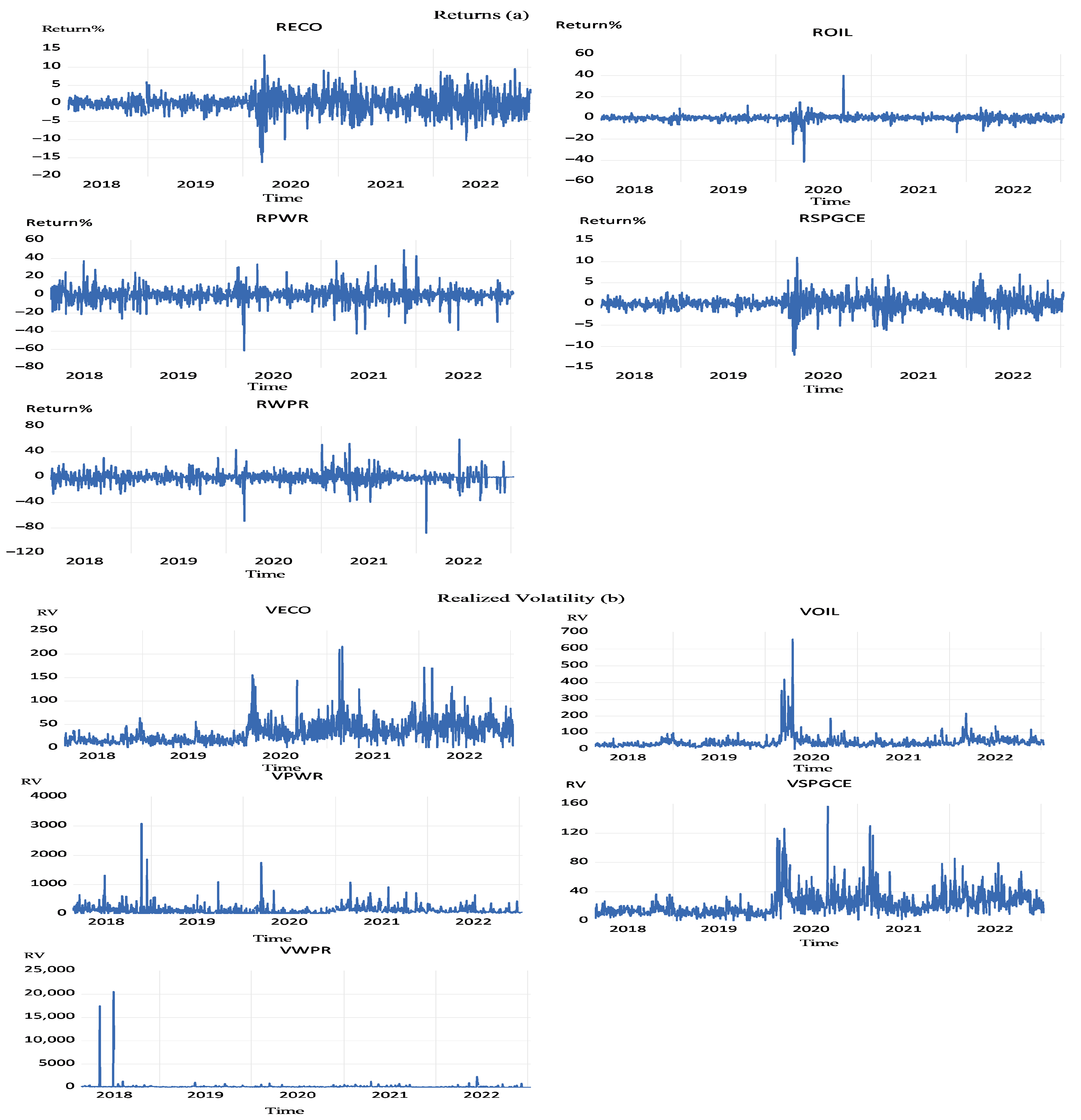
The two unique panels (a and b) in Figure 2’s comprehensive analysis provide a profound insight into the dynamics of realized volatility and returns among traditional and green energy assets, capturing the nuances of risk sensitivity and market behavior. The returns of Oil, Green Tokens, and Clean Energy indexes are compared in Panel (a), which also shows a significant difference in return between traditional energy investments and their green equivalents. Interestingly, conventional energy sources like oil exhibit high volatility, indicating their susceptibility to outside market influences like regulatory changes and geopolitical tensions. By comparison, investments in renewable energy, as reflected in clean energy indices, exhibit notably more stable patterns and less volatility, as illustrated in panel (b). This stability is consistent with growing investor confidence and a deliberate move toward sustainable energy solutions, which are supported by progressive technology and supportive legislative frameworks. This analysis’s dual aspects, which include volatility profiles and return performance, highlight the continuous paradigm shift in investing choices in favor of sustainability. This change is indicative of a deeper movement in the market that embraces risk mitigation techniques and environmental concerns in an effort to build resilience in the face of mounting uncertainty in the global energy sector. These kinds of insights are essential to comprehending how investment landscapes are changing, especially in relation to the growing convergence of environmental sustainability and financial markets.
In the preliminary examination of the statistical properties of returns (Table 1 Panel (a)) from various energy-related investments, the author uncovers distinct characteristics that warrant a dynamic analytical approach. Analysis of the mean returns reveals a spectrum from slightly positive to significantly negative values, indicating varied performance across these assets. Notably, the variance metrics of these returns highlight substantial volatility, particularly for investments in green tokens RPWR and RWPR. Crucially, the distributions of these returns exhibit significant departures from normality, as evidenced by measures of skewness, excess kurtosis, and the results of the Jonquière (JB) test. This is further demonstrated by the highly significant JB statistics across all series, underscoring the non-normal behavior of these investment returns.
In the analysis of the realized volatility (Table 1 Panel (b)), the dataset, encompassing realized volatility measures for VECO, VWPR, VSPGCE, VPWR, and VOIL, reveals a broad range of average volatilities, with significant variations observed among the green tokens VPWR and VWPR. Furthermore, the distributions of realized volatilities manifest significant skewness and excess kurtosis, indicating pronounced deviations from the normal distribution and a propensity for extreme volatility events. In addition, According to Elliott et al. [63], the Dickey–Fuller unit root test using generalized least squares shows that all returns and realized volatility series are significant, indicating that they are all stationary. This highlights the need for a more thorough and comprehensive approach to analyzing financial time series, one that goes beyond traditional linear methods. By incorporating both the time-varying nature of variables and the possibility of non-linear relationships, the TVP-VAR and QVAR models provide a more accurate representation of the complex and ever-evolving interconnectedness and volatility in financial markets. Together, these models can offer valuable insights into the behavior and risks of financial time series, making them crucial tools for both researchers and practitioners in the financial industry.

3.2. TVP-VAR Methodology

To analyze the dynamic interplay of renewable energy investments, we employ the Time-Varying Parameter Vector Autoregression (TVP-VAR) framework. Building on the work of Diebold and Yılmaz [20] this model allows us to explore the interconnectedness of assets from both static and dynamic perspectives. One significant advantage of the TVP-VAR model is its ability to eliminate the need for selecting a fixed-length sample window, thus preventing the omission of crucial information and parameter estimation errors. This model enables the computation of both static and time-rolling connectedness, providing valuable insights into the overall network and specific connections between pairs of assets.
The TVP-VAR model adapts the traditional Vector Autoregressive model to incorporate time-varying coefficients, thereby capturing the evolving dynamics among financial and energy markets. This flexibility is crucial for understanding how relationships between green tokens, clean energy indices, and oil prices fluctuate over time due to external shocks and market changes. We follow the methodology outlined by Attarzadeh and Balcilar [43] which leverages Bayesian shrinkage techniques for efficient estimation of high-dimensional systems without resorting to computationally intensive simulations. This approach allows for the derivation of dynamic connectedness indices and directional connectedness measures that are robust against the persistence issues commonly encountered in rolling window estimation.
Additionally, the TVP-VAR framework is particularly adept at handling both limited time series and low-frequency data, offering superior performance when accounting for heteroscedasticity compared to homoscedastic procedures. This makes the TVP-VAR model especially useful for examining the dynamic connectedness in diverse data conditions [64].
Let Z t = ( O I L t , P W R t , W R P t ,   S P G C t , E C O t ) with n = 5 be the definition of the n × 1 dimensional vector of variables.
The TVP-VAR model for order P can be represented in the following form:
Z t = θ t f t 1 + ĕ t ,                                                                                                   ĕ t n 0 , ω t
v e c θ t & = vec θ ω t 1 + η t                                               η t T 0 , Ϙ t
where   f t 1 = ( z t 1 , z t 2 , , z t P ) is an nP × 1 vector, θ t = ( θ 1 t , θ 2 t , , θ P t ) is an n × nP coefficient matrix with n × n coefficient sub-matrices θ i t , i = 1 , 2 , , P . ĕ t   and η t are n × 1 and nP × 1, respectively, normally distribute error vectors with time-varying variance-covariance matrices ω t and Ϙ t , which are n × n and nP × nP, respectively. For the TVP-VAR model, the vector moving average (VMA) can be obtained using the Wold representation theorem in Equation (4).
Z t = i = 1 p θ i t Z t i + ĕ t = j = 1   Ψ j t ĕ t j
where Ψ i t are linear functions of { θ 1 t , θ 2 t ,   , θ p t } . The core principle of the vector moving average (VMA) model with time-varying coefficients is the adaptability of its coefficients, permitting a more nuanced and dynamic depiction of temporal data. This adaptability enables the derivation of generalized impulse response functions (GIRF) and generalized forecast error variance decompositions (GFEVD). Both of these analytics frameworks offer insights into the evolving interrelations among the variables within the model by examining the repercussions of fluctuations or disturbances. The methodologies for executing GIRF and GFEVD analyses are extensively elaborated upon by Koop et al. [65] and Pesaran and Shin [66] marking their significance in the realm of time series analytics. Diebold and Yilmaz [67] describe the GFEVD as the proportion of the variance in variable i that can be attributed to innovations in variable j, φ i j , t h , at forecasting step h, and its normalized version, φ ~ i j , t h , can be calculated as:
Ϙ i j , t h = σ j j , t 1 t = 1 h 1   e i Ψ t ω t e j 2 t = 1 h 1   e i Ψ t ω t Ψ t e i ,                   Ϙ ~ i j , t h = Ϙ i j , t h j = 1 N   Ϙ i j , t h
The total connectedness index (TCI) serves as an indicator of the degree to which a set of variables are interdependent and reliant on each other. Its computation is predicated upon the utilization of generalized forecast error variance decompositions, which enable the quantification of the influence that each variable exerts on the return and volatility of a given variable in the sample. Symbolically, the TCI is delineated as follows:
T C t h = i , j = 1 , i j n   Ϙ ~ i j , t h i , j = 1 n   Ϙ ~ i j , t h × 100
The concept of spillover involves the average influence of movements in one market on other markets, disregarding any effects on the market itself due to lags. In this context, we are specifically interested in the spillover of variable i onto all other variables j, representing the overall directional connectedness of the market with others. In simpler terms, the spillover from market i to market j measures the typical impact of shocks in market i on market j, without considering the reverse influence of market j on itself. This analytical approach enables the assessment of the interconnectedness of financial markets and the identification of potential sources of systemic risk. Total directional connectedness to and from other markets can be expressed as follows:
T C i j , t h = j = 1 , i j n   Ϙ ~ i j , t h n × 100
T C i j , t h = j = 1 , i j n   Ϙ ~ j i , t h n × 100
Another aspect that can be assessed is the net directional connection, which can be obtained by subtracting Equation (8) from Equation (9).
T C i , t h = T C i j , t h T C i j , t h
The net pairwise directional connection (NPC), as computed in Equation (11), allows us to determine the extent of a bidirectional relationship between two variables. This approach enables the identification of whether one variable has an impact on the other or vice versa, thereby providing insights into the dynamic relationships among the variables in the system.
NPC i j h = Ϙ ~ j i t h Ϙ ~ i j t h × 100

3.3. QVAR Methodology

To perform the Quantile Vector Autoregressive (QVAR) analysis, we follow the methodology outlined by Ando et al. [21] and subsequently applied by Yousaf et al. [22]. This methodology has been successfully used in previous research to investigate spillover effects in financial markets. The QVAR approach leverages differential impacts across the distribution of returns and volatilities, highlighting how relationships vary under different market conditions. The QVAR model captures non-linear and asymmetric relationships between variables, which are often present in financial markets. This allows for a more nuanced understanding of how assets interact under various conditions, beyond what traditional linear models can provide. Additionally, the QVAR model allows for the examination of tail risks and extreme market conditions, which is critical for risk management and portfolio optimization. It provides insights into how assets behave during periods of extreme volatility or stress, which are not adequately captured by mean-based models. Furthermore, the QVAR model offers robustness across various market conditions, providing insights into how relationships between assets change in different market states, such as bullish, bearish, and neutral conditions. By employing the QVAR methodology, this study offers a comprehensive analysis of the dynamic interconnections and spillover effects in the renewable energy market.

3.4. Model Parameters and Stability Checks

Based on the results obtained from the Bayesian Information Criterion (BIC), a model order of p = 1 is determined for both returns and volatility. This indicates that the TVP-VAR and QVAR models incorporate one lag for both the returns and volatility variables. In our comprehensive analysis, the choice of using a VAR forgetting factor of 0.99 and an EWMA forgetting factor of the same value was meticulously validated through extensive stability checks. Our model exhibited lower Total Connectedness Index (TCI) scores compared to models with differing forgetting factors, indicating greater temporal stability and reduced error propagation over time. This suggests that our approach of emphasizing historical data consistency effectively informs the current model’s predictions. Furthermore, setting the EWMA forgetting factor at 0.99 corroborates the validity of this approach, as it similarly returned the lowest TCI values among alternatives. This underscores its effectiveness in maintaining data relevance amidst inherent market fluctuations.
Additionally, the Bayes prior size was set at 200 based on empirical validation. This configuration highlighted an optimal balance between model sensitivity and robustness. This prior size strengthens the model’s reliance on well-established historical trends, which is particularly crucial in the context of renewable energy markets known for their rapid evolution and response to technological and policy changes. This support from historical data ensures that our model remains grounded in well-substantiated information while remaining adaptable to new data inputs.

4. Empirical Results

4.1. Averaged Dynamic Connectedness

The spillover Table 2 reveals insightful dynamics concerning the interconnectedness and the directional spillover effects among these assets. One of the most salient findings from the analysis is the distinctive role played by green tokens, RPWR and RWPR, within the broader context of energy finance. These blockchain-based assets, designed to facilitate and promote renewable energy production and consumption through decentralized platforms, demonstrate a unique spillover dynamic, indicative of their nascent but growing influence on the energy sector. A significant outward spillover from Powerledger (RPWR) to Wepower (RWPR) highlights a potential sector-specific interaction that underscores the sensitivity of RWPR returns to developments or sentiments in RPWR. This specific linkage between RPWR and RWPR suggests a closely knit sub-sector within the renewable tokens market, potentially driven by shared technological, regulatory, and market mechanisms.
The self-spillover effects observed for RPWR and RWPR, with values of 74.46% and 78.19%, respectively, further emphasize their predominantly self-reliant return dynamics, albeit with RPWR exerting a notable influence on RWPR. However, in contrast to the relatively insular dynamics within the green token sector, clean energy indices such as RSPGCE and RECO exhibit a broader level of interaction with other assets, notably with each other, indicating a strong interdependency within the clean energy finance ecosystem. Such interdependencies are pivotal as they highlight the collective response of clean energy assets to overarching market trends, policy shifts, and technological advancements, which could have profound implications for investment strategies and risk management practices.
Significantly, the role of oil (ROIL) within this interconnected network warrants a nuanced interpretation. ROIL challenges conventional assumptions of oil’s market dominance by emerging as a net receiver of spillover effects, despite its longstanding prominence in the global energy market. This stance captures the intricate dynamics at work in the shift to a more sustainable and diversified energy portfolio, where clean energy assets and innovative financial instruments interact and impact conventional energy sources. The net receiver status of oil could be indicative of the broader economic and policy shifts towards renewable energy sources, potentially signifying oil’s evolving role in a changing energy market landscape.

4.2. Average Dynamic Connectedness for Realized Volatility

The analysis of the average dynamic connectedness for realized volatility reveals intriguing dynamics within the interconnected network of the energy sector, utilizing the TVP-VAR methodology. A prominent observation relates to the renewable tokens—Powerledger (VPWR) and Wepower (VWPR)—which emerge as net receivers of shocks in the volatility network. Despite being potentially more volatile due to their nascent status, they consistently act as net receivers, underscoring their vulnerability to the broader energy sector’s fluctuations. Interestingly, a notable shift occurs with Oil (VOIL), a conventional and dominant player within the energy sector. In terms of realized volatility, oil transitions from being a net receiver (return) to a significant net transmitter, boasting a transmission rate of 26.82%. This dramatic change suggests that Oil, as a traditional heavyweight, continues to wield substantial influence over the volatility of the energy market.
In a similar vein, the clean energy indices: VECO and VSPGCE, retain their roles as major transmitters of volatility. This consistent position reaffirms their significant standing within the energy sector and their extensive interactions with other assets. Viewed from a wider perspective, the interconnectedness within the energy market is also mirrored in the Total Connectedness Index (TCI) and the cumulative Total Connectedness Index (cTCI). The data verifies a complex web of interconnectedness, with both returns and realized volatility around 30%, which is crucial for understanding the overall dispersion of volatility across the energy market.

4.3. Dynamic Total Connectedness

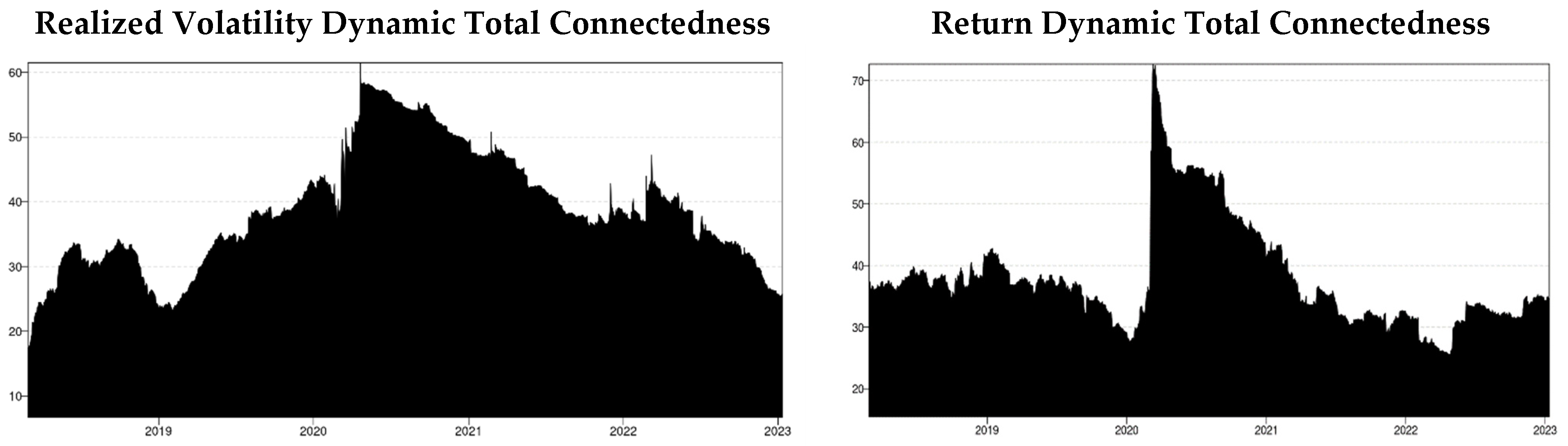
In the empirical exploration illustrated in Figure 3, we deployed the TVP-VAR methodology to dissect the nuanced dynamics of Return Dynamic Total Connectedness (RDTC) and Realized Volatility Dynamic Total Connectedness (RVDTC) amongst a diverse group of assets: green tokens, clean energy indexes, and oil prices. These insights unveil the intricate interplay and evolving relationships between the realms of renewable energy markets and the conventional energy market under the scrutiny of global economic turbulences and major geopolitical occurrences.
The quantitative assessment reveals that the RVDTC among the selected assets oscillates within the range of 25% to 60%, offering a compelling illustration of how interconnected the realized volatility of these assets are through various economic cycles. This fluctuating yet, substantial connectedness underscores the profound collective market responses to disruptions and evolving macroeconomic landscapes. In contrast, the RDTC unveils a broader range of interconnectedness, spanning from 25% to approximately 70%. This heightened sensitivity in the domain of return connectedness illustrates the assets’ vulnerability to global uncertainties, magnifying the market’s perception of risk during periods of tumult, such as the COVID-19 pandemic in 2020 and the onset of Russian conflicts in February 2022.
Comparative analysis between RDTC and RVDTC results improves comprehension of market dynamics. The RDTC dives into the world of market mood, reflecting acute reactions to crises, while the RVDTC highlights the gradual integration of markets and the mutual influence of economic and policy changes on asset volatility. The divergences in connectedness ranges that have been identified, particularly the wider range in volatility connectedness, indicate how distinct external events have an impact on market perceptions of risk as opposed to return dynamics. This comparative analysis highlights the ways in which external disturbances influence asset returns and, more importantly, intensify the difficulties associated with market volatility and risk perceptions.

4.4. Net Pairwise Directional Connectedness

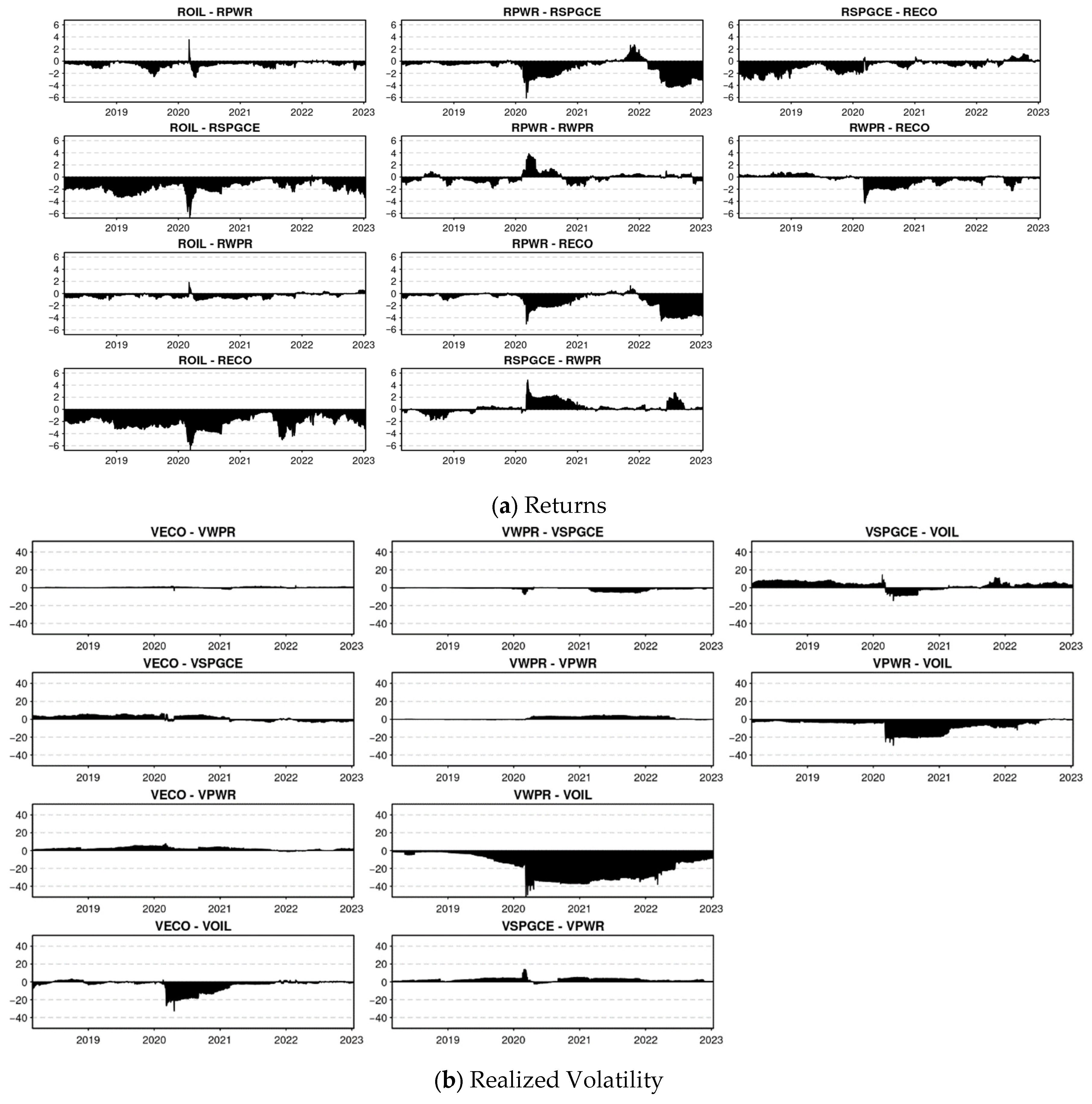
This investigation delves into the net pairwise directional connectedness (NPDC) to shed light on the intricate pathways through which returns and realized volatilities are dispersed among the five assets under examination. This analytical approach aids in distinguishing the distribution dynamics, allowing us to identify the primary sources and targets within the pairwise market interactions. The elucidative findings from this analysis are systematically illustrated in Figure 4, where Panel (a) highlights the channels of return spillovers and Panel (b) maps out the contours of volatility spillovers.
The analysis of net pairwise spillover effects within the energy markets landscape unravels a noteworthy pattern, particularly concerning green tokens. These tokens emerge as somewhat isolated entities within the broader market ecosystem, predominantly absorbing shocks from the clean energy stock sector. The advent of the coronavirus pandemic significantly altered their trajectory, positioning green tokens as recipients of both return and volatility shocks. This shift is indicative of a growing investor inclination towards these nascent assets amidst the global crisis, possibly viewing them as burgeoning investment frontiers.
Further complexities in market dynamics were observed during the escalation of the Russian conflict, throughout which green tokens consistently absorbed shocks emanating from the traditional energy sphere, specifically oil. In an intriguing twist, oil concurrently emerged as a net receptor of return shocks generated by the clean energy market, albeit continuing its role as a shock distributor in the sphere of realized volatility. This dynamic vividly illustrates the interconnected relationships among various energy assets during times of crisis.
Green tokens were first found to have a minimal association with more conventional asset classes, as evidenced by pre-pandemic investigations that showed their limited responsiveness to external market shocks. But the start of the epidemic caused a sharp decline in traditional energy values and a spike in market volatility, highlighting green tokens as competitive options in the financial markets. This renewed interest highlights a major redirection of investor attention toward green tokens, driven by the need for diversification in these uncertain times away from traditional energy assets.

4.5. Connectivity Dynamics Plot

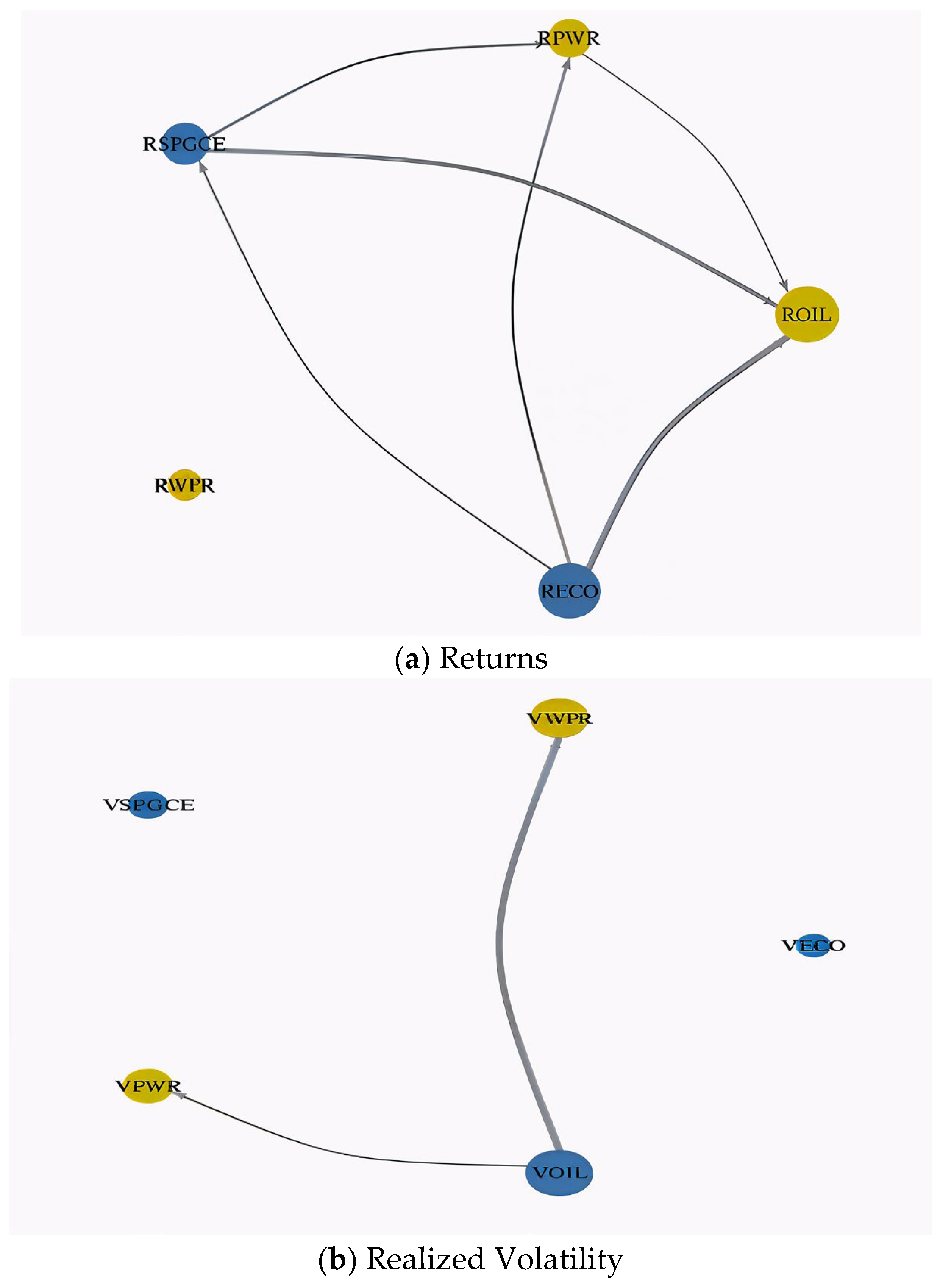
Figure 5 (network plot) illustrates the nuanced dynamics of shock transmission among the variables in both Returns and Realized Volatility. In panel (a), which focuses on returns, ECO emerges as a primary agent of shock distribution (blue node), exerting significant influence over SPGCE, PWR, and notably OIL, while showing no connectivity with WPR. This highlights ECO’s crucial role within the clean energy sector, positioning it as a key determinant in shaping market return trajectories. In Panel (b), which presents the realized-volatility network, crude oil acts as the principal transmitter of shocks, sending volatility to both renewable-energy tokens, which function as clear receivers. This configuration demonstrates that volatility originating in conventional-energy markets continues to influence the dynamics of emerging digital-energy assets. In contrast, the clean-energy indices VECO and VSPGCE appear visually disconnected from the network. Their apparent isolation reflects their diversified portfolio structures, where volatility tends to be dispersed internally among numerous constituent firms rather than transmitted externally. From an economic standpoint, this pattern implies that established clean-energy indices act as stabilizing anchors within the broader energy ecosystem, while blockchain-based renewable-energy tokens remain highly sensitive receivers of market shocks from oil. Overall, the realized-volatility network reveals distinct tiers of market maturity and integration: conventional energy serving as the volatility source, clean-energy indices as buffers, and renewable-energy tokens as recipients of systemic risk.
The dichotomy observed in the transmission dynamics between returns and realized volatility underscores a complex tapestry of asset interrelations and sensitivities. The domain of returns is highlighted by strategic economic evolutions and policy interventions, especially within nascent sectors such as renewable energy. Conversely, the volatility narrative is significantly shaped by broader energy paradigms, capturing the immediacy of market responses to global shifts and economic uncertainties.
Of particular note is the elucidation of the roles played by the green tokens, WPR and PWR, within this network structure. The isolation of WPR within the framework of return shocks portends a unique market dynamic that is distinct from the broader asset interactions. This observation suggests an inherent divergence in the market dynamics governing green tokens, potentially attributed to their specialized market niches and comparatively lower market capitalization. This aspect introduces a critical dimension to our analysis, elucidating the potential of green tokens in fostering portfolio diversification—an aspect underexplored in the prevailing financial literature.

4.6. Reliability of TVP-VAR Through TCI Analysis Across COVID-19 Periods

This study employs the TVP-VAR framework to analyze market dynamics across three phases that reflect distinct periods of global market behavior. To ensure conceptual neutrality and consistency, we adopt the labels Phase 1, Phase 2, and Phase 3. Phase 1 (27 February 2018–31 December 2019) represents the stable period before the emergence of COVID-19, when energy and financial markets followed regular patterns of volatility and growth. Phase 2 (2 January 2020–31 December 2021) corresponds to the period of severe global disruption that began after COVID-19 was declared a Public Health Emergency of International Concern in January 2020. This phase captures the sharp decline in energy demand, extreme market volatility, and extensive fiscal and monetary interventions undertaken worldwide. Phase 3 (3 January 2022–12 January 2023) reflects the subsequent period of global reopening and market normalization, when vaccination coverage surpassed half of the world’s population and most economic restrictions were lifted, as documented by international public-health data sources.
Throughout these periods, the TCI for returns escalated from a pre-pandemic level of 29.62% to 34.83% during the pandemic, suggesting increased market interconnectedness amidst heightened systemic stress. It subsequently decreased to 27.11% in the post-pandemic phase as conditions began to stabilize. This pattern affirms that the TVP-VAR model effectively tracks the progression of market connectedness, showcasing its utility in identifying risk concentrations and dependencies during significant market turbulence.
Moreover, realized volatilities demonstrated more drastic changes, with TCI jumping from 16.16% pre-pandemic to 34.39% during the pandemic period, before declining to 22.30% post-pandemic. These substantial reactions emphasize the TVP-VAR model’s capability to handle acute shifts in market conditions, providing a robust demonstration of its effectiveness in modeling volatility across different levels of market stress.
Integrating these results into a broader methodological context, and complementing them with comparisons between QVAR and the TVP-VAR models, remarkably bolsters the credibility of the TVP-VAR outcomes. This approach not only fortifies the reliability of the findings but also underscores the additional insights provided by QVAR. By comparing these two models, it becomes evident that TVP-VAR maintains robust performance, while QVAR offers supplementary information that enhances our understanding of market dynamics under varying conditions. Such comparative analysis highlights the model’s role as an indispensable tool for dynamic economic analysis. The distinct TCI metrics across the various phases of the COVID-19 pandemic vividly showcase the TVP-VAR model’s adaptive and predictive capabilities, underlining its essential function in forecasting and managing market behaviors. This rigorous analytical approach serves as a compelling endorsement of the TVP-VAR’s robustness, thus broadening its practical applications for policymakers and financial analysts who are tasked with navigating complex and evolving markets.

4.7. Comparative Analysis of Total Spillover Effects: QVAR vs. TVP-VAR

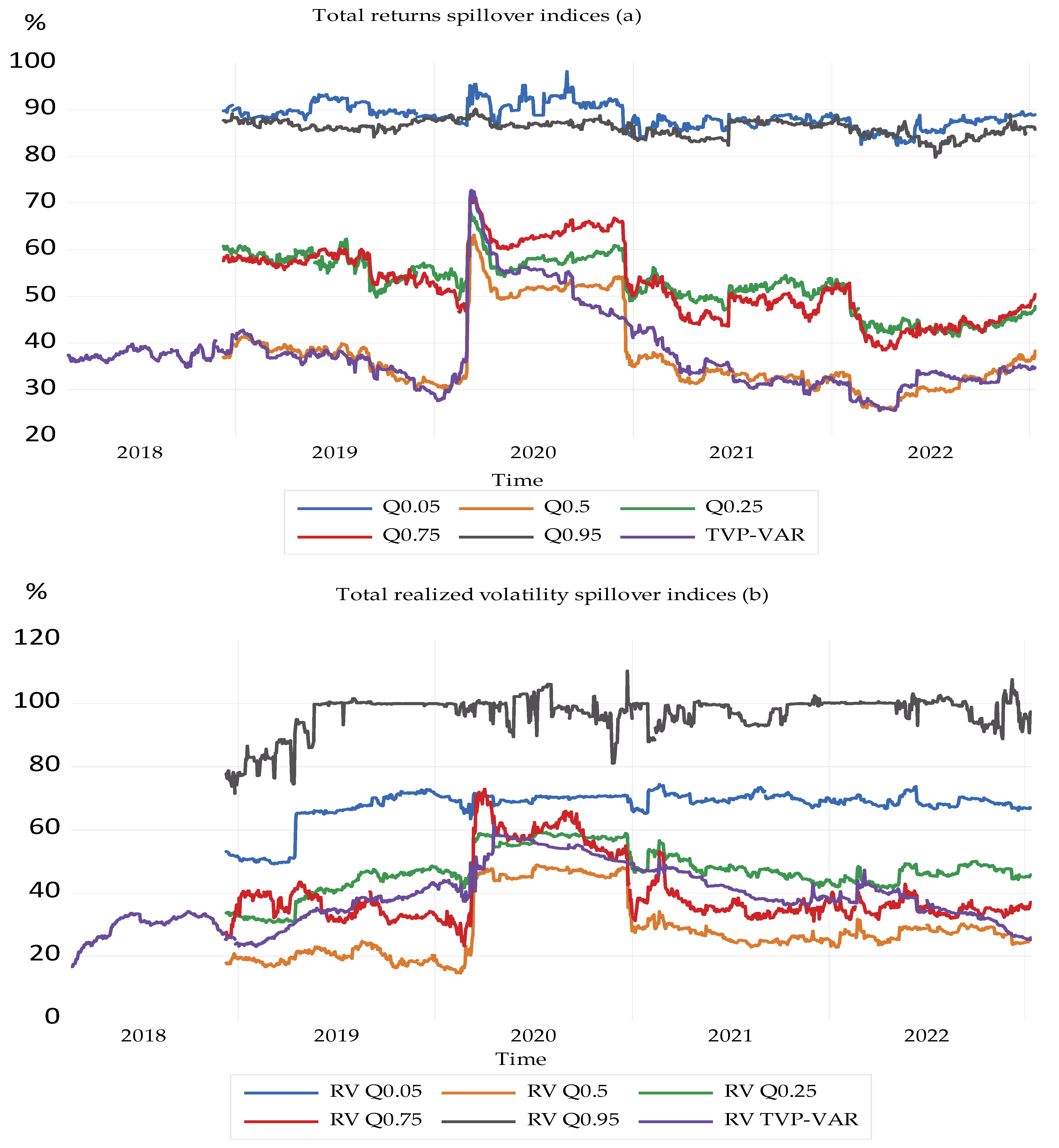
The QVAR model, introduced by Ando et al. [21], is a powerful tool for analyzing the behavior of asset prices across various stages of volatility and market sentiments. As demonstrated in Figure 6a, the returns of green tokens, clean energy indexes, and oil prices exhibit varying patterns at different quantile and TVP-VAR approaches. This highlights the need for a methodology that can capture the non-linear and time-varying relationships between these assets. Moreover, Figure 6b illustrates how realized volatility fluctuates with varying market sentiment levels, underscoring the significance of a flexible and dynamic strategy. Because QVAR can capture both the unique patterns of volatility and the heterogeneity of market conditions, this model performs exceptionally well in these kinds of situations and makes it possible to evaluate the interactions between oil prices, clean energy indices, and green tokens more precisely.
In the context of returns spillover indices, the QVAR model uncovers a distinct pattern where both the higher (Q0.95) and lower (Q0.05) quantiles significantly deviate from the mid-quantile (Q0.5) spillovers as well as TVP-VAR approach. This disparity is fundamentally attributed to the QVAR model’s sensitivity in detecting the extremities of market behavior that traditional and even some advanced methodologies like TVP-VAR may overlook. Specifically, in periods of market downturns, investors’ risk aversion typically escalates, leading to a pronounced spillover in the lower quantile as market participants move towards safer assets or liquidate positions in anticipation of further declines. Conversely, during bullish market conditions, the optimism and increased speculative activity contribute to significant spillovers in the higher quantile. These tail reactions are more profound and variable, reflective of investor sentiment and market speculation, which QVAR adeptly captures but may appear subdued in the TVP-VAR analysis due to its more generalized temporal view.
Regarding realized volatility, the observation that only the higher quantile significantly diverges from the others within the sample period further illuminates the asymmetrical nature of market responses to extreme conditions. This phenomenon is particularly concentrated in periods of high market uncertainty or exogenous shocks, where volatility spikes are more pronounced due to sudden increases in trading volume, driven by speculative trading or rapid shifts in investor sentiment. Here, the QVAR model’s capacity to pinpoint these divergences in the higher quantile showcases its acute sensitivity to the dynamics of market extremities—illuminating the disproportionate impact of sharp, pessimistic shifts in market conditions or sudden speculative bubbles.
This effect may be less pronounced in lower quantiles for realized volatility, as downturns or negative market sentiments often lead to a gradual increase in volatility rather than the sharp spikes witnessed in extreme bullish conditions. Thus, while TVP-VAR provides a broad temporal perspective, capturing the evolving nature of spillover effects over time, it is the acute sensitivity of the QVAR model to the nuances and extremes of market reactions that offer unparalleled insights—especially in identifying the disparate impacts across quantiles for both returns and realized volatility. These insights are pivotal not only for understanding the underlying dynamics of market behavior but also for crafting nuanced risk management and investment strategies, tailored to navigate the complexities of financial markets under various conditions.

5. Discussion

Based on the findings, this study provides new insights into the dynamic interplay between renewable energy tokens, conventional renewable energy assets, and fossil fuel markets. This study, described as pioneering in its kind, uncovers new dynamics between emerging digital assets related to renewable energy and traditional financial markets, highlighting the increasingly complex relationships shaped by technological advancements and shifting investment paradigms towards sustainability. Previous literature, such as the works of Attarzadeh [42], Caporale [44], Zhang [58] and Ding [59] has explored the interplay between renewable energy investments and various asset types. However, this study extends understanding by weaving in novel assets like Powerledger and Wepower into the analysis, demonstrating how these digital tokens interact with conventional energy markets in both normal and extreme market conditions. Our results confirm that renewable energy tokens are not independent financial instruments but are embedded in broader energy and financial markets, making them subject to the same macroeconomic and geopolitical factors that influence traditional assets.
The study provides empirical evidence highlighting the volatility and performance dynamics of these digital tokens compared to traditional clean energy indices and crude oil prices. The analysis indicates that renewable energy tokens are emerging as robust financial instruments that not only enhance traditional investment portfolios but also exhibit resilience during market volatilities, such as those experienced during the global COVID-19 pandemic. A notable trend identified in the study is the significant impact of the COVID-19 pandemic on the pricing and volatility of these assets, leading to a surge in clean energy investments and renewable energy tokens. This trend underscores their emerging market status and the influence of global economic disruptions. This research may hold significant implications for both investors and policymakers. Contrary to the conventional belief that the price of crude oil is the principal driver of energy markets as identified by Yahya et al. [68] and Yousaf et al. [22], this study suggests that the behavior of clean energy stock prices mirrors such influences under normal market conditions. This observation implies that the price dynamics of clean energy could have predictive power for renewable digital assets when the market is stable, thus aligning with previous investigations into conventional renewable energy assets as noted by [69].
In the intricate tapestry of financial markets, renewable energy tokens have emerged as principal net receivers both in terms of returns and realized volatility, underscoring their unique and evolving role within the energy and financial sectors. This distinctive positioning can be attributed to their nascent nature and the growing investor interest driven by the global shift towards sustainability. As net receivers, these tokens act as barometers for the market’s response to innovations in renewable energy financing and technology adoption. The heightened sensitivity of these tokens to market movements reflects their potential for high returns but also signals their susceptibility to pronounced volatility during market fluctuations. The findings further indicate that under extreme quantile conditions, the interconnectedness between renewable energy tokens and conventional renewable energy stocks significantly increases, suggesting that traditional clean energy markets serve as leading indicators for digital energy assets. This dual characteristic renders renewable energy tokens a compelling study for investors and analysts alike, offering deeper insights into risk-reward dynamics in emerging asset classes.
Additionally, their role as net receivers highlights their dependence on broader market sentiments and economic trends, thereby providing a critical linkage in understanding how technological shifts and policy changes resonate through financial markets. As such, renewable energy tokens not only represent a frontier in green investment but also serve as crucial indicators of market attitudes towards renewable energy ventures, influencing and informing investment strategies aimed at harnessing the economic potential of sustainability transitions. However, their rapid growth and increased integration with traditional energy markets underscore the urgent need for comprehensive regulatory frameworks to mitigate systemic risks and enhance investor confidence. Given the heightened volatility of digital energy assets, policymakers must develop risk assessment models that incorporate spillover effects from fossil fuel and clean energy stocks to ensure a stable transition to digitalized renewable investments.
The results reveal a significant disparity in volatility between conventional energy investments and their green counterparts. Traditional energy sources like oil exhibit susceptibility to external market forces, whereas renewable energy investments demonstrate steadier trends and lower volatility. This suggests a paradigm shift in investment preferences towards more sustainable options. The role of supportive regulatory environments and technological advancements is crucial in facilitating this transition. By integrating our findings with existing literature, it becomes evident that global financial markets are increasingly valuing sustainability and renewable energy. This study’s unique focus on the integration of digital tokens within the renewable energy investment landscape provides deeper insights into the financial opportunities and challenges at the intersection of sustainability, technology, and investment.

6. Conclusions and Policy Implications

This study provides new evidence on the dynamic interconnections between renewable-energy tokens, clean-energy indices, and fossil-fuel markets by applying both TVP-VAR and QVAR models to return and realized-volatility data from February 2018 to January 2023. The dual-framework approach captures how spillovers evolve under different market conditions and across distributional extremes, offering a richer understanding of how digital and traditional energy assets interact.
The empirical findings reveal several important insights. First, renewable-energy tokens—particularly PWR and WPR—behave predominantly as net receivers of shocks, absorbing the volatility transmitted from oil and clean-energy markets rather than generating it. Their limited market capitalization and liquidity explain this sensitivity and underline the still-developing nature of digital-energy assets. Second, clean-energy indices such as VECO and VSPGCE act as stabilizing transmitters: their diversified composition allows them to distribute shocks within the renewable-energy sector while cushioning contagion to other markets. Third, crude oil remains the dominant transmitter of both return and volatility spillovers, confirming the continued systemic influence of conventional energy on emerging sustainable-finance instruments.
Taken together, these results demonstrate that renewable-energy tokens occupy a transitional position in the global energy-investment network—being linked to, yet not fully integrated with, traditional energy markets. Their behavior reflects both opportunity and vulnerability: they provide potential diversification benefits during market stress but remain highly responsive to external shocks.
The findings also have clear policy and practical implications. For investors, renewable-energy tokens may enhance portfolio diversification but should be managed within a broader risk framework acknowledging their dependence on conventional-energy volatility. For regulators, the results highlight the need to strengthen transparency, trading standards, and market-liquidity mechanisms in digital-energy assets to prevent localized shocks from amplifying systemic risk. For policymakers, the evidence suggests that supporting blockchain-based financing mechanisms could complement clean-energy transitions if accompanied by appropriate regulatory safeguards and technological innovation incentives.
Overall, this study enriches the growing literature on sustainable-finance digitalization by showing that renewable-energy tokens act as early indicators of sentiment and volatility spillovers between the fossil-fuel and clean-energy sectors. Future research could extend the analysis by incorporating additional tokens, macroeconomic drivers, or alternative econometric frameworks to further illuminate how digital finance contributes to the resilience and integration of global renewable-energy markets.

Funding

This research received no external funding.

Institutional Review Board Statement

Not applicable.

Informed Consent Statement

Not applicable.

Data Availability Statement

Data will be made available on request.

Conflicts of Interest

The author declares that there are no known competing financial interests or personal relationships that could have appeared to influence the work reported in this paper.

Glossary

Bayesian Information Criterion (BIC) A criterion is used for model selection among a finite set of models. The model with the lowest BIC is considered the best fit. Bayes Prior A prior distribution in Bayesian statistics that represents the initial beliefs before considering new data. Dynamic Connectedness A measure of how the interconnectedness between different financial assets changes over time, capturing the evolving nature of their relationships. Forecast Window The timeframe over which a model predicts future values. Net Pairwise Directional Connectedness (NPDC) A measure that shows the directional connectedness between two specific variables, indicating the extent to which one variable affects the other. Quantile Vector Autoregression (QVAR) A model that examines how relationships between financial variables behave under different market conditions, such as during market highs or lows. Realized Volatility (RV) A measure of the actual volatility of a financial instrument over a specific period. Realized Volatility Dynamic Total Connectedness (RVDTC) A measure of the total connectedness in realized volatility across different assets. Return Dynamic Total Connectedness (RDTC) A measure of the total connectedness in returns across different assets, showing how interconnected the returns are. Total Connectedness Index (TCI) A metric used to quantify the overall interconnectedness in a system, often used in the context of financial markets to measure the degree of spillovers. Time-Varying Parameter Vector Autoregression (TVP-VAR) A model that analyzes how relationships between financial variables change over time by using time-varying coefficients.

References

  1. Holechek, J.L.; Geli, H.M.E.; Sawalhah, M.N.; Valdez, R. A global assessment: Can renewable energy replace fossil fuels by 2050? Sustainability 2022, 14, 4792. [Google Scholar] [CrossRef]
  2. Abakah, E.J.A.; Chowdhury, M.A.F.; Abdullah, M.; Hammoudeh, S. Energy tokens and green energy markets under crisis periods: A quantile downside tail risk dependence analysis. Int. Rev. Econ. Financ. 2024, 96, 103636. [Google Scholar] [CrossRef]
  3. Kumar, P.; Singh, O. Fuel Cell and Hydrogen-based Hybrid Energy Conversion Technologies. In Prospects of Hydrogen Fueled Power Generation; River Publishers: Aalborg, Denmark, 2024; pp. 207–221. [Google Scholar]
  4. Kumar, P.; Date, A.; Shabani, B. Towards self-water-sufficient renewable hydrogen power supply systems by utilising electrolyser and fuel cell waste heat. Int. J. Hydrogen Energy 2025, 137, 380–396. [Google Scholar] [CrossRef]
  5. Wu, Y.; Wu, Y.; Guerrero, J.M.; Vasquez, J.C. Digitalization and decentralization driving transactive energy Internet: Key technologies and infrastructures. Int. J. Electr. Power Energy Syst. 2021, 126, 106593. [Google Scholar] [CrossRef]
  6. Dorri, A.; Luo, F.; Kanhere, S.S.; Jurdak, R.; Dong, Z.Y. SPB: A secure private blockchain-based solution for distributed energy trading. IEEE Commun. Mag. 2019, 57, 120–126. [Google Scholar] [CrossRef]
  7. Wongthongtham, P.; Marrable, D.; Abu-Salih, B.; Liu, X.; Morrison, G. Blockchain-enabled Peer-to-Peer energy trading. Comput. Electr. Eng. 2021, 94, 107299. [Google Scholar] [CrossRef]
  8. Henriques, I.; Sadorsky, P. Do clean energy stocks diversify the risk of FinTech stocks? Connectedness and portfolio implications. Glob. Financ. J. 2024, 62, 101019. [Google Scholar] [CrossRef]
  9. Nautiyal, N.; Alrababa’a, A.R.; Rehman, M.U.; Vo, X.V.; Al-Faryan, M.A.S. Portfolio risk and return between energy and non-energy stocks. Heliyon 2024, 10, e31199. [Google Scholar] [CrossRef]
  10. Dias, R.; Galvão, R.; Cruz, S.; Irfan, M.; Alexandre, P.; Gonçalves, S.; Teixeira, N.; Palma, C.; Almeida, L. Testing the diversifying asset hypothesis between clean energy stock indices and oil price. Int. J. Energy Econ. Policy 2024, 14, 295–302. [Google Scholar] [CrossRef]
  11. Ben Ameur, H.; Ftiti, Z.; Louhichi, W.; Yousfi, M. Do green investments improve portfolio diversification? Evidence from mean conditional value-at-risk optimization. Int. Rev. Financ. Anal. 2024, 94, 103255. [Google Scholar] [CrossRef]
  12. Wu, R.; Li, B.; Qin, Z. Spillovers and dependency between green finance and traditional energy markets under different market conditions. Energy Policy 2024, 192, 114263. [Google Scholar] [CrossRef]
  13. Ren, X.; Xiao, Y.; Duan, K.; Urquhart, A. Spillover effects between fossil energy and green markets: Evidence from informational inefficiency. Energy Econ. 2024, 131, 107317. [Google Scholar] [CrossRef]
  14. Cevik, E.; I Cevik, E.; Dibooglu, S.; Cergibozan, R.; Bugan, M.F.; Destek, M.A. Connectedness and risk spillovers between crude oil and clean energy stock markets. Energy Environ. 2024, 35, 3319–3339. [Google Scholar] [CrossRef]
  15. Zhao, H.; Yu, M.; Meng, J.; Jiang, Y. Examining the Spillover Effects of Renewable Energy Policies on China’s Traditional Energy Industries and Stock Markets. Energies 2024, 17, 2563. [Google Scholar] [CrossRef]
  16. Ozkan, O.; Abosedra, S.; Sharif, A.; Alola, A.A. Dynamic volatility among fossil energy, clean energy and major assets: Evidence from the novel DCC-GARCH. Econ. Change Restruct. 2024, 57, 98. [Google Scholar] [CrossRef]
  17. Mhadhbi, M. The interconnected carbon, fossil fuels, and clean energy markets: Exploring Europe and China’s perspectives on climate change. Financ. Res. Lett. 2024, 62, 105185. [Google Scholar] [CrossRef]
  18. Ahmadian-Yazdi, F.; Roudari, S.; Omidi, V.; Mensi, W.; Al-Yahyaee, K.H. Contagion effect between fuel fossil energies and agricultural commodity markets and portfolio management implications. Int. Rev. Econ. Financ. 2024, 95, 103492. [Google Scholar] [CrossRef]
  19. Goodell, J.W.; Yadav, M.P.; Ruan, J.; Abedin, M.Z.; Malhotra, N. Traditional assets, digital assets and renewable energy: Investigating connectedness during COVID-19 and the Russia-Ukraine war. Financ. Res. Lett. 2023, 58, 104323. [Google Scholar]
  20. Diebold, F.X.; Yılmaz, K. On the network topology of variance decompositions: Measuring the connectedness of financial firms. J. Econom. 2014, 182, 119–134. [Google Scholar]
  21. Ando, T.; Greenwood-Nimmo, M.; Shin, Y. Quantile connectedness: Modeling tail behavior in the topology of financial networks. Manag. Sci. 2022, 68, 2401–2431. [Google Scholar] [CrossRef]
  22. Yousaf, I.; Nekhili, R.; Umar, M. Extreme connectedness between renewable energy tokens and fossil fuel markets. Energy Econ. 2022, 114, 106305. [Google Scholar] [CrossRef]
  23. Ustaoglu, E. Extreme return connectedness between renewable energy tokens and renewable energy stock markets: Evidence from a quantile-based analysis. Environ. Sci. Pollut. Res. 2024, 31, 5086–5099. [Google Scholar] [CrossRef]
  24. Hoang, A.T.; Foley, A.M.; Nižetić, S.; Huang, Z.; Ong, H.C.; Ölçer, A.I.; Nguyen, X.P. Energy-related approach for reduction of CO2 emissions: A critical strategy on the port-to-ship pathway. J. Clean. Prod. 2022, 355, 131772. [Google Scholar] [CrossRef]
  25. Mujtaba, A.; Jena, P.K.; Bekun, F.V.; Sahu, P.K. Symmetric and asymmetric impact of economic growth, capital formation, renewable and non-renewable energy consumption on environment in OECD countries. Renew. Sustain. Energy Rev. 2022, 160, 112300. [Google Scholar] [CrossRef]
  26. Zhang, D.; Mohsin, M.; Rasheed, A.K.; Chang, Y.; Taghizadeh-Hesary, F. Public spending and green economic growth in BRI region: Mediating role of green finance. Energy Policy 2021, 153, 112256. [Google Scholar] [CrossRef]
  27. Griffiths, S. Renewable energy policy trends and recommendations for GCC countries. Energy Transit. 2017, 1, 3. [Google Scholar] [CrossRef]
  28. Naeem, M.A.; Yousaf, I.; Karim, S.; Tiwari, A.K.; Farid, S. Comparing asymmetric price efficiency in regional ESG markets before and during COVID-19. Econ. Model. 2023, 118, 106095. [Google Scholar] [CrossRef]
  29. Oosthuizen, M.A.; Inglesi-Lotz, R. The impact of policy priority flexibility on the speed of renewable energy adoption. Renew. Energy 2022, 194, 426–438. [Google Scholar] [CrossRef]
  30. Gozgor, G.; Mahalik, M.K.; Demir, E.; Padhan, H. The impact of economic globalization on renewable energy in the OECD countries. Energy Policy 2020, 139, 111365. [Google Scholar] [CrossRef]
  31. Hassan, Q.; Viktor, P.; Al-Musawi, T.J.; Ali, B.M.; Algburi, S.; Alzoubi, H.M.; Al-Jiboory, A.K.; Sameen, A.Z.; Salman, H.M.; Jaszczur, M. The renewable energy role in the global energy Transformations. Renew. Energy Focus 2024, 48, 100545. [Google Scholar] [CrossRef]
  32. Zadeh, O.R.; Romagnoli, S. Financing sustainable energy transition with algorithmic energy tokens. Energy Econ. 2024, 132, 107420. [Google Scholar] [CrossRef]
  33. Ali, S.; Umar, M.; Naveed, M.; Shan, S. Assessing the impact of renewable energy tokens on BRICS stock markets: A new diversification approach. Energy Econ. 2024, 134, 107523. [Google Scholar] [CrossRef]
  34. Naifar, N. Interactions between renewable energy tokens, oil shocks, and clean energy investments: Do COP26 policies matter? Energy Policy 2025, 198, 114497. [Google Scholar] [CrossRef]
  35. Wang, X.; Liu, J.; Xie, Q. Quantile frequency connectedness between energy tokens, crypto market, and renewable energy stock markets. Heliyon 2024, 10, e25068. [Google Scholar] [CrossRef] [PubMed]
  36. Marques, N.L.; Gomes, L.L.; Brandão, L.E. A blockchain-based model for token renewable energy certificate offers. Rev. Contab. Finanças 2023, 34, e1582. [Google Scholar] [CrossRef]
  37. Marin, O.; Cioara, T.; Anghel, I. Blockchain solution for buildings’ multi-energy flexibility trading using multi-token standards. Future Internet 2023, 15, 177. [Google Scholar] [CrossRef]
  38. Ahmad, W.; Rais, S. Time-varying spillover and the portfolio diversification implications of clean energy equity with commodities and financial assets. Emerg. Mark. Financ. Trade 2018, 54, 1837–1855. [Google Scholar] [CrossRef]
  39. Kocaarslan, B.; Soytas, U. Dynamic correlations between oil prices and the stock prices of clean energy and technology firms: The role of reserve currency (US dollar). Energy Econ. 2019, 84, 104502. [Google Scholar] [CrossRef]
  40. Liu, N.; Liu, C.; Da, B.; Zhang, T.; Guan, F. Dependence and risk spillovers between green bonds and clean energy markets. J. Clean. Prod. 2021, 279, 123595. [Google Scholar] [CrossRef]
  41. Nguyen, T.T.H.; Naeem, M.A.; Balli, F.; Balli, H.O.; Vo, X.V. Time-frequency comovement among green bonds, stocks, commodities, clean energy, and conventional bonds. Financ. Res. Lett. 2021, 40, 101739. [Google Scholar] [CrossRef]
  42. Attarzadeh, A.; Balcilar, M. On the Dynamic Connectedness of the Stock, Oil, Clean Energy, and Technology Markets. Energies 2022, 15, 1893. [Google Scholar] [CrossRef]
  43. Attarzadeh, A.; Balcilar, M. On the dynamic return and volatility connectedness of cryptocurrency, crude oil, clean energy, and stock markets: A time-varying analysis. Environ. Sci. Pollut. Res. 2022, 29, 65185–65196. [Google Scholar] [CrossRef] [PubMed]
  44. Caporale, G.M.; Spagnolo, N.; Almajali, A. Connectedness between fossil and renewable energy stock indices: The impact of the COP policies. Econ. Model. 2023, 123, 106273. [Google Scholar] [CrossRef]
  45. Naeem, M.A.; Husain, A.; Bossman, A.; Karim, S. Assessing the linkage of energy cryptocurrency with clean and dirty energy markets. Energy Econ. 2024, 130, 107279. [Google Scholar] [CrossRef]
  46. Pham, L.; Huynh, T.L.D.; Hanif, W. Time-varying asymmetric spillovers among cryptocurrency, green and fossil-fuel investments. Glob. Financ. J. 2023, 58, 100891. [Google Scholar] [CrossRef]
  47. Li, H.; Li, Q.; Huang, X.; Guo, L. Do green bonds and economic policy uncertainty matter for carbon price? New insights from a TVP-VAR framework. Int. Rev. Financ. Anal. 2023, 86, 102502. [Google Scholar] [CrossRef]
  48. Li, T.; Umar, M.; Mirza, N.; Yue, X.-G. Green financing and resources utilization: A story of N-11 economies in the climate change era. Econ. Anal. Policy 2023, 78, 1174–1184. [Google Scholar] [CrossRef]
  49. Li, Z.; Meng, Q. Time and frequency connectedness and portfolio diversification between cryptocurrencies and renewable energy stock markets during COVID-19. N. Am. J. Econ. Financ. 2022, 59, 101565. [Google Scholar] [CrossRef]
  50. Liu, W.-J.; Chiu, W.-Y.; Hua, W. Blockchain-enabled renewable energy certificate trading: A secure and privacy-preserving approach. Energy 2024, 290, 130110. [Google Scholar] [CrossRef]
  51. Ren, B.; Lucey, B. Do clean and dirty cryptocurrency markets herd differently? Financ. Res. Lett. 2022, 47, 102795. [Google Scholar] [CrossRef]
  52. Wang, X.; Fang, F.; Ma, S.; Xiang, L.; Xiao, Z. Dynamic volatility spillover among cryptocurrencies and energy markets: An empirical analysis based on a multilevel complex network. N. Am. J. Econ. Financ. 2024, 69, 102035. [Google Scholar] [CrossRef]
  53. Agrawal, A. Asymmetric link between energy market and crypto market. Int. J. Financ. Eng. 2024, 11, 2350038. [Google Scholar] [CrossRef]
  54. Ozcelebi, O.; El Khoury, R.; Yoon, S.-M. Interplay between renewable energy and fossil fuel markets: Fresh evidence from quantile-on-quantile and wavelet quantile approaches. Energy Econ. 2024, 140, 108012. [Google Scholar] [CrossRef]
  55. Mensi, W.; Rehman, M.U.; Vo, X.V. Risk spillovers and diversification between oil and non-ferrous metals during bear and bull market states. Resour. Policy 2021, 72, 102132. [Google Scholar] [CrossRef]
  56. Mensi, W.; Vo, X.V.; Kang, S.H. Multiscale spillovers, connectedness, and portfolio management among precious and industrial metals, energy, agriculture, and livestock futures. Resour. Policy 2021, 74, 102375. [Google Scholar] [CrossRef]
  57. Ren, B.; Lucey, B. A clean, green haven?—Examining the relationship between clean energy, clean and dirty cryptocurrencies. Energy Econ. 2022, 109, 105951. [Google Scholar] [CrossRef]
  58. Zhang, H.; Zhang, Y.; Gao, W.; Li, Y. Extreme quantile spillovers and drivers among clean energy, electricity and energy metals markets. Int. Rev. Financ. Anal. 2023, 86, 102474. [Google Scholar] [CrossRef]
  59. Ding, Q.; Huang, J.; Zhang, H. Time-frequency spillovers among carbon, fossil energy and clean energy markets: The effects of attention to climate change. Int. Rev. Financ. Anal. 2022, 83, 102222. [Google Scholar] [CrossRef]
  60. Fusion Media. Investing.com Market Data Portal. 2023. Available online: https://www.investing.com (accessed on 1 May 2023).
  61. Rogers, L.C.G.; Satchell, S.E. Estimating variance from high, low and closing prices. Ann. Appl. Probab. 1991, 1, 504–512. [Google Scholar] [CrossRef]
  62. Rogers, L.C.G.; Satchell, S.E.; Yoon, Y. Estimating the volatility of stock prices: A comparison of methods that use high and low prices. Appl. Financ. Econ. 1994, 4, 241–247. [Google Scholar]
  63. Elliott, G.; Rothenberg, T.J.; Stock, J.H. Efficient Tests for an Autoregressive Unit Root; National Bureau of Economic Research: Cambridge, MA, USA, 1992. [Google Scholar]
  64. Koop, G.; Korobilis, D. A new index of financial conditions. Eur. Econ. Rev. 2014, 71, 101–116. [Google Scholar] [CrossRef]
  65. Koop, G.; Pesaran, M.H.; Potter, S.M. Impulse response analysis in nonlinear multivariate models. J. Econom. 1996, 74, 119–147. [Google Scholar] [CrossRef]
  66. Pesaran, H.H.; Shin, Y. Generalized impulse response analysis in linear multivariate models. Econ. Lett. 1998, 58, 17–29. [Google Scholar] [CrossRef]
  67. Diebold, F.X.; Yilmaz, K. Better to give than to receive: Predictive directional measurement of volatility spillovers. Int. J. Forecast. 2012, 28, 57–66. [Google Scholar] [CrossRef]
  68. Yahya, M.; Kanjilal, K.; Dutta, A.; Uddin, G.S.; Ghosh, S. Can clean energy stock price rule oil price? New evidences from a regime-switching model at first and second moments. Energy Econ. 2021, 95, 105116. [Google Scholar] [CrossRef]
  69. Hammoudeh, S.; Mokni, K.; Ben-Salha, O.; Ajmi, A.N. Distributional predictability between oil prices and renewable energy stocks: Is there a role for the COVID-19 pandemic? Energy Econ. 2021, 103, 105512. [Google Scholar] [CrossRef]
Figure 1. Time series plots of ECO, SPGCE, OIL, PWR, and WPR. (X-axis represents time; Y-axis represents indices value for ECO and SPGCE, and Prices in USD for OIL, PWR, and WPR).
Sustainability 17 09735 g001
Figure 2. Returns (a) and realized volatility (b) of assets. (X-axis represents time for both figures and Y-axis shows Return (a) and Realized Volatility (b)).
Sustainability 17 09735 g002
Figure 3. Total return and volatility spillover indices from the TVP-VAR (X-axis represents time and Y-axis shows the percentage change in the total spillover index).
Sustainability 17 09735 g003
Figure 4. Net pairwise directional return and volatility connectedness (X-axis represents time, Y-axis shows percentage change).
Sustainability 17 09735 g004
Figure 5. Network Plot Analysis of Five Assets—‘R’ Denotes Returns (a) and ‘V’ Denotes Realized Volatility (b), blue node transmitter, and yellow node receiver of the shocks.
Sustainability 17 09735 g005
Figure 6. Comparative analysis of overall volatility spillovers using the TVP-VAR model and different quantiles from the QVAR model for green tokens, clean energy indices, and oil prices. Panel (a) illustrates return spillovers, while Panel (b) depicts realized volatility spillovers (X-axis represents time and Y-axis indicates the percentage change in total spillover index in different quantiles).
Sustainability 17 09735 g006
Table 1. Statistical properties of the series.
(a) Returns
ROILRPWRRSPGCERWPRRECO
Mean0.016−0.1130.064−0.490.046
Median0.180.080.06−0.040.13
Variance11.84468.8153.29984.2837.4
Skewness−1.894 ***−0.196 ***−0.393 ***−0.599 ***−0.312 ***
Ex. Kurtosis50.826 ***7.212 ***6.649 ***14.158 ***3.355 ***
JB133,018.433 ***2671.285 ***2295.595 ***10,338.519 ***596.285 ***
ADF-GLS−9.594 ***−6.226 ***−9.864 ***−15.973 ***−8.834 ***
N12291229122912291229
(b) Realized Volatility
VECOVWPRVSPGCEVPWRVOIL
Mean32.569173.60122.878125.42544.559
Median26.787105.61518.66985.89436.738
Variance561.037654,454.869266.66528,645.5571404.466
Skewness2.189 ***21.657 ***2.590 ***7.319 ***6.897 ***
Ex. Kurtosis9.126 ***498.668 ***11.195 ***96.233 ***79.884 ***
JB5251.015 ***12,840,454.787 ***7798.390 ***485,595.607 ***336,800.076 ***
ADF-GLS−6.400 ***−14.932 ***−5.717 ***−12.521 ***−6.272 ***
N12291229122912291229
Note: The Jarque-Berra (J.B.) test evaluates whether a given dataset follows a normal distribution, while the Dickey–Fuller generalized least squares (ADF-GLS) unit root test is used to identify any unit roots that may be present and (N) Number of Observations. *** Significance is determined at the 1% level.
Table 2. Average Dynamic Connectedness.
(a) Returns Spillover
ROIL RPWR RSPGCE RWPR RECO FROM
ROIL 85.13 1.68 5.05 1.30 6.84 14.87
RPWR 1.11 74.46 3.66 16.89 3.88 25.54
RSPGCE 3.34 2.57 55.38 1.72 36.99 44.62
RWPR 0.92 16.85 2.11 78.19 1.93 21.81
RECO 4.60 2.72 36.14 1.46 55.08 44.92
Transmitted 9.97 23.82 46.95 21.38 49.65 151.77
Including own 95.10 98.28 102.33 99.57 104.73 cTCI/TCI
NET spillovers −4.90 −1.72 2.33 −0.43 4.73 37.94/30.35
(b) Realized Volatility Spillover
VECOVWPRVSPGCEVPWRVOILFROM
VECO 58.21 1.52 27.39 3.15 9.73 41.79
VWPR 1.76 70.20 1.60 7.08 19.36 29.80
VSPGCE 29.04 0.29 61.08 1.49 8.10 38.92
VPWR 5.25 8.48 3.81 74.48 7.98 25.52
VOIL 6.05 0.60 10.91 0.78 81.66 18.34
Transmitted 42.11 10.90 43.70 12.50 45.16 154.37
Including own 100.32 81.09 104.79 86.98 126.82 cTCI/TCI
NET spillovers 0.32 −18.91 4.79 −13.02 26.82 38.59/30.87
Note: This model (TVP-VAR) is applied to break down the underlying variance of various assets: ECO (Wilder Hill Clean Energy Index), OIL (West Texas Intermediate crude oil), WPR (Wepower), PWR (Powerledger), and SPGCE (S&P Global Clean Energy). It aims to analyze the transfer of returns and volatility from one asset to another, also known as return and volatility spillovers. The forecast window of 10 days refers to the timeframe in which the model predicts returns and volatility. Furthermore, V represents Volatility, and R represents Return.
Disclaimer/Publisher’s Note: The statements, opinions and data contained in all publications are solely those of the individual author(s) and contributor(s) and not of MDPI and/or the editor(s). MDPI and/or the editor(s) disclaim responsibility for any injury to people or property resulting from any ideas, methods, instructions or products referred to in the content.