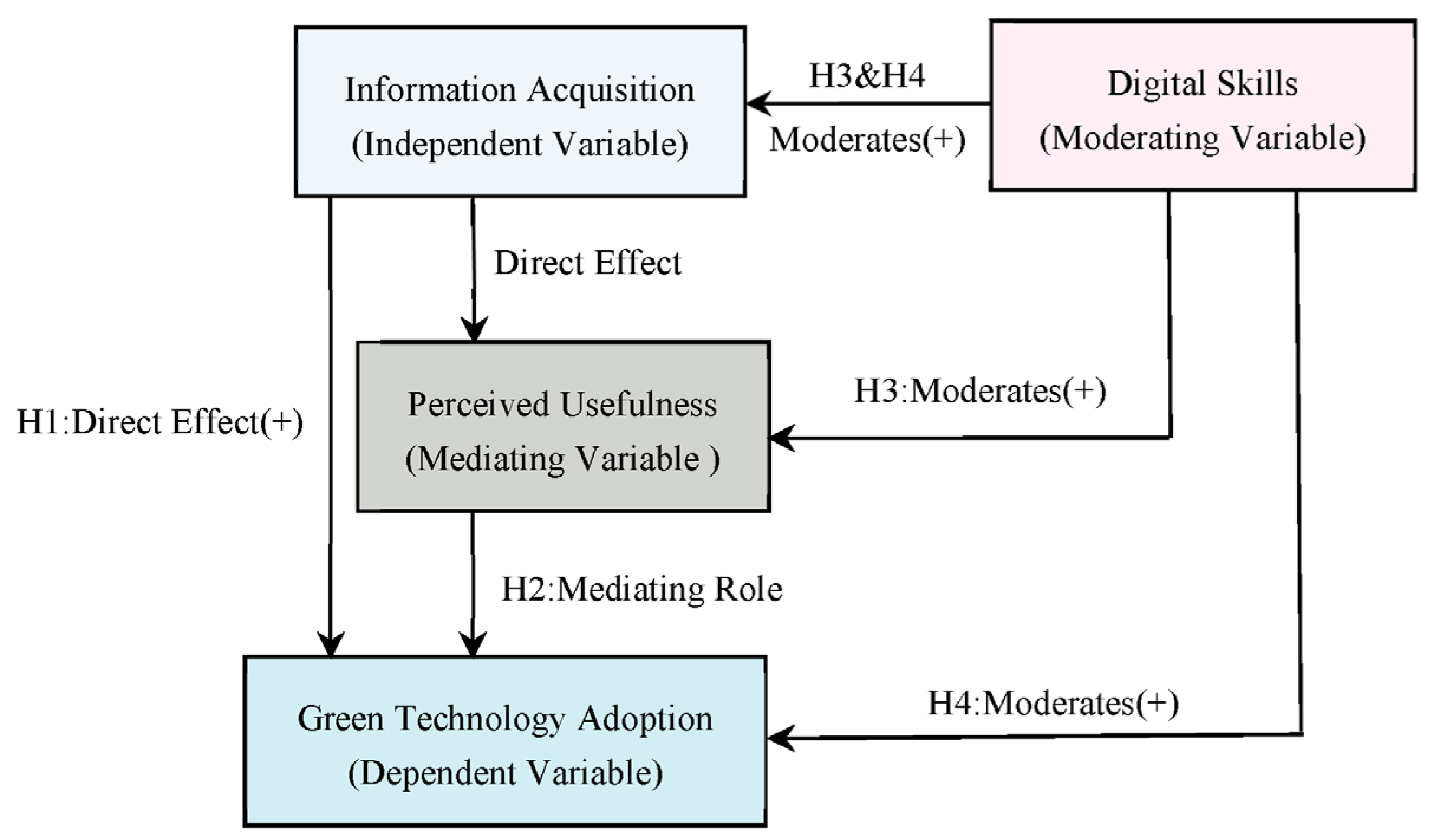



Information Acquisition and Green Technology Adoption Among Chinese Farmers: Mediation by Perceived Usefulness and Moderation by Digital Skills
Abstract
1. Introduction
2. Theoretical Analysis and Research Hypothesis
2.1. Direct Impact of Information Acquisition on Farmers’ Adoption of Green Production Technologies
2.2. Mediating Role of Perceived Usefulness
2.3. Moderating Role of Digital Skills
3. Materials and Methods
3.1. Data Source
3.2. Variable Selection and Description
3.2.1. Dependent Variable
3.2.2. Independent Variable
3.2.3. Mediating Variable
3.2.4. Moderating Variable
3.2.5. Control Variables
3.2.6. Reliability and Validity Tests of the Scale
3.3. Model Specification
3.3.1. Main Effect Model
3.3.2. Mediating Effect Model
3.3.3. Moderation Effect Model
3.3.4. Heterogeneity Analysis Model
4. Estimation Results and Analysis
4.1. Descriptive Statistical Analysis
4.2. Model Diagnostics and Basic Robustness Tests
4.3. Main Effect Analysis
4.4. Mediation Effect Analysis
4.5. Moderating Effect Analysis
4.6. Heterogeneity Analysis
4.7. Robustness Check
5. Discussion
6. Conclusions and Recommendations
Author Contributions
Funding
Institutional Review Board Statement
Informed Consent Statement
Data Availability Statement
Conflicts of Interest
References
- Nguyen, L.L.H.; Khuu, D.T.; Halibas, A.; Nguyen, T.Q. Factors that influence the intention of smallholder rice farmers to adopt cleaner production practices: An empirical study of precision agriculture adoption. Eval. Rev. 2024, 48, 692–735. [Google Scholar] [CrossRef]
- Schulz, D.; Börner, J. Innovation context and technology traits explain heterogeneity across studies of agricultural technology adoption: A meta-analysis. J. Agric. Econ. 2023, 74, 570–590. [Google Scholar] [CrossRef]
- Konstantinos, C.; Charoula, D. Factors shaping innovative behavior: A meta-analysis of technology adoption studies in agriculture. Can. J. Agric. Econ. 2025, 71, 75–103. [Google Scholar] [CrossRef]
- Li, X.G.; Xue, W.; Huo, X.X. Fertilizer application training programs, the adoption of formula fertilization techniques and agricultural productivity: Evidence from 691 apple growers in China. Nat. Resour. Forum. 2025, 47, 298–316. [Google Scholar] [CrossRef]
- Xie, Y.Q.; Chen, Z.; Khan, A.; Ke, S.F. Organizational support, market access, and farmers’ adoption of agricultural green production technology: Evidence from the main kiwifruit production areas in Shaanxi Province. Environ. Sci. Pollut. Res. 2024, 31, 11912–11932. [Google Scholar] [CrossRef]
- Shen, Y.J.; Shi, R.; Yao, L.Y.; Zhao, M.J. Perceived value, government regulations, and garmers’ agricultural freen production technology adoption: Evidence from China’s Yellow River basin. Environ. Manag. 2024, 73, 509–531. [Google Scholar] [CrossRef]
- Masi, M.; De Rosa, M.; Vecchio, Y.; Adinolfi, F. The long way to innovation adoption: Insights from precision agriculture. Agric. Food Econ. 2022, 10, 27. [Google Scholar] [CrossRef]
- Rezaei, R.; Safa, L.; Ganjkhanloo, M. Understanding farmers’ ecological conservation behavior regarding the use of integrated pest management: An application of the technology acceptance mode. Glob. Ecol. Conserv. 2020, 22, e00941. [Google Scholar] [CrossRef]
- Wang, G.L.; Xu, M. The role of social interaction in farmers’ water-saving irrigation technology adoption: Testing farmers’ interaction mechanisms. Sci. Rep. 2024, 14, 24969. [Google Scholar] [CrossRef]
- Idowu, C.A.; Kazeem, A.A.; Enitan, O.F.; Olawunmi, F.A.A.; Tsugiyuki, M.; Toshiyuki, W. Effect of information sources on farmers’ adoption of Sawah eco-technology in Nigeria. J. Agric. Ext. 2020, 24, 64. [Google Scholar] [CrossRef]
- Duan, W.; Luo, G.Q. Ecological cognition, digital agricultural technology adoption and the sustainable development of family grain farms—An empirical study from China. Pol. J. Environ. Stud. 2024, 33, 178201. [Google Scholar] [CrossRef]
- Xie, K.X.; Zhu, Y.R.; Ma, Y.Q.; Chen, S.J. Willingness of tea farmers to adopt ecological agriculture techniques based on the UTAUT extended model. Int. J. Environ. Res. Public Health 2022, 19, 15351. [Google Scholar] [CrossRef]
- DeLay, N.D.; Thompson, N.M.; Mintert, J.R. Precision agriculture technology adoption and technical efficiency. J. Agric. Econ. 2022, 73, 195–219. [Google Scholar] [CrossRef]
- Wang, X.; Drabik, D.; Zhang, J.B. How channels of knowledge acquisition affect farmers’ adoption of green agricultural technologies: Evidence from Hubei province, China. Int. J. Agric. Sustain. 2023, 21, 2270254. [Google Scholar] [CrossRef]
- Rosário, J.; Madureira, L.; Marques, C.; Silva, R. Understanding Farmers’ Adoption of Sustainable Agriculture Innovations: A Systematic Literature Review. Agronomy 2022, 12, 2879. [Google Scholar] [CrossRef]
- Vasavi, S.; Anandaraja, N.; Murugan, P.P.; Latha, M.R.; Selvi, R.P. Challenges and strategies of resource poor farmers in adoption of innovative farming technologies: A comprehensive review. Agric. Syst. 2025, 227, 137734. [Google Scholar] [CrossRef]
- Zhang, R.Y.; Feng, Y.N.; Li, Y.F.; Zheng, K. Can different information channels promote farmers’ adoption of Agricultural Green Production Technologies? Empirical insights from Sichuan Province. PLoS ONE 2024, 19, e0308398. [Google Scholar] [CrossRef]
- Valizadeh, N.; Hayati, D. A systematic review on selection and comparison of holistic agricultural sustainability assessment approaches. Front. Sustain. Food Syst. 2025, 9, 1559503. [Google Scholar] [CrossRef]
- Li, Z.L.; Zhu, M.D.; Zuo, Q.L. Social network, production purpose, and biological pesticide application behavior of rice farmers. Front. Environ. Sci. 2022, 10, 834760. [Google Scholar] [CrossRef]
- Zheng, Y.Y.; Fan, Q.Q.; Jia, W. How much did internet use promote grain production?-evidence from a survey of 1242 farmers in 13 provinces in China. Foods 2022, 11, 1389. [Google Scholar] [CrossRef]
- Cheng, H.; Lyu, K.Y.; Li, J.C.; Shiu, H. Bridging the digital divide for rural older adults by family intergenerational learning: A classroom case in a rural primary school in China. Int. J. Environ. Res. Public Health 2022, 19, 371. [Google Scholar] [CrossRef]
- Wang, J.Z.; Long, F. The impact of value cognition and institutional environment on the quality and safety control behavior of major producers of grain and its intergenerational differences. J. Hunan. Agric. Univ. (Soc. Sci.) 2023, 24, 15–24. [Google Scholar] [CrossRef]
- Yu, X.Y.; Sheng, G.J.; Sun, D.S.; He, R. Effect of digital multimedia on the adoption of agricultural green production technology among farmers in Liaoning Province, China. Sci. Rep. 2024, 6, 13092. [Google Scholar] [CrossRef]
- Liu, M.Z.Y.; Liu, H. Farmers’ adoption of agriculture green production technologies: Perceived value or policy-driven? Heliyon 2024, 10, e23925. [Google Scholar] [CrossRef]
- Wu, Q.; Zhou, J. Need for Cognitive Closure, Information acquisition and adoption of green prevention and control technology. Ecol. Chem. Eng. S 2021, 28, 129–143. [Google Scholar] [CrossRef]
- Gong, S.Y.; Jiang, L.D.; Yu, Z.G. Can Digital human capital promote farmers’ willingness to engage in green production? Exploring the role of online learning and social networks. Behav. Sci. 2025, 15, 227. [Google Scholar] [CrossRef]
- Ratana, S.; Ajchamon, T. A Systematic Review of Factors Influencing Farmers’ Adoption of Organic Farming. Sustainability 2021, 13, 3842. [Google Scholar] [CrossRef]
- Qiao, D.K.; Luo, L.; Chen, C.Y.; Qiu, L. How does social learning influence Chinese farmers’ safe pesticide use behavior? An analysis based on a moderated mediation effect. J. Clean. Prod. 2023, 430, 139722. [Google Scholar] [CrossRef]
- Lv, X.F.; Li, J. Realising the potential of information acquisition in promoting sustainable agriculture: A systematic review. J. Inf. Sci. 2024, 11, 93772. [Google Scholar] [CrossRef]
- Ma, Q.H.; Zheng, S.F.; Lu, Q. Social network, internet use and farmers’ green production technology adopting behavior. J. Arid Land Resour. Environ. 2022, 36, 16–21. [Google Scholar] [CrossRef]
- Ma, Q.H.; Zheng, S.F. The impact of information on acquisition channels on farmers’ green control technology behavior. J. Northwest AF Univ. (Soc. Sci. Ed.) 2023, 23, 109–119. [Google Scholar] [CrossRef]
- Yang, C.F.; Zheng, S.F.; Yang, N. The impact of information literacy and green prevention and control technology adoption behavior on farmers’ income. J. Ecol. Agric. China 2020, 28, 1823–1834. [Google Scholar] [CrossRef]
- Tong, R.; He, L.J.; Wang, Y.Q. Subsidy policy, effect cognition of environment-friendly pest control and adoption of environment-friendly pest control: Based on investigation of main apple growing areas in Shaanxi Province. Sci. Technol. Manag. Res. 2020, 40, 124–129. [Google Scholar] [CrossRef]
- Walter, S.; Boden, B.; Gunter, K.; Paul, B. Analyze the relationship among information technology, precision agriculture, and sustainability. J. Commerc. Biotechnol. 2022, 27, 158–168. [Google Scholar] [CrossRef]
- Davis, F.D. Perceived usefulness, perceived ease of use, and user acceptance of information technology. MIS Q. 1989, 13, 319–342. [Google Scholar] [CrossRef]
- Meena, S.; Kaur, M.; Singh, K.Y. Constraints in Adoption of Improved Kinnow Production Technology in Rajasthan, India: The Farmers Perspective. J. Exp. Agric. Int. 2024, 46, 474–483. [Google Scholar] [CrossRef]
- Liu, X.; Kaida, N. Parent-child intergenerational associations of environmental attitudes, psychological barriers, and pro-environmental behaviors in Japan and China. Sustainability 2024, 16, 10445. [Google Scholar] [CrossRef]
- Chen, Y.S.; Lu, Y.H. Factors influencing the information needs and information access channels of farmers: An empirical study in Guangdong, China. J. Inf. Sci. 2020, 46, 3–22. [Google Scholar] [CrossRef]
- Hao, X.Y.; Wang, Y.; Zhang, H. The impact of digital capability on farmers’ adoption of green production technologies: Evidence from the middle-upper Yellow River basin. Res. Agric. Mod. 2025, 46, 1–17. [Google Scholar] [CrossRef]
- Zhang, L.; Luo, B.L. Three Generations under one roof: The impact of intergenerational knowledge transfer on the pro-environmental behaviors of rural households. Agric. Technol. Econ. 2024, 1, 4–18. [Google Scholar] [CrossRef]
- Mao, H.; Chai, Y.J.; Chen, S.J. Land tenure and green production behavior: Empirical analysis based on fertilizer use by cotton farmers in China. Int. J. Environ. Res. Public Health 2021, 18, 4677. [Google Scholar] [CrossRef]
- Liu, M.Y.; Luo, X.F.; Yu, W.Z.; Huang, Y.H. Analysis of the Influence of Intergenerational Effect and Neighborhood Effect on Farmers’ Adoption of Green Production Technology. J. China Agric. Univ. 2020, 25, 206–215. [Google Scholar] [CrossRef]
- Dzanku, F.M.; Osei, R.D.; Nkegbe, P.K.; Osei-Akoto, I. Information delivery channels and agricultural technology uptake: Experimental evidence from Ghana. Eur. Rev. Agric. Econ. 2022, 49, 82–120. [Google Scholar] [CrossRef]
- Xiong, F.X.; You, C.X.; Zhu, S.B. Effect of digital technology application on grain grower’s behavior of green production technology adoption. J. Agric. Resour. Reg. Plann. 2025, 46, 62–72. [Google Scholar]
- Gulati, K.; Ward, P.S.; Lybbert, T.J.; Spielman, D.J. Intrahousehold preferences heterogeneity and demand for labor-saving agricultural technology. Am. J. Agr. Econ. 2024, 106, 684–711. [Google Scholar] [CrossRef]
- Kaumi, F.K.; Nyambane, C.O.; Karega, L.N.; Rasugu, H.M. Effect of on-farm testing on adoption of banana production technologies among smallholder farmers in Meru region, Kenya. J. Agribus. Dev. Emerg. Econ. 2023, 13, 90–105. [Google Scholar] [CrossRef]
- Martey, E.; Etwire, P.M.; Mockshell, J. Climate-smart cowpea adoption and welfare effects of comprehensive agricultural training programs. Technol. Soc. 2024, 64, 101468. [Google Scholar] [CrossRef]
- Bambio, Y.; Deb, A.; Kazianga, H. Exposure to agricultural technologies and adoption: The West Africa agricultural productivity program in Ghana, Senegal and Mali. Food Policy 2022, 113, 102288. [Google Scholar] [CrossRef]
- Lissillour, R.; Essiz, O.; Boninsegni, M.F.; Song, Z.P. Intergenerational transmission of sustainable consumption practices: Dyadic dynamics of green receptivity, subjective knowledge, peer conformity, and intra-family communication. J. Environ. Manag. 2025, 378, 124754. [Google Scholar] [CrossRef]
- Rogers, E.M. Diffusion of Innovations, 5th ed.; Free Press: New York, NY, USA, 1995; pp. 251–255. [Google Scholar] [CrossRef]
- Mkupete, M.J.; Davalos, J. Implications of climate-smart agriculture technology adoption on women’s productivity and food security in Tanzania. Agric. Econ. 2025, 56, 247–267. [Google Scholar] [CrossRef]
- Sun, X.L.; Lyu, J.; Ge, C.D. Knowledge and farmers’ adoption of green production technologies: An empirical study on IPM adoption intention in major India-Rice-Producing areas in the Anhui province of China. Int. J. Environ. Res. Public Health 2022, 19, 14292. [Google Scholar] [CrossRef]
- Yang, Y.Y.; Wang, Y.B. The impact of government subsidies and quality certification on farmers’ adoption of green pest control technologies. Agriculture 2025, 15, 35. [Google Scholar] [CrossRef]
- Miriam, V.; Belia, S.; Jolanda, L. How young adults view older people: Exploring the pathways of constructing a group image after participation in an intergenerational programme. J. Aging Stud. 2021, 56, 100912. [Google Scholar] [CrossRef]
- Yu, Y.P.; Zhang, J.L.; Zhang, K.; Xu, D.D.; Qi, Y.B. The impacts of farmer ageing on farmland ecological restoration technology adoption: Empirical evidence from rural China. J. Clean. Prod. 2023, 430, 139648. [Google Scholar] [CrossRef]


| Type | Variable | Definition | Measurement Method |
|---|---|---|---|
| Dependent | GPTA | Green Tech Adoption Degree | Not adopted = 0, Partially adopted (1–2 items) = 1, Mostly adopted (3–4 items) = 2, Fully adopted (5 items) = 3 |
| Independent | IA_Channel | Diversity of information acquisition channels | Number of channels used in the past year (e.g., government extension, cooperatives, social media) (0–8) |
| IA_Quality | Quality of information sources | Likert 5-point scale score: 1 = strongly disagree, 2 = disagree, 3 = neutral, 4 = agree,5 = strongly agree | |
| IA_Trust | Credibility of information sources | Likert 5-point scale score: Average score of trust levels in different sources (e.g., experts, government, relatives/friends, internet celebrities). | |
| Mediating | PU | Perceived Usefulness | Likert 5-point scale score: Average score of expected benefits regarding yield increase, cost saving, environmental protection, and policy benefits from green technologies. |
| Moderating | DS | Digital Skills | Comprehensive digital literacy score including four dimensions: device operation, information retrieval, information evaluation, and application. Average score per dimension (5-point scale). |
| Control | Age | Household Head Age | Age in years (from household registration/self-report). |
| Edu | Education Level | Primary education (primary school or below) = 1, Secondary education (junior/senior high school or technical school) = 2, Higher education (college or above) = 3 | |
| Land_Size | Farmland operation scale | Actual cultivated area (ha) | |
| Farm_Experience | Farming experience | Continuous variable (years) | |
| Income | Annual household income | Annual household income from grain farming (10,000 RMB) | |
| Eco_zone | Ecological zone | Bashang Plateau = 1, Piedmont Plain = 2, Low Plain = 3, Coastal Saline-Alkali Area = 4 |
| Construct | Item/Dimension | Standardized Factor Loading | Cronbach’s α | Composite Reliability (CR) | Average Variance Extracted (AVE) |
|---|---|---|---|---|---|
| Perceived Usefulness | Yield Confidence | 0.72 | 0.79 | 0.81 | 0.52 |
| Cost Saving | 0.75 | ||||
| Environmental Recognition | 0.68 | ||||
| Policy Benefit | 0.73 | ||||
| Digital Skills | Device Operation | 0.71 | 0.84 | 0.85 | 0.56 |
| Information Retrieval | 0.78 | ||||
| Information Evaluation | 0.76 | ||||
| Technology Application | 0.74 |
| 1. Perceived Sefulness | 2. Digital Skills | |
|---|---|---|
| 1. Perceived Usefulness | 0.72 | |
| 2. Digital Skills | 0.41 | 0.75 |
| Variable Type | Variable Name | Variable Measurement | Frequency (n) | Percentage (%) | Mean | Std. Err. |
|---|---|---|---|---|---|---|
| Dependent Variable | GPTA | Green Production Technology Adoption: Not adopted = 0; Partially adopted (1–2 items) = 1; Mostly adopted (3–4 items) = 2; Fully adopted (5 items) = 3 | 1.24 | 0.83 | ||
| 0 (Not adopted) | 122 | 21.3 | ||||
| 1 (Partially adopted) | 248 | 43.2 | ||||
| 2 (Mostly adopted) | 153 | 26.7 | ||||
| 3 (Fully adopted) | 51 | 8.9 | ||||
| Independent Variables | IA_Channel | Number of information channels used (0–8) | 3.87 | 1.72 | ||
| IA_Quality | Information content quality (1–5 Likert scale) | 3.41 | 0.76 | |||
| IA_Trust | Information source credibility (1–5 Likert scale) | 3.52 | 0.81 | |||
| Mediating Variable | PU | Perceived Usefulness (1–5 Likert scale) | 3.39 | 0.74 | ||
| Moderating Variable | DS | Digital Skills (1–5 Likert scale) | 3.15 | 0.80 | ||
| Control Variables | Gender | 0 = Female; 1 = Male | 0.71 | 0.45 | ||
| 0 = Female | 166 | 28.9 | ||||
| 1 = Male | 408 | 71.1 | ||||
| Age | Continuous (Years) | 51.2 | 12.7 | |||
| Edu | Education Level: Primary school and below = 1; Middle school = 2; College and above = 3 | 1.91 | 0.73 | |||
| 1 = Primary and below | 178 | 31.0 | ||||
| 2 = Middle school | 259 | 45.1 | ||||
| 3 = College and above | 137 | 23.9 | ||||
| Land_Size | Continuous (Hectares) | 15.6 | 22.3 | |||
| Farm_Experience | Continuous (Years) | 29.3 | 14.2 | |||
| Income | Annual household grain income (10,000 CNY) | 3.8 | 4.1 | |||
| Eco_zone | Ecological Zone: 1 = Bashang Plateau; 2 = Shanqian Plain; 3 = Low Plain; 4= Coastal Saline | 2.38 | 1.05 | |||
| 1 = Bashang Plateau | 132 | 23.0 | ||||
| 2 = Shanqian Plain | 158 | 27.5 | ||||
| 3 = Low Plain | 145 | 25.3 | ||||
| 4 = Coastal Saline | 139 | 24.2 |
| Variable | VIF | 1/VIF |
|---|---|---|
| IA_Channel | 1.85 | 0.541 |
| IA_Quality | 2.47 | 0.405 |
| IA_Trust | 1.92 | 0.521 |
| DS | 1.78 | 0.562 |
| Age | 1.45 | 0.690 |
| Edu | 1.62 | 0.617 |
| Land_Size | 1.29 | 0.775 |
| Farm_Experience | 1.51 | 0.662 |
| Income | 1.33 | 0.752 |
| Mean VIF | 1.69 |
| Test Item | Statistic/Value | p-Value | Inference |
|---|---|---|---|
| Likelihood Ratio Chi-square | 168.34 | <0.001 | Model is significant |
| Pseudo R2 (McFadden) | 0.286 | - | |
| Overall Prediction Accuracy | 72.5% | - | |
| Brant Test (Parallel Lines Assumption) | - | 0.124 | Assumption holds |
| Variable | Coefficient | Std. Error | Odds Ratio (OR) Value | p-Value |
|---|---|---|---|---|
| IA_Channel | 0.317 *** | 0.042 | 1.373 | 0.000 |
| IA_Quality | 0.502 *** | 0.058 | 1.652 | 0.000 |
| IA_Trust | 0.416 *** | 0.104 | 1.516 | 0.000 |
| Age | −0.021 * | 0.011 | 0.979 | 0.052 |
| Edu | 0.284 *** | 0.112 | 1.328 | 0.011 |
| Land_Size | 0.038 *** | 0.009 | 1.039 | 0.000 |
| Farm_Experience | −0.016 * | 0.008 | 0.984 | 0.046 |
| Income | 0.105 ** | 0.042 | 1.111 | 0.012 |
| Eco_zone | Controlled | |||
| Pseudo R2 | 0.286 | |||
| LR chi2 | 168.34 *** |
| Path | Indirect Effect | Boot Std. Error | 95% Boot CI | Mediating Effect Ratio |
|---|---|---|---|---|
| IA_Channel → PU → GPTA | 0.138 *** | 0.027 | [0.029, 0.197] | 32.1% |
| IA_Quality → PU → GPTA | 0.152 *** | 0.031 | [0.101, 0.218] | 35.4% |
| IA_Trust → PU → GPTA | 0.126 *** | 0.029 | [0.078, 0.185] | 30.3% |
| PU Dimension | IA_Channel → PU | IA_Quality → PU | IA_Trust → PU | Explained Variance Ratio |
|---|---|---|---|---|
| Yield Confidence | 0.53 *** | 0.61 *** | 0.48 *** | 38.7% |
| Cost Saving | 0.38 *** | 0.45 *** | 0.42 *** | 28.3% |
| Eco. Recognition | 0.45 *** | 0.52 *** | 0.39 *** | 33.0% |
| Variable | Model 1: PU (Dep. Var.) | Model 2: GPTA (Dep. Var.) |
|---|---|---|
| IA_Channel | 0.291 *** (0.044) | 0.317 *** (0.042) |
| IA_Quality | 0.502 *** (0.085) | 0.502 *** (0.085) |
| IA_Trust | 0.416 *** (0.104) | 0.416 *** (0.104) |
| DS | 0.186 *** (0.073) | 0.152 *** (0.086) |
| IA_Channel × DS | 0.138 *** (0.027) | 0.124 *** (0.025) |
| IA_Quality × DS | 0.173 *** (0.032) | 0.155 *** (0.030) |
| IA_Trust × DS | 0.126 *** (0.029) | 0.118 *** (0.027) |
| Sample Size | 574 | 574 |
| R2/Pseudo R2 | 0.402 | 0.298 |
| ∆R2/∆Pseudo R2 | +0.016 | +0.012 |
| Variable | High Digital Skills Group (DS ≥ 3) | Low Digital Skills Group (DS < 3) | Plain Areas | Mountainous Areas |
|---|---|---|---|---|
| Coefficient (OR Value) | Coefficient (OR Value) | Coefficient (OR Value) | Coefficient (OR Value) | |
| IA_Channel | 0.682 *** (1.978) | 0.317 *** (1.373) | 0.285 *** (1.330) | 0.401 *** (1.494) |
| IA_Quality | 0.785 *** (2.193) | 0.402 *** (1.494) | 0.587 *** (1.799) | 0.198 *** (1.219) |
| IA_Trust | 0.601 *** (1.824) | 0.285 *** (1.330) | 0.452 *** (1.572) | 0.301 *** (1.351) |
| Control Vars. | Yes | Yes | Yes | Yes |
| Pseudo R2 | 0.324 | 0.271 | 0.305 | 0.262 |
| Variable | Plain Areas (n = 354) | Mountainous Areas (n = 220) |
|---|---|---|
| Coefficient (OR Value) | Coefficient (OR Value) | |
| IA_Channel | 0.285 *** (1.330) | 0.401 *** (1.494) |
| IA_Quality | 0.587 *** (1.799) | 0.198 *** (1.219) |
| IA_Trust | 0.452 *** (1.572) | 0.301 *** (1.351) |
| Variable | Baseline Model (OLRM) | Robustness Model 1 (MLRM) | Robustness Model 2 (Alt. Vars.) | Robustness Model 3 (Winsorized) |
|---|---|---|---|---|
| Coefficient (OR Value) | Coefficient (OR Value) | Coefficient (OR Value) | Coefficient (OR Value) | |
| IA_Channel | 0.317 *** (1.373) | 0.302 *** (1.353) | 0.331 *** (1.392) | 0.309 *** (1.362) |
| IA_Quality | 0.502 *** (1.652) | 0.488 *** (1.629) | 0.518 *** (1.679) | 0.459 *** (1.641) |
| IA_Trust | 0.416 *** (1.516) | 0.401 *** (1.493) | 0.427 *** (1.533) | 0.410 *** (1.507) |
| Pseudo R2 | 0.286 | 0.278 | 0.291 | 0.281 |
| Sample Size | 574 | 574 | 574 | 574 |
Disclaimer/Publisher’s Note: The statements, opinions and data contained in all publications are solely those of the individual author(s) and contributor(s) and not of MDPI and/or the editor(s). MDPI and/or the editor(s) disclaim responsibility for any injury to people or property resulting from any ideas, methods, instructions or products referred to in the content. |
© 2025 by the authors. Licensee MDPI, Basel, Switzerland. This article is an open access article distributed under the terms and conditions of the Creative Commons Attribution (CC BY) license (https://creativecommons.org/licenses/by/4.0/).
Share and Cite
Yuan, W.; Zhao, J.; Huo, M.; Feng, Y.; Xu, S. Information Acquisition and Green Technology Adoption Among Chinese Farmers: Mediation by Perceived Usefulness and Moderation by Digital Skills. Sustainability 2025, 17, 9712. https://doi.org/10.3390/su17219712
Yuan W, Zhao J, Huo M, Feng Y, Xu S. Information Acquisition and Green Technology Adoption Among Chinese Farmers: Mediation by Perceived Usefulness and Moderation by Digital Skills. Sustainability. 2025; 17(21):9712. https://doi.org/10.3390/su17219712
Chicago/Turabian StyleYuan, Weimin, Junyan Zhao, Mengke Huo, Yiwei Feng, and Shuai Xu. 2025. "Information Acquisition and Green Technology Adoption Among Chinese Farmers: Mediation by Perceived Usefulness and Moderation by Digital Skills" Sustainability 17, no. 21: 9712. https://doi.org/10.3390/su17219712
APA StyleYuan, W., Zhao, J., Huo, M., Feng, Y., & Xu, S. (2025). Information Acquisition and Green Technology Adoption Among Chinese Farmers: Mediation by Perceived Usefulness and Moderation by Digital Skills. Sustainability, 17(21), 9712. https://doi.org/10.3390/su17219712