Article

Fostering Sustainability Integrity: How Social Trust Curbs Corporate Brownwashing in China

College of Economics and Management, Anhui Normal University, Wuhu 241002, China
*
Author to whom correspondence should be addressed.
Sustainability 2025, 17(21), 9696; https://doi.org/10.3390/su17219696
Submission received: 30 September 2025 / Revised: 19 October 2025 / Accepted: 27 October 2025 / Published: 31 October 2025

Abstract

This study explores the role of social trust, a critical informal institution, in mitigating corporate brownwashing—the strategic concealment of positive environmental performance. Drawing on a panel of 15,081 firm-year observations from Chinese A-share listed firms between 2010 and 2022, we operationalize brownwashing as a strategy where firms demonstrate substantive environmental compliance (i.e., no environmental penalties) while simultaneously practicing symbolic verbal conservatism (below-median environmental disclosure). Our empirical analysis reveals that higher regional social trust significantly curbs the propensity for firms to engage in brownwashing. This effect is not only statistically significant but also economically meaningful: a one-standard-deviation increase in social trust is associated with a 1.85 percentage point decrease in the likelihood of brownwashing. This effect operates through two key channels: enhancing stakeholder monitoring and reinforcing internal governance for environmental accountability. The impact of trust is significantly amplified under specific conditions: its role is more pronounced where formal sustainability regulations are weaker, highlighting trust as a crucial informal pillar of the sustainability governance architecture, and its inhibitory effect is strengthened when firms face higher reputational risks tied to their environmental performance. This study makes several contributions: it provides broad, cross-industry evidence on a key challenge in sustainability reporting; offers empirical support for the “trust fidelity” theory in the context of environmental disclosure; and develops a ‘channel-amplifier’ framework that advances our understanding of the complex institutional interplay required to foster corporate environmental transparency.

1. Introduction

In an era defined by the global sustainability agenda, the integrity of corporate environmental conduct has become a cornerstone of long-term value and stakeholder trust [1,2]. However, a discrepancy often exists between corporate declarations and actions in environmental disclosure. Beyond the well-documented issue of greenwashing [3,4], an emerging concern is brownwashing—an insidious strategy of intentionally downplaying or concealing positive environmental performance [5,6]. This “strategic silence” does more than misdirect capital; it erodes the credibility of market-based environmental governance, distorts incentives for genuine corporate stewardship, and ultimately jeopardizes the collective progress toward a substantive green transition [7]. Consequently, understanding why and under what circumstances firms engage in brownwashing is of paramount importance for improving corporate governance and accelerating a substantive green transition.
The existing literature on brownwashing, while growing, reveals two notable gaps. First, its perspective is often narrow, with research focusing almost exclusively on heavily polluting industries (e.g., Li et al. [5], Testa et al. [6] and Wang et al. [8]). This narrow focus may create a sample selection bias and likely underestimates the prevalence of brownwashing, thereby constraining a holistic understanding of corporate sustainability commitments across the broader economy. Second, its institutional analysis often presents an imbalanced view of the sustainability governance architecture, emphasizing formal mechanisms while overlooking informal ones (e.g., Huang et al. [9] and Li et al. [5]). This is particularly salient in emerging markets like China, where the binding power of formal institutions can be weakened by inconsistent implementation. Such contexts accentuate the role of informal institutions, with social trust emerging as a critical, yet often neglected, pillar for shaping corporate environmental ethics and accountability [10,11]. Crucially, prior studies have not fully explored the complex interplay between informal and formal institutions, often simplifying it to a substitution-complementarity dichotomy.
To address these research gaps, this paper focuses on social trust, a cornerstone of social capital and a key informal institution rooted in regional culture. Social trust may play a pivotal role in shaping corporate strategic behaviors like brownwashing. However, its theoretical effect on corporate opportunism is ambiguous, with two opposing perspectives: trust fidelity and trust exploitation. The former posits that high levels of social trust strengthen reputational mechanisms and ethical constraints, encouraging firms to behave more reliably [12]. The latter perspective suggests that a high-trust environment may lead to lax stakeholder monitoring, creating opportunities for opportunistic behavior [13]. This theoretical tension raises several key questions: What role does social trust play in the specific strategic behavior of brownwashing? Furthermore, what are the underlying mechanisms and boundary conditions of its influence? These questions form the core motivation of our study.
To answer these questions systematically, this paper proposes and tests an integrated “channel-amplifier” theoretical framework. The central idea is that social trust does not operate in a vacuum; rather, it channels its governance effects through two key pathways—activating external monitoring and strengthening internal managerial discipline. Concurrently, the effectiveness of these channels is not static but is significantly amplified when firms face greater reputational risk exposure.
Based on this framework, we systematically examine the impact of social trust on corporate brownwashing using an all-industry sample of A-share companies in China from 2010 to 2022. Our findings indicate that social trust significantly inhibits corporate brownwashing, which is consistent with the theory of trust fidelity. This result remains robust after addressing endogeneity concerns and conducting a series of robustness tests. Mechanism analysis demonstrates that this inhibitory effect operates primarily by activating external monitoring and reinforcing internal managerial discipline. Further heterogeneity analysis reveals that the governance role of social trust is more pronounced in two contexts: first, when formal institutional constraints are relatively weak (e.g., in non-state-owned firms and regions with weaker legal environments), highlighting its substitution role as an informal governance mechanism; and second, when firms have greater reputational risk exposure (e.g., when facing high market competition or operating in a heavily polluting industry).
This study aims to make several contributions to the literature. First, from an empirical standpoint, by utilizing an all-industry sample, our study moves beyond the narrow focus on heavily polluting sectors. This approach provides a more comprehensive view of brownwashing, offering crucial insights to inform the design of more resilient and adaptive sustainability governance mechanisms that are effective across diverse economic sectors. Second, we contribute to the literature on the social foundations of corporate sustainability. By demonstrating that trust inhibits rather than enables opportunistic silence in a novel context, our findings lend support to the “trust fidelity” perspective in its long-standing debate with the “trust exploitation” view. Third, from a theoretical standpoint, this paper develops and validates a “channel-amplifier” model. This framework offers a more nuanced perspective on sustainability governance than the traditional “substitution/complementarity” dichotomy, revealing how informal institutions like trust can empower existing governance structures and dynamically amplify their effectiveness in high-risk situations. This not only advances our theoretical understanding of complex institutional dynamics in transition economies but also clarifies the micro-mechanisms underpinning the governance role of trust.
The remainder of the paper is organized as follows: Section 2 reviews the relevant literature and presents the hypotheses. Section 3 defines the variables and outlines the empirical models. Section 4 reports the regression results and additional robustness checks. Section 5 offers further analysis. The final section concludes the paper and discusses directions for future research.

2. Literature Review and Research Hypotheses

The authenticity of corporate environmental conduct is a cornerstone of the global sustainability agenda. In this context, brownwashing—the strategic concealment or downplaying of positive environmental impacts [5,6]—poses a significant threat to market integrity and undermines the collective effort toward a sustainable future. Rooted in principal-agent theory, brownwashing is an opportunistic manifestation of managerial cost–benefit analysis under information asymmetry, a behavior that prioritizes short-term gains at the expense of long-term sustainable value for shareholders and society [14].
Existing literature has approached brownwashing from both motivational and governance perspectives. Motivational studies identify drivers such as cost leadership strategies [9,15] and centralized executive power [16], as well as external pressures like stakeholder scrutiny and market risk aversion [17,18] and hedging against market risk aversion to the “green premium” [6]. On the governance level, research has shown that internal mechanisms such as executive environmental experience [8], board network density [5], and gender diversity [19], along with external forces like media scrutiny, analyst attention, and market competition [5,8] can all serve as effective deterrents. However, these studies have predominantly focused on firm-level characteristics and formal institutions, which are often treated as a monolithic force. This overlooks the complex ‘incentive mix’ of penalties, subsidies, and taxes that formal regulation actually entails, whose effects are heterogeneous across firms [20]. The crucial role of macro-level informal institutions, particularly social trust, in shaping corporate environmental strategies and interacting with this diverse regulatory toolkit remains a significant gap in the literature.
In emerging markets, where formal institutional frameworks can be less robust, informal institutions like social trust often play a vital governance role [21]. As a core element of social capital, social trust influences economic decisions by shaping shared values and behavioral norms [10]. Yet, its impact on corporate environmental opportunism is theoretically ambiguous, giving rise to two competing perspectives: “trust fidelity” versus “trust exploitation.” This ambiguity is echoed in the related field of greenwashing research, where empirical findings are starkly divided, with some studies supporting the inhibitory effect of trust [22] and others finding it exacerbates misconduct [12]. This suggests that the relationship between social trust and symbolic environmental behaviors is complex and warrants a dedicated investigation.
The “trust fidelity” perspective posits that social trust acts as a powerful, non-market disciplinary mechanism that aligns corporate behavior with societal expectations for sustainability. In a high-trust environment, reputation is a critical asset. Firms that betray this trust through deceptive practices like brownwashing face severe reputational sanctions, which can translate into tangible economic losses [23,24], especially in a modern economic landscape where industry-level climate transition risks can amplify the financial consequences of reputational damage [25]. This theory suggests that the constraining effect of social trust is not abstract; rather, it operates through concrete governance channels. First, at the external level, social trust can activate and amplify formal regulatory pressure. High public trust fosters a low tolerance for corporate irresponsibility, increasing the “political cost” for regulators who fail to act. This compels governments to enforce environmental regulations more stringently, creating a strong external deterrent [26]. More specifically, it can enhance the efficacy of the entire regulatory portfolio; for instance, by magnifying the deterrent effect of penalties through heightened reputational costs and ensuring that subsidies genuinely foster green innovation rather than opportunistic behavior [20]. Second, at the internal level, social trust permeates corporate culture and imposes personal reputational constraints on managers. In a high-trust ecosystem, integrity is a key professional asset. The fear of personal reputational damage incentivizes managers to establish more robust internal governance and control systems, ensuring that corporate actions genuinely reflect their stated commitment to sustainability [27,28].
Conversely, the “trust exploitation” perspective highlights a potential “dark side” of social trust, suggesting it could inadvertently enable brownwashing. Externally, high trust may foster “regulatory laxity”. Stakeholders and regulators might develop a “reputation halo” around local firms, reducing their scrutiny and creating an environment where misconduct is less likely to be detected [29,30]. This perceived lower risk of detection could embolden managers to engage in opportunistic concealment. Internally, a high-trust environment might create a “crowding-out” effect on formal disclosure systems. Managers may mistakenly believe their social reputation suffices to maintain stakeholder confidence, thereby underinvesting in transparent and high-quality environmental reporting systems [31]. Furthermore, drawing from behavioral ethics, the concept of “moral licensing” provides a powerful psychological micro-foundation for this dark side [32,33]. In a high-trust context, managers and firms may accumulate a reservoir of social goodwill. This accumulated ‘moral credit’ can, paradoxically, grant them a psychological ‘license’ to engage in opportunistic behaviors like brownwashing, as they may perceive that their strong reputation can absorb or excuse minor ethical lapses. This lack of transparency, coupled with performance-based incentives, could therefore create not only the opportunity but also the psychological justification for managers to exploit trust for personal gain [12].
Given these competing theoretical arguments, the net effect of social trust on corporate brownwashing is an empirical question. To resolve this ambiguity, we propose the following competing hypotheses:
Hypothesis 1a (H1a).
There is a negative correlation between regional social trust and corporate brownwashing.
Hypothesis 1b (H1b).
There is a positive correlation between regional social trust and corporate brownwashing.

3. Materials and Methods

3.1. Sample and Data

We select A-share companies listed on China’s Shanghai and Shenzhen stock exchanges from 2010 to 2022 as our initial research sample. We exclude financial and insurance firms, those designated as special treatment (ST/PT), and observations with missing data. To mitigate the influence of outliers, all primary continuous variables were winsorized at the 1% and 99% levels. This process yielded a final sample of 15,081 firm-year observations. Social trust data were sourced from the China General Social Survey (CGSS). Data for identifying brownwashing behavior were compiled from corporate annual reports obtained via the Wingo platform and from firm-related penalty data from the CSMAR database.

3.2. Variables and Empirical Model

3.2.1. Measuring Brownwashing

Following the research of Loughran et al. [34] and Hu et al. [35], we conceptualize “brownwashing” as a firm’s “strategic silence” to avert potential negative consequences—an intentional downplaying or concealment of its positive environmental performance. Unlike the overt exaggeration of “greenwashing,” the key feature of brownwashing is inadequate, rather than false, disclosure. Consequently, an ideal metric for brownwashing must capture two dimensions simultaneously: “verbal conservatism” and “substantive action”.
Based on this framework, we construct a two-dimensional dummy variable to identify brownwashing behavior. The first dimension is verbal disclosure. We measure this by calculating the frequency of specific environmental terms (e.g., “environmental,” “low carbon,” “green”) in the Management Discussion and Analysis (MD&A) section of a firm’s annual report. If this frequency falls below the industry-year median, we classify the firm as being “verbally conservative” (Oral = 1); otherwise, it is 0. The second dimension is substantive performance. We employ a negative screening indicator based on a regulatory compliance baseline. Specifically, we examine whether the company received an administrative penalty from regulatory authorities for environmental issues during the year. If no penalty was issued, we consider the firm to have at least met basic environmental regulations, thereby achieving a baseline of substantive performance. We define this as “substantively robust” (Real = 1); otherwise, it is 0.
Ultimately, we identify a firm as engaging in brownwashing (BW = 1) when it is both “verbally conservative” (Oral = 1) and “substantively robust” (Real = 1)—that is, the firm performs adequately by meeting compliance standards but selectively maintains a low profile in its disclosures. Otherwise, BW is 0.
We acknowledge that equating “no penalties” with “good environmental performance” is a relatively broad assumption. However, within the Chinese institutional context, administrative environmental penalties serve as official signals for the most severe violations. Therefore, the absence of penalties is an objective and robust baseline indicator of a firm’s environmental risk and performance stability [36]. Similarly, by benchmarking against the industry median, our measure of “verbal conservatism” effectively controls for inherent differences in disclosure norms across industries, making it a valid method for identifying a firm’s propensity for “strategic silence”. Nevertheless, to ensure the robustness of our conclusions, we will conduct a supplementary analysis in a subsequent section, replacing the “substantive performance” dimension with a stricter metric based on a firm’s substantive environmental investments.

3.2.2. Measuring Social Trust

We use social trust data from the China General Social Survey (CGSS), a comprehensive and ongoing survey of social conditions in China [37,38]. The indicator is constructed based on responses to the question: “Overall, do you agree that the vast majority of people can be trusted in this society?” We define regional social trust (Trust) as the proportion of respondents in each province who answered “strongly agree” or “somewhat agree” relative to the total number of respondents in that province.

3.2.3. Control Variables

Drawing on prior literature (e.g., Cao et al. [39] and Xiao and Chen [40]), we include a set of control variables. Firm-level financial controls include the leverage ratio (Lev), return on equity (Roe), operating income growth rate (Growth), Tobin’s Q (TobinQ), and the current ratio (Liquid). Operational controls include inventory turnover (Inv) and the inverse of the Lerner index (Lerner). Corporate governance controls include disclosure quality (Dis), the percentage of independent directors (Indep), and the largest shareholder’s ownership percentage (Shrcr1). Detailed variable definitions are provided in Table 1.

3.2.4. Empirical Model

To examine the impact of social trust on corporate brownwashing, we estimate the following baseline model:
B W i , t = β 0 + β 1 T r u s t i , t + β 3 C o n t r o l s i , t + Y e a r + I n d u s t r y + ε i , t
In this model, the dependent variable BW represents brownwashing, and the key independent variable is Trust. If the coefficient β 1 is significantly negative, Hypothesis H1a is supported. Conversely, if β 1 is significantly positive, Hypothesis H1b is supported. We also control for year and industry fixed effects and cluster standard errors at the firm level.

4. Empirical Results

4.1. Descriptive Statistics

Table 2 presents the descriptive statistics for the main variables. The mean of the brownwashing variable (BW) is 0.345, with a standard deviation of 0.475, indicating that 34.5% of the firm-year observations in our sample exhibit brownwashing behavior. The mean of social trust (Trust) is 0.630, with a standard deviation of 0.082, suggesting that there are notable differences in the level of social trust across regions. The distributions of the other control variables are consistent with findings from previous studies.

4.2. Baseline Regression Analysis

Table 3 reports the results of the baseline regression. Column (1) presents the model without control variables, while column (2) includes the full set of controls. In both specifications, the coefficient on social trust is significantly negative at the 1% level, supporting Hypothesis H1a. In terms of economic significance, the results in columns (1) and (2) indicate that a one-standard-deviation increase in social trust (0.082) corresponds to a 2.25 and 1.85 percentage point decrease in a firm’s probability of engaging in brownwashing (−0.274 × 0.082; −0.225 × 0.082). This effect is equivalent to 6.53% and 5.36% of the sample mean (0.345), indicating that the inhibitory effect of social trust is economically meaningful.

4.3. Endogeneity Tests

4.3.1. Instrumental Variables Approach

To address potential endogeneity arising from unobservable confounding factors or reverse causality between social trust and corporate brownwashing, we employ an instrumental variable approach. We select the strength of clan culture and dialect diversity as instrumental variables for social trust.
Clan culture enhances regional social trust through social networks and moral constraint mechanisms [41]. As a core carrier of traditional social capital, clan culture strengthens intra-group reciprocal norms and ethical constraints through institutional symbols such as ancestral hall activities and family rules [42]. Conversely, dialect diversity can weaken social trust by creating linguistic communication barriers [43,44]. When regional dialects are more diverse, the cost of cross-group communication rises, making it more difficult to form uniform social norms and leading to lower levels of trust. Therefore, both variables are theoretically highly correlated with social trust.
At the same time, these instrumental variables must satisfy the exclusion restriction. We measure the strength of clan culture by the population proportion of the top three surnames in a prefecture-level city. As a deep-rooted cultural tradition, it is plausibly exogenous to a firm’s contemporary environmental disclosure decisions (i.e., brownwashing). Similarly, dialect diversity influences social trust by affecting the efficiency of communication but has no direct causal relationship with a firm’s decision to engage in brownwashing. Thus, both instrumental variables meet the exogeneity requirement.
Columns (1) and (2) of Table 4 report the two-stage least squares (2SLS) regression results. The first-stage results show that clan culture significantly and positively affects regional social trust, while dialect diversity significantly weakens it, consistent with our analysis. In the second-stage regression, the coefficient on Trust is significantly negative, confirming that social trust can effectively inhibit corporate brownwashing. The associated diagnostic tests support the validity of our instruments: the Kleibergen-Paap rk LM statistic is significant at the 1% level, rejecting the null hypothesis of under-identification; the Kleibergen-Paap rk Wald F-statistic is 92.685, far exceeding the critical value of 10 and indicating that the instruments are not weak; and the Hansen J-statistic is not significant (p-value = 0.473), indicating that the instruments are jointly exogenous and there is no over-identification problem.
However, one might argue that these cultural factors could correlate with local institutional features, such as the media environment or civic engagement, which might themselves influence corporate disclosure. To formally test the validity of the exclusion restriction against this alternative hypothesis, we introduce two provincial-level control variables into our 2SLS model: media density and internet penetration. As shown in the columns (3) and (4) of Table 4, the inclusion of these controls does not alter our main findings. The effect of social trust remains significantly negative, and all diagnostic statistics continue to support the validity of our instruments. This provides strong evidence that our instruments affect brownwashing primarily through the channel of social trust, rather than through the local information environment.

4.3.2. Propensity Score Matching (PSM)

To mitigate potential sample self-selection bias, we use the propensity score matching (PSM) method. We divide the sample into a high-trust group and a low-trust group based on the median value of Trust. We then use the control variables from the baseline regression as covariates and perform a 1:1 nearest-neighbor matching.
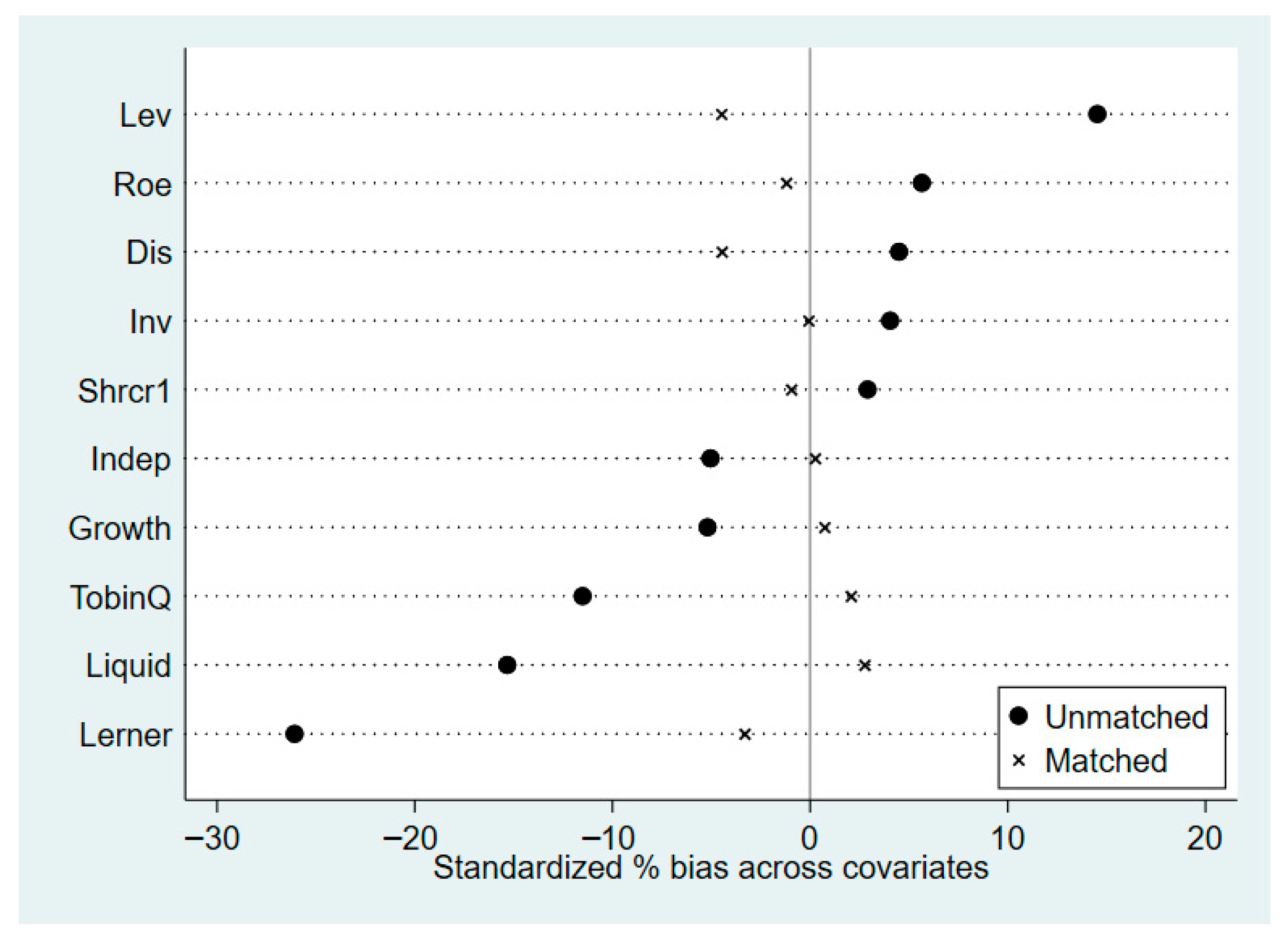
To ensure the quality of the match, we perform a 1:1 nearest-neighbor matching within a strict caliper of 0.02. This process is conducted exclusively within the region of common support, meaning that firms with no suitable counterparts in the opposing group are trimmed from the analysis to avoid poor matches and extrapolation. The effectiveness of this procedure is confirmed by the covariate balance plot presented in Figure 1. The plot shows that the standardized percentage bias for all covariates is reduced to well below the conventional 10% threshold after matching, indicating that the observable characteristics between the treatment and control groups are well-balanced. Table 5, Column (1) presents the results, where the trust coefficient remains significantly negative, further supporting the robustness of our research findings.

4.3.3. Difference-in-Difference Analysis

To further address endogeneity concerns, we employ a staggered difference-in-differences (DID) design, leveraging the “National Social Credit System Pilot Zone” policy as a quasi-natural experiment. This policy, rolled out in batches starting in 2015, provides a plausibly exogenous shock to the regional trust environment. We define firms in pilot cities as the treatment group and estimate a staggered DID model with firm and year fixed effects.
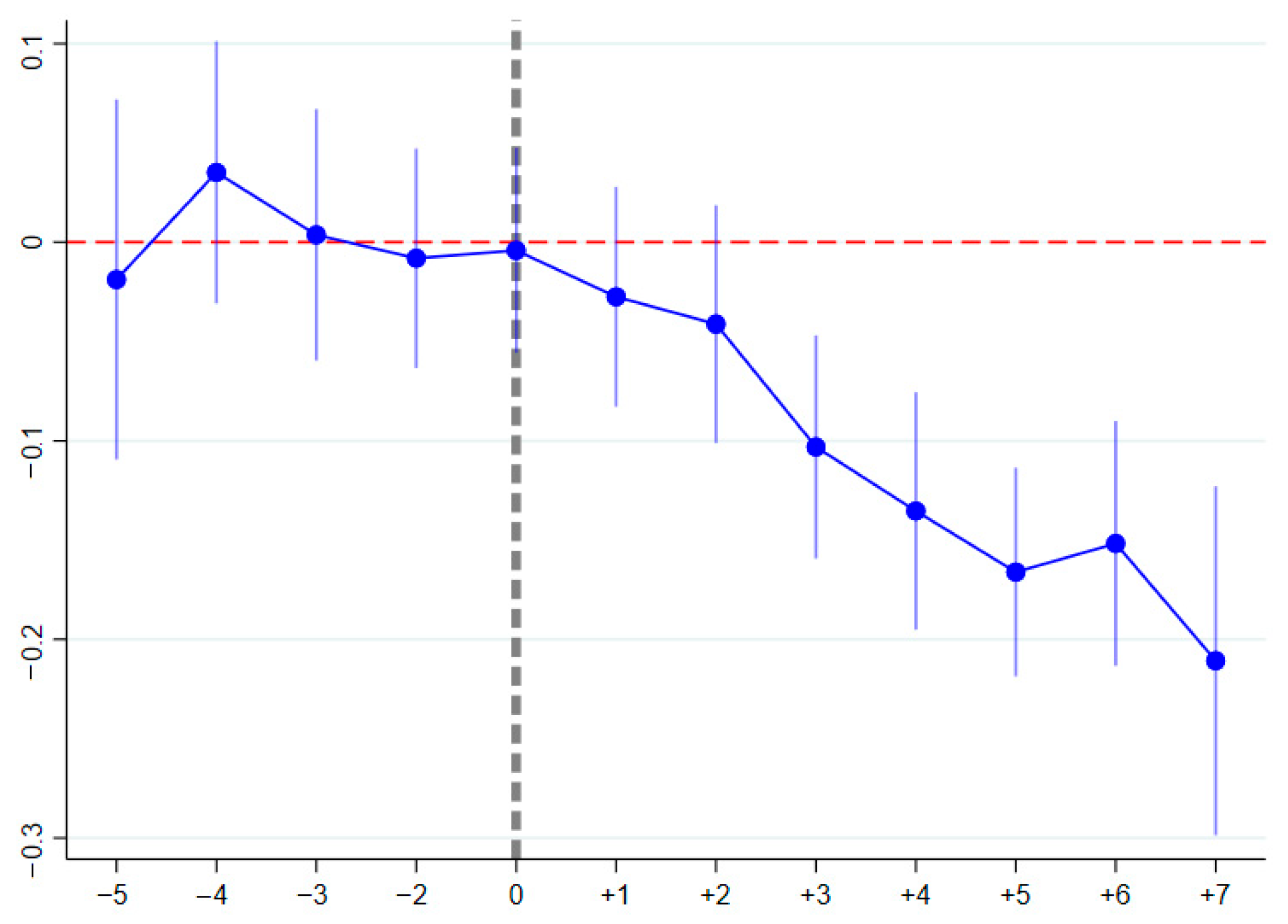
The results, presented in column (2) of Table 5, show that the coefficient on the policy interaction term (DID) is −0.069 and significant at the 1% level, providing strong causal evidence that an enhanced trust environment curtails brownwashing. To validate our design, we conduct an event study. As shown in Figure 2, the coefficients for all pre-policy periods are insignificant, confirming that the parallel trends assumption holds. The plot also reveals a dynamic effect, with the policy’s inhibitory impact becoming significant three years post-implementation, consistent with the time required for institutional policies to take substantive effect. This DID analysis robustly supports our main hypothesis with causal evidence.

4.4. Robustness Tests

4.4.1. Alternative Measure of Social Trust

We use an alternative proxy, Trust2, to remeasure social trust. This variable is constructed from responses to the same CGSS question but uses an ordinal scale: “Strongly disagree” = −2, “Disagree” = −1, “Neither agree nor disagree” = 0, “Agree” = 1, and “Strongly agree” = 2. We then calculate the provincial-level arithmetic mean of these scores. The results, reported in column (1) of Table 6, show that the coefficient on Trust2 is significantly negative at the 1% level, confirming the stability of our results.

4.4.2. Alternative Measure of Brownwashing

To ensure the credibility of our core findings, we conduct a series of rigorous robustness checks. These tests are designed to address three primary potential challenges to our results: (1) the construct validity of our baseline proxy for substantive performance, (2) the sensitivity of our results to an alternative, more stringent performance proxy, and (3) the potential confounding effect of disclosure length on our textual measure.
First, we empirically validate our original proxy for “substantively robust” performance—the absence of environmental penalties (Real = 1). This proxy focuses on a compliance baseline, and one might argue that it simply reflects lax enforcement rather than superior performance. To address this, we test it against external, objective indicators. As detailed in Appendix A.2 Table A2, we find that firms with Real = 1 are associated with significantly higher Bloomberg environmental scores and significantly fewer negative environmental news items. This provides strong supportive evidence that our baseline proxy is indeed identifying firms with superior substantive performance.
Second, to ensure our core conclusion is not contingent upon this specific compliance-based measurement, we conduct a more stringent test using an alternative, investment-based measure. Specifically, we construct an indicator of environmental investment intensity—calculated by summing and standardizing green and environmental investments. We then redefine Real = 1 to indicate that a firm’s environmental investment intensity is above the industry mean and reconstruct our brownwashing proxy accordingly (BW2). The regression results, presented in Table 6, Column (2), show that the coefficient for our core explanatory variable, Social Trust (Trust), remains significantly negative. This demonstrates that our conclusion holds even under a stricter, “proactive investment” criterion, not just a “baseline compliance” one.
Third, beyond the validity of our performance proxy, we address whether our textual measure is merely an artifact of document length. To thoroughly mitigate this potential confounding, we conduct a highly stringent test by simultaneously implementing two modifications. We re-estimate our baseline model by defining the normalized dependent variable—calculated as the frequency of environment-related terms divided by the total length of the Management’s Discussion and Analysis (MD&A) section—as the new brownwashing variable (BW3). Concurrently, we include the natural logarithm of MD&A length as an additional control variable in the analysis. This combined approach is particularly rigorous; normalizing the dependent variable directly accounts for disclosure volume, while controlling for document length purges any residual, non-linear effects of a firm’s general verbosity. The results of this test, reported in Table 6, Column (3), confirm that the coefficient on Trust remains negative and statistically significant. This provides strong evidence that our finding is not driven by disclosure length.
Taken together, the initial validation of our proxy, the confirmation using a more stringent measure, and the robustness to control for document length collectively strengthen the credibility of our core conclusion.

4.4.3. Alternative Fixed Effect

To address potential omitted variable bias from time-varying provincial factors, a standard approach like province-by-year fixed effects is unsuitable here. Our key variable, Social Trust, is measured at the province-year level, which creates severe multi-collinearity with such fixed effects, making identification statistically impossible. Therefore, we adopt a direct approach by augmenting our baseline model with key time-varying provincial-level controls: Provincial GDP, the Provincial Marketization Index, and Provincial Fiscal Expenditure. As shown in column (4) of Table 6, the coefficient on Trust remains significantly negative. This result confirms that our findings are robust and not driven by these major provincial economic and policy dynamics, reinforcing the specific role of social trust.
Beyond addressing provincial-level time-varying factors, we also account for heterogeneity in time-varying differences across industries—a potential source of omitted variable bias that could affect the reliability of our results. To this end, we further include industry-by-year interaction fixed effects in our model. The results, reported in column (5) of Table 6, show that the coefficient on Trust remains significantly negative, providing additional evidence that the negative relationship between social trust and the outcome variable is stable even after controlling for industry-specific temporal trends.

4.4.4. Adjusting the Sample Period

To account for the potential impact of the COVID-19 pandemic and associated economic disruptions, we exclude the 2020–2022 period from our sample. The results, reported in column (5) of Table 6, show that the coefficient on Trust remains significantly negative, suggesting that our findings are not driven by the pandemic period.

4.4.5. Alternative Estimation Models

Since our dependent variable, brownwashing (BW), is a dummy variable, our baseline regression uses the Linear Probability Model (LPM), which is widely used in empirical research due to its ability to handle high-dimensional fixed effects and its intuitively interpretable coefficients. However, to ensure that our core findings are not biased by this specific model choice, we also perform robustness tests using Probit and Logit models.
Table 7 reports the results. Column (1) presents the baseline LPM results, while columns (2) and (3) show the estimation results from the Probit and Logit models, respectively. The coefficient on the core explanatory variable, Trust, is consistently negative and significant at the 1% level across all three models. This high degree of consistency confirms that our conclusion—that social trust significantly inhibits corporate brownwashing—is robust.

5. Further Analysis

5.1. Mechanism Test: The Governance Channels of Social Trust

Our baseline regression results confirm that social trust significantly inhibits corporate brownwashing, supporting the trust fidelity hypothesis. This section explores the underlying pathways through which this governance effect operates. We posit that social trust is not an isolated cultural variable but functions by altering the behavior and decision-making of key governance actors. Specifically, we examine two critical transmission channels: an external governance channel, through which social trust enhances formal government regulation, and an internal governance channel, where it promotes better corporate governance practices.

5.1.1. External Governance Channel

First, we test the external governance channel, where the core logic is that social trust activates and strengthens formal regulatory oversight. In regions with high social trust, the public holds higher ethical expectations and has a lower tolerance for corporate misconduct. This societal pressure increases the “political cost” for local governments to neglect their regulatory duties. To maintain their own credibility and respond to public concerns, governments are more incentivized to translate potential regulatory oversight into actual, stringent enforcement actions against environmental misbehavior [26,45]. Consequently, social trust can curb brownwashing by elevating the level of formal government regulation.
To empirically test this channel, we adopt a two-pronged approach that examines both governmental intent and tangible commitment. First, following Fang et al. [46], we measure local regulatory intensity (Regulation) by the frequency of environmental protection-related words in local government work reports. As shown in column (1) of Table 8, the regression coefficient of social trust on government regulation is significantly positive (coefficient = 0.001, p < 0.01). This indicates that higher regional social trust is associated with stronger formal regulatory intensity.
However, to ensure this heightened attention translates beyond rhetoric into tangible action, we corroborate this finding with a “hard” measure: the ratio of investment in pollution control to GDP (Pollution control expenditure). This indicator captures real financial resources allocated to proactive environmental governance [47]. As reported in column (2) of Table 8, the coefficient of social trust on pollution control investment is also significantly positive. This provides compelling evidence that in high-trust regions, the stated regulatory intent is backed by substantial financial commitment.
Taken together, these findings paint a complete picture: social trust does not operate in a vacuum but actively shapes the formal institutional environment, compelling local governments to not only talk more about environmental protection but also to invest more in it. This dual evidence strongly supports the external governance channel, demonstrating a clear pathway from public trust to concrete regulatory action that helps curb brownwashing.

5.1.2. Internal Governance Channel

Second, we examine the internal governance channel. Beyond influencing external regulators, social trust can permeate corporate decision-making by fostering an environment that encourages stronger internal governance. In a high-trust business ecosystem, integrity and reputation are critical professional assets for managers [27]. The anticipation of severe personal reputational damage from being associated with opportunistic behaviors like brownwashing serves as a powerful deterrent. This incentivizes firms and their managers to proactively establish more robust internal control and oversight mechanisms to signal their trustworthiness and align their actions with societal norms [28,48].
To test this proposition, we first assess the overall quality of corporate internal governance. We use a comprehensive corporate governance index (Govern) constructed via principal component analysis of nine indicators [49]. The results in column (2) of Table 8, show a significantly positive coefficient for social trust (coefficient = 0.858, p < 0.01), suggesting that firms in high-trust regions tend to have better holistic governance structures.
To triangulate this finding and unpack what “better governance” entails in this context, we further examine two specific, direct indicators: Board Size and the presence of executives with a green background. Board size serves as a proxy for monitoring capacity, while a green executive background signals environmental expertise and strategic commitment. As shown in columns (4) and (5) of Table 8, social trust is significantly and positively associated with both a larger board and a higher likelihood of having executives with green expertise.
These results provide a nuanced and robust view of the internal governance channel. Social trust is not only associated with a general improvement in governance quality, but this improvement is manifested through tangible enhancements in both monitoring capacity (larger boards) and strategic environmental expertise at the highest level (green executives). By fostering these stronger internal mechanisms, social trust reduces the managerial discretion and information asymmetry that create fertile ground for brownwashing.

5.2. Heterogeneity Analysis

Having established the external and internal channels, we now explore the conditions that amplify their effectiveness. As our theoretical framework suggests, the governance effect of social trust should be stronger when the risk of brownwashing exposure is higher or the associated penalties are more severe.

5.2.1. Ownership Structure

State-owned enterprises (SOEs) and non-SOEs differ significantly in their governance and objectives. SOEs often carry social and political mandates, and their environmental behavior is subject to strong administrative constraints from the government [50]. This formal “hard constraint” limits their scope for disclosure opportunism. In contrast, non-SOEs are more exposed to market competition, and their survival depends heavily on market-based reputational capital. For these firms, a “collapse of trust” in a high-trust environment translates directly into severe penalties, such as financing difficulties and customer loss. This implies that the reputational penalty amplified by social trust is a more potent deterrent for non-SOEs.
Regressions grouped by ownership type (columns (1) and (2) of Table 9) show that the negative effect of Trust on brownwashing is significant only in the non-SOE sample (coefficient = −0.280, p < 0.01). This result supports our expectation that the role of social trust as an informal reputational governance mechanism is particularly critical for non-SOEs, where reputational costs are more impactful.

5.2.2. Legal Environment

In regions with weak legal environments, the formal system provides an insufficient deterrent to opportunistic behavior. In this vacuum, stakeholders rely more heavily on informal signals like social trust and reputation to assess a firm [51]. Consequently, the trust fidelity mechanism becomes a key complementary governance force. In such settings, the penalty for a brownwashing-induced trust breach is particularly severe, as few other reliable formal signals exist to repair a firm’s reputation, amplifying the marginal punitive effect.
Following Gao et al. [52], we use the “Market Intermediary Organization Development and Rule of Law Environment Index” to measure the regional legal environment and group samples by the median. The results (columns (3) and (4) of Table 9) reveal that the coefficient on Trust is significantly negative only in the group with a weaker legal environment (coefficient = −0.210, p < 0.05). This validates the critical role of social trust as a complementary governance mechanism in imperfect institutional settings.

5.2.3. Market Competition

Market competition is a powerful external force shaping corporate behavior. In a competitive industry, reputation is a key intangible asset for gaining a competitive advantage [45]. Intense competition means that stakeholders have numerous alternatives. In this environment, the negative impact of detected brownwashing is rapidly amplified, leading to a swift loss of market share and increasing the penalty for reputational damage.
We use the Lerner index to measure market competition and divide the sample into high- and low-competition groups. The results in columns (1) and (2) of Table 10 show that the negative association between social trust and brownwashing is significant only in the high-competition group. This supports our inference that the governance effect of social trust is more pronounced in high-competition environments where reputational penalties are more costly.

5.2.4. Industry Pollution Level

Heavily polluting firms are naturally under the spotlight of regulators, the media, and the public due to their significant negative externalities [53]. This high level of scrutiny increases the exposure risk for brownwashing. In a high-trust environment, a trust breach by a firm in a sensitive industry can quickly trigger a “collapse of trust” and devastating reputational damage [23]. Therefore, we expect the governance effect of social trust to be more pronounced in heavily polluting industries.
We classify industries as heavily or non-heavily polluting based on the 2012 CSRC guidelines. The results in columns (3) and (4) of Table 10 show that the inhibitory effect of social trust on brownwashing is significant only for firms in heavily polluting industries. This suggests that, driven by both high exposure and reputation risks, social trust is a more effective constraint on firms in these sectors.

6. Discussion and Conclusions

This study makes three primary contributions to the sustainability governance literature by examining how social trust curbs corporate brownwashing through a ‘channel-amplifier’ logic. First, our all-industry sample provides a more comprehensive empirical portrait of brownwashing, moving beyond the conventional focus on heavily polluting sectors. Second, our findings lend empirical support to the “trust fidelity” perspective, informing the long-standing debate on whether trust inhibits or enables corporate opportunism. Third, we develop and test a “channel-amplifier” framework, offering a more nuanced alternative to the conventional substitution-complementarity dichotomy for understanding the interplay between informal and formal governance.
Our empirical findings provide the foundation for these contributions, revealing effects that are both statistically significant and economically meaningful. We find that social trust significantly deters brownwashing: a one-standard-deviation increase in the trust index corresponds to a 1.85 percentage point reduction in a firm’s probability of such behavior. This governance effect operates through two distinct channels: compensating for weaknesses in external government regulation while reinforcing internal governance discipline. Furthermore, the effect is not uniform, amplifying substantially under high-risk conditions. Our heterogeneity analysis (Table 10) quantifies these boundary conditions: the deterrent power of trust is over twice as strong in high-competition environments (a 29.6 percentage point reduction) and is similarly potent for firms in heavily polluting industries (a 26.0 percentage point reduction). In contrast, the effect is statistically insignificant in low-risk settings. These findings underscore that the reputational discipline of social trust is most potent when the stakes—whether competitive or environmental—are highest.
Our findings offer actionable implications for stakeholders. For policymakers, our study reveals social trust as a powerful informal governance mechanism that complements formal regulation, suggesting a path for regionally differentiated environmental policies. In low-trust regions, regulators should intensify formal oversight and penalties. Conversely, in high-trust regions, policymakers can leverage existing social capital by implementing incentive-based policies that amplify the reputational benefits of authentic environmental performance.
From a corporate governance perspective, boards must recognize that ESG-related reputational risks are geographically contingent. In high-trust provinces, the risk of exposure for brownwashing—and the subsequent reputational damage—is significantly higher, demanding that ESG strategies be grounded in authenticity. Firms in these regions should invest in substantive environmental improvements and communicate them proactively, as such authenticity is more likely to be recognized and rewarded.
Finally, for investors, our research provides a nuanced lens for ESG risk assessment. Provincial social trust should be a key factor in evaluating a firm’s non-financial risk; opaque disclosures from a firm in a high-trust area warrant heightened scrutiny. This insight refines stewardship strategies: when engaging with companies in high-trust regions, investors must be more skeptical of low-quality disclosures and demand credible evidence of substantive performance, as the stakes for corporate hypocrisy are much higher.
Despite its contributions, this study has several limitations that open up promising avenues for future research. First, our study is situated within the specific institutional context of China. While this provides valuable insights into an important emerging economy, future research should extend the analysis to other international contexts, such as the EU or other emerging markets, to test the cross-cultural validity of our “channel-amplifier” framework. This would help to establish the generalizability of social trust as a governance mechanism.
Second, while our triangulation analysis using Bloomberg scores and media reports strengthens our brownwashing metric, future studies could achieve even greater precision. A particularly promising direction is to incorporate machine learning techniques, such as advanced textual analysis of sustainability reports and corporate communications, to uncover more latent and nuanced dimensions of brownwashing, moving beyond simple word counts to capture tone, sentiment, and thematic sophistication.
Finally, our research could be extended by exploring how social trust interacts with the rapidly evolving landscape of corporate governance. A fruitful line of inquiry would be to investigate the interplay between social trust and new formal institutions (e.g., the global adoption of mandatory ESG reporting standards) or disruptive digital technologies (e.g., blockchain for transparent audit trails). Understanding whether these new mechanisms will complement or substitute for informal trust-based governance is a critical question for the future of sustainable business practices.

Author Contributions

Conceptualization, L.W. and S.Z.; methodology, L.W. and S.Z.; software, L.W. and S.Z.; validation, L.W. and S.Z.; formal analysis, L.W.; investigation, L.W. and S.Z.; resources, L.W. and S.Z.; data curation, L.W.; writing—original draft preparation, L.W.; writing—review and editing, L.W. and S.Z.; visualization, L.W. and S.Z.; supervision, L.W.; project administration, S.Z.; funding acquisition, S.Z. All authors have read and agreed to the published version of the manuscript.

Funding

This research was funded by the Philosophy and Social Science Planning Project of Anhui Province, grant number AHSKQ2023D014 and the Major Project of the Scientific Research Program of Higher Education Institutions in Anhui Province, grant number 2022AH040023.

Institutional Review Board Statement

Not applicable.

Informed Consent Statement

Not applicable.

Data Availability Statement

The raw data supporting the conclusions of this article will be made available by the authors on request.

Conflicts of Interest

The authors declare no conflicts of interest.

Appendix A

Appendix A.1

As shown in Table A1, the Pearson correlation coefficient between social trust (Trust) and corporate brownwashing (BW) is −0.118, which is statistically significant at the 1% level. This result clearly and robustly reveals a significant negative association between social trust and corporate brownwashing. A further inspection indicates that both social trust (Trust) and corporate brownwashing (BW) exhibit varying degrees of correlation with each control variable. Such a correlational feature validates the rationality of variable selection in this study.
Table A1. Correlation matrix.
BWTrustLevRoeInvDisLernerLiquidGrowthTobinQIndepshrcr1
BW1
Trust−0.118
***
1
Lev−0.221
***
0.059 ***1
Roe0.0100.011−0.105
***
1
Inv−0.067
***
0.0100.046
***
0.0011
Dis−0.054
***
0.013−0.024
***
0.262
***
0.0021
Lerner0.032
***
−0.091
***
0.105
***
−0.113
***
0.097
***
−0.041
***
1
Liquid0.221
***
−0.087
***
−0.663
***
0.047
***
−0.104
***
−0.004−0.042
***
1
Growth0.042
***
−0.020
**
0.038
***
0.009−0.186
***
−0.012−0.052
***
0.0131
TobinQ0.149
***
−0.041
***
−0.304
***
0.213
***
−0.101
***
0.058
***
−0.083
***
0.188
***
0.014
*
1
Indep0.022
***
−0.047
***
0.006−0.001−0.017
**
0.012−0.014
*
0.0040.014
*
0.039
***
1
shrcr1−0.020
**
−0.0020.061
***
0.121
***
0.066
***
0.115
***
0.051
***
−0.021
***
−0.017
**
−0.089
***
0.056
***
1
Note: Symbols ***, **, and * represents significance at 1%, 5%, and 10% thresholds, respectively.

Appendix A.2

Table A2 in the Appendix shows that “firms without penalties” (where Real = 1) have significantly higher Bloomberg Environmental Scores and significantly fewer annual negative environmental news articles received. These results provide direct evidence that our proxy variable can effectively distinguish firms with better substantive environmental performance, thereby supporting the setup of our main tests.
Table A2. Validity test of the proxy variable.
Variables(1)(2)
EscoreNegative Environmental News
Real0.036 ***−0.111 ***
(2.905)(−2.790)
Cons1.048 ***0.023
(16.681)(0.099)
N14,83812,456
R20.0690.613
Ind YESYES
YearYESYES
Note: Symbols *** represent significance at 1% thresholds.

Appendix A.3

Appendix A.3.1. The Threshold Effect of Social Trust

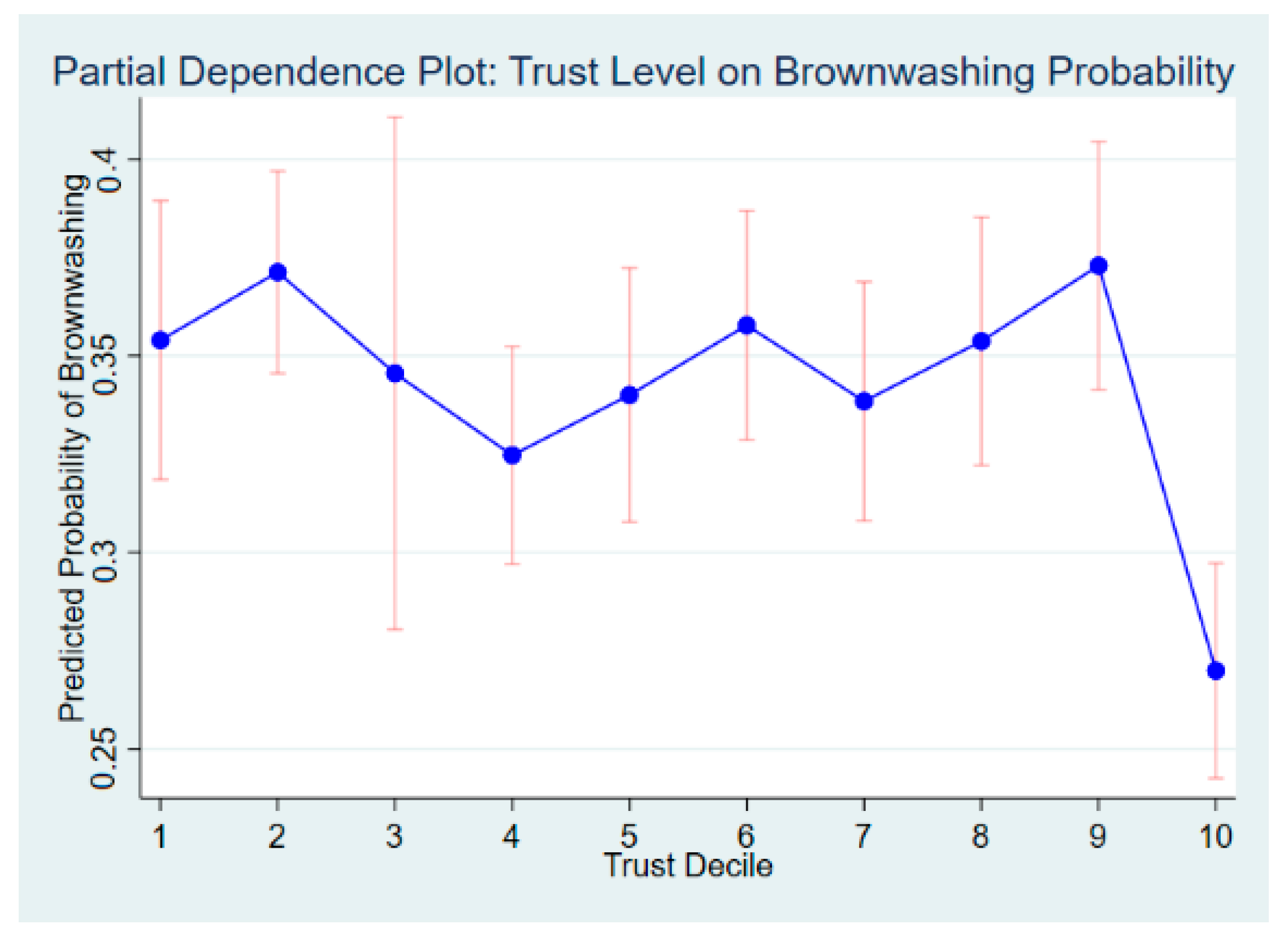
We test for a non-linear effect by calculating the predicted probability of brownwashing across trust deciles. As shown in Table A3 and visualized in Figure A1, the inhibitory effect of trust is statistically dormant for the first nine deciles. A “cliff effect” emerges only at the highest decile (top 10%), where the probability of brownwashing drops by a substantial 8.4 percentage points (p < 0.01) compared to the lowest decile. This reveals a critical mass threshold for trust to be effective.
Table A3. Impact of Trust Deciles on the Probability of Brownwashing.
Trust DecilePredicted ProbabilityDifference from BaselineSignificance
10.354----Not Significant
20.371+0.017Not Significant
30.346−0.008Not Significant
40.325−0.029Not Significant
50.340−0.014Not Significant
60.358+0.004Not Significant
70.338−0.016Not Significant
80.3540.000Not Significant
90.373+0.019Not Significant
100.270−0.084 ***p < 0.01
Note: *** represents significance at 1% thresholds.
Figure A1. Partial Dependence Plot: Trust Level on Brownwashing Probability.
Sustainability 17 09696 g0a1

Appendix A.3.2. Market Competition as an Amplifier

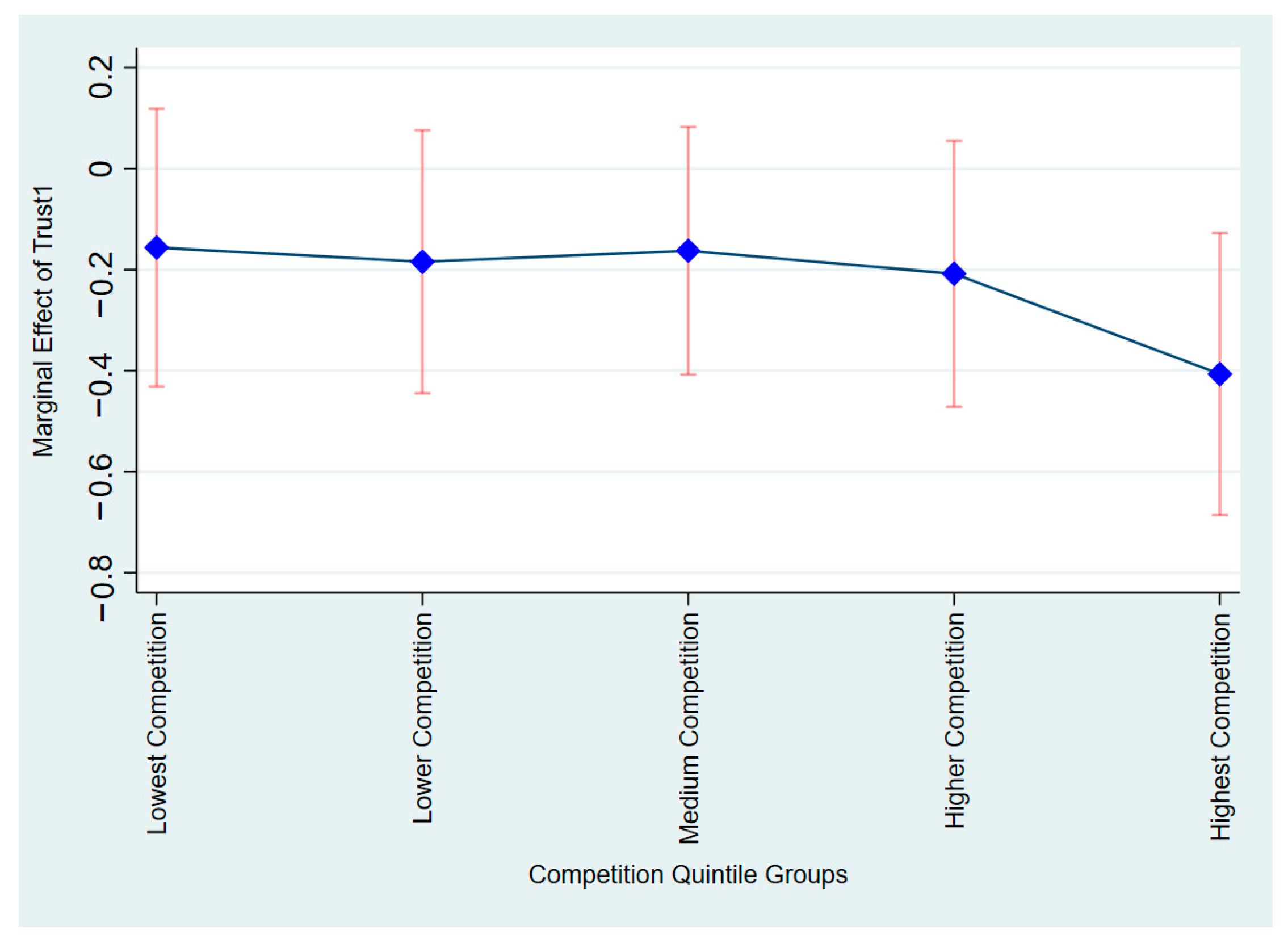
We test the “amplifier” hypothesis by estimating the marginal effect of trust across different levels of market competition. Table A4 and Figure A2 show that the effect of trust is insignificant in less competitive environments. However, in the most competitive markets, the effect becomes large and highly significant (−0.407, p < 0.01), demonstrating that competition is a key moderator that activates the disciplinary power of trust.
Table A4. Marginal Effects of Trust1 Across Competition Environments.
Competition GroupMarginal Effectp-Value95% Confidence IntervalSignificance
Lowest
Competition
−0.15620.266[−0.431, 0.119]Not Significant
Lower
Competition
−0.18430.165[−0.445, 0.076]Not Significant
Medium
Competition
−0.16240.194[−0.408, 0.083]Not Significant
Higher
Competition
−0.20790.121[−0.471, 0.055]Not Significant
Highest
Competition
−0.40670.004[−0.686, −0.128]p < 0.01
Figure A2. Across Competition Quintiles: Heterogeneous Marginal Effects.
Sustainability 17 09696 g0a2

Appendix A.4

Table A5 shows that the coefficient of the triple interaction term (Trust × Polluting Industry × Post2018) is −0.515 and statistically significant (p = 0.044). This result provides strong causal evidence for our hypothesis. It indicates that the 2018 regulatory shock significantly amplified the positive effect of social trust on corporate environmental performance (where a negative coefficient on our dependent variable, e.g., pollution levels, indicates better performance), and this amplifying effect was particularly pronounced for firms in high-polluting industries. This suggests that social trust and formal regulation are complements; trust as an informal governance mechanism becomes even more potent when formal regulatory scrutiny is heightened.
Table A5. Result of a triple-difference (DDD) model.
(1)
BW
Trust−0.245 **
(−2.048)
Polluting × post2018 × Trust−0.515 **
(−2.015)
Cons0.518 ***
(6.278)
N15,081
R20.136
ControlsYES
IndYES
YearYES
Note: Symbols ***, ** represent significance at 1%, 5% thresholds, respectively.

References

  1. Amin, M.H.; Ali, H.; Mohamed, E.K.A. Corporate Social Responsibility Disclosure on Twitter: Signalling or Greenwashing? Evidence from the UK. Int. J. Financ. Econ. 2024, 29, 1745–1761. [Google Scholar] [CrossRef]
  2. Sun, Y.; Su, K.; Cai, W.; Bai, M. Is Transparency in Sustainability the Fruit of Business Trust: Evidence from Sustainability Disclosure? Int. J. Financ. Econ. 2025, 30, 2407–2426. [Google Scholar] [CrossRef]
  3. Chen, J.; Yang, Y.; Ding, Q.; Xie, J. Top Management Team Connectedness and Greenwashing. Int. J. Financ. Econ. 2025, 30, 3725–3743. [Google Scholar] [CrossRef]
  4. Walker, K.; Wan, F. The Harm of Symbolic Actions and Green-Washing: Corporate Actions and Communications on Environmental Performance and Their Financial Implications. J. Bus. Ethics 2012, 109, 227–242. [Google Scholar] [CrossRef]
  5. Li, W.; Ding, R.; Zhang, Z. What Role Do Directors’ Networks Play in Corporate Brownwashing? Bus. Ethics Environ. Responsib. 2025. [Google Scholar] [CrossRef]
  6. Testa, F.; Miroshnychenko, I.; Barontini, R.; Frey, M. Does It Pay to Be a Greenwasher or a Brownwasher? Bus. Strategy Environ. 2018, 27, 1104–1116. [Google Scholar] [CrossRef]
  7. Amores-Salvadó, J.; Martin-de Castro, G.; Albertini, E. Walking the Talk, but above All, Talking the Walk: Looking Green for Market Stakeholder Engagement. Corp. Soc. Responsib. Environ. Manag. 2023, 30, 431–442. [Google Scholar] [CrossRef]
  8. Wang, C.; Zhang, T.; Duan, D.; Yang, S. Do Green-Minded Executives Matter? Evidence from ESG Brownwashing Behaviour. Appl. Econ. Lett. 2025, 1–7. [Google Scholar] [CrossRef]
  9. Huang, Y.; Francoeur, C.; Brammer, S. What Drives and Curbs Brownwashing? Bus. Strategy Environ. 2022, 31, 2518–2532. [Google Scholar] [CrossRef]
  10. Guiso, L.; Sapienza, P.; Zingales, L. Does Culture Affect Economic Outcomes? J. Econ. Perspect. 2006, 20, 23–48. [Google Scholar] [CrossRef]
  11. Stulz, R.M.; Williamson, R. Culture, Openness, and Finance. J. Financ. Econ. 2003, 70, 313–349. [Google Scholar] [CrossRef]
  12. Wang, J.; Ke, Y. “Fidelity” or “Exploitation”: Social Trust and Corporate Greenwashing. Econ. Anal. Policy 2025, 86, 336–350. [Google Scholar] [CrossRef]
  13. Maung, M. The Bright Side of Social Trust and Entrepreneurial Finance. Int. Rev. Econ. Financ. 2024, 92, 778–795. [Google Scholar] [CrossRef]
  14. Jensen, M.C.; Meckling, W.H. Theory of the Firm: Managerial Behavior, Agency Costs and Ownership Structure. J. Financ. Econ. 1976, 3, 305–360. [Google Scholar] [CrossRef]
  15. Verrecchia, R.E. Essays on Disclosure. J. Account. Econ. 2001, 32, 97–180. [Google Scholar] [CrossRef]
  16. Gull, A.A.; Hussain, N.; Khan, S.A.; Mushtaq, R.; Orij, R. The Power of the CEO and Environmental Decoupling. Bus. Strategy Environ. 2023, 32, 3951–3964. [Google Scholar] [CrossRef]
  17. Bansal, P.; Bogner, W.C. Deciding on ISO 14001: Economics, Institutions, and Context. Long Range Plann. 2002, 35, 269–290. [Google Scholar] [CrossRef]
  18. Heyes, A.; Lyon, T.P.; Martin, S. Salience Games: Private Politics When Public Attention Is Limited. J. Environ. Econ. Manag. 2018, 88, 396–410. [Google Scholar] [CrossRef]
  19. Eliwa, Y.; Aboud, A.; Saleh, A. Board Gender Diversity and ESG Decoupling: Does Religiosity Matter? Bus. Strategy Environ. 2023, 32, 4046–4067. [Google Scholar] [CrossRef]
  20. Guo, C.; Ma, W.; Yang, C.; Yang, R. Enterprise Characteristics and Incentive Effect of Environmental Regulation. Int. Rev. Financ. 2025, 25, e70032. [Google Scholar] [CrossRef]
  21. Chen, X.; Wan, P. Social Trust and Corporate Social Responsibility: Evidence from China. Corp. Soc. Responsib. Environ. Manag. 2020, 27, 485–500. [Google Scholar] [CrossRef]
  22. Xiong, J.; Chen, L.; Zhu, Y.; Maak, T. Social Trust and Corporate Greenwashing: Insights from China’s Pilot Social Credit Systems. J. Bus. Ethics 2025. [Google Scholar] [CrossRef]
  23. Gonçalves, T.; Gaio, C.; Costa, E. Committed vs Opportunistic Corporate and Social Responsibility Reporting. J. Bus. Res. 2020, 115, 417–427. [Google Scholar] [CrossRef]
  24. Yin, S.; Lin, Z.; Li, P.; Peng, B. Does Environmental Credit Affect Bank Loans? Evidence from Chinese a-Share Listed Firms. Int. J. Financ. Econ. 2025, 30, 1225–1248. [Google Scholar] [CrossRef]
  25. Zhou, Q.; Ni, J.; Yang, C. Climate Transition Risk and Industry Returns: The Impact of Green Innovation and Carbon Market Uncertainty. Technol. Forecast. Soc. Change 2025, 214, 124056. [Google Scholar] [CrossRef]
  26. Ji, C.; Jiang, J.; Zhang, Y. Political Trust and Government Performance in the Time of COVID-19. World Dev. 2024, 176, 106499. [Google Scholar] [CrossRef]
  27. Hilary, G.; Huang, S. Trust and Contracting: Evidence from Church Sex Scandals. J. Bus. Ethics 2023, 182, 421–442. [Google Scholar] [CrossRef]
  28. Qin, W.; Liang, Q.; Jiao, Y.; Lu, M.; Shan, Y. Social Trust and Dividend Payouts: Evidence from China. Pac.-Basin Financ. J. 2022, 72, 101726. [Google Scholar] [CrossRef]
  29. Castillo, M.; Carter, M. Behavioral Responses to Natural Disasters; George Mason University, Interdisciplinary Center for Economic Science: Arlington, VA, USA, 2011. [Google Scholar]
  30. Gu, L.; Liu, J.; Peng, Y. Locality Stereotype, CEO Trustworthiness and Stock Price Crash Risk: Evidence from China. J. Bus. Ethics 2022, 175, 773–797. [Google Scholar] [CrossRef]
  31. Aghion, P.; Algan, Y.; Cahuc, P.; Shleifer, A. Regulation and Distrust*. Q. J. Econ. 2010, 125, 1015–1049. [Google Scholar] [CrossRef]
  32. Rotella, A.; Barclay, P. Failure to Replicate Moral Licensing and Moral Cleansing in an Online Experiment. Pers. Individ. Differ. 2020, 161, 109967. [Google Scholar] [CrossRef]
  33. Song, E.; Lee, M.-S.; Park, J.; Lee, H. Translating pro-environmental intention to behavior: The role of moral licensing effect. Sustain. Prod. Consum. 2024, 52, 527–540. [Google Scholar] [CrossRef]
  34. Loughran, T.; McDonald, B.; Yun, H. A Wolf in Sheep’s Clothing: The Use of Ethics-Related Terms in 10-K Reports. J. Bus. Ethics 2009, 89, 39–49. [Google Scholar] [CrossRef]
  35. Hu, X.; Hua, R.; Liu, Q.; Wang, C. The Green Fog: Environmental Rating Disagreement and Corporate Greenwashing. Pac.-Basin Financ. J. 2023, 78, 101952. [Google Scholar] [CrossRef]
  36. Guedhami, O.; Pan, Y.; Saadi, S.; Zhao, D. Do Environmental Penalties Matter to Corporate Innovation? Energy Econ. 2025, 141, 108064. [Google Scholar] [CrossRef]
  37. Liu, T.; Zhang, B. Does Social Trust Enhance Firm Engagement in Supply Chain Finance? Financ. Res. Lett. 2025, 78, 107152. [Google Scholar] [CrossRef]
  38. Wu, W.; Firth, M.; Rui, O.M. Trust and the Provision of Trade Credit. J. Bank. Financ. 2014, 39, 146–159. [Google Scholar] [CrossRef]
  39. Cao, Y.; Xue, Y.; Tan, Y. Social Trust, Financial Constraints, and Enterprise Information Disclosure. Financ. Res. Lett. 2025, 83, 107651. [Google Scholar] [CrossRef]
  40. Xiao, M.; Chen, N. How Does Social Trust Promote Enterprises’ Financialization? Int. Rev. Financ. Anal. 2025, 97, 103819. [Google Scholar] [CrossRef]
  41. Gambetta, D. Trust: Making and Breaking Cooperative Relations; Blackwell: Oxford, UK, 1988. [Google Scholar]
  42. Peng, Y. Kinship Networks and Entrepreneurs in China’s Transitional Economy. Researchgate 2004, 109, 1045–1074. [Google Scholar] [CrossRef]
  43. Ang, J.S.; Cheng, Y.; Wu, C. Trust, Investment, and Business Contracting. J. Financ. Quant. Anal. 2015, 50, 569–595. [Google Scholar] [CrossRef]
  44. Guiso, L.; Sapienza, P.; Zingales, L. Trusting the Stock Market. J. Financ. 2008, 63, 2557–2600. [Google Scholar] [CrossRef]
  45. Zhu, H.; Wagner, E. Is Corporate Social Responsibility a Matter of Trust? A Cross-Country Investigation. Int. Rev. Financ. Anal. 2024, 93, 103127. [Google Scholar] [CrossRef]
  46. Fang, C.; Wang, Z.; Zhao, L. Environmental Regulations and the Greenwashing of Corporate ESG Reports. Econ. Anal. Policy 2025, 87, 1469–1481. [Google Scholar] [CrossRef]
  47. Zhu, B.; Wang, Y. Does Social Trust Affect Firms’ ESG Performance? Int. Rev. Financ. Anal. 2024, 93, 103153. [Google Scholar] [CrossRef]
  48. Dong, W.; Han, H.; Ke, Y.; Chan, K.C. Social Trust and Corporate Misconduct: Evidence from China. J. Bus. Ethics 2018, 151, 539–562. [Google Scholar] [CrossRef]
  49. Yu, H.; Zhang, J. Do Green Investors Empower Companies to Develop Sustainably? A Study Based on the Perspective of Innovation Investment and Corporate Governance Levels. Financ. Res. Lett. 2025, 79, 107263. [Google Scholar] [CrossRef]
  50. Jin, H.; Jiang, N.; Su, W.; Dalia, S. How Does Customer Enterprise Digitalization Improve the Green Total Factor Productivity of State-Owned Suppliers: From the Supply Chain Perspective. Omega 2025, 133, 103248. [Google Scholar] [CrossRef]
  51. Krueger, P.; Sautner, Z.; Tang, D.Y.; Zhong, R. The Effects of Mandatory ESG Disclosure Around the World. J. Account. Res. 2024, 62, 1795–1847. [Google Scholar] [CrossRef]
  52. Gao, M.; Leung, H.; Liu, L.; Qiu, B. Consumer Behaviour and Credit Supply: Evidence from an Australian FinTech Lender. Financ. Res. Lett. 2023, 57, 104205. [Google Scholar] [CrossRef]
  53. Jin, H.; Liu, C.; Chen, S. Why Is COD Pollution from Chinese Manufacturing Declining?—The Role of Environmental Regulation. J. Clean. Prod. 2022, 373, 133808. [Google Scholar] [CrossRef]
Figure 1. PSM covariate balance plots.
Sustainability 17 09696 g001
Figure 2. Event study.
Sustainability 17 09696 g002
Table 1. Definitions of the variables.
TypeVariable NameSymbolDefinition
Dependent variableBrownwashingBWDummy variable with a value of 1 if the firm engaged in brownwashing
Independent variablesSocial TrustTrustBased on the provincial-level scores in the “China General Social Survey”
Control
Variables
Leverage ratioLEVThe proportion of total assets to total liabilities
Return on equityRoeNet Profit/Shareholders’ Equity Balance
operating income growth rateGrowth(Current Period Operating Profit—Prior Year Same Period Operating Profit)/Prior Year Same Period Operating Profit
Tobin’s QTobinQMarket Value/Total Assets
current ratioLiquidCurrent Assets/Current Liabilities
inventory turnoverInvOperating Costs/Ending Inventory Balance
The inverse of the Lerner indexLernerThe reciprocal of [(a single company’s operating income/total operating income within the industry) × cumulative Lerner index of individual stocks]
Information disclosureDisA is rated as excellent and assigned a value of four, and so on.
The percentage of
independent directors
IndepNumber of Independent Directors/Board Size
The largest shareholder’s ownership percentageShrcr1the largest shareholder’s ownership percentage
Table 2. Descriptive Statistics.
VariableMeanMinSDp50MaxN
BW0.34500.4750115,081
Trust0.6300.3650.0820.6460.79215,081
Lev0.3950.0500.1940.3860.82315,081
Roe0.088−0.3450.0910.0870.32615,081
Inv2.413−2.6671.3052.29216.80015,081
Dis3.18810.5943415,081
Lerner11.260−39.847.9639.166130.10015,081
Liquid2.7680.4082.8661.80918.43015,081
Growth0.301−0.5920.6850.1254.33915,081
TobinQ2.1270.8311.3321.6908.35315,081
Indep37.5933.335.34635.71057.14015,081
Shrcr134.0708.56714.65032.03074.02015,081
Note: This table presents the summary statistics of the main variables. All primary continuous variables were winsorized at the 1% and 99% levels. The transformation of relevant variables is shown in Table 1.
Table 3. Baseline Regression.
Variables(1)(2)
BWBW
Trust−0.274 ***−0.225 ***
(−3.071)(−2.792)
Lev −0.324 ***
(−7.854)
Roe −0.034
(−0.621)
Inv −0.007
(−1.196)
Dis −0.043 ***
(−5.207)
Lerner −0.000
(−0.372)
Liquid 0.016 ***
(6.695)
Growth 0.017 **
(2.005)
TobinQ 0.039 ***
(8.479)
Indep 0.002 **
(2.072)
Shrcr1 −0.000
(−0.311)
Cons0.518 ***0.563 ***
(9.078)(7.313)
N15,08115,081
R20.0570.117
Ind YESYES
YearYESYES
Note: Brackets are used to denote T-statistics. Symbols ***, ** represent significance at 1%, 5% thresholds, respectively.
Table 4. Instrumental variable method.
(1)(2)(3)(4)
First-StageSecond-StageFirst-StageSecond-Stage
TrustBWTrustBW
Clan culture0.329 *** 0.243 ***
(12.424) (7.886)
Dialect diversity−0.053 *** −0.051 ***
(−7.656) (−7.707)
Trust −0.923 *** −1.455 ***
(−4.642) (−5.494)
Cons0.583 ***0.947 ***1.078 ***1.544 ***
(48.887)(6.497)(17.010)(3.377)
N13,37413,37413,37413,374
R20.4050.1170.1450.095
ControlsYESYESYESYES
Cragg-Donald Wald F 205.295 *** 112,856 ***
Kleibergen-Paap rk LM 92.685 *** 49.606 ***
IndYESYESYESYES
YearYESYESYESYES
Note: Clan culture and Dialect diversity serve as the instrumental variables for social trust. Brackets are used to denote T-statistics. Symbols *** represents significance at 1%thresholds, respectively.
Table 5. Propensity score matching and DID analysis.
Variables(1)(2)
BWDID
Trust−0.197 **
(−2.102)
Treatpost −0.069 ***
(−3.677)
Cons0.564 ***0.420 ***
(6.183)(5.079)
N797114,531
R20.0570.521
IndYESYES
YearYESYES
Note: Brackets are used to denote T-statistics. Symbols ***, ** represent significance at 1%, 5% thresholds, respectively.
Table 6. Regression results of stability test.
(1)(2)(3)(4)(5)(6)
Changing the Measurement MethodAlternative Fixed EffectsAdjusting the Sample Period
BWBW2BW3BWBWBW
Trust −0.223 **−0.431 ***−0.201 **−0.227 ***−0.267 ***
(−2.277)(−5.085)(−2.315)(−2.783)(−2.869)
Trust2−0.122 ***
(−2.951)
Cons0.478 ***0.620 ***2.984 ***0.578 ***0.560 ***0.548 ***
(7.940)(6.640)(8.161)(3.167)(7.220)(6.104)
N15,08110,06010,58115,02515,08110,142
R20.1170.1110.0930.1320.1190.095
text lengthNONOYESNONONO
Ind × YearNONONONOYESNO
ControlsYESYESYESYESYESYES
IndYESYESYESYESYESYES
YearYESYESYESYESYESYES
Note: ‘BW2’ and ‘BW3’ stand for a new measure of corporate brownwashing. Brackets are used to denote T-statistics. Symbols ***, ** represent significance at 1%, 5% thresholds, respectively.
Table 7. Regression results with model replacement.
(1)(2)(3)
LPMProbitLogit
BWBWBW
Trust−0.225 ***−0.228 ***−0.224 ***
(−2.792)(−2.875)(−2.842)
N15,08115,08115,081
R20.1170.1190.096
ControlsYESYESYES
IndYESYESYES
YearYESYESYES
Note: Brackets are used to denote T-statistics. Symbols *** represents significance at 1%,thresholds, respectively.
Table 8. Regression results with mechanism test.
(1)(2)(3)(4)(5)
External Governance ChannelInternal Governance Channel
RegulationPollution Control ExpenditureGovernanceExecutive Green BackgroundBoard Size
Trust0.001 ***0.018 ***0.858 ***0.172 *0.976 **
(6.591)(11.437)(4.286)(1.946)(2.562)
Cons0.002 ***−0.002 *−1.168 ***0.187 **12.773 **
(16.040)(−1.864)(−6.246)(2.213)(34.049)
N13,59815,08114,40014,50415,081
R20.1300.3690.5060.0990.316
ControlsYESYESYESYESYES
IndYESYESYESYESYES
YearYESYESYESYESYES
Note: Brackets are used to denote T-statistics. Symbols ***, **, and * represent significance at 1%, 5%, and 10% thresholds, respectively.
Table 9. Heterogeneity analysis of equity nature and legal environment.
(1)(2)(3)(4)
SOEsNon-SOEsHigh Legal EnvironmentLow Legal Environment
BWBWBWBW
Trust−0.060−0.280 ***−0.024−0.210 **
(−0.463)(−2.789)(−0.142)(−2.466)
Cons0.383 ***0.560 ***0.474 ***0.499 ***
(2.950)(5.857)(3.573)(5.373)
N426310,81775377543
R20.0570.1170.1220.127
ControlsYESYESYESYES
IndYESYESYESYES
YearYESYESYESYES
Note: Brackets are used to denote T-statistics. Symbols ***, ** represent significance at 1%, 5% thresholds, respectively.
Table 10. Heterogeneity analysis of market competitiveness and industry classification.
(1)(2)(3)(4)
High-Competition GroupLow-Competition GroupHeavily Polluting IndustriesNon-Heavily Polluting Industries
BWBWBWBW
Trust−0.296 ***−0.144−0.260 ***−0.190
(−2.600)(−1.409)(−2.728)(−1.285)
Cons0.608 ***0.483 ***0.653 ***0.551 ***
(5.942)(4.643)(7.306)(3.793)
N7542753910,3064775
R20.1180.1230.1420.078
ControlsYESYESYESYES
IndYESYESYESYES
YearYESYESYESYES
Note: Brackets are used to denote T-statistics. Symbols *** represents significance at 1%thresholds, respectively.
Disclaimer/Publisher’s Note: The statements, opinions and data contained in all publications are solely those of the individual author(s) and contributor(s) and not of MDPI and/or the editor(s). MDPI and/or the editor(s) disclaim responsibility for any injury to people or property resulting from any ideas, methods, instructions or products referred to in the content.