Article

Research on the Coordinated Development of Green Technological Innovation in the Yangtze River Economic Belt Urban Agglomerations from the Perspective of Sustainable Development

1
School of Mathematics and Statistics, Yancheng Teachers University, Yancheng 224000, China
2
School of Statistics, Dongbei University of Finance and Economics, Dalian 116025, China
*
Author to whom correspondence should be addressed.
Sustainability 2025, 17(21), 9689; https://doi.org/10.3390/su17219689
Submission received: 14 September 2025 / Revised: 24 October 2025 / Accepted: 29 October 2025 / Published: 30 October 2025

Abstract

Green technological innovation integrates the two major strategies of innovation-driven development and green development and serves as a crucial pathway to achieving the goal of high-quality and sustainable development in the Yangtze River Economic Belt (YREB). Against the backdrop of regional integration, it is of great significance to study the coordinated development trend of green technological innovation, with urban agglomerations as the unit of study. This study takes 108 cities in the YREB as research objects, constructs a Green Technological Innovation Efficiency (GTIE) measurement framework based on a two-stage DEA model, and decomposes GTIE into Technological Innovation Efficiency (TIE) and Green Production Capacity (GCP). On this basis, using the System GMM model, this study examines the mechanism by which the economic connection structure affects GTIE, TIE, and GCP from the perspective of urban agglomeration spatial networks. The empirical results show that from 2006 to 2020, the overall GTIE of the YREB showed a steady upward trend, and its spatial pattern evolved from “high in the east and low in the west” to “coordinated development of the three major urban agglomerations.” The three urban agglomerations played a core leading role in the diffusion of regional green innovation. Specifically, the economic integration development of urban agglomeration spatial networks significantly promoted the improvement of GTIE; the spatial network structure of TIE within the urban agglomerations exerted a significant positive spillover effect on GCP, while the GCP network structure also showed a significant feedback effect on TIE. Overall, through strengthening the inter-city flow of innovative factors and collaboration, regional integration has effectively promoted the coordinated growth and diffusion of green technological innovation, providing important support for the high-quality improvement of regional productivity and contributing to the sustainable development of the region.

1. Introduction

The enhancement of China’s technological innovation capabilities and the achievement of green, sustainable development are predicated on the promotion of coordinated development through green innovation, the implementation of which requires coordinated development. The Yangtze River Economic Belt (YREB) is a region that spans 11 provinces and municipalities. It is considered to be China’s most economically robust and developmentally promising region [1]. This region is of significant practical importance for enhancing the quality and efficiency of China’s economy. Exploration of green technological innovation in the YREB is conducive to the comprehensive shaping of new development advantages, the advancement of green transformation of development patterns, and the promotion of regional integration and coordinated development. In the context of these initiatives, the promotion of regional integration and coordinated development can be regarded as a long-term strategic policy for China. The importance of regional coordinated development centered on urban agglomerations in optimizing the spatial pattern of China’s economic and social development is well documented [2]. In the context of accelerating urbanization, urban agglomerations have emerged as significant drivers of high-quality economic development. The strategic prioritization of green technological innovation within urban agglomerations has been demonstrated to significantly amplify their agglomeration effects, thereby driving the development of surrounding cities and, in turn, establishing a coordinated development pattern among a diverse range of urban sizes, including large, medium, and small cities, as well as towns, with urban agglomerations serving as the fundamental framework for this coordination.
The YREB is a region that spans China’s eastern, central, and western regions, encompassing three major national-level urban agglomerations: the Yangtze River Delta Urban Agglomeration (YRDUA), the Middle Yangtze Urban Agglomeration (MYUA), and the Chengdu–Chongqing Urban Agglomeration (CCUA). Significant disparities are evident among these urban agglomerations with regard to resource environments, innovative investments, and economic development. Furthermore, the spatial distribution of contributions from transportation and locational advantages exhibited by each agglomeration is subject to variation. It is imperative to elucidate the developmental trends and regional disparities in green technological innovation at each stage in order to advance the integrated development of the YREB. On the one hand, by analyzing the developmental stages of green technological innovation and investigating the root causes of its inefficiencies, it is possible to accurately identify regional developmental weaknesses, formulate improvement plans, and achieve high-quality development in green technological innovation. On the other hand, from the perspective of urban agglomeration spatial networks, establishing a coordinated development mechanism for technological R&D and green production and conducting an in-depth exploration of the spatial logic between inter-urban economic connections and green technological innovation development will help fully realize the spatial spillover effects of integrated development. This, in turn, will accelerate the realization of high-quality and high-efficiency development in the Yangtze River Economic Belt (YREB) and facilitate regional coordinated development.
A research trend has emerged in existing studies on the development paths of green technological innovation, showing a shift from the national level to the regional level [3] and then to the urban agglomeration level [4]. This provides policy guidance for accomplishing comprehensive bottom-up development. Currently, research on Green Technological Innovation Efficiency (GTIE) has reached a relatively mature stage. The mainstream methods adopted by scholars to evaluate GTIE are Data Envelopment Analysis (DEA) and Stochastic Frontier Approach (SFA) models. Most scholars, from the perspective of extensive development, use single-stage DEA models to directly calculate the input–output ratio of green technological innovation [5]. This method aims to achieve a harmonious win–win situation between economic and environmental benefits by efficiently allocating labor and capital inputs to maximize economic efficiency while minimizing environmental burdens [6]. Traditional models such as DEA-BBC and BAM-DEA fall into this category of application. Building on this foundation, subsequent researchers have further expanded this using the Malmquist index to decompose efficiency into two components—technological progress and scale efficiency—to obtain the relative degree of change in GTIE [7,8]. However, improving Green Technological Innovation Efficiency requires simultaneous enhancement of both Technological Innovation Efficiency (TIE) and green production efficiency (GPE). Only by attaining the green and intensive utilization of innovation–production resources can we achieve low-input, high-output innovation conversion in the technological innovation stage, while simultaneously improving production efficiency and reducing environmental pollution in the green production stage. Therefore, the measurement of GTIE has gradually evolved toward two-stage or three-stage methods [9,10,11]. Examples include utilizing the network SBM model to measure GTIE in micro-enterprises, categorizing it into technological R&D efficiency and technology transfer efficiency, and conducting static analysis of the stage characteristics and scale effects of enterprises enhancing GTIE [12]; focusing on the provincial scale, the dynamic changes and network structure of regional GTIE are also comprehensively examined [3]. Between these two methods, the two-stage DEA method can identify the root causes of systemic inefficiency with high precision, and scholars have used this method to decompose the production process in their research [13].
With the acceleration of urbanization, promoting regional integration has become a key approach to improving the efficiency of China’s economic operation and fostering high-quality growth. Regional integrated development refers to the realization of efficient allocation and the free flow of production factors within a region. Through spillover effects such as resource sharing, industrial linkage, and innovation diffusion, coordinated development among cities in a region is promoted, which enhances overall competitiveness. Specifically, commodity market integration not only expands the market scale and improves operating efficiency through cross-regional commodity circulation but also lowers the entry threshold for external enterprises, thereby promoting healthy competition centered on green technology [14]. At the same time, the entry of external enterprises brings advanced technological innovation experience and direct knowledge spillover effects, which form positive incentives for the green technological innovation of local enterprises [15]. Factor market integration can break down barriers to the flow of innovative factors such as knowledge and talents, alleviate the problem of resource misallocation, and improve the allocation efficiency of innovative factors. Meanwhile, by strengthening the decisive role of the market in resource allocation, a “reverse constraint mechanism” related to enterprises’ green technological R&D is formed, further enhancing the overall green innovation capability of the region [16]. Existing studies have shown that the upper and lower reaches of the Yangtze River Economic Belt (YREB) have formed significant industrial and innovative agglomeration advantages, driving the continuous improvement of regional GTIE. At the urban agglomeration level, the Yangtze River Delta Urban Agglomeration (YRDUA), relying on its coastal location and the leading role of core cities, exhibits stronger innovation agglomeration and radiation functions, significantly promoting the GTIE levels of cities within the agglomeration [17]. To further reveal the internal mechanism underlying regional integration’s impact on economic growth and improvement of innovation capability, scholars have introduced the gravity model [18], the social network analysis model [19], and the radiation model [20]. From the perspective of the evolution of urban network structure, they have deeply explored the spatial characteristics and internal logic of urban agglomeration integration. However, the application of these methods in the field of synergy between technological R&D and green production is still relatively limited at present.
Building on existing research, this study first constructs a Green Technological Innovation Efficiency measurement system using a two-stage DEA model. The model integrates technological R&D efficiency and green production efficiency into a unified analytical framework, which helps to more accurately evaluate the full-process efficiency of green technological innovation and provides methodological support for efficiency analysis in the subsequent phase. Second, from the perspective of urban agglomeration spatial integration, this study analyzes the spatial evolution pattern of GTIE across 108 cities in the YREB and the coordinated change trend of Technological Innovation Efficiency (TIE) and Green Production Capacity (GCP). It reveals the spatiotemporal evolution laws of green innovation development paths and efficiency differences among different urban agglomerations. Finally, using the System GMM model, this study explores the mechanism by which the economic connection structure of urban agglomeration spatial networks affects GTIE, TIE, and GCP. It verifies the positive spillover effect of the TIE network structure on GCP and the feedback effect of the GCP network structure on TIE and reveals the internal mechanism by which spatial network connections strengthen green innovation synergy. This study is intended to provide a reference for promoting the regional integration of the Yangtze River Economic Belt.

2. Materials and Methods

2.1. Research Methods

2.1.1. Measuring Green Technological Innovation Efficiency

From a systematic perspective, the efficiency of green technological innovation (GTIE) reflects the synergy efficiency of the technological innovation system in promoting economic benefits and alleviating environmental pressure and serves as a crucial indicator for measuring the level of green development. Based on this definition, this study used the product of Technological Innovation Efficiency (TIE) and green production efficiency (GPE) to reflect the comprehensive performance of technological innovation activities in terms of innovation transformation and environmental friendliness. A two-stage DEA model, with chains and additional inputs, was employed to analyze the green technological innovation process across 108 cities in the Yangtze River Economic Belt (YREB). This multiplicative calculation method is highly consistent with the connotation of GTIE: it not only inherits GTIE’s core requirement of “synergizing economic benefits and environmental protection” but also quantitatively connects the two key links—innovation transformation and green production—that constitute GTIE, ensuring the precise alignment between measurement methods and connotative requirements. This model was developed by Li and Chen and further refined by Ma et al. [21,22]. The model divides the process into two stages of technological innovation and green production. By calculating TIE, GPE, and GTIE, the root causes of inefficiency in green technological innovation within the YREB can be analyzed. In contradistinction to additive models, this study employed a multiplicative model to reflect the relationship between sub-stages and GTIE, thereby emphasizing the role of intermediate outputs in the serial structure of sub-stages. The green technological innovation process in the YREB is illustrated in Figure 1.
Since this study covers 108 cities in the YREB, the model comprises 108 DMU units of the same type, denoted as D M U j ( j = 1 , , 110 ) . In Figure 1, x j 1 ( i = 1 , , m ) represents the input variables for the technological innovation stage, with m denoting the number of input variables; z d j ( d = 1 , , D ) denotes the output variables for the technological innovation stage, with d indicating the number of output variables; x h j 2 ( h = 1 , , H ) signifies additional input variables for the green production stage, with H indicating the number of additional input variables; y r j ( r = 1 , , s ) represents the output variables for the green production stage, with s indicating the number of output variables. The decision variables v i and q h represent the weight structures of external inputs to the two sub-stages, respectively. Since the intermediate process encompasses both technological innovation outputs and green production inputs, w d denotes its weight as both an output of the technological innovation stage and an input to the green production stage (thus avoiding modeling conflicts in efficiency evaluation caused by differing stage weights). The weight for the final output is denoted by u r . Based on the Constant Returns to Scale (CCR) model and incorporating the DEA process diagram for two-stage incremental inputs, the GTIE of decision unit D M U k can be solved using Equation (1).
θ k = max θ k 1 θ k 2 = max d = 1 D w d z d k i = 1 m v i x i k 1 * r = 1 s u r y r k d = 1 D w d z d k + h = 1 H q h x h k 2 s . t . θ k 1 1 , θ k 2 1 , v i , w d , q h , u r 0 i , d , h , r , j
Here, θ k denotes the GTIE of the green technological innovation stage, while θ k 1 and θ k 2 represent the system efficiencies of the two sub-stages, respectively. Due to the presence of exogenous input d = 1 D w d z d k in the green production stage, Equation (1) cannot be directly converted into a linear programming problem. Therefore, a “heuristic algorithm” must be employed to solve for GTIE. Combined with the efficiency decomposition approach of the “multiplicative model,” the overall system efficiency is decomposed to evaluate the operational efficiency of the chained two-stage system while considering additional inputs.
θ k 1 max = max d = 1 D w d z d k i = 1 m v i x i k 1 s . t . d = 1 D w d z d k i = 1 m v i x i k 1 1 j r = 1 s u r y r j d = 1 D w d z d j + h = 1 H q h x h j 2 1 j v i , w d , q h , u r 0 i , d , h , r
The same constraints in Equations (1) and (2) can be used to constrain the efficiency thresholds for both the overall process and sub-stages, and to estimate the optimal efficiency θ k 1 max of the technological innovation stage. By combining Equations (1)–(3) can be derived.
θ k = max θ k 1 × r = 1 R u r y r k d = 1 D w d z d k + h = 1 H q h x h k 2 s . t . d = 1 D w d z d j i = 1 m v i x i j 1 1 j r = 1 R u r y r j d = 1 D w d z d j + h = 1 H q h x h j 2 1 j d = 1 D w d z d k i = 1 m v i x i k 1 = θ k 1 θ k 1 [ 0 , θ k 1 max ] v i , w d , q h , u r 0 i , d , h , r
Equations (2) and (3) are converted into linear equations according to the Charnes–Cooper transformation. After calculating θ k and θ k 1 , the efficiency value of the green production stage is obtained as θ k 2 = θ k / θ k 1 . Similarly, the efficiency θ k 2 of the green production stage can also be used as a variable to express the function of the overall efficiency θ k ; in this case, the efficiency value of the technological innovation stage is obtained as θ k 1 = θ k / θ k 2 . Regardless of which stage’s efficiency value is prioritized as the variable to determine the overall efficiency of the green technological innovation process, its optimal value is unique, and the decomposition of the efficiencies of the two sub-stages is also unique.

2.1.2. Gravity Model

The gravity model, based on the principle of spatial interaction, can quantify the intensity of inter-city interactions and has gradually become a core tool for analyzing spatial interactions in new economic geography and regional economics. For instance, Liu et al. employed the gravity model to analyze the spatial interaction intensity within the MYUA [23], revealing its spatial interaction characteristics and influencing factors; Lu et al. employed the gravity model to characterize the intensity and direction of green tourism productivity linkages among provinces within the YREB [24]. This study employed a modified gravity model to quantify the intensity of economic connections between cities, and on this basis, the study uses social network analysis (SNA) to identify the association characteristics of network nodes at the urban agglomeration scale.
The expression of the modified gravity model is as follows:
R i , l , t = K i , l , t P i , t G i , t P j , t G j , t D i , j 2 , K i , l , t = G i , t G i , t + G j , t
In the formula, the subscript l represents an urban agglomeration, i represents a city, and t represents a year. R i , l , t denotes the economic connection between city i and city j in year t, K i , l , t denotes the economic pulling force between city i and city j in yea t, and D i , j denotes the distance between the centers of city i and city j; P and G, respectively, represent the city’s year-end permanent population and real GDP indicators. Then, binarization processing is performed on the economic connection, converting R i , l , t into a binary variable r i , l , t , as follows:
r i , l , t = 1 , R i , l , t > μ 0 , R i , l , t < μ , μ = 1 n 2 i = 1 n j = 1 n t = 2006 2020 R i , l , t
If r i , l , t = 1 , the economic attraction from city i to city j is considered to be higher than the average value of the economic attractions among all cities, and there is a direct economic connection between city i and city j; conversely, if r i , l , t = 0 , there is no direct economic connection between city i and city j. Finally, using the network density formula of social network analysis, the economic network structure of urban agglomerations (NSS_ECO) is calculated, as follows:
N S S _ E C O l , t = M l , t N l , t ( N l , t 1 )
In the formula, N S S _ E C O l , t represents the economic network density of urban agglomeration l in period t, and its value range is between 0 and 1. The larger the value of N S S _ E C O l , t , the stronger the economic connections between cities within the urban agglomeration, and the urban agglomeration tends to develop towards economic integration.
Similarly, to further measure the Technological Research and Development Network structure (NSS_TIE) and Green Production Network Structure (NSS_GCP) of urban agglomerations in the Yangtze River Economic Belt, θ k 1 and θ k 2 are, respectively, used to calculate the connection intensity of technological research and development efficiency and green production efficiency between cities by using the modified gravity model, as follows:
R i , l , t = K i , l , t θ i , t θ j , t D i , j 2 , K i , l , t = θ i , t θ i , t + θ j , t

2.1.3. GMM Model

Based on data availability, as well as the matching and comparability of research samples, this study used the modified gravity model and network density formula to measure the NSS_ECO of urban agglomerations in YREB, aiming to explore the impact of economic network connections between urban agglomerations on the development of green technological innovation.
Meanwhile, considering the mutually promoting relationship between technological research and development (R&D) and green production, this study further verified the direct functional relationships between NSS_TIE and GCP, as well as between NSS_GCP and TIE. The aim was to examine whether TIE and GCP can achieve mutual promotion from the perspective of regional integration.
In the empirical analysis, the following panel data models were established: Equation (8) is the benchmark model, while Equations (9) and (10) are collaborative models for verifying the effects of TIE and GCP. Additionally, considering the potential endogeneity between spatial network structure and green technological innovation development, this study processed the explained variable by taking its first-order lag. The models are as follows:
Y i , l , t = α 0 + α 1 Y i , l , t 1 + α 2 N S S _ E C O l , t + ρ X i , l , t + μ i + λ t + ε i , l , t
T I E i , l , t = δ 0 + δ 1 T I E i , l , t 1 + δ 2 N S S _ G C P l , t + ρ X i , l , t + μ i + λ t + ε i , l , t
G C P i , l , t = χ 0 + χ 1 G C P i , l , t 1 + χ 2 N S S _ T I E l , t + ρ X i , l , t + μ i + λ t + ε i , l , t
In the formula, the subscript l represents an urban agglomeration, i represents a city, and t represents a year. The explained variable Y i , k , t encompasses GTIE, TIE, and GCP. N S S _ E C O l , t , N S S _ T I E l , t , and N S S _ G C P l , t are the core explanatory variables; X i , l , t is the control variable; ρ is the corresponding coefficient; μ i and λ t are the city and year fixed effects, respectively; and ε i , l , t is the random disturbance term.

2.2. Data Sources

This study covers 108 cities in the YREB (excluding autonomous prefectures and municipalities directly under Hubei Province due to data gaps). The data sources include the China Regional Economic Statistical Yearbook (2006–2020), China Urban Statistical Yearbook, China Urban and Rural Construction Statistical Yearbook, China Urban Construction Statistical Yearbook, National Economic and Social Development Statistical Bulletin, provincial/municipal statistical yearbooks, and the China National Intellectual Property Administration.

2.2.1. Input and Output Variables for Green Technological Innovation Efficiency

The two-stage chained DEA model incorporating additional inputs involves four categories of indicators: technological innovation inputs and outputs, and green production inputs and outputs. Drawing on the existing literature, a city-level green technological innovation indicator system for the YREB was constructed from an input–output perspective to enhance the scientific rigor of these indicators.
The first stage is the technological innovation stage, which refers to the process of converting initial inputs (human resources and capital) into scientific and technological achievements. This stage reflects the innovation efficiency of new technologies. Since the study uses city-level panel data, to ensure data availability, the number of personnel engaged in scientific research and technological services is selected as the human input, government expenditure on science and technology is selected as the capital input, and the number of authorized patent applications of each city in different years is selected as the output of scientific and technological achievements.
The second stage is the green production stage, which continues from the technological innovation stage. It involves producing and selling technological products through additional investments under the objectives of high returns and low pollution. Since the green production stage involves both economic returns and ecological environment, the following additional inputs are measured for this stage: labor inputs for production and environmental governance are represented by the number of people engaged in secondary and tertiary industries, as well as water conservancy, environmental, and public facility management; capital inputs are measured by fixed asset investment and environmental governance investment. The green production stage encompasses both desired and undesired outputs. Among the desired outputs, per capita GDP, new product sales revenue, and total retail sales of consumer goods reflect a city’s economic benefits, while the comprehensive utilization rate of general industrial solid waste reflects its ecological benefits. The undesired output is the environmental pollution emission index (calculated using the entropy method for three variables: industrial wastewater, sulfur dioxide, and industrial solid waste across cities) [25].

2.2.2. Control Variables of the GMM Model

Identifying the impacts of the spatial network economic connections, TIE connections, and GCP connections of urban agglomerations on the green technological innovation development of the Yangtze River Economic Belt (YREB) helps to deeply explore the promotion effect of regional integration development on GTIE and the synergistic effect between TIE and GCP. To control the impacts that other factors have on GTIE, the following control variables were selected:
Urbanization rate (Ur): Expressed as the proportion of the permanent urban population to the total population. Digital economy development level (Dig): Measured by the proportion of employees in computer services and software industries to the total employees in urban units. Government investment (Gov): Measured by the proportion of local general public budget expenditure to GDP. Opening-up level (Out): Calculated as the ratio of actually utilized foreign investment to regional gross domestic product. Marketization level (Mar): Calculated as the ratio of urban private and individual employees to the total urban employed population.

3. Results

3.1. Measuring Green Technological Innovation Efficiency and Spatial Patterns in the YREB

3.1.1. Measuring Green Technological Innovation Development Efficiency in the YREB

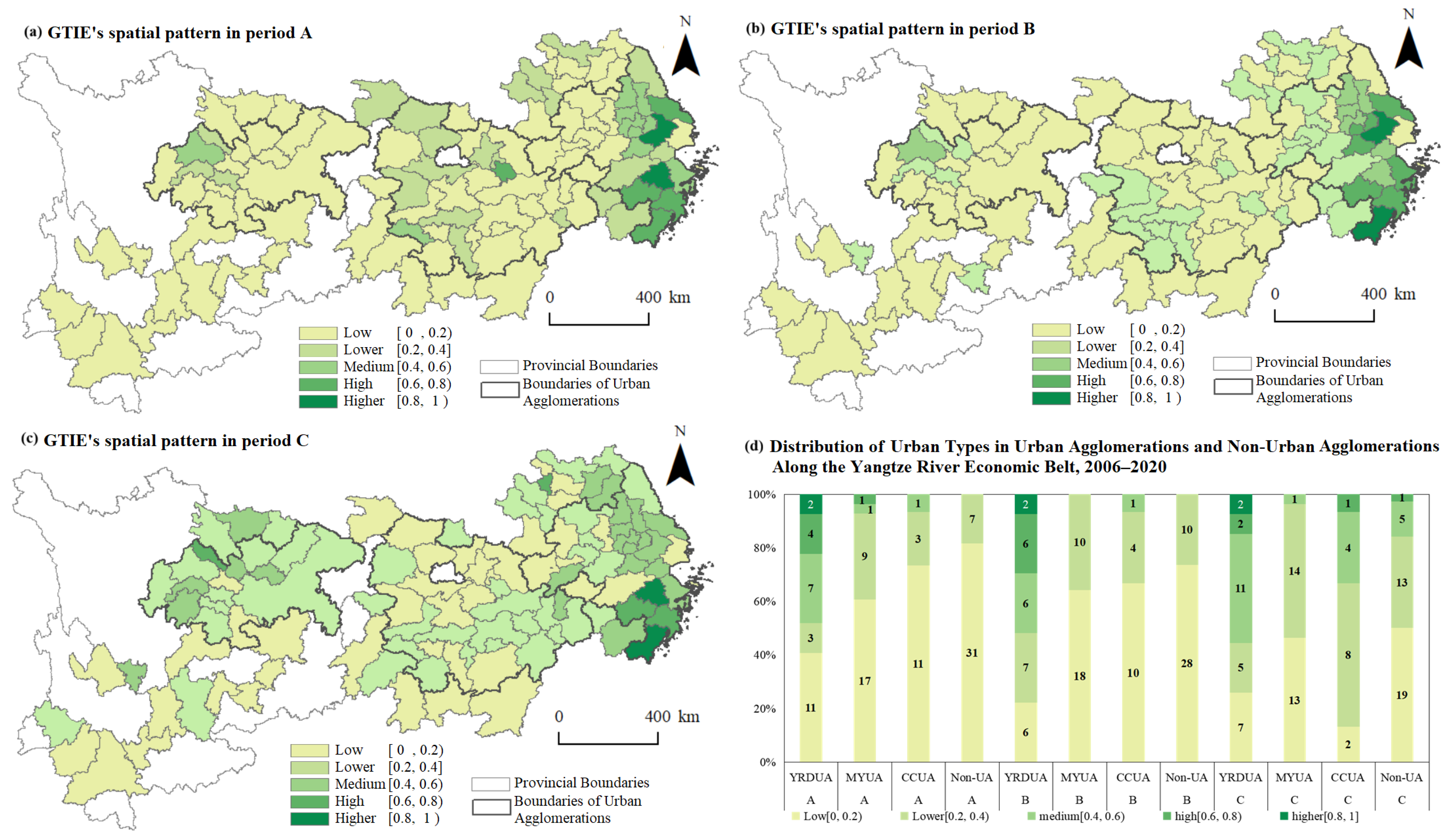
The total efficiency calculated using the multiplicative model is the product of the two sub-stages’ efficiencies. Consequently, the conditions for achieving DEA efficiency in green technological innovation are more stringent. A city can only achieve DEA efficiency in green technological innovation when both its technological innovation stage and green production stage efficiencies are on the production frontier. This study then examined the spatial distribution pattern of GTIE among 108 cities in the Yangtze River Economic Belt from 2006 to 2020, as well as the distribution of urban types in urban agglomerations and non-urban agglomerations. In Figure 2a–c represent the periods 2006–2010 (11th Five-Year Plan period), 2011–2015 (12th Five-Year Plan period), and 2016–2020 (13th Five-Year Plan period), respectively.
Combined with the spatial distribution characteristics, during the period of 2006–2010, there were seven cities in the YREB with GTIE at a relatively high or high development level, which were mainly distributed in the eastern coastal areas. Among them, Suzhou and Shaoxing performed prominently, with both being in the high-level interval, while only Huangshi in the central region achieved a relatively high level of development. Overall, during this period, GTIE showed a significant spatial imbalance pattern of “high in the east and low in the west,” but no obvious spatial agglomeration characteristics of urban agglomerations had been formed yet. In 2017, the report of the 19th National Congress of the Communist Party of China proposed to “take urban agglomerations as the main body to build an urban pattern of coordinated development of large, medium and small cities and small towns”. Promoting internal coordinated development, with urban agglomerations as the core, is considered the only way to achieve the integration of the Yangtze River Economic Belt. The Yangtze River Economic Belt includes three national-level urban agglomerations—YRDUA (27 cities), MYUA (28 cities), and CCUA (15 cities)—covering a total of 70 cities across seven provinces and two municipalities. Under policy guidance, from 2011 to 2015, the number of cities with low-level GTIE decreased from 70 to 62. Although the overall pattern of “high in the east and low in the west” had not been fundamentally improved, the GTIE showed a trend of gradually diffusing from the east to the central region. Especially within the Yangtze River Delta Urban Agglomeration, the overall level of GTIE had been comprehensively improved, and a relatively significant spatial characteristic of “high–high agglomeration” had been formed. Between 2016 and 2020, the spatial distribution of GTIE tended to be balanced, and cities at medium and higher levels were mainly concentrated in the three major urban agglomerations. Therefore, the Yangtze River Economic Belt had basically achieved internal integrated development with urban agglomerations as the units.
From the comparison between urban agglomerations and non-urban agglomerations, during the period of 2006–2020, the proportion of cities with low GTIE was relatively high in non-urban agglomeration areas; by contrast, in urban agglomerations, especially the YRDUA, there were more cities in the medium-high and relatively high efficiency intervals. Taking the period 2006–2010 as an example, the number of medium- and high-efficiency cities in the YRDUA was significantly higher than that in the MYUA and CCUA, while non-urban agglomeration areas were dominated by low-efficiency cities. This shows that urban agglomerations play a key role in promoting the improvement of regional GTIE by virtue of their comprehensive advantages in resource agglomeration, flow of innovation factors, and industrial linkages; in contrast, non-urban agglomeration areas still have obvious shortcomings in innovation-driven and industrial transformation, and there is a need to further strengthen green innovation capabilities and industrial structure optimization. With the development of GTIE within the urban agglomerations, the development levels of adjacent areas outside of these agglomerations have also been effectively enhanced, revealing a spatial pattern where central cities within an agglomeration drive the development of surrounding cities.

3.1.2. Spatial–Temporal Evolution of Synergistic Development Between TIE and GCP

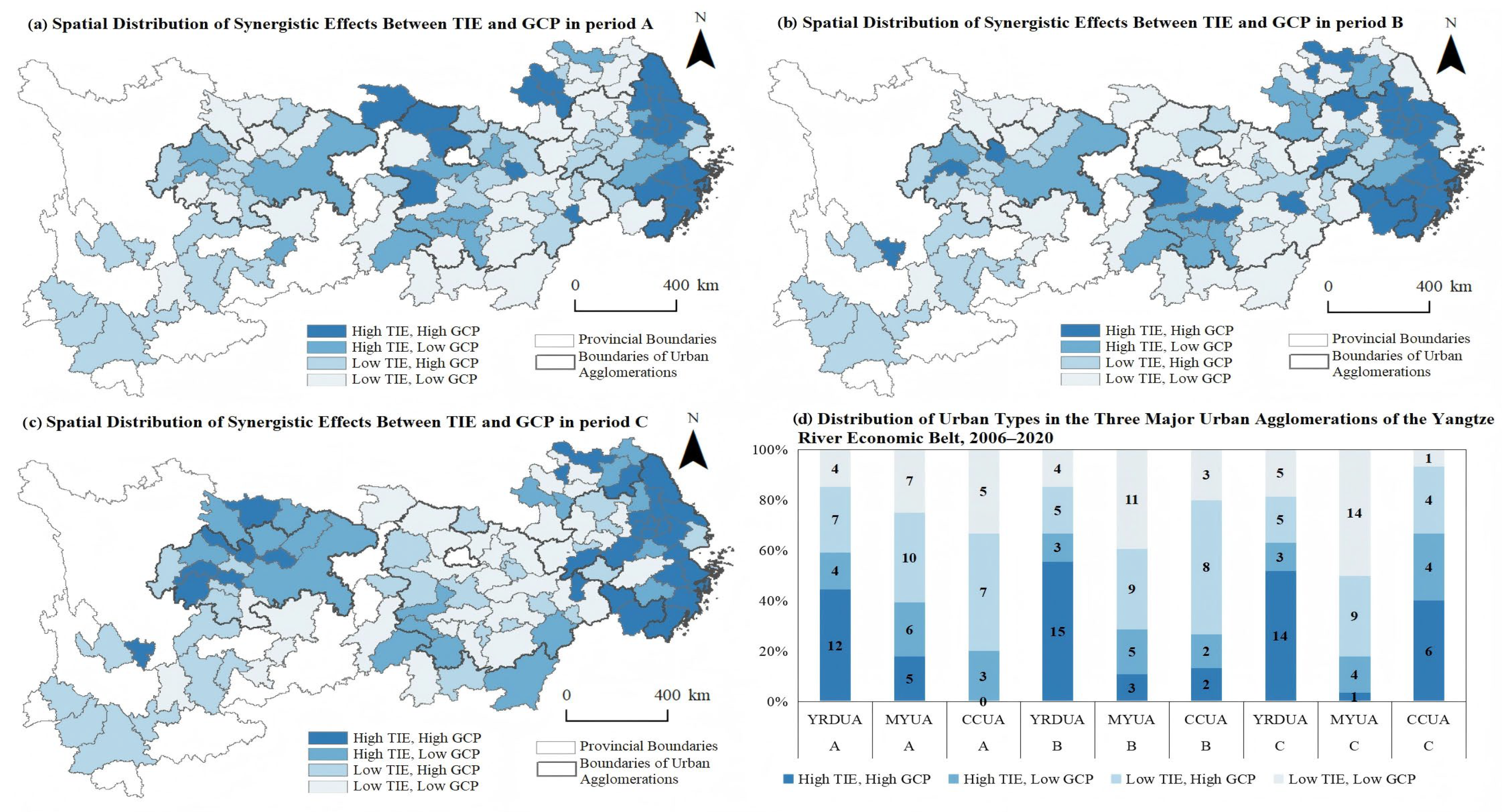
Taking the mean values of Technological Innovation Efficiency (TIE) and Green Production Capacity (GCP) as the dividing lines (values higher than the mean are defined as high level, and those lower than the mean as low level), the 108 cities in the Yangtze River Economic Belt (YREB) were classified into four types: “high TIE–high GCP”, “high TIE–low GCP”, “low TIE–high GCP”, and “low TIE–low GCP” (in Figure 3a–c). Based on this classification, the synergistic development pattern of TIE and GCP in the YREB from 2006 to 2020 was analyzed. From the perspective of the spatial distribution results of synergistic effects, during the research period, the synergistic development level of TIE and GCP in the Yangtze River Delta Urban Agglomeration (YREUA) was generally stable, presenting a spatial pattern dominated by “high TIE–high GCP”-type cities. Moreover, such cities gradually diffused to adjacent areas outside the agglomeration, reflecting a clear innovation spillover effect. The synergistic development level of TIE and GCP in the Chengdu–Chongqing Urban Agglomeration (CCUA) improved significantly. There were no “high TIE–high GCP”-type cities from 2006 to 2010, but the number increased to 6 during the period 2016–2020, and only Luzhou remained in the “low TIE–low GCP” state. This transformation is closely related to the national strategic deployment for the Chengdu–Chongqing region. Since the Chengdu–Chongqing Economic Zone was included in the national planning preparation sequence in 2007, the region, relying on the two core cities of Chengdu and Chongqing, had gradually formed an industrial agglomeration and economic linkage corridor. After 2011, the industrial layout of the Chengdu–Chongqing Economic Zone continued to be optimized, and the infrastructure and transportation system were constantly improved. The formal implementation of the “Chengdu–Chongqing Urban Agglomeration Development Plan” in 2016 marked the CCUA as being upgraded to a national key development urban agglomeration, providing institutional guarantee and policy drive for the integration of regional collaborative innovation and green production. In contrast, the synergistic effect of TIE and GCP in the MYUA improved only slightly during the research period. From 2016 to 2020, the region was still dominated by resource- and labor-intensive industries, with relatively insufficient technological research and development and talent accumulation. Enterprises in the MYUA placed limited investment in green process innovation and faced high research and development as well as governance costs during the transformation process, making it difficult to achieve the simultaneous improvement of TIE and GCP. At the same time, there were significant development gaps within the MYUA in economic strength, technical level, and infrastructure construction between core cities such as Wuhan, Changsha and Nanchang and surrounding cities. The diffusion of green technology and the spillover effect of innovation were not significant, which restricted the overall collaborative development of the region.
Overall, relying on the advantages of a sound industrial foundation, as well as strong scientific and technological innovation capability and policy environment, the YREUA has played a significant leading role in promoting the synergistic development of TIE and GCP. The CCUA has achieved rapid catch-up with the support of policy orientation and transportation interconnection. However, the MYUA is still restricted by a single industrial structure and insufficient innovation elements, and the agglomeration needs to strengthen its investment in scientific and technological innovation and the construction of regional linkage mechanisms. It is evident that urban agglomerations play a key spatial carrier role in the synergistic development of regional green productivity, and the internal flow of innovation elements and the technology diffusion mechanism are the core driving forces for promoting the overall high-quality development of the Yangtze River Economic Belt.

3.2. Metric Inspection and Regression Analysis

3.2.1. Descriptive Statistics

Descriptive statistics were conducted for all variables, including the dependent variable, core explanatory variables, control variables, and moderator variables, and the results are shown in Table 1.

3.2.2. Empirical Research and Result Analysis

Before conducting the regression analysis, a correlation analysis and variance inflation factor (VIF) test were first performed on the variables. The results showed that the correlation coefficients between all variables were less than 0.6, and the maximum value of VIF was 1.63, so the problem of multicollinearity could be ruled out. Second, the LLC and Fisher–ADF methods were used to test the stationarity of the data. The results indicated that the first-order integrated sequences of all variables rejected the null hypothesis at the 1% significance level. Finally, the Pedroni, KAO, and Westerlund methods were further used to conduct a cointegration test on the panel data again. The results showed that the p-values corresponding to each statistic rejected the null hypothesis at the 5% significance level. Therefore, there was a cointegration relationship between the variables, and there was no spurious regression. At the same time, there may be an interaction between the development of urban green technological innovation and the network structure of the urban agglomeration where such innovation occurs; that is, on the one hand, the optimization of the urban agglomeration network structure helps to promote the flow of factors and technology spillover between cities and promote the development of green technological innovation; on the other hand, the improvement of the level of green technological innovation helps to optimize the network structure of the urban agglomeration. This two-way influence will create an endogenous problem due to the mutual causality between the urban agglomeration network structure and green technological innovation. Therefore, this study took the lag term of the explained variable as an instrumental variable and used the system GMM method to estimate the model in order to alleviate any endogenous bias inherent in the model.
(1)
Benchmark Regression Results
Based on the panel data of the three major urban agglomerations in the Yangtze River Economic Belt, this study conducted benchmark regressions using Equations (8)–(10), and the regression results are shown in Table 2. The results show that the influence coefficients of NSS_ECO on GTIE, TIE, and GCP are all significantly positive, indicating that with the continuous optimization of the spatial network structure of the urban agglomerations, the technical cooperation and factor flow between cities in these agglomerations will become more frequent, which will promote the diffusion and sharing of knowledge in the spatial dimension and reduce innovation costs, thereby significantly promoting the overall improvement of green technological innovation, technological research and development, and green production efficiency. From the comparison of coefficients, the direct promotion effect of NSS_ECO on TIE (0.720) is the most significant, while its influence on GCP (0.276) is relatively weak. This may be because technical factors and talent factors have stronger cross-regional mobility. Especially under the background of continuous improvement of transportation infrastructure and information network construction, the cross-spatial interaction effect of knowledge and information is more prominent. The results of the lag-term coefficients show that GTIE, TIE, and GCP all have a certain path dependence; that is, the higher the level of urban green technological innovation, the more ideal the green production process, innovation environment, and infrastructure conditions. With the continuous enhancement of technology accumulation and talent acquisition, it becomes easier for GTIE to achieve high-level growth in subsequent years. In addition, the regression coefficients of NSS_TIE and NSS_GCP are both significantly positive, indicating that the spatial network association structure of Technological Innovation Efficiency (TIE) and Green Production Capacity (GCP) plays a significant synergistic role in regional development. On the one hand, the stronger the spatial correlation of TIE within the urban agglomerations, the more significant its promotion effect on GCP; on the other hand, the denser the spatial network of GCP, the more prominent its positive enabling effect on TIE. This implies that there is a mutually promoting and advancing spatial synergistic relationship between the two. Overall, the integrated development of TIE and GCP within the urban agglomerations can effectively promote the coordinated evolution of technological research and development and green production. By breaking down spatial barriers between cities and strengthening the free flow of factors and resource sharing, the high-density spatial networks of TIE and GCP not only improve the allocation efficiency of innovation factors but also further amplify the synergistic growth effect between technological innovation and green production, promoting a high-quality leap in the overall productivity of the region.
(2)
Analysis of Heterogeneity Based on Industrial Structure
Considering that differences in industrial structure among cities may affect the mechanism by which the urban agglomeration network connection structure acts on GTIE, it is necessary to conduct a heterogeneity analysis from the perspective of industrial structure. The level of industrial structure upgrading is measured by the proportion of the added value of the tertiary industry to that of the secondary industry, which reflects the degree to which regional industries have shifted from a factor-driven type to an innovation-driven type. It can be seen from Table 3 that from the perspective of the economic connection structure of urban agglomeration spatial networks, NSS_ECO has a significant promoting effect on GTIE, TIE, and GCP, regardless of whether the regions under study have a high or low level of industrial structure upgrading. This indicates that the higher the level of economic integration of urban agglomerations in the YREB, the greater the positive effect on the development of green technological innovation. However, from the perspective of the spatial network TIE connection and GCP connection of urban agglomerations, the impact of NSS_TIE on GCP and the impact of NSS_GCP on TIE are only significantly promoted in regions with a high level of industrial structure upgrading. This is because the higher the level of industrial structure, the stronger the ability to gather innovative factors, and the greater the potential for technological connection and collaborative innovation among enterprises, which can better exert the transmission effect of the urban agglomeration network connection structure on green technological innovation. On the contrary, regions with relatively low-level industrial structures are still dominated by resource- or labor-intensive industries, with insufficient demand for green innovation and weak technology spillover effects, so the promoting effect of the network structure may be limited.
(3)
Robustness Test
To further test the robustness and reliability of the research results, this study conducted a robustness analysis by changing the measurement method of the explained variable. Specifically, the two-stage DEA additive model considering additional inputs was used to recalculate the GTIE, TIE, and GCP. On this basis, the GMM method was adopted to conduct re-regression analysis, and the results are shown in Table 3. From the regression results in Table 4, the coefficient signs and significance levels of each core variable are highly consistent with those of the benchmark regression results, indicating that the research conclusions have strong robustness under different indicator measurements and estimation methods. This shows that even when the variable measurement method is changed, factors such as the spatial network density of the three major urban agglomerations in the Yangtze River Economic Belt still have a significant promoting effect on various efficiencies, which further verifies the reliability and explanatory power of the benchmark regression results obtained in this study.

4. Discussion

This study reveals that GTIE in the YREB exhibits a spatial pattern evolution characterized by “core-led, periphery-driven” development alongside agglomeration growth. It demonstrates that agglomerations play a pivotal role in regional green technology innovation, with their development enhancing GTIE levels in surrounding cities through economic linkages and innovation network diffusion effects, ultimately advancing regional integration. This finding aligns closely with national and regional urban agglomeration strategies, further demonstrating that urban agglomerations serve not only as key drivers of economic growth but also as vital catalysts for green technology innovation [26]. Compared to provincial-level studies, this research reexamines the spatial distribution of GTIE at the economic belt scale, revealing new structural characteristics in regional disparities. Provincial-level studies typically indicate higher GTIE levels in eastern and central regions, with relatively lower levels in western and northeastern regions [27]. However, from the perspective of the YREB, with the acceleration of national strategic guidance and regional coordinated development, both eastern and western regions exhibit high GTIE levels. In contrast, central regions demonstrate relatively low GTIE levels due to their dominant industries leaning toward traditional production sectors, insufficient aggregation of innovation resources, and the failure to fully leverage their transportation hub functions as innovation advantages. This conclusion aligns with existing research on GTIE decomposition, which found that “efficiency in the technology R&D phase is higher in the eastern and western regions” [28]. This further indicates that the central region needs to leverage its geographical location and industrial foundation to strengthen green technology R&D investment and innovation capacity-building, thereby driving the overall improvement of China’s GTIE at the regional level.
Building upon this foundation, this study analyzes the promotional effects of urban agglomeration integration on the development of TIE and GCP from the perspective of spatial network linkage structures. Findings reveal that tighter economic ties within urban agglomerations facilitate greater collaborative sharing of innovation knowledge and green production practices among cities, thereby significantly enhancing GTIE development. Concurrently, by introducing the linkage density between TIE and GCP within urban agglomeration spatial networks and constructing a synergy model, this research validates the existence of a significant synergistic co-evolutionary relationship between the two within spatial networks. Heterogeneity analysis indicates that when industrial structure upgrading is low, the promotional effect of TIE linkage intensity on GCP is negligible. This suggests that advancing industrial structure upgrading is a critical pathway for achieving the synergistic development of TIE and GCP. This finding provides a new theoretical perspective for understanding the interactive relationship between green innovation and green production in the context of urban agglomerations.
Nevertheless, this study leaves room for further exploration in revealing the intrinsic mechanisms through which regional integration influences GTIE. Future research may consider developing a regional integration measurement index system to characterize its long-term driving effects on GTIE from a dynamic network perspective, thereby deepening theoretical and empirical studies on regional green innovation development pathways.

5. Conclusions and Recommendations

This study conducted a systematic investigation into the spatial characteristics and mechanisms of GTIE in the YREB. First, it constructed a GTIE measurement framework based on a two-stage DEA model, which scientifically depicts the internal structure of the green innovation process and the efficiency conversion mechanism. Second, from the spatial perspective of urban agglomerations, it systematically analyzed the spatiotemporal evolution characteristics of GTIE and revealed the coordinated evolution laws of TIE and GCP within different urban agglomerations. Finally, using the System GMM model, it explored the influence mechanism of the economic connection structure of urban agglomeration spatial networks on GTIE, TIE, and GCP, and uncovered the internal logic of how regional integration promotes the coordinated development of green technological innovation. The main research conclusions are as follows:
The GTIE of the YREB shows significant phased evolution and regional differentiation characteristics in both temporal and spatial dimensions. The overall trend evolves from a spatially unbalanced pattern of “high in the east and low in the west” to a pattern of “coordinated improvement centered on urban agglomerations,” reflecting the continuous enhancement of the agglomeration effect and the spatial spillover effect of green innovation activities within urban agglomerations. The YRDUA has taken the lead in forming a relatively complete innovation system and industrial coordination mechanism, becoming a core growth pole that leads to the improvement of green technological innovation and green production efficiency.
Regarding the coordinated development level of TIE and GCP, the YRDUA has always maintained a high-level coordinated development pattern of “high TIE–high GCP” and has driven the efficiency improvement of surrounding areas through innovation spillover effects; the CCUA has achieved a rapid transformation from low coordination to high coordination, driven by national policy support and transportation interconnection, showing a significant latecomer catch-up effect; however, the MYUA is constrained by a heavy industrial structure, insufficient accumulation of innovative factors, and development gaps within the agglomeration, leading to limited improvement in the synergy between TIE and GCP.
The economic connection structure of urban agglomeration spatial networks exerts a significant positive impact on GTIE, TIE, and GCP. Among these, the promotion effect on TIE is the most significant, while the effect on GCP is relatively weaker. In addition, GTIE, TIE, and GCP all exhibit clear path dependence characteristics, and there is a significant synergistic relationship between the spatial network connection structures of TIE and GCP. This indicates that the integrated development of TIE with GCP within urban agglomerations not only promotes the coordinated evolution of technological research and development and green production but also provides significant support for the sustainable development of the entire region.
This study reveals the pivotal role of urban agglomerations in driving the integration process of the YREB and enhancing its GTIE. To this end, differentiated strategies must be formulated from the perspective of urban agglomeration governance to promote the coordinated development of green technology R&D, diffusion, and application.
First, urban clusters should be regarded as organic wholes. By leveraging the resource endowments, locational advantages, and industrial linkages of MYUA, comprehensive multi-node transportation networks should be enhanced to strengthen connectivity and economic ties between cities. This will facilitate the efficient cross-regional flow and coordination of innovation factors—such as talent, technology, and capital—within the urban cluster. Second, holistic planning must be implemented. This involves optimizing the allocation of scientific research resources to enhance collaborative innovation efficiency during the R&D phase, while simultaneously accelerating the transformation of research outcomes into marketable and industrial applications. This establishes a comprehensive green technology support system spanning the entire chain of “R&D—Transformation—Dissemination.” Finally, efforts should focus on optimizing YREB’s industrial structure and spatial division of labor. This will provide a stable industrial foundation for the diffusion and spillover effects of green technologies within the regional spatial network, enhance industries’ capacity to absorb and further disseminate green technologies, and ultimately elevate the sustainable development level of the entire region.

Author Contributions

Conceptualization, Y.D.; Methodology, W.D.; Software, Y.D.; Validation, Y.D.; Formal analysis, W.D.; Resources, Y.D.; Writing—original draft preparation, W.D.; Writing—review and editing, Y.D. All authors have read and agreed to the published version of the manuscript.

Funding

This research received no external funding.

Institutional Review Board Statement

Not applicable.

Informed Consent Statement

Not applicable.

Data Availability Statement

The raw data supporting the conclusions of this article will be made available by the authors upon request.

Acknowledgments

We express our gratitude for the insightful comments and constructive suggestions provided during the peer-review process.

Conflicts of Interest

The authors declare no conflicts of interest.

References

  1. Han, D.; Sun, P.; Bi, C.; Shi, Z. Whether the development strategy of the Yangtze River Economic Belt can achieve the double welfare effects of synergistic governance of pollution control and carbon reduction? Urban Clim. 2024, 56, 102083. [Google Scholar] [CrossRef]
  2. Chen, D.; Li, Y.; Zhang, C.; Zhang, Y.; Hou, J.; Lin, Y.; Wu, S.; Lang, Y.; Hu, W. Regional coordinated development policy as an instrument for alleviating land finance dependency: Evidence from the urban agglomeration development. Land Use Policy 2024, 143, 107182. [Google Scholar] [CrossRef]
  3. Wang, Q.; Ren, S. Evaluation of green technology innovation efficiency in a regional context: A dynamic network slacks-based measuring approach. Technol. Forecast. Soc. Change 2022, 182, 121836. [Google Scholar]
  4. Liu, P.; Zhao, Y.; Zhu, J.; Yang, C. Technological industry agglomeration, green innovation efficiency, and development quality of city cluster. Green Financ. 2022, 4, 411. [Google Scholar]
  5. Xu, X.; He, Y.; Tan, Q.; Chen, X. Measurement and driving mechanisms of water use efficiency in the three major urban agglomerations in China from the perspective of green and sustainable development. Ecol. Indic. 2025, 178, 114094. [Google Scholar] [CrossRef]
  6. Zhao, X.; Hu, L.; Chen, X.; Ling, L. Energy-biased technological progress and green innovation: Evidence from Chinese cities. Renew. Energy 2025, 256, 124079. [Google Scholar] [CrossRef]
  7. Chen, X.; Chen, Y.; Huang, W.; Zhang, X. A new Malmquist-type green total factor productivity measure: An application to China. Energy Econ. 2023, 117, 106408. [Google Scholar]
  8. Yang, K.; Kuang, J. Can green location-oriented policy enhance urban green innovation efficiency? Evidence from national ecological industrial demonstration parks. J. Clean. Prod. 2025, 524, 146469. [Google Scholar] [CrossRef]
  9. Zuo, Z.; Guo, H.; Li, Y.; Cheng, J. A two-stage DEA evaluation of Chinese mining industry technological innovation efficiency and eco-efficiency. Environ. Impact Assess. Rev. 2022, 94, 106762. [Google Scholar] [CrossRef]
  10. Yang, H.; Zhang, X.; Liu, B.; Huang, Y. Evaluation of green low-carbon innovation development efficiency: An improved two-stage non-cooperative DEA model. J. Clean. Prod. 2023, 400, 136662. [Google Scholar] [CrossRef]
  11. Wu, J.; Wang, S.; Zhang, R.; Zhao, M.; Sun, X.; Qie, X.; Wang, Y. Measurement of green innovation efficiency in Chinese listed energy-intensive enterprises based on the three stage Super-SBM model. Int. Rev. Econ. Financ. 2025, 97, 103819. [Google Scholar] [CrossRef]
  12. Jie, H. Overall optimization model of efficiency and performance of green technology innovation. Sustain. Comput. Inform. Syst. 2021, 30, 100501. [Google Scholar] [CrossRef]
  13. Kao, C.; Huang, S.N. Efficiency decomposition in two-stage data envelopment analysis: An application to non-life insurance companies in Taiwan. Oper. Res. 1995, 180, 418–429. [Google Scholar] [CrossRef]
  14. Lin, T.; Chen, Z. Does market integration promote green technology innovation? Evidence from China. Front. Environ. Sci. 2022, 10, 1097616. [Google Scholar] [CrossRef]
  15. Wang, M.; Li, Y.; Wang, Z.; Shi, Y. The synergy impact of external environmental pressures and corporate environmental commitment on innovations in green technology. Corp. Soc. Responsib. Environ. Manag. 2024, 31, 854–878. [Google Scholar] [CrossRef]
  16. Bataineh, M.J.; Sánchez-Sellero, P.; Ayad, F. Green is the new black: How research and development and green innovation provide businesses a competitive edge. Bus. Strategy Environ. 2024, 33, 1004–1023. [Google Scholar] [CrossRef]
  17. Sun, Y.M.; Mei, X.; Zhan, S.M. A Study on the Temporal and spatial pattern and driving forces of green technology innovation in Yangtze River Delta urban agglomeration. J. Jianghuai Trib. 2021, 1, 13–22, 61. (In Chinese) [Google Scholar]
  18. Wang, L.; Zhang, F.; Zang, Y.; Duan, J. Understanding the regional integration process from the perspective of agglomeration and urban networks: Case study in central China. Int. J. Environ. Res. Public Health 2022, 19, 12834. [Google Scholar] [CrossRef]
  19. Chai, D.; Du, J.; Yu, Z.; Zhang, D. City network mining in China’s Yangtze river economic belt based on “two-way time distance” modified gravity model and social network analysis. Front. Phys. 2022, 10, 1018993. [Google Scholar] [CrossRef]
  20. Tian, Y.; Mao, Q. The effect of regional integration on urban sprawl in urban agglomeration areas: A case study of the Yangtze River Delta, China. Habitat Int. 2022, 130, 102695.20. [Google Scholar] [CrossRef]
  21. Li, Y.J.; Chen, Y.; Liang, L.; Xian, J.H. DEA models for extended two-stage network structures. Omega 2012, 40, 611–618. [Google Scholar] [CrossRef]
  22. Ma, J.F.; Qi, L.N.; Deng, L.Z. DEA efficiency evaluation of hybrid two-stage system with additive inputs. J. Syst. Eng. 2020, 35, 276–288. (In Chinese) [Google Scholar]
  23. Liu, L.; Luo, J.; Xiao, X.; Hu, B.; Qi, S.; Lin, H.; Zu, X. Spatio-Temporal Evolution of Urban Innovation Networks: A Case Study of the Urban Agglomeration in the Middle Reaches of the Yangtze River, China. Land 2022, 11, 597. [Google Scholar] [CrossRef]
  24. Lu, L.W.; Song, D.Y.; Huang, C. Measurement on the green total factor productivity of YREB: Taking 108 cities for example. J. Urban Probl. 2017, 01, 61–67. (In Chinese) [Google Scholar]
  25. Lu, X.J.; Shi, P.F.; Deng, Z.W.; Li, X.; Hu, Y. Calculation of green production efficiency of tourism in YREB and analysis of its spatial and temporal evolution. China Popul. Resour. Environ. 2019, 29, 19–30. (In Chinese) [Google Scholar]
  26. Yin, H.; Zhang, Z.; Wan, Y.; Gao, Z.; Guo, Y.; Xiao, R. Sustainable network analysis and coordinated development simulation of urban agglomerations from multiple perspectives. J. Clean. Prod. 2023, 413, 137378. [Google Scholar] [CrossRef]
  27. Li, Y.; Fang, Y.; Meng, Q. Spatial pattern evolution and driving factors of urban green technology innovation in China. J. Geogr. Sci. 2024, 34, 289–308. [Google Scholar] [CrossRef]
  28. Li, M.; Chen, Y. Evaluation and spatiotemporal evolution of green innovation efficiency in China: A two-stage value chain perspective. Eng. Manag. Prod. Serv. 2024, 16, 48–68. [Google Scholar] [CrossRef]
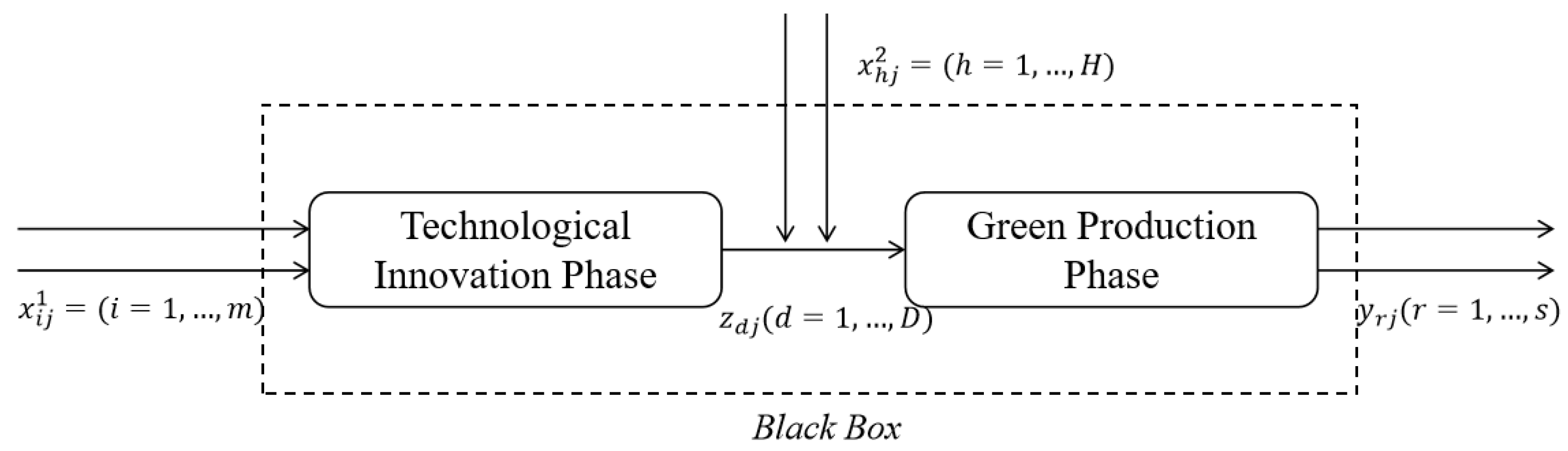
Figure 1. Green technological innovation process in the YREB.
Sustainability 17 09689 g001
Figure 2. The spatial distribution pattern of GTIE among 108 cities in the YREB from 2006 to 2020.
Sustainability 17 09689 g002
Figure 3. Spatial–temporal evolution of synergistic development between TIE and GCP from 2006 to 2020.
Sustainability 17 09689 g003
Table 1. Descriptive statistics of study variables.
VariableObsMeanStd. Dev.Min.Max.
TIE10500.3400.2360.0281.000
GCP10500.8400.1590.3621.000
GTIE10500.2890.2190.0281.000
NSS_ECO10500.0640.0510.0040.187
NSS_TIE10500.0640.0420.0130.152
NSS_GCP10500.0640.0220.0290.110
Ur105054.83713.28821.30089.6
Dig10501.2340.9630.1088.609
Gov10500.1550.0570.0570.675
Out10500.0250.0200.0000.117
Mar10501.3100.9310.05217.141
Table 2. Benchmark regression results.
VariableGTIETIEGCPTIEGCP
L.GTIE0.660 ***
(0.089)
L.TIE 0.667 *** 0.691 ***
(0.098) (0.104)
L.GCP 0.660 *** 0.578 **
(0.089) (0.086)
NSS_ECO0.701 ***0.720 ***0.276 **
(0.201)(0.228)(0.134)
NSS_TIE 0.353 **
(0.140)
NSS_GCP 1.574 ***
(0.545)
Control VariablesYesYesYesYesYes
ConstantsYesYesYesYesYes
AR(1)0.0000.0000.0000.0000.000
AR(2)0.3000.2090.1190.2480.115
Sargan0.7100.4900.7840.9800.918
Note: Standard errors are shown in parentheses. **, and *** indicate significance at the 5% and 10% levels, respectively.
Table 3. Heterogeneity analysis.
VariableHigh-Advanced Industrial StructureLow-Advanced Industrial Structure
GTIETIEGCPTIEGCPGTIETIEGCPTIEGCP
L.GTIE0.582 *** 0.627 ***
(0.129) (0.121)
L.TIE 0.618 *** 0.646 *** 0.641 *** 0.635 ***
(0.129) (0.126) (0.138) (0.141)
L.GCP 0.651 *** 0.362 ** 0.566 ***1.324 **0.578 ***
(0.142) (0.151) (0.123)(0.553)(0.124)
NSS_ECO0.651 **0.570 **0.341 * 0.764 ***0.750 **0.248
(0.267)(0.289)(0.186) (0.275)(0.328)(0.179)
NSS_TIE 0.454 ** 0.273
(0.219) (0.179)
NSS_GCP 1.506 ***
(0.539)
Control VariablesYesYesYesYesYesYesYesYesYesYes
ConstantsYesYesYesYesYesYesYesYesYesYes
AR(1)0.0000.0000.0000.0000.0000.0000.0000.0000.0000.000
AR(2)0.6630.1570.8020.1910.8650.2720.2490.9180.2610.877
Hansen0.7870.8500.9220.6970.8530.3870.2920.8890.2800.895
Note: Standard errors are shown in parentheses. *, **, and *** indicate significance at the 1%, 5% and 10% levels, respectively.
Table 4. Robustness test.
VariableGTIETIEGCPTIEGCP
L.GTIE0.574 ***
(0.064)
L.TIE 0.539 *** 0.506 ***
(0.066) (0.072)
L.GCP 0.603 *** 0.752 ***
(0.128) (0.196)
NSS0.461 ***0.496 ***0.472 **
(0.149)(0.168)(0.211)
NSS_TIE 0.425 ***
(0.232)
NSS_GCP 1.426 ***
(0.316)
Control VariablesYesYesYesYesYes
ConstantsYesYesYesYesYes
AR(1)0.0000.0000.0000.0000.000
AR(2)0.4390.3180.2340.3520.231
Hansen0.8110.8840.1990.6980.374
Note: Standard errors are shown in parentheses. **, and *** indicate significance at the 5% and 10% levels, respectively.
Disclaimer/Publisher’s Note: The statements, opinions and data contained in all publications are solely those of the individual author(s) and contributor(s) and not of MDPI and/or the editor(s). MDPI and/or the editor(s) disclaim responsibility for any injury to people or property resulting from any ideas, methods, instructions or products referred to in the content.