Article

Analysis of Dynamic Risk Transmission in Cascade Reservoirs Driven by Multi-Objective Optimal Operation

1
School of Water Conservancy and Civil Engineering, Northeast Agricultural University, Harbin 150030, China
2
Hebei Handan Hydrological Survey and Research Center, Handan 056001, China
3
Heilongjiang Provincial Water Conservancy and Hydroelectric Power Investigation, Design and Research Institute, Harbin 150080, China
4
College of Sciences, Shihezi University, Shihezi 832003, China
*
Author to whom correspondence should be addressed.
Sustainability 2025, 17(21), 9623; https://doi.org/10.3390/su17219623
Submission received: 14 August 2025 / Revised: 24 October 2025 / Accepted: 27 October 2025 / Published: 29 October 2025

Abstract

The numerous uncertainties in the process of water resource development and utilization bring multiple risks to water resource management. To enhance socio-economic benefits while considering ecological benefits, it is urgent to deeply explore risks. In this paper, Nuozhadu, Jinghong, and Ganlanba hydropower stations on the lower reaches of the Lancang River are taken as the objects. To balance the socio-economic and ecological benefits, a multi-objective optimization operation model was constructed. To describe the risk transmission, a VAR model was constructed, and the dynamic transmission among risks was explored. The results show that the ratio of ecological change is 10.38%, and the cascade power generation is 33,243 GWh (2% higher than the designed). The impacts of the perturbation for each risk on itself and others are quantitatively analyzed by the impulse response function. It is concluded that the transmission direction is generally positive, but the increase in ecological risk has negative impacts on risks of output and abandoned water, and risks of power generation and output also negatively affect abandoned water risk. Finally, the risk transmission is quantitatively estimated by the variance decomposition method. It is concluded that the power generation risk contributes most to the output and ecology risks, the ecological risk only contributes significantly to the abandoned water risk (the contribution rate is 6.30%), and the abandoned water risk contributes a lot to the others.

1. Introduction

Cascade reservoirs, as an important component of modern water resource management, play a crucial role in flood control, power generation, improving navigation, and promoting regional economic development [1,2,3]. However, with the increasing demand for water resources and the uncertainty brought by climate change, the operation of cascade reservoirs is facing challenges [4,5]. This is particularly true in multi-objective optimization operations, where the complex interactions among competing objectives can lead to conflicts and compromise the overall benefits. For example, to maximize the benefits of power generation, a reservoir typically needs to maintain a high water level. This practice can weaken the flood control capacity of the reservoir, potentially posing a threat to downstream areas and adversely affecting the ecological health of the river. Similarly, under extreme weather conditions, high storage may need to be released to ensure downstream flood control safety, thereby sacrificing the power generation benefits [6,7,8]. These operational conflicts highlight the pressing need for sustainable management strategies that can balance competing demands while maintaining ecosystem integrity [9,10,11].
It is particularly important to deeply understand the dynamic risk transmission mechanism of multi-objective optimization of cascade reservoirs [12,13,14]. It involves identifying and evaluating risk factors in the process of reservoir operation and exploring how these risks interact and propagate among the operation objectives. Such understanding is fundamental to advancing sustainable water resource management, as it enables the development of operational frameworks that enhance system resilience while minimizing environmental impacts. Therefore, comprehensive and accurate information can be provided to decision-makers by revealing the regular patterns of risk transmission for a series of balanced decisions among operational objectives to achieve the overall efficiency improvement and sustainability enhancement of water resource management [15,16].
At present, researchers have made progress in developing multi-objective optimization models of cascade reservoirs. These models are intended to balance multiple objectives (such as flood control, power generation, shipping, and sediment control) by integrating advanced algorithms and technologies [17,18,19]. For example, Liu [20] proposed a multi-objective operation model based on parallel approximate evaluation and a long short-term memory neural network for quickly formulating operation laws for cascade reservoirs. Jing [21] proposed a set of multi-objective coordination principles for reservoirs based on the theory of synergy and constructed an optimization model. However, research on the dynamic transmission of risks during the process of multi-objective optimization operation of cascade reservoirs is still relatively lagging.
Currently, research on risk transmission of reservoir operations is still emerging without a comprehensive quantitative framework for analyzing multiple risks, which limits scholars from having an in-depth understanding of the complex relationship of the multiple risks promoted by reservoir operations. Liu [22] used the Newsboy theory for reservoir risk management and revealed the impact of multiple risk sources on the real-time risk process of saline tides in reservoirs. Zhang [23] constructed a risk operation model at a tolerable risk level and proposed operation scenarios that consider both single risks and multiple risks. Lu [24] established a risk analysis model that considers both upstream and downstream to evaluate the impact of multiple risk sources with spatiotemporal correlations on reservoir flood control operation. The above studies have provided valuable insights into the research on risk transmission of reservoir operation, but most of them focused on the assessment and management of a single risk or special risk sources from reservoir operation. There is still a lack of systematic and quantitative methods for the transmission relationship among multiple risks (such as power generation risk, ecological risk, and output risk) from the complex reservoir operation system. These risks may come from factors such as uncertainty in inflow, changes in operation demands, and fluctuations in external conditions (such as climate change), and propagate through the complex relationships within the cascade reservoir system. Therefore, it is crucial to fully reveal the mechanisms and laws of dynamic risk transmission to ensure the reliable and efficient operation of cascade reservoirs and the maximization of the comprehensive benefits.
This paper presents a novel application of the vector autoregressive (VAR) model to study risk transmission in reservoir operations. The VAR model, as a classic econometric model, performs well in analyzing the dynamic relationships of all endogenous variables in a system [25,26]. The key methodological requirement is a framework that can capture bidirectional feedback and time-lagged effects among risk factors. The VAR model is selected because it meets this requirement by treating all variables as endogenous within a system. This allows us to move beyond static analysis and employ impulse response functions to visualize how a risk shock propagates and variance decomposition to identify the dominant risk sources in the cascade system. It is possible to quantitatively analyze the mutual influence and transmission relationship of risks in the cascade reservoir operation system by constructing a VAR model to provide accurate support for decision-makers. Recently, the VAR model has gradually become widely applied in the field of water resources. For example, Liu [27] used the VAR model to reveal the bidirectional dependence between multi-source water resource types and vegetation, and Zhang [28] analyzed the dynamic relationship between soil moisture and vegetation productivity. These studies provide useful insights and references for the application of the VAR model in the study of risk transmission in reservoir operations.
In this paper, the Nuozhadu (NZD), Jinghong (JH), and Ganlanba (GLB) hydropower stations on the lower reaches of the Lancang River (LCR) are taken as research subjects, and a multi-objective optimization operation model with objectives focusing on power generation and ecological protection was constructed. Moreover, key risk factors from multi-objective operation were identified and evaluated, and a risk factor dynamic transmission framework based on the VAR model was constructed. The impulse response function (IRF) and variance decomposition method (VDM) were used to quantitatively evaluate the dynamic transmission relation of risks in the operation system.

2. Study Area and Data

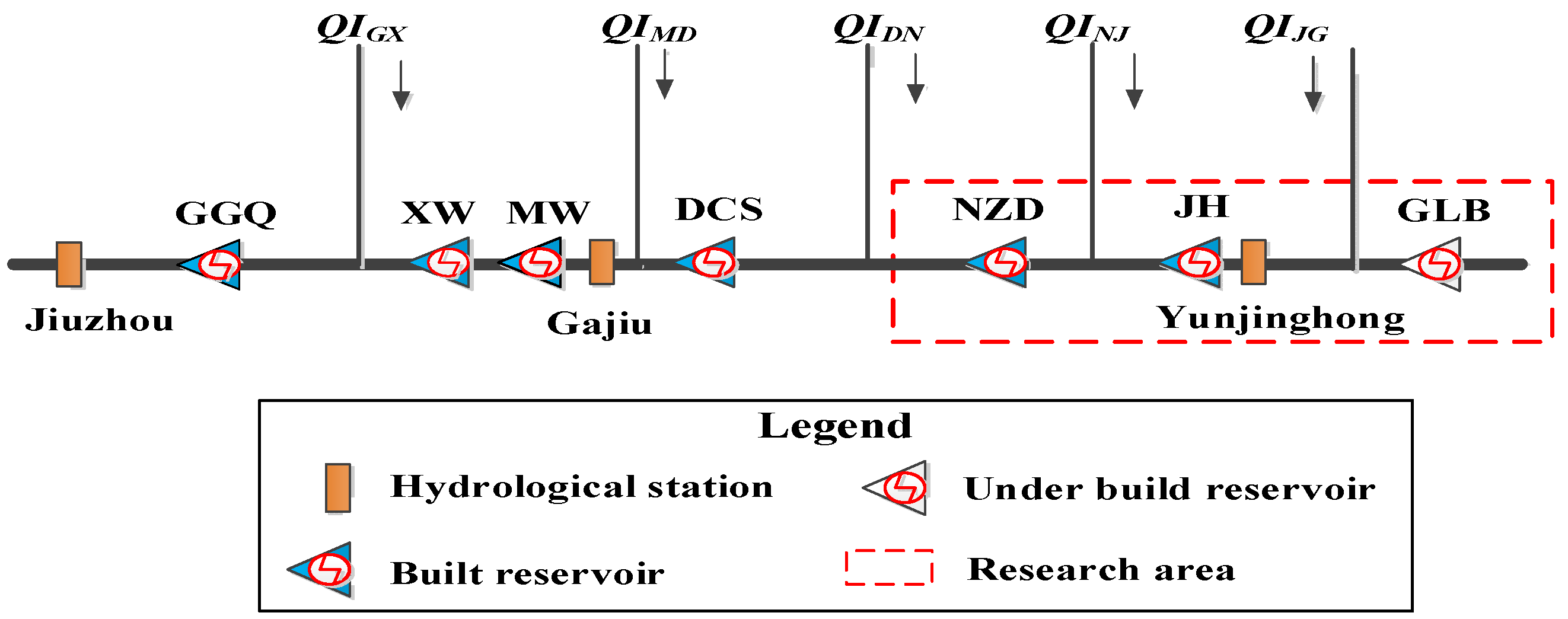
The lower reaches of the LCR were selected as the study area (Figure 1), which is an international river originating in Qinghai Province, China. With a total length of 4880 km and a length of 2139 km within China, the LCR flows through Laos, Myanmar, Thailand, Cambodia, and Vietnam; the whole river is known as the Mekong River. The LCR watershed covers an area of 16.74 × 10⁴ km2, with an annual mean streamflow of 74.15 billion m3 [23,29,30]. The operation of the cascade reservoirs in this basin is central to a complex water management puzzle, where multiple competing demands coexist. Among these, the conflict between hydropower generation and ecological conservation was widely identified as the most pressing and fundamental trade-off [31,32]. In the middle and lower reaches of the LCR, seven cascade hydropower stations are planned, including Gongguoqiao (GGQ), Xiaowan (XW), Manwan (MW), and Dachaoshan (DCS) on the middle reaches, and Nuozhadu (NZD), Jinghong (JH), and Ganlanba (GLB) on the lower reaches (Figure 2). In this study, NZD, JH, and GLB hydropower stations on the lower reaches of LCR are taken as the research objects, and the ecological operation mode, economic (mainly for the power generation) operation mode, and risks generated during the operation process are studied [33,34].
The normal high water levels of NZD and JH hydropower stations are 812 m and 602 m, respectively, with corresponding storages of 23.7 billion m3 and 0.309 billion m3. The total installed capacities are 5850 MW and 1750 MW, and the firm outputs are 2400 MW and 780 MW; the annual mean power generation of NZD is 23,900 GWh and JH is 7800 GWh. In addition, the NZD hydropower station has a multi-year regulation capability, but JH only has a seasonal capability. GLB, only for daily, serves as the reregulating reservoir for JH, and the main tasks are for power generation in regard to ecological water and downstream shipping [35].
The data utilized in this study include monthly measured runoff and reservoir operation data for NZD, JH, and GLB, which are provided by Huaneng Lancang River Hydropower Co., Ltd. [23].

3. Methods

3.1. Construction of Multi-Objective Operation Model for Cascade Reservoirs

Based on the monthly inflow runoff of NZD, JH, and GLB hydropower stations for 57 years, the multi-objective optimal operation model of the cascade reservoirs downstream of LCR is constructed for the objectives of maximum power generation and minimum ratio of ecology change (REC).

3.1.1. Objective Function

F = m a x ( f 1 , f 2 ) = λ 1 f 1 λ 2 f 2
f 1 = m a x t = 1 T m = 1 3 N ( m , t ) Δ t + m i n ( N b N m ) , 0
f 2 = m i n 1 T t = 1 T D t
D t = Q t m a x Q t Q t + Q t m a x , Q t > Q t m a x 0 Q t m i n Q t Q t + Q t m i n , Q t < Q t m i n
where F is the multi-objective function; f 1 and f 2 are the objective functions of power generation (a maximization objective) and ratio of ecological change (a minimization objective), respectively; the negative sign applied to λ 2 f 2 is a conventional technique to coherently integrate the minimization of f 2 into a unified maximization framework. It is critical to note that both f 1 and f 2 were normalized to dimensionless quantities within the range [0, 1] prior to the weighting process to eliminate the influence of differing units and scales, ensuring a fair and balanced aggregation. λ 1 and λ 2 are the weights of sub-objective functions; N ( m , t ) is the output of the hydropower plant n at time t (MW); N m is the mean output of cascade hydropower plants in dry seasons (MW); N b represents the designed guaranteed output (MW); Δ t is the length of time interval (s); D t represents the distance between the discharge of a hydropower plant and the suitable ecological water demand; Q t is the discharge (m3/s); Q t m i n and Q t m a x are the lower and upper limits of the suitable ecological water demand, respectively; m is the number of cascade reservoirs [33].

3.1.2. Constraints

The main constraints of the model are described in Table 1.
V ( t ) and V ( t + Δ t ) are the storage capacities at the beginning and ending of the hydropower station at time t, and Q I ( t ) and Q O ( t ) are the inflow and outflow of the hydropower station at time t; Z ( m , t ) , Z m a x ( m , t ) , and Z m i n ( m , t ) are the water level and the upper and lower limits of the water level at the t-time of the m-power station, and the water level Z ( m , t ) is the decision variable in the optimization model; Q ( m , t ) , Q m a x ( m , t ) , and Q m i n ( m , t ) are the discharge and the upper and lower limits of the discharge at the t-time of the m-power station, respectively; N max ( m , t ) and N min ( m , t ) represent the upper and lower limits of output at the t-time of the m-power station; Q m is the minimum navigable flow of the m-power station, and Q m = 504   m 3 / s ; Q F ( m , t ) , Q F m a x ( m , t ) , and Q F m i n ( m , t ) represent the power generation flow of the m-power station and the upper and lower limits of the power generation flow at the t-time of the m-power station, respectively; Other variables are the same as above.

3.2. Solution Approach of Multi-Objective Model

(1)
GA solution
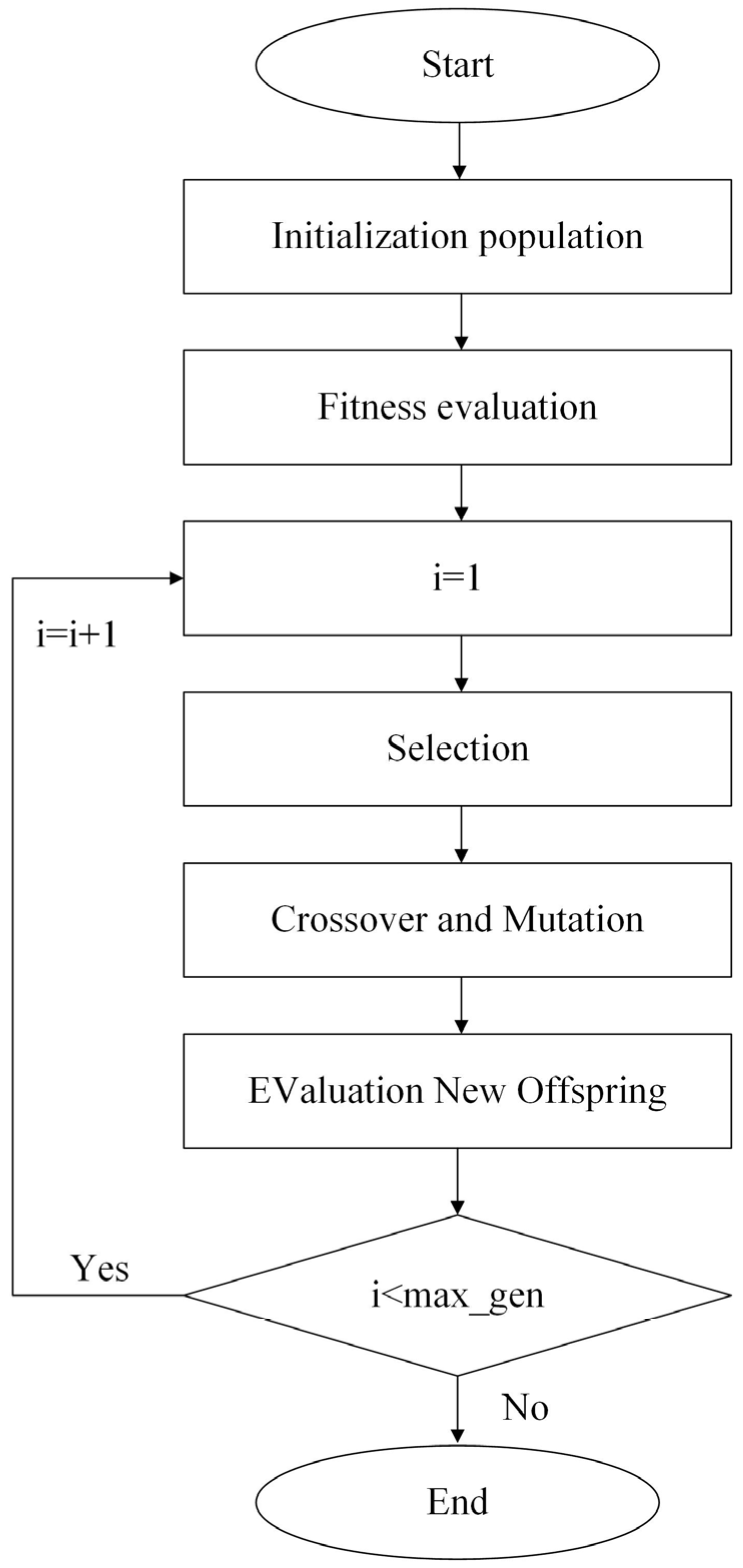
The GA method was adopted to solve the reservoir operation model in this study [23,33]. A real-coded genetic algorithm was custom-developed to solve the optimization model. Real coding was chosen as it directly represents the continuous decision variables of reservoir operations. The flowchart of ga is shown in Figure 3, and the steps of GA can be summarized as follows:
Step 1: Initialize the population.
Step 2: Calculate the fitness of each chromosome.
Step 3: Select the parent chromosomes by the random selection method or the roulette wheel method.
Step 4: Perform crossover, mutation, and selection strategies on the population to obtain the offspring.
Step 5: Repeat the above steps. When all evolution generations are completed, output the final optimal solution. Otherwise, repeat Step 2 to Step 4.
In this study, the GA was implemented with a population size of 100 and evolved for 2000 generations. The algorithm utilized tournament selection, simulated binary crossover (SBX) with a probability of 0.7, and polynomial mutation with a probability of 0.3. In order to combine the optimal algorithm and hydropower plant operation in practice and narrow down the search space and the optimization time, the low and up limits of the water levels are constantly revised using a dynamic water balance model that incorporates inflow and antecedent water levels, in addition to the constraint sets in each time interval [35].
(2)
The decision-making of the multi-objective operation model
The entropy weight method (EW) and gray relational analysis method (GR) are used to select the optimal solution set and determine the weight coefficients of the sub-objective in the multi-objective operation model.
(1)
Determine weights by using the EW method
The rationality of the scheme evaluation in the EW method [36] depends on the conversion between entropy value and entropy weight. The judgment matrix is used to determine the weights of indicators (in this paper this is for the sub-objectives), and the steps are as follows:
a.
Construct the judgment matrix R of n evaluation indicators for m events:
R = ( x i j ) n m
b.
Normalize the judgment matrix:
b i j = x i j x m i n x m a x x m i n
c.
Determine the entropy of evaluation indicators:
H i = 1 ln m j = 1 m f i j ln f i j
f i j = 1 + b i j j = 1 m ( 1 + b i j )
d.
Calculate the entropy weights of the evaluation indicators:
W = ( W i ) 1 × n
W i = 1 H i i = 1 n H i ,   i = 1 n W i = 1
where x m i n and x m a x are, respectively, the least satisfactory and most satisfactory values of events m under the same indicator conditions; H is the entropy of the indicator; W is the entropy weight of the indicator.
(2)
Determine the optimal solution with the GR method
The main idea of the GR analysis method [37] is to find the ideal optimal solution and then determine the similarity between the actual curve of the solution and the ideal curve to determine the membership degree. Therefore, the evaluated objects are made a comprehensive comparison and ranking. The total number of schemes (n) in this paper is 14, the judgment indicator (m) is 6, and the standardized evaluation indicator is generated as follows: x 1 , x 2 , , x m , x i = [ x i ( 1 ) , x i ( 2 ) , , x i ( n ) ] , i = 1 , 2 , , m . Assuming x 0 is an ideal solution, the correlation coefficient between x 0 and x i is as follows:
ξ i ( k ) = Δ m i n + ρ Δ m a x Δ i ( k ) + ρ Δ m a x , i = 1 , 2 , , n ; k = 1 , 2 , , m
The membership degree between the i-th evaluation scheme and the ideal scheme is shown in Equation (12):
γ i = k = 1 m W k ξ i ( k )
where Δ m i n = m i n i m i n k x 0 k x i ( k ) ; Δ m a x = m a x i m a x k x 0 k x i ( k ) ; ρ is the resolution coefficient, ρ [ 0 , 1 ] .
(3)
Coupling of EW and GR for Optimal Solution Selection
a.
According to the decision variables of different schemes, the evaluation indexes of each scheme are calculated;
b.
The entropy weight method is used to calculate the weight of different evaluation indexes;
c.
The weights and evaluation indexes are used to evaluate different schemes, and the optimal scheme is selected.
(4)
Methodological procedure
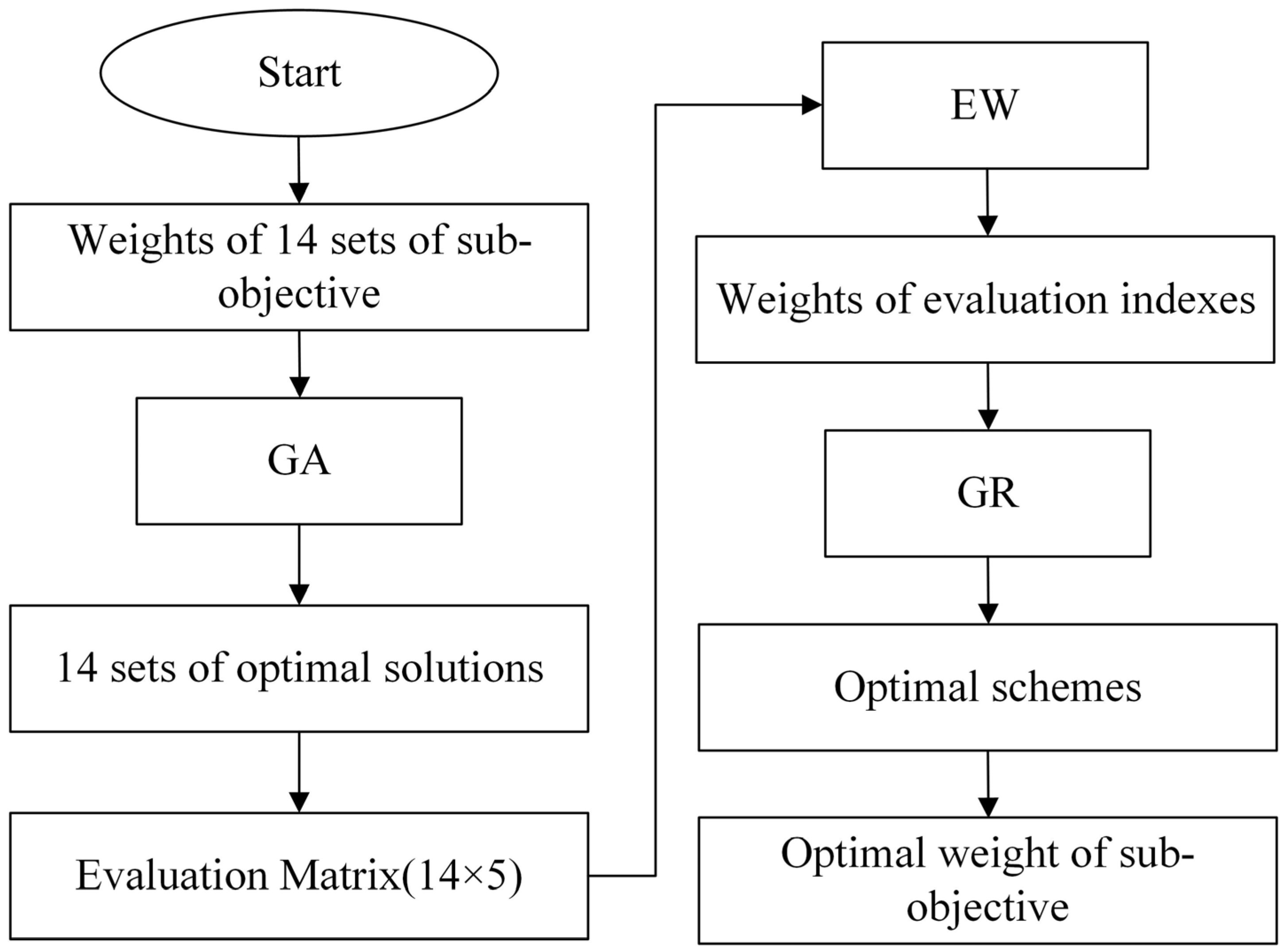
The procedure for determining the optimal weight is executed through the following sequential steps (see Figure 4):
a.
Define Weight Scenarios: Fourteen distinct sets of weights are pre-defined for the sub-objective functions.
b.
Execute Multi-Scenario Optimization: Each weight set is input into a real-coded genetic algorithm (GA), which is executed independently for each set to obtain a corresponding optimal solution.
c.
Calculate Evaluation Metrics: Five evaluation metrics (annual mean power generation; the ratio of power generation to abandoned water; average output in the dry season; variation coefficient of output in the dry season; the ratio of minimum output to annual mean output; and REC) are computed for each of the fourteen optimal solutions derived from the previous step.
d.
Determine Metric Weights: The EW method is applied to the matrix composed of the evaluation metrics to calculate their objective weights.
e.
Rank Schemes: The fourteen candidate schemes are evaluated and ranked using the GR method, incorporating the weights obtained from the EW method to identify the overall optimal scheme.
f.
Finalize Optimal Weights: The weight combination that produced the top-ranked scheme in the GR is identified as the final optimal weight combination for the multi-objective problem.

3.3. Determination and Description of Risk Indicators

In light of the characteristics of the study area, four risk indicators are identified from two aspects of power generation and ecology, namely, power generation risk (PGR), output risk (OR), ecological risk (ER), and abandoned water risk (AWR) [20]. The calculation formula is as follows:
(a)
Power generation risk:
R i s k ( E ) = P ( E i < E exp F )
(b)
Output risk:
R i s k ( N ) = P ( N i < N exp F )
(c)
Ecological risk:
R i s k ( Q e ) = P ( Q t < Q t max Q t > Q t min F )
(d)
Abandoned water risk:
R i s k ( Q s ) = P ( Q s > 0 F )
where P is the probability; E i and E exp are the actual power generation and expected power generation of the power station, respectively (GWh); N i and N exp represent the output and designed guaranteed output for cascade hydropower plants (MW); Q s is the abandoned water (m3/s).

3.4. The VAR Model

The VAR model was proposed by Christopher Sims in 1980 [38] and is an autoregressive model for univariate time series based on vectors. The purpose of the VAR model is to process historical data, and it is generally used to analyze or predict the dynamic relationships between multiple variables and the reactions of variables to disturbances and shocks [39]. By observing the influence of random disturbances on endogenous variables at present and in the future, the influence of shocks on system variables is analyzed. The least squares method (LSM) was used to estimate the parameters of the VAR model [40].
The modeling steps of the VAR model are as follows.
Firstly, the risk factors Y, generated by the operation model, are taken as inter-related time series Et, and the following vectors are constructed:
Y = [ y 1 , t , y 2 , t , , y i , t ]
E t = [ e 1 , t , e 2 , t , , e i , t ]
Then, a VAR model is constructed based on the inter-relationships between risk factors:
Y t = c + A 1 Y t 1 + A 2 Y t 2 + + A p Y t p + B 0 E t + u t
The prediction model takes Yt of a certain risk factor at the current moment, of the past p − 1 moment, and Et as input, and then predicts the risk factors at a future moment. Finally, the future risk factors are predicted through the iteration formula, as follows:
Y t + 1 = c + A 1 Y t 1 + A 2 Y t 2 + + A p Y t p + B 0 E t
A 1 , A 2 A p , B 0 is the estimated parameter matrix and is a constant matrix that can be solved through a system of simultaneous equations as follows:
G = D Z + U
G = [ Y p , Y p + 1 , , Y m ] = y 1 , p y 1 , m y k , p y k , m
D = [ c , A 1 , A p , B 0 ]
Z = 1 1 E p E m
U = [ u p , u p + 1 , u m ]
Finally, the LSM is used to solve the problem, and the least squares solution for the total parameter matrix D can be described as follows:
D = ( Z T Z ) 1 Z T G
where Yt and Et are k-dimensional endogenous variable vectors and d-dimensional exogenous variable vectors, respectively; t is the sample number; m is the lag intervals for endogenous variables; p is the lag order, u t is white noise vector; A p and B 0 are coefficient matrixes; c is a constant.
The whole process of the VAR model is divided into the following steps [41,42]:
(1)
The augmented Dickey–Fuller (ADF) method is used to test the unit roots in the sequence to eliminate the phenomenon of spurious regression; in the process of the ADF test, the null hypothesis is that a unit root exists in the sequence, indicating that the sequence belongs to a non-stationary sequence. If the statistical value is larger than the critical value, the sequence is considered a non-stationary series; otherwise, the null hypothesis is not accepted [41,42,43];
(2)
Determine the lag intervals for endogenous variables;
(3)
Estimate the model coefficient and construct the VAR model;
(4)
The root estimate method is used for the stationarity test;
(5)
The response of one variable or several variables after being impacted by the numerical results for other variables currently and in the future is determined by the IRF;
(6)
The VDM is used to describe the contribution of shocks to the fluctuation of variables and to analyze the reactions, while, at the same time, comparing them with the results of the impulse response to test the stability and rationality of the constructed model.

4. Results and Discussion

4.1. Optimal Solution of Multi-Objective Model

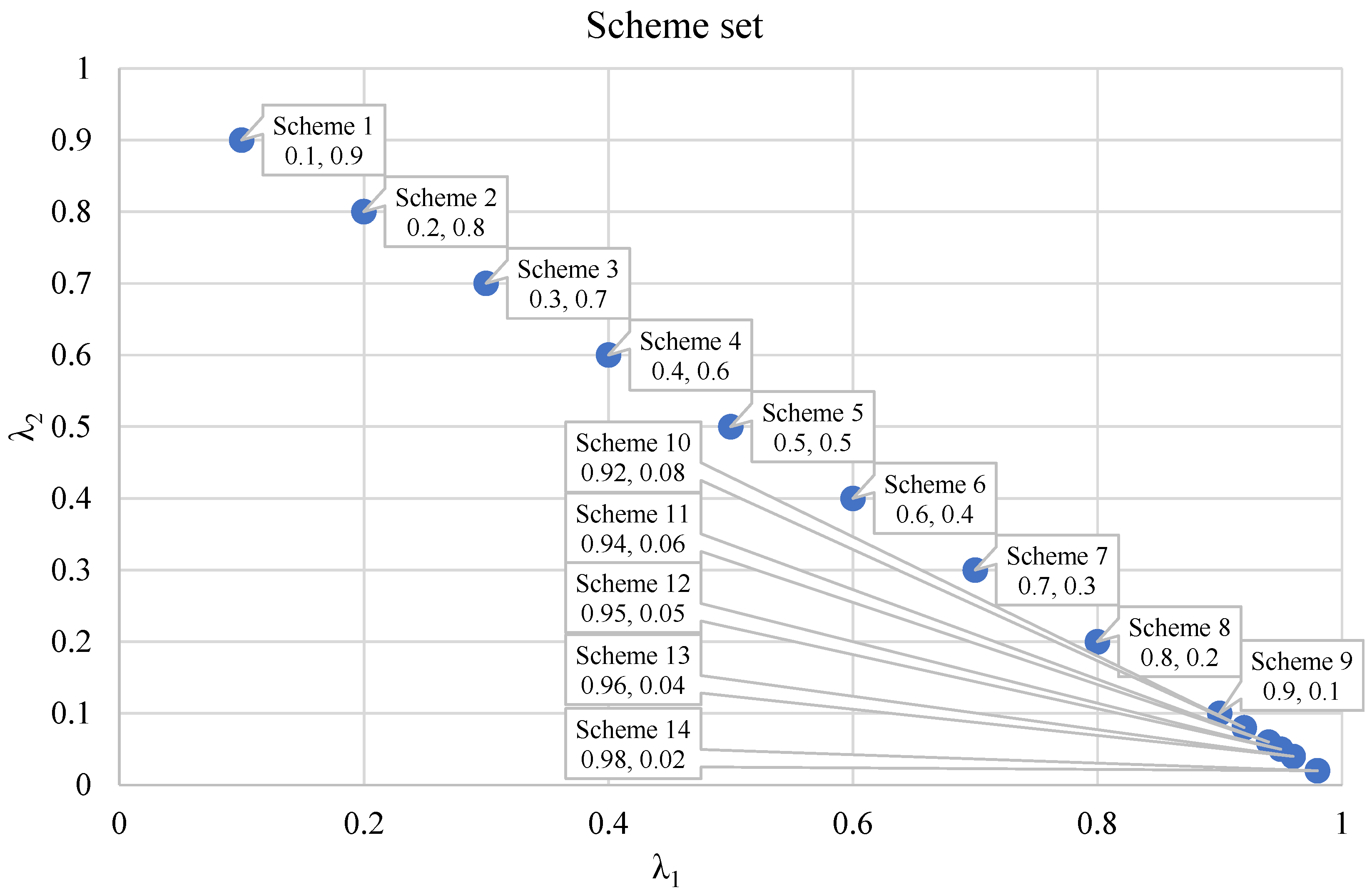
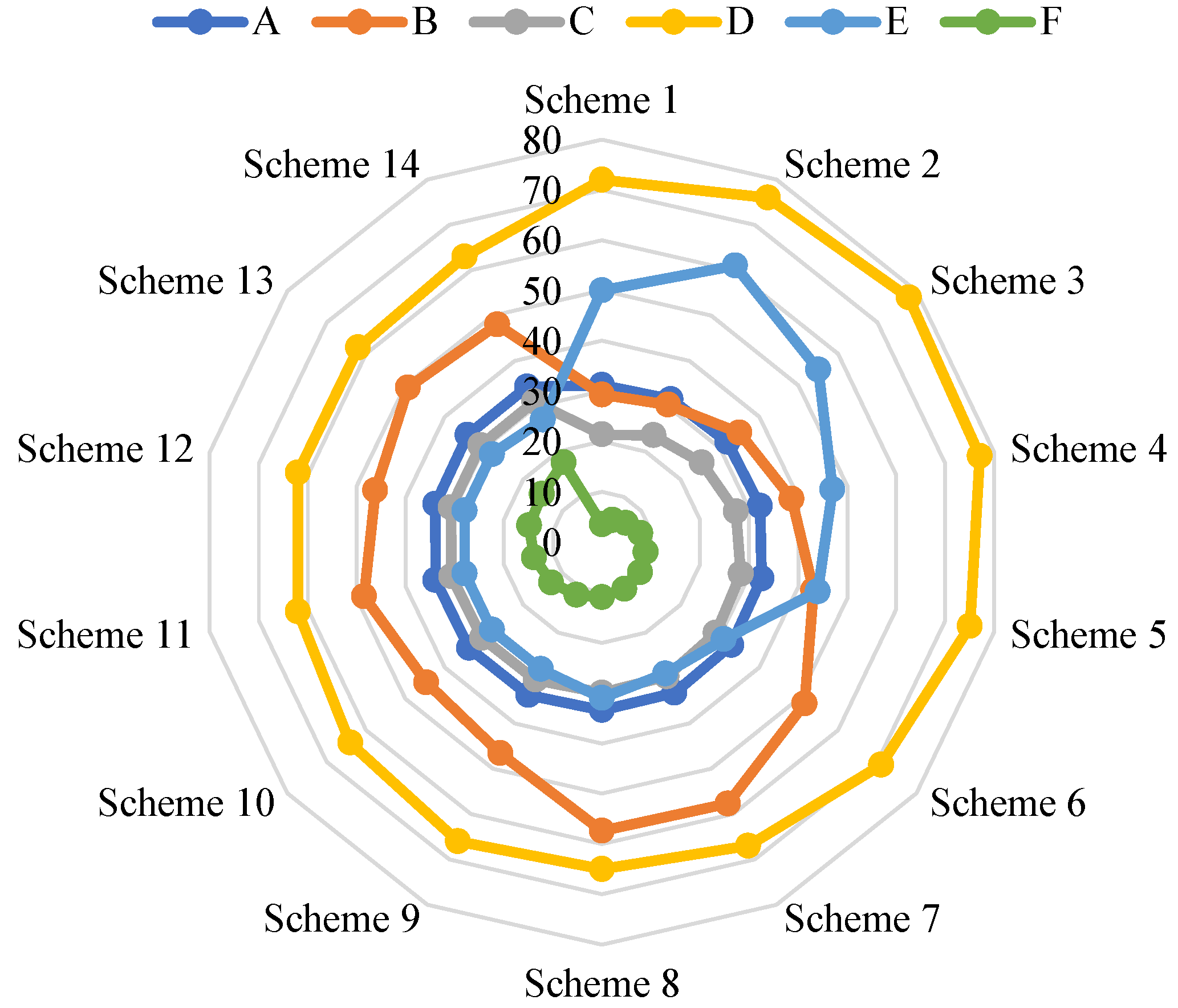
A multi-objective operation scheme was established by setting different weights for two objectives. The weights set ranged from 0 to 1, and a total of 14 schemes were designed (shown in Figure 5). The EW and GR methods were used to solve the multi-objective optimization model of reservoir operation, and the main purpose was to standardize the sub-objective functions and determine their weights. Six indicators were selected to determine the optimal solution (in Figure 6). The EW method was used to calculate the weights of six evaluation indicators, and then the GR method was used to determine the membership degree, and the corresponding values ( γ i ) of Scheme 1 to Scheme 14 were 86.79, 82.35, 82.10, 82.59, 83.27, 87.95, 89.78, 89.08, 88.42, 87.94, 88.35, 87.74, 88.01, and 87.45, respectively. According to the principle of maximum membership degree (where the maximum γ i represents the optimal scheme), the optimal scheme was determined as Scheme 7. The weight of the sub-objective with the maximum power generation was 0.7, and the weight of the sub-objective function with the minimum REC was 0.3.

4.2. Results of Multi-Objective Optimal Operation

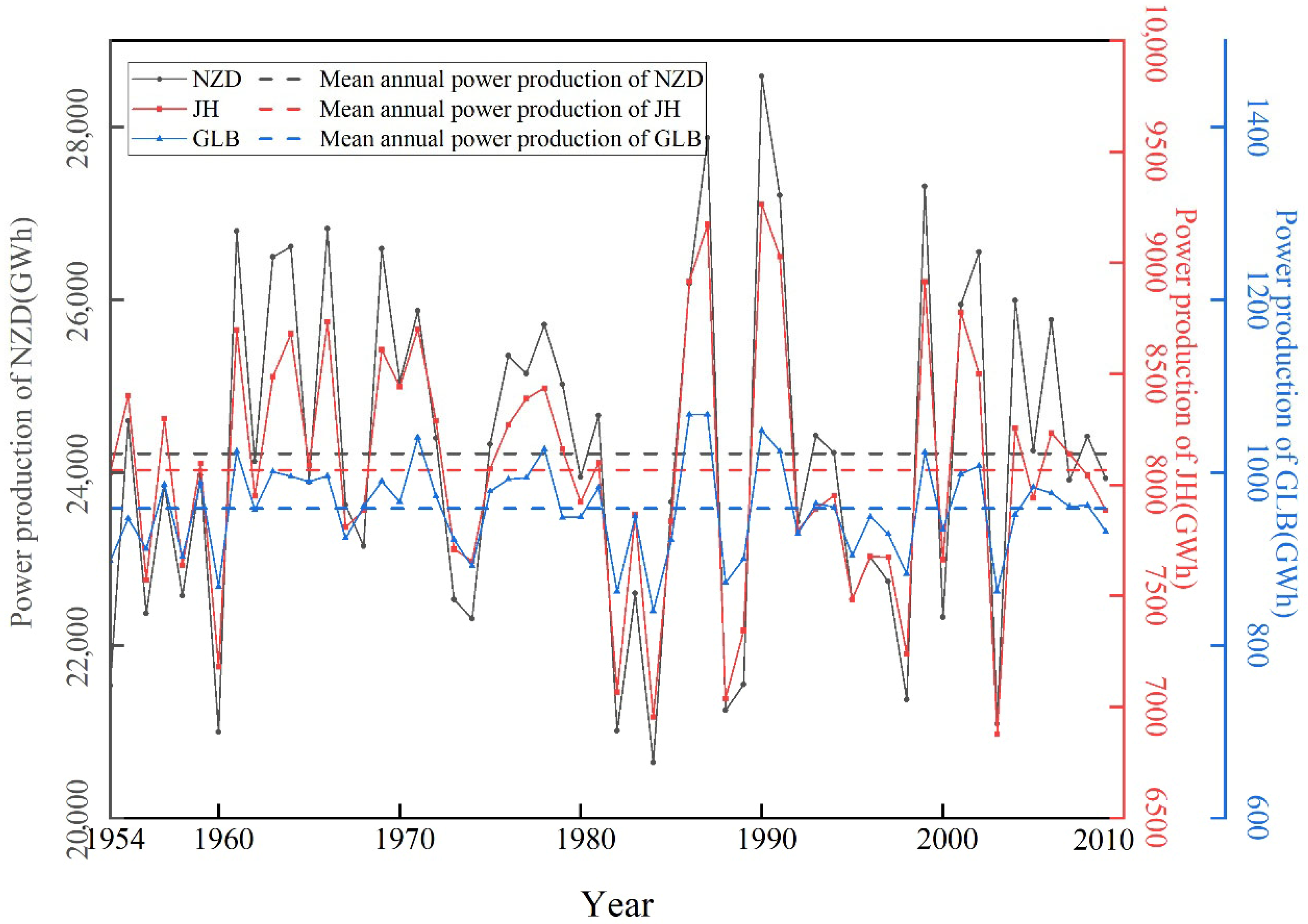
The results of the multi-objective optimal operation of cascade reservoirs on the lower reaches of the LCR basin are shown in Table 2 and Figure 7. The minimum annual power generation is 28,436 GWh (in 1984) and the maximum is 38,898 GWh (in 1990). The average annual power generation is 33,243 GWh, which is 661 GWh more than the designed power generation (32,582 GWh) [33]. The average output during the dry season is 2.9648 GW. Additionally, the minimum and maximum average REC were 5.8% and 16.27%, respectively. The annual mean power generation of the NZD, JH, and GLB hydropower plants are 242,170 GWh, 8067 GWh, and 958 GWh, respectively.
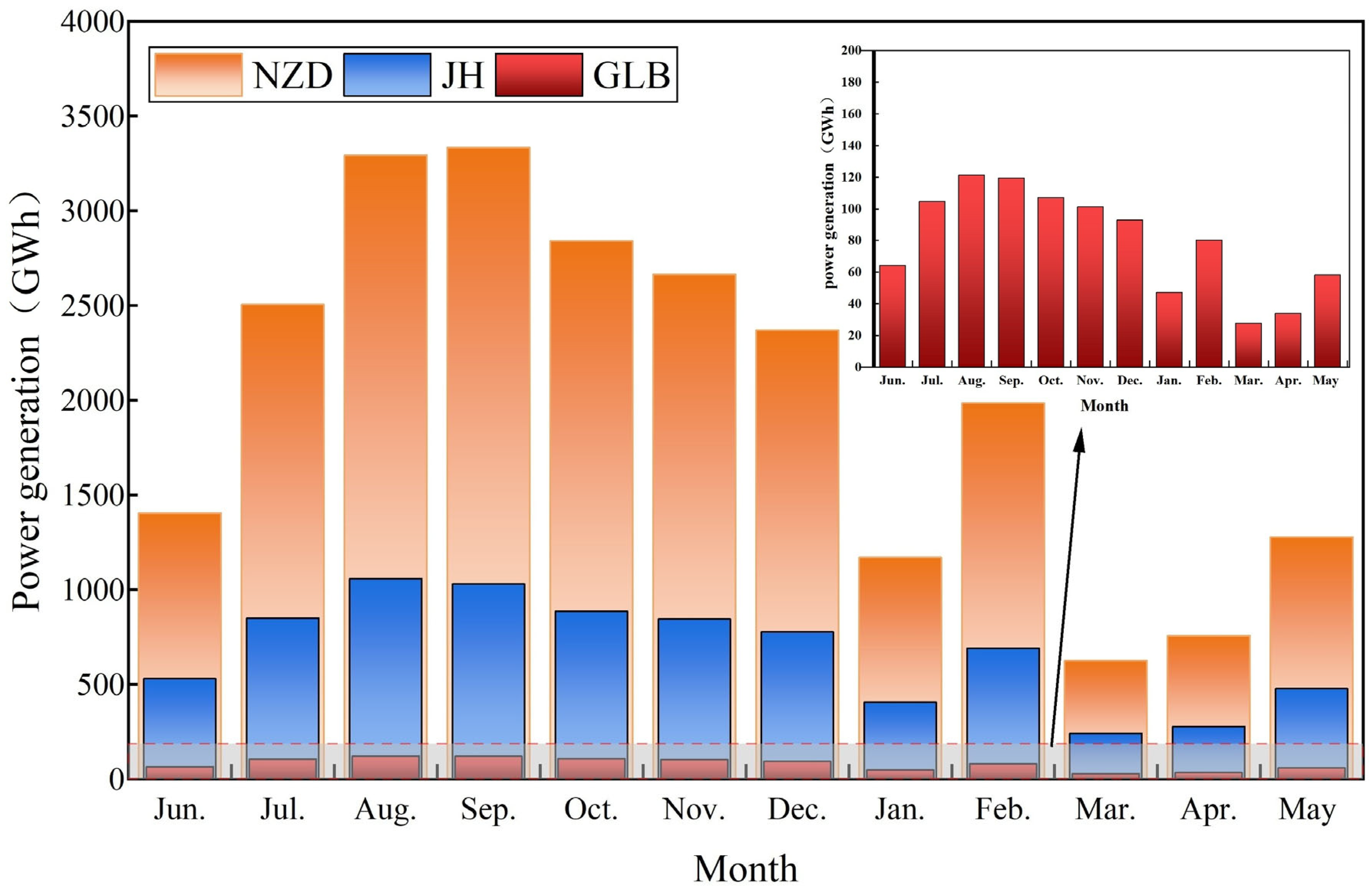
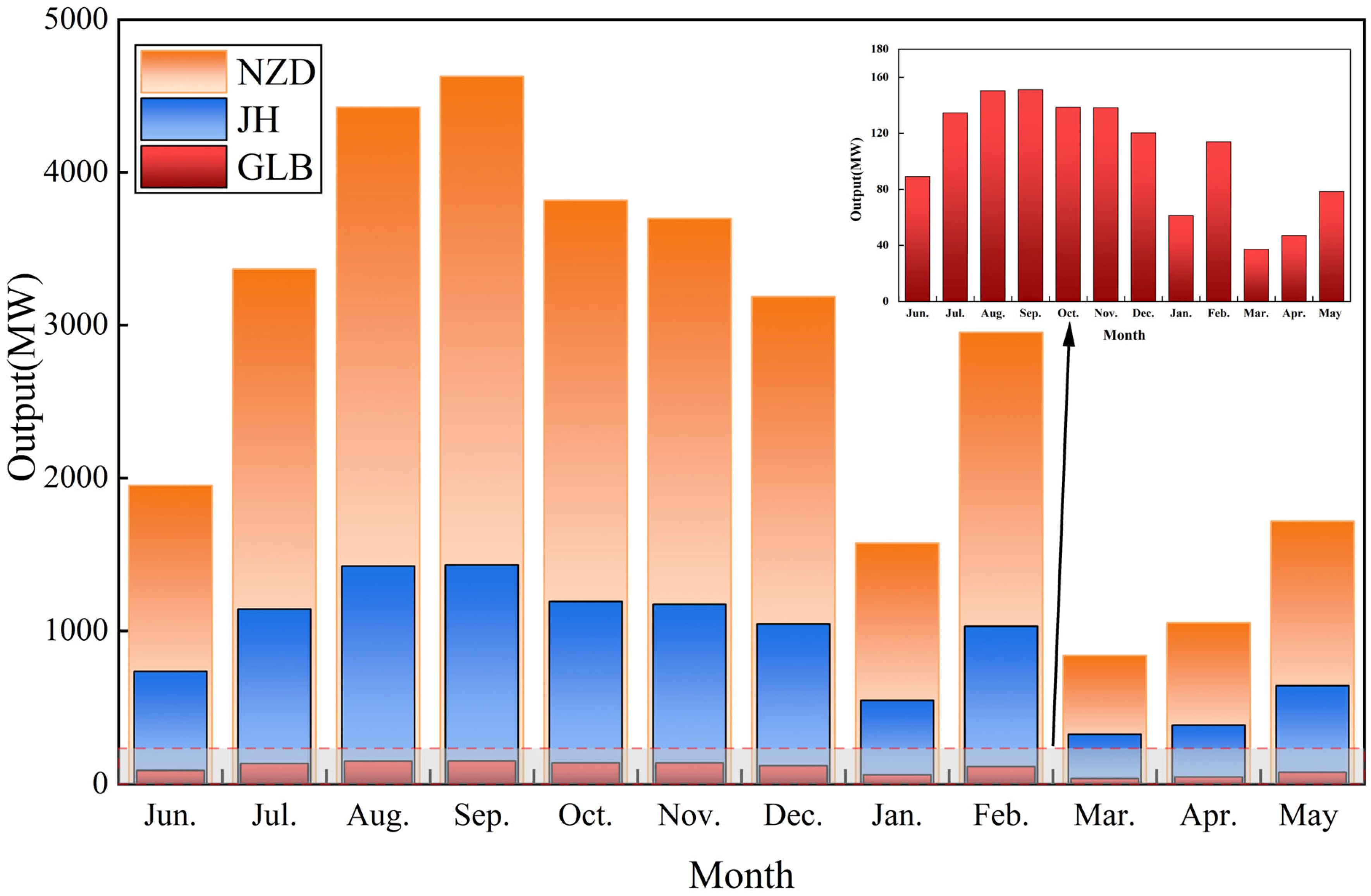
The monthly power generation of the three hydropower plants is shown in Figure 8. It can be seen that, except for the NZD hydropower plant, where the maximum monthly power generation occurred in September (3332 GWh), the maximum monthly power generation of the other plants occurred in August. The maximum cascade power generation was 4472 GWh in August, followed by 4448 GWh in September. The minimum cascade power generation occurred in March (893 GWh). The trend of the cascade output (shown in Figure 9) is similar to that of power generation, and the average output of the NZD, JH, and GLB power plants in the dry season is 2145 MW, 734.6 MW, and 85.3 MW, respectively.
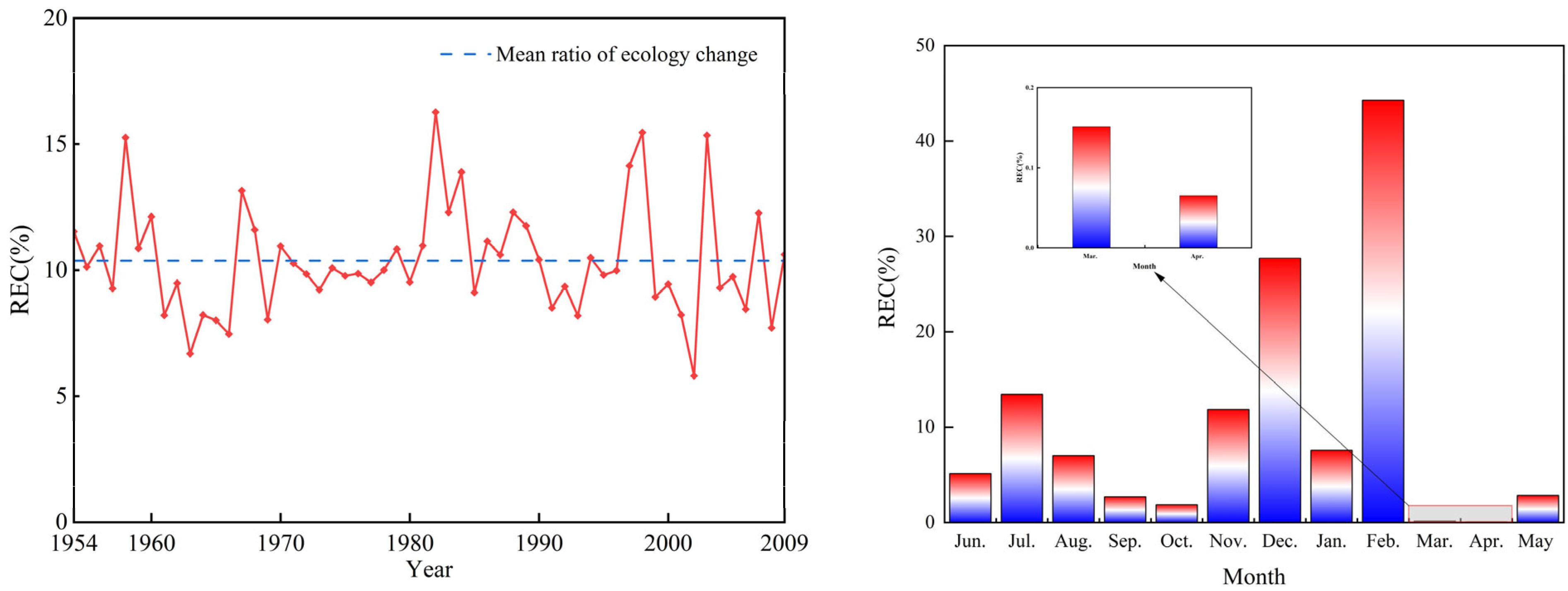
On the lower reaches of JH, the main water demands include ecological water for fish habitats and water for shipping [33]. The monthly mean REC for multiple years (the arithmetic mean of the monthly REC values for 57 years) of the multi-objective operation is 10.38% (shown in Figure 10); the maximum REC appeared in February (44.28%), followed by December (27.69%), and both of them appeared in the dry season. These peak REC values signify periods of pronounced ecological stress, where a trade-off between human and ecological water needs is most acute. The primary reason is that during the heart of the dry season, incoming flow is severely insufficient, and the reservoir release often cannot satisfy the comprehensive ecological water demand of the lower reaches of the JH. In contrast, the RECs in the dry season (in March and April) are close to 0. This indicates that the simpler ecological water demand requirements during that period can still be met, even under low inflow conditions.

4.3. Risk Assessment of Multi-Objective Optimal Operation

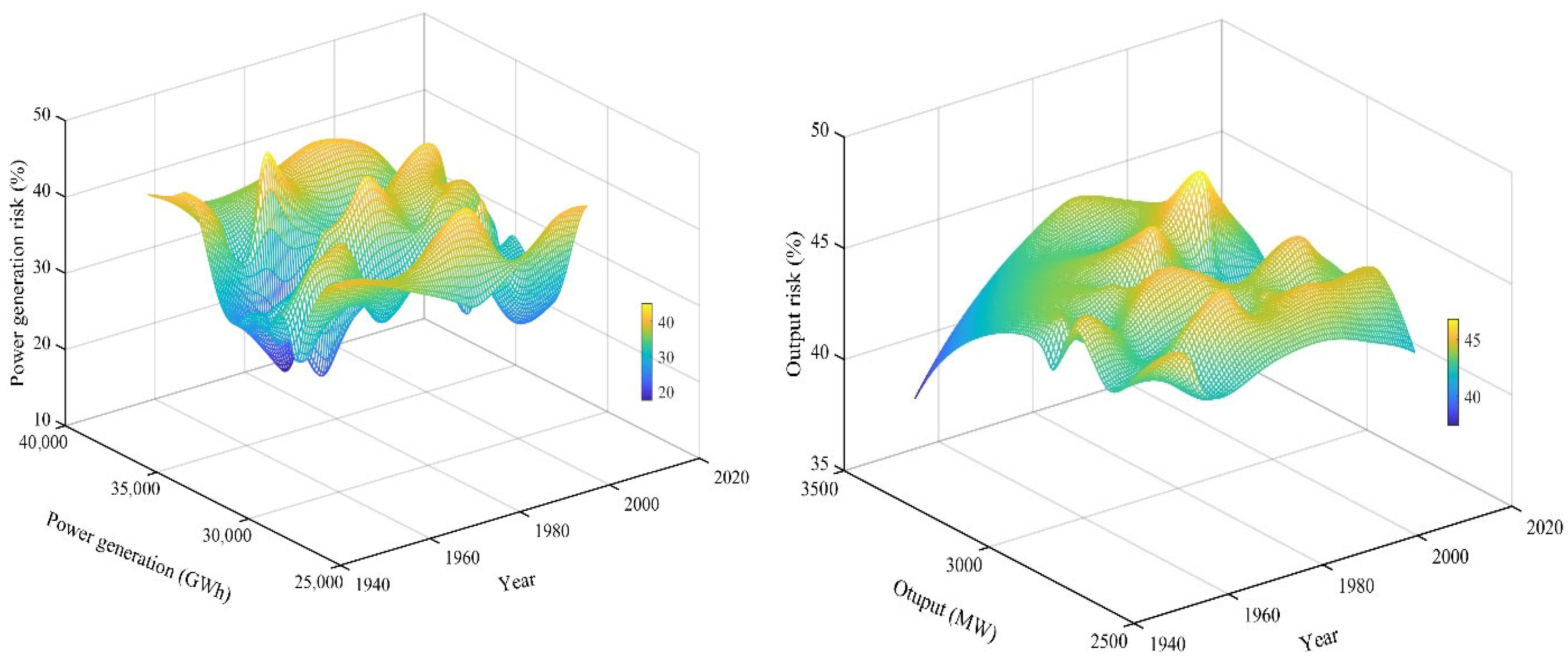
Based on the optimal scheme selected by multi-objective optimization and decision analysis, the risks of power generation, output, abandoned water, and ecological water were subsequently calculated according to their probabilistic definitions provided. The annual power generation and annual output in dry years are plotted with the corresponding risks in Figure 11. It is concluded that the threshold of power generation risk is 19–45%, and the annual mean power generation risk is 33.14%, while the threshold of output risk is 42.33–46%, and the annual mean output risk is 43.82%. It can be seen that compared with the power generation, the overall risk level of the output is higher and the fluctuation range is smaller, indicating that the output is more sensitive to drought conditions and the risk is more concentrated.
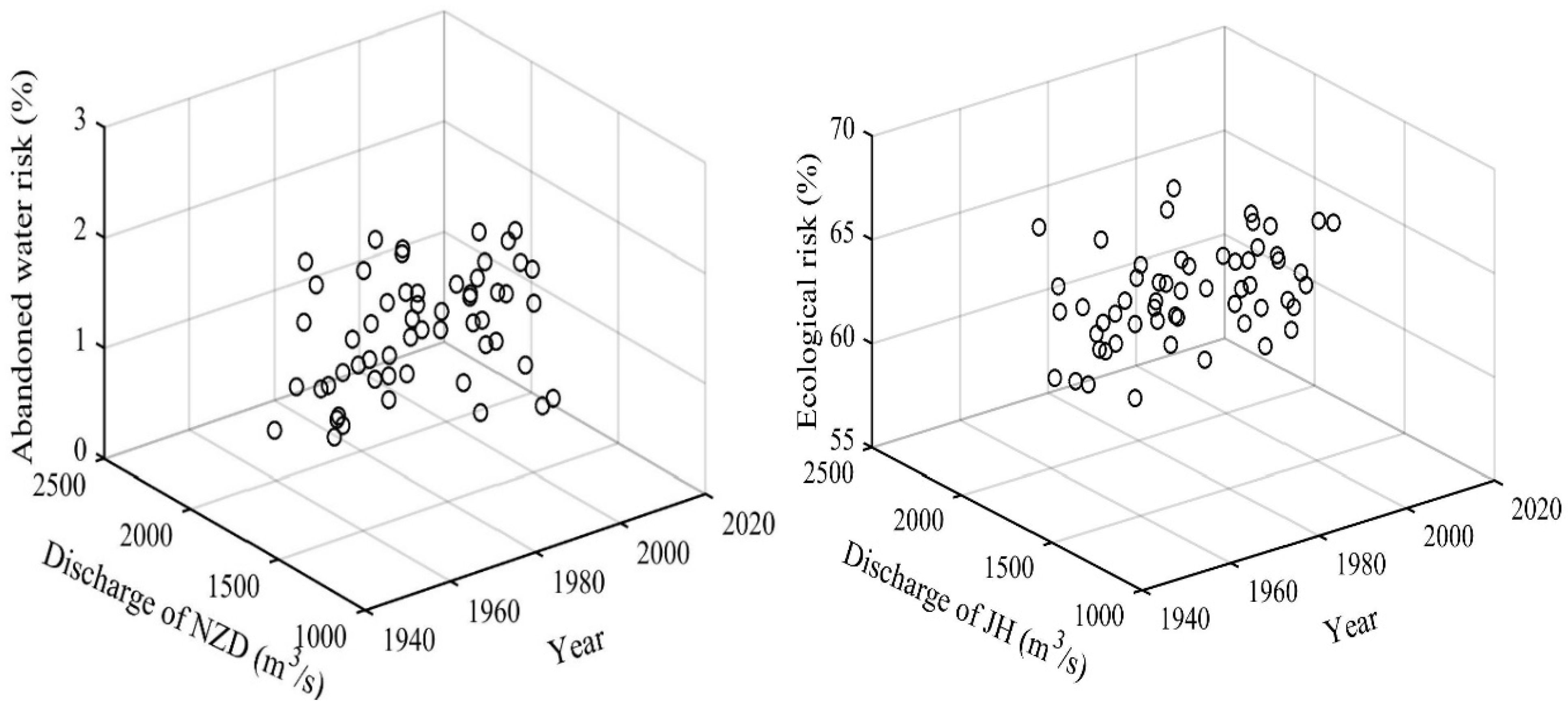
The NZD is for multi-annual regulation, and the operation of NZD changed the hydrological situation of natural runoff a lot, playing a leading role in the cascade hydropower system, especially in the power generation and ecosystem on the lower reaches. Therefore, the operation mode of NZD is directly related to the cascade power generation, and the abandoned water will affect the whole cascade hydropower system. As shown in Figure 12, the relationship between the discharge of the NZD reservoir from 1954 to 2010 and the corresponding abandoned water risk is shown. Most of the data points are concentrated in low-risk areas (less than 2%), indicating that severe abandonment of water is not a common event under the current scheduling mode. In addition, the JH hydropower station has the comprehensive utilization benefits of navigation and ecosystem, and the discharge is closely related to the REC [33]. As shown in Figure 10, the relationship between the discharge of the JH reservoir from 1954 to 2010 and the corresponding ecological risks is shown. From the perspective of time, the distribution of these high-risk and high-flow events is not uniform because the discharge of the JH reservoir is too high or too low, which will cause the ecological risk to change. In general, the annual mean discharge of the NZD hydropower station is 1700 m3/s, and that of the JH hydropower station is 1771 m3/s (shown in Figure 10). The threshold of ecological risk (REC) is 59.67–66.83%, the average value is 63.01%, and the threshold of abandoned water risk is 0.33–2.42%; the average is 1.35%.

4.4. Dynamic Risk Transmission of Cascade Hydropower Stations’ Operation Based on the VAR Model

To deeply analyze and quantitatively investigate the transmission relationship between the risk indicators, the VAR model of multi-objective operation risk of cascade hydropower stations on the lower reaches of LCR is constructed. Firstly, the stationarity of the risk data set is tested to ensure satisfaction with the model requirements; secondly, the lag intervals and parameters of the VAR model are determined; finally, the IRF and VDM are used to quantitatively investigate the risk transmission among risk indicators.

4.4.1. Construction of the VAR Model

In this paper, the ADF (augmented Dickey–Fuller) method was adopted to test the stability of the risk sequence to eliminate the phenomenon of spurious regression by checking whether a unit root exists in the sequence. The test results of the four groups of risk indicator series are listed in Table 3, which shows that all the indicators rejected the null hypothesis, namely, the four sequences are stationary. Therefore, the four groups of risk indicator sequences meet the prerequisites for the VAR modeling.
In this paper, five statistics, including the likelihood ratio (LR), Akaike information criterion (AIC), Schwarz criterion (SC), final prediction error criterion (FPE), and HQ [44], are selected to determine the lag. The lag of the four risk indicators is calculated (shown in Table 4). The results of the five statistics show that the model achieves the best value when the lag is two. Therefore, the parameters of the VAR Model were estimated (Table 5), and then the two-order VAR model was constructed with the sequence of PGR-OR-ER-AWR. Taking the risk of power generation as an example, the R2 was 0.82, and its autoregressive formula is as follows:
PGR = 0.73 × PGR ( 1 ) 0.41 × PGR ( 2 ) + 0.89 × OR ( 1 ) + 0.45 × O R ( 2 ) 0.45 × ER ( 1 ) 0.62 × ER ( 2 ) + 0.03 × AWR ( 1 ) + 0.02 × AWR ( 1 ) + 0.002
Similarly, the R2 for the sequence of OR, ER, and AWR were 0.81, 0.83, and 0.79.

4.4.2. Stationarity Test

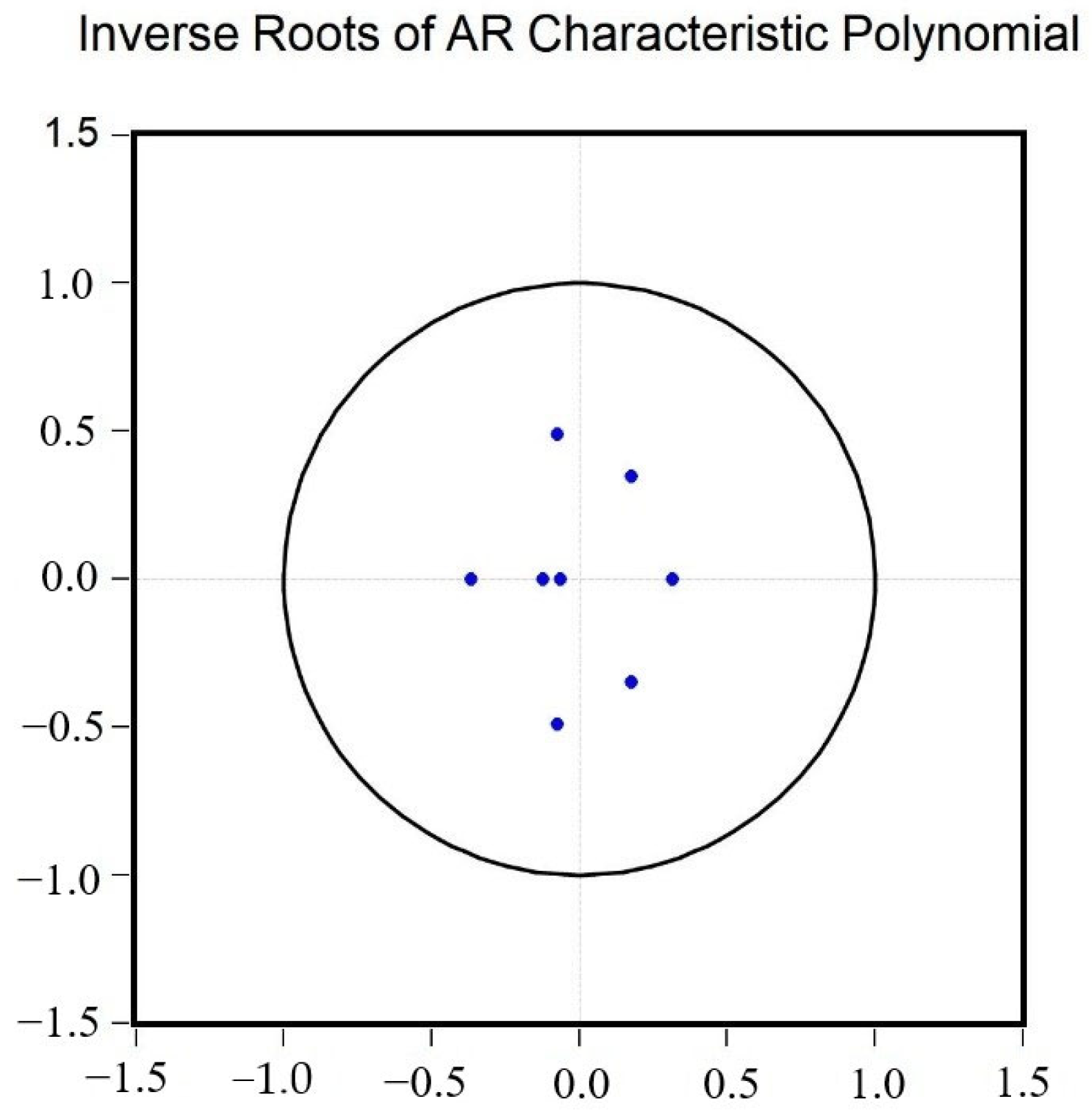
The stability estimation of the constructed VAR model is important, as it directly affects the validity of the results. The stability of VAR models is usually tested by using an AR root, and when the reciprocal of the root modulus of all unit roots is within the unit circle, which means the model passes the stationarity test [45,46]. The result of the AR test for the VAR model is shown in Figure 13. It was concluded that the reciprocal of all root modules of the AR characteristic polynomial was within the unit circle, indicating that the VAR model reached the stationarity standard.

4.4.3. Risk Transmission in the Process of Reservoir Operation

Impulse Response Analysis for Risk Transmission
When a variable in the system is subjected to a certain impact, it will inevitably have corresponding effects on itself or other related variables. In this study, the IRF was commonly adopted to quantify this kind of relationship in the risk system of cascade reservoir operation. The main idea is to give a standard deviation impulse to a random disturbance item in the system to measure the response or variation for the values of all endogenous current variables and those in the future, including changes, degrees, persistence, and pulsation. The IRF can be used to intuitively describe the dynamic interaction response and effects between all the variables [47,48]. The lag of 10 (10 years) was selected to simulate the response tracts of the four groups of risk indicators. The IRF was to observe the time lengths for the variables with a fluctuation recovering to stability, and the horizontal axis represents the number of lags, and the vertical axis is the response degree value (%).
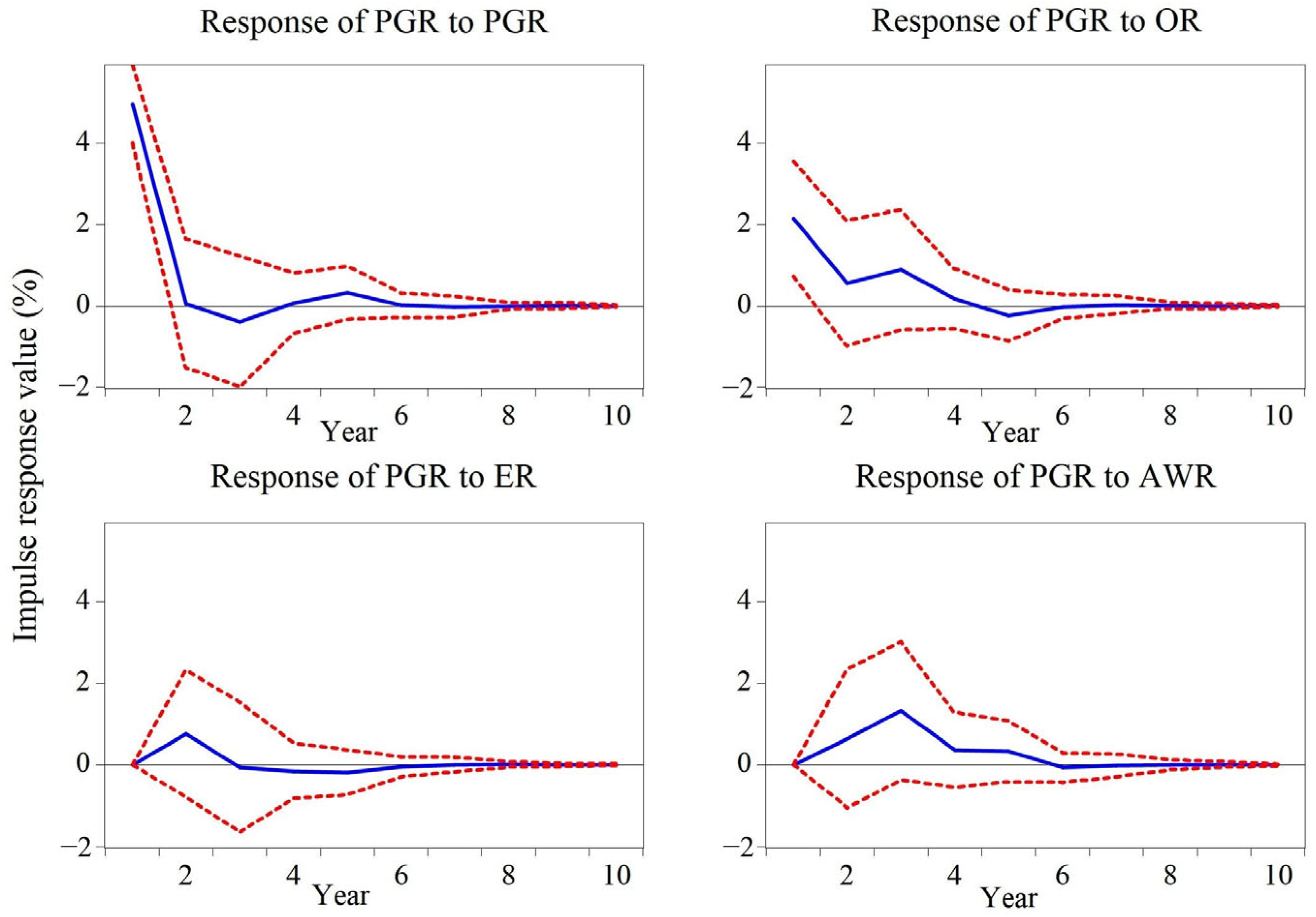
The impulse response results for PGR to PGR, OR, ER, and AWR are shown in Figure 14. It was shown that the impulse response curves (the blue line) and the standard deviation curves (the red line) showed convergence. It is concluded that the long-term response gradually weakened, tending to 0, and the convergence period was around the eighth year, which indicated that a standard deviation impulse for the four groups of risk indicators had a strong impact on PGR. Furthermore, despite the fact that PGR had quite a strong fluctuation response to itself, it had a response to OR as well, which showed a volatility response in the transmission process. At first, PGR had no response to ER and AWR, while it showed a strong positive response to itself and OR (response values are 4.96% and 2.14%), but then the response amplitude gradually decreased, and the volatility tended to be weaker and weaker. The average response values of PGR to PGR, OR, ER, and AWR were 0.50%, 0.35%, 0.04%, and 0.26%, respectively. Generally, when PGR, OR, ER, and AWR are disturbed, the transfer response direction of PGR shows as positive, which shows that the three risk indicators promoted an increase in PGR by adding a standard deviation pulse interference.
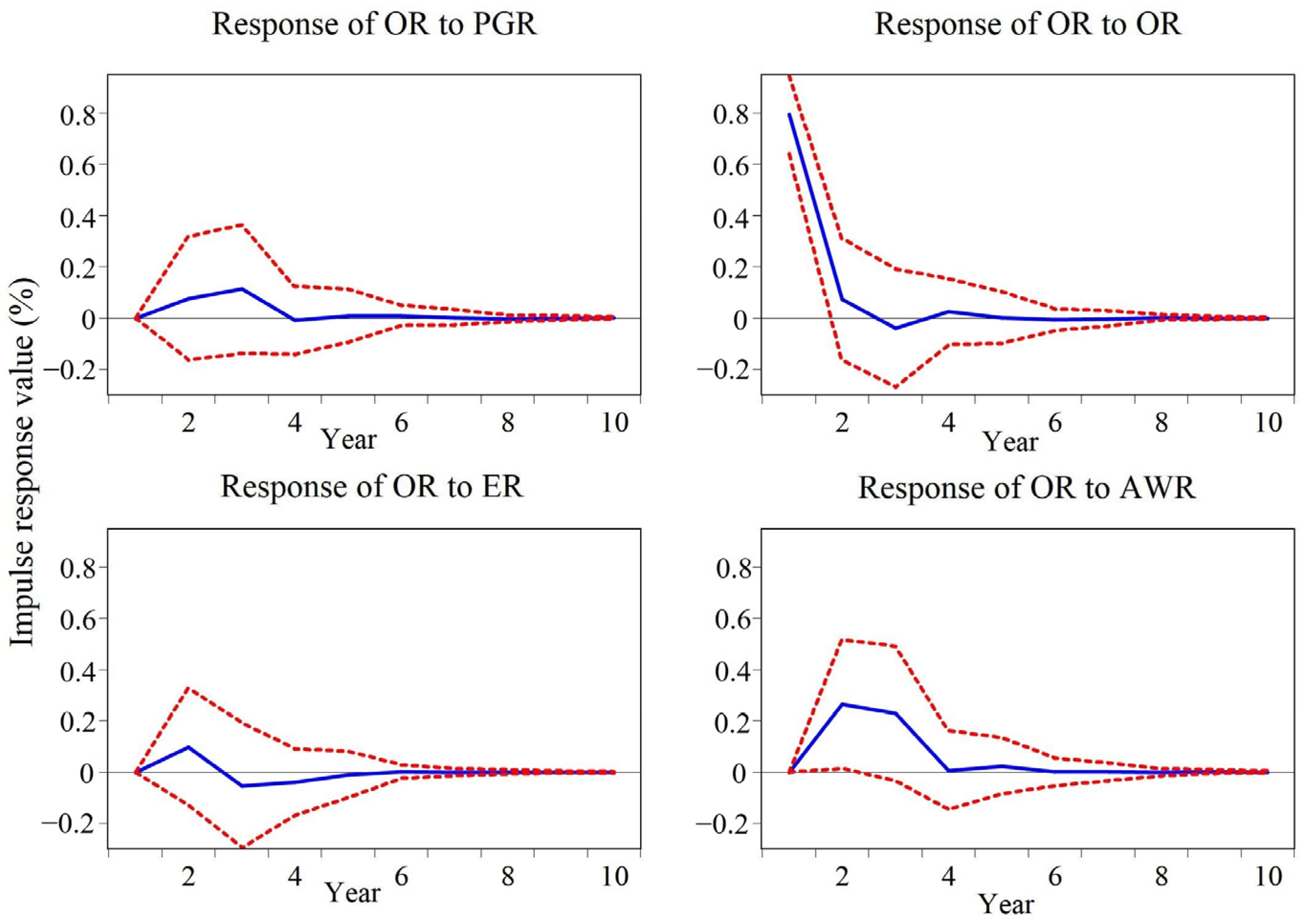
The impulse response results for OR to PGR, OR, ER, and AWR are shown in Figure 15, and the impulse response curves and the standard deviation curves showed convergence. It is concluded that the long-term response gradually weakened, tending to 0, and the convergence period for the response of OR to ER is about the sixth year, and others are about the eighth year. At first, despite the fact that OR had a positive response to itself (response value is 0.79%), OR showed no response to the increase in the other three risks. The average response values of OR to PGR, OR, ER, and AWR were 0.02%, 0.08%, 0%, and 0.05%, respectively. Generally, the impulse response curve of OR was not as strong as that of PGR, and the response value was too low, especially the average response value of OR to ER, which was close to 0. Therefore, the increase in ER had little effect on OR. In addition, the transfer response direction of OR to PGR, OR, and AWR showed as positive. It was concluded that the three risk indicators promoted the OR by adding a standard deviation pulse interference.
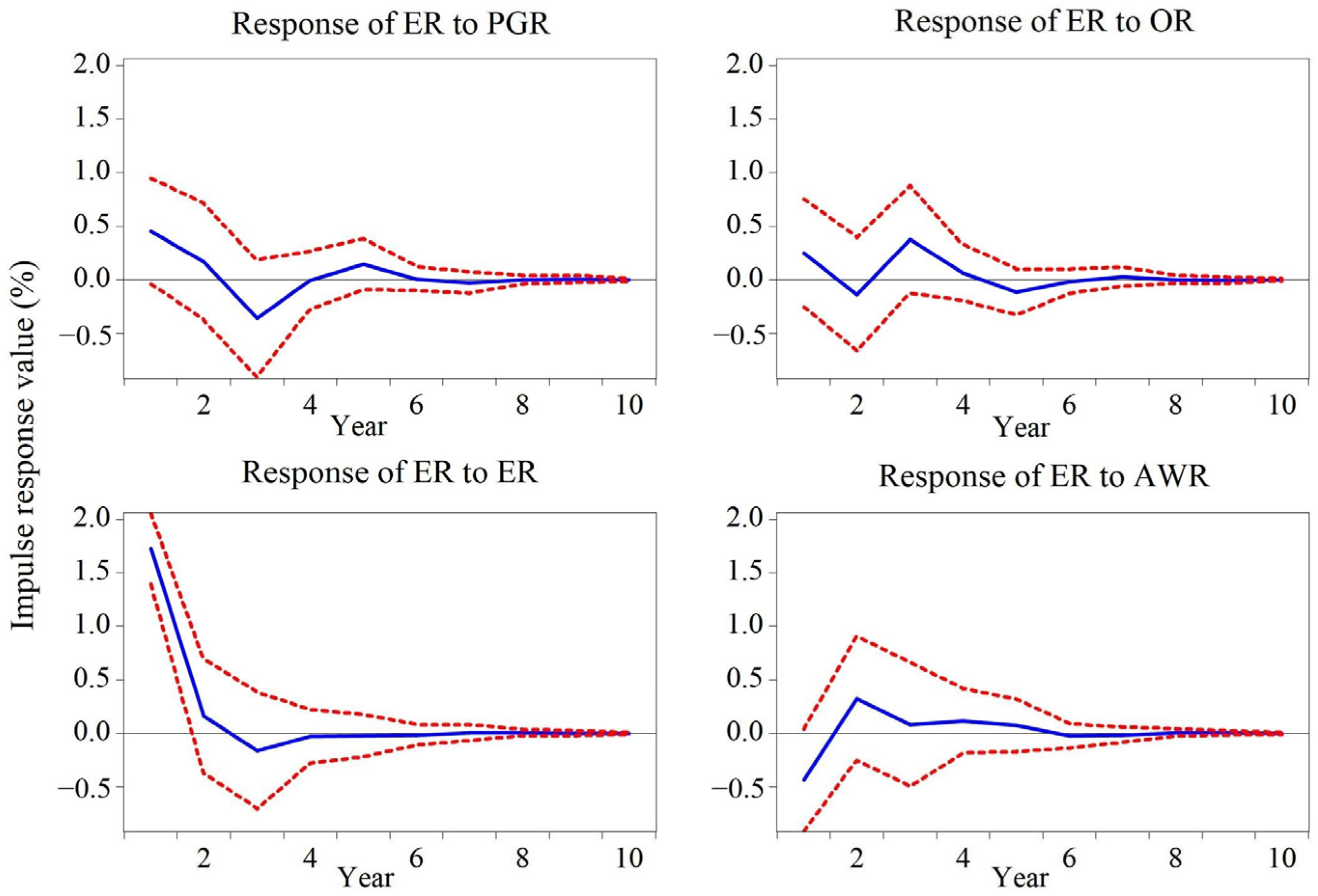
The impulse response results for ER to PGR, OR, ER, and AWR are shown in Figure 16. And the convergence period was the same as that of PGR (both in about the eighth year). Furthermore, except for a quite strong fluctuation response to itself, the ER had a weak response to the other three risk indicators in the transmission process. At first, regardless of the negative response to AWR (response value was 0.44%), ER had a positive response to PGR, OR, and itself (response values are 0.45%, 0.25%, and 1.73%, respectively), but then the response amplitude gradually decreased, and the volatility became weaker. Generally, the average response values of ER to PGR, OR, ER, and AWR were 0.04%, 0.04%, 0.17%, and 0.01%, respectively. It was concluded that ER had a certain response to itself increase, but the response values to the other three risk indicators were pretty low when adding a standard deviation pulse interference.
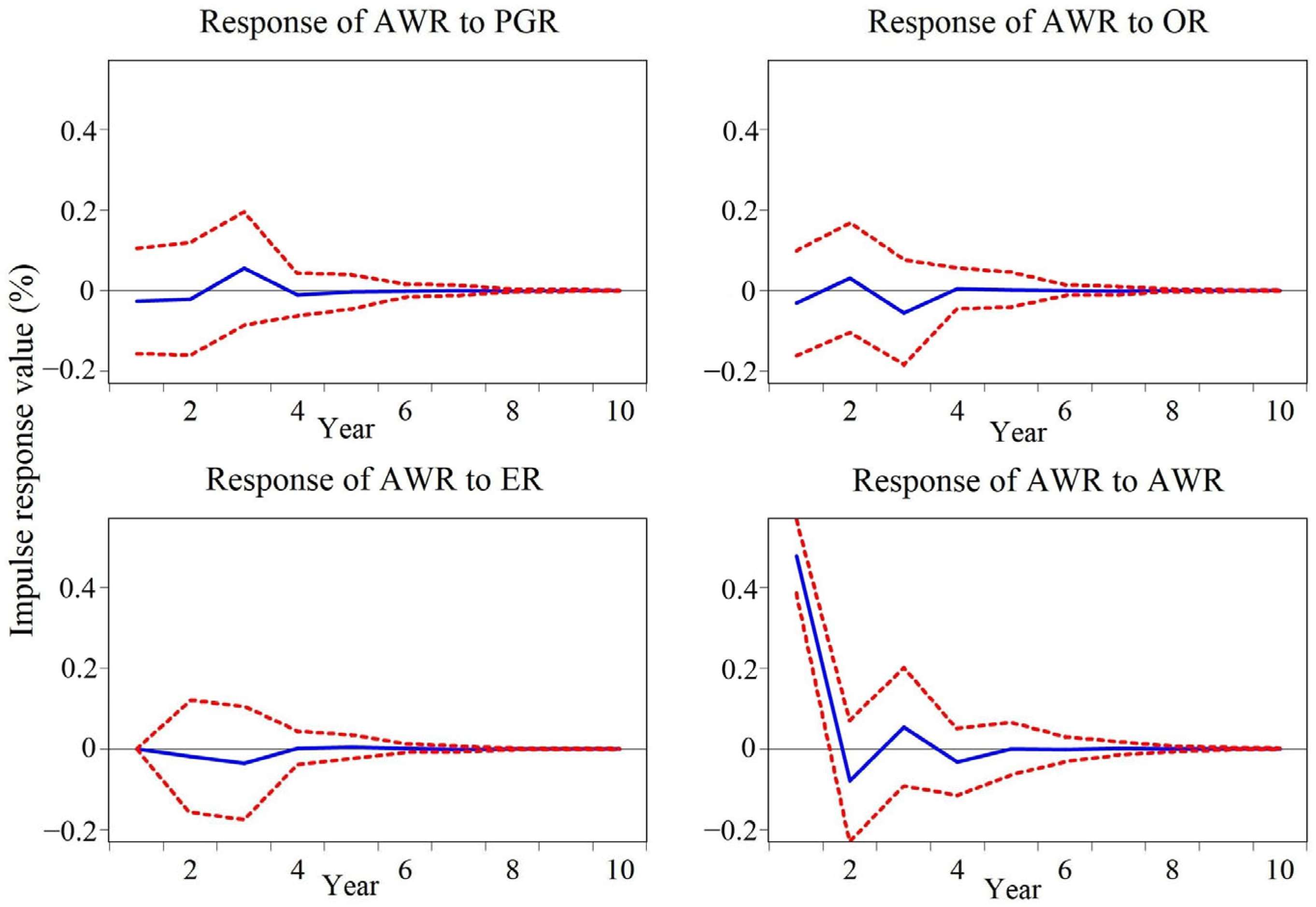
The impulse response results for AWR to PGR, OR, ER, and AWR are shown in Figure 17. The convergence period of AWR itself is about the eighth year, and the other three risk indicators are about the sixth year. Although AWR had a strong fluctuation response to itself, the response to the other three risk indicators was close to 0. The average response values of AWR to PGR, OR, and ER were −0.0005%, −0.005%, and −0.005%, respectively. Generally, the transfer response direction of AWR to PGR, OR, and ER showed as negative. It was indicated that responses of AWR to the other three risk indicators were negative when adding a standard deviation pulse interference.
Variance Decomposition Analysis for Risk Transmission
In this paper, the VDM was applied to quantitatively evaluate the risk transmission. It can be used to achieve the contribution of one risk indicator to other risk indicators by adding a standard deviation. Different from IRF, variance decomposition can calculate the contribution rate of each variable in the system [49].
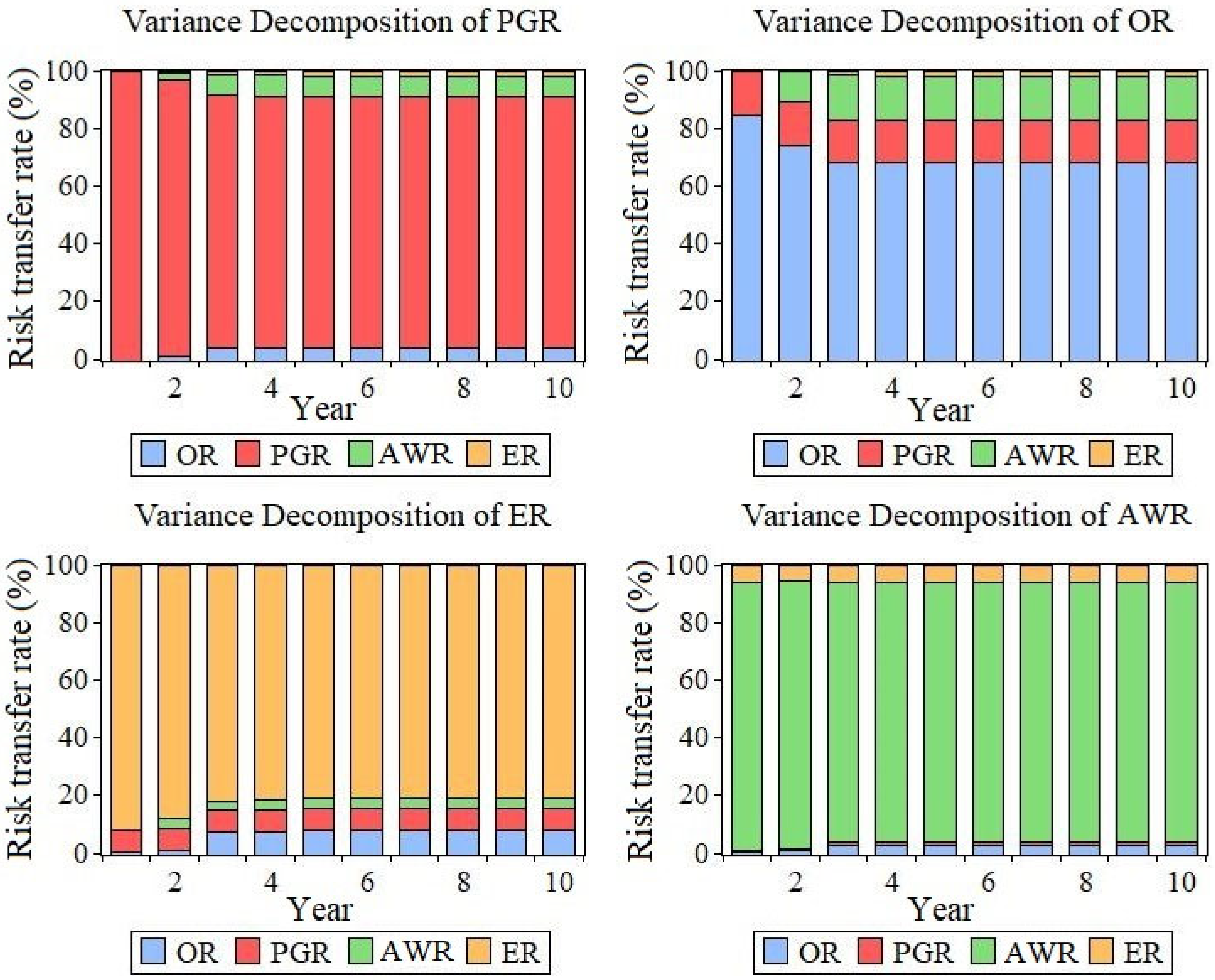
The results for the contribution rates of each risk indicator by variance decomposition are shown in Figure 18. It is concluded that at a lag of the first year, the contribution of PGR to itself was 100%. From the lag of the second year, the other risk indicators started to contribute to PGR. The contributions of AWR and OR had a slight change (the contribution rate is 6.08% and 3.15%), and OR had a little contribution to PGR (the contribution rate is only 1.48%). ER and AWR did not transfer to OR at the lag of the first year, and the contributions of OR to PGR and itself were 15.71% and 84.29%, respectively. In the second year, the transmission of OR decreased to 73.82%, and ER showed a small transmission (0.13%), but the transmission of AWR increased to 10.95%. Generally, except for its contribution to OR itself (the average transmission is 70.23%), PGR and AWR had little difference in the transmission to OR, which were 14.88% and 13.47%, respectively. ER had the lowest contribution to OR with an average transmission of 1.43%.
The other three risk factors showed the transmission to the ER, except for AWR, when the risk spread to the first year. The transmission of ER was the highest (92.32%), and transmission of PGR and OR to ER was 7.61% and 0.07%, respectively. From the second year, the four risk indicators began to contribute to ER. Generally, PGR and OR had little difference (the average contribution rate was 7.77% and 6.20%, respectively), but AWR had a low contribution to PGR (3.18%). In addition, the four risk indicators all contributed to AWR in the first year. In terms of the average contribution rate, AWR contributed the most to itself (90.53%). Except for AWR itself, the risk transmission mainly came from ER (6.30%), and transmission of OR and PGR was low (2.33% and 0.84%, respectively).
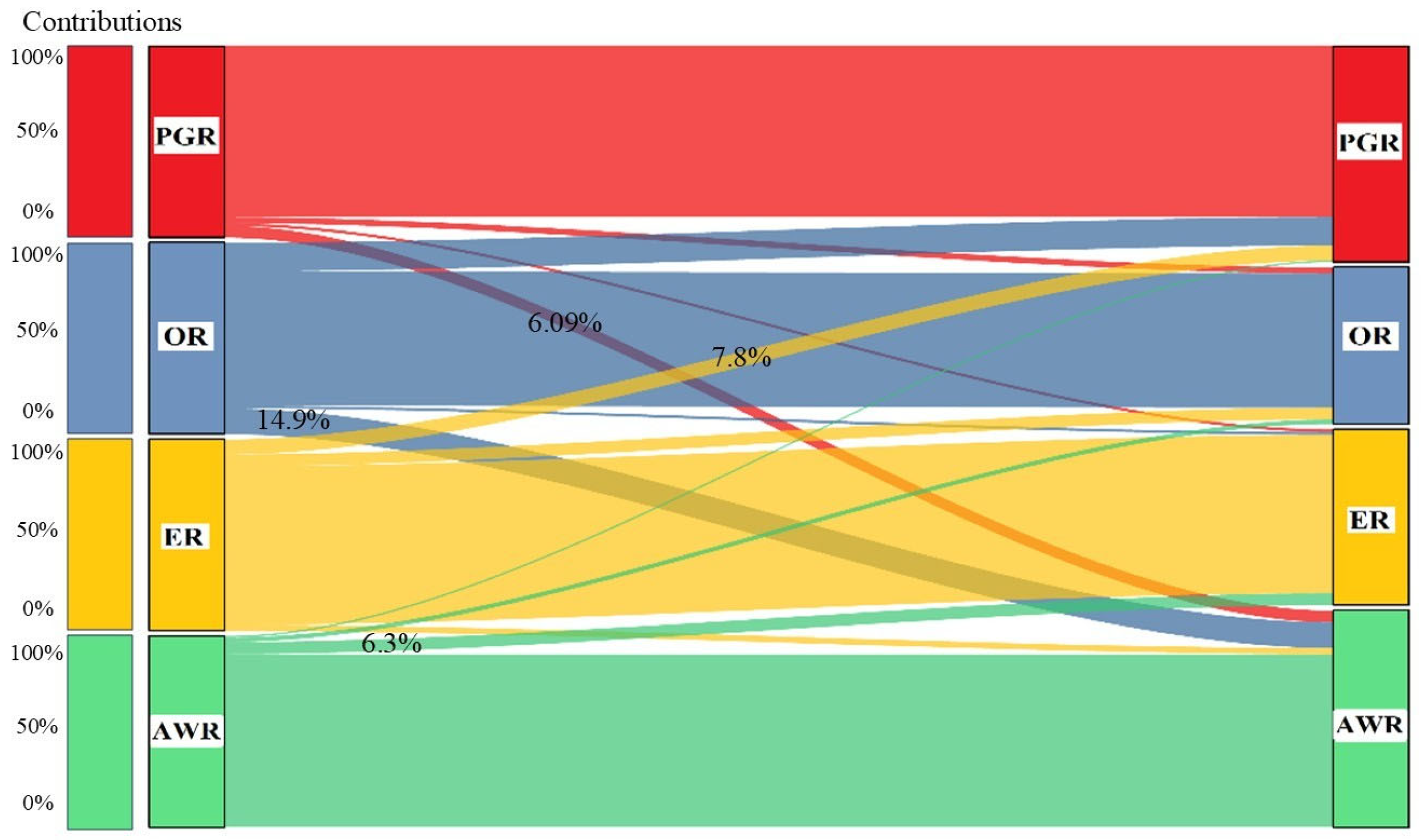
The dynamic transfer process within the four risk indicators is shown in Figure 19, with the width of each link proportional to the risk contribution rate, which could reveal the direction and amount of transmission clearly. In general, the risk transmission of each single risk indicator itself is dominant, but there are differences among risks. Under the condition of ignoring the transmission from themselves, contributions of PGR to OR and ER are dominant, but the contributions to AWR are negligible. OR contributed 2–6% to the other three risk factors. ER contributed significantly to AWR, but a little to PGR and OR. The contribution of AWR to the other three risk factors is significant, especially to OR (more than 10%).

5. Conclusions

A lot of uncertain factors exist in the process of water resource development and utilization, which makes water resources regulation face multiple risks. To ensure the stable growth of socio-economic benefits and eco-environmental benefits, it is urgent that we deeply explore the risks faced by water resource regulation and control systems. The NZD, JH, and GLB hydropower stations on the lower reaches of the LCR were selected as the objects for this paper, and a multi-objective optimization operation model for cascade hydropower stations was constructed. Additionally, a risk transmission model for cascade hydropower station operation was constructed based on the VAR model, and the dynamic transmission relationship and transmission quantity of risks were analyzed.
The results of the multi-objective operation model of cascade hydropower stations show that the discharge of the reservoir changed about 10.38% compared with the suitable ecological water demand (the monthly mean REC is 10.38%), and the annual mean power generation is 33,243 GWh, which is 661 GWh more than the regular cascade power generation (32,582 GWh). Four kinds of risk factors are selected to analyze the number of risks from the process of cascade reservoir operation, namely, EGR, OR, ER, and AWR. The threshold values are 19–45%, 42.33–46%, 59.67–66.83%, and 0.33–2.42%, respectively.
In this paper, the VAR model for multi-objective operation risk is constructed to deeply analyze the transmission relationship and quantity among risks. Five statistics, LR, AIC, SC, FPE, and HQ, are selected to determine the optimal lag (the lag of the VAR model is 2). The VAR model passes the stationarity standard by the AR root test. The results of IRF show that the PGR and OR added a standard deviation disturbance, the increase in AWR was inhibited (the transmission is negative), and the increase in the other risks was promoted (the transmission is positive). In addition, the increase in ER promoted the PGR but inhibited the OR and the AWR. The increase in AWR promoted the growth of the other risks.
Finally, the VDM is used to quantitatively estimate the transmission between risk indicators. The results show that the risk transmission of each risk itself is dominant, but the process of transmission shows differences among risk indicators. Regardless of itself, the contribution of PGR to OR and ER is dominant (the contribution rates are 14.88% and 7.77%, respectively), but its contribution to AWR is low (0.84%). The contribution of OR to the other three risk factors is between 2 and 6%. ER contributes significantly to AWR (6.30%) but performs a little to PGR and OR (1.48% and 1.43%). AWR contributes a lot to the other three risks (contribution rates are 6.08%, 13.47%, and 3.18% to PGR, or ER, respectively).

Author Contributions

Conceptualization, H.Z.; methodology, H.Z.; software, J.L.; validation, J.L. and S.Y.; formal analysis, J.L.; investigation, J.W. and C.W.; resources, H.Z.; data curation, D.W.; writing—original draft preparation, J.L.; writing—review and editing, L.Z.; visualization, J.W. and C.W.; supervision, J.H.; project administration, H.Z.; funding acquisition, H.Z. All authors have read and agreed to the published version of the manuscript.

Funding

This research was supported by the National Natural Science Foundation of China (Grant No. 52209008), the Excellent Young Teachers Basic Research Support Program of Heilongjiang Province (Grant No. YQJH2024026), and the “Tianchi Talent” Introduction Program in Xinjiang (Grant No. CZ001304).

Institutional Review Board Statement

Not applicable.

Informed Consent Statement

Not applicable.

Data Availability Statement

The data presented in this study are available on request from the corresponding author.

Conflicts of Interest

The authors declare no conflict of interest.

References

  1. Zhang, Q.; Liu, W.; Sun, H.; Wang, H.; Wang, L.; Zhang, J.; Xu, Z. Cascade reservoir regulations on nitrogen source and transformation in the Tibetan Plateau river: Constraints from high frequency data of Lancang river. J. Hydrol. 2024, 650, 132563. [Google Scholar] [CrossRef]
  2. Hu, H.; Zuo, Q.; Li, H.; Yang, K. Stochastic multi-attribute group decision-making for long-term com-prehensive operation of cascade reservoirs under multiple uncertainties. J. Hydrol. Reg. Stud. 2024, 53, 101758. [Google Scholar] [CrossRef]
  3. Zhu, Y.; Zhou, Y.; Xu, C.; Chang, F. Optimizing complementary operation of mega cascade reservoirs for boosting hydropower sustainability. Sustain. Energy Technol. Assess. 2024, 64, 103719. [Google Scholar] [CrossRef]
  4. Zhou, S.; Wang, Y.; Su, H.; Chang, J.; Huang, Q.; Li, Z. Dynamic quantitative assessment of multiple un-certainty sources in future hydropower generation prediction of cascade reservoirs with hydrological variations. Energy 2024, 299, 131447. [Google Scholar] [CrossRef]
  5. Feng, Z.; Zhang, L.; Mo, L.; Wang, Y.; Niu, W. A multi-objective cooperation search algorithm for cascade reservoirs operation optimization considering power generation and ecological flows. Appl. Soft Comput. 2024, 150, 111085. [Google Scholar] [CrossRef]
  6. Niu, C.; Chang, J.; Wang, Y.; Shi, X.; Wang, X.; Guo, A.; Jin, W.; Zhou, S. A water resource equilibrium regulation model under water resource utilization conflict: A case study in the Yellow River Basin. Water Resour. Res. 2022, 58, e2021WR030779. [Google Scholar] [CrossRef]
  7. Qiu, H.; Chen, L.; Zhou, J.; He, Z.; Zhang, H. Risk analysis of water supply-hydropower generation-environment nexus in the cascade reservoir operation. J. Clean. Prod. 2020, 283, 124239. [Google Scholar] [CrossRef]
  8. Chen, L.; Ge, L.; Wang, D.; Zhong, W.; Zhan, T.; Deng, A. Multi-objective water-sediment optimal operation of cascade reservoirs in the Yellow River Basin. J. Hydrol. 2022, 609, 127744. [Google Scholar] [CrossRef]
  9. Lee, J.; Shin, H. Agricultural Reservoir Operation Strategy Considering Climate and Policy Changes. Sustainability 2022, 14, 9014. [Google Scholar] [CrossRef]
  10. Luo, Q.; Luo, Y.; Zhou, Y.; Zhu, D.; Chang, F.-J.; Xu, C.-Y. Reducing Carbon Emissions: A Multi-Objective Approach to the Hydropower Operation of Mega Reservoirs. Sustainability 2025, 17, 2770. [Google Scholar] [CrossRef]
  11. Wu, X.; Shen, X.; Wei, C.; Xie, X.; Li, J. Reservoir Operation Sequence- and Equity Principle-Based Multi-Objective Ecological Operation of Reservoir Group: A Case Study in a Basin of Northeast China. Sustainability 2022, 14, 6150. [Google Scholar] [CrossRef]
  12. Zhang, Y.; Chen, Q.; Wang, R.; Wang, H.; Chen, Z.; Li, Y.; Liu, H. A study of operational safety risk identification of a cascade reservoir group (I)—Bayesian network-based risk identification for cascade hydropower stations. Sustain. Energy Technol. Assess. 2021, 48, 101583. [Google Scholar] [CrossRef]
  13. Wang, T.; Li, Z.; Ge, W.; Zhang, Y.; Jiao, Y.; Jing, L.; Gelder, P. Rank classification method for cascade reservoirs considering scale, benefits, and risk consequences. J. Hydrol. 2023, 623, 129856. [Google Scholar] [CrossRef]
  14. Liu, J.; Song, T.; Mei, C.; Wang, H.; Zhang, D.; Nazli, S. Flood risk zoning of cascade reservoir dam break based on a 1D-2D coupled hydrodynamic model: A case study on the Jinsha-Yalong River. J. Hydrol. 2024, 639, 131555. [Google Scholar] [CrossRef]
  15. Gong, Y.; Liu, P.; Liu, D.; Zhang, X.; Xu, W.; Xiang, D. An analytical two-stage risk analysis model in the real-time reservoir operation. J. Hydrol. 2024, 645, 132256. [Google Scholar] [CrossRef]
  16. Yang, Z.; Wang, Y.; Song, S.; Li, Y.; Hu, H.; Feng, J.; Xu, S.; Yang, K. Multi-objective operation-decision-making-risk propagation analysis for cascade reservoirs affected by future streamflow process variations. J. Hydrol. 2023, 620, 129518. [Google Scholar] [CrossRef]
  17. Bao, Y.; Sun, M.; Wang, Y.; Lu, J.; Wu, Y.; Chen, H.; Li, S.; Qin, Y.; Wang, Z.; Wen, J.; et al. Impact of Cascade Reservoir on the Sources of Organic Matter in Sediments of Lancang River. iScience 2025, 28, 111681. [Google Scholar] [CrossRef]
  18. Yang, Z.; Min, Q.; Guo, X.; Wang, C.; Yan, B.; Li, X.; Liu, D.; Ma, J.; Lorke, A. Cascaded reservoirs pro-mote phosphorus bioavailability of surface sediments in the upper Mekong river. Sci. Total Environ. 2024, 955, 176876. [Google Scholar] [CrossRef]
  19. He, S.; Li, B.; Li, Q.; Zheng, H.; Chen, Y. Refining hydropower operation by dynamic control of cascade reservoir water levels with flood season segmentation. Energy 2025, 314, 134156. [Google Scholar] [CrossRef]
  20. Liu, D.; Bai, T.; Deng, M.; Huang, Q.; Wei, X.; Liu, J. A parallel approximate evaluation-based model for multi-objective operation optimization of reservoir group. Swarm Evol. Comput. 2023, 78, 101288. [Google Scholar] [CrossRef]
  21. Jing, W.; Wang, Y.; Chang, J.; Wang, X.; Niu, C.; Wang, Y.; Peng, S. Multi-objective synergetic reservoir operation in a sediment-laden river. J. Hydrol. 2021, 599, 126295. [Google Scholar] [CrossRef]
  22. Liu, D.; Bai, T.; Ju, C.; Liu, X.; Chen, X.; Huang, Q.; Liu, J. Newsboy theory for real-time multi-source risk operation of reservoir group: A case study of Pearl River Basin. J. Hydrol. 2024, 637, 131359. [Google Scholar] [CrossRef]
  23. Zhang, L.; Yang, S.; Yuan, C.; Zhang, H.; Chang, J.; Xu, P.; Liu, J.; Hu, J.; Xing, Z.; Wang, C.; et al. Practice of multiple risk operation in multi-objective optimal operation of cascade hydropower plants: A case in lower branch of Lancang River Basin. J. Hydrol. 2025, 650, 132481. [Google Scholar] [CrossRef]
  24. Lu, Q.; Zhong, P.; Xu, B.; Huang, X.; Zhu, F.; Wang, H.; Ma, Y. Multi-objective risk analysis for flood control operation of a complex reservoir system under multiple time-space correlated uncertainties. J. Hydrol. 2022, 606, 127419. [Google Scholar] [CrossRef]
  25. Liu, S.; Huang, M.; Li, Y. Chinese Agricultural Insurance Development in a VAR Model. Procedia Comput. Sci. 2022, 202, 399–407. [Google Scholar] [CrossRef]
  26. Inoue, A.; Kilian, L. Joint Bayesian Inference about Impulse Responses in VAR Models. Work. Pap. 2020, 231, 457–476. [Google Scholar] [CrossRef]
  27. Liu, Y.; Wang, X.; Shan, F.; Yue, H.; Shi, J. The bidirectional dependency between global water resources and vegetation productivity. J. Hydrol. 2024, 635, 131160. [Google Scholar] [CrossRef]
  28. Zhang, W.; Wei, F.; Horion, S.; Rasmus, F.; Forkel, M.; Brandt, M. Global quantification of the bidirectional dependency between soil moisture and vegetation productivity. Agric. For. Meteorol. 2022, 313, 108735. [Google Scholar] [CrossRef]
  29. Huyan, Y.; Zhang, B.; Wang, X.; Lu, Y.; Liu, F. Geochemistry of the Lancang River (Upper Mekong River) overbank sediments: Implications for provenance, weathering and sedimentary characteristics. Appl. Geochem. 2023, 156, 105747. [Google Scholar] [CrossRef]
  30. Wang, Y.; Long, D.; Li, X. High-temporal-resolution monitoring of reservoir water storage of the Lancang-Mekong River. Remote Sens. Environ. 2023, 292, 113575. [Google Scholar] [CrossRef]
  31. Li, J.; Dong, S.; Peng, M.; Yang, Z.; Liu, S.; Li, X.; Zhao, C. Effects of damming on the biological integrity of fish assemblages in the middle Lancang-Mekong River basin. Ecol. Indic. 2013, 34, 94–102. [Google Scholar] [CrossRef]
  32. Wang, Y.; Wang, Q.; Zhang, W.; Wang, N.; Cong, N.; Kattel, G.; Qi, Y.; Yao, W. Ecological perspectives of endemic fish species under cascade hydropower development. Lake Reserv. Manag. 2024, 40, 404–425. [Google Scholar] [CrossRef]
  33. Zhang, H.; Chang, J.; Gao, C.; Wu, H.; Wang, Y.; Lei, K.; Long, R.; Zhang, L. Cascade hydropower plants operation considering comprehensive ecological water demands. Energy Convers. Manag. 2019, 180, 119–133. [Google Scholar] [CrossRef]
  34. Zhang, L.; Zhang, H.; Liu, D.; Huang, Q.; Chang, J.; Liu, S. The dynamic response of runoff to human activities and climate change based on a combined hierarchical structure hydrological model and vector autoregressive model. Agronomy 2023, 13, 510. [Google Scholar] [CrossRef]
  35. Zhang, L.; Huang, Q.; Liu, D.; Deng, M.; Zhang, H.; Pan, B.; Zhang, H. Long-term and mid-term ecological operation of cascade hydropower plants considering ecological water demands in arid region. J. Clean. Prod. 2021, 279, 123599. [Google Scholar] [CrossRef]
  36. Huang, S.; Chang, J.; Leng, G.; Huang, Q. Integrated index for drought assessment based on variable fuzzy set theory: A case study in the Yellow River basin, China. J. Hydrol. 2015, 527, 608–618. [Google Scholar] [CrossRef]
  37. Jiang, Q.; Liu, W.; Wu, S. Analysis on factors affecting moisture stability of steel slag asphalt concrete using grey correlation method. J. Clean. Prod. 2023, 397, 136490. [Google Scholar] [CrossRef]
  38. Sims, C. Macroeconomics and Reality. Econometrica 1980, 48, 1–48. [Google Scholar] [CrossRef]
  39. Chi, Y.; Zou, Y.; Zheng, X.; Wang, Q. Hybrid model-data-driven dynamic VAR planning for wind-penetrated power system using spectral surrogate techniques. Int. J. Electr. Power Energy Syst. 2024, 159, 109998. [Google Scholar] [CrossRef]
  40. Christiano, L.J.; Christopher, A. Sims Vector Autoregressions. Scand. J. Econ. 2012, 114, 1082–1104. [Google Scholar] [CrossRef]
  41. Cavaliere, G.; Rahbek, A.; Taylor, A.M.R. Bootstrap Determination of the Co-Integration Rank in Heteroskedastic VAR Models. Econom. Rev. 2014, 33, 606–650. [Google Scholar] [CrossRef]
  42. Liu, X.; Jia, C. Statistical Analysis of Rainfall Intensity Frequency Considering Rainfall Time in the Diurnal Cycle. Water Resour. Manag. 2024, 38, 5579–5596. [Google Scholar] [CrossRef]
  43. Cavicchioli, M. Statistical Analysis of Mixture Vector Autoregressive Models. Scand. J. Stat. 2016, 43, 1192–1213. [Google Scholar] [CrossRef]
  44. Utouh, H.; Tile, A. The nexus between foreign direct investment and nominal exchange rate, real GDP, and capital stock in Tanzania. Acta Sci. Pol. Oeconomia 2023, 22, 73–87. [Google Scholar] [CrossRef]
  45. Ahking, F.W. Model mis-specification and Johansen’s co-integration analysis: An application to the US money demand. J. Macroecon. 2002, 24, 51–66. [Google Scholar] [CrossRef]
  46. Lütkepohl, H.; Saikkonen, P. Testing for the cointegrating rank of a VAR process with a time trend. J. Econom. 2000, 95, 177–198. [Google Scholar] [CrossRef]
  47. Cavicchioli, M. A matrix unified framework for deriving various impulse responses in Markov switching VAR: Evidence from oil and gas markets. J. Econ. Asymmetries 2024, 29, e00349. [Google Scholar] [CrossRef]
  48. Liu, J.; Cao, Y. Does out-migration really affect forestry ecological security? An empirical case study based on Heilongjiang province, China. Forests 2024, 15, 1400. [Google Scholar] [CrossRef]
  49. Elzaki, R.M.; Al-Mahish, M. Food insecurity and water management shocks in Saudi Arabia: Bayesian VAR analysis. PLoS ONE 2024, 19, e0296721. [Google Scholar] [CrossRef]
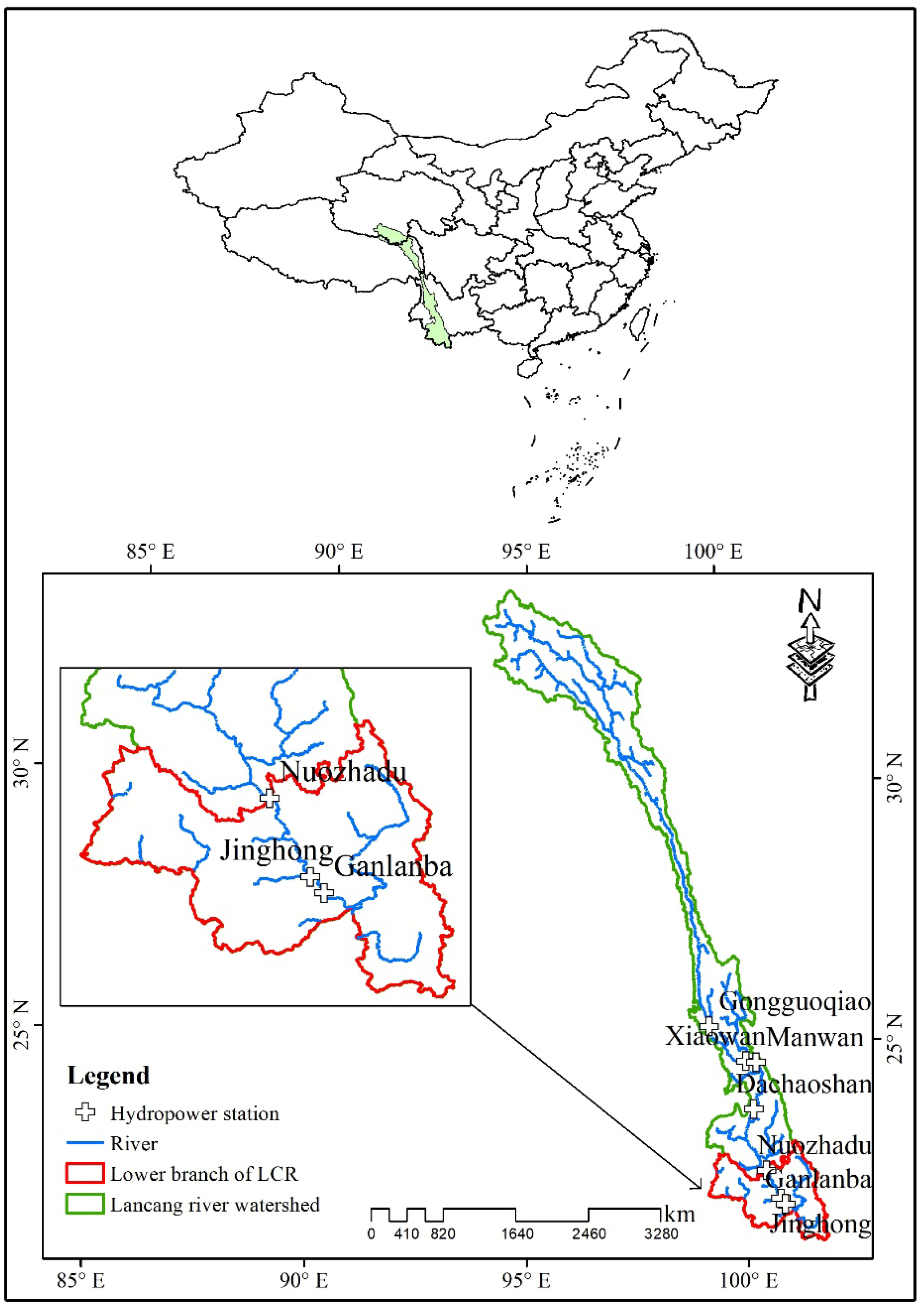
Figure 1. The watershed of the Lancang River.
Sustainability 17 09623 g001
Figure 2. Node diagram of the mainstream hydropower plants in the LCR.
Sustainability 17 09623 g002
Figure 3. Flow chart of GA.
Sustainability 17 09623 g003
Figure 4. Flow chart for determining the optimal weight.
Sustainability 17 09623 g004
Figure 5. Weight settings for the multi-objective scheme set (the corresponding weights of each sub-objective function).
Sustainability 17 09623 g005
Figure 6. Evaluation metrics (A is annual mean power generation (103 GWh)); B is the ratio of power generation to abandoned water (0.1 kWh/ m3); C is average output in the dry season (10 MW); D is variation coefficient of output in the dry season (%); E is the ratio of minimum output to annual mean output (%); F is REC (%).
Sustainability 17 09623 g006
Figure 7. Annual power generation of the hydropower plants.
Sustainability 17 09623 g007
Figure 8. Monthly mean power generation of NZD, JH, and GLB.
Sustainability 17 09623 g008
Figure 9. Monthly mean output of NZD, JH, and GLB.
Sustainability 17 09623 g009
Figure 10. Annual and monthly mean REC for lower reaches of JH.
Sustainability 17 09623 g010
Figure 11. Scatter diagram of power generation and output with risks.
Sustainability 17 09623 g011
Figure 12. Scatter plot of discharge and risk factors.
Sustainability 17 09623 g012
Figure 13. Stationarity test based on the VAR model for 4 risk indicators.
Sustainability 17 09623 g013
Figure 14. Impulse response curve of power generation risk (PGR).
Sustainability 17 09623 g014
Figure 15. Impulse response curve of output risk (OR).
Sustainability 17 09623 g015
Figure 16. Impulse response curve for the ecological risk (ER).
Sustainability 17 09623 g016
Figure 17. Impulse response curve of abandoned water risk (AWR).
Sustainability 17 09623 g017
Figure 18. Statistical graph of transmission among 4 risk indicators.
Sustainability 17 09623 g018
Figure 19. Dynamic process graph of transmission among 4 risk indicators.
Sustainability 17 09623 g019
Table 1. The main constraints of the model.
ConstraintExpression
Water balance constraint V ( t + Δ t ) = V ( t ) + [ Q I ( t ) Q 0 ( t ) ] Δ t
Water level constraint Z m i n m , t Z ( m , t ) Z m a x ( m , t )
Discharge constraint: Q m i n ( m , t ) Q ( m , t ) Q m a x ( m , t )
Output constraint N m i n ( m , t ) N ( m , t ) N m a x ( m , t )
Generator flow constraint Q F m i n ( m , t ) Q F ( m , t ) Q F m a x ( m , t )
Variable non-negative constraint V 0 , Z 0 , Q 0 , N 0 , Q F 0
Table 2. The multi-objective optimal operation results of cascade hydropower stations.
Hydropower StationsAnnual Mean Power Generation/GWhAverage Output in Dry Season/MWMonthly Mean REC/%
NZD24,217214.510.38
JH806771.46
GLB9588.53
Total33,243296.48
Table 3. Results for unit root test of each risk indicator.
Risk IndexADF TestCritical Value
(a = 5%)
Result
t = Statisticp = Value
PGR−6.439692 *0−2.915522Stationary
OR−6.10293 *0−2.915522Stationary
ER−6.899601 *0−2.915522Stationary
AWR−8.397068 *0−2.915522Stationary
Note: * denotes rejection of the hypothesis at the 0.05 level.
Table 4. Lag of the VAR model for four risk indicators.
LagLRAICSCFPEHQ
0NA−5.6558−5.54904.11 × 10−8−5.6126
1125.9523−6.7066−6.17231.44 × 10−8−6.4906
279.0371 *−7.2817 *−6.3201 *8.10 × 10−9 *−6.8930 *
324.2078−7.2400−5.85100.49 × 10−9−6.6786
Note: * represents the best lag order under the statistical criteria. NA represents not available owing to insufficient degrees of freedom.
Table 5. Parameters for the VAR model of four risk indicators.
Risk FactorsPGRORERAWR
PGR (−1)−0.730.030.010.24
PGR (−2)−0.410.030.02−0.23
OR (−1)0.89−0.710.31−5.93
OR (−2)0.45−0.360.33−5.30
ER (−1)−0.450.02−0.761.57
ER (−2)−0.62−0.10−0.362.53
AWR (−1)0.030.0020.001−0.66
AWR (−2)0.020.003−0.002−0.26
C0.0020.0004−0.0010.002
R20.820.810.830.79
Note: C represents a constant, and the information in the expansion is lag.
Disclaimer/Publisher’s Note: The statements, opinions and data contained in all publications are solely those of the individual author(s) and contributor(s) and not of MDPI and/or the editor(s). MDPI and/or the editor(s) disclaim responsibility for any injury to people or property resulting from any ideas, methods, instructions or products referred to in the content.