You are currently viewing a new version of our website. To view the old version click .
Sustainability
  • Article
  • Open Access

29 October 2025

Fintech as a Catalyst for Sustainability: Empirical Evidence from Saudi Arabia

and
1
College of Business Administration, University of Business and Technology, Jeddah 21448, Saudi Arabia
2
Accounting and Finance Department, College of Management and Technology, Arab Academy for Science & Technology and Maritime, Cairo P.O. Box 1029, Egypt
3
Accounting Department, College of Business Administration, University of Business and Technology, Jeddah 21448, Saudi Arabia
*
Author to whom correspondence should be addressed.

Abstract

This study explores the impact of financial technology (Fintech) on economic, social, and environmental sustainability in Saudi Arabia using survey-based empirical evidence. Using ordinal logistic regression, the results provide evidence of a positive and significant role of fintech adoption in each of the three areas of sustainability. On the economic front, fintech fosters financial inclusion, bank efficiency, and sector diversification. Socially, it promotes equality by providing greater access to financial services for vulnerable groups like women, youth, and SMEs, as well as creating new job opportunities. Environmentally, fintech reduces the environmental footprint of financial transactions and funnels capital into green initiatives, as outlined in Saudi Arabia’s Vision 2030 aspirations. The findings have important policy and managerial implications, suggesting that banks should include fintech as a strategic source of sustainable development, while policymakers must implement enabling regulation and incentives to encourage innovation. Cross-country analysis within the GCC and examination of moderating variables such as institutional quality and corporate governance could form part of future research.

1. Introduction

The past decade has witnessed the world undergo a drastic change in the financial sector by the digital revolution. Leading the pack of the most drastic developments is financial technology (Fintech) that transforms the access, production, and consumption of financial services. Through the integration of artificial intelligence, blockchain, big data, and digital platforms, Fintech is creating new economic and organizational models that can respond to existing challenges [1,2,3]. These are not merely technological innovations. They are part of a broader vision of sustainability, which encompasses economic, environmental and social visions [4].
Economically, Fintech enhances the competitiveness and effectiveness of financial markets. It facilitates financial inclusion and promote sustainable economic growth by reducing transaction costs, enhancing transparency, and improving access to finance [5,6,7,8]. Small and medium-sized enterprises (SMEs), who typically are hard-pressed to get credit, particularly benefit from alternative financing models such as digital wallets, peer-to-peer lending (P2P lending) and crowdfunding [9,10,11]. These mechanisms guarantee an increase in the productive infrastructure and diversification of sources of funding, which increases long-term economic resilience [12,13].
At the societal level, the impacts of Fintech are largely observed in the expansion of financial inclusion and the reduction of inequalities. By providing marginalized populations, particularly in developing countries, with access to simple banking services via cell phones or dematerialized services, Fintech results in more social equity. It also generates new employment opportunities, encourage financial literacy, and support women’s empowerment and youth entrepreneurship. But this is a benign contribution to be set against risks associated with the digital divide, which can heighten inequalities between the connected and the yet-untouched, still outside the digital world [14].
From an environmental perspective, Fintech is playing an increasingly vital role in the green transition and becoming a more sustainable economy. Blockchain technologies, for example, allow for responsible investment tracking and transparency of funded projects. Green fintech and sustainable finance platforms redirect funds into green projects, such as renewable energy or carbon-reduction initiatives. Moreover, financial services dematerialization and transaction digitization reduce the use of paper and physical space of traditional banking institutions, thus fostering a circular and sustainable economy [4,7,15].
Theoretically, the connection between sustainability and fintech can be explained through a variety of theoretical concepts. According to agency theory, financial technologies reduce information asymmetry and agency costs, enhance transparency, and promote the optimal use of resources, thereby improving economic sustainability [3,16]. The sustainable development theory identifies the role of fintech to promote socially responsible and green projects as well as financial inclusion, thus ensuring balanced economic, social and ecological growth [9,11]. Finally, Schumpeterian technological innovation theory indicates that fintech is a source of “creative destruction,” which reconfigures traditional finance frameworks and produces innovations driving competitiveness and the transition towards a more sustainable economy [17,18].
In practice, previous studies reveal the presence of positive and negative impacts on the Fintech and sustainability nexus. Various studies report that Fintech promotes financial inclusion, reduces costs of transactions, and promotes sustainable development [4,14,15]. In addition, application of digital technologies increases efficiency and transparency, thereby improving economic and social sustainability [7,8,14].
However, existing research suggests that Fintech poses potential risks like financial instability due to increased competition and disruption of traditional banking models [19], cybersecurity, digital exclusion, and energy consumption of technologies [4,20]. The research suggests that Fintech’s influence on sustainability is double-edged and critically dependent on regulatory and institutional contexts.
As in other countries, Saudi Arabia is experiencing the rapid development of its Fintech sector, spearheaded by Vision 2030 and the Financial Sector Development Program. The Fintech Strategy centers on the promotion of a cashless economy, enhancing financial inclusion, and establishing Riyadh as a hub internationally. Regulators such as CMA and SAMA are enabling this activity via regulatory sandboxes and green finance and ESG integration legal frameworks. Flagship initiatives involve the initial USD 850 million sustainable sukuk raised by the Saudi National Bank in 2022 and the Green Financing Framework that was launched in 2024, which is a sign of the growing attention towards environmental objectives. Green fintech hence appears to be a major control lever in the achievement of carbon neutrality by 2060 and decreasing CO2 emission by 2030. Despite challenges such as the lack of ESG data and technical skills, the opportunities offered ESG rating, carbon footprint tracking, green financing for renewable energy and green supply chains define the core contribution of fintech to the economic, social, and environmental growth of the Kingdom.
Against this background, this research aims to explore the contribution of Fintech to Saudi Arabian sustainability. More specifically, it makes several important contributions to sustainability and Fintech research. It first provides new empirical evidence concerning Fintech contribution to Saudi Arabian sustainable development in a country where such research is relatively sparse. This study seeks to answer the following central research question: To what extent does the adoption of financial technology (FinTech) contribute to economic, social, and environmental sustainability in Saudi Arabia? By investigating this question, the research aims to provide empirical evidence on the role of FinTech in advancing sustainable development, in line with the strategic objectives outlined in Saudi Arabia’s Vision 2030.
Utilizing a questionnaire aimed at directly addressing financial sector stakeholders as well as Fintech service customers, the research transmits actual attitudes and practices regarding the integration of economic, environmental, and social considerations. Second, it illuminates the dynamics whereby Fintech fuels financial inclusion, transactional efficiency, and sustainable project finance, thus bolstering extant theoretical frameworks of sustainable development and technological innovation. Finally, it provides policy implications to regulators, banks, and Fintech startups regarding the levers and inhibitors to the adoption of sustainable Fintech in the Saudi context. The survey-based study completes classical quantitative studies and bridges the gap in knowing what makes humans and organizations resilient regarding sustainability in the finance sector.
The rest of the paper is structured as follows. Section 2 develops the hypotheses developed in the context of Fintech and sustainability. Section 3 will present the methodology used in the study. Section 4 discusses and presents the findings. Section 5 concludes.

2. Literature Review

2.1. Theoretical Background

FinTech has profoundly transformed global financial services. Beyond being a mere vehicle for technological change, it is increasingly recognized as a strategic lever for advancing sustainable development. FinTech promotes financial inclusion, transaction transparency, capital flow traceability, and the empowerment of economic agents through digital technologies such as mobile finance, blockchain, peer-to-peer lending platforms, and robo-advisors [2,3]. These technologies facilitate investment in projects with positive environmental and social outcomes, strengthen corporate governance, and enhance economic resilience to sustainability-related shocks [3,18]. To understand the FinTech–sustainability nexus, we draw on three key theoretical perspectives:

2.1.1. Agency Theory

Agency theory posits that conflicts of interest between principals (e.g., shareholders) and agents (e.g., managers) can undermine sustainability objectives [16] FinTech offers digital tools that enhance transparency and monitoring, thereby reducing information asymmetries and improving managerial accountability. Blockchain platforms, for instance, provide immutable records of transactions, limiting opportunistic behavior [2]. Similarly, AI-driven ESG reporting facilitates the disclosure of non-financial information, boosting stakeholder trust [3,21]. Recent work by [22] confirms that FinTech enhances corporate sustainability through improved governance and digital infrastructure.

2.1.2. Sustainable Development Theory

This theory emphasizes the balance between economic, social, and environmental dimensions. FinTech contributes to this balance by expanding access to financial services, especially for underserved populations. Mobile banking, P2P lending, and green crowdfunding platforms democratize access to capital [11]. FinTech also channels investments toward impactful projects via instruments like green bonds and ESG funds. Through data analytics and risk management technologies, it enables firms to identify sustainable opportunities and optimize investment decisions. Refs. [11,23] highlight FinTech’s role in fostering inclusive growth and environmental performance, even under geopolitical uncertainty.

2.1.3. Schumpeterian Innovation Theory

Schumpeter’s theory of innovation underscores the role of technological change in economic transformation through “creative destruction” [17]. FinTech exemplifies this process by disrupting traditional financial paradigms with innovations such as smart contracts and robo-advisors. These technologies enable more efficient capital allocation and support the emergence of sustainable business models. Ref. [24] empirically validates Schumpeter’s view, showing that FinTech-driven innovation positively influences economic growth, particularly in developing economies. Ref. [25] further illustrates how FinTech innovations reshape access to capital and financial services for small businesses.

2.2. Empirical Studies and Hypothesis Development

In recent years, the relationship between Fintech and sustainability has been a key focus of empirical research, prompting numerous studies. Despite this, the findings obtained are varied, reflecting the situational nature of the complexity. Notably, recent research has primarily focused on the positive impact of Fintech on sustainability. For instance, ref. [12] conducted an econometric study to evaluate the effect of Fintech on the sustainable performance of small and medium-sized enterprises (SMEs) in Pakistan. The main findings show that the application of financial technology improves the sustainable performance of SMEs. The study also revealed that green innovation and circular economy practices partially mediate the relationship between Fintech and sustainable performance. Ref. [7] found that the use of financial technologies is essential for fostering environmental sustainability in emerging economies. It also shows that human development directly contributes to such sustainability, with green innovation playing an essential mediating role. Thus, this study establishes a partnership between financial inclusion, the use of financial technologies, human progress, and green finance, which improves environmental protection.
In the same vein, ref. [26] found that Fintech had a strongly positive influence on firms’ ESG performance, with the greatest impact occurring during the decline phase, followed by the maturity and growth phases. Green finance also enhances this influence, particularly in the growth phase. Furthermore, the influence of Fintech on ESG performance is greater in industries with a higher environmental impact. These findings highlight the importance of companies tailoring their Fintech-associated strategies according to their life cycle and industry characteristics in order to optimize their ESG performance. In addition, ref. [3] demonstrates that the adoption of financial technology encourages the development of environmentally friendly financial products and services, thereby facilitating the transition to a low-carbon economy. Based on a case study of Chinese listed companies from 2015 to 2022, the results reveal that financial technology significantly enhances their environmental, social and governance performance. These findings remain robust when regional and sectoral idiosyncrasies are controlled, thanks to the stringent methodology employed, which considers endogeneity. In addition, cross-border capital mobility enhances this positive impact. The financial technology effect operates through innovation in research and development, the attention given to research reports and ownership of funds. These results confirm the importance of promoting the development of financial technology in global innovation ecosystems to support company sustainability.
Ref. [27] demonstrates that social pressure, reinforced by environmental, social, and governance issues, encourages the banking sector to adopt innovative technologies. Partnerships between banks and financial technology companies enable more effective achievement of sustainable development objectives. The study also emphasizes the importance of raising awareness of and providing training on these new technologies for managers and employees, to facilitate their integration into sustainable banking practices. However, ref. [4] argues that technological advancements have a negative impact on the environment by increasing carbon emissions. This is a one-way cause-and-effect relationship, and stricter regulation of such technologies, as well as the exploitation of clean energy sources, is needed to limit their environmental impact. In addition, ref. [20] demonstrates that Fintech adoption leads to a decrease in banking stability in GCC countries. However, this perverse effect is less noticeable for large, well-capitalized, Islamic state-owned banks, as well as in the most competitive and well-developed sectors. Considering this, our first hypothesis is as follows:
Hypothesis 1.
Fintech improves sustainability in Saudi Arabia.
Hypothesis 1(a).
Fintech positively affects economic sustainability.
Hypothesis 1(b).
Fintech positively affects social sustainability.
Hypothesis 1(c).
Fintech positively affects environmental sustainability.
Hypothesis 2.
Technological innovation (TI), as a component of FinTech, has a significant positive effect on environmental sustainability in Saudi Arabia.

3. Research Methodology

3.1. Research Design and Approach

To investigate the relationship between FinTech and sustainability (economic, social, and environmental) in Saudi Arabia, we employ an explanatory research design. This design emphasizes understanding the underlying mechanisms and interactions that explain a particular phenomenon [28]. The quantitative approach is most suitable when the research aims to identify factors influencing an outcome, assess the effectiveness of an intervention, or determine the best predictors of a given result [29]. This methodological choice allows for a more comprehensive understanding by leveraging the strengths of quantitative data.

3.2. Method of Data Collection

The study exclusively utilized primary data, collected through a combination of structured questionnaires and unstructured interviews. The questionnaire comprised both closed-ended and open-ended items, with the closed-ended questions formatted using a Likert scale to facilitate quantitative analysis. This approach ensured both the relevance and reliability of the data collection process (for more details, please, see Appendix A).

3.3. Sample Design

The target population for this study comprises managers working within the Saudi financial institutions. A total of 103 managers were identified, distributed across various financial institutions: 4 commercial banks (24 mangers), 5 investment banks (31 mangers), 3 Islamic banks (18 mangers), 3 insurance companies (18 mangers), and 2 Fintech companies (12 mangers). Each manager represents an individual unit of analysis, whereas the “Type of Financial Institution” table reports the number of institutions per category. The response rate is 100%, as all identified managers participated in the study. Given the relatively small size of the population, we employed a census survey method to include all eligible participants. The census method is particularly reliable when dealing with a limited population, as it ensures comprehensive coverage and minimizes sampling error [30]. The empirical data for this study were collected through a structured questionnaire administered between February and April 2025. This period was strategically chosen to capture respondents’ perceptions during a time of active FinTech development and policy momentum in Saudi Arabia, particularly in alignment with the country’s Vision 2030 initiatives. Conducting the survey during this timeframe allowed for the observation of current trends and attitudes toward FinTech adoption, ensuring that the findings reflect a relevant and timely snapshot of its impact on sustainability across economic, social, and environmental dimensions.

3.4. Method of Data Analysis

The study employed STATA 17 to perform both descriptive and inferential statistical analyses. Descriptive tools such as mean, standard deviation, frequency, and percentage were used to summarize demographic data. To address specific research objectives, correlation analysis and ordered logistic regression were applied to examine the relationship between FinTech and sustainability.

3.5. Equation Model

To explore the impact of fintech on sustainability, we employ ordinal logistic regression. This approach is a statistical analysis method that can be used to model the relationship between an ordinal response variable and one or more explanatory variables. The choice of this approach is based on that given that all variables are constructed from ordinal data collected via Likert-scale items, this modeling approach is methodologically appropriate and widely used in survey-based research [31].
Therefore, the formula for the ordinal logistic regression model is as follows:
logit   P S u s t j = α j ( β 1 F I N T E C H 1 + β 2 T I 2 + β 3 F I 3 + β 4 E C 4 ) + μ i
where j = 1, 2, …, J − 1
Sust = ordinal dependent variable (with J ordered categories): sustainability (economic, social, environmental).
P S u s t j = cumulative probability that Sust is less than or equal to category j.
α j = intercept specific to each cumulative category.
FINTECH = financial technology.
TI = technological innovation.
FI = financial inclusion.
EC = efficiency and costs.
FinTech development is measured using seven items from Part II of the questionnaire, which capture dimensions such as accessibility, innovation, performance, regulatory support, trust, and social influence. These dimensions are grounded in established theoretical models like the Technology Acceptance Model (TAM) and the Unified Theory of Acceptance and Use of Technology (UTAUT), commonly used in digital financial services research [32,33].
Sustainability of the financial sector is assessed through 21 items divided into three sub-dimensions: economic, social, and environmental sustainability. These dimensions are aligned with the United Nations Sustainable Development Goals (SDGs), particularly SDG 8 (economic growth), SDG 9 (innovation), SDG 10 (reduced inequalities), and SDG 13 (climate action). The indicators are based on frameworks from [34] UNEP FI (2020), OECD, and recent academic contributions such as [35].
The selected indicators allow for a perception-based measurement tailored to the Saudi context and aligned with Vision 2030 objectives. They are comparable to those used in empirical studies on FinTech and sustainable finance in Gulf countries and Asia [36,37].

4. Results and Discussion

4.1. Background Information of Respondents

Table 1 summarizes the demographic characteristics of respondents. The outcomes indicate a predominantly male representation, with 64.1% male and 35.9% female participants. In terms of age distribution, the largest group falls within the 40–50 age range (39.8%), followed by those aged 30–39 (36.9%), while 12.6% are under 30 and 10.7% are above 50. Educational attainment is notably high: 68% of respondents hold a bachelor’s degree, 22.3% a master’s degree, and 5.8% a doctorate, with only 3.9% reporting a high school education.
Table 1. Demographic characteristics of respondents.
Regarding professional roles, 36.9% serve as Senior Managers, 30.1% as Department Heads, 20.4% as Executive Board Members, and 12.6% as Directors, reflecting a sample composed largely of senior-level professionals.
Experience in the financial sector is well distributed, with 33% having 5–10 years of experience, 26.2% between 11–15 years, 23.3% more than 15 years, and 17.5% less than 5 years. Geographically, most respondents are based in Riyadh (40.8%) and Jeddah (33%), with smaller proportions in the Eastern Province (14.6%) and other regions (11.6%). Institutional representation is diverse, though commercial and investment banks dominate, while Islamic banks, insurance companies, and fintech firms account for smaller shares. Finally, fintech integration appears significant, with 63.1% of institutions reporting adoption compared to 36.9% without integration.

4.2. Descriptive Statistics

Table 2 summarizes the descriptive statistics for all variables of the study. The FINTECH variable has a mean value of 0.677 (Std. Dev. = 0.170), indicating a relatively high level of adoption across the sample. Similarly, ECS (economic sustainability) and SS (social sustainability) exhibit mean scores of 0.708 (Std. Dev. = 0.175) and 0.766 (Std. Dev. = 0.149), respectively, suggesting that respondents perceive these dimensions as well-developed. ENS (environmental sustainability) and TI (Technological Innovation) show moderate averages of 0.718 (Std. Dev. = 0.206) and 0.681 (Std. Dev. = 0.213), reflecting variability in their implementation. Financial Inclusion (FI) and efficiency and costs (EC) also report relatively high means of 0.700 (Std. Dev. = 0.180) and 0.764 (Std. Dev. = 0.136), respectively, indicating strong alignment with the objectives of inclusive and sustainable financial practices. Across all variables, the minimum and maximum values range from 0 to 1, consistent with normalized measures, which facilitates comparability and interpretation.
Table 2. Descriptive statistics.

4.3. Analysis of Econometrics Model Regression

4.3.1. Cronbach’s Alpha, KMO and Bartlet Tests

Table 3 summarizes the reliability and sampling adequacy tests. The results indicate that the measurement scales used in this study demonstrate acceptable internal consistency and suitability for factor analysis. Cronbach’s alpha values range from 0.7144 to 0.8638 across the dimensions. Most variables, such as ENS, SS, and FI, exhibit strong reliability, exceeding the commonly accepted threshold of 0.70. ECS, FINTECH, TI, and EC also show satisfactory reliability.
Table 3. Outcomes of Cronbach’s Alpha, KMO and Bartlett tests.
The Kaiser–Meyer–Olkin (KMO) values, which assess sampling adequacy, range between 0.614 and 0.701, indicating a moderate level of suitability for factor analysis. Furthermore, Bartlett’s Test of Sphericity is significant at p < 0.001 for all dimensions, confirming that the correlation matrices are not identity matrices and that factor analysis is appropriate. Generally, these outcomes support the reliability and validity of the measurement model.

4.3.2. Test of Multicollinearity

Table 4 summarizes the results of the variance inflation factors (VIF). The outcomes reported for Models (1)–(3) indicate negligible multicollinearity among the predictors. Across all specifications, VIF values are tightly clustered between 1.15 (EC) and 1.38 (FI), with a mean VIF of 1.31, while the corresponding tolerance values (1/VIF) range from 0.868 to 0.723. These figures lie comfortably within conventional benchmarks (e.g., VIF well below 5 and tolerance well above 0.20), suggesting that the explanatory variables (FI, TI, FINTECH, and EC) do not exhibit problematic overlaps in the information they provide.
Table 4. Multicollinearity test.

4.3.3. Test of Heteroskedasticity

Table 5 presents the outcomes of the Breusch–Pagan/Cook–Weisberg test. The results indicate no evidence of heteroskedasticity across the three models. The chi-square statistics (χ2 = 1.60, 1.95, and 0.52) are associated with p-values of 0.1579, 0.1520, and 0.4709, all exceeding the 0.05 significance threshold. Therefore, the null hypothesis of homoskedasticity cannot be rejected, suggesting that the error variances are constant and the models satisfy this key OLS assumption.
Table 5. Breusch–Pagan/Cook–Weisberg test for heteroskedasticity.

4.3.4. Test of Omitted Variable Bias

Table 6 presents the results of the Ramsey RESET test. The outcomes suggest no evidence of model misspecification across the three models. The F-statistics (F (3,95) = 1.67, 1.49, and 1.23) correspond to p-values of 0.1795, 0.1601, and 0.3020, all above the 0.05 significance level. Therefore, the null hypothesis that the models are correctly specified cannot be rejected, indicating that omitted variable bias is unlikely to be a concern.
Table 6. Ramsey RESET test for omitted variables.

4.3.5. Checking Outliers

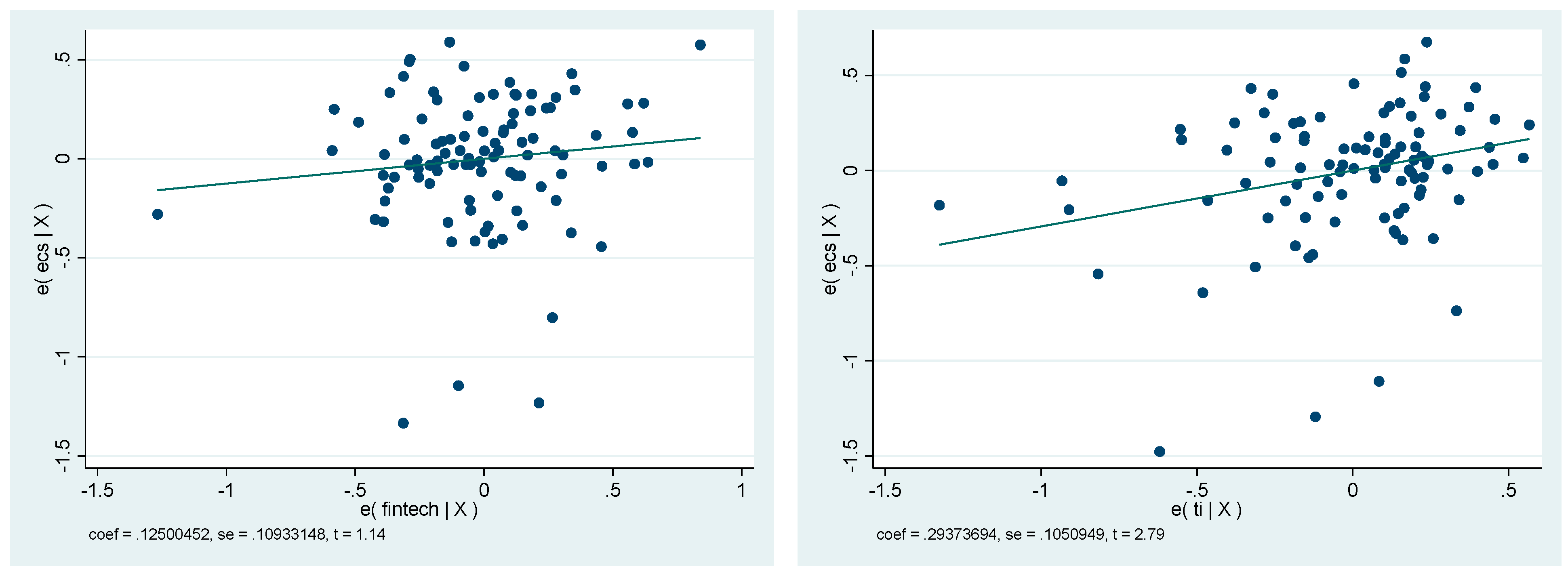
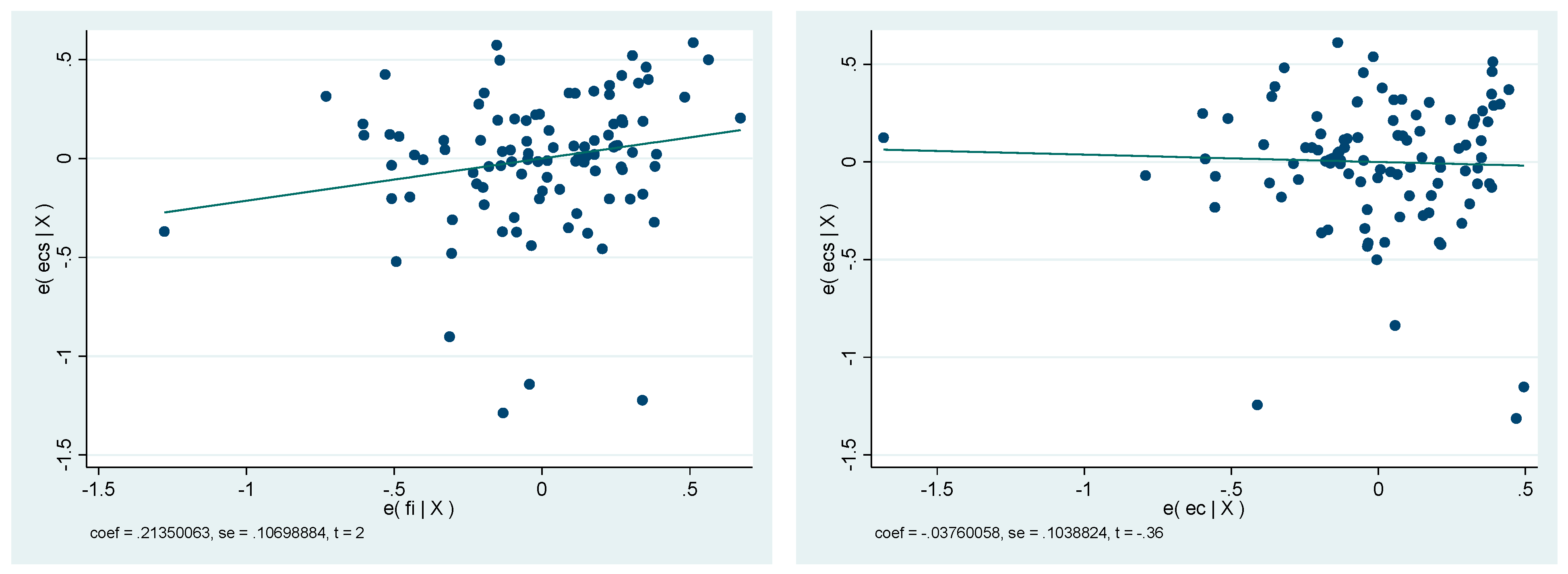
Outliers represent extreme data points that can distort statistical estimates and lead to biased results. They often arise from sources such as measurement errors, data entry mistakes, intentional misreporting by participants, or sampling errors. To detect potential outliers, the researcher employed added-variable plots after running the regression. Figure 1 examines the relationship of each predictor with the dependent variable while controlling other variables. After inspection, all observations appeared within an acceptable range, revealing that no significant outliers were present in the dataset.
Figure 1. Checking for outliers. Source: Authors’ work using Stata 17 software.

4.4. Correlation

Spearman’s correlation coefficient is a nonparametric measure that effectively summarizes the strength and direction of the ordinal association between two variables, offering a more robust alternative to the traditional Chi-square test [38]. Unlike Pearson’s correlation, it does not assume normality, making it suitable for non-normally distributed data. Additionally, as a rank-based statistic, it is less sensitive to outliers compared to parametric correlation measures.
Table 7 presents the outcomes of the Spearman correlation matrix. The results reveal significant positive associations among most variables. FINTECH correlates most strongly with SS (ρ = 0.458*), FI (ρ = 0.433*), and TI (ρ = 0.369*), with smaller but significant links to ECS (ρ = 0.305*), EC (ρ = 0.285*), and ENS (ρ = 0.198*). This suggests that security systems, financial inclusion, and technological innovation are key factors associated with fintech adoption. Among predictors, the strongest relationship is between SS and TI (ρ = 0.570*), indicating that innovation and security often co-occur. ECS also correlates moderately with SS (ρ = 0.432*) and TI (ρ = 0.414*), while ENS shows its highest link with EC (ρ = 0.386*). Non-significant associations, such as ENS with FI (ρ = 0.060), suggest some conceptual independence among variables.
Table 7. Spearman correlation matrix.

4.5. Ordered Logit Regression Results

The main findings obtained on the impact of Fintech on sustainability (economic, social, and environmental) are listed in Table 8. These results show that all the coefficients of the Fintech variable are statistically significant and positive in almost all the regressions but with varying degrees of significance.
Table 8. Main results.
Control variables play a vital role in determining all three dimensions of sustainability. Particularly, the coefficients of technology innovation (TI) have positive and significant effects on the economic, social, and environmental dimensions. This result verifies that technological innovation is conclusive when it comes to improving sustainability. It creates employment and increases productivity economically, reduces costs and improves process efficiency, and unlocks new markets and business opportunities, producing more stable and competitive growth. It improves quality of life socially by making finance, education, and healthcare more accessible, providing higher-quality jobs and inclusion. Finally, regarding the environment, innovation in renewable energy, recycling, and energy efficiency helps to cap carbon prints, conserve natural resources, and enable a shift towards more ecosystem-friendly consumption and production patterns. Technological innovation thus appears to be an essential driver for the balance between economic growth, social well-being and environmental protection.
In addition, the coefficient of the financial inclusion (FI) variable has a positive and significant impact on economic sustainability. This is because financial inclusion has a significant impact on the performance of the economy since it avails formal bank and financial services to more individuals and firms. By enhancing savings, credit, and investment, it stimulates productivity and facilitates the creation of new economic activities, particularly for small and medium-sized enterprises that are often under financing constraints. Such broadening of access to financial resources also stimulates household consumption and innovation, which reinforces economic growth and aggregate competitiveness. In addition, by reducing the dependence on the informal economy, financial inclusion improves transparency, allocation of resources, and macroeconomic stability, thus contributing to more balanced and sustainable development.
Finally, from the findings, the efficiency and costs (EC) variable has a positive impact on environmental sustainability. In other words, enhancing efficiency and reducing costs have a positive effect on environmental sustainability by encouraging companies to try and maximize their utilization of resources and reduce waste. By employing more efficient processes, organizations reduce their energy consumption, pollutant emissions and waste and hence have fewer environmental effects. Cost-saving measures also result in companies investing in cleaner technologies and favoring production models based on the circular economy. Thus, cost control and efficiency are not only limited to increasing the profitability of the economy but also assist in the conservation of natural resources and in making the transition to ecologically beneficial sustainable development.

4.6. Discussion

The main finding of the study shows that FinTech enhances sustainability, confirming hypothesis H1. More specifically, in columns (1) and (2), we can observe that Fintech has a positive relationship with economic sustainability. That is, the use of Fintech enhances economic sustainability. Particularly, the development of digital financial services in Saudi Arabia enables more financial inclusion by providing unbanked families and small businesses access to suitable credit and savings tools, stimulating consumption, productive investment, and entrepreneurial innovation. Furthermore, digitalization enables information simplification and reduced transaction costs, thereby making the financial system more efficient and enhancing investors’ confidence. This influence is translated into a steady diversification of the economy under the Vision 2030 strategy, aimed at decreasing hydrocarbon dependence and providing more balanced and sustainable development. In addition, fintech provokes competitiveness and application of new technologies (mobile payments, blockchain, crowdfunding platforms), increasing the resilience of the market to external shocks and creating a beneficial environment for sustainable long-term development. In this case, hypothesis H1(b) is accepted. This result has been confirmed by numerous previous studies [9,10,11].
Similarly, the results, presented in columns (3) and (4), reveal that Fintech fosters social sustainability. Economically, this is characterized by the fact that Fintech provides digital financial services at hand. It reduces differences between individuals and improves the integration of segments under-banked in the banking system, namely women, youth and small family businesses. This democratic access to savings and credit serves to raise living standards, increase economic autonomy and create new employment in the digital economy. In addition, the traceability and transparency made available by Fintech solutions strengthen trust in transactions, facilitate social cohesion and allow for the incorporation of social justice and equity objectives integrated within Vision 2030. This result proves the validity of hypothesis H1(c). Thus, the dissemination of financial innovations is apparently a key driver in promoting inclusive growth and reducing social disparities. This result is consistent with that found by [14].
The results also show that Fintech promotes environmental sustainability. This means that digitalization of finance reduces the use of paper and physical mobility in banking transactions and thus limits the carbon footprint of the financial sector. Furthermore, the growth of digital platforms for finance and green fintech facilitates environmental initiatives, such as green energy or sustainable infrastructure, to be able to mobilize capital more conveniently. Fintech also facilitates better use of resources through big data analysis, which allows investors and institutions to capitalize on environmental factors in decision-making more effectively. This is its positive contribution in the context of Vision 2030, and it shows the strategic role of financial innovation in transitioning to a circular and greener economy as well as Saudi Arabia’s compatibility with international sustainability criteria. This result is like those found by [7,15,16]. However, it is in contrast with that found by [16] where the authors found that technological advancements hamper environmental sustainability due to excessive carbon emissions.
The development of FinTech in Saudi Arabia is closely intertwined with the country’s strategic vision for economic transformation and sustainability. Under Vision 2030, the Saudi government has launched the Financial Sector Development Program (FSDP), which explicitly promotes FinTech as a driver of financial inclusion, innovation, and diversification away from oil dependency. Recent government investments in digital infrastructure, regulatory sandboxes, and green finance initiatives reflect a strong institutional commitment to aligning financial innovation with sustainable development goals. Our findings, which highlight perceived contributions of FinTech to economic and social sustainability, resonate with these national priorities. Moreover, studies such as [39] have mapped FinTech’s role in advancing specific SDGs in the Saudi context, including SDG 8 (Decent Work and Economic Growth) and SDG 9 (Industry, Innovation, and Infrastructure). By situating our results within this policy framework, we underscore the relevance of FinTech not only as a technological trend but as a strategic instrument in Saudi Arabia’s sustainability agenda.
Beyond technological and institutional factors, user behavior plays a pivotal role in shaping the perceived impact of FinTech services. As [40] demonstrates, even the framing of financial products—such as advisory fees—can influence investor decisions. In the context of Saudi Arabia, where digital financial literacy and trust in emerging technologies are evolving, the design and delivery of FinTech services may moderate how users perceive their contribution to sustainability. Features such as personalization, transparency, and ease of use could enhance adoption and reinforce positive perceptions. Future research could investigate these behavioral mechanisms more deeply, potentially integrating experimental or user-centered approaches to complement survey-based findings.

5. Conclusions

This study, founded on a questionnaire survey among a representative sample in Saudi Arabia, stresses the positive impact of Fintech on all dimensions of sustainability. The empirical evidence demonstrates, on the one hand, that fintech helps achieve economic sustainability through increased financial inclusion, greater efficiency of bank services, and sector diversification. On the other hand, it facilitates social sustainability by smoothing out gaps in access to financial services, improving women’s and youth empowerment, and creating new opportunities for employment. Finally, fintech facilitates environmental sustainability by reducing the environmental footprint of financial transactions and directing capital flows to green ventures, in line with the objectives of Vision 2030.
These are far-reaching implications for policymakers. For banking and finance institutions, the goal is to integrate fintech as a strategic tool to equilibrate economic efficiency and sustainable commitment. For policymakers and regulatory authorities, the results imply the need to introduce policies for facilitating financial innovation, effective regulation management, and tax benefits to ensure the development of fintech solutions based on ESG criteria. Moreover, fintech can be used as an instrument of public policy to promote social inclusion and help the transformation of the country’s environmental conditions. Based on these results, banks and Fintech are recommended to invest more in digital infrastructure, design financial products for disadvantaged groups, and build sustainable financing solutions (green fintech). Public authorities must prompt cooperation among incumbent and new players by means of public–private partnerships and start awareness and financial education initiatives to increase user trust in digital technologies.
While this study provides valuable insights into the role of FinTech in promoting sustainability across economic, social, and environmental dimensions in Saudi Arabia, several limitations should be acknowledged. First, the analysis is based solely on survey data, which may be subject to response bias and may not fully capture the complexity of FinTech adoption and its broader impacts. Second, the use of ordinal logistic regression, while appropriate for the nature of the data, limits the ability to explore non-linear relationships or interactions between variables. Third, the study focuses exclusively on Saudi Arabia, which may restrict the generalizability of the findings to other contexts, particularly within the broader GCC region. Fourth, the absence of moderating variables such as institutional quality, regulatory frameworks, and corporate governance may overlook important factors that influence the effectiveness of FinTech in driving sustainable development. These limitations suggest avenues for future research, including comparative cross-country analyses and the integration of additional contextual variables. Finally, this study employs an ordinal logistic regression model to examine the relationship between FinTech development and sustainability perceptions. Given that all variables are constructed from ordinal data collected via Likert-scale items, this modeling approach is methodologically appropriate and widely used in survey-based research [31]. However, as the data are cross-sectional and perceptual in nature, the analysis identifies associations rather than causal effects. While control variables such as financial inclusion, technological innovation, and cost-efficiency are included to reduce omitted variable bias, potential endogeneity and reverse causality—such as the possibility that more sustainable regions attract greater FinTech activity—cannot be fully ruled out. Due to data constraints, advanced causal identification strategies such as instrumental variables or panel data techniques were not feasible. Future research could address these limitations by employing longitudinal designs or quasi-experimental methods. Accordingly, the interpretation of results has been carefully framed to avoid causal language, emphasizing associative relationships and perceived contributions.

Author Contributions

Conceptualization, E.F.A. and S.M.B.; methodology, E.F.A. and S.M.B.; software, E.F.A. and S.M.B.; validation, E.F.A. and S.M.B.; formal analysis, E.F.A. and S.M.B.; investigation, E.F.A. and S.M.B.; resources, S.M.B.; data curation, S.M.B.; writing—original draft, S.M.B. and E.F.A.; writing—review and editing, E.F.A. and S.M.B.; visualization, S.M.B.; supervision, E.F.A.; project administration, E.F.A. All authors have read and agreed to the published version of the manuscript.

Funding

This research received no external funding.

Institutional Review Board Statement

We would like to clarify that the research titled “Fintech as a Catalyst for Sustainability: Empirical Evidence from Saudi Arabia”, although it involves the use of a survey, does not require approval from an ethics committee or institutional review board (IRB), for the following reasons:
  • Nature of the study: The study does not involve data collection from humans or animals. The survey exclusively gathers information at the organization level, focusing on technological capabilities, infrastructure, and processes within organization. All questions pertain strictly to organizational aspects and do not inquire about personal opinions or behaviours, ensuring that no sensitive or personal data is collected.
  • Absence of Personality Identifiable Information: The study collects any personally identifiable information, nor does it include activities that could affect the privacy, safety, or personal performance of employees. The data pertains solely to organizational practices and does not involve personal or private matters.
  • No human-subject engagement: the study does not engage Individuals as research subjects nor does it involve any medical, psychological, social, or behavioral interventions. Additionally.it does not include or affect vulnerable populations, placing it outside the scope of ethical review requirements for human subject research.
  • Informed context and transparency: All researchers who participated in the survey were fully Informed of the nature and purpose of the study. Transparency was maintained throughout the process, ensuring that participation was voluntary, non-invasive, and strictly related to organizational data.
  • Minimal risk: The data collected is strictly related to organizational performance and technological capacity and is derived from publicly or non-sensitive sources. The study poses no risk to individuals and does not impact privacy or personal well-being.

Data Availability Statement

The data presented in this study is available on request from the corresponding author.

Conflicts of Interest

The authors declare no conflicts of interest.

Appendix A

Questionnaire:
Part I: General Information
  • Gender
☐ Male
☐ Female
2.
Age
☐ Under 30
☐ 30–39
☐ 40–49
☐ 50 and above
3.
Current Position
☐ Senior Manager
☐ Department Head
☐ Director
☐ Executive Board Member
4.
Years of Experience in the Financial Sector
☐ Less than 5 years
☐ 5–10 years
☐ 11–15 years
☐ More than 15 years
5.
Type of Financial Institution
☐ Commercial Bank
☐ Investment Bank
☐ Islamic Bank
☐ Insurance Company
☐ Fintech Company
6.
Location of Your Institution (Region in Saudi Arabia)
☐ Riyadh
☐ Jeddah
☐ Eastern Province
☐ Other (please specify)
7.
Has your institution adopted or partnered with fintech solutions?
☐ Yes
☐ No
Part II—Fintech
1.
Fintech services are easily accessible in your area.
2.
Fintech have improved the speed of financial services.
3.
Fintech offer more innovative services than traditional banks.
4.
The Saudi regulatory framework is favorable to the development of fintech.
5.
You trust the security of fintech services.
6.
There is a friend effect in preferring FinTech services.
7.
People who are important to me support my use of FinTech services.
Part III—Sustainability of the Saudi Financial Sector
A. Economic Sustainability
  • Fintech strengthens the competitiveness of the financial sector.
  • Fintech promotes economic diversification (Vision 2030).
  • The financial sector remains resilient thanks to technological innovation.
  • Fintech services attract new investors.
  • Fintech contributes to the modernization of the banking sector.
  • Banking digitalization supports sustainable growth.
  • Fintech development reduces dependence on oil revenues.
B. Social Sustainability
  • Fintech makes financial services more accessible to all.
  • Fintech products are adapted to customers’ specific needs.
  • Fintech platforms improve transaction transparency.
  • Fintech strengthens the relationship between institutions and users.
  • Digital financial education is facilitated by fintech.
  • Fintech reduces disparities between urban and rural areas.
  • Fintech services contribute to a more equitable society.
C. Environmental Sustainability
  • Fintech services reduce paper usage.
  • Digitalization lowers the need for travel to physical branches.
  • Fintech supports green investment projects.
  • The ecological footprint of fintech platforms is low.
  • Financial institutions are adopting sustainable digital solutions.
  • Fintechs encourage eco-friendly practices in the sector.
  • Fintech development aligns with the principles of sustainable finance.
Part IV. Control variables
A. Technological Innovation
  • Fintech has introduced new technological solutions in the financial sector.
  • Technologies like AI and blockchain are used in fintech services.
  • Fintech services are more flexible than those of traditional banks.
  • Fintech innovations meet the expectations of Saudi customers.
  • Fintech offers personalized solutions based on user data.
  • The adoption of fintech technologies is accelerating in the Kingdom.
  • Saudi banks are investing in collaboration with fintech startups.
B. Financial Inclusion
  • Fintech services are accessible to unbanked individuals.
  • Women and youth use fintech services more frequently.
  • Fintech applications are accessible even in rural areas.
  • Fintech promotes the inclusion of small businesses in the financial system.
  • Lower costs make fintech services more inclusive.
  • Fintechs contribute to the financial education of the general public.
  • Fintech services help expand the customer base of the financial sector.
C. Efficiency and Costs
  • Fintech services reduce transaction processing times.
  • Transaction fees are lower on fintech platforms.
  • Clients can manage their finances more easily using fintech.
  • Digital platforms reduce the operational costs of financial institutions.
  • Fintech enables the automation of multiple financial processes.
  • User experience is better on fintech applications.
  • Fintech increases the efficiency of the Saudi financial system.

References

  1. Ding, N.; Gu, L.; Peng, Y. Fintech, financial constraints and innovation: Evidence from China. J. Corp. Financ. 2022, 73, 102194. [Google Scholar]
  2. Brogi, M.; Lagasio, V. New but naughty. Evol. Misconduct FinTech. Int. Rev. Financ. Anal. 2024, 95, 103489. [Google Scholar]
  3. Liu, Y.; Tian, X.; Long, Y. Can Fintech enhance firms’ ambidextrous innovation capabilities? Perspective of organizational resilience. Financ. Res. Lett. 2025, 79, 107170. [Google Scholar]
  4. Shahid, M.N.; Zahid, Z.; Sher, F.; Ishtiaq, M. Impact of FinTech and control of corruption on environmental sustainability. J. Econ. Criminol. 2025, 8, 100162. [Google Scholar] [CrossRef]
  5. Nenavath, S.; Mishra, S. Impact of green finance and fintech on sustainable economic growth: Empirical evidence from India. Heliyon 2023, 9, e16301. [Google Scholar] [CrossRef]
  6. Jie, Y.; Rasool, Z.; Nassani, A.A.; Mattayaphutron, S.; Murad, M. Sustainable Central Asia: Impact of fintech, natural resources, renewable energy, and financial inclusion to combat environmental degradation and achieving sustainable development goals. Resour. Policy 2024, 95, 105138. [Google Scholar] [CrossRef]
  7. Ghouse, G.; Bhatti, M.I.; Nasrullah, M.J. The impact of financial inclusion, Fintech, HDI, and green finance on environmental sustainability in E-7 countries. Financ. Res. Lett. 2025, 72, 106617. [Google Scholar]
  8. Choudhary, D.; Kumar, A.; Gong, Y.; Papadopoulos, T. Examination of risks in circular supply chains using transition management lens: Towards a circular economy in emerging markets. J. Oper. Res. Soc. 2025, 1–19. [Google Scholar] [CrossRef]
  9. Oanh, T.T.K. Digital financial inclusion in the context of financial development: Environmental destruction or the driving force for technological advancement. Borsa Istanb. Rev. 2024, 24, 292–303. [Google Scholar] [CrossRef]
  10. Tao, Z.; Chao, J. Investing in green, sustaining the planet: The role of fintech in promoting corporate green investment in the Chinese energy industry. J. Environ. Manag. 2024, 370, 122990. [Google Scholar] [CrossRef]
  11. Sayari, S.; Mgadmi, N.; Dhaou, I.B.; Almehdar, M.; Chishty, S.K.; Rabeh, A. Advancing Sustainable Development Through Digital Transformation and Fintech Innovation. Sustainability 2025, 17, 4924. [Google Scholar] [CrossRef]
  12. Waqar, M.; Sohail, A.; Bashir, Z.; Cai, Z.; Ahmad, M.; Mehak, G. Fintech revolution and sustainability: Unveiling the impact on SMEs through circular economy and green innovation practices. Sustain. Futures 2025, 9, 100714. [Google Scholar] [CrossRef]
  13. Ullah, S.; Begum, M. FinTech and financial sustainability: A mediating role of financial inclusion. Technol. Forecast. Soc. Change 2025, 217, 124129. [Google Scholar] [CrossRef]
  14. Khanchel, I.; Lassoued, N.; Hamed, S. Intellectual capital, borrowers’ default risk, and digitalization: Allies or adversaries? Strateg. Change 2025, 34, 209–223. [Google Scholar] [CrossRef]
  15. Kashif, M.; Pinglu, C.; Ullah, S.; Zaman, M. Evaluating the influence of financial technology (FinTech) on sustainable finance: A comprehensive global analysis. Financ. Mark. Portf. Manag. 2024, 38, 123–155. [Google Scholar] [CrossRef]
  16. Jensen, M.C.; Meckling, W.H. Theory of the Firm: Managerial Behavior, Agency Costs, and Ownership Structure. In Economics Social Institutions; Brunner, K., Ed.; Springer: Dordrecht, The Netherlands, 1979; Volume 1, pp. 163–231. [Google Scholar]
  17. Schumpeter, J.A. The Theory of Economic Development: An Inquiry Into Profits, Capital, Credit, Interest, and the Business Cycle; Transaction Publishers: Piscataway, NJ, USA, 1983; Volume 55. [Google Scholar]
  18. Rizvi, S.K.A.; Rahat, B.; Naqvi, B.; Umar, M. Revolutionizing finance: The synergy of fintech, digital adoption, and innovation. Technol. Forecast. Soc. Change 2024, 200, 123112. [Google Scholar]
  19. Chen, X.; Teng, L.; Chen, W. How does FinTech affect the development of the digital economy? Evidence from China. North Am. J. Econ. Financ. 2022, 61, 101697. [Google Scholar]
  20. Khan, K.; Luo, T.; Ullah, S.; Rasheed, H.M.W.; Li, P.-H. Does digital financial inclusion affect CO2 emissions? Evidence from 76 emerging markets and developing economies (EMDE’s). J. Clean. Prod. 2023, 420, 138313. [Google Scholar]
  21. Wu, F.; Hu, Y.; Shen, M. The color of FinTech: FinTech and corporate green transformation in China. Int. Rev. Financ. Anal. 2024, 94, 103254. [Google Scholar] [CrossRef]
  22. Wang, G.; Zhang, H. FinTech-driven corporate sustainability: A technology–organization–environment framework analysis. Sustainability 2025, 17, 8748. [Google Scholar]
  23. Mhlanga, D. FinTech, Financial Inclusion, and Sustainable Development: Disruption, Innovation, and Growth, 1st ed.; Routledge: Oxford, UK, 2024. [Google Scholar]
  24. Cevik, S. Is Schumpeter Right? FinTech and Economic Growth (IMF Working Paper No. 2024/020). International Monetary Fund. 2024. Available online: https://www.imf.org/en/Publications/WP/Issues/2024/01/22/Is-Schumpeter-Right-Fintech-and-Economic-Growth-539938 (accessed on 1 October 2025).
  25. Dar, B.I.; Badwan, N.; Kumar, J. Investigating the role of Fintech innovations and green finance toward sustainable economic development: A bibliometric analysis. Int. J. Islam. Middle East. Financ. Manag. 2024, 17, 1175–1195. [Google Scholar] [CrossRef]
  26. Hu, H.; Jia, Z.; Yang, S. Exploring FinTech, green finance, and ESG performance across corporate life-cycles. Int. Rev. Financ. Anal. 2025, 97, 103871. [Google Scholar] [CrossRef]
  27. Galeone, G.; Ranaldo, S.; Fusco, A. ESG and FinTech: Are they connected? Res. Int. Bus. Financ. 2024, 69, 102225. [Google Scholar]
  28. Saunders, M.; Lewis, P.; Thornhill, A. Research Methods for Business Students, 5th ed.; Pearson Education Limited: London, UK, 2009. [Google Scholar]
  29. Creswell, J. Research Design: Qualitative, Quantitative and Mixed Methods Approaches, 3rd ed.; SAGE Publications, Inc.: Los Angeles, CA, USA, 2009. [Google Scholar]
  30. Kothari, C. Research Methodology, Methods and Techniques, 2nd ed.; New Age International (p) Ltd. Publishers: Jaipur, India, 2004. [Google Scholar]
  31. Agresti, A. Analysis of Ordinal Categorical Data, 2nd ed.; Wiley: Hoboken, NJ, USA, 2010. [Google Scholar]
  32. Zavolokina, L.; Dolata, M.; Schwabe, G. FinTech—What’s in a Name? In Proceedings of the 37th International Conference on Information Systems (ICIS 2016), Dublin, Ireland, 11–14 December 2016. [Google Scholar]
  33. Gomber, P.; Kauffman, R.J.; Parker, C.; Weber, B.W. On the Fintech Revolution: Interpreting the Forces of Innovation, Disruption, and Transformation in Financial Services. J. Manag. Inf. Syst. 2018, 35, 220–265. [Google Scholar] [CrossRef]
  34. UNEPFI. Rethinking Impact to Finance the SDGs; United Nations Environment Programme Finance Initiative: Geneva, Switzerland, 2020. [Google Scholar]
  35. Roy, V.; Vasa, L. FinTech and ESG in sustainable finance: A systematic review. Discov. Sustain. 2025, 6, 93–110. [Google Scholar]
  36. Salem, F.; Shahimi, S. A comprehensive analysis of FinTech (1968–2025): Trends, technologies, and future directions. Future Bus. J. 2025, 11, 52–68. [Google Scholar] [CrossRef]
  37. Damtoft, J.S.; Jensen, A. Sustainability performance measurement—A framework. J. Glob. Responsib. 2025, 16, 162–178. [Google Scholar] [CrossRef]
  38. Warner, R.M. Applied Statistics: From Bivariate Through Multivariate Techniques, 3rd ed.; SAGE Publications: Thousand Oaks, CA, USA, 2017. [Google Scholar]
  39. Noreen, U. Mapping of FinTech ecosystem to Sustainable Development Goals (SDGs): Saudi Arabia’s landscape. Sustainability 2024, 16, 9362. [Google Scholar] [CrossRef]
  40. Mugerman, Y.; Sade, O.; Winter, E. Out-of-pocket vs. out-of-investment in financial advisory fees: Evidence from the lab. J. Econ. Psychol. 2020, 81, 102317. [Google Scholar] [CrossRef]
Disclaimer/Publisher’s Note: The statements, opinions and data contained in all publications are solely those of the individual author(s) and contributor(s) and not of MDPI and/or the editor(s). MDPI and/or the editor(s) disclaim responsibility for any injury to people or property resulting from any ideas, methods, instructions or products referred to in the content.

Article Metrics

Citations

Article Access Statistics

Multiple requests from the same IP address are counted as one view.