Digitalization for a Sustainable Performance: Dual-Study Analysis of Digital Leadership, Circular Economy, and Technological Innovation


Abstract
1. Introduction
2. Theory and Hypothesis
2.1. Digital Leadership and Circular Economy Practices
2.2. Circular Economy Practices and Organizational Performance
2.3. Mediating Role of Circular Economy Practices
2.4. Moderating Effect of Technological Innovation
3. Methodology
3.1. Data Collection Procedure
3.2. Measurements
4. Results
4.1. Model Fit
4.2. Discriminant Validity (Farnell and Larker Criterion)
4.3. Inner Model Evaluation
4.4. Hypothesis Testing
5. Discussion
5.1. Theoretical Implications
5.2. Practical Implications
5.3. Limitations and Future Research Directions
Author Contributions
Funding
Institutional Review Board Statement
Informed Consent Statement
Data Availability Statement
Conflicts of Interest
Appendix A. Study 2. Construct Items

| Digital Leadership | 0.905 | 0.927 | 0.681 | ||
| DL1 | Our digital leader raises the awareness of the employees of the institution about the risks of information technologies. | 0.782 | |||
| DL2 | Our digital leader raises awareness of the technologies that can be used to improve organizational processes. | 0.744 | |||
| DL3 | Our digital leader determines the ethical behaviors required for informatics practices together with all its stakeholders. | 0.810 | |||
| DL4 | Our digital leader plays an informative role to reduce resistance to innovations brought by information technologies. | 0.862 | |||
| DL5 | Our digital leader shares his/her own experiences about technological possibilities that help his/her colleagues to learn about the organization’s structure. | 0.873 | |||
| DL6 | In order to increase participation in the corporate vision, a digital leader guides the employees of the institution regarding the technological tools that can be used. | 0.873 | |||
| Circular Economy Practices | 0.926 | 0.944 | 0.773 | ||
| CEP1 | Our organization is engaged in reducing resources use in the production, distribution, and consumption processes. | 0.875 | |||
| CEP2 | Our organization is engaged in reusing of resources in the production, distribution, and consumption processes. | 0.902 | |||
| CEP3 | Our organization is engaged in recycling of resources in the production, distribution, and consumption processes. | 0.881 | |||
| CEP4 | Our organization is engaged in recovering of resources in the production, distribution, and consumption processes. | 0.893 | |||
| CEP5 | Our organization is engaged in regeneration of resources in the production, distribution, and consumption processes. | 0.844 | |||
| Organizational Performance | 0.861 | 0.901 | 0.647 | ||
| OP1 | Compared with key competitors, our company is more successful. | 0.866 | |||
| OP2 | Compared with key competitors, our company has a greater market share. | 0.762 | |||
| OP3 | Compared with key competitors, our company is growing faster. | 0.679 | |||
| OP4 | Compared with key competitors, our company is more profitable. | 0.848 | |||
| OP5 | Compared with key competitors, our company is more innovative. | 0.851 | |||
| Technological Innovation | 0.941 | 0.951 | 0.709 | ||
| TI1 | Our organization uses technologies in production processes. | 0.879 | |||
| TI2 | The application of technologies generates information on the production processes. | 0.813 | |||
| TI3 | Having more information contributes to proper decision making. | 0.837 | |||
| TI4 | Artificial intelligence applications help workers’ tasks. | 0.787 | |||
| TI5 | The use of software helps the processing of large amounts of data. | 0.754 | |||
| TI6 | Technology allows for the obtaining of reliable information on the production process. | 0.882 | |||
| TI7 | The organization shares information digitally. | 0.905 | |||
| TI8 | The adoption of technology improves the use of resources. | 0.870 | |||
References
- Nara, E.O.B.; da Costa, M.B.; Baierle, I.C.; Schaefer, J.L.; Benitez, G.B.; do Santos, L.M.A.L.; Benitez, L.B. Expected impact of The, industry 4.0 technologies on sustainable development: A study in context of Brazil’s plastic industry. Sustain. Prod. Consum. 2021, 25, 102–122. [Google Scholar] [CrossRef]
- Sachs, J.D. The Age of Sustainable Development; Columbia Press, University: New York, NY, USA, 2015. [Google Scholar]
- Kong, Y.; Agyemang, A.; Alessa, N.; Kongkuah, M. The moderating role of technological innovation on environment, social, and governance (ESG) performance and firm value: Evidence from developing and least-developed countries. Sustainability 2023, 15, 14240. [Google Scholar] [CrossRef]
- Soni, V.; Gnekpe, C.; Roux, M.; Anand, R.; Yaroson, E.V.; Banwet, D.K. Adaptive distributed leadership and circular economy adoption by emerging SMEs. J. Bus. Res. 2023, 156, 113488. [Google Scholar] [CrossRef]
- Rehman Khan, S.A.; Yu, Z.; Sarwat, S.; Godil, D.I.; Amin, S.; Shujaat, S. The role of block chain technology in circular economy practices Logistics, improve organizational performance. Int. J. Res. Appl. 2021, 25, 605–622. [Google Scholar] [CrossRef]
- Ajwani-Ramchandani, R.; Figueira, S.; de Oliveira, R.T.; Jha, S. Importance, Enhancing the circular and modified linear economy: The of blockchain for developing economies. Resour. Conserv. Recycl. 2021, 168, 105468. [Google Scholar] [CrossRef]
- Shojaei, A.; Ketabi, R.; Razkenari, M.; Hakim, H.; Wang, J. Through, Enabling a circular economy in the built environment sector blockchain technology. J. Clean. Prod. 2021, 294, 126352. [Google Scholar] [CrossRef]
- Esposito, M.; Tse, T.; Soufani, K. Introducing a circular economy: New thinking with new managerial and policy implications. Calif. Manag. Rev. 2018, 60, 5–19. [Google Scholar] [CrossRef]
- Botezat, E.A.; Dodescu, A.O.; Văduva, S.; Fotea, S.L. An exploration of circular economy practices and performance among Romanian producers. Sustainability 2018, 10, 3191. [Google Scholar] [CrossRef]
- Khan, S.A.R.; Umar, M.; Asadov, A.; Tanveer, M.; Yu, Z. Technological revolution and circular economy practices: A mechanism of green economy. Sustainability 2022, 14, 4524. [Google Scholar] [CrossRef]
- Kwarteng, A.; Simpson, S.N.Y.; Agyenim-Boateng, C. The effects of circular economy initiative implementation on business performance: The moderating role of organizational culture. Soc. Responsib. J. 2022, 18, 1311–1341. [Google Scholar] [CrossRef]
- Bahadori, N.; Kaymak, T.; Seraj, M. Environmental, social, and governance factors in emerging markets: The impact on firm performance. Bus. Strateg. Dev. 2021, 4, 411–422. [Google Scholar] [CrossRef]
- Hasan, M.N.; Anastasiadis, S.; Spence, L.J.; Uba, C.D. Environmental attitudes of polluting SMEs: Qualitative insights from a low-income developing country. Bus. Strateg. Dev. 2020, 3, 554–566. [Google Scholar] [CrossRef]
- Lewandowski, M. Designing the business models for circular economy—Towards the conceptual framework. Sustainability 2016, 8, 43. [Google Scholar] [CrossRef]
- Korhonen, J.; Honkasalo, A.; Seppälä, J. Circular economy: The concept and its limitations. Ecol. Econ. 2018, 143, 37–46. [Google Scholar] [CrossRef]
- Schroeder, P.; Anggraeni, K.; Weber, U. The relevance of circular economy practices to the sustainable development goals. J. Ind. Ecol. 2019, 23, 77–95. [Google Scholar] [CrossRef]
- Schroeder, P.; Dewick, P.; Kusi-Sarpong, S.; Hofstetter, J.S. Tensions, Circular economy and power relations in global value chains: And trade-offs for lower income countries. Resour. Conserv. Recycl. 2018, 136, 77–78. [Google Scholar] [CrossRef]
- Wang, J.; Wu, H.; Chen, Y. Made in China 2025 and manufacturing strategy decisions with reverse QFD. Int. J. Prod. Econ. 2020, 224, 107539. [Google Scholar] [CrossRef]
- Rodríguez-Espíndola, O.; Cuevas-Romo, A.; Chowdhury, S.; Díaz-Acevedo, N.; Albores, P.; Despoudi, S.; Malesios, C.; Dey, P. The role of circular economy principles and sustainable-oriented innovation to enhance social, economic and environmental performance: Evidence from Mexican SMEs. Int. J. Prod. Econ. 2022, 24, 108495. [Google Scholar] [CrossRef]
- Yin, S.; Jia, F.; Chen, L.; Wang, Q. Circular economy practices and sustainable performance: A meta-analysis. Resour. Conserv. Recycl. 2023, 190, 106838. [Google Scholar] [CrossRef]
- Mantlana, K.B.; Maoela, M.A. Mapping the interlinkages between sustainable development goal 9 and other sustainable development goals: A preliminary exploration. Bus. Strateg. Dev. 2020, 3, 344–355. [Google Scholar] [CrossRef]
- Jabbour, A.B.L.S.; Jabbour, C.J.C.; Godinho Filho, M.; Roubaud, D. Research Industry 4.0 and the circular economy: A proposed Of, agenda and original roadmap for sustainable operations. Ann. Oper. Res. 2018, 270, 273–286. [Google Scholar]
- Todorovic, T.; Medic, N.; Delic, M.; Zivlak, N.; Gracanin, D. Performance implications of organizational and technological innovation: An integrative perspective. Sustainability 2022, 14, 2836. [Google Scholar] [CrossRef]
- Treacy, R.; Humphreys, P.; McIvor, R.; Lo, C. ISO14001 certification and operating performance: A practice-based view. Int. J. Prod. Econ. 2019, 208, 319–328. [Google Scholar] [CrossRef]
- Bromiley, P.; Rau, D. Towards a practice-based view of strategy. Strateg. Manag. J. 2014, 35, 1249–1256. [Google Scholar] [CrossRef]
- Silva, M.E.; Pereira, S.C.; Gold, S. The response of the Brazilian View., cashew nut supply chain to natural disasters: A practice-based. J. Clean. Prod. 2018, 204, 660–671. [Google Scholar] [CrossRef]
- Wasono, L.W.; Furinto, A. The effect of digital leadership and innovation management for incumbent telecommunication company in the digital disruptive era. Int. J. Eng. Technol. 2018, 7, 125–130. [Google Scholar] [CrossRef]
- Erhan, T.; Uzunbacak, H.H.; Aydin, E. From conventional to digital leadership: Exploring digitalization of leadership and innovative work behavior. Manag. Res. Rev. 2022, 45, 1524–1543. [Google Scholar] [CrossRef]
- Öngel, V.; Günsel, A.; Gençer Çelik, G.; Altındağ, E.; Tatlı, H.S. Digital Leadership’s Influence on Individual Creativity and Employee Performance: A View through the Generational Lens. Behav. Sci. 2023, 14, 3. [Google Scholar] [CrossRef]
- Khan, S.A.R.; Shah, A.S.A.; Yu, Z.; Tanveer, M. A systematic literature review on circular economy practices: Challenges, opportunities and future trends. J. Entrep. Emerg. Econ. 2022, 14, 754–795. [Google Scholar] [CrossRef]
- Borowska, G. Digital leadership for digital transformation. Współczesna Gospod. 2019, 10, 11–19. [Google Scholar]
- Borah, P.S.; Iqbal, S.; Akhtar, S. Linking social media usage and SME’s sustainable performance: The role of digital leadership and innovation capabilities. Technol. Soc. 2022, 68, 101900. [Google Scholar] [CrossRef]
- Calzolari, T.; Genovese, A.; Brint, A. The adoption of circular economy practices in supply chains–An assessment of European Multi-National Enterprises. J. Clean. Prod. 2021, 312, 127616. [Google Scholar] [CrossRef]
- Bag, S.; Dhamija, P.; Bryde, D.J.; Singh, R.K. Effect of ecoinnovation on green supply chain management, circular economy Capability, and performance of small and medium enterprises. J. Bus. Res. 2022, 141, 60–72. [Google Scholar] [CrossRef]
- Khan, A.N.; Khan, N.A. The nexuses between transformational leadership and employee green organisational citizenship behaviour: Role of environmental attitude and green dedication. Bus. Strateg. Environ. 2022, 31, 921–933. [Google Scholar] [CrossRef]
- Feng, X.; Goli, A. Enhancing business performance through circular economy: A comprehensive mathematical model and statistical analysis. Sustainability 2023, 15, 12631. [Google Scholar] [CrossRef]
- Morais, D.O.; Silvestre, B.S. Advancing social sustainability in An, supply chain management: Lessons from multiple case studies in emerging economy. J. Clean. Prod. 2018, 199, 222–235. [Google Scholar] [CrossRef]
- Tahu, G.P.; Yuesti, A.; Verawati, Y. Implications of Circular Economy, Supply Chain Management Innovation and Sustainability on Organisational Performance. Int. J. Supply Chain Manag. 2020, 3, 23–25. [Google Scholar]
- Antonioli, D.; Ghisetti, C.; Pareglio, S.; Quatrosi, M. Innovation, Circular economy practices and organisational settings: Empirical evidence from Italy. 2022. Available online: https://ssrn.com/abstract=4038174 (accessed on 24 August 2024).
- Sassanelli, C.; Terzi, S. Circular Economy and Sustainable Business Performance Management. Sustainability 2023, 15, 8619. [Google Scholar] [CrossRef]
- Orellana, L.M.G.; Romero, M.Á.M.; Reyes, G.Y.; Gutierrez, F.S.; Hernández, F.A.H.; Palacios, A.Z.; Carranza, C.P.M. Digital transformation and circular economy in universities. J. Namibian Stud. Hist. Polit. Cult. 2023, 33, 621–638. [Google Scholar]
- Mangla, S.K.; Luthra, S.; Mishra, N.; Singh, A.; Rana, N.P.; Dora, M.; Dwivedi, Y. Barriers to effective circular supply chain management in a developing country context. Prod. Plan. Control 2018, 29, 551–569. [Google Scholar] [CrossRef]
- Sehnem, S.; Jabbour, C.J.C.; Pereira, S.C.F.; Jabbour, d.S. Improving sustainable supply chains performance operational excellence: Circular economy approach. Resour. Conserv. Recycl. 2019, 149, 236–248. [Google Scholar] [CrossRef]
- Katou, A.A.; Kafetzopoulos, D.; Vayona, A. Investigating the serially mediating mechanisms of organizational ambidexterity and the circular economy in the relationship between ambidextrous leadership and sustainability performance. Sustainability 2023, 15, 7937. [Google Scholar] [CrossRef]
- Laguir, I.; Stekelorum, R.; Beysül, A.; Mouadili, O.; Segbotangni, E.A. Eco-control systems and firm performance: Understanding the mediating role of circular economy practices and the moderating role of environmental uncertainty. J. Clean. Prod. 2024, 450, 141894. [Google Scholar] [CrossRef]
- de Andrade Júnior, H.; de Andrade, T.P.; Rosinha, A.P. Sustainable Leadership as a Vector of the Circular Economy. In Handbook of Research on Creating Sustainable Value in the Global Economy; de Andrade Júnior, H., de Andrade, T.P., Rosinha, A.P., Eds.; IGI Global: Hershey, PA, USA, 2020; pp. 165–180. [Google Scholar]
- Villet, H.J. Promoting Circularity Through Sustainable Leadership. In Human Resource Management Practices for Promoting Sustainability; IGI Global: Hershey, PA, USA, 2021; pp. 197–211. [Google Scholar]
- Manzar, M.S.; Ali, S.; Anwar, J.; Bilal, M.; Hassan, R.M. Unveiling the Pathway Toward Green Management Strategies to Green Building Success: The Mediating Role of Circular Economy Practices. Bull. Bus. Econ. 2024, 13, 908–917. [Google Scholar] [CrossRef]
- Godin, B. The Idea of Technological Innovation: A Brief Alternative History; Edward Elgar Publishing: Cheltenham, UK, 2020. [Google Scholar]
- Archibugi, D.; Iammarino, S. The globalization of technological innovation: Definition and evidence. Rev. Int. Polit. Econ. 2002, 9, 98–122. [Google Scholar] [CrossRef]
- Ali, O.; Osmanaj, V.; Alryalat, M.; Chimhundu, R.; Dwivedi, Y.K. The impact of technological innovation on marketing: Individuals, organizations and environment: A systematic review. Econ. Res. Istraživanja 2023, 36, 2210661. [Google Scholar] [CrossRef]
- Getor, R.Y.; Mishra, N.; Ramudhin, A. The role of technological innovation in plastic production within a circular economy framework. Resour. Conserv. Recycl. 2020, 163, 105094. [Google Scholar] [CrossRef]
- Anser, M.K.; Khan, M.A.; Awan, U.; Batool, R.; Zaman, K.; Imran, M.; Sasmoko Indrianti, Y.; Khan, A.; Bakar, Z.A. The role of technological innovation in a dynamic model of the environmental supply chain curve: Evidence from a panel of 102 countries. Processes 2020, 8, 1033. [Google Scholar] [CrossRef]
- Del Giudice, M.; Chierici, R.; Mazzucchelli, A.; Fiano, F. Supply chain management in the era of circular economy: The moderating effect of big data. Int. J. Logist. Manag. 2021, 32, 337–356. [Google Scholar] [CrossRef]
- Magrini, C.; Nicolas, J.; Berg, H.; Bellini, A.; Paolini, E.; Vincenti, N.; Campadello, L.; Bonoli, A. Using internet of things and distributed ledger technology for digital circular economy enablement: The case of electronic equipment. Sustainability 2021, 13, 4982. [Google Scholar] [CrossRef]
- Noman, A.A.; Akter, U.H.; Pranto, T.H.; Haque, A.K.M. Machine learning and artificial intelligence in circular economy: A bibliometric analysis and systematic literature review. Ann. Emerg. Technol. Comput. 2022, 6, 13–40. [Google Scholar] [CrossRef]
- Yunis, M.; Tarhini, A.; Kassar, A. The role of ICT and innovation in enhancing organizational performance: The catalysing effect of corporate entrepreneurship. J. Bus. Res. 2018, 88, 344–356. [Google Scholar] [CrossRef]
- Nižetić, S.; Djilali, N.; Papadopoulos, A.; Rodrigues, J.J. Smart technologies for promotion of energy efficiency, utilization of sustainable resources and waste management. J. Clean. Prod. 2019, 231, 565–591. [Google Scholar] [CrossRef]
- Centobelli, P.; Cerchione, R.; Del Vecchio, P.; Oropallo, E.; Secundo, G. Blockchain technology for bridging trust, traceability and transparency in circular supply chain. Inf. Manag. 2022, 59, 103508. [Google Scholar] [CrossRef]
- Bressanelli, G.; Adrodegari, F.; Perona, M.; Saccani, N. Exploring how usage-focused business models enable circular economy through digital technologies. Sustainability 2018, 10, 639. [Google Scholar] [CrossRef]
- Satrovic, E.; Cetindas, A.; Akben, I.; Damrah, S. Do natural resource dependence, economic growth and transport energy consumption accelerate ecological footprint in the most innovative countries? The moderating role of technological innovation. Gondwana Res. 2024, 127, 116–130. [Google Scholar] [CrossRef]
- Kanwal, S.; Pitafi, A.H.; Ahmad, M.; Khan, N.A.; Ali, S.M.; Surahio, M.K. Corridor Cross-border analysis of China–Pakistan Economic development project and local residence quality of life. J. Public Aff. 2020, 20, e2022. [Google Scholar] [CrossRef]
- Brislin, R.W. Back-translation for cross-cultural research. J. Cross. Cult. Psychol. 1970, 1, 185–216. [Google Scholar] [CrossRef]
- Khan, S.A.R.; Ponce, P.; Tanveer, M.; Aguirre-Padilla, N.; Mahmood, H.; Shah, S.A.A. Technological innovation and circular economy practices: Business strategies to mitigate the effects of COVID-19. Sustainability 2021, 13, 8479. [Google Scholar] [CrossRef]
- Hu, L.T.; Bentler, P.M. Fit indices in covariance structure modeling: Sensitivity to underparameterized model misspecification. Psychol. Methods 1998, 3, 424. [Google Scholar] [CrossRef]
- Schuberth, F.; Rademaker, M.E.; Henseler, J. Assessing the Overall Fit of Composite Models Estimated by Partial Least Squares Path Modeling. Eur. J. Mark. 2023, 57, 1678–1702. [Google Scholar] [CrossRef]
- Fornell, C.; Larcker, D.F. Evaluating structural equation models with unobservable variables and measurement error. J. Mark. Res. 1981, 18, 39–50. [Google Scholar] [CrossRef]
- Ringle, C.M.; Sarstedt, M.; Mitchell, R.; Gudergan, S.P. Partial least squares structural equation modeling in HRM research. Int. J. Hum. Resour. Manag. 2018, 31, 1617–1643. [Google Scholar] [CrossRef]
- Hair, J.F.J.; Hult, G.T.M.; Ringle, C.M.; Sarstedt, M. A Primer on Partial Least Squares Structural Equation Modeling (PLS-SEM), 2nd ed.; SAGE Publications: NewYork, NY, USA, 2016. [Google Scholar]
- Ordóñez de Pablos, P. Handbook of Research on Developing Circular, Digital, and Green Economies in Asia; IGI Global: Hershey, PA, USA, 2021. [Google Scholar]
- Metcalf, M.; Hinske, C. 10 Circular economy leadership. In The Impossibilities of the Circular Economy; Routledge: London, UK, 2022; p. 103. [Google Scholar]
- Chowdhury, S.; Dey, P.K.; Rodríguez-Espíndola, O.; Parkes, G.; Tuyet, N.T.A.; Long, D.D.; Ha, T.P. Impact of organisational factors on the circular economy practices and sustainable performance of small and medium-sized enterprises in Vietnam. J. Bus. Res. 2022, 147, 362–378. [Google Scholar] [CrossRef]
- Khan, S.A.R.; Zia-ul-haq, H.M.; Umar, M.; Yu, Z. Digital technology and circular economy practices: An strategy to improve organizational performance. Bus. Strateg. Dev. 2021, 4, 482–490. [Google Scholar] [CrossRef]
- Liu, J.; Quddoos, M.U.; Akhtar, M.H.; Amin, M.S.; Tariq, M.; Lamar, A. Digital technologies and circular economy in supply chain management: In the era of COVID-19 pandemic. Oper. Manag. Res. 2022, 15, 326–341. [Google Scholar] [CrossRef]
- Farooque, M.; Zhang, A.; Choi, T.M.; Hartley, J.L.; Liu, Y. Antecedents and performance outcomes of circular procurement: An empirical study in China. J. Purch. Supply Manag. 2024, 30, 100882. [Google Scholar] [CrossRef]
- Cai, X.; Khan, N.A.; Egorova, O. Transactional leadership And, matters in green creative behaviour through workplace learning Network, green knowledge management: Moderating role of social sites use. Pers. Rev. 2023, 53, 317–335. [Google Scholar] [CrossRef]
- Khan, S.A.R.; Tabish, M.; Zhang, Y. Embracement of industry 4.0 and sustainable supply chain practices under the shadow of practice-based view theory: Ensuring environmental sustainability in corporate sector. J. Clean. Prod. 2023, 398, 136609. [Google Scholar] [CrossRef]
- Khan, S.A.R.; Ahmad, Z.; Sheikh, A.A.; Yu, Z. Green technology adoption paving the way toward sustainable performance in circular economy: A case of Pakistani small and medium enterprises. Int. J. Innov. Sci. 2023; ahead-of-print. [Google Scholar]
- Yuan, X.; Liu, M.; Yuan, Q.; Fan, X.; Teng, Y.; Fu, J.; Ma, Q.; Wang, Q.; Zuo, J. Transitioning China to a circular economy through remanufacturing: A comprehensive review of the management institutions and policy system. Resour. Conserv. Recycl. 2020, 161, 104920. [Google Scholar]
- Walker, A.M.; Opferkuch, K.; Lindgreen, E.R.; Simboli, A.; Vermeulen, W.J.; Raggi, A. Assessing the social sustainability of circular economy practices: Industry perspectives from Italy and the Netherlands. Sustain. Prod. Consum. 2021, 27, 831–844. [Google Scholar] [CrossRef]
- Cheffi, W.; Zahir-ul-Hassan, M.K.; Farooq, M.O.; Baqrain, A.; Mansour, M.M.H. Ethical leadership, management control systems and circular economy in SMEs in an emerging economy, the UAE. J. Bus. Res. 2023, 156, 113513. [Google Scholar] [CrossRef]


| Demographic Characteristics | Number (N) | Percentage | Number (N) | Percentage |
|---|---|---|---|---|
| Study 1 | Study 2 | |||
| Gender | ||||
| Male | 152 | 54% | 182 | 71% |
| Female | 130 | 46% | 74 | 29% |
| Age | ||||
| 18–25 | 65 | 23% | 70 | 27% |
| 26–35 | 149 | 53% | 95 | 37% |
| 36–43 | 37 | 13% | 56 | 22% |
| 43 above | 31 | 11% | 35 | 14% |
| Qualification | ||||
| Undergraduate | 59 | 21% | 67 | 27% |
| Graduate | 118 | 42% | 87 | 34% |
| Postgraduate | 105 | 37% | 102 | 39% |
| Experience | ||||
| 1–5 years | 90 | 32% | 59 | 23% |
| 5–10 years | 82 | 29% | 108 | 42% |
| 10–15 years | 62 | 22% | 48 | 19% |
| Above 15 years | 48 | 17% | 41 | 16% |
| SRMR | d_ULS | d_G | Chi-Square | NFI | |
|---|---|---|---|---|---|
| Study 1 | 0.075 | 0.763 | 0.294 | 467.087 | 0.838 |
| Study 2 | 0.065 | 1.262 | 0.721 | 996.973 | 0.809 |
| CEP | DL | OP | TI | |
|---|---|---|---|---|
| Study 1 | ||||
| CEP | 0.857 | |||
| DL | 0.271 | 0.823 | ||
| OP | 0.446 | 0.539 | 0.754 | |
| Study 2 | ||||
| CEP | 0.879 | |||
| DL | 0.338 | 0.825 | ||
| OP | 0.441 | 0.525 | 0.805 | |
| TI | 0.225 | 0.390 | 0.414 | 0.842 |
| Constructs | Items | Loadings | Alpha | CR | AVE |
|---|---|---|---|---|---|
| Study 1 | |||||
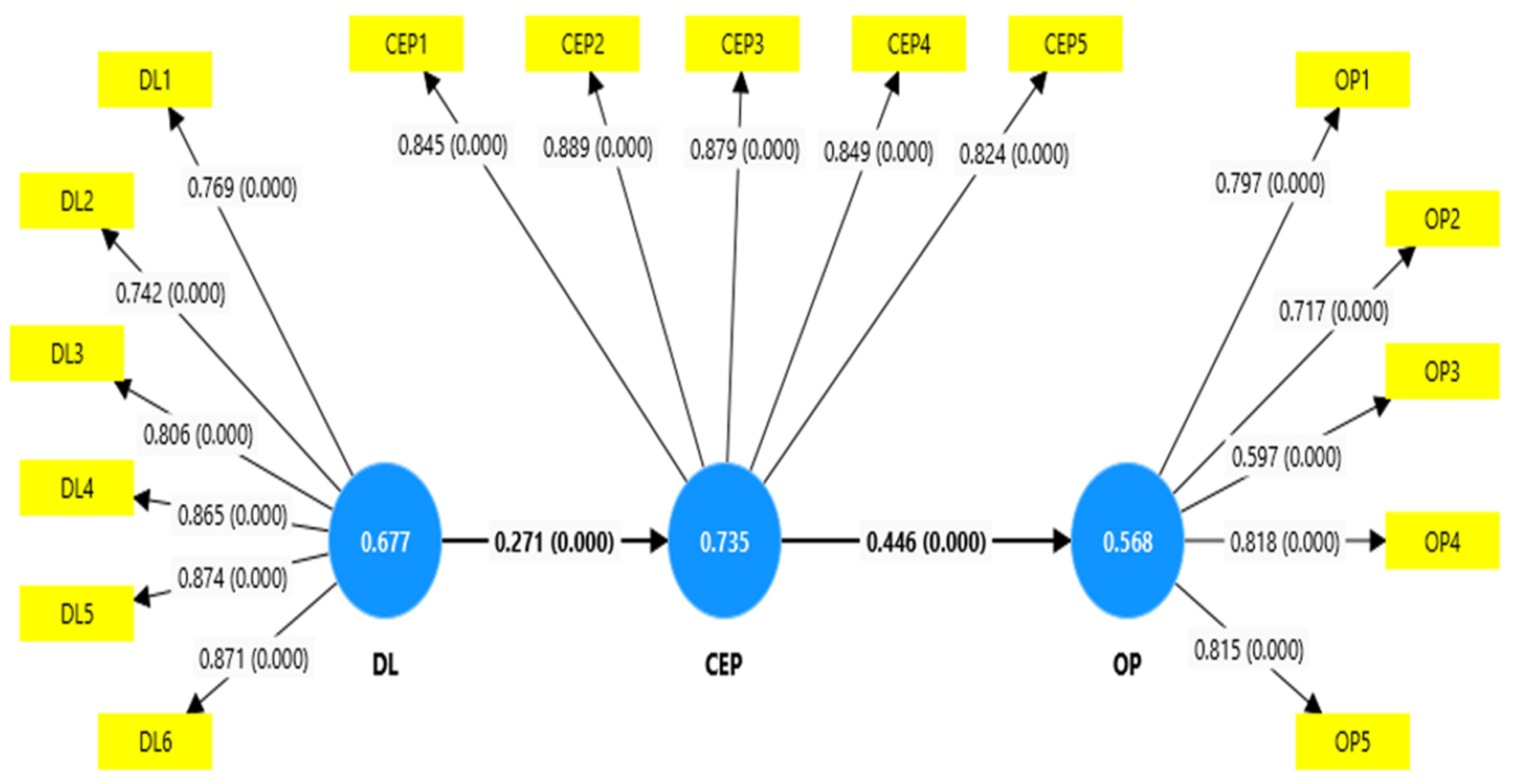
| Digital Leadership | 0.903 | 0.904 | 0.677 | ||
| DL1 | Our digital leader raises the awareness of the employees of the institution about the risks of information technologies | 0.769 | |||
| DL2 | Our digital leader raises awareness of the technologies that can be used to improve organizational processes. | 0.742 | |||
| DL3 | Our digital leader determines the ethical behaviors required for informatics practices together with all its stakeholders. | 0.806 | |||
| DL4 | Our digital leader plays an informative role to reduce resistance to innovations brought by information technologies. | 0.865 | |||
| DL5 | Our digital leader shares his/her own experiences about technological possibilities that help his/her colleagues to learn about the organization’s structure. | 0.874 | |||
| DL6 | In order to increase participation in the corporate vision, a digital leader guides the employees of the institution regarding the technological tools that can be used. | 0.871 | |||
| Circular Economy Practices | 0.910 | 0.913 | 0.735 | ||
| CEP1 | Our organization is engaged in reducing resources use in the production, distribution, and consumption processes. | 0.845 | |||
| CEP2 | Our organization is engaged in reusing of resources in the production, distribution, and consumption processes. | 0.889 | |||
| CEP3 | Our organization is engaged in recycling of resources in the production, distribution, and consumption processes. | 0.879 | |||
| CEP4 | Our organization is engaged in recovering of resources in the production, distribution, and consumption processes. | 0.849 | |||
| CEP5 | Our organization is engaged in regeneration of resources in the production, distribution, and consumption processes. | 0.824 | |||
| Organizational Performance | 0.806 | 0.822 | 0.568 | ||
| OP1 | Compared with key competitors, our company is more successful. | 0.797 | |||
| OP2 | Compared with key competitors, our company has a greater market share. | 0.717 | |||
| OP3 | Compared with key competitors, our company is growing faster. | 0.597 | |||
| OP4 | Compared with key competitors, our company is more profitable. | 0.818 | |||
| OP5 | Compared with key competitors, our company is more innovative. | 0.815 | |||
| Structural Path | Proposal Effects | Path Coefficient | Std. Dev. | t-Value | p-Value | Decision |
|---|---|---|---|---|---|---|
| Study 1 | ||||||
| DL→CEP | H1 | 0.278 | 0.064 | 4.256 | 0.000 | Supported |
| CEP→OP | H2 | 0.453 | 0.047 | 9.434 | 0.000 | Supported |
| DL→CEP→OP | H3 | 0.127 | 0.036 | 3.318 | 0.001 | Supported |
| Study 2 | ||||||
| DL→CEP | H1 | 0.346 | 0.061 | 5.528 | 0.000 | Supported |
| CEP→OP | H2 | 0.333 | 0.053 | 6.259 | 0.000 | Supported |
| DL→CEP→OP | H3 | 0.116 | 0.031 | 3.639 | 0.000 | Supported |
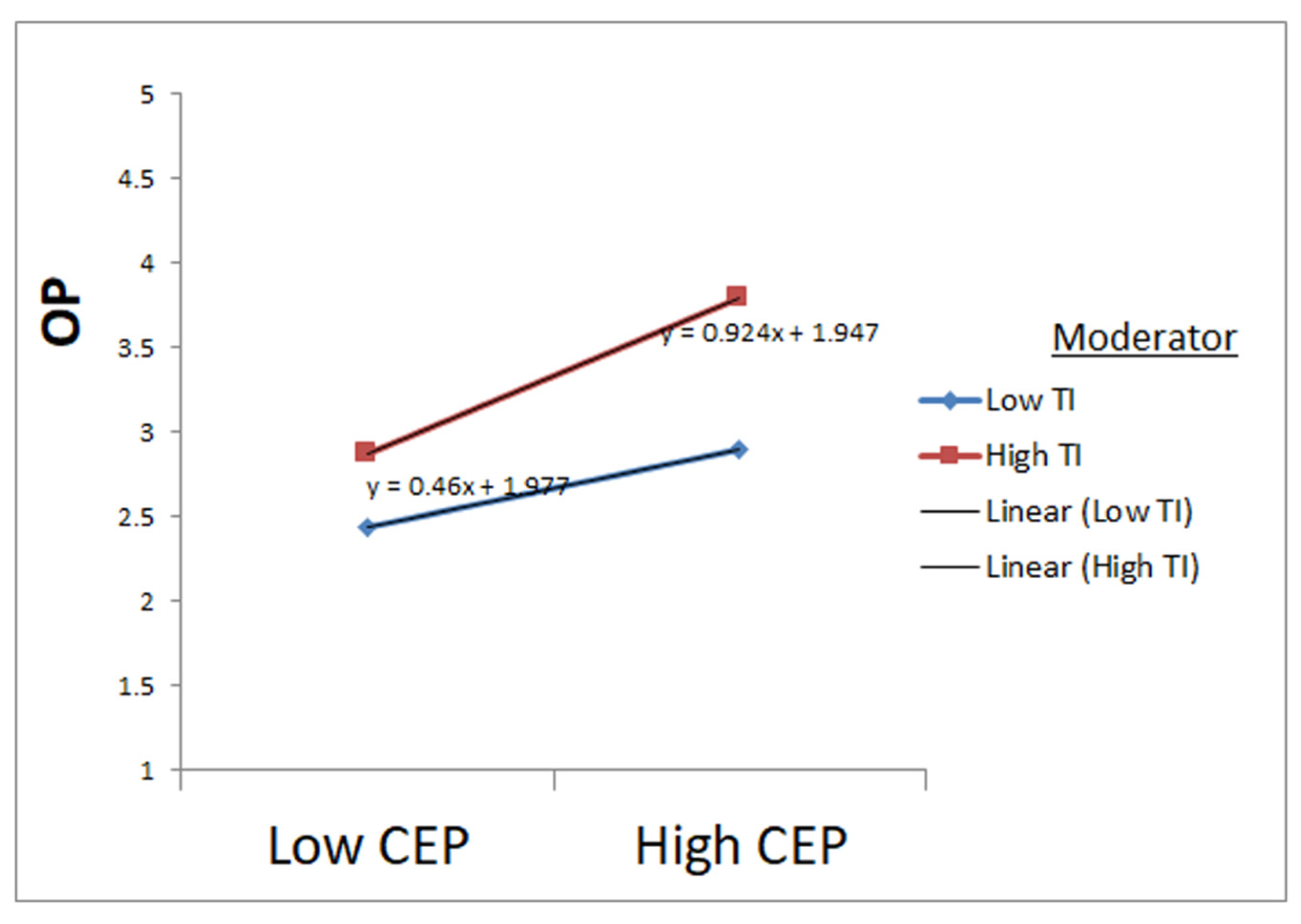
| TI*CEP→OP | H4 | 0.179 | 0.053 | 3.379 | 0.001 | Supported |
Disclaimer/Publisher’s Note: The statements, opinions and data contained in all publications are solely those of the individual author(s) and contributor(s) and not of MDPI and/or the editor(s). MDPI and/or the editor(s) disclaim responsibility for any injury to people or property resulting from any ideas, methods, instructions or products referred to in the content. |
© 2024 by the authors. Licensee MDPI, Basel, Switzerland. This article is an open access article distributed under the terms and conditions of the Creative Commons Attribution (CC BY) license (https://creativecommons.org/licenses/by/4.0/).
Share and Cite
Khan, A.Y.; Akhtar, M.; Khan, A.Y. Digitalization for a Sustainable Performance: Dual-Study Analysis of Digital Leadership, Circular Economy, and Technological Innovation. Sustainability 2024, 16, 10465. https://doi.org/10.3390/su162310465
Khan AY, Akhtar M, Khan AY. Digitalization for a Sustainable Performance: Dual-Study Analysis of Digital Leadership, Circular Economy, and Technological Innovation. Sustainability. 2024; 16(23):10465. https://doi.org/10.3390/su162310465
Chicago/Turabian StyleKhan, Asfand Yar, Maria Akhtar, and Azmat Yar Khan. 2024. "Digitalization for a Sustainable Performance: Dual-Study Analysis of Digital Leadership, Circular Economy, and Technological Innovation" Sustainability 16, no. 23: 10465. https://doi.org/10.3390/su162310465
APA StyleKhan, A. Y., Akhtar, M., & Khan, A. Y. (2024). Digitalization for a Sustainable Performance: Dual-Study Analysis of Digital Leadership, Circular Economy, and Technological Innovation. Sustainability, 16(23), 10465. https://doi.org/10.3390/su162310465