


The Impact of Digital Transformation on Excessive Financialization in the Real Economy
Abstract
1. Introduction
2. Literature Review
2.1. Theory on Digital Transformation
2.2. Mechanism of the Impact of Digital Transformation on Excessive Financialization
2.3. Potential Transmission Paths for Digital Transformation to Affect Real Enterprises
2.3.1. Improve Financing and Investment Efficiency
2.3.2. Improve Governance and Internal Operational Efficiency
3. Study Design
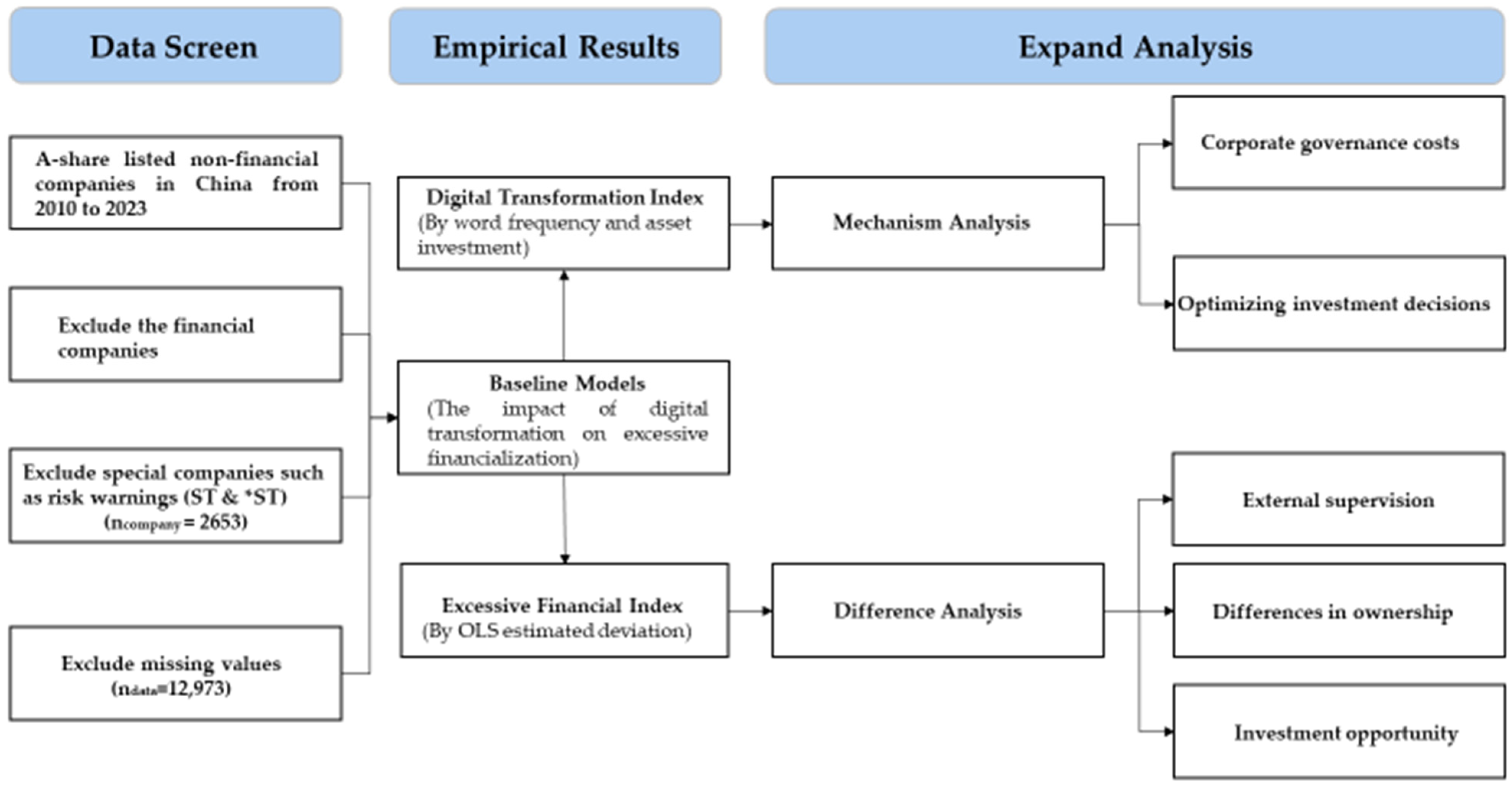
3.1. Methods for Data Collection and Sample Selection
- Digital transformation, measured through indicators based on the application of digital technologies;
- Quantitative metrics for excessive financialization, derived from corporate financial statements;
- Macro-level data sourced from official statistical yearbooks;
- Micro-level data obtained from the CSMAR and Wind databases.
- Samples flagged with delisting risk warnings in the A-share market were removed;
- Data from the financial sector were excluded due to its unique characteristics;
- Samples with missing data for certain years were eliminated.
3.2. Definitions of Variables
3.2.1. Dependent Variable: Excessive Financialization
3.2.2. Independent Variable: Digital Transformation Indicators
3.2.3. Control Variable
3.3. Baseline Model
4. Empirical Results and Analysis
4.1. The Impact of Corporate Digital Transformation on Excessive Financialization
4.2. Robust Test
4.2.1. Replace Key Variables
4.2.2. Marginal Effect Test
4.2.3. Endogenous Test—Probit Model
4.2.4. Propensity Score Matching
4.3. Analysis of Influence Mechanism
4.3.1. Corporate Governance Costs
4.3.2. Optimizing Investment Decisions
4.4. Difference Analysis
4.4.1. Investment Opportunity
4.4.2. External Supervision
4.4.3. Differences in Ownership
5. Conclusions and Implications
5.1. Conclusions
- Corporate digital transformation → corporate governance costs → excessive financialization: The corporate digital transformation strategy helps to reduce corporate governance costs, diminishing the self-serving motives of management, thereby effectively curbing excessive financialization in real-sector firms.
- Corporate digital transformation → optimized investment decision-making → excessive financialization: The corporate digital transformation strategy improves investment efficiency and optimizes investment decision-making, thus effectively reducing the level of excessive financialization in real-sector firms.
5.2. Implications
5.3. Limitations and Future Research
Author Contributions
Funding
Institutional Review Board Statement
Informed Consent Statement
Data Availability Statement
Conflicts of Interest
References
- Anshari, M. Book review—Digitalisation and organisation design: Knowledge management in the Asian digital economy. J. Bus. Econ. Anal. 2022, 5, 149–152. [Google Scholar] [CrossRef]
- Chen, X.; Li, Y.; Song, L.; Wang, Y. The theoretical system and research outlook of the digital economy. Manag. World 2022, 38, 208–224+13–16. [Google Scholar]
- Zhang, L.; Mu, R.; Zhan, Y.; Yu, J.; Liu, L.; Yu, Y.; Zhang, J. Digital economy, energy efficiency, and carbon emissions: Evidence from provincial panel data in China. Sci. Total Environ. 2022, 852, 158403. [Google Scholar] [CrossRef] [PubMed]
- Chen, W.; Liu, Z.; Guo, J. The effect of stabilizing leverage to curb the shift from the real economy to finance: Mechanism analysis and effect evaluation. Soc. Sci. Dig. 2024, 2, 73–75. [Google Scholar]
- Orhangazi, O. Financialization and Capital Accumulation in the Nonfinancial Corporate Sector: A Theoretical and Empirical Investigation on the US Economy, 1973–2004. MPRA Pap. 2007, 32, 863–886. [Google Scholar] [CrossRef]
- Krippner, G.R. The financialization of the American economy. Socio-Econ. Rev. 2005, 3, 173–208. [Google Scholar] [CrossRef]
- Richardson, S. OINV-investment of free cash flow. Rev. Account. Stud. 2006, 11, 159–189. [Google Scholar] [CrossRef]
- Demir, F. Financial liberalization, private investment and portfolio choice: Financialization of real sectors in emerging markets. J. Dev. Econ. 2009, 88, 314–324. [Google Scholar] [CrossRef]
- Alvarez, I. Financialization, non-financial corporations and income inequality: The case of France. Socio-Econ. Rev. 2015, 13, 449–475. [Google Scholar] [CrossRef]
- Davis, L.E. Financialization and the non-financial corporation: An investigation of firm-level investment behavior in the United States. Metroecon. Int. Rev. Econ. 2018, 69, 270–307. [Google Scholar] [CrossRef]
- Ghobakhloo, M. Industry 4.0, digitization, and opportunities for sustainability. J. Clean. Prod. 2020, 252, 119869. [Google Scholar] [CrossRef]
- Nambisan, S.; Wright, M.; Feldman, M. The digital transformation of innovation and entrepreneurship: Progress, challenges and key themes. Res. Policy 2019, 48, 103773. [Google Scholar] [CrossRef]
- Tomaskovic-Devey, D.; Lin, K.H. Financialization: Causes, Inequality Consequences, and Policy Implications; Social Science Electronic Publishing: New York, NY, USA, 2024. [Google Scholar]
- Sabino, K.; Alex, H. The rise of finance: Causes and consequences of financialization. Socio-Econ. Rev. 2015, 13, 411–415. [Google Scholar] [CrossRef]
- Foster, J.B.; Magdoff, F. The Great Financial Crisis; NYU Press: New York, NY, USA, 2009. [Google Scholar]
- Orhangazi, Ö. Financialization and the US Economy; Edward Elgar Publishing: Cheltenham, UK, 2008. [Google Scholar] [CrossRef]
- Yue, C.S.; Lim, J.J. Information Technology in Asia: New Development Paradigms; ISEAS Publishing: Singapore, 2002. [Google Scholar]
- Nicolăescu, E.; Alpopi, C.; Zaharia, C. Measuring Corporate Sustainability Performance. Sustainability 2015, 7, 851–865. [Google Scholar] [CrossRef]
- Weili, Y. Does digital transformation matter to green innovation: Based on TOE framework and configuration perspective. Environ. Sci. Pollut. Res. 2023, 30, 100046–100057. [Google Scholar] [CrossRef]
- Ragab, R.; Depre, N. Micro irrigation in the era of technology: Innovation and digital transformation. World Water Policy 2023, 9, 678–681. [Google Scholar] [CrossRef]
- Kokuytseva, T.; Kharlamov, M. Corporate Management Based on Assessing and Forecasting the Effects the Digital Transformation May Have on the Company Competitive Ability. In Proceedings of the International Science and Technology Conference “FarEastСon 2021”, Vladivostok, Russia, 5–8 October 2021; Springer: Singapore, 2022. [Google Scholar] [CrossRef]
- Jin, X.; Pan, X. Government Attention, Market Competition and Firm Digital Transformation. Sustainability 2023, 15, 9057. [Google Scholar] [CrossRef]
- Jensen, M. Agency Costs of Free Cash Flow, Corporate Finance, and Takeovers. Am. Econ. Rev. 1999, 76, 323–329. [Google Scholar] [CrossRef]
- Tori, D.; Onaran, Z. The effects of financialization on investment: Evidence from firm-level data for the UK. Camb. J. Econ. 2016, 42, 1393–1416. [Google Scholar] [CrossRef]
- Verhoef, P.C.; Broekhuizen, T.; Bart, Y.; Bhattacharya, A.; Dong, J.Q.; Fabian, N.; Haenlein, M. Digital transformation: A multidisciplinary reflection and research agenda. J. Bus. Res. 2021, 122, 889–901. [Google Scholar] [CrossRef]
- Li, C.; Li, D.; Zhou, C. The mechanism of digital economy driving the transformation and upgrading of manufacturing. Bus. Res. 2020, 2, 73–82. [Google Scholar]
- Zhong, X.; Li, H. Enterprise digital transformation: Concept definition, key digital technologies, and measurement methods. Financ. Econ. 2024, 2, 60–69+100. [Google Scholar]
- Svensson, M.; Rosengren, C.; Strm, F. Digitalization and Privacy: A Systematic Literature Review; Lund University: Lund, Sweden, 2016. [Google Scholar]
- Bharadwaj, A.; Sawy, O.A.E.; Pavlou, P.A.; Venkatraman, N.V. Digital business strategy: Toward a next generation of insights. MIS Q. 2013, 37, 471–482. [Google Scholar] [CrossRef]
- Lü, T. Trends and paths of digital transformation in traditional industries. People’s Forum Acad. Front. 2019, 18, 13–19. [Google Scholar]
- Wang, X.; Liu, H. Three important characteristics of corporate culture in the digital age. Mod. Team 2022, 8, 30–31. [Google Scholar]
- Bing, C. Demand created by the growing digital economy for innovations in regulation from the perspective of the rule of law. Front. Law China 2022, 17, 309–333. [Google Scholar]
- Deng, C.; Xia, W.; Chen, S. Financialization of non-financial enterprises: “Stabilizer” or “collapse booster”? Res. Financ. Econ. 2019, 34, 17. [Google Scholar]
- Liu, H.; Li, S. The impact of urban digital economy development on manufacturing innovation efficiency: Evidence from Chinese listed manufacturing firms. Int. J. Empir. Econ. 2023, 2, 2350004. [Google Scholar] [CrossRef]
- Bester, H. The role of collateral in a model of debt renegotiation. J. Money Credit. Bank. 1994, 26, 72–86. [Google Scholar] [CrossRef]
- Lessard, D.R.; Williamson, J. Capital flight and Third World debt. Inst. Int. Econ. 1987, 19, 506–508. [Google Scholar]
- Chong, T.T.L.; Lu, L.; Ongena, S. Does banking competition alleviate or worsen credit constraints faced by small- and medium-sized enterprises? Evidence from China. J. Bank. Financ. 2013, 37, 3412–3424. [Google Scholar] [CrossRef]
- Berger, A.N.; Udell, G.F. Small business credit availability and relationship lending: The importance of bank organisational structure. Econ. J. 2002, 477, F32–F53. [Google Scholar] [CrossRef]
- Bossaerts, P.; Plott, C. Basic principles of asset pricing theory: Evidence from large-scale experimental financial markets. Rev. Financ. 2004, 8, 135–169. [Google Scholar] [CrossRef]
- Zhang, C.; Zhang, B. The mystery of the decline in the investment rate of Chinese industry: A perspective of economic financialization. Econ. Res. 2016, 51, 15. [Google Scholar]
- Leonard, L.; Gonzalezperez, M.A. International business, sustainability and corporate social responsibility. In Advances in Sustainability & Environmental Justice; Emerald Group Publishing: Leeds, UK, 2013. [Google Scholar] [CrossRef]
- Froud, J.; Johal, S.; Leaver, A.; Williams, K. Financialization and Strategy: Narrative and Numbers; Routledge: Oxfordshire, UK, 2006. [Google Scholar]
- Dong, X.; McIntyre, S.H. The second machine age: Work, progress, and prosperity in a time of brilliant technologies. Quant. Financ. 2014, 14, 380–383. [Google Scholar] [CrossRef]
- Fazzari, S.M.; Hubbard, R.G.; Petersen, B.C. Financing constraints and corporate investment. Brook. Pap. Econ. Act. 1988, 1988, 141–195. [Google Scholar] [CrossRef]
- Majluf, M.N.S. Corporate financing and investment decisions when firms have information that investors do not have. J. Financ. Econ. 1984, 13, 187–221. [Google Scholar]
- Brown, J.R.; Martinsson, G.; Petersen, B.C. Do financing constraints matter for R&D? Eur. Econ. Rev. 2012, 56, 1512–1529. [Google Scholar]
- Santos, A.; Cincera, M. Determinants of financing constraints. Small Bus. Econ. 2022, 58, 1427–1439. [Google Scholar] [CrossRef]
- Frank, M.Z.; Shen, T. Investment and the weighted average cost of capital. J. Financ. Econ. 2016, 119, 300–315. [Google Scholar] [CrossRef]
- Spira, L.F.; Page, M. Risk management: The reinvention of internal control and the changing role of internal audit. Account. Audit. Account. J. 2003, 16, 640–661. [Google Scholar] [CrossRef]
- Mican, C.; Fernandes, G.; Araújo, M.; Ares, E. Project portfolio risk assessment in digital transformation: Challenges and opportunities. IOP Conf. Ser. Mater. Sci. Eng. 2021, 1193, 012111. [Google Scholar] [CrossRef]
- Du, Y.; Zhang, H.; Chen, J. The impact of financialization on the future development of real enterprises: Promotion or inhibition? China Ind. Econ. 2017, 12, 113–131. [Google Scholar]
- Huang, Q.; Fan, Y.; Zhang, S. Textual analysis of corporate annual reports for the measurement of digital transformation. Int. J. Inf. Manag. 2021, 58, 102–118. [Google Scholar]
- Li, R.; Rao, J.; Wan, L. The digital economy, enterprise digital transformation, and enterprise innovation. Manag. Decis. Econ. 2022, 43, 2875–2886. [Google Scholar] [CrossRef]
- Zhong, R.Y.; Xu, X.; Klotz, E.; Newman, S.T. Intelligent manufacturing in the context of Industry 4.0: A review. Engineering 2017, 3, 616–630. [Google Scholar] [CrossRef]

| Indicators | Key Words |
|---|---|
| Digital technology application | machine learning, semantic search, NFC payment, cloud IT, brain-inspired computing, big data, investment decision support systems, etc. |
| Information network systems | information network, Internet of Things (IoT), industrial Internet, cyber-physical systems, information integration, industrial communication, networking, etc. |
| Intelligent manufacturing | numerical control, smart wearables, intelligent fault diagnosis, smart warehousing, smart terminals, intelligent connectivity, future factory, etc. |
| Business models | O2O (Online-to-Offline), B2C (Business-to-Consumer), digital marketing, unmanned retail, internet business model, internet ecosystem, Internet Plus (Internet+), etc. |
| Variables | (1) Logit | (2) Robust | (3) Cluster |
|---|---|---|---|
| L.Dig | −0.107 ***1 | −0.107 *** | −0.107 *** |
| (−6.131) | (−6.126) | (−6.590) | |
| L.FINRATIO | 3.907 *** | 3.907 *** | 3.907 *** |
| (12.57) | (11.71) | (10.39) | |
| L.Growth | 0.156 *** | 0.156 *** | 0.156 *** |
| (3.796) | (3.759) | (3.798) | |
| L.Size | 0.0104 | 0.0104 | 0.0104 |
| (0.591) | (0.588) | (0.618) | |
| L.Age | −0.391 *** | −0.391 *** | −0.391 *** |
| (−12.73) | (−12.63) | (−12.95) | |
| L.ROA | −0.108 | −0.108 | −0.108 |
| (−0.372) | (−0.375) | (−0.387) | |
| L.TobinQ | −0.455 | −0.455 | −0.455 |
| (−1.177) | (−1.169) | (−1.212) | |
| L.PRIVATE | −0.135 *** | −0.135 *** | −0.135 *** |
| (−2.963) | (−2.951) | (−3.076) | |
| L.Power | −0.0307 | −0.0307 | −0.0307 |
| (−0.706) | (−0.708) | (−0.725) | |
| L.TopHold | 0.0795 | 0.0795 | 0.0795 |
| (0.610) | (0.608) | (0.634) | |
| Constant | −0.0708 *** | −0.0708 *** | −0.0708 *** |
| (−4.397) | (−4.259) | (−4.071) | |
| N | 12,973 | 12,973 | 12,973 |
| Variables | (1) Logit | (2) Robust | (3) Cluster | (4) Logit | (5) Robust | (6) Cluster |
|---|---|---|---|---|---|---|
| L.Dig1 | −0.0990 ***1 | −0.0990 *** | −0.0990 *** | |||
| (−3.630) | (−3.618) | (−4.236) | ||||
| L.Dig2 | −0.0356 ** | −0.0356 ** | −0.0356 ** | |||
| (−2.096) | (−2.114) | (−2.193) | ||||
| CV | ||||||
| Industry | ||||||
| Constant | −1.263 *** | −1.263 *** | −1.263 *** | −1.340 *** | −1.340 *** | −1.340 *** |
| (−3.081) | (−3.112) | (−3.342) | (−3.298) | (−3.332) | (−3.579) | |
| N | 12,973 | 12,973 | 12,973 | 12,973 | 12,973 | 12,973 |
| Variables | Odds Ratio | dy/dx |
|---|---|---|
| Dig | 0.5987 ***1 | −0.0253 *** |
| (−6.13) | (−6.17) | |
| L.Fin | 49.7657 *** | 0.9258 *** |
| (12.57) | (12.86) | |
| L.Growth | 1.1685 | 0.0369 |
| (−3.80) | (3.80) | |
| L.Size | 1.0104 | 0.00245 |
| (0.59) | (0.59) | |
| L.Age | 0.67640 *** | −0.09264 *** |
| (−12.73) | (−13.05) | |
| L.ROA | 0.8979 *** | −0.0255 *** |
| (−0.37) | (−0.37) | |
| L.TobinQ | 0.9316 *** | −0.0168 |
| (−4.40) | (−4.41) | |
| L.PRIVATE | 0.8736 *** | −0.0320 *** |
| (−2.96) | (−2.97) | |
| L.Power | 0.9698 *** | −0.0073 *** |
| (−0.71) | (−0.71) | |
| L.TopHold | 1.0827 | 0.0188 |
| (0.61) | (0.61) | |
| Cons | 2.3752 ** | - |
| (2.10) | - | |
| N | 12,668 | 12,668 |
| Variables | Odds Ratio | dy/dx | |
|---|---|---|---|
| L.Dig | −0.0659 *** | −0.0659 *** | −0.0659 *** |
| (−6.130) | (−6.126) | (−6.586) | |
| CV | |||
| Industry | |||
| Year | |||
| Constant | −0.2412 | −0.2412 | −0.2412 |
| (−13.01) | (−13.04) | (−13.197) | |
| N | 12,973 | 12,973 | 12,973 |
| L.Size | L.Age | L.Power | L.Balance | L.TopHold | Cons | N | R2_p | |
|---|---|---|---|---|---|---|---|---|
| L.Dig | −0.0651 ***1 | −0.0890 *** | 0.246 *** | 0.144 *** | 1.417 *** | −2.404 *** | 21,100 | 0.268 |
| (−4.27) | (−3.61) | (7.09) | (4.14) | (9.56) | (−6.64) |
| Variables | Sample Matching | Mean | Percentage Reduction | t-Test | |||
|---|---|---|---|---|---|---|---|
| Treatment Groups | Control Groups | Standard Deviation (%) | Standard Deviation Reduction Rate (%) | T Value | p Value | ||
| L.Size | U | 22.274 | 22.129 | 18 | 7.23 | 0.000 | |
| M | 0.03377 | 0.03454 | −1.1 | 93.7 | 1.51 | 0.000 | |
| L.Age | U | 2.1747 | 2.1731 | 0.2 | 0.15 | 0.000 | |
| M | 0.1723 | 0.179 | −0.9 | 79.4 | −0.61 | 0.132 | |
| L.Power | U | 0.27733 | 0.2323 | 10.3 | 6.74 | 0.000 | |
| M | 0.1683 | 0.1685 | 1.9 | 99.5 | 1.26 | 0.883 | |
| L.Balance | U | 0.69079 | 0.690 | 0.1 | 0.08 | 0.000 | |
| M | 0.1820 | 0.0630 | −1.0 | 97.3 | −0.63 | 0.209 | |
| L.TopHold | U | 0.35805 | 0.34201 | 10.6 | 6.91 | 0.000 | |
| M | 0.3576 | 0.3571 | 0.3 | 82.5 | 0.19 | 0.000 | |
| L.Size | U | 22.274 | 22.129 | 18 | 7.23 | 0.000 | |
| M | 0.03377 | 0.03454 | −1.1 | 93.7 | 1.51 | 0.000 | |
| Variable | Sample | Treatment Groups | Control Groups | Variable Differences | Standard Deviation | T Value |
|---|---|---|---|---|---|---|
| DFin | Unmatched | 0.4193 | 0.4250 | −0.0057 | 0.0076 | −3.09 |
| ATT | 0.4182 | 0.4111 | 0.0071 | 0.1113 | −4.46 |
| (1) DFin | (2) Cost | (3) DFin | |
|---|---|---|---|
| L.Dig | −0.107 ***1 | −0.0013 *** | −0.0819 *** |
| (−6.131) | (−0.03) | (−4.86) | |
| Cost | 0.4817 ** | ||
| (2.04) | |||
| Controls | YES | YES | YES |
| Cons | −0.0708 *** | −1.0646 *** | 0.0096 *** |
| (−4.397) | (−31.47) | (0.02) | |
| N | 12,668 | 12,668 | 12,668 |
| (1) DFin | (2) Inv | (3) DFin | |
|---|---|---|---|
| L.Dig | −0.107 ***1 | −0.0079 *** | −0.0131 *** |
| (−6.131) | (−6.08) | (−3.68) | |
| Inv | −0.0956 *** | ||
| (−4.16) | |||
| CV | |||
| cons | −1.8830 *** | 0.0765 *** | −1.1609 *** |
| (−3.75) | (8.93) | (−3.75) | |
| N | 12,668 | 12,668 | 12,668 |
| (1) | (2) | (3) | (4) | |
|---|---|---|---|---|
| Higher Investment Opportunities | Lower Investment Opportunities | Higher Growth Opportunities | Lower Growth Opportunities | |
| Dig | 0.0174 1 | −0.0280 *** | 0.0203 | −0.0300 *** |
| (1.425) | (−4.739) | (1.645) | (−5.118) | |
| Constant | 0.304 *** | 0.440 *** | 0.318 *** | 0.442 *** |
| (8.619) | (28.58) | (8.954) | (29.13) | |
| CV | ||||
| Industry | ||||
| Year |
| (1) | (2) | (3) | (4) | |
|---|---|---|---|---|
| Analysts Pay High Attention | Analysts Have Low Attention | Research Reports Receive High Attention | Research Reports Have Low Attention | |
| Dig | 0.0226 1 | −0.0371 *** | 0.0320 | −0.0275 *** |
| (0.118) | (−6.290) | (0.664) | (−4.944) | |
| Constant | 0.437 *** | 0.430 *** | 0.448 *** | 0.418 *** |
| (28.96) | (27.76) | (28.36) | (28.64) | |
| CV | ||||
| Industry | ||||
| Year |
| (1) | (2) | |
|---|---|---|
| Private Enterprises | State-Owned Enterprises | |
| Dig | −0.0469 ***1 | −0.0169 *** |
| (−7.962) | (−3.112) | |
| CV | ||
| Industry | ||
| Year |
Disclaimer/Publisher’s Note: The statements, opinions and data contained in all publications are solely those of the individual author(s) and contributor(s) and not of MDPI and/or the editor(s). MDPI and/or the editor(s) disclaim responsibility for any injury to people or property resulting from any ideas, methods, instructions or products referred to in the content. |
© 2024 by the authors. Licensee MDPI, Basel, Switzerland. This article is an open access article distributed under the terms and conditions of the Creative Commons Attribution (CC BY) license (https://creativecommons.org/licenses/by/4.0/).
Share and Cite
Jin, X.; Xie, Q. The Impact of Digital Transformation on Excessive Financialization in the Real Economy. Sustainability 2024, 16, 10464. https://doi.org/10.3390/su162310464
Jin X, Xie Q. The Impact of Digital Transformation on Excessive Financialization in the Real Economy. Sustainability. 2024; 16(23):10464. https://doi.org/10.3390/su162310464
Chicago/Turabian StyleJin, Xuejun, and Qiyun Xie. 2024. "The Impact of Digital Transformation on Excessive Financialization in the Real Economy" Sustainability 16, no. 23: 10464. https://doi.org/10.3390/su162310464
APA StyleJin, X., & Xie, Q. (2024). The Impact of Digital Transformation on Excessive Financialization in the Real Economy. Sustainability, 16(23), 10464. https://doi.org/10.3390/su162310464

