Harnessing Community Science to Support Implementation and Success of Nature-Based Solutions



Abstract
1. Introduction
- (1)
- Contributory projects (where scientists design and citizens contribute);
- (2)
- Collaborative projects (where scientists design, citizens contribute data, refine project design, analyze data, and/or disseminate findings); and
- (3)
- Co-created projects (where scientists and the public work together, and some public participants have a more active role throughout the scientific process).
1.1. Considering CS in NbS Typologies
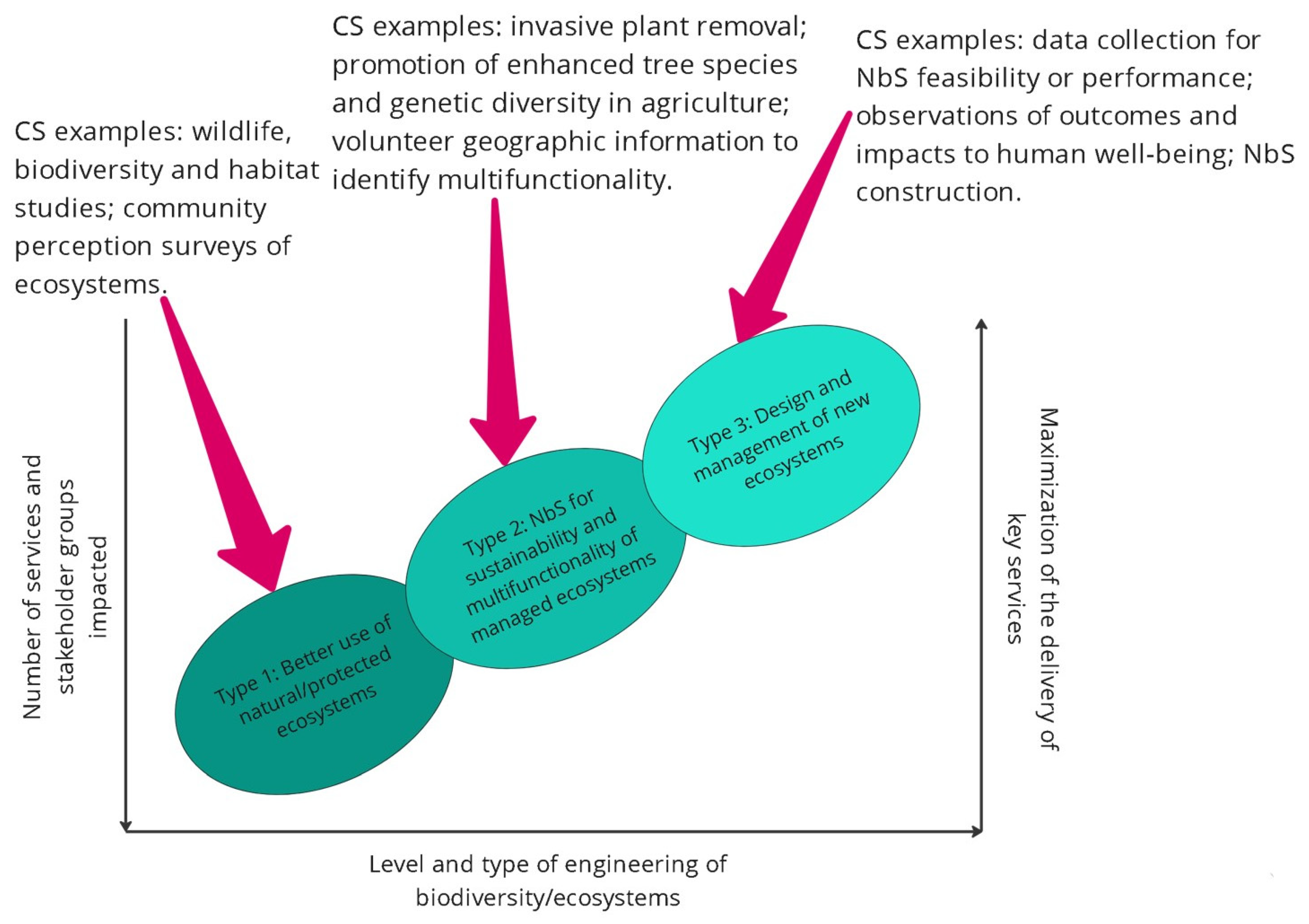
1.1.1. The Role of CS in the NbS Interventional Typology
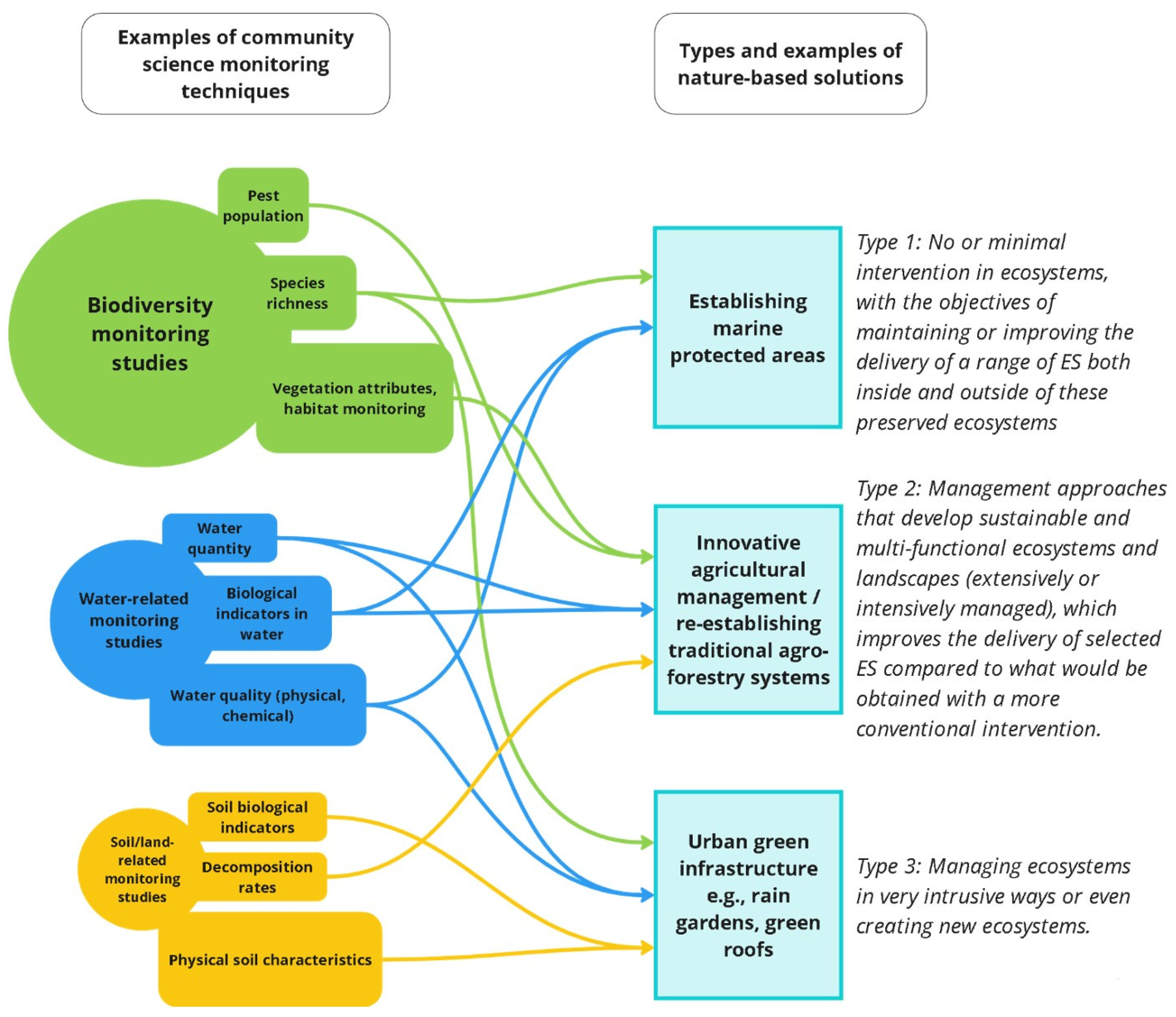
1.1.2. Typology Considering NbS Benefits and Functions
- A.
- Ecosystem-based Protection Approaches (e.g., area-based conservation, protected area management):
- Monitoring and Surveillance: Engaging local communities in monitoring and surveillance activities can help detect environmental changes early, such as habitat degradation, and invasive species.
- Advocacy and Policy Support: Community scientists can advocate for policy changes based on data collected, supporting conservation initiatives and protected area management.
- B.
- Ecosystem Restoration Approaches (e.g., ecological restoration, ecological engineering, forest landscape restoration):
- Data Collection and Analysis: Community scientists can assist in collecting data on biodiversity, soil health, and water quality to evaluate the success of restoration efforts.
- Implementation and Maintenance: Involving local communities in restoration projects promotes stewardship and ensures long-term sustainability of restored ecosystems.
- C.
- Issue-specific Ecosystem-related Approaches (e.g., ecosystem-based adaptation, ecosystem-based mitigation, ecosystem-based disaster risk management):
- Targeted Data Collection: Community scientists can target specific issues such as air or water pollution by collecting data on pollutant levels in collaboration with scientific experts.
- Education and Awareness: CS programs can educate and raise awareness among local communities about the importance of ecosystems and their role in providing protection against natural hazards and disasters.
- D.
- Infrastructure-related Approaches (e.g., natural infrastructure, green infrastructure):
- Green Infrastructure Monitoring: CS can monitor the effectiveness of green infrastructure projects (e.g., green roofs, rain gardens) in mitigating urban heat islands or reducing stormwater runoff.
- Community Engagement in Design: Involve community scientists in the planning and design stages of infrastructure projects to ensure they meet local needs and maximize ecological benefits.
- E.
- Ecosystem-based Management Approaches (e.g., integrated coastal zone management, integrated water resources management):
- Local or Traditional Ecological Knowledge: Indigenous peoples and local community participants often possess local or traditional ecological knowledge that can complement scientific research and inform management decisions.
- Participatory Decision-making: Engaging communities in monitoring and decision-making processes fosters trust and ensures that management strategies align with local priorities.
1.2. The Role of CS in the NbS Co-Benefits Framework
2. Methods
3. Results and Discussion
3.1. The Use of CS in NbS Planning and Implementation
3.1.1. Environmental Monitoring to Determine Baseline Conditions
3.1.2. Involvement of Participants in NbS Development and Planning Through Discussions and Workshops (Co-Designing Processes)
3.1.3. Using Existing CS Databases to Support NbS Design and Implementation
3.1.4. Monitoring Effectiveness of NbS Infrastructure, Soliciting Feedback from Community Members on Impacts of NbS
3.1.5. Participation in Multifunctional Activities
3.2. Expanding on Types of Environmental Monitoring Through CS to Enhance NbS Planning and Implementation
3.3. Participatory Monitoring as a Factor of Success for NbS
4. Conclusions
Supplementary Materials
Author Contributions
Funding
Conflicts of Interest
References
- Van Brussel, S.; Huyse, H. Citizen science on speed? Realising the triple objective of scientific rigour, policy influence and deep citizen engagement in a large-scale citizen science project on ambient air quality in Antwerp. J. Environ. Plan. Manag. 2018, 62, 534–551. [Google Scholar] [CrossRef]
- Bonney, R.; Phillips, T.B.; Ballard, H.L.; Enck, J.W. Can citizen science enhance public understanding of science? Public Underst. Sci. 2016, 25, 2–16. [Google Scholar] [CrossRef] [PubMed]
- Kral, R.M.; Maftukhah, R.; Mentler, A.; Murtiningrum, M.; Ngadisih, N.; Keiblinger, K.M. Citizen science in the field: Co-experimentation at pilot scale for sustainable use of natural resources. Sustainability 2020, 12, 7700. [Google Scholar] [CrossRef]
- Lin Hunter, D.E.; Newman, G.J.; Balgopal, M.M. What’s in a name? The paradox of citizen science and community science. Front. Ecol. Environ. 2023, 21, 244–250. [Google Scholar] [CrossRef]
- Bonney, R.; Ballard, H.; Jordan, R.; McCallie, E.; Phillips, T.; Shirk, J.; Wilderman, C.C. Public Participation in Scientific Research: Defining the Field and Assessing Its Potential for Informal Science Education. A CAISE Inquiry Group Report. Online Submiss. 2009. [Google Scholar]
- Nunes, N.; Björner, E.; Hilding-Hamann, K.E. Guidelines for citizen engagement and the co-creation of nature-based solutions: Living knowledge in the URBiNAT project. Sustainability 2021, 13, 13378. [Google Scholar] [CrossRef]
- Denzin, N.K.; Lincoln, Y.S.; Smith, L.T. Handbook of Critical and Indigenous Methodologies; Sage: Southend Oaks, CA, USA, 2008. [Google Scholar]
- Wilson, N.J.; Mutter, E.; Inkster, J.; Satterfield, T. Community-Based Monitoring as the practice of Indigenous governance: A case study of Indigenous-led water quality monitoring in the Yukon River Basin. J. Environ. Manag. 2018, 210, 290–298. [Google Scholar] [CrossRef] [PubMed]
- Brunet, N.D.; Jardine, T.D.; Jones, P.D.; Macdermid, F.; Reed, G.; Bogdan, A.-M.; Tchir, D.R.; Natcher, D.C. Towards indigenous community-led monitoring of fish in the oil sands region of Canada: Lessons at the intersection of cultural consensus and fish science. Extr. Ind. Soc. 2020, 7, 1319–1329. [Google Scholar] [CrossRef]
- Wiseman, N.D.; Bardsley, D.K. Monitoring to Learn, Learning to Monitor: A Critical Analysis of Opportunities for I ndigenous Community-Based Monitoring of Environmental Change in Australian Rangelands. Geogr. Res. 2016, 54, 52–71. [Google Scholar] [CrossRef]
- Brill, G.; Carlin, D.; McNeeley, S.; Griswold, D. Stakeholder Engagement Guide for Nature-Based Solutions; United Nations CEO Water Mandate and Pacific Institute: Oakland, CA, USA, 2022; Available online: https://ceowatermandate.org/nbs/wp-content/uploads/sites/41/2022/11/CEOWater_SEG_F2.pdf (accessed on 24 August 2024).
- Robinson, L.D.; Cawthray, J.L.; West, S.E.; Bonn, A.; Ansine, J. Ten principles of citizen science. In Citizen Science: Innovation in Open Science, Society and Policy; UCL Press: London, UK, 2018; pp. 27–40. [Google Scholar]
- Mazumdar, S.; Ceccaroni, L.; Piera, J.; Hölker, F.; Berre, A.; Arlinghaus, R.; Bowser, A. Citizen Science Technologies and New Opportunities for Participation; UCL Press: London, UK, 2018. [Google Scholar]
- Best, L.; Schwarz, N.; Obergh, D.; Teuling, A.; Van Kanten, R.; Willemen, L. Urban green spaces and variation in cooling in the humid tropics: The case of Paramaribo. Urban For. Urban Green. 2023, 89, 128111. [Google Scholar] [CrossRef]
- Williams, C.R.; Burnell, S.M.; Rogers, M.; Flies, E.J.; Baldock, K.L. Nature-based citizen science as a mechanism to improve human health in urban areas. Int. J. Environ. Res. Public Health 2022, 19, 68. [Google Scholar] [CrossRef] [PubMed]
- Santori, C.; Keith, R.J.; Whittington, C.M.; Thompson, M.B.; Van Dyke, J.U.; Spencer, R.J. Changes in participant behaviour and attitudes are associated with knowledge and skills gained by using a turtle conservation citizen science app. People Nat. 2021, 3, 66–76. [Google Scholar] [CrossRef]
- Rudko, S.P.; Reimink, R.L.; Peter, B.; White, J.; Hanington, P.C. Democratizing water monitoring: Implementation of a community-based qPCR monitoring program for recreational water hazards. PLoS ONE 2020, 15, e0229701. [Google Scholar] [CrossRef] [PubMed]
- Restemeyer, B.; Boogaard, F.C. Potentials and pitfalls of mapping nature-based solutions with the online citizen science platform climatescan. Land 2021, 10, 5. [Google Scholar] [CrossRef]
- Arnstein, S.R. A ladder of citizen participation. J. Am. Plan. Assoc. 2019, 85, 24–34. [Google Scholar] [CrossRef]
- Gibson, M.; Maron, M.; Taws, N.; Simmonds, J.S.; Walsh, J.C. Use of citizen science datasets to test effects of grazing exclusion and replanting on Australian woodland birds. Restor. Ecol. 2022, 30, e13610. [Google Scholar] [CrossRef]
- Strohbach, M.W.; Lerman, S.B.; Warren, P.S. Are small greening areas enhancing bird diversity? Insights from community-driven greening projects in Boston. Landsc. Urban Plan. 2013, 114, 69–79. [Google Scholar] [CrossRef]
- D’Alessio, M.; Rushing, G.; Gray, T.L. Monitoring water quality through citizen science while teaching STEM undergraduate courses during a global pandemic. Sci. Total Environ. 2021, 779, 146547. [Google Scholar] [CrossRef]
- Pudifoot, B.; Cárdenas, M.L.; Buytaert, W.; Paul, J.D.; Narraway, C.L.; Loiselle, S. When It Rains, It Pours: Integrating Citizen Science Methods to Understand Resilience of Urban Green Spaces. Front. Water 2021, 3, 654493. [Google Scholar] [CrossRef]
- Hausmann, A.; Slotow, R.; Burns, J.K.; Di Minin, E. The ecosystem service of sense of place: Benefits for human well-being and biodiversity conservation. Environ. Conserv. 2016, 43, 117–127. [Google Scholar] [CrossRef]
- Cohen-Shacham, E.; Walters, G.; Janzen, C.; Maginnis, S. Nature-based solutions to address global societal challenges. IUCN Gland Switz. 2016, 97, 2016–2036. [Google Scholar]
- Schröter, M.; Van der Zanden, E.H.; van Oudenhoven, A.P.; Remme, R.P.; Serna-Chavez, H.M.; De Groot, R.S.; Opdam, P. Ecosystem services as a contested concept: A synthesis of critique and counter-arguments. Conserv. Lett. 2014, 7, 514–523. [Google Scholar] [CrossRef]
- Dekker, I.; Sharifyazd, S.; Batung, E.; Dubrawski, K.L. Maximizing Benefits to Nature and Society in Techno-Ecological Innovation for Water. Sustainability 2021, 13, 6400. [Google Scholar] [CrossRef]
- Puskás, N.; Abunnasr, Y.; Naalbandian, S. Assessing deeper levels of participation in nature-based solutions in urban landscapes—A literature review of real-world cases. Landsc. Urban Plan. 2021, 210, 104065. [Google Scholar] [CrossRef]
- Kiss, B.; Sekulova, F.; Hörschelmann, K.; Salk, C.F.; Takahashi, W.; Wamsler, C. Citizen participation in the governance of nature-based solutions. Environ. Policy Gov. 2022, 32, 247–272. [Google Scholar] [CrossRef]
- d’Hont, F.M.; Slinger, J.H. Including local knowledge in coastal policy innovation: Comparing three Dutch case studies. Local Environ. 2022, 27, 897–914. [Google Scholar] [CrossRef]
- Eggermont, H.; Balian, E.; Azevedo, J.M.N.; Beumer, V.; Brodin, T.; Claudet, J.; Fady, B.; Grube, M.; Keune, H.; Lamarque, P.; et al. Nature-based Solutions: New Influence for Environmental Management and Research in Europe. GAIA—Ecol. Perspect. Sci. Soc. 2015, 24, 243–248. [Google Scholar] [CrossRef]
- Somarakis, G.; Stagakis, S.; Chrysoulakis, N.; Mesimäki, M.; Lehvävirta, S. ThinkNature Nature-Based Solutions Handbook; European Union: Brussels, Belgium, 2019. [Google Scholar]
- Andrade, A.; Cohen-Shacham, E.; Dalton, J.; Edwards, S.; Hessenberger, D.; Maginnis, S.; Maynard, S.; McElwee, P.; Murti, R.; Nelson, C. IUCN Global Standard for Nature-Based Solutions; IUCN-2020-020; IUCN: Grand, Switzerland, 2020. [Google Scholar]
- Huxham, M.; Dencer-Brown, A.; Diele, K.; Kathiresan, K.; Nagelkerken, I.; Wanjiru, C. Mangroves and people: Local ecosystem services in a changing climate. In Mangrove Ecosystems: A Global Biogeographic Perspective: Structure, Function, and Services; Springer: Cham, Switzerland, 2017; pp. 245–274. [Google Scholar]
- Gioria, M.; O’flynn, C.; Osborne, B.A. Managing invasions by terrestrial alien plants in ireland: Challenges and opportunities. Biol. Environ. 2019, 119B, 37–61. [Google Scholar] [CrossRef]
- Anderson, V.; Gough, W.A. A Typology of Nature-Based Solutions for Sustainable Development: An Analysis of Form, Function, Nomenclature, and Associated Applications. Land 2022, 11, 1072. [Google Scholar] [CrossRef]
- Raymond, C.M.; Frantzeskaki, N.; Kabisch, N.; Berry, P.; Breil, M.; Nita, M.R.; Geneletti, D.; Calfapietra, C. A framework for assessing and implementing the co-benefits of nature-based solutions in urban areas. Environ. Sci. Policy 2017, 77, 15–24. [Google Scholar] [CrossRef]
- Cárdenas, M.L.; Wilde, V.; Hagen-Zanker, A.; Seifert-Dähnn, I.; Hutchins, M.G.; Loiselle, S. The circular benefits of participation in nature-based solutions. Sustainability 2021, 13, 4344. [Google Scholar] [CrossRef]
- Vasiliades, M.A.; Hadjichambis, A.C.; Paraskeva-Hadjichambi, D.; Adamou, A.; Georgiou, Y. A Systematic Literature Review on the Participation Aspects of Environmental and Nature-Based Citizen Science Initiatives. Sustainability 2021, 13, 7457. [Google Scholar] [CrossRef]
- Ferreira, V.; Barreira, A.; Loures, L.; Antunes, D.; Panagopoulos, T. Stakeholders’ Engagement on Nature-Based Solutions: A Systematic Literature Review. Sustainability 2020, 12, 640. [Google Scholar] [CrossRef]
- van der Jagt, A.P.N.; Szaraz, L.R.; Delshammar, T.; Cvejic, R.; Santos, A.; Goodness, J.; Buijs, A. Cultivating nature-based solutions: The governance of communal urban gardens in the European Union. Environ. Res. 2017, 159, 264–275. [Google Scholar] [CrossRef]
- Scolobig, A.; Linnerooth-Bayer, J.; Pelling, M.; Martin, J.G.C.; Deubelli, T.M.; Liu, W.; Oen, A. Transformative adaptation through nature-based solutions: A comparative case study analysis in China, Italy, and Germany. Reg. Environ. Chang. 2023, 23, 69. [Google Scholar] [CrossRef]
- Jones, E.F.; Frei, R.J.; Lee, R.M.; Maxwell, J.D.; Shoemaker, R.; Follett, A.P.; Lawson, G.M.; Malmfeldt, M.; Watts, R.; Aanderud, Z.T.; et al. Citizen science reveals unexpected solute patterns in semiarid river networks. PLoS ONE 2021, 16, e0255411. [Google Scholar] [CrossRef] [PubMed]
- Paul, J.D.; Buytaert, W.; Allen, S.; Ballesteros-Cánovas, J.A.; Bhusal, J.; Cieslik, K.; Clark, J.; Dugar, S.; Hannah, D.M.; Stoffel, M. Citizen science for hydrological risk reduction and resilience building. Wiley Interdiscip. Rev. Water 2018, 5, e1262. [Google Scholar] [CrossRef]
- Albert, C.; Brillinger, M.; Guerrero, P.; Gottwald, S.; Henze, J.; Schmidt, S.; Ott, E.; Schroter, B. Planning nature-based solutions: Principles, steps, and insights. Ambio 2021, 50, 1446–1461. [Google Scholar] [CrossRef]
- Ngao, J.; Cárdenas, M.L.; Améglio, T.; Colin, J.; Saudreau, M. Implications of urban land management on the cooling properties of urban trees: Citizen science and laboratory analysis. Sustainability 2021, 13, 13656. [Google Scholar] [CrossRef]
- Lekshmi, B.; Saha, D.; Sutar, R.S.; Singh, R.; Prabhu, S.D.; Kamat, A.M.; Sharma, S.; Saxena, R.; Loiselle, S.; Asolekar, S.R. Science & technology agenda for blue-green spaces inspired by citizen science: Case for rejuvenation of powai lake. Sustainability 2021, 13, 10061. [Google Scholar] [CrossRef]
- Cendejas, J.C.; Ramírez, L.M.; Zierold, J.R.; Valenzuela, J.D.; Ibarra, M.M.; de Tagle, S.M.S.; Téllez, A.C. Evaluation of the impacts of land use in water quality and the role of nature-based solutions: A citizen science-based study. Sustainability 2021, 13, 10519. [Google Scholar] [CrossRef]
- Cariou, E.; Baltzer, A.; Leparoux, D.; Lacombe, V. Collaborative 3d monitoring for coastal survey: Conclusive tests and first feedbacks using the selphcoast workflow. Geosciences 2021, 11, 114. [Google Scholar] [CrossRef]
- Wolff, E.; Rauf, H.A.; Diep, L.; Natakun, B.; Kelly, K.; Hamel, P. Implementing participatory nature-based solutions in the Global South. Front. Sustain. Cities 2022, 4, 956534. [Google Scholar] [CrossRef]
- Noël, G.; Van Keymeulen, V.; Barbier, Y.; Smets, S.; Van Damme, O.; Colinet, G.; Lokatis, S.; Ruelle, J.; Francis, F. Nest aggregations of wild bees and apoid wasps in urban pavements: A ‘street life’ to be promoted in urban planning. Insect Conserv. Divers. 2024, 17, 396–408. [Google Scholar] [CrossRef]
- Di Grazia, F.; Gumiero, B.; Galgani, L.; Troiani, E.; Ferri, M.; Loiselle, S.A. Ecosystem services evaluation of nature-based solutions with the help of citizen scientists. Sustainability 2021, 13, 10629. [Google Scholar] [CrossRef]
- Lee, K.C.; Karimova, P.G.; Yan, S.Y.; Li, Y.S. Resilience assessment workshops: A biocultural approach to conservation management of a rural landscape in Taiwan. Sustainability 2020, 12, 408. [Google Scholar] [CrossRef]
- Abu Ali, M.; Alawadi, K.; Khanal, A. The role of green infrastructure in enhancing microclimate conditions: A case study of a low-rise neighborhood in Abu Dhabi. Sustainability 2021, 13, 4260. [Google Scholar] [CrossRef]
- Cambria, V.E.; Campagnaro, T.; Trentanovi, G.; Testolin, R.; Attorre, F.; Sitzia, T. Citizen science data to measure human use of green areas and forests in european cities. Forests 2021, 12, 779. [Google Scholar] [CrossRef]
- Beninde, J.; Delaney, T.W.; Gonzalez, G.; Shaffer, H.B. Harnessing iNaturalist to quantify hotspots of urban biodiversity: The Los Angeles case study. Front. Ecol. Evol. 2023, 11, 983371. [Google Scholar] [CrossRef]
- Boogaard, F. Climate Change Adaptation in Africa, Asia, and Europe with the Citizen Science Climate Scan Platform Promoting Nature-Based Solutions. In Handbook of Climate Change Management: Research, Leadership, Transformation; Springer: Cham, Switzerland, 2021; Volume 5, pp. 3761–3799. [Google Scholar]
- Vander Meer, E. Green Infrastructure Mapping for Adaptation, Biodiversity, and Health and Wellbeing: A Tool Development Case Study in Edinburgh. In Palgrave Studies in Sustainable Business in Association with Future Earth; Springer: Cham, Switzerland, 2022; pp. 39–62. [Google Scholar]
- Wild, T.C.; Dempsey, N.; Broadhead, A.T. Volunteered information on nature-based solutions—Dredging for data on deculverting. Urban For. Urban Green. 2019, 40, 254–263. [Google Scholar] [CrossRef]
- Andrews, L.; Mocorro Powell, A.D.; Rottle, N.; Engelke, J. Advancing equity and justice through community science programming in design, construction, and research of a nature-based solution: The Duwamish Floating Wetlands Project. Socio-Ecol. Pract. Res. 2022, 4, 377–391. [Google Scholar] [CrossRef]
- Conte, A.; Brunetti, P.; Allevato, E.; Stazi, S.R.; Antenozio, M.L.; Passatore, L.; Cardarelli, M. Nature Based Solutions on the river environment: An example of cross-disciplinary sustainable management, with local community active participation and visual art as science transfer tool. J. Environ. Plan. Manag. 2020, 66, 2388–2405. [Google Scholar] [CrossRef]
- Rahman, M.M.; Haque, A.; Nakagawa, H.; Zhang, H.; Rahman, A.; Dustegir, M.; Hossain, M.; Hussain, M.M.; Islam, J.; Hore, S.K. Sediment management using bandal-like structures as nature-based solution. Environ. Fluid Mech. 2023. [Google Scholar] [CrossRef]
- Amarakoon, V.; Dharmarathne, G.; Premasiri, R.; Mukherjee, M.; Shaw, R.; Wickramasinghe, D. Potential for the complementary and integrative use of citizen science and modern science in flood risk reduction: A case study from Sri Lanka. Int. J. Disaster Risk Reduct. 2024, 103, 104331. [Google Scholar] [CrossRef]
- Meixner, T.; Berkowitz, A.R.; Downey, A.E.; Pillich, J.; Levea, R.; Smith, B.K.; Chandler, M.; Gupta, N.; Rullman, S.; Woodroof, A.; et al. Rapid assessment and long-term monitoring of green stormwater infrastructure with citizen scientists. Sustainability 2021, 13, 12520. [Google Scholar] [CrossRef]
- Koutsovili, E.I.; Tzoraki, O.; Kalli, A.A.; Provatas, S.; Gaganis, P. Participatory approaches for planning nature-based solutions in flood vulnerable landscapes. Environ. Sci. Policy 2023, 140, 12–23. [Google Scholar] [CrossRef]
- Oral, H.V.; Carvalho, P.; Gajewska, M.; Ursino, N.; Masi, F.; Hullebusch, E.D.v.; Kazak, J.K.; Exposito, A.; Cipolletta, G.; Andersen, T.R.; et al. A review of nature-based solutions for urban water management in European circular cities: A critical assessment based on case studies and literature. Blue-Green Syst. 2020, 2, 112–136. [Google Scholar] [CrossRef]
- Hulbert, J.M.; Agne, M.C.; Burgess, T.I.; Roets, F.; Wingfield, M.J. Urban environments provide opportunities for early detections of Phytophthora invasions. Biol. Invasions 2017, 19, 3629–3644. [Google Scholar] [CrossRef]
- Daume, S.; Albert, M.; von Gadow, K. Assessing citizen science opportunities in forest monitoring using probabilistic topic modelling. For. Ecosyst. 2014, 1, 11. [Google Scholar] [CrossRef]
- Kolokotsa, D.; Lilli, A.A.; Lilli, M.A.; Nikolaidis, N.P. On the impact of nature-based solutions on citizens’ health & well being. Energy Build. 2020, 229, 110527. [Google Scholar]
- Crall, A.W.; Jarnevich, C.S.; Panke, B.; Young, N.; Renz, M.; Morisette, J. Using habitat suitability models to target invasive plant species surveys. Ecol. Appl. 2013, 23, 60–72. [Google Scholar] [CrossRef] [PubMed]
- Balian, E.; Eggermont, H.; Le Roux, X. Outputs of the strategic foresight workshop “nature-based solutions in a BiodivERsA context”. In Proceedings of the Brussels: BiodivERsA Workshop Report, Brussels, Belgium, 11 June 2014. [Google Scholar]



| CS Approaches Used in NbS | Example of Study | NbS Planning and Implementation | Summary of Approach | ||
|---|---|---|---|---|---|
| Understand Challenges | Create Visions and Scenarios | Realize and Monitor | |||
| Monitoring baseline of environmental parameters | Implications of urban land management on the cooling properties of urban trees: Citizen science and laboratory analysis [46] | ✓ | Citizen scientists gathering data and fresh leaf and shoot samples to investigate the impact of growing conditions set by land and tree management practices in urban environments. | ||
| Science & technology agenda for blue-green spaces inspired by citizen science: case for rejuvenation of Powai Lake [47] | ✓ | ✓ | Water quality monitoring program by citizen scientists leading to the development of a lake rejuvenation plan. | ||
| Evaluation of the impacts of land use in water quality and the role of NbS: A citizen science-based study [48] | ✓ | Citizen-based monitoring of physical and chemical water quality parameters, nutrient analysis, and sample collection for bacteriological analysis to determine NbS potential for the regulation of water quality of a major freshwater reservoir. | |||
| Collaborative 3d monitoring for coastal survey: Conclusive tests and first feedbacks using the SELPhCoAST workflow [49] | ✓ | Citizen-based coastal erosion monitoring using a smartphone application (in situ photo datasets) to facilitate NbS approaches for local coastal restoration and protection policies. | |||
| Implementing participatory nature-based solutions in the Global South [50] | ✓ | ✓ | Citizen scientists collecting a comprehensive photo archive of flood levels informing the design of constructed wetlands. | ||
| Nest aggregations of wild bees and apoid wasps in urban pavements: A ‘street life’ to be promoted in urban planning [51] | ✓ | ✓ | Citizen science approach to investigate the richness of ground-nesting species living under urban pavements and preferences for sidewalk pavements to propose urban management guidelines supporting pollination. | ||
| Ecosystem services evaluation of nature-based solutions with the help of citizen scientists [52] | ✓ | ✓ | Citizen science approach to collect qualitative and semi-quantitative water quality measurements of a major Italian water catchment under different NbS scenarios. The benefits of nutrient transport with respect to the costs of individual and combined NbS approaches were estimated. | ||
| Involvement of participants in NbS development/planning (co-design of NbS to address societal challenges) | Resilience assessment workshops: A biocultural approach to conservation management of a rural landscape in Taiwan [53] | ✓ | Eliciting a community-driven vision to enhance landscape resilience. | ||
| Including local knowledge in coastal policy innovation: comparing three Dutch case studies [30] | ✓ | Participants asked to co-design utopic and dystopic visions on long temporal scales and were presented and linked to coastal management strategies toward shared futures. | |||
| The circular benefits of participation in nature-based solutions [38] | ✓ | ✓ | ✓ | Observational and intellectual reflection by participants experiencing NbS to identify benefits to local needs. | |
| The role of green infrastructure in enhancing microclimate conditions: A case study of a low-rise neighborhood in Abu Dhabi [54] | ✓ | ✓ | On-site measurements of tree physical characteristics, air temperature, and geotagging with the use of technology to determine ideal urban tree species for urban cooling effects in Abu Dhabi. | ||
| Utilizing existing citizen science platforms and databases | Citizen science data to measure human use of green areas and forests in European cities [55]; Harnessing iNaturalist to quantify hotspots of urban biodiversity: the Los Angeles case study [56] | ✓ | ✓ | Utilizing iNaturalist citizen science data to support sustainable development by spatial planning and conservation. | |
| Climate Change Adaptation in Africa, Asia, and Europe with the Citizen Science Climate Scan Platform Promoting Nature-Based Solutions [18,57] | ✓ | Online citizen science platform ClimateScan as a tool to stimulate stakeholder engagement and NbS promotion. | |||
| Monitoring effectiveness of NbS infrastructure, soliciting feedback from community members on impacts of NbS | When It Rains, It Pours: Integrating Citizen Science Methods to Understand Resilience of Urban Green Spaces [23] | ✓ | Citizen scientists measuring infiltration rates and soil characteristics in managed and unmanaged green spaces. Advocates for citizen action to improve local green space infiltration and support local flood resilience. | ||
| Green Infrastructure Mapping for Adaptation, Biodiversity, and Health and Wellbeing: A Tool Development Case Study in Edinburgh [58] | ✓ | Green infrastructure mapping using CS to collect vegetation type and blue space data for adaptation, biodiversity, and health and wellbeing. | |||
| Volunteered information on nature-based solutions—Dredging for data on deculverting [59] | ✓ | ✓ | Collection of geo-reference locations and addresses of daylighting cases and investigation of drivers for deculverting. | ||
| Integrated CS and participation in multifuctional activities | Advancing equity and justice through CS programming in design, construction, and research of a nature-based solution: the Duwamish Floating Wetlands Project [60] | ✓ | ✓ | ✓ | Wide diversity of community members participated in the construction and field and lab monitoring of NbS (floating wetlands), resulting in significant contributions to NbS and possible long-term impacts on participants and the environment. |
| Nature Based Solutions on the river environment: an example of cross-disciplinary sustainable management, with local community active participation and visual art as science transfer tool [61] | ✓ | ✓ | ✓ | Social and cultural events (public debate, art exposition, performance, and workshops in the experimental field) were organized during the scientific component of a phytoremediation project for a riparian area resulting in policy recommendations for NbS implementation. | |
| Sediment management using bandal-like structures as nature-based solution [62] | ✓ | ✓ | ✓ | Integrated NbS approach to sediment management involving local community in initial consultations, and construction and monitoring of NbS. | |
| Societal Challenge [33] | NbS Success Metrics | CS Examples and Key Resources |
|---|---|---|
| Water security | Water quantity (e.g., water levels, source identification, flow conditions) | Use of flow meters and probes, top setting wading rods, bucket wheel water current meter, reading flow gauges |
| Water quality (e.g., physical, chemical, biological parameters in freshwater, stormwater, marine water, groundwater) | Visual observation (color, presence of algae, macrophytes, presence/absence of trash), quantitative measurements TDS green, pathogen and chemical pollutant monitoring, community-based quantitative polymerase chain reaction (qPCR) to screen for fecal indicator organisms. | |
| Watershed mapping to improve accuracy and detail of watershed maps and features, identification of water sources for water use | Public participation in geographic information systems (GISs), OpenStreetMap (OSM) | |
| Biodiversity surveys | Species identification of invasive bumblebees and butterflies, coastal invasive species abundance, taxonomic identification | |
| Water consumption monitoring (e.g., reading water use meters, logging water-saving practices, and consumption patterns for residential and industrial uses) | Water diary, public engagement through telephone questionnaires | |
| Food security | Urban agriculture monitoring (e.g., monitoring community gardens, rooftop gardens, and urban farms for crop yields, soil quality, and water usage) | Quantification of community garden crop yields |
| Community food mapping (e.g., mapping food resources, food access points, assessment of food security and equity, promotion of food waste reduction, and sustainable agriculture) | Citizen science photovoice/diary food asset mapping | |
| Invasive species monitoring (quantitative measurements) | Volunteer-based assessment of invasive and native crab species in coastal states | |
| Monitoring pollination services | Pollinator monitoring mass participation citizen science, pollination service provision in gardens | |
| Water quality/quantity monitoring impacting food sources (e.g., freshwater/groundwater source for agriculture, shellfish habitats) | Visual observation (color, presence of algae, macrophytes, presence/absence of trash), quantitative measurements TDS green, pathogen and chemical pollutant monitoring | |
| Climate monitoring (e.g., air temperature, precipitation, humidity, cloud cover, measurement of CO2 levels, cloud cover, sunshine duration) | CitizenSensing web application for climate profiles of cities submitted by citizens, rainfall monitoring | |
| Soil nutrient monitoring (e.g., soil pH, nitrogen, phosphorus, and potassium testing, organic matter content, cover crop studies, soil erosion assessment, microbial activity) | Visual Evaluation of Soil Structure (VESS) and extensive list of soil quality monitoring, Teabag Index for assessing soil biodiversity (soil biological activity), infiltration rate, quadrat-based visual assessment for vegetation cover | |
| Land use investigations (e.g., monitoring land use changes, biodiversity, seasonal phenology, assessment of historical land use, community mapping) | Land use change monitoring with citizen scientists | |
| Human health | Air quality monitoring (e.g., particulate matter, ground-level ozone) | Low-cost air quality measurement devices monitoring of tropospheric ozone |
| Water quality monitoring | Visual observation (color, presence of algae, macrophytes, presence/absence of trash), quantitative measurements TDS green, pathogen and chemical pollutant monitoring | |
| Vector-borne disease monitoring (e.g., mosquito, tick, flea surveillance) | Vector identification and pathogen testing service for citizens—data used for vector population size estimation, monitoring of arboviral vectors across populations using participatory data | |
| Infectious disease surveillance | Collection of weekly health reports and survey data after influenza seasons | |
| Health behavior monitoring or surveillance (i.e., observation and recording of individual or population-level health-related actions and habits) | Monitoring health benefits of the natural environment as a CS program | |
| Noise pollution monitoring | Smartphone-based SPLnFTT sound meter application | |
| Food and nutrition monitoring | Dietary surveys, food diaries, nutritional studies monitoring dietary patterns, nutritional intake, and food-related behaviors | |
| Sanitation and hygiene (e.g., access to safe water and waste services) | Citizen science and nature-based sanitation solutions | |
| Disaster risk management | Climate monitoring (e.g., air temperature, precipitation, humidity, cloud cover, measurement of CO2 levels, cloud cover, sunshine duration) | Air and water temperature readings, rain gauge |
| Flood monitoring | Flood risk-related data collection | |
| Community hazard mapping | Disaster risk reduction citizen science projects | |
| Wildfire monitoring, human fire behavior investigations | Smartphone-based Smoke Sense application to record smoke experiences, health symptoms, behaviors taken to reduce exposure to smoke. | |
| Volunteer geographic information (i.e., contribution of geospatial data such as maps, GPS tracks, geographic annotations to support disaster risk management activities) | Public participation in geographic information systems (GIS), OpenStreetMap (OSM) | |
| Seismic monitoring | Low-cost seismic sensors | |
| Climate change | Climate monitoring (e.g., air temperature, precipitation, humidity, cloud cover, measurement of CO2 levels, cloud cover, sunshine duration) | Air and water temperature readings, rain gauge |
| Carbon footprint tracking (i.e., monitoring energy consumption, transportation habits, waste generation). Various online tools and mobile apps allowing individuals to calculate their carbon emission and opportunities to reduce their environmental impact. | CO2 concentration living labs through I-Change program, carbon footprint, and energy content of food estimation using survey data | |
| Biodiversity monitoring (e.g., observing habitat changes due to climatic factors) | Visual/photo observations (birds, pollinators, mammals, amphibians and reptiles) | |
| Ocean monitoring (e.g., marine biodiversity surveys, coral reef monitoring, marine debris, fisheries tracking) | Observations for diversity, marine debris, geocaching with field notes, photos, and GPS data | |
| Urban heat island monitoring | Distributed citizen-owned sensor network and mobile sensor deployment for publicly available infrastructure. | |
| Glacier monitoring (e.g., documenting changes in glacier size, mass, and dynamics through photography, GPS surveys, field observations) | Georeferenced glacier spot photos from tourist citizen scientists | |
| Remote sensing analysis | Visual classification of satellite imagery, community-based annotation of satellite imagery |
Disclaimer/Publisher’s Note: The statements, opinions and data contained in all publications are solely those of the individual author(s) and contributor(s) and not of MDPI and/or the editor(s). MDPI and/or the editor(s) disclaim responsibility for any injury to people or property resulting from any ideas, methods, instructions or products referred to in the content. |
© 2024 by the authors. Licensee MDPI, Basel, Switzerland. This article is an open access article distributed under the terms and conditions of the Creative Commons Attribution (CC BY) license (https://creativecommons.org/licenses/by/4.0/).
Share and Cite
Cabling, L.P.B.; Dubrawski, K.L.; Acker, M.; Brill, G. Harnessing Community Science to Support Implementation and Success of Nature-Based Solutions. Sustainability 2024, 16, 10415. https://doi.org/10.3390/su162310415
Cabling LPB, Dubrawski KL, Acker M, Brill G. Harnessing Community Science to Support Implementation and Success of Nature-Based Solutions. Sustainability. 2024; 16(23):10415. https://doi.org/10.3390/su162310415
Chicago/Turabian StyleCabling, Ludwig Paul B., Kristian L. Dubrawski, Maleea Acker, and Gregg Brill. 2024. "Harnessing Community Science to Support Implementation and Success of Nature-Based Solutions" Sustainability 16, no. 23: 10415. https://doi.org/10.3390/su162310415
APA StyleCabling, L. P. B., Dubrawski, K. L., Acker, M., & Brill, G. (2024). Harnessing Community Science to Support Implementation and Success of Nature-Based Solutions. Sustainability, 16(23), 10415. https://doi.org/10.3390/su162310415