Graph Representation of the 15-Minute City: A Comparison between Rome, London, and Paris


Abstract
1. Introduction
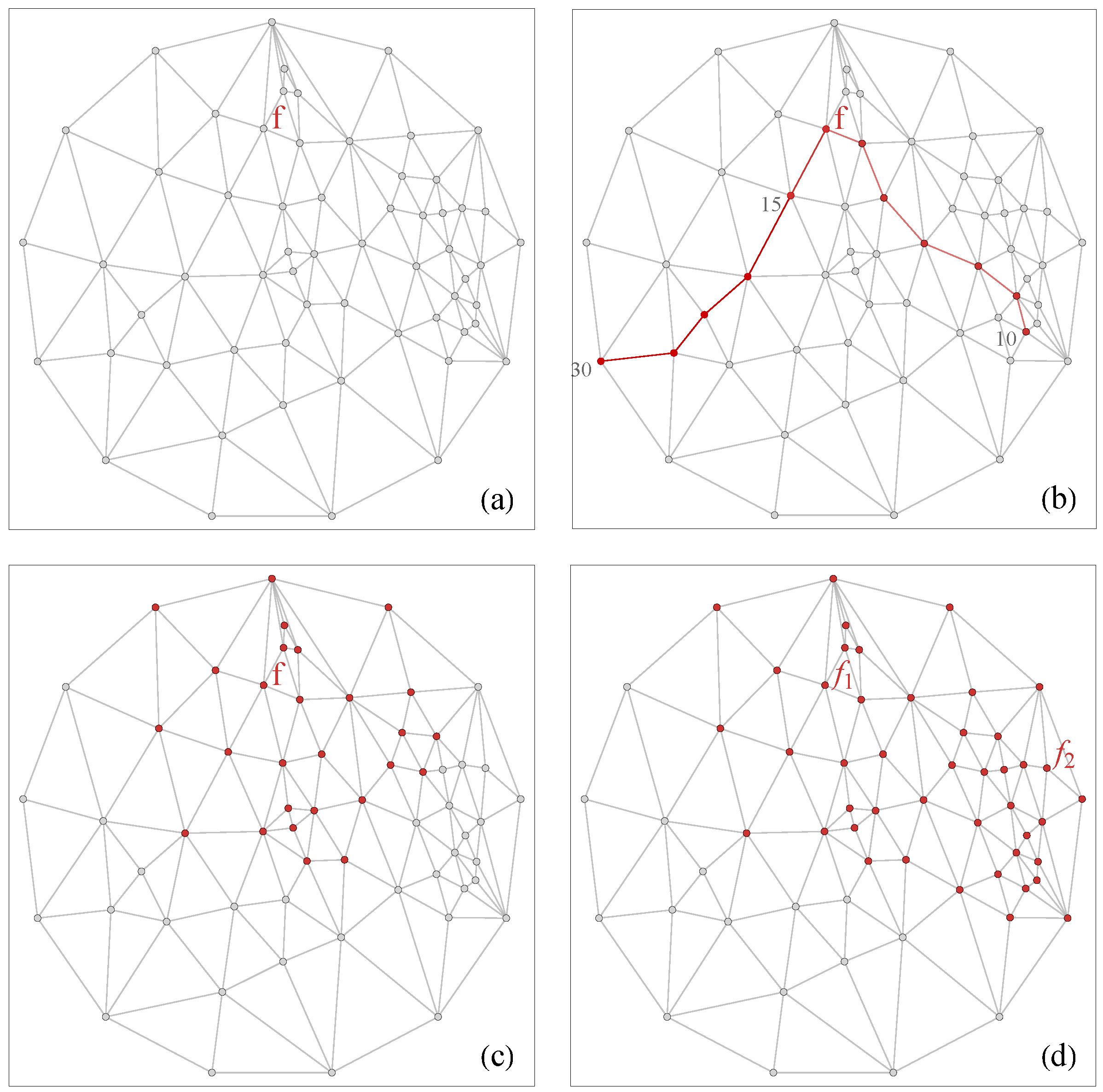
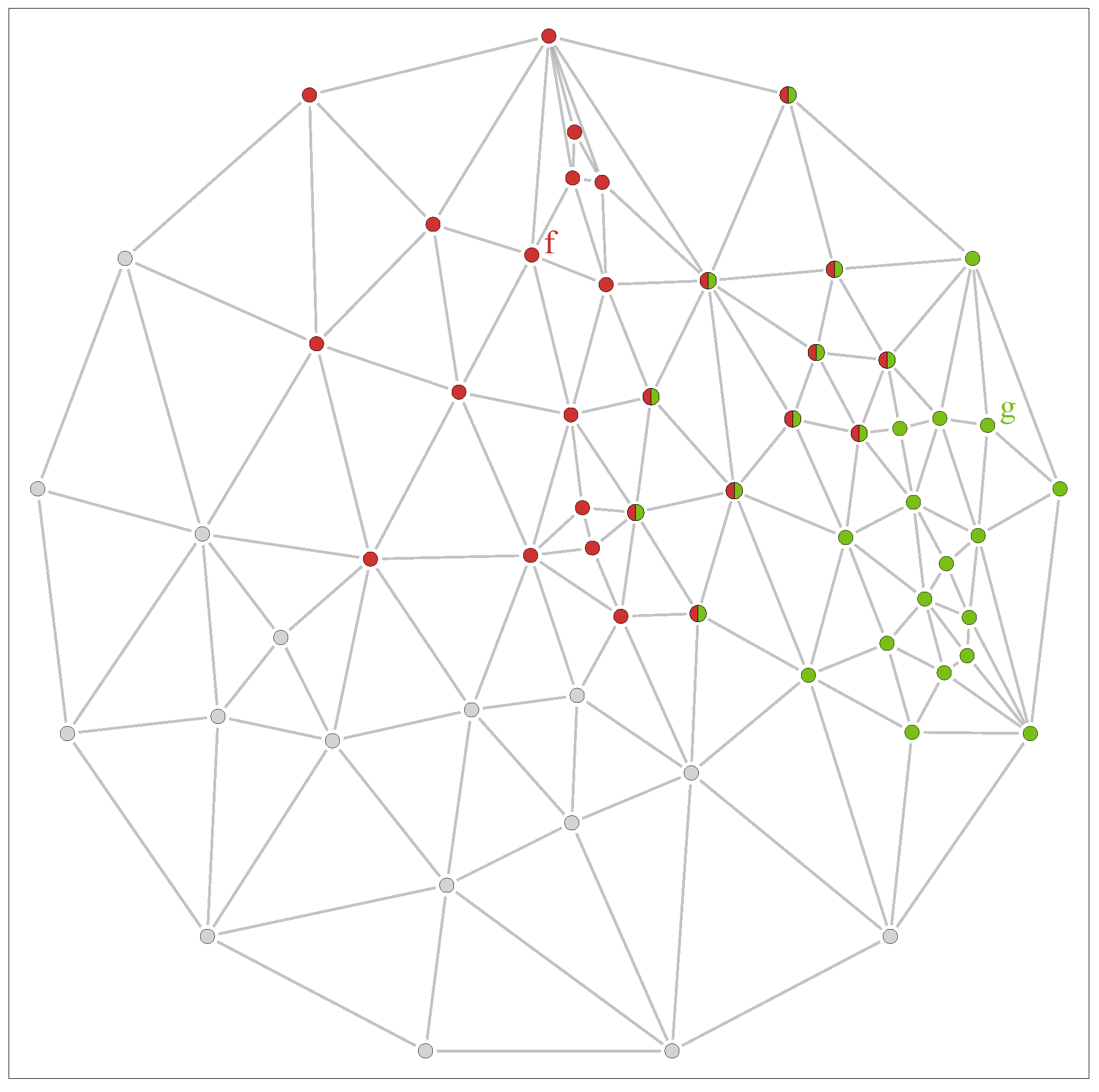
2. A Graph Model of the 15-Minute City
3. The 15-MC Graph and Urban Analysis
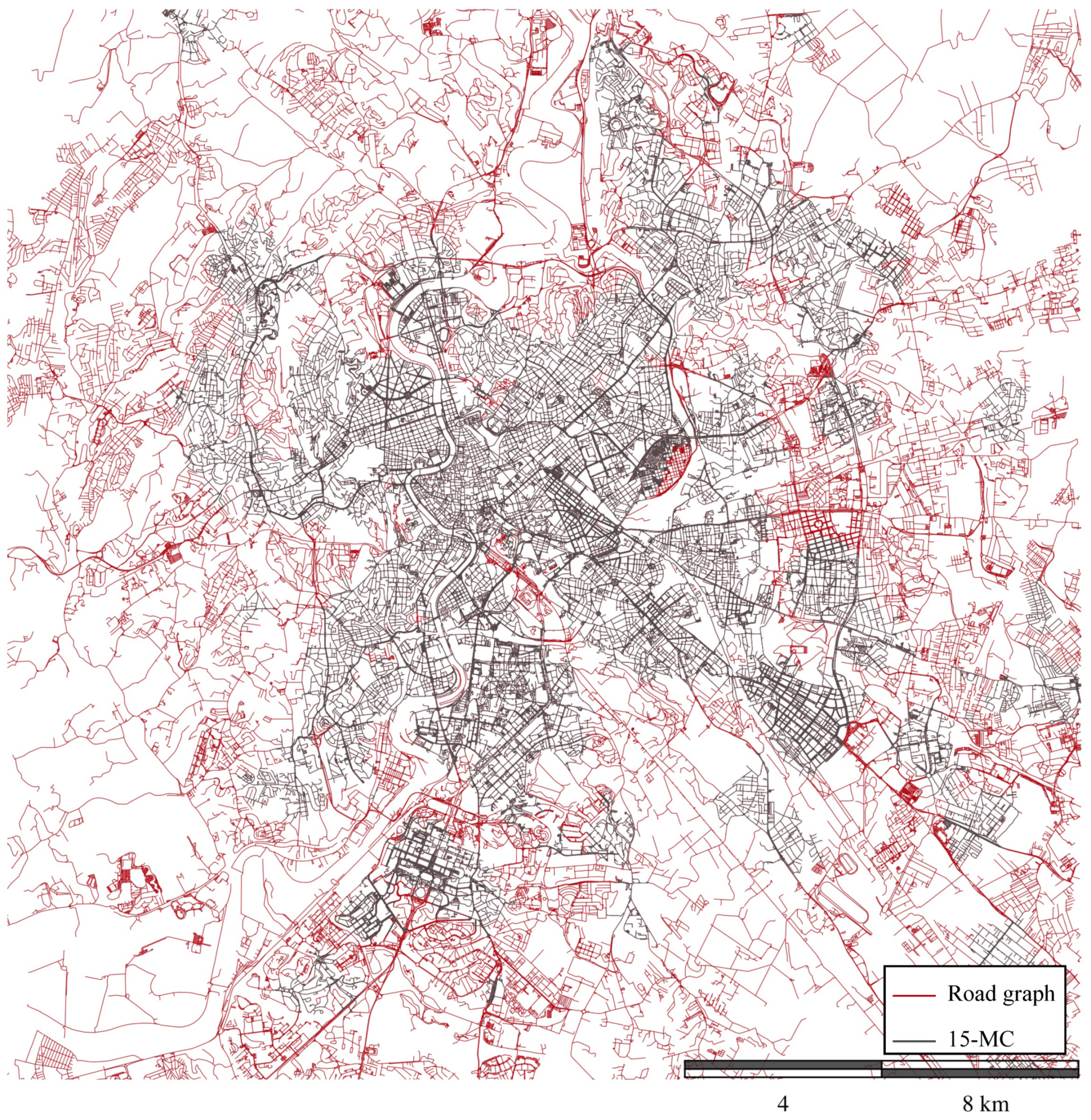
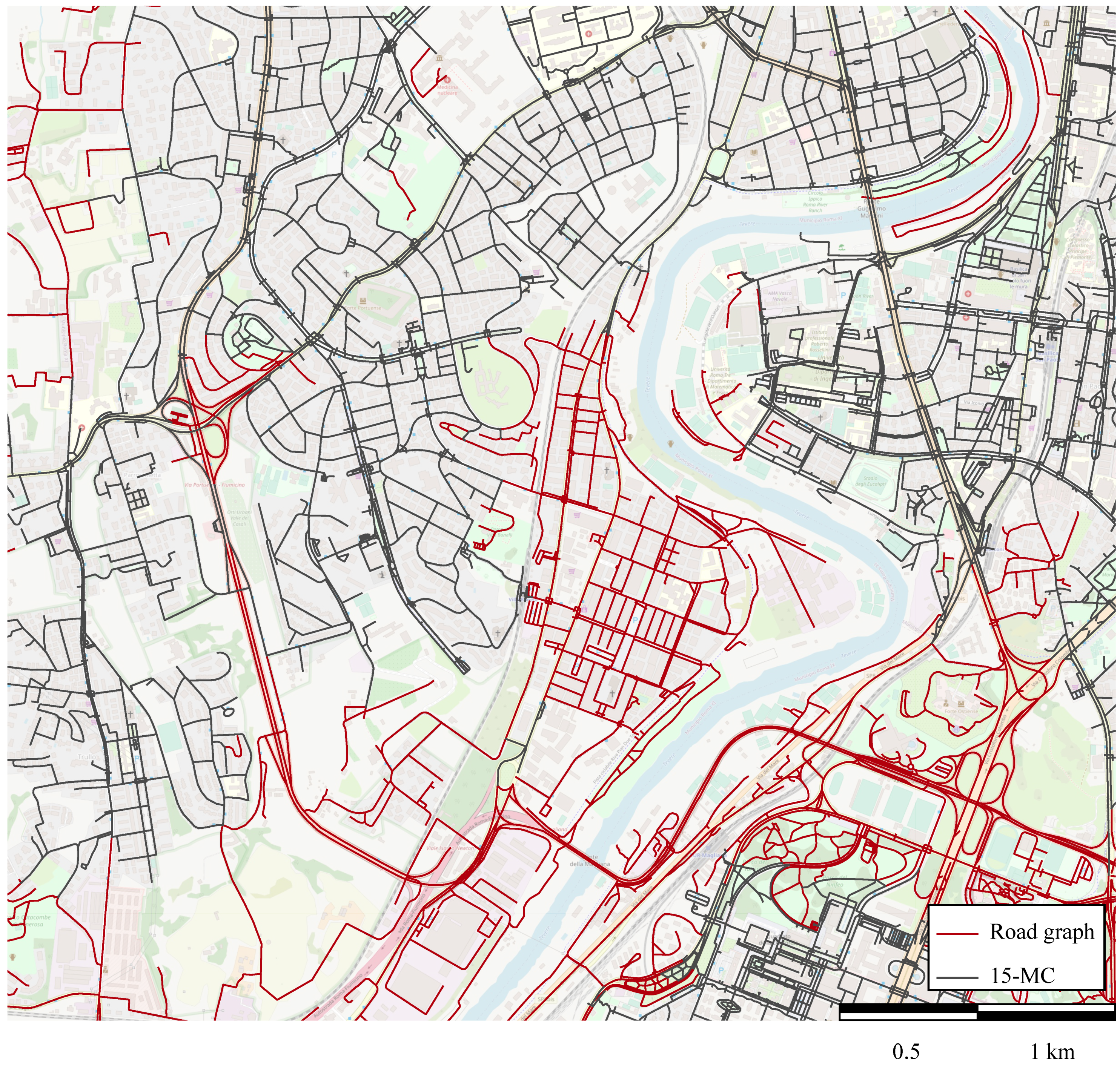
Rome, Paris, and London: A Comparison
4. Results
5. Discussion
Author Contributions
Funding
Institutional Review Board Statement
Informed Consent Statement
Data Availability Statement
Acknowledgments
Conflicts of Interest
Abbreviations
| 15-MC | 15-minute city |
| t-MC | generic t-minute city |
References
- Moreno, C.; Allam, Z.; Chabaud, D.; Gall, C.; Pratlong, F. Introducing the 15-minute city: Sustainability, resilience and place identity in future post-pandemic cities. Smart Cities 2021, 4, 93–111. [Google Scholar] [CrossRef] [Scilit]
- Allam, Z.; Bibri, S.E.; Chabaud, D.; Moreno, C. The Theoretical, Practical, and Technological Foundations of the 15-minute City Model: Proximity and Its Environmental, Social and Economic Benefits for Sustainability. Energies 2022, 15, 6042. [Google Scholar] [CrossRef] [Scilit]
- Marchigiani, E.; Bonfantini, B. Urban Transition and the Return of Neighbourhood Planning. Questioning the Proximity Syndrome and the 15-Minute City. Sustainability 2022, 14, 5468. [Google Scholar] [CrossRef] [Scilit]
- Pozoukidou, G.; Chatziyiannaki, Z. 15-Minute City: Decomposing the New Urban Planning Eutopia. Sustainability 2021, 13, 928. [Google Scholar] [CrossRef] [Scilit]
- Gaglione, F.; Gargiulo, C.; Zucaro, F.; Cottrill, C. Urban accessibility in a 15-minute city: A measure in the city of Naples, Italy. Transp. Res. Procedia 2022, 60, 378–385. [Google Scholar] [CrossRef] [Scilit]
- Mulíček, O.; Osman, R.; Seidenglanz, D. Urban rhythms: A chronotopic approach to urban timespace. Time Soc. 2015, 24, 304–325. [Google Scholar] [CrossRef] [Scilit]
- Weng, M.; Ding, N.; Li, J.; Jin, X.; Xiao, H.; He, Z.; Su, S. The 15-minute walkable neighborhoods: Measurement, social inequalities and implications for building healthy communities in urban China. J. Transp. Health 2019, 13, 259–273. [Google Scholar] [CrossRef] [Scilit]
- Capasso Da Silva, D.; King, D.A.; Lemar, S. Accessibility in Practice: 20-Minute City as a Sustainability Planning Goal. Sustainability 2020, 12, 129. [Google Scholar] [CrossRef] [Scilit]
- Cocchia, A. Smart and Digital City: A Systematic Literature Review. In Smart City: How to Create Public and Economic Value with High Technology in Urban Space; Dameri, R.P., Rosenthal-Sabroux, C., Eds.; Springer International Publishing: Cham, Switzerland, 2014; pp. 13–43. [Google Scholar] [CrossRef] [Scilit]
- Gil Solá, A.; Vilhelmson, B. Negotiating Proximity in Sustainable Urban Planning: A Swedish Case. Sustainability 2019, 11, 31. [Google Scholar] [CrossRef] [Scilit]
- Hosford, K.; Beairsto, J.; Winters, M. Is the 15-minute city within reach? Evaluating walking and cycling accessibility to grocery stores in Vancouver. Transp. Res. Interdiscip. Perspect. 2022, 14, 100602. [Google Scholar] [CrossRef] [Scilit]
- C40 Knowledge Hub. How to Build Back Better with a 15-Minute City. 2020. Available online: https://www.c40knowledgehub.org/s/article/How-to-build-back-better-with-a-15-minute-city?language=en_US (accessed on 14 February 2023).
- Campisi, T.; Basbas, S.; Skoufas, A.; AkgÃŒn, N.; Ticali, D.; Tesoriere, G. The Impact of COVID-19 Pandemic on the Resilience of Sustainable Mobility in Sicily. Sustainability 2020, 12, 8829. [Google Scholar] [CrossRef] [Scilit]
- Campisi, T.; Severino, A.; Al-Rashid, M.A.; Pau, G. The Development of the Smart Cities in the Connected and Autonomous Vehicles (CAVs) Era: From Mobility Patterns to Scaling in Cities. Infrastructures 2021, 6, 100. [Google Scholar] [CrossRef] [Scilit]
- Pozoukidou, G.; Angelidou, M. Urban Planning in the 15-minute City: Revisited under Sustainable and Smart City Developments until 2030. Smart Cities 2022, 5, 1356–1375. [Google Scholar] [CrossRef] [Scilit]
- Khavarian-Garmsir, A.R.; Sharifi, A.; Sadeghi, A. The 15-minute city: Urban planning and design efforts toward creating sustainable neighborhoods. Cities 2023, 132, 104101. [Google Scholar] [CrossRef] [Scilit]
- Logan, T.; Hobbs, M.; Conrow, L.; Reid, N.; Young, R.; Anderson, M. The x-minute city: Measuring the 10, 15, 20-minute city and an evaluation of its use for sustainable urban design. Cities 2022, 131, 103924. [Google Scholar] [CrossRef] [Scilit]
- Caselli, B.; Carra, M.; Rossetti, S.; Zazzi, M. Exploring the 15-minute neighbourhoods. An evaluation based on the walkability performance to public facilities. Transp. Res. Procedia 2022, 60, 346–353. [Google Scholar] [CrossRef] [Scilit]
- Zhang, S.; Zhen, F.; Kong, Y.; Lobsang, T.; Zou, S. Towards a 15-minute city: A network-based evaluation framework. Environ. Plan. B Urban Anal. City Sci. 2022, 50. [Google Scholar] [CrossRef] [Scilit]
- Blanchard, P.; Volchenkov, D. Mathematical Analysis of Urban Spatial Networks; Springer: Berlin/Heidelberg, Germany, 2009; pp. 151–157. [Google Scholar]
- Buhl, J.; Gautrais, J.; Reeves, N.; Solé, R.V.; Valverde, S.; Kuntz, P.; Theraulaz, G. Topological patterns in street networks of self-organized urban settlements. Eur. Phys. J. B—Condens. Matter Complex Syst. 2006, 49, 513–522. [Google Scholar] [CrossRef] [Scilit]
- Burke, J.; Gras AlomÃ, R.; Yu, F.; Kruguer, J. Geospatial analysis framework for evaluating urban design typologies in relation with the 15-minute city standards. J. Bus. Res. 2022, 151, 651–667. [Google Scholar] [CrossRef] [Scilit]
- Cardillo, A.; Scellato, S.; Latora, V.; Porta, S. Structural properties of planar graphs of urban street patterns. Phys. Rev. E 2006, 73, 066107. [Google Scholar] [CrossRef] [Scilit]
- D’Autilia, R.; Spada, M. Shaping ideal cities: The graph representation of the urban utopia. Environ. Plan. B Urban Anal. City Sci. 2019, 46, 423–444. [Google Scholar] [CrossRef] [Scilit]
- Alexanderson, G.L. About the cover: Euler and Königsberg’s bridges: A historical view. Bull. Am. Math. Soc. 2006, 43, 567–573. [Google Scholar] [CrossRef] [Scilit]
- D’Autilia, R.; Spada, M. Extension of Space Syntax Methods to Generic Urban Variables. Urban Sci. 2018, 2, 82. [Google Scholar] [CrossRef] [Scilit]
- Achler, G.; Barra, A. A numerical investigation of the jamming transition in traffic flow on diluted planar networks. Int. J. Mod. Phys. B 2010, 24, 6351–6363. [Google Scholar] [CrossRef] [Scilit]
- Dijkstra, E.W. A note on two problems in connexion with graphs. Numer. Math. 1959, 1, 269–271. [Google Scholar] [CrossRef] [Scilit]
- Masucci, A.P.; Smith, D.; Crooks, A.; Batty, M. Random planar graphs and the London street network. Eur. Phys. J. B 2009, 71, 259–271. [Google Scholar] [CrossRef] [Scilit]
- Euler, L. Elementa Doctrinae Solidorum. Euler Archive—All Works. 1758. Available online: https://scholarlycommons.pacific.edu/euler-works/230/ (accessed on 14 February 2023).
- Diestel, R. Graph Theory; Electronic Library of Mathematics; Springer: Berlin/Heidelberg, Germany, 2006. [Google Scholar]
- Townsend, T. Spotlight: Is London Already a 15-Minute City? 2022. Available online: https://www.futureoflondon.org.uk/2022/09/20/spotlight-london-15-minute-city/?utm_source=rss&utm_medium=rss&utm_campaign=spotlight-london-15-minute-city (accessed on 14 February 2023).
- Trabalzi, F. Rethinking design for social housing: Space appropriation at the periphery of Rome. J. Urban. Int. Res. Placemaking Urban Sustain. 2010, 3, 131–144. [Google Scholar] [CrossRef] [Scilit]
- OpenStreetMap Contributors. 2017. Available online: https://www.openstreetmap.org (accessed on 14 February 2023).
- Boeing, G. OSMnx: New methods for acquiring, constructing, analyzing, and visualizing complex street networks. Comput. Environ. Urban Syst. 2017, 65, 126–139. [Google Scholar] [CrossRef] [Scilit]
- Zhao, P.; Yen, Y.; Bailey, E.; Sohail, M.T. Analysis of Urban Drivable and Walkable Street Networks of the ASEAN Smart Cities Network. ISPRS Int. J. Geo-Inf. 2019, 8, 459. [Google Scholar] [CrossRef] [Scilit]
- Yamu, C.; Van Nes, A. An Integrated Modeling Approach Combining Multifractal Urban Planning with a Space Syntax Perspective. Urban Sci. 2017, 1, 37. [Google Scholar] [CrossRef] [Scilit]
- Forde, A.; Daniel, J. Pedestrian walking speed at un-signalized midblock crosswalk and its impact on urban street segment performance. J. Traffic Transp. Eng. (Engl. Ed.) 2021, 8, 57–69. [Google Scholar] [CrossRef] [Scilit]
- Abdelfattah, L.; Deponte, D.; Fossa, G. The 15-minute city: Interpreting the model to bring out urban resiliencies. Transp. Res. Procedia 2022, 60, 330–337. [Google Scholar] [CrossRef] [Scilit]
- Carandini, A. The Atlas of Ancient Rome: Biography and Portraits of the City; Princeton University Press: Princeton, NJ, USA, 2017. [Google Scholar]
- di Cristofaro, M.; Di Pirro, E.; Ottaviano, M.; Marchetti, M.; Lasserre, B.; Sallustio, L. Greener or Greyer? Exploring the Trends of Sealed and Permeable Spaces Availability in Italian Built-Up Areas during the Last Three Decades. Forests 2022, 13, 1983. [Google Scholar] [CrossRef] [Scilit]
- Allam, Z.; Bibri, S.E.; Jones, D.S.; Chabaud, D.; Moreno, C. Unpacking the “15-Minute City” via 6G, IoT, and Digital Twins: Towards a New Narrative for Increasing Urban Efficiency, Resilience, and Sustainability. Sensors 2022, 22, 1369. [Google Scholar] [CrossRef] [Scilit] [PubMed]
- Townsend, T. Why Birmingham’s 15-Minute City Must Be Smart Too. 2021. Available online: https://www.greaterbirminghamchambers.com/latest-news/blogs/2021/6/why-birmingham-s-15-minute-city-must-be-smart-too (accessed on 14 February 2023).
- Manika, S. Transforming Vacant Commercial Spaces: From Localized Hotspots of Urban Shrinkage to “Smart” Co-Working Places. Open J. Soc. Sci. 2020, 8, 86–97. [Google Scholar] [CrossRef]
- Vallicelli, M. Smart cities and digital workplace culture in the global European context: Amsterdam, London and Paris. City Cult. Soc. 2018, 12, 25–34. [Google Scholar] [CrossRef] [Scilit]
- Hillier, B. Space Is a Machine: A Configurational Theory of Architecture; Cambridge University Press: Cambridge, UK, 1996. [Google Scholar]


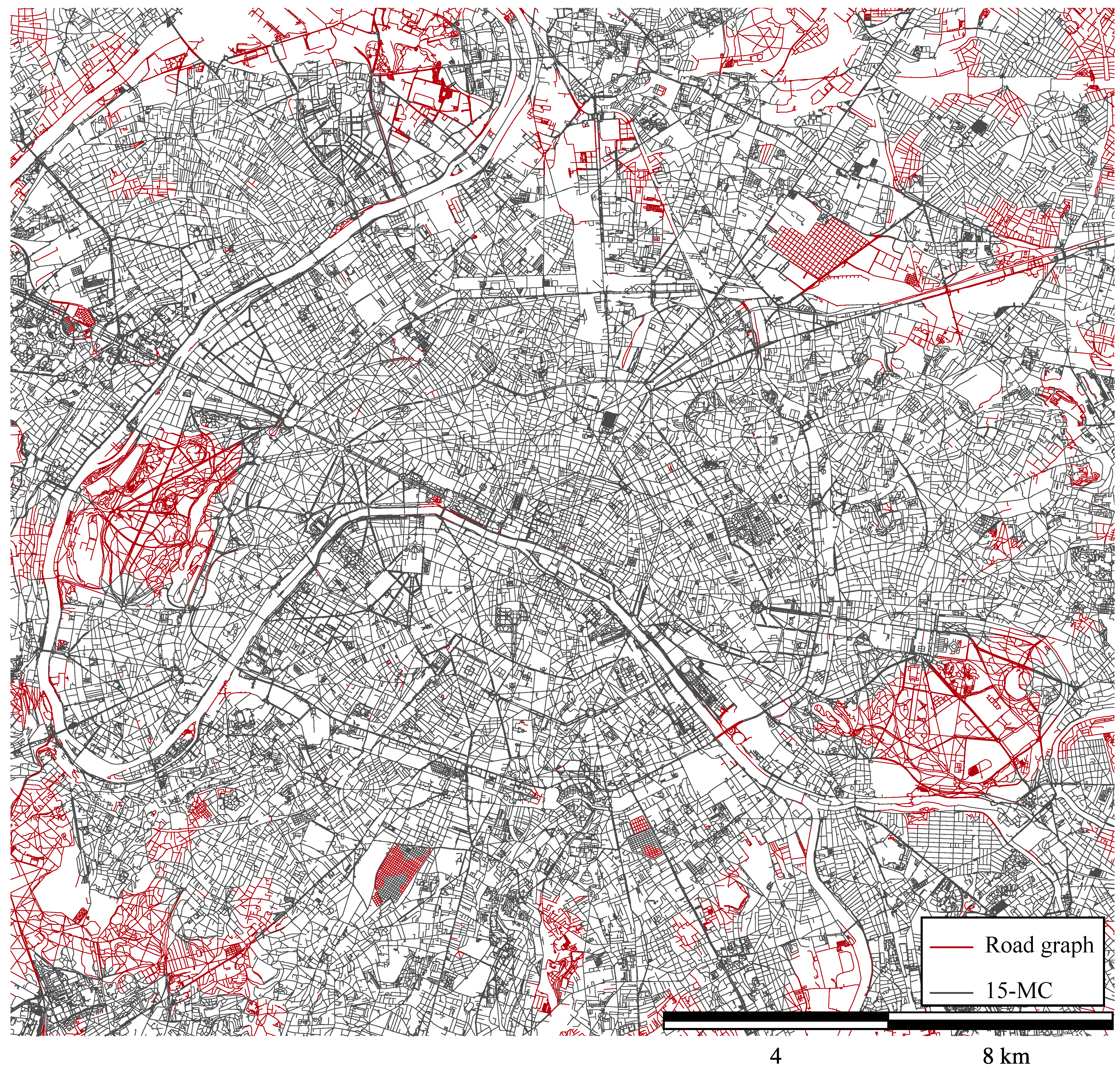
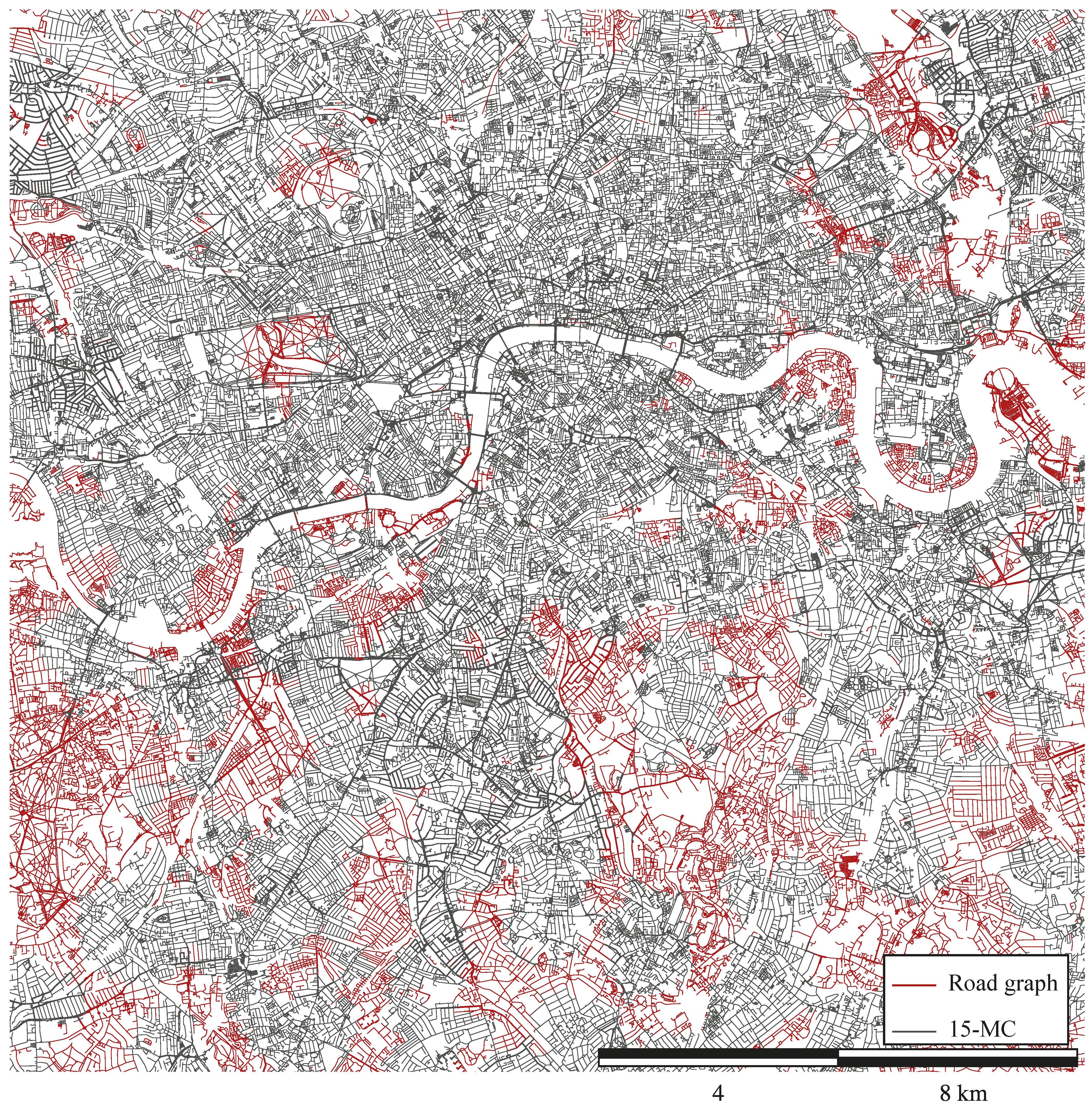
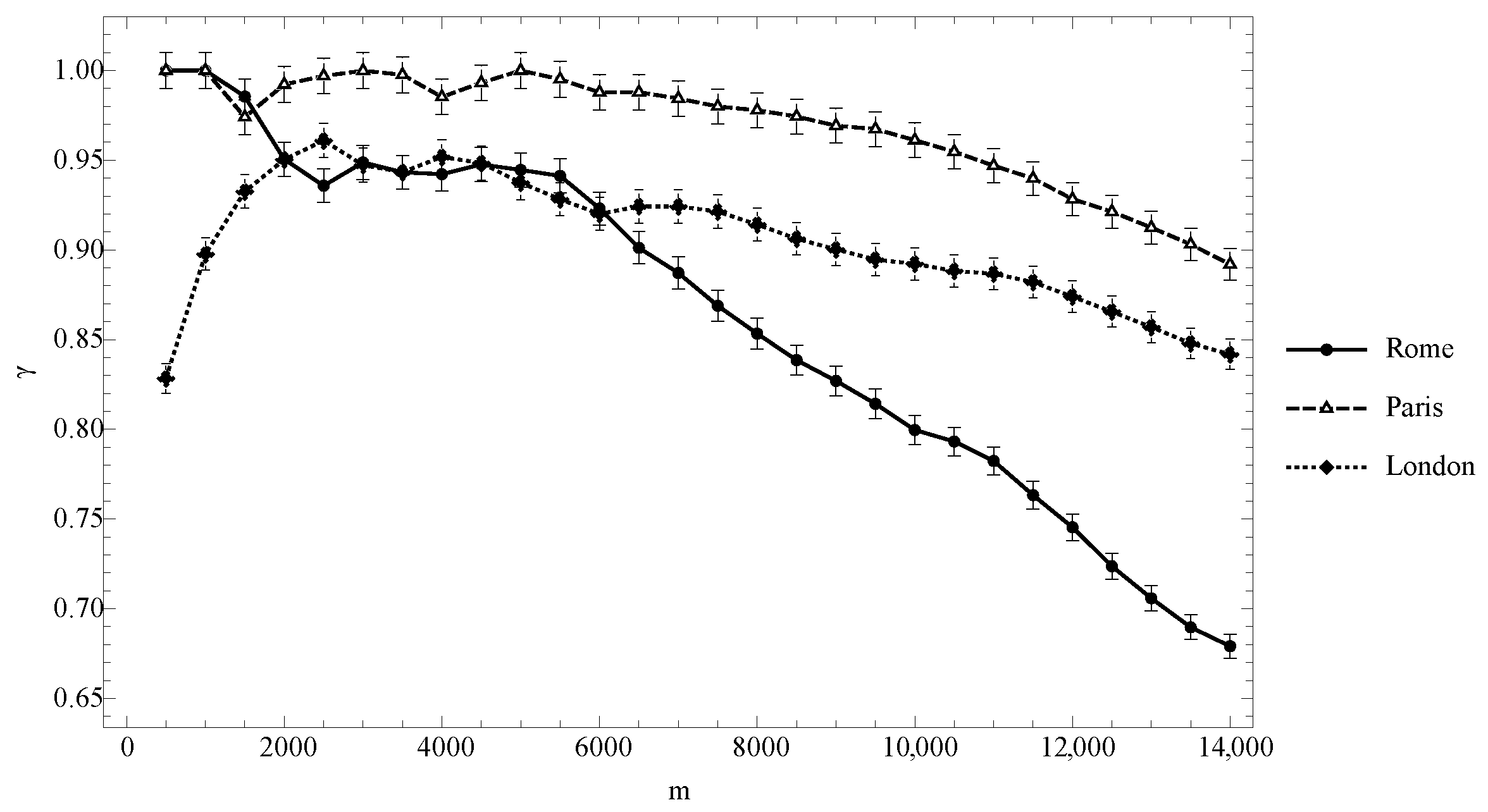
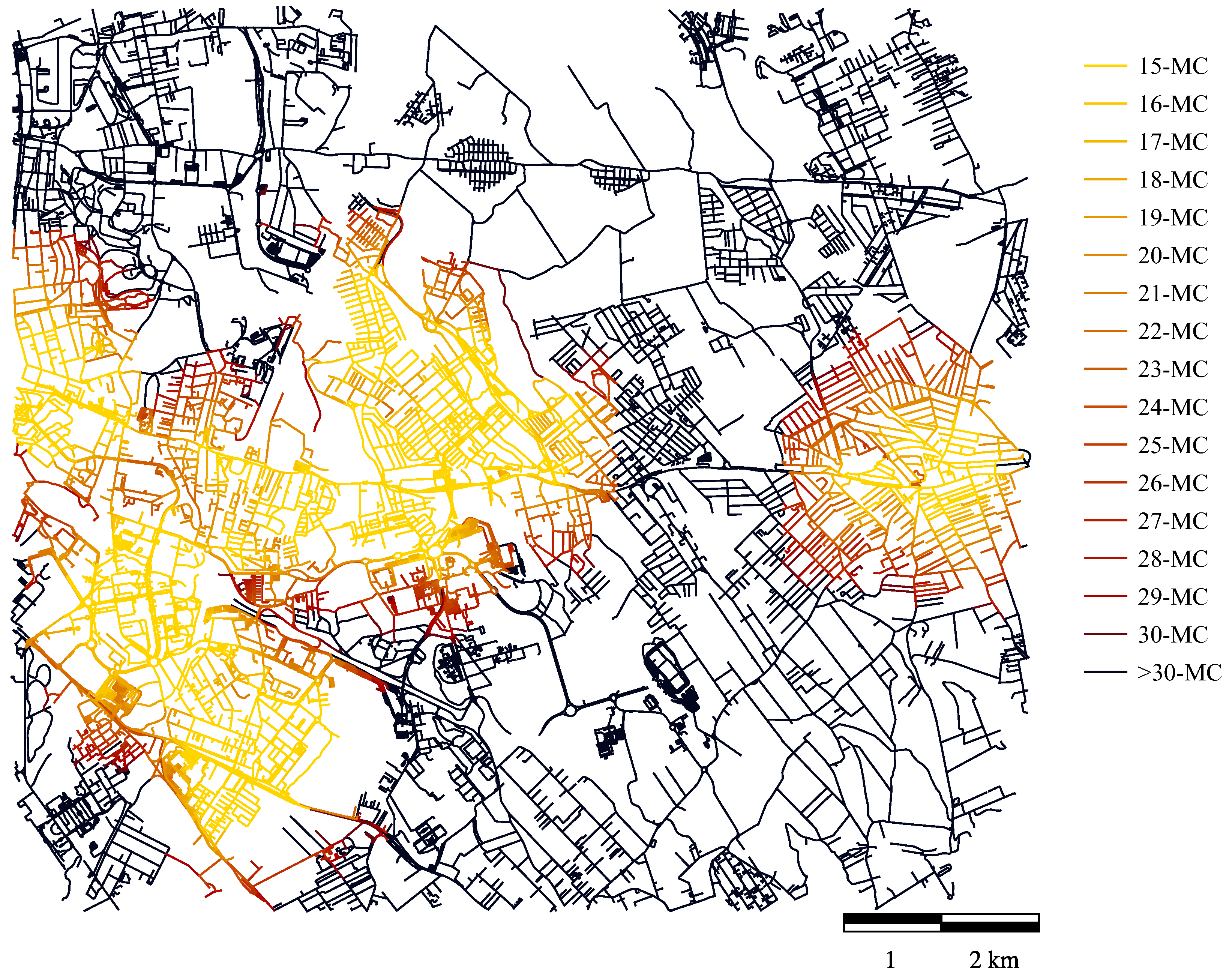

| City | |||
|---|---|---|---|
| Rome | 76,142 | 122,961 | 0.62 |
| Paris | 171,369 | 192,633 | 0.89 |
| London | 156,442 | 189,398 | 0.82 |
Disclaimer/Publisher’s Note: The statements, opinions and data contained in all publications are solely those of the individual author(s) and contributor(s) and not of MDPI and/or the editor(s). MDPI and/or the editor(s) disclaim responsibility for any injury to people or property resulting from any ideas, methods, instructions or products referred to in the content. |
© 2023 by the authors. Licensee MDPI, Basel, Switzerland. This article is an open access article distributed under the terms and conditions of the Creative Commons Attribution (CC BY) license (https://creativecommons.org/licenses/by/4.0/).
Share and Cite
Barbieri, L.; D’Autilia, R.; Marrone, P.; Montella, I. Graph Representation of the 15-Minute City: A Comparison between Rome, London, and Paris. Sustainability 2023, 15, 3772. https://doi.org/10.3390/su15043772
Barbieri L, D’Autilia R, Marrone P, Montella I. Graph Representation of the 15-Minute City: A Comparison between Rome, London, and Paris. Sustainability. 2023; 15(4):3772. https://doi.org/10.3390/su15043772
Chicago/Turabian StyleBarbieri, Lorenzo, Roberto D’Autilia, Paola Marrone, and Ilaria Montella. 2023. "Graph Representation of the 15-Minute City: A Comparison between Rome, London, and Paris" Sustainability 15, no. 4: 3772. https://doi.org/10.3390/su15043772
APA StyleBarbieri, L., D’Autilia, R., Marrone, P., & Montella, I. (2023). Graph Representation of the 15-Minute City: A Comparison between Rome, London, and Paris. Sustainability, 15(4), 3772. https://doi.org/10.3390/su15043772