


Abstract
Climate change, the emission of greenhouse gases, and air pollution are some of the most important and challenging environmental issues. One of the main sources of such problems is the field of transportation, which leads to the emission of greenhouse gases. An efficient way to deal with such problems is carrying out sustainable transportation to reduce the amount of air pollution in an efficient way. The evaluation of sustainable vehicles can be considered a multi-criteria decision-making (MCDM) method due to the existence of several criteria. In this paper, we aim to provide an approach based on MCDM methods and the spherical fuzzy set (SFS) concept to evaluate and prioritize sustainable vehicles for a transportation system in Tehran, Iran. Therefore, we have developed a new integrated approach based on the stepwise weight assessment ratio analysis (SWARA) and the measurement of alternatives and ranking according to the compromise solution (MARCOS) methods in SFS to assess the sustainable vehicles based on the criteria identified by experts. The evaluation results show that the main criterion of the environment has a high degree of importance compared to other criteria. Moreover, autonomous vehicles are the best and most sustainable vehicles to reduce greenhouse gas emissions. Finally, by comparing the ranking results with other decision-making methods, it was found that the proposed approach has high validity and efficiency.
1. Introduction
The problems of climate change and the increase in the need for energy have drawn the attention of the whole world to this issue. According to the report of the International Energy Agency, the total energy demand is likely to increase by 30% by 2040 [1]. Moreover, due to the increasing population and the industrialization of cities, the increase in the need for energy can be seen in all parts of the world, especially in big cities [2]. Unfortunately, the source of the required energy is fossil fuels, and this leads to climate change and the emission of greenhouse gases, which is one of the most important and threatening issues for the sustainability of the environment [3,4,5]. Therefore, in order to achieve stability and preserve the environment the emission of greenhouse gases and the consumption of fossil fuels must be significantly reduced [6,7].
The transportation system is one of the main sources of fossil fuel consumption and as a result the emission of greenhouse gases and air pollution [8,9,10,11]. Due to the increase in population, public transportation is also growing, but the transportation infrastructure is still not suitable for the current demand. Hence, there are problems such as severe crowding during rush hours and traffic in the streets of the city [2]. On the other hand, the increase in traffic leads to a higher contribution of the emission of greenhouse gases and air pollution by the transportation sector [12]. In such circumstances, people prefer to use private cars to avoid long queues and long waiting times. In this case, the use of private cars, the transportation system, and the air pollution situation will be in worse condition and traffic will increase intermittently [2].
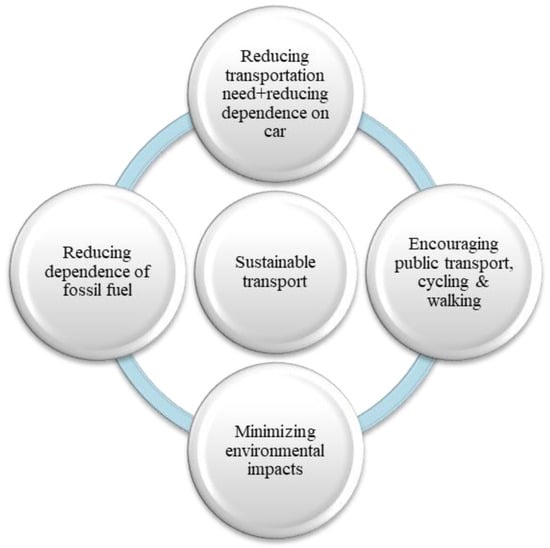
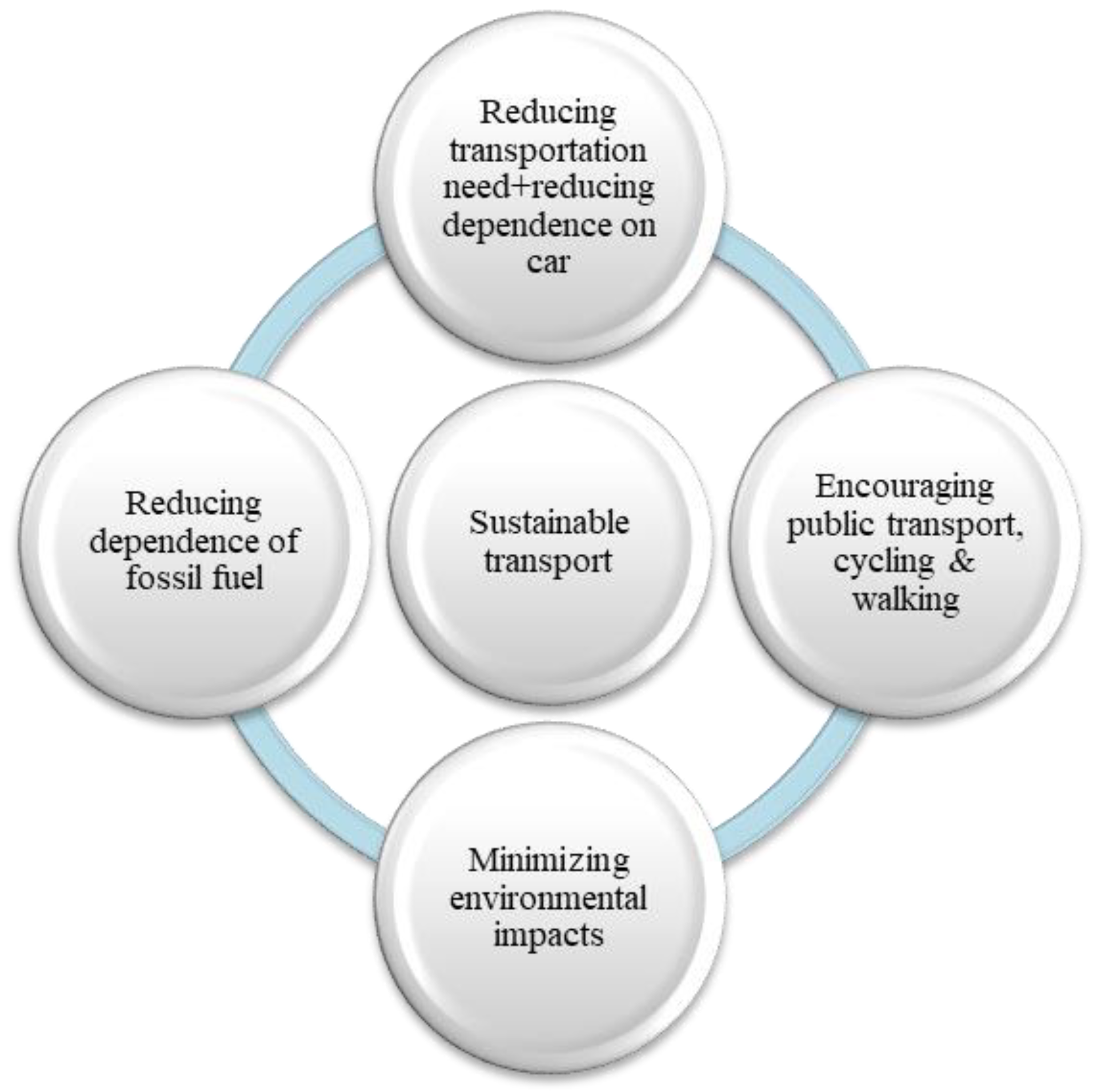
Considering the current climate conditions of the world and preventing the emission of greenhouse gases, the government is obliged to ban fossil fuel-based vehicles and also provide projects to reduce air pollution. Due to the increase in air pollution and excessive traffic, moving towards a sustainable transportation system and its implementation to preserve the environment and prevent climate change is strongly felt [13]. In Figure 1, a full presentation of the significant effects of sustainable transportation is provided. As can be seen, sustainable transportation leads to a decrease in the demand for fossil fuels, and as the use of fossil fuels decreases, the amount of greenhouse gas emissions decreases and leads to the cessation of climate change [14]. Therefore, the aim of this article is to provide sustainable vehicle alternatives for the transportation system and evaluate them according to related criteria. The evaluation and prioritization of alternative vehicles based on existing criteria might be considered with multi-criteria decision-making (MCDM).
Figure 1.
Impressive effects of sustainable transport.
MCDM has been developed in the fuzzy environment due to the uncertainty in the data of real-world problems and the challenges faced when dealing with it [15,16,17]. The fuzzy set was first introduced by Zadeh, et al. [18] to deal with uncertainty. Then, to increase the ability to deal with uncertainty, other fuzzy sets were developed. One of the newest fuzzy sets is the spherical fuzzy set (SFS) developed by Kutlu Gündoğdu and Kahraman [19]. This set is an extension of neutrosophic sets (NS), intuitionistic fuzzy sets (IFS), and Pythagorean fuzzy sets (PFS). In this set, in addition to membership and non-membership degrees, there is also a hesitant degree as an indication of the validity of experts’ opinions, and all three degrees are defined independently of each other, unlike other fuzzy sets [20,21]. Its three-dimensional nature makes this set different from other sets. SFS allows decision makers (DMs) to express their opinions as membership functions on a spherical surface. They also have more freedom when expressing opinions and making decisions [22,23].
Because of the increase and growth of the population in the coming years, it is clear that the frequency and magnitude of intra-city transportation problems will also increase [13]. Therefore, according to the mentioned challenges and in order to overcome these challenges and achieve sustainable development or in other words sustainable transportation, introducing and evaluating alternative vehicles in this research according to the environmental conditions of the Tehran metropolis has been tried. In this case, by choosing the best and most suitable ones, the emission of greenhouse gases can be prevented and as a result, air pollution can be reduced. In this paper, the topic of sustainability in transportation in Tehran is evaluated according to the indicators and components proposed for sustainability in this area in three economic, social, and environmental dimensions from the point of view of experts and specialists.
In most decision-making issues due to the lack of access to accurate information or incomplete and ambiguous information, it is necessary to use the opinions of experts to make decisions. Therefore, fuzzy sets can be very suitable for dealing with uncertainty and evaluating ambiguous information. The suggested approach in this paper is based on SFS which is very powerful. Therefore, this paper aimed to accurately assess and choose the best alternative vehicle for the transportation system in Tehran, Iran. In the proposed approach, the stepwise weight assessment ratio analysis (SWARA) method is used in the SFS for weighting the criteria. This method gives DMs and policymakers the opportunity to prioritize according to specific and current conditions. The implementation of this method in the SFS leads to the processing of ambiguous information and obtaining more accurate results. Moreover, the measurement of alternatives and ranking according to the compromise solution (MARCOS) method based on the SFS has been chosen for prioritizing and evaluating alternative vehicles. The recommended approach gives a new framework based on MCDM methods in the SFS, which is very powerful for processing ambiguous information and dealing with the uncertainty of experts’ opinions. Based on the above features, the contributions and innovations of the proposed approach can be expressed as follows:
- I.
- An integrated decision-making approach using the SWARA and MARCOS methods to assess and choose the best alternative vehicle to deal with greenhouse gas emissions and reduce air pollution and thus achieve a sustainable transportation system.
- II.
- The proposed approach based on MCDM methods provides a tool for multi-criteria evaluation despite uncertainty and vague information. Implementation of the proposed approach leads to more reliable and realistic results when making decisions.
- III.
- The implementation of the powerful methods of SWARA and MARCOS in the SFS enables the processing of contradictory and ambiguous information by a group of experts. Therefore, stable, accurate, and real results are obtained.
- IV.
- Taking advantage of the opinions of several experts, using their opinions based on aggregation operators of SFS and group decision-making to increase the ability to deal with uncertainty in data.
The remainder of the paper is planned as follows: Section 2 is assigned to the literature review about sustainable transportation and the research gap is provided. The next section examines the problem definition, criteria, and alternatives. Moreover, the recommended approach which is based on the SWARA and MARCOS methods is provided. Context definition, results, and comparative analysis are detailed in Section 4. Finally, in Section 5, the paper is concluded; in addition, suggestions for future research are provided.
2. Literature Review
In this section, some studies related to the field are reviewed. Reviewed studies are divided into two groups. In the first group, studies related to the criteria of sustainable transportation are examined. In the second group, studies related to transportation that have used MCDM methods are examined.
2.1. Sustainable Transportation
Acar and Dincer [24] stated transportation is one of the biggest consumers of fossil fuels in the world. For the stability of the transportation system, they proposed hydrogen to provide clean, safe, reliable, and affordable energy. In this way, the amount of greenhouse gas emissions can be prevented by replacing hydrogen. Sayyadi and Awasthi [25] investigated sustainable transportation policies due to the complexity and multiple elements in transportation systems. They evaluated the proposed policies based on the criteria of congestion level, fuel consumption, and greenhouse gas emissions. Shokoohyar, et al. [26] researched the deaths caused by traffic, the low quality of transportation infrastructure, and the increase in fossil fuel consumption in the transportation system. Therefore, in order to deal with such problems, they stated that it is necessary to move towards a sustainable transportation system. Pathak, et al. [27] presented a comprehensive framework for evaluating sustainable transportation systems. They stated that evaluating the performance of transportation systems leads to the progress of sustainability goals.
Schemme, et al. [28] examined strategies to produce, select, and implement future fuel alternatives for the transportation system for sustainable development. They introduced non-fossil diesel fuels which were based on renewable energy as a useful and viable strategy. De Souza, et al. [29] focused on the consumption of fossil fuels in the transportation system and their replacement. In order to reduce greenhouse gas emissions and air pollution, they introduced electric and battery electric vehicles. They also claimed that electric vehicles have less impact on environmental sustainability. Szaruga and Załoga [30] aimed to identify the directions of rationalization of the energy intensity of road freight transport in Poland. [31] tried to answer this question: Does the choice of the route determine the total energy consumption of inland waterway transport and therefore affect the potential of cargo transport of this mode? Godil, et al. [32] surveyed the role of renewable energy in the transportation system, both economically and in terms of reducing CO2 emissions. Their research shows that the use of renewable energy in the transportation system not only leads to technological innovation, but also reduces greenhouse gas emissions. de Almeida Guimarães and Junior [33] analyzed strategies based on environmental sustainability in order to upgrade and improve transportation systems and move towards sustainable development. The reviewed research related to the field of transportation is presented in Table 1.
Table 1.
Overview of research related to transportation system.
2.2. Applying MCDM Methods in Transportation
Considering the complexity and multiple elements in the transportation system, Sayyadi and Awasthi [25] introduced policies for the sustainability of transportation. To evaluate the introduced policies, they weighted the three criteria of fuel consumption, congestion level, and the emission of greenhouse gases using the analytic network process (ANP) method. Ulutaş, et al. [35] proposed the MCDM hybrid model in order to choose a suitable company for transportation in a cost-effective way. They implemented the PIPRECIA method and a combined compromise solution (CoCoSo) to rank transport companies in a fuzzy environment. Pamucar, et al. [36] studied an important and challenging issue of transportation demand management. By evaluating the introduced strategies based on decision-making methods, they came to the conclusion that improving and upgrading transportation capacity is the best strategy for managing transportation demand.
Sarkar and Biswas [37] considered the selection of the best transport company based on relevant criteria as a decision-making method. They used the technique for order of preference by similarity to ideal solution (TOPSIS) and the analytical hierarchy process (AHP) methods in the PFS environment, respectively, to weigh the criteria and prioritize the companies. Pamucar, et al. [38] defined the increase in greenhouse gas emissions as one of the biggest and most challenging environmental problems. Therefore, they proposed alternative fuel vehicles to deal with this problem, and to evaluate them, they used the full consistency method (FUCOM) and measurement of choices and their ranking as a compromise solution (MARCOS) method in the neutrosophic fuzzy environment. Moreover, according to the obtained results, they stated that the most important criteria for evaluation are energy cost and purchase cost. Moreover, the evaluation results showed that electric vehicles can be very useful and efficient for the current transportation system.
Pamucar, et al. [39] applied the concept of sustainable joint mobility to deal with the challenges in the current transportation system. They evaluated electronic bicycles, electronic vehicles, and autonomous electronic vehicles based on 20 criteria and used the evaluation based on distance from average solution (EDAS) method. Devi, et al. [40] declared that determining the best strategy for sustainable transportation despite the uncertainty of data is a challenging issue. Therefore, the TOPSIS method in the SFS is utilized to evaluate the strategies. The reviewed research related to the field of transportation and MCDM methods is presented in Table 2.
Table 2.
Research related to transportation and MCDM methods.
2.3. Research Gap
The transportation system is one of the important factors in life and economic growth. This issue has caused planners to pay more attention to the category of transportation and its development. However, despite the importance of this system in the daily life of citizens, common transportation patterns lead to the imposition of heavy environmental, social, and economic costs and many problems such as increased energy consumption, car traffic, greenhouse gas emissions, and air pollution. At the foundation of all these problems, there is a complex process that is independent of the interaction between the increasing level of car ownership and the locational decisions of people and businesses in and around cities. Thus, cars are the main cause of environmental pollution and global risks. Following such environmental consequences of transportation, the need for the concept of sustainable transportation is strongly felt [41]. Environmental sustainability can be supported through sustainable transportation. It can be said that sustainable transportation not only seeks to reduce air pollution, greenhouse gas emissions, noise pollution, and traffic, but also considers reducing poverty and supporting economic growth [42].
The city of Tehran, as the center, is the most populated city in Iran and the most important commercial, administrative, and concentration hub of services and facilities, which, despite its great potential, due to the growth of the population and the increase in cars, is facing problems such as air pollution and the reduction of air quality. It is obvious that with the increase and growth of the population in the coming years, the frequency and magnitude of intra-city transportation problems will also increase. Therefore, according to the mentioned issues and challenges, this research has tried to evaluate alternative sustainable vehicles from the point of view of experts according to the conditions of Tehran city and environmental issues. According to the literature review in Section 2.1 and Section 2.2, there have been many articles in the field of transportation. However, so far, no article has been completed on the evaluation of alternative vehicles based on environmental, economic, resilience, and human health criteria using MCDM methods in an SFS environment. The main question of the current study is: which kind of vehicles are suitable to deal with greenhouse gas emissions and reduce air pollution? Therefore, in this research, an integrated SWARA-MARCOS approach has been developed in the SFS environment to weigh the mentioned criteria and evaluate alternative sustainable vehicles.
3. Problem Definition
Today, most transportation experts are trying to provide a city with effective, healthy, safe, and fast transportation for citizens by implementing sustainable transportation in cities. The Tehran metropolis with eight million people is the largest metropolis in the country and the Middle East. It is certain that the development of the urban transport network and Iran’s megacities is the most important urban challenge and Tehran, as the capital of Iran’s megacities, needs executive solutions and acceleration in the expansion of the urban transport network. Therefore, in this research, according to the economic and environmental conditions prevailing in the Tehran metropolis, six sustainable vehicles have been defined, including fuel cell vehicles (FCV), autonomous vehicles (AV), metro (M), electric vehicles (EV), hybrid electric vehicles (HEV), and bicycles (B). Moreover, to evaluate these sustainable vehicles in Tehran city, four main criteria (environmental, economic, resilience, and human health) and thirteen sub-criteria are considered by experts.
3.1. Definition of Criteria
By examining and literature review, as well as using the opinions of experts in this field, environmental, economic, resilience, sustainability, and human health criteria have been identified with regard to the sustainability approach. The main criteria and their sub-criteria are presented with brief explanations in Table 3.
Table 3.
Sustainable transportation evaluation criteria.
3.2. Proposed Model
3.2.1. SFS
After the introduction of fuzzy sets by Zadeh, Klir and Yuan [18], new fuzzy sets have been developed, including IFS and PFS, and SFS, which is the newest of them [43,44,45]. In the following section, the properties and important operations utilized in this paper are provided.
Definition 1 [19].
Letbe a universe of discourse. Equation (1) is called SFS over the domain.
wheredefines membership, non-membership, and hesitant degrees for everyin the SFS, respectively.
Definition 2 [46].
Letandbe two SFS numbers andto be a constant number greater than 0. The basic mathematical operations of these two SF numbers are as follows:
Definition 3 [19].
For SFandthe following rules are valid under the conditions.
Definition 4.
Let the representative of the SFS number be [19]. Let {}. The score value and accuracy function of the number can be calculated from the equations presented below:
Note that:if and only if
Sometimes the numbers achieved through the score and accuracy are not appropriate, and negative or zero values may be gained, and the accuracy of the performance may be the same. Consequently, the prioritization function () is considered for SF numbers, which is as in Equation (16).
Definition 5 [47].
Single-valued spherical weighted arithmetic mean (SWAM) with respect tois calculated as follows:
3.2.2. SFS-SWARA
The SWARA method was initially introduced by Keršuliene, et al. [48] for weighting the criteria. This method has a very simple algorithm and while being simple and easy to implement, it is a very powerful, understandable, and accurate method for weighting. This method has fewer pairwise comparisons compared to other weighting methods. It also gives DMs and politicians the opportunity to prioritize the criteria based on the conditions prevailing in the country or defined policies. In this method, based on the opinions of experts, the most important criterion gets the first position and the least important criterion is placed in the last position [43,49]. Based on the basic algorithm of the SWARA method, the SFS-SWARA steps are defined as follows
Step 1: Determining the factors related to the topic raised.
In the first step, experts prioritize the identified criteria based on their importance using linguistic variables. Then, the linguistic variables provided based on the DMs’ opinions are transformed into numbers of SFS according to Table 4.
Table 4.
Linguistic variables of SFS.
Step 2: Integration of expert opinions
Based on Equation (17), experts’ opinions are merged based on their experience and expertise.
Step 3: Calculating ()
To prioritize criteria, the is computed by Equation (13). The most important criteria are written based on (). The most influential and least influential criteria are put in the top set and lowest classification categories, respectively.
Step 4: Calculating the approximate significance of the criteria () and compute the coefficient ()
At this stage, the () of each criterion compared to the previous criteria is determined. () is a function of () of each criterion, which is computed using Equation (18):
Step 5: Computing first primary mass
Equation (19) is used to calculate the initial weight of each criterion. Of course, it should be kept in mind that the weight of the first criterion, the most critical criterion according to experts, is considered equal to one.
Step 6: Attempt the final steps of the criteria phase
In the last step, the final weight of the criteria, also called the nominal weight, is computed through Equation (20), where wj presents the compared weight of the j criteria and presents the number of criteria.
3.2.3. SFS-MARCOS
MARCOS is one of the new MCDM methods for ranking options introduced by Stević, et al. [50]. This method has high efficiency and reliability compared to other ranking methods due to its ease of implementation, high efficiency, and more accurate determination of the degree of desirability of options. The degree of desirability of options is determined by this method by defining the relationship between options and ideal and anti-ideal degrees as reference points and providing an accurate ranking of options [51]. Considering that the opinions of experts are usually accompanied by uncertainty, MCDM methods are developed with the fuzzy concept to overcome the existing uncertainty. For this reason, in this research, the MARCOS method has been developed in the SFS environment, which is very powerful for dealing with uncertainty.
Step 1: Forming the initial matrix based on the opinions of experts
Suppose alternatives are evaluated using criteria and each alternative is scored based on each criterion. Suppose illustrates our alternatives and represents the criteria. So, first, the decision matrix based on SFS linguistic variables is formed as an Equation (21).
Then, in Table 4 the linguistic variables which are provided by experts are converted into SFS numbers using Table 4.
Step2: Specifying the ideal and the counter-ideal
In the following, based on Equations (22) and (23), ideal (Âai) and anti-ideal (Âid) values are computed.
Expression C represents the criteria of the cost type and expression B represents the criteria of the positive type.
Step 3: Aggregate matrix formation
Due to the fact that the opinion of several experts is used in group decision-making, at this stage, merging the decision-making matrices formed by each expert and forming the aggregated matrix based on Equation (17) and the weight of the experts is necessary.
Step 4: Computing PF values and normalizing the decision matrix
First, the values of all SFS numbers are calculated using Equation (16) to normalize the aggregated decision matrix.
Normalization is performed for cost-related criteria and profit-related criteria using Equations (24) and (25). The output of this part is a matrix where all the criteria are of a profit nature (positive), because the normalization method of this method is linear.
Step 5: Forming a weighted decision matrix
The weights obtained from the weighting methods are applied to the normalized decision matrix and the weighted decision matrix is formed using Equation (26).
Step 6: Computing the utility degrees
The utility degrees of alternatives are computed using Equations (27) and (28).
In Equations (27) and (28), is the sum of the values of each row in the weighted matrix, which is achieved from Equation (29).
Step 7: Ranking alternatives based on the utility functions
Finally, the utility functions of each alternative are computed using Equation (30).
In Equation (30), is the anti-ideal utility function, and is the ideal utility function for each alternative, which is computed from Equations (31) and (32). Then, based on the values obtained from each alternative, ranking is done. The ranking is completed in descending order.
3.2.4. Proposed Approach Phrases
This section presents the proposed approach. The proposed approach is shown in two levels. In phase one, the weights of the criteria are calculated using the SF-SWARA method according to experts’ opinions and using Table 4. Experts have related experience with transportation and sustainable development. In the second phase, the alternatives are prioritized using the SF-MARCOS method. Unlike in the conventional version of MCDM methods, the expert data are expressed using SF numbers, namely the membership, non-membership, and hesitance degrees, which are independent.
4. Experimental Results
4.1. Case Study
Tehran is the largest city in Iran, the second largest city in the Middle East after Cairo, and one of the most populous cities in the world. The selection of Tehran as the capital has started the ground for increasing the population of this city. Moreover, Tehran’s special position has led to a large number of people from nearby cities entering Tehran for business every day and returning to their cities after finishing their activities. In addition, thousands of students and professors are commuting between Tehran and the surrounding cities every day, which indicates the influence of the Tehran metropolis. The metropolis of Tehran has rapid population growth, and this issue has its own problems; air pollution, traffic, and the emission of greenhouse gases are among these problems. Undoubtedly, transportation is one of the main sources of air pollution in Tehran. Therefore, it is necessary to review the current method of transportation in Tehran. The development of sustainable transportation is one of the ways to improve the transportation situation in this metropolis.
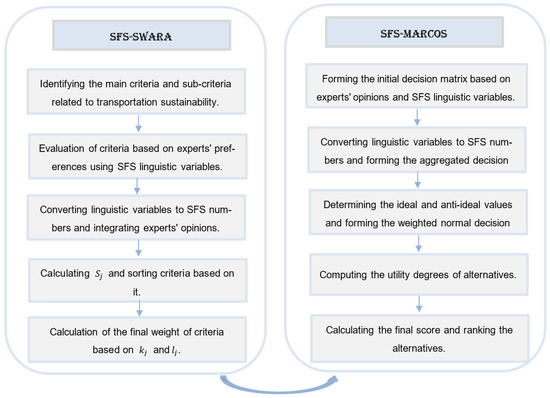
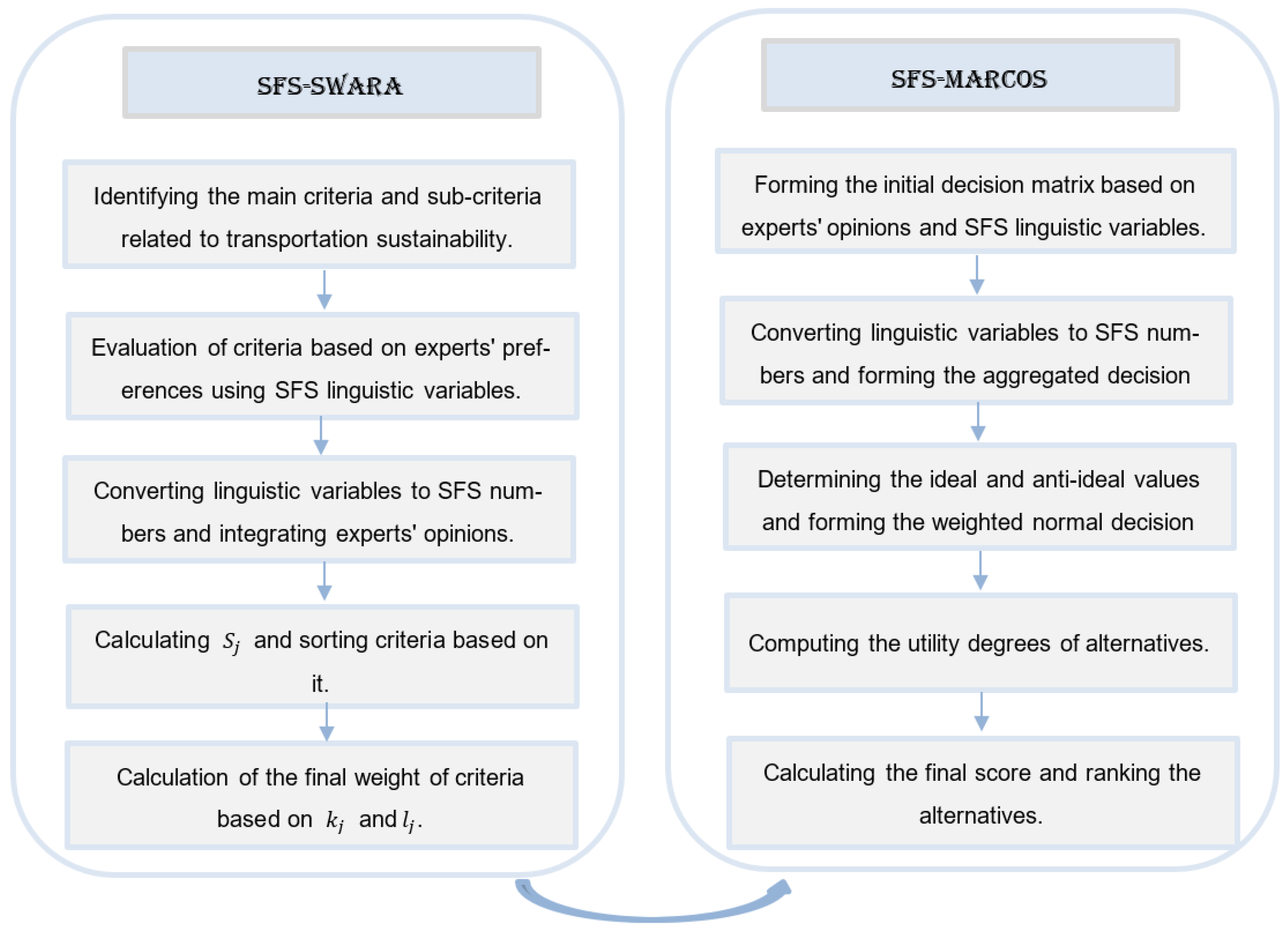
Therefore, in response to the mentioned problems, in this research, we have developed an integrated SFS-SWARA-MARCOS approach to evaluate sustainable vehicles in an SFS environment. The introduced approach is presented in Figure 2. First, according to the prevailing conditions in Tehran, the decision-making team consisting of three people has identified criteria in four environmental, economic, resilient, and human health areas. The selected experts have experience and expertise in the field of transportation. In the first stage, experts weigh the main criteria and sub-criteria separately using the SFS-SWARA method and according to SFS linguistic variables. Then, in the second stage, using the MARCOS method in the SFS environment, the introduced sustainable vehicles are evaluated and prioritized based on the weights obtained for the criteria. What transportation experts agree on is achieving a sustainable transportation model in Tehran so that they can provide the vision of a healthy city with fast, efficient, and safe transportation for all citizens.
Figure 2.
Steps of the proposed approach.
First, according to the first stage of the proposed approach, experts weigh the identified criteria. First, the main criteria are evaluated, then the sub-criteria of each main criterion are weighted separately. Experts first evaluate the criteria based on their degree of importance according to SFS linguistic variables presented in Table 5. Then the linguistic variables provided by the experts are converted into SFS numbers.
Table 5.
Evaluation of main criteria based on SFS linguistic variables.
Considering the experience of the three experts used in this research, there is therefore a need to integrate the opinions presented and form an accumulated decision matrix. Therefore, by the usage of Equation (17) and the weight of experts based on their experience and expertise, respectively, 0.35, 0.40, and 0.25 opinions are merged. Then, using Equation (13), the values of the SFS numbers are calculated and based on the , and the criteria are sorted in descending order. The criterion with the highest is placed in the first position and the criterion with the lowest takes the last position. Then, in the next step, the values of and are calculated based on Equation (18). After that, the initial weight of each criterion is calculated according to Equation (19) and finally, the final weight of the criteria is obtained based on Equation (20). The aggregated preferences based on the SWAM operator are presented in Table 6. The results of the SFS-SWARA method are presented in Table 7.
Table 6.
Aggregated preferences based on the SWAM operator.
Table 7.
The results obtained from the SFS-SWARA method.
The mentioned steps are applied to obtain the sub-criteria weights. The local and global weights obtained from the SFS-SWARA method are presented in Table 8. Global weights are obtained by multiplying local weights by the weight of the main criteria. According to the obtained results, it can be seen that the main criterion (environmental) is of high importance, and air pollution and climate change are of high importance compared to other sub-criteria (See Appendix A).
Table 8.
The final weight of the main criteria and sub-criteria.
4.2. Ranking Sustainable Transportation Alternative
By moving to the next stage of the proposed approach, first, the decision matrix is made according to the opinions of experts and linguistic variables presented in Table 4 in the form of Table 9. The rows of this matrix represent sustainable vehicles and its columns represent criteria identified by experts.
Table 9.
Initial decision matrix based on expert opinions and SFS linguistic variables.
Then the linguistic variables presented in the initial matrix are converted into SFS numbers based on Table 4. According to the weightings of the experts and using Equation (17), the aggregated decision matrix is formed in the form of a Table 10.
Table 10.
The accumulated decision matrix based on SWAM operator.
In the next step, in order to determine the ideal and anti-ideal values, the values of SFS numbers are calculated according to Equation (16). Then, the ideal and anti-ideal values are obtained according to whether the criteria are positive or negative based on Equations (22) and (23). The Normalized and weighted decision matrix matrix is formed in the form of a Table 11.
Table 11.
Normalized and weighted decision matrix.
Then, according to the type of criteria, the decision matrix is normalized based on Equations (24) and (25). After forming the normalized matrix, the weighted matrix is formed based on the weights obtained from the SFS-SWARA method and Equation (26). Then, according to the next step of the SFS-MARCOS method, the values of the degree of desirability and of the options according to Equations (27) and (28) are calculated. Finally, the final performance of the options is calculated according to Equation (30) and the ranking is based on the available values in descending order. The results obtained from the SFS-MARCOS method are presented in Table 12.
Table 12.
The results obtained from the proposed approach.
According to the table, it can be seen that the autonomous vehicle with a score of 0.708 has been identified as the best sustainable vehicle, the electric vehicle with a score of 0.689 has won second place, and the bicycle with a score of 0.643 is in last place.
4.3. Comparative Analysis
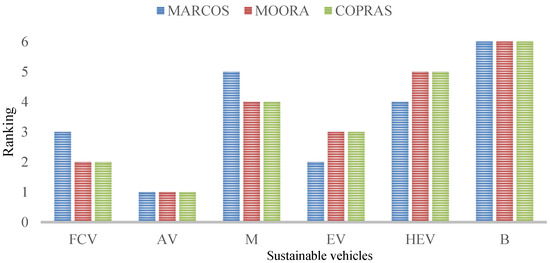
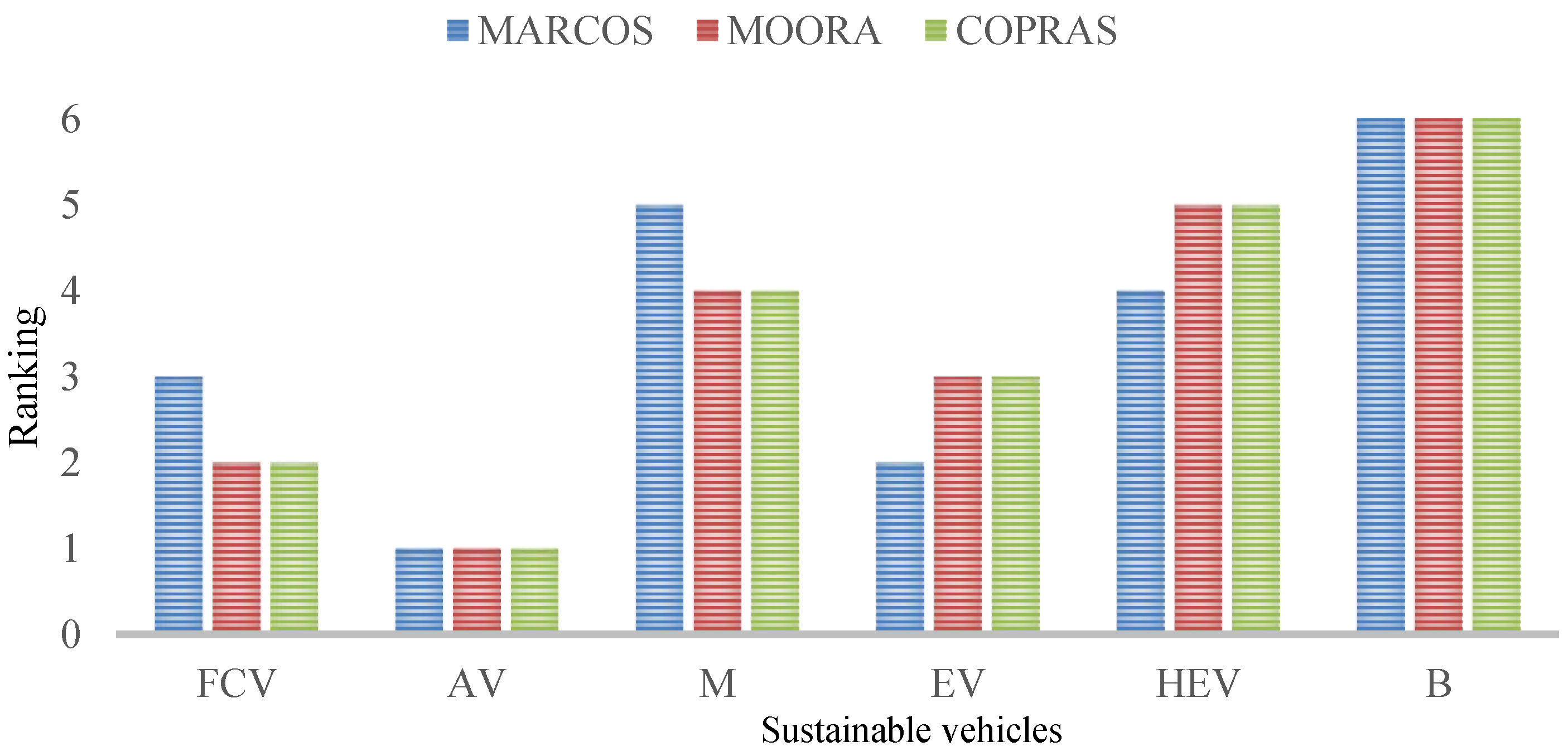
Evaluating the validity of the results obtained from the decision-making method is very necessary in order to test the strength of the proposed approach and the accuracy of the obtained results. Since each MCDM method has different steps for weighting and ranking the options, no specific method has been introduced to validate the results. However, based on the opinions of researchers, the results obtained from the method in question can be compared with other decision-making methods. In this part, in order to validate the obtained ranking, the ranking results have been compared with other decision-making methods, such as the SFS-multi-objective optimization method of proportional analysis (MOORA) and the SFS-complex proportional assessment (COPRAS). The ranking obtained from the mentioned methods is presented in Table 13. According to Figure 3, it can be seen that there is not much change in the ranking. In the MOORA method, autonomous vehicles and electric vehicles are placed in first and second place with scores of 0.100 and 0.094, respectively. Moreover, in the COPRAS method, like the MOORA and MARCOS methods, autonomous and electric vehicles have won the first and second places, respectively. Moreover, the bicycle is in last place in all three methods. According to Table 3, the best and the worst alternatives are the same in all methods. Moreover, the ranks of the alternatives in the results of the proposed approach have a high correlation coefficient with other methods in the literature. Therefore, it is concluded that the prioritization obtained is the same in all three methods, showing the validity of the proposed approach.
Table 13.
Ranking obtained from SFS-MOORA and SFS-COPRAS methods.
Figure 3.
Comparison of the ranking obtained with other MCDM methods.
4.4. Discussion and Policy Suggestions
Transportation is one of the inevitable necessities of every human society that causes dynamic, economic, and social development. Sustainable development in general and sustainable transportation in particular is in search of finding a balance between environmental, social, and economic qualities in the present and future (in the field of transportation facilities); in fact, the planning and design of sustainable transportation seeks to find solutions to reduce complications in different sectors. Many experts consider and believe that transportation is the foundation of sustainable development due to its importance in the economy, industry, politics, and even military sectors. The more efficient the transportation, the more inclusive the development as a result; in other words, every move should be the most efficient in terms of cost-benefit and compatibility with the environment. The role of sustainable transportation in sustainable development in relation to factors such as public welfare, national economy, environment, and social effects is significant. Therefore, the selection of transportation systems that are compatible with the optimal consumption of fuel and available energy and environmental conditions is the first priority of sustainable development, and having a dynamic, coordinated, and organized transportation network is one of the main criteria for measuring the development of societies. Based on this, a society that has a more efficient transportation network will benefit from a more comprehensive development.
The purpose of decision-making is to choose the best option, strategy, and alternative or to weigh the factors involved in decision-making. Some decisions are very simple, but in the real world such decisions are very few; that is why it requires a powerful method that can measure each option based on different criteria. Moreover, in order to deal with the uncertainty in the opinions of experts, MCDM methods have been developed in the SFS. The SFS is developed from Pythagorean and intuitionistic fuzzy sets, which, unlike other fuzzy sets, have three degrees of membership, non-membership, and degree of doubt, which are separate from each other, and the membership functions are generalized on a spherical surface. Hence, this set gives more freedom to decision-makers. Based on the results obtained from the developed approach, compared with other decision-making methods and sensitivity analysis, it is observed that the obtained results are reliable and stable. According to the results of the proposed approach, autonomous vehicles and electric vehicles with scores of 0.708 and 0.689, are suitable vehicles to reduce greenhouse gas emissions in the Tehran transportation system, respectively. On the other hand, bicycles with a score of 0.643 are not suitable according to our problem. So, the municipality of Tehran can improve the situation of Tehran’s air pollution with smart investments.
5. Conclusions
One of the main sources of pollution in Iran is the transportation sector where a high percentage of carbon dioxide and greenhouse gas emissions occur. Traffic analysis also shows that the Tehran metropolis is one of the most densely populated and polluted cities in Iran. The rate of population growth in this metropolis has led to an increase in the volume of traffic and as a result, the amount of greenhouse gas emissions increases. On the other hand, traffic and emissions of greenhouse gases harm the sustainability of the environment and lead to safety, health, and social risks for all citizens. Therefore, it is necessary to review the current transport system of Tehran. One of the ways to deal with Tehran’s air pollution is to implement a sustainable transportation system to deal with climate change.
The aim of this paper is to suggest sustainable vehicles (full cell vehicles, autonomous vehicles, metro, electric vehicles, hybrid electric vehicles, and bicycles) and evaluate them based on four main criteria (environmental, economic, resilient, and human health) and thirteen sub-criteria. As a result, to rank sustainable vehicles in the SFS environment, an integrated SWARA-MARCOS approach has been developed. In this way, managers and DMs can choose the most appropriate strategy based on this research and take a step toward reducing greenhouse gas emissions in the field of transportation. In this model, the identified criteria were weighted based on the SFS-SWARA method, and according to the results, it was found that the main environmental criterion is of high importance. Moreover, according to the ranking obtained from the SFS-MARCOS method, autonomous vehicles are the most suitable sustainable vehicle for the metropolis of Tehran.
As a result of the team decision-making process and uncertainty in experts’ opinions and ambiguity of information, definitive numbers are not capable of dealing with these limitations. Therefore, in this research, the proposed approach to deal with uncertainty in the SFS environment has been implemented. SFS is a three-dimensional fuzzy set that has a high ability to deal with uncertainty and cover vague information. It also allows DMs to express their opinions with a greater degree of freedom on a spherical surface. Moreover, by comparing the proposed approach with other decision-making methods, it was observed that the proposed approach is a completely reliable and efficient method that can be used for other areas as well. One of the limitations of the current study was the number of judging experts. In prospective research, it is recommended to use a fuzzy cognitive map to consider the relationships between the criteria to obtain more precise results based on the relationships between criteria. In future research, two fuzzy numbers can also be used to evaluate the opinions of experts accurately. Therefore, the proposed approach can be developed with the Z-number and R-number theories. One of the future suggestions is to use the SFS Choquet integral recommended by Bonab et al. [15] to consider the relationships between the criteria when obtaining the weights of the criteria. It is also possible to use the methods developed with artificial intelligence such as the HECON method [26] to obtain the weight of the criteria in the future.
Author Contributions
Conceptualization, S.J.G. and M.N.A.R.; methodology, S.J.G.; software, S.J.G.; validation, M.N.A.R. and F.Y.M.; formal analysis, M.Z.R.; investigation, M.N.A.R.; resources, M.S.; data curation, F.Y.M.; writing—original draft preparation, A.R.I.; writing—review and editing, H.; visualization, M.S.; supervision, S.J.G.; project administration, M.N.A.R.; funding acquisition, M.N.A.R. and M.Z.R. All authors have read and agreed to the published version of the manuscript.
Funding
The authors also greatly appreciate the support of the Universiti Kebangsaan Malaysia, Malaysia under grant No. FRGS/1/2018/TK08/UKM/02/1 for financing this research.
Institutional Review Board Statement
Not applicable.
Informed Consent Statement
Not applicable.
Data Availability Statement
Not applicable.
Acknowledgments
The authors wish to express their sincere thanks to the academic editor and reviewers for their detailed comments and many valuable suggestions that have significantly improved the quality of this paper.
Conflicts of Interest
The authors declare no conflict of interest.
Appendix A
Table A1.
Evaluation of sub-criteria of environmental criterion based on SFS linguistic variables.
Table A2.
Evaluation of sub-criteria of environmental criterion based on SFS numbers.
Table A3.
Aggregated preferences based on the SWAM operator for sub-criteria of environmental criterion.
Table A4.
The obtained weights for the sub-criteria of the environmental criterion.
Table A5.
Evaluation of sub-criteria of economic criterion based on SFS linguistic variables.
Table A6.
Evaluation of sub-criteria of economic criterion based on SFS numbers.
Table A7.
Aggregated preferences based on the SWAM operator for sub-criteria of economic criterion.
Table A8.
The obtained weights for the sub-criteria of the economic criterion.
Table A9.
Evaluation of sub-criteria of resilient criterion based on SFS linguistic variables.
Table A10.
Evaluation of sub-criteria of resilient criterion based on SFS numbers.
Table A11.
Aggregated preferences based on the SWAM operator for sub-criteria of resilient criterion.
Table A12.
The obtained weights for the sub-criteria of the resilient criterion.
Table A13.
Evaluation of sub-criteria of human health criterion based on SFS linguistic variables.
Table A14.
Evaluation of sub-criteria of human health criterion based on SFS numbers.
Table A15.
Aggregated preferences based on the SWAM operator for sub-criteria of human health criterion.
Table A16.
The obtained weights for the sub-criteria of the human health criterion.
References
- Liu, F.; Zhao, F.; Liu, Z.; Hao, H. The impact of fuel cell vehicle deployment on road transport greenhouse gas emissions: The China case. Int. J. Hydrog. Energy 2018, 43, 22604–22621. [Google Scholar] [CrossRef] [Scilit]
- Nassereddine, M.; Eskandari, H. An integrated MCDM approach to evaluate public transportation systems in Tehran. Transp. Res. Part A Policy Pract. 2017, 106, 427–439. [Google Scholar] [CrossRef] [Scilit]
- Lange, S.; Pohl, J.; Santarius, T. Digitalization and energy consumption. Does ICT reduce energy demand? Ecol. Econ. 2020, 176, 106760. [Google Scholar] [CrossRef] [Scilit]
- Zulkefly, N.S.; Hishamuddin, H.; Rashid, F.A.A.; Razali, N.; Saibani, N.; Ab Rahman, M.N. The effect of transportation disruptions on cold chain sustainability. Evergreen 2021, 8, 262–270. [Google Scholar] [CrossRef] [Scilit]
- Shukla, P.R.; Dhar, S. Energy Policies for Low Carbon Sustainable Transport in Asia; Elsevier: Amsterdam, The Netherlands, 2015; Volume 81, pp. 170–175. [Google Scholar]
- Radonjič, G.; Tompa, S. Carbon footprint calculation in telecommunications companies–The importance and relevance of scope 3 greenhouse gases emissions. Renew. Sustain. Energy Rev. 2018, 98, 361–375. [Google Scholar] [CrossRef] [Scilit]
- Leuveano, R.A.C.; Ab Rahman, M.N.; Mahmood, W.M.F.W.; Saleh, C. Integrated vendor-buyer lot-sizing model with transportation and quality improvement consideration under just-in-time problem. Mathematics 2019, 7, 944. [Google Scholar] [CrossRef] [Scilit]
- Jafarzadeh-Ghoushchi, S.; Rahman, M.N.A. Performance study of artificial neural network modelling to predict carried weight in the transportation system. Int. J. Logist. Syst. Manag. 2016, 24, 200–212. [Google Scholar]
- Garg, H.; Rizk-Allah, R.M. A novel approach for solving rough multi-objective transportation problem: Development and prospects. Comput. Appl. Math. 2021, 40, 149. [Google Scholar] [CrossRef] [Scilit]
- Gupta, S.; Garg, H.; Chaudhary, S. Parameter estimation and optimization of multi-objective capacitated stochastic transportation problem for gamma distribution. Complex Intell. Syst. 2020, 6, 651–667. [Google Scholar] [CrossRef] [Scilit]
- Ahmad, S.A.H.; Ab Rahman, M.N.; Muhamed, A.A. Optimal temperature in cold storage for perishable foods. In Proceedings of the International Conference on Industrial Engineering and Operations Management, Detroit, MI, USA, 10–14 August 2020; pp. 3449–3456. [Google Scholar]
- Kraus, L.; Proff, H. Sustainable Urban Transportation Criteria and Measurement—A Systematic Literature Review. Sustainability 2021, 13, 7113. [Google Scholar] [CrossRef] [Scilit]
- Waqas, M.; Dong, Q.-l.; Ahmad, N.; Zhu, Y.; Nadeem, M. Understanding Acceptability towards Sustainable Transportation Behavior, A Case Study of China. Sustainability 2018, 10, 3686. [Google Scholar] [CrossRef] [Scilit]
- Bonab, S.R.; Ghoushchi, S.J.; Deveci, M.; Haseli, G. Logistic autonomous vehicles assessment using decision support model under spherical fuzzy set integrated Choquet Integral approach. Expert Syst. Appl. 2023, 214, 119205. [Google Scholar] [CrossRef] [Scilit]
- Garg, H.; Keikha, A. Various aggregation operators of the generalized hesitant fuzzy numbers based on Archimedean t-norm and t-conorm functions. Soft Comput. 2022, 26, 13263–13276. [Google Scholar] [CrossRef] [Scilit]
- Bonab, S.R.; Osgooei, E. Environment risk assessment of wastewater treatment using FMEA method based on Pythagorean fuzzy multiple-criteria decision-making. Environ. Dev. Sustain. 2022, 1–31. [Google Scholar] [CrossRef] [Scilit]
- Ghoushchi, S.J.; Nasiri, B. Sustainable landfill site selection for hazardous waste using a GIS-based MCDM approach with G-number information. Environ. Dev. Sustain. 2022, 1–32. [Google Scholar] [CrossRef] [Scilit]
- Zadeh, L.A.; Klir, G.J.; Yuan, B. Fuzzy Sets, Fuzzy Logic, and Fuzzy Systems: Selected Papers; World Scientific: Singapore, 1996; Volume 6. [Google Scholar]
- Gündoğdu, F.K.; Kahraman, C. Spherical fuzzy sets and spherical fuzzy TOPSIS method. J. Intell. Fuzzy Syst. 2019, 36, 337–352. [Google Scholar] [CrossRef] [Scilit]
- Ghoushchi, S.J.; Jalalat, S.M.; Bonab, S.R.; Ghiaci, A.M.; Haseli, G.; Tomaskova, H. Evaluation of wind turbine failure modes using the developed SWARA-CoCoSo methods based on the spherical fuzzy environment. IEEE Access 2022, 10, 86750–86764. [Google Scholar] [CrossRef] [Scilit]
- Ghoushchi, S.J.; Bonab, S.R.; Ghiaci, A.M.; Haseli, G.; Tomaskova, H.; Hajiaghaei-Keshteli, M. Landfill site selection for medical waste using an integrated SWARA-WASPAS framework based on spherical fuzzy set. Sustainability 2021, 13, 13950. [Google Scholar] [CrossRef] [Scilit]
- Ghoushchi, S.J.; Ghiaci, A.M.; Bonab, S.R.; Ranjbarzadeh, R. Barriers to circular economy implementation in designing of sustainable medical waste management systems using a new extended decision-making and FMEA models. Environ. Sci. Pollut. Res. 2022, 29, 79735–79753. [Google Scholar] [CrossRef] [Scilit]
- Ghiaci, A.M.; Garg, H.; Ghoushchi, S.J. Improving emergency departments during COVID-19 pandemic: A simulation and MCDM approach with MARCOS methodology in an uncertain environment. Comput. Appl. Math. 2022, 41, 368. [Google Scholar] [CrossRef] [Scilit]
- Acar, C.; Dincer, I. The potential role of hydrogen as a sustainable transportation fuel to combat global warming. Int. J. Hydrog. Energy 2020, 45, 3396–3406. [Google Scholar] [CrossRef] [Scilit]
- Sayyadi, R.; Awasthi, A. An integrated approach based on system dynamics and ANP for evaluating sustainable transportation policies. Int. J. Syst. Sci. Oper. Logist. 2020, 7, 182–191. [Google Scholar] [CrossRef] [Scilit]
- Shokoohyar, S.; Gorizi, A.J.; Ghomi, V.; Liang, W.; Kim, H.J. Sustainable Transportation in Practice: A Systematic Quantitative Review of Case Studies. Sustainability 2022, 14, 2617. [Google Scholar] [CrossRef] [Scilit]
- Pathak, D.K.; Thakur, L.S.; Rahman, S. Performance evaluation framework for sustainable freight transportation systems. Int. J. Prod. Res. 2019, 57, 6202–6222. [Google Scholar] [CrossRef] [Scilit]
- Schemme, S.; Samsun, R.C.; Peters, R.; Stolten, D. Power-to-fuel as a key to sustainable transport systems–An analysis of diesel fuels produced from CO2 and renewable electricity. Fuel 2017, 205, 198–221. [Google Scholar] [CrossRef] [Scilit]
- De Souza, L.L.P.; Lora, E.E.S.; Palacio, J.C.E.; Rocha, M.H.; Renó, M.L.G.; Venturini, O.J. Comparative environmental life cycle assessment of conventional vehicles with different fuel options, plug-in hybrid and electric vehicles for a sustainable transportation system in Brazil. J. Clean. Prod. 2018, 203, 444–468. [Google Scholar] [CrossRef] [Scilit]
- Szaruga, E.; Załoga, E. Environmental Management from the Point of View of the Energy Intensity of Road Freight Transport and Shocks. Int. J. Environ. Res. Public Health 2022, 19, 14417. [Google Scholar] [CrossRef] [Scilit]
- Szaruga, E.; Załoga, E. Qualitative–Quantitative Warning Modeling of Energy Consumption Processes in Inland Waterway Freight Transport on River Sections for Environmental Management. Energies 2022, 15, 4660. [Google Scholar] [CrossRef] [Scilit]
- Godil, D.I.; Yu, Z.; Sharif, A.; Usman, R.; Khan, S.A.R. Investigate the role of technology innovation and renewable energy in reducing transport sector CO2 emission in China: A path toward sustainable development. Sustain. Dev. 2021, 29, 694–707. [Google Scholar] [CrossRef] [Scilit]
- De Almeida Guimarães, V.; Junior, I.C.L. Performance assessment and evaluation method for passenger transportation: A step toward sustainability. J. Clean. Prod. 2017, 142, 297–307. [Google Scholar] [CrossRef] [Scilit]
- Ab Rahman, M.N.; Leuveano, R.A.C.; bin Jafar, F.A.; Saleh, C.; Deros, B.M.; Mahmood, W.M.F.W.; Mahmood, W.H.W. Incorporating logistic costs into a single vendor–buyer JELS model. Appl. Math. Model. 2016, 40, 10809–10819. [Google Scholar] [CrossRef] [Scilit]
- Ulutaş, A.; Popovic, G.; Radanov, P.; Stanujkic, D.; Karabasevic, D. A new hybrid fuzzy PSI-PIPRECIA-CoCoSo MCDM based approach to solving the transportation company selection problem. Technol. Econ. Dev. Econ. 2021, 27, 1227–1249. [Google Scholar] [CrossRef] [Scilit]
- Pamucar, D.; Deveci, M.; Canıtez, F.; Bozanic, D. A fuzzy Full Consistency Method-Dombi-Bonferroni model for prioritizing transportation demand management measures. Appl. Soft Comput. 2020, 87, 105952. [Google Scholar] [CrossRef] [Scilit]
- Sarkar, B.; Biswas, A. Pythagorean fuzzy AHP-TOPSIS integrated approach for transportation management through a new distance measure. Soft Comput. 2021, 25, 4073–4089. [Google Scholar] [CrossRef] [Scilit]
- Pamucar, D.; Ecer, F.; Deveci, M. Assessment of alternative fuel vehicles for sustainable road transportation of United States using integrated fuzzy FUCOM and neutrosophic fuzzy MARCOS methodology. Sci. Total Environ. 2021, 788, 147763. [Google Scholar] [CrossRef] [Scilit]
- Pamucar, D.; Simic, V.; Lazarević, D.; Dobrodolac, M.; Deveci, M. Prioritization of sustainable mobility sharing systems using integrated fuzzy DIBR and fuzzy-rough EDAS model. Sustain. Cities Soc. 2022, 82, 103910. [Google Scholar] [CrossRef] [Scilit]
- Devi, P.; Kizielewicz, B.; Guleria, A.; Shekhovtsov, A.; Wątróbski, J.; Królikowski, T.; Więckowski, J.; Sałabun, W. Decision Support in Selecting a Reliable Strategy for Sustainable Urban Transport Based on Laplacian Energy of T-Spherical Fuzzy Graphs. Energies 2022, 15, 4970. [Google Scholar] [CrossRef] [Scilit]
- Więckowski, M. Will the consequences of COVID-19 trigger a redefining of the role of transport in the development of sustainable tourism? Sustainability 2021, 13, 1887. [Google Scholar] [CrossRef] [Scilit]
- Aloui, A.; Hamani, N.; Derrouiche, R.; Delahoche, L. Systematic literature review on collaborative sustainable transportation: Overview, analysis and perspectives. Transp. Res. Interdiscip. Perspect. 2021, 9, 100291. [Google Scholar] [CrossRef] [Scilit]
- Garg, H.; Vimala, J.; Rajareega, S.; Preethi, D.; Perez-Dominguez, L. Complex intuitionistic fuzzy soft SWARA-COPRAS approach: An application of ERP software selection. AIMS Math. 2022, 7, 5895–5909. [Google Scholar] [CrossRef] [Scilit]
- Razaq, A.; Alhamzi, G.; Razzaque, A.; Garg, H. A Comprehensive Study on Pythagorean Fuzzy Normal Subgroups and Pythagorean Fuzzy Isomorphisms. Symmetry 2022, 14, 2084. [Google Scholar] [CrossRef] [Scilit]
- Garg, H. A new possibility degree measure for interval-valued q-rung orthopair fuzzy sets in decision-making. Int. J. Intell. Syst. 2021, 36, 526–557. [Google Scholar] [CrossRef] [Scilit]
- Sharaf, I.M. Global supplier selection with spherical fuzzy analytic hierarchy process. In Decision Making with Spherical Fuzzy Sets; Springer: Berlin/Heidelberg, Germany, 2021; pp. 323–348. [Google Scholar]
- Dorosti, S.; Fathi, M.; Ghoushchi, S.J.; Khakifirooz, M.; Khazaeili, M. Patient waiting time management through fuzzy based failure mode and effect analysis. J. Intell. Fuzzy Syst. 2020, 38, 2069–2080. [Google Scholar] [CrossRef] [Scilit]
- Keršuliene, V.; Zavadskas, E.K.; Turskis, Z. Selection of rational dispute resolution method by applying new step-wise weight assessment ratio analysis (SWARA). J. Bus. Econ. Manag. 2010, 11, 243–258. [Google Scholar] [CrossRef] [Scilit]
- Ghoushchi, S.J.; Gharibi, K.; Osgooei, E.; Ab Rahman, M.N.; Khazaeili, M. Risk prioritization in failure mode and effects analysis with extended SWARA and MOORA methods based on Z-numbers theory. Informatica 2021, 32, 41–67. [Google Scholar] [CrossRef] [Scilit]
- Stević, Ž.; Pamučar, D.; Puška, A.; Chatterjee, P. Sustainable supplier selection in healthcare industries using a new MCDM method: Measurement of alternatives and ranking according to COmpromise solution (MARCOS). Comput. Ind. Eng. 2020, 140, 106231. [Google Scholar] [CrossRef] [Scilit]
- Stanković, M.; Stević, Ž.; Das, D.K.; Subotić, M.; Pamučar, D. A new fuzzy MARCOS method for road traffic risk analysis. Mathematics 2020, 8, 457. [Google Scholar] [CrossRef] [Scilit]

Disclaimer/Publisher’s Note: The statements, opinions and data contained in all publications are solely those of the individual author(s) and contributor(s) and not of MDPI and/or the editor(s). MDPI and/or the editor(s) disclaim responsibility for any injury to people or property resulting from any ideas, methods, instructions or products referred to in the content. |
© 2023 by the authors. Licensee MDPI, Basel, Switzerland. This article is an open access article distributed under the terms and conditions of the Creative Commons Attribution (CC BY) license (https://creativecommons.org/licenses/by/4.0/).