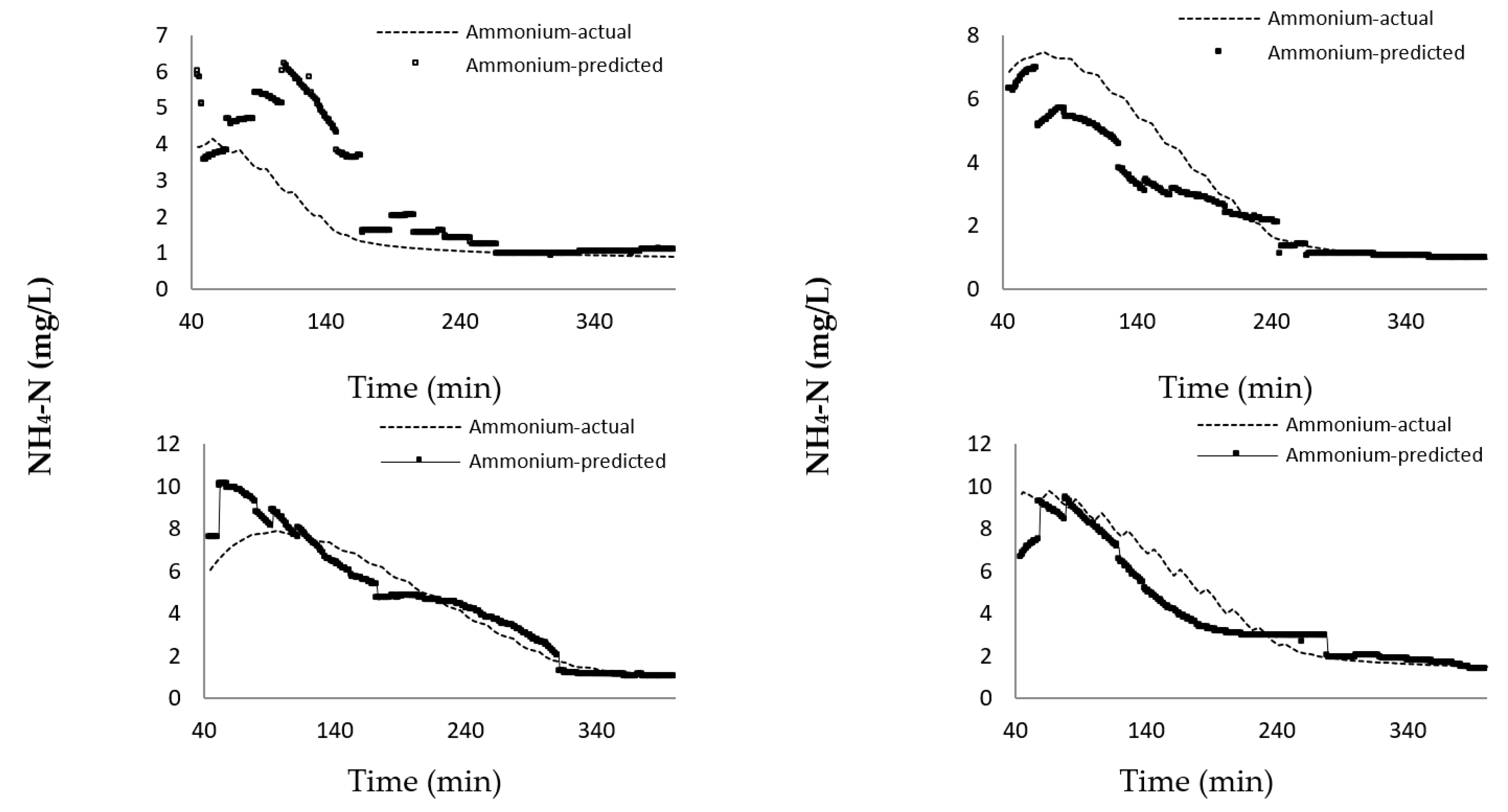

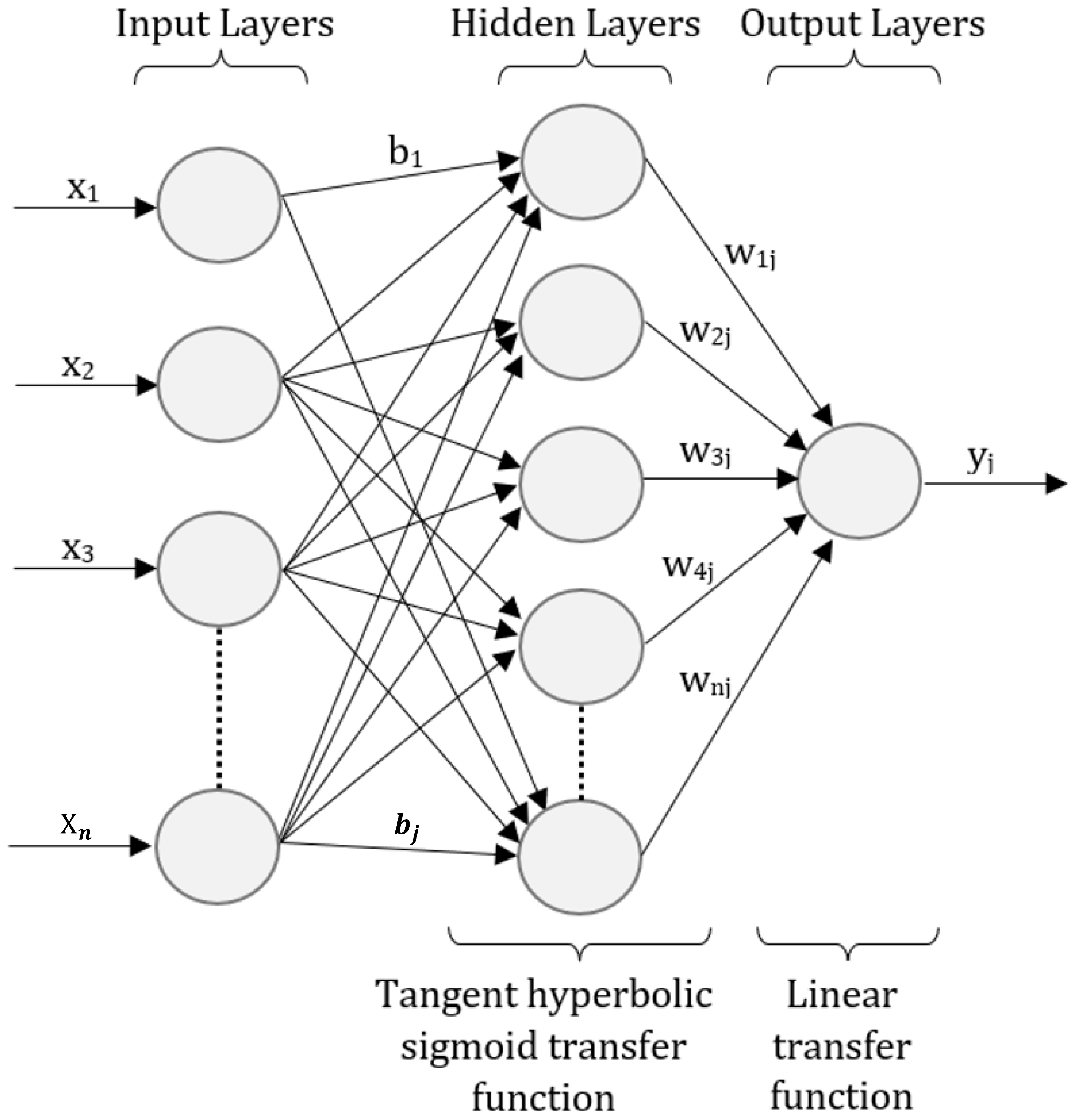
Application of Neural Networks and Regression Modelling to Enable Environmental Regulatory Compliance and Energy Optimisation in a Sequencing Batch Reactor

Abstract
1. Introduction
1.1. RTC in Wastewater Treatment Facilities
1.2. Numerical Modelling Methods
2. Materials and Methods
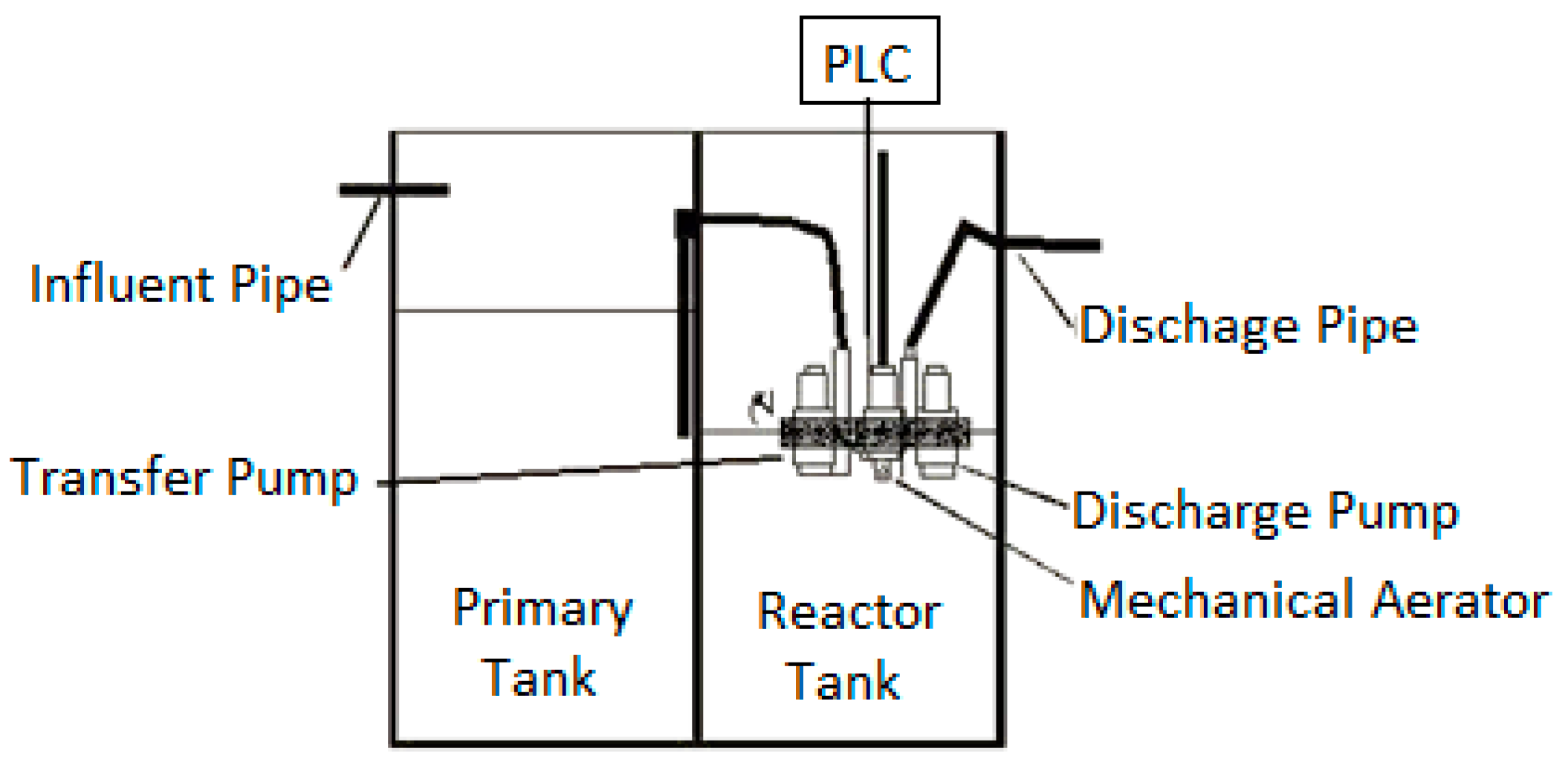
2.1. Cycle Control
2.2. Monitoring
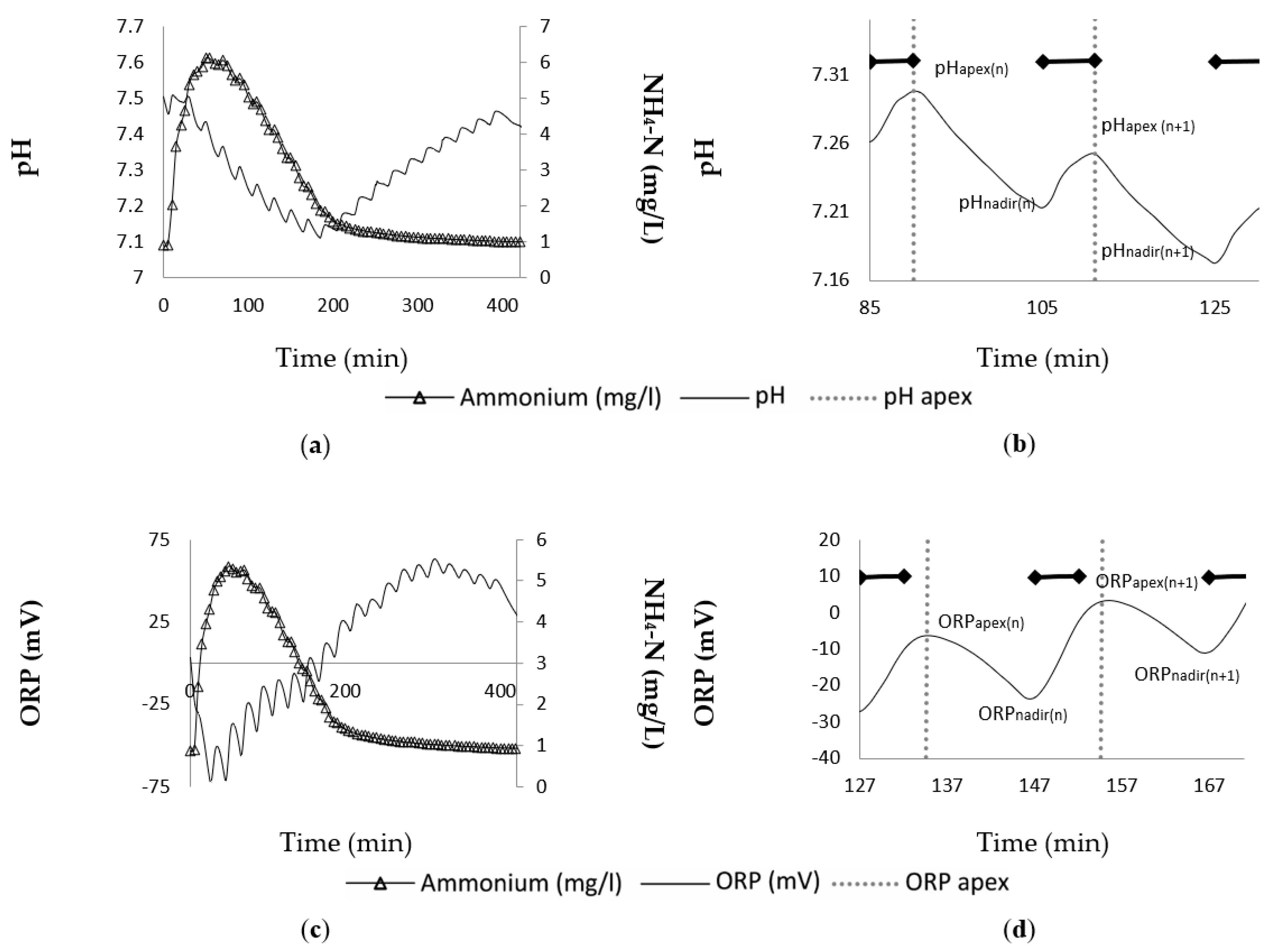
2.3. Overview of NH4-N, pH and ORP Profiles
3. Application
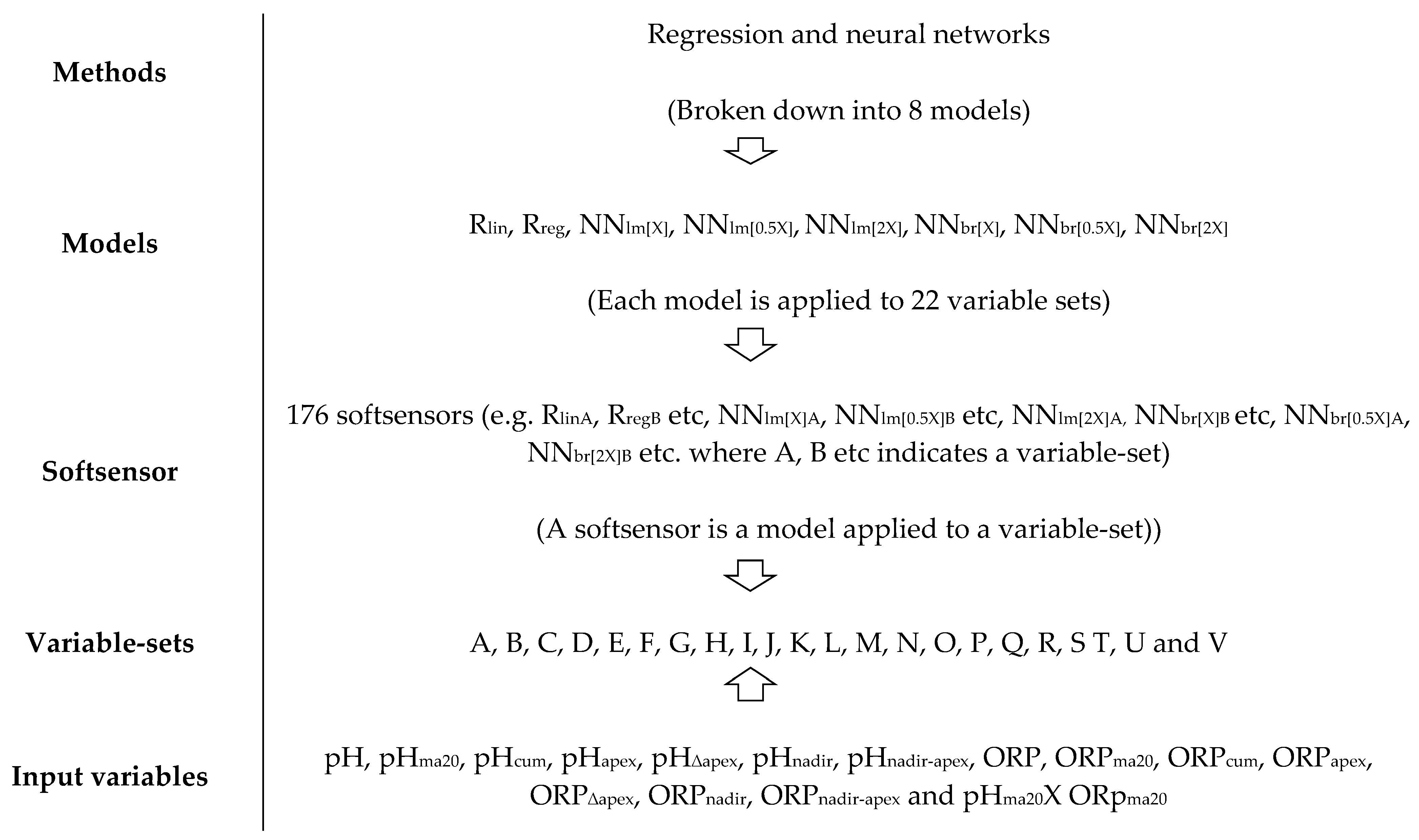
3.1. Assessed Input Variables
3.2. Models
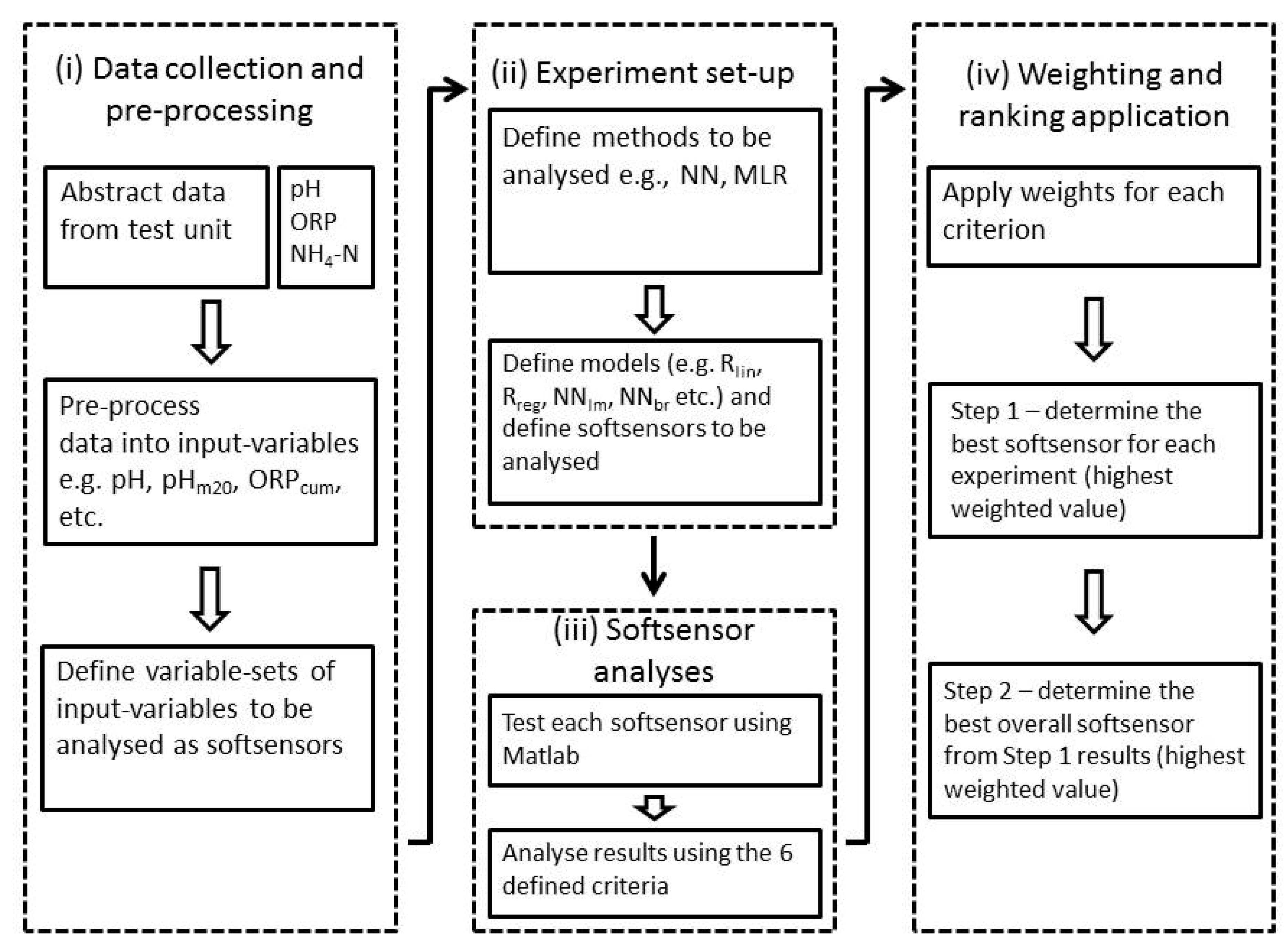
3.3. Analyses
3.4. Ranking System
3.5. Further Analyses
4. Results
4.1. Regression Results
4.2. Neural Network Results
4.3. Weighting and Ranking Results
4.4. Comparison between Methodologies Applied
5. Discussion
6. Conclusions and Outlook
Author Contributions
Funding
Institutional Review Board Statement
Informed Consent Statement
Data Availability Statement
Conflicts of Interest
Appendix A

| Soft Sensor | Average R2 in Last 200 Min | Average RMSE in Last 200 Min | Averages at 2 mg NH4-N/l Trigger | |||||
|---|---|---|---|---|---|---|---|---|
| Average R2 | Average RMSE | NH4rem (%) | Tsave (%) | aberror (mg/L) | SC | |||
| RlinA | 0.744 | 0.639 | 1.229 | 0.62 | 81 | 59 | 0.66 | 12 |
| RlinB | 0.779 | 0.515 | 1.273 | 0.506 | 86 | 58 | 0.64 | 12 |
| RlinC | 0.777 | 0.466 | 1.315 | 0.498 | 85 | 53 | 0.66 | 12 |
| RlinD | 0.777 | 0.465 | 1.313 | 0.496 | 82 | 57 | 0.99 | 11 |
| RlinE | 0.647 | 0.709 | 1.246 | 0.614 | 76 | 66 | 0.81 | 10 |
| RlinF | 0.725 | 0.554 | 1.234 | 0.55 | 77 | 60 | 0.62 | 11 |
| RlinG | 0.639 | 0.746 | 1.28 | 0.584 | 80 | 61 | 0.31 | 11 |
| RlinH | 0.773 | 0.553 | 1.32 | 0.5 | 86 | 53 | 0.58 | 12 |
| RlinI | 0.721 | 0.582 | 1.349 | 0.63 | 77 | 50 | 0.88 | 11 |
| RlinJ | 0.598 | 0.641 | 1.515 | 0.907 | 87 | 27 | 1.41 | 12 |
| RlinK | 0.765 | 0.867 | 1.498 | 0.627 | 93 | 40 | 0.82 | 12 |
| RlinL | 0.766 | 0.594 | 1.337 | 0.568 | 79 | 56 | 1.19 | 11 |
| RlinM | 0.364 | 0.397 | 1.634 | 0.949 | 97 | 14 | 1.31 | 12 |
| RlinN | 0.334 | 0.699 | 1.664 | 0.98 | 97 | 14 | 1.39 | 12 |
| RlinO | 0.351 | 0.683 | 1.776 | 0.913 | 20 | 86 | 3.67 | 5 |
| RlinP | 0.639 | 0.746 | 1.25 | 0.584 | 80 | 61 | 0.31 | 11 |
| RlinQ | 0.696 | 0.834 | 1.509 | 0.676 | 93 | 36 | 0.78 | 12 |
| RlinR | 0.779 | 0.635 | 1.32 | 0.544 | 80 | 55 | 1.17 | 11 |
| RlinS | 0.779 | 0.628 | 1.339 | 0.581 | 88 | 50 | 0.69 | 12 |
| RlinT | 0.493 | 0.742 | 1.455 | 0.604 | 62 | 69 | 1.17 | 10 |
| RlinU | 0.739 | 0.866 | 1.463 | 0.577 | 89 | 47 | 0.65 | 12 |
| RlinV | 0.78 | 0.868 | 1.399 | 0.528 | 91 | 43 | 0.75 | 12 |
| Soft Sensor | Average R2 in Last 200 Min | Average RMSE in Last 200 Min | Averages at 2 mg NH4-N/l Trigger | |||||
|---|---|---|---|---|---|---|---|---|
| Average R2 | Average RMSE | NH4rem (%) | Tsave (%) | aberror (mg/L) | SC | |||
| RregA | 0.745 | 0.633 | 1.198 | 0.581 | 82 | 59 | 61 | 12 |
| RregB | 0.714 | 0.502 | 1.233 | 0.554 | 75 | 61 | 72 | 11 |
| RregC | 0.72 | 0.492 | 1.238 | 0.559 | 77 | 60 | 68 | 11 |
| RregD | 0.727 | 0.507 | 1.232 | 0.547 | 77 | 60 | 66 | 11 |
| RregE | 0.729 | 0.544 | 1.232 | 0.546 | 77 | 59 | 65 | 11 |
| RregF | 0.762 | 0.661 | 1.195 | 0.553 | 78 | 61 | 100 | 11 |
| RregG | 0.748 | 0.521 | 1.254 | 0.504 | 83 | 55 | 50 | 12 |
| RregH | 0.79 | 0.665 | 1.226 | 0.448 | 78 | 59 | 97 | 11 |
| RregI | 0.727 | 0.507 | 1.232 | 0.547 | 78 | 60 | 61 | 11 |
| RregJ | 0.732 | 0.872 | 1.471 | 0.664 | 91 | 36 | 82 | 12 |
| RregK | 0.789 | 0.837 | 1.315 | 0.523 | 88 | 50 | 84 | 12 |
| RregL | 0.782 | 0.646 | 1.234 | 0.479 | 85 | 55 | 58 | 12 |
| RregM | 0.698 | 0.853 | 1.495 | 0.64 | 92 | 37 | 78 | 12 |
| RregN | 0.67 | 0.854 | 1.533 | 0.665 | 91 | 38 | 86 | 12 |
| RregO | 0.693 | 0.853 | 1.497 | 0.642 | 92 | 37 | 77 | 12 |
| RregP | 0.748 | 0.521 | 1.255 | 0.505 | 79 | 56 | 49 | 11 |
| RregQ | 0.791 | 0.843 | 1.358 | 0.693 | 88 | 43 | 84 | 12 |
| RregR | 0.727 | 0.534 | 1.219 | 0.563 | 84 | 55 | 56 | 12 |
| RregS | 0.741 | 0.567 | 1.263 | 0.546 | 85 | 52 | 58 | 12 |
| RregT | 0.772 | 0.866 | 1.405 | 0.524 | 93 | 43 | 74 | 12 |
| RregU | 0.822 | 0.853 | 1.321 | 0.558 | 88 | 46 | 84 | 12 |
| RregV | 0.817 | 0.869 | 1.336 | 0.551 | 87 | 47 | 87 | 12 |
| Soft Sensor | Average R2 In Last 200 Min | Average RMSE in Last 200 Min | Averages at 2 mg NH4-N/l Trigger | |||||
|---|---|---|---|---|---|---|---|---|
| Average R2 | Average RMSE | NH4rem (%) | Tsave (%) | aberror (mg/L) | SC | |||
| NNlm[X]A | 0.552 | 0.568 | 1.255 | 0.547 | 56 | 63 | 1.02 | 11 |
| NNlm[X]B | 0.546 | 0.441 | 1.347 | 0.314 | 50 | 64 | 1.62 | 10 |
| NNlm[X]C | 0.53 | 0.44 | 1.139 | 0.336 | 55 | 69 | 0.86 | 10 |
| NNlm[X]D | 0.489 | 0.273 | 1.201 | 0.429 | 55 | 65 | 1.55 | 11 |
| NNlm[X]E | 0.265 | 0.301 | 1.05 | 0.288 | 60 | 67 | 1.29 | 11 |
| NNlm[X]F | 0.512 | 0.451 | 1.055 | 0.481 | 54 | 62 | 1.80 | 11 |
| NNlm[X]G | 0.626 | 0.422 | 1.039 | 0.396 | 60 | 67 | 1.13 | 10 |
| NNlm[X]H | 0.639 | 0.555 | 1.027 | 0.372 | 56 | 70 | 2.56 | 10 |
| NNlm[X]I | 0.47 | 0.431 | 1.33 | 0.7 | 49 | 67 | 1.87 | 10 |
| NNlm[X]J | 0.42 | 0.436 | 1.698 | 0.845 | 53 | 60 | 2.85 | 11 |
| NNlm[X]K | 0.711 | 0.589 | 1.214 | 0.481 | 66 | 65 | 2.31 | 10 |
| NNlm[X]L | 0.649 | 0.642 | 0.142 | 0.548 | 65 | 65 | 6.49 | 9 |
| NNlm[X]M | 0.732 | 0.669 | 1.438 | 0.494 | 91 | 38 | 0.66 | 12 |
| NNlm[X]N | 0.705 | 0.764 | 1.379 | 0.661 | 92 | 34 | 0.95 | 12 |
| NNlm[X]O | 0.658 | 0.675 | 1.302 | 0.464 | 91 | 37 | 0.69 | 12 |
| NNlm[X]P | 0.431 | 0.509 | 1.165 | 0.439 | 52 | 62 | 1.13 | 11 |
| NNlm[X]Q | 0.514 | 0.516 | 1.165 | 0.552 | 68 | 56 | 1.08 | 11 |
| NNlm[X]R | 0.528 | 0.565 | 1.094 | 0.517 | 67 | 63 | 0.78 | 11 |
| NNlm[X]S | 0.67 | 0.248 | 1.147 | 0.583 | 67 | 65 | 0.78 | 12 |
| NNlm[X]T | 0.721 | 0.663 | 1.368 | 0.488 | 77 | 56 | 0.89 | 12 |
| NNlm[X]U | 0.539 | 0.401 | 1.084 | 0.374 | 63 | 61 | 0.63 | 12 |
| NNlm[X]V | 0.619 | 0.44 | 1.327 | 0.532 | 75 | 56 | 0.55 | 11 |
| Soft Sensor | Average R2 in Last 200 Min | Average RMSE in Last 200 Min | Averages at 2 mg NH4-N/l Trigger | |||||
|---|---|---|---|---|---|---|---|---|
| Average R2 | Average RMSE | NH4rem (%) | Tsave (%) | aberror (mg/L) | SC | |||
| NNlm[0.5X]A | 0.623 | 0.615 | 1.135 | 0.532 | 58 | 56 | 1.72 | 11.00 |
| NNlm[0.5X]B | 0.426 | 0.328 | 0.947 | 0.39 | 52 | 67 | 1.88 | 11.00 |
| NNlm[0.5X]C | 0.635 | 0.393 | 0.1093 | 0.39 | 55 | 67 | 1.56 | 11.00 |
| NNlm[0.5X]D | 0.57 | 0.439 | 0.8965 | 0.294 | 45 | 68 | 1.26 | 10.00 |
| NNlm[0.5X]E | 0.671 | 0.327 | 1.05 | 0.374 | 59 | 67 | 1.03 | 12.00 |
| NNlm[0.5X]F | 0.643 | 0.577 | 1.309 | 0.523 | 52 | 67 | 1.57 | 11.00 |
| NNlm[0.5X]G | 0.662 | 0.442 | 1.142 | 0.428 | 67 | 65 | 0.85 | 11.00 |
| NNlm[0.5X]H | 0.818 | 0.717 | 1.107 | 0.379 | 65 | 66 | 0.86 | 11.00 |
| NNlm[0.5X]I | 0.68 | 0.444 | 1.025 | 0.476 | 54 | 70 | 0.99 | 11.00 |
| NNlm[0.5X]J | 0.71 | 0.779 | 1.445 | 0.727 | 54 | 73 | 2.63 | 12.00 |
| NNlm[0.5X]K | 0.752 | 0.617 | 1.087 | 0.494 | 64 | 60 | 0.80 | 12.00 |
| NNlm[0.5X]L | 0.79 | 0.68 | 1.233 | 0.489 | 66 | 66 | 0.69 | 11.00 |
| NNlm[0.5X]M | 0.708 | 0.634 | 1.392 | 0.457 | 91 | 40 | 0.71 | 12.00 |
| NNlm[0.5X]N | 0.775 | 0.681 | 1.406 | 0.538 | 74 | 55 | 1.03 | 11.00 |
| NNlm[0.5X]O | 0.772 | 0.764 | 1.498 | 0.653 | 54 | 67 | 6.36 | 10.00 |
| NNlm[0.5X]P | 0.692 | 0.404 | 1.2 | 0.453 | 56 | 69 | 1.11 | 11.00 |
| NNlm[0.5X]Q | 0.526 | 0.283 | 1.269 | 0.523 | 37 | 74 | 1.80 | 8.00 |
| NNlm[0.5X]R | 0.672 | 0.465 | 1.044 | 0.457 | 51 | 68 | 1.73 | 10.00 |
| NNlm[0.5X]S | 0.58 | 0.26 | 1.129 | 0.619 | 53 | 71 | 1.58 | 10.00 |
| NNlm[0.5X]T | 0.72 | 0.752 | 1.377 | 0.496 | 76 | 56 | 0.97 | 12.00 |
| NNlm[0.5X]U | 0.6 | 0.547 | 1.096 | 0.43 | 61 | 69 | 1.20 | 11.00 |
| NNlm[0.5X]V | 0.775 | 0.88 | 1.113 | 0.488 | 52 | 63 | 1.15 | 11.00 |
| Soft Sensor | Average R2 in Last 200 Min | Average RMSE in Last 200 Min | Averages at 2 mg NH4-N/l Trigger | |||||
|---|---|---|---|---|---|---|---|---|
| Average R2 | Average RMSE | NH4rem (%) | Tsave (%) | aberror (mg/L) | SC | |||
| NNlm[2X]A | 0.557 | 0.438 | 1.497 | 0.877 | 58 | 56 | 1.72 | 11.00 |
| NNlm[2X]B | 0.485 | 0.145 | 1.613 | 0.904 | 52 | 67 | 1.88 | 11.00 |
| NNlm[2X]C | 0.442 | 0.445 | 1.448 | 0.613 | 55 | 67 | 1.56 | 11.00 |
| NNlm[2X]D | 0.447 | 0.245 | 1.369 | 0.542 | 45 | 68 | 1.26 | 10.00 |
| NNlm[2X]E | 0.609 | 0.376 | 1.301 | 0.499 | 59 | 67 | 1.03 | 12.00 |
| NNlm[2X]F | 0.509 | 0.385 | 1.252 | 0.55 | 52 | 67 | 1.57 | 11.00 |
| NNlm[2X]G | 0.571 | 0.491 | 1.145 | 0.446 | 67 | 65 | 0.85 | 11.00 |
| NNlm[2X]H | 0.64 | 0.555 | 1.008 | 0.416 | 65 | 66 | 0.86 | 11.00 |
| NNlm[2X]I | 0.671 | 0.387 | 1.016 | 0.478 | 54 | 70 | 0.99 | 11.00 |
| NNlm[2X]J | 0.435 | 0.38 | 2.182 | 1.3 | 54 | 73 | 2.63 | 12.00 |
| NNlm[2X]K | 0.601 | 0.653 | 1.102 | 0.441 | 64 | 60 | 0.80 | 12.00 |
| NNlm[2X]L | 0.64 | 0.433 | 1.062 | 0.47 | 66 | 66 | 0.69 | 11.00 |
| NNlm[2X]M | 0.71 | 0.702 | 1.361 | 0.62 | 91 | 40 | 0.71 | 12.00 |
| NNlm[2X]N | 0.62 | 0.631 | 2.083 | 1.254 | 74 | 55 | 1.03 | 11.00 |
| NNlm[2X]O | 0.409 | 0.594 | 4.09 | 3.405 | 54 | 67 | 6.36 | 10.00 |
| NNlm[2X]P | 0.528 | 0.42 | 1.126 | 0.381 | 56 | 69 | 1.11 | 11.00 |
| NNlm[2X]Q | 0.466 | 0.409 | 1.4 | 0.576 | 37 | 74 | 1.80 | 8.00 |
| NNlm[2X]R | 0.508 | 0.313 | 1.403 | 0.815 | 51 | 68 | 1.73 | 10.00 |
| NNlm[2X]S | 0.493 | 0.342 | 1.308 | 0.703 | 53 | 71 | 1.58 | 10.00 |
| NNlm[2X]T | 0.646 | 0.32 | 1.337 | 0.478 | 76 | 56 | 0.97 | 12.00 |
| NNlm[2X]U | 0.607 | 0.649 | 1.181 | 0.498 | 61 | 69 | 1.20 | 11.00 |
| NNlm[2X]V | 0.455 | 0.465 | 1.222 | 0.469 | 52 | 63 | 1.15 | 11.00 |
| Soft Sensor | Average R2 in Last 200 Min | Average RMSE in Last 200 Min | Averages at 2 mg NH4-N/l Trigger | |||||
|---|---|---|---|---|---|---|---|---|
| Average R2 | Average RMSE | NH4rem (%) | Tsave (%) | aberror (mg/L) | SC | |||
| NNbr[X]A | 0.46 | 0.288 | 1.368 | 0.996 | 50 | 67 | 1.32 | 12 |
| NNbr[X]B | 0.514 | 0.515 | 1.265 | 0.431 | 54 | 64 | 2.40 | 11 |
| NNbr[X]C | 0.59 | 0.378 | 1.078 | 0.341 | 61 | 68 | 1.26 | 11 |
| NNbr[X]D | 0.651 | 0.395 | 1.29 | 0.417 | 57 | 58 | 1.29 | 10 |
| NNbr[X]E | 0.529 | 0.329 | 0.999 | 0.268 | 61 | 62 | 0.86 | 11 |
| NNbr[X]F | 0.559 | 0.421 | 0.942 | 0.424 | 55 | 69 | 0.93 | 10 |
| NNbr[X]G | 0.665 | 0.667 | 1.063 | 0.407 | 63 | 66 | 1.19 | 11 |
| NNbr[X]H | 0.698 | 0.457 | 1.363 | 0.465 | 61 | 68 | 7.58 | 10 |
| NNbr[X]I | 0.588 | 0.547 | 1.089 | 0.522 | 61 | 64 | 1.96 | 10 |
| NNbr[X]J | 0.548 | 0.556 | 1.833 | 0.796 | 79 | 51 | 1.44 | 12 |
| NNbr[X]K | 0.65 | 0.679 | 1.044 | 0.443 | 64 | 66 | 0.92 | 11 |
| NNbr[X]L | 0.622 | 0.661 | 1.183 | 0.502 | 75 | 61 | 0.74 | 11 |
| NNbr[X]M | 0.762 | 0.721 | 1.392 | 0.461 | 90 | 44 | 0.79 | 12 |
| NNbr[X]N | 0.702 | 0.598 | 1.452 | 0.702 | 92 | 39 | 1.03 | 12 |
| NNbr[X]O | 0.607 | 0.286 | 1.365 | 0.578 | 89 | 46 | 0.71 | 12 |
| NNbr[X]P | 0.559 | 0.469 | 0.992 | 0.389 | 60 | 59 | 0.76 | 12 |
| NNbr[X]Q | 0.499 | 0.462 | 1.182 | 0.541 | 70 | 57 | 0.92 | 12 |
| NNbr[X]R | 0.52 | 0.484 | 1.18 | 0.5 | 57 | 67 | 0.74 | 11 |
| NNbr[X]S | 0.594 | 0.276 | 1.057 | 0.57 | 75 | 64 | 0.64 | 11 |
| NNbr[X]T | 0.715 | 0.584 | 1.327 | 0.346 | 73 | 56 | 0.60 | 11 |
| NNbr[X]U | 0.533 | 0.469 | 0.935 | 0.358 | 63 | 57 | 0.67 | 11 |
| NNbr[X]V | 0.72 | 0.638 | 1.024 | 0.395 | 68 | 66 | 1.00 | 11 |
| Soft Sensor | Average R2 in Last 200 Min | Average RMSE in Last 200 Min | Averages at 2 mg NH4-N/l Trigger | |||||
|---|---|---|---|---|---|---|---|---|
| Average R2 | Average RMSE | NH4rem (%) | Tsave (%) | aberror (mg/L) | SC | |||
| NNbr[0.5X]A | 0.54 | 0.477 | 0.975 | 0.4 | 54 | 64 | 0.68 | 10 |
| NNbr[0.5X]B | 0.542 | 0.424 | 1.009 | 0.225 | 47 | 73 | 1.17 | 9 |
| NNbr[0.5X]C | 0.595 | 0.539 | 1.188 | 0.466 | 58 | 68 | 1.48 | 11 |
| NNbr[0.5X]D | 0.682 | 0.374 | 1.042 | 0.396 | 72 | 65 | 0.84 | 11 |
| NNbr[0.5X]E | 0.562 | 0.638 | 0.946 | 0.269 | 58 | 69 | 1.04 | 11 |
| NNbr[0.5X]F | 0.59 | 0.551 | 1.07 | 0.448 | 50 | 69 | 1.85 | 10 |
| NNbr[0.5X]G | 0.642 | 0.559 | 1.064 | 0.431 | 71 | 63 | 1.01 | 11 |
| NNbr[0.5X]H | 0.815 | 0.675 | 1.124 | 0.382 | 69 | 66 | 0.85 | 11 |
| NNbr[0.5X]I | 0.593 | 0.451 | 1.244 | 0.637 | 55 | 65 | 2.03 | 10 |
| NNbr[0.5X]J | 0.713 | 0.636 | 1.523 | 0.722 | 94 | 38 | 1.04 | 12 |
| NNbr[0.5X]K | 0.778 | 0.554 | 1.092 | 0.418 | 79 | 59 | 0.86 | 12 |
| NNbr[0.5X]L | 0.732 | 0.638 | 1.198 | 0.588 | 68 | 64 | 1.18 | 11 |
| NNbr[0.5X]M | 0.717 | 0.692 | 1.367 | 0.52 | 92 | 37 | 0.75 | 12 |
| NNbr[0.5X]N | 0.787 | 0.843 | 1.356 | 0.589 | 93 | 41 | 0.79 | 12 |
| NNbr[0.5X]O | 0.775 | 0.77 | 1.45 | 0.662 | 90 | 41 | 0.94 | 12 |
| NNbr[0.5X]P | 0.622 | 0.679 | 1.033 | 0.437 | 64 | 61 | 1.02 | 11 |
| NNbr[0.5X]Q | 0.486 | 0.326 | 1.224 | 0.585 | 65 | 66 | 1.34 | 12 |
| NNbr[0.5X]R | 0.568 | 0.409 | 1.115 | 0.501 | 61 | 66 | 0.77 | 11 |
| NNbr[0.5X]S | 0.546 | 0.315 | 1.149 | 0.564 | 66 | 65 | 0.60 | 11 |
| NNbr[0.5X]T | 0.704 | 0.482 | 1.383 | 0.463 | 82 | 52 | 0.62 | 12 |
| NNbr[0.5X]U | 0.686 | 0.668 | 1.089 | 0.397 | 63 | 67 | 1.17 | 12 |
| NNbr[0.5X]V | 0.739 | 0.723 | 1.094 | 0.402 | 75 | 59 | 0.58 | 11 |
| Soft Sensor | Average R2 in Last 200 Min | Average RMSE in Last 200 Min | Averages at 2 mg NH4-N/l Trigger | |||||
|---|---|---|---|---|---|---|---|---|
| Average R2 | Average RMSE | NH4rem (%) | Tsave (%) | aberror (mg/L) | SC | |||
| NNbr[2X]A | 0.458 | 0.513 | 2.083 | 1.202 | 61 | 61 | 2.08 | 10 |
| NNbr[2X]B | 0.537 | 0.274 | 1.275 | 0.502 | 56 | 65 | 1.53 | 10 |
| NNbr[2X]C | 0.54 | 0.339 | 1.099 | 0.46 | 61 | 61 | 1.08 | 11 |
| NNbr[2X]D | 0.543 | 0.3 | 1.261 | 0.447 | 44 | 69 | 1.77 | 10 |
| NNbr[2X]E | 0.511 | 0.435 | 1.041 | 0.347 | 52 | 66 | 1.81 | 10 |
| NNbr[2X]F | 0.487 | 0.502 | 1.555 | 0.993 | 53 | 64 | 1.28 | 10 |
| NNbr[2X]G | 0.506 | 0.496 | 1.036 | 0.395 | 47 | 73 | 1.34 | 10 |
| NNbr[2X]H | 0.633 | 0.482 | 1.086 | 0.364 | 64 | 67 | 1.88 | 11 |
| NNbr[2X]I | 0.573 | 0.459 | 1.209 | 0.496 | 54 | 71 | 1.04 | 11 |
| NNbr[2X]J | 0.335 | 0.551 | 2.084 | 1.01 | 42 | 67 | 2.36 | 10 |
| NNbr[2X]K | 0.662 | 0.557 | 1.195 | 0.475 | 67 | 66 | 0.88 | 11 |
| NNbr[2X]L | 0.667 | 0.551 | 1.216 | 0.49 | 72 | 62 | 0.71 | 11 |
| NNbr[2X]M | 0.71 | 0.59 | 1.513 | 0.631 | 92 | 42 | 1.10 | 12 |
| NNbr[2X]N | 0.64 | 0.546 | 1.302 | 0.603 | 90 | 44 | 0.79 | 12 |
| NNbr[2X]O | 0.526 | 0.442 | 1.431 | 0.562 | 67 | 53 | 1.10 | 10 |
| NNbr[2X]P | 0.465 | 0.486 | 1.131 | 0.425 | 44 | 74 | 1.53 | 9 |
| NNbr[2X]Q | 0.403 | 0.409 | 1.605 | 0.923 | 49 | 70 | 1.64 | 10 |
| NNbr[2X]R | 0.462 | 0.395 | 1.437 | 0.512 | 45 | 75 | 2.64 | 9 |
| NNbr[2X]S | 0.49 | 0.307 | 1.154 | 0.644 | 52 | 69 | 0.84 | 10 |
| NNbr[2X]T | 0.629 | 0.309 | 1.374 | 0.406 | 65 | 58 | 0.86 | 11 |
| NNbr[2X]U | 0.581 | 0.769 | 0.942 | 0.196 | 88 | 67 | 0.57 | 11 |
| NNbr[2X]V | 0.643 | 0.538 | 0.981 | 0.342 | 70 | 59 | 0.49 | 11 |
| Soft Sensor | Rlin | Rreg | NNlin[X] | NNlin[0.5X] | NNlin[2X] | NNbr[X] | NNbr[0.5X] | NNbr[2X] | Sum | Rank |
|---|---|---|---|---|---|---|---|---|---|---|
| A | 13 | 16 | 11 | 6 | 7 | 1 | 15 | 3 | 72 | 16 |
| B | 17 | 5 | 6 | 2 | 1 | 3 | 7 | 6 | 47 | 20 |
| C | 16 | 4 | 16 | 5 | 10 | 10 | 4 | 14 | 79 | 15 |
| D | 10 | 11 | 5 | 4 | 8 | 5 | 17 | 5 | 65 | 18 |
| E | 9 | 15 | 13 | 20 | 13 | 14 | 13 | 8 | 105 | 11 |
| F | 15 | 1 | 4 | 14 | 9 | 7 | 2 | 7 | 59 | 19 |
| G | 19 | 21 | 12 | 16 | 20 | 11 | 12 | 13 | 124 | 4 |
| H | 22 | 6 | 8 | 19 | 19 | 2 | 21 | 11 | 108 | 9 |
| I | 5 | 14 | 2 | 10 | 15 | 4 | 1 | 15 | 66 | 17 |
| J | 3 | 8 | 1 | 7 | 4 | 6 | 6 | 1 | 36 | 22 |
| K | 11 | 13 | 6 | 8 | 22 | 17 | 16 | 19 | 112 | 8 |
| L | 6 | 22 | 3 | 18 | 21 | 19 | 5 | 20 | 114 | 6 |
| M | 2 | 10 | 21 | 21 | 18 | 20 | 19 | 16 | 127 | 3 |
| N | 4 | 3 | 15 | 13 | 12 | 8 | 18 | 18 | 91 | 12 |
| O | 1 | 12 | 22 | 9 | 3 | 13 | 10 | 10 | 80 | 14 |
| P | 19 | 20 | 9 | 17 | 16 | 15 | 8 | 9 | 113 | 7 |
| Q | 12 | 2 | 10 | 1 | 5 | 9 | 3 | 4 | 46 | 21 |
| R | 8 | 17 | 16 | 21 | 2 | 12 | 10 | 2 | 88 | 13 |
| S | 14 | 18 | 14 | 12 | 6 | 16 | 14 | 12 | 106 | 10 |
| T | 7 | 19 | 18 | 11 | 17 | 22 | 20 | 17 | 131 | 1 |
| U | 21 | 9 | 20 | 3 | 14 | 21 | 9 | 22 | 119 | 5 |
| V | 18 | 7 | 19 | 15 | 11 | 18 | 22 | 21 | 131 | 1 |
References
- Baudart, G.; Hirzel, M.; Kate, K.; Ram, P.; Shinnar, A. Lale: Consistent automated machine learning. arXiv 2020, arXiv:2007.01977. [Google Scholar]
- Brasil, J.; Macedo, M.; Lago, C.; Oliveira, T.; Júnior, M.; Oliveira, T.; Mendiondo, E. Nature-based solutions and real-time control: Challenges and opportunities. Water 2021, 13, 651. [Google Scholar] [CrossRef]
- Hashim, H.; Ryan, P.; Clifford, E. A statistically based fault detection and diagnosis approach for non-residential building water distribution systems. Adv. Eng. Inform. 2020, 46, 101187. [Google Scholar] [CrossRef]
- Icke, O.; van Es, D.M.; de Koning, M.F.; Wuister, J.J.; Ng, J.; Phua, K.M.; Koh, Y.K.; Chan, W.J.; Tao, G. Performance improvement of wastewater treatment processes by application of machine learning. Water Sci. Technol. 2020, 82, 2671–2680. [Google Scholar] [CrossRef] [PubMed]
- Yang, C.; Zhang, Y.; Huang, M.; Liu, H. Adaptive dynamic prediction of effluent quality in wastewater treatment processes using partial least squares embedded with relevance vector machine. J. Clean. Prod. 2021, 314, 128076. [Google Scholar] [CrossRef]
- Keshavarzi Arshadi, A.; Webb, J.; Salem, M.; Cruz, E.; Calad-Thomson, S.; Ghadirian, N.; Collins, J.; Diez-Cecilia, E.; Kelly, B.; Goodarzi, H.; et al. Artificial Intelligence for COVID-19 Drug Discovery and Vaccine Development. Front. Artif. Intell. 2020, 3, 65. [Google Scholar] [CrossRef]
- Lapuschkin, S.; Wäldchen, S.; Binder, A.; Montavon, G.; Samek, W.; Müller, K.-R. Unmasking Clever Hans predictors and assessing what machines really learn. Nat. Commun. 2019, 10, 1096. [Google Scholar] [CrossRef]
- Ong, E.; Wong, M.U.; Huffman, A.; He, Y. COVID-19 Coronavirus Vaccine Design Using Reverse Vaccinology and Machine Learning. Front. Immunol. 2020, 11, 1581. [Google Scholar] [CrossRef]
- Chen, C.L.P.; Zhang, C.-Y. Data-intensive applications, challenges, techniques and technologies: A survey on Big Data. Inf. Sci. 2014, 275, 314–347. [Google Scholar] [CrossRef]
- Ridzuan, N.H.A.M.; Marwan, N.F.; Khalid, N.; Ali, M.H.; Tseng, M.L. Effects of Agriculture, Renewable Energy, and Economic Growth on Carbon Dioxide Emissions: Evidence of the Environmental Kuznets Curve. Resour. Conserv. Recycl. 2020, 160, 104879. [Google Scholar] [CrossRef]
- Khan, S.A.; Ponce, P.; Yu, Z.; Golpîra, H.; Mathew, M. Environmental Technology and Wastewater Treatment: Strategies to Achieve Environmental Sustainability. Chemosphere 2022, 286, 131532. [Google Scholar] [CrossRef] [PubMed]
- Zuccarello, P.; Manganelli, M.; Conti, G.O.; Copat, C.; Grasso, A.; Cristaldi, A.; De Angelis, G.; Testai, E.; Stefanelli, M.; Vichi, S.; et al. Water Quality and Human Health: A Simple Monitoring Model of Toxic Cyanobacteria Growth in Highly Variable Mediterranean Hot Dry Environments. Environ. Res. 2021, 192, 110291. [Google Scholar] [CrossRef]
- Luccarini, L.; Bragadin, G.L.; Colombini, G.; Mancini, M.; Mello, P.; Montali, M.; Sottara, D. Formal verification of wastewater treatment processes using events detected from continuous signals by means of artificial neural networks. Case study: SBR plant. Environ. Model. Softw. Environ. Data News 2010, 25, 648–660. [Google Scholar] [CrossRef]
- Torregrossa, D.; Castellet-Viciano, L.; Hernández-Sancho, F. A data analysis approach to evaluate the impact of the capacity utilization on the energy consumption of wastewater treatment plants. Sustain. Cities Soc. 2019, 45, 307–313. [Google Scholar] [CrossRef]
- Vives Fàbregas, M.T. SBR Technology for Wastewater Treatment: Suitable Operational Conditions for a Nutrient Removal; Universitat de Girona: Girona, Spain, 2004. [Google Scholar]
- Bernardelli, A.; Marsili-Libelli, S.; Manzini, A.; Stancari, S.; Tardini, G.; Montanari, D.; Anceschi, G.; Gelli, P.; Venier, S. Real-time model predictive control of a wastewater treatment plant based on machine learning. Water Sci. Technol. 2020, 81, 2391–2400. [Google Scholar] [CrossRef]
- Fox, S.; Cahill, M.; O’Reilly, E.; Clifford, E. Decentralized wastewater treatment using ‘pumped flow biofilm reactor’ (PFBR) technology. Water Pract. Technol. 2016, 11, 93–103. [Google Scholar] [CrossRef]
- Norton, J.W. Decentralized Systems. Water Environ. Res. 2009, 81, 1440–1450. [Google Scholar] [CrossRef]
- Di Cicco, M.R.; Masiello, A.; Spagnuolo, A.; Vetromile, C.; Borea, L.; Giannella, G.; Iovinella, M.; Lubritto, C. Real-Time Monitoring and Static Data Analysis to Assess Energetic and Environmental Performances in the Wastewater Sector: A Case Study. Energies 2021, 14, 6948. [Google Scholar] [CrossRef]
- Ashagre, B.B.; Fu, G.; Butler, D. Automation and real-time control of urban wastewater systems: A review of the move towards sustainability: Journal of Water Supply. Res. Technol.-Aqua 2020, 69, 751–768. [Google Scholar]
- Aguado, D.; Ribes, J.; Montoya, T.; Ferrer, J.; Seco, A. A methodology for sequencing batch reactor identification with artificial neural networks: A case study. Comput. Chem. Eng. 2009, 33, 465–472. [Google Scholar] [CrossRef]
- Haimi, H.; Mulas, M.; Corona, F.; Vahala, R. Data-derived soft-sensors for biological wastewater treatment plants: An overview. Environ. Model. Softw. Environ. Data News 2013, 47, 88–107. [Google Scholar] [CrossRef]
- Huang, M.; Ma, Y.; Wan, J.; Chen, X. A sensor-software based on a genetic algorithm-based neural fuzzy system for modeling and simulating a wastewater treatment process. Appl. Soft Comput. 2015, 27, 1–10. [Google Scholar] [CrossRef]
- Huang, M.-z.; Wan, J.-q.; Ma, Y.-w.; Li, W.-j.; Sun, X.-f.; Wang, Y. A fast predicting neural fuzzy model for on-line estimation of nutrient dynamics in an anoxic/oxic process. Bioresour. Technol. 2010, 101, 1642–1651. [Google Scholar] [CrossRef] [PubMed]
- Akın, B.S.; Ugurlu, A. Monitoring and control of biological nutrient removal in a Sequencing Batch Reactor. Process Biochem. 2005, 40, 2873–2878. [Google Scholar] [CrossRef]
- Ga, C.H.; Ra, C.S. Real-time control of oxic phase using pH (mV)-time profile in swine wastewater treatment. J. Hazard. Mater. 2009, 172, 61–67. [Google Scholar] [CrossRef]
- Guo, H.J.; Peng, Y.Z.; Wang, S.Y.; Zheng, Y.N.; Huang, H.J.; Ge, S.J. Effective and robust partial nitrification to nitrite by real-time aeration duration control in an SBR treating domestic wastewater. Process Biochem. 2009, 44, 979–985. [Google Scholar] [CrossRef]
- Tanwar, P.; Nandy, T.; Ukey, P.; Manekar, P. Correlating on-line monitoring parameters, pH, DO and ORP with nutrient removal in an intermittent cyclic process bioreactor system. Bioresour. Technol. 2008, 99, 7630–7635. [Google Scholar] [CrossRef]
- Won, S.G.; Ra, C.S. Biological nitrogen removal with a real-time control strategy using moving slope changes of pH(mV)- and ORP-time profiles. Water Res. 2011, 45, 171–178. [Google Scholar] [CrossRef]
- De Canete, J.F.; del Saz-Orozco, P.; Baratti, R.; Mulas, M.; Ruano, A.; Garcia-Cerezo, A. Soft-sensing estimation of plant effluent concentrations in a biological wastewater treatment plant using an optimal neural network. Expert Syst. Appl. 2016, 63, 8–19. [Google Scholar] [CrossRef]
- Kim, H.; Hao, O.J. pH and Oxidation-Reduction Potential Control Strategy for Optimization of Nitrogen Removal in an Alternating Aerobic-Anoxic System. Water Environ. Res. 2001, 73, 95–102. [Google Scholar] [CrossRef]
- Luccarini, L.; Porrà, E.; Spagni, A.; Ratini, P.; Grilli, S.; Longhi, S.; Bortone, G. Soft sensors for control of nitrogen and phosphorus removal from wastewaters by neural networks. Water Sci. Technol. 2002, 45, 101–107. [Google Scholar] [CrossRef] [PubMed]
- Li, J.; Ni, Y.; Peng, Y.; Guowei, G.; Jingen, L.; Su, W.; Guobiao, C.; Changjin, O. On-line controlling system for nitrogen and phosphorus removal of municipal wastewater in a sequencing batch reactor (SBR). Front. Environ. Sci. Eng. 2008, 2, 99–102. [Google Scholar] [CrossRef]
- Villez, K.; Sin, G.; Vanrolleghem, P.A.; Ruiz, M.; Colomer, J.; Rosén, C.; Vanrolleghem, P.A. Combining multiway principal component analysis (MPCA) and clustering for efficient data mining of historical data sets of SBR processes. Water Sci Technol. 2008, 57, 1659–1666. [Google Scholar] [CrossRef] [PubMed][Green Version]
- Yang, Q.; Gu, S.; Peng, Y.; Wang, S.; Liu, X. Progress in the Development of Control Strategies for the SBR Process. Clean Soil Air Water 2010, 38, 732–749. [Google Scholar] [CrossRef]
- Khataee, A.; Kasiri, M. Modeling of Biological Water and Wastewater Treatment Processes Using Artificial Neural Networks. CLEAN–Soil Air Water 2011, 39, 742–749. [Google Scholar] [CrossRef]
- Kocijan, J.; Hvala, N. Sequencing batch-reactor control using Gaussian-process models. Bioresour. Technol. 2013, 137, 340–348. [Google Scholar] [CrossRef]
- Puig, S.; Corominas, L.; Adama, T.; Colomer; Balaguer, M.; Colprim, J. An On-line Optimisation of a SBR Cycle for Carbon and Nitrogen Removal Based on On-line pH and OUR: The Role of Dissolved Oxygen Control. Water Sci. Technol. 2006, 53, 171–178. [Google Scholar] [CrossRef][Green Version]
- Hong, S.H.; Lee, M.W.; Lee, D.S.; Park, J.M. Monitoring of sequencing batch reactor for nitrogen and phosphorus removal using neural networks. Biochem. Eng. J. 2007, 35, 365–370. [Google Scholar] [CrossRef]
- Casellas, M.; Dagot, C.; Baudu, M. Set up and assessment of a control strategy in a SBR in order to enhance nitrogen and phosphorus removal. Process Biochem. 2006, 41, 1994–2001. [Google Scholar] [CrossRef]
- Mingzhi, H.; Jinquan, W.; Yongwen, M.; Yan, W.; Weijiang, L.; Xiaofei, S. Control rules of aeration in a submerged biofilm wastewater treatment process using fuzzy neural networks. Expert Syst. Appl. 2009, 36, 10428–10437. [Google Scholar] [CrossRef]
- Han, H.-G.; Li, Y.; Guo, Y.-N.; Qiao, J.-F. A soft computing method to predict sludge volume index based on a recurrent self-organizing neural network. Appl. Soft Comput. 2016, 38, 477–486. [Google Scholar] [CrossRef]
- Li, F.; Qiao, J.; Han, H.; Yang, C. A self-organizing cascade neural network with random weights for nonlinear system modeling. Appl. Soft Comput. 2016, 42, 184–193. [Google Scholar] [CrossRef]
- Syafiie, S.; Tadeo, F.; Martinez, E.; Alvarez, T. Model-free control based on reinforcement learning for a wastewater treatment problem. Appl. Soft Comput. 2011, 11, 73–82. [Google Scholar] [CrossRef]
- Wan, J.; Huang, M.; Ma, Y.; Guo, W.; Wang, Y.; Zhang, H.; Li, W.; Sun, X. Prediction of effluent quality of a paper mill wastewater treatment using an adaptive network-based fuzzy inference system. Appl. Soft Comput. 2011, 11, 3238–3246. [Google Scholar] [CrossRef]
- Foscoliano, C.; Del Vigo, S.; Mulas, M.; Tronci, S. Predictive control of an activated sludge process for long term operation. Chem. Eng. J. 2006, 304, 1031–1044. [Google Scholar] [CrossRef]
- Mulas, M.; Corona, F.; Sirviö, J.; Hyvönen, S.; Vahala, R. Full-scale implementation of an advanced control system on a biological wastewater treatment plant. IFAC-Pap. 2016, 49, 1163–1168. [Google Scholar] [CrossRef]
- James, G.; Witten, D.; Hastie, T.; Tibshirani, R. An Introduction to Statistical Learning; Springer: New York, NY, USA, 2013; Volume 112. [Google Scholar]
- Souza, F.A.A.; Araújo, R.; Mendes, J. Review of soft sensor methods for regression applications. Chemom. Intell. Lab. Syst. 2016, 152, 69–79. [Google Scholar] [CrossRef]
- Abyaneh, H.Z. Evaluation of multivariate linear regression and artificial neural networks in prediction of water quality parameters. J. Environ. Health Sci. Eng. 2014, 12, 40. [Google Scholar] [CrossRef]
- Nasr, M.S.; Moustafa, M.A.E.; Seif, H.A.E.; El Kobrosy, G. Application of Artificial Neural Network (ANN) for the prediction of EL-AGAMY wastewater treatment plant performance-EGYPT. Alex. Eng. J. 2012, 51, 37–43. [Google Scholar] [CrossRef]
- Arslan, O.; Yetik, O. ANN based optimization of supercritical ORC-Binary geothermal power plant: Simav case study. Appl. Therm. Eng. 2011, 31, 3922–3928. [Google Scholar] [CrossRef]
- Hagan, M.T.; Menhaj, M.B. Training feedforward networks with the Marquardt algorithm. IEEE Trans. Neural Netw. 1994, 5, 989–993. [Google Scholar] [CrossRef] [PubMed]
- Nawi, N.M.; Khan, A.; Rehman, M.Z. CSLM: Levenberg marquardt based back propagation algorithm optimized with cuckoo search. J. ICT Res. Appl. 2013, 7, 103–116. [Google Scholar] [CrossRef]
- Rahimi-Ajdadi, F.; Abbaspour-Gilandeh, Y. Artificial Neural Network and stepwise multiple range regression methods for prediction of tractor fuel consumption. Meas. J. Int. Meas. Confed. 2011, 44, 2104–2111. [Google Scholar] [CrossRef]
- Wagh, V.; Panaskar, D.; Muley, A.; Mukate, S.; Gaikwad, S. Neural network modelling for nitrate concentration in groundwater of Kadava River basin, Nashik, Maharashtra, India. Groundw. Sustain. Dev. 2018, 7, 436–445. [Google Scholar] [CrossRef]
- Dan Foresee, F.; Hagan, M.T. Gauss-Newton approximation to Bayesian learning. In Proceedings of the International Conference on Neural Networks (ICNN’97), Houston, TX, USA, 12 June 1997; Volume 3, pp. 1930–1935. [Google Scholar]
- MacKay, D.J.C. Bayesian interpolation. Neural Comput. 1992, 4, 415–447. [Google Scholar] [CrossRef]
- Sharma, A.K.; Sharma, R.K.; Kasana, H.S. Prediction of first lactation 305-day milk yield in Karan Fries dairy cattle using ANN modeling. Appl. Soft Comput. 2007, 7, 1112–1120. [Google Scholar] [CrossRef]
- Tien Bui, D.; Pradhan, B.; Lofman, O.; Revhaug, I.; Dick, O.B. Landslide susceptibility assessment in the Hoa Binh province of Vietnam: A comparison of the Levenberg–Marquardt and Bayesian regularized neural networks. Geomorphology 2012, 171–172, 12–29. [Google Scholar] [CrossRef]
- CEN 12566-3; Small Wastewater Treatment Systems for up to 50 PT—Part 3: Packaged and/or Site Assembled Domestic Wastewater Treatment Plants. National Standards Authority of Ireland: Dublin, Ireland, 2006; pp. 1–34.
- Federation, Water Environmental; Aph Association. Standard Methods for the Examination of Water and Wastewater; Port City Press: Baltimore, MD, USA, 2005. [Google Scholar]
- Chang, C.H.; Hao, O.J. Sequencing Batch Reactor System for Nutrient Removal: ORP and pH Profiles. J. Chem. Technol. Biotechnol. Int. Res. Process Environ. AND Clean Technol. 1996, 67, 27–38. [Google Scholar] [CrossRef]
- Holman, J.B. The Application of pH and ORP Process Control Parameters within the Aerobic Denitrification Process. Ph.D. Thesis, University of Canterbury, Christchurch, New Zealand, 2004. [Google Scholar]
- Bishop, C.M. Neural Networks for Pattern Recognition; Oxford University Press: Oxford, UK, 1995; ISBN 978-0198538646. [Google Scholar]
- Hossain, S.Z.; Sultana, N.; Jassim, M.S.; Coskuner, G.; Hazin, L.M.; Razzak, S.A.; Hossain, M.M. Soft-Computing Modeling and Multiresponse Optimization for Nutrient Removal Process from Municipal Wastewater Using Microalgae. J. Water Process Eng. 2022, 45, 102490. [Google Scholar] [CrossRef]




| Objectives | Control Methodology | Influent Type | Study Type | References |
|---|---|---|---|---|
| Advanced RTC Methodologies | ||||
| Strategy proposal for SBR optimisation using pH, ORP and DO profiles and fuzzy clustering algorithms for detecting critical process transitions | Fuzzy clustering with wavelet de-noising | Synthetic wastewater | Strategy examined using data collected from a pilot-scale SBR reactor | [16] |
| Investigation into the use of pH, ORP and DO sensors with an advanced control strategy to optimise nitrogen removal in a continuous system | Fuzzy logic | Urban wastewater with a small industrial input | Pilot-scale continuous flow plant | [31] |
| Development of an RTC strategy using artificial NNs with ORP and pH sensors for optimised nitrogen removal and phosphorus uptake | Artificial NNs | Synthetic wastewater | Laboratory-scale continuous flow SBR reactor | [28] |
| Examination of using NNs for predicting biological nitrogen and phosphorus removal using ORP and pH | NNs | Synthetic wastewater | Laboratory-scale SBR reactor | [32] |
| Examination of the establishment of an online controlling system for nitrogen and phosphorus removal. | A primary professional intelligent control filtered noise by filtration wave and used NNs, database and deducing machine to identify each breakpoint. | Municipal Wastewater | Laboratory-scale SBR reactor | [33] |
| Methodology development for process monitoring and process analysis for nitrogen and phosphorus removal | Use of multi-way principal component analysis (MPCA) and clustering using historical process data | Domestic strength Synthetic wastewater | Pilot-scale SBR reactor | [34] |
| Validation study to assess the ability of an algorithm using networks to detect breakpoints using pH, ORP and DO sensors | NNs, de-noising was achieved using a regularisation algorithm | Municipal wastewater | Pilot-scale SBR reactor | [13] |
| Examination of using a software sensor for real-time estimation of nutrient concentration using pH, ORP and DO sensors | Fuzzy NN analysis | Synthetic wastewater | Bench-scale SBR reactor | [23] |
| Examination of using a software sensor for real-time estimation of nutrient concentration using pH, ORP and DO sensors | Genetic algorithm-based neural fuzzy system, using self-adapting fuzzy c-means clustering and genetic algorithms | Synthetic wastewater | Laboratory-scale SBR reactor | [24] |
| Examination of an intelligent control system to achieve advanced nitrogen removal using DO, pH and ORP sensors. | Three-layer network technology with high-performance PLCs and fuzzy control for break point identification | Municipal wastewater | Pilot-scale SBR reactor | [35] |
| Review article on the general use of artificial NNSAT modelling biological water and wastewater treatment processes | Artificial NNs | Several types | Several types | [36] |
| Examination of the use of a Gaussian-process (GP) model for the online optimisation of batch phases using pH, ORP and DO sensors. | GP regression was used to smooth the signals and GP classification was used for pattern recognition | Not specified | Laboratory-scale SBR reactor | [37] |
| Examination of the optimisation of a fuzzy logic controlled DO SBR system using pH and OUR trends for carbon and NH4-N removal | Fuzzy control was used to switch on and off DO input, in order to smooth out pH and OUR profiles. The breaking point was identified using episode representation | Urban wastewater | Pilot-scale SBR reactor | [38] |
| Examination of a methodology to develop a soft sensor monitoring of an SBR for enhanced biological phosphorus removal. | Artificial NNs | Synthetic wastewater | Laboratory-scale SBR reactor | [21] |
| Examination of a soft sensor for the optimisation of an SBR for biological nutrient removal | NNs | Synthetic wastewater | Laboratory-scale SBR reactor | [39] |
| Development of a control strategy to enhance nitrogen and phosphorus removal in an SBR reactor using pH, ORP and OUR | Use of a data acquisition system with curve fitting and characteristic point detection | Municipal wastewater | Semi industrial pilot SBR reactor | [40] |
| Development of a reliable RTC and supervision tool for DO control | Fuzzy NNs | Industrial wastewater | Aerated submerged biofilm wastewater treatment process | [41] |
| Development of a soft computing method to predict sludge volume index (SVI) values in a real WWTP | Recurrent self-organising NN | Municipal WWTP | Model based on SBR WWTP | [42] |
| Examination applies a self-organising cascade neural network (SCNN) with random weights to a non-linear system | Cascade NNs | Municipal WWTP | Model based on municipal WWTP | [43] |
| Proposal using a model-free learning control (MFLC) system to control advanced oxidation in the treatment of industrial wastewaters | Reinforcement learning | Phenol wastewater | Laboratory pilot plant | [44] |
| Development of a model for predicting TSS and chemical oxygen demand removal | Fuzzy inference system with principal control analysis | Papermill process wastewater | Papermill WWTP with an anaerobic digester and submerged biofilm biological reactor | [45] |
| Identifying model to predict effluent nitrogen concentrations and assessment of controller efficiency in terms of economic and environmental performances | Recurrent NNs for model identification and dynamic matrix control as predictive control (PC) algorithm and Benchmark Simulation Model 1 to test these PC configurations | Biological wastewater | Activated sludge process of a municipal WWTP | [46] |
| Development of soft sensor to predict effluent concentrations such as COD, TSS and TN content | NN with principal component analysis | Biological wastewater | Activated sludge process of large-scale municipal WWTP | [30] |
| Time of Day | % of Total Volume | Volume (Litres) | Time of Day | % of Total Volume | Volume (Litres) |
|---|---|---|---|---|---|
| 0:00–6:00 | 0 | 0 | 15:00–16:00 | 0 | 0 |
| 6:00–7:00 | 10 | 60 | 16:00–17:00 | 0 | 0 |
| 7:00–8:00 | 10 | 60 | 17:00–18:00 | 0 | 0 |
| 8:00–9:00 | 10 | 60 | 18:00–19:00 | 20 | 120 |
| 9:00–10:00 | 5 | 30 | 19:00–20:00 | 20 | 120 |
| 10:00–11:00 | 5 | 30 | 20:00–21:00 | 5 | 30 |
| 11:00–12:00 | 5 | 30 | 21:00–22:00 | 5 | 30 |
| 12:00–13:00 | 0 | 0 | 22:00–23:00 | 5 | 30 |
| 13:00–14:00 | 0 | 0 | 23:00–0:00 | 0 | 0 |
| 14:00–15:00 | 0 | 0 |
| Phase (Step) | Operation | Description | Illustration |
|---|---|---|---|
| Fill (1) | Pump: A-On | The pump was switched on for 5 s, subsequently creating a siphon that moved liquid from the primary chamber into the reaction chamber. Siphoning terminated when the liquid level in the primary chamber went below the inlet level of the feed pipe or the liquid level or once the two chambers had equalised. |  |
| Aerobic—Repeated for 400 min (2) | (a) Aeration: B-On | The aeration period consisted of a”repetitive sequence of (a) aeration on for 5 min and (b) off for 15 min. |  |
| (b) Rest | 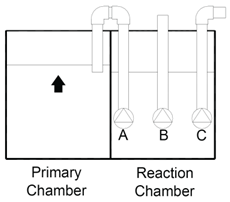 | ||
| (3) | Settle | A settle time allowed an activated sludge settle prior to discharge creating an upper layer of clarified treated wastewater. |  |
| (4) | Discharge: C-On | The discharge pump I is used to remove the clarified treated wastewater from the upper portion of the reactor tank. |  |
| Symbol Definition | Pump On  ; Pump Off ; Pump Off  | ||
| Legend | A—transfer pump, B—mechanical aerator, C—discharge pump | ||
| Input Variable | Description |
|---|---|
| pH | Raw pH data |
| pHma20 | Moving average of pH over the previous 20 min of data (i.e., 1 aeration block; Section 2.1) |
| pHcum | Cumulative sum of pH data over the duration of the cycle |
| pHapex | pH apex values during each aeration period |
| pH∆apex | Change in sequential pH apex values over a treatment cycle |
| pHnadir | pH nadir values during each aeration period |
| pHnadir-apex | pH nadir value minus pH apex value for each aeration period |
| ORP | Raw ORP data |
| ORPma20 | Moving average of ORP over the previous 20 min of data |
| ORPcum | Cumulative sum of ORP data over the duration of the cycle |
| ORPapex | ORP apex values during each aeration period |
| ORP∆apex | Change in sequential ORP apex values over a treatment cycle |
| ORPnadir | ORP nadir values during each aeration period |
| ORPnadir-apex | ORP nadir value minus ORP apex value for each aeration period |
| pHma20XORPma20 | pHma20 input variable multiplied by the ORPma20 input variable |
| Variable Sets | Input Variables | ||||||||||||||
|---|---|---|---|---|---|---|---|---|---|---|---|---|---|---|---|
| pH | pHma20 | pHcum | pHapex | pH∆apex | pHnadir | pHnadir-apex | ORP | ORPma20 | ORPcum | ORPapex | ORP∆apex | ORPnadir | ORPnadir-apex | pHma20.ORPma20 | |
| A | X | X | X | X | X | X | X | X | X | X | X | X | X | X | X |
| B | X | X | X | X | X | X | X | X | X | X | X | X | X | ||
| C | X | X | X | X | X | X | X | X | X | X | X | ||||
| D | X | X | X | X | X | X | X | X | X | X | |||||
| E | X | X | X | X | X | X | X | X | |||||||
| F | X | X | X | X | X | X | X | X | X | ||||||
| G | X | X | X | X | X | ||||||||||
| H | X | X | X | ||||||||||||
| I | X | X | X | X | X | X | |||||||||
| J | X | X | X | X | X | ||||||||||
| K | X | X | |||||||||||||
| L | X | X | |||||||||||||
| M | X | X | |||||||||||||
| N | X | X | |||||||||||||
| O | X | X | X | ||||||||||||
| P | X | X | X | X | |||||||||||
| Q | X | X | X | X | |||||||||||
| R | X | X | X | X | |||||||||||
| S | X | X | X | X | |||||||||||
| T | X | X | |||||||||||||
| U | X | X | X | X | |||||||||||
| V | X | X | |||||||||||||
| Criterion | Description | Practical Application |
|---|---|---|
| Category A | ||
| Criterion 1A: R2 | Referred to as the coefficient of determination, it is an indicator of the strength of the relationship between variables. 0 indicates a poor relationship, while 1 indicates a very close relationship. | Measures the strength of the relationship between predicted NH4-N trend and actual NH4-N trend |
| Criterion 2A: RMSE | Root mean square error (RMSE) is a standard statistical metric to measure model performance; it measures the difference between sample and predictor values and is a good measure of accuracy. The lower the RMSE value the more accurate the prediction. | Measures the average accuracy of the predicted NH4-N trend against the actual NH4-N trend |
| Category B | ||
| Criterion 1B: Percentage of NH4-N removal (NH4rem(%)) | This criterion returns the percentage NH4-N removal from the peak NH4-N (NH4 peak) concentration (during any given cycle) from a model controlled cycleto the actual NH4-N concentration achieved on-site in a full (non-controlled) treatment cycle (NH4 final). The higher the NH4rem value the better the soft sensor. where NH4rem is the percentage of potential NH4-N removal achieved, NH4 thres is the actual NH4-N concentration where the cycle was terminated by the selected cut-off threshold (mg NH4-N/l), NH4 final is the final NH4-N concentration at the end of a full cycle (mg NH4-N/l) and NH4 peak is the highest NH4-N concentration. NH4 thres could be related to an ammonium discharge limit at a given site. | Provides a comparison of the NH4-N concentration at which the cycle would have been ended by the model during a controlled cycle and the actual final NH4-N concentration at the end of a non-controlled cycle |
| Criterion 2B: Percentage of time saved (Tsave) | This criterion returns the time saved (as a percentage of a non-controlled cycle) by the soft sensor in question, at the selected cut-off threshold value, when compared to the full treatment cycle (and expressed as a percentage). The higher the Tsave value, the better the soft sensor. where Tsave is the time saving (%), Tthres is the time at which the cycle would be ended by the model in a controlled scenario and Tfixed is the fixed time cycle length (min) set in an uncontrolled scenario. | Indicates the time saved with the selected cut-off threshold value. For example, the model might be asked to terminate the treatment cycle when NH4-N concentrations are predicted to reach a certain concentration (e.g., a discharge limit concentration). In general, the greater the time saved, the better, as in practice it increases system capacity |
| Criterion 3B: Number of successful cycles (SC) | During the application of the soft sensors, it was noticed that some soft sensors may end a treatment cycle very early due to the addition and subsequent mixing of influent at the start of a treatment cycle. This can influence pH and ORP trends temporarily and cause cycles to be ended at an early stage (often prior to the new influent beign completely missed with existing wastewater in the system). Where a cycle was ended before NH4 peak occurred, a soft sensor was deemed unsuccessful for that cycle. | Allows for elimination of soft sensors that would end cycles too early |
| Criterion 4B: Absolute error (Aberror) | This criterion assessed the accuracy of the soft sensor in meeting a specific threshold concentration for effluent NH4-N discharges. | Indicates the accuracy of each soft sensor at the cut-off threshold value |
| Criterion | Weight | Comments |
|---|---|---|
| Aberror | 10 | Aberror indicates the accuracy of the soft sensor at the selected cut-off threshold value. Important as facilities must achieve regulatory compliance |
| RMSE | 5 | RMSE indicates the accuracy of the soft sensor when estimating the concentration over a cycle |
| NH4rem | 4 | Provides an indication of the NH4-N removal performance of the soft sensor |
| R2 | 3 | Indicates how well the predicted NH4-N trend matches the actual trend |
| Tsave | 2 | Indicates the time saving and energy savings of the soft sensor |
| SC | 1 | Least important as low SC values indicate more cycles will finish earlier than they should |
| Parameter | Average Influent | Influent st.dev. | Average Effluent | Influent st.dev. | % Removal | n Inf/Eff |
|---|---|---|---|---|---|---|
| mg/L | mg/L | mg/L | mg/L | |||
| CODf | 405 | 126 | 120 | 85 | 70.3 | 9/14 14 |
| TN | 87.4 | 36 | 16.2 | 7.9 | 81.5 | 12/18 |
| NH4-N | 49.6 | 20 | 1.1 | 1.2 | 97.8 | 17/28 |
| NO3-N | - | - | 2.5 | 4.3 | - | -/27 |
| Soft Sensor | Comparison of the Best Soft Sensor for Each Model against Each Criterion (Step 1) | Overall Ranking (Step 2) | |||||
|---|---|---|---|---|---|---|---|
| Average R2 in Last 200 Min of the Cycle | Average RMSE in Last 200 Min of the Cycle | Averages at 2 mg NH4-N/l Trigger | Ranking | ||||
| NH4rem (%) | Tsave (%) | aberror (mg/L) | SC | ||||
| RlinH | 0.553 | 0.5 | 86 | 53 | 0.58 | 12 | 6 |
| RregL | 0.646 | 0.479 | 85 | 55 | 0.58 | 12 | 4 |
| NNlm[X]O | 0.675 | 0.464 | 91 | 37 | 0.69 | 12 | 9 |
| NNlm[0.5X]M | 0.634 | 0.457 | 92 | 36 | 0.59 | 12 | 7 |
| NNlm[X]R | 0.465 | 0.457 | 77 | 63 | 0.48 | 11 | 3 |
| NNlm[X]K | 0.653 | 0.441 | 64 | 60 | 0.80 | 12 | 8 |
| NNbr[X]T | 0.584 | 0.346 | 73 | 56 | 0.60 | 11 | 4 |
| NNbr[0.5X]V | 0.723 | 0.402 | 75 | 59 | 0.58 | 11 | 2 |
| NNbr[2X]U | 0.769 | 0.196 | 88 | 67 | 0.57 | 11 | 1 |
| Soft Sensor | Rlin | Rreg | NNlin[X] | NNlin[0.5X] | NNlin[2X] | NNbr[X] | NNbr[0.5X] | NNbr[2X] |
|---|---|---|---|---|---|---|---|---|
| A | 3 | 1 | 5 | 2 | 6 | 7 | 4 | 8 |
| B | 1 | 3 | 5 | 2 | 8 | 7 | 4 | 6 |
| C | 1 | 2 | 4 | 2 | 8 | 6 | 7 | 5 |
| D | 4 | 3 | 7 | 1 | 5 | 6 | 2 | 8 |
| E | 4 | 2 | 7 | 1 | 4 | 3 | 6 | 8 |
| F | 2 | 4 | 6 | 1 | 5 | 3 | 7 | 8 |
| G | 2 | 3 | 7 | 1 | 4 | 6 | 5 | 8 |
| H | 4 | 5 | 7 | 1 | 2 | 8 | 3 | 6 |
| I | 4 | 2 | 7 | 1 | 3 | 6 | 8 | 5 |
| J | 4 | 1 | 8 | 2 | 6 | 5 | 3 | 7 |
| K | 2 | 3 | 8 | 5 | 1 | 7 | 3 | 5 |
| L | 7 | 2 | 8 | 1 | 3 | 4 | 6 | 5 |
| M | 8 | 6 | 3 | 1 | 2 | 5 | 4 | 7 |
| N | 7 | 4 | 5 | 2 | 6 | 7 | 1 | 3 |
| O | 8 | 2 | 1 | 3 | 7 | 4 | 5 | 6 |
| P | 1 | 3 | 7 | 2 | 3 | 5 | 6 | 8 |
| Q | 1 | 4 | 5 | 2 | 6 | 3 | 7 | 8 |
| R | 6 | 3 | 5 | 1 | 7 | 2 | 4 | 8 |
| S | 3 | 1 | 6 | 5 | 7 | 4 | 2 | 8 |
| T | 8 | 3 | 6 | 4 | 6 | 1 | 2 | 5 |
| U | 3 | 6 | 2 | 4 | 8 | 5 | 7 | 1 |
| V | 4 | 6 | 5 | 3 | 6 | 8 | 2 | 1 |
| Sum | 87 | 692 | 124 | 47 | 113 | 112 | 98 | 64 |
| Rank | 3 | 2 | 7 | 1 | 6 | 5 | 4 | 8 |
Publisher’s Note: MDPI stays neutral with regard to jurisdictional claims in published maps and institutional affiliations. |
© 2022 by the authors. Licensee MDPI, Basel, Switzerland. This article is an open access article distributed under the terms and conditions of the Creative Commons Attribution (CC BY) license (https://creativecommons.org/licenses/by/4.0/).
Share and Cite
Fox, S.; McDermott, J.; Doherty, E.; Cooney, R.; Clifford, E. Application of Neural Networks and Regression Modelling to Enable Environmental Regulatory Compliance and Energy Optimisation in a Sequencing Batch Reactor. Sustainability 2022, 14, 4098. https://doi.org/10.3390/su14074098
Fox S, McDermott J, Doherty E, Cooney R, Clifford E. Application of Neural Networks and Regression Modelling to Enable Environmental Regulatory Compliance and Energy Optimisation in a Sequencing Batch Reactor. Sustainability. 2022; 14(7):4098. https://doi.org/10.3390/su14074098
Chicago/Turabian StyleFox, Shane, James McDermott, Edelle Doherty, Ronan Cooney, and Eoghan Clifford. 2022. "Application of Neural Networks and Regression Modelling to Enable Environmental Regulatory Compliance and Energy Optimisation in a Sequencing Batch Reactor" Sustainability 14, no. 7: 4098. https://doi.org/10.3390/su14074098
APA StyleFox, S., McDermott, J., Doherty, E., Cooney, R., & Clifford, E. (2022). Application of Neural Networks and Regression Modelling to Enable Environmental Regulatory Compliance and Energy Optimisation in a Sequencing Batch Reactor. Sustainability, 14(7), 4098. https://doi.org/10.3390/su14074098