


Abstract
The digital maturity model (DMM) can help enterprises scientifically evaluate their digital maturity level, identify their weaknesses, and then further formulate improvement strategies. Most of the existing relevant studies focus on the Internet industry, new retail industry, and manufacturing industry, while discussion on other industries is rare. The cost consultation industry is a typical data-intensive industry. The study on its digital transformation capacity is a response to the digital cost trend in the current engineering field. The purpose of this paper is to build a DMM to evaluate the digital maturity level of cost consultation enterprises. Based on capability maturity theory and industry characteristics, the key dimensions and specific evaluation index system of the digital transformation of cost consultation enterprises are determined by using literature analysis, expert interview, and other methods, and a DMM of cost consultation enterprises is built. The model covers six dimensions, namely, top-level design, infrastructure, cost consultation business process, professional management, comprehensive integration, and digital cost performance, which are divided into 18 categories and 61 domains. On this basis, the analytic hierarchy process (AHP) and fuzzy comprehensive evaluation are comprehensively used to evaluate the digital maturity. Finally, a benchmark central enterprise in China’s high-speed rail industry, the Institute of Industry and Economics, China Railway Siyuan Survey and Design Group Co., Ltd. is selected for the case study. Results show that this enterprise, as a whole, is at the digital pioneer level. However, the effects of professional management and comprehensive integration are general, which should be the future improvement direction of digital transformation. This paper can provide the theoretical reference for the digital transformation of the cost consultation industry.
1. Introduction
In the era of digital economy, digital transformation has become an inevitable choice for enterprises to cope with changes in digital technology, increasingly fierce digital competition and digital customer behavior [1]. The so-called digital transformation, in essence, is the deep integration of the new generation of digital technology and the substantial economy [2,3,4]. Fitzgerald et al. (2014) defined digital transformation as the application of innovative digital technologies to improve customer experience and channel operation or create new business models by means of innovative digital technologies [5]. Singh et al. (2020) defined digital transformation as enterprises taking all-round actions to deal with the opportunities and risks brought by digital technologies [6]. Cost consultation is a typical data-intensive industry. Data are the core and the key to cost consultation business. Whether it is the feasibility study, project evaluation, and project decision making in the early stage; the construction drawing design and project implementation in the midterm; or the completion acceptance, completion settlement and final accounts, and post project evaluation in the late stage, it is carried out closely around engineering-cost-related data. The digital transformation of the cost consultation industry refers to the integration of personnel, data, business processes, and technical standards in combination with the advanced whole-process engineering consultation concepts to realize the digitalization of the whole process, all elements, and all participants of the project cost consultation. Digital Cost Management 2020 was proposed by China’s cost industry in 2020, helping achieve intelligent market pricing, digital fine management, and accurate data ser-vices, and driving the implementation of comprehensive cost management.
Exploring the digital transformation of enterprises in the new situation of data as a production factor is of great theoretical value and policy relevance. Accordingly, this has increasingly become a hot issue in academic circles [7]. Existing research has explored the mechanism of digital transformation and its impact on enterprise performance, including how to adjust organizational structure, business models, resource requirements, and other aspects to adapt to digital transformation. However, from an industry perspective, the research is mainly based on the manufacturing industry and the new retail industry. Compared with these industries, the digital transformation of the cost consultation industry started relatively late, and there is still a gap in the level of digital construction. Therefore, the research on the digital transformation of the cost consultation industry is insufficient. Driven by digitalization and marketization, digital transformation is conducive to giving full play to the value of data and realizing fine management of cost work. At present, the path of digital transformation has not been established, and the maturity model can provide enterprises effective improvement guidance. However, due to different social and economic backgrounds and industrial foundations, existing achievements at home and abroad are difficult to apply in the data-intensive cost consultation industry. Based on this, this research aims to establish a DMM suitable for cost consultation enterprises, in order to accurately and objectively reflect the digital maturity level and help enterprises formulate improvement roadmaps for digital transformation.
Based on the capability maturity theory, combined with the characteristics of the cost consultation industry, on the basis of theory and literature analysis, this paper uses questionnaires and expert interviews to construct a DMM for cost consultation enterprises. The model contains 6 first-level indexes, 18 second-level indexes, and 61 third-level indexes. Then, the digital maturity of the enterprise is divided into 5 levels, and the digital maturity is evaluated by the AHP and the fuzzy comprehensive evaluation. Finally, in order to verify the feasibility and applicability of the model, a case study of a benchmark central enterprise in China’s high-speed rail industry is carried out. Through the distribution of 300 questionnaires for employees and 7 questionnaires for technical experts to the enterprise, the relevant data are obtained, and then the target vector value is calculated according to the model layer by layer. Finally, according to the division scale of maturity level, the case enterprise is at the digital pioneer level.
The rest of the paper is organized as follows. Section 2 briefly presents relevant literature, and Section 3 establishes a basic model of digital maturity for cost consultation enterprises. Section 4 introduces the method for evaluating the digital maturity level, and Section 5 conducts a case study and presents the evaluation results. Section 6 summarizes the study, pointing out the limitations and future research directions.
2. Literature Review
Based on the relevant research at home and abroad, the digital transformation of enterprises is carried out in four aspects (Xiao Jinghua, 2020) [8]. First, the effect of digital transformation on enterprise performance is analyzed from the perspective of result. Numerous scholars believe that the digital transformation of enterprises has a positive impact on performance [9,10,11,12,13]. For example, He Fan et al. (2019) evaluated the performance improvement of entity enterprises after digital transformation [14]. Chi Maomao et al. (2021) made an empirical analysis of China’s manufacturing enterprises and proved that digital transformation is the key to enterprise innovation performance [15]. However, some scholars have considered that the application of digital technology has a negative or uncertain effect on enterprises [16,17]. Second, the transformation, implementation route, and resource demand of enterprises in different management fields are explored from the perspective of process [18,19]. For example, Hess et al. (2016) studied the implementation path of formulating an enterprise digital transformation strategy [20]. Sun Guoqiang et al. (2021) comparatively analyzed an enterprise network digital transformation route based on fuzzy sets from the perspective of relational embeddedness [21]. Ghobakhloo et al. (2021) studied the key factors affecting the success of SMEs’ digital transformation [22]. In addition, the research of some scholars shows that transformational leadership, organizational sensitivity, structure, and culture can promote digital transformation [23,24,25,26]. Third, the influence mechanism of digital transformation on enterprise organizational structure, business system, and business model is analyzed from the perspective of technological innovation and application [27,28,29,30,31]. For example, Vial G. (2019) constructed a framework of digital transformation and comprehensively described the essence and effect of digital transformation from the perspectives of digital disruption, business strategy, organizational structure, organizational culture, and value creation [32]. Shan Yu et al. (2021) discussed the mechanism of digitalization on the formation of organizational resilience in crisis situations [33]. Fourth, the industry investigation, industry policy, and management strategy of enterprise digital transformation are studied from the perspective of industry or industrial application, and practical cases and data on enterprise digital transformation are provided. For example, Cai Chunhua et al. (2020) discussed the influence of the scenario-based business model on value creation in combination with the example of Tianhong’s digital transformation from 2017 to 2018 [34]. Ma Sai et al. (2020) analyzed the key problems and corresponding implementation strategies in the digital transformation of time-honored enterprises from the perspective of paradox management, by taking Zhanggong Liquor as an example [35].
However, these studies mainly focus on the manufacturing industry, and relevant research (both theoretical and empirical studies) on the modern service industry is quite scarce. Nowadays, in response to the trend of digital transformation, cost consultation enterprises are actively promoting the upgrading of cost consultation services. Due to the lack of effective guidance tools, it is necessary to establish a digital maturity assessment model for cost consultation enterprises.
The capability maturity model (CMM) originated from the computer software industry. Its core is to regard software development as a process and create software development and maintenance based on this principle to monitor and study the process to make it more scientific and standardized, thereby better achieving the business goal of enterprises. The CMM is widely used in various fields. The digital transformation of enterprises is a gradual process to achieve specific goals and achieve sustainable growth. Therefore, the CMM is applied to the practice of digital transformation of the cost consultation enterprise to construct a DMM to evaluate the digital level of enterprises, which is an effective way to drive digital transformation. The CMM is used to evaluate the research object by selecting multiple indexes, evaluating the upper-level indexes from the lowest level, and finally obtaining the maturity evaluation results of the research object level by level. On the one hand, the model helps enterprises understand their own digital levels, identify their weaknesses, and improve the transformation route. On the other hand, it can enable the government to grasp the digital transformation levels of enterprises as a whole and provide a basis for the formulation of policies and digital standards.
With the birth of CMM theory, many scholars at home and abroad have begun to study the maturity model and apply it in different fields. Rapaccini et al. proposed a maturity model for evaluating the new service development (NSD) of a manufacturing enterprise providing product services in 2013. This model can not only describe the maturity of the NSD process of a company but also clarify the important gaps and determine the priorities of improvement actions [36]. In 2018, Ping Wang and Joan Mileski constructed a communication maturity model that can be used to evaluate the maturity of the organization in project communication management and provide the organization with a set of methods to improve communication performance and communication management ability [37]. In 2019, Carvalho et al. developed a comprehensive maturity model and applied it to a hospital information system (HIS). The model with a group of key maturity factors and characteristics can evaluate not only the overall maturity of an HIS but also the maturity of its different dimensions [38]. In 2020, Adrodegari et al. developed a service maturity model to evaluate and position the company service-oriented process with the product as the core [39]. Some scholars have successively studied or developed the production management maturity model, the logistics 4.0 maturity model, the enterprise risk management maturity model, and the business process management maturity model [40,41,42,43,44].
In recent years, the concept and evaluation system of digitalization and digital transformation have been gradually established as digital technology plays an increasingly important role in the world economy [45]. Some scholars have established maturity evaluation models such as the digitalization of health care services, the digitalization of hospitals, and the digitalization of IT companies [46,47,48,49]. For the digital maturity evaluation model of industrial manufacturing, the representative DMM is shown in Table 1.

Table 1.
Representative models of digital maturity evaluation.
The first research on the maturity model in China began in 1998, and it has been continuously developed and improved in organizations and institutions in different fields since then. In 2018, Chen Gang et al. built an enterprise process maturity evaluation model from five dimensions, namely, information, execution, role management, system text, and culture [55]. In 2019, Tang Shanhong et al. applied the maturity model to the field of military data management to help strategy makers better manage and apply military data [56]. In 2020, Xiao Jijun et al. applied the maturity model to the intelligent manufacturing field to evaluate the maturity of intelligent manufacturing from four dimensions [57]. In 2021, Huang Haiying et al. developed a data security CMM for evaluating national data sovereignty security capability [58]. Chi Yaqiong et al. focused on the problems of the effective protection of enterprise data to establish a data protection maturity evaluation model, which was applied to three typical industries, namely, financial business, information technology, and retail business [59].
Some scholars have gradually paid attention to research on enterprise digital maturity. Digital maturity evaluation can reflect the digitalization degree of enterprise business and comprehensively measure the digital level of enterprises from three perspectives, namely, business integrity, technology driving, and capability foundation. It can help enterprises clarify their digital capability and explore the digital upgrading and improvement pathway suitable for their conditions and development directions [60]. In 2019, Wang Rui et al. constructed a digital maturity evaluation model of manufacturing enterprises from four dimensions, namely, strategy, operating technology, cultural organization capability, and ecosystem [61]. In 2021, Wang Hecheng et al. developed a DMM. This model includes five key process areas, namely, strategy and organization, infrastructure, business process and management digitalization, comprehensive integration, and digital performance [62].
Based on the above studies, the maturity model has been applied to all walks of life, but the maturity evaluation model for enterprise digitalization is relatively rare, and research on the digital maturity of cost consultation enterprises is even scarcer. The cost consultation industry is characterized by immense data and a great variety of data, and data-driven decision making needs a large amount of manpower and material resources in data processing. Therefore, carrying out digital transformation is imperative for cost consultation enterprises. At present, a corresponding evaluation tool is urgently needed to evaluate the digital maturity of cost consultation enterprises, help them clarify their digital transformation degree, and identify weaknesses for further improvement.
3. Basic model
3.1. Analysis of Characteristics of Cost Consultation Industry
Cost consultation is an intelligent service industry that accepts and undertakes the whole cost management of construction projects, including the preparation and review of feasibility studies, investment estimates, project estimates, project budgets, project settlements, and completion final accounts, and the provision of relevant project cost information. Compared with the manufacturing industry, the cost consultation enterprise is an independent third-party service organization, and its business process is based on knowledge and experience. However, the traditional cost consultation relies on the manual processing of a large amount of data, which easily causes data silos, resulting in low efficiency and quality. With the rapid development of a new round of digital technology, construction projects have high requirements for the authenticity, accuracy, and timeliness of cost. Digital cost emerges as the times require. The so-called digital cost refers to the industrial strategy that accelerates the transformation and upgrading of construction cost management by means of BIM and cloud computing, big data, Internet of things, mobile Internet, artificial intelligence, blockchain, and other digital technologies. At present, the digitalization of project cost is in the construction stage. Maturity analysis can provide an important reference for cost consultation enterprises to explore the transformation route.
The existing DMM is mainly used to evaluate the digital level of enterprises from procurement, manufacturing, logistics, supply chain, marketing, R&D, and other aspects, which mainly focuses on the manufacturing industry and new retail industry. For the cost consultation industry, this paper integrates the whole life cycle from the establishment, design, implementation, completion, and operation and maintenance of the cost management project to the DMM based on the features and characteristics of the cost consultation industry as well as the digital practical process of the industry to construct a scientific, effective DMM.
3.2. Selection of Evaluation Indexes
3.2.1. Preliminary Development
First, this paper analyzes the existing maturity model based on the literature review, concludes the principle, step, and method of framework construction, and proposes a preliminary evaluation indexes. To ensure the rationality of the evaluation index system, interviews are conducted with the senior managers, business managers, and employees of the Institute of Industry and Economics, China Railway Siyuan Survey and Design Group Co., Ltd. by using the field research method. The content of the field interview includes the understanding of relevant managers and practitioners on digital transformation and their views on key processes, and interviewees are invited to evaluate the index system and suggest points for improvement. Based on literature theory and many interviews, the DMM for cost consultation enterprises is preliminarily formed in this paper, including six key dimensions.
3.2.2. Honing by Experts
The index system based on literature theory is not perfect in dealing with the details. The Delphi method is used to collect the opinions of the members of an expert team in an anonymous way, which can obtain more comprehensive information. Therefore, an expert team, consisting of senior managers for digital construction, business managers of the Institute of Industry and Economics, China Railway Siyuan Survey and Design Group Co., Ltd., and scholars of digital technologies in universities, is established in this study. These experts have rich practical experience in cost management and theoretical knowledge in the digital field and are authoritative and representative.
In this paper, a Likert five-level scale is used to design a questionnaire, and the members of the expert team are invited to evaluate the comprehensiveness and representativeness of the first-level indexes, the rationality of the second-level indexes, and the scientificity of the third-level indexes in the initial index system, and propose suggestions on the contents of the index system. After three rounds of feedback, the experts have consistent opinions on the description of the index system. The index system is improved according to the experts’ opinions and modifications of the indexes.
3.2.3. Model Establishment
According to the principles of scientificity, systematicness, independence, completeness, objectivity, and operability, this paper constructs a digital maturity evaluation index system for cost consultation enterprises, as shown in Table 2, including 6 first-level indexes, 18 second-level indexes, and 61 third-level indexes, which are named dimension, category, and domain.
Table 2.
Digital maturity evaluation index system for cost consultation enterprises.
The top-level design determines how to carry out digital transformation and at what kind of cost. The dimension mainly reflects the importance that enterprises attach to digital cost, the digital cost strategic design capacity of enterprises, and the layout ability of digital cost ecology. Infrastructure is a necessary condition for cost consultation enterprises to carry out digital transformation. Cost consultation enterprises mainly focus on intelligent cost construction capacity and digital security protection systems in digital infrastructure. The cost consultation business process is mainly to evaluate the application of digital technology by cost consultation enterprises in the business process, including the project decision-making stage, survey and design stage, project implementation stage, completion acceptance stage, and operation and maintenance stage. Each category is reflected by the degree of digital application of key activities in the corresponding stage. Professional management mainly reflects the digital maturity of various management businesses of cost consultation enterprises and investigates the digitalization degree from four aspects, namely, organizational structure, financial management, human resource management, and R&D. Comprehensive integration mainly reflects the vertical integration between departments and business processes within an enterprise as well as the horizontal integration between different enterprises. The digital cost performance reflects benefit improvement and efficiency improvement of enterprise digital transformation from benefit measurement and efficiency measurement.
4. Methods
4.1. Selection of Evaluation Methods
In evaluating the maturity level, scholars usually analyze the case enterprises by using the weighted average method, the radar chart method, the semi-structured interview method, and other methods. The study is generally carried out in two steps. First, the weights of the evaluation indexes are determined by using AHP, the precedence chart method, and the entropy method. Then, the maturity value is calculated by combining with matter-element extension theory, grey cluster analysis, and fuzzy comprehensive evaluation. Among the analysis methods for determining the weights, the entropy method requires objective data from multiple evaluation objects, whereas AHP and the precedence chart method judge the importance based on expert experience and knowledge, but the precedence chart requires a large amount of sample information on experts’ opinions. The fuzzy comprehensive evaluation processes the data of the evaluated objects by accurate digital means, which can scientifically and rationally analyze the hidden information. Many qualitative indexes are in the digital maturity evaluation system for cost consultation enterprises. Therefore, AHP is adopted to determine the weights, and the fuzzy comprehensive evaluation is used to calculate the value of maturity in this paper.
4.2. Evaluation Process
First, the expert team is invited to make pairwise comparison of the indexes in the evaluation index system, and the judgment matrices of the indexes at all levels are established to conduct a consistency test. Then, the eigenvector value of each judgment matrix is calculated, which is the single-layer weight of each index. The combined weights of all indexes are calculated by multiplying the single-layer weights by the combined weights of the higher-level indexes. Then, a third-level index scoring questionnaire is designed based on the fuzzy comprehensive evaluation to construct a second-level index fuzzy evaluation matrix. Finally, the fuzzy evaluation matrix and the weight vector determined by AHP are used to determine the higher-level indexes evaluation matrix and the evaluation vector of digital maturity in the target layer. The evaluation process is shown in Figure 1.
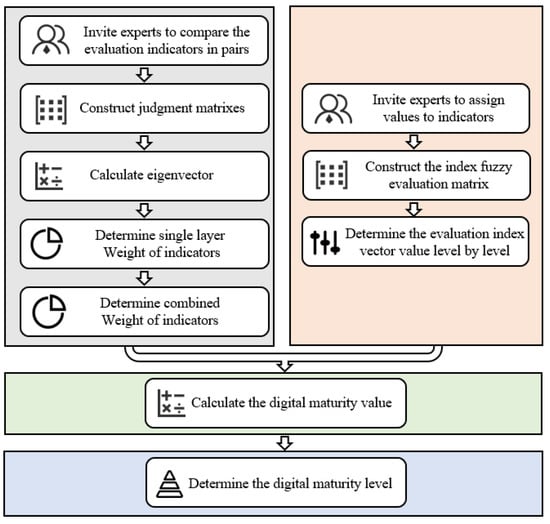
Figure 1.
Evaluation process.
4.3. Judgment of Evaluation Results
After combining the experts’ opinions with the relevant literature, the digital maturity of cost consultation enterprises is divided into five levels: beginner, starter, practitioner, pioneer, and leader [53,60,62]. Score range and specific descriptions are shown in Table 3.
Table 3.
Division of digital maturity level.
5. Case Study
In this paper, the Institute of Industry and Economics, China Railway Siyuan Survey and Design Group Co., Ltd. is selected for the case study. China Railway Siyuan Survey and Design Group Co., Ltd. is a large-scale comprehensive survey and design institute in China, mainly responsible for the survey and design of railway (especially high-speed railway) projects in East China, Central South China, and South China. The main reasons for choosing this institute for the case study include the following points. First, the Institute of Industry and Economics, China Railway Siyuan Survey and Design Group Co., Ltd. is a data-intensive business center. The data are the core and the key to the development of the main business. Second, China Railway Siyuan Survey and Design Group Co., Ltd. has ranked first among the top 50 Chinese engineering survey and design enterprises in terms of comprehensive strength for many consecutive years, and it has a strong benchmark in the industry. At the same time, as one of the first batch of enterprises that have carried out digital transformation and upgrading in China’s high-speed rail industry, China Railway Siyuan Survey and Design Group Co., Ltd. has rich digital management experience. The relevant achievement, Practice of Digital Management of Whole-process Cost Consultation of High-speed Railway, won the first prize in enterprise management modernization innovation in Hubei Province in 2020, which fully indicates that its digital transformation management practice is generally recognized by the industry. Third, as the upstream industry of the engineering construction industry chain, the digital transformation of the design institute is the response and implementation of accelerating the deep integration and development of the digital economy and the real economy proposed in China’s 14th five-year plan. At present, the construction of the digital design institute is in full swing in the industry.
5.1. Determination of Index Weights
Taking the Institute of Industry and Economics, China Railway Siyuan Survey and Design Group Co., Ltd. as the object of study, a hierarchical structure model is constructed combined with the evaluation index system. The target layer is the digital maturity of the Institute of Industry and Economics, China Railway Siyuan Survey and Design Group Co., Ltd. Based on the hierarchical structure model, and a questionnaire is designed. Several experts with rich experience in the field of cost are invited to make a pairwise comparison of indexes at all levels and make an importance judgement. Over a week, seven weight questionnaires filled by senior experts are collected. After repeated discussion, the importance judgment of all judgment matrices is completed, and finally, all judgment matrices pass the consistency test. The single-layer weight and the combined weight of each evaluation index are calculated according to the judgment matrix, and the results are shown in Table 4.
Table 4.
Evaluation index weight.
5.2. Fuzzy Comprehensive Evaluation
5.2.1. Establishing Fuzzy Comprehensive Evaluation Factor Set
The factor set of each hierarchy is established according to the hierarchical structure model. Factor set . For example, all factors influencing the digital maturity of the target layer include top-level design, infrastructure, cost consultation business process, professional management, comprehensive integration, and digital cost performance, and the set composed of these factors is the factor set of digital maturity.
5.2.2. Establishing Fuzzy Comprehensive Evaluation Weight Set
The weight set, W, of the factor set is obtained by using the single-layer weights determined by AHP. For example, the weight set, W, corresponded by the factor set of the target layer U = {top − level design, infrastructure, cost consultation business process, professional management, comprehensive integration, and digital cost performance} is .
5.2.3. Data Survey and Collection
Based on the evaluation index system, the digital maturity survey questionnaire of the case enterprise is made by using third-level indexes. To ensure the authenticity, reliability, and relevance of the questionnaire data, first, the questionnaire is sent to some experts in the fields of cost consultation and digitalization, and the contents of the questionnaire are modified and improved according to the feedback. Then, the questionnaire is distributed to the case enterprise in a small range to test the credibility. Finally, the data are collected formally. The questionnaire is distributed to employees of the Institute of Industry and Economics, China Railway Siyuan Survey and Design Group Co., Ltd. The questionnaire is collected from 1 April to 15 May 2021. A total of 300 questionnaires are distributed, of which 283 are valid after excluding data with evident randomness, and the effective questionnaire recovery rate is 94.33%.
After sorting out all the valid questionnaire data, a three-level index scoring table is obtained. Not all data are listed here because of limitations in paper length. The evaluation matrix for the second-level indexes is constructed based on these evaluation data, which is represented by R, such as the fuzzy evaluation matrix of A1 Emphasis on digital cost:
5.2.4. Calculating Total Maturity Score
The product of the weight vector and the evaluation matrix is equal to the fuzzy vector, M, of the index. The maximum fuzzy vector is taken, and the comment in the corresponding comment set is the final evaluation of the index. After multilayer calculation, the fuzzy vector of the target layer can be finally obtained. The calculation results are shown in Table 5.
Table 5.
Calculation result of fuzzy vector.
Combining with the score of digital maturity evaluation model of cost consultation enterprises, , the total score of digital maturity evaluation of the Institute of Industry and Economics, China Railway Siyuan Survey and Design Group Co., Ltd. can be calculated:
5.3. Analysis of Evaluation Results
Based on the calculation result of fuzzy vector and maximum membership principle, the level corresponding to the maximum value is the evaluation level of this indicator.
According to statistics, only two second-level indexes have the fuzzy evaluation result of Excellent, namely, B1, intelligent cost construction capability, and E2, horizontal integration. Five second-level indexes have the fuzzy evaluation result of Good, namely, A1, Emphasis on digital cost, C1, Digitalization in project decision-making stage, C5, Digitalization operation and maintenance stage, D4, R&D digitalization, and F2, Efficiency measure. In addition, the fuzzy evaluation results of 12 second-level indexes are General, which account for 63.2% of all second-level indexes. Based on the above data, the evaluation results of all second-level indexes in the Institute of Industry and Economics, China Railway Siyuan Survey and Design Group Co., Ltd. are not less than the level of General, and that of more than 1/3 of second-level indexes is higher than the level of General. The Institute of Industry and Economics, China Railway Siyuan Survey and Design Group Co., Ltd. has no serious weakness in digital transformation.
Among all first-level indexes, only B, Infrastructure, achieves the fuzzy evaluation result of Excellent, and A, Top-level design, C, Cost consultation business process, and F, Digital cost performance, obtain the fuzzy evaluation result of Good. In addition, the fuzzy evaluation results of the two other first-level indexes are General, which account for 33.3% of all second-level indexes. Enterprises attach importance to digital transformation in top-level design, upgrade the infrastructure, and have made achievements in business process and digital performance. However, they need to improve in professional management and comprehensive integration.
The fuzzy evaluation result of digital maturity of the target layer is General. However, the total score of digital maturity calculated reaches 3.23865, which is the result from 283 questionnaires. Therefore, compared with the evaluation result based on fuzzy vector, the total system score (3.23865) can better reflect the true enterprise digital maturity. Based on the division of digital maturity level of cost consultation enterprises, the digital maturity level of the Institute of Industry and Economics, China Railway Siyuan Survey and Design Group Co., Ltd. is a digital pioneer.
6. Conclusions
6.1. Research Conclusions
At present, digital transformation is an important development direction of enterprises and a key focus of China’s digital economic development. Enterprise digital maturity evaluation is used to evaluate the status and result of digital transformation based on the overall situation, which helps enterprises clarify their situation in digitalization and provides an important reference for their overall digital transformation and route planning. In this paper, based on the relevant literature and experts’ experience, a digital maturity evaluation model for cost consultation enterprises is constructed, combined with the industrial characteristics. At the same time, taking a large-scale central enterprise, the Institute of Industry and Economics, China Railway Siyuan Survey and Design Group Co., Ltd. as a case analysis object, AHP and fuzzy comprehensive evaluation are adopted to analyze its digital maturity. The study results show that the fuzzy evaluation result of the Institute of Industry and Economics, China Railway Siyuan Survey and Design Group Co., Ltd. in Professional management and Comprehensive integration is General, which is the key factor restricting its digital transformation development. Based on this, suggestions on improvement are proposed as below:
(1) In terms of Professional management, the evaluation result of the Institute of Industry and Economics, China Railway Siyuan Survey and Design Group Co., Ltd. in only R&D digitalization is Good, whereas the three other second-level evaluation results are General, indicating a large room for improvement. In terms of organizational structure, enterprises should adjust the organizational structure and personnel structure and focus on the effect of digital technologies and the change of commercial mode on the organization. The department responsible for digital transformation is set additionally to build a team of cross-departmental cooperation, such as business and IT. In the aspect of financial management, enterprises can unify the financial system to achieve information sharing and data value mining. In the aspect of human resources management, the talent data development and analysis capability is improved by establishing a centralized human resource management platform.
(2) In terms of Comprehensive integration, the comment on the horizontal integration of the Institute of Industry and Economics, China Railway Siyuan Survey and Design Group Co., Ltd. is Excellent. It indicates that the integration of the value chain between an enterprise and related upstream and downstream enterprises based on digital technologies is Good. However, the comment on longitudinal integration is General. The digitalization integration between departments and business processes within an enterprise needs to be improved. The enterprise should focus on improving the data exchange within the enterprise and the efficiency of all links with digital empowerment and break the information island using digital technologies to realize the collaborative value of all departments.
The innovation of this paper is mainly reflected in the following aspects. On the one hand, in accordance with the urgent needs of traditional enterprises’ digital transformation in the current digital economy era, a DMM applied to cost consultation enterprises is constructed. The evaluation system contains all the key processes of enterprise digital development. It can comprehensively measure the digital level of cost consultation enterprises from multiple dimensions. The model is conducive to enterprises’ self-diagnosis and third-party evaluation, providing a guiding tool for the digital transformation of cost consultation enterprises. On the other hand, the existing research on digital transformation mostly focuses on new enterprises, giving first place to the Internet and new retail. The research on digital maturity also focuses on the manufacturing industry, whereas relevant research on the service industry is rare. Taking a typical data-intensive service enterprise, a cost consultation enterprise, as the object of study, this paper expands the application scope of the maturity model and enriches the relevant studies based on theoretical model derivation and the case analysis under the local management situation in China.
6.2. Management Inspiration
First, taking digitalization as the driving force and transformation as the goal. The core essence of enterprise digital transformation is to use digital technology to enable business and realize transformation and upgrading. A problem of attaching importance to the application of digital technology and ignoring transformation development in many enterprises exists. To obtain the positive roles of digital transformation in the optimization, innovation, and reconstruction of a system of value creation, the enterprise must deepen the reform. First, the top-level design should highlight the determination of transformation. The top-level design is the leadership’s grasp of the direction of the enterprise’s digital strategic planning. It should include detailed transformation objectives and action plans and obtain the understanding and support of all business departments. Next, the operation mode of the organizational structure should have the ability to respond to digital needs quickly. Enterprises should adjust their organizational structure, focus on team building, promote the construction of digital capabilities and talent teams, and build organizations and teams with agility. In addition, the business should closely combine with technology and improve the quality and efficiency of the business process through the digital transformation of the whole value chain.
Second, it is important to instigate self-insight and avoid blind transformation. Digital transformation is a gradual process. Great differences exist in the digital transformation route of different enterprises and industries. Enterprises should not copy mechanically. They should fully understand their digital construction foundation and need to formulate their transformation plans. Before digital transformation, the problems to be solved should be clarified, and the basic conditions for implementing the digital transformation, including technical personnel, software and hardware equipment, and data utilization ability, should be evaluated. In the digital transformation, we should constantly analyze weak links and strive to formulate accurate transformation plans. Combining with the strategic planning of the management and the feedback of employees, we should also dynamically pay attention to the digital maturity of the enterprise and formulate the targeted improvement plan to drive the orderly development of enterprise digital transformation as required.
6.3. Limitations and Future Research Directions
There are some deficiencies in our research. First, although a benchmark enterprise in China’s high-speed rail industry was selected for case analysis, it may not fully represent the entire cost consultation industry due to the limited number of questionnaires. In addition, although AHP and fuzzy comprehensive evaluation are very mature methods, it is difficult to avoid being influenced by subjective factors due to the involvement of expert scoring and other links.
Future research can be improved from the following aspects: First, the digital maturity evaluation index system should be continuously improved. With the development of digital economy, the factors affecting the digitalization of enterprises will further increase, going beyond the scope of the evaluation indexes of this paper. Therefore, follow-up research can supplement, modify, and improve the evaluation indexes of the maturity model through combining with the practical experience of digital leading enterprises. Second, the objectivity of the evaluation should be enhanced. Many qualitative indexes are in the evaluation index system, which affects the judgment of maturity. More quantitative indexes and more objective evaluation methods will be used in subsequent research to analyze the digital maturity of enterprises. Third, the universality of the DMM should be improved. The model in this paper is only applicable to cost consultation enterprises but not to the construction industry and real estate industry related to cost consultation. A DMM suitable for the engineering construction ecosystem can be established in subsequent research.
Author Contributions
X.H. organized this study, conceived the manuscript idea, and participated in data collection and investigation. M.Z. drafted the manuscript, contributed to the study design, and implemented data collection. Y.H. (Yixuan Hu) was involved in drafting the manuscript, and reviewed and edited the manuscript. Y.H. (Yuan Huang) provided relevant information of the case company, assisted the research team in conducting expert interviews and questionnaire surveys, and contributed to the paper revision. All authors have read and agreed to the published version of the manuscript.
Funding
This research was funded by Fundamental Research Funds for the Central Universities of China (Project No.: 2022VI01-07), General Project of Hubei Social Science Funds of China (Project No.: 2021198), and 2020 Railway Engineering Cost Standard Project of State Railway Administration of China (Project No.: 2020ZJ017).
Institutional Review Board Statement
Not applicable.
Informed Consent Statement
Informed consent was obtained from all subjects involved in the study.
Data Availability Statement
The datasets used or analyzed in this are accessible from the corresponding author on demand.
Conflicts of Interest
The authors declare no conflict of interest.
References
- Verhoef, P.C.; Broekhuizen, T.; Bart, Y.; Bhattacharya, A.; Dong, J.Q.; Fabian, N.; Haenlein, M. Digital transformation: A multidisciplinary reflection and research agenda. J. Bus. Res. 2021, 122, 889–901. [Google Scholar] [CrossRef]
- Nasiri, M.; Ukko, J.; Saunila, M.; Rantala, T. Managing the digital supply chain: The role of smart technologies. Technovation 2020, 96–97, 102121. [Google Scholar] [CrossRef]
- Katsamakas, E. Digital Transformation and Sustainable Business Models. Sustainability 2022, 14, 6414. [Google Scholar] [CrossRef]
- Majdalawieh, M.; Khan, S. Building an Integrated Digital Transformation System Framework: A Design Science Research, the Case of FedUni. Sustainability 2022, 14, 6121. [Google Scholar] [CrossRef]
- Fitzgerald, M.; Kruschwitz, N.; Bonnet, D.; Welch, M. Embracing Digital Technology: A New Strategic Imperative. MIT Sloan Manag. Rev. 2014, 55, 137–148. [Google Scholar]
- Singh, A.; Klarner, P.; Hess, T. How Do Chief Digital Officers Pursue Digital Transformation Activities? The Role of Organization Design Parameters. Long Range Plan. 2020, 53, 101890. [Google Scholar] [CrossRef]
- Bican, P.M.; Brem, A. Digital business model, digital transformation, digital entrepreneurship: Is there a sustainable “digital”? Sustainability 2020, 12, 5239. [Google Scholar] [CrossRef]
- Xiao, J.H. Cross-system Digital Transformation and Adaptive Changes of Management. REFORM 2020, 4, 37–49. [Google Scholar]
- Benner, M.J.; Waldfogel, J. Changing the channel: Digitization and the rise of “middle tail” strategies. Strat. Mgmt. J. 2020, 1–24. [Google Scholar] [CrossRef]
- Johnson, G.A.; Lewis, R.A.; Reiley, D.H. When less is more: Data and power in advertising experiments. Mark. Sci. 2017, 36, 43–53. [Google Scholar] [CrossRef]
- Sousa-Zomer, T.T.; Neely, A.; Martinez, V. Digital transforming capability and performance: A microfoundational perspective. Int. J. Oper. Prod. Manag. 2020, 40, 1095–1128. [Google Scholar] [CrossRef]
- Wang, X.; Gu, Y.; Ahmad, M.; Xue, C. The Impact of Digital Capability on Manufacturing Company Performance. Sustainability 2022, 14, 6214. [Google Scholar] [CrossRef]
- Peng, Y.; Tao, C. Can digital transformation promote enterprise performance?—From the perspective of public policy and innovation. J. Innov. Knowl. 2022, 7, 100198. [Google Scholar] [CrossRef]
- He, F.; Liu, H.X. The Performance lmprovement Effect of Digital Transformation Enterprises from the Digital Economy Perspective. REFORM 2019, 4, 137–148. Available online: https://kns.cnki.net/kcms/detail/detail.aspx?FileName=REFO201904012&DbName=CJFQ2019 (accessed on 29 June 2022).
- Chi, M.M.; Wang, J.J.; Wang, W.J. Research on the influencing mechanism of firms’ innovation performance in the context of digital transformation: A mixed method study. Stu. Sci. Sci. 2022, 40, 319–331. [Google Scholar] [CrossRef]
- Grewal, L.; Stephen, A.T.; Coleman, N.V. When posting about products on social media backfires: The negative effects of consumer identity signaling on product interest. J. Mark. Res. 2019, 56, 197–210. [Google Scholar] [CrossRef]
- Jacobides, M.G.; Cennamo, C.; Gawer, A. Towards a theory of ecosystems. Strateg. Manag. J. 2018, 39, 2255–2276. [Google Scholar] [CrossRef]
- Caliskan, A.; Özen, Y.D.Ö.; Ozturkoglu, Y. Digital transformation of traditional marketing business model in new industry era. J. Enterp. Inf. Manag. 2020, 34, 1252–1273. [Google Scholar] [CrossRef]
- You, Y.; Yi, L. A Corpus-based empirical study on energy enterprises digital transformation. Energy Rep. 2021, 7, 198–209. [Google Scholar] [CrossRef]
- Hess, T.; Matt, C.; Benlian, A.; Wiesboeck, F. Options for Formulating a Digital Transformation Strategy. MIS Q. Exec. 2016, 15, 123–139. [Google Scholar] [CrossRef]
- Sun, G.Q.; Li, T. Research on Enterprise Network Digital Transformation Path under the Background of Digital Economy. Sci. Sci. Manag. S.T. 2021, 42, 128–145. [Google Scholar]
- Ghobakhloo, M.; Iranmanesh, M. Digital transformation success under Industry 4.0: A strategic guideline for manufacturing SMEs. J. Manuf. Technol. Manag. 2021, 32, 1533–1556. [Google Scholar] [CrossRef]
- AlNuaimi, B.K.; Singh, S.K.; Ren, S.; Budhwar, P.; Vorobyev, D. Mastering digital transformation: The nexus between leadership, agility, and digital strategy. J. Bus. Res. 2022, 145, 636–648. [Google Scholar] [CrossRef]
- Ardi, K.; Djati, S.P.; Bernarto, I.; Yulianeu, A.; Sudibjo, N.; Nanda, H.A.; Nanda, K.A. The relationship between digital transformational leadership styles and knowledge-based empowering interaction for increasing organisational innovativeness. Int. J. Innov. Creat. Chang. 2020, 11, 259–277. [Google Scholar]
- Porfírio, J.A.; Carrilho, T.; Felício, J.A.; Jardim, J. Leadership characteristics and digital transformation. J. Bus. Res. 2021, 124, 610–619. [Google Scholar] [CrossRef]
- Imran, F.; Shahzad, K.; Butt, A.; Kantola, J. Digital transformation of industrial organizations: Toward an integrated framework. J. Chang. Manag. 2021, 21, 451–479. [Google Scholar] [CrossRef]
- Kretschmer, T.; Khashabi, P. Digital transformation and organization design: An integrated approach. Calif. Manag. Rev. 2020, 62, 86–104. [Google Scholar] [CrossRef]
- Rachinger, M.; Rauter, R.; Müller, C.; Vorraber, W.; Schirgi, E. Digitalization and its influence on business model innovation. J. Manuf. Technol. Manag. 2018, 30, 1143–1160. [Google Scholar] [CrossRef]
- Li, F. The digital transformation of business models in the creative industries: A holistic framework and emerging trends. Technovation 2020, 92, 102012. [Google Scholar] [CrossRef]
- Bouncken, R.B.; Kraus, S.; Roig-Tierno, N. Knowledge-and innovation-based business models for future growth: Digitalized business models and portfolio considerations. Rev. Manag. Sci. 2021, 15, 1–14. [Google Scholar] [CrossRef]
- Klos, C.; Spieth, P.; Clauss, T.; Klusmann, C. Digital transformation of incumbent firms: A business model innovation perspective. IEEE Trans. Eng. Manag. 2021, 1–17. [Google Scholar] [CrossRef]
- Vial, G. Understanding Digital Transformation: A Review and a Research Agenda. J. Strateg. Inf. Syst. 2019, 28, 118–144. [Google Scholar] [CrossRef]
- Shan, Y.; Xu, H.; Zhou, L.X.; Zhou, Q. Digital and Intelligent Empowerment: How to Form Organizational Resilience in Crisis?: An Exploratory Case Study Based on Forest Cabin’s turning Crisis into Opportunity. Manga World 2021, 37, 84–104. [Google Scholar] [CrossRef]
- Cai, C.H.; Liu, W.; Jiang, J.H. Effect of Business Model Contextualization on Value Creation: A Case Study of RAINBOW’s Digital Transformation from 2007 to 2018. Nankai Bus. Rev. 2020, 23, 98–108. [Google Scholar]
- Ma, S.; Li, C.X. Paradox Management in the Digital Transformation of Time-honored Enterprises: A Case of Zhanggong. China Soft Sci. 2020, 4, 184–192. Available online: https://kns.cnki.net/kcms/detail/detail.aspx?FileName=ZGRK202004017&DbName=CJFQ2020 (accessed on 29 June 2022).
- Rapaccini, M.; Saccani, N.; Pezzotta, G.; Burger, T.; Ganz, W. Service Development in Product-Service Systems: A Maturity Model. Serv. Ind. J. 2013, 33, 300–319. [Google Scholar] [CrossRef]
- Wang, P.; Mileski, J. Strategic maritime management as a new emerging field in maritime studies. Marit. Bus. Rev. 2018, 3, 290–313. [Google Scholar] [CrossRef]
- Carvalho, J.V.; Rocha, Á.; van de Wetering, R.; Abreu, A. A Maturity Model for Hospital Information Systems. J. Bus. Res. 2019, 94, 388–399. [Google Scholar] [CrossRef]
- Adrodegari, F.; Saccani, N. A Maturity Model for the Servitization of Product-Centric Companies. J. Manuf. Technol. Manag. 2020, 31, 775–797. [Google Scholar] [CrossRef]
- Kosieradzka, A. Maturity model for production management. Procedia Eng. 2017, 182, 342–349. [Google Scholar] [CrossRef]
- Facchini, F.; Oleśków-Szłapka, J.; Ranieri, L.; Urbinati, A. A maturity model for logistics 4.0: An empirical analysis and a roadmap for future research. Sustainability 2019, 12, 86. [Google Scholar] [CrossRef]
- Oliva, F.L. A maturity model for enterprise risk management. Int. J. Prod. Econ. 2016, 173, 66–79. [Google Scholar] [CrossRef]
- Joblot, L.; Deneux, D.; Lamouri, S.; Paviot, T. Building Information Maturity Model specific to the renovation sector. Autom. Constr. 2019, 101, 140–159. [Google Scholar] [CrossRef]
- Szelągowski, M.; Berniak-Woźny, J. How to improve the assessment of BPM maturity in the era of digital transformation. Inf. Syst. E-Bus. Manag. 2022, 20, 171–198. [Google Scholar] [CrossRef]
- Gökalp, E.; Martinez, V. Digital Transformation Capability Maturity Model Enabling the Assessment of Industrial Manufacturers. Comput. Ind. 2021, 132, 103522. [Google Scholar] [CrossRef]
- Flott, K.; Callahan, R.; Darzi, A.; Mayer, E. A patient-centered framework for evaluating digital maturity of health services: A systematic review. J. Med. Internet Res. 2016, 18, e5047. [Google Scholar] [CrossRef]
- Duncan, R.; Eden, R.; Woods, L.; Wong, I.; Sullivan, C. Synthesizing Dimensions of Digital Maturity in Hospitals: Systematic Review. J. Med. Internet Res. 2022, 24, e32994. [Google Scholar] [CrossRef]
- Martin, G.; Clarke, J.; Liew, F.; Arora, S.; King, D.; Aylin, P. Evaluating the impact of organisational digital maturity on clinical outcomes in secondary care in England. NPI Digit. Med. 2019, 2, 1–7. [Google Scholar] [CrossRef]
- Gollhardt, T.; Halsbenning, S.; Hermann, A.; Karsakova, A.; Becker, J. Development of a Digital Transformation Maturity Model for IT Companies. In Proceedings of the 22nd IEEE International Conference on Business Informatics (CBI), Univ Antwerp, Belgium, 22–24 June 2020; pp. 94–103. [Google Scholar] [CrossRef]
- Friedrich, R.; Le Merle, M.; Grone, F.; Koster, A. Measuring Industry Digitization: Leaders and Laggards in the Digital Economy; Booz & Co.: London, UK, 2011. [Google Scholar]
- Valdez-de-Leon, O. A digital maturity model for telecommunications service providers. Technol. Innov. Manag. Rev. 2016, 6, 19–32. [Google Scholar]
- Leyh, C.; Schaeffer, T.; Bley, K.; Bay, L. The Application of the Maturity Model SIMMI 4.0 in Selected Enterprises. In Proceedings of the Amcis 2017 Proceedings, Boston, MA, USA, 10–12 August 2017; ISBN 978-3-319-53075-8. [Google Scholar]
- Mittal, S.; Romero, D.; Wuest, T. Towards a Smart Manufacturing Maturity Model for SMEs (SM3E). In Advances in Production Management Systems. Smart Manufacturing for Industry 4.0, Proceedings of the APMS 2018. IFIP Advances in Information and Communication Technology, Seoul, Korea, 26–30 August 2018; Moon, I., Lee, G.M., Park, J., Kiritsis, D., VonCieminski, G., Eds.; Springer: Cham, Switzerland, 2018; Volume 536, pp. 155–163. ISBN 9783319997063. [Google Scholar]
- Williams, C.; Schallmo, D.; Lang, K.; Boardman, L. Digital maturity models for small and medium-sized enterprises: A systematic literature review. In Proceedings of the International Society for Professional Innovation Management (ISPIM) Innovation Conference, Florence, Italy, 16–19 June 2019; pp. 1–15. [Google Scholar]
- Chen, G.; Jiang, H.L. Process Maturity Model and Evaluation Method Based on Maturity Factor. Stat. Decis. 2018, 34, 181–184. [Google Scholar] [CrossRef]
- Tang, S.H.; You, H.L.; Gao, Q.; Cheng, J.J.; Du, W.Y. DMM Discussion on the Usability of DMM Model in the Research Field of Military Data Management Maturity. Inf. Stud. Theory Appl. 2019, 42, 83–86. [Google Scholar] [CrossRef]
- Xiao, J.J.; Zheng, Y.Q.; Xu, J.P. Research on Intelligent Manufacturing Maturity Evaluation Model based on AHP and DHNN. Chin. J. Syst. Sci. 2020, 28, 105–110. [Google Scholar]
- Huang, H.Y.; Wen, Y.H. Research on the Maturity Model of Data Sovereignty Security Capability. Libr. Info. 2021, 4, 29–38. [Google Scholar] [CrossRef]
- Chi, Y.Q.; Liu, F.; Qi, J.Y. Construction of Enterprise Data Protection Maturity Model under the Background of Digital Transformation. J. Intell. 2021, 40, 133–140. [Google Scholar] [CrossRef]
- Lu, Y.; Wang, C.X. Comparative Analysis and Research Progress on Quantitative Evaluation of Digital Transformation. Sci. Technol. Prog. Policy 2021, 38, 152–160. [Google Scholar]
- Wang, R.; Dong, M.; Hou, W.H. Evaluation Model and Method of Digital Maturity of Manufacturing Enterprises. Sci. Technol. Manag. Res. 2019, 39, 57–64. [Google Scholar] [CrossRef]
- Wang, H.C.; Wang, S.W.; Liu, R.H. Research on Enterprise Digital Maturity Model. Manag. Rev. 2021, 33, 152–162. [Google Scholar] [CrossRef]
Publisher’s Note: MDPI stays neutral with regard to jurisdictional claims in published maps and institutional affiliations. |
© 2022 by the authors. Licensee MDPI, Basel, Switzerland. This article is an open access article distributed under the terms and conditions of the Creative Commons Attribution (CC BY) license (https://creativecommons.org/licenses/by/4.0/).