


Abstract
The COVID-19 pandemic has affected the way people use social media in a particular manner. The paper aims to investigate the impact of the pandemic on the use of social media, taking into account the sex and personality types of users in Poland. The survey involved 469 active users of social media. The data were analysed with statistical methods. A significant part of the respondents believed that the COVID-19 pandemic affected the way they used social media. They pointed out that the most common social media use drivers were immediate needs, often of pragmatic nature, such as rapid communication and exchange of information, and social needs. Among the survey population, it was the women who were more active on social media, particularly regarding Instagram. They were also more active on Pinterest and Snapchat. Men were more active on YouTube. Extraverts published more often on Facebook, Instagram, Snapchat, or Pinterest by a wide margin. They were also more active in general and more often judged social media content. The respondents indicated social platforms they believed would gain or lose popularity in the nearest future. The overall conclusion is that the pandemic may be a good time to launch new social platforms or promote less popular ones with new functionalities and narrow targets.
1. Introduction
The COVID-19 pandemic caused a global healthcare crisis, which redefined the perception of the processes that run the world. Restricted mobility, both local and global, had numerous consequences, including limited face-to-face human contact and curbed free flow of services and goods [1,2]. As a result, many activities moved to the Internet, including work, school, entertainment, and human contact in a broad sense. Consequently, the role of mass media, including social media, has grown to an unprecedented size [3].
In the time of pandemic, the public needs access to valid and reliable information about symptoms, infection prevention, and effective therapies [4]. Moreover, it needs contact with others and access to cultural events and other forms of distraction. The pandemic has made social media the leading channel for disseminating scientific and governmental messages and information from individuals [5].
Today, social media are often perceived as fast and effective platforms for searching, sharing, and disseminating information [4]. Social media is capable of meeting the need for information, belonging, and human contact. It can provide education as well as meaningful and useful information. At the same time, it accumulates much unpleasant information of disputable reliability. Overexposure to negative content can trigger or fuel fear and anxiety. This said, social media content had both a positive and negative impact on people during the COVID-19 pandemic [1]. Nevertheless, people are forced to foster their relations through global, digital social networks due to restricted mobility [2].
Many researchers investigated social media’s role in disseminating information, focusing on its reliability [6,7,8]. The effort was mainly through polls and surveys (online or phone) or big data analysis [5,9,10]. The research shows that the power of negative emotions, such as anxiety and panic, caused by overexposure to social media information differs by sex and educational background [11]. Our research fills in a certain gap, as it refrains from analysing the effect of disinformation on decisions and mental state of social media users, but looks for relationships between sex and personality type and the way social media is used during the COVID-19 pandemic.
The research attempted to answer the following research question:
- Question 1 (Q1).
- Are there any differences in the use of specific social media types attributable to sex and personality traits among young adults (18–29)?
- Question 2 (Q2).
- Are there differences in social media use drivers among sexes and personality features?
- Question 3 (Q3).
- How has the COVID-19 pandemic affected social media use?
This paper is organised as follows. Section 2 looks into issues related to the growing popularity of social media. It further reviews the literature on the effect of sex and personality on social media use and such platforms’ role during the COVID-19 pandemic. Section 3 presents the research methodology. The Section 4 presents results in three parts: (1) the first part offers data analysis results divided by sex and personality traits; (2) part two demonstrates the impact of COVID-19 on changes in social media use; (3) part three offers social platform popularity forecasts. The results are discussed in Section 5. The last component is a summary and practical implications and limitations of the research.
2. Literature Review
The use of social media sites has become one of the most popular social behaviours, thanks to its ubiquity and the many different opportunities that they offer [12]. Social media sites have been defined as ‘web-based services that allow individuals to (1) construct a public or semi-public profile within a bounded system, (2) articulate a list of other users with whom they share a connection, and (3) view and traverse their list of connections and those made by others within the system’ [13] (p. 211).
2.1. Use and Power of Social Media
The COVID-19 pandemic accelerated the evolution of the global digital landscape and the Internet user population. Some estimate that 2020 saw 346 million people use the Internet for the first time. Today, there are about 4.57 billion Internet users globally; almost 60% of the global population [14]. The lovechild of the World Wide Web is social media, which comes in many forms, including blogs, microblogs, forums, photo-sharing platforms, business networks, social gaming, chat applications, and last but not least, social networks [15].
Social platforms are popular. Over 90% of adult Internet users (young adults, aged 18 to 29) declared that they used social media often and regularly, and Facebook, YouTube, and Twitter are counted among the most visited websites [16,17].
Social media usage is blowing up across the world faster than ever before. More than half of the world now uses social media—social media users have grown by more than 10 percent over the past year, taking the global total to 3.96 billion by the start of July 2020. This means that each day of 2020, the social media user base grew by more than one million people on average, almost twelve new users a second. Moreover, current users declared they used social media more often during the pandemic than before [14].
A study by the Pew Research Center in eleven countries in four regions of the world (including Venezuela, South Africa, India, Mexico, and Tunisia) demonstrated that smartphone and social media users were more likely to build relations with people from various social groups. Moreover, they more readily interacted with people with different beliefs, social status, and racial or ethnic background. Smartphone owners had more experience with healthcare and administration e-services [18].
Women and men use social media at similar rates. Women were more likely than men to use social networking sites for a number of years, although these differences have been modest since 2015. Moreover, research shows that racial or ethnic background do not influence the frequency of social media use. What matters is income and education. People from households with higher income levels and those with a university degree use social platforms more often [17].
2.2. Factors Influencing the Use of Social Media
While there are various motivations for individuals to use social media sites, the primary ones are establishing and maintaining interpersonal relations [12]. Research shows that some personality traits can drive increased social media activity. Such factors as extraversion, emotional stability, and openness to new experience affect how people use networking sites [19]. A study by Özgüven and Mucan [20] shows that two personality traits (conscientiousness and openness to experience), two demographic attributes (education and income level), and life satisfaction are significant predictors of social media use. Farnadi et al. [21] ran a comparative analysis of selected computational personality recognition methods on a dataset from Facebook, Twitter, and YouTube. Golbeck et al. [22] proposed determining user’s personality based on their public information on their Facebook profile. Liu et al. [23] showed that the content of images users post to their social media is driven in part by personality. For example, agreeable and conscientious users display more positive emotions in their profile pictures, while users high in openness prefer more aesthetic photos. Correa et al. [19] showed that while extraversion and openness to experiences were positively related to social media use, emotional stability was a negative predictor, controlling for socio-demographics and life satisfaction. These findings differed by sex and age. While extravert men and women were both likely to be more frequent users of social media tools, only men with greater emotional instability were more regular users [19].
Dunn and Guadagno [24] investigated the influence of gender, the ‘big 5 personality factors’, and self-esteem on virtual self-representation in the form of avatar self-discrepancy. The research shows that men and women tended to choose avatars close to a perfect male or female body. Men who were open to new experience more often chose avatars with different skin tones. Introverts (women and men both) and women with high levels of neuroticism were more likely to go for attractive avatars. Muscanell and Guadagno [25] examined the influence of gender and personality on individuals’ use of online social networking websites such as Facebook and MySpace. They demonstrated that men more often used social platforms to find new relations, and women were more interested in maintaining relationships. Horzum [26], on the other hand, demonstrated that men more often used Facebook to express themselves, meet new people, and store and organize things more, while women used it for education. Besides, agreeable and conscientious people use Facebook to maintain existing relationship more. Hughes et al. [27] investigated the relationship between user personality and Facebook and Twitter use. Results showed that personality was related to online socialising and information seeking/exchange. Still, it was not as influential as some previous research has suggested. Besides, a preference for Facebook or Twitter was associated with personality differences. Schwartz et al. [28] looked into dependencies between the language (such as the tendency to use specific words or phrases), personality, and sex. They analysed Facebook posts and identified significant discrepancies in dictionaries among various sexes and personality traits.
2.3. Social Media in the Time of the COVID-19 Pandemic
The outbreak of the COVID-19 pandemic kindled numerous adverse phenomena. Social distancing, mobility restrictions or travel bans, quarantine, and business lockdown have hit most global communities. As people met less often in person in public spaces, they discussed the issues in social media [29]. It was not only the virus but also information that spread rapidly during the COVID-19 pandemic, too often causing or fuelling panic. Some researchers demonstrated that panic spread faster through networking sites than the coronavirus [30]. In the first months, media reports about the disease were published and shared, especially over social platforms. As a result, the COVID-19 pandemic is referred to as the first-ever social media infodemic [11].
Social sites can play a positive role during a pandemic by promoting effective quarantine or social distancing strategies or combating disinformation [1,30]. Social networks can quickly spread important news, scientific discoveries, or diagnostic, therapeutic, and control protocols. Their potential can also be harnessed to compare various pandemic strategies over geographical boundaries and time limits [31]. Pollett and Rivers [32] noted that social media played an important role in global research communication for quick information exchange as the pandemic grew.
Social media users have played an important part since the outbreak of the COVID-19 pandemic by sharing information on its current status, disease prevention, and healthcare statistics. Simultaneously, it was in social media that gossip and conspiracy theories spread the quickest [8]. Monitoring of pandemic-related information consists mostly of real-time collection, processing, and analysis of text data. Spatiotemporal analyses of social media content can represent the occurrence and intensity of phenomena using maps. Such compilations offer data for making decisions about where to intensify educational campaigns to help combat disinformation [30].
Tasnim et al. [9] claimed that advanced technology should be employed to detect and remove false content from social platforms. Analysis of social media content can be useful for pinpointing potential or actual outbreaks. It is possible thanks to the analysis of social media search indexes regarding such keywords as dry cough, fever, chest pain, coronavirus, or pneumonia. It can be crucial for preventing the COVID-19 pandemic [10]. Moreover, social media content analysis can help identify public mood in the context of the pandemic [33].
Social media content monitoring is considered the best method for trend tracking and combating disinformation [9,30]. The disinformation in the COVID-19 pandemic was dubbed infodemic [6,11]. The term ‘infodemic’ was defined as ‘an overabundance of information—some accurate and some not—that makes it hard for people to find trustworthy sources and reliable guidance when they need it’ [34].
Study shows that social media users are better informed about various facts and events related to the COVID-19 pandemic and follow them using social platforms. Kaya [7] demonstrated that social media users verify the credibility of sources of information and try to rely on trustworthy ones. He, moreover, demonstrated that conscious use of social platforms and detachment from information found there reduce anxiety associated with negative content.
Information in social media can carry various overtones, from hopefully optimistic to pessimistic or even catastrophic. At the same time, information from reliable sources can be useful for decision making. It can reduce anxiety and doubt. Researchers believe it affects daily life, from health, including mental state, to shopping decisions. According to experts, the accumulation of negative input about the COVID-19 pandemic in social media can lead to panic stockpiling [35]. Panic-inducing social media content related to the COVID-19 pandemic drove consumers to stockpile food and medicines at the beginning of the pandemic [35]. Moreover, research confirms that COVID-19 significantly changed business operations and consumer shopping patterns [36,37].
The work investigates three research hypotheses:
Hypothesis 1 (H1).
Sex and personality traits affect the type of social media young adults (18–29) use.
Hypothesis 2 (H2).
Sex and personality traits affect the drivers of social media use.
Hypothesis 3 (H3).
The COVID-19 pandemic resulted in users aged 18–29 using social media more often.
3. Materials and Methods
The authors conducted a survey among students of four fields of study in December 2020: Management and Production Engineering, Management, Business Analytics, Logistics and Sociology (Silesian University of Technology in Gliwice). The research sample was randomly selected. Invitations were sent to 590 respondents, 521 of whom responded. We were prepared for only a minor response rate down to 10–15% of correct questionnaires, and we feared only people with certain personality traits (open-minded, empathetic, keen on sharing knowledge) would respond. We wanted all or almost all members of a specific group of students to participate, which would provide a random sample of the Polish student population. Therefore, we introduced a kind of incentive to motivate students to participate. It involved additional student activity points for an ICT course at the university. The points were available to those who took part in the survey and a discussion on the topics that appeared in questionnaires and were related to the use of social media during the pandemic. Each questionnaire had a unique ID at the end to be sent in a special form as a confirmation of the participation. The participation was optional and anonymous, but we believe the points (a kind of a bonus) and the domain of social media and personality traits resulted in such a great turnout. The ‘incentive’ boosted student motivation to fill in the questionnaire. The sample for the statistical analysis was 469 questionnaires from respondents aged 18 to 29. Incomplete, damaged, or illegible questionnaires were rejected.
One of the research aspects was to analyse the use of social media, depending on the declared sex. The population (n = 469) consisted of 285 (60.8%) women and 184 (39.2%) men (Table 1). Data reliability was tested. The Cronbach’s alpha score for questions on the use of social media (Q11_FB-Q33_TL, 30 items) was 0.799, and for questions related to motivation (Q41-Q58, 18 items), 0.897. The scores confirmed the high, acceptable reliability of the research tool and results.
Table 1.
Profile of the respondents.
The research was divided into two stages. The first stage was an online personality test (16 Personalities—16P, NERIS Analytics Limited, United Kingdom) [38]. Next, the authors designed and verified an original survey questionnaire to link the respondent’s personality to how they used social media. The other questionnaire asked the respondents to state their personality test result (16P personality type) and opinions on the results’ accuracy. It was important to determine the diagnostic reliability of 16P. Hence, the additional questions. Should there be no correlation between personality self-assessment by the respondents and results of the 16P tests, we would have abandoned the tool. 16P is a relatively new online tool. There is not much research available that uses it. Therefore, we decided to verify its reliability with additional control questions.
3.1. Survey Questionnaire
The survey employed various response scales. The survey questions employed a seven-point Likert scale, a five-point qualitative ordinal scale, and a percentage score. The frequency of social media use was measured with an ordinal scale with the following values: several times a day (5), several times a week (4), several times a month (3), several times a year (2), less than several times a year or not at all (1). The frequency of use of individual social platforms was analysed in three domains: browsing (Q11), reacting (Q22), and posting (Q33) (Table 2).
Table 2.
Research questions on the frequency of use of specific social platforms.
Questions regarding the motivation to use social media (M-IN-FB) (Table A2) were measured on a 7-point Likert scale ranging from strongly disagree (1) to strongly agree (7). The questions were limited to Facebook to keep the questionnaire length within reasonable bounds. It was selected due to its significant popularity [39].
Personality types described in the 16 Personalities test are based on independent personality aspects referred to as: Mind (Introverted {I}, Extraverted {E}), Energy (Observant{S}, Intuitive {N}), Nature (Thinking {T}, Feeling {F}), and Tactics (Judging {J}, Prospecting {P}) (Table 3).
Table 3.
Independent personality aspects according to 16P.
A combination of the first four letters identifies each of the 16 personality types (Table A1). 16P was employed due to its quality, focus on the scientific foundations for the test, availability, and user-friendliness. The 16P form was used in other studies, such as personality profiling with social media posts [40], investigation of links between personality and personal abilities [41], or personality classification modelling [42].
The questionnaire contained five additional questions: (1) do you agree with the result and specification of your personality from the 16P test? (scale ranging from strongly disagree to strongly agree, question P1_X) (2); to what percentage extent do you agree with the result and specification of your personality from the 16P test? (scale from 0 to 100%, question P1_Q); (3) how many (estimate) Facebook friends do you have? (question F1); (4) with how many Facebook friends (estimate) do you keep in touch (at least once a year)? (question F2); (5) what personality trait do you identify with (scale: introvert, rather introvert, ambivert, rather extravert, extravert, question P2). The respondents were then asked about their opinions on the impact of the COVID-19 pandemic on using such social platforms as Facebook. Responses were put on a five-point scale (1—definitely decreased, 2—decreased, 3—stayed the same, 4—increased, 5—definitely increased). Respondents could add a short textual response. The questionnaire contained two open-ended questions about the respondents’ opinions on social media’s popularity in 2021 (Table 4).
Table 4.
Open-ended questions about the predicted popularity of social media in 2021.
3.2. Statistical Analysis
The authors conducted one-, two-, and multi-dimensional data analyses. The one-dimensional analysis was a classic, positional descriptive analysis. This approach facilitated a comparison of responses in non-parametric statistical tests for personalities and sex. The statistical analysis involved 469 questionnaires. It was more than the minimum random sample size estimated at 386 (for the maximum sample error of ±5% and confidence level of p = 0.95). The descriptive statistical analysis concerning quantity advantages was mostly about obtaining such measures as the arithmetic mean (Mean), standard deviation (SD), and median (Mdn). A Likert scale was used so that the respondents could choose one of seven responses. An ordinal scale was used as well to specify the frequency of use of individual social media platforms. The two-dimensional analysis employed the Pearson’s correlation coefficient and Spearman’s rank correlation. The normality of the distribution of the variables was verified with the Shapiro–Wilk test. Two mean values for the independent groups of respondents were compared with the Student’s t-test for normally distributed variables. Homogeneity of variance was determined with the F-test. Two groups with distribution variances other than normal were compared with the Mann–Whitney U test. The significance of differences between stratum weights was verified with the chi-squared test.
Statistical hypotheses were verified using statistical tests, taking into account significance at a level of α ≤ 0.05. At the same time, it was noted that the p probability of an error was not greater than 0.05.
The multi-dimensional analysis employed a correspondence analysis. Results of the analysis are presented in a two-dimensional figure with relationships between individual groups. The internal consistency of the survey was verified with Cronbach’s alpha. The statistical analysis was performed in Microsoft Excel (Microsoft Corporation, Redmond, WA, USA) and Statistica (TIBCO Software Inc., Palo Alto, CA, USA).
4. Results
The analysed population included 469 respondents. It consisted of 285 women (60.8%) and 184 (39.2%) men. We attempted to balance the sample mostly for sex group sizes. The sex structure of the study population reflects the structure of the Polish university student population. According to 2018 statistical data of the Central Statistical Office of Poland, the student population in Poland consisted of 58% women and 42% men [43]. In terms of the age criterion, the sample consisted in 75.5% of people aged 18–21, 20.9% of respondents aged 22–25, and 3.6% was people 26–29 years of age. Regarding the declared personality type criterion, 29% of the respondents identified as introverts (Introvert or rather Introvert), 29.2% believed to be ambiverts, and 35.2% were extraverts (Extravert or rather Extravert). Only 6.6% of the respondents were unable to determine their personality (Table A1).
According to the 16P personality test, the sample included all 16 personalities. The most numerous were ESFJ—Consul (15.1%) and ENFJ—Protagonist (13.9%) (Table A1). An overwhelming majority (82.5%) of the respondents believed their 16P test result to reflect their perception of their personality (responses: agree definitely, agree, somewhat agree). Only 7.6% of the respondents did not agree with the results of the 16P test.
Data analysis by personality was conducted in two variants. The first one covered all respondents (n = 469), and the other focused on those who agreed with the 16P test results (n = 387). The purpose of the double analysis was to identify any potential statistical differences for results of personality traits’ impact on the use of social media for the entire group (n = 469) and for the group that assessed the accuracy and effectiveness of the 16P test’s description of their personality as high. It turned out that statistical differences between the groups were identifiable and almost identical in both cases. Hence, the results for n = 469 are presented.
The respondents declared 16 personality types. Behavioural differences between the types were classified into four opposing traits, PP11–PP14, to identify differences between the groups (Table A3). This division allowed the authors to compare trait P11 (Introverted, Extraverted) according to the 16P test with personality self-assessment by the respondents, P2 (Personality 2—own opinion).
First, the authors looked into the correlation between variable PP11 and P2 with PP1 values of Introverted (I) = 1, Extraverted (E) = 2 and P2 values of Introvert = 1, Rather Introvert = 2, Both (ambivert) = 3, Rather Extravert = 4, Extravert = 5, Don’t know/hard to say = NN. This yielded a statistically significant Pearson’s correlation r = 0.691 (n = 438, p < 0.05) and Spearman’s rank correlation r = 0.699 (n = 438, p < 0.05). This means that the 16P test results were highly consistent with respondents’ declarations in this regard.
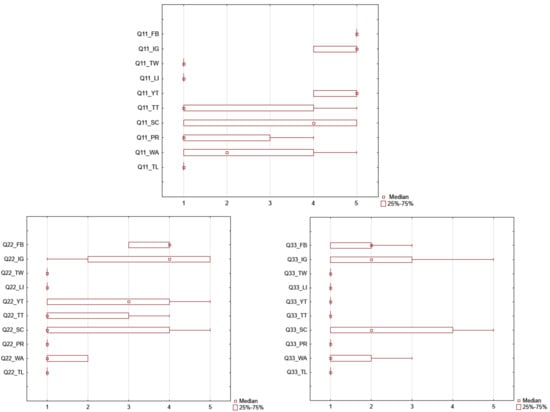
Analysis of responses to questions (for both sexes and all personality types) about the frequency and manner of using specific social platforms identified differences in their popularity. It revealed that the respondents most often browsed content posted on Facebook, YouTube, and Instagram. They most frequently published their opinions on Instagram and Facebook, but also YouTube and Snapchat. The least popular platforms in terms of content publishing were LinkedIn and Tumblr. The respondents were most keen on publishing original content on Snapchat, Instagram, and Facebook (Table 5, Figure 1). Moreover, the respondents listed social platforms they have actively used recently. They were, in descending order of use: Spotify, Reddit, Twitch, Discord, SoundCloud, Olx, Steam, Wattpad, Tinder, Vinted, and Telegram.
Table 5.
Use of social platforms.
Figure 1.
Social media—browsing (Q11), reacting (Q22), posting (Q33). Scale: less than several times a year or not at all (1), several times a year (2), several times a month (3), several times a week (4), several times a day (5). Source: original work.
The respondents indicated that they were motivated to use Facebook by immediate needs, often of pragmatic nature, such as rapid communication and exchange of information at school/university (Q58, 6.44 ± 1), but also the need for distraction (Q56, 5.3 ± 1.6) and social needs, such as the urge to keep in contact with acquaintances (Q53, 6.32 ± 1.07) and the need to stay up to date (Q51, 5.32 ± 1.57). Other motivating factors for the respondents were the popularity of the application in a specific group (Q43, 6.38 ± 0.95), availability of selected features (Q50, 6.13 ± 1.41), habit (Q47, 5.96 ± 1.28), and usability (Q42, 5.48 ± 1.46). The ten key drivers included the possibility to learn interesting things from others (Q52, 5.27 ± 1.57) and free access (Q41, 5.21 ± 1.77) as well. Respondents’ responses regarding motivation to use Facebook can be found in Appendix A (Table A4 and Table A5).
4.1. Data Analysis by Sex and Personality Traits
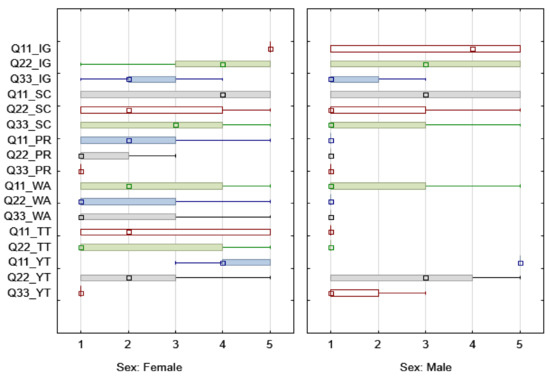
The research shows many differences between men and women regarding social media use during the COVID-19 pandemic. Women (F) from the study population were much more active in social media, particularly on Instagram (Q11_IG, Q22_IG, Q33_IG), Snapchat (Q11_SC, Q22_SC, Q33_SC), Pinterest (Q11_PR, Q22_PR, Q33_PR), and WhatsApp (Q11_WA, Q22_WA, Q33_WA). Women were also more active on TikTok (Q11_TT, Q22_TT). Men were significantly more active on YouTube (Q11_YT, Q22_YT, Q33_YT). The statistical differences (* p < 0.05, ** p < 0.01, *** p < 0.001) in social media use between women and men are shown in Figure 2 and in Table 6. Complete data are presented in Appendix A (Table A6).
Figure 2.
Differences in social media use between men and women. Scale: less than several times a year or not at all (1), several times a year (2), several times a month (3), several times a week (4), several times a day (5). Source: original work.
Table 6.
Differences in social media use. Mann–Whitney U test results for variable Sex (Female = 285, Male = 184).
Women and men exhibited different drivers to use Facebook as well (Table 7). The most significant differences were noted for questions regarding curiosity and the intention to learn details from other people’s lives (Q57, M = 3.67 ± 1.87, F = 4.35 ± 1.74, p < 0.001), perception of the working speed (Q45, M = 4.41 ± 1.86, F = 4.92 ± 1.51, p < 0.01), and security of use (Q48, M = 3.42 ± 1.80, F = 3.87 ± 1.41, p < 0.01). Women scored these drivers more.
Table 7.
Differences in drive variables to use Facebook and the number of friends. Mann–Whitney U test for variable Sex (Female = 285, Male = 184).
Women usually had more Facebook friends (597 ± 343) than men (503 ± 386). They kept in contact with a similar number of them (72 ± 95) as men (67 ± 95). Complete data are presented in Appendix A (Table A7).
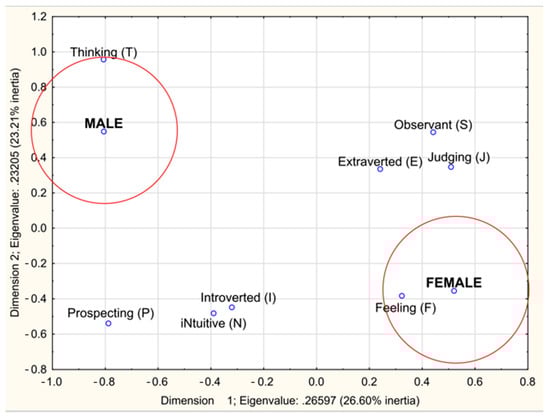
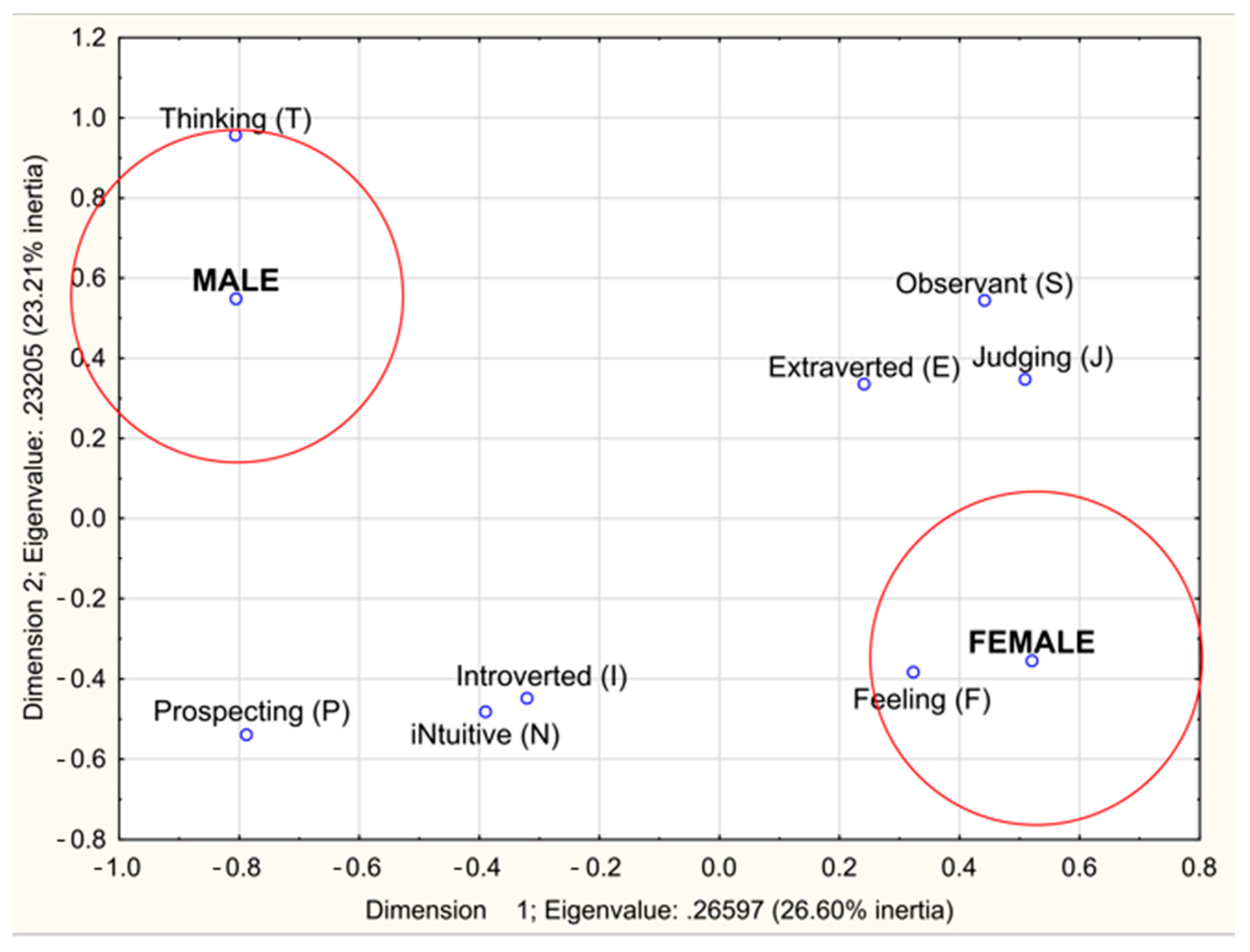
Moreover, female respondents were more emotionally sensitive, emphatic, and focused on social harmony and cooperation (Feeling {F}). Men, on the other hand, focused on objectivity and rationality, prioritised logic over emotions, and tended to hide their feelings (Thinking {T}) (Figure 3).
Figure 3.
Correspondence analysis results—sex and personality traits. Source: original study.
The study shows that the small age difference between two groups of respondents, 18–21 and 22–25, significantly influenced social media use and drivers of Facebook use. Younger respondents (18–21) used such social platforms as TikTok (Q11_TT, Q22_TT, Q33_TT), Snapchat (11_SC, 22_SC, 33_SC), and Pinterest (Q11_PR) much more often (p < 0.001). They shared their opinions more often on Facebook (Q22_FB, p < 0.05), Instagram (Q22_IG, p < 0.05), and Pinterest (Q22_PR, p < 0.05). Moreover, older participants (22–25) more often used LinkedIn (Q11_LI, Q22_LI, Q33_LI, p < 0.001). Complete data are presented in Appendix A (Table A8 and Table A9). However, the results need to be confirmed in future because the size of the 18–21 y/o group in the study was much larger than that of the 22–25, which could hurt the reliability of the results.
The authors investigated differences in social media use among selected personalities. The study shows that extraversion significantly affects social media usage. Extraverts more frequently browsed content on Instagram, TikTok, and Snapchat (Q11_IG, Q11_TT, Q11_SC, p < 0.01). They were more active and judged the content of others more (Q22_FB, Q22_IG, Q22_SC, p < 0.01). Extraverted users much more often posted content on such platforms as Facebook, Instagram, and Snapchat (Q33_FB, Q33_IG, Q33_SC, p < 0.001). Analysis results of the significance of differences in social platforms use by Introverted (I) and Extraverted (E) participants are shown in (Table 8). Complete data are presented in Appendix A in (Table A10)
Table 8.
Differences in social media use. U Mann–Whitney test for variable Personality Trait PP11—Introverted (I = 201), Extraverted (E = 268).
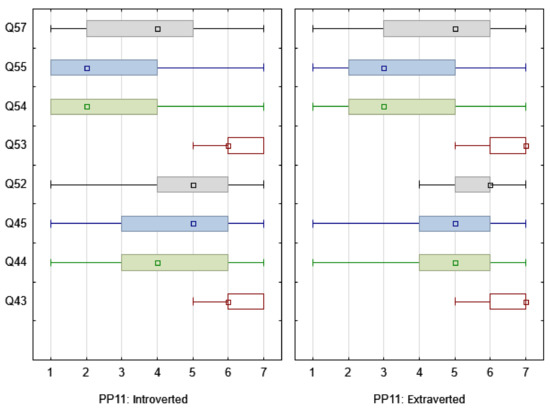
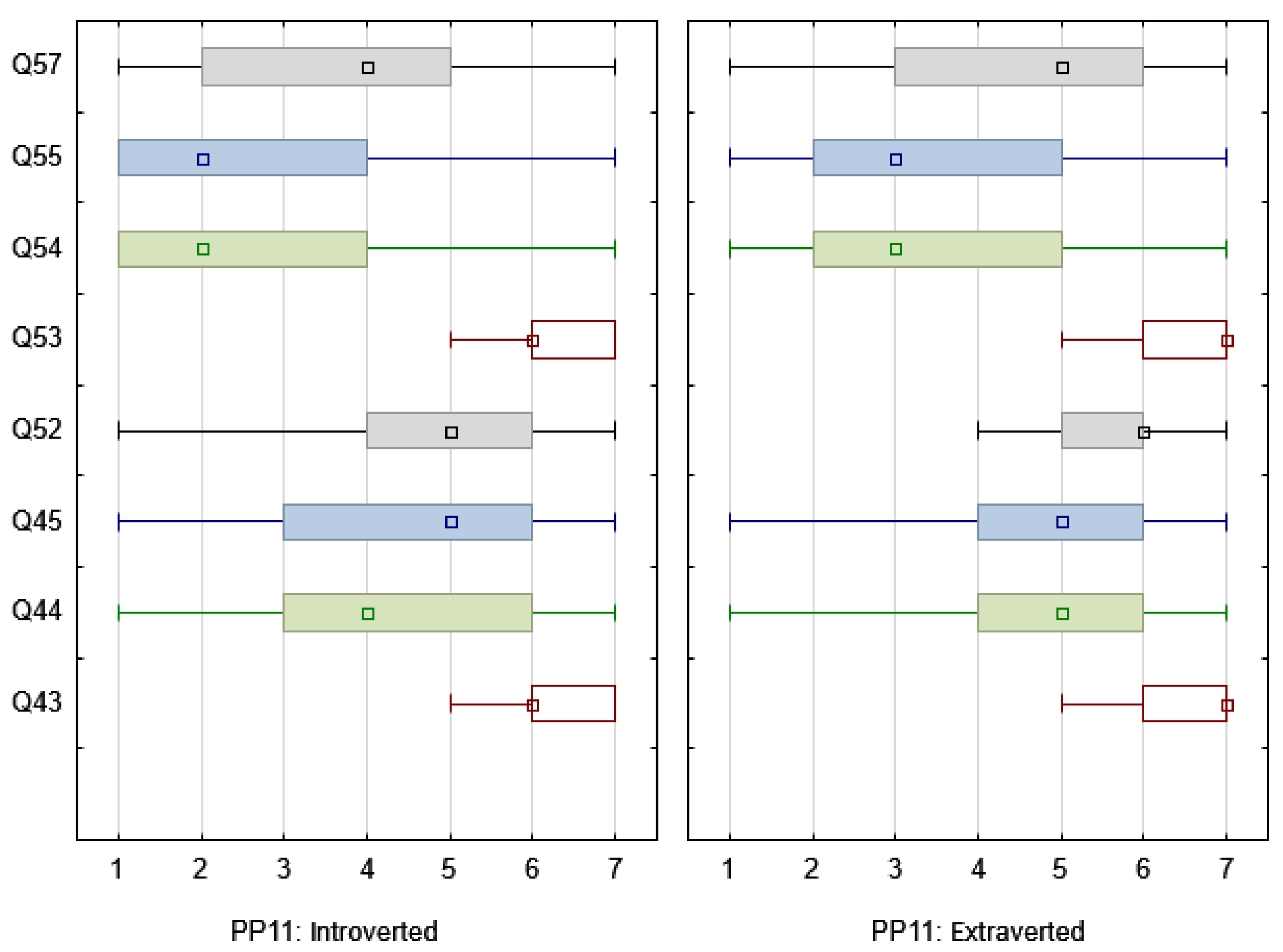
Extraverts had many more ‘friends’ (656 ± 380) than introverts (433 ± 295) and declared keeping in touch with more of them (85 ± 103) than introverts (50 ± 78). Facebook use drivers exhibited multiple differences between the groups. The primary variation was the need to keep in contact with friends (Q53, I = 6.09 ± 1.25, E = 6.49 ± 0.87, p < 0.001), share interesting information (Q54, I = 2.63 ± 1.72, E = 3.48 ± 1.84, p < 0.001), and express one’s opinions in public (Q55, I = 2.7 ± 1.76, E = 3.30 ± 1.84, p < 0.001). Other significant differences involved the popularity of the platform among friends (Q43, I = 6.24 ± 1.01, E = 6.48 ± 0.90, p < 0.01), functionality (Q44, I = 4.33 ± 1.66, E = 4.75 ± 1.51, p < 0.01), working speed (Q45, I = 4.48 ± 1.7, E = 4.90 ± 1.63, p < 0.01), and opportunities to access interesting information (Q52, I = 5 ± 1.73, E = 5.47 ± 1.41, p < 0.01), (Q57, I = 3.77 ± 1.9, E = 4.32 ± 1.73, p < 0.01). In all those cases, the factors were more important to extraverts than introverts (Figure 4 and Table 9). Complete data are presented in Appendix A in (Table A11)
Figure 4.
Social media—differences in Facebook use drivers between Introverted and Extraverted personalities. Scale: variable attributes were measured on a 7-point Likert scale ranging from strongly disagree (1) to strongly agree (7).
Table 9.
Differences in drive variables to use Facebook and the number of friends. U Mann–Whitney test for variable Personality Trait PP11—Introverted (I = 201), Extraverted (E = 268).
For areas related to the Energy (Intuitive {N} and Observant {S}), Nature (Thinking {T} and Feeling {F}), and Tactics (Judging {J} and Prospecting {P}), the largest differences were identified in the frequency of use of Instagram and Pinterest. The differences were most visible for different Natures. Feeling {F} persons used such social platforms as Snapchat (Q11_SC, Q22_SC, Q33_SC, p < 0.001), TikTok (Q11_TT, p < 0.01), Pinterest (Q11_PR, p < 0.001), and Instagram (Q33_IG, p < 0.05) much more frequently (Table 10). Complete data are presented in Appendix A in (Table A12)
Table 10.
Differences in social media use. U Mann–Whitney test for variable Personality Trait PP12—Intuitive (N = 249), Observant (S = 220); PP13—Thinking (T = 134), Feeling (F = 335); PP14—Prospecting (P = 184), Judging (J = 285).
4.2. The Impact of COVID-19 on Social Media Use Changes
According to the respondents, the COVID-19 pandemic had affected the way they used social media (Q60). About 9.6% of them declared a significantly more frequent use of social networking, while 28.8% declared a more frequent use than usual. Only 4.7% of the participants claimed to have used social media less during the pandemic, and 1.5% reported a significant decrease in their social media activity. Fifty-five per cent declared a similar level of social media usage as before the pandemic. Interestingly, many respondents claimed to have used Facebook less while spending more time on Instagram.
A difference between two traits, Mind {I} and {E} and Nature {T} and {F}, was identified in how respondents perceived the effect of the pandemic on their activity levels in social media. No significant differences were found for sexes and other personality traits (Table 11).
Table 11.
The impact of COVID-19 on changes in activity in social media by sex and personality trait.
Increased activity in social media was noted for all the groups. It was slightly greater for extraverts compared to introverts. Feeling {F} and Thinking {T} persons differed in how they perceived their social media activity levels. People characterised as Feeling {F} are usually caring, compassionate, and warm. Their concern about others can focus on the immediate surroundings, such as family, friends, and acquaintances. Yet, it can encompass broader areas as well, such as global peace, hunger, environmental protection, or the protection of endangered animal species. Hence, Feeling {F} people can treat social platforms as places where they can, or even should, support and help others. This trait can, therefore, promote increased activity, also in social media, during the difficult time of COVID-19-related restrictions and social isolation.
4.3. Forecasts of Social Media Popularity
The respondents were keen to answer optional questions about social platforms’ future popularity (414 responses). Their task was to indicate social platforms that they believed would gain or lose popularity in the nearest future and to justify their opinions. Sites that would lose popularity were listed by 40% of the respondents, while 48% of them proposed platforms that should gain popularity. Extraverts responded more readily (69%) than introverts (31%). A majority of responses was given by women (268, 65%). Men provided 146 responses or 35%.
Most respondents predicted the shrinking popularity of Snapchat (43%) and Facebook (37%). Many fewer participants believed that Twitter (7%) and TikTok (10%) would shrink. Most respondents predicted the growth in popularity of Instagram (50%) and TikTok (46%). Some offered other platforms they believed would grow more popular in the nearest future: Discord, Twitch, Vinted, Pinterest, Weverse, and Skillshare. These were isolated cases but supported by insightful arguments (Table 12 and Table 13).
Table 12.
Forecast growth or decrease in popularity of selected social platforms.
Table 13.
Selected responses forecasting an increase in social platform popularity.
The forecast growth was usually supported with changes in content perception (preference for images and videos), following trends (craze), and search for distractions from everyday life, particularly the COVID-19 pandemic (Table 13).
The most common arguments for the decrease in popularity of Facebook and Snapchat was boredom, technical issues (during use), negative phenomena, such as hate speech, trend following, and new, more interesting social platforms (Table 14). The analysis of the responses took into account sex and personality traits.
Table 14.
Selected responses regarding a decrease in social media popularity.
The responses regarding the increase in popularity most often suggested Instagram and TikTok, but also less known platforms, such as Discord and Twitch. Most respondents predicted a decrease in the popularity of such platforms as Facebook and Snapchat. Moreover, the responses suggest that many people aged 18–29 see trends and changes in social media use culture. The changes are dynamic and accelerated by the COVID-19 pandemic. Young people look for platforms where they can work on their passions and interests. They consider Facebook a source of general information and a tool for quick communication (with Messenger). It is other platforms that they believe to give them room for growing passions (such as Instagram and TikTok.). The respondents also forecast an increase in popularity of platforms that offer specific benefits and functionalities, such as marketplaces: Olx, Vinted, Booking, educational sites: Udemy, Skillshare, entertainment sites: YouTube, Steam, Twitch, Discord, Netflix, Spotify, and professional and business sites: LinkedIn. The time of the COVID-19 pandemic may be an opportunity for smaller networking platforms to grow. During the pandemic, the respondents looked for new social platforms with new entertainment options and functionalities. They had more free time to test new social platforms relevant to their interests.
5. Discussion
Sex and personality traits affect how people use social media (Hypothesis 1, H1). Differences in the way specific types of social platforms are used that are attributable to sex and personality have been identified (Question 1, Q1). This conclusion is consistent with other studies, such as Dunn and Guadagno [24], Muscanell and Guadagno [25], Schwartz et al. [28], and Horzum [26]. It was the women who were much more active in social media, particularly as regards Instagram. They were also more active on Pinterest and Snapchat. Men were more active on YouTube. Extraverts published more often on Facebook, Instagram, Snapchat, or Pinterest by a wide margin. They were also more active in general and more often judged other content. They had many more social media friends and contacted them more often.
The other research hypothesis (Hypothesis 2, H2) has been partially confirmed. The authors identified significant differences in mean values for several driver variables between sexes and personality traits (Question 2, Q2). It is evident for groups of different sexes and Mind traits (Introverted, Extraverted). Still, their significance ranking lists are very similar in individual groups. Minor changes in the ranking list can be found regarding the need to stay up to date (Q51), entertainment (Q56), access to interesting information from others (Q52), and free access (Q41). This hypothesis can also be verified in future research with principal component analysis (PCA) of driver variables for various social platforms.
The third research hypothesis (Hypothesis 3, H3) has not been confirmed in full. The pandemic has affected the way the respondents used social media, but the changes were not the same for everyone (Question 3, Q3). Some users used social media more often during the pandemic, but others noted no changes in this regard. A small group of respondents used social media less often during the pandemic because of personal experience (reduced social media use due to other users’ behaviour). Additionally, many respondents increased their activity on Instagram, perhaps due to general trends or craze.
According to the respondents, the increased level of social media activity during the COVID-19 pandemic is caused by more time to spare (Question 3, Q3). Therefore, they believe that social media is a way to spend free time, especially as it is easily accessible and ‘always on hand’ (via smartphones, for example). Extraverts more often used social media due to their personality features, such as active attitude and focus on cooperation. Extraverts did not need additional incentive to stimulate social media activity. Introverts more often browsed content in a passive manner and required stronger motivation to engage in extra activity. This finding is consistent with other studies. According to research by Cho and Auger [44] and Correa et al. [19], extraverts are more involved and active in social media. They also share content more readily [45].
Social media research often focused on preventing disinformation and pandemic monitoring using keywords [46]. It also investigated the impact of content on the well-being and/or mental state of the audience [4,35,47]. Our research demonstrated that the users were not particularly interested in verifying social media content. They refused to be mere passive recipients. Most of the responses suggested that they searched for the most popular and most useful platforms. Such platforms that would enable them to actively influence others and win a new audience. It may be indicative of social media becoming a kind of ‘virtual surrogate’ for the real world of social (youth) contacts where young people want to navigate and feel ‘like in their own neighbourhood’. One could ask now, whether the pandemic has caused a shift of everyday (school yard) behaviour, such as selection of friends, activity, or emotional needs, to social media. The question remains open. Moreover, our research indirectly confirmed findings by Kaya [7] that social media users verify the reliability of information sources and try to use reliable ones. The statements by the respondents suggest they were analytical and critical of social media.
6. Conclusions
Some respondents confirmed that the pandemic affected their activity in social media. Note that the influence depended on personality traits rather than sex. Extraverts and more empathic people focused on social harmony and cooperation (Feeling {F}) exhibited a more significant increase in social media activity than introverts and people who tend to conceal their feelings (Thinking {T}).
The respondents pointed out decreasing popularity of the most popular social platforms and potential growth of less known social media targeted at specific user groups and their needs, often related to sex, trends, or personality. The results confirm previous research outcomes and complement them with new conclusions regarding social media use differences among sexes and different personality traits in the context of COVID-19.
The research demonstrated that users used social media more often during the pandemic than before it. Moreover, many users changed the platforms they used due to the pandemic. According to the responses, with more time to spare, users started paying more attention to social media content, its forms, and the ways it was published. The pandemic might have improved the awareness of social media use. Users were more critical and analytical of the social platforms they used. Many people revised their perception of selected social platforms. The research further demonstrated that users had more time for critical analysis of functionalities of social media during the pandemic. The respondents wrote a lot about the usability of specific platforms. Rather than in content verification, they were interested in improving the reach; the accuracy of information was less important than the potential reach (size of audience). The users searched for new platforms and functionalities to easily publish content without the burden of advertisements or imperfect interface.
Practical Implications and Limitations of the Research
The study employed a cross-sectional and descriptive approach. The investigation of the impact of personality traits on social media use involved an analysis of four dimensions of personality traits as per the 16P test. Note the difference in group size for the comparison of means for the two groups. The study involved students with at least secondary education. The study was conducted in Poland. Personality traits were determined using the 16P tool, which may be burdened with a measurement error. To verify each respondent’s result, the questionnaire contained three questions to verify the reliability of the 16P test and confirm the result with their subjective opinion. Moreover, the analysis was based on a specific advantage of one opposite personality trait over the other (such as Introverted and Extraverted, Feeling and Thinking, etc.). The intensity of the trait, such as 88% Introvert, was not considered. To obtain the most homogeneous random sample possible, the authors analysed 469 students aged 18–29, which can be perceived as a limitation, but also an advantage considering personality trait and sex analysis.
The respondents pointed out that they had more free time during the pandemic, which they spent browsing social media content. They preferred images and videos and searched for new social platforms. Hence, the pandemic may be a good time to launch new social platforms or promote less popular ones. It is consistent with the respondents’ opinions where they emphasised ‘being bored’ with the available platforms.
Author Contributions
Conceptualisation, D.Z. and K.K.; methodology, D.Z. and K.K.; validation, D.Z. and K.K.; formal analysis, D.Z.; resources, D.Z. and K.K.; data curation, D.Z.; writing—original draft preparation, K.K. and D.Z.; writing—review and editing, K.K. and D.Z.; visualisation, K.K. and D.Z.; supervision, K.K. and D.Z.; project administration, K.K. and D.Z.; funding acquisition, K.K. and D.Z. All authors have read and agreed to the published version of the manuscript.
Funding
This study was financed by the Ministry of Science and Higher Education of the Republic of Poland under the project ‘Cultural heritage of small homelands’ No. PPI/APM/2018/1/00010/U/001 financed by the Polish National Agency for Academic Exchange as part of the International Academic Partnerships.
Institutional Review Board Statement
The study was conducted according to the guidelines of the Declaration of Helsinki, but has not been submitted to an Institutional Review Board.
Informed Consent Statement
Informed consent was obtained from all subjects involved in the study.
Data Availability Statement
The datasets generated and analyzed during the current study are not publicly available due to participant confidentiality but are available from the corresponding author on reasonable request.
Acknowledgments
The paper was written at the Digital Cultural Heritage Laboratory (https://culturalheritage.urk.edu.pl, accessed on 23 April 2021), part of the Department of Land Management and Landscape Architecture at the Faculty of Environmental Engineering and Land Surveying of the University of Agriculture in Krakow, Poland. The authors wish to express their gratitude to the reviewers for their constructive criticism, which contributed to the final content of the paper.
Conflicts of Interest
The authors declare no conflict of interest.
Appendix A
Table A1.
Personality types according to 16P.
Table A2.
Survey questions regarding motivation (M-IN-FB).
Table A3.
Personality types by personality traits.
Table A4.
Opinions of respondents regarding the influence of driver variables to use Facebook; statement and % of answers (n = 469).
Table A5.
Ranking list of driver variables to use Facebook by groups of respondents.
Table A6.
Differences in social media use. Mann–Whitney U test results for variable Sex (Female = 285, Male = 184).
Table A7.
Differences in drive variables to use Facebook and the number of friends. Mann–Whitney U test for variable Sex (Female = 285, Male = 184).
Table A8.
Differences in social media use. Mann–Whitney U test for variable Age; (18–21) = 354, (22–25) = 98.
Table A9.
Differences in drive variables to use Facebook and the number of friends. Mann–Whitney U test for variable Age; (18–21) = 354, (22–25) = 98.
Table A10.
Differences in social media use. U Mann–Whitney test for variable Personality Trait PP11—Introverted (I = 201), Extraverted (E = 268).
Table A11.
Differences in drive variables to use Facebook and the number of friends. U Mann–Whitney test for variable Personality Trait PP11—Introverted (I = 201), Extraverted (E = 268).
Table A12.
Differences in social media use. U Mann–Whitney test for variable Personality Trait PP12—Intuitive (N = 249), Observant (S = 220); PP13—Thinking (T = 134), Feeling (F = 335); PP14—Prospecting (P = 184), Judging (J = 285).
References
- Hussain, W. Role of social media in COVID-19 pandemic. Int. J. Front. Sci. 2020, 4, 59–60. [Google Scholar] [CrossRef] [Scilit]
- Limaye, R.J.; Sauer, M.; Ali, J.; Bernstein, J.; Wahl, B.; Barnhill, A.; Labrique, A. Building trust while influencing online COVID-19 content in the social media world. Lancet Digit. Health 2020, 2, e277–e278. [Google Scholar] [CrossRef] [Scilit]
- Nabity-Grover, T.; Cheung, C.M.K.; Thatcher, J.B. Inside out and outside in: How the COVID-19 pandemic affects self-disclosure on social media. Int. J. Inf. Manag. 2020, 55, 102188. [Google Scholar] [CrossRef] [Scilit] [PubMed]
- Sahni, H.; Sharma, H. Role of social media during the COVID-19 pandemic: Beneficial, destructive, or reconstructive? Int. J. Acad. Med. 2020, 6, 70. [Google Scholar]
- Goel, A.; Gupta, L. Social media in the times of COVID-19. J. Clin. Rheumatol. 2020, 26, 220–223. [Google Scholar] [CrossRef] [Scilit]
- Hao, K.; Basu, T. The Coronavirus Is the First True Social-Media “Infodemic”. Available online: https://www.technologyreview.com/s/615184/the-coronavirus-is-the-first-true-social-media-infodemic (accessed on 12 February 2021).
- Kaya, T. The changes in the effects of social media use of cypriots due to COVID-19 pandemic. Technol. Soc. 2020, 63, 101380. [Google Scholar] [CrossRef] [Scilit] [PubMed]
- Islam, M.S.; Sarkar, T.; Khan, S.H.; Mostofa Kamal, A.-H.; Hasan, S.M.M.; Kabir, A.; Yeasmin, D.; Islam, M.A.; Amin Chowdhury, K.I.; Anwar, K.S.; et al. COVID-19–related infodemic and its impact on public health: A global social media analysis. Am. J. Trop. Med. Hyg. 2020, 103, 1621–1629. [Google Scholar] [CrossRef] [Scilit] [PubMed]
- Tasnim, S.; Hossain, M.M.; Mazumder, H. Impact of rumors and misinformation on COVID-19 in social media. J. Prev. Med. Public Health 2020, 53, 171–174. [Google Scholar] [CrossRef] [Scilit]
- Qin, L.; Sun, Q.; Wang, Y.; Wu, K.-F.; Chen, M.; Shia, B.-C.; Wu, S.-Y. Prediction of number of cases of 2019 novel coronavirus (COVID-19) using social media search index. Int. J. Environ. Res. Public Health 2020, 17, 2365. [Google Scholar] [CrossRef] [Scilit]
- Ahmad, A.R.; Murad, H.R. The impact of social media on panic during the COVID-19 pandemic in Iraqi Kurdistan: Online questionnaire study. J. Med. Int. Res. 2020, 22, e19556. [Google Scholar] [CrossRef] [Scilit] [PubMed]
- Kircaburun, K.; Alhabash, S.; Tosuntaş, Ş.B.; Griffiths, M.D. Uses and gratifications of problematic social media use among university students: A simultaneous examination of the big five of personality traits, social media platforms, and social media use motives. Int. J. Ment. Health Addict. 2020, 18, 525–547. [Google Scholar] [CrossRef] [Scilit]
- Boyd, D.M.; Ellison, N.B. Social network sites: Definition, history, and scholarship. J. Comput. Mediat. Commun. 2007, 13, 210–230. [Google Scholar] [CrossRef] [Scilit]
- Kemp, S. Digital 2020: July Global Statshot. Available online: https://datareportal.com/reports/digital-2020-july-global-statshot (accessed on 18 January 2021).
- Clement, J. Social Media—Statistics & Facts. Statista. Available online: https://www.statista.com/topics/1164/social-networks (accessed on 18 January 2021).
- Fan, W.; Gordon, M.D. The power of social media analytics. Commun. ACM 2014, 57, 74–81. [Google Scholar] [CrossRef] [Scilit]
- Perrin, A. Social Media Usage: 2005–2015. Available online: https://www.pewresearch.org/internet/2015/10/08/social-networking-usage-2005-2015/ (accessed on 18 January 2021).
- Silver, L.; Huang, C.; Taylor, K. In emerging economies, smartphone and social media users have broader social networks. Pew Res. Cent. 2019. Available online: https://www.pewresearch.org/internet/wp-content/uploads/sites/9/2019/08/Pew-Research-Center_Emerging-Economies-Smartphone-Social-Media-Users-Have-Broader-Social-Networks-Report_2019-08-22.pdf (accessed on 23 April 2021).
- Correa, T.; Hinsley, A.W.; de Zúñiga, H.G. Who interacts on the Web?: The intersection of users’ personality and social media use. Comput. Hum. Behav. 2010, 26, 247–253. [Google Scholar] [CrossRef] [Scilit]
- Özgüven, N.; Mucan, B. The relationship between personality traits and social media use. Soc. Behav. Pers. 2013, 41, 517–528. [Google Scholar] [CrossRef] [Scilit]
- Farnadi, G.; Sitaraman, G.; Sushmita, S.; Celli, F.; Kosinski, M.; Stillwell, D.; Davalos, S.; Moens, M.-F.; De Cock, M. Computational personality recognition in social media. User Model. User Adap. Inter. 2016, 26, 109–142. [Google Scholar] [CrossRef] [Scilit]
- Golbeck, J.; Robles, C.; Turner, K. Predicting personality with social media. In Proceedings of the 2011 Annual Conference Extended Abstracts on Human Factors in Computing Systems—CHI EA ’11, Vancouver, BC, Canada, 7–12 May 2011; ACM Press: Vancouver, BC, Canada, 2011; pp. 253–262. [Google Scholar]
- Liu, L.; Preotiuc-Pietro, D.; Samani, Z.R.; Moghaddam, M.E.; Ungar, L. Analyzing personality through social media profile picture choice. In Proceedings of the International AAAI Conference on Web and Social Media, Cologne, Germany, 17–20 May 2016; Volume 10. [Google Scholar]
- Dunn, R.A.; Guadagno, R.E. My avatar and me—gender and personality predictors of avatar-self discrepancy. Comput. Hum. Behav. 2012, 28, 97–106. [Google Scholar] [CrossRef] [Scilit]
- Muscanell, N.L.; Guadagno, R.E. Make new friends or keep the old: Gender and personality differences in social networking use. Comput. Hum. Behav. 2012, 28, 107–112. [Google Scholar] [CrossRef] [Scilit]
- Horzum, M.B. Examining the relationship to gender and personality on the purpose of facebook usage of turkish university students. Comput. Hum. Behav. 2016, 64, 319–328. [Google Scholar] [CrossRef] [Scilit]
- Hughes, D.J.; Rowe, M.; Batey, M.; Lee, A. A tale of two sites: Twitter vs. Facebook and the personality predictors of social media usage. Comput. Hum. Behav. 2012, 28, 561–569. [Google Scholar] [CrossRef] [Scilit]
- Schwartz, H.A.; Eichstaedt, J.C.; Kern, M.L.; Dziurzynski, L.; Ramones, S.M.; Agrawal, M.; Shah, A.; Kosinski, M.; Stillwell, D.; Seligman, M.E.P.; et al. Personality, gender, and age in the language of social media: The open-vocabulary approach. PLoS ONE 2013, 8, e73791. [Google Scholar] [CrossRef] [Scilit]
- Chen, E.; Lerman, K.; Ferrara, E. Tracking social media discourse about the COVID-19 pandemic: Development of a public coronavirus twitter data set. JMIR Public Health Surveill 2020, 6, e19273. [Google Scholar] [CrossRef] [Scilit]
- Depoux, A.; Martin, S.; Karafillakis, E.; Preet, R.; Wilder-Smith, A.; Larson, H. The pandemic of social media panic travels faster than the COVID-19 outbreak. J. Travel Med. 2020, 27, taaa031. [Google Scholar] [CrossRef] [Scilit]
- González-Padilla, D.A.; Tortolero-Blanco, L. Social media influence in the COVID-19 pandemic. Int. braz j urol 2020, 46, 120–124. [Google Scholar] [CrossRef] [Scilit]
- Pollett, S.; Rivers, C. Social media and the new world of scientific communication during the COVID-19 pandemic. Clin. Infect. Dis. 2020, 71, 2184–2186. [Google Scholar] [CrossRef] [Scilit] [PubMed]
- Zhao, Y.; Cheng, S.; Yu, X.; Xu, H. Chinese public’s attention to the COVID-19 epidemic on social media: Observational descriptive study. J. Med. Internet Res. 2020, 22, e18825. [Google Scholar] [CrossRef] [Scilit]
- WHO. World Health Organization: Coronavirus Disease (COVID-19) Situation Reports-13. Available online: https://www.who.int/emergencies/diseases/novel-coronavirus-2019/situation-reports (accessed on 17 November 2020).
- Naeem, M. Do social media platforms develop consumer panic buying during the fear of Covid-19 pandemic. J. Retail. Consum. Serv. 2021, 58, 102226. [Google Scholar] [CrossRef] [Scilit]
- Algharabat, R.; Rana, N.P.; Alalwan, A.A.; Baabdullah, A.; Gupta, A. Investigating the antecedents of customer brand engagement and consumer-based brand equity in social media. J. Retail. Consum. Serv. 2020, 53, 101767. [Google Scholar] [CrossRef] [Scilit]
- Ting, H.; Ling, J.; Cheah, J.H. Editorial: It will go away!? Pandemic crisis and business in Asia. AJBR 2020, 10. [Google Scholar] [CrossRef] [Scilit]
- NERIS. Analytics Limited. 16Personality—Personal Test. Available online: https://www.16personalities.com/articles/our-theory (accessed on 17 November 2020).
- Swani, K.; Milne, G.R. Evaluating facebook brand content popularity for service versus goods offerings. J. Bus. Res. 2017, 79, 123–133. [Google Scholar] [CrossRef] [Scilit]
- Sonmezoz, K.; Ugur, O.; Diri, B. MBTI personality prediction With machine learning. In Proceedings of the 2020 28th Signal Processing and Communications Applications Conference (SIU), Gaziantep, Turkey, 5–7 October 2020; pp. 1–4. [Google Scholar]
- Perez-Gonzalez, H.G.; Nunez-Varela, A.; Martinez-Perez, F.E.; Nava-Munoz, S.E.; David Arjona-Villicana, P.; Castillo-Barrera, F.E.; Munoz-Arteaga, J. Investigating the effects of personality on software design in a higher education setting through an experiment. In Proceedings of the 2018 6th International Conference in Software Engineering Research and Innovation (CONISOFT), San Luis Potosí, Mexico, 24–26 October 2018; pp. 72–78. [Google Scholar]
- Park, J.; Lee, S.; Brotherton, K.; Um, D.; Park, J. Identification of speech characteristics to distinguish human personality of introversive and extroversive male groups. IJERPH 2020, 17, 2125. [Google Scholar] [CrossRef] [Scilit]
- GUS. Central Statistical Office of Poland. Higher Education in the 2018/2019 Academic Year. Available online: https://stat.gov.pl/obszary-tematyczne/edukacja/edukacja/szkolnictwo-wyzsze-w-roku-akademickim-20182019-wyniki-wstepne,8,6.html (accessed on 17 November 2020).
- Cho, M.; Auger, G.A. Extrovert and engaged? Exploring the connection between personality and involvement of stakeholders and the perceived relationship investment of nonprofit organizations. Public Relat. Rev. 2017, 43, 729–737. [Google Scholar] [CrossRef] [Scilit]
- Hodas, N.O.; Butner, R.; Corley, C. How a user’s personality influences content engagement in social media. In Social Informatics; Lecture Notes in Computer Science; Spiro, E., Ahn, Y.-Y., Eds.; Springer International Publishing: Cham, Germany, 2016; Volume 10046, pp. 481–493. [Google Scholar] [CrossRef] [Scilit]
- Gao, J.; Zheng, P.; Jia, Y.; Chen, H.; Mao, Y.; Chen, S.; Wang, Y.; Fu, H.; Dai, J. Mental health problems and social media exposure during COVID-19 outbreak. PLoS ONE 2020, 15, e0231924. [Google Scholar] [CrossRef] [Scilit]
- Nemes, L.; Kiss, A. Social media sentiment analysis based on COVID-19. J. Inf. Telecommun. 2021, 5, 1–15. [Google Scholar] [CrossRef] [Scilit]

Publisher’s Note: MDPI stays neutral with regard to jurisdictional claims in published maps and institutional affiliations. |
© 2021 by the authors. Licensee MDPI, Basel, Switzerland. This article is an open access article distributed under the terms and conditions of the Creative Commons Attribution (CC BY) license (https://creativecommons.org/licenses/by/4.0/).