


“Agro”, “Agri”, or “Rural”: The Different Viewpoints of Tourism Research Combined with Sustainability and Sustainable Development


Abstract
:1. Introduction
2. Materials and Methods
3. Results
4. Discussion and Conclusions
Supplementary Materials
Author Contributions
Funding
Institutional Review Board Statement
Informed Consent Statement
Data Availability Statement
Acknowledgments
Conflicts of Interest
References
- Gil Arroyo, C.; Barbieri, C.; Rich, S.R. Defining agritourism: A comparative study of stakeholders’ perceptions in Missouri and North Carolina. Tour. Manag. 2013, 37, 39–47. [Google Scholar] [CrossRef]
- Karampela, S.; Papapanos, G.; Kizos, T. Perceptions of Agritourism and Cooperation: Comparisons between an Island and a Mountain Region in Greece. Sustainability 2019, 11, 680. [Google Scholar] [CrossRef] [Green Version]
- Phillip, S.; Hunter, C.; Blackstock, K. A typology for defining agritourism. Tour. Manag. 2010, 31, 754–758. [Google Scholar] [CrossRef]
- Tew, C.; Barbieri, C. The perceived benefits of agritourism: The provider’s perspective. Tour. Manag. 2012, 33, 215–224. [Google Scholar] [CrossRef]
- Lamie, R.D.; Chase, L.; Chiodo, E.; Dickes, L.; Flanigan, S.; Schmidt, C.; Streifeneder, T. Agritourism around the globe: Definitions, authenticity, and potential controversy. J. Agric. Food Syst. Community Dev. 2021, 10, 1–5. [Google Scholar] [CrossRef]
- Lane, B.; Kastenholz, E. Rural tourism: The evolution of practice and research approaches–Towards a new generation concept? J. Sustain. Tour. 2015, 23, 1133–1156. [Google Scholar] [CrossRef]
- Dimitrovski, D.; Leković, M.; Joukes, V. A bibliometric analysis of Crossref agritourism literature indexed in Web of Science. Hot. Tour. Manag. 2019, 7, 25–37. [Google Scholar] [CrossRef]
- Barbieri, C. Agritourism research: A perspective article. Tour. Rev. 2020, 75, 149–152. [Google Scholar] [CrossRef]
- Barbieri, C.; Streifeneder, T. Agritourism Advances around the Globe: A Commentary from the Editors. Open Agric. 2019, 4, 712–714. [Google Scholar] [CrossRef]
- Rauniyar, S.; Awasthi, M.K.; Kapoor, S.; Mishra, A.K. Agritourism: Structured literature review and bibliometric analysis. Tour. Recr. Res. 2020, 46, 52–70. [Google Scholar] [CrossRef]
- Pérez-Olmos, K.N.; Aguilar-Rivera, N. Agritourism and sustainable local development in Mexico: A systematic review. Environ. Dev. Sustain. 2021, 1–21. Available online: https://link.springer.com/article/10.1007%2Fs10668-021-01413-0 (accessed on 1 July 2021).
- Ammirato, S.; Felicetti, A.M.; Raso, C.; Pansera, B.A.; Violi, A. Agritourism and Sustainability: What we can learn from a systematic literature review. Sustainability 2020, 12, 9575. [Google Scholar] [CrossRef]
- Andarani, P.; Lestari, D.F.; Rezagama, A.; Sariffuddin, S. Sustainable Ecotourism Development based on Participatory Rural Appraisal: A Case Study of Thekelan Village, Central Java, Indonesia. In E3S Web of Conferences; EDP Sciences: Les Ulis, France, 2018; Volume 73, p. 02019. [Google Scholar] [CrossRef] [Green Version]
- Qian, C.; Sasaki, N.; Jourdain, D.; Kim, S.M.; Shivakoti, P.G. Local livelihood under different governances of tourism development in China- A case study of Huangshan mountain area. Tour. Manag. 2017, 61, 221–233. [Google Scholar] [CrossRef]
- Trukhachev, A. Methodology for Evaluating the Rural Tourism Potentials: A Tool to Ensure Sustainable Development of Rural Settlements. Sustainability 2015, 7, 3052–3070. [Google Scholar] [CrossRef] [Green Version]
- Park, D.P.; Nunkoo, R.; Yoon, Y.S. Rural residents’ attitudes to tourism and the moderating effects of social capital. Tour. Geogr. 2015, 17, 112–133. [Google Scholar] [CrossRef]
- Wen Keat, K.; Musa, N.B. Responsible Tourism System Dynamic Planning Model for Rural Area. In Proceedings of the 5th International Conference on Information and Communication Technology for the Muslim World, ICT4M, Kuching, Malaysia, 17–18 November 2014; pp. 1–6. [Google Scholar]
- Barbieri, C. Assessing the sustainability of agritourism in the US: A comparison between agritourism and other farm entrepreneurial ventures. J. Sustain. Tour. 2013, 21, 252–270. [Google Scholar] [CrossRef]
- Stensland, S.; Baardsen, S. The effects of property and landowner characteristics on profit efficiency in salmon angling tourism in Norway. J. Sustain. Tour. 2012, 20, 627–644. [Google Scholar] [CrossRef]
- Blancas, F.J.; Lozano-Oyola, M.; González, M.; Guerrero, F.M.; Caballero, R. How to use sustainability indicators for tourism planning: The case of rural tourism in Andalusia (Spain). Sc. Total Environ. 2011, 412, 28–45. [Google Scholar] [CrossRef] [PubMed]
- Pacaud, L.; Vollet, D.; Angeon, V. Impact of tourism infrastructure on regional development: The implantation of a Center Parcs resort in northern France. Tour. Econ. 2007, 13, 389–406. [Google Scholar] [CrossRef]
- Jiang, Y.; Wang, S. Spatial Distribution Characteristics of Agritourism Consumption. Sustainability 2018, 10, 992. [Google Scholar] [CrossRef] [Green Version]
- Petrovi’c, M.D.; Vujko, A.; Gaji’c, T.; Vukovi’c, D.V.; Radovanovi´c, M.; Jovanovi´c, J.M.; Vukovi´c, N. Tourism as an Approach to Sustainable Rural Development in Post-Socialist Countries: A Comparative Study of Serbia and Slovenia. Sustainability 2017, 10, 54. [Google Scholar] [CrossRef] [Green Version]
- Kline, C.; Barbieri, C.; LaPan, C. The Influence of Agritourism on Niche Meats Loyalty and Purchasing. J. Travel Res. 2014, 55, 643–658. [Google Scholar] [CrossRef]
- Ohe, Y. Retired baby boomers as operators of sustainable rural tourism: The roles and significance. WIT Trans. Ecol. Environ. 2006, 97, 251–260. [Google Scholar]
- Ammirato, S.; Felicetti, A.M.; Della Gala, M.; Frega, N.; Volpentesta, A.P. Sustainable development for rural areas: A Survey on the agritourism rural networks. IFIP Adv. Inf. Commun. Technol. 2017, 506, 564–574. [Google Scholar]
- Park, D.-B.; Yoon, Y.-S. Developing Sustainable Rural Tourism Evaluation Indicators. Int. J. Tour. Res. 2011, 13, 401–415. [Google Scholar] [CrossRef]
- Butnaru, G.I.; Haller, A.P. Perspective of Sustainable Rural Tourism in the United Kingdom of Great Britain and Northern Ireland (UK): Comparative Study of β and σ Convergence in the Economic Development Regions. Sustainability 2017, 9, 525. [Google Scholar] [CrossRef] [Green Version]
- Kim, S.; Jamal, T. The co-evolution of rural tourism and sustainable rural development in Hongdong, Korea: Complexity, conflict and local response. J. Sustain. Tour. 2015, 23, 1363–1385. [Google Scholar] [CrossRef]
- Yang, Z.; Cai, J.; Sliuzas, R. Agro-tourism enterprises as a form of multi-functional urban agriculture for peri-urban development in China. Habitat Int. 2010, 34, 374–385. [Google Scholar] [CrossRef]
- Sayadi, S.; Gonzalez-Roa, M.C.; Calatrava-Requena, J. Public preferences for landscape features: The case of agricultural landscape in mountainous Mediterranean areas. Land Use Pol. 2009, 26, 334–344. [Google Scholar] [CrossRef]
- Ohe, Y. Impact of Rural Tourism Operated by Retiree Farmers on Multifunctionality: Evidence from Chiba, Japan. Asia Pac. J. Tour. Res. 2008, 13, 343–356. [Google Scholar] [CrossRef]
- Silva, R.F.B.D.; Rodrigues, M.D.A.; Vieira, S.A.; Batistella, M.; Farinaci, J. Perspectives for environmental conservation and ecosystem services on coupled rural–urban systems. Perspect. Ecol. Conserv. 2017, 15, 74–81. [Google Scholar] [CrossRef]
- Tigan, E.; Brinzan, O.; Lungu, M.; Milin, A.I. Ecolabeling in touristic accommodation structures- an integral part of sustainable management. Int. Multidiscip. Sci. GeoConf. SGEM 2017, 17, 235–242. [Google Scholar]
- Ellis, V.; Bosworth, G. Supporting rural entrepreneurship in the UK microbrewery sector. Br. Food J. 2015, 117, 2724–2738. [Google Scholar] [CrossRef] [Green Version]
- Rebollo, J.F.V.; Baidal, J.A.I. Measuring Sustainability in a Mass Tourist Destination: Pressures, Perceptions and Policy Responses in Torrevieja, Spain. J. Sustain. Tour. 2003, 11, 181–203. [Google Scholar] [CrossRef] [Green Version]
- Marzo-Navarro, M.; Pedraja-Iglesias, M.; Vinzón, L. Sustainability indicators of rural tourism from the perspective of the residents. Tour. Geogr. 2015, 17, 586–602. [Google Scholar] [CrossRef]
- Sims, R. Food, place and authenticity: Local food and the sustainable tourism experience. J. Sustain. Tour. 2009, 17, 321–336. [Google Scholar] [CrossRef]
- Syamsiyah, N.; Qanti, S.R.; Wiyono, S.N.; Kusno, K.; Sulistyowati, L. Risk mitigation of mango farming in agro-tourism development in Cirebon Regency. In IOP Conference Series: Earth and Environmental Science; IOP Publishing: Bristol, UK, 2018; Volume 306, p. 012030. [Google Scholar]
- Valdivia, C.; Barbieri, C. Agritourism as a sustainable adaptation strategy to climate change in the Andean Altiplano. Tour. Manag. Perspect. 2014, 11, 18–25. [Google Scholar] [CrossRef]
- Quaranta, G.; Citro, E.; Salvia, R. Economic and Social Sustainable Synergies to Promote Innovations in Rural Tourism and Local Development. Sustainability 2016, 8, 668. [Google Scholar] [CrossRef] [Green Version]
- Han, L.; Liu, Y.; Zhao, J.; Gao, Y. Research on Planning Management of the Leisure and Tourism oriented Suburban Villages Based on System Theory. In MATEC Web of Conferences; EDP Sciences: Les Ulis, France, 2018; Volume 175, p. 04027. [Google Scholar] [CrossRef]
- Bencivenga, A.; Giampietro, A.; Percoco, A. Rural tourism: A webgis tool for the rural resources of the appennino lucano-val d’agri lagonegrese national park, Italy. WIT Trans. Ecol. Environ. 2018, 227, 21–30. [Google Scholar]
- Konieczna, J.; Trystuła, A. Use of Cadastral Databases in Land Consolidation in Poland. In Proceedings of the International Conference on Environmental Engineering, Vilnius, Lithuania, 27–28 April 2017; Available online: http://enviro.vgtu.lt/index.php/enviro/2017/paper/view/104 (accessed on 3 March 2020).
- Nekhay, O.; Arriaza, M. How Attractive Is Upland Olive Groves Landscape? Application of the Analytic Hierarchy Process and GIS in Southern Spain. Sustainability 2006, 8, 1160. [Google Scholar] [CrossRef] [Green Version]
- González-Ramiro, A.; Gonçalves, G.; Sánchez-Ríos, A.; Jeong, J.S. Using a VGI and GIS-Based Multicriteria Approach for Assessing the Potential of Rural Tourism in Extremadura (Spain). Sustainability 2016, 8, 1144. [Google Scholar] [CrossRef] [Green Version]
- Saito, Y.; Suzuki, T.; Kobayashi, K.I.; Sato, K.; Hirafuji, M.; Fukatsu, T.; Ichimura, R.; Yashiro, R.; Takeuchi, S.; Yuasa, K.; et al. Field Server Monitoring System for Construction of IT Farming and Agri-tourism—Trial Report from Obuse-town, Nagano Japan. In Proceedings of the 2006 SICE-ICASE International Joint Conference, Busan, Korea, 18–21 October 2006; pp. 4848–4851. [Google Scholar]
- Xi, J.-C.; Kong, Q.-Q.; Wang, X.-G. Spatial Polarization of villages in tourist destinations: A case study Yesanpo, China. J. Mt. Sci. 2015, 12, 1038–1050. [Google Scholar] [CrossRef]
- Zhang, R.-Y.; Xi, J.-C.; Wang, S.-K.; Wang, X.-G.; Ge, Q.-S. Village Network Centrality in Rural Tourism Destination: A Case from Yesanpo Tourism Area. China J. Mt. Sci. 2015, 12, 759–768. [Google Scholar] [CrossRef]
- Šimková, E. Strategic approaches to rural tourism and sustainable development of rural areas. Agric. Econ. 2007, 53, 263–270. [Google Scholar] [CrossRef] [Green Version]
- Yang, X.; Li, H.; Chen, W.M.; Fu, H. Corporate Community Involvement and Chinese Rural Tourist Destination Sustainability. Sustainability 2019, 11, 1574. [Google Scholar] [CrossRef] [Green Version]
- Manaf, A.; Purbasari, N.; Damayanti, M.; Aprilia, N.; Astuti, W. Community-Based Rural Tourism in Inter-Organizational Collaboration: How Does It Work Sustainably? Lessons Learned from Nglanggeran Tourism Village, Gunungkidul Regency, Yogyakarta, Indonesia. Sustainability 2018, 10, 2142. [Google Scholar] [CrossRef] [Green Version]
- Pawson, S.; D’Arcy, P.; Richardson, S. The value of community-based tourism in Banteay Chhmar, Cambodia. Tour. Geogr. 2017, 19, 378–397. [Google Scholar] [CrossRef]
- Lekaota, L. The importance of rural communities’ participation in the management of tourism management: A case study from Lesotho. Worldw. Hosp. Tour. Themes 2015, 7, 453–462. [Google Scholar] [CrossRef]
- Nair, V.; Hamzah, A. Successful community-based tourism approaches for rural destinations: The Asia Pacific experience. Worldw. Hosp. Tour. Themes 2015, 7, 429–439. [Google Scholar] [CrossRef] [Green Version]
- Zou, T.; Huang, S.S.; Ding, P. Toward A Community-driven Development Model of Rural Tourism: The Chinese Experience. Int. J. Tour. Res. 2014, 16, 261–271. [Google Scholar] [CrossRef]
- Karagiannis, S.; Stavroulakis, D. Development of Agrotourism through the Application of Internet Technologies: Problems and Perspectives. In Proceedings of the International Conference on Information and Communication Technologies for Sustainable Agri-production and Environment (HAICTA 2011), Skiathos, Greece, 8–11 September 2011; Volume 1152, pp. 299–308. [Google Scholar]
- Borrelli, I.P.; Cesaretti, G.P.; Misso, R.; Scarpato, D. Climate change, rural systems and innovation: The role of Internet. In Proceedings of the International Conference on Information and Communication Technologies for Sustainable Agri-production and Environment (HAICTA 2011), Skiathos, Greece, 8–11 September 2011; Volume 1152, pp. 259–272. [Google Scholar]
- Shedenov, U.; Litvishko, O.; Kazbekov, B.; Suyunchaliyeva, M.; Kazbekova, K. Improvement of ecological tourism on the principles of sustainable economic development. In E3S Web of Conferences; EDP Sciences: Les Ulis, France, 2019; Volume 135, p. 04047. [Google Scholar] [CrossRef]
- Choo, H.; Jamal, T. Tourism on organic farms in South Korea: A new form of ecotourism? J. Sustain. Tour. 2009, 17, 431–454. [Google Scholar] [CrossRef]
- Velázquez, V.F.; Colonna, J.; Pletsch, M.A.J.S.; Sallun, A.E.M.; Sallun Filho, W. The current situation of protection and conservation of the Colonia impact crater, Sao Paolo, Brazil. GeoJ. Tour. Geosit. 2016, 17, 7–20. [Google Scholar]
- Tuohino, A.; Hynonen, A. Ecotourism—Imagery and reality. Reflections on Concepts and Practises in Finnish Rural Tourism. Nord. Geogr. Publ. 2001, 30, 2–9. [Google Scholar]
- Wanner, A.; Pröbstl-Haider, U. Barriers to Stakeholder Involvement in Sustainable Rural Tourism Development—Experiences from Southeast Europe. Sustainability 2019, 11, 3372. [Google Scholar] [CrossRef] [Green Version]
- Ormazdi, M.R.; Pourfikouhi, A.; Armar, T. The necessities of verifying the policies of Non Governmental Organizations development in planning and management of rural tourism of Iran. Life Sci. J. 2013, 10, 51–58. [Google Scholar]
- Dax, T.; Zhang, D.; Chen, Y. Agritourism Initiatives in the Context of Continuous Out-Migration: Comparative Perspectives for the Alps and Chinese Mountain Regions. Sustainability 2019, 11, 4418. [Google Scholar] [CrossRef] [Green Version]
- Theodoropoulou, H.; Mitoula, R.; Astara, O.; Kaldis, P. Applied Issues of Agritourism Cooperation and Sustainable Endogenous Development. Am. J. Appl. Sci. 2008, 5, 1588–1594. [Google Scholar]
- Tsiaras, S.; Triantafillidou, E.; Katsanika, E. Green marketing as a strategic tool for the sustainable development of less favoured areas of Greece: Women’s agro-tourism cooperatives. Int. J. Electron. Cust. Relatsh. Manag. 2016, 10, 54–64. [Google Scholar] [CrossRef]
- Pérez, L.F.; Hernández, J.M.; Campón, A.M. Rural Tourists and Their Attitudes and Motivations towards the Practice of Environmental Activities such as Agrotourism. Int. J. Environ. Res. 2013, 7, 255–264. [Google Scholar]
- Bambi, G.; Iacobelli, S.; Rossi, G.; Pellegrini, P.; Barbari, M. Rural Tourism to Promote Territories along the Ancient Roads of Communication: Case Study of the Rediscovery of the St. Francis’ Ways Between Florence and La Verna. Eur. Countrys. 2019, 11, 462–474. [Google Scholar] [CrossRef] [Green Version]
- Iatu, C.; Ibănescu, B.-C.; Stoleriu, O.M.; Munteanu, A. The WHS Designation—A Factor of Sustainable Tourism Growth for Romanian Rural Areas? Sustainability 2018, 10, 626. [Google Scholar] [CrossRef] [Green Version]
- Hwang, D.; Chi, S.-H.; Lee, B. Collective Action That Influences Tourism: Social Structural Approach to Community Involvement. J. Hosp. Tour. Res. 2013, 40, 497–515. [Google Scholar] [CrossRef]
- Hwang, D.; Stewart, W.P.; Ko, W.-P. Community Behavior and Sustainable Rural Tourism Development. J. Travel Res. 2012, 51, 328–341. [Google Scholar] [CrossRef]
- Tregua, M.; D’Auria, A.; Marano-Marcolini, C. Oleotourism: Local Actors for Local Tourism Development. Sustainability 2018, 10, 1492. [Google Scholar] [CrossRef] [Green Version]
- Lanfranchi, M.; Giannetto, C. A feasibility study for a project of alternative energy production in an agritourism business in Sicily. Int. J. Environ. Stud. 2018, 75, 334–342. [Google Scholar] [CrossRef]
- Martín Martín, J.M.M.; Salinas Fernández, J.A.S.; Rodríguez Martín, J.A.S.; Jiménez Aguilera, J. Assessment of the Tourism’s Potential as a Sustainable Development Instrument in Terms of Annual Stability: Application to Spanish Rural Destinations in Process of Consolidation. Sustainability 2017, 9, 1692. [Google Scholar] [CrossRef] [Green Version]
- Giurea, R.; Precazzini, I.; Ragazzi, M.; Achim, M.I.; Cioca, L.I.; Conti, F.; Torretta, F.; Rada, E.C. Good Practices and Actions for Sustainable Municipal Solid Waste Management in the Tourist Sector. Resources 2018, 7, 51. [Google Scholar] [CrossRef] [Green Version]
- Villanueva-Álvaro, J.-J.; Mondéjar-Jiménez, J.; Sáez-Martínez, F.-J. Rural Tourism: Development, Management and Sustainability in Rural Establishments. Sustainability 2017, 9, 818. [Google Scholar] [CrossRef] [Green Version]
- Ferrari, G.; Mondéjar-Jiménez, J.; Vargas-Vargas, M. Environmental Sustainable Management of Small Rural Tourist Enterprises. Int. J. Environ. Res. 2010, 4, 407–414. [Google Scholar]
- Aoki, M. Motivations for organic farming in tourist regions: A case study in Nepal. Environ. Dev. Sustainability 2014, 16, 181–193. [Google Scholar] [CrossRef] [Green Version]
- Asciuto, A.; Franco, C.P.D.; Schimmenti, E. An exploratory study of sustainable rural tourism in Sicily. Int. J. Bus. Glob. 2013, 11, 149–158. [Google Scholar] [CrossRef]
- Cebrián, F.; Sánchez, I. The Landscape as a tourist resource and its impact in mountain areas in the South of Castilla-la Mancha (Spain). Int. J. Sustain. Dev. Plan. 2016, 11, 345–354. [Google Scholar] [CrossRef] [Green Version]
- Skowronek, E.; Krukowska, R.; Swieca, A.; Tucki, A. The evolution of rural landscapes in mid-eastern Poland as exemplified by selected villages. Landsc. Urban. Plan. 2005, 70, 45–56. [Google Scholar] [CrossRef]
- Emelyanova, L.L.; Kropinova, E.G.; Voloshenko, K.J. The integrated approach to sustainable development of rural areas: The case for the agricultural sector in the Kaliningrad region of the Russian Federation. Int. J. Agric. Resour. Gov. Ecol. 2015, 11, 158–177. [Google Scholar] [CrossRef]
- Fuschi, M.; Evangelista, V. The rural tourism challenge in Pescara’s hilly landscape, Italy: Awareness, integration, sustainability. GeoJ. Tour. Geosit. 2017, 20, 272–281. [Google Scholar]
- Ivana, B. Sustainable Landscape Management in Tara National Park (Village Jagoštica, Serbia). Geogr. Pannonica 2012, 16, 94–102. [Google Scholar]
- Soovali, H.; Palang, H.; Alumae, H.; Kulvik, M.; Oja, T.; Kaur, E.; Prede, M.; Pae, T. (Traditional) landscape identity-globalized, abandoned, sustained? WIT Trans. Ecol. Environ. 2003, 64, 926–935. [Google Scholar]
- Carlsen, J.; Getz, D.; Ali-Knight, J. The Environmental Attitudes and Practices of Family Businesses in the Rural Tourism and Hospitality Sectors. J. Sustain. Tour. 2001, 9, 281–297. [Google Scholar] [CrossRef]
- Randelli, F.; Martellozzo, F. Is rural tourism-induced built-up growth a threat for the sustainability of rural areas? The case study of Tuscany. Land Use Pol. 2019, 86, 387–398. [Google Scholar] [CrossRef]
- Razali, A.; Syed Ismail, S.N.; Awang, S.; Praveena, S.M.; Zainal Abidin, E. Land use change in highland area and its impact on river water quality: A review of case studies in Malaysia. Ecolog. Process. 2018, 7, 1–17. [Google Scholar] [CrossRef] [Green Version]
- Xi, J.; Zhao, M.; Ge, Q.; Kong, Q. Changes in land use of a village driven by over 25 years of tourism: The case of Gougezhuang village, China. Land Use Pol. 2014, 40, 119–130. [Google Scholar] [CrossRef]
- Melendez-Pastor, I.; Hernández, E.I.; Navarro-Pedreño, J.; Gómez, I. Socioeconomic factors influencing land cover changes in rural areas: The case of the Sierra de Albarracín (Spain). Appl. Geogr. 2014, 52, 34–45. [Google Scholar] [CrossRef]
- Lai, P.-H.; Lyons, K. Place-meaning and Sustainable Land Management: Motivations of Texas Hill Country Landowners. Tour. Geogr. 2011, 13, 360–380. [Google Scholar] [CrossRef]
- Rojas-Caldelas, R.; Peña-Salmón, C.; Quintanilla-Montoya, A.L. Planning and management challenges of tourism in natural protected areas in Baja California, Mexico. Int. J. Sustain. Dev. Plan. 2017, 12, 517–527. [Google Scholar] [CrossRef]
- Kachniewska, M.A. Tourism development as a determinant of quality of life in rural areas. Worldw. Hosp. Tour. Themes 2015, 7, 500–515. [Google Scholar] [CrossRef]
- Moral, F.J.; Rebollo, F.J.; Paniagua, M.; Murillo, M. Using an objective and probabilistic model to evaluate the impact of different factors in the dehesa agroforestry ecosystem. Ecolog. Indic. 2014, 46, 253–259. [Google Scholar] [CrossRef]
- Nath, T.K.; Dahalan, M.P.B.; Parish, F.; Rengasamy, N. Local Peoples’ Appreciation on and Contribution to Conservation of Peatland Swamp Forests: Experience from Peninsular Malaysia. Wetl. 2017, 37, 1067–1077. [Google Scholar] [CrossRef] [Green Version]
- Gullino, P.; Battisti, L.; Larcher, F. Linking Multifunctionality and Sustainability for Valuing Peri-Urban Farming: A Case Study in the Turin Metropolitan Area (Italy). Sustainability 2018, 10, 1625. [Google Scholar] [CrossRef] [Green Version]
- Farmer, J. Leisure in Living Local through Food and Farming. Leisure Sci. 2012, 34, 490–495. [Google Scholar] [CrossRef]
- Shen, F.; Cottrell, S.P.; Hughey, K.F.D.; Morrison, K. Agritourism sustainability in rural mountain areas of China: A community perspective. Int. J. Bus. Glob. 2009, 3, 123–145. [Google Scholar] [CrossRef]
- Cottrell, S.P.; Vaske, J.J.; Shen, F.; Ritter, P. Resident Perceptions of Sustainable Tourism in Chongdugou, China. Soc. Nat. Resour. 2007, 20, 511–525. [Google Scholar] [CrossRef]
- Kantar, S.; Svrznjak, K. Development of sustainable rural tourism. Deturope 2017, 9, 26–34. [Google Scholar]
- Addinsall, C.; Scherrer, P.; Weiler, B.; Glencross, K. An ecologically and socially inclusive model of agritourism to support smallholder livelihoods in the South Pacific. Asia Pac. J. Tour. Res. 2017, 22, 301–315. [Google Scholar] [CrossRef]
- Prevolšek, B.; Maksimovic, A.; Puška, A.; Pažek, K.; Žibert, M.; Crtomir, R. Sustainable Development of Ethno-Villages in Bosnia and Herzegovina—A Multi Criteria Assessment. Sustainability 2020, 12, 1399. [Google Scholar] [CrossRef] [Green Version]
- Sonnino, R. For a ‘Piece of Bread’? Interpreting Sustainable Development through Agritourism in Southern Tuscany. Sociol. Rural. 2004, 44, 285–300. [Google Scholar] [CrossRef]
- Ammirato, S.; Felicetti, A.M. The Agritourism as a Means of Sustainable Development for Rural Communities: A Research from the Field. Int. J. Interdiscip. Environ. Stud. 2014, 8, 17–29. [Google Scholar] [CrossRef]
- Ottomano Palmisano, G.; Loisi, R.V.; Ruggiero, G.; Rocchi, L.; Boggia, A.; Roma, R.; Dal Sasso, P. Using Analytic Network Process and Dominance-based Rough Set Approach for sustainable requalification of traditional farm buildings in Southern Italy. Land Use Pol. 2016, 59, 95–110. [Google Scholar] [CrossRef]
- Kastenholz, E.; Eusébio, C.; Carneiro, M.J. Segmenting the rural tourist market by sustainable travel behaviour: Insights from village visitors in Portugal. J. Destin. Mark. Manag. 2018, 10, 132–142. [Google Scholar] [CrossRef]
- Kastenholz, E. “Management of Demand” as a Tool in Sustainable Tourist Destination Development. J. Sustain. Tour. 2004, 12, 388–408. [Google Scholar] [CrossRef]
- Ibănescu, B.-C.; Stoleriu, O.M.; Munteanu, A.; Iațu, C. The Impact of Tourism on Sustainable Development of Rural Areas: Evidence from Romania. Sustainability 2018, 10, 3529. [Google Scholar] [CrossRef] [Green Version]
- Artina, S.V.; Dewi, P.W.; Yulianti, T.R. SWOT Analysis of the Development of the Tourist Cibuntu Village, Cibuntu Regency, West Java. In IOP Conference Series: Earth and Environmental Science; IOP Publishing: Bristol, UK, 2018; Volume 145, p. 012074. [Google Scholar]
- Gronau, W.; Kaufmann, R. Tourism as a stimulus for sustainable development in rural areas: A Cypriot Perspective. Tour 2011, 4, 83–96. [Google Scholar]
- Kowalska, M.; Knapik, W.; Bogusz, M. Farm Education as a Component of Sustainable Development in Selected Countries of the European Union. Probl. Ekorozw. 2016, 11, 81–88. [Google Scholar]
- Karampela, S.; Kizos, T. Agritourism and local development: Evidence from two case studies in Greece. Int. J. Tour. Res. 2018, 20, 566–577. [Google Scholar] [CrossRef]
- Karampela, S.; Kizos, T.; Spilanis, I. Evaluating the impact of agritourism on local development in small islands. Isl. Stud. J. 2016, 11, 161–176. [Google Scholar]
- Pavić, L.; Pažek, K.; Pavlovič, M. Agritourism between agriculture and tourism. A review. In 3rd International Thematic Monograph: Modern Management Tools and Economy of Tourism Sector in Present Era; Bevanda, V., Štetić, S., Eds.; Association of Economists and Managers of the Balkans: Belgrade, Serbia, 2018; pp. 243–257. [Google Scholar]
- Open Knowledge Maps. A Visual Interface to the World’s Scientific Knowledge. Available online: https://openknowledgemaps.org/ (accessed on 20 March 2020).
- Karampela, S.; Papazoglou, C.; Kizos, T.; Spilanis, I. Sustainable local development on Aegean Islands: A meta-analysis of the literature. Isl. Stud. J. 2017, 12, 71–94. [Google Scholar] [CrossRef]
- Wanner, A.; Seier, G.; Probstl-Haider, U. Policies related to sustainable tourism—An assessment and comparison of European policies, frameworks and plans. J. Outdoor Recreat. Tour. 2020, 29, 100275. [Google Scholar] [CrossRef]
- Chiodo, E.; Fantin, A.; Dickes, L.; Arogundade, T.; Lamie, R.D.; Assing, L.; Stewart, C.; Salvatore, R. Agritourism in Mountainous Regions—Insights from an International Perspective. Sustainability 2019, 11, 3715. [Google Scholar] [CrossRef] [Green Version]
- Budiman, I. Climate-smart agriculture policy and (in)justice for smallholders in developing countries. Future of Food: Journal on Food. Agric. Soc. 2019, 7, 31–41. [Google Scholar]
- Badulescu, D.; Badulescu, A. Rural Tourism Development through Cross-border Cooperation. The Case of Romanian-Hungarian Cross-border Area. East. Eur. Countrys. 2017, 23, 191–208. [Google Scholar] [CrossRef] [Green Version]
- Cigir, K. Creating a living lab model for tourism and hospitality businesses to stimulate CSR and sustainability innovations. WIT Trans. Ecol. Environ. 2018, 217, 569–583. [Google Scholar]
- Eimermann, M. Two sides of the same coin: Dutch rural tourism entrepreneurs and countryside capital in Sweden. Rural Soc. 2016, 25, 55–73. [Google Scholar] [CrossRef]
- Diaconescu, D.M.; Moraru, R.; Stănciulescu, G. Considerations on gastronomic tourism as a component of sustainable local development. Amfiteatru Econ. 2016, 18, 999–1014. [Google Scholar]
- Assimakopoulos, A.M.; Puech, C.; Meinkoehn, F.; Gallicchio, E.; Grotiuz, I. Local-Communities Insertion Network Para America Latina: The Link-All System. In Proceedings of the ICHIM 05 Digital Culture and Heritage/Patrimoine culturel et numérique, Paris, France, 21–23 September 2005. [Google Scholar]
- Ma, X.L.; Dai, M.L.; Fan, D.X.F. Land expropriation in tourism development: Residents’ attitudinal change and its influencing mechanism. Tour. Manag. 2020, 76, 103957. [Google Scholar] [CrossRef]
- Ohe, Y.; Ciani, A. Evaluation of agritourism activity in Italy. Facility based or local culture based? Tour. Econ. 2011, 17, 581–601. [Google Scholar] [CrossRef]
- Karampela, S.; Kizos, T. Agritourism and cultural tourism hook up: Theoretical and practical examples. In Proceedings of the THInC 1st Tourism & Hospitality International Congress Cultural Diversity and Tourism for Community Development, Lisbon, Portugal, 19–21 May 2021. [Google Scholar]
- Bausch, T.; Schröder, T.; Tauber, V.; Lane, B. Sustainable Tourism: The Elephant in the Room. Sustainability 2021, 13, 8376. [Google Scholar] [CrossRef]
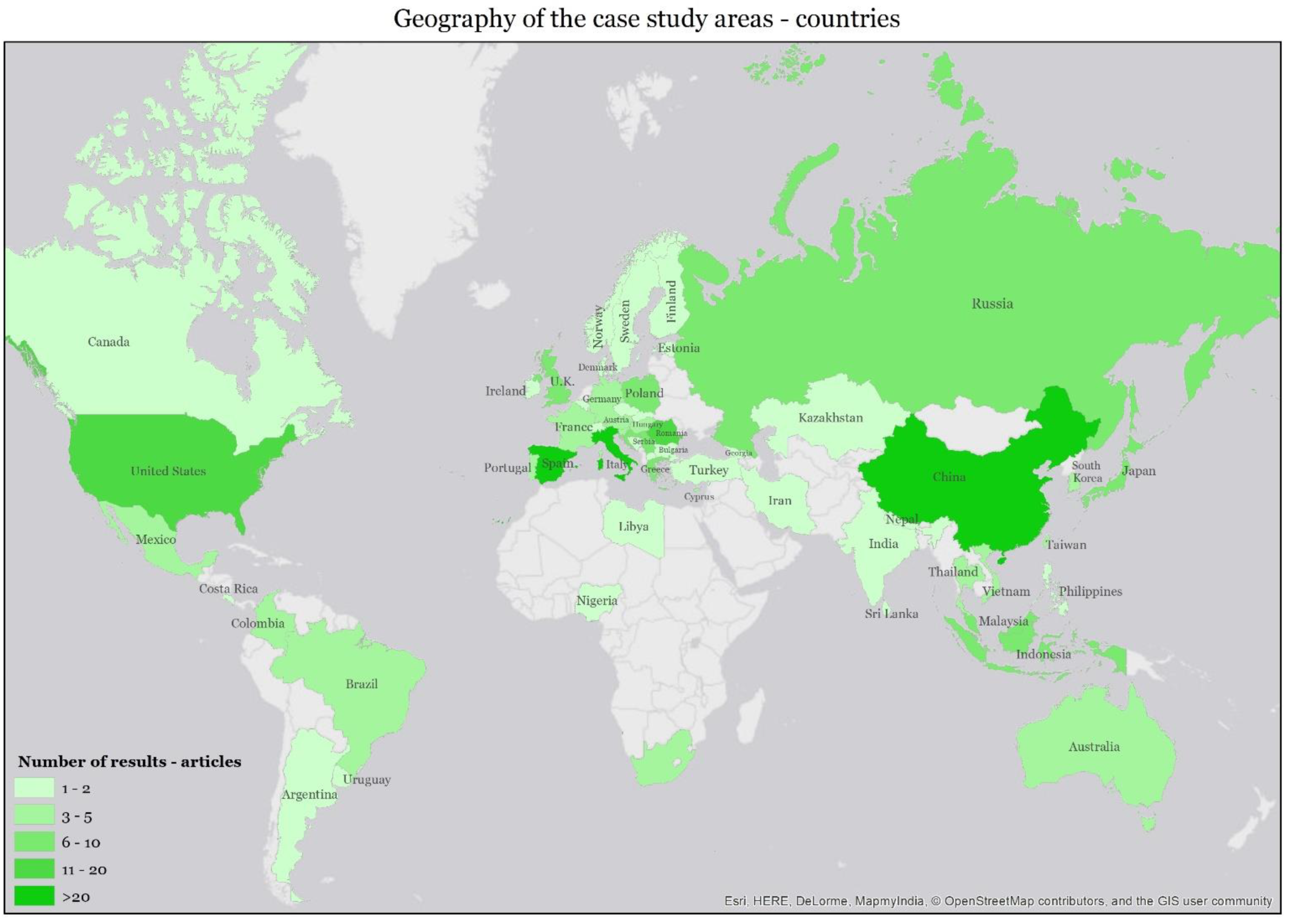
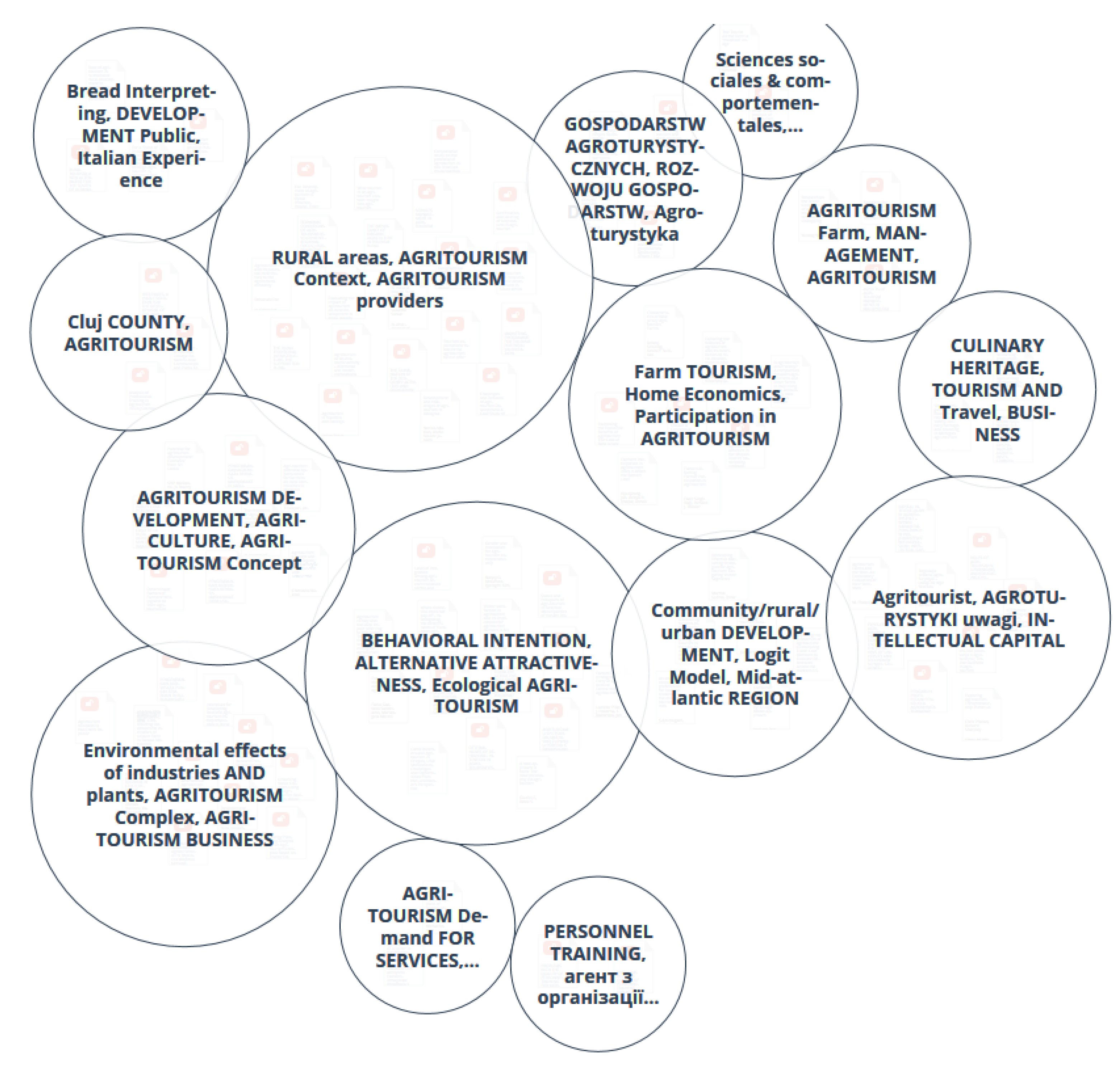

| Keywords in Categories | Number of Results (N) | Total Percentage (%) |
|---|---|---|
| Form(s) of tourism | 1923 | 24.8 |
| Countries/regions/geographic position-characteristics | 1692 | 21.8 |
| Tourism management and development | 886 | 11.4 |
| “New trend” keywords | 593 | 7.6 |
| Economics | 534 | 6.9 |
| Sustainability | 428 | 5.5 |
| Rural/regional development | 361 | 4.7 |
| Agriculture | 226 | 2.9 |
| Methods | 214 | 2.8 |
| Environment/ecology | 176 | 2.3 |
| Planning and land use | 158 | 2.0 |
| Cultural heritage | 141 | 1.8 |
| Community | 122 | 1.6 |
| Governance | 96 | 1.2 |
| Farm | 80 | 1.0 |
| Landscape | 79 | 1.0 |
| Recreation | 53 | 0.7 |
| Total | 7,762 | 100 |
| Scientific Journals | Number of Results (N) |
|---|---|
| Tourism Management | 75 |
| Sustainability (Switzerland) | 71 |
| Journal of Sustainable Tourism | 67 |
| Tourism Geographies | 34 |
| Annals of Tourism Research | 32 |
| Iop Conference Series Earth and Environmental Science | 31 |
| Current Issues in Tourism | 29 |
| Journal of Travel Research | 29 |
| Wit Transactions on Ecology and the Environment | 27 |
| International Journal of Tourism Research | 24 |
| Quality Access to Success | 24 |
| WorldWide Hospitality and Tourism Themes | 23 |
| Tourism Economics | 22 |
| Total | 488 |
| Country of Authors’ Affiliation | Number of Results (N) |
|---|---|
| China | 258 |
| United States | 255 |
| Spain | 206 |
| United Kingdom | 161 |
| Italy | 130 |
| Romania | 114 |
| Malaysia | 105 |
| Poland | 80 |
| Australia | 69 |
| Portugal | 69 |
| Indonesia | 62 |
| Canada | 61 |
| France | 51 |
| Greece | 51 |
| Total | 1672 |
| Keywords | Number of Results (N) | Total Percentage (%) | |
|---|---|---|---|
| 1 | Economy | 142 | 13.9 |
| Society | 214 | 21.0 | |
| Environment | 124 | 12.2 | |
| 2 | Sustainable Development | 56 | 5.5 |
| Sustainability | 79 | 7.8 | |
| Local Development | 9 | 0.9 | |
| 3 | Supply | 199 | 19.5 |
| Demand | 120 | 11.8 | |
| Residents | 59 | 5.8 | |
| 4 | Policy recommendations | 17 | 1.7 |
| Total | 1019 | 100 | |
| 5 | Qualitative methods | 184 | 56.3 |
| Quantitative methods | 143 | 43.7 | |
| Total | 327 | 100 | |
| Theme/Sub-Theme | Most Important Issue(s) Presented | Most Important Findings |
|---|---|---|
| Economy |
|
|
| Society |
|
|
| Environment |
|
|
| Sustainability |
|
|
| Sustainable development |
|
|
| Local development |
|
|
Publisher’s Note: MDPI stays neutral with regard to jurisdictional claims in published maps and institutional affiliations. |
© 2021 by the authors. Licensee MDPI, Basel, Switzerland. This article is an open access article distributed under the terms and conditions of the Creative Commons Attribution (CC BY) license (https://creativecommons.org/licenses/by/4.0/).
Share and Cite
Karampela, S.; Andreopoulos, A.; Koutsouris, A. “Agro”, “Agri”, or “Rural”: The Different Viewpoints of Tourism Research Combined with Sustainability and Sustainable Development. Sustainability 2021, 13, 9550. https://doi.org/10.3390/su13179550
Karampela S, Andreopoulos A, Koutsouris A. “Agro”, “Agri”, or “Rural”: The Different Viewpoints of Tourism Research Combined with Sustainability and Sustainable Development. Sustainability. 2021; 13(17):9550. https://doi.org/10.3390/su13179550
Chicago/Turabian StyleKarampela, Sofia, Alexis Andreopoulos, and Alex Koutsouris. 2021. "“Agro”, “Agri”, or “Rural”: The Different Viewpoints of Tourism Research Combined with Sustainability and Sustainable Development" Sustainability 13, no. 17: 9550. https://doi.org/10.3390/su13179550
APA StyleKarampela, S., Andreopoulos, A., & Koutsouris, A. (2021). “Agro”, “Agri”, or “Rural”: The Different Viewpoints of Tourism Research Combined with Sustainability and Sustainable Development. Sustainability, 13(17), 9550. https://doi.org/10.3390/su13179550

