Sustainable Glass Recycling Culture-Based on Semi-Automatic Glass Bottle Cutter Prototype
 ,
,  , ,
, ,  and
and 
Abstract
1. Introduction
1.1. Glass Recycling Insight
- Reduction in raw material extraction: cullet, glass crashed into small pieces through recycling process steps, serves as a substitute for the glass production process. This allows a reduction in raw material extraction [7].
- Save energy: Using cullet in the glass production process reduces energy consumption. It brings energy savings from avoided provision and calcination of raw materials [7]. Cullet has a lower melting point compared to its raw material [8]. When cullet is used in closed-loop cycles, generally, a cullet volume increase of 10% in the glass-making process reduces energy consumption by 2–3% [9]. The Foundation of the Energy of the Community of Madrid (FENERCOM, its acronym in Spanish) mentions that recycling glass saves 32% of energy in the process, and ecovidrio talks about a saving of 38% [10]. A case of cullet recycling in Italy exposed a volume reduction of 318 Mm3 of natural glass.
- Quality conservation: Glass has the benefit of conserving its purity and undergoing no loss of quality when it is recycled [11]. The amount of new glass is the same as the amount of glass used for recycling.
- Waste reduction: Cullet brings a volume reduction in waste in landfills. A glass bottle exposed to the environment takes more than 4000 years to disappear. According to the National Association of Manufacturers of Glass Containers (ANFEVI, its acronym in Spanish), recycling a glass container that has finished its period of life did not increase the volume of Urban Solid Waste (USW) [12].
- Decrements in environmental contaminants: Glass recycling is one technique that positively impacts sustainability since it is possible to reuse this raw material several times. Turning it into an alternative raw material by not losing its quality, which makes it an attractive proposal [13]. According to [14,15], when a glass tone is recycled, 0.58 t of CO is saved, 20% reduces air pollution, and water pollution is cut from 40 to 50% throughout the supply chain. Ecovidrio mentions savings of 53% of CO2 emissions when using cullet versus raw materials. The Italian cullet recycling case proved a reduction of 1.9 Mt of CO while, as a general rule, an increase of 10% of cullet volume decreases CO by 5%. [7].
1.2. The Case of Glass Recycling in Mexico
1.3. Understanding the Project
2. State of the Art
2.1. Integrated Sustainable Waste Management
2.2. The Quintuple Helix Model
2.3. Glass Bottle
2.4. Thermal Shock
2.5. Temperature Control
3. Materials and Methods
3.1. Methodology
- Collecting various and different commercial glass bottles available in the area of study.
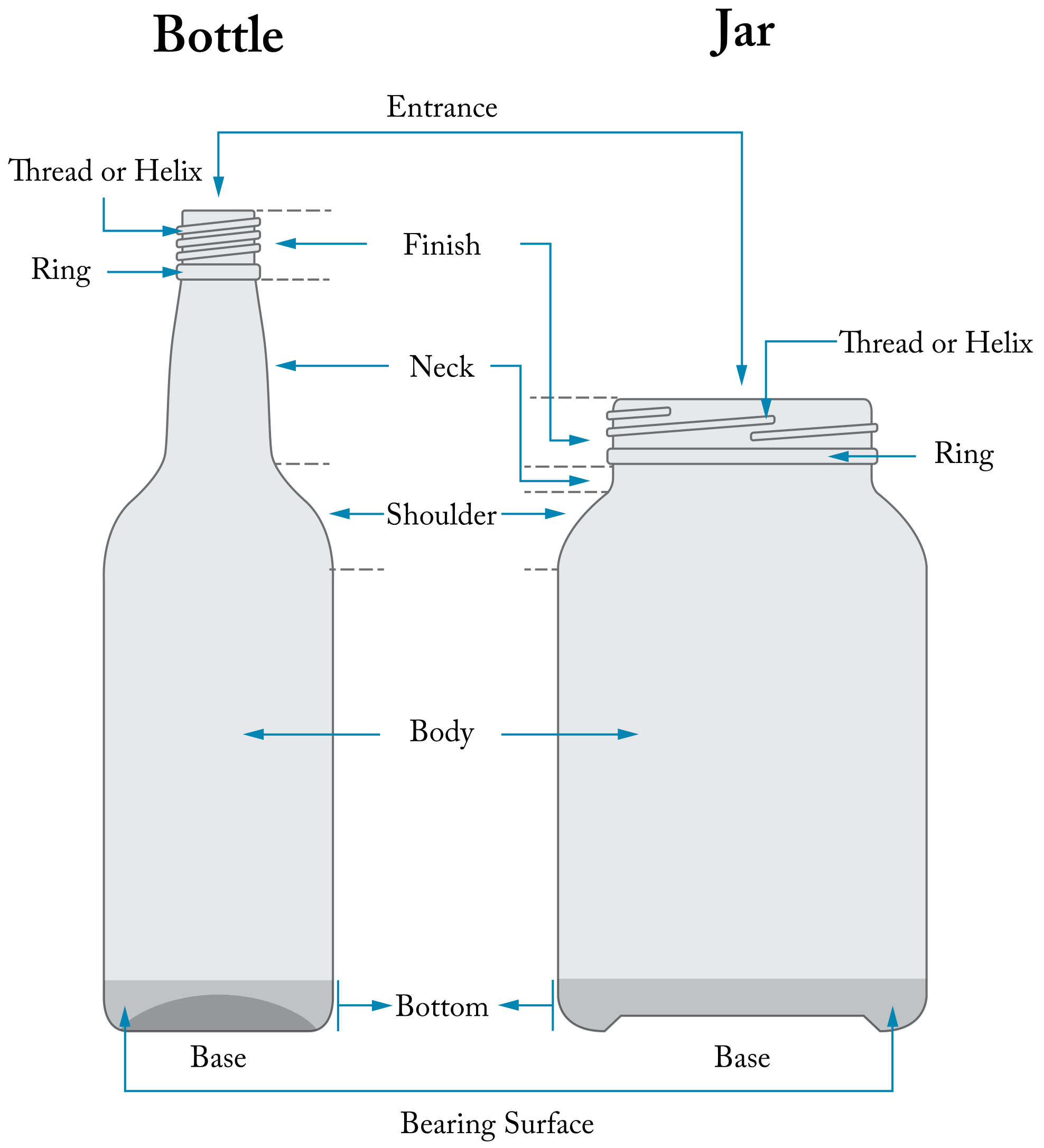
- Using Figure 2 as reference, we acquired the values and data of each bottle:
- Neck diameter: The minimum value of the neck diameter in the bottle. It is recommended to obtain the value immediately down the ring. The neck diameter is used to establish the values for the glass bottle holder. The value for entry is the principal to determine.
- Finish height: The value is the difference between the ring and the entrance. It permits the determination of the value of the height of the space for the glass bottle holder.
- Body diameter: The maximum value of the body diameter is required if the shape is not uniform. It allows us to determine the range for adapting the position of the heating element.
- Bottle height: The value is the difference between the entrance and the base. It lets us establish the maximum height value of the bottle capable of getting cut.
- Color type: The data about the color of the glass are not determinant for prototype design.
- Develop the first design for the prototype structure.
- Use the data obtained from point 2 to establish dimensions of the structure.
- Consider some requirements for a good performance of the structure of the prototype.
- In case the design of the prototype did not consider requirements or can be improved to reach a higher level of accomplishment, the design should be changed or improved.
- Make sure data are obtained by computer for their interpretation.
- Evaluate if the proposed process operates according to expectations.
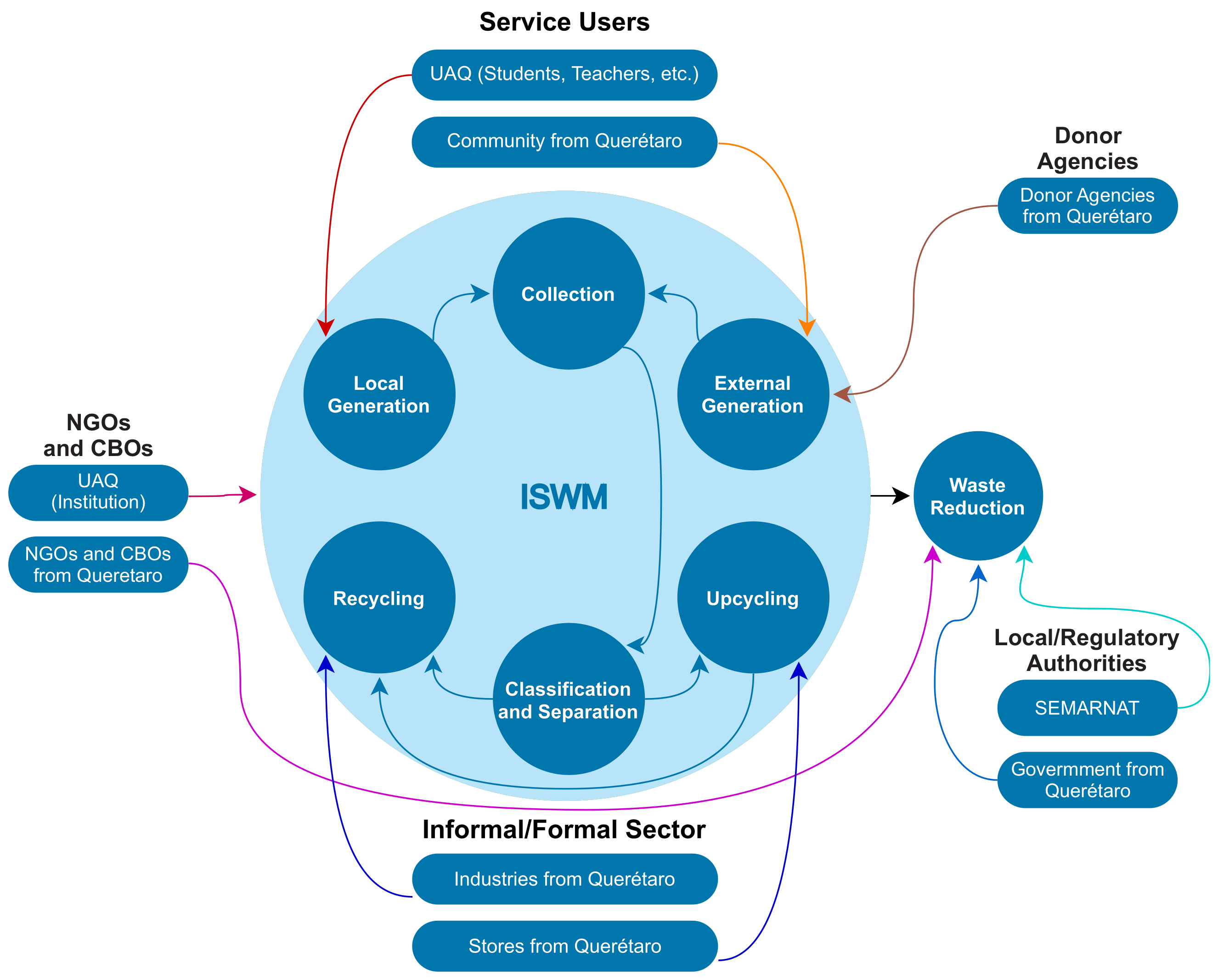
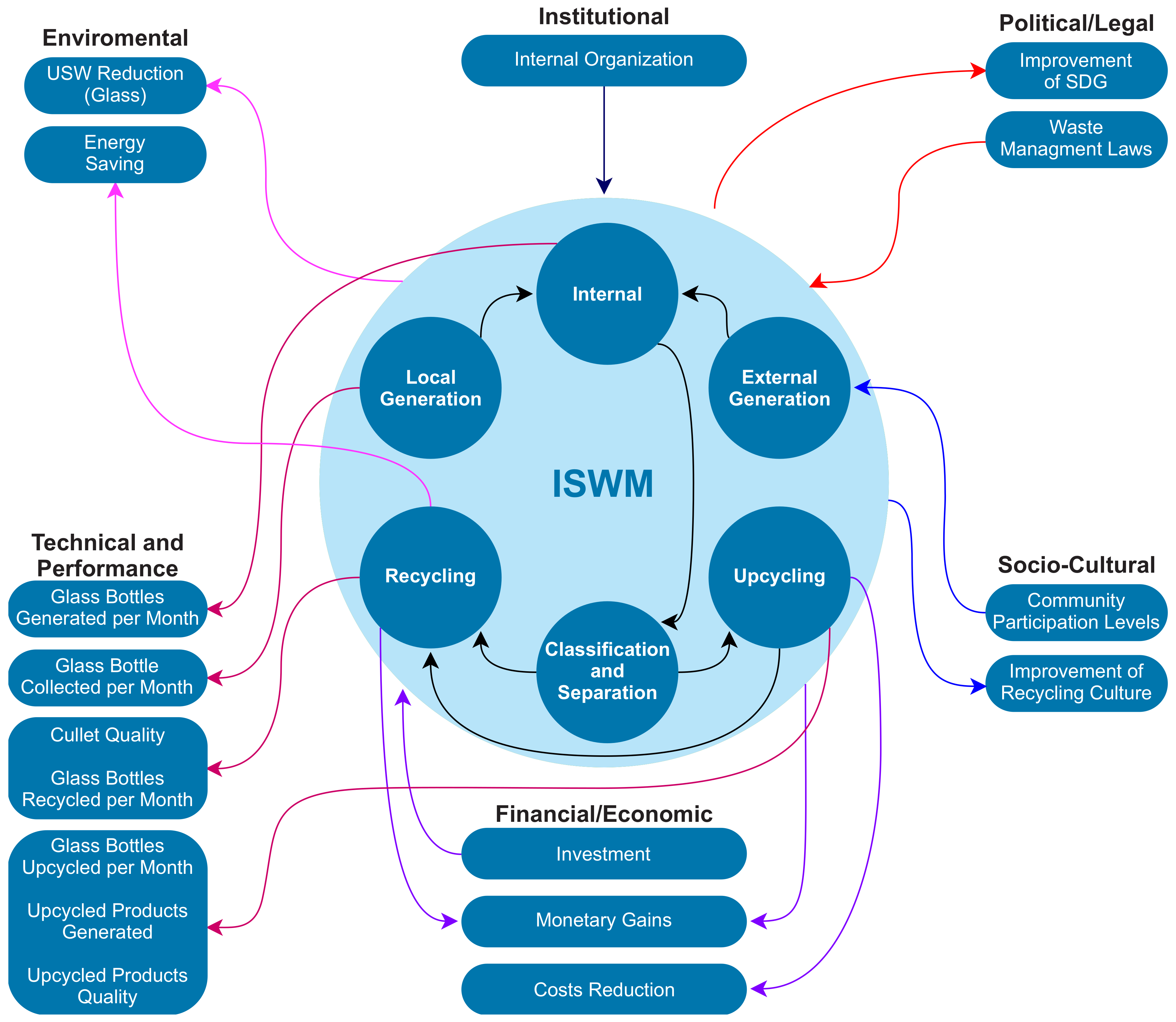
- Using the Faculty of Engineering as the base for the ISWM proposal, analyze all elements (process) for sustainable culture considering glass waste reduction by recycling and upcycling.
- Explain each element, the difficulties involved, the benefits obtained, and the areas needing improvement.
- When the elements are identified, all stakeholders must be detected in their element correspondents. Each element must have at least one stakeholder. One stakeholder can participate in one or more elements.
- Signalize the responsibilities that each stakeholder has in the element.
- Identify all aspects of the ISWM and indicate which element is used.
- Explain the importance of each aspect and how it affects the ISWM.
- Gather the information about elements, stakeholders, and aspects from ISWM.
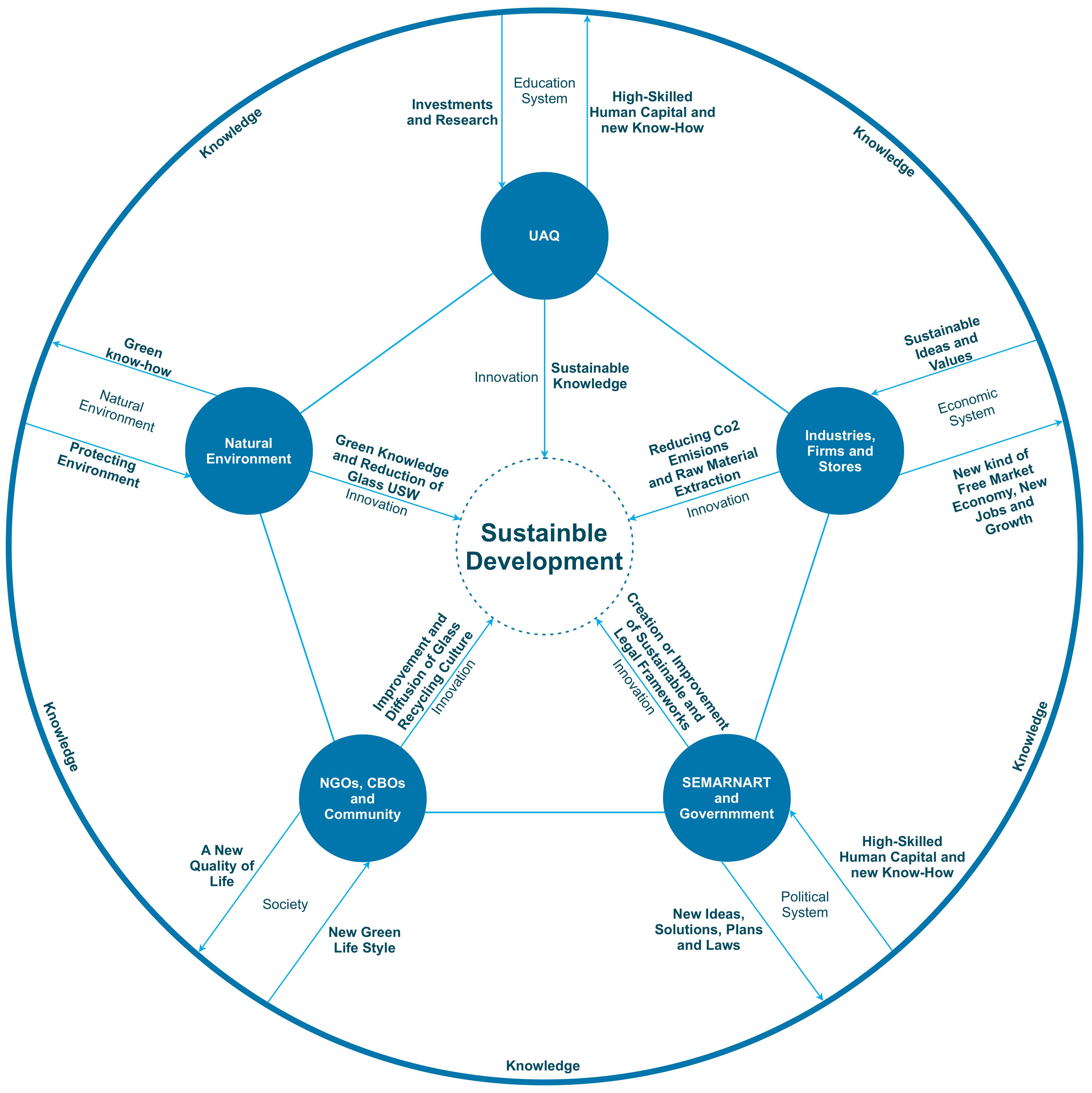
- Elaborate on the Quintuple Helix Model using the ISWM approach as a base.
3.2. Electronic Circuit
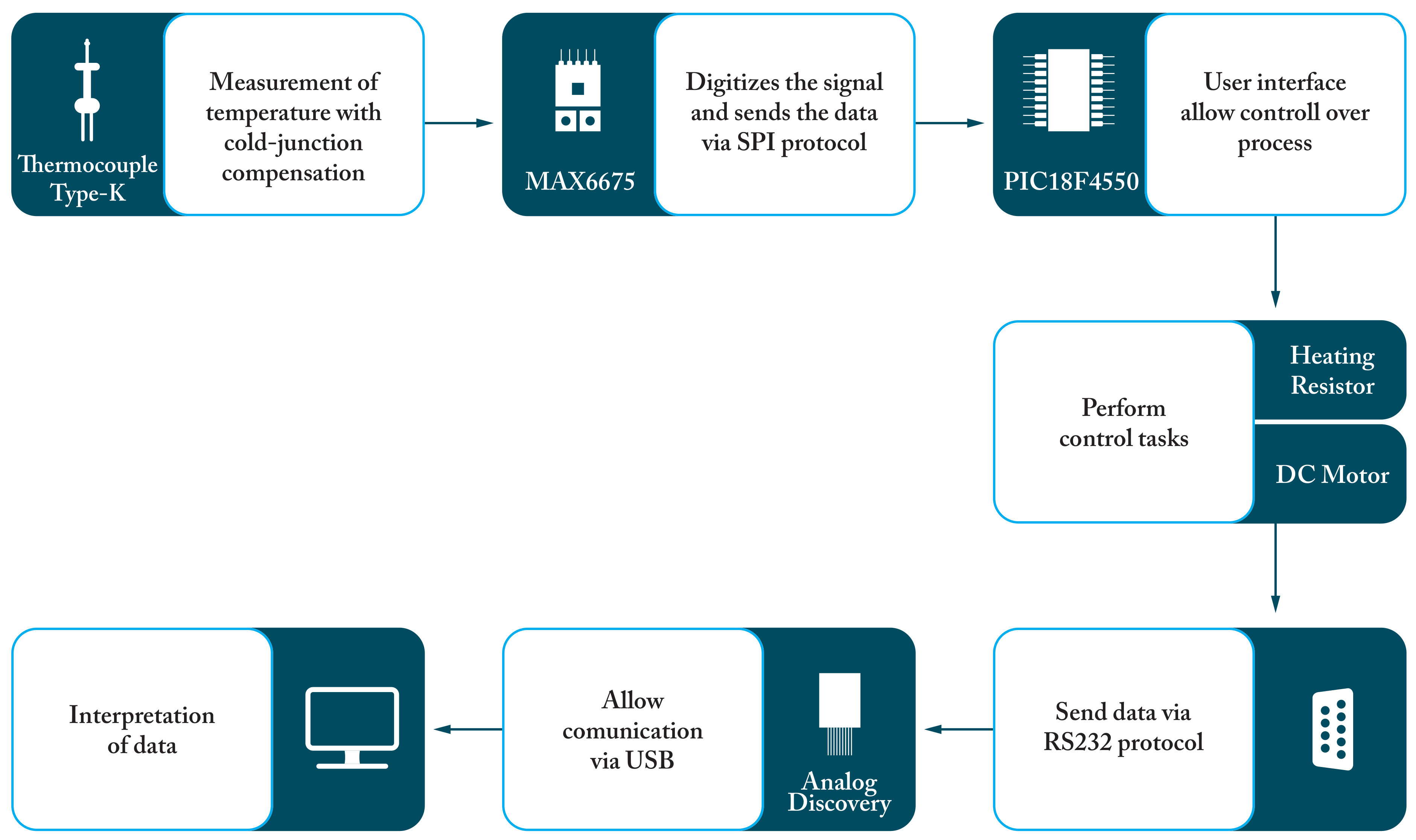
- Obtaining and controlling the temperature present over a heating resistor.
- Varying the velocity present in a DC motor.
- Sending data to a computer for their interpretation.
3.3. Structure
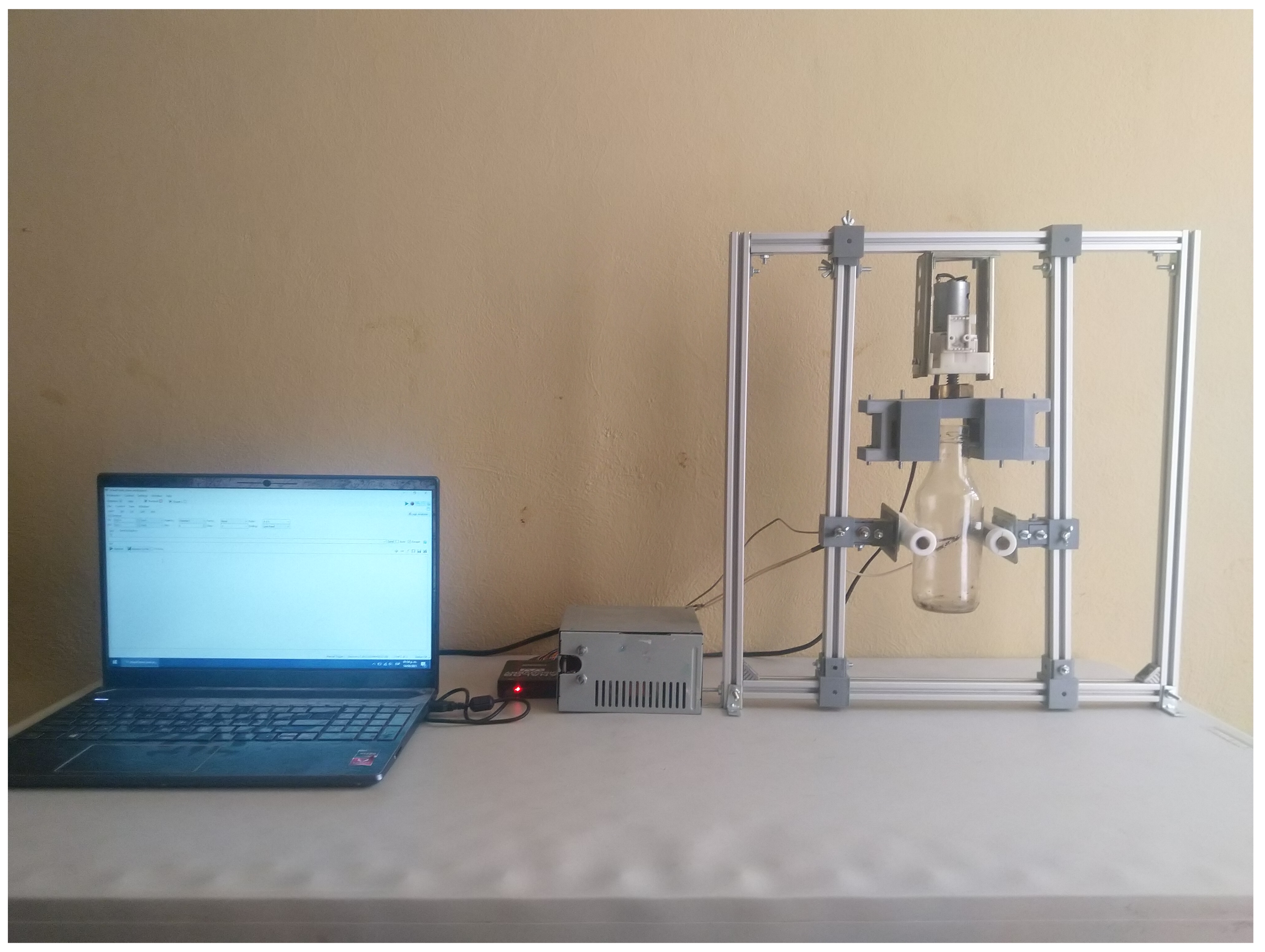
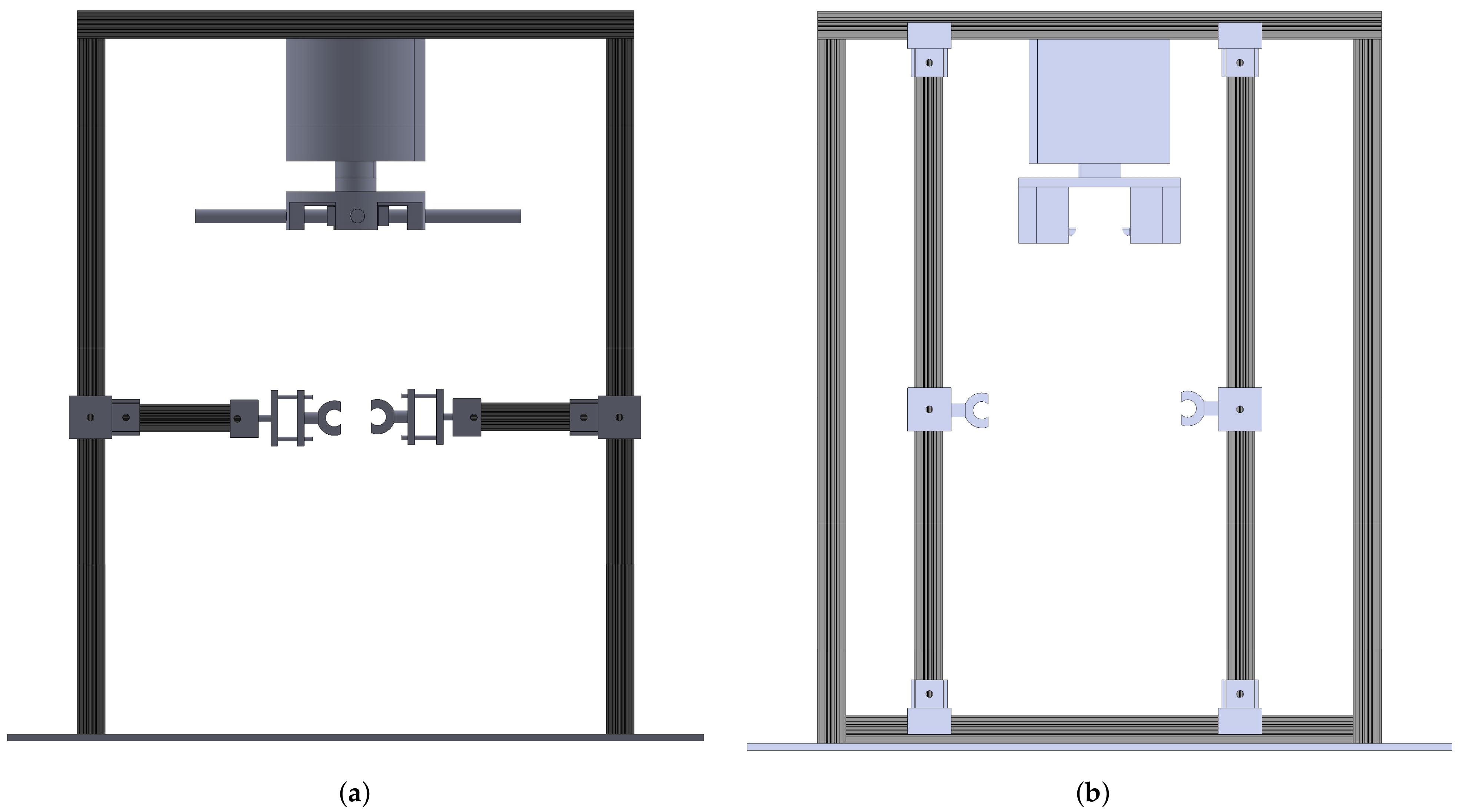
- Support structure: this is the principal structure in charge of keeping the prototype stable.
- Heating resistor holder: it has to hold the heating elements to perform the cut over the bottle.
- Glass bottle holder: the most important part, it needs to keep stable the glass bottle during the cutting process.
4. Results
4.1. Structure of Prototype: Design and Performance
- The grab of the glass bottle holder is not stable enough and was difficult to use.
- Despite the holder adapting correctly to the neck diameter, its design may be improved.
- Adjusting the heating element took more time than expected.
- The support structure is not as stable as desired.
- The movement of heating element holders now is horizontal and requires vertical support. The previous design considered a horizontal axis for its movement. It was deformed due to the weight of the heating element and its holders.
- The new design considers a faster and smooth horizontal movement.
- The glass bottle holder is now designed for its adaptation with only the neck width. The new design is more compact.
- The grab of the bottle, while it is rotating, is more stable.
- The heating element holder uses Bosch aluminum profile and polytetrafluoroethylene (PTFE) bar. Due to their characteristics, these materials are not ignited when high temperatures are reached. The PTFE also avoids electrical current flowing to the prototype structure.
4.2. ISWM and the Quintuple Helix Model: Proposal and Analysis
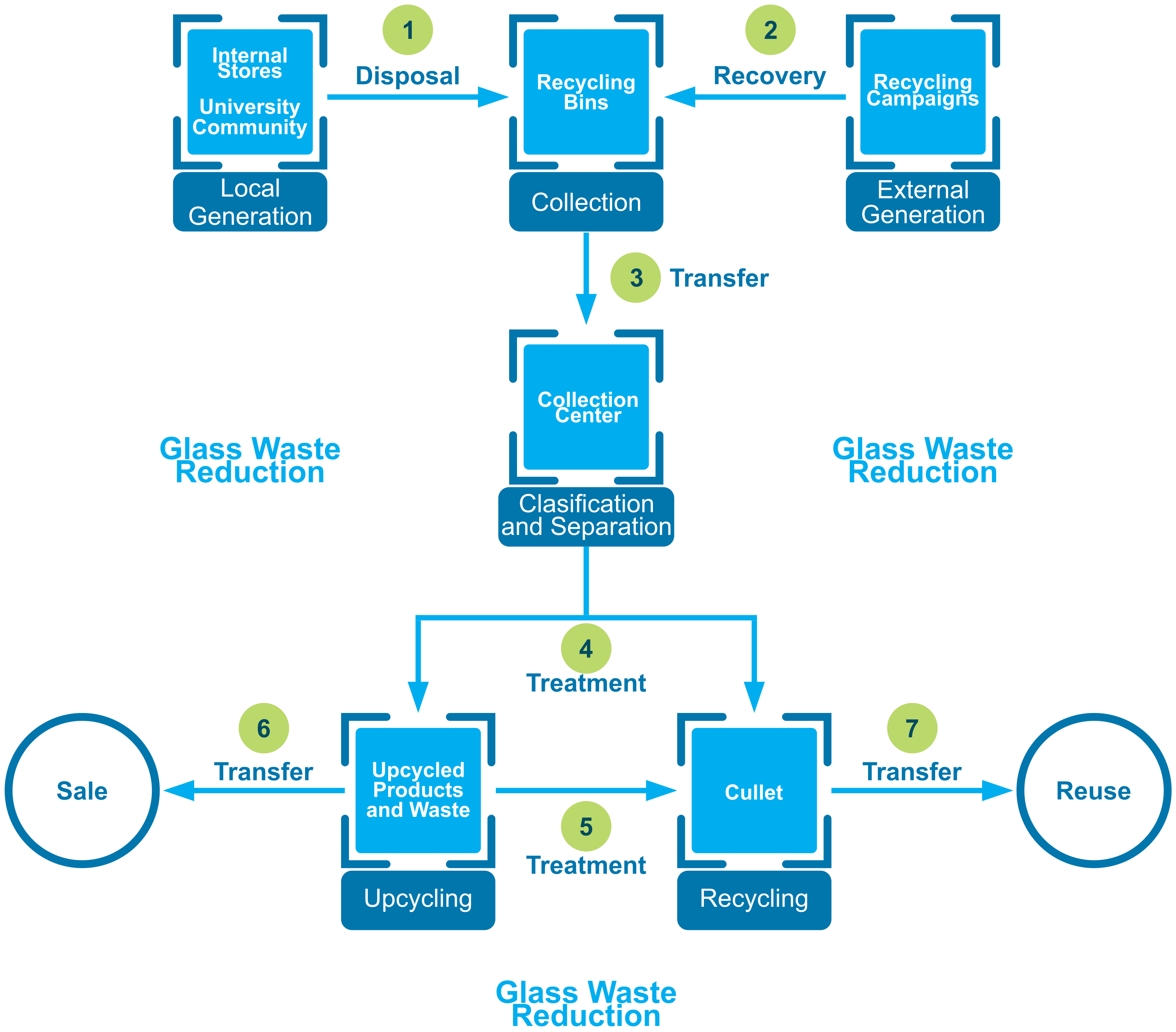
- The objects obtained from glass container upcycling acquire a new value. This means the extension of their life cycle and the creation of new jobs.
- The glass leftover from upcycling is reincorporated in the recycling process as material for obtaining cullet. No glass waste must be generated.
- When glass bottles turn into cullet, a volume reduction is produced. Obtaining cullet before transportation saves transport costs.
- Local generation and external generation: These served as input processes and represented the first step to reduce glass waste. Local generation depends on the participation of UAQ users. Inside and around UAQ installations, some stores sell everyday products packed in glass bottles. External generation depends on community participation from Querétaro and requires advertising campaigns to encourage people to participate.
- Collection: This element aims to gather all glass waste from local generation and external generation elements. The collection does not mix glass waste.
- Classification and separation: The recollection task aims to gather glass containers and keep them in good condition. The classification task helps to verify the state of these and decide which treatment and process are required.
- Upcycling and recycling: The upcycling process requires this project for its execution. Glass bottles in a good state are recommended for upcycling. All waste that cannot be used for an upcycled product is used to recycle for cullet generation.
- Sale and reuse: Upcycled products represent an opportunity for their sale. The generated cullet represents an opportunity for reuse.
- Disposal: In FI installations, the containers for this task also have other waste. Due to their limited size, when trash recollection bins are full, students use recycling bins to deposit all kinds of waste. It carries to a bad collection process. Effective promotion, provision, and availability of recycling bins and their design (lids, insert lots, shape, and size) can increase participation and success [43]. It represents an improvement area. If glass bottles are damaged when disposed, they are no longer used for upcycling.
- Recovery: External generation origins are recycling campaigns, and some containers are required to dispose of glass waste obtained. It is recommended to have recycling bins that consider classifying the glass waste by color.
- Transfer (3): This activity requires not damaging the glass bottles for upcycling and not mixing the glass waste classified by color.
- Treatment (4): It aims to prepare the glass bottles for upcycling or recycling. If the glass bottle surface is in a perfect state, but with impurities inside or over it, a treatment process must be carried out to guarantee a good cutting process. Different treatments must be carried out to ensure high-quality cullet if the glass bottle or waste is not in a perfect state or presents impurities.
- Treatment (5): It is the same case as Treatment (4). The waste produced by upcycling requires treatment in case new impurities appear.
- Transfer (6): Due to upcycled products obtaining new values, and it is required to keep them in good condition to succeed in their sale.
- Transfer (7): The cullet obtained must conserve its quality during its transfer. If new contaminants mix with the cullet, it affects the process that uses this cullet.
4.3. New Opportunities
- Introduce glass recycling and upcycling as an opportunity to reduce USW;
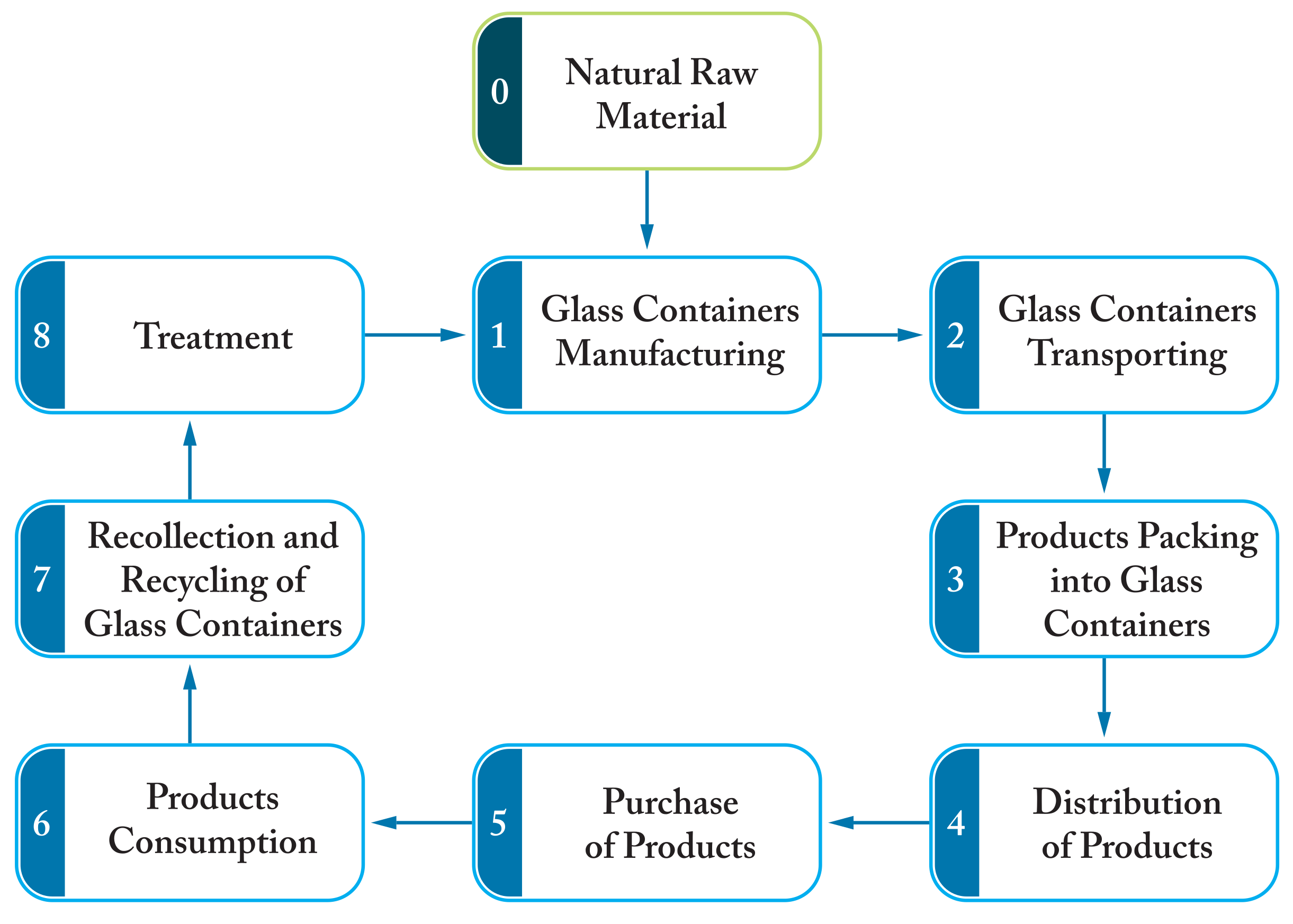
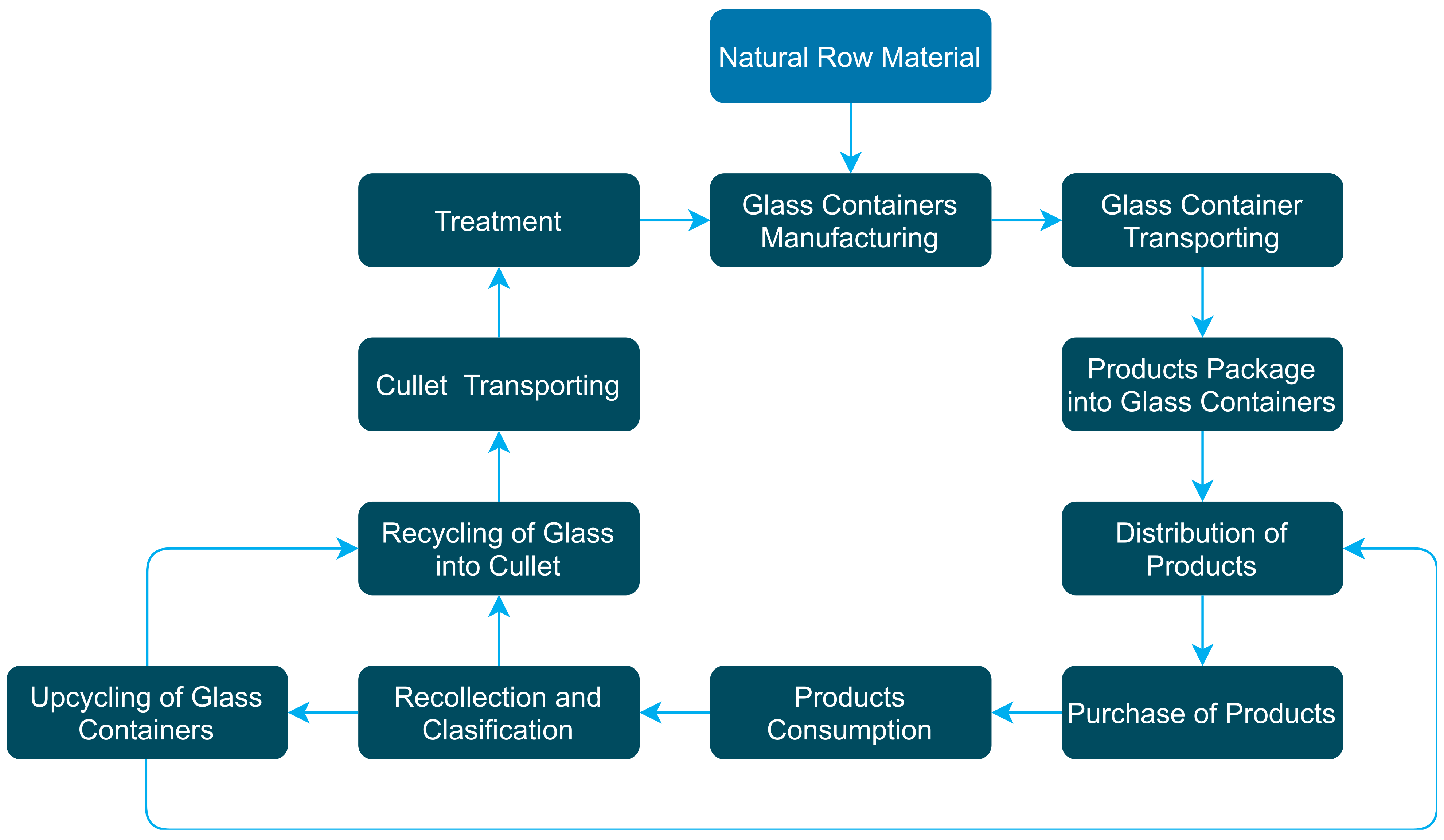
- Exhibit the proposed integral glass recycling process and its benefits, see Figure 7;
- Present this project as an opportunity to reduce glass waste and create jobs;
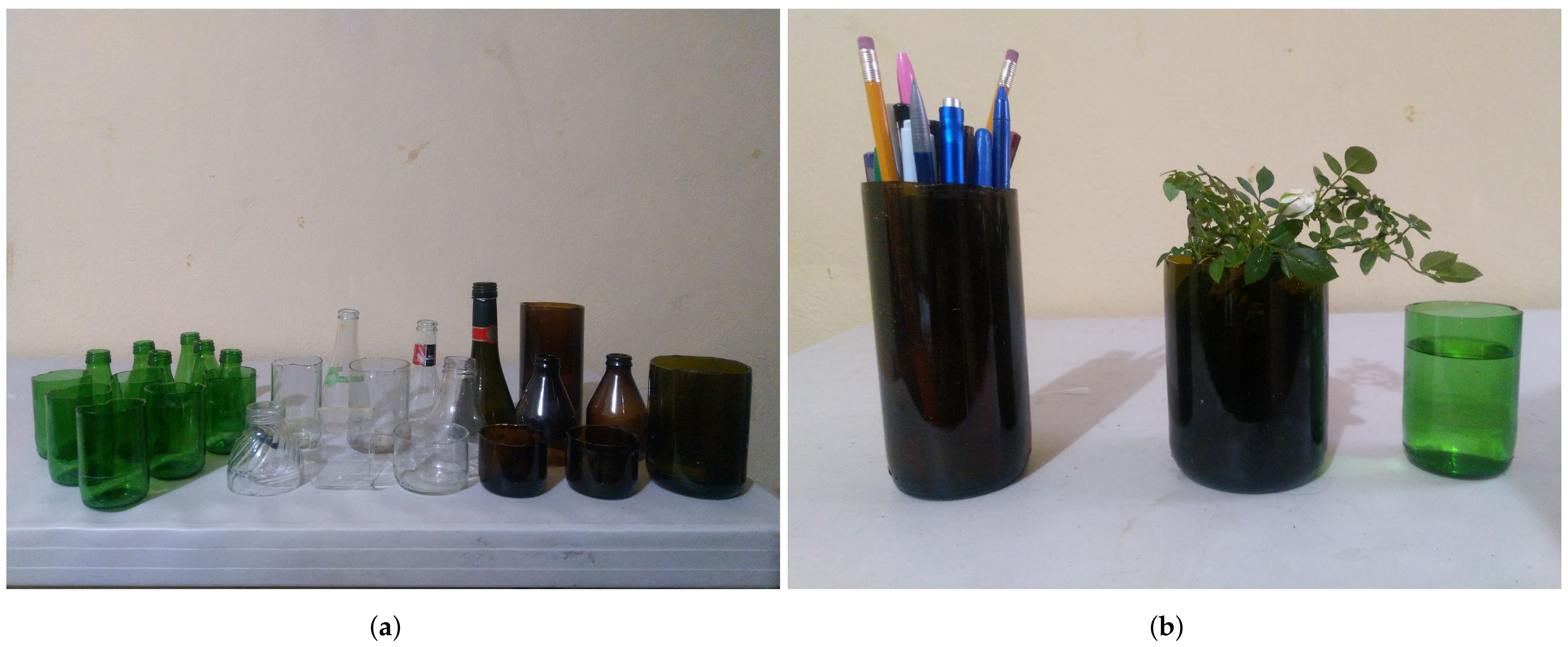
- Introduce examples of products obtained by upcycling glass bottles;
- Promote sustainable practices for reducing, recycling, and reusing glass bottles;
- The society is invited to join various projects, solve problems in the community and disseminate what has been carried out to meet the objectives.
- The private initiative strengthens alliances and certifies and participates in meeting the sustainable development objectives.
- The academy strengthens research collaboratively to create innovative solutions and measure the impact.
- The government improves the use and application of public resources and generates effective alliances in a participatory model to meet the SDGs.
5. Conclusions
Author Contributions
Funding
Institutional Review Board Statement
Informed Consent Statement
Data Availability Statement
Acknowledgments
Conflicts of Interest
Appendix A
Appendix A.1. USW Tables

| Type of USW | 2012 | 2017 | ||
|---|---|---|---|---|
| Percentage | kt | Percentage | kt | |
| Organic waste | 52.4 | 22,060 | 51.6 | 23,043 |
| Paper, cardboard and paper products | 13.8 | 5810 | 14.2 | 6338 |
| Others 1 | 12.1 | 5094 | 12 | 5350 |
| Plastics | 10.9 | 4589 | 11 | 4929 |
| Glass | 5.9 | 2484 | 6.1 | 2718 |
| Aluminum | 1.7 | 716 | 1.8 | 798 |
| Textile | 1.4 | 589 | 1.4 | 642 |
| Ferrous metals | 1.1 | 463 | 1.2 | 522 |
| Other non-ferrous metals | 0.6 | 253 | 0.7 | 307 |
| Total | 100 | 42,058 | 100 | 44,647 |
| Type of USW | 2012 | 2016 | ||
|---|---|---|---|---|
| Percentage | kg/day | Percentage | kg/day | |
| Paper, cardboard and paper products | 32 | 143,187 | 28.3 | 21,746 |
| Others 1 | 16.6 | 74,364 | 4.3 | 3274 |
| PET | 15.8 | 70,798 | 22.2 | 17,044 |
| Glass | 13.8 | 62,052 | 18.5 | 14,188 |
| Plastic | 9.2 | 41,115 | 10.3 | 7880 |
| Electronics and domestic appliances | 5.1 | 22,842 | 2.3 | 1788 |
| Iron, sheet and steel | 4.9 | 21,868 | 10 | 7652 |
| Aluminum | 1.4 | 6129 | 2.5 | 1950 |
| Copper, bronze and lead | 1.2 | 5710 | 1.8 | 1346 |
| Total | 100 | 448,065 | 100 | 76,868 |
| Country | 2012 | 2014 | 2016 | 2018 |
|---|---|---|---|---|
| Australia | 32 | 30 | 28 | - |
| Austria | 25 | 26 | 26 | 26 |
| Belgium | 33 | 33 | 33 | 34 |
| Czech Republic | 21 | 23 | 27 | 23 |
| Denmark | 27 | 28 | 30 | 32 |
| Estonia | 18 | 29 | 28 | 26 |
| Finland | 22 | 18 | 29 | 29 |
| France | 21 | 22 | 23 | 25 |
| Germany | 46 | 48 | 49 | 49 |
| Greece | 14 | 12 | 14 | 15 |
| Hungary | 21 | 25 | 27 | 29 |
| Iceland | 24 | 21 | 26 | - |
| Ireland | 34 | 34 | 34 | 30 |
| Italy | 25 | 27 | 30 | 32 |
| Japan | 20 | 21 | 20 | 20 |
| Korea | 58 | 58 | 59 | 64 |
| Lithuania | 20 | 21 | 26 | 27 |
| Luxembourg | 28 | 28 | 29 | 30 |
| Mexico | - | - | - | - |
| The Netherlands | 24 | 24 | 26 | 27 |
| Norway | 26 | 26 | 28 | 31 |
| Poland | 13 | 21 | 28 | 26 |
| Portugal | 12 | 16 | 15 | 13 |
| Slovak Republic | 8 | 5 | 16 | 17 |
| Slovenia | 38 | 30 | 48 | 54 |
| Spain | 20 | 17 | 18 | 18 |
| Sweden | 32 | 33 | 32 | 30 |
| Switzerland | 35 | 33 | 31 | 31 |
| Turkey | - | - | 9 | 12 |
| United Kingdom | 27 | 27 | 27 | 27 |
| United States | 26 | 26 | 26 | 25 |
References
- Van Beukering, P. Recycling, International Trade and the Environment; Kluwer Academic Publishers: Dordrecht, The Netherlands, 2018; pp. 83–90. [Google Scholar]
- Zhao, H.; Li, Q.; Liu, S.; Gan, F. Characterization of microcrystals in some ancient glass beads from china by means of confocal Raman microspectroscopy. J. Raman Spectrosc. 2013, 44, 643–649. [Google Scholar] [CrossRef]
- Medina, M. Reciclaje de desechos sólidos en América Latina. Front. Norte 1999, 11, 1–25. [Google Scholar]
- Mohajerani, A.; Vajna, J.; Cheung, T.H.H.; Kurmus, H.; Arulrajah, A.; Horpibulsuk, S. Practical recycling applications of crushed waste glass in construction materials: A review. Constr. Build. Mater. 2017, 156, 443–467. [Google Scholar] [CrossRef]
- Lin, K.Y. User experience-based product design for smart production to empower industry 4.0 in the glass recycling circular economy. Comput. Ind. Eng. 2018, 125, 729–738. [Google Scholar] [CrossRef]
- Ibrahim, S.; Meawad, A. Assessment of waste packaging glass bottles as supplementary cementitious materials. Constr. Build. Mater. 2018, 182, 451–458. [Google Scholar] [CrossRef]
- Larsen, A.W.; Merrild, H.; Christensen, T.H. Recycling of glass: Accounting of greenhouse gases and global warming contributions. Waste Manag. Res. 2009, 27, 754–762. [Google Scholar] [CrossRef] [PubMed]
- Alba Ingenieros, S. La Energía de los Residuos. 2012. Available online: https://www.fenercom.com/publicacion/la-energia-de-los-residuos/ (accessed on 31 January 2021).
- Testa, O.M.M.; Rosaria-Sessa, S.S.M.; Sica, D. Long-Term Sustainability from the Perspective of Cullet Recycling in the Container Glass Industry: Evidence from Italy. Sustainability 2017, 9, 1752. [Google Scholar] [CrossRef]
- ecovidrio. Medio Ambiente y Desarrollo Sostenible. Available online: https://www.ecovidrio.es/reciclaje/medioambiente (accessed on 1 February 2021).
- Sudharsan, N.; Palanisamy, T.; Subhash, C.Y. Environmental sustainability of waste glass as a valuable construction material-A critical review. Ecol. Environ. Conser. 2018, 24, S331–S338. [Google Scholar]
- ANFEVI. Reciclado. Available online: http://www.anfevi.com/el-envase-de-vidrio/reciclado/ (accessed on 29 January 2021).
- Cocking, R. The challenge for glass recycling. Sustainable Waste Management. In Proceedings of the International Symposium, University of Dundee, Scotland, UK, 9–11 September 2003; pp. 73–78. [Google Scholar]
- FEVE. Facts & Product Details. Available online: https://feve.org/about-glass/facts-product-details/ (accessed on 1 February 2021).
- Sarkis, C.J.L.; Raich, O.M.; Mestre, J.L.Z. Assessment of the temperature of waterproofing membrane when a recycled crushed glass finish layer is used on flat roofs to protect from sun radiance. Energy Procedia 2017, 115, 451–462. [Google Scholar] [CrossRef]
- SEMARNAT. Residuos. In Informe de la Situación del Medio Ambiente en México; 2015; Available online: https://apps1.semarnat.gob.mx:8443/dgeia/informe15/tema/cap7.html (accessed on 1 June 2021).
- SEMARNAT. Informe del Medio Ambiente, 2018, Capitulo 7 Residuos. Available online: https://apps1.semarnat.gob.mx:8443/dgeia/informe18/tema/cap7.html (accessed on 31 January 2021).
- SEMARNAT. Compra Venta de Chatarra y Reciclados por Kilogramos. Available online: https://www.supraciclaje.com/precios-hoy/ (accessed on 29 January 2021).
- Cerrando el Ciclo. Nosotros. Available online: www.cerrandoelciclo.org/nosotros.html (accessed on 25 October 2019).
- Instituto Nacional de Estadística y Geografía (INEGI). Censo Nacional de Gobiernos Municipales y Delegacionales 2017. Available online: https://www.inegi.org.mx/programas/cngmd/2017/#Tabulados (accessed on 25 February 2021).
- Organisation for Economic Co-Operation and Development (OECD). Municipal Waste, Generation and Treatment. Available online: https://stats.oecd.org/Index.aspx?DataSetCode=MUNW (accessed on 25 February 2021).
- Keitsch, M. Structuring ethical interpretations of the sustainable development goals-Concepts, implications and progress. Sustainability 2018, 10, 829. [Google Scholar] [CrossRef]
- United Nations. Transforming Our World: The 2030 Agenda for Sustainable Development. Available online: https://sdgs.un.org/2030agenda (accessed on 16 March 2021).
- United Nations. THE 17 GOALS. Available online: https://sdgs.un.org/es/goals (accessed on 16 March 2021).
- SEMARNAT. Objetivos de Desarrollo Sostenible, 17 Compromisos Alcanzables para Casi 200 Naciones. Available online: https://www.gob.mx/semarnat/articulos/objetivos-de-desarrollo-sostenible-17-compromisos-alcanzables-para-casi-200-naciones?idiom=es (accessed on 16 March 2021).
- SEMARNAT. Sistema de Información de los Objetivos de Desarrollo Sostenible. Available online: http://agenda2030.mx (accessed on 16 March 2021).
- Soler-Costa, R.; Moreno-Guerrero, A.J.; López-Belmonte, J.; Marín-Marín, J.A. Co-Word Analysis and Academic Performance of the Term TPACK in Web of Science. Sustainability 2021, 13, 1481. [Google Scholar] [CrossRef]
- Wegener, C. Upcycling—A new perspective on waste in social innovation. J. Comp. Soc. Work. 2016, 11, 242–260. [Google Scholar] [CrossRef]
- Hoornweb, P.B.T.D. What A Waste. A Global Review of Solid Waste Management; Urban Development Series Knowledge Papers; The World Bank: Washington, DC, USA, 2012; Volume 15. [Google Scholar]
- Carayanis, E.; Campbell, D.F.J. Triple Helix, Quadruple Helix and Quintuple Helix and How Do Knowledge, Innovation and the Environment Relate to Each Other? Int. J. Soc. Ecol. Sustain. Dev. 2010, 1, 41–69. [Google Scholar] [CrossRef]
- Elias, G.; Carayannis, T.D.B.; Campbell, D.F.J. The Quintuple Helix innovation model: Global warming as a challenge and driver for innovation. J. Innov. Entrep. 2012, 1, 1–12. [Google Scholar] [CrossRef]
- Ecoembes. In La correcta Especificación de los Envases; Available online: https://www.studocu.com/es-mx/document/universidad-tecmilenio/procesos-de-manufactura/practicas/la-correcta-especificacion-de-los-envases-copia/8646498/view (accessed on 1 June 2021).
- Instituto de Ecología del Estado, Dirección de Mejoramiento Ambiental, C.d.M.I.d.R. Manual para la Implementación 3rR´s, Aprovechamiento de Residuos Urbanos, 1st ed.; Coordinación de Manejo Integral de Residuos: Salamanca, Mexico, 2007; pp. 5–13.
- Röben, E. El Reciclaje, Oportunidades Para Reducir la Generación de los Desechos Sólidos y Reintegrar Materiales Recuperables en el Círculo Económico, 1st ed.; DED Ecuador: Loja, Ecuador, 2003. [Google Scholar]
- Rendtorff, L.B.N.; Garrido, E.A. Choque Térmico de Materiales Refractarios: Comportamiento, Evaluación y Ensayos. Ceram. Cristal. 2007, 129, 181. [Google Scholar]
- Hernández-Gaviño, R. Introducción a los Sistemas de Control: Conceptos, Aplicaciones y Simulación con MATLAB, 1st ed.; Prentice Hall: Estado de Mexico, México, 2010. [Google Scholar]
- Alberto-Pérez, M.; Pérez-Hidalgo, A.; Perez Berenguer, E. Introducción a los Sistemas de Control y Modelo Matemático para Sistemas Lineales Invariantes en el Tiempo; Universidad Nacional de San Juan: San Juan, Argentina, 2008. [Google Scholar]
- Jiménez-Ceciliano, P.J. Concepts and Implementation of PID Controllers in a Smelting Furnace Steel, edición especial movilidad estudiantil ed.; Tecnología en Marcha; Tecnología en Marcha: Cartago, Costa Rica, 2014. [Google Scholar]
- Odry, Á.; Kecskes, I.; Sarcevic, P.; Vizvari, Z.; Toth, A.; Odry, P. A novel fuzzy-adaptive extended kalman filter for real-time attitude estimation of mobile robots. Sensors 2020, 20, 803. [Google Scholar] [CrossRef]
- Kecskés, I.; Burkus, E.; Király, Z.; Odry, Á.; Odry, P. Competition of motor controllers using a simplified robot leg: Pid vs. fuzzy logic. In Proceedings of the 2017 Fourth International Conference on Mathematics and Computers in Sciences and in Industry (MCSI), Corfu, Greece, 24–27 August 2017; pp. 37–43. [Google Scholar]
- Odry, À.; Fullér, R. Comparison of optimized PID and fuzzy control strategies on a mobile pendulum robot. In Proceedings of the 2018 IEEE 12th International Symposium on Applied Computational Intelligence and Informatics (SACI), Timisoara, Romania, 17–19 May 2018; pp. 000207–000212. [Google Scholar]
- Valenti, M.T.I.C. Implementing a PID Controller Using a PIC18 MCU. Available online: http://ww1.microchip.com/downloads/en/Appnotes/00937a.pdf (accessed on 1 June 2021).
- Keramitsoglou, K.M.; Tsagarakis, K.P. Public Participation in Designing the Recycling Bins to Encourage Recycling. Sustainability 2018, 668, 1240. [Google Scholar] [CrossRef]
- United Nations. Garantizar Modalidades de Consumo y Producción Sostenibles. Available online: https://sdgs.un.org/es/goals/goal12 (accessed on 23 March 2021).
- Agenda 2030. Objetivo de Desarrollo Sostenible 17: Alianzas para Lograr los Objetivos. Available online: https://www.gob.mx/agenda2030/articulos/17-alianzas-para-lograr-los-objetivos (accessed on 23 March 2021).
- Moreno-Guerrero, A.J.; Soler-Costa, R.; Marín-Marín, J.A.; López-Belmonte, J. Flipped learning y buenas prácticas docentes en educación secundaria. Comun. Rev. Comun. Educ. 2021, 29, 103–113. [Google Scholar]
- López-Belmonte, J.; Marín-Marín, J.A.; Soler-Costa, R.; Moreno-Guerrero, A.J. Arduino advances in web of science. A Scientific mapping of literary production. IEEE Access 2020, 8, 128674–128682. [Google Scholar] [CrossRef]
- Marín-Marín, J.A.; Costa, R.S.; Moreno-Guerrero, A.J.; López-Belmonte, J. Makey makey as an interactive robotic tool for high school students’ learning in multicultural contexts. Educ. Sci. 2020, 10, 239. [Google Scholar] [CrossRef]
- Wieser, M.; Andreas Schaur, S.H.U.; Lackner, R. On the Effect of Recycled Polyolefins on the Thermorheological Performance of Polymer-Modified Bitumen Used for Roofing-Applications. Sustainability 2021, 13, 3284. [Google Scholar] [CrossRef]
- Jones, S. Waste Management in Australia Is an Environmental Crisis: What Needs to Change so Adaptive Governance Can Help? Sustainability 2020, 12, 9212. [Google Scholar] [CrossRef]


| Scrap | Waste | ||
|---|---|---|---|
| Material | USD/kg | Material | USD/kg |
| PET | 0.12–0.47 | Plastic | 0.12–0.54 |
| Plastics | 0.06–0.09 | Archival paper | 0.17 |
| Paperboard | 0.07 | Cardboard | 0.12–0.15 |
| Paper | 0.005–0.05 | Glass | 0.06 |
| Glass | 0.005 | ||
| Year | USW Recollected t/day | USW Sent for Recovery t/day | USW Recovered t/day | Recollected/Sent for Recovery % | Sent for Recovery/ Recovered % | Recollected/ Recovered % |
|---|---|---|---|---|---|---|
| 2012 | 99,770,725.0 | 6,083,199.0 | 764,596.0 | 6.10 | 12.57 | 0.77 |
| 2014 | 102,887,315.0 | 3,423,613.0 | 510,786.0 | 3.33 | 14.92 | 0.50 |
| 2016 | 104,734,930.0 | 5,375,859.0 | 2,117,472.0 | 5.13 | 39.39 | 2.02 |
| 2018 | 107,055,547.0 | 7,339,967.0 | 1,948,168.0 | 6.86 | 26.54 | 1.82 |
| Dimensions | ||
|---|---|---|
| Elements | Stakeholders | Aspects |
| Generation and Separation | Local/Regulatory Authorities | Environmental |
| Recovery | Non-Governmental Organizations (NGOs) | Institutional |
| Collection | Community-Based Organizations (CBOs) | Political/Legal |
| Transfer | Service Users | Financial/Economic |
| Treatment and Disposal | Informal/Formal Sector | Socio-Cultural |
| Reduce, Recycle, and Reuse | Donor Agencies | Technical and Performance |
| Factors | Interpretation |
|---|---|
| Working conditions | Conditions in which the material is elaborated |
| Dimensions | Thickness of the refractory material |
| Geometry | The shape of the object |
| Temperature cycle | A cycle where temperature varies |
| Variable | Representation |
|---|---|
| Value resulting from the PID controller | |
| Proportional value of the controller | |
| Integral value of the controller | |
| Last value of the integral part | |
| Derivative value of the controller | |
| Actual value of the error. It is the difference between the desired value and the current value of the temperature | |
| Last value of the error | |
| Proportional constant | |
| Integral constant | |
| Derivative constant |
| Characteristic | Details |
|---|---|
| PIC18F4550 | |
| 10-Bit Analog-to-Digital Module | 13 |
| Capture/Compare/PWM Modules | 1 |
| Serial Communications | MSSP, Enhanced USART |
| Universal Serial Bus Module | 1 |
| Comparators | 2 |
| MAX6675 Integrated Circuit | |
| Data Output | 12-bit |
| Resolution | 0.25 °C |
| Thermocouple Accuracy | 8 LSBs |
| Maximun Temperature Reading | +1024 °C |
| Digital Conversion | Direct digital conversion of Type-K Thermocouple Output |
| Signal Compensation | Cold-Junction Compensation |
| Thermocouple Type-K | |
| Temperature Range | −200 °C to +1250 °C |
| Requirements | Considerations |
|---|---|
| Support structure | |
| The structure must be stable during the cutting process | The structure will need to consider a safe way to move from one place to another when required |
| The design should be as simple as possible | It will consider a way to resolve temperature problems present in the structure to avoid making injuries to the user |
| Adapting the height for cutting the bottle must be fast | |
| Heating element holder | |
| The position should be stable during the process to avoid variations in cuts | The holding arms need to consider a way to prevent current to flow through it, in case of an accident. |
| Adjusting to the bottle body or neck width must be fast | |
| Due to the heating element being placed here, the holder must consider a way to prevent ignition | |
| Glass bottle holder | |
| The grabbing of the bottle should be stable during the cutting process to avoid the bottles falling | Placing the bottle in the prototype needs to be easy to minimize the effort of the user and saving time |
| The holder needs to adapt to the neck diameter of the bottle | |
| Mark of Bottle | Neck Diameter | Helix Height | Body Diameter | Bottle Height | Color Type |
|---|---|---|---|---|---|
| Café Olé® 281 mL | 41 mm | 19 mm | 65 mm | 152 mm | Crystalline |
| Snapple® 473 mL | 35 mm | 13 mm | 72 mm | 175 mm | Crystalline |
| Sprite® 235 mL | 25 mm | 18 mm | 56 mm | 189 mm | Green |
| BÚHO® 355 mL | 24 mm | 10 mm | 61 mm | 230 mm | Crystalline |
| Source Perrier® 330 mL | 24 mm | 19 mm | 68 mm | 190 mm | Green |
| del Valle® 413 ml | 35 mm | 12 mm | 64 mm | 182 mm | Crystalline |
| Jumex® 450 mL | 34 mm | 17 mm | 68 mm | 193 mm | Crystalline |
| Chela Libre® 660 ml | 25 mm | 17 mm | 75 mm | 287 mm | Amber/Brown |
| Riunite Lambrusco® 750 mL | 27 mm | 16 mm | 86 mm | 296 mm | Amber/Brown |
| Caribe Cooler® 300mL | 25 mm | 19 mm | 60 mm | 195 mm | Crystal |
| Target | Indicators | ||
|---|---|---|---|
| 12.2 | Achieve sustainable management and efficient use of natural resources. | 12.2.1 | Material footprint, material footprint per capita, and material footprint per Gross Domestic Product (GDP). |
| 12.2.2 | Domestic material consumption, domestic material consumption per capita, and domestic material consumption per GDP. | ||
| 12.5 | Substantially reduce waste generation through prevention, reduction, recycling, and reuse. | 12.5.1 | National recycling rate, tons of material recycled. |
| 12.7 | Promote public procurement practices that are sustainable, in accordance with national policies and priorities. | 12.7.1 | Number of countries implementing sustainable public procurement policies and action plans. |
| 12.8 | Ensure that people everywhere have the relevant information and awareness for sustainable development and lifestyles in harmony with nature. | 12.8.1 | Extent to which (i) global citizenship education and (ii) education for sustainable development (including climate change education) are mainstreamed in (a) national education policies; (b) curricula; (c) teacher education; and (d) student assessment. |
| 12.a | Support developing countries to strengthen their scientific and technological capacity to move towards more sustainable patterns of consumption and production. | 12.a.1 | Amount of support to developing countries on research and development for sustainable consumption and production and environmentally sound technologies. |
| 12.b | Develop and implement tools to monitor sustainable development impacts for sustainable tourism that creates jobs and promotes local culture and products. | 12.b.1 | Number of sustainable tourism strategies or policies and implemented action plans with agreed monitoring and evaluation tools. |
Publisher’s Note: MDPI stays neutral with regard to jurisdictional claims in published maps and institutional affiliations. |
© 2021 by the authors. Licensee MDPI, Basel, Switzerland. This article is an open access article distributed under the terms and conditions of the Creative Commons Attribution (CC BY) license (https://creativecommons.org/licenses/by/4.0/).
Share and Cite
García Guerrero, J.; Rodríguez Reséndiz, J.; Rodríguez Reséndiz, H.; Álvarez-Alvarado, J.M.; Rodríguez Abreo, O. Sustainable Glass Recycling Culture-Based on Semi-Automatic Glass Bottle Cutter Prototype. Sustainability 2021, 13, 6405. https://doi.org/10.3390/su13116405
García Guerrero J, Rodríguez Reséndiz J, Rodríguez Reséndiz H, Álvarez-Alvarado JM, Rodríguez Abreo O. Sustainable Glass Recycling Culture-Based on Semi-Automatic Glass Bottle Cutter Prototype. Sustainability. 2021; 13(11):6405. https://doi.org/10.3390/su13116405
Chicago/Turabian StyleGarcía Guerrero, Jovheiry, Juvenal Rodríguez Reséndiz, Hugo Rodríguez Reséndiz, José Manuel Álvarez-Alvarado, and Omar Rodríguez Abreo. 2021. "Sustainable Glass Recycling Culture-Based on Semi-Automatic Glass Bottle Cutter Prototype" Sustainability 13, no. 11: 6405. https://doi.org/10.3390/su13116405
APA StyleGarcía Guerrero, J., Rodríguez Reséndiz, J., Rodríguez Reséndiz, H., Álvarez-Alvarado, J. M., & Rodríguez Abreo, O. (2021). Sustainable Glass Recycling Culture-Based on Semi-Automatic Glass Bottle Cutter Prototype. Sustainability, 13(11), 6405. https://doi.org/10.3390/su13116405