


Abstract
This systematic review focused on the effect of the educational environment design on students’ and teachers’ performance, satisfaction, and wellbeing. Starting from a bulk of 1307 articles, a set of N = 68 empirical papers was selected and organized on the basis of four different content clusters, i.e., architectural building design and aesthetic features, indoor environmental features, classroom design, and school green spaces/outdoor spaces. From the analysis of research findings, the key role of pleasant, warm, and flexible learning environments emerged, for promoting both wellbeing and performance of users. More specifically, the presence of charming colors and pictures, ergonomic furniture, and adequate acoustic, thermal comfort, ventilation, and natural lighting have emerged as important features that school designers should care for. Furthermore, an integration of both indoor and outdoor learning situations showed to be effective for improving students’ learning and wellbeing.
1. Introduction
School experiences may have important effects not only on students’ performance, but also on their future lives. In fact, good emotional health during school age is associated with educational success, development of a healthy lifestyle, and reduced risk of adverse socioeconomic outcomes, psychiatric disorders, self-harm, and suicide in later life [1].
Over the last decade, evidence has been accumulating on the relationship between environments and users’ health within a “user-centered” perspective [2]. This approach aims at planning and designing spaces that align with needs, preferences, and behavioral responses of current and potential users, as well as with the instrumental goal for which those spaces have been created. For this purpose, the interaction between the setting features/functions and the users’ characteristics and activities should be taken accurately into account.
Consistent with the user-centered design approach, the construct of “design humanization” has been developed, particularly for healthcare environments [3,4], referring to those spatial-physical features that influence users’ responses. Such a construct can be generalized also to other kinds of places, such as community residences for the elderly population [5] and school environments, since it refers to a set of design attributes that should be provided to satisfy fundamental users’ needs [6,7,8]. In sum, school building design is supposed to play a central role in the creation of environments that improve educational attainment. Promoting a higher level of design humanization in a school environment means to take into account its spatial-physical configuration, in order to increase the outcome in terms of both learning and wellbeing, especially when considering the high proportion of time that both staff and students spend at school each week.
According to the US National Research Council [9], the design attributes highlighted within the humanization framework recall those “school facility factors” (including quality of maintenance, lighting, colors, noise, temperature, and air quality [10]) that affect students’ health, safety, sense of self, and psychological state. Similarly, in the general framework proposed by Gifford [2], humanization design features can be included in those “physical features of the learning environment” that are variables (besides personal characteristics of the student and social/organizational climate) influencing students’ attitudes toward learning (such as desire to learn and satisfaction toward the school experience) and related behaviors (such as performance and participation/involvement). In this regard, a lot of empirical evidence has been produced concerning these effects on an array of individual and social outcomes, of specific school design attributes, such as state [11] and dimension of the school facility [12,13], noise [14,15,16], temperature and indoor air quality [17,18,19,20], classroom lighting conditions [14,21], spatial layout [22,23,24,25,26,27], interpersonal distance [28,29], personalization of spaces [30], furniture quality [31,32], and the presence of natural elements in outdoor spaces [33,34,35].
Whilst numerous researchers have systematically investigated literature about the effect of specific aspects of a school’s environment on performance and wellbeing [1,36], uncovering a variety of relations in the process, there has been no attempt to synthesize and summarize this accumulation of evidence in a coherent manner. Indeed, from a preliminary analysis of existing literature on the topic, it seems that no review has drawn together this evidence specifically examining the impact of different features of school buildings—such as architectural design, aesthetic quality, spatial and physical characteristics, internal layout and furniture, and external spaces—on students’ and staffs’ psychological responses, which include patterns such as learning outcomes, needs, preferences, expectancies, emotions, choices, and behaviors.
A systematic review of the latest available literature about the effects of different aspects of school-built environment on learning and wellbeing could be useful both for the development of research in this field, through the identification of those features of the built environment which weigh more on users’ performance, comfort, wellbeing, and satisfaction, and for designing and redesigning/retrofitting school buildings to enhance the valence of users’ educational experience. Hence, the proposal of this review is to identify the existing research literature published in the last ten years on the relationship between school environment and school users, in order to provide a general picture about recent findings on this topic and open future avenues of research.
The structure of the review is organized around four main clusters of school features, which are related to place satisfaction [2,37] and refer to different levels of environmental scale. This is in line with the conception of the environment as a multi-place system [38], which relies on Bronfenbrenner’s systemic view [39], applied also to healthcare environments [3,7]. More specifically, the first two clusters of school features concern a molar environmental scale (tapping both outdoor and indoor environment aspects) and include respectively school building/architectural design/aesthetic features, such as school building size, building aesthetics, refurbishment, and indoor environmental features, such as lighting, temperature, and acoustic. The third cluster is about classroom design/furniture, that is at a specific (indoor) level of environmental scale. Finally, the fourth cluster focuses on school green spaces/outdoor spaces with regards a specific (outdoor) level of environmental scale. Following this distinction, the review aims to give answers to four main questions:
- 1)
- What is the evidence for the association between the school building/architectural design/aesthetic features and users’ psychological responses, and which environmental factors have the greatest impact?
- 2)
- What is the evidence for the association between the indoor environmental features of the school place and users’ psychological responses, and which environmental factors have the greatest impact?
- 3)
- What is the evidence for the association between classroom design/furniture and users’ psychological responses, and which environmental factors have the greatest impact?
- 4)
- What is the evidence for the association between school green spaces/outdoor spaces and users’ psychological responses, and which environmental factors have the greatest impact?
2. Materials and Methods
The review focused on the effect of the educational environment design on students’ and teachers’ satisfaction, performance, and wellbeing. The specific inclusion criteria used for the selection procedure are addressed in the following paragraphs.
2.1. Search Methods for the Selection of Studies
The literature search was carried out from September to December 2017, using EBSCOhost Integrated Search (including Academic Search Complete; Art & Architecture Complete; Humanities Source; Applied Science & Technology Source; Environment Complete; SocINDEX with Full Text; Education Source; MEDLINE Complete; CINAHL Complete; Psychology and Behavioral Sciences Collection) across different fields of interest, such as arts and architecture, computer science and engineering, Earth and environment, education, health sciences, life sciences, psychology, and sociology.
Previously specified search criteria were defined before the search phase: The review was restricted to English language full-text articles, published in academic and scholarly peer-reviewed journals. In line with Pullin and Stewart’s Guidelines for Systematic Review [40] we adopted a holistic approach, by including a large number of variables limiting the number of studies. To this aim, we limited the search to the previous decade (i.e., publication date ranging from 2008 to 2017).
The selection process was oriented by the distinction of the four different clusters of school features previously reported, thus four distinct searches were carried out, one for each cluster.
Using Boolean operators, specific keywords combinations were identified for each cluster. All clusters had a mean string [learning OR wellbeing OR well-being OR well being OR satisfaction OR drop-out school OR socialization OR socialisation OR place attachment OR place identity] including all the (assumed) outcome variables, combined with AND and—for each cluster secondary strings, representing all the (possible) exposure measures, as follows:
- 1)
- [school design OR school building OR architectural design] for the first cluster;
- 2)
- [lighting OR noise OR acoustic OR temperature OR ventilation] AND [school OR classroom] for the second cluster;
- 3)
- [classrooms design OR layout OR furniture] AND [school] for the third cluster;
- 4)
- [green spaces OR green areas OR outdoor] AND [school] for the fourth cluster.
Keywords had to be included in the articles’ abstracts.
2.2. Criteria for Inclusion
All articles were included if at least one exposure measure and one outcome variable were present. Studies were excluded if (1) they addressed only exposure measures; (2) they included only outcome variables; (3) the educational setting did not represent the research focus (this review refers to schools from kindergarten to secondary school, since we did not include terms such as “university” or “college” or “higher education” in our search. Following this rule, we removed nine papers from our selection because they concern higher education places); (4) they regarded an irrelevant topic; (5) they were more pertinent to another cluster (and in such a case they were moved to that cluster).
During the revision process, two independent judges (i.e., the first and the second author of this article) assigned a value of 0 (i.e., exclusion) or 1 (i.e., inclusion) to each article and, subsequently, they assessed the inter-reliability for each cluster. Furthermore, all the articles were marked on the basis of the motives for their exclusion. Percentages for each reason of papers’ exclusion are as follows:
- Only exposure variables were addressed: 5.3% of papers;
- Only outcome variables were included: 15% of papers;
- The educational setting did not represent the research context: 5.6% of papers;
- The research focus was an irrelevant topic: 73.6% of papers;
- Another cluster was more pertinent for their inclusion: 0.5% of papers.
2.3. Inter-Rater Reliability
Articles emerged from each of the four searches were independently screened for relevance—first by title and abstract and then by full-text—by the two judges, then their inter-rater reliability was assessed through the Cohen’s Kappa coefficient, which on average of the four clusters resulted equal to 0.56 (lying in the upper portion of the “moderate” agreement interval, see [41]). Finally, inconsistencies about the inclusion/exclusion of articles in the review was solved through discussion to reach a perfect agreement between the two raters.
3. Results
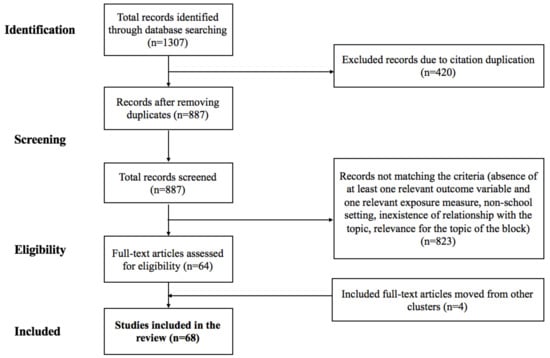
A total of 1307 articles were identified, 420 of which were immediately removed due to duplicate publications. A total of 887 studies were then screened through an analysis of the abstracts and 814 were considered unsuitable for inclusion (see exclusion criteria 1–4). Sixty-eight studies were reviewed through an analysis of the full-text and were finally selected and included in the review (64 relevant for the topic of each cluster and four studies moving across clusters). A summary of the literature review process is shown in Figure 1.
Figure 1.
Summary of the literature review process.
Table 1 shows the variables considered by the studies that fulfilled the inclusion criteria for this review. Indoor environmental features of school buildings are the most considered cluster of exposure measures variables (Cluster 2), followed by the outdoor and green areas cluster (Cluster 4).
Table 1.
Summary of the reviewed studies.
Table 2, Table 3, Table 4 and Table 5 report information about the reviewed studies for each of the clusters, specifying authors, research design, participants (number of schools involved, sample size, age, and country), exposure measures [1], outcome measures, and relevant results are reported. Following the graphical schematization used by a systematic review about the relationship between school furniture and students’ performance, the effect of the exposure measure was classified as (+) when the effect resulted in an improvement in the outcome variable, (−) when the effect was negative, (0) when there were no change, and (+/−) when the results were not clear [36] (p. 96).
Table 2.
Studies on the effects of school building, architectural design, and aesthetic features.
Table 3.
Studies on the effects of indoor environmental features.
Table 4.
Studies on the effects of classroom design and furniture.
Table 5.
Studies on the effects of school green spaces or outdoor spaces.
Considering all the selected studies, the most studied outcome variable was “learning,” found in 62 studies (also in terms of “performance,” “education,” “teaching,” “learning environment” on the whole), followed by studies that presented “wellbeing,” tested 14 times (also in terms of “comfort,” “health,” and the other outcome variables examined in other studies, “satisfaction” in five studies, “socialization” in seven studies, “place identity” in two studies) (in particular, “learning” has been operationalized in terms of individual level score in task performance (e.g., [42,43], a specific measurement scale (e.g., [44,45]), teachers’ and students’ observation and/or interviews (e.g., [46,47]), acoustic perception (e.g., [48,49]), and visual and audio data collected (e.g., [50]). As concerns “wellbeing,” it has been operationalized through specific measurement scales (e.g., assessing parental involvement, contacts with friends, and general well-being: [51]; or physical comfort: [52,53], students’ and teachers’ interviews (see [54]), speech measurement through objective parameters of noise and sound (see [55]), and observation of students’ posture [56]).
Two outcome variables, “drop-out” and “place attachment,” did not emerge among search results.
3.1. Effects of School Building, Architectural Design, and Aesthetic Features on Students’ and Teachers’ Psychological Responses
Starting from 1307 total articles, this cluster identified 819 initial papers, 537 of which were reviewed due to duplicate publications. A total number of 10 articles was finally included (Table 2).
As for the sample, five studies recruited students as research participants (one from preschool, two from a junior high school, and two from a senior high school), three sampled staff (two targeted school leaders and one head teachers, teachers, and other related staff), and another two studies sampled both students and teachers.
Concerning the study design, the ten papers of this cluster present different methodologies (see Table 1). In five studies, effects of school building and architectural features were investigated using quantitative methods (surveys), whereas the remaining five studies used qualitative methods (field and case studies, observational designs, interviews). One study [57] used a causal comparative research, with a pre-post-test design comparing homogenous groups (elementary, middle, and high school students) tested before and after exposure to the intervention of interest (e.g., school building renovation).
As regards the measures, the initial search found either self-report or objective measures of effects of school building design on school users, and only one study using objective measures was identified [57], specifically students’ scores at mathematics and reading subtests. Other studies used either one or more of the following types of self-report measures: Teachers’ and/or students’ evaluation of learning environment (three), educational behaviors (two), design quality and school usability (two), wellbeing (one), and aspirations for the future (one). The most studied outcome variable was learning evaluation (i.e., students’ achievement and performance), whereas student drop-out rate was not examined in result studies.
As for the countries, the studies were mostly (70%) conducted in Europe, specifically two in the UK (20%) and the others in other different European countries. The remaining three (30%) studies were conducted in North America (two) and Asia (one).
Considering the outcome variables, the results reveal that 61.5% of the reviewed studies of Cluster 1 presented positive (+) results, 30.8% presented negative (−) results, and 7.7% presented no change (0). For example, the study of Cencič (2017) showed that the age of the school building (new, old, or renovated) has a different effect on school leader evaluation of learning environment, with new schools scoring higher than old or refurbished schools in some factors (e.g., ecology, feelings, aesthetics), and old schools scoring higher than new or refurbished schools in other factors (e.g., logic, mathematics, creativity).
Overall, this analysis highlights some strengths of this line of research. First, the literature on the effects of school building and architectural design integrates studies carried out with different methods and approaches (i.e., qualitative and quantitative) and involving different users (ranging from students at different grades to teachers and staff members). Moreover, these prior studies investigated the role of rebuilding and architectural features on several aspects of the life at school such as teaching experience, learning outcomes, satisfaction.
However, these results also underline some gaps that future studies should address. More specifically, the research showed some inconsistent or not conclusive evidence about the positive effects of renewing and rebuilding schools. Thus, to better explore the phenomenon, further investigations could take into consideration crucial moderators (e.g., place identity, gender). Importantly, most of these studies were conducted on a small number of participants, using different measures and focusing on different design and architectural aspects: If on one side the integration of different tools and perspective enriches the analysis, on the other side the comparison of results is not always possible. Therefore, additional studies should be carried out to fill this gap, taking into account the holistic nature of environmental aesthetics that requires—much more than other aspects—a bridge between complementary perspectives [58].
3.2. Effects of Indoor Environmental Features of School Environments on Students’ and Teachers’ Psychological Responses
Starting from 1307 total papers, this cluster identified 181 initial articles, 126 of which were reviewed due to duplicate publications. A total number of 22 articles was finally included (Table 3).
About the sample, 17 studies (77.3%) recruited only students as participants (of which six of primary schools, two of middle schools, four of both primary and middle school, four of post-middle school and one of unspecified age) and the remaining five studies sampled both students and teachers (22.7%).
As for the study design, different methodologies were used across the 22 papers of this cluster (see Table 1). In 19 studies (86.4%), effects of indoor environmental features were detected by quantitative methods (i.e., survey, experiment, and field studies), two studies (9%) used a mixed design (both quantitative and qualitative methods), and the remaining one study used qualitative methods (collection of the teachers’ data).
As concerns the measures, 10 studies used objective measures (e.g., classroom ventilation rates, acoustic and lighting parameters, students’ scores on standard tests), whereas three studies used one or more of the following types of self-report measures: Teachers’ and/or students’ evaluation of teaching/learning experiences, perceived satisfaction, thermal sensation/comfort, and so on. The remaining nine studies used both objective (especially to assess exposure conditions, in terms of role of acoustic and lighting features of the classroom environment) and self-report measures. The most studied outcome variable was students’ learning, in terms of performance, ability, level of attention and concentration, followed by wellbeing in terms of health and comfort, and, finally, by students’ and teachers’ perceptions of physical environment. Regarding the countries, the studies were mostly (63.7%) conducted in Europe (eight) and US (six), while the other studies were conducted respectively in Asia (five), Australia and New Zealand (two), and Africa (one).
The overall findings show that 46.7% of the reviewed studies presented positive (+) results, 50% showed negative results (−), and 3.,3% presented no changes (0).
Indeed, differently from the prior cluster that identified an equal number of qualitative and quantitative studies, the present cluster of studies was skewed toward the quantitative and experimental approach. This is probably due to past research traditions on the effects of physical attributes that are more prone to environmental assessments. Although this approach has some concrete advantages (e.g., identification of the variables, involvement of a greater number of participants, comparison between studies), on another hand, it overshadows important aspects. For instance, this line of research often investigates the effects of environmental features on “objective” variables such as learning outcomes and performance: Qualitative research would be likely to deepen the analysis on subjective users’ wellness, experience of stress, or comfort. Moreover, most of the cited studies focused on a single physical characteristic of the indoor environment (e.g., noise, light, ventilation), leaving out important interactions between these features in a naturalistic setting and between indoor and outdoor or contextual variables.
In this vein, studies on multisensory integration (e.g., light color and temperature; [59]) could provide important suggestions for future research. Importantly, few studies explored the effects of indoor physical attributes (e.g., [60]) on pupils with special needs: Developing this line of research is crucial to design actual inclusive learning environments.
3.3. Effects of Classroom Design and Furniture on Students’ and Teachers’ Psychological Responses
Starting from 1307 total articles, this cluster identified 108 initial papers, but only 81 were reviewed due to duplicate publications. Twelve articles were finally included, of which three studies came from other clusters (Table 4).
As for the sample, five studies (42%) recruited participants from students (specifically, from elementary schools), three (25%) sampled staff (among teachers, school administrators, and other related staff), and the remaining four studies sampled both students and teachers (33%).
As regards the study design, a range of different methodologies were used amongst the 12 studies in the third cluster. In eight studies (about 66%) effects of spatial features (classroom design) and furniture were measured by qualitative methods (focus groups, informal interviews, observations, case studies, reports), two studies (about 17%) used quantitative methods (i.e., surveys and field studies) and the remaining two studies (about 17%) used a mixed design (both quantitative and qualitative methods).
Concerning the measures, 11 studies used self-reported measures (i.e., students’ perception and satisfaction towards the learning environment, in terms of spatial evaluation of movement, furniture arrangement and room design, subjective comfort, wellbeing), whereas only one study (see [61]) used both objective and self-reported measures.
About the countries, four studies were conducted in Europe (two in England, one in Ireland, and one in Portugal), two studies were conducted in Asia (one in Turkey and one in Sri-Lanka), four studies were conducted in the American continent (three in USA and one in Brazil), and finally, two studies were conducted in a not specified country.
The overall findings illustrated that 75% of the reviewed studies presented positive (+) results, whereas the remaining 25% showed negative (−) results.
Overall, the research literature on this cluster has been definitely characterized by the predominance of qualitative data, collected through interviews (individual or group ones) or observations, or derived from the realization of case studies. The primacy of self-report measures as outcome variables is another distinctive feature of this cluster. The presence of studies addressing the needs of specific students’ categories (in particular children from primary schools, but also deaf or autistic students) could be related to the fact that the spatial level of analysis of this cluster is more circumscribed and focal than the others, representing a sort of microsystem for the user, as highlighted by the multiplace approach (see [7,38,39]. In other words, the classroom environment being the most direct, central, and thus meaningful subsystem of the school environment in the experience of students and teachers, then this spatial level should be particularly cared for in order to respond to differential needs.
As for the previous clusters, it is quite difficult to make comparisons across studies, given the predominance of qualitative studies as well as the high variability in construct operationalization, sample size and characteristics, kinds of techniques and tools (often ad hoc ones, not previously validated). Future research should investigate the potential role of socio-demographic variables (e.g., gender) and socio-psychological dimensions (e.g., interpersonal distance, intra-group and inter-group dynamics, social norms) as potential moderators of the relationship between the “objective” classroom environment features and users’ responses.
3.4. Effects of School Green Spaces or Outdoor Spaces on Students’ and Teachers’ Psychological Responses
Starting from a total of 1307 papers, this cluster identified 199 initial articles, 143 of which were reviewed due to duplicate publications. Twenty-four articles were finally included, one study of which came from another cluster (Table 5).
Concerning the sample, seven studies (29%) recruited participants who were students (one of which was attending early childhood education, four of which were attending primary school, one from middle school, and, finally, one with a sample of primary school students and another sample of high school students), nine studies (38%) sampled staff (among teachers and/or school principals) and/or other local members (parents, careers, charity staff), and the remaining eight studies sampled both students and teachers (33%).
As regards the study design, a range of different methodologies were used. In 18 studies (76%), effects of the presence of school activities in outdoor education form were measured by using qualitative methods (multi case studies, field experiments, semi-structured individual/group interviews, observation, and focus groups), four studies (17%) used quantitative methods (survey, experimental, and quasi-experimental studies), and the remaining two studies (8%) used a mixed design (both quantitative and qualitative methods).
About the measures, all studies used self-report measures (i.e., students’ and teachers’ perception of impact of outdoor education on learning, involvement, and enjoyment of participants), six of these used also objective measures (i.e., science knowledge assessment, knowledge test scores, students’ academic performance).
As for the countries, 50% of studies were conducted in North America, 33% of studies were conducted in Europe (three in England, one in Scotland, one in Wales, one in Slovenia, one in Italy, and one in Croatia), and the remaining 17% of studies were conducted in Australia (two) and Asia (two).
Most of the findings (89%) presented positive (+) results, whereas the remaining 11% showed negative (−) results. The most examined outcome variable was learning evaluation, which referred to both the physical activity and the outdoor teaching experience.
Overall, if compared to the previous ones, this cluster of studies fruitfully integrate different perspectives and methodologies, revealing a quite consistent pattern of results: The opportunity to use outdoor spaces and facilities for outdoor teaching proved to be positively related to a wide range of variables. Importantly, these outcomes are not exclusively referred to performance in curriculum activities but also to relevant social skills (e.g., positive relationships, friendship, independence, self-confidence). However, these results also underline some points that require more attention and indicate future avenues of research. First, as for the previous clusters, outcome variables related to the outdoor environment have been often assessed through ad hoc measures: Further studies should address this point trying to validate more reliable instruments. This would also facilitate the comparison between different studies and results, thus providing a more systematic picture of the phenomenon. Second, research should try to integrate the investigation on indoor features with that on outdoor variables. Indeed, the relation between indoor and outdoor environments (hallways, windows, French window opening into the garden) has been barely explored. Furthermore, future studies should focus attention on individual differences that are likely to moderate such effects, as gender, age, and specific needs.
4. Discussion
From the review of the 68 papers selected according to specific criteria, a total of 68% of articles presented positive results, while the other ones showed negative results (29.2%), or no change (2.8%). Specifically, findings were organized in four sections based on exposure variables, i.e., architectural building design and aesthetic features, indoor environmental features, classroom design, and school green spaces or outdoor spaces.
About the first research question concerning the influence on users of school building/architectural design/aesthetic features, research has focused on the different impacts of new, old, and renovated buildings on students’ performance. Findings showed that the better the building design, the higher the students’ performance [47,57], as well as an increased positive benefit on students’ wellbeing [51]. However, a negative effect on students’ attention and sense of privacy was reported in the presence of flexible learning environments characterized by open and transparent designs (e.g., interior windows or open spaces [46]). Furthermore, regarding the adequate size of buildings, Slunjski [62] found that facilities should not be too large to foster the development of children’s identities. According to this scholar, too many groups in a kindergarten make it difficult, or even impossible, for children to socialize and communicate with other children from the various groups, and such occurrence is also an obstacle to free movement of children throughout the facility. The learning space, indeed, becomes part of students’ identity and, in turn, they become part of the place [63].
As for the second research question, about the association between the indoor environmental features of the school place and users’ psychological responses, research outcomes illustrated the importance of features such as noise, ventilation, and lighting in enhancing the students’ academic performance. Many of the studies have focused on the acoustic features, which are identified as a potential factor able to decrease attention and concentration. Specifically, school buildings close to main roads had a higher level of noise pollution, with a significant impact on students’ and teachers’ performance and comfort [52,64], impairing memory and learning [65], even though the extent of annoyance depends on the task (e.g., verbal tasks, and basic mathematics; [60,66]). Moreover, higher noise levels impeded the development of interaction and collaborative learning [67]. However, students’ learning and concentration are also affected by lighting [68,69], and specifically natural light in classrooms was associated with both better health and better performance [70]. Finally, further factors showing a positive effect on short-term concentration and performance (e.g., logical thinking) are thermal comfort and ventilation [42,43].
As regards the third research question, about the effect on users of classroom design/furniture, research literature has showed the relevant role of the educational environment on students’ performance and learning capacity. Furthermore, a classroom design with a flexible space promotes self-direct student learning [71,72] and teachers reported several benefits on students (i.e., increasing engagement with the addressed topics, retaining information, and increasing ability to learn and remember material [73]). Furniture (e.g., chairs) designed for children were also identified as features with a considerable impact [71]. Satisfaction, wellbeing, and comfort are triggered by ergonomic furniture painted with attractive colors and pictures [53], a well-equipped library, and a fitted blackboard [54].
Finally, about the fourth research question concerning the influence on users of school green spaces/outdoor spaces, studies have mainly focused on teachers’ perceptions and students’ learning in the outdoor learning experience. Indeed, school green spaces showed positive effects on students, both in terms of better health and higher engagement in lessons, improving critical thinking skills, problem-solving abilities, and enhancing sense of independence, motivation, and responsibility [44,74,75,76]. Outdoor lessons triggered students’ desire to learn in a natural environment [77], also promoting children’s imaginative play and the development of social positive relationships [78,79,80]. Furthermore, outdoor experience enhanced students’ emotional responses [81]. According to Dhanapal and Lim [82], an integration of both indoor and outdoor learning is recommended in order to improve students’ performance. Regarding teachers’ perceptions, they positively underlined the impact of outdoor teaching, reporting a whole involvement of students’ senses and resulting in an enhancement of students’ learning [83,84]. Better social and personal wellbeing were also reported [85].
This analysis of the recent literature concerning the influence of design dimensions on school users’ responses underlined a series of gaps and some inconsistencies that merit attention and are likely to open future avenues of research. One gap concerns the methodological domain. In fact, findings of this systematic review let emerge that quantitative research is poorly represented in two of the four clusters, i.e., classroom design/furniture and school green spaces/outdoor spaces (see also Table 1). Thus, there is a need for more quantitative evidence about the relationship between indoor/outdoor school settings and users’ responses. The integration of qualitative and quantitative approaches and the use of more recent methodologies (e.g., based on virtual reality) could represent an added value for better understanding such relationships.
These new technologies, the integration of qualitative and quantitative methodologies, and of implicit and explicit measures could also be used to update the analyses of some processes and the impact of variables that have been widely explored in the past (e.g., the role of indoor environmental features such as noise, light, color) but narrowly analyzed in the decade considered in the present review. This might create a gap between the engineering, architecture, design advances, and our knowledge of the influences of such innovations on the users.
Future research should also focus on patterns that have been scarcely considered by prior studies. For instance, future research might explore how spatial features affect perceived control over the learning environment space on students’ ability to have better control of their environment.
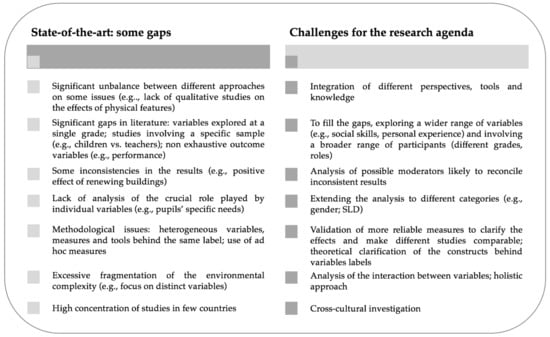
Finally, the present review also highlighted some inconsistencies detailed in previous sections. For instance, results related to school renovation or about the impact of noise on math performance are not clear-cut. These ambiguities might suggest the role of crucial moderator variables, such as interpersonal distance, compliance to social norms, and place identity, just to name a few. Thus, future research is called to explore the boundary conditions of such results and clarify better the mechanisms underlying the effects (see Figure 2).
Figure 2.
Summary of research gaps and challenges.
5. Conclusions
This systematic review is, to our knowledge, the first comprehensive systematic synthesis of recent evidence regarding the impact of different school environmental features on students’ and staffs’ responses, since other literature reviews on this topic (e.g., [86]) do not use the format of a systematic review. The only exception is represented by a systematic review about the effects of learning environments on students’ learning outcomes, published in a technical report [87]. Nevertheless, it is worth noting that such a report, published after December 2017 (that is the time limit for our papers’ selection), focused on a dimension (i.e., learning outcomes) that is more circumscribed than the broader one we considered.
Empirical findings of our review derive from studies conducted in countries with different educational systems and cultures. The overall results indicate that a series of school features, of both internal and external spaces, should be cared for, in order to fit with users’ needs and improve learning experiences. In this regard, we need to consider that pupils from the age of five-years old spend at least 6–8 h every day of the week in the school environment and apart from their homes—they spend more time at school than anywhere else.
Concerning the studies’ research design, it is worth noting the prevalence of quantitative methods (such as experimental and quasi-experimental, field studies, and surveys) in studies related to the role of, respectively, architectural features and indoor environmental features in influencing users’ responses. On the other hand, qualitative approaches (such as focus groups, informal interviews, observations, case studies) have been prominent in studies on the impact of, respectively, classroom design and furniture, and school green spaces, where the outcome variable was often learning evaluation. Future studies are required to fill the gaps, integrating qualitative and quantitative methods to study different aspects of learning environments (e.g., indoor and physical features)
As regards measurement issues, the use of self-report measures has been prevalent in almost all clusters, with the exception of studies on indoor environmental features, which mostly relied on objective measures (e.g., classroom ventilation rates, acoustic, and lighting parameters). In some studies, across all clusters, the combined use of both self-report and objective measures was chosen.
In sum, findings across different clusters highlighted the prominent role of a pleasant, warm, and flexible learning space in both influencing students’ wellbeing and enhancing their academic marks, even though the presence of open spaces may also have a negative effect on students’ attention and sense of privacy. In order to increase the level of comfort, satisfaction, and performance, several studies identified the importance of designing classrooms with charming colors, pictures, and ergonomic furniture, also paying attention to the levels of acoustic, thermal comfort, ventilation, and natural lighting. Furthermore, in order to improve students’ learning and wellbeing, it should be recommended to have an integration of both indoor and outdoor learning. Indeed, green spaces showed relevant positive effects, both on scholastic and social aspects. However, future research should pay attention on individual variables (e.g., gender, age, and specific needs) that are likely to moderate such effects. Importantly, although it poses a critical methodological challenge, future research should focus attention not only on single variables but also on their interactions or co-occurrence in order to capture the high-level complexity of the phenomena.
Regarding the relationship between the school environment and place-related psychological patterns, only few studies have examined the effect of school design on place identity, whereas no studies have examined such effect on place attachment. Indeed, the substantial lack of research on these issues is rather surprising, given the importance for occupants’ wellbeing of developing a positive interaction with a meaningful place, as the school is a place for both pupils and teachers. Future studies should then focus on that.
Finally, some limits of this systematic review need to be mentioned. Despite the attempt to get access to the relevant published literature through systematic research and the subsequent scanning of reference lists of articles, some publications may have been overlooked. A more complete set of keywords could have intercepted further research articles. We used as a search tool the integrated database EBSCOhost, which includes a considerable number of publishers and high-impact scientific journals, thus following the procedure of other systematic reviews (e.g., see [88,89]). However, we cannot exclude that some relevant papers have been missed. This should apply also for the choice of grounding on a division into four conceptual clusters: Such choice influenced the paper selection process, nevertheless it provided a systematic, structured, and consistent reading key for the analysis.
A further limitation of this review concerns the search process itself, which may not have allowed the identification of all studies showing the effects of the features of school environment on students’ and teachers’ responses, especially considering the pre-specified search criteria to include only English language full-text articles published in academic and scholarly peer-reviewed journals.
Overall, following an “evidence-based design” perspective [90], these research findings should inform the development of school design interventions, which are expected to promote positive effects on users’ achievement, engagement, affective state, comfort and wellbeing, cognitive processes, social interactions, identification with the place, pro-social and pro-environmental behavior. In the long term, the downstream results could be the reduction of the number of early-school leavers, increased wellbeing of pupils with specific learning disorders, promotion of positive class social interactions (e.g., reduction of bullying) and integration (e.g., reduction of ethnic prejudice), and prevention of teachers’ burn-out. The recent trends suggest that “classic” old-style schools are likely to disappear to leave room to new learning environments in the future. Thus, the outcome of this review can be useful in the definition of guidelines for best practices that architects, education scientists, teachers, psychologists, policy makers, and members of the community could share within a “user-centered design” [2] view.
Author Contributions
Conceptualization, F.F., S.S., S.M., V.C., and V.T.; methodology, F.F., S.M., V.C., and S.S.; data curation, S.M. and V.C.; writing—original draft preparation, S.M.; writing—review and editing, S.M., V.C., F.F., S.S., and V.T.; supervision, F.F. and S.S.; project administration, F.F. and S.S. All authors have read and agreed to the published version of the manuscript.
Funding
This research was funded by the Iscol@ Project (Autonomous Region of Sardinia, Italy, Regional Council Deliberation n. 10/15, 28/03/2014).
Conflicts of Interest
The authors declare no conflict of interest.
References
- Kidger, J.; Araya, R.; Donovan, J.; Gunnell, D. The Effect of the School Environment on the Emotional Health of Adolescents: A Systematic Review. Pediatrics 2012, 129, 925–949. [Google Scholar] [CrossRef] [Scilit]
- Gifford, R. Environmental Psychology: Principles and Practice; Allyn & Bacon: Boston, MA, USA, 2002. [Google Scholar]
- Fornara, F.; Bonaiuto, M.; Bonnes, M. Perceived hospital quality indicators: A study of orthopaedic units. J. Environ. Psychol. 2006, 26, 321–334. [Google Scholar] [CrossRef] [Scilit]
- Nagasawa, Y. The geography of hospitals. In Theoretical Perspectives in Environment-Behavior Research; Wapner, S., Demick, J., Yamamoto, T., Minani, H., Eds.; Kluwer: New York, NY, USA, 2000; pp. 217–227. [Google Scholar]
- Fornara, F.; Manca, S. Healthy residential environments for the elderly. In Handbook of Environmental Psychology and Quality of Life Research; Fleury-Bahi, G., Pol, E., Navarro, O., Eds.; Springer: Berlin, Germany, 2017; pp. 441–465. [Google Scholar]
- Evans, G.W.; McCoy, J.M. When buildings don’t work: The role of architecture in human health. J. Environ. Psychol. 1998, 18, 85–94. [Google Scholar] [CrossRef] [Scilit]
- Fornara, F.; Andrade, C. Healthcare environments. In The Oxford Handbook of Environmental and Conservation Psychology; Clayton, S., Ed.; Oxford University Press: New York, NY, USA, 2012; pp. 295–315. [Google Scholar]
- Pressly, P.K.; Heesacker, M. The physical environment and counseling: A review of theory and research. J. Couns. Dev. 2001, 79, 148–160. [Google Scholar] [CrossRef] [Scilit]
- National Research Council. Green Schools: Attributes for Health and Learning; National Academies Press: Washington, DC, USA, 2007. [Google Scholar]
- Sanoff, H.; Walden, R. School environments. In The Oxford Handbook of Environmental and Conservation Psychology; Clayton, S.D., Ed.; Oxford University Press: New York, NY, USA, 2012; pp. 276–294. [Google Scholar]
- Earthman, G.I. The quality of school buildings, student achievement, and student behavior. Bild. Und Erzieh. 1999, 52, 353–372. [Google Scholar] [CrossRef] [Scilit]
- Fowler, W.J. School size and student outcomes. Adv. Educ. Product. 1995, 5, 3–26. [Google Scholar]
- Rutter, R.A. Effects of School as a Community; ED 313 470; National Center on Effective Secondary Schools: Madison, WI, USA, 1988. [Google Scholar]
- Earthman, G.I. Prioritization of 31 Criteria for School Building Adequacy. 2004. Available online: http://www.schoolfunding.info/policy/facilities/ACLUfacilities_report1-04.pdf (accessed on 26 January 2020).
- Fisher, K. Building Better Outcomes: The impact of School Infrastructure on Student Outcomes and Behaviour; Schooling Issues Digest; Department of Education, Training and Youth Affairs: Canberra, Australia, 2001. [Google Scholar]
- Schneider, M. Do School Facilities Affect Academic Outcomes? National Clearinghouse for Educational Facilities: Washington, DC, USA, 2002. [Google Scholar]
- Ryd, H.; Wyon, D.P. Methods of Evaluating Human Stress due to Climate; National Swedish Institute for Building Research: Stockholm, Sweden, 1970. [Google Scholar]
- Flatt, D.L. The effects of high temperature upon certain physical tasks by high school students. Diss. Abstr. Int. 1975, 35, 7678A. [Google Scholar]
- Smedje, G.; Norbäck, D.; Edling, C. Asthma among secondary schoolchildren in relation to the school environment. Clin. Exp. Allergy 1997, 27, 1270–1278. [Google Scholar] [CrossRef] [Scilit]
- Norbäck, D.; Torgén, M.; Edling, C. Volatile organic compounds, respirable dust, and personal factors related to prevalence and incidence of sick building syndrome in primary schools. Br. J. Ind. Med. 1990, 17, 733–741. [Google Scholar] [CrossRef] [Scilit]
- Wurtman, R.J. The effects of light on the human body. Sci. Am. 1975, 233, 68–77. [Google Scholar] [CrossRef] [Scilit]
- Zifferblatt, S.M. Architecture and human behaviour: Toward increased understanding of a functional relationship. Educ. Technol. 1972, 12, 54–57. [Google Scholar]
- Wheldall, K.; Lam, Y.Y. Rows versus tables II: The effects of two classroom seating arrangements on classroom disruption rate, on-task behaviour and teacher behaviour in three special school classes. Educ. Psychol. 1987, 7, 303–312. [Google Scholar] [CrossRef] [Scilit]
- Wheldall, K.; Morris, M.; Vaughan, P.; Ng, Y.Y. Rows versus tables: An example of the use of behavioural ecology in two classes of eleven-year-old children. Educ. Psychol. 1981, 1, 171–184. [Google Scholar] [CrossRef] [Scilit]
- Axelrod, S.; Hall, R.V.; Tams, A. Comparison of two common classroom seating arrangements. Acad. Ther. 1979, 15, 29–36. [Google Scholar] [CrossRef] [Scilit]
- Rosenfield, P.; Lambert, N.M.; Black, A. Desk arrangement effects on pupil classroom behaviour. J. Educ. Psychol. 1985, 77, 101–108. [Google Scholar] [CrossRef]
- Gill, W.M. A look at the change to open-plan schools in New Zealand. New Zealand J. Educ. Stud. 1977, 12, 3–16. [Google Scholar]
- Rohe, W.; Patterson, A.H. The effects of varied levels of resources and density on behavior in a daycare center. Child. City 1974, 1, 161–171. [Google Scholar]
- Weinstein, C.S. The physical environment of the school: A review of the research. Rev. Educ. Res. 1979, 49, 577–610. [Google Scholar] [CrossRef]
- Neill, S.R. Preschool design and child behavior. J. Child Psychol. Psychiatry 1982, 23, 309–318. [Google Scholar] [CrossRef] [Scilit]
- Sommer, R.; Olsen, H. The soft classroom. Environ. Behav. 1980, 12, 3–16. [Google Scholar] [CrossRef] [Scilit]
- Gifford, R. Environmental Psychology: Principles and Practice, 5th ed.; Optimal Books: Colville, WA, USA, 2014. [Google Scholar]
- Arbogast, K.L.; Kane, B.C.P.; Kirwan, J.L.; Hertel, B.R. Vegetation and outdoor recess time at elementary schools: What are the connections? J. Environ. Psychol. 2009, 29, 450–456. [Google Scholar] [CrossRef] [Scilit]
- Berman, M.G.; Jonides, J.; Kaplan, S. The cognitive benefits of interacting with nature. Psychol. Sci. 2008, 19, 1207–1212. [Google Scholar] [CrossRef] [Scilit]
- Bagot, K.L. Perceived restorative components: A scale for children. Child. Youth Environ. 2004, 14, 107–129. [Google Scholar]
- Castellucci, H.I.; Arezes, P.M.; Molenbroek, J.F.M.; de Bruin, R.; Viviani, C. The influence of school furniture on students’ performance and physical responses: Results of a systematic review. Ergonomics 2017, 60, 93–110. [Google Scholar] [CrossRef] [Scilit]
- Fornara, F.; Bonaiuto, M.; Bonnes, M. Cross-validation of abbreviated Perceived Residential Environment Quality (PREQ) and Neighbourhood Attachment (NA) Indicators. Environ. Behav. 2010, 42, 171–196. [Google Scholar] [CrossRef] [Scilit]
- Bonnes, M.; Secchiaroli, G. Environmental Psychology. A Psycho-Social Introduction; Sage: London, UK, 1995. [Google Scholar]
- Bronfenbrenner, U. The Ecology of Human Development: Experiments by Nature and Design; Harvard University Press: Cambridge, MA, USA, 1979. [Google Scholar]
- Pullin, A.S.; Stewart, G.B. Guidelines for systematic review in conservation and environmental management. Conserv. Biol. 2006, 20, 1647–1656. [Google Scholar] [CrossRef] [Scilit]
- McHugh, M. Interrater reliability: The kappa statistic. Biochemiamedica 2012, 22, 276–282. [Google Scholar] [CrossRef] [Scilit]
- Mendell, M.J.; Eliseeva, E.A.; Davies, M.M.; Lobscheid, A. Do classroom ventilation rates in California elementary schools influence standardized test scores? Results from a prospective study. Indoor Air 2016, 26, 546–557. [Google Scholar] [CrossRef] [Scilit]
- Petersen, S.; Jensen, K.L.; Pedersen, A.L.S.; Rasmussen, H.S. The effect of increased classroom ventilation rate indicated by reduced CO2 concentration on the performance of schoolwork by children. Indoor Air 2016, 26, 366–379. [Google Scholar] [CrossRef] [Scilit]
- Borić, E.; Škugor, A. Achieving Students’ Competencies Through Research-Based Outdoor Science Teaching. Croat. J. Educ. 2014, 16, 149–164. [Google Scholar]
- Kinnealey, M.; Pfeiffer, B.; Miller, J.; Roan, C.; Shoener, R.; Ellner, M.L. Effect of classroom modification on attention and engagement of students with autism or dyspraxia. Am. J. Occup. Ther. 2012, 66, 511–519. [Google Scholar] [CrossRef] [Scilit]
- Leiringer, R.; Cardellino, P. Schools for the twenty-first century: School design and educational transformation. Br. Educ. Res. J. 2011, 37, 915–934. [Google Scholar] [CrossRef] [Scilit]
- Ghaffarzadeh, M. A Comparative Study of Discrimination in Education: The Learning Environment and Behaviours of Students and Teachers in Iran. Iafor J. Educ. 2016, 4, 34–46. [Google Scholar] [CrossRef] [Scilit]
- Mealings, K.T.; Demuth, K.; Buchholz, J.; Dillon, H. The Development of the Mealings, Demuth, Dillon, and Buchholz Classroom Speech Perception Test. J. SpeechLang. Hear. Res. 2015, 58, 1350–1362. [Google Scholar] [CrossRef] [Scilit] [PubMed]
- Punnoose, M.M.; Arya, R.; Nandurkar, A.N. Speech Perception in Noise among Children with Learning Disabilities. Int. J. Community Health Med Res. 2017, 3, 24–31. [Google Scholar]
- Waters, J.; Maynard, T. What’s so interesting outside? A study of child-initiated interaction with teachers in the natural outdoor environment. Eur. Early Child. Educ. Res. J. 2010, 18, 473–483. [Google Scholar] [CrossRef] [Scilit]
- Cuyvers, K.; De Weerd, G.; Dupont, S.; Mols, S.; Nuytten, C. Well-Being at School: Does Infrastructure Matter? CELE Exchange, No 2011/10; OECD Publishing: Antwerp, Belgium, 2011; Available online: https://EconPapers.repec.org/RePEc:oec:eduaac:2011/10-en (accessed on 26 January 2020).
- Akhtar, J.; Anjum, N.; Iftikhar, N. Evaluation of the impact of noise pollution on students in congested area of Rawalpindi. Nurture 2013, 7, 1–9. [Google Scholar]
- Maheshwar; Jawalkar, C.S. Ergonomic Based Design and Survey of Elementary School Furniture. J. Sch. Educ. Technol. 2014, 9, 27–31. [Google Scholar]
- Martins, L.B.; Gaudiot, D.M. The deaf and the classroom design: A contribution of the built environmental ergonomics for the accessibility. Work 2012, 41, 3663–3668. [Google Scholar] [CrossRef] [Scilit]
- Chan, K.M.; Li, C.M.; Ma, E.P.; Yiu, E.M.; McPherson, B. Noise levels in an urban Asian school environment. Noise Health 2015, 17, 48–55. [Google Scholar] [CrossRef] [Scilit]
- Gonçalves, M.A.; Arezes, P.M. Postural assessment of school children: An input for the design of furniture. Work 2012, 41, 876–880. [Google Scholar] [CrossRef] [Scilit]
- Lumpkin, R.B. School Buildings, Socioeconomic Status, Race, and Student Achievement. J. Intercult. Discip. 2016, 15, 170–185. [Google Scholar]
- Porteous, D. Approaches to environmental aesthetics. J. Environ. Psychol. 1982, 2, 53–66. [Google Scholar] [CrossRef] [Scilit]
- Huebner, G.M.; Shipworth, D.T.; Gauthier, S.; Witzel, C.; Raynham, P.; Chan, W. Saving energy with light? Experimental studies assessing the impact of colour temperature on thermal comfort. Energy Res. Soc. Sci. 2016, 15, 45–57. [Google Scholar] [CrossRef] [Scilit]
- Brännström, K.J.; Johansson, E.; Vigertsson, D.; Morris, D.J.; Sahlén, B.; Lyberg-Åhlander, V. How Children Perceive the Acoustic Environment of Their School. Noise Health 2017, 19, 84–94. [Google Scholar] [CrossRef] [Scilit]
- Aturupane, H.; Glewwe, P.; Wisniewski, S. The impact of school quality, socio-economic factors and child health on students academic performance: Evidence from Sri Lankan primary schools (English). Educ. Econ. 2013, 21, 2–37. [Google Scholar] [CrossRef] [Scilit]
- Slunjski, E. Multidisciplinary Approach to Designing Space of Early Childhood Education Institutions as a Condition for High-Quality Education Process. Croat. J. Educ. 2015, 17, 253–264. [Google Scholar]
- Wolsey, T.D.V.; Uline, C.L. Student Perceptions of Middle Grades Learning Environments. Middle Sch. J. 2010, 42, 40–47. [Google Scholar] [CrossRef] [Scilit]
- Ana, G.R.E.E.; Shendell, D.G.; Brown, G.E.; Sridhar, M.K.C. Assessment of Noise and Associated Health Impacts at Selected Secondary Schools in Ibadan, Nigeria. J. Environ. Public Health 2009, 2009, 739502. [Google Scholar] [CrossRef] [Scilit]
- Ljung, R.; Sörqvist, P.; Kjellberg, A.; Green, A.M. Poor Listening Conditions Impair Memory for Intelligible Lectures: Implications for Acoustic Classroom Standards. Noise Notes 2009, 10, 39–46. [Google Scholar] [CrossRef] [Scilit]
- Ljung, R.; Sörqvist, P.; Hygge, S. Effects of road traffic noise and irrelevant speech on children’s reading and mathematical performance. Noise Health 2009, 11, 194–198. [Google Scholar] [CrossRef] [Scilit] [PubMed]
- McKellin, W.H.; Shahin, K.; Hodgson, M.; Jamieson, J.; Pichora-Fuller, M.K. Noisy zones of proximal development: Conversation in noisy classrooms. J. Socioling. 2011, 15, 65–93. [Google Scholar] [CrossRef] [Scilit]
- Lee, H.-S.; Kwon, S.-Y.; Lim, J.-H. A Development of a Lighting Control System Based on Context-Awareness for the Improvement of Learning Efficiency in Classroom. Wirel. Pers. Commun. 2016, 86, 165–181. [Google Scholar] [CrossRef] [Scilit]
- Sleegers, P.J.C.; Moolenaar, N.M.; Galetzka, M.; Pruyn, A.; Sarroukh, B.E.; van der Zande, B. Lighting affects students’ concentration positively: Findings from three Dutch studies. Lighting Res. Technol. 2013, 45, 159–175. [Google Scholar] [CrossRef] [Scilit]
- Nilforoushan, M.; Hanna, R.; Naeini, H.S.; Mozzafar, F. Role and architectural characteristics in primary schools for day light in Glasgow (Scotland). Rev. High. Educ. Self-Learn. 2013, 6, 57–66. [Google Scholar]
- Smith, T.J. Designing learning environments to promote student learning: Ergonomics in all but name. Work 2013, 4, 39–60. [Google Scholar] [CrossRef] [Scilit]
- Parnell, R.; Procter, L. Flexibility and placemaking for autonomy in learning. Educ. Child Psychol. 2011, 28, 77–88. [Google Scholar]
- Benes, S.; Finn, K.E.; Sullivan, E.C.; Yan, Z. Teachers’ Perceptions of Using Movement in the Classroom. Phys. Educ. 2016, 73, 110–135. [Google Scholar] [CrossRef] [Scilit]
- Yates, K.A.; Sullivan, S.C. Meaningful learning and school-based gardens: A multi-case study conducted in the harsh climate of the greater Yellowstone ecosystem. J. Ethnogr. Qual. Res. 2017, 11, 305–319. [Google Scholar]
- James, J.K.; Williams, T. School-Based Experiential Outdoor Education: A Neglected Necessity. J. Exp. Educ. 2017, 40, 58–71. [Google Scholar] [CrossRef] [Scilit]
- Sharpe, D. Independent thinkers and learners: A critical evaluation of the ‘Growing Together Schools Programme’. Pastor. Care Educ. 2014, 32, 197–207. [Google Scholar] [CrossRef] [Scilit]
- Gomboc, K. Back to Nature: Exploring the Potential for Implementing the Norwegian Idea of Outdoor Days in the Slovenian School System. J. Elem. Educ. 2016, 9, 123–138. [Google Scholar]
- Dowdell, K.; Graya, T.; Malone, K. Nature and its Influence on Children’s Outdoor Play. Aust. J. Outdoor Educ. 2011, 15, 24–35. [Google Scholar] [CrossRef] [Scilit]
- Flom, B.; Johnson, C.; Hubbard, J.; Reidt, D. The Natural School Counselor: Using Nature to Promote Mental Health in Schools. J. Creat. Ment. Health 2011, 6, 118–131. [Google Scholar] [CrossRef] [Scilit]
- Christie, B.; Beames, S.; Higgins, P. Context, culture and critical thinking: Scottish secondary school teachers’ and pupils’ experiences of outdoor learning. Br. Educ. Res. J. 2016, 42, 417–437. [Google Scholar] [CrossRef] [Scilit]
- Hanvey, C.E. Experiences with an Outdoor Prop Box: Addressing Standards during Recess. Young Child. 2010, 65, 30–33. [Google Scholar]
- Dhanapal, S.; Lim, C.C.Y. A comparative study of the impacts and students’ perceptions of indoor and outdoor learning in the science classroom. In Asia-Pacific Forum on Science Learning and Teaching; The Education University of Hong Kong: Pok Fu Lam, Hong Kong, China, 2013; Volume 14, pp. 1–23. [Google Scholar]
- Gehris, J.S.; Gooze, R.A.; Whitaker, R.C. Teachers’ perceptions about children’s movement and learning in early childhood education programmes. Child: CareHealth Dev. 2015, 41, 122–131. [Google Scholar] [CrossRef] [Scilit]
- Feille, K. Getting outside: Three teachers’ stories of using the schoolyard as an integrated tool for elementary teaching. Electron. J. Sci. Educ. 2013, 17, n3. Available online: http://ejse.southwestern.edu/article/view/11643 (accessed on 26 January 2020).
- Bortolotti, A.; Crudeli, F.; Ritscher, P. Outdoor learning in-service training for teachers. A case study from Prato. J. Plus Educ. Spec. Issue 2014, 2014, 61–68. [Google Scholar]
- Blackmore, J.; Bateman, D.; O’Mara, J.; Loughlin, J. Research into the Connection between Built Learning Spaces and Student Outcomes: Literature Review; Victorian Department of Education and Early Childhood Development: Melbourne, Australia, 2011. Available online: http://www.education.vic.gov.au/Documents/about/programs/infrastructure/blackmorelearningspaces.pdf (accessed on 26 January 2020).
- Byers, T.; Mahat, M.; Liu, K.; Knock, A.; Imms, W. Systematic Review of the Effects of Learning Environments on Student Learning Outcomes; Technical Report 4/2018; University of Melbourne, LEaRN: Melbourne, Australia, 2018. [Google Scholar]
- Monroe, M.C.; Plate, R.R.; Oxarart, A.; Bowers, A.; Chaves, W.A. Identifying effective climate change education strategies: A systematic review of the research. Environ. Educ. Res. 2019, 25, 791–812. [Google Scholar] [CrossRef] [Scilit]
- Delavari, M.; Sønderlund, A.L.; Swinburn, B.; Mellor, D.; Renzaho, A. Acculturation and obesity among migrant populations in high income countries―A systematic review. BMC Public Health 2013, 13, 458. [Google Scholar] [CrossRef] [Scilit] [PubMed]
- Hamilton, K. The four levels of evidence-based design practice. Healthc. Des. 2003, 3, 18–26. [Google Scholar]

© 2020 by the authors. Licensee MDPI, Basel, Switzerland. This article is an open access article distributed under the terms and conditions of the Creative Commons Attribution (CC BY) license (http://creativecommons.org/licenses/by/4.0/).