Abstract
Firm values change substantially between deal announcement and closing, risking renegotiation or termination. For deals that eventually close, does waiting longer to close benefit the acquirer post-M&A? We investigate whether the time that elapses until deal completion is an indicator of post-M&A performance and failure. We find that deals taking an optimum time to implement perform better, supporting the due diligence hypothesis, while taking too long to close is an indication of poor post-M&A performance and subsequent failure, supporting the overdue hypothesis.
1. Introduction
Most corporations experience constant changes in composition and structure. Mergers and acquisitions (M&A) remains a popular means of corporate restructuring. This fact has been proven courtesy a couple of decades of rigorous research on M&A. Research on M&A has reached a mature stage, yet the evidence on whether M&A are value-destroying or value-adding transactions remains inconclusive.
M&A research has traditionally focused on the macro-economic determinants affecting the level and performance of the deal activity. The recent literature has, however, focused on the micro-level determinants (i.e., deal-level determinants) of merger activity and performance. One area of interest concerns the time it takes for a deal to close. The timeliness of a deal is very important because the firm values that drive interest in and the need for the deal could change substantially between the deal’s announcement and its closing date. A long duration may lead to the need for renegotiation or termination, reducing the level of deal activity overall [1]. When deals take too long to close, it creates a completion risk (i.e., the deal may not close; [2]). The high abandonment rates of announced M&A deals cited in the literature show that the time between deal announcement and completion is critical. Aside from the large number of M&A deals that are abandoned or suspended, the failure rates for deals completed and implemented possibly exceed 70% [3].
Despite extensive and rigorous research on M&A, few studies have examined the time taken to complete M&A deals after the deal agreement and announcement, the information implications this duration has regarding the deal process, and its consequences after the deal is completed. Only a few studies have attempted to explain the antecedents and determinants of the time it takes to close a deal. No study has examined whether the time taken to close a deal affects the acquirer post-merger. The literature has largely ignored the time it takes until a deal closes as a determinant of performance and a risk indicator of failure probability. Studies have excluded the effect of the time it takes for a deal to close by restricting samples to an arbitrarily set time period [4,5]. However, arbitrarily setting the interval to one year or any other interval is not only subjective, but can obscure important information implications of the time interval between deal announcement and deal closing. Thus, in this article, we attempt to investigate the effect of the time it takes to complete a deal on the post-deal performance and the likelihood of failure of the acquirer or the newly combined firm.
Chahine, Hasan and Mazboudi report that according to Mergermarket Group, about 64% of respondents prefer to complete M&A deals quickly to capture synergies early, and 36% prefer expanding the due diligence timeline [6]. Thus, we propose and test two complementary hypotheses—the due diligence hypothesis and the overdue hypothesis—to examine whether the time taken until deal completion is an indication predicting the performance and survival of a deal post-completion. The due diligence hypothesis posits that a deal may take a long time to complete after its announcement because the acquirer has undertaken rigorous due diligence to ensure a proper close. This due diligence process provides acquiring firms with a more informed assessment of the expected costs, benefits, and risks of acquisition and grants them the opportunity to renegotiate or terminate bad deals [7]. If the due diligence hypothesis holds, then the deal should experience higher gains and be associated with a higher likelihood of survival post-M&A, while deals for which due diligence is not undertaken should be associated with lower performance outcomes and increased failure likelihood. On the other hand, the overdue hypothesis posits that a deal may be delayed or abandoned if it faces huge challenges to successful completion and implementation. In such a situation, the deal is delayed not necessarily because due diligence is being undertaken, but because of possible challenges to the deal itself; even if the deal is completed, we expect a higher possibility of poor performance and subsequent deal failure. Our findings support both of our hypotheses, as we confirm an inverse U-shaped relationship between time until deal completion and post-M&A performance and a U-shaped relationship between time until deal completion and post-M&A failure.
Wangerin shows that less due diligence is associated with lower post-merger profitability and indicates a monotonic relationship between due diligence and profitability [7]. We show further in addition to his findings that beyond an optimal deal closing time, the acquirer also suffers low post-merger profitability indicating the presence of a non-monotonic relationship. Further, our study takes on the further challenge of using various time intervals from the short term to the long term (i.e., the immediate one month after the deal close to five years after completion) and in addition uses additional measures of profitability not limited to Wangerin’s single measure. We also show that there is a non-monotonic relationship between the time it takes the deal to close, and the likelihood of failure.
The question of what is the optimum time within which to close a deal is complex, since any number of deal antecedents and characteristics may affect the time required until a deal closes, such as the deal’s complexity [8]; whether it is local or cross-border [9]; whether the target has a poor past performance and has a bankruptcy flag on the deal [10,11]; whether it is a friendly or hostile deal [12]; whether the acquirer’s stocks are overvalued [13]; whether the deal is occurring during a financial crisis [14]; and what type of deal advisors are involved [15]. To control for the endogeneity of time until deal completion, we employ an instrumental variable regression to provide further support for our findings, albeit weakly.
To the best of our knowledge, this study is the first to test time until deal completion as a determinant of M&A performance and subsequent survival. We help explain why some M&A fail, in contrast to the large body of literature suggesting that M&A are a useful way to increase shareholder value and improve the performance of underperforming targets. We also suggest that time until deal completion could proxy for a varied array of risk factors influencing survival post-M&A. In a market where information is typically kept out of the public eye during the negotiation process, the time taken until deal completion is likely to be a very important source of information for investors, risk managers, and regulators. Caiazza and Pozzolo indicate that the time elapsed from the moment of the announcement of a deal and its successful conclusion or its abandonment can provide information on the ex-ante probability that it will succeed or fail, thus suggesting the need to pay attention to the time it takes until a deal is completed [16]. Ekelund, Ford and Thornton find that the time difference for merger completion is estimated to be about 75 days (or 80%) longer in regulated industries and that both the cost of merger delay and the benefits of careful merger review can be substantial concluding that an interesting extension of their research would be to evaluate why delays exist and their financial significance [17]. Though our paper does not fully investigate the reasons for delays, our paper is an attempt to investigate the economic significance of careful merger reviews as against delays which may provide information on how swift or otherwise dealers need to act to conclude a deal
The rest of the paper is structured as follows. Section 2 reviews the literature on M&A and develops the study’s hypotheses. Section 3 describes the data, explains how they were collected, and introduces the study’s research methodologies. Section 4 presents and describes the results. Finally, Section 5 concludes the paper.
2. Literature Review and Hypothesis Development
Rigorous research over the past decade has investigated the determinants of M&A performance and failure. One of the major purposes of M&A is to take advantage of the synergies created by joining the two entities, and these synergies are time-bound. Thus, as the literature has stressed, the deals need to be closed in a timely fashion [6]. In addition, because executives can engage in adverse behavior while undertaking large acquisitions, many shareholders pressure managers to close their deals quickly [18]. When deals close too quickly, and without due diligence, they lead to concerns about their performance and survival. However, due diligence requires time and a large investment of resources: It is costly. Nevertheless, the research has shown that more due diligence is undertaken by acquirers when the benefits expected from undertaking such due diligence exceed the expected costs and when it would lead to a better deal. Furthermore, the M&A market is opaque, and its negotiations are conducted behind closed doors, so that the public cannot easily ascertain what is happening. The major events most visible to the market are announcements of deals and of their consummation or abandonment. Given the information asymmetry between the parties to a deal and the market and the expectation that a successful deal should close within an optimal period, the time a deal takes to close could be a valuable source of information and serve as a signal to the market about whether the deal is potentially value-creating or faces significant challenges, thus, indicating its expected performance and survival. The focus of our research is on transactional due diligence conducted by the acquirer after the deal announcement as opposed to preliminary due diligence or due diligence review conducted before the announcement. To the extent that the acquirer has signed a deal agreement with the target and announces it to the public, we believe the acquirer would have conducted enough preliminary due diligence to satisfy itself of the validity of the deal and that further transactional due diligence is only undertaken by the acquirer for incremental benefits to the deals, ceteris paribus. In this context, two complementary hypotheses related to the time until completion are proposed below.
2.1. Due Diligence Hypothesis
Effective due diligence is taken by the acquirer to satisfy itself of the validity of the representation and warranties made by the target in the deal provisions. Wangerin indicates that due diligence enables the acquirer to verify that no “material adverse event” has occurred that would be detrimental to the value of the target firm [7]. He further shows that less due diligence is associated with lower post-merger profitability. In a rushed deal, detailed provisions critical to its success might be overlooked or ignored, the targets may conceal earnings management [19], or the acquirers may hide opportunistic activities, such as inflated earnings [20]. As rushed deals have potentially negative consequences, the literature has stressed the need for effective due diligence for deal success.
Therefore, adequate due diligence should ensure increasing returns to the acquirer post-M&A. We assume in proposing this hypothesis that, in line with prior findings, the acquirer will conduct due diligence on condition that the expected benefits from the additional effort are greater than the associated costs, including the direct cost of the due diligence process itself and the indirect cost of losing timeliness through a delayed close. If these assumptions are correct, a deal’s post-M&A performance should increase, and its post-M&A likelihood of failure decrease, as the time taken for deal completion increases, due to the benefits accruing from the additional due diligence efforts. This would indicate an increasing or positive relationship between time until deal completion and subsequent deal performance and a negative relationship between the former and the likelihood of failure post-M&A. We, thus, propose the following:
Hypothesis 1:
If the due diligence hypothesis holds, there is a positive relationship between time until deal completion and subsequent deal performance post-M&A up to its optimum closing time, ceteris paribus
Hypothesis 2:
If the due diligence hypothesis holds, there is a negative relationship between time until deal completion and the likelihood of deal failure post-M&A up to its optimum closing time, ceteris paribus.
2.2. Overdue Hypothesis
As M&A are complex, sufficient time and resources must be committed to ensure the expected outcome. Differing from deal to deal, this sufficiency is defined as the optimal time required for the deal to close and for optimal due diligence by the acquirer. However, if a deal takes a longer-than-optimum time to implement, the loss of timeliness and expected deal synergies would reduce performance and increase the risk of failure. The literature lists a number of reasons why a deal may be delayed, including conflicting interests among the parties during negotiations; government influence via antitrust laws; and the opposition of stakeholders, such as shareholders, employees, and interested social groups. Thus, when a deal takes longer than its optimum interval to close, even if the delaying factors are not revealed to the market, the delay may indicate challenges, problems, or opposition to the deal. The rising and prohibitive termination fees associated with the inability to close a deal may be an important reason why parties to a deal, especially the acquirer, may want to see a deal to the end even if it encountered problems during the negotiation process [21]. We hypothesize that this delay will reduce subsequent performance after the deal closes because of the risk that the fundamentals of the target may change substantially from what was envisaged [1], and the risk that an untimely implementation will subtract from the deal the beneficial synergies of integration, such as technological advancements and tax credit consolidation. This suggests a negatively sloped relationship between time until deal completion and subsequent performance if a deal is delayed beyond the optimal closing time and a positively sloped relationship with the subsequent likelihood of failure: As time until deal completion approaches its optimum, subsequent performance increases until it reaches a maximum at the optimum and decreases as the deal is delayed further beyond the optimum time; the opposite dynamic obtains concerning the likelihood of failure. We, thus, propose the following:
Hypothesis 3:
If the overdue hypothesis holds, there is a negative relationship between time until deal completion and subsequent deal performance post-M&A beyond its optimum closing time, ceteris paribus.
Hypothesis 4:
If the overdue hypothesis holds, there is a positive relationship between time until deal completion and the likelihood of deal failure post-M&A beyond its optimum closing time, ceteris paribus.
The due diligence and overdue hypotheses are complementary, rather than competing. Rather than the relationship between time until deal completion and subsequent performance continuously being positive or negative, we argue that it is positive only up to an optimum point and then negative thereafter. The opposite effect holds for the relationship between time until deal completion and the likelihood of failure. Specifically, we propose, there is an inverse U-shaped relationship between time until deal completion and post-M&A performance and a U-shaped relationship between time until deal completion and the post-M&A likelihood of failure. We, therefore, test hypotheses 1 and 3 and hypotheses 2 and 4 together with a quadratic term in our regressions.
There is few research that discusses the time until deal completion and its effect on post M&A performance or failure. Most of the literature does not explicitly test for this, albeit we find discussions or indication in them that help buttress our hypothesis. We have attempted to summarize some of them in Table 1 below.
Table 1.
List of articles related to hypotheses.
3. Data
3.1. Sample Selection
Data for this study are obtained from a wide variety of sources. We collect data on both local US M&A and cross-border M&A from 2000 to 2010 between US firms as acquirers and firms in other countries as targets from the Thomson Reuters Securities Data Company (SDC) Platinum Mergers and Acquisitions database. Since we use data from the anti-director index developed by Djankov et al. [27], the target countries comprise the 73 countries examined in their study. We include only completed deals and exclude deals involving governments or their agencies, as well as unknown deals. The sample includes both public and private targets. Data on the following deal characteristics were obtained: Date announced, date effective, post-acquisition ownership percentage, value of transaction, target and acquirer SIC codes, form of deal compensation (percentage of stock or percentage of cash), the attitude of the deal (whether friendly or hostile), and the number of target and acquirer advisors. We collect data on stock returns and information on delisting from the Center for Research in Security Prices (CRSP) and data on firm fundamentals from COMPUSTAT.
The following control variables are used. At the deal level, we control for performance and survival effects related to payment method using a dummy variable that equals one if the deal is majority financed by cash, and zero otherwise. Berkovitch and Narayanan [28] have shown that cash-financed deals can be accomplished quickly without delays, thus, posing less risk to the deal; the opposite is true when the deal is financed with stock or a mixture of securities. The ownership percentage determines whether the acquirer can control the target. If the acquirer does not have majority control, the inefficiencies currently causing poor target performance are highly likely to continue, as there is no definite change in ownership to affect performance or survival probability [29]. Research has shown that M&A between firms in unrelated industries are usually associated with poor performance because such mergers rarely benefit from the advantages generated by sharing resources, having experience in the same industry, and enjoying an easy availability of human resources, among others [30].
With respect to country-level controls, weaker shareholder protection poses a risk to the performance and survival of an M&A deal because of the high costs of expropriation and lower stock development, creating friction in the raising of external equity [31]. Bebchuk [32] shows how low shareholder protection negatively affects corporations and shareholders. We control for shareholder protection using the anti-director rights index of Djankov et al. [27]. The finance literature has shown that cultural differences between countries can affect business dealings between them [33,34]. We, thus, control for how differences between the advisor and target countries’ cultures in terms of language and religion can affect the M&A deal. Countries’ locations and the distance between them influence their culture, weather conditions, and the ease with which business can be conducted between them. There are benefits to geographical diversification in the form of increased markets, exposure to different economic conditions, and the opportunity to learn new skills and obtain new resources and technology. However, it has been empirically shown that differences in geographical location between the acquirer and target can affect M&A deals [35]. We control for these differences using a geographical dummy. We, thus, use GDP growth and total stock market development growth to control for other possible country and capital market effects.
3.2. Testing for U-shaped and Inverted U-shaped Relationship and Optimal Turning Point
In recent years, much attention has been paid to the consequences of spurious quadratic relationships concluded merely based on the significance and magnitude of the unsquared and squared terms in a model. Consequently, more stringent tests for verifying the robustness of findings of quadratic relations have been developed and applied in the literature. We use the rigorous test of Lind and Mehlum [36] to test the U-shaped and inverse U-shaped relationships we have hypothesized (The tests are referred to as U-test in the reported tables). An inverse U-shaped quadratic relationship requires a positive slope at the start and a negative slope at the end of the interval and vice versa. We set the minimum and maximum values to the observed values in our sample. We set a quadratic relation of the form:
where is the explanatory variable time until deal completion, is the variable to be explained (i.e., CAR, BHAR, as defined in Appendix A), is the error term, and is the set of control variables (also defined in Appendix A).
Suppose is the estimated variance of , is the estimated variance of , and is the estimated covariance of and , where and are the estimators of and , respectively. The null and alternative hypotheses for testing an inverse U-relationship are
where is the minimum time to close the deal and is the maximum time to close the deal in our sample. The corresponding t-statistic is
In addition, from the quadratic relation defined above, it follows with a simple differentiation that the optimal time for closing the deal should occur at the time where
Put differently, this occurs at the turning point; the point where the average marginal effect equals zero.
In addition, we make use of a Wald test to investigate the significance of including the squared term of time until deal completion in our regressions. The null of the Wald test is that the squared term is zero. If it is rejected, then it indicates that placing a squared term in the regressions is justifiable and relevant as we do. Otherwise, it means the squared term of time until deal completion can be deleted without affecting our model in any meaningful way.
3.3. Measuring Stock Performance
We use the standard event study measure to evaluate the firm’s stock performance after the close of the deal. We use the cumulative abnormal return (CAR) as the measure during the short-horizon study and the buy-and-hold abnormal return during the long-horizon study. The cumulative abnormal return of the acquirer is computed as
where is the return of the acquirer, and is the expected return of the acquirer computed based on the mean-adjusted model, market model, three-factor model of Fama and French [37], and four-factor model of Carhart [38]. The buy-and-hold abnormal returns (BHAR) of the acquirer are computed as
where is the return of the acquirer and is the expected return of the market portfolio.
The value-weighted return of all CRSP firms incorporated in the US and listed on the NYSE, AMEX, or NASDAQ is used as a proxy for the market return.
The market model is estimated as , with being the return of the acquirer in the estimation window and the corresponding value-weighted return of all CRSP firms and E[= 0.
The three-factor model is estimated as ., with E[= 0, where is the return of the acquirer in the estimation window, is the risk-free rate, is the corresponding value-weighted return of all CRSP firms, is the excess return of small over big stocks measured by market capitalization, is the excess return of high market-to-book ratio stocks over low market-to-book ratio stocks.
The four-factor model is estimated as , with E[= 0, where is the return of the acquirer in the estimation window, is the risk-free rate, is the corresponding value-weighted return of all CRSP firms, is the excess return of small over big stocks measured by market capitalization, is the excess return of high market-to-book ratio stocks over low market-to-book ratio stocks, is the excess of past winning stocks over past losing stock (also referred to as the “momentum factor”).
3.4. Sample Summary and Description
We summarize and describe the sample in Table 2. The summary of deals by target nation and the correlation table of the variables used in the study are reported additionally in Appendix B. Our sample consists of 5925 firm-year observations and 2689 firms. The highest number of observations occur in 2000, and the next highest number occurred in 2006. This is consistent with the observation in the literature that M&A activity rose through the early 2000s until the onset of the financial crisis in 2007. In terms of continental classification, most of the deals occur in the Americas (probably influenced by the large number of observations of local US M&A in our sample), and the next highest number occur in Europe. As reported in Appendix B under deal summary by target nation based on effective year, the highest number of international deals occur between the US and Canada and between the US and the United Kingdom, reinforcing the finding of other studies that more M&A occur between countries that are geographically close or that have a large volume of bilateral trade.
Panel B of Table 2 shows that the mean time it takes to complete a deal is about two months, and the longest duration in our sample is sixty-six months (corresponding to about five years and six months). The shortest time is zero, which represent deals that are completed on the same day they are announced. Note that this does not imply that the acquirer did not undertake any due diligence at all as the acquirer could have already undertaken some preliminary due diligence or due diligence review before the deal announcement, albeit our focus is on transactional due diligence conducted after the deal announcement. Another variable of interest is the ownership percentage; the mean is about 98.53%.
This ownership level indicates that the acquirer has obtained enough ownership in the target to control it completely and that the performance of the target can have a material effect on the acquirer post-M&A.
The correlation table reported in Appendix B indicates that the pairwise correlation between the variables in our sample is substantially low. The highest correlation is between the language dummy and the geographical dummy. This is not a cause for concern. The mean variance inflation function of our variables is 2.09, far below the rule-of-thumb of 10 used in many studies. Therefore, our study has no multicollinearity issues. In addition, the Breusch–Pagan/Cook–Weisberg test and the White test for heteroscedasticity with a null of constant variance are rejected, indicating possible heteroscedasticity in our models. We, thus, use heteroscedasticity-robust standard errors. We also correct for possible clustering at the firm and year levels. The mean level of Tobin’s Q is 1.95, indicating that the acquiring firms in the sample are overvalued on average. The acquirers’ mean debt-to-asset ratio is also 0.48; it can, thus, be inferred that most of the acquirers are not saddled by significant debt; their assets can cover twice their level of debt in their portfolios on average.
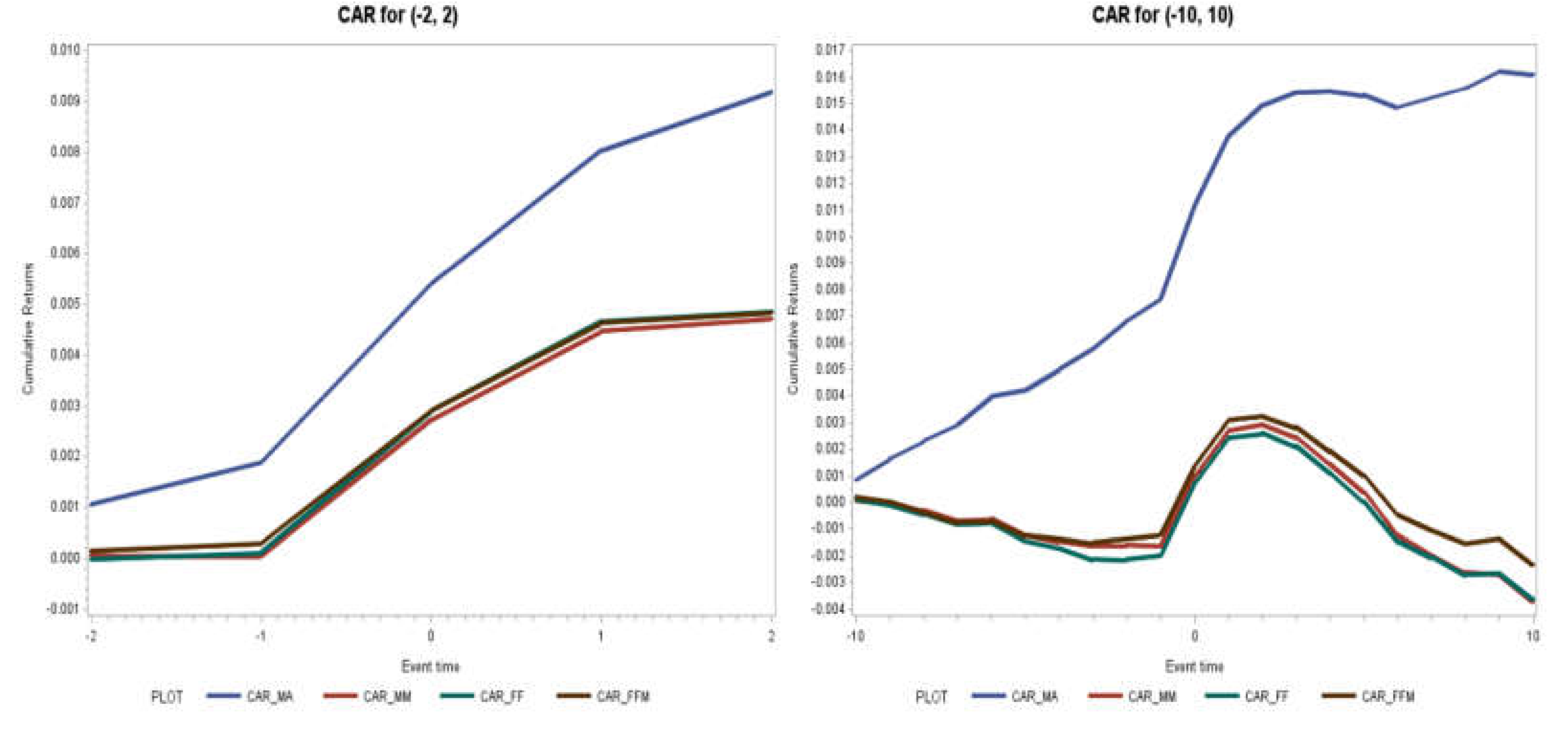
Figure 1 reports the cumulative abnormal returns of the acquirer after the deal closes and becomes effective. Specifically, we report the CAR for two days before and two days after the effective date, as well as for 10 days before and 10 days after it. We employ various approaches to measure the expected returns, such as using the mean-adjusted return, market-model, Fama–French three-factor model, and Carhart four-factor model. Aside from the mean-adjusted model, which shows higher levels of cumulative abnormal returns of about 0.92% for the (−2,2) day interval, very little difference is seen when using the other three approaches; they show about 0.45% cumulative abnormal returns for the same interval. The models all show similar abnormal return trends. The acquirer experiences increasing returns around the day the deal closes, and then they begin to decrease. The increase in returns beyond what is expected for the acquirer when the deal closes indicates a positive reaction from the market that the deal has closed successfully, allaying uncertainties regarding whether the deal would be abandoned. This result is a confirmation of prior findings in the literature of a positive reaction associated with a successful close [39].
Figure 1.
Cumulative abnormal returns of the acquirer (−2,2) and (−10,10) using the mean-adjusted model, market-model, Fama–French three-factor model and Carhart four-factor model. Source: Thomson Reuters Securities Data Company (SDC) Platinum Mergers and Acquisitions database, Center for Research in Security Prices (CRSP) database.
4. Results and Discussion
To investigate how the time until completion affects the acquirer post-M&A, we study several quantitative indicators, including stock performance, financial performance, and operational performance. We also investigate how time until deal completion affects the likelihood of failure, and then conduct a survival analysis.
4.1. Stock Performance
Table 3 presents the results of our tests for the due diligence and overdue hypotheses using stock performance. For the short-term analysis, we use cumulative abnormal return (CAR) to measure the stock performance of the acquirer one month and three months after the deal, as in Equation (8). Due to the misspecification bias related to using CAR to measure long-horizon returns, we adopt the buy-and-hold abnormal returns (BHAR) to measure stock performance six months, one year, two years, and three years after the deal following Kothari and Warner [40], as in Equation (9). In this study, we focus on the post-merger CAR and BHAR because the acquirer was independent of the target at the announcement date. The deal is effective only after the deal closes or is consummated. To estimate the expected returns, we use the constant mean-adjusted model for all subsequent regressions after confirming that our results do not substantially differ across the different measurement approaches outlined above. We run a panel regression using a squared term of time until completion to test the inverse U-shaped relationship between stock performance and time until deal completion:
where is the cumulative abnormal returns of the acquirer or newly merged firm, is the time until deal completion, is the squared term of time until deal completion, are firm fixed effects used to control for time-invariant heterogeneity among firms, and is the error term. The control variables are the national- and firm-level and deal-specific variables, as explained above. All variables are defined in Appendix A. The Wald tests to verify that the quadratic terms in the models are equal to zero are reported. In addition, the turning point of the quadratic relationship between time until deal completion and the dependent variable is reported, as well as the result and implication of the stringent test of quadratic relation, following Lind and Mehlum [36]. Standard errors are corrected for heteroscedasticity and clustered by firm and year.
Table 3.
Effect of Time until Completion on Stock Performance.
The results are shown in Table 3 indicate a negative sign on the squared term of time until deal completion, confirming an inverse U-shaped relationship. We subject the model to the stringent test of Lind and Mehlum [36]. The null hypothesis of monotone or U-shaped relationship is strongly rejected, indicating an inverse U-shaped relationship between time until deal completion and stock performance, and thus, confirming hypotheses 1 and 3. In other words, the results are shown in Table 3 support both the due diligence hypothesis and the overdue hypothesis. This result implies that, up until a certain optimal period of deal completion, post-M&A stock performance measured by cumulative abnormal returns or buy-and-hold abnormal returns increases until it reaches a maximum; when time until deal completion extends beyond this optimal time, however, stock performance declines, as the possible existence of challenges to the deal is being signaled. The results for various time intervals show that our findings are robust to various time specifications. The Wald test that the quadratic term in the model is zero is strongly rejected in all time intervals except for one year after deal completion, where it is marginally rejected at the 10% level. Interestingly, the extremum revealed empirically in our sample for the one-month interval is 455 days (one year and three months), which is far beyond the mean period of about two months for deal completion in our sample. This indicates that deals that should take an average of about two months, but that extend beyond one year arouse concern in the market given the opaque nature of information provision during the negotiation process, coupled with the desire to close deals quickly to benefit from timely synergies.
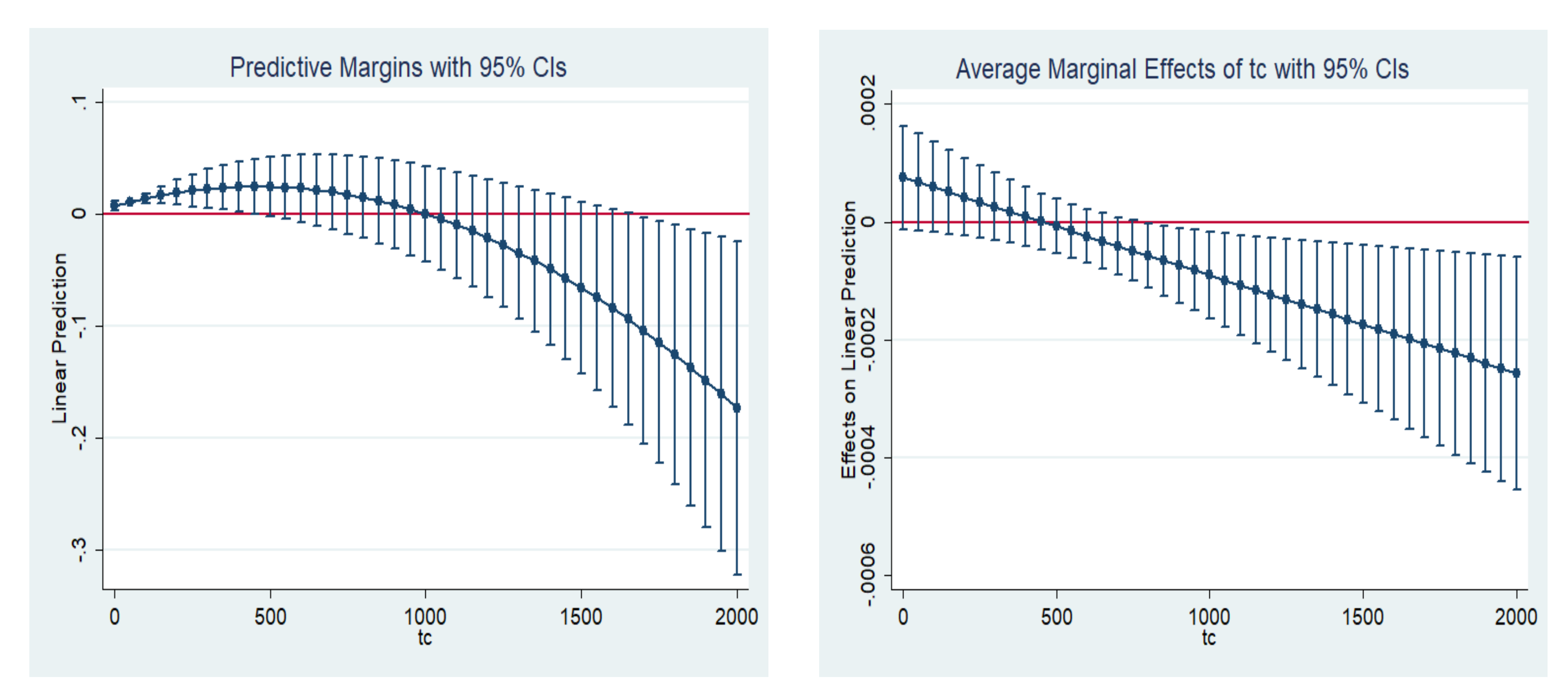
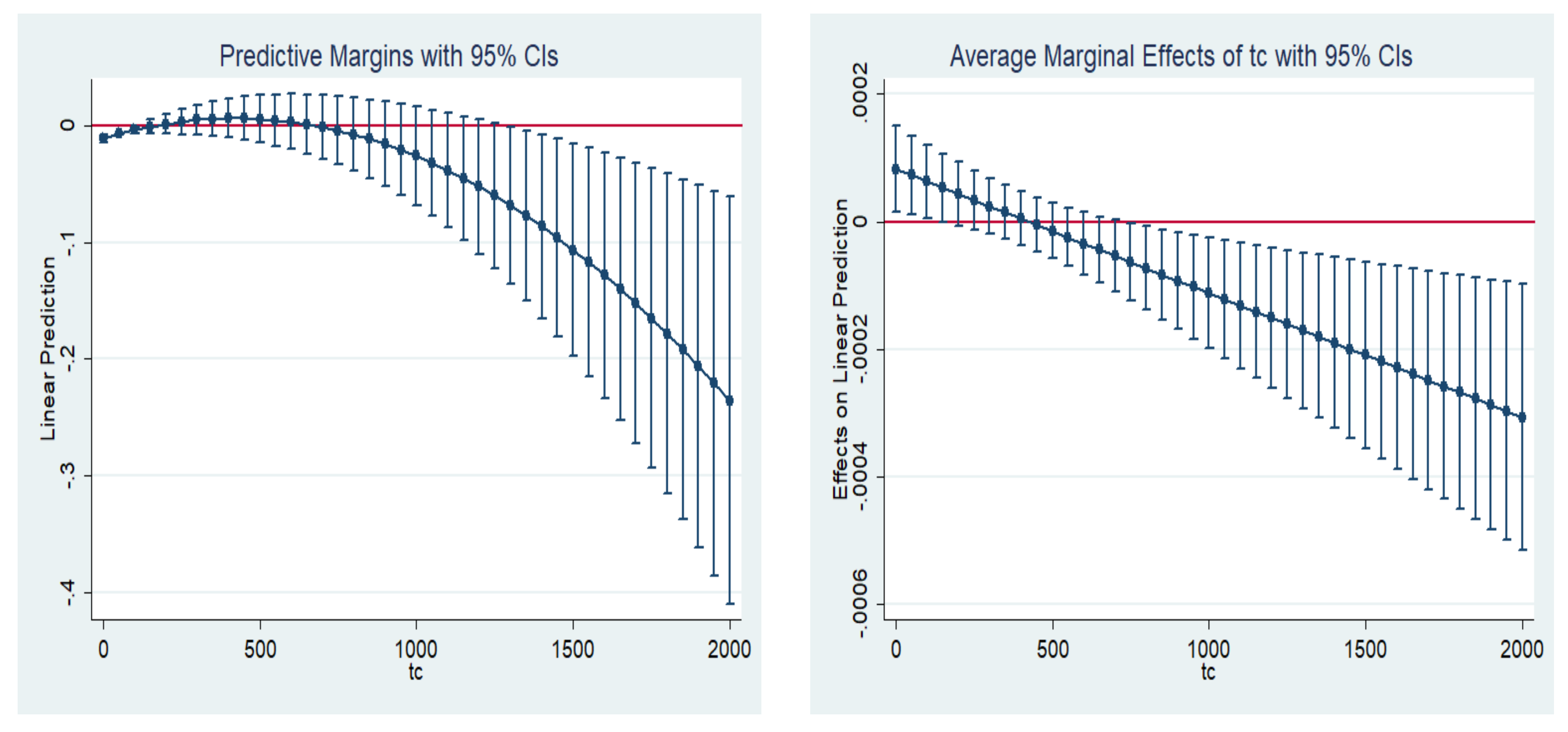
When seeking to determine the economic impact of time until deal completion on stock performance, we cannot directly employ the magnitude of the coefficients of time and time-squared in the models. The literature agrees that the co-efficient of a quadratic term in a model is not equal to the marginal effect, in contrast to the case of a normal linear regression without any polynomial terms or interaction terms. This applies not only to squared terms, but also to other polynomial terms, as well as interaction terms in any empirical model. This issue is further complicated if the regression is a non-linear one, such as the probit or logit regression [41]. We, therefore, present a graphical illustration of how time until deal completion affects the acquirer’s stock performance at various durations until deal close in Figure 2 for the one-month interval. As presented in the predictive margins graph of Figure 2, there is a clear inverse U-shaped relationship between time until deal completion and stock performance. As time until deal completion increases toward the turning point, the acquirer’s abnormal stock returns increase, but they begin to decrease beyond the extremum. Regarding marginal effects, for deals that close up until the turning point of about 455 days, every additional day adds a positive abnormal return to the firm’s overall stock performance until an extremum, thus, lending support to the due diligence hypothesis. However, beyond the extremum, every additional day adds a negative abnormal return to the stock performance, resulting in a decreasing slope and a decline in performance, supporting the overdue hypothesis.
Figure 2.
Predictive margins and average marginal effects of time until completion (in days) on acquirer’s cumulative abnormal returns one month after the close of the deal with 95% confidence intervals. Source: Table 3.
Concerning the other control variables, our results confirm the literature in many ways. Deals paid for in cash are positively related to subsequent acquirer performance, though not significantly, in our sample. The literature generally finds that deals that are expected to result in large gains for the acquirer and in which the acquirer is confident are paid for in cash to prevent the target’s shareholders from benefitting from the increases in share prices that would result if they were paid for in stock. Differences across industries and geographical locations are associated with negative coefficients, as expected. The coefficient on shareholder protection in the target country is positive, indicating that M&A involving target countries with strong shareholder protection are associated with increases in overall share performance and less risk of expropriation from acquirers’ gains, which strongly aligns with both our intuition and the literature. Given the widespread criticism in the literature of using stock performance alone to measure performance, we present further evidence using the acquirer’s post-deal operational and financial performance.
4.2. Operational Performance
We measure operational performance using the change in turnover as a proxy. Thanos and Papadakis [42] show that this proxy is used in the accounting literature as an alternative approach to measuring operational performance or efficiency. We expect an increase in turnover for deals that improve the acquirer’s operational performance post-M&A. We run a panel regression controlling for firm fixed effects, as in the model in Equation (10), below:
where is the sales scaled by total assets of the acquirer or newly merged firm t-years after, is the time until deal completion, is the squared term of time until deal completion, are firm fixed effects used to control for time-invariant heterogeneity among firms, and is the error term. The control variables are the national- and firm-level and deal-specific variables, as explained above. All variables are defined in Appendix A. The Wald tests verifying that the quadratic terms in the models are equal to zero are reported. In addition, the turning point of the quadratic relationship between time until deal completion and the dependent variable is reported, as well as the result and implication of the stringent test of quadratic relation, following Lind and Mehlum [36]. Standard errors are corrected for heteroscedasticity and clustered by firm and year.
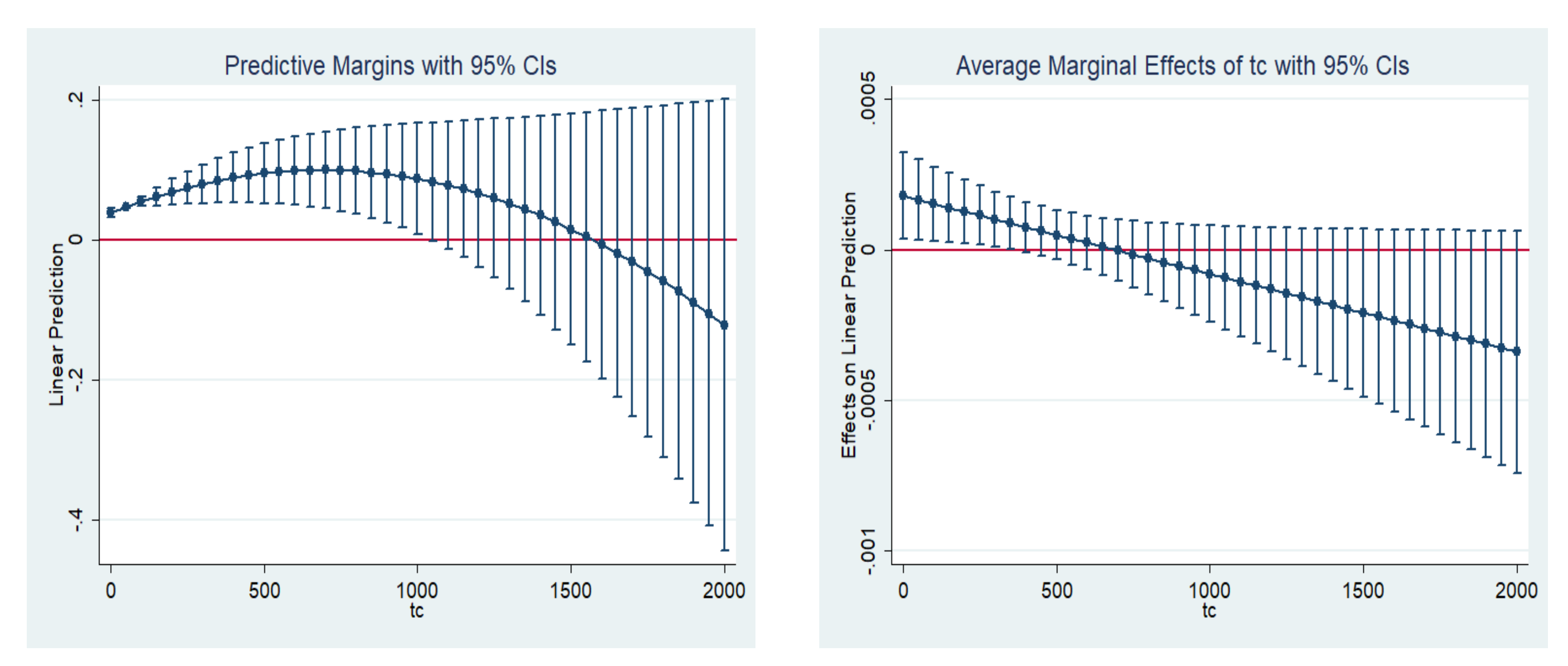
The results of this regression are presented in Table 4 below. The results for one year and three years after deal completion indicate an inverse U-shaped relationship between time until deal completion and operational performance, reinforcing our previous results. The results for two and five years after the deal reject the inverse U-shaped relationship in the stringent test. The corresponding predictive margins and marginal effect graphs for one year after the deal are shown in Figure 3. The summary (albeit weak) evidence is that the due diligence and overdue hypotheses are complementary and are supported with respect to operational performance.
Table 4.
Effect of time until completion on operational performance.
Figure 3.
Predictive margins and average marginal effects of time until completion (in days) on acquirer turnover one year after the close of the deal with 95% confidence intervals. Source: Table 4.
4.3. Financial Performance
We deepen our analysis of post-M&A performance by employing a measure of financial performance proxied by the change in return on assets (ROA) as measured by the change in earnings before interest, taxes, depreciation and amortization (EBITDA) scaled by total assets [42]. We employ a panel regression, as in Equation (11), and control for firm fixed effects and correct standard errors for heteroscedasticity and serial correlation, as above.
where is the earnings before interest, taxes, depreciation and amortization (EBITDA) scaled by total assets of the acquirer or newly merged firm t-years after, is the time until deal completion, is the squared term of time until deal completion, are firm fixed effects used to control for time-invariant heterogeneity among firms, and is the error term. The control variables are the national- and firm-level and deal-specific variables, as explained above. All variables are defined in Appendix A. The Wald tests verifying that the quadratic terms in the models are equal to zero are reported. In addition, the turning point of the quadratic relationship between time until deal completion and the dependent variable is reported, as well as the result and implication of the stringent test of quadratic relation, following Lind and Mehlum [36]. The results are presented in Table 5 and graphically in Figure 4, below.
Table 5.
Effect of time until completion on financial performance.
Figure 4.
Predictive margins and average marginal effects of time until completion (in days) on acquirer’s return on assets one year after the close of the deal with a 95% confidence interval. Source: Table 5.
The results are shown in Table 5 support hypotheses 1 and 3 for the time intervals of one, two, and three years post-deal. However, the null of monotone or U-shaped relationship between time and financial performance cannot be rejected for the interval of five years after deal completion. All the foregoing results confirm that the due diligence hypothesis (hypothesis 1) and the overdue hypothesis (hypothesis 3) are complementary given the presence of an inverse U-shaped relationship between time until deal completion and post-M&A performance.
4.4. Likelihood of Failure
We further test our hypotheses by investigating how time until deal completion is related to failure for the acquirer after the deal closes. We consider failure to be an event in which the acquirer is delisted at t periods post-deal [43,44].
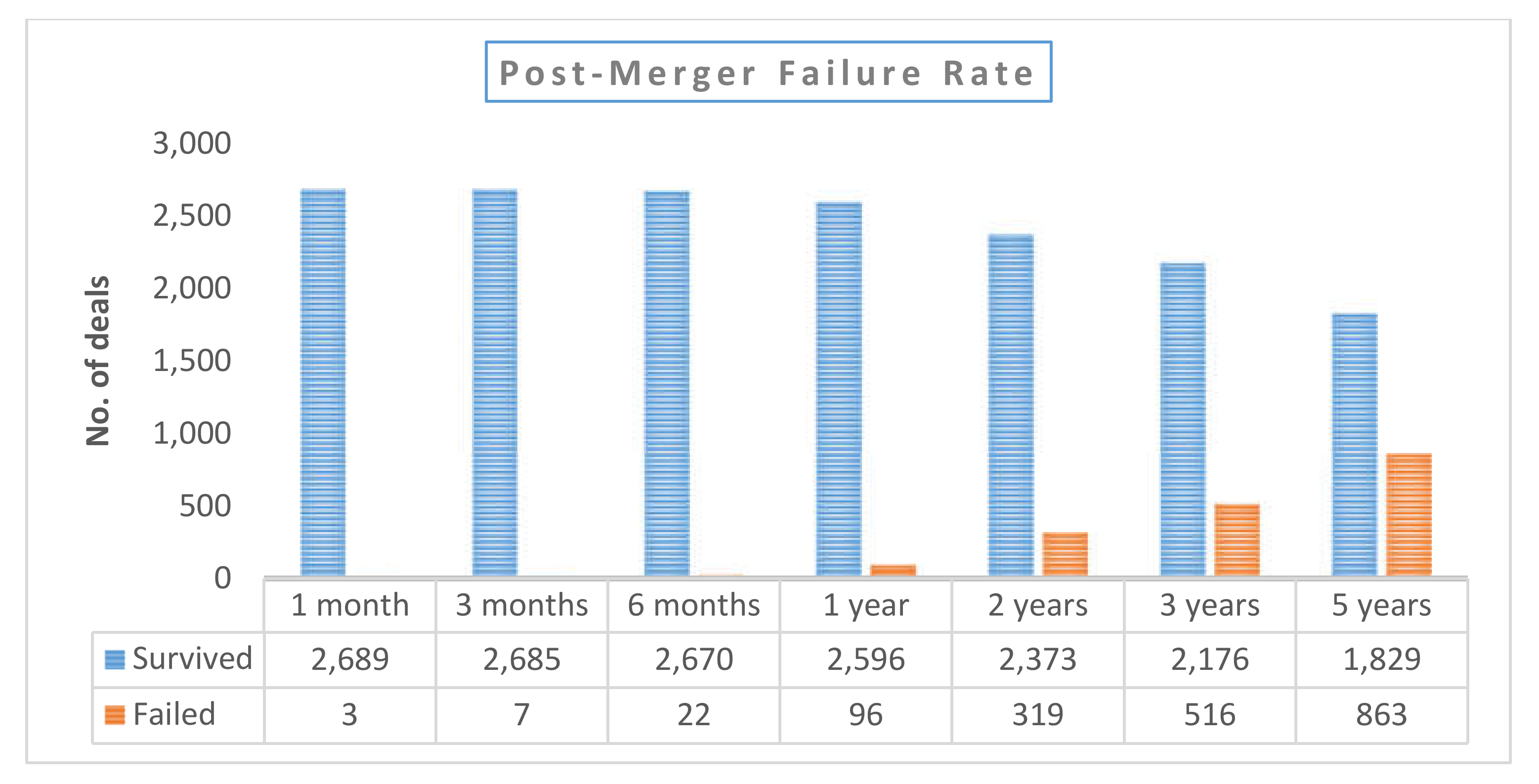
First, we present a graph of the failure rates of the firms in our sample in Figure 5. As the figure shows, there is a substantial rate of failure for acquirers post-M&A in our sample. About one-third of firms fail within five years after the deal. Some studies find post-M&A failure rates of about 70% or 90% [3], so our estimates are relatively conservative. Such high rates of failure motivate an investigation into the determinants of acquirer failure post-M&A. We, therefore, run a logistic regression with a failure dummy as the dependent variable in Equation (12).
where f(.) is the logit function.
Figure 5.
Histogram comparing the number of deals that survive or fail post-M&A with various time intervals. Source: Thomson Reuters Securities Data Company (SDC) Platinum Mergers and Acquisitions database, Center for Research in Security Prices (CRSP) database.
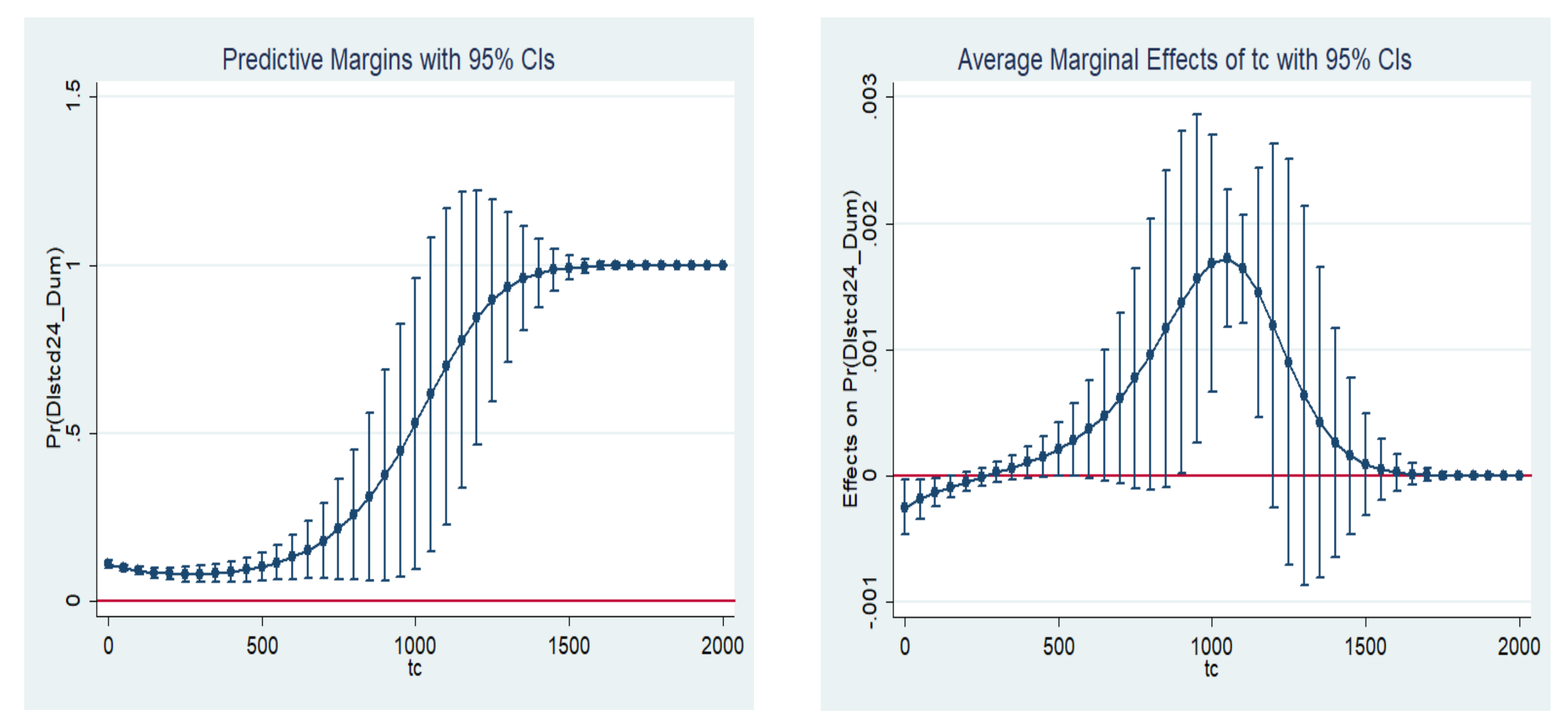
The results are shown in Table 6 below. To aid interpretation, the marginal effects associated with the regression are reported in Table 7, and the corresponding predictive margin graph and marginal effect graph for two years post-deal are provided in Figure 6. The results in Table 6 and Table 7 support the due diligence hypothesis and the overdue hypothesis with respect to the likelihood of failure, as predicted in hypotheses 2 and 4. The results are show a strong U-shaped relationship for the two- and three-year time intervals. For the one-year and five-year intervals; however, the composite null of the stringent test of a U-shaped relationship is not rejected. Overall, the results are shown in Table 6 and Table 7 support the U-shaped relationship between time until deal completion and the likelihood of failure. The predictive margins in Figure 6 conform to the shape of a logit distribution and reveal low and decreasing levels of failure prediction before the turning point, and a sharp increase in failure prediction in the days beyond the optimum, which worsens every day. Moreover, the marginal effect is negative before the turning point, indicating that, before the turning point, each additional day reduces the likelihood of failure (supporting the due diligence hypothesis), but that, after the turning point, the marginal effect is always above zero, though it rises sharply and falls. However, the fact that it remains positive beyond the turning point shows that each additional day beyond the turning point is associated with an increased likelihood of failure, supporting the overdue hypothesis.
Table 6.
Effect of time until completion on failure.
Table 7.
Effect of time until completion on actual failure (Marginal Effects).
Figure 6.
Predictive margins and average marginal effects of time until completion (in days) on acquirer’s likelihood of failure two years after the close of the deal with 95% confidence intervals. Source: Table 6.
Table 6 investigates the effect of time until completion on acquirer’s likelihood of failure post-M&A at various time intervals: One year, two years, three years, and five years after the deal by logistic regression. The dependent variable is a dummy that equals one if the firm is delisted by t periods after the close of the deal, and zero otherwise. All variables are defined in Appendix A. Industry and year effects are included in all models, and the Wald tests verifying that the quadratic terms in the models are equal to zero are reported. In addition, the turning point of the quadratic relationship of time until deal completion with the dependent variable is reported, as well as the result and implication of the stringent test of quadratic relation, following Lind and Mehlum [36]. Standard errors are clustered by the firm to deal with serial correlation.
Table 7 reports the marginal effects of the regression results in Table 6. The dependent variable is a dummy that equals one if the firm is delisted by t periods after the close of the deal, and zero otherwise. All variables are defined in Appendix A. Standard errors are clustered by the firm to deal with serial correlation.
4.5. Survival Analysis
The logit model presents evidence on how time until deal completion influences the likelihood of failure post-M&A. However, the logit model uses only status information (0 or 1) and does not consider the duration until the status changes. However, the transition intensities, which are cumulative, are worth considering. We, therefore, conduct a survival analysis to investigate how time until deal completion influences how long it takes until the acquirer fails (i.e., is subsequently delisted or is involved in another M&A).
Given that represents the likelihood of experiencing an event at a point in time (in this case, M&A failure after the deal closes), the cumulative distribution function associated with observing the event within a time interval (in this case, from deal close until deal failure) is given as . A simple transformation of the cumulative distribution function gives us the survival function, which is the probability of survival beyond time, expressed as . We model the hazard rate, which is the relative likelihood that event failure occurs at time , conditional on the survival of a subject up to time. Put intuitively, the hazard rate is the instantaneous rate of failure without regard for the accumulation of hazard up to time. The result of the survival analysis is shown in Table 8 based on Equation (13), below.
where f(.) is the underlying distribution of the model, t is the time until failure, and tc is the time until deal completion. The gamma model and log-normal model results are reported with selection criteria based on the AIC and BIC values, shown in Panel B.
The table below shows a survival analysis of the time until the acquirer experiences a failure, defined as being delisted by t periods after the close of the deal. All variables are defined in Appendix A. Standard errors are corrected for heteroscedasticity and clustered by the firm to deal with serial correlation.
First, a test of the proportional hazard assumption shows that the assumption is violated in our sample, for which reason we do not use the semi-parametric cox-proportional hazard model for our survival analysis. Alternatively, we use parametric models, which assume an underlying distribution of the error term. However, our choice of the underlying distribution is not arbitrary. We employ the AIC and BIC information criterion to select the most suitable model for the parametric model. The results, shown in Panel B of Table 8, show that the gamma distribution and the lognormal distribution are the best in terms of the assumptions of the underlying distribution; we, thus, present the results related to these two distributions. As can be seen in the reported hazard ratios for both the gamma distribution parametric model and the lognormal distribution parametric model, each additional month before the closing of a deal increases the hazard of experiencing a subsequent failure by 0.015% and 0.0182%, respectively, lending more support to the overdue hypothesis.
4.6. Robustness Checks
We conduct a further investigation to test the robustness of our results. As mentioned, the time to deal completion may not be exogenously determined, but rather endogenously influenced. Specifically, deal closing times tend to differ according to how complex the deal is [8]); whether it is a cross deal [9]; whether the target experienced poor performance and is being acquired after bankruptcy [10,11]; whether it is a friendly or hostile deal [12]; whether the acquirer’s stocks are overvalued [13]; whether the deal occurs during a financial crisis [14]; and what type of deal advisors are involved [15].
To control for possible endogeneity that may affect our findings, we re-estimate our regressions related to stock performance, financial performance, and operational performance by employing a two-stage least squares regression. We account for complexity by considering the transaction value; for cross-border deals by using a dummy equal to one when the deal is cross-border; for whether the deal is undertaken during a financial crisis by using a financial crisis dummy; and for the target’s past performance by using a bankruptcy flag dummy. The data are all obtained from the SDC. We also use a stock payment dummy and Tobin’s q to control for possible market valuation effects on the timing of the deal and control for deal advisors’ influence on the deal completion time using the number of acquirer and target advisors (where available). The excluded instruments in our regressions are the number of acquirer advisors and the number of target advisors.
Regarding the exclusion conditions, the number of target and acquirer advisors should not have a direct effect on the acquirer’s post-M&A performance. The type and quality of the acquirer and target advisors should have a direct effect on their performance rather than the number of advisors. We argue that though the kind and number of acquirer and target advisors can potentially influence the performance of the acquirer, it is unlikely that this effect will be direct. The number of acquirer advisors and target advisors should only affect the performance of the acquirer through their influence on how fast and timely the deal is consummated. Although it is not a direct test of the exclusion condition, the Hansen J-Test of over-identifying restrictions with the null that the instrumental variables are valid (i.e., uncorrelated with an error term and the excluded instruments are correctly excluded from the estimated equation) is not rejected. We also conduct endogeneity test for the endogenous regressor and find that the null that the specified endogenous regressors can actually be treated as exogenous is not rejected suggesting that using OLS approach may be more efficient than using the IV approach. This obviously does not augur well for our work.
However, we will like to believe that time until deal completion is still endogenous to tread on the side of caution. Even if time until deal completion were not endogenous, it still works in our favor that the fixed effect regression earlier presented is valid. As mentioned earlier, the literature has indicated that time is endogenously determined, and economic reasoning supports the endogeneity of time until deal completion as the time is affected by many human and discretionary factors while a deal is negotiated, and thus, not exogenously determined. However statistically, we are unable to show the endogeneity of the time variable from the data. We are regardless inclined to argue that the endogeneity of time is valid, and some reasons may attribute for our failure to reject the null of the endogeneity test statistically.
First, our instrument is shown to be weak, which is a limitation of our work. The endogeneity test is found to be invalid under weak instruments, and its power varies depending on instrument strength, an issue extensively discussed in the literature [45,46].
Secondly, due to data limitations, we have a lot of empty slots for the number of target advisors and a number of acquirer advisors which reduces our sample size in the IV regressions greatly by more than 70% compared to the fixed effects regressions. This may also partially account for why we fail to reject the test. We are unable to confirm this for sure, given the data limitations and the weakness of our instrument. Thus, the result under the IV regression may be taken with a pinch of salt.
To deal with potential issues caused by the use of a weak instrument, we re-run our regressions using an estimator known to be robust to weak instruments, that is, Fuller’s modified LIML estimation [47]. We follow Hahn, Hausman, and Kuersteiner in using α = 4 for our Fuller estimation, as they find that it works significantly better than α = 2 [48]. The Fuller estimation results are available upon request from the authors. We present and discuss our results from the 2SLS, shown in Table 9, Table 10, and Table 11.
Table 9.
Two-stage least square regression of effect of time until completion on stock performance.
Table 10.
Two-stage least square regression of effect of time until completion on operational performance.
Table 11.
Two-stage least square regression of effect of time until completion on financial performance.
The results shown in Table 9 confirm the validity of our results for the one-, two-, and three-year intervals, though only weakly for the one-year interval. There is an inverse U-shaped relationship between time until deal completion and the acquirer’s stock performance post-M&A for these intervals. For the one-, three-, and six-month intervals, our hypotheses are not supported with respect to post-M&A performance, perhaps due to the loss of many observations caused by a lack of data on the number of acquirer and target advisors.
None of the results for the operational performance, shown in Table 10, is significant at the 5% level. The only noteworthy observation is that the coefficient on time until deal completion has the expected sign. Regarding financial performance, the results are shown in Table 11 indicate that both hypotheses 1 and 3 are supported for all time intervals except for the five-year period. Thus, after possible endogeneity concerns are controlled for, our overall results support the two complementary hypotheses, albeit weakly. For the sake of brevity, we only present summarized results of the 2SLS fixed regressions here. The full results will be available upon request for interested readers.
Table 9 investigates the effect of time until completion on acquirer’s stock performance post-M&A at various time intervals by a 2SLS fixed effects regression. For the one- and three-month time intervals, the cumulative abnormal return is used as the dependent variable; for the six-month, one-year, two-year, and three-year intervals, the buy-and-hold abnormal returns is used as the dependent variable. All variables are defined in Appendix A. Firm fixed effects are included in all models, and standard errors are corrected for heteroscedasticity and clustered by firm and year. The Wald test, U-test, Hansen J test and the endogeneity test results are also reported.
Table 10 investigates the effect of time until completion on acquirer’s operational performance post-M&A by a 2SLS fixed effects regression for various time intervals: One year, two years, three years, and five years after the deal. The dependent variable is the change in turnover of the acquirer from the close of the deal and t years after. All variables are defined in Appendix A. Firm fixed effects are included in all models, and standard errors are corrected for heteroscedasticity and clustered by firm and year to deal with serial correlation. The Wald test, U-test, Hansen J test and the endogeneity test results are also reported.

Table 11 investigates the effect of time until completion on acquirer’s financial performance post-M&A by a 2SLS fixed effects regression for various time intervals: One year, two years, three years, and five years after the deal. The dependent variable is the change in return on assets of the acquirer from the close of the deal and t years after. All variables are defined in Appendix A. Firm fixed effects are included in all models, and standard errors are corrected for heteroscedasticity and clustered by firm and year to deal with serial correlation. The Wald test, U-test, Hansen J test and the endogeneity test results are also reported.

5. Conclusions
This study empirically investigates how time until deal completion affects the acquirer’s post-M&A performance and the likelihood of failure. We propose and test the complementary overdue and due diligence hypotheses. The due diligence hypothesis posits that deals take longer to complete because the acquirer conducts due diligence, with a subsequent expectation of superior post-M&A performance and reduced likelihood of failure. Conversely, the overdue hypothesis posits that deals that take a longer-than-optimal time to complete face fundamental challenges, leading to poor post-M&A performance and increased risk of failure. We suggest that time until deal completion could proxy for a varied array of risk factors influencing performance and survival post-M&A. Caiazza and Pozzolo indicate that the time elapsed from the moment of the announcement of a deal and its successful conclusion or its abandonment can provide information on the ex-ante probability that it will succeed or fail, thus suggesting the need to pay attention to the time it takes for a deal is completed [16]. We reveal a strong inverse U-shaped relationship between time until deal completion and performance as measured by cumulative abnormal returns, buy-and-hold abnormal returns, changes in turnover, and changes in return on assets. We also find a U-shaped relationship between time until deal completion and the likelihood of failure (where the acquirer is delisted post-M&A). These findings all support both the overdue hypothesis and the due diligence hypothesis.
Our results have a number of implications. First, though due diligence is important to ensure that detailed provisions critical to a deal’s success are not overlooked, and uncertainty related to a deal are resolved prior to closing, unnecessarily delaying the close of a deal without economic justification (that the expected benefit from delay exceeds the costs associated with delay) is detrimental to the future performance of the deal and may lead to subsequent failure. As a deal is delayed, opportunities to take advantages from the synergies resulting from the merger maybe lost while at the same time direct and indirect cost from the delay would spiral possibly increasing to a point where they could not be offset by the post-M&A performance [25]. Indeed, as indicated in the literature, if a deal is truly beneficial to both parties, then it would be closed quickly [6,16]. Secondly, although it is not directly communicated to the market, the time elapsed until deal completion may be an indicator of a merger’s quality, as well as its future performance and/or failure likelihood. To tread on the side of caution, investors, risk managers and regulators need to raise the red flag if a deal unreasonably extends beyond a certain period of time. Though there is not fixed rule as to the optimum time, a conservative conclusion from our results may be from one to two years, depending on the complexity and size of the deal. In a market where information is typically kept out of the public eye during the negotiation process of deals, the time taken until deal completion is likely to be a very important source of information for the market. At the same time, a deal which is closed too quickly maybe a cause for concern as essential parts of the due diligence process may have been ignored. Finally, even though regulators need to undertake a careful review of deals before they are approved, especially when there are antitrust concerns, it will augur well for the firms involved in such reviews are not unduly delayed.
The research results are limited in a number of ways. We are unable to investigate transactional due diligence directly as it is unobservable, and thus, proxy it with the time between deal announcement and completion. We are also unable to individually investigate the reasons for the delay, as we are not privy to that information in our dataset. In addition, we are not able to deal with the issue of endogeneity fully as our instrument was found to be weak and the endogeneity of time until deal completion could not be statistically established despite the economic justification of its endogeneity. In this respect, the results of the instrumental variable regression could be taken with a pinch of salt. Nevertheless, based our results, the time until deal completion has important implications for post-M&A performance and failure. Future research may investigate the reasons for delays in closing deals and their impact on subsequent performance. A model or method of directly quantifying the amount of due diligence may also be another future direction of research. Finally, proposition of a theoretical model in light of these empirical results may be another interesting line of research. We suggest that future research on the performance and failure of M&A may need, at the very minimum, to incorporate time until deal completion as a determinant or control variable, or (ideally) to use its squared term.
Author Contributions
Conceptualization, E.K.T., C.K.; methodology, E.K.T.; software, E.K.T.; validation, C.K.; formal analysis, E.K.T.; investigation, C.K.; resources, C.K.; data curation, E.K.T.; writing—original draft preparation, E.K.T.; writing—review and editing, C.K.; supervision, C.K.; project administration, C.K. All authors have read and agreed to the published version of the manuscript.
Funding
This research was funded by the Asian Institute of Corporate Governance, Korea University, grant number K2006331 (Amount: 1800CHF).
Acknowledgments
We are indebted to the anonymous reviewers and the editor. We are also grateful for comments from participants at seminars at Korea University Business School and the 3rd Sydney Banking and Financial Stability Conference 2019.
Conflicts of Interest
The authors declare no conflict of interest.
Appendix A
Table A1.
Definition of Variables.
Table A1.
Definition of Variables.
| CAR and BHAR | The one-month and three-month CAR, and the six-month, one-year, and three-year BHAR of the acquirer firm after the deal. Source: CRSP and COMPUSTAT |
| ROA | The ROA of the acquirer one year, two years, three years, and five years after the deal. ROA is calculated as earnings before interest, taxes, depreciation and amortization (EBITDA) divided by Total Assets. Source: COMPUSTAT |
| Turnover | The turnover of the acquirer one year, two years, three years, and five years after the deal. Turnover is calculated as Sales divided by Total Assets. Source: COMPUSTAT |
| Failure dummy | A dummy variable which is equal to one if the firm is delisted after the deal by t periods, and zero otherwise. Source: CRSP |
| Survival Analysis: (Time until Failure) | The time taken until delisting or acquisition of the acquirer firm. Source: CRSP |
| Time until Completion | The interval between the announcement and effective date of the deal measured in months. Source: SDC database |
| Cash Payment | A dummy variable equal to one if the deal is financed by all or majority cash or other means, and zero if financed by all or majority stock. Source: SDC database |
| Industry Difference | A dummy variable that equals one if the acquirer and target firms belong to different industries and zero if they belong to the same or related industry. Source: SDC database |
| Shareholder Protection | The new anti-self-dealing rights score of the target’s country as developed by Djankov et al. [27] Source: Reference [27] |
| Language Difference | A dummy variable that equals one if acquirer’s and target’s countries use different languages, and zero otherwise. Source: Reference [34]), World Factbook |
| Geographical Difference | A dummy variable that equals one if target’s and acquirer’s countries are from different continents, and zero otherwise. The following country classification is used (America, Asia, Africa, Oceania and Europe): http://www.mapsofworld.com/worldmaps/world-map-with-latitude-and-longitude.html |
| GDP Growth | The annual GDP growth rate of the target countries. Source: World Bank Development Indicators |
| Total Stock Traded Growth | The calculated annual growth of the total stock market value of the target countries. Source: World Bank Development Indicators |
| Value of Transaction | The log of the total value of the consideration paid by the acquirer, excluding fees and expenses. Source: SDC database |
| Ownership Percentage | The percentage ownership of the acquirer after the deal. Source: SDC database |
| Firm Size | The log of total assets of the acquirer firm. Source: COMPUSTAT |
| Firm Cash flow | The cash flow of the acquirer firm scaled by its total assets. Source: COMPUSTAT |
| Firm Leverage | The total liabilities of the acquirer firm scaled by its total assets. Source: COMPUSTAT |
| Firm valuation | The Tobin’s q of the acquirer firm. Tobin’s q is defined as the ratio of total assets plus market capitalization minus common equity minus deferred taxes and investment tax credit to total assets. Source: COMPUSTAT |
| Bankruptcy | A dummy variable equal to one it the target has the flag of bankruptcy before the deal, and zero otherwise. Source: SDC database |
| Cross border | A dummy variable equal to one if the deal is cross-border (international), and zero otherwise. Source: SDC database |
| Attitude | An indicator variable equal to one if the attitude to the deal is hostile, and zero otherwise. Source: SDC database |
| Acquirer advisors | The number of acquirer advisors. Source: SDC database |
| Target advisors | The number of target advisors. Source: SDC database |
Appendix B
Table A2.
Deal summary by target nation based on effective year.
Table A2.
Deal summary by target nation based on effective year.
| Target Nation | 2000 | 2001 | 2002 | 2003 | 2004 | 2005 | 2006 | 2007 | 2008 | 2009 | 2010 | 2011 | 2012 | 2013 | 2014 | Total |
|---|---|---|---|---|---|---|---|---|---|---|---|---|---|---|---|---|
| Argentina | 3 | 1 | 1 | 0 | 2 | 0 | 1 | 0 | 0 | 0 | 1 | 0 | 1 | 0 | 0 | 10 |
| Australia | 5 | 4 | 5 | 2 | 9 | 2 | 3 | 7 | 6 | 6 | 5 | 0 | 0 | 0 | 0 | 54 |
| Austria | 0 | 0 | 0 | 0 | 0 | 1 | 0 | 2 | 0 | 0 | 0 | 1 | 0 | 0 | 0 | 4 |
| Belgium | 2 | 3 | 1 | 0 | 1 | 4 | 2 | 0 | 3 | 2 | 0 | 0 | 0 | 0 | 0 | 18 |
| Brazil | 0 | 1 | 1 | 1 | 1 | 3 | 2 | 1 | 3 | 3 | 2 | 0 | 0 | 0 | 0 | 18 |
| Bulgaria | 0 | 0 | 0 | 0 | 0 | 1 | 0 | 1 | 0 | 0 | 0 | 0 | 0 | 0 | 0 | 2 |
| Canada | 17 | 28 | 22 | 12 | 20 | 16 | 19 | 29 | 17 | 11 | 21 | 1 | 0 | 1 | 0 | 214 |
| Chile | 0 | 0 | 1 | 0 | 0 | 1 | 0 | 0 | 1 | 3 | 0 | 0 | 0 | 0 | 0 | 6 |
| China | 1 | 2 | 3 | 4 | 2 | 4 | 5 | 6 | 5 | 3 | 5 | 0 | 0 | 0 | 0 | 40 |
| Colombia | 0 | 0 | 0 | 0 | 1 | 0 | 0 | 0 | 1 | 1 | 0 | 0 | 0 | 0 | 0 | 3 |
| Croatia | 0 | 0 | 0 | 0 | 0 | 0 | 1 | 0 | 0 | 0 | 0 | 0 | 0 | 0 | 0 | 1 |
| Czech Republic | 0 | 0 | 0 | 1 | 1 | 0 | 1 | 1 | 0 | 0 | 0 | 0 | 0 | 0 | 0 | 4 |
| Denmark | 2 | 1 | 2 | 0 | 0 | 1 | 1 | 1 | 1 | 0 | 2 | 1 | 0 | 0 | 0 | 12 |
| Finland | 2 | 0 | 2 | 0 | 3 | 1 | 0 | 1 | 1 | 0 | 0 | 0 | 0 | 0 | 0 | 10 |
| France | 5 | 10 | 3 | 6 | 6 | 7 | 6 | 5 | 7 | 1 | 5 | 1 | 0 | 0 | 0 | 62 |
| Germany | 6 | 7 | 13 | 9 | 15 | 11 | 13 | 10 | 6 | 4 | 3 | 2 | 0 | 0 | 0 | 99 |
| Ghana | 0 | 0 | 0 | 1 | 0 | 0 | 0 | 0 | 0 | 0 | 0 | 0 | 0 | 0 | 0 | 1 |
| Hong Kong | 0 | 0 | 1 | 0 | 1 | 1 | 3 | 1 | 0 | 0 | 0 | 0 | 0 | 0 | 0 | 7 |
| Hungary | 0 | 0 | 0 | 0 | 1 | 1 | 1 | 0 | 0 | 0 | 0 | 0 | 0 | 0 | 0 | 3 |
| Iceland | 0 | 0 | 0 | 0 | 1 | 0 | 0 | 0 | 0 | 0 | 0 | 0 | 0 | 0 | 0 | 1 |
| India | 1 | 0 | 0 | 2 | 1 | 0 | 2 | 2 | 0 | 3 | 5 | 0 | 0 | 0 | 0 | 16 |
| Indonesia | 2 | 0 | 0 | 1 | 0 | 1 | 0 | 0 | 0 | 0 | 0 | 0 | 0 | 0 | 0 | 4 |
| Ireland-Rep | 2 | 0 | 2 | 1 | 2 | 0 | 3 | 1 | 1 | 1 | 1 | 0 | 0 | 0 | 0 | 14 |
| Israel | 3 | 0 | 0 | 0 | 2 | 3 | 2 | 3 | 2 | 2 | 1 | 0 | 0 | 0 | 0 | 18 |
| Italy | 2 | 0 | 3 | 2 | 0 | 3 | 3 | 1 | 3 | 2 | 3 | 0 | 0 | 0 | 0 | 22 |
| Japan | 3 | 3 | 2 | 2 | 1 | 0 | 1 | 1 | 1 | 0 | 1 | 0 | 0 | 0 | 0 | 15 |
| Kazakhstan | 0 | 0 | 0 | 0 | 0 | 1 | 0 | 0 | 0 | 0 | 0 | 0 | 0 | 0 | 0 | 1 |
| Lithuania | 0 | 1 | 0 | 0 | 0 | 0 | 0 | 0 | 0 | 0 | 0 | 0 | 0 | 0 | 0 | 1 |
| Luxembourg | 0 | 1 | 0 | 0 | 0 | 1 | 0 | 1 | 0 | 0 | 0 | 0 | 0 | 0 | 0 | 3 |
| Malaysia | 0 | 0 | 0 | 0 | 0 | 1 | 0 | 0 | 0 | 0 | 0 | 0 | 0 | 0 | 0 | 1 |
| Mexico | 3 | 2 | 5 | 0 | 2 | 1 | 1 | 4 | 2 | 0 | 1 | 1 | 0 | 0 | 0 | 22 |
| Morocco | 0 | 0 | 0 | 0 | 0 | 1 | 0 | 0 | 0 | 0 | 0 | 0 | 0 | 0 | 0 | 1 |
| Netherlands | 2 | 7 | 1 | 7 | 2 | 3 | 7 | 4 | 4 | 1 | 2 | 1 | 0 | 0 | 0 | 41 |
| New Zealand | 0 | 0 | 0 | 0 | 2 | 1 | 1 | 1 | 1 | 1 | 1 | 0 | 0 | 0 | 0 | 8 |
| Norway | 2 | 2 | 2 | 0 | 1 | 0 | 1 | 2 | 2 | 1 | 2 | 1 | 0 | 0 | 0 | 16 |
| Philippines | 0 | 1 | 0 | 0 | 0 | 2 | 0 | 1 | 2 | 0 | 0 | 0 | 0 | 0 | 0 | 6 |
| Poland | 0 | 0 | 0 | 0 | 1 | 0 | 0 | 1 | 0 | 0 | 0 | 0 | 0 | 0 | 0 | 2 |
| Portugal | 0 | 0 | 0 | 0 | 0 | 1 | 0 | 1 | 0 | 1 | 0 | 0 | 0 | 0 | 0 | 3 |
| Romania | 0 | 0 | 0 | 0 | 0 | 0 | 1 | 0 | 0 | 0 | 0 | 0 | 0 | 0 | 0 | 1 |
| Russian Fed | 1 | 0 | 0 | 0 | 0 | 2 | 1 | 1 | 2 | 1 | 0 | 0 | 0 | 0 | 0 | 8 |
| Singapore | 0 | 0 | 1 | 1 | 0 | 1 | 0 | 0 | 0 | 2 | 1 | 0 | 0 | 0 | 0 | 6 |
| South Africa | 2 | 0 | 0 | 2 | 0 | 1 | 0 | 0 | 0 | 1 | 0 | 1 | 0 | 0 | 0 | 7 |
| South Korea | 1 | 1 | 0 | 1 | 1 | 1 | 2 | 0 | 1 | 1 | 2 | 0 | 0 | 0 | 0 | 11 |
| Spain | 0 | 2 | 2 | 0 | 2 | 2 | 3 | 1 | 2 | 0 | 2 | 0 | 0 | 0 | 0 | 16 |
| Sweden | 3 | 4 | 0 | 0 | 4 | 2 | 5 | 3 | 1 | 2 | 2 | 1 | 0 | 0 | 0 | 27 |
| Switzerland | 1 | 2 | 1 | 1 | 3 | 1 | 4 | 3 | 1 | 1 | 6 | 0 | 0 | 0 | 0 | 24 |
| Taiwan | 2 | 1 | 0 | 1 | 4 | 3 | 4 | 2 | 1 | 2 | 0 | 0 | 0 | 0 | 0 | 20 |
| Thailand | 1 | 0 | 1 | 0 | 0 | 0 | 0 | 0 | 1 | 0 | 0 | 0 | 0 | 0 | 0 | 3 |
| Turkey | 0 | 0 | 1 | 0 | 0 | 0 | 0 | 0 | 0 | 0 | 0 | 0 | 0 | 0 | 0 | 1 |
| United Kingdom | 24 | 16 | 26 | 20 | 24 | 24 | 16 | 20 | 13 | 8 | 16 | 1 | 0 | 0 | 0 | 208 |
| United States | 531 | 472 | 474 | 453 | 461 | 464 | 481 | 463 | 390 | 284 | 312 | 39 | 1 | 1 | 1 | 4827 |
| Uruguay | 0 | 0 | 0 | 0 | 0 | 0 | 0 | 0 | 0 | 0 | 1 | 0 | 0 | 0 | 0 | 1 |
| Venezuela | 1 | 0 | 1 | 0 | 0 | 0 | 0 | 0 | 0 | 0 | 0 | 0 | 0 | 0 | 0 | 2 |
| Total | 630 | 572 | 577 | 530 | 577 | 574 | 596 | 581 | 481 | 348 | 403 | 51 | 2 | 2 | 1 | 5925 |
Table A3.
Correlation table.
Table A3.
Correlation table.
| tc | cp | di | sp | la | gr | gdp | tsg | vt | op | lat | chat | ltat | tq | |
|---|---|---|---|---|---|---|---|---|---|---|---|---|---|---|
| tc | 1 | |||||||||||||
| cp | −0.0732* | 1 | ||||||||||||
| di | −0.023 | −0.0186 | 1 | |||||||||||
| sp | −0.0338* | 0.0336* | 0.0124 | 1 | ||||||||||
| la | 0.0362* | −0.0436* | 0.011 | −0.6807* | 1 | |||||||||
| gr | −0.0017 | −0.0346* | 0.0255* | −0.1629* | 0.7292* | 1 | ||||||||
| gdp | 0 | −0.0275* | −0.0043 | 0.0495* | 0.1488* | 0.1494* | 1 | |||||||
| tsg | −0.016 | 0.0075 | 0.0135 | −0.0429* | 0.0976* | 0.0819* | 0.4169* | 1 | ||||||
| vt | 0.3164* | 0.0727* | −0.0552* | −0.0276* | −0.0036 | −0.0151 | −0.0194 | 0.0223 | 1 | |||||
| op | −0.0382* | 0.0497* | −0.0292* | 0.0673* | −0.1516* | −0.0988* | −0.0573* | −0.0559* | 0.0326* | 1 | ||||
| lat | 0.2205* | 0.0701* | −0.0035 | −0.0510* | 0.0912* | 0.0763* | −0.0348* | −0.0023 | 0.6520* | −0.0354* | 1 | |||
| chat | −0.1039* | −0.0232 | −0.0154 | 0.009 | 0.0213 | 0.0318* | −0.0161 | −0.0328* | −0.2295* | 0.0302* | −0.3039* | 1 | ||
| ltat | 0.1411* | −0.003 | −0.0029 | −0.0241 | 0.0258* | 0.005 | −0.0063 | −0.0011 | 0.1861* | −0.0256* | 0.2921* | −0.3595* | 1 | |
| tq | −0.0603* | −0.0368* | −0.012 | −0.0147 | 0.0345* | 0.0352* | 0.0894* | 0.0355* | −0.0552* | 0.0106 | −0.0753* | 0.2701* | −0.1640* | 1 |
Table 1 Panel D shows the pairwise correlation between the dependent, independent, and control variables used in this study. Tc is the time until deal completion, cp is the dummy for majority cash payment for deal, di is the dummy for difference in industry between acquirer and target, sp is the anti-director rights index of Djankov et al. [27], proxying for shareholder protection, la is the difference in language between the acquirer and target proxying for cultural differences between the parties to the deal, gr is the geographical dummy for whether the acquirer and target belong to the same continent, gdp is the gross domestic product of the target country, tsg is the total stock growth of the target country, vt is the value of the M&A transaction, op is the ownership percentage of the acquirer after the deal closes, lat is the log of total assets to control for size, chat is the cash flow scaled by total assets to control for cash flow, ltat is the long-term debt scaled by total assets to control for leverage, and tq is the Tobin’s q to control for valuation
References
- Bhagwat, V.; Dam, R.; Harford, J. The real effects of uncertainty on merger activity. Rev. Financ. Stud. 2016, 29, 3000–3034. [Google Scholar] [CrossRef]
- Afsharipour, A. Paying to break up: The metamorphosis of reverse termination fees. UC Davis Leg. Stud. Res. Pap. 2009, 191. [Google Scholar] [CrossRef]
- Christensen, C.M.; Alton, R.; Rising, C.; Waldeck, A. The new M&A playbook. Harv. Bus. Rev. 2011, 89, 48–57. [Google Scholar]
- Furfine, C.H.; Rosen, R.J. Mergers increase default risk. J. Corp. Financ. 2011, 17, 832–849. [Google Scholar] [CrossRef]
- Koerniadi, H.; Chandrasekhar, K.; Tourani-Rad, A. Cross-border mergers and acquisitions and default risk. Int. Rev. Financ. Anal. 2015, 42, 336–348. [Google Scholar] [CrossRef][Green Version]
- Chahine, S.; Iftekhar, H.; Mazboudi, M. The role of auditors in merger and acquisition completion time. Int. J. Audit. 2018, 22, 568–582. [Google Scholar] [CrossRef]
- Wangerin, D. M&A due diligence, post-acquisition performance, and financial reporting for business combinations. Contemp. Account. Res. 2019, 36, 2344–2378. [Google Scholar]
- Luypaert, M.; De Maeseneire, W. Antecedents of time to completion in mergers and acquisitions. Appl. Econ. Lett. 2015, 22, 299–304. [Google Scholar] [CrossRef]
- Dikova, D.; Rao Sahib, P.; Van Witteloostuijn, A. Cross-border acquisition abandonment and completion: The effect of institutional differences and organizational learning in the international business service industry 1981–2001. J. Int. Bus. Stud. 2010, 41, 223–245. [Google Scholar] [CrossRef]
- Moeller, S.; Carapeto, M. Acquiring Distressed and Bankrupt Concerns. In The Handbook of Mergers and Acquisitions; Faulkner, D., Teerikangas, S., Joseph, R., Eds.; Oxford University Press: London, UK, 2012; pp. 272–284. [Google Scholar]
- Carapeto, M.; Moeller, S.; Faelten, A. The good, the bad, and the ugly: A survival guide to M&A in distressed times. 2009. Unpublished manuscript. [Google Scholar]
- Offenberg, D.; Pirinsky, C. How do acquirers choose between mergers and tender offers? J. Financ. Econ. 2015, 116, 331–348. [Google Scholar] [CrossRef]
- Ang, J.S.; Cheng, Y. Direct evidence on the market-driven acquisition theory. J. Financ. Res. 2006, 29, 199–216. [Google Scholar] [CrossRef]
- Sánchez, C.; Seeber, C.D.; Goldberg, S.R. M&A update. J. Corp. Account. Financ. 2011, 22, 9–13. [Google Scholar]
- Hunter, W.C.; Jagtiani, J. An analysis of advisor choice, fees, and effort in mergers and acquisitions. Rev. Financ. Econ. 2003, 12, 65–81. [Google Scholar] [CrossRef]
- Caiazza, S.; Alberto, F.P. The determinants of failed takeovers in the banking sector: Deal or country characteristics? J. Bank. Financ. 2016, 72, S92–S103. [Google Scholar] [CrossRef]
- Ekelund, J.R.; Robert, B.; Ford, G.S.; Thornton, M. The measurement of merger delay in regulated and restructuring industries. Appl. Econ. Lett. 2001, 8, 535–537. [Google Scholar] [CrossRef]
- Eckbo, B.E. Handbook of Empirical Corporate Finance Set; Elsevier: Amsterdam, The Netherlands, 2008. [Google Scholar]
- Easterwood, C.M. Takeovers and incentives for earnings management: An empirical analysis. J. Appl. Bus. Res. 1998, 14, 29–48. [Google Scholar] [CrossRef]
- Louis, H.; Sun, A.X. Abnormal accruals and managerial intent: Evidence from the timing of merger announcements and completions. Contemp. Account. Res. 2016, 33, 1101–1135. [Google Scholar] [CrossRef]
- Butler, F.C.; Sauska, P. Mergers and acquisitions: Termination fees and acquisition deal completion. J. Manag. Issues 2014, 26, 44–54. [Google Scholar]
- Fuller, K.P. Why some firms use collar offers in mergers. Financ. Rev. 2003, 38, 127–150. [Google Scholar] [CrossRef]
- Muehlfeld, K.; Sahib, P.R.; Witteloostuijn, A.V. Completion or abandonment of mergers and acquisitions: Evidence from the newspaper industry, 1981–2000. J. Media Econ. 2007, 20, 107–137. [Google Scholar] [CrossRef]
- Ferreira, M.P.; Borini, F.; Vicente, S.; Almeida, M.R. The pre–acquisition process: The temporal hiatus between the announcement and completion in foreign acquisitions in Brazil. Int. J. Emerg. Mark. 2017. [Google Scholar] [CrossRef]
- Hwang, J.E.; Roh, T. Successful M&A Experiences: Breadth, Depth, and Deal Duration in the US Semiconductor Industry. In Academy of Management Proceedings; Academy of Management: Briarcliff Manor, NY, USA, 2015; Volume 2015, p. 10522. [Google Scholar]
- Picquet, T. Determinants of Deal Duration in Mergers and Acquisitions: Are They the Same for Private and Public Targets; Université Catholique de Louvain: Louvain-la-Neuve, Belgium, 2017. [Google Scholar]
- Djankov, S.; La Porta, R.; Lopez-de-Silanes, F.; Shleifer, A. The law and economics of self-dealing. J. Financ. Econ. 2008, 88, 430–465. [Google Scholar] [CrossRef]
- Berkovitch, E.; Narayanan, M.P. Competition and the medium of exchange in takeovers. Rev. Financ. Stud. 1990, 3, 153–174. [Google Scholar] [CrossRef]
- Jensen, M.C.; Ruback, R.S. The market for corporate control: The scientific evidence. J. Financ. Econ. 1983, 11, 5–50. [Google Scholar] [CrossRef]
- Healy, P.M.; Palepu, K.G.; Ruback, R.S. Does corporate performance improve after mergers? J. Financ. Econ. 1992, 31, 135–175. [Google Scholar] [CrossRef]
- Rossi, S.; Volpin, P.F. Cross-country determinants of mergers and acquisitions. J. Financ. Econ. 2004, 74, 277–304. [Google Scholar] [CrossRef]
- Bebchuk, L.A. A rent-protection theory of corporate ownership and control. Nat. Bureau Econ. Res. 1999. [Google Scholar] [CrossRef]
- Ahern, K.R.; Daminelli, D.; Fracassi, C. Lost in translation? The effect of cultural values on mergers around the world. J. Financ. Econ. 2015, 117, 165–189. [Google Scholar] [CrossRef]
- Stulz, R.M.; Williamson, R. Culture, openness, and finance. J. Financ. Econ. 2003, 70, 313–349. [Google Scholar] [CrossRef]
- Uysal, V.B.; Kedia, S.; Panchapagesan, V. Geography and acquirer returns. J. Financ. Intermed. 2008, 17, 256–275. [Google Scholar] [CrossRef]
- Lind, J.T.; Mehlum, H. With or without U? The appropriate test for a U-shaped relationship. Oxf. Bull. Econ. Stat. 2010, 72, 109–118. [Google Scholar] [CrossRef]
- Fama, E.F.; French, K.R. Common risk factors in the returns on stocks and bonds. J. Financ. Econ. 1993, 33, 3–56. [Google Scholar] [CrossRef]
- Carhart, M.M. On persistence in mutual fund performance. J. Financ. 1997, 52, 57–82. [Google Scholar] [CrossRef]
- Savor, P.G.; Lu, Q. Do stock mergers create value for acquirers? J. Financ. 2009, 64, 1061–1097. [Google Scholar] [CrossRef]
- Kothari, S.P.; Warner, J.B. Econometrics of Event Studies. In Handbook of Empirical Corporate Finance; Elsevier: Amsterdam, The Netherlands, 2007; pp. 3–36. [Google Scholar]
- Zelner, B.A. Using simulation to interpret results from logit, probit, and other nonlinear models. Strat. Manag. J. 2009, 30, 1335–1348. [Google Scholar] [CrossRef]
- Thanos, I.C.; Papadakis, V.M. The Use of Accounting-Based Measures in Measuring M&A Performance: A Review of Five Decades of Research. In Advances in Mergers and Acquisitions; Emerald Group Publishing Limited: Bingley, UK, 2012; pp. 103–120. [Google Scholar]
- Fama, E.F.; French, K.R. New lists: Fundamentals and survival rates. J. Financ. Econ. 2004, 73, 229–269. [Google Scholar] [CrossRef]
- Chang, K.; Kim, Y.C.; Shim, H. Weak firms follow strong firms in hot IPO markets. Asia Pac. J. Financ. Stud. 2013, 42, 76–108. [Google Scholar] [CrossRef]
- Demko, A. Validity and Power of the Hausman Test Under Weak Instruments; Reed College: Portland, OR, USA, 2012. [Google Scholar]
- Hahn, J.; Ham, J.C.; Moon, H.R. The Hausman test and weak instruments. J. Econom. 2011, 160, 289–299. [Google Scholar] [CrossRef]
- Fuller, W.A. Some properties of a modification of the limited information estimator. Econometrica 1977, 45, 939–953. [Google Scholar] [CrossRef]
- Hahn, J.; Hausman, J.; Kuersteiner, G. Estimation with weak instruments: Accuracy of higher-order bias and MSE approximations. Econom. J. 2004, 7, 272–306. [Google Scholar] [CrossRef]
© 2020 by the authors. Licensee MDPI, Basel, Switzerland. This article is an open access article distributed under the terms and conditions of the Creative Commons Attribution (CC BY) license (http://creativecommons.org/licenses/by/4.0/).