Data-Driven Approach to Understand the Mobility Patterns of the Portuguese Population during the COVID-19 Pandemic



Abstract
1. Introduction
2. Materials and Methods
2.1. Events
2.2. Data
2.3. Methods
3. Results
4. Discussion
5. Conclusions
Author Contributions
Funding
Acknowledgments
Conflicts of Interest
Appendix A
Appendix B
References
- Huang, C.; Wang, Y.; Li, X.; Ren, L.; Zhao, J.; Hu, Y.; Zhang, L.; Fan, G.; Xu, J.; Gu, X.; et al. Clinical features of patients infected with 2019 novel coronavirus in Wuhan, China. Lancet 2020, 395, 497–506. [Google Scholar] [CrossRef]
- World Health Organization Novel Coronavirus—China 11-fev 2020; World Health Organization: Geneva, Switzerland, 2020.
- Li, Q.; Guan, X.; Wu, P.; Wang, X.; Zhou, L.; Tong, Y.; Ren, R.; Leung, K.S.M.; Lau, E.H.Y.; Wong, J.Y.; et al. Early Transmission Dynamics in Wuhan, China, of Novel Coronavirus–Infected Pneumonia. N. Engl. J. Med. 2020, 382, 1199–1207. [Google Scholar] [CrossRef]
- Spiteri, G.; Fielding, J.; Diercke, M.; Campese, C.; Enouf, V.; Gaymard, A.; Bella, A.; Sognamiglio, P.; Moros, M.J.S.; Riutort, A.N.; et al. First cases of coronavirus disease 2019 (COVID-19) in the WHO European Region, 24 January to 21 February 2020. Eurosurveillance 2020, 25, 2000178. [Google Scholar] [CrossRef]
- Portugal Estamos on: Resposta de Portugal à COVID-19. Available online: https://covid19estamoson.gov.pt (accessed on 25 August 2020).
- Chinazzi, M.; Davis, J.T.; Ajelli, M.; Gioannini, C.; Litvinova, M.; Merler, S.; Piontti, A.P.Y.; Mu, K.; Rossi, L.; Sun, K.; et al. The effect of travel restrictions on the spread of the 2019 novel coronavirus (COVID-19) outbreak. Science 2020, 368, 395–400. [Google Scholar] [CrossRef]
- Haydon, D.T.; Chase–Topping, M.; Shaw, D.J.; Matthews, L.; Friar, J.K.; Wilesmith, J.; Woolhouse, M.E.J. The construction and analysis of epidemic trees with reference to the 2001 UK foot–and–mouth outbreak. Proc. R. Soc. B Biol. Sci. 2003, 270, 121–127. [Google Scholar] [CrossRef]
- Wallinga, J. Different Epidemic Curves for Severe Acute Respiratory Syndrome Reveal Similar Impacts of Control Measures. Am. J. Epidemiol. 2004, 160, 509–516. [Google Scholar] [CrossRef]
- Cori, A.; Ferguson, N.M.; Fraser, C.; Cauchemez, S. A New Framework and Software to Estimate Time-Varying Reproduction Numbers During Epidemics. Am. J. Epidemiol. 2013, 178, 1505–1512. [Google Scholar] [CrossRef]
- Google LLC. Google COVID-19 Community Mobility Reports. Available online: https://www.google.com/covid19/mobility/ (accessed on 8 May 2020).
- Rodríguez-Barranco, M.; Rivas-García, L.; Quiles, J.L.; Redondo-Sánchez, D.; Aranda-Ramírez, P.; Llopis-González, J.; Pérez, M.J.S.; Sanchez-Gonzalez, C. The spread of SARS-CoV-2 in Spain: Hygiene habits, sociodemographic profile, mobility patterns and comorbidities. Environ. Res. 2020, 192, 110223. [Google Scholar] [CrossRef]
- Data Science for Social Good Portugal Data on the COVID-19 Pandemic in Portugal. Available online: https://github.com/dssg-pt/covid19pt-data (accessed on 4 November 2020).
- Portugal Governo da República Portuguesa. Available online: https://www.portugal.gov.pt (accessed on 25 August 2020).
- Roser, M.; Ritchie, H.; Ortiz-Ospina, E.; Hasell, J. Coronavirus Pandemic (COVID-19). Available online: https://ourworldindata.org/coronavirus (accessed on 10 August 2020).
- Aktay, A.; Bavadekar, S.; Cossoul, G.; Davis, J.; Desfontaines, D.; Fabrikant, A.; Gabrilovich, E.; Gadepalli, K.; Gipson, B.; Guevara, M.; et al. Google COVID-19 Community Mobility Reports: Anonymization Process Description (version 1.0). arXiv 2020, arXiv:2004.04145. [Google Scholar]
- Jenelius, E.; Cebecauer, M. Impacts of COVID-19 on public transport ridership in Sweden: Analysis of ticket validations, sales and passenger counts. Transp. Res. Interdiscip. Perspect. 2020, 8, 100242. [Google Scholar] [CrossRef]
- RStudio Team. RStudio: Integrated Development for R; RStudio, Inc.: Boston, MA, USA, 2020. [Google Scholar]
- R Core Team. R: A Language and Environment for Statistical Computing; R Core Team: Vienna, Austria, 2017. [Google Scholar]
- Killick, R.; Eckley, I.A. Changepoint: An R Package for Changepoint Analysis. J. Stat. Softw. 2014, 58, 1–19. [Google Scholar] [CrossRef]
- Scott, A.A.J.; Knott, M. A Cluster Analysis Method for Grouping Means in the Analysis of Variance Published by: International Biometric Society Stable. Biometrics 1974, 30, 507–512. [Google Scholar] [CrossRef]
- Killick, R.; Fearnhead, P.; Eckley, I.A. Optimal Detection of Changepoints with a Linear Computational Cost. J. Am. Stat. Assoc. 2012, 107, 1590–1598. [Google Scholar] [CrossRef]
- Nishiura, H.; Linton, N.M.; Akhmetzhanov, A.R. Serial interval of novel coronavirus (COVID-19) infections. Int. J. Infect. Dis. 2020, 93, 284–286. [Google Scholar] [CrossRef]
- WHO. Considerations for Quarantine of Individuals in the Context of Containment for Coronavirus Disease (COVID-19); WHO: Geneva, Switzerland, 2020; pp. 3–5. [Google Scholar]
- Flaxman, S.; Mishra, S.; Gandy, A.; Unwin, H.J.T.; Mellan, T.A.; Coupland, H.; Whittaker, C.; Zhu, H.; Berah, T.; Eaton, J.W.; et al. Estimating the effects of non-pharmaceutical interventions on COVID-19 in Europe. Nat. Cell Biol. 2020, 584, 257–261. [Google Scholar] [CrossRef]
- Cartenì, A.; Di Francesco, L.; Martino, M. How mobility habits influenced the spread of the COVID-19 pandemic: Results from the Italian case study. Sci. Total Environ. 2020, 741, 140489. [Google Scholar] [CrossRef]
- Gondauri, D.; Batiashvili, M. The Study of the Effects of Mobility Trends on the Statistical Models of the COVID-19 Virus Spreading. Electron. J. Gen. Med. 2020, 17, em243. [Google Scholar] [CrossRef]
- Loewenthal, G.; Abadi, S.; Avram, O.; Halabi, K.; Ecker, N.; Nagar, N.; Mayrose, I.; Pupko, T. COVID-19 pandemic-related lockdown: Response time is more important than its strictness. EMBO Mol. Med. 2020, 12, 1–8. [Google Scholar] [CrossRef]
- Slater, S.J.; Christiana, R.W.; Gustat, J. Recommendations for Keeping Parks and Green Space Accessible for Mental and Physical Health during COVID-19 and Other Pandemics. Prev. Chronic Dis. 2020, 17, E59. [Google Scholar] [CrossRef]
- Venter, Z.S.; Barton, D.N.; Gundersen, V.; Figari, H.; Nowell, M. Urban nature in a time of crisis: Recreational use of green space increases during the COVID-19 outbreak in Oslo, Norway. Environ. Res. Lett. 2020, 15, 104075. [Google Scholar] [CrossRef]
- Wise, J. Covid-19: Risk of second wave is very real, say researchers. BMJ 2020, 369, m2294. [Google Scholar] [CrossRef]
- Gopalan, A.; Tyagi, H. How Reliable are Test Numbers for Revealing the COVID-19 Ground Truth and Applying Interventions? J. Indian Inst. Sci. 2020, 1–22. [Google Scholar] [CrossRef]
- Silva, C.; Teixeira, J.; Proença, A. Revealing the Cycling Potential of Starter Cycling Cities. Transp. Res. Procedia 2019, 41, 637–654. [Google Scholar] [CrossRef]



| Intervention | Description | Date |
|---|---|---|
| Public events | Gatherings with more than 100 people are forbidden. | 12 March 2020 |
| Social distancing | Capacity restrictions in bars and restaurants, closed night clubs, limiting people in closed spaces are recommended. | 12 March 2020 |
| Schools and universities | Schools and universities closed. | 14 March 2020 |
| Social distancing | Decrease in capacity to 1/3 and maintain a minimum distance of 1 m (ideally 2 m) in public services. | 17 March 2020 |
| Self-isolating of ill people | Isolation is mandatory for sick people or being monitored by health authorities. | 19 March 2020 |
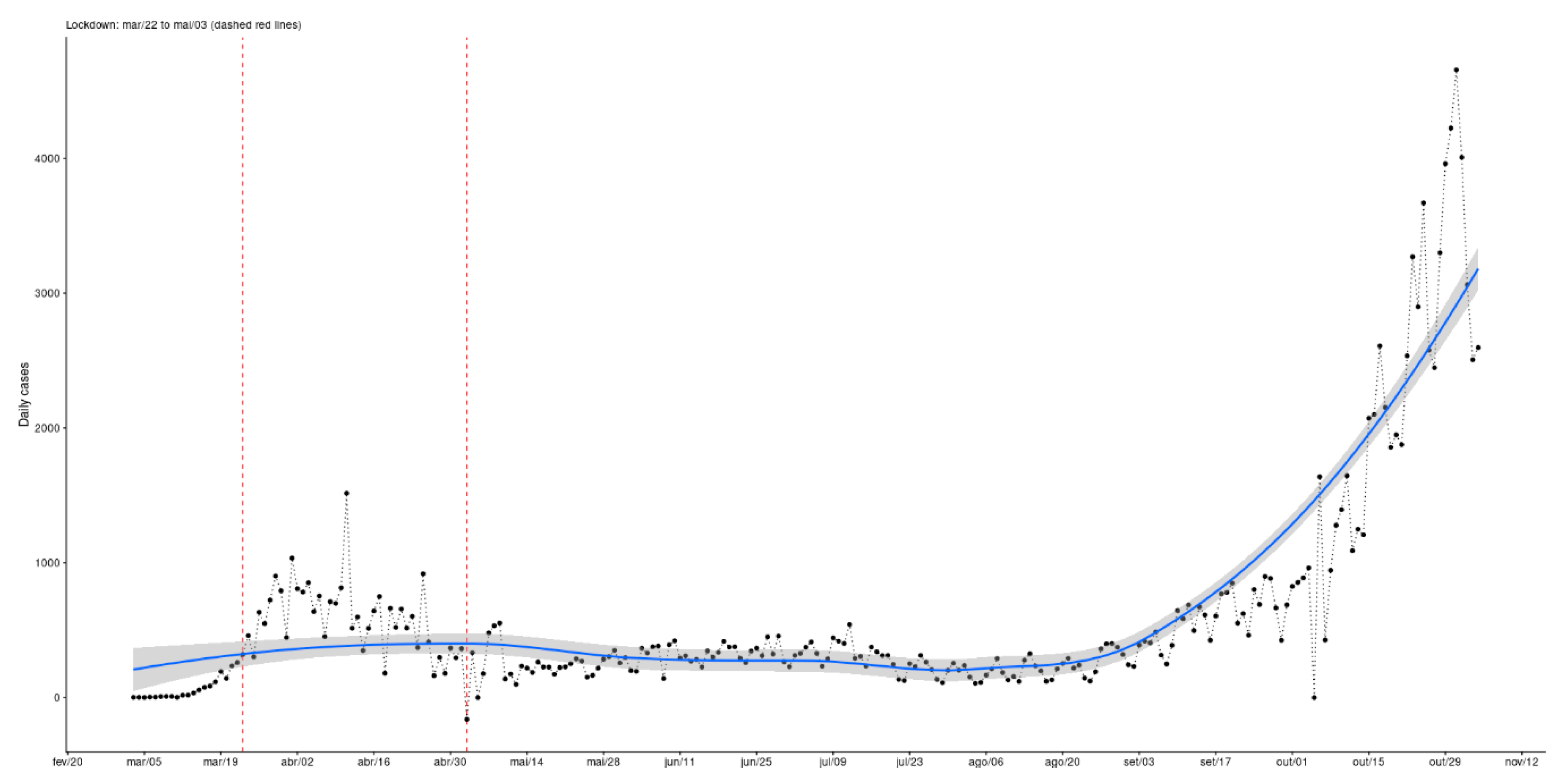
| Lockdown start | Start of the lockdown. | 22 March 2020 |
| Public gatherings | Gatherings of more than five people prohibited (except for large families). | 2 April 2020 |
| Lockdown end | End of the lockdown. | 3 May 2020 |
| Category | Subcategories |
|---|---|
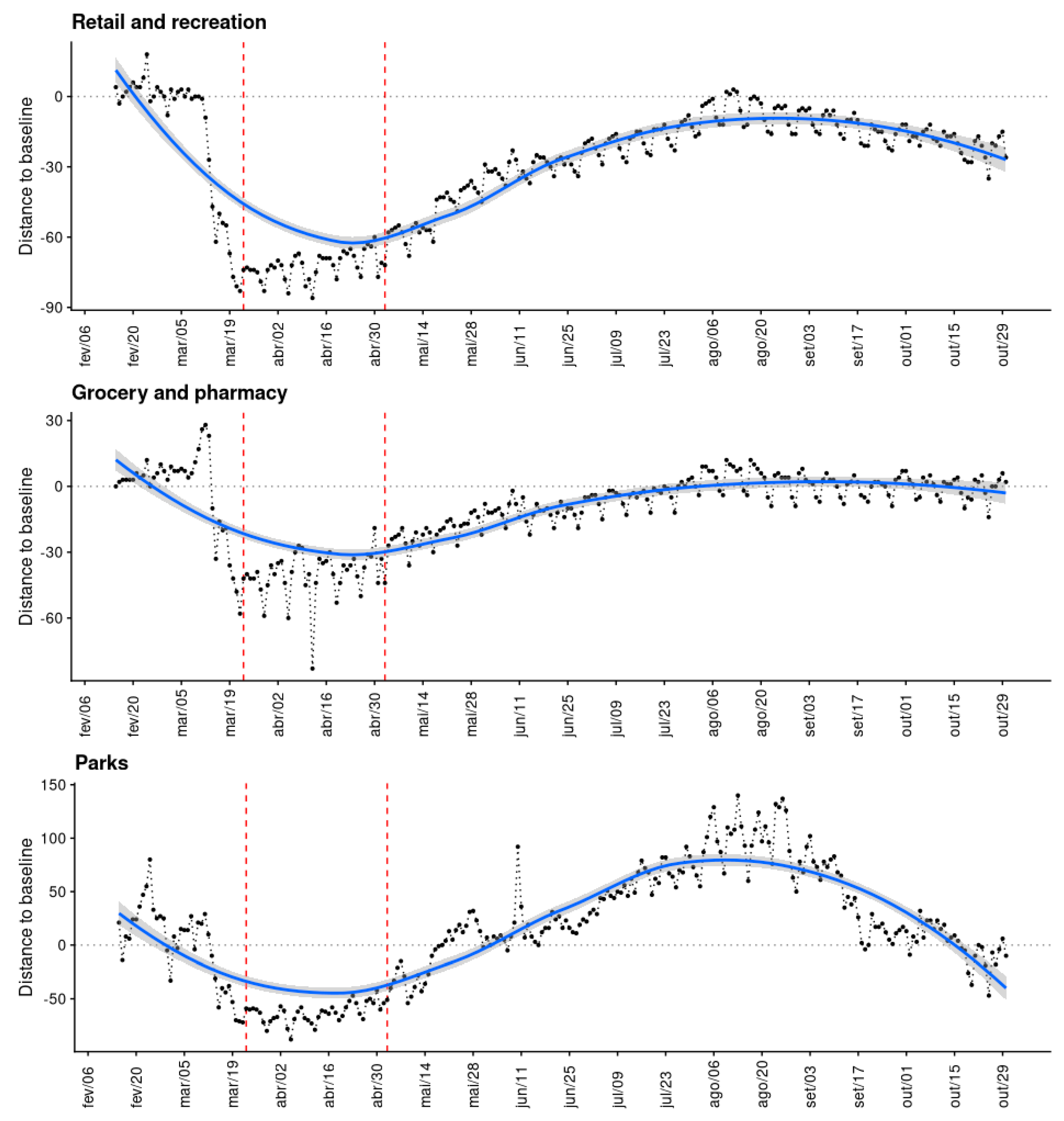
| Retail and recreation | Restaurants, cafes, shopping centers, theme parks, museums, libraries, and movie theaters. |
| Grocery and pharmacy | Grocery markets, food warehouses, farmers markets, specialty food shops, drug stores, and pharmacies. |
| Parks | National parks, public beaches, marinas, dog parks, plazas, and public gardens. |
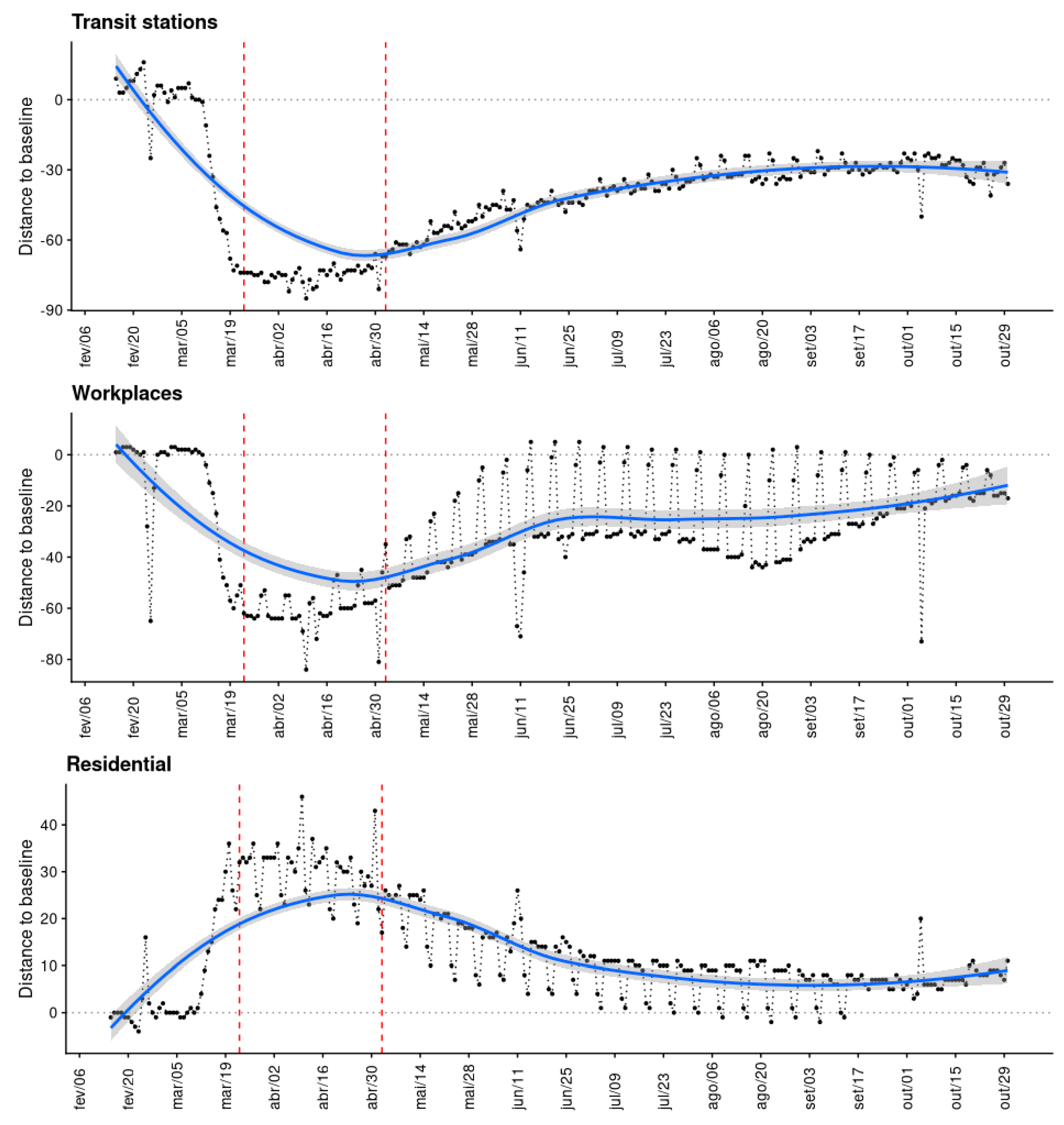
| Transit stations | Public transport hubs such as subway, bus, and train stations. |
| Workplace | Places of work. |
| Residential | Places of residence. |
Publisher’s Note: MDPI stays neutral with regard to jurisdictional claims in published maps and institutional affiliations. |
© 2020 by the authors. Licensee MDPI, Basel, Switzerland. This article is an open access article distributed under the terms and conditions of the Creative Commons Attribution (CC BY) license (http://creativecommons.org/licenses/by/4.0/).
Share and Cite
Tamagusko, T.; Ferreira, A. Data-Driven Approach to Understand the Mobility Patterns of the Portuguese Population during the COVID-19 Pandemic. Sustainability 2020, 12, 9775. https://doi.org/10.3390/su12229775
Tamagusko T, Ferreira A. Data-Driven Approach to Understand the Mobility Patterns of the Portuguese Population during the COVID-19 Pandemic. Sustainability. 2020; 12(22):9775. https://doi.org/10.3390/su12229775
Chicago/Turabian StyleTamagusko, Tiago, and Adelino Ferreira. 2020. "Data-Driven Approach to Understand the Mobility Patterns of the Portuguese Population during the COVID-19 Pandemic" Sustainability 12, no. 22: 9775. https://doi.org/10.3390/su12229775
APA StyleTamagusko, T., & Ferreira, A. (2020). Data-Driven Approach to Understand the Mobility Patterns of the Portuguese Population during the COVID-19 Pandemic. Sustainability, 12(22), 9775. https://doi.org/10.3390/su12229775