Skip to Content
SustainabilitySustainability
  • Article
  • Open Access

10 August 2020

The Impact of Social Media on the Brand Capital of Famous People

and
1
The Research Institute on Territorial and Inter-Organizational Cooperation, Faculty of Applied Sciences, WSB University, 41-300 Dąbrowa Górnicza, Poland
2
Department of Management, WSB University, 41-300 Dąbrowa Górnicza, Poland
*
Author to whom correspondence should be addressed.

Abstract

The article is of a research nature. The aim of the article is to identify the role of social media in shaping personal brand. To this end, the first part discusses the concept of personal brand, as well as components of brand capital in the case of famous people, including consumer-based capital. Attention was also paid to the great importance of social media and the growing role of their users in the process of shaping personal brand. Based on the analysis of the source literature, a research gap was identified, related to the lack of empirical verification of the relationship between users’ online activity and and capital of famous people, also known as celebrities, associated with artistic and cultural activities. The article uses the results of the direct research carried out in the period 2019–2020. The second (empirical) part of the article presents research hypotheses, methodology, as well as results and conclusions from the research. Based on 26 in-depth individual interviews that were conducted with people famous in Poland (mainly engaged in artistic and cultural activities) and surveys of a group of 324 social media users, it was shown, among others, that online activity of Internet users stimulates the brand capital of famous people. Statistically significant relationships were observed for such components of the personal brand as awareness/associations with the personal brand and for the relationship regarding the perception of the quality of activities carried out by a famous person.

1. Introduction

The shaping of brand by famous people in the second and third decades of the 21st century appears to be one of the obvious processes taking place in the social field. Of course, in the context of the primary purpose of this process, the most important area of activity will be the professional one. It is clear that the creation of personal brand by famous people is carried out primarily to achieve the objectives of gaining a better position on the labour market. However, it should be remembered that this process is much more complex and is not limited to professional activities, because—in the case of famous people—better or additional work very often means increasing financial resources (economic capital) which—for example by expanding the network of contacts—is associated with raising social status (increasing social capital). Therefore, many different research problems can be associated with the perception of a famous person in terms of personal brand. The limits of the application of brand management theory concepts to the activities of an individual are an interesting area of research. Another problem that deserves consideration is the psychological and sociological foundations of models for shaping personal brand proposed by specialists and the verification of these solutions in terms of both the effectiveness and consequences of use [1]. In the sphere of culture, we can also notice another very important research area related to the potential psychological costs of perceiving oneself in the category of personal brand or to ethical issues. Questions related to personal brand capital, including the initial capital of the individual—without which it is impossible to create a personal brand—as well as the ways and possibilities of using social media in its development, are also becoming more and more important [2]. Such a situation sets a new framework for studying the brand of people operating in the broadly understood sphere of culture [3]. The artistic and professional career of famous people depends significantly on their brand capital, which, in turn, is increasingly being built in social media with the help of Internet users [4].
Famous people more and more often realise that the greater their personal brand capital based on consumers (social media users), the easier it is for them to achieve their goals [5]. This is proved by advertising contracts that are formed with people who have a large number of “followers” or “likes” on social media. In other words, a strong personal brand is the key capital of a famous person, and its shaping should be the subject of a carefully prepared image strategy [6]. Social media users have a very important role to play in this strategy, which is highlighted in this article.

2. The Concept of Personal Brand and the Components of Consumer-Based Brand Capital

Before discussing the role and importance of the Internet users’ social media activity in building the brand capital of famous people, it is necessary to define both the concept of a personal brand and indicate the most important components of a consumer-based brand capital. Personal brand—the image of a person—reflects how the given individual is perceived by others. Its creation consists of a series of coherent actions carried out to build reputation and increase the measurable value of a personal brand among a specific public. Such a process includes the conscious communication of specific content on social media [7]. Personal brand is a concept that is increasingly used by people who operate in the public sphere, including the sphere of culture. This includes both people involved in show business (e.g., TV presenters, vocalists and bloggers) and artists associated with the “high culture” (e.g., opera singers, composers, theatre actors). Referring to the definition of the brand proposed by L. de Chernatony [8], an identifiable person representing permanent values recognised by the recipient as those that best meet their needs can be considered a personal brand. In such an approach, it is important to be able to identify a specific personal brand and values that are appreciated by the brand’s recipient. Therefore, there is a clear relationship between the personal brand and the image of a given person [9,10]. A personal brand should be understood as the image of a particular person in the eyes of others. It results from identifying the degree of convergence and discrepancy between information declared by a given person (e.g., in social media) and their authentic behaviours, traits, skills or reactions. The personal brand of a specific person can be associated with the designation of a given individual (by name, surname, artistic pseudonym, etc.), their image (in the eyes of others) and the promised bundle of benefits (the probability of its receipt is guaranteed by the skills, qualifications and experience of the person, their culture of expression or personal culture in general). The fact of having a specific brand means that even people with very similar characteristics (knowledge, qualifications or experience) are more positively or negatively perceived by others, mainly due to the emotions built around them. A personal brand, therefore, distinguishes the given person from competitors, in particular when such a person is a candidate for a specific position or acts as a service provider and is perceived as someone very reliable, which makes others want to engage in cooperation [11,12]. Belief in the characteristics of a given person (confirmed by both the certificates, diplomas, recommendations they won, and the number of likes on the social media profile) facilitates the process of selecting a person and assigning them a given position (e.g., a new role in a popular TV series) or performance of specific tasks (e.g., acting as presenter of a new TV show).
Considering the above, the capital of a consumer-based personal brand can be defined as a commonly existing opinion about a famous person [13], which, however, should not be confused with their identity. Rozwadowska defines identity as a set of specific stimuli, while brand capital is more closely related to the way they are interpreted. Tworzydło [14] also refers to the brand capital of a famous person, defined as the opinion of a group of people about this person, or the image of a given person that appears in people’s minds. The capital of consumer-based personal brand is, therefore, a complex construct because it involves a certain combination of the perception of a given person, including its beliefs and attitudes, as well as a set of impressions regarding this person’s behaviour [15]. At the same time, it should be remembered that brand capital is not a static concept and may decrease or increase with changes in the opinions or preferences of the external environment and result from the development of the famous person [16].
According to Keller [17], the capital of a famous person’s brand is associated with knowledge about that person, as well as awareness of their existence and function in a given sector. In turn, according to Aaker [18], the capital of a consumer-based personal brand will be influenced by a set of components related to the famous person. According to Aaker, these components include:
(i)
Famous person brand awareness: how much the particular person is present in the mind of the recipient (the potential recipient of the brand), which translates into the ability of the recipient to recognise or recall a particular person (e.g., actor, TV presenter, singer) at a given moment and in a given situation [19];
(ii)
Associations with the famous person: everything that, according to the recipient (potential recipient of the brand), is related to the famous person [19]. They are related to the creation of the image of a famous person in the mind of the recipient (potential recipient of the brand), the type of work performed by the famous person and their features (e.g., name, surname, artistic nickname, important facts from the biography) [20];
(iii)
Perceived quality of the famous person’s offer: perception by the recipient (potential recipient of the brand) of the overall quality of the product/service of a famous person or belief in its superiority as compared to alternative products/services of other people operating in the same or a similar industry [21];
(iv)
Loyalty to a famous person: attachment of the brand recipient to a particular famous person. Loyalty reflects the likelihood of a brand recipient, diverting interest in the activities of a famous person to another person, for example when a change occurs in the components of the image of a famous person [22].
Previous research on brand capital proves that the famous person brand awareness and associations with that person can be combined into one component [21], which is why, in this article, these two elements will be considered jointly.
In accordance to PersonalBrand.com—the leading authority on the topic of personal branding and the creation of a personal brand, a personal brand is a widely recognized and largely uniform perception or impression of an individual based on their experience, expertise, competencies, actions and/or achievements within a community, industry, or the marketplace at large. By personal branding in this article, we mean the conscious and intentional effort to create and influence the public perception of an individual by positioning them as an authority in their industry, elevating their credibility, and differentiating themselves from the competition, to ultimately advance their career, increase their circle of influence, and have a larger impact. In other words, a personal brand is rooted in the minds of people in the market. Personal branding is the effort to communicate and present your value to the world [23]. By brand capital, we mean a subjective and hardly tangible assessment of the brand in the eyes of its recipients, which consists of brand awareness, attitude towards it and perception of its ethics [24]. In turn, by brand capital based on consumer, we mean a set of assets and liabilities that are related to the brand, its name, and its mark, which can be attached or subtracted from the total value of the service for a famous person and for its clients [18].

3. Materials and Methods

In order to determine the importance of social media in shaping personal brand and to analyse the impact of online activity of the social media users on the brand capital of famous people, it is necessary to operationalise the concept of a famous person. For the purposes of this study, it has been assumed that being a famous person means having universal (mass) recognition. Therefore, other features do not seem necessary to obtain the status of a famous person. The concept of a famous person in this article thus coincides in part with the term of a celebrity, as the definition of this concept—created in 1961 by the American sociologist D. Boorstin—states it is a person known for being known [25]. However, it is easy to notice that celebrities defined in this way are only part of the group of people considered as “famous”. While famous people are defined on the basis of their recognisability, celebrities are defined as those seeking to be recognisable. In other words, celebrities are often talked about, but mainly because they themselves intentionally provide fuel for that interest [26]. In this study, the research was carried out with people famous in a broad sense (including people who can be included in the category of celebrities). It should be noted that the authors of the article do not consider the word celebrity as pejorative. We should not forget that, in English, where the term celebrity acquired its contemporary meaning, it is identified with someone famous or notable.
The main purpose of the research conducted among both famous people and social media users was:
(i)
Determining the meaning of individual components of the capital of consumer-based personal brand;
(ii)
Defining levels of activity of social media users serving to build brand capital of famous people;
(iii)
Determining the impact of online activity of social media users on the brand capital of famous people.
The main hypothesis adopted claims that the online activity of social media users has a significant (stimulating) impact on the capital of the brand of famous people. This hypothesis, based on previous findings of Muntinga et al. [27] and Aaker [18,19,20], was further defined with three partial hypotheses:
(i)
H1: consumption, contribution and creation of content related to the famous person by Internet users in social media has a positive effect on the awareness/association with the brand of this famous person;
(ii)
H2: consumption, contribution and creation of content related to the famous person by Internet users in social media has a positive effect on the perception of the quality of this person’s personal brand;
(iii)
H3: consumption, contribution and creation of content related to the famous person by Internet users in social media has a positive effect on loyalty to this famous person’s brand.
In this article, consumption, contribution and content creation on the Internet were treated as a single latent variable, which is expected to correlate and exert a positive influence on the brand capital of a famous person. In order to verify the research hypotheses formulated in this way, our own research study was conducted using the following methods and techniques:
(i)
Qualitative research: individual in-depth interviews with people famous in Poland (26 interviews). These were mainly actors playing in popular TV series broadcast in Poland, presenters of national TV programmes (presenters of game shows, weather forecasts, news programmes, hosts of the “breakfast television”), as well as well-known creators and artists (composers, writers, fashion designers, vocalists). The list of interviewed persons is presented in Table 1.
Table 1. Famous people with whom individual in-depth interviews were conducted.
Interviews were conducted with the use of a questionnaire, from 30 March 2019 to 30 December 2019. The interview questionnaire consisted of an introduction, six parts containing substantive questions and a summary—a total of 45 questions, of which five were of a “warm-up” nature, i.e., were short questions based on associations and complements, while another 40 questions were open and in-depth:
(ii)
Quantitative research: carried out on a group of people who regularly use social media. The data were collected using a standardised questionnaire. The research involved 341 respondents residing in the Silesian Voivodeship. As a result of a verification, all incomplete and erroneous questionnaires, as well as questionnaires completed by respondents who replied that they had never used social media, were rejected. This resulted in the final number of 324 correctly completed questionnaires. Women constituted 61.8% of the sample, while men 38.2%. Most of the respondents (47.6%) were young people aged 19–28 and 29–38 (33.8%). The most numerous group was respondents with secondary education (64.3%); 32.7% of respondents were people with tertiary education (Table 2). Surveys were carried out from January to March 2020.
Table 2. Demographic data of the respondents.
Respondents browsing the content about famous people active in the area of culture most often used social media such as Facebook (87.4%), Twitter (12.7%) or Instagram (46.9%). Respondents considered mobile phone (smartphone) as by far the most popular device for viewing content on the Internet—81.2%.

4. Results

4.1. Qualitative Research Results—Shaping Personal Brand with the Use of Social Media

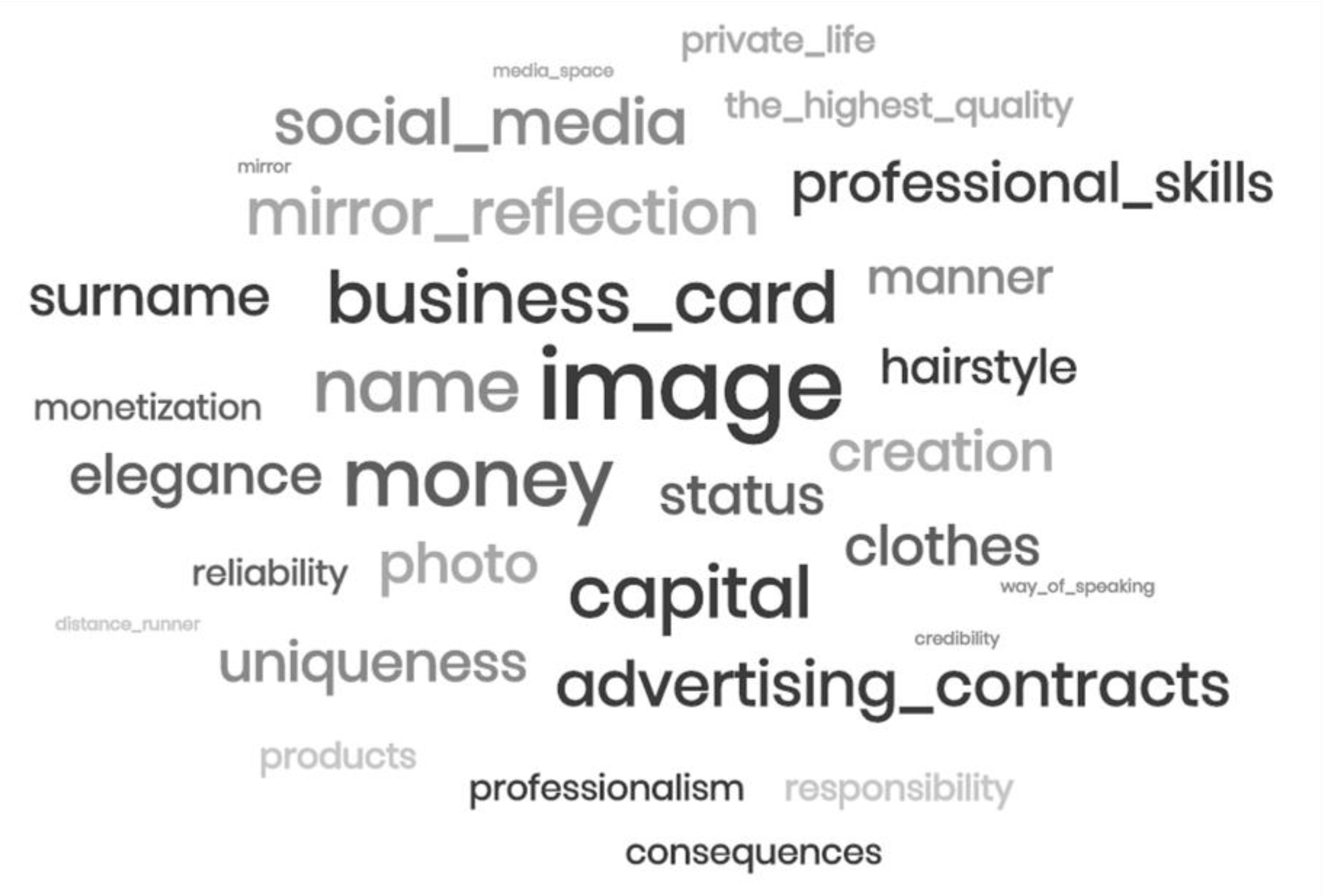
The first stage of the research included qualitative research carried out with the method of individual in-depth interviews based on a questionnaire (26 individual in-depth interviews). The interviewees were people famous in Poland (with relatively high recognition), the vast majority of whom have artistic/PR agents (13 respondents); four people use the services of acting agencies. The remaining nine persons did not have—at the time of the research—an agent that could help them in shaping their personal brand. According to the respondents, the main tasks of an agent, apart from obtaining orders, providing legal services or negotiating rates, include building the image of a famous person and caring for personal brand, which very often includes looking after social media activity. In one of the first questions, the respondents were asked how they would define personal brand. Personal brand was most often associated by these famous people with image, money, name or capital for the future. Despite the large variety of responses, the respondents agreed that a professionally and thoughtfully shaped personal brand builds the image of a given person in the minds of people in such a person’s environment, including colleagues, as well as potential and current employers or clients. They also agreed that social media activities have very large impact on personal brand. At the same time, most respondents said that these activities are not carried out by them personally and are not part of any precisely outlined strategy or detailed plan prepared in writing. The perception of personal brand by the surveyed famous people is presented graphically in Figure 1.
Figure 1. Personal brand in the opinion of respondents—word cloud. (Source: own study based on research using WordCloud software, https://monkeylearn.com/word-cloud/).
When building a personal brand, it should be remembered that each person has their own functional elements—mainly demographic, but also related to skills, experience, qualifications, and declared attitudes. The research shows that personal brand consists of such factors as appearance (e.g., hairstyle), silhouette, dress or condition of outfit, external traits of character, body language (way of being, gestures), the experience or qualifications of a famous person, represented attitude, self-confidence, self-respect, and the ability to gain trust. According to the respondents, the style of communication, the way of speaking, the way of writing (including the way of writing posts on social media), the ability to listen, and the way of presenting oneself are also very important. In the opinion of a significant proportion of respondents, personal brand will not be complete without effort being made to analyse and combine all these aspects. In other words, the elements listed by the interviewees should be linked to one another and need to cooperate in symbiosis. If only some of them are developed but others are neglected, the personal brand will be incomplete and inconsistent.
When starting to create a personal brand, one should begin with a sober assessment of the potential of a specific person. If the potential is insufficient, the expenditure on an artificially created brand may exceed the profits obtained in this respect. Research conducted among people famous in Poland shows that in the sphere of culture—due to the different potential of particular persons—different categories of brands are built. However, they most often fall into one of five models known from the source literature (Table 3).
Table 3. Selected personal brand models.
According to the respondents, two issues are becoming more and more important when creating a personal brand (regardless of the model chosen). The first is striving to stand out from other people through qualifications, characteristics, appearance, and hobbies or items used. At the same time, the uniqueness of such features, as well as rethinking the possibilities and developing a strategy for their long-term use, is very important. Secondly, in the opinion of the respondents, it is important to build the personal brand through behaviour, way of speaking, and mastering verbal and non-verbal communication, as well as through the level of education. In this case, however, the respondents pointed out the threat of stereotyping. Therefore, building a personal brand, just as in the case of shaping a product brand, cannot be a collection of random activities. Actions taken should be all part of a precisely planned process based on the idea of one’s own career path, which is implemented consistently, although with some possible flexibility.
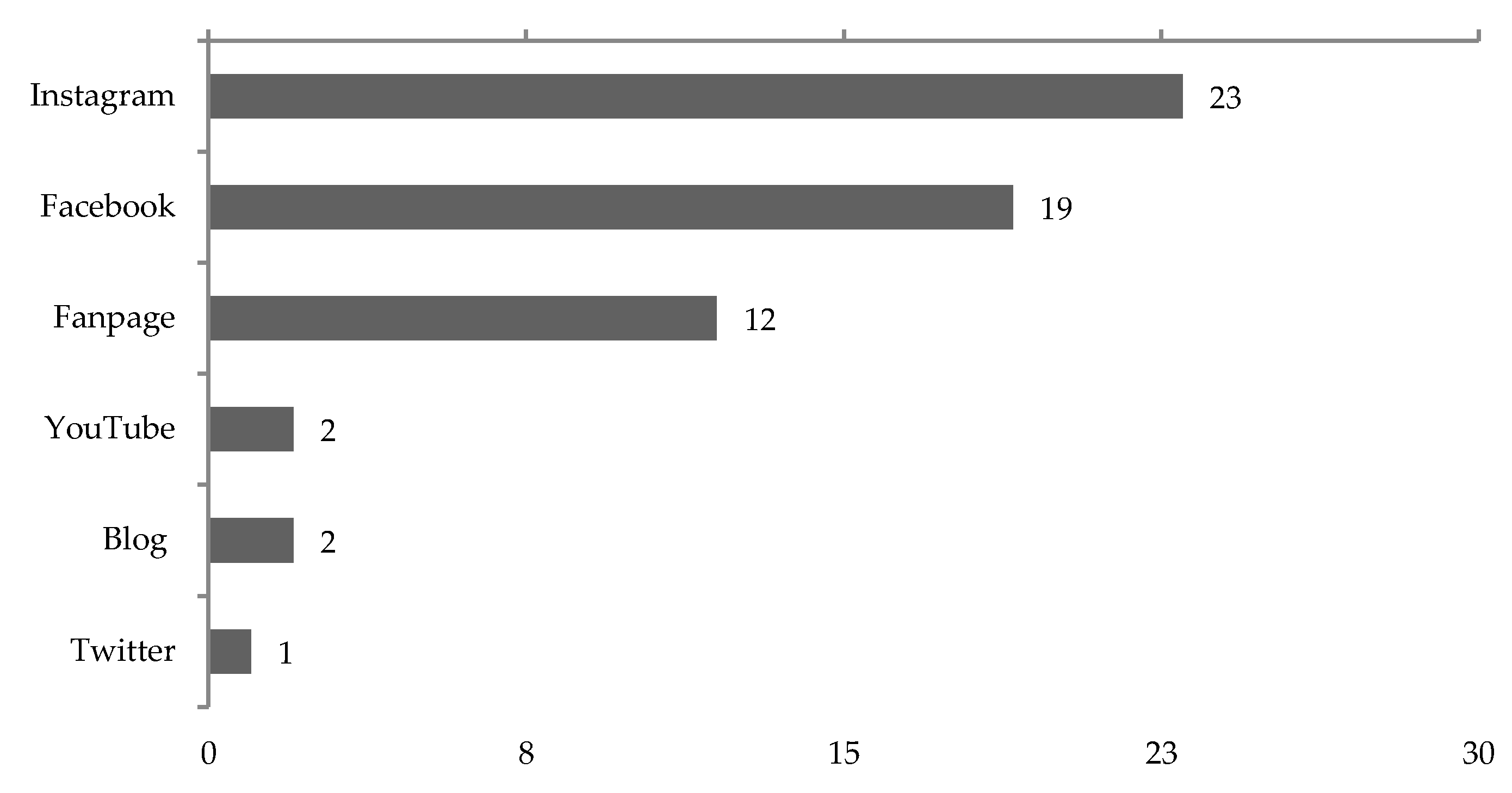
The respondents were also asked to indicate social media which they use and find of great importance in the process of shaping a personal brand. The results are shown in Figure 2.
Figure 2. Social media used by the surveyed famous people in the process of shaping personal brand (in numbers). Data source: Collected within this research.
Only one respondent among the 26 interviewees does not use social media. Other respondents show relatively high activity in this area, as evidenced by the fact that the majority of them use at least two different forms of social media. The respondents most often use Instagram (23 persons). In the opinion of a significant proportion of respondents, Instagram is the most popular and well-developed media platform on the Internet and—in the cultural sector—it has overtaken the popular Facebook. According to the respondents, Facebook is a platform where text prevails over photos, unlike Instagram, where mainly photos are posted. Instagram also has a larger range, is faster, allows easier access to photos and video, and is more colourful, dynamic and interactive. Respondents also found that Twitter, as a tool for shaping personal brand, is better for journalists or people dealing with politics. In the opinion of famous people, the goal of running social media is to get better job offers, greater prestige, and expand the sphere of influence. Respondents stated that—thanks to social media—on the one hand they learn about what is happening in their industry, and on the other, they have a chance to tell others what they are doing, and what moment of their professional life they are at.

4.2. Quantitative Research Results—the Impact of Online Activity of Social Media Users on the Brand Capital of a Famous Person

To describe the activity of respondents on social media, they were asked to express their view on 15 statements using a seven-point bipolar Likert scale, ranging from “very rarely” to “very common”. These statements were prepared on the basis of the results of 26 individual in-depth interviews conducted with persons famous in Poland. The components and their individual compounds, used to measure the online activity of Internet users on social media, are presented in Table 4.
Table 4. Components for measuring online activity on social media.
The statements used to measure the awareness/associations with the famous person’s brand, as well as the perception of the brand’s quality and loyalty regarding the specific famous person (a total of nine statements) were developed on the basis of the source literature and, based on in-depth individual interviews with 26 persons famous in Poland, further adapted to the seven-point bipolar Likert scale (extending from the answer “definitely disagree” to “definitely agree”). Famous person brand awareness and its perceived quality was measured by six statements based on the assumptions of B. Yoo, et al. [21,22] and A.F. Villarejo-Ramos and M.J. Sánchez-Franco [29]. To measure the loyalty to a famous person, three statements were proposed, formulated with use of the concept by G. Walsh et al. [30] (Table 5).
Table 5. Components of the system used to measure the famous person’s brand awareness, and the perception of its quality and loyalty to the famous person.
A combination of exploratory and confirmatory statistics was used in the analyses. First, an analysis of the reliability of the three components used to measure the online activity of the surveyed social media users was conducted [31]. This was carried out using the SPSS software and the “Reliability analysis” module. Cronbach’s alpha internal consistency model based on the average correlation between scale items [32] was chosen as the analytical model—in the analysed case, it reflected 0.945. The results of the assessment of the reliability of the measurement tool for all 15 questions, therefore, indicate that it is highly reliable for all three components: “Consumption” (Cronbach’s alpha coefficient of 0.883), “Contribution” (0.922) and “Creation” (0.901).
Then, exploratory factor analysis was conducted with the principal components’ method and Promax orthogonal rotation, using SPSS software [33]. The Kaiser–Meyer–Olkin (KMO) coefficient of sampling adequacy was 0.935. The possibility of using factor analysis was also confirmed by the p-value, which was below 0.001. The obtained results proved their adequate adjustment to the data—none of the scale items used were eliminated from the analysis. Taking into account the degree of explanation of the variability of the input set of variables, it was possible to detect two factors, explaining over 69% of the information for the full set of 15 observable variables (Table 6).
Table 6. Factor load matrix (online activity in social media)—full model.
Using Promax oblique rotation ensuring the relationship between factors, it was shown that this relationship reflects 0.659, which means a moderately strong positive relationship.
Afterwards, an analysis of the reliability of the components used to measure personal brand capital components was conducted. The software used and all assumptions are analogous to the three components discussed earlier to measure the online activity of social media users. The obtained results proved their adjustment to the data—none of the scale items used were eliminated from the analysis. Taking into account the degree of explanation of the variability in the input set of variables, it was possible to detect three factors explaining over 76% of the information for the full set of nine observable variables (Table 7).
Table 7. Factor load matrix—full model.
The results of the analysis show that it was possible to generate three factors uniquely corresponding to the components of the system used to measure the brand awareness of the famous person, its perceived quality and loyalty to the famous person. Factor loads have high values, showing a very strong correlation between observable input variables and hidden factors. A moderately strong correlation was observed between factor 1 (famous person brand awareness) and factor 2 (perception of the personal brand quality), while the dependency between other pairs of factors are very weak, which suggests their independence.
In order to test the research hypotheses, all latent variables were put into the structural equation model (SEM). The SEM analysis was based on a factor model estimated using principal compounds in correspondence to the results obtained, which did not assume the elimination of any variable. The components used to measure the activity of respondents in social media were analysed as a second-order factor consisting of first-order latent variables (consumption, contribution and creation). In turn, the system used to measure the capital of the famous person’s brand consisted of three latent variables (famous person brand awareness, perceived quality of the famous person’s brand, and loyalty to the famous person). The results are presented in Table 8.
Table 8. Regression coefficients in the SEM model.
The results in Table 8 clearly show that we can observe a positive effect of all three components used to measure the activity of Internet users in social media on the components of the system used to measure the brand capital of famous people, however, statistical significance (*) was confirmed only for the relationship between the component such as “awareness/associations with the famous person’s brand” and the component “perception of the quality of the famous person’s brand”. The relationships are positive, which means that these components stimulate individual compounds of the personal brand capital. Therefore, along with the increase in online activity in social media, the level of awareness and perception of the quality of the famous person’s brand increases. The strength of the impact is measured by a standardised regression coefficient—the impact is weak but comparable. However, the impact on relationship with loyalty to the famous person is negligible, which is associated with the lack of significance for this relationship. When summarising the final results of the analysis and referring them to the partial research hypotheses, it was found that:
(i)
H1: consumption, contribution and creation of content related to the famous person by Internet users on social media has a positive effect on the awareness/association with the brand of this famous person was confirmed;
(ii)
H2: consumption, contribution and creation of content related to the famous person by Internet users on social media has a positive effect on the perception of the quality of this person’s personal brand was confirmed;
(iii)
H3: consumption, contribution and creation of content related to the famous person by Internet users in social media has a positive effect on loyalty to the brand of this famous person was not confirmed.
Considering the fact that two out of three partial hypotheses have been confirmed, it should be assumed that the online activity of social media users has a significant impact on the brand capital of famous people, in particular on its components such as the famous people brand awareness and the perception of the personal brand quality.


5. Discussion

At the beginning of the third decade of the 21st century, there is no doubt that a well-prepared campaign designed to build a strong, respected and widely recognised personal brand should include social media activities [34,35]. What really differentiates social media from most other promotional instruments used to shape the brand of famous people is primarily the feedback [36]. The message broadcast through them goes from the sender to the recipient, after which the recipient has the opportunity to answer the sender in real time [37]. Moreover, Internet users themselves are very often active creators of messages about famous people (whose professional and private life they are interested in) published on social media sites (both on their own profiles or pages and the profiles or pages of others) [38]. Research conducted among famous people shows that the behaviour of Internet users in social media affecting the capital of their personal brand can occur at three different levels.
Level one (the lowest) is characterised by the fact that it only requires passive reception of content related to a specific famous person from social media users (e.g., viewing photos, short videos with the participation of a famous person, viewing ratings and comments about that person, reading discussions taking place on the social media sites regarding the activities of the given celebrity or events carried out.) These materials are placed by the agents of these people or by the celebrities themselves (according to the statements of the interviewed famous people, in Poland, the latter situation is definitely more common). The activity of social media users at the second (intermediate) level contributes to creating additional content related to the famous person, including participating in discussions about this person on pages gathering fans, writing comments about specific celebrities or adding content related to them (e.g., photos, videos, graphic content) on blogs and pages gathering fans (fanpages). Level three (the highest) is associated with high activity and creativity of social media users. This activity is expressed by the creation of and publication on the web of content related to a specific famous person that will later be consumed or disseminated by others (e.g., creating and posting photos, graphic content, short videos or audio files related to a specific famous person, and publishing reviews of professional and non-professional activities of such persons).
The division of the activity of social media users having an impact on the brand capital of famous people—outlined as a result of individual in-depth interviews—is consistent with the concept proposed by Muntinga, who divided the activity of Internet users on social media into three categories: consumption, contribution and creation [27]. According to him, increasing the capital of a consumer-based brand (including the personal one) with the use of social media will only be effective if it is implemented on a regular and systemic basis, as well as in a way that involves Internet users at all three levels. To this end, it is very important to replace accidental and one-off initiatives with cyclical and repetitive actions. Malinowska-Parzydło [39] draws attention to personal public relations, which should be focused on planning, implementing and controlling one’s own marketing communication in social media. However, to be able to discuss this, it is necessary to specify the target group of messages as well as instruments and media used to reach these people. Of course, it is very important to think about the content of the messages. In the opinion of a significant portion of the surveyed famous people, creating a true, lively personal brand is always linked to partially revealing their private live. It should be remembered that relationships in the family, the number of wives (husbands), behaviour of children and even pets can have both positive and negative influence on a personal brand. However, for a large proportion of recipients, hiding one’s private life makes the image of a given person flat, pale and boring. Therefore, the appearance of a famous person on the pages of tabloid, their presence in breakfast TV programmes or in social media is very important. The results of the quantitative research carried out for the purposes of this article also prove this rule. It turns out that consuming, contributing and creating content related to a famous person by social media users stimulates the capital of such famous person’s brand. Surprisingly and contrary to assumptions, no particular impact of online activity on loyalty to a famous person was noted. It is therefore worth considering what could actually translate into such an impact. It can be concluded from research conducted in the United Kingdom that Internet users who follow the profile of a selected person on social media do it primarily from a desire to provide promotional support to this person (47%), impress their friends (38%) or obtain information (announcements) about upcoming events with the participation of the famous person (35%). Only every fifth respondent who declares that they follow the profile of a famous person in social media would consider participating in an event with the presence of this famous person [40]. This means that the profiles of famous people available in social media are attractive on their own for the users of these media, which makes these users eagerly consume content about celebrities, and often even share their opinions about them (contribution). It should be noted, however, that this type of online activity is usually not associated with a large intellectual effort from the Internet user, therefore it can be observed most often. The third, highest level of activity requires social media users to be much more involved, not limited to just consuming or sharing content. It often requires practical skills (e.g., preparation of a short video or graphic content), which is why this type of online activity occurs much less frequently than activity at the first (consumption of content) or the second (contribution) levels. The consumption and contribution of content undoubtedly has a great impact on the awareness of the functioning of a famous person in the particular industry, and even a positive perception of the quality of such a person’s offer (personal brand). In the process of building loyalty to a famous person, however, the most important factor is the creation of content, which is less frequent online activity. Therefore, this is probably one of the reasons why there was no statistically significant relationship for the impact of online activity of social media users on loyalty to a famous person. Similar conclusions were drawn from research conducted in 2018 on a group of 1021 users of social media [41]. The conducted research thus shows that personal brand management in social media is not limited to transmission of the image of the famous person, but also involves building the brand’s capital based on the online activity of its recipients. Therefore, it involves not only describing the events, but also their creation; it is not limited to shaping the opinions of social media users, but also enables feedback provided by the Internet user to the famous person.

6. Conclusions

People famous in Poland who reach for social media in the process of building the capital of their personal brand should remember that these media are governed by different laws than typical marketing communication tools. Particular attention should be paid to openness, transparency, informality and equality of users. An important implication of these features is readiness for an honest dialogue with users. However, it is not enough to focus the attention of others on yourself, you also need to maintain it, which is much more difficult. Therefore, to maintain the dynamics of this image, you need to create interesting events. It should be remembered that situations appearing in the lives of famous people in an uncontrolled manner also require adequate exposure because these types of events are particularly attractive to a large number of Internet users. Famous people must also be aware of the fact that interactions with social media users can be both positive and negative, which translates into the capital of their personal brand in both positive and negative ways [42,43]. Famous people building their personal brand using social media may have to face troublesome interactions, criticising their activities, presented photos, videos, initiatives or topics. The manifestation of criticism (both more and less justified) in the case of famous persons is inevitable, therefore it is necessary for such persons to determine—in consultation with their agents—the appropriate guidelines for dealing with such cases. Of course, disabling comments is always an option, but it closes a priceless feedback channel, thanks to which famous people can not only improve their activities and adjust them better to the needs of their recipients, but also build personal brand capital based on the activity of social media users [44,45,46].
The obtained results may be of use in the development of the strategy for building a personal brand using social media to be used by famous people operating in a cultural and artistic environment. Based on the conducted research, it is possible to indicate future research directions regarding the factors influencing the involvement of Internet users in the process of building celebrities’ brand capital. In the future, in-depth qualitative and quantitative research is planned on a much larger sample of celebrities and online consumers of famous people’s services in countries of Central Europe.

Author Contributions

Both authors contributed equally in the development of the present paper. For the proper paper development, all the phases have been discussed and worked by the authors. All authors have read and agree to the published version of the manuscript.

Funding

The project is funded under the program of the Minister of Science and Higher Education titled “Regional Initiative of Excellence” in 2019–2022, project number 018/RID/2018/19; amount of funding PLN 10,788,423.16.

Conflicts of Interest

The authors declare no conflict of interest.

References

  1. Grzesiak, M. Personal brand creation in the digital age. In Theory, Research and Practice; Palgrave Pivot: Warsaw, Poland, 2018. [Google Scholar]
  2. Smith, P.R.; Zook, Z. Marketing Communications: Integrating Offline and Online with Social Media; Kogan Page Publishers: London, UK, 2011. [Google Scholar]
  3. Hajduk, G.; Mróz-Gorgoń, B. Rola strategii w zarządzaniu rozwojem instytucji kultury. In Marketingowe Oraz Społeczne Aspekty Zarządzania w Kulturze; Wróblewski, Ł., Ed.; Wydawnictwo Adam Marszałek: Toruń, Poland, 2017; pp. 33–48. [Google Scholar]
  4. Mróz-Gorgoń, B. Marketingowe aspekty wykorzystania mediów społecznościowych przez marki modowe w Polsce. Mark. I Rynek 2014, 8, 577–582. [Google Scholar]
  5. Shao, G. Understanding the Appeal of User-Generated Media: A Uses and Gratification Perspective. Internet Res. 2009, 19, 15. [Google Scholar] [CrossRef]
  6. Bilińska-Reformat, K.; Grzesiak, M. Young Consumers’ Behaviours in Social Media and Their Impact on Personal Brand Development. Zesz. Nauk. Wyższej Szkoły Humanit. Zarządzanie 2019, 2, 57–72. [Google Scholar]
  7. Lair, D.J.; Sullivan, K.; Cheney, G. Marketization and the Recasting of the Professional Sel. Manag. Commun. Q. 2005, 18, 307–343. [Google Scholar] [CrossRef]
  8. de Chernatony, L. Marka. Wizja i Tworzenie Marki; Gdańskie Wydawnictwo Psychologiczne: Gdańsk, Poland, 2003. [Google Scholar]
  9. Gander, M. Managing your personal brand. Perspect. Policy Pract. High. Educ. 2014, 18, 99–102. [Google Scholar] [CrossRef]
  10. Shephard, I.D.H. From cattle and coke to Charlie: Meeting the challenge of self-marketing and personal branding. J. Mark. Manag. 2005, 21, 589–606. [Google Scholar] [CrossRef]
  11. Brownlie, D.; Hewer, P.; Kerrigan, F. The exploding plastic inevitable; Branding being; brand warhol & the factory year. Scand. J. Manag. 2013, 29, 184–193. [Google Scholar]
  12. Gander, M.; Moyes, H.; Sabzaleiva, E. Managing Your Career in Higher Education Administration; Palgrave Macmillan: Basingstoke, UK, 2014. [Google Scholar]
  13. Rozwadowska, B. Public Relations—Teoria, Praktyka, Perspektywy; Wydawnictwo Studio Emka: Warsaw, Poland, 2002. [Google Scholar]
  14. Tworzydło, D. Macierz Celów Wizerunkowych w Procesie Oceny Efektów Public Relations; Wydawnictwo WSIiZ: Rzeszów, Poland, 2008. [Google Scholar]
  15. Treadwell, D.F.; Harrison, T.M. Conceptualizing and Assessing Organizational Image Model Images, Commitment, and Communication. Commun. Monogr. 1994, 61, 63–85. [Google Scholar] [CrossRef]
  16. Schivinski, B.; Brzozowska-Woś, M. Badanie aktywności online polskich konsumentów dotyczącej marek. E-Mentor 2015, 2, 77–85. [Google Scholar]
  17. Keller, K.L. Conceptualizing, measuring, and Managing Customer-Based Brand Equity. J. Mark. 1993, 57, 1–22. [Google Scholar] [CrossRef]
  18. Aaker, D.A. Managing Brand Equity: Capitalizing on the Value of a Brand Name; The Free Press: New York, NY, USA, 1991. [Google Scholar]
  19. Aaker, D.A. Measuring brand equity across products and markets. Calif. Manag. Rev. 1996, 38, 102–120. [Google Scholar] [CrossRef]
  20. Aaker, D.A.; Joachimsthaler, E. Brand Leadership: Building Assets in an Information Economy; The Free Press: New York, NY, USA, 2000. [Google Scholar]
  21. Yoo, B.; Donthu, N. Developing and validating a multidimensional consumer-based brand equity scale. J. Bus. Res. 2001, 52, 1–14. [Google Scholar] [CrossRef]
  22. Yoo, B.; Donthu, N.; Lee, S. An examination of selected marketing mix elements and brand equity. J. Acad. Mark. Sci. 2000, 28, 1–14. [Google Scholar] [CrossRef]
  23. Definition of A Personal Brand Vs. Personal Branding, PersonalBrand.com. Available online: https://personalbrand.com/definition/ (accessed on 25 July 2020).
  24. Keller, K.L. Strategiczne Zarządzanie Marką. Kapitał Marki—Budowanie, Mierzenie i Zarządzanie; Wydawnictwo Nieoczywiste: Warsaw, Poland, 2016. [Google Scholar]
  25. Niczewski, R.; Potrzebowski, J. Celebryci w Ataku. Celebrity Effect Jako Skuteczne Narzędzie Komunikacji Marketingowej; Agora: Warsaw, Poland, 2010. [Google Scholar]
  26. Grzegorczyk, A. Celebrities in the culture industry. Cult. Manag. Sci. Educ. 2018, 2, 71–80. [Google Scholar] [CrossRef]
  27. Muntinga, D.G.; Moorman, M.; Smit, E.G. Introducing COBRAs: Exploring motivations for brand-related social media use. Int. J. Advert. 2011, 30, 13–46. [Google Scholar] [CrossRef]
  28. Niedźwiedziński, M.; Klepacz, H.; Szymańska, K. Budowanie marki osobistej w mediach społecznościowych. Mark. I Zarządzanie 2016, 4, 339–349. [Google Scholar] [CrossRef]
  29. Villarejo-Ramos, A.F.; Sánchez-Franco, M.J. The impact of marketing communication and price promotion on brand equity. J. Brand Manag. 2005, 12, 431–445. [Google Scholar] [CrossRef]
  30. Walsh, G.; Mitchell, V.W.; Jackson, P.R.; Beatty, S.E. Examining the antecedents and consequences of corporate reputation: A customer perspective. Br. J. Manag. 2009, 20, 187–203. [Google Scholar] [CrossRef]
  31. Aczel, A.D.; Sounderpandian, J. Statystyka w Zarządzaniu; Wydawnictwo PWN: Warsaw, Poland, 2017. [Google Scholar]
  32. Timm, N.H. Applied Multivariate Analysis; Springer: Berlin/Heidelberg, Germany, 2002. [Google Scholar]
  33. Konarski, R. Modele Równań Strukturalnych; Teoria I Praktyka; Wydawnictwo PWN: Warsaw, Poland, 2015. [Google Scholar]
  34. Killian, G.; McManus, K. A Marketing Communications Approach for the Digital Era: Managerial Guidelines for Social Media Integration. Bus. Horiz. 2015, 58, 539–549. [Google Scholar] [CrossRef]
  35. Wróblewski, Ł. Building the Relationship Between Cultural Institutions and Citizens of a Small City Divided by the Border. Cult. Manag. Sci. Educ. 2020, 4, 119–128. [Google Scholar] [CrossRef]
  36. Correia, T.J.F.; Mateus, A.; Leonor, S. Marketing Communications Model for Innovation Networks. Int. J. Innov. 2015, 3, 43–53. [Google Scholar] [CrossRef]
  37. Wróblewski, Ł. Culture Management. Strategy and Marketing Aspects; Logos Verlag: Berlin, Germany, 2017. [Google Scholar]
  38. Kaplan, A.M.; Haenlein, M. Users of the world, unite! The challenges and opportunities of Social Media. Bus. Horiz. 2010, 53, 59–68. [Google Scholar] [CrossRef]
  39. Malinowska-Parzydło, J. Jesteś Marką. Jak Odnieść Sukces i Pozostać Sobą; Wydawnictwo Helion: Gliwice, Poland, 2015. [Google Scholar]
  40. Social Media Audiences and the Museum. Available online: https://www.museumnext.com/2010/07/museums-can-use-social-media (accessed on 10 May 2020).
  41. Wróblewski, Ł.; Bilińska-Reformat, K.; Grzesiak, M. Sustainable Activity of Cultural Service Consumers of Social Media Users—Influence on the Brand Capital of Cultural Institutions. Sustainability 2018, 10, 3986. [Google Scholar] [CrossRef]
  42. Grzesiak, M. Negatywne implikacje postprawdy i fake newsów w kontekście kształtowania marki osobistej. Mark. I Rynek 2017, 24, 20–26. [Google Scholar]
  43. Mazurek-Łopacińska, K.; Sobocińska, M. Marketing communication in the light of challenges brought about by virtualisation and interactivity. Econ. Bus. Rev. 2016, 2, 65–76. [Google Scholar] [CrossRef]
  44. Kopera, S.; Najda-Janoszka, M.; Wszendobył-Skulska, E. Kanał YouTube jako przykład wykorzystania mediów społecznościowych w procesie transferu wiedzy do biznesu turystycznego. Folia Tur. 2014, 32, 55–72. [Google Scholar]
  45. Panda, T.K. Consumer response to brand placements in films role of brand congruity and modality of presentation in bringing attitudinal change among Consumers with special reference to brand placements in Hindi films. South Asian J. Manag. 2004, 11, 4. [Google Scholar]
  46. Maric, J. Digital Storytelling in Interdisciplinary and Inter-institutional Collaboration - Lessons from our Youngest. Cult. Manag. Sci. Educ. 2020, 4, 129–144. [Google Scholar] [CrossRef]

Article Metrics

Citations

Article Access Statistics

Multiple requests from the same IP address are counted as one view.