

Skip to Content
SustainabilitySustainability
  • Article
  • Open Access

5 July 2018

Community Heritage Linking Place and Mobility: A Case Study of “Bangbei” in Ethnic Bai Villages of Yunnan Province, China

,
,
and
1
School of Tourism and Geography Science & Collaborative Innovation Center for Geopolitical Setting of Southwest China and Borderland Development, Yunnan Normal University, 768 E Juxian Road, Kunming 650500, China
2
School of Geography and Tourism, Qufu Normal University, 80 Yantai Bei Road, Rizhao 276800, China
3
Department of Geography, University of Wisconsin–Madison, 550 N. Park St., Madison, WI 53706, USA
4
School of Culture and Communication & Cultural Economics Research Institute, Central University of Finance and Economics, 39 South College Road, Beijing 100081, China
This article belongs to the Special Issue Local Heritage and Sustainability

Abstract

Is there any kind of community heritage that links individuals and homes within the context of increasing mobility? In this study, the unique Bangbei system of the Bai ethnic group in Dianbei District of Dali Bai Autonomous Prefecture, Yunnan Province, China is examined. In-depth interviews have been employed to assess the evolution of Bangbei and the dynamic nature of its development. We find that Bangbei has become an important “place-making” tool for linking people and their “homes”, thus serving as a spatially unbounded place-based community heritage mechanism that sees community as not only place-bound, but as increasingly dispersed and mobile. This case prompts us to rethink the spatial boundedness of particular community heritages and their role in making and maintaining placeness in the context of increasing globalization and associated mobility. Thinking about Bangbei helps us conceptualize community heritage in a more spatially expansive and unbounded way.

1. Introduction

Place is a core concept of human geography, especially cultural geography [1]. In recent years, however, the “mobility turn” has shifted the focus of research on place. With the continuous development of technology and social media, often considered to be “distance-demolishing technologies”, distance is no longer as major a factor in restricting communications between people as it once was and contact between different people is becoming increasingly easy. This being the case, it is not surprising that the social scientists are paying more attention to people and information flows, concerns associated with “mobility” [2,3].
In that human mobility has become increasingly easy and common, individuals are travelling more and going farther away, to work, pursue educational opportunities, or for various other reasons. However, this increased mobility can result in individuals losing their sense of place over the long-term. Attachment to place is becoming less important due to the increased mobility associated with globalization.
It is important to recognize that communities are contextualized in their histories, but that their relationships are rapidly changing, especially in relation to cities [4]. How, therefore, can contact be maintained between mobile individuals and communities centered in particular places? Who will take the role to maintain connectivity? How are such roles facilitated? How should we see the role and spatiality of communities’ heritage organizations? What role do they have in linking mobile individuals to particular places? These are some of the questions raised here. We focus on “Bangbei”, a well-established type of mutual support organization found in Dianbei District, which is in Dali Bai Autonomous Prefecture, on the border with Lijiang City-level Prefecture, in Yunnan Province, southwest China. We do this because of Bangbei’s crucial role, as a part of community heritage, in facilitating connectivity between mobile individuals and particular places or homes. We argue that Bangbei is a community institution that on the one hand is place-based, but on the other hand has effectively evolved to adapt to increased societal social mobility. The main take-away message from this paper is that thinking about Bangbei helps us to conceptualize institutions linked to community heritage as being more than simply spatially bounded entities. Community heritage institutions such as Bangbei are crucial, we argue, for helping mobile individuals create a sense of “place”.
In the next section we review the literature linking community and mobility. In Section 3, we then introduce the study area and explain the methods used. Section 4 describes the formation and transition process of Bangbei and the mechanisms associated with this process. Section 5 is the discussion part of the paper, where we show how social organization associated with Bangbei links mobile communities with particular places. Finally, we provide some concluding remarks in Section 6.

2. Literature Review

2.1. Community and Community Studies

Community studies have a long history in the social sciences and can be traced back to the early 20th century [5]. Localized community studies, which were especially popular among social anthropologists, have, however, long been criticized for viewing villages as insular, primitive and relatively simple. Modern western societies, which were previously believed to be more complex, did not become the subject of investigations, including by geographers, until much later, but they too have faced criticisms for failing to grapple with such processes as increasing industrialization, geographical mobility, and urbanization. In addition, communities have often been problematically thought of in binary terms, as either stable or unstable [6]. However, beginning of the 1980s and 1990s, community studies experienced somewhat of a revival, due to increasing interest in the rapid changes being experienced by rural people, especially in the face of increasing industrialization and urbanization. Rather than seeing communities as ahistorical, immobile and static, as was frequently the case in earlier studies, more emphasis was put on their dynamic nature [7]. However, criticisms continued, including that community studies tended to emphasize unity rather than difference, and often romanticized community life [8]. Defilippis et al. have more recently, however, pointed out that these debates about community were often overly polarized, with authors either glorifying community studies or simply dismissing research on communities. They advocate for more middle-of-the-road approaches, ones that both recognize outside impacts but without denying bottom-up influences as well [9].
As geographers, we would add that communities often continued to be thought of as spatially bounded, and as “the smallest spatial system which encompasses the principle features of society” [5]. Until more recently, there was inadequate consideration of the role of outside linkages and mobility in shaping communities. However, more recently geographers and other social scientists, such as McDowell et al. have challenged older static and ahistorical ideas about attachment to place, and have explored different forms of communal attachment, including what they call “elective belonging” [9]. Most recently, understandings of community have further expanded, and recent studies have considered a broad range of communities rather than just bounded villages, including those based on social class, race, gender, sexuality and disability, just to name some of the possibilities [10]. There has also been movement towards thinking of contextual community differences, as has been the general trend in recent years in the soft social sciences and humanities more generally [11].

2.2. Mobility

Mobility is an important feature of modern society and has become one of the most important concepts in the contemporary social sciences. Prior to the 21st century, interdisciplinary research on mobility was rare, but with the emergence of a series of studies over the past couple of decades, the “mobility turn” has become well established [12,13]. The body of research that has emerged does not take mobility as only a critical tool or an abstract concept but relies on continuously innovative dynamic methods and includes several figurative studies on mobility [14].
Although the present new “paradigm of mobility” comes more from the social sciences generally than geography specifically, cultural geography has also tracked the quite fruitful research on mobility in the humanities [15]. Although not always situating their studies within the paradigm of mobility, many human geographers can be classified as appliers and practitioners of mobility theory [16].
Mobility studies have critiqued the view that “the world is composed of fixed things” [17]. Moreover, the relationship between mobility and globalization is now seen as increasingly complex. Because the mobility of people, information and capital results in the “constant changing” of places, all places tend to be seen as potentially nomadic and fundamentally rootless. Any given space is no longer the only place, but is attached with the liberation of mobile individuals, rather than the superposition of some abstract features [18]. At the same time, mobility can be understood as being analyzed using a fixed and static approach [19,20,21,22]. During a study by Favell, it became evident that a lot of time is needed to study some supposedly static things: for example, borders, national territories, and peoples’ senses of place in relation to homeland [23]. This is also the focus of this study.

2.3. Place, Community and Mobility

The literature on place and community has often been seen as contrary or certainly not complementary to globalized space flows [24]. For this reason, research on place and community is sometimes considered outdated or conservative, and lacking in terms of in-depth theoretical construction and discussion [25,26].
Research on place and community under the background of the mobility turn has tried, however, to compensate for this deviation from globalization, at least to some extent. Indeed, links between individuals, communities, and mobile places has become an increasingly important field of inquiry for human geographers. Relevant work is mainly being conducted in relation to two dimensions: emotional and functional connections. Viewed from the dimension of emotional connection and related to the mobile individual and place, place is closely linked to the formation of individual and community identities [27]; and the existence of original culture, including cultural systems and spiritual senses of place, which also affect memory, emotion and identity of individuals in relation to place. Mobility is generally considered to be the main aggressive force that reduces one’s sense of placeness [28]. Specifically, mobility impedes the ability of individuals to carry out daily life and maintain emotional and daily communications between individuals and communities. It can be explained in three ways. First, reduction in direct contact between individuals and communities; second, changes in an individual’s sense of place and the self-identification with local communities; third, physical (community transformation, relocation, etc.) and social (loss of familiar persons, growth or moving in of new generation within the community) changes of place. Thus, the original identity and sense of place in a person’s memory can dramatically change. The emotions of a mobile individual toward a place often comes from the individual’s own experience, exchanges with others in a social group, and memories of particular interactions with particular social groups or communities. When individual leaves a place, his or her emotions and identity toward it are mainly derived from memory; with changes of place, therefore, the sense of place of a mobile individual also shifts, particularly as time passes. There is a Chinese idiom that states that: “The things are still there, but men are no more the same ones”. In fact, for mobile individuals intertwined with the process of globalization, “both places and the men will change”.
As Skey points out, the identity and sense of placeness of mobile individuals are gradually deepened and awakened when they interact with other people or cultures in different places; they desire to build a “bounded, familiar and homely place” [28]. When it comes to the relationship between the mobile individual and home, people pay more attention to their contact with fixed homes within certain geographic areas. This process depends not only on the mobile individual, but also relies on community heritage, as with all kinds of organizations. What impact do these community heritages have on the relationship between mobile individuals and place? This is the core topic of this paper.

3. Study Area and Methods

3.1. Study Area

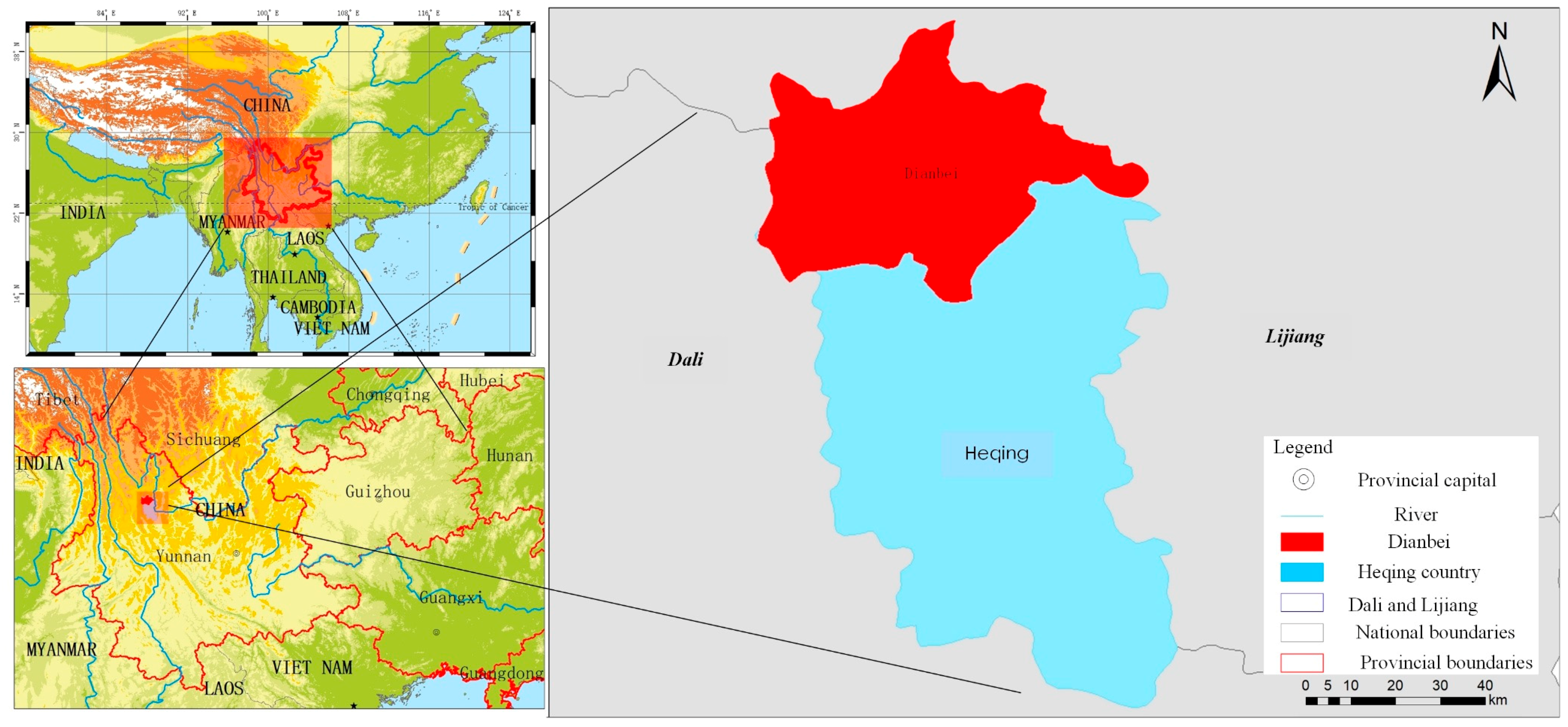
To develop our ideas about the linkages between place and mobility, we needed to find a study area with both stable self-governing community organizations and several emigrants. Bangbei in Dianbei District meets these qualifications. The villages where the research was focused are on the border of Dali Bai Minority Autonomous Prefecture and Lijiang City of Yunnan and include Xiuyi and Potouyi villages in Yunhe Town and all the communities of Caohai Town and Xintun Town (Figure 1), which are the core areas of Dianbei in Heqing. Located in the north of Heqing County Town, the area is an important passage for entering Lijiang and Tibetan areas from Heqing. There are 29 village committees in the region, inhabited by people classified into various ethnic groups, including Bai, Han, Yi, Naxi, Tibetan, and Lisu. People belonging to the Bai nationality constitute the majority ethnic group found in the area, accounting for about 76 percent of the total population; 20 percent of the people are ethnic Han.
Figure 1. Location map of Dianbei District, Heqing County, Yunnan Province, China.
The area is at the northern end of the basin of Heqing, where the terrain is relatively flat and there are numerous water bodies. The “Dian horse” is from here and horses are an important means of transportation in the area. Because southwest China is located on a plateau, with many mountains and canyons, the terrain is complex and vehicle transport is extremely inconvenient.
Heqing is one of the important posts on the ancient Tea Horse Road. Since the late Ming and early Qing Dynasties, business and trade has flourished in this region. The policy on bureaucratization of native officers during the Ming and Qing dynasties resulted in the area becoming economically linked with other parts of the mainland, and many people moved in from other regions. Thus, advanced means of production entered Dianbei from the lowlands, including new forms of handicraft production; and commerce rapidly expanded. Therefore, in addition to agriculture, many families became actively involved in trade and business, including conducting commercial activities in Burmese and Tibetan areas. After the 1850s, commerce became an important source of income, and between 1895 and 1950 the Dianbei area became increasingly integrated with international markets. On the one hand, businesspeople from the Dianbei area in Heqing sold industrial products or raw materials imported from India, Burma and Siam (Thailand) to local areas, and they also sent them on to Lijiang, Tibet and other places; on the other hand, they transported precious herbs and minerals from Lijiang and Tibetan areas via Xiaguan, Tengchong, Simao and Kunming to Burma, India and elsewhere.
Since 2005, businesspeople in the villages of Dianbei have spread all over China, and their handicraft products are being exported to the United States, Japan, Myanmar, Thailand, Nepal and India. Beginning in around 2001, commerce and handicrafts became the major source of revenue in some villages, and agriculture began constituting only supplementary income; this is especially the case in Xiuyi, Potouyi, Xinhua, Banqiao and Mutun Villages, where people who engage predominantly in handicraft and commercial activities now constitute 76 percent of the total population. Practitioners are mainly salespeople or shopkeepers. The center of the handicraft industry is silver forging. In addition, many people have left the region to seek business opportunities in other parts of China and elsewhere. So how do those working and living elsewhere maintain contact with the places where they grew up? What differences exist in this region as compared to others? What roles does community heritage play in maintaining and increasing those connections? This brings us back to Bangbei, the key for answering these questions.

3.2. Methods

Depth interviewing was the main method adopted during this study. To increase the reliability of the interviews, at least two interviewers were present on the site during each interview and the interviews were coded within a week of each interview. Sampling was done using a combination of objective random sampling and typical sampling to ensure that the conclusions are representative and comparable.
Interviews were conducted from February to March 2012, in March 2013, and from February to March 2014. Interviews were mainly done in the villages of Mutun, Xinhua, Sanyinan, Luoweiyi, Hetou, Banqiao, Fengmi, Zhouwangtun, Xiuyi and Potouyi, with 110 people being interviewed in total. This accounts for 10% of the total population in Bangbei areas. Among those interviewed, there were 75 males and 35 females; 53 Bais, 40 Hans, 10 Naxis, and seven from other ethnic groups; and the occupational structure of the interviewees was: 15 government staff, 25 people going out to do the silver business, 20 people working in enterprises and institutions, 15 students and 35 agricultural workers. Forty-five people were interviewed via telephone (mainly business people and employees of enterprises and institutions outside Yunnan Province) and 65 were interviewed face to face. During the interview process, Bais used the Bai language, Naxis used the Naxi language, and Hans and people from other ethnic groups used Mandarin.
The core interview questions asked were: (1) Could you tell us about your personal mobile trajectory? When did you live in Dianbei district? When did you leave your hometown? How often do you return to Dianbei? (2) What is Bangbei? When was it established? (3) Why does the Bangbei system exist in this period of ‘mobility’? (4) Why do you want to join Bangbei and when did you join a Bangbei? (5) What are the prerequisites for joining Bangbei? (6) In your opinion, what are the benefits of joining Bangbei? What are the rights and obligations of members? (7) What is the operating mechanism of Bangbei? (8) What are the rights and obligations associated with Bangbei? (9) In what ways does Bangbei constrain villagers and members? (10) What role does Bangbei play in this period of ‘mobility’?

4. Results: Formation and Transition of Bangbei

4.1. Formation of Bangbei

“Bangbei” (in one dialect of Bai language) is an important community heritage in all the villages of Dianbei District; there are Bangbei in villages of both ethnic Bai and Han peoples, even though Bangbei appears to have originated with the Bai. According to the classification system of social organizations developed by Cooley, Bangbei in Dianbei villages has long existed as grassroots community organizations composed of peers of similar ages and those with close relationships based on family, clan and village community [29]. Bangbei goes beyond the Hukou system, which is a form of population registration and one of the major tools to control migration employed by the state in China [30]. Once Bangbei membership is confirmed, no matter where the members stay and whether their Hukou are relocated away from one’s village, the relationship between members remains intact provided that members follow the rules of their Bangbei.
While mutual aid organizations have long existed in Chinese society, especially in rural areas [31,32], Bangbei is different in crucial ways. Bangbei are unique in that they are designed to exclusively support local villagers in similar age groups. Mr. Li Yingtang (Bai nationality, 92 years old, Sanyinan Village) stated that, “Bangbei refers to a group of people of similar ages engaged to help each other in daily life …” In addition, Hong Guoxing (Bai nationality, 50 years old, secretary of the Party branch of Luoweiyi Village) stated, “Bangbei refers to mutual help among peers …” Second, Bangbei has specific spatial limitations, ones that insist that members cannot cross villages and only people at the same village can be grouped into the same Bangbei. Third, a person is not allowed to be a member of more than one Bangbei at a time. Fourth, Bangbei have a wider range of functions for helping members and their families than typical mutual assistance associations. Fifth, punishment imposed on Bangbei members who violate rules is confined to family members originating from the same household, and do not relate to more distant relatives that come from other households.
For an individual, the Bangbei organization is linked to specific group identity apart from only family and clan. For these organizations, all members support other members and request members to help each other; and handle village affairs and ward off external threats. Bangbei has strict geographical and age restrictions; only people from the same village and of the same or similar age can form a unified Bangbei.
When did Bangbei originate? Nobody knows, but it has been around for longer than anyone can remember. Mr. Li Yingtang, the 92 years old already quoted above, said, “Bangbei existed before I could remember things …” Zhou Zhengshu (Han nationality, 64 years old, villager of Mutun village) explained, “Bangbei existed before we were born, but there is a big difference between Bangbei in my grandfather’s generation and that of our generation … In the age of collectivization (communes), people knew the members of Bangbei, but they never got together; mostly peers who got along well played together”.
Zhang Huanlin (Bai nationality, 40, villager of Hetou Village) said: “When I was a child Bangbei were not so organized and disciplined. Generally, a few good friends who were members of the same Bangbei looked for marriage partners together and went to the temple fair together. Members of Bangbei attended wedding ceremonies of other members … Only in the last seven or eight years have Bangbei set up clear regulations and a strict punishment system to regulate members”.
Zhao Haiyang (Bai nationality, 21 years old, villager of Fengmi Village) said: “When I was in elementary school, my parents told me about members of Bangbei, and we were organized to celebrate spring ploughing and we went to the temple fair together …”
Bangbei also exists in other ethnic Bai parts of China, such as villages around Dali. However, due to differences in dialect, these villages often call Bengbei “Ban’er Huo”. “Ban’er” refers to friends or fellows, while “Huo” refers to a group of people. Thus, Ban’er Huo are supposed to bring together groups of friends. According to Yang Guoxing, an ethnic Bai villager from Shangjiu Village, near Dali City, all the villages in his area have long had such organizations.

4.2. The Evolution of Bangbei in Dianbei District

The evolution of Bangbei in Dianbei District has been dynamic; the binding effect, scope, functions and corresponding rules and regulations have varied greatly during different periods. Its formation is not only restricted by historic institutions, but is closely related to materiality, social systems, customs and the overall social and political environment. We found that interviewees had different understandings about Bangbei, but that there is a consensus that Bangbei existed before they could remember; that the basic form remains the same, but that its functions and corresponding system have changed greatly.
Viewed in relation to the function of Bangbei and its mechanisms for constraining members, the development of Bangbei can usefully be divided into three stages of change over the last hundred years, namely the stage of “prosperity-declining” before 1949; the stage of “disappearing-dying out-reappearing” from 1950 to 2000; and the stage of “appearing-maturing” since 2001. Among all the interviews done, 35 people were born before 1949; 45 were born between 1950 and 1970; and 40 were born after the 1970s. People born before 1949 were found to have a deep belief in Bangbei; Bangbei existed during their time and played a role throughout their production cycles and lives. However, people born between 1950 and 1970 tend to think that Bangbei has had little impact on their lives, as it was subject to government restrictions during this period. In their memory, Bangbei meant just parents or people of similar ages who had close personal relationships and who often helped each other. Bangbei gradually became re-established in around 2001, after government restrictions were eased. Many people born after 1970 think Bangbei plays an important role in their lives. Table 1 presents the time division and basic characteristics of the three stages of Bangbei in our study area.
Table 1. Comparison of organization, function and system of Bangbei at different stages.

4.3. Dynamic Mechanisms for Forming and Transitioning Bangbei

Bangbei at present are formed by villagers for agricultural production, responding to disasters, and for protecting individual or collective benefits. Second, the power of the individual is extremely limited in relation to Bangbei. Third, an individual is likely to form a relatively stable relationship with peers who grow up together and face similar problems. Fourth, during exchanges with other social groups, in addition to identifying with one’s family and clan, one needs group recognition, including from peers.
During one interview, an elderly man mentioned that the reason for forming Bangbei is to have partners for having fun together when one is young, to spend one’s remaining years together after becoming old, and to go to the underworld together after one dies, to avoid being lonely. In summary, we find that a prerequisite to the formation of Bangbei lies in the recognition from one’s village, as only people from the same villages can form Bangbei. Second, Bangbei are formed to maintain common interests during daily production activities. Third, identities associated with Bangbei include consideration of place; different places give people different identities, but identity is created socially in people’s daily lives [33]. Villager daily production practices occur within the scope of a particular village, and interpersonal communication and help during production needs a common identity. Fourth, the historic institution of village is important for people forming Bangbei since members must be from the same villages. Fifth, change in the function of Bangbei is greatly influenced by material conditions, production, social institutions and the political environment.

6. Conclusions

Place-making is about social relations, and the complex contacts between place and the outside world [35]. In Dianbei, Bangbei are community heritage organizations that play a crucial role in the production and maintenance of place, though linking mobile individuals and places (Figure 2). Bangbei uses internal social relations and relationships in villages and with “absent” people to internalize “non-localized” circumstances outside of villages. Indeed, Bangbei are linked to community heritage, but they are not spatially bounded in ways that such organizations are often imagined.
Figure 2. The key idea of this paper.
In the context of globalization, with the fluidity of capital, and the movement of people and goods, mobility has become prevalent. However, increased individual mobility has contributed to the weakening of social life in rural areas. However, in Heqing, this external “non-localized” effect has been localized through Bangbei, which link mobile individuals to unique “social and cultural spaces”—their villages. Bangbei help facilitate the maintenance of senses of places for those not present, at least to some extent, despite dramatic changes in mobility. Thus, Bangbei can be considered to be seen as important forms of spatially unbounded community heritage, ones that play crucial roles in place-making and in the maintenance of a sense of community.
This form has, however, some shortcomings. It excludes members who do not join Bangbei, resulting in their isolation from Bangbei, thereby depriving them of individual contact with groups and places. This affects their emotional ties with places and causes the maintenance of social relationships to gradually weaken, ultimately leading to even less attachment to their original places compared if Bangbei did not exist at all.
Throughout other Han villages in China, in the historical “acquaintance societies” formed, rural work has long been maintained by families, clans and the feudal elite [36], with the latter at least initially disappearing with the great reform that followed the adoption of communism in China. Individuals leave the villages to earn more income or for other purposes. In such cases, community heritage and village structure are reconstructed or risk disappearing under the impact of these external forces. The earlier geographical and kinship-based social structure is replaced by “modern families”, thus causing the self-organizing structures of the countryside to collapse. This unique “social and cultural space” of village is gradually and continuously dying out. The People’s Daily newspaper in China reported that a hundred villages disappear in China every day. This may be an exaggeration, but it does demonstrate a growing concern regarding village communities in China. However, the existence of Bangbei provides an important means for maintaining and even strengthening one’s sense of village placeness. Under the impact and influence of globalization, urbanization, and marketization, villages in minority areas have made innovative adjustments through the realignment of a traditional social system to meet the challenges of their own social needs, and to find a balance between tradition and modernity. Thus, through Bangbei, connections between people and places have generally been strengthened, thus providing the foundation for continuous reproduction and the formation of a particular type of place, which might best be referred to as home.

Author Contributions

J.D. and I.G.B. contributed to the conceptual framework of the paper. C.L. and X.Z. contributed to the fieldworks.

Funding

This research was supported as a project of National Natural Science Foundation of China (41501149), the Major Program of the National Social Science Foundation of China (18VSJ080, 15ZDB122).

Acknowledgments

We acknowledge the help provided by Yuejing Ge, Shangyi Zhou and Zhisheng Zhou. We are also grateful to the villagers in Dianbei District for their assistance.

Conflicts of Interest

The authors declare no conflict of interest.

References

  1. Gregory, D.; Johnston, R.; Pratt, G.; Watts, M.; Whatmore, S. The Dictionary of Human Geography; John Wiley & Sons: Hoboken, NJ, USA, 2009; p. 539. ISBN 9781405132886. [Google Scholar]
  2. Appadurai, A. Modernity at Large: Cultural Dimensions of Globalization; University of Minnesota Press: Minneapolis, MN, USA, 1996; ISBN 9780816627936. [Google Scholar]
  3. Baird, I.G.; Vue, P. The ties that bind: The role of Hmong social networks in developing small-scale rubber cultivation in Laos. Mobilities 2017, 12, 136–154. [Google Scholar] [CrossRef] [Scilit]
  4. Garau, C.; Zamperlin, P.; Balletto, G. Reconsidering the Geddesian Concepts of Community and Space through the Paradigm of Smart Cities. Sustainability 2016, 8, 985. [Google Scholar] [CrossRef] [Scilit]
  5. Lewis, G.J. Welsh rural community studies: Retrospective and prospect. Cambria 1986, 13, 27–40. [Google Scholar]
  6. Zimmerman, J.N. Mediated knowledge: Reexamining six classic community studies from a woman’s point of view. Rural Sociol. 2011, 76, 141–166. [Google Scholar] [CrossRef] [Scilit]
  7. Day, G. A community of communities? Similarity and difference in Welsh rural community studies. Econ. Soc. Rev. 1998, 29, 233–257. [Google Scholar]
  8. Defilippis, J.; Fisher, R.; Shragge, E. Neither romance nor regulation: Re-evaluating community. Int. J. Urban Reg. Res. 2006, 30, 673–689. [Google Scholar] [CrossRef] [Scilit]
  9. McDowell, L.; Ward, K.; Perrons, D.; Ray, K.; Fagan, C. Place, class and local circuits of reproduction: Exploring the social geography of middle-class childcare in London. Urban Stud. 2006, 43, 2163–2182. [Google Scholar] [CrossRef] [Scilit]
  10. Mayo, M. CDJ 50 years anniversary conference presentation: Looking backwards, looking forwards—From the present. Community Dev. J. 2016, 51, 8–22. [Google Scholar] [CrossRef] [Scilit]
  11. Cope, M.R.; Curritt, A.; Flaherty, J.; Brown, R.B. Making sense of community action and voluntary participation—A multilevel test of multilevel hypotheses: Do communities act? Rural Sociol. 2016, 81, 3–34. [Google Scholar] [CrossRef] [Scilit]
  12. Urry, J. Sociology beyond Societies: Mobilities for the Twenty-First Century; Routledge: London, UK, 2000; ISBN 9780415190893. [Google Scholar]
  13. Cresswell, T. On the Move: Mobility in the Modern Western World; New Routledge: New York, NY, USA, 2006; ISBN 0415952557. [Google Scholar]
  14. Blunt, A. Cultural geography: Cultural geographies of home. Prog. Hum. Geogr. 2005, 29, 505–515. [Google Scholar] [CrossRef] [Scilit]
  15. Hannam, K.; Sheller, M.; Urry, J. Editorial: Mobilities, immobilities and moorings. Mobilities 2006, 1, 1–22. [Google Scholar] [CrossRef] [Scilit]
  16. Urry, J. Mobilities; Polity: Cambridge, UK, 2007; ISBN 0745634184. [Google Scholar]
  17. Cresswell, T. The right to mobility: The production of mobility in the courtroom. Antipode 2006, 38, 735–754. [Google Scholar] [CrossRef] [Scilit]
  18. Szerszynski, B.; Urry, J. Visuality, mobility and the cosmopolitan: Inhabiting the world from afar. Br. J. Sociol. 2006, 57, 113–131. [Google Scholar] [CrossRef] [Scilit] [PubMed]
  19. Adey, P. If mobility is everything then it is nothing: Towards a relational politics of (im) mobilities. Mobilities 2006, 1, 75–94. [Google Scholar] [CrossRef] [Scilit]
  20. Allon, F. Backpacker heaven the consumption and construction of tourist spaces and landscapes in Sydney. Space Cult. 2004, 7, 49–63. [Google Scholar] [CrossRef] [Scilit]
  21. Allon, F.; Anderson, K.; Bushell, R. Mutant mobilities: Backpacker tourism in ‘global’ Sydney. Mobilities 2008, 3, 73–94. [Google Scholar] [CrossRef] [Scilit]
  22. Frello, B. Towards a discursive analytics of movement: On the making and unmaking of movement as an object of knowledge. Mobilities 2008, 3, 25–50. [Google Scholar] [CrossRef] [Scilit]
  23. Favell, A. Migration, mobility and globaloney: Metaphors and rhetoric in the sociology of globalization. Glob. Netw. 2001, 1, 389–398. [Google Scholar] [CrossRef] [Scilit]
  24. Cresswell, T. Place: A Short Introduction; John Wiley & Sons: Hoboken, NJ, USA, 2014; ISBN 0470655623. [Google Scholar]
  25. Coleman, S.; Collins, P. Locating the Field: Space, Place and Context in Anthropology; Berg: Oxford, UK, 2006; ISBN 101845204034. [Google Scholar]
  26. Nayak, A. Race, Place and Gobalization: Youth Cultures in a Changing World; Bloomsbury Publishing: London, UK, 2003; Volume 28, pp. 125–130. [Google Scholar]
  27. Keith, M.; Pile, S. Place and the Politics of Identity; Routledge: New York, NY, USA, 2004; ISBN 9780415090094. [Google Scholar]
  28. Skey, M. ‘Thank god, I'm back!’:(Re) defining the nation as a homely place in relation to journeys abroad. J. Cult. Geogr. 2011, 28, 233–252. [Google Scholar] [CrossRef] [Scilit]
  29. Cooley, C.H. Two Major Works: Social Organization. Human Nature and the Social Order; Free Press: New York, NY, USA, 1909. [Google Scholar]
  30. Chan, K.W.; Zhang, L. The hukou system and rural-urban migration in China: Processes and changes. China Q. 1999, 160, 818–855. [Google Scholar] [CrossRef] [Scilit]
  31. Fei, X.; Hamilton, G.; Wang, Z. From the Soil, the Foundations of Chinese Society: A Translation of Fei Xiaotong’s Xiangtu Zhongguo, with an Introduction and Epilogue; University of California Press: Oakland, CA, USA, 1992; ISBN 978-0520077966. [Google Scholar]
  32. Wang, X. Mutual empowerment of state and peasantry: Grassroots democracy in rural China. World Dev. 1997, 25, 1431–1442. [Google Scholar] [CrossRef] [Scilit]
  33. Cresswell, T. In Place-Out of Place: Geography, Ideology, and Transgression; University of Minnesota Press: Minneapolis, MN, USA, 1996; ISBN 9780816623891. [Google Scholar]
  34. Castree, N. Place: Connections and Boundaries in an Interdependent World. In Key Concepts in Geography; Holloway, S.L., Rice, S.P., Valentine, G., Eds.; Sage: London, UK, 2003; pp. 165–186. [Google Scholar]
  35. Massey, D. A global sense of place. Marx. Today 1991, 6, 24–29. [Google Scholar]
  36. Fei, H.T. Peasant Life in China: A Field Study of Country Life in the Yangtze Valley; Routledge: London, UK, 1981; ISBN 9780710005908. [Google Scholar]
Article Metrics

Citations

Article Access Statistics

Multiple requests from the same IP address are counted as one view.



