


Early Sport Specialization in a Pediatric Population: A Rapid Review of Injury, Function, Performance, and Psychological Outcomes
 , , , , , and
Abstract
1. Introduction
2. Methods
2.1. Literature Search and Screening
2.2. Quality Appraisal and Risk of Bias
2.3. Statistical Analysis
3. Results
3.1. Patient Demographics and Cohort
3.2. Injury Outcomes
3.3. Functional and Performance Outcomes
3.4. Sport Success
3.5. Psychological Outcomes
4. Discussion
4.1. Summary
4.1.1. Summary of Injury Outcomes
4.1.2. Summary of Functional/Performance Outcomes and Sport Success
4.1.3. Summary of Psychological Outcomes
4.2. Strengths and Limitations
5. Conclusions
Author Contributions
Funding
Institutional Review Board Statement
Informed Consent Statement
Data Availability Statement
Conflicts of Interest
Appendix A. Search Terms
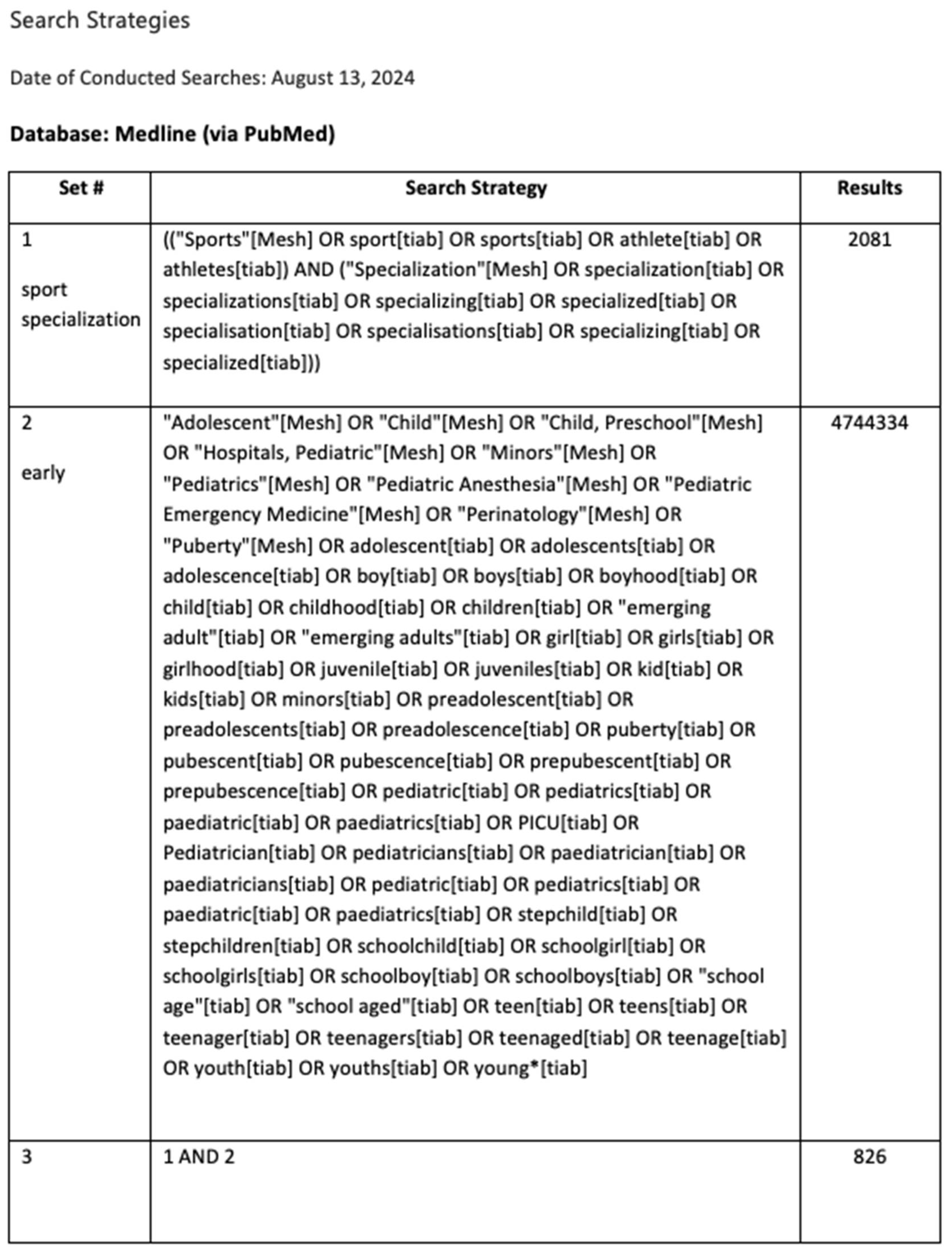
Appendix B. Full Quality Assessment and Risk of Bias

| MINORS | A Clearly Stated Aim | Inclusion of Consecutive Patients | Prospective Collection of Data | Endpoints Appropriate to the Aim of the Study | Unbiased Assessment of Study Endpoint | Follow-Up Period Appropriate to the Aim of the Study | Loss to Follow Up Less Than 5% | Prospective Calculation of the Study Size | Total |
|---|---|---|---|---|---|---|---|---|---|
| Ahlquist 2020 [17] | 2 | 2 | 0 | 2 | 0 | 1 | 2 | 2 | 11 |
| Allahabadi 2022 [18] | 2 | 2 | 0 | 2 | 1 | 1 | 2 | 2 | 12 |
| Allahabadi 2023 [19] | 2 | 2 | 0 | 2 | 1 | 2 | 2 | 2 | 13 |
| Arede 2019 [20] | 2 | 2 | 0 | 2 | 0 | 2 | 1 | 2 | 11 |
| Arnold 2019 [21] | 2 | 0 | 0 | 2 | 1 | 2 | 1 | 2 | 10 |
| Barfield 2019 [22] | 2 | 1 | 0 | 2 | 1 | 2 | 2 | 2 | 12 |
| Beese 2015 [23] | 2 | 2 | 0 | 2 | 1 | 2 | 2 | 2 | 12 |
| Bell 2016 [24] | 2 | 1 | 0 | 2 | 1 | 2 | 1 | 2 | 11 |
| Biese 2020a [25] | 2 | 2 | 0 | 2 | 2 | 2 | 0 | 2 | 12 |
| Biese 2020b [26] | 2 | 0 | 0 | 2 | 2 | 2 | 0 | 2 | 10 |
| Biese 2021 [27] | 2 | 1 | 0 | 2 | 2 | 2 | 1 | 2 | 12 |
| Biese 2022 [28] | 2 | 1 | 0 | 1 | 1 | 2 | 1 | 2 | 10 |
| Biese 2024 [29] | 2 | 0 | 0 | 2 | 1 | 2 | 1 | 2 | 10 |
| Bonnette 2023 [30] | 2 | 2 | 0 | 2 | 1 | 2 | 2 | 2 | 13 |
| Bridge 2013 [31] | 2 | 1 | 0 | 2 | 1 | 2 | 1 | 2 | 11 |
| Bush 2021 [32] | 2 | 2 | 0 | 2 | 2 | 2 | 1 | 2 | 13 |
| Butler 2024 [33] | 2 | 1 | 0 | 2 | 1 | 2 | 1 | 2 | 11 |
| Camp 2023 [34] | 2 | 2 | 0 | 1 | 1 | 1 | 1 | 2 | 10 |
| Chen 2022 [35] | 2 | 0 | 0 | 2 | 0 | 2 | 1 | 2 | 9 |
| Chou 2023 [36] | 2 | 1 | 0 | 2 | 1 | 2 | 2 | 2 | 12 |
| Confino 2019 [37] | 2 | 1 | 0 | 1 | 0 | 2 | 2 | 2 | 10 |
| Croci 2021 [38] | 2 | 1 | 0 | 2 | 1 | 2 | 2 | 2 | 12 |
| Dahab 2019 [39] | 2 | 2 | 0 | 2 | 1 | 2 | 1 | 2 | 12 |
| DiCesare 2019a [40] | 2 | 1 | 0 | 2 | 0 | 2 | 1 | 2 | 10 |
| DiCesare 2019b [41] | 2 | 2 | 0 | 2 | 0 | 2 | 1 | 2 | 11 |
| DiStefano 2018 [42] | 2 | 2 | 0 | 1 | 2 | 2 | 1 | 2 | 12 |
| Dobsacha 2023 [43] | 2 | 0 | 0 | 2 | 1 | 2 | 0 | 2 | 9 |
| Field 2019 [44] | 2 | 1 | 0 | 2 | 1 | 2 | 0 | 2 | 10 |
| Fransen 2012 [45] | 2 | 2 | 0 | 2 | 1 | 2 | 2 | 2 | 13 |
| Frome 2019 [46] | 2 | 1 | 0 | 2 | 1 | 2 | 0 | 2 | 10 |
| Gallant 2017 [47] | 2 | 2 | 0 | 2 | 1 | 2 | 0 | 2 | 11 |
| Garcia 2021a [48] | 2 | 1 | 0 | 2 | 1 | 2 | 0 | 2 | 10 |
| Garcia 2021b [49] | 2 | 1 | 0 | 2 | 1 | 2 | 0 | 2 | 10 |
| Ha 2023 [50] | 1 | 2 | 0 | 2 | 2 | 2 | 1 | 2 | 12 |
| Hall 2015 [51] | 2 | 1 | 0 | 2 | 1 | 2 | 1 | 2 | 11 |
| Heath 2021 [52] | 1 | 2 | 0 | 2 | 1 | 2 | 1 | 2 | 11 |
| Herman 2019 [53] | 2 | 1 | 0 | 2 | 1 | 2 | 1 | 2 | 11 |
| HuardPelletier 2022 [54] | 2 | 2 | 0 | 2 | 0 | 2 | 1 | 2 | 11 |
| HuardPelletier 2024 [55] | 2 | 1 | 0 | 2 | 1 | 2 | 1 | 2 | 11 |
| Iona 2022 [56] | 2 | 0 | 0 | 2 | 0 | 2 | 0 | 2 | 8 |
| Jayanthi 2015 [57] | 2 | 2 | 0 | 2 | 1 | 2 | 1 | 2 | 12 |
| Jayanthi 2020 [58] | 2 | 2 | 0 | 1 | 1 | 2 | 0 | 2 | 10 |
| Larson 2019 [59] | 2 | 2 | 0 | 2 | 0 | 2 | 1 | 2 | 11 |
| Lear 2024 [60] | 2 | 2 | 0 | 2 | 0 | 2 | 0 | 2 | 10 |
| Lenz 2024 [61] | 2 | 2 | 0 | 1 | 2 | 1 | 1 | 2 | 11 |
| Lima 2020 [62] | 1 | 1 | 0 | 2 | 1 | 2 | 1 | 2 | 10 |
| Li 2023 [63] | 2 | 2 | 0 | 2 | 0 | 2 | 1 | 2 | 11 |
| McDonald 2019 [64] | 2 | 0 | 0 | 2 | 1 | 2 | 1 | 2 | 10 |
| McGowan 2020 [65] | 2 | 1 | 0 | 2 | 0 | 2 | 1 | 2 | 10 |
| McGuine 2017 [66] | 2 | 2 | 0 | 2 | 0 | 2 | 1 | 2 | 11 |
| McKay 2023 [67] | 2 | 2 | 0 | 2 | 0 | 2 | 1 | 2 | 11 |
| Meisel 2022 [68] | 2 | 2 | 0 | 2 | 0 | 2 | 0 | 2 | 10 |
| Miller 2017 [69] | 2 | 2 | 0 | 2 | 0 | 2 | 1 | 2 | 11 |
| Moseid 2019 [70] | 2 | 2 | 0 | 2 | 0 | 2 | 1 | 2 | 11 |
| Murday 2024 [71] | 2 | 2 | 0 | 2 | 0 | 2 | 1 | 2 | 11 |
| Nagano 2023 [72] | 2 | 2 | 0 | 2 | 0 | 2 | 1 | 2 | 11 |
| Nguyen 2023 [73] | 2 | 2 | 0 | 2 | 0 | 2 | 1 | 2 | 11 |
| Okoruwa 2022 [74] | 2 | 1 | 0 | 2 | 1 | 2 | 2 | 2 | 12 |
| Pasulka 2017 [75] | 2 | 2 | 0 | 2 | 1 | 2 | 1 | 2 | 13 |
| Post 2017a [76] | 2 | 2 | 0 | 2 | 0 | 2 | 1 | 2 | 11 |
| Post 2017b [13] | 2 | 2 | 0 | 2 | 1 | 2 | 1 | 2 | 12 |
| Post 2020a [77] | 2 | 1 | 0 | 2 | 0 | 2 | 1 | 2 | 10 |
| Post 2020b [78] | 2 | 2 | 0 | 2 | 1 | 2 | 1 | 2 | 12 |
| Post 2021a [79] | 2 | 2 | 0 | 2 | 1 | 2 | 1 | 2 | 12 |
| Post 2021b [80] | 2 | 2 | 0 | 2 | 1 | 2 | 1 | 2 | 12 |
| Post 2021c [81] | 2 | 2 | 0 | 2 | 1 | 2 | 1 | 2 | 12 |
| Post 2024 [82] | 2 | 2 | 0 | 2 | 1 | 2 | 1 | 2 | 12 |
| Rauh 2020 [83] | 2 | 2 | 0 | 2 | 1 | 1 | 1 | 2 | 11 |
| Riehm 2023 [84] | 2 | 1 | 0 | 2 | 1 | 2 | 1 | 2 | 11 |
| Root 2019 [85] | 2 | 2 | 0 | 2 | 1 | 2 | 2 | 2 | 13 |
| Ross 2022 [86] | 2 | 1 | 0 | 2 | 1 | 1 | 1 | 2 | 10 |
| Rugg 2018 [87] | 2 | 1 | 0 | 2 | 0 | 2 | 2 | 2 | 11 |
| Rugg 2021 [88] | 2 | 1 | 0 | 2 | 1 | 2 | 1 | 2 | 11 |
| Sheppard 2020 [89] | 2 | 2 | 0 | 2 | 0 | 2 | 1 | 2 | 11 |
| Soderstrom 2023 [90] | 0 | 2 | 0 | 2 | 1 | 2 | 0 | 2 | 9 |
| Staub 2020 [91] | 2 | 2 | 0 | 2 | 2 | 2 | 2 | 2 | 14 |
| Steinl 2021 [10] | 2 | 2 | 0 | 2 | 2 | 2 | 1 | 2 | 13 |
| Stockbower 2022 [92] | 2 | 2 | 0 | 2 | 2 | 2 | 1 | 2 | 13 |
| Sugimoto 2019 [93] | 2 | 2 | 0 | 2 | 2 | 2 | 1 | 2 | 13 |
| Sweeney 2021 [94] | 2 | 2 | 0 | 2 | 0 | 2 | 1 | 2 | 11 |
| Swindell 2019 [11] | 2 | 1 | 0 | 2 | 2 | 2 | 0 | 2 | 11 |
| Valenzuela-Moss 2024 [95] | 2 | 2 | 0 | 2 | 2 | 2 | 1 | 2 | 14 |
| Vernick 2021 [96] | 2 | 2 | 0 | 2 | 2 | 2 | 1 | 2 | 13 |
| Watson 2019 [97] | 2 | 2 | 0 | 2 | 2 | 2 | 1 | 2 | 13 |
| Watson 2022 [98] | 2 | 2 | 0 | 2 | 2 | 2 | 1 | 2 | 13 |
| Whatman 2023 [99] | 2 | 2 | 0 | 2 | 2 | 2 | 1 | 2 | 13 |
| Whatman 2021 [100] | 2 | 2 | 1 | 2 | 1 | 2 | 1 | 2 | 13 |
| Wilhelm 2017 [101] | 2 | 2 | 0 | 2 | 1 | 2 | 1 | 1 | 11 |
| Wilkins 2023 [102] | 2 | 2 | 0 | 2 | 1 | 2 | 1 | 1 | 11 |
| Wilkins 2024 [103] | 2 | 2 | 0 | 2 | 0 | 2 | 1 | 0 | 9 |
| Xiao 2021 [104] | 2 | 2 | 0 | 2 | 0 | 2 | 1 | 2 | 11 |
| Zeller 2024 [105] | 2 | 2 | 0 | 2 | 2 | 2 | 1 | 2 | 13 |
| Zoellner 2022 [106] | 2 | 2 | 0 | 2 | 1 | 2 | 2 | 2 | 13 |
References
- LaPrade, R.F.; Agel, J.; Baker, J.; Brenner, J.S.; Cordasco, F.A.; Cote, J.; Engebretsen, L.; Feeley, B.T.; Gould, D.; Hainline, B.; et al. AOSSM Early Sport Specialization Consensus Statement. Orthop. J. Sports Med. 2016, 4, 2325967116644241. [Google Scholar] [CrossRef] [PubMed]
- Hollabaugh, W.L.; Jeckell, A.S.; Diamond, A.B. Name, Image, and Likeness and the Health of the Young Athlete: A Call to Action for Sports Medicine Providers and the Athletic Healthcare Network. Sports Health 2024, 16, 209–212. [Google Scholar] [CrossRef]
- Haider, A.A.; Troyer, S.C.; Mologne, M.S.; Hardi, A.; Kuhn, A.W. Parental influence and perceptions on youth single sport specialization: A systematic review. Physician Sportsmed. 2024, 52, 541–555. [Google Scholar] [CrossRef]
- Bell, D.R.; Post, E.G.; Trigsted, S.M.; Schaefer, D.A.; McGuine, T.A.; Brooks, M.A. Parents’ Awareness and Perceptions of Sport Specialization and Injury Prevention Recommendations. Clin. J. Sport. Med. 2020, 30, 539–543. [Google Scholar] [CrossRef]
- DiSanti, J.S.; Post, E.G.; Bell, D.R.; Schaefer, D.A.; Brooks, M.A.; McGuine, T.A.; Erickson, K. Exploring Coaches’ Perceptions of Youth Sport Specialization: A Comparison of High School and Club Sport Contexts. J. Athl. Train. 2019, 54, 1055–1060. [Google Scholar] [CrossRef] [PubMed]
- Ericsson, K.A.; Krampe, R.T.; Tesch-Römer, C. The role of deliberate practice in the acquisition of expert performance. Psychol. Rev. 1993, 100, 363. [Google Scholar] [CrossRef]
- Lloyd, R.S.; Oliver, J.L.; Faigenbaum, A.D.; Howard, R.; De Ste Croix, M.B.; Williams, C.A.; Best, T.M.; Alvar, B.A.; Micheli, L.J.; Thomas, D.P.; et al. Long-term athletic development- part 1: A pathway for all youth. J. Strength. Cond. Res. 2015, 29, 1439–1450. [Google Scholar] [CrossRef]
- Feeley, B.T.; Agel, J.; LaPrade, R.F. When Is It Too Early for Single Sport Specialization? Am. J. Sports Med. 2016, 44, 234–241. [Google Scholar] [CrossRef] [PubMed]
- Giusti, N.E.; Carder, S.L.; Vopat, L.; Baker, J.; Tarakemeh, A.; Vopat, B.; Mulcahey, M.K. Comparing Burnout in Sport-Specializing Versus Sport-Sampling Adolescent Athletes: A Systematic Review and Meta-analysis. Orthop. J. Sports Med. 2020, 8, 2325967120907579. [Google Scholar] [CrossRef]
- Steinl, G.K.; Padaki, A.S.; Irvine, J.N.; Popkin, C.A.; Ahmad, C.S.; Lynch, T.S. The prevalence of high school multi-sport participation in elite national football league athletes. Physician Sportsmed. 2021, 49, 476–479. [Google Scholar] [CrossRef]
- Swindell, H.W.; Marcille, M.L.; Trofa, D.P.; Paulino, F.E.; Desai, N.N.; Lynch, T.S.; Ahmad, C.S.; Popkin, C.A. An Analysis of Sports Specialization in NCAA Division I Collegiate Athletics. Orthop. J. Sports Med. 2019, 7, 2325967118821179. [Google Scholar] [CrossRef]
- Barreiro, J.A.; Howard, R. Incorporating Unstructured Free Play into Organized Sports. Strength. Cond. J. 2017, 39, 11–19. [Google Scholar] [CrossRef]
- Post, E.G.; Trigsted, S.M.; Riekena, J.W.; Hetzel, S.; McGuine, T.A.; Brooks, M.A.; Bell, D.R. The Association of Sport Specialization and Training Volume With Injury History in Youth Athletes. Am. J. Sports Med. 2017, 45, 1405–1412. [Google Scholar] [CrossRef]
- Bell, D.R.; Post, E.G.; Biese, K.; Bay, C.; Valovich McLeod, T. Sport Specialization and Risk of Overuse Injuries: A Systematic Review With Meta-analysis. Pediatrics 2018, 142, e20180657. [Google Scholar] [CrossRef]
- Fabricant, P.D.; Lakomkin, N.; Sugimoto, D.; Tepolt, F.A.; Stracciolini, A.; Kocher, M.S. Youth sports specialization and musculoskeletal injury: A systematic review of the literature. Physician Sportsmed. 2016, 44, 257–262. [Google Scholar] [CrossRef] [PubMed]
- Slim, K.; Nini, E.; Forestier, D.; Kwiatkowski, F.; Panis, Y.; Chipponi, J. Methodological index for non-randomized studies (minors): Development and validation of a new instrument. ANZ J. Surg. 2003, 73, 712–716. [Google Scholar] [CrossRef] [PubMed]
- Ahlquist, S.; Cash, B.M.; Hame, S.L. Associations of Early Sport Specialization and High Training Volume With Injury Rates in National Collegiate Athletic Association Division I Athletes. Orthop. J. Sports Med. 2020, 8, 2325967120906825. [Google Scholar] [CrossRef]
- Allahabadi, S.; Calthorpe, L.; Pandya, N.K. Financial and medical burdens of youth sports specialization: Survey of pediatric sports patients. J. Sports Med. Phys. Fitness 2022, 62, 716–721. [Google Scholar] [CrossRef]
- Allahabadi, S.; Gatto, A.P.; Kopardekar, A.; Davies, M.R.; Pandya, N.K. National Football League (NFL) quarterbacks who were multisport high school athletes have better in-season performance statistics and career success. Physician Sportsmed. 2023, 51, 320–324. [Google Scholar] [CrossRef]
- Arede, J.; Esteves, P.; Ferreira, A.P.; Sampaio, J.; Leite, N. Jump higher, run faster: Effects of diversified sport participation on talent identification and selection in youth basketball. J. Sports Sci. 2019, 37, 2220–2227. [Google Scholar] [CrossRef]
- Arnold, A.J.; Thigpen, C.A.; Beattie, P.F.; Kissenberth, M.J.; Tokish, J.M.; Shanley, E. Sport Specialization and Increased Injury Frequency in Youth Baseball Players: A Prospective Study. J. Athl. Train. 2019, 54, 1115–1122. [Google Scholar] [CrossRef] [PubMed]
- Barfield, J.W.; Oliver, G.D. Sport Specialization and Single-Legged-Squat Performance Among Youth Baseball and Softball Athletes. J. Athl. Train. 2019, 54, 1067–1073. [Google Scholar] [CrossRef]
- Beese, M.E.; Joy, E.; Switzler, C.L.; Hicks-Little, C.A. Landing Error Scoring System Differences Between Single-Sport and Multi-Sport Female High School-Aged Athletes. J. Athl. Train. 2015, 50, 806–811. [Google Scholar] [CrossRef] [PubMed]
- Bell, D.R.; Post, E.G.; Trigsted, S.M.; Hetzel, S.; McGuine, T.A.; Brooks, M.A. Prevalence of Sport Specialization in High School Athletics: A 1-Year Observational Study. Am. J. Sports Med. 2016, 44, 1469–1474. [Google Scholar] [CrossRef]
- Biese, K.M.; McGuine, T.A.; Kliethermes, S.A.; Bell, D.R.; Post, E.G.; Watson, A.M.; Brooks, M.A.; Lang, P.J. Sport specialization and sport participation opportunities and their association with injury history in female high school volleyball athletes. Phys. Ther. Sport. 2020, 45, 86–92. [Google Scholar] [CrossRef]
- Biese, K.M.; Post, E.G.; Schaefer, D.A., 2nd; Hernandez, M.I.; Brooks, M.A.; McGuine, T.A.; Bell, D.R. Evaluation of adolescent sport specialization and injury mechanism by sex: A secondary analysis. J. Sci. Med. Sport. 2020, 23, 721–725. [Google Scholar] [CrossRef]
- Biese, K.M.; Winans, M.; Fenton, A.N.; Hernandez, M.; Schaefer, D.A.; Bell, D.R. High School Sport Specialization and Injury in Collegiate Club-Sport Athletes. J. Athl. Train. 2021, 56, 1271–1277. [Google Scholar] [CrossRef]
- Biese, K.M.; Winans, M.; Hernandez, M.I.; Schaefer, D.A.; Post, E.G.; Sanfilippo, J.L.; Bell, D.R. Comparing High School Sport Specialization Trends Between Division I and Club Collegiate Athletes. Sports Health 2022, 14, 849–858. [Google Scholar] [CrossRef] [PubMed]
- Biese, K.M.; Winans, M.; Rudek, G.; Cadmus-Bertram, L.; Andreae, S.; Brooks, M.A.; Kliethermes, S.; McGuine, T.A.; Bell, D.R. Sport Specialization and Sport Motivation in Middle School-Aged Athletes. J. Athl. Train. 2024, 59, 274–280. [Google Scholar] [CrossRef]
- Bonnette, S.; Riley, M.A.; Riehm, C.; DiCesare, C.A.; Christy, M.; Wilson, J.; Schille, A.; Diekfuss, J.A.; Kiefer, A.W.; Jayanthi, N.; et al. Differences in Lower Extremity Coordination Patterns as a Function of Sports Specialization. J. Mot. Behav. 2023, 55, 245–255. [Google Scholar] [CrossRef]
- Bridge, M.W.; Toms, M.R. The specialising or sampling debate: A retrospective analysis of adolescent sports participation in the UK. J. Sports Sci. 2013, 31, 87–96. [Google Scholar] [CrossRef]
- Bush, C.M.; Wilhelm, A.J.; Lavallee, M.E.; Deitch, J.R. Early Sport Specialization in Elite Weightlifters: Weightlifting Injury Occurrence and Relevant Opinions. J. Strength. Cond. Res. 2021, 35, 3260–3264. [Google Scholar] [CrossRef] [PubMed]
- Butler, L.S.; Sugimoto, D.; Erdman, A.; Yoder, J.; Greiner, K.; Larroque, C.; Latz, K.; Loewen, A.; Wyatt, C.W.; DeVerna, A.; et al. Highly Active Middle School Athletes Demonstrate Poor Motor Skill Proficiency. Sports Health 2024, 16, 527–533. [Google Scholar] [CrossRef] [PubMed]
- Camp, C.L.; Erickson, B.J.; Bowman, E.N.; Freehill, M.T.; Smith, M.V.; Christoffer, D.; Clinker, C.; Ishikawa, H.; Thomas, L.; Chalmers, P.N. Early single sport specialization does not improve pitching velocity, motion, strength, or utilization in high school baseball pitchers. JSES Rev. Rep. Tech. 2023, 3, 506–510. [Google Scholar] [CrossRef]
- Chen, D.L.; Meyers, R.N.; Provance, A.J.; Zynda, A.J.; Wagner, K.J., 3rd; Siegel, S.R.; Howell, D.R.; Miller, S.M. Early Sport Specialization and Past Injury in Competitive Youth Rock Climbers. Wilderness Environ. Med. 2022, 33, 179–186. [Google Scholar] [CrossRef]
- Chou, T.Y.; Biese, K.; Leung, W.; Bell, D.; Kaminski, T.; McGuine, T. The Association of Sport Specialization and Concussion History on Self-Reported Depressive Symptoms and Quality of Life Among High School Athletes. Clin. J. Sport. Med. 2023, 33, 139–144. [Google Scholar] [CrossRef]
- Confino, J.; Irvine, J.N.; O’Connor, M.; Ahmad, C.S.; Lynch, T.S. Early Sports Specialization Is Associated With Upper Extremity Injuries in Throwers and Fewer Games Played in Major League Baseball. Orthop. J. Sports Med. 2019, 7, 2325967119861101. [Google Scholar] [CrossRef] [PubMed]
- Croci, J.; Nicknair, J.; Goetschius, J. Early Sport Specialization Linked to Throwing Arm Function and Upper Extremity Injury History in College Baseball Players. Sports Health 2021, 13, 230–236. [Google Scholar] [CrossRef]
- Dahab, K.; Potter, M.N.; Provance, A.; Albright, J.; Howell, D.R. Sport Specialization, Club Sport Participation, Quality of Life, and Injury History Among High School Athletes. J. Athl. Train. 2019, 54, 1061–1066. [Google Scholar] [CrossRef]
- DiCesare, C.A.; Montalvo, A.; Barber Foss, K.D.; Thomas, S.M.; Ford, K.R.; Hewett, T.E.; Jayanthi, N.A.; Stracciolini, A.; Bell, D.R.; Myer, G.D. Lower Extremity Biomechanics Are Altered Across Maturation in Sport-Specialized Female Adolescent Athletes. Front. Pediatr. 2019, 7, 268. [Google Scholar] [CrossRef]
- DiCesare, C.A.; Montalvo, A.; Foss, K.D.B.; Thomas, S.M.; Hewett, T.E.; Jayanthi, N.A.; Myer, G.D. Sport Specialization and Coordination Differences in Multisport Adolescent Female Basketball, Soccer, and Volleyball Athletes. J. Athl. Train. 2019, 54, 1105–1114. [Google Scholar] [CrossRef] [PubMed]
- DiStefano, L.J.; Beltz, E.M.; Root, H.J.; Martinez, J.C.; Houghton, A.; Taranto, N.; Pearce, K.; McConnell, E.; Muscat, C.; Boyle, S.; et al. Sport Sampling Is Associated With Improved Landing Technique in Youth Athletes. Sports Health 2018, 10, 160–168. [Google Scholar] [CrossRef] [PubMed]
- Dobscha, M.; Peterson, C.; Powers, W.S.; Goetschius, J. Youth sport specialization associated with poorer lower extremity function & pain as young adults. Phys. Sportsmed. 2023, 51, 254–259. [Google Scholar] [CrossRef] [PubMed]
- Field, A.E.; Tepolt, F.A.; Yang, D.S.; Kocher, M.S. Injury Risk Associated With Sports Specialization and Activity Volume in Youth. Orthop. J. Sports Med. 2019, 7, 2325967119870124. [Google Scholar] [CrossRef]
- Fransen, J.; Pion, J.; Vandendriessche, J.; Vandorpe, B.; Vaeyens, R.; Lenoir, M.; Philippaerts, R.M. Differences in physical fitness and gross motor coordination in boys aged 6-12 years specializing in one versus sampling more than one sport. J. Sports Sci. 2012, 30, 379–386. [Google Scholar] [CrossRef]
- Frome, D.; Rychlik, K.; Fokas, J.; Chiampas, G.; Jayanthi, N.; LaBella, C. Sports Specialization Is Not Associated With Greater Odds of Previous Injury in Elite Male Youth Soccer Players. Clin. J. Sport. Med. 2019, 29, 368–373. [Google Scholar] [CrossRef]
- Gallant, F.; O’Loughlin, J.L.; Brunet, J.; Sabiston, C.M.; Belanger, M. Childhood Sports Participation and Adolescent Sport Profile. Pediatrics 2017, 140, e20171449. [Google Scholar] [CrossRef]
- Garcia, M.C.; Taylor-Haas, J.A.; Rauh, M.J.; Toland, M.D.; Bazett-Jones, D.M. Sport Specialization and Quality of Life among Middle- and High-School Long-Distance Runners of Different Injury Status: A Retrospective Study. J. Sports Sci. 2021, 39, 2727–2734. [Google Scholar] [CrossRef]
- Garcia, M.C.; Taylor-Haas, J.A.; Rauh, M.J.; Toland, M.D.; Bazett-Jones, D.M. Sport Specialization in Middle School and High School Long-Distance Runners. J. Athl. Train. 2021, 56, 1003–1009. [Google Scholar] [CrossRef]
- Ha, D.; Nagai, S.; Noh, B.; Mukai, N.; Miyakawa, S.; Takemura, M. Injury Prevalence among Young Elite Baseball Players. Sports 2023, 11, 134. [Google Scholar] [CrossRef]
- Hall, R.; Barber Foss, K.; Hewett, T.E.; Myer, G.D. Sport specialization’s association with an increased risk of developing anterior knee pain in adolescent female athletes. J. Sport. Rehabil. 2015, 24, 31–35. [Google Scholar] [CrossRef]
- Heath, M.R.; Janosky, J.J.; Pegno, A.; Schachne, J.M.; Fabricant, P.D. Age Is More Predictive of Safe Movement Patterns Than Are Physical Activity or Sports Specialization: A Prospective Motion Analysis Study of Young Athletes. Am. J. Sports Med. 2021, 49, 1904–1911. [Google Scholar] [CrossRef]
- Herman, D.C.; Riveros, D.; Jacobs, K.; Harris, A.; Massengill, C.; Vincent, H.K. Previous High School Participation in Varsity Sport and Jump-Landing Biomechanics in Adult Recreational Athletes. J. Athl. Train. 2019, 54, 1089–1094. [Google Scholar] [CrossRef]
- Huard Pelletier, V.; Lemoyne, J. Early Sport Specialization and Relative Age Effect: Prevalence and Influence on Perceived Competence in Ice Hockey Players. Sports 2022, 10, 62. [Google Scholar] [CrossRef]
- Huard Pelletier, V.; Lemoyne, J. Perceived competence in ice hockey and its associations with relative age, early sport specialization, and players’ position. Front. Psychol. 2024, 15, 1336529. [Google Scholar] [CrossRef]
- Iona, T.; Raimo, S.; Coco, D.; Tortella, P.; Masala, D.; Ammendolia, A.; Mannocci, A.; La Torre, G. Specialization and Injury Risk in Different Youth Sports: A Bio-Emotional Social Approach. Front. Psychol. 2022, 13, 818739. [Google Scholar] [CrossRef]
- Jayanthi, N.A.; LaBella, C.R.; Fischer, D.; Pasulka, J.; Dugas, L.R. Sports-specialized intensive training and the risk of injury in young athletes: A clinical case-control study. Am. J. Sports Med. 2015, 43, 794–801. [Google Scholar] [CrossRef]
- Jayanthi, N.; Kleithermes, S.; Dugas, L.; Pasulka, J.; Iqbal, S.; LaBella, C. Risk of Injuries Associated With Sport Specialization and Intense Training Patterns in Young Athletes: A Longitudinal Clinical Case-Control Study. Orthop. J. Sports Med. 2020, 8, 2325967120922764. [Google Scholar] [CrossRef]
- Larson, H.K.; Young, B.W.; McHugh, T.F.; Rodgers, W.M. Markers of Early Specialization and Their Relationships With Burnout and Dropout in Swimming. J. Sport. Exerc. Psychol. 2019, 41, 46–54. [Google Scholar] [CrossRef]
- Lear, A.; Zeller, A.M.; McNulty, S.; Bentley, B.; Post, E. Results of a National Survey on Sport Specialization Behavior and Throwing Arm Injury in Youth Softball Players. Sports Health 2024, 16, 327–332. [Google Scholar] [CrossRef]
- Lenz, A.; Provance, A.; Johnson, L.A.; Teramoto, M. Diving Into Sports Specialization: The Association of Early Specialization on Injury Rates in Youth to Young Adult Divers. Clin. J. Sport. Med. 2024, 35, 75–92. [Google Scholar] [CrossRef]
- Lima, A.B.; Nascimento, J.V.; Leonardi, T.J.; Soares, A.L.; Paes, R.R.; Goncalves, C.E.; Carvalho, H.M. Deliberate Practice, Functional Performance and Psychological Characteristics in Young Basketball Players: A Bayesian Multilevel Analysis. Int. J. Environ. Res. Public. Health 2020, 17, 4078. [Google Scholar] [CrossRef]
- Li, X.; Feng, R.; Luo, S.; Li, C.; Gomez-Ruano, M.A. The associations of early specialization, sports volume, and maturity status with musculoskeletal injury in elite youth football players. Front. Physiol. 2023, 14, 1183204. [Google Scholar] [CrossRef]
- McDonald, C.; Deitch, J.; Bush, C. Early Sports Specialization in Elite Wrestlers. Sports Health 2019, 11, 397–401. [Google Scholar] [CrossRef]
- McGowan, J.; Whatman, C.; Walters, S. The associations of early specialisation and sport volume with musculoskeletal injury in New Zealand children. J. Sci. Med. Sport. 2020, 23, 139–144. [Google Scholar] [CrossRef]
- McGuine, T.A.; Post, E.G.; Hetzel, S.J.; Brooks, M.A.; Trigsted, S.; Bell, D.R. A Prospective Study on the Effect of Sport Specialization on Lower Extremity Injury Rates in High School Athletes. Am. J. Sports Med. 2017, 45, 2706–2712. [Google Scholar] [CrossRef]
- McKay, C.; Hoch, J.M.; Hoch, M.C.; Dlugonski, D. Sports Specialization, Physical Literacy, and Physical Activity Levels in Young Adults. J. Sport. Rehabil. 2023, 32, 190–195. [Google Scholar] [CrossRef]
- Meisel, P.L.; DiFiori, J.P.; Cote, J.; Nguyen, J.T.; Brenner, J.S.; Malina, R.M.; Ryan, E., 3rd; Gullich, A. Age of Early Specialization, Competitive Volume, Injury, and Sleep Habits in Youth Sport: A Preliminary Study of US Youth Basketball. Sports Health 2022, 14, 30–44. [Google Scholar] [CrossRef]
- Miller, M.M.; Trapp, J.L.; Post, E.G.; Trigsted, S.M.; McGuine, T.A.; Brooks, M.A.; Bell, D.R. The Effects of Specialization and Sex on Anterior Y-Balance Performance in High School Athletes. Sports Health 2017, 9, 375–382. [Google Scholar] [CrossRef]
- Moseid, C.H.; Myklebust, G.; Fagerland, M.W.; Bahr, R. The association between early specialization and performance level with injury and illness risk in youth elite athletes. Scand. J. Med. Sci. Sports 2019, 29, 460–468. [Google Scholar] [CrossRef]
- Murday, P.F.; McLoughlin, D.E.; Wild, J.T.; Kwon, S.; Burgess, J.; LaBella, C.R. Injury Patterns in Highly Specialized Youth Athletes: A Comparison of 2 Pathways to Specialization. J. Athl. Train. 2024, 59, 112–120. [Google Scholar] [CrossRef]
- Nagano, Y.; Oyama, T. Early Sport Specialization Trends and Injuries in Former High School Athletes Specialized in Sports. Open Access J. Sports Med. 2023, 14, 1–7. [Google Scholar] [CrossRef]
- Nguyen, M.; Bixby, S.; Yen, Y.M.; Miller, P.; Stracciolini, A. Moderate and High Sport Specialization Level in Ice Hockey Athletes Is Associated With Symptomatic Cam Deformity. Sports Health 2023, 15, 753–759. [Google Scholar] [CrossRef]
- Okoruwa, E.T.; Abbott, A.; Stamm, M.; Mulcahey, M.K. Sport Specialization Classification and Injury Risk in Female Athletes. Sports Health 2022, 14, 797–804. [Google Scholar] [CrossRef]
- Pasulka, J.; Jayanthi, N.; McCann, A.; Dugas, L.R.; LaBella, C. Specialization patterns across various youth sports and relationship to injury risk. Phys. Sportsmed. 2017, 45, 344–352. [Google Scholar] [CrossRef]
- Post, E.G.; Bell, D.R.; Trigsted, S.M.; Pfaller, A.Y.; Hetzel, S.J.; Brooks, M.A.; McGuine, T.A. Association of Competition Volume, Club Sports, and Sport Specialization With Sex and Lower Extremity Injury History in High School Athletes. Sports Health 2017, 9, 518–523. [Google Scholar] [CrossRef]
- Post, E.G.; Biese, K.M.; Schaefer, D.A.; Watson, A.M.; McGuine, T.A.; Brooks, M.A.; Bell, D.R. Sport-Specific Associations of Specialization and Sex With Overuse Injury in Youth Athletes. Sports Health 2020, 12, 36–42. [Google Scholar] [CrossRef]
- Post, E.G.; Struminger, A.H.; Hibberd, E.E. Sport specialization is associated with upper-extremity overuse injury in high school baseball players. J. Shoulder Elbow Surg. 2020, 29, 1775–1782. [Google Scholar] [CrossRef]
- Post, E.G.; Rosenthal, M.D.; Pennock, A.T.; Rauh, M.J. The association of sport participation behaviors with throwing-arm health in Little League Baseball pitchers. JSES Rev. Rep. Tech. 2021, 1, 90–95. [Google Scholar] [CrossRef]
- Post, E.G.; Rosenthal, M.D.; Pennock, A.T.; Rauh, M.J. Prevalence and Consequences of Sport Specialization Among Little League Baseball Players. Sports Health 2021, 13, 223–229. [Google Scholar] [CrossRef]
- Post, E.G.; Rosenthal, M.D.; Root, H.J.; Rauh, M.J. Sport Specialization Behaviors Are Associated With History of Reported Injury in Youth Basketball. J. Pediatr. Orthop. 2021, 41, 507–513. [Google Scholar] [CrossRef]
- Post, E.G.; Rivera, M.J.; Robison, H.J.; Rauh, M.J.; McGuine, T.A.; Simon, J.E. Injury risk factors related to sport specialization in high school basketball: A prospective study. J. Athl. Train. 2024, 59, 1213–1218. [Google Scholar] [CrossRef]
- Rauh, M.J.; Tenforde, A.S.; Barrack, M.T.; Rosenthal, M.D.; Nichols, J.F. Sport Specialization and Low Bone Mineral Density in Female High School Distance Runners. J. Athl. Train. 2020, 55, 1239–1246. [Google Scholar] [CrossRef]
- Riehm, C.D.; Bonnette, S.; Riley, M.A.; Diekfuss, J.A.; DiCesare, C.A.; Schille, A.; Kiefer, A.W.; Jayanthi, N.A.; Kliethermes, S.; Lloyd, R.S.; et al. Movement Regularity Differentiates Specialized and Nonspecialized Athletes in a Virtual Reality Soccer Header Task. J. Sport. Rehabil. 2023, 32, 248–255. [Google Scholar] [CrossRef]
- Root, H.; Marshall, A.N.; Thatcher, A.; Valier, A.R.S.; Valovich McLeod, T.C.; Bay, R.C. Sport Specialization and Fitness and Functional Task Performance Among Youth Competitive Gymnasts. J. Athl. Train. 2019, 54, 1095–1104. [Google Scholar] [CrossRef]
- Ross, K.A.; Fried, J.W.; Bloom, D.A.; Gonzalez-Lomas, G. The effect of specialization and level of competition on injury in elite male ice hockey players. Physician Sportsmed. 2022, 50, 295–300. [Google Scholar] [CrossRef]
- Rugg, C.; Kadoor, A.; Feeley, B.T.; Pandya, N.K. The Effects of Playing Multiple High School Sports on National Basketball Association Players’ Propensity for Injury and Athletic Performance. Am. J. Sports Med. 2018, 46, 402–408. [Google Scholar] [CrossRef]
- Rugg, C.M.; Coughlan, M.J.; Li, J.N.; Hame, S.L.; Feeley, B.T. Early Sport Specialization Among Former National Collegiate Athletic Association Athletes: Trends, Scholarship Attainment, Injury, and Attrition. Am. J. Sports Med. 2021, 49, 1049–1058. [Google Scholar] [CrossRef]
- Sheppard, M.; Nicknair, J.; Goetschius, J. Early Sport Specialization and Subjective Hip and Groin Dysfunction in Collegiate Ice Hockey Athletes. J. Athl. Train. 2020, 55, 232–237. [Google Scholar] [CrossRef]
- Soderstrom, T.; Garn, A.C. Sport specialization in Swedish football players: Investigating a model of antecedents and outcomes. Eur. J. Sport. Sci. 2023, 23, 1868–1876. [Google Scholar] [CrossRef]
- Staub, I.; Zinner, C.; Bieder, A.; Vogt, T. Within-sport specialisation and entry age as predictors of success among age group swimmers. Eur. J. Sport. Sci. 2020, 20, 1160–1167. [Google Scholar] [CrossRef]
- Stockbower, K.A.; Howell, D.R.; Seehusen, C.N.; Armento, A.M.; Walker, G.A. Sport specialization, sleep, fatigue, and psychosocial ratings: Do highly specialized athletes differ from their less specialized peers? Phys. Sportsmed. 2022, 50, 400–405. [Google Scholar] [CrossRef]
- Sugimoto, D.; Jackson, S.S.; Howell, D.R.; Meehan, W.P., 3rd; Stracciolini, A. Association between training volume and lower extremity overuse injuries in young female athletes: Implications for early sports specialization. Phys. Sportsmed. 2019, 47, 199–204. [Google Scholar] [CrossRef]
- Sweeney, E.; Howell, D.R.; Seehusen, C.N.; Tilley, D.; Casey, E. Health outcomes among former female collegiate gymnasts: The influence of sport specialization, concussion, and disordered eating. Phys. Sportsmed. 2021, 49, 438–444. [Google Scholar] [CrossRef]
- Valenzuela-Moss, J.; Sini, M.; Wren, T.A.L.; Edison, B.R. Changes in Sports Participation, Specialization, and Burnout From 7th to 12th Grade: Final Results From a 6-Year Longitudinal Study. Sports Health 2024, 16, 177–183. [Google Scholar] [CrossRef]
- Venrick, C.C.B.; Miraldi, S.F.; DiStefano, L.J.; Peck, K.Y.; Posner, L.M.A.; Houston, M.N.; Padua, D.A.; Marshall, S.W.; Cameron, K.L. Differences in Lower Extremity Movement Quality by Level of Sport Specialization in Cadets Entering a United States Service Academy. Sports Health 2021, 13, 588–593. [Google Scholar] [CrossRef]
- Watson, A.; Brickson, S. Relationships Between Sport Specialization, Sleep, and Subjective Well-Being in Female Adolescent Athletes. Clin. J. Sport. Med. 2019, 29, 384–390. [Google Scholar] [CrossRef]
- Watson, A.; McGuine, T.; Lang, P.; Post, E.; Biese, K.; Kliethermes, S.; Brooks, M.A.; Bell, D. The Relationships Between Sport Specialization, Sleep, and Quality of Life in Female Youth Volleyball Athletes. Sports Health 2022, 14, 237–245. [Google Scholar] [CrossRef]
- Whatman, C.; van den Berg, C.; Black, A.M.; West, S.; Hagel, B.; Eliason, P.; Emery, C. High Sport Specialization Is Associated With More Musculoskeletal Injuries in Canadian High School Students. Clin. J. Sport. Med. 2023, 33, 233–238. [Google Scholar] [CrossRef]
- Whatman, C.; van den Berg, C.; Palacios-Derflingher, L.; Emery, C. Sport Specialization, Physical Performance and Injury History in Canadian Junior High School Students. Int. J. Sports Phys. Ther. 2021, 16, 1566–1574. [Google Scholar] [CrossRef]
- Wilhelm, A.; Choi, C.; Deitch, J. Early Sport Specialization: Effectiveness and Risk of Injury in Professional Baseball Players. Orthop. J. Sports Med. 2017, 5, 2325967117728922. [Google Scholar] [CrossRef]
- Wilkins, S.J.; Bell, D.R.; Kahanov, L.; Martin, M.; Post, E.G. Early Sport Specialization and Long-term Throwing Arm Health in College Baseball Players. Sports Health 2023, 15, 746–752. [Google Scholar] [CrossRef]
- Wilkins, S.J.; Martin, M.; Kahanov, L.; Bell, D.R.; Post, E.G. Motivation and Behaviors Related to Sport Specialization in Collegiate Baseball Players. J. Athl. Train. 2024, 59, 661–672. [Google Scholar] [CrossRef] [PubMed]
- Xiao, M.; Lemos, J.L.; Hwang, C.E.; Sherman, S.L.; Safran, M.R.; Abrams, G.D. High Specialization among Female Youth Soccer Players Is Associated with an Increased Likelihood of Serious Injury. Med. Sci. Sports Exerc. 2021, 53, 2086–2092. [Google Scholar] [CrossRef] [PubMed]
- Zeller, A.M.; Lear, A.; Post, E.; McNulty, S.; Bentley, B. A National Survey on the Relationship of Youth Sport Specialization Behaviors to Self-Reported Anxiety and Depression in Youth Softball Players. Sports Health 2024, 16, 184–194. [Google Scholar] [CrossRef] [PubMed]
- Zoellner, A.; Whatman, C.; Sheerin, K.; Read, P. Prevalence of sport specialisation and association with injury history in youth football. Phys. Ther. Sport. 2022, 58, 160–166. [Google Scholar] [CrossRef]
- Jayanthi, N.A.; Post, E.G.; Laury, T.C.; Fabricant, P.D. Health Consequences of Youth Sport Specialization. J. Athl. Train. 2019, 54, 1040–1049. [Google Scholar] [CrossRef]
- Post, E.G.; Trigsted, S.M.; Schaefer, D.A.; Cadmus-Bertram, L.A.; Watson, A.M.; McGuine, T.A.; Brooks, M.A.; Bell, D.R. Knowledge, Attitudes, and Beliefs of Youth Sports Coaches Regarding Sport Volume Recommendations and Sport Specialization. J. Strength. Cond. Res. 2020, 34, 2911–2919. [Google Scholar] [CrossRef]
- Davis, K.W.; Gill, K.G. Upper extremity injuries in young athletes. Semin. Musculoskelet. Radiol. 2012, 16, 269–279. [Google Scholar] [CrossRef]
- Feijen, S.; Tate, A.; Kuppens, K.; Claes, A.; Struyf, F. Swim-Training Volume and Shoulder Pain Across the Life Span of the Competitive Swimmer: A Systematic Review. J. Athl. Train. 2020, 55, 32–41. [Google Scholar] [CrossRef]
- Seminati, E.; Minetti, A.E. Overuse in volleyball training/practice: A review on shoulder and spine-related injuries. Eur. J. Sport. Sci. 2013, 13, 732–743. [Google Scholar] [CrossRef] [PubMed]
- Zaremski, J.L.; Zeppieri, G., Jr.; Tripp, B.L. Sport Specialization and Overuse Injuries in Adolescent Throwing Athletes: A Narrative Review. J. Athl. Train. 2019, 54, 1030–1039. [Google Scholar] [CrossRef] [PubMed]
- Olsen, S.J., 2nd; Fleisig, G.S.; Dun, S.; Loftice, J.; Andrews, J.R. Risk factors for shoulder and elbow injuries in adolescent baseball pitchers. Am. J. Sports Med. 2006, 34, 905–912. [Google Scholar] [CrossRef]
- Ahmad, C.S.; Padaki, A.S.; Noticewala, M.S.; Makhni, E.C.; Popkin, C.A. The Youth Throwing Score: Validating Injury Assessment in Young Baseball Players. Am. J. Sports Med. 2017, 45, 317–324. [Google Scholar] [CrossRef]
- Meister, K.; Day, T.; Horodyski, M.; Kaminski, T.W.; Wasik, M.P.; Tillman, S. Rotational motion changes in the glenohumeral joint of the adolescent/Little League baseball player. Am. J. Sports Med. 2005, 33, 693–698. [Google Scholar] [CrossRef]
- DiFiori, J.P.; Quitiquit, C.; Gray, A.; Kimlin, E.J.; Baker, R. Early Single Sport Specialization in a High-Achieving US Athlete Population: Comparing National Collegiate Athletic Association Student-Athletes and Undergraduate Students. J. Athl. Train. 2019, 54, 1050–1054. [Google Scholar] [CrossRef] [PubMed]
- Daley, M.M.; Shoop, J.; Christino, M.A. Mental Health in the Specialized Athlete. Curr. Rev. Musculoskelet. Med. 2023, 16, 410–418. [Google Scholar] [CrossRef]
- Burwell, M.; DiSanti, J.; Valovich McLeod, T.C. Early Sport Specialization in College Athletes and the Impact on Health-Related Quality of Life: A Critically Appraised Topic. J. Sport. Rehabil. 2022, 31, 645–650. [Google Scholar] [CrossRef]
- Haraldsdottir, K.; Watson, A.M. Psychosocial Impacts of Sports-related Injuries in Adolescent Athletes. Curr. Sports Med. Rep. 2021, 20, 104–108. [Google Scholar] [CrossRef]
| Author Year | Study Design (Retrospective, Prospective, etc.) | Number of Subjects | Age Currently: Mean (SD), Median (SE or Range), or Range | Age at Specialization: Mean (SD), Median (SE or Range), or Range | Sport | Level of Sport Activity | Risk of Bias Assessment |
|---|---|---|---|---|---|---|---|
| Ahlquist 2020 [17] | Cross-sectional | 183 | 20.1 ± 1.4 (18–23) | Early Sport Specialization: <14 Late Sport Specialization: 14+ | Baseball/Softball, Basketball, Cross Country, Football, Golf, Gymnastics, Rowing, Soccer, Swimming/Diving, Tennis, Track and Field, Volleyball, Waterpolo | NCAA Division I | 11 |
| Allahabadi 2022 [18] | Survey | 203 | 13.6 ± 3.1 | NR | Baseball, Basketball, Football, Soccer | Club, School (level of school not reported) | 12 |
| Allahabadi 2023 [19] | Retrospective Cohort | 303 | NR | NR | Football | NFL | 13 |
| Arede 2019 [20] | Cross-Sectional | 68 | Boys: 12.19 ± 0.58 Girls: 12.03 ± 0.54 | Boys: More Specialized: 6.91 ± 1.93, Less Specialized: 10.23 ± 1.36 Girls: More Specialized: 6.50 ± 1.57, Less Specialized: 10.25 ± 1.59 | Basketball | U-13 | 11 |
| Arnold 2019 [21] | Prospective Cohort | 159 | 11.1 ± 1.1 | NR | Baseball | Youth League | 10 |
| Barfield 2019 [22] | Cross-Sectional | 49 | 12.96 ± 2.32 | NR | Baseball, Softball | Youth League | 12 |
| Beese 2015 [23] | Cross-Sectional | 40 | Single Sport Specialized: 15.05 ± 1.2 Multisport Specialized: 15.32 ±1.2 | NR | Soccer | Local soccer clubs and Olympic Development Program | 12 |
| Bell 2016 [24] | Cross-Sectional | 302 | 15.5 ± 1.2 | NR | Basketball, Tennis, Volleyball, Soccer | High School | 11 |
| Biese 2020a [25] | Cross-Sectional | 1588 | 15.6 ± 1.1 | NR | Volleyball | High School | 12 |
| Biese 2020b [26] | Cross-Sectional | 2011 | 13.7 ± 1.6 | NR | Baseball, Basketball, Cross Country, Football, Gymnastics, Ice Hockey, Lacrosse, Soccer, Softball, Swimming/Diving, Tennis, Track and Field, Volleyball, Wrestling | High School | 10 |
| Biese 2021 [27] | Cross-Sectional | 412 | 20.1 ± 2.0 | NR | Baseball, Basketball, Cheer/Dance, Gymnastics, Ice Hockey, Lacrosse, Soccer, Softball, Swimming/Diving, Tennis, Track, Volleyball, Wrestling | Collegiate Club Sports | 12 |
| Biese 2022 [28] | Retrospective | 466 | NR | NR | Basketball, Ice Hockey, Soccer, Softball, Tennis, Track, Volleyball, Wrestling | NCAA Division 1, Club | 10 |
| Biese 2024 [29] | Cross-Sectional | 178 | NR | NR | Archery, Baseball, Basketball, Cross Country, Dance, Equestrian, Football, Golf, Gymnastics, Ice Hockey, Martial Arts, Skiing—Cross Country, Soccer, Swimming/Diving, Tennis, Track and Field, Volleyball, Wrestling | Middle School | 10 |
| Bonnette 2023 [30] | Cross-Sectional | 49 | Non-Specialized: 14.65 ± 1.19 Highly Specialized: 15.00 ± 0.53 | NR | Soccer | Middle and High School | 13 |
| Bridge 2013 [31] | Retrospective | 1006 | NR | NR | Boxing, Football, Hockey, Netball, Powerlifting, Rugby, Swimming/Diving | High School | 11 |
| Bush 2021 [32] | Cross-Sectional | 141 | 27.9 ± 6.07 | Specialization in Youth: 13.4 ± 2.58 (8–16), Specialization in Junior: 17.4 ± 2.21 (8–20) | Weightlifting | USA Weightlifting | 13 |
| Butler 2024 [33] | Cross-Sectional | 91 | 12.6 ± 0.9 | NR | Baseball, Basketball, Cross Country, Dance, Flag Football, Football, Golf, Gymnastics, Lacrosse, Soccer, Softball, Tennis, Track, Volleyball, Other | High School | 11 |
| Camp 2023 [34] | Prospective | 115 | 16.3 ± 1.4 | NR | Baseball, Basketball, Football, Golf, Hockey, Roping, Soccer, Swimming/Diving, Wrestling | High School | 10 |
| Chen 2022 [35] | Cross-Sectional | 101 | 14 ± 3 | 11 ± 2 (7–16) | Rock Climbing | National and International level | 9 |
| Chou 2023 [36] | Cross-Sectional | 2453 | Multisport: 15.8 ± 1.2 Specialized: 15.9 ± 1.2 | NR | Baseball, Basketball, Cheer, Cross Country, Football, Golf, Ice Hockey, Lacrosse, Soccer, Softball, Swimming/Diving, Tennis, Track, Volleyball, Wrestling | High School | 12 |
| Confino 2019 [37] | Cross-Sectional | 746 | Single Sport: 19.80 Multisport: 20.01 | NR | Baseball | MLB | 10 |
| Croci 2021 [38] | Cohort | 129 | Low Specialization: 19.9 ± 1.1 Moderately Specialized: 19.7 ± 1.4 Highly Specialized: 19.9 ± 1.2 | 13 | Baseball | NCAA Division II, NCAA Division III, NAIA, National Club Baseball Association Division | 12 |
| Dahab 2019 [39] | Cross-Sectional | 97 | 15.2 ± 1.1 | NR | Baseball, Basketball, Cheer, Cross Country, Field Hockey, Football, Golf, Gymnastics, Lacrosse, Rugby, Soccer, Softball, Swimming/Diving, Tennis, Track and Field, Volleyball, Water Polo, Wrestling | High School | 12 |
| DiCesare 2019a [40] | Prospective | 158 | 13.4 ± 1.8 | NR | Basketball, Soccer, Volleyball | Middle and High School | 10 |
| DiCesare 2019b [41] | Prospective | 732 | 13.8 ± 2.0 | NR | Basketball, Soccer, Volleyball | Middle School, High School, and College | 11 |
| DiStefano 2018 [42] | Cross-Sectional | 355 | Single Sport: 11 ± 2 Multisport: 11 ± 2 | NR | Basketball, Soccer | Elite organizations from suburban/rural areas | 12 |
| Dobscha 2023 [43] | Cross-Sectional | 356 | 20 (19–21) | NR | Baseball, Basketball, Cheer, Cross Country, Field Hockey, Football, Gymnastics, Ice Hockey, Lacrosse, Soccer, Softball, Swimming/Diving, Tennis, Track and Field, Volleyball, Wrestling | College students reporting on their high school sports | 9 |
| Field 2019 [44] | Cohort | 10,138 | Male: 12.4 ± 1.6 Female: 12.6 ± 1.6 | NR | Baseball, Basketball, Cheer/Gymnastics, Dance, Football, Hockey, Martial Arts, Running, Skating, Soccer, Swimming/Diving, Tennis, Volleyball | NR | 10 |
| Fransen 2012 [45] | Cross-Sectional | 735 | 6–12 | NR | NR | NR | 13 |
| Frome 2019 [46] | Cross-Sectional | 2099 | 13.2 ± 1.8 | Age of specialization Total: 9.2 (2.1) Specialized: 9.2 (2.1) Non-Specialized: NR | Soccer | U.S. Soccer Development Academy | 10 |
| Gallant 2017 [47] | Cross-Sectional | 756 | 10–11 | NR | NR | NR | 11 |
| Garcia 2021a [48] | Retrospective | 306 | 15.7 ± 1.1 | NR | Baseball/Softball, Basketball, Boxing, Cross Country, CrossFit, Dance, Field Hockey, Gymnastics, Lacrosse, Martial Arts, Nordic Skiing, Soccer, Swimming/Diving, Tennis, Track, Wrestling | Middle and High School | 10 |
| Garcia 2021b [49] | Cross-Sectional | 258 | Male: 15.8 ± 0.9 Female: 15.6 ± 1.4 | NR | Cross Country | Middle and High School | 10 |
| Ha 2023 [50] | Retrospective | 271 | NR | NR | Baseball | Korean youth baseball | 12 |
| Hall 2015 [51] | Retrospective | 546 | NR | Single Sport: 14.5 (14.3–14.7) Multisport: 13.8 (13.6–14.0) | Basketball, Soccer, Volleyball | Middle and High School | 11 |
| Heath 2021 [52] | Cross-Sectional | 147 | 13.4 ± 2.2 | High Specialized: 13.9 (2.2) Low Specialized: 12.1 (1.5) | Basketball, Football, Soccer, Other | NR | 11 |
| Herman 2019 [53] | Cross-Sectional | 50 | 23.8 ± 2.5 | NR | Basketball, Lacrosse, Soccer, Volleyball | High School Varsity | 11 |
| Huard Pelletier 2022 [54] | Cross-Sectional | 188 | NR | NR | Hockey | Recreation, Competitive, and Elite | 11 |
| Huard Pelletier 2024 [55] | Cross-Sectional | 971 | 14.78 ± 1.61 | NR | Hockey | Development hockey networks | 11 |
| Iona 2022 [56] | Retrospective | 169 | 11.2 ± 2.7 | NR | Unspecified Individual: 30 Team: 139 | Varies from local to international competition | 8 |
| Jayanthi 2015 [57] | Case–Control | 1190 | 13.7 ± 2.3 | 11.8 (2.6) | NR | NR | 12 |
| Jayanthi 2020 [58] | Case–Control | 579 | 14.1 (2.3) | 11.62 (2.57) | NR | NR | 10 |
| Larson 2019 [59] | Retrospective | 81 | 12–13 | 8.79 (2.05) | Swimming/Diving | NR | 11 |
| Lear 2024 [60] | Cross-sectional Survey | 1309 | 15.1 (1.7) | NR | Softball | NR | 10 |
| Lenz 2024 [61] | Cross-sectional survey | 133 | 14.9 (3.8), 15 (8–25) | NR | Diving | Members of USA Diving Association and Collegiate Divers | 11 |
| Lima 2020 [62] | Cross-Sectional Survey | 321 | 14.1 (1.7) | 10.4 (9.6–11.1) | Basketball | Club | 10 |
| Li 2023 [63] | Cross-Sectional Survey | 178 | 13.3 (1.2) | NR | Soccer | Elite (National School Football Winter Camp) | 11 |
| McDonald 2019 [64] | Cross-Sectional | 143 | NR | 13.1 (3.82) | Wrestling | NCAA Division I, World/Olympic Team | 10 |
| McGowan 2020 [65] | Cross-Sectional Survey | 914 | 12.6 (0.5) | NR | Basketball, Field Hockey, Football, Futsal, Gymnastics, Netball, Rugby, Swimming/Diving, Tennis, Water Polo | National sports competition | 10 |
| McGuine 2017 [66] | Prospective | 1544 | 16.1 (1.1) | NR | Baseball, Basketball, Cheer, Dance, Football, Gymnastics, Ice Hockey, Lacrosse, Soccer, Softball, Swimming/Diving, Tennis, Track/Cross Country, Volleyball, Wrestling | High School | 11 |
| McKay 2023 [67] | Cross-Sectional | 172 | 22.1 (2.1) | NR | Variety | High School | 11 |
| Meisel 2022 [68] | Cross-Sectional Survey | 349 | 16.3 (1.5) | NR | Basketball | Club or High School | 10 |
| Miller 2017 [69] | Cross-Sectional Survey | 295 | NR | NR | Basketball, Soccer, Tennis, Volleyball | High School | 11 |
| Moseid 2019 [70] | Cross-Sectional Survey | 259 | 16 | NR | Varies | Specialized sport academy high school | 11 |
| Murday 2024 [71] | Cross-Sectional | 1171 | Exclusively specialized: 15.26 Evolved specialized: 15.35 Low-moderately specialized: 15.23 | Exclusive: 8.23 Evolved: 9.62 | Variety of individual and team | NR | 11 |
| Nagano 2023 [72] | Retrospective | 1337 | Team sports: 30.1 (5.2) Individual: 30.3 (5.1) | NR | Team: Baseball, Basketball, Cheer, Dance, Dance, Handball, Lacrosse, Rhythmic Gymnastics, Soccer, Softball, Volleyball Individual: Archery, Badminton, Ballet, Fencing, Gymnastics, Karate, Kendo, Naginata, Skiing, Soft Tennis, Swimming/Diving, Table Tennis, Tennis, Track and Field | Elementary to High School | 11 |
| Nguyen 2023 [73] | Retrospective and Cross-Sectional Questionnaire | 66 | 15–25 | 10.7 (3.5) | Hockey | Variable | 11 |
| Okoruwa 2022 [74] | Cross-Sectional | 219 | NR | NR | NR | High School | 12 |
| Pasulka 2017 [75] | Case–Control | 1190 | Team Sport: 14.4 (2.2) Individual Sport: 14.1 (2.3) | Team Sports:12.0 (2.7) Individual Sports: 11.2 (2.4) | Variable team and individual | NR | 13 |
| Post 2017a [76] | Cross-Sectional | 1544 | 16.1 (1.1) | NR | Variable team and individual | High School | 11 |
| Post 2017b [13] | Case–Control | 2011 | 12–18 | NR | Baseball, Basketball, Cheer/Dance, Football, Gymnastics, Ice Hockey, Lacrosse, Soccer, Softball, Swimming/Diving, Tennis, Track/Cross Country, Volleyball, Wrestling, Other | Club | 12 |
| Post 2020a [77] | Cross-Sectional | 716 | 14.21 (1.5) | NR | Basketball, Soccer, Volleyball | Club Team | 10 |
| Post 2020b [78] | Cross-Sectional | 551 | 15.9 ± 1.3 | NR | Baseball | Club/High School | 12 |
| Post 2021a [79] | Questionnaire | 184 | 9.8 | NR | Baseball | Little League | 12 |
| Post 2021b [80] | Cross-Sectional | 241 | 9.5 ± 1.6 | NR | Baseball | Little League | 12 |
| Post 2021c [81] | Cross-Sectional | 805 | 12.9 ± 2.5 | Basketball start age: 8.2 ±2.5 | Basketball | Travel/Club | 12 |
| Post 2024 [82] | Prospective Cohort | 130 | 15.6 (1.3) | NR | Basketball | High School | 12 |
| Rauh 2020 [83] | Cross-Sectional | 64 | 15.6 ± 1.4 | NR | Cross Country | High School | 11 |
| Riehm 2023 [84] | Cross-Sectional | 44 | Non-Specialized: 14.68 (1.2) Specialized: 15.04 (0.53) | NR | Soccer | Club | 11 |
| Root 2019 [85] | Retrospective | 131 | 10.9 ± 2.9 Low: 7.95 ± 2.64 Moderate: 11.67 ± 2.78 High: 10.87 ± 2.63 | NR | Gymnastics | Club | 13 |
| Ross 2022 [86] | Retrospective | 101 | >18 | Overall: 13 ± 4 Professional: 14 ± 3 Collegiate: 13 ± 4 Junior: 11 ± 4 | Ice Hockey | Professional, collegiate, junior | 10 |
| Rugg 2018 [87] | Retrospective | 237 | Multisport: 21.0 ± 1.4 Single Sport: 20.8 ± 1.3 | NR | Basketball | Professional | 11 |
| Rugg 2021 [88] | Retrospective Cohort | 1550 | NR | <15 years | Baseball, Basketball, Cross Country, Fencing, Field Hockey, Football, Golf, Gymnastics, Ice Hockey, Lacrosse, Rowing, Rugby, Skiing, Soccer, Softball, Swimming/Diving, Tennis, Track and Field, Volleyball, Water Polo, Wrestling | NCAA | 11 |
| Sheppard 2020 [89] | Retrospective Cohort | 187 | 20.8 ± 1.9 | 14.8 ± 3.6 | Ice hockey | NCAA Division III | 11 |
| Söderström 2023 [90] | Retrospective | 1026 | 21 | NR | Soccer | Club | 9 |
| Staub 2020 [91] | Cohort study | 1705 | 18 | 11 | Swimming | Club | 14 |
| Steinl 2021 [10] | Cross-sectional | 318 | Specialized: 22.0 ± 1.0 Multisport: 22.3 ± 1.1 | NR | Football Multisport athletes: Baseball, Basketball, Golf, Hockey, Lacrosse, Rugby, Soccer, Tennis, Track, Wrestling | Professional | 13 |
| Stockbower 2022 [92] | Cross-sectional | 186 | 15.3 ± 1.3 | NR | NR | High School | 13 |
| Sugimoto 2019 [93] | Cross-Sectional | 236 | 12–18 | NR | 30 different sports | Club/High School | 13 |
| Sweeney 2021 [94] | Retrospective survey | 473 | 32.4 (26.3, 41.2) | Early: 8 (5, 10) Late: 16 (14, 18) | Gymnastics | College | 11 |
| Swindell 2019 [11] | Cross-Sectional | 303 | 19.9 ± 1.52 | Overall: 14.9 ± 3.06 | Archery, Baseball, Basketball, Cross Country, Fencing, Field Hockey, Football, Golf, Lacrosse, Rowing, Soccer, Softball, Squash, Swimming/Diving, Tennis, Track and Field, Volleyball, Water polo, Wrestling | NCAA Division 1 | 11 |
| Valenzuela-Moss 2024 [95] | Prospective | 126 | Grades 7–11 | NR | NR | Middle School/High School | 14 |
| Venrick 2021 [96] | Cross-sectional and Prospective Cohort | 1950 | 17–23 | NR | NR | Varsity, High School | 13 |
| Watson 2019 [97] | Prospective Cohort | 52 | 12.9–17.9 | NR | Soccer | Club | 13 |
| Watson 2022 [98] | Cross-Sectional | 1482 | 14–18 | NR | Volleyball | High School | 13 |
| Whatman 2023 [99] | Cross-Sectional | 1504 | 14–19 | <12 years old | Top 10: Alpine Skiing, Badminton, Basketball, Dance, Football, Ice Hockey, Running, Soccer, Swimming/Diving, Volleyball | High School | 13 |
| Whatman 2021 [100] | Cross-Sectional | 238 | 11–16 | NR | Badminton, Basketball, Basketball, Cheer, Dance, Figure Skating, Football, Gymnastics, Hockey, Horseback Riding, Karate, Lacrosse, Martial Arts, Mixed Martial Arts, Parkour, Ringette, Rock Climbing, Skateboarding, Soccer, Sprinting, Swimming, Taekwondo, Tennis, Volleyball | Junior High | 13 |
| Wilhelm 2017 [101] | Descriptive epidemiological | 102 | 22–40 | 8.91 (3.7) | Baseball | Professional, survey about youth career | 11 |
| Wilkins 2023 [102] | Cross-Sectional | 752 | 19.9 ± 1.5 | 15.6 | Baseball | College | 11 |
| Wilkins 2024 [103] | Qualitative study, Online Teleconference | 25 | Undergraduate college | NR | Baseball | College | 9 |
| Xiao 2021 [104] | Cross-Sectional Survey | 1081 | Youth: 14.7 ± 1.6 College/Pro: 19.7 ± 1.7 | Youth: 339 (44.2%) College/Professional: 65 (25.9%) | Soccer | Youth | 11 |
| Zeller 2024 [105] | Cross-Sectional Survey | 1283 | 15.1 ± 1.7 | NR | Softball | Youth | 13 |
| Zoellner 2022 [106] | Cross-Sectional Survey | 414 | 12.8 ± 1.1 | NR | Soccer | Youth | 13 |
| Author Year | Sport | Level of Sport Activity | Injury Outcomes | Early Sport Specialization Bad/Good/Same/Mixed |
|---|---|---|---|---|
| Ahlquist 2020 [17] | Baseball/Softball, Basketball, Cross Country, Football, Golf, Gymnastics, Rowing, Soccer, Swimming/Diving, Tennis, Track and Field, Volleyball, Waterpolo | NCAA Division I | Early sport specialization was significantly associated with a greater total number of injuries and increased time missed for injury compared to late specialization. | Bad |
| Allahabadi 2022 [18] | Baseball, Basketball, Football, Soccer | Club, School (level of school not reported) | Multisport athletes were more likely to present to clinic for a sports-related injury compared to single-sport athletes, but single-sport athletes had a statistically significantly greater number of medical appointments for sport injuries. | Mixed |
| Arnold 2019 [21] | Baseball | Youth League | Specialization in baseball amongst youth athletes was associated with higher frequency of injury. | Bad |
| Bell 2016 [24] | Basketball, Tennis, Volleyball, Soccer | High School | Overuse knee injuries were associated with high sport specialization. | Bad |
| Biese 2020a [25] | Volleyball | High School | Moderate and high sport specialization were associated with statistically significantly increased odds of musculoskeletal injury in past 12 months. | Bad |
| Biese 2020b [26] | Baseball, Basketball, Cross Country, Football, Gymnastics, Ice Hockey, Lacrosse, Soccer, Softball, Swimming/Diving, Tennis, Track and Field, Volleyball, Wrestling | High School | Highly specialized athletes were more likely to report acute and overuse injuries, but this relationship was dependent on sex (more likely in female athletes). | Bad |
| Biese 2021 [27] | Baseball, Basketball, Cheer/Dance, Gymnastics, Ice Hockey, Lacrosse, Soccer, Softball, Swimming/Diving, Tennis, Track, Volleyball, Wrestling | Collegiate Club Sports | No differences between high school sport specialization and college club sport injuries. | Same |
| Bush 2021 [32] | Weightlifting | USA Weightlifting | Before age 21, specializing in weightlifting at the youth level was significant for increased occurrence of injury. | Bad |
| Camp 2023 [34] | Baseball, Basketball, Football, Golf, Hockey, Roping, Soccer, Swimming/Diving, Wrestling | High School | No statistically significant difference in history of injury between multisport and single sport athletes. | Same |
| Chen 2022 [35] | Rock Climbing | National and International level | For lifetime injury, late sport specialization was associated with a significantly higher rate compared to early specialization. For injury within the last 12 months, late specialization was associated with a significantly higher rate compared to early and non-specialized athletes. | Good |
| Confino 2019 [37] | Baseball | MLB | Single-sport athletes had significantly higher number of upper extremity injuries and recurrent elbow injuries compared to multisport athletes. | Bad |
| Croci 2021 [38] | Baseball | NCAA Division II, NCAA Division III, NAIA, National Club Baseball Association Division | High sport specialization more likely to report shoulder and elbow injuries. | Bad |
| Dahab 2019 [39] | Baseball, Basketball, Cheer, Cross Country, Field Hockey, Football, Golf, Gymnastics, Lacrosse, Rugby, Soccer, Softball, Swimming/Diving, Tennis, Track and Field, Volleyball, Water Polo, Wrestling | High School | No differences were evident in injury history among the specialization groups. | Same |
| Dobsacha 2023 [43] | Baseball, Basketball, Cheer, Cross Country, Field Hockey, Football, Gymnastics, Ice Hockey, Lacrosse, Soccer, Softball, Swimming/Diving, Tennis, Track and Field, Volleyball, Wrestling | College students reporting on their high school sports | High-specialization athletes reported significantly greater foot/ankle pain and sport-related knee injury compared to low-specialization group, otherwise there were no statistically significant differences. | Mixed |
| Field 2019 [44] | Baseball, Basketball, Cheer/Gymnastics, Dance, Football, Hockey, Martial Arts, Running, Skating, Soccer, Swimming/Diving, Tennis, Volleyball | NR | Risk of injury with sports specialization was associated with female gender and varied by sport. | Mixed |
| Frome 2019 [46] | Soccer | U.S. Soccer Development Academy | Specialized athletes had lower odds of any previous injury, similar odds of previous lower extremity overuse injury, and greater odds of missing more practices due to injury. | Mixed |
| Garcia 2021a [48] | Baseball/Softball, Basketball, Boxing, Cross Country, CrossFit, Dance, Field Hockey, Gymnastics, Lacrosse, Martial Arts, Nordic Skiing, Soccer, Swimming/Diving, Tennis, Track, Wrestling | Middle and High School | No statistically significant difference in frequency of sport specialization based on injury status. | Same |
| Garcia 2021b [49] | Cross Country | Middle and High School | No statistically significant differences between sport specialization levels for running-related injuries. | Same |
| Ha 2023 [50] | Baseball | Korean youth baseball | Excessive practice and a lack of rest during middle school (growth spurt period) can significantly increase the risk of lower back problems in young baseball players. | Bad |
| Hall 2015 [51] | Basketball, Soccer, Volleyball | Middle and High School | Single-sport athletes were at increased risk of patellofemoral pain, patellar tendinopathy, and Osgood–Schlatter Disease compared to multiple sport athletes. | Bad |
| Iona 2022 [56] | Unspecified Individual: 30 Team: 139 | Varies from local to international competition | There were no statistically significant differences between sport specialization groups in regard to rest from sports for overuse injuries. | Same |
| Jayanthi 2015 [57] | NR | NR | Sport specialization was an independent risk factor for injury. | Bad |
| Jayanthi 2020 [58] | NR | NR | Moderate- and high-specialization athletes were at increased odds for overuse injury. No statistically significant differences in serious overuse injuries or reinjury. | Mixed |
| Lenz 2024 [61] | Diving | Members of USA Diving Association and Collegiate Divers | Late sport specialization had significantly higher percentage of head/neck injuries while early sport specialization had significantly higher percentage of wrist injuries, otherwise there were no significant differences. | Mixed |
| Li 2023 [63] | Soccer | Elite (National School Football Winter Camp) | Early sport specialization had a significantly higher odds of any injury, otherwise there were no significant differences. | Mixed |
| McDonald 2019 [64] | Wrestling | NCAA Division I, World/Olympic Team | Early sport specialization was associated with significantly greater number of major injuries prior to college. | Bad |
| McGowan 2020 [65] | Basketball, Field Hockey, Football, Futsal, Gymnastics, Netball, Rugby, Swimming/Diving, Tennis, Water Polo | National sports competition | No significant differences in injury between specialization groups | Same |
| McGuine 2017 [66] | Baseball, Basketball, Cheer, Dance, Football, Gymnastics, Ice Hockey, Lacrosse, Soccer, Softball, Swimming/Diving, Tennis, Track/Cross Country, Volleyball, Wrestling | High School | Moderate- and high-specialization athletes were at significantly increased odds for any lower extremity injury and chronic lower injury. There were no significant differences in acute lower injury or injury requiring surgery. | Mixed |
| McKay 2023 [67] | Variety | High School | High-specialization group had significantly greater number of previous injuries reported. | Same |
| Meisel 2022 [68] | Basketball | Club or High School | No significant relationship between early specialization prior to age 14 years and basketball-related injury. | Same |
| Moseid 2019 [70] | Varies | Specialized sport academy high school | Early sport specialization was associated with an increased risk of acute injuries, but this association was modified by sex, sport category, and training load at baseline, and no longer significant after adjustment for these factors. | Mixed |
| Murday 2024 [71] | Variety of individual and team | NR | For acute and overuse injuries, the exclusive highly specialized group did not differ from the evolved highly specialized group. However, the exclusive highly specialized group differed from the low–moderately specialized group, and the evolved highly specialized group differed from the low–moderately specialized group. For overuse and serious overuse injuries, there was no difference between the exclusive highly specialized and evolved highly specialized groups, the exclusive highly specialized and low–moderately specialized groups, and the evolved highly specialized and low–moderately specialized groups. | Mixed |
| Nagano 2023 [72] | Team: Baseball, Basketball, Cheer, Dance, Dance, Handball, Lacrosse, Rhythmic Gymnastics, Soccer, Softball, Volleyball Individual: Archery, Badminton, Ballet, Fencing, Gymnastics, Karate, Kendo, Naginata, Skiing, Soft Tennis, Swimming/Diving, Table Tennis, Tennis, Track and Field | Elementary to High School | Sport specialization was significantly associated with a greater prevalence of overuse injuries. | Bad |
| Nguyen 2023 [73] | Hockey | Variable | Moderate and high specialization were significantly associated with increased odds of Cam deformity. | Bad |
| Okoruwa 2022 [74] | NR | High School | Moderate and high specialization were significantly associated with stress fractures, injury history, and history of concussion. | Bad |
| Pasulka 2017 [75] | Variable team and individual | NR | Single-sport-specialized athletes in individual sports accounted for a higher proportion of overuse injuries and serious overuse injuries, but a lower proportion of acute injuries compared to single-sport-specialized athletes involved in team sports. | Bad |
| Post 2017a [76] | Variable team and individual | High School | Moderate- and high-specialization athletes had significantly increased odds of previous lower extremity injury. | Bad |
| Post 2017b [13] | Baseball, Basketball, Cheer/Dance, Football, Gymnastics, Ice Hockey, Lacrosse, Soccer, Softball, Swimming/Diving, Tennis, Track/Cross Country, Volleyball, Wrestling, Other | Club | High-specialization athletes had significantly greater injuries and overuse injuries. | Bad |
| Post 2020a [78] | Basketball, Soccer, Volleyball | Club Team | Volleyball was associated with significant association between high sport specialization and overuse injury. Basketball and soccer did not demonstrate significant differences between sport specialization and overuse injury. | Mixed |
| Post 2024 [82] | Basketball | High School | There was no difference in injury risk between highly specialized and low-specialized athletes. Injury risk may be specific to certain behaviors such as year-round play and participation in skills camps. | Same |
| Post 2021c [81] | Basketball | Travel/Club | High-specialization athletes had significantly greater number of injuries | Bad |
| Ross 2022 [86] | Ice Hockey | Professional, collegiate, junior | No significant difference between groups and total injuries. | Same |
| Rugg 2018 [87] | Basketball | Professional | Single-sport-specialized athletes had a significantly higher proportion sustaining major injury. | Bad |
| Rugg 2021 [88] | Baseball, Basketball, Cross Country, Fencing, Field Hockey, Football, Golf, Gymnastics, Ice Hockey, Lacrosse, Rowing, Rugby, Skiing, Soccer, Softball, Swimming/Diving, Tennis, Track and Field, Volleyball, Water Polo, Wrestling | NCAA | No significant difference between groups in sustaining collegiate injury. | Same |
| Sheppard 2020 [89] | Ice hockey | NCAA Division III | Early ice hockey specialization may be detrimental to hip and groin function in collegiate ice hockey athletes. | Bad |
| Steinl 2021 [10] | Football Multisport athletes: Baseball, Basketball, Golf, Hockey, Lacrosse, Rugby, Soccer, Tennis, Track, Wrestling | Professional | No significant difference in missed games due to upper extremity injuries. | Same |
| Stockbower 2022 [92] | NR | High School | No significant difference in history of time-loss injury between groups. | Same |
| Sweeney 2021 [94] | Gymnastics | College | Early specialization was significantly associated with sustaining in injury that resulted in surgery. Otherwise, there were no significant differences in college time-loss injury, retirement during college, or stress fracture during college. | Mixed |
| Watson 2022 [98] | Volleyball | High School | High specialization was significantly associated with increased rate of injury. | Bad |
| Whatman 2023 [99] | Top 10: Alpine Skiing, Badminton, Basketball, Dance, Football, Ice Hockey, Running, Soccer, Swimming/Diving, Volleyball | High School | High specialization was significantly associated with all musculoskeletal injuries. There were no significant differences in lower extremity musculoskeletal injuries and concussions. | Mixed |
| Whatman 2021 [100] | Badminton, Basketball, Basketball, Cheer, Dance, Figure Skating, Football, Gymnastics, Hockey, Horseback Riding, Karate, Lacrosse, Martial Arts, Mixed Martial Arts, Parkour, Ringette, Rock Climbing, Skateboarding, Soccer, Sprinting, Swimming, Taekwondo, Tennis, Volleyball | Junior High | No significant association between specialization and injury history. | Same |
| Wilkins 2023 [102] | Baseball | College | Early baseball specialization as a youth baseball player may not impact throwing arm health in college baseball athletes. | Same |
| Wilhelm 2017 [101] | Baseball | Professional, survey about youth career | Early sport specialization associated with significantly increased injuries as a professional. | Bad |
| Xiao 2021 [104] | Soccer | Youth | High specialization in female youth soccer players is associated with an increased likelihood of sustaining a serious injury. | Bad |
| Zoellner 2022 [106] | Soccer | Youth | High sport specialization associated with significantly increased odds of gradual onset injury on both unadjusted and adjusted analysis. Otherwise, there were no statistically significant differences. | Mixed |
| Author Year | Sport | Level of Sport Activity | Functional Outcomes | Early Sport Specialization Bad/Good/Same/Mixed |
|---|---|---|---|---|
| Arede 2019 [20] | Basketball | U-13 | Sport specialization was significantly negatively associated with performance testing. | Bad |
| Barfield 2019 [22] | Baseball, Softball | Youth League | No significant different between specialization groups. | Same |
| Beese 2015 [23] | Soccer | Local soccer clubs and Olympic Development Program | No difference between groups on LESS testing. | Same |
| Bonnette 2023 [30] | Soccer | Middle and High School | The results indicate that the highly specialized athletes tended to exhibit greater degrees of coordination but also the ability to break the coordinated patterns of joint angle changes to execute a cutting maneuver, which requires asymmetric demands on the lower extremities while planting on one leg and changing direction. | Mixed |
| Butler 2024 [33] | Baseball, Basketball, Cross Country, Dance, Flag Football, Football, Golf, Gymnastics, Lacrosse, Soccer, Softball, Tennis, Track, Volleyball, Other | High School | There was no difference in proficiency on Test of Gross Motor Development between specialization levels. | Same |
| Camp 2023 [34] | Baseball, Basketball, Football, Golf, Hockey, Roping, Soccer, Swimming/Diving, Wrestling | High School | No differences between groups on range of motion, strength, or pitch velocity. External rotation strength in dominant extremity was significantly greater in multisport athletes than single sport. | Mixed |
| Croci 2021 [38] | Baseball | NCAA Division II, NCAA Division III, NAIA, National Club Baseball Association Division | High specialization was significantly associated with poorer throwing arm function. | Bad |
| DiCesare 2019a [40] | Basketball, Soccer, Volleyball | Middle and High School | Sport specialization was significantly associated with biomechanical changes that are indicative of potentially compromised neuromuscular control that may increase injury risk pre- to post-puberty in sport-specialized female athletes. | Bad |
| DiCesare 2019b [41] | Basketball, Soccer, Volleyball | Middle School, High School, and College | Sport specialization was associated with increased variability of critical hip- and knee-joint couplings responsible for effective landing during the DVJ. Altered coordination strategies that involve the hip and knee joints may underlie unstable landings, inefficient force-absorption strategies, or greater contact forces that can place the lower extremities at risk for injury (or a combination of these). | Bad |
| DiStefano 2018 [42] | Basketball, Soccer | Elite organizations from suburban/rural areas | Sport specialization was associated with worse neuromuscular control. | Bad |
| Dobsacha 2023 [43] | Baseball, Basketball, Cheer, Cross Country, Field Hockey, Football, Gymnastics, Ice Hockey, Lacrosse, Soccer, Softball, Swimming/Diving, Tennis, Track and Field, Volleyball, Wrestling | College students reporting on their high school sports | Even after discontinuing sports, young adults who were highly specialized in youth sports before high school reported clinically important deficits in lower extremity function. | Bad |
| Fransen 2012 [45] | NR | NR | Playing multiple sports was significantly associated with improved function, performance, and gross motor coordination. | Bad |
| Gallant 2017 [47] | NR | NR | Sport sampling should be promoted in childhood because it may be linked to higher physical levels during adolescence. | Bad |
| Heath 2021 [52] | Basketball, Football, Soccer, Other | NR | High sport specialization was associated with better movement quality; however, this relationship was not significant when controlling for age. | Mixed |
| Herman 2019 [53] | Basketball, Lacrosse, Soccer, Volleyball | High School Varsity | LESS scores were lower in athletes who had a history of multisport high school varsity participation compared with those who had a history of single-sport or no participation in these sports at this level. Multisport high school varsity participation in these sports may result in improved neuromuscular performance and potentially reduced injury risks as adults. | Bad |
| Lima 2020 [62] | Basketball | Club | No difference between specialization groups on functional outcomes. | Same |
| McKay 2023 [67] | Variety | High School | No difference between specialization groups on functional outcomes. | Same |
| Miller 2017 [69] | Basketball, Soccer, Tennis, Volleyball | High School | Clinicians should be aware that single-sport male athletes may display deficits in dynamic balance, potentially increasing their risk of injury. | Bad |
| Post 2020b [78] | Baseball | Club/High School | High specialization in baseball, particularly for pitchers, was associated with upper extremity overuse injury history and worse throwing-arm health in high school baseball athletes. | Bad |
| Post 2021a [79] | Baseball | Little League | Sport specialization was not significantly associated with youth throwing scores. | Same |
| Post 2021b [80] | Baseball | Little League | Sport specialization was negatively associated with throwing score. | Bad |
| Rauh 2020 [83] | Cross Country | High School | A high level of sport specialization in high school female distance runners may be associated with a heightened risk for low bone mineral density. | Bad |
| Riehm 2023 [84] | Soccer | Club | Center of gravity trajectories of specialized and non-specialized athletes differed with respect to movement variability. | Mixed |
| Root 2019 [85] | Gymnastics | Club | There were generally no differences between groups for gymnastics fitness tasks. | Same |
| Rugg 2018 [87] | Basketball | Professional | Multisport athletes in high school participated in more games and had longer careers than those who participated in a single sport. | Bad |
| Sugimoto 2019 [93] | 30 different sports | Club/High School | There were significant differences between single- and multisport athletes in regard to ankle plantarflexion range of motion and knee extension muscular strength. Otherwise, there was no significant differences between groups. | Mixed |
| Venrick 2021 [96] | NR | Varsity, High School | Women reporting moderate sport specialization had improved movement quality and significantly better LESS scores compared to those with high/low specialization. | Mixed |
| Watson 2019 [97] | Soccer | Club | No differences between specialization groups in regard to VO2 Max or time to exhaustion | Same |
| Watson 2022 [98] | Volleyball | High School | Highly specialized female volleyball athletes demonstrate decreased quality of life and increased daytime sleepiness. | Bad |
| Whatman 2021 [100] | Badminton, Basketball, Basketball, Cheer, Dance, Figure Skating, Football, Gymnastics, Hockey, Horseback Riding, Karate, Lacrosse, Martial Arts, Mixed Martial Arts, Parkour, Ringette, Rock Climbing, Skateboarding, Soccer, Sprinting, Swimming, Taekwondo, Tennis, Volleyball | Junior High | Level of sport specialization was not associated with a range of physical performance measures. | Same |
| Author Year | Sport | Level of Sport Activity | Sport Success Outcomes | Early Sport Specialization Bad/Good/Same/Mixed |
|---|---|---|---|---|
| Ahlquist 2020 [17] | Baseball/Softball, Basketball, Cross Country, Football, Golf, Gymnastics, Rowing, Soccer, Swimming/Diving, Tennis, Track and Field, Volleyball, Waterpolo | NCAA Division I | Compared to late specialization, early sport specialization is associated with increased odds of being recruited, receiving scholarship, and receiving a full scholarship. | Good |
| Allahabadi 2023 [19] | Football | NFL | In the regular season, non-specialized (multisport) NFL QBs have significantly more games played per season, touchdowns thrown per game, pass yards per game, higher QB rating compared to specialized (single-sport) QBs. There were no significant differences in passing completion, interceptions, and rush yards per game compared to specialized QBs. In the playoffs, non-specialized (multisport) QBs have significantly more games played per season than specialized (single-sport) QBs. There were no significant differences in touchdowns per game, pass completion, pass yards per game, interceptions per game, rush yards per game, and QB rating compared to specialized QBs. Non-specialized QBs have significantly higher rates of Pro Bowl appearances, MVP awards, and Super Bowl victories per athlete compared to non-specialized QBs. | Bad |
| Bridge 2013 [31] | Boxing, Football, Hockey, Netball, Powerlifting, Rugby, Swimming/Diving | High School | Non-specialization was significantly associated with higher level sport participation compared to specialization in one sport. | Bad |
| HuardPelletier 2022 [54] | Hockey | Recreation, Competitive, and Elite | There was a significant difference in magnitude (p < 0.001) that exists in sport specialization levels based on the playing level of the ice hockey players. Specifically, there are fewer competitive players in the high specialization group and more in the low specialization group than at the other two playing levels. Elites also have a significantly larger proportion of highly specialized athletes and a lower proportion of athletes with low specialization. | Good |
| Meisel 2022 [68] | Basketball | Club or High School | There is no significant difference between the number of athletes that ranked inside the top 250 as compared to outside the top 250 athletes in their class comparing specialization vs. non-specialization. | Same |
| Ross 2022 [86] | Ice hockey | Professional, collegiate, junior | Specializing exclusively in ice hockey earlier in life was not associated with playing professionally. | Bad |
| Rugg 2021 [88] | Baseball, Basketball, Cross Country, Fencing, Field Hockey, Football, Golf, Gymnastics, Ice Hockey, Lacrosse, Rowing, Rugby, Skiing, Soccer, Softball, Swimming/Diving, Tennis, Track and Field, Volleyball, Water Polo, Wrestling | NCAA | There is no significant difference in the percentage of specialized vs. non-specialized athletes that received scholarships or had longer college career lengths. | Same |
| Söderström 2023 [90] | Soccer | Club | There was no significant association between early specialization and elite adult sports participation. | Same |
| Staub 2020 [91] | Swimming | Club | Less specialization was associated with greater success by having a higher FINA point score at age 18 especially when comparing national team members with non-national team members. There was an association in earlier specialization and entry into the top 100 with higher FINA point scores at age 18. Being listed in more than one stroke correlated with success at age 18. | Mixed |
| Steinl 2021 [10] | Football Multisport athletes: Baseball, Basketball, Golf, Hockey, Lacrosse, Rugby, Soccer, Tennis, Track, Wrestling | Professional | There is no significant difference in specialized and non-specialized NFL players making more than one Pro Bowl and being selected for the Pro Bowl. There is no significant difference in specialized and non-specialized NFL players that are currently active players. | Same |
| Watson 2019 [97] | Soccer | Club | No significant difference between the number of years playing soccer between specialized and non-specialized female athletes. | Same |
| Xiao 2021 [104] | Soccer | Youth | Specialization in soccer at a young age was reported by youth participants as a way they felt helped advance them to a higher level in their athletic career; however, this choice often led to feelings of burnout and added pressure. | Good |
| Author Year | Sport | Level of Sport Activity | Psychologic Outcomes | Early Sport Specialization Bad/Good/Same/Mixed |
|---|---|---|---|---|
| Biese 2024 [29] | Archery, Baseball, Basketball, Cross Country, Dance, Equestrian, Football, Golf, Gymnastics, Ice Hockey, Martial Arts, Skiing—Cross Country, Soccer, Swimming/Diving, Tennis, Track and Field, Volleyball, Wrestling | Middle School | No significant difference in the average identified regulation score between single- and multisport athletes. | Same |
| Chou 2023 [36] | Baseball, Basketball, Cheer, Cross Country, Football, Golf, Ice Hockey, Lacrosse, Soccer, Softball, Swimming/Diving, Tennis, Track, Volleyball, Wrestling | High School | Specialization was significantly associated with higher odds of reporting severe depressive symptoms on PHQ-9 and reduced PedsQL than non-specialization. | Bad |
| Dahab 2019 [39] | Baseball, Basketball, Cheer, Cross Country, Field Hockey, Football, Golf, Gymnastics, Lacrosse, Rugby, Soccer, Softball, Swimming/Diving, Tennis, Track and Field, Volleyball, Water Polo, Wrestling | High School | No significant differences between quality of life or depression in specialized vs. non-specialized athletes. | Same |
| Garcia 2021b [49] | Cross Country | Middle and High School | No significant difference between specialized vs. non-specialized athletes in reporting quality of life, sleep quality, or sleep duration in male and female middle and high school runners. | Same |
| HuardPelletier 2022 [54] | Hockey | Recreation, Competitive, and Elite | There is no difference in early specialization vs. non-specialization when it comes to athletes realizing their sport competencies. | Same |
| HuardPelletier 2024 [55] | Hockey | Development hockey networks | More specialized athletes tend to have stronger perceptions of their competencies. | Good |
| Lima 2020 [62] | Basketball | Club | Enjoyment, motivation for deliberate practice, and motivation for achievement and competition do not appear to be negatively influenced by early specialization. | Same |
| McDonald 2019 [64] | Wrestling | NCAA Division I, World/Olympic Team | No significant difference between the percentage of early- and late-specialization athletes in feeling as if they needed to specialized in order to be an elite wrestler. | Same |
| Okoruwa 2022 [74] | NR | High School | Three-point specialization, six-point specialization, and self-reported specialization showed no significant difference between athletes that were labeled as highly, moderate-, or low-specialized and were worried about their weight. | Same |
| Post 2017b [13] | Baseball, Basketball, Cheer/Dance, Football, Gymnastics, Ice Hockey, Lacrosse, Soccer, Softball, Swimming/Diving, Tennis, Track/Cross Country, Volleyball, Wrestling, Other | Club | There was a significantly higher percentage of athletes that reported missing time with friends that were highly specialized compared to moderately and low-specialized athletes. | Bad |
| Stockbower 2022 [92] | NR | High School | There was significantly higher fatigue, anxiety, and depressive symptoms reported for higher specialized athletes than moderately specialized athletes. | Bad |
| Swindell 2019 [11] | Archery, Baseball, Basketball, Cross Country, Fencing, Field Hockey, Football, Golf, Lacrosse, Rowing, Soccer, Softball, Squash, Swimming/Diving, Tennis, Track and Field, Volleyball, Water polo, Wrestling | NCAA Division 1 | Among specialized athletes, there was a significant difference in those wanting to specialize in an individual sport vs. a team sport for the reasons of lacking time for multiple sports, wanting to acquire a college scholarship, and wanting to go professional. | Same |
| Valenzuela-Moss 2024 [95] | NR | Middle School/High School | There was no significant increase in burnout among specialized athletes as age increased, but there was significant school-related burnout among specialized athletes as they moved from middle to high school. | Bad |
| Watson 2019 [97] | Soccer | Club | There were significantly lower (worse) scores for fatigue, soreness, mood, and sleep quality in specialized athletes vs. non-specialized athletes. | Bad |
| Watson 2022 [98] | Volleyball | High School | No significant difference in emotional, social, school, and psychosocial function between specialized and non-specialized athletes. | Same |
| Wilkins 2024 [103] | Baseball | College | Moderate- and high-level specialists described higher levels of passion, participating in deliberate practice, higher levels of performance-related stress, and a desire to quit sports more than low-level specialists. | Bad |
| Zeller 2024 [105] | Softball | Youth | There were significantly lower PHQ9 and GAD-7 scores in athletes that were more specialized compared to those who were less specialized. | Good |
| Outcome Category | Number of Studies | Study Breakdown Relative to Early/High Sport Specialization | Conclusion |
|---|---|---|---|
| Injury | 54 |
| Early/High sport specialization was generally associated with higher risk of injury. |
| Function/Performance | 30 |
| Early/High sport specialization was generally associated with worser function and performance outcomes. |
| Sport Success | 13 |
| Early/High sport specialization demonstrated mixed evidence but no clear advantage in regard to sport success. |
| Psychological | 18 |
| Early/High sport specialization may impact psychological outcomes. |
Disclaimer/Publisher’s Note: The statements, opinions and data contained in all publications are solely those of the individual author(s) and contributor(s) and not of MDPI and/or the editor(s). MDPI and/or the editor(s) disclaim responsibility for any injury to people or property resulting from any ideas, methods, instructions or products referred to in the content. |
© 2025 by the authors. Licensee MDPI, Basel, Switzerland. This article is an open access article distributed under the terms and conditions of the Creative Commons Attribution (CC BY) license (https://creativecommons.org/licenses/by/4.0/).
Share and Cite
Luo, E.J.; Reed, J.; Mitchell, J.K.; Dorrestein, E.; Kiwinda, L.V.; Hendren, S.; Hinton, Z.W.; Lau, B.C. Early Sport Specialization in a Pediatric Population: A Rapid Review of Injury, Function, Performance, and Psychological Outcomes. Clin. Pract. 2025, 15, 88. https://doi.org/10.3390/clinpract15050088
Luo EJ, Reed J, Mitchell JK, Dorrestein E, Kiwinda LV, Hendren S, Hinton ZW, Lau BC. Early Sport Specialization in a Pediatric Population: A Rapid Review of Injury, Function, Performance, and Psychological Outcomes. Clinics and Practice. 2025; 15(5):88. https://doi.org/10.3390/clinpract15050088
Chicago/Turabian StyleLuo, Emily J., Jake Reed, John Kyle Mitchell, Emilie Dorrestein, Lulla V. Kiwinda, Steph Hendren, Zoe W. Hinton, and Brian C. Lau. 2025. "Early Sport Specialization in a Pediatric Population: A Rapid Review of Injury, Function, Performance, and Psychological Outcomes" Clinics and Practice 15, no. 5: 88. https://doi.org/10.3390/clinpract15050088
APA StyleLuo, E. J., Reed, J., Mitchell, J. K., Dorrestein, E., Kiwinda, L. V., Hendren, S., Hinton, Z. W., & Lau, B. C. (2025). Early Sport Specialization in a Pediatric Population: A Rapid Review of Injury, Function, Performance, and Psychological Outcomes. Clinics and Practice, 15(5), 88. https://doi.org/10.3390/clinpract15050088

