
Psychosocial and Mental Health Determinants of Suicidal Behavior Among Nursing Students: A Cross-Sectional Study in Mexico

 ,
,  , ,
, ,  , , , , and
Abstract
1. Introduction
2. Materials and Methods
2.1. Study Design and Participants
2.2. Sample and Sampling
2.3. Techniques and Instruments for Data Collection
2.4. Ethical Considerations
2.5. Data Analysis
3. Results
3.1. General Characteristics of the Study Population and Suicidal Behavior Stratification
3.2. Mental Health Disorders
3.3. Substance Use and Use-Related Situations
3.4. Perceived Social Support
3.5. Multivariate Data Modeling to Weigh Variables Associated with Suicidal Behavior and Suicide Attempt
3.6. Exploratory Factor Analysis for Interdependence Between Variables
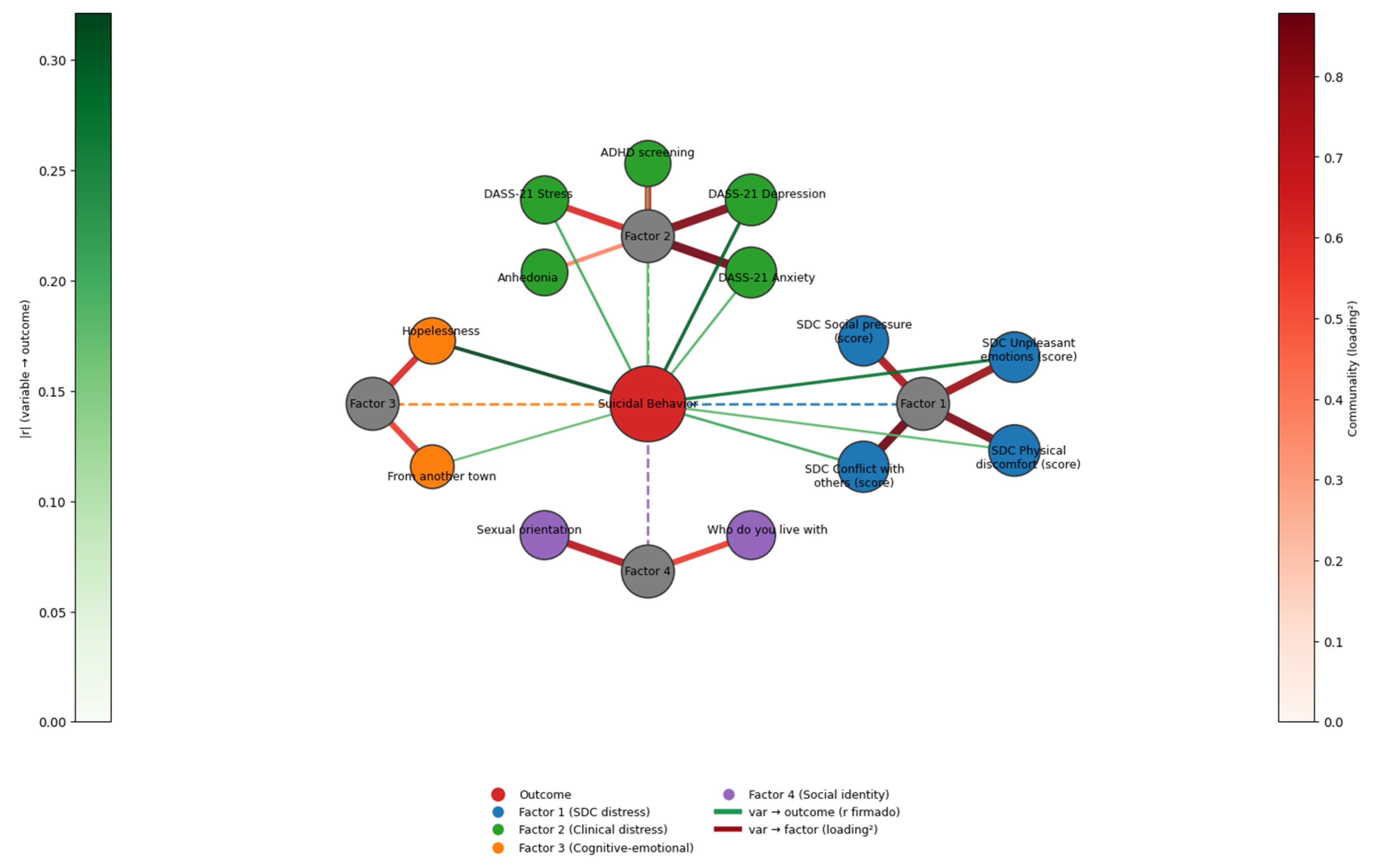
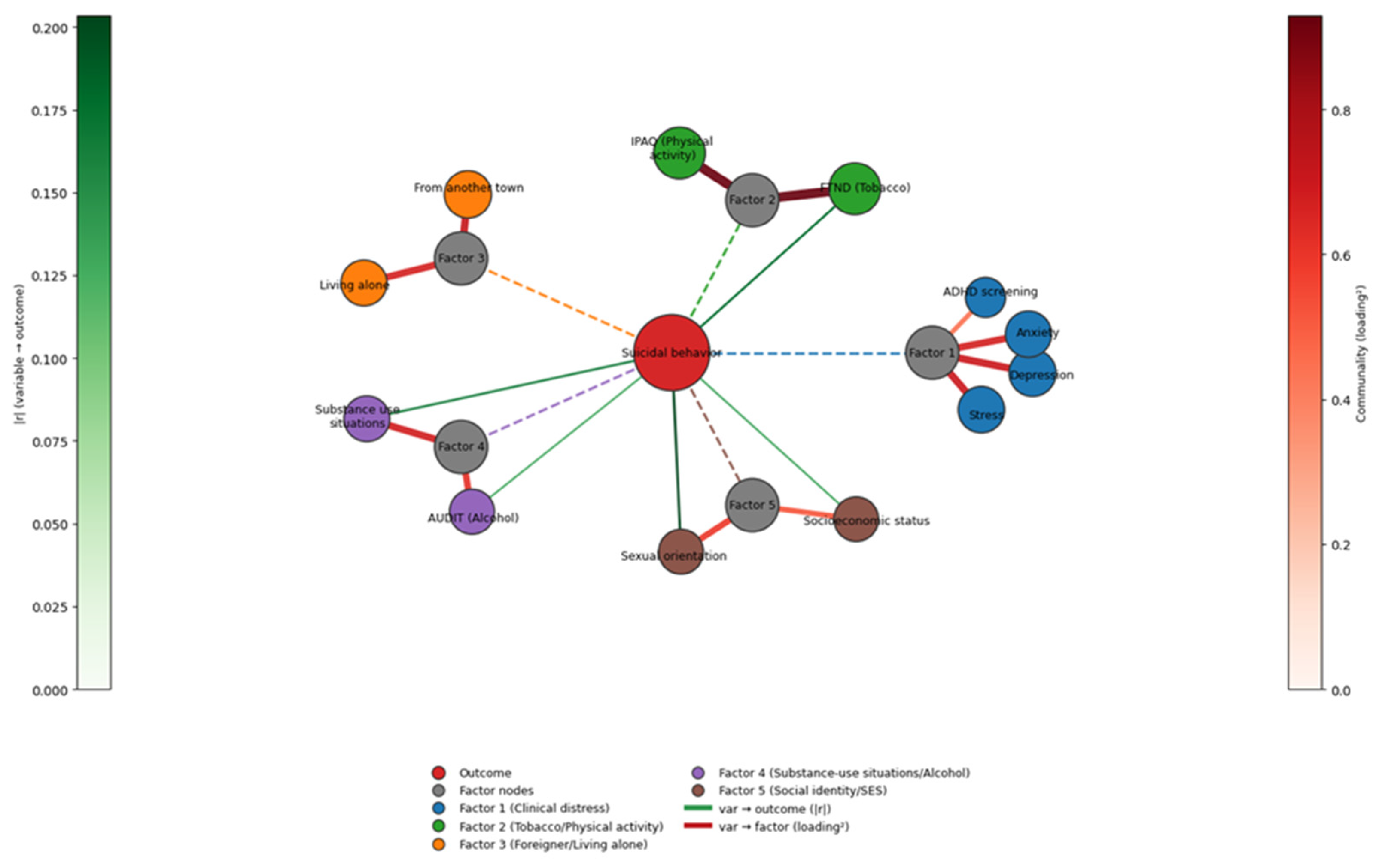
- Situational Distress (SDC factor): This dimension grouped items related to emotional and interpersonal strain in consumption contexts, including unpleasant emotions (0.889), physical discomfort (0.915), the need or temptation to consume (0.870), conflict with others (0.937) and social pressure (0.872).
- Clinical Distress (DASS/ADHD factor): This dimension captured core psychopathological symptoms, including stress (0.786), depression (0.917), anxiety (0.930), ADHD screening (0.788) and anhedonia (0.609).
- Cognitive–emotional vulnerability: This factor was primarily defined by hopelessness (0.787) and anhedonia (0.564), with moderate contributions from living context (0.486) and hailing from a different town (−0.750). It reflects a latent vulnerability pattern combining negative cognitive and emotional states with contextual fragility.
- Social identity/Context: This dimension grouped social background variables, including sexual orientation (0.849) and living arrangements (0.752).
3.7. Network Analysis and Factorial Visualization
4. Discussion
- Situational Distress (SDC factor): This dimension reflected the role of consumption and interpersonal strain, with high loadings on unpleasant emotions (0.889), physical discomfort (0.915), temptation to consume (0.870), conflict with others (0.937) and social pressure (0.872). These findings support the idea that situational triggers, particularly those linked to social stress and substance use, can lead to suicidal behavior [57].
- Clinical Distress (DASS/ADHD factor): This dimension grouped core psychopathological indicators, including stress (0.786), depression (0.917), anxiety (0.930), ADHD-related traits (0.788) and anhedonia (0.609). Clustering these variables shows the role of comorbid psychiatric conditions in elevating suicide risk. This is consistent with extensive literature linking mood and attention disorders to suicidal behavior [58,61].
- Cognitive–emotional vulnerability: This factor was defined by hopelessness (0.787) and anhedonia (0.564), with a contextual contribution from living arrangements (0.486). The co-occurrence of these elements reflects a vulnerability structure characterized by pessimistic cognitions, diminished capacity for positive effects and contextual fragility. These are all recognized as proximal risk markers for suicide [62].
- Social identity/context: This dimension encompasses sexual orientation (0.849), living arrangements (0.752) and geographic origin (–0.750 for those from another town). This is consistent with evidence that sexual minorities and socially isolated students are disproportionately vulnerable to mental health issues and suicidal behavior due to the combined effects of stigma and discrimination, as well as having limited access to protective social networks [56].
Study Limitations and Future Directions
5. Conclusions
Supplementary Materials
Author Contributions
Funding
Institutional Review Board Statement
Informed Consent Statement
Data Availability Statement
Public Involvement Statement
Guidelines and Standards Statement
Use of Artificial Intelligence
Acknowledgments
Conflicts of Interest
Abbreviations
| WHO | World Health Organization |
| OECD | Organization for Economic Cooperation and Development |
| ADHD | Attention-deficit/hyperactivity disorder |
| DASS-21 | Depression, Anxiety and Stress Scale |
| IPAQ | International Physical Activity Questionnaire |
| MOS | Medical Outcomes Study Social Support Survey |
| AUDIT | Alcohol Use Disorders Identification Test |
| SIQ | Self-Injury Questionnaire |
| CAST | Cannabis Addiction Test |
| FTND | Fagerström Test for Nicotine Dependence |
| ASSIST | Alcohol, Smoking and Substance Involvement Screening Test |
| DUSI | Drug Use Situations Inventory |
| ASRS v1.1 | Adult ADHD Self-Report Scale |
References
- Nock, M.K.; Borges, G.; Bromet, E.J.; Cha, C.B.; Kessler, R.C.; Lee, S. Suicide and suicidal behavior. Epidemiol. Rev. 2008, 30, 133–154. [Google Scholar] [CrossRef]
- World Health Organization. Suicide; World Health Organization: Geneva, Switzerland, 2025. [Google Scholar]
- World Health Organization. Suicide Worldwide in 2019: Global Health Estimates; World Health Organization: Geneva, Switzerland, 2021. [Google Scholar]
- OECD. A New Benchmark for Mental Health Systems; Tackling the Social and Economic Costs of Mental Ill-Health; OECD: Paris, France, 2021. [Google Scholar]
- Xiao, Y.; Hinrichs, R.; Johnson, N.; McKinley, A.; Carlson, J.; Agley, J.; Yip, P.S.F. Suicide Prevention Among College Students Before and During the COVID-19 Pandemic: Protocol for a Systematic Review and Meta-analysis. JMIR Res. Protoc. 2021, 10, e26948. [Google Scholar] [CrossRef]
- Gómez Delgado, G.; Ponce Rojo, A.; Ramírez Mireles, J.E.; Carmona-Moreno, F.d.J.; Flores Salcedo, C.C.; Hernández Romero, A.M. Suicide Risk Factors in High School Students. Int. J. Environ. Res. Public Health 2024, 21, 1055. [Google Scholar] [CrossRef]
- Nebhinani, N.; Mamta; Gaikwad, A.D.; Tamphasana, L. Nursing students’ attitude toward suicide prevention. Ind. Psychiatry J. 2013, 22, 114–117. [Google Scholar] [CrossRef] [PubMed]
- Wisłowska-Stanek, A.; Kołosowska, K.; Maciejak, P. Neurobiological Basis of Increased Risk for Suicidal Behaviour. Cells 2021, 10, 2519. [Google Scholar] [CrossRef]
- Barbayannis, G.; Bandari, M.; Zheng, X.; Baquerizo, H.; Pecor, K.W.; Ming, X. Academic Stress and Mental Well-Being in College Students: Correlations, Affected Groups, and COVID-19. Front. Psychol. 2022, 13, 886344. [Google Scholar] [CrossRef]
- Hyseni Duraku, Z.; Davis, H.; Hamiti, E. Mental health, study skills, social support, and barriers to seeking psychological help among university students: A call for mental health support in higher education. Front. Public Health 2023, 11, 1220614. [Google Scholar] [CrossRef]
- Dias, J.M.; Subu, M.A.; Al-Yateem, N.; Ahmed, F.R.; Rahman, S.A.; Abraham, M.S.; Forootan, S.M.; Sarkhosh, F.A.; Javanbakh, F. Nursing students’ stressors and coping strategies during their first clinical training: A qualitative study in the United Arab Emirates. BMC Nurs. 2024, 23, 322. [Google Scholar] [CrossRef] [PubMed]
- Tung, Y.-J.; Lo, K.K.; Ho, R.C.; Tam, W.S.W. Prevalence of depression among nursing students: A systematic review and meta-analysis. Nurse Educ. Today 2018, 63, 119–129. [Google Scholar] [CrossRef]
- Chernomas, W.M.; Shapiro, C. Stress, depression, and anxiety among undergraduate nursing students. Int. J. Nurs. Educ. Scholarsh. 2013, 10, 255–266. [Google Scholar]
- Swift, A.; Banks, L.; Baleswaran, A.; Cooke, N.; Little, C.; McGrath, L.; Meechan-Rogers, R.; Neve, A.; Rees, H.; Tomlinson, A.; et al. COVID-19 and student nurses: A view from England. J. Clin. Nurs. 2020, 29, 3111–3114. [Google Scholar] [CrossRef]
- Mendez-Pinto, I.; Antuña-Casal, M.; Mosteiro-Diaz, M. Psychological disorders among Spanish Nursing students three months after COVID-19 lockdown: A cross-sectional study. Int. J. Ment. Health Nurs. 2023, 32, 479–489. [Google Scholar] [CrossRef]
- Goetz, C.S. Are you prepared to SAVE your nursing student from suicide? J. Nurs. Educ. 1998, 37, 92–95. [Google Scholar] [CrossRef]
- Stubin, C.A. A call to intervene: Suicide risk among nursing students. Creat. Nurs. 2020, 26, 253–255. [Google Scholar] [CrossRef] [PubMed]
- Groves, S.; Lascelles, K.; Hawton, K. Suicide, self-harm, and suicide ideation in nurses and midwives: A systematic review of prevalence, contributory factors, and interventions. J. Affect. Disord. 2023, 331, 393–404. [Google Scholar] [CrossRef] [PubMed]
- Solmi, M.; Radua, J.; Olivola, M.; Croce, E.; Soardo, L.; Salazar de Pablo, G.; Il Shin, J.; Kirkbride, J.B.; Jones, P.; Kim, J.H.; et al. Age at onset of mental disorders worldwide: Large-scale meta-analysis of 192 epidemiological studies. Mol. Psychiatry 2022, 27, 281–295. [Google Scholar] [CrossRef] [PubMed]
- Oates, J.; Drey, N.; Jones, J. Interwoven histories: Mental health nurses with experience of mental illness, qualitative findings from a mixed methods study. Int. J. Ment. Health Nurs. 2018, 27, 1383–1391. [Google Scholar] [CrossRef]
- Feskanich, D.; Hastrup, J.L.; Marshall, J.; Colditz, G.; Stampfer, M.; Willett, W.C.; Kawachi, I. Stress and suicide in the Nurses’ Health Study. J. Epidemiol. Community Health 2002, 56, 95–98. [Google Scholar] [CrossRef]
- Lageborn, C.T.; Bjureberg, J.; Song, J.; Runeson, B.; Möller, J.; Ljung, R.; Dahlin, M. Risk of suicide and self-harm in university students entering different university programs—A national register-based cohort study in Sweden. Soc. Psychiatry Psychiatr. Epidemiol. 2023, 58, 1139–1149. [Google Scholar] [CrossRef]
- Agerbo, E.; Gunnell, D.; Bonde, J.P.; Mortensen, P.B.; Nordentoft, M. Suicide and occupation: The impact of socio-economic, demographic and psychiatric differences. Psychol. Med. 2007, 37, 1131–1140. [Google Scholar] [CrossRef]
- Hawton, K.; Agerbo, E.; Simkin, S.; Platt, B.; Mellanby, R.J. Risk of suicide in medical and related occupational groups: A national study based on Danish case population-based registers. J. Affect. Disord. 2011, 134, 320–326. [Google Scholar] [CrossRef]
- Davis, M.A.; Cher, B.A.; Friese, C.R.; Bynum, J.P. Association of US nurse and physician occupation with risk of suicide. JAMA Psychiatry 2021, 78, 651–658. [Google Scholar] [CrossRef]
- Efstathiou, M.; Kakaidi, V.; Tsitsas, G.; Mantzoukas, S.; Gouva, M.; Dragioti, E. The prevalence of mental health issues among nursing students: An umbrella review synthesis of meta-analytic evidence. Int. J. Nurs. Stud. 2025, 163, 104993. [Google Scholar] [CrossRef]
- Luceño-Moreno, L.; Vázquez-Estévez, D.; Martín-García, J.; Talavera-Velasco, B. Factors Associated With Suicidal Ideation in College Students of Health Sciences. Depress. Anxiety 2025, 2025, 4397417. [Google Scholar] [CrossRef]
- Auerbach, R.P.; Stewart, J.G.; Johnson, S.L. Impulsivity and Suicidality in Adolescent Inpatients. J. Abnorm. Child Psychol. 2017, 45, 91–103. [Google Scholar] [CrossRef]
- Rathee, A.; Dixit, P.; Raj, A.; Bala, J.; Singh, D.; Kumar, L. Impulsivity among Senior Nursing Students: The role of Emotional Intelligence and clinical performance. Investig. Educ. Enferm. 2025, 43, e08. [Google Scholar] [CrossRef]
- Tang, F.; Byrne, M.; Qin, P. Psychological distress and risk for suicidal behavior among university students in contemporary China. J. Affect. Disord. 2018, 228, 101–108. [Google Scholar] [CrossRef] [PubMed]
- Sonmez, Y.; Akdemir, M.; Meydanlioglu, A.; Aktekin, M.R. Psychological Distress, Depression, and Anxiety in Nursing Students: A Longitudinal Study. Healthcare 2023, 11, 636. [Google Scholar] [CrossRef] [PubMed]
- Akdemir, M.; Aktekin, M.R.; Şenol, Y.Y.; Sönmez, Y.; Doğanavşargil Baysal, Ö.; Mamakli, S.; Köse, F.; Bozbay, D.S.; Erdoğan, K.; Gürpinar, E. Depression and Psychological Distress in Medical Students, A Prospective Study. Noro Psikiyatr. Ars. 2022, 59, 116–122. [Google Scholar] [CrossRef] [PubMed]
- Shahnovsky, O.; Apter, A.; Barzilay, S. The Association between Hyperactivity and Suicidal Behavior and Attempts among Children Referred from Emergency Departments. Eur. J. Investig. Health Psychol. Educ. 2024, 14, 2616–2627. [Google Scholar] [CrossRef]
- Mohamed, N.A.; Ali, S.O.; Ehrahim, E.E.E.; Ahmed, A.L.; Wahba, A.M. Predictors of Academic and Clinical Stress Among Nursing Students. SAGE Open Nurs. 2024, 10, 23779608241290392. [Google Scholar] [CrossRef]
- Atreya, A.; Nepal, S.; Menezes, R.G.; Marhatta, A.; Ghimire, S.; Shah, P. Suicidal Ideation Among Medical and Nursing Students. J. Nepal Health Res. Counc. 2023, 20, 852–858. [Google Scholar] [CrossRef]
- Rivera-Rivera, L.; Fonseca-Pedrero, E.; Seris-Martinez, M.; Vazquez-Sala, A.; Reynales-Shigematsu, L.M. Prevalence and psychological factors associated withsuicidal behavior in adolescents. Ensanut 2018–19. Salud Publica Mex. 2020, 62, 672–681. [Google Scholar] [CrossRef]
- Nava Jiménez, C.M.; Velázquez-Narváez, Y.; Ruiz Ramos, L.; Martínez Sulvarán, J.O. Level of depression, anxiety and stress in working mothers with children under 6 years of age. Rev. Mex. Salud Cuid. Ambient. 2024, 1, 23–32. [Google Scholar] [CrossRef]
- Aljadani, A.H.; Alshammari, T.S.; Sadaqir, R.I.; Alrashede, N.O.E.; Aldajani, B.M.; Almehmadi, S.A.; Altuhayni, A.S.; Abouzed, M.A. Prevalence and Risk Factors of Attention Deficit-Hyperactivity Disorder in the Saudi Population: A Systematic Review and Meta-analysis. Saudi J. Med. Med. Sci. 2023, 11, 126–134. [Google Scholar] [CrossRef]
- Macip, S.G.; Martínez, A.D.; León, S.O.; Forteza, C.F.G.; Núñez, J.L.G.J. Características psicométricas de la Escala de Ideación Suicida de Beck (ISB) en estudiantes universitarios de la ciudad de México. Salud Ment. 2000, 23, 21–30. [Google Scholar]
- Hermosillo-de-la-Torre, A.E.; Méndez-Sánchez, C.; González-Betanzos, F. Evidencias de validez factorial de la Escala de desesperanza de Beck en español con muestras clínicas y no clínicas. Acta Colomb. Psicol. 2020, 23, 148–169. [Google Scholar] [CrossRef]
- Gloria Margarita, G.; Patricia, B.; Bonilla, M.; Virseda, J.A. Estrucura factorial y consistencia interna de la Escala de Ansiedad, Depresión y Estrés (DASS-21) en una muestra no clínica. Psicol. Cienc. Soc. 2006, 8, 3–7. [Google Scholar]
- Alcázar-Córcoles, M.; Verdejo, A.; Bouso, J.C. Psychometric Properties of Plutchik’s Impulsivity Scale in Juvenile Spanishspeaking population. Actas Españolas Psiquiatr. 2015, 43, 161–169. [Google Scholar]
- Mantilla Toloza, S.C.; Gómez-Conesa, A. El Cuestionario Internacional de Actividad Física. Un instrumento adecuado en el seguimiento de la actividad física poblacional. Rev. Iberoam. Fisioter. Kinesiol. 2007, 10, 48–52. [Google Scholar] [CrossRef]
- Reyes Zamorano, E.; Godinez, E.; Vargas, K.; Orozco, N.; Medina, J.; Flores, A.; Flores, L.; Jaimes, A.; Ortiz, S.; Lopez, O.; et al. Validación de constructo de la escala de autorreporte del TDAH. Salud Ment. 2009, 32, 343–350. [Google Scholar]
- Navarrete, B.; Galindo Vázquez, O.; Alcaraz, R.; Penedo, F.; Lerma, A. Propiedades psicométricas del Cuestionario MOS de Apoyo Social en una muestra de pacientes con enfermedades cardiovasculares en población mexicana. Psicol. Salud 2021, 31, 225–235. [Google Scholar] [CrossRef]
- Seguel Palma, F.; Santander Manríquez, G.; Alexandre Barriga, O. Validez y confiabilidad Test de Identificación de los trastornos debidos al consumo de alcohol (AUDIT) en estudiantes de una universidad Chilena. Cienc. Enfermería 2013, 19, 23–35. [Google Scholar] [CrossRef]
- Cano Queved, J.K.; García-García, E.E.; Torres Prado, R.Y.; Cuenca Robles, N.E. Adaptación de la Cédula de Autolesión (CAL): Propiedades psicométricas y resultados en una muestra de adolescentes. Arch. Venez. Farmacol. Ter. 2021, 4, 545–549. [Google Scholar]
- Fernandez-Artamendi, S.; Fernandez-Hermida, J.R.; Garcia-Cueto, E.; Secades-Villa, R.; Garcia-Fernandez, G.; Barrial-Barben, S. Spanish adaptation and validation of The Adolescent-Cannabis Problems Questionnaire (CPQ-A). Adicciones 2012, 24, 41–49. [Google Scholar] [CrossRef]
- Arias-Gallegos, W.L.; Huamani-Cahua, J.C.; Choque-Vera, R. Análisis psicométrico del test de Fagerström de dependencia a la nicotina en una muestra de estudiantes universitarios de Arequipa, Perú. Acta Médica Peru. 2018, 35, 174–179. [Google Scholar] [CrossRef]
- Tiburcio Sainz, M.; Rosete-Mohedano, M.G.; Natera Rey, G.; Martínez Vélez, N.A.; Carreño García, S.; Pérez Cisneros, D. Validity and Reliability of the Alcohol, Smoking, and Substance Involvement Screening Test (ASSIST) in University Students. Adicciones 2016, 28, 19–27. [Google Scholar] [CrossRef]
- Leon Bello, L. Adaptacion, Validacion y Confiabilizacion del Inventory of Drug Taking Situation (IDTS) y el Drug Taking Confidence Questionnaire (DTCQ). Bachelor’s Thesis, Universidad Nacional Autónoma de México, Mexico City, Mexico, 2001. Available online: https://repositorio.unam.mx/contenidos/397483 (accessed on 1 September 2025).
- Torres, L.; Mares, M.; Chainé, S.; VÁZquez, J.; Ruiz, M. Programa De Satisfactores Cotidianos Para Usuarios Con Dependencia a Sustancias Adictivas; Manual Del Terapeuta; Centro Nacional para la Prevención y Control de las Adicciones: Mexico City, Mexico, 2008. [Google Scholar]
- Horon, R.; McManus, T.; Schmollinger, J.; Barr, T.; Jimenez, M. A study of the use and interpretation of standardized suicide risk assessment: Measures within a psychiatrically hospitalized correctional population. Suicide Life-Threat. Behav. 2013, 43, 17–38. [Google Scholar] [CrossRef]
- American Psychiatric Association. Diagnostic and Statistical Manual of Mental Disorders; American Psychiatric Association: Washington, DC, USA, 2013. [Google Scholar]
- Martinez-Fierro, M.L.; Reyes-Hurtado, J.R.; Ayala-Haro, A.E.; Avila-Carrasco, L.; Ramirez-Hernandez, L.A.; Lozano-Razo, G.; Zavala-Rayas, J.; Vazquez-Reyes, S.; Mauricio-Gonzalez, A.; Velasco-Elizondo, P.; et al. The hidden risk factors behind of suicidal behavior in medical students: A cross-sectional cohort study in Mexico. Front. Psychiatry 2025, 16, 1505088. [Google Scholar] [CrossRef]
- Meyer, I.H. Prejudice, social stress, and mental health in lesbian, gay, and bisexual populations: Conceptual issues and research evidence. Psychol. Bull. 2003, 129, 674–697. [Google Scholar] [CrossRef]
- Joiner, T.E., Jr.; Conwell, Y.; Fitzpatrick, K.K.; Witte, T.K.; Schmidt, N.B.; Berlim, M.T.; Fleck, M.P.; Rudd, M.D. Four studies on how past and current suicidality relate even when “everything but the kitchen sink” is covaried. J. Abnorm. Psychol. 2005, 114, 291–303. [Google Scholar] [CrossRef]
- Agosti, V.; Chen, Y.; Levin, F.R. Does Attention Deficit Hyperactivity Disorder increase the risk of suicide attempts? J. Affect. Disord. 2011, 133, 595–599. [Google Scholar] [CrossRef]
- Beck, A.T.; Steer, R.A.; Kovacs, M.; Garrison, B. Hopelessness and eventual suicide: A 10-year prospective study of patients hospitalized with suicidal ideation. Am. J. Psychiatry 1985, 142, 559–563. [Google Scholar] [CrossRef] [PubMed]
- Ribeiro, J.D.; Huang, X.; Fox, K.R.; Franklin, J.C. Depression and hopelessness as risk factors for suicide ideation, attempts and death: Meta-analysis of longitudinal studies. Br. J. Psychiatry 2018, 212, 279–286. [Google Scholar] [CrossRef] [PubMed]
- World Health Organization. Preventing Suicide: A Global Imperative; World Health Organization: Geneva, Switzerland, 2014. [Google Scholar]
- Winer, E.S.; Nadorff, M.R.; Ellis, T.E.; Allen, J.G.; Herrera, S.; Salem, T. Anhedonia predicts suicidal ideation in a large psychiatric inpatient sample. Psychiatry Res. 2014, 218, 124–128. [Google Scholar] [CrossRef] [PubMed]
- Groves, S.; Lascelles, K.; Hawton, K. Suicidal thoughts and behaviours among student nurses and midwives: A systematic review. J. Adv. Nurs. 2024, 80, 2202–2213. [Google Scholar] [CrossRef]
- Lepiani-Diaz, I.; Paramio, A.; Palazon-Fernandez, J.L.; Roman-Sanchez, D.; Carranza-Naval, M.J.; Mata-Perez, C.; Cruz-Barrientos, A.; Paramio-Cuevas, J.C. The Impact of Clinical Training Seminars on Stress and Perception of Clinical Placement Stressors among Spanish Undergraduate Nursing Students: A Two-Phase Mixed-Methods Study. Healthcare 2023, 11, 300. [Google Scholar] [CrossRef]
- Ab Latif, R.; Mat Nor, M.Z. Stressors and Coping Strategies during Clinical Practice among Diploma Nursing Students. Malays. J. Med. Sci. 2019, 26, 88–98. [Google Scholar] [CrossRef]
- Okechukwu, F.O.; Ogba, K.T.U.; Nwufo, J.I.; Ogba, M.O.; Onyekachi, B.N.; Nwanosike, C.I.; Onyishi, A.B. Academic stress and suicidal ideation: Moderating roles of coping style and resilience. BMC Psychiatry 2022, 22, 546. [Google Scholar] [CrossRef]
- Mofatteh, M. Risk factors associated with stress, anxiety, and depression among university undergraduate students. AIMS Public Health 2021, 8, 36–65. [Google Scholar] [CrossRef]
- Davidson, J.E.; Accardi, R.; Sanchez, C.; Zisook, S.; Hoffman, L.A. Sustainability and outcomes of a suicide prevention program for nurses. Worldviews Evid.-Based Nurs. 2020, 17, 24–31. [Google Scholar] [CrossRef] [PubMed]
- Black, M.H.; Scott, M.; Baker-Young, E.; Thompson, C.; McGarry, S.; Hayden-Evans, M.; Snyman, Z.; Zimmermann, F.; Kacic, V.; Falkmer, T.J.E.C.; et al. Preventing suicide in post-secondary students: A scoping review of suicide prevention programs. Eur. Child Adolesc. Psychiatry 2023, 32, 735–771. [Google Scholar] [CrossRef] [PubMed]



| Variable | Total (n = 433) | Suicidal Behavior | p-Value | |
|---|---|---|---|---|
| Presence (n = 66) | Absence (n = 367) | |||
| Age | 20.3 ± 2.78 | 20.7 ± 3.03 | 20.2 ± 2.74 | 0.237 |
| Sex | 0.015 | |||
| Female | 337 (77.8) | 59 (89.4) | 278 (75.7) | |
| Male | 96 (22.2) | 7 (10.6) | 89 (24.3) | |
| Foreigner | <0.001 | |||
| No | 259 (59.8) | 53 (80.3) | 206 (56.1) | |
| Yes | 174 (40.2) | 13 (19.7) | 161 (43.9) | |
| Social class | 0.095 | |||
| Poverty | 9 (2.1) | 4 (6.1) | 5 (1.4) | |
| Lower middle class | 138 (31.9) | 21 (31.8) | 117 (31.9) | |
| Middle class | 259 (59.8) | 38 (57.6) | 221 (60.2) | |
| Upper middle class | 27 (6.2) | 3 (4.5) | 24 (6.5) | |
| Living alone | - | |||
| No | 433 (100) | 66 (100) | 367 (100) | |
| Yes | 0 (0) | 0 (0) | 0 (0) | |
| Sexual orientation | 0.028 | |||
| Heterosexual | 384 (88.7) | 56 (84.8) | 328 (89.4) | |
| Bisexual | 23 (5.3) | 8 (12.1) | 15 (4.1) | |
| Homosexual | 12 (2.8) | 0 (0.0) | 12 (3.3) | |
| Other | 14 (3.2) | 2 (3) | 11 (4.7) | |
| Gender identity | 0.027 | |||
| Cisgender | 415 (95.8) | 61 (92.4) | 354 (96.5) | |
| Nonbinary | 11 (2.5) | 5 (7.6) | 6 (1.6) | |
| Pangender | 2 (0.5) | 0 (0.0) | 2 (0.5) | |
| Transgender | 5 (1.2) | 0 (0.0) | 5 (1.4) | |
| Marital status | 0.04 | |||
| Married | 9 (2.1) | 2 (3.0) | 7 (1.9) | |
| Divorced | 1 (0.2) | 0 (0.0) | 1 (0.3) | |
| In a relationship | 4 (0.9) | 2 (3.0) | 2 (0.5) | |
| Single | 405 (93.5) | 59 (89.4) | 346 (94.3) | |
| Cohabiting/Common-law union | 13 (3.0) | 2 (3.0) | 11 (3.0) | |
| Widowed | 1 (0.2) | 1 (1.5) | 0 (0.0) | |
| Working | 1.0 | |||
| No | 311 (71.8) | 48 (72.7) | 263 (71.7) | |
| Yes | 122 (28.2) | 18 (27.3) | 104 (28.3) | |
| Children | 0.017 | |||
| No | 279 (94.9) | 40 (87.0) | 239 (96.4) | |
| Yes | 15 (5.1) | 6 (13.0) | 9 (3.6) | |
| Physical activity | 0.524 | |||
| High | 144 (33.3) | 19 (28.8) | 125 (34.1) | |
| Medium | 164 (37.9) | 29 (43.9) | 135 (36.8) | |
| Low | 125 (28.9) | 18 (27.3) | 107 (29.2) | |
| Variable | Total (n = 433) | Suicidal Behavior | p-Value | |
|---|---|---|---|---|
| Presence (n = 66) | Absence (n = 367) | |||
| ADHD | ||||
| Unlikely | 132 (30.5) | 11 (16.7) | 121 (33.0) | <0.0001 |
| Probable | 113 (26.1) | 13 (19.7) | 100 (27.2) | |
| Indicative | 188 (43.4) | 42 (63.6) | 146 (39.8) | |
| Depression | ||||
| No depression | 106 (24.5) | 8 (12.1) | 98 (26.7) | <0.001 |
| Mild | 26 (6.0) | 1 (1.5) | 25 (6.8) | |
| Moderate | 64 (14.8) | 6 (9.1) | 58 (15.8) | |
| Severe | 42 (9.7) | 10 (15.2) | 32 (8.7) | |
| Extremely severe | 56 (12.9) | 21 (31.8) | 35 (9.5) | |
| Anxiety | ||||
| No anxiety | 91 (21.0) | 9 (13.6) | 82 (22.3) | 0.008 |
| Mild | 17 (3.9) | 1 (1.5) | 16 (4.4) | |
| Moderate | 49 (11.3) | 4 (6.1) | 45 (12.3) | |
| Severe | 36 (8.3) | 5 (7.6) | 31 (8.4) | |
| Extremely severe | 101 (23.3) | 27 (40.9) | 74 (20.2) | |
| Stress | ||||
| No stress | 142 (32.8) | 14 (21.2) | 128 (34.9) | 0.014 |
| Mild | 33 (7.6) | 4 (6.1) | 29 (7.9) | |
| Moderate | 47 (10.9) | 7 (10.6) | 40 (10.9) | |
| Severe | 48 (11.1) | 14 (21.2) | 34 (9.3) | |
| Impulsivity | ||||
| High impulsivity | 258 (59.6) | 28 (42.4) | 230 (62.7) | 0.003 |
| Low impulsivity | 175 (40.4) | 38 (57.6) | 137 (37.3) | |
| Hopelessness | ||||
| No hopelessness | 174 (40.2) | 28 (42.4) | 146 (39.8) | 0.001 |
| Mild | 75 (17.3) | 22 (33.3) | 53 (14.4) | |
| Moderate | 9 (2.1) | 7 (10.6) | 2 (0.5) | |
| Severe | 174 (40.2) | 28 (42.4) | 146 (39.8) | |
| Anhedonia | ||||
| Always | 67 (15.5) | 10 (15.2) | 57 (15.5) | 0.123 |
| Almost always | 197 (45.5) | 22 (33.3) | 175 (47.7) | |
| Sometimes | 83 (19.2) | 19 (28.8) | 64 (17.4) | |
| Rarely | 42 (9.7) | 6 (9.1) | 36 (9.8) | |
| Never | 67 (15.5) | 10 (15.2) | 57 (15.5) | |
| Variable | Total (n = 433) * | Suicidal Behavior | p-Value | |
|---|---|---|---|---|
| Presence (n = 66) | Absence (n = 367) | |||
| Tobacco | ||||
| Without consumption | 75 (17.3) | 23 (34.8) | 52 (14.2) | <0.001 |
| Mild | 23 (5.3) | 7 (10.6) | 16 (4.4) | |
| Moderate | 4 (0.9) | 1 (1.5) | 3 (0.8) | |
| Alcohol | ||||
| Low risk | 180 (41.6) | 26 (39.4) | 154 (42.0) | 0.001 |
| Medium risk | 82 (18.9) | 22 (33.3) | 60 (16.3) | |
| High risk | 11 (2.5) | 4 (6.1) | 7 (1.9) | |
| Likely addiction | 8 (1.8) | 0 (0.0) | 8 (2.2) | |
| Cannabis | ||||
| Without symptoms of addiction | 24 (5.5) | 8 (12.1) | 16 (4.4) | 0.013 |
| With symptoms of problematic use | 13 (3.0) | 2 (3.0) | 11 (3.0) | |
| Symptoms of addiction | 11 (2.5) | 4 (6.1) | 7 (1.9) | |
| Substance use situations | ||||
| 1. Pleasant emotions | ||||
| Indicates consumption | 12 (9.8) | 1 (3.8) | 11 (11.5) | 0.432 |
| Did not use the substance | 110 (90.2) | 25 (96.2) | 85 (88.5) | |
| 2. Self-control | ||||
| Indicates consumption | 6 (4.9) | 2 (7.7) | 4 (4.2) | 0.821 |
| Did not use the substance | 116 (95.1) | 24 (92.3) | 92 (95.8) | |
| 3. Physical discomfort | ||||
| Indicates consumption | 10 (8.2) | 1 (3.8) | 9 (9.4) | 0.611 |
| Did not use the substance | 112 (91.8) | 25 (96.2) | 87 (90.6) | |
| 4. Need or craving | ||||
| Indicates consumption | 3 (2.5) | 0 (0.0) | 3 (3.1) | 0.842 |
| Did not use the substance | 119 (97.5) | 26 (100.0) | 93 (96.9) | |
| 5. Unpleasant emotions | ||||
| Indicates consumption | 12 (9.8) | 1 (3.8) | 11 (11.5) | 0.611 |
| Did not use the substance | 110 (90.2) | 25 (96.2) | 85 (88.5) | |
| 6. Pleasant moments with others | ||||
| Indicates consumption | 19 (15.6) | 1 (3.8) | 18 (18.8) | 0.120 |
| Did not use the substance | 103 (84.4) | 25 (96.2) | 78 (81.2) | |
| 7. Conflict with others | ||||
| Indicates consumption | 8 (6.6) | 1 (3.8) | 7 (7.3) | 0.855 |
| Did not use the substance | 114 (93.4) | 25 (96.2) | 89 (92.7) | |
| 8. Social pressure | ||||
| Indicates consumption | 8 (6.6) | 2 (7.7) | 6 (6.2) | 1.00 |
| Did not use the substance | 114 (3.4) | 24 (92.3) | 90 (93.8) | |
| Variable | Total (n = 433) | Suicidal Behavior | p-Value | ||
|---|---|---|---|---|---|
| Presence (n = 66) | Absence (n = 367) | ||||
| Material assistance | <0.0001 | ||||
| Maximum | 208 (70.7) | 15 (46.9) | 184 (74.2) | 2.68 (1.84–3.9) | |
| Medium | 72 (24.5) | 14 (43.8) | 54 (21.8) | ||
| Minimum | 14 (4.8) | 3 (9.4) | 10 (4.0) | ||
| Emotional support | <0.0001 | ||||
| Maximum | 208 (70.7) | 15 (32.6) | 193 (72.3) | 2.1 (1.45–2.92) | |
| Medium | 74 (25.2) | 14 (41.3) | 60 (22.5) | ||
| Minimum | 12 (4.1) | 5 (26.1) | 7 (2.6) | ||
| Affective support | |||||
| Maximum | 205 (69.7) | 19 (50.0) | 186 (73.5) | 3.1 (2.03–4.59) | <0.0001 |
| Medium | 75 (25.5) | 12 (31.6) | 63 (24.9) | ||
| Minimum | 14 (4.8) | 7 (18.4) | 7 (2.8) | ||
| Social relations of leisure and distraction | |||||
| Maximum | 211 (71.8) | 17 (36.2) | 194 (77.7) | 1.97 (1.31–2.94) | 0.0013 |
| Medium | 71 (24.1) | 21 (44.7) | 50 (20.0) | ||
| Minimum | 12 (4.1) | 9 (19.1) | 3 (1.2) | ||
| Predictor | p-Value | OR | 95% CI |
|---|---|---|---|
| Hopelessness (score) | <0.001 | 2.24 | 1.43–3.50 |
| DASS-21 Depression (score) | <0.001 | 1.54 | 1.20–1.97 |
| Variable | Component | |||
|---|---|---|---|---|
| 1 | 2 | 3 | 4 | |
| SDC Conflict with others | 0.937 | 0.119 | 0.081 | −0.098 |
| SDC Physical discomfort | 0.915 | 0.277 | −0.014 | −0.084 |
| SDC Unpleasant emotions | 0.889 | 0.278 | 0.032 | −0.125 |
| SDC Social pressure | 0.872 | 0.181 | −0.058 | 0.263 |
| SDC Need or temptation | 0.870 | 0.262 | 0.062 | 0.186 |
| DASS-21 Anxiety | 0.171 | 0.93 | 0.042 | 0.021 |
| DASS-21 Depression | 0.299 | 0.917 | 0.022 | −0.021 |
| ADHD screening | 0.260 | 0.788 | 0.043 | 0.068 |
| DASS-21 Stress | 0.319 | 0.786 | −0.028 | 0.229 |
| Anhedonia | 0.039 | 0.609 | 0.564 | −0.153 |
| Hopelessness | 0.098 | 0.268 | 0.787 | −0.058 |
| Who do you live with | 0.042 | 0.021 | 0.486 | 0.752 |
| Sexual orientation | 0.005 | 0.106 | −0.281 | 0.849 |
| From another town | 0.044 | 0.18 | −0.750 | −0.051 |
Disclaimer/Publisher’s Note: The statements, opinions and data contained in all publications are solely those of the individual author(s) and contributor(s) and not of MDPI and/or the editor(s). MDPI and/or the editor(s) disclaim responsibility for any injury to people or property resulting from any ideas, methods, instructions or products referred to in the content. |
© 2025 by the authors. Licensee MDPI, Basel, Switzerland. This article is an open access article distributed under the terms and conditions of the Creative Commons Attribution (CC BY) license (https://creativecommons.org/licenses/by/4.0/).
Share and Cite
Martinez-Fierro, M.L.; Ramirez-Hernandez, L.A.; Trejo-Ortiz, P.M.; Lozano-Razo, G.; Zavala-Rayas, J.; Vazquez-Reyes, S.; Velasco-Elizondo, P.; Mauricio-Gonzalez, A.; Araujo-Espino, R.; Mollinedo-Montaño, F.E.; et al. Psychosocial and Mental Health Determinants of Suicidal Behavior Among Nursing Students: A Cross-Sectional Study in Mexico. Nurs. Rep. 2025, 15, 441. https://doi.org/10.3390/nursrep15120441
Martinez-Fierro ML, Ramirez-Hernandez LA, Trejo-Ortiz PM, Lozano-Razo G, Zavala-Rayas J, Vazquez-Reyes S, Velasco-Elizondo P, Mauricio-Gonzalez A, Araujo-Espino R, Mollinedo-Montaño FE, et al. Psychosocial and Mental Health Determinants of Suicidal Behavior Among Nursing Students: A Cross-Sectional Study in Mexico. Nursing Reports. 2025; 15(12):441. https://doi.org/10.3390/nursrep15120441
Chicago/Turabian StyleMartinez-Fierro, Margarita L., Leticia A. Ramirez-Hernandez, Perla M. Trejo-Ortiz, Georgina Lozano-Razo, Javier Zavala-Rayas, Sodel Vazquez-Reyes, Perla Velasco-Elizondo, Alejandro Mauricio-Gonzalez, Roxana Araujo-Espino, Fabiana E. Mollinedo-Montaño, and et al. 2025. "Psychosocial and Mental Health Determinants of Suicidal Behavior Among Nursing Students: A Cross-Sectional Study in Mexico" Nursing Reports 15, no. 12: 441. https://doi.org/10.3390/nursrep15120441
APA StyleMartinez-Fierro, M. L., Ramirez-Hernandez, L. A., Trejo-Ortiz, P. M., Lozano-Razo, G., Zavala-Rayas, J., Vazquez-Reyes, S., Velasco-Elizondo, P., Mauricio-Gonzalez, A., Araujo-Espino, R., Mollinedo-Montaño, F. E., Gutierrez-Camacho, J. R., & Garza-Veloz, I. (2025). Psychosocial and Mental Health Determinants of Suicidal Behavior Among Nursing Students: A Cross-Sectional Study in Mexico. Nursing Reports, 15(12), 441. https://doi.org/10.3390/nursrep15120441