

Growth and Adaptation of Newly Graduated Nurses Based on Duchscher’s Stages of Transition Theory and Transition Shock Model: A Longitudinal Quantitative Study




Abstract
1. Introduction
2. Materials and Methods
2.1. Design and Framework
Longitudinal Structure and Follow-Up
2.2. Survey Instrument and Domains
2.3. Data Collection and Sample
2.4. Statistical Analysis
3. Results
4. Discussion
5. Conclusions
Supplementary Materials
Author Contributions
Funding
Institutional Review Board Statement
Informed Consent Statement
Data Availability Statement
Public Involvement Statement
Guidelines and Standards Statement
Use of Artificial Intelligence
Conflicts of Interest
Abbreviations
| PCA | Principal Component Analysis |
| TTPPs | Transition to Practice Programs |
| GNTPs | Graduate Nurse Transition Programs |
| RS | Responsibilities |
| RO | Roles |
| RL | Relationships |
| KN | Knowledge |
References
- Baharum, H.; Ismail, A.; McKenna, L.; Mohamed, Z.; Ibrahim, R.; Hassan, N.H. Success factors in adaptation of newly graduated nurses: A scoping review. BMC Nurs. 2023, 22, 125. [Google Scholar] [CrossRef]
- Edwards, D.; Carrier, J.; Hawker, C. Effectiveness of strategies and interventions aiming to assist the transition from student to newly qualified nurse: An update systematic review protocol. JBI Evid. Synth. 2019, 17, 157–163. [Google Scholar] [CrossRef]
- Aggar, C.; Bloomfield, J.; Thomas, T.H.; Gordon, C.J. Australia’s first transition to professional practice in primary care program for graduate registered nurses: A pilot study. BMC Nurs. 2017, 16, 14. [Google Scholar] [CrossRef]
- Hallaran, A.J.; Edge, D.S.; Almost, J.; Tregunno, D. New nurses’ perceptions on transition to practice: A thematic analysis. Can. J. Nurs. Res. 2023, 55, 126–136. [Google Scholar] [CrossRef]
- Koh, C.S.L.; Ong, K.K.; Tan, M.M.L.; Mordiffi, S.Z. Evaluation of a graduate nurse residency program: A retrospective longitudinal study. Nurse Educ. Today 2023, 126, 105801. [Google Scholar] [CrossRef]
- Yıldız, C.Ç.; Ergün, Y. Transition experiences of newly graduated nurses. Clin. Exp. Health Sci. 2020, 10, 113–119. [Google Scholar] [CrossRef]
- Labrague, L.; McEnroe-Petitte, D. Job stress in new nurses during the transition period: An integrative review. Int. Nurs. Rev. 2018, 65, 491–504. [Google Scholar] [CrossRef] [PubMed]
- Duchscher, J.E.B. Transition shock: The initial stage of role adaptation for newly graduated registered nurses. J. Adv. Nurs. 2009, 65, 1103–1113. [Google Scholar] [CrossRef]
- Kreedi, F.; Brown, M.; Marsh, L.; Rogers, K. Newly Graduate Registered Nurses’ Experiences of transition to clinical practice: A systematic review. Am. J. Nurs. Res. 2021, 9, 94–105. [Google Scholar] [CrossRef]
- Flinkman, M.; Salanterä, S. Early career experiences and perceptions—A qualitative exploration of the turnover of young registered nurses and intention to leave the nursing profession in F inland. J. Nurs. Manag. 2015, 23, 1050–1057. [Google Scholar] [CrossRef]
- Rush, K.L.; Janke, R.; Duchscher, J.E.; Phillips, R.; Kaur, S. Best practices of formal new graduate transition programs: An integrative review. Int. J. Nurs. Stud. 2019, 94, 139–158. [Google Scholar] [CrossRef] [PubMed]
- Morphet, J.; Kent, B.; Plummer, V.; Considine, J. The effect of Transition to Specialty Practice Programs on Australian emergency nurses’ professional development, recruitment and retention. Australas. Emerg. Nurs. J. 2015, 18, 204–211. [Google Scholar] [CrossRef] [PubMed]
- Kenny, A.; Dickson-Swift, V.; McKenna, L.; Charette, M.; Rush, K.L.; Stacey, G.; Darvill, A.; Leigh, J.; Burton, R.; Phillips, C. Interventions to support graduate nurse transition to practice and associated outcomes: A systematic review. Nurse Educ. Today 2021, 100, 104860. [Google Scholar] [CrossRef]
- Jangland, E.; Gunningberg, L.; Nyholm, L. A mentoring programme to meet newly graduated nurses’ needs and give senior nurses a new career opportunity: A multiple-case study. Nurse Educ. Pract. 2021, 57, 103233. [Google Scholar] [CrossRef] [PubMed]
- Keshk, L.I.; Mersal, F.A. Assessment of graduate nurses entry level competencies: Expectations of faculty members versus nurse managers. Am. J. Nurs. Res. 2017, 5, 1–12. [Google Scholar]
- Moore, A.; Parks, K.; Beckling, A. Transitioning from student to new graduate nurse. Nurs. Made Incred. Easy 2020, 18, 51–55. [Google Scholar] [CrossRef]
- Kaihlanen, A.-M.; Elovainio, M.; Haavisto, E.; Salminen, L.; Sinervo, T. Final clinical practicum, transition experience and turnover intentions among newly graduated nurses: A cross sectional study. Nurse Educ. Today 2020, 84, 104245. [Google Scholar] [CrossRef]
- Aguayo-González, M.; Weise, C. Career transition and identity development in academic nurses: A qualitative study. J. Constr. Psychol. 2022, 35, 1371–1389. [Google Scholar] [CrossRef]
- Kim, H.; Kim, E.G. A meta-analysis on predictors of turnover intention of hospital nurses in South Korea (2000–2020). Nurs. Open 2021, 8, 2406–2418. [Google Scholar] [CrossRef]
- Taylor, C.; Foster, J. The experiences of new graduate nurses working in a pediatric setting: A qualitative systematic review. J. Pediatr. Nurs. 2022, 67, e234–e248. [Google Scholar] [CrossRef]
- Duchscher, J.B. A process of becoming: The stages of new nursing graduate professional role transition. J. Contin. Educ. Nurs. 2008, 39, 441–450. [Google Scholar] [CrossRef]
- Cusack, L.; Madsen, L.; Duchscher, J.B.; You, W. Does transition theory matter?: A descriptive study of a transition program in Australia based on duchscher’s stages of transition theory and transition shock model. Aust. J. Adv. Nurs. 2024, 41, 33–41. [Google Scholar] [CrossRef]
- Duchscher, J.B. From Surviving to Thriving: Navigating the First Year of Professional Nursing Practice; Nursing the Future: Kamloops, BC, Canada, 2012. [Google Scholar]
- Pasila, K.; Elo, S.; Kääriäinen, M. Newly graduated nurses’ orientation experiences: A systematic review of qualitative studies. Int. J. Nurs. Stud. 2017, 71, 17–27. [Google Scholar] [CrossRef] [PubMed]
- Edwards, D.; Hawker, C.; Carrier, J.; Rees, C. A systematic review of the effectiveness of strategies and interventions to improve the transition from student to newly qualified nurse. Int. J. Nurs. Stud. 2015, 52, 1254–1268. [Google Scholar] [CrossRef]
- Hussein, R.; Everett, B.; Ramjan, L.M.; Hu, W.; Salamonson, Y. New graduate nurses’ experiences in a clinical specialty: A follow up study of newcomer perceptions of transitional support. BMC Nurs. 2017, 16, 42. [Google Scholar] [CrossRef]
- Hallaran, A.J.; Edge, D.S.; Almost, J.; Tregunno, D. New registered nurse transition to the workforce and intention to leave: Testing a theoretical model. Can. J. Nurs. Res. 2021, 53, 384–396. [Google Scholar] [CrossRef] [PubMed]
- Rochester, S.; Kilstoff, K.; Scott, G. Learning from success: Improving undergraduate education through understanding the capabilities of successful nurse graduates. Nurse Educ. Today 2005, 25, 181–188. [Google Scholar] [CrossRef]
- Scott, G.; Chang, E.; Grebennikov, L. Using successful graduates to improve the quality of undergraduate nursing programs. J. Teach. Learn. Grad. Employab. 2010, 1, 26–44. [Google Scholar] [CrossRef][Green Version]
- Charette, M.; McKenna, L.; McGillion, A.; Burke, S. Effectiveness of transition programs on new graduate nurses’ clinical competence, job satisfaction and perceptions of support: A mixed-methods study. J. Clin. Nurs. 2023, 32, 1354–1369. [Google Scholar] [CrossRef] [PubMed]
- Voss, J.G.; Alfes, C.M.; Clark, A.; Lilly, K.D.; Moore, S. Why mentoring matters for new graduates transitioning to practice: Implications for nurse leaders. Nurse Lead. 2022, 20, 399–403. [Google Scholar] [CrossRef]
- Vidal, J.-A.M.; Olley, R. Systematic literature review of the effects of clinical mentoring on new graduate registered nurses’ clinical performance, job satisfaction and job retention. Asia Pac. J. Health Manag. 2021, 16, 70–82. [Google Scholar] [CrossRef]
- Thompson, T.C. Characteristics of Successful Nurse Mentors and Potential Effects On The Retention And Job Satisfaction Of New Graduate Nurses: An Integrative Review. Ph.D. Thesis, Liberty University, Lynchburg, VA, USA, 2021. [Google Scholar]
- Eklund, A.; Sterner, A.; Nilsson, M.S.; Larsman, P. The impact of transition programs on well-being, experiences of work environment and turnover intention among early career hospital nurses. Work 2025, 80, 1960–1968. [Google Scholar]
- Murray, M.; Sundin, D.; Cope, V. Supporting new graduate registered nurse transition for safety: A literature review update. Collegian 2020, 27, 125–134. [Google Scholar] [CrossRef]
- Gardiner, I.; Sheen, J. Graduate nurse experiences of support: A review. Nurse Educ. Today 2016, 40, 7–12. [Google Scholar] [CrossRef]
- Perez-Perdomo, A.; Zabalegui, A. Teaching strategies for developing clinical reasoning skills in nursing students: A systematic review of randomised controlled trials. Healthcare 2024, 12, 90. [Google Scholar] [CrossRef] [PubMed]
- Ankers, M.D.; Barton, C.A.; Parry, Y.K. A phenomenological exploration of graduate nurse transition to professional practice within a transition to practice program. Collegian 2018, 25, 319–325. [Google Scholar] [CrossRef]
- Yu, F.; Raphael, D.; Mackay, L.; Smith, M.; King, A. Personal and work-related factors associated with nurse resilience: A systematic review. Int. J. Nurs. Stud. 2019, 93, 129–140. [Google Scholar] [CrossRef] [PubMed]
- Regan, S.; Wong, C.; Laschinger, H.K.; Cummings, G.; Leiter, M.; MacPhee, M.; Rhéaume, A.; Ritchie, J.A.; Wolff, A.C.; Jeffs, L. Starting out: Qualitative perspectives of new graduate nurses and nurse leaders on transition to practice. J. Nurs. Manag. 2017, 25, 246–255. [Google Scholar] [CrossRef]
- Epstein, M.; Söderström, M.; Jirwe, M.; Tucker, P.; Dahlgren, A. Sleep and fatigue in newly graduated nurses—Experiences and strategies for handling shiftwork. J. Clin. Nurs. 2020, 29, 184–194. [Google Scholar] [CrossRef]
- Hunter, K.; Cook, C. Role-modelling and the hidden curriculum: New graduate nurses’ professional socialisation. J. Clin. Nurs. 2018, 27, 3157–3170. [Google Scholar] [CrossRef]
- Whitehead, B.; Owen, P.; Henshaw, L.; Beddingham, E.; Simmons, M. Supporting newly qualified nurse transition: A case study in a UK hospital. Nurse Educ. Today 2016, 36, 58–63. [Google Scholar] [CrossRef]
- Miller, C.M.; Meyer, K.; Riemann, L.A.; Carter, B.T.; Brant, J.M. Transition into practice: Outcomes of a nurse residency program. J. Contin. Educ. Nurs. 2023, 54, 32–39. [Google Scholar] [CrossRef]
- Philippa, R.; Ann, H.; Jacqueline, M.; Nicola, A. Professional identity in nursing: A mixed method research study. Nurse Educ. Pract. 2021, 52, 103039. [Google Scholar] [CrossRef]
- Chappell, K.B.; Richards, K.C. New graduate nurses, new graduate nurse transition programs, and clinical leadership skill: A systematic review. J. Nurses Prof. Dev. 2015, 31, 128–137. [Google Scholar] [CrossRef] [PubMed]
- Stacey, G.; Cook, G.; Aubeeluck, A.; Stranks, B.; Long, L.; Krepa, M.; Lucre, K. The implementation of resilience based clinical supervision to support transition to practice in newly qualified healthcare professionals. Nurse Educ. Today 2020, 94, 104564. [Google Scholar] [CrossRef] [PubMed]
- Rogers, S.; Redley, B.; Rawson, H. Developing work readiness in graduate nurses undertaking transition to practice programs: An integrative review. Nurse Educ. Today 2021, 105, 105034. [Google Scholar] [CrossRef] [PubMed]
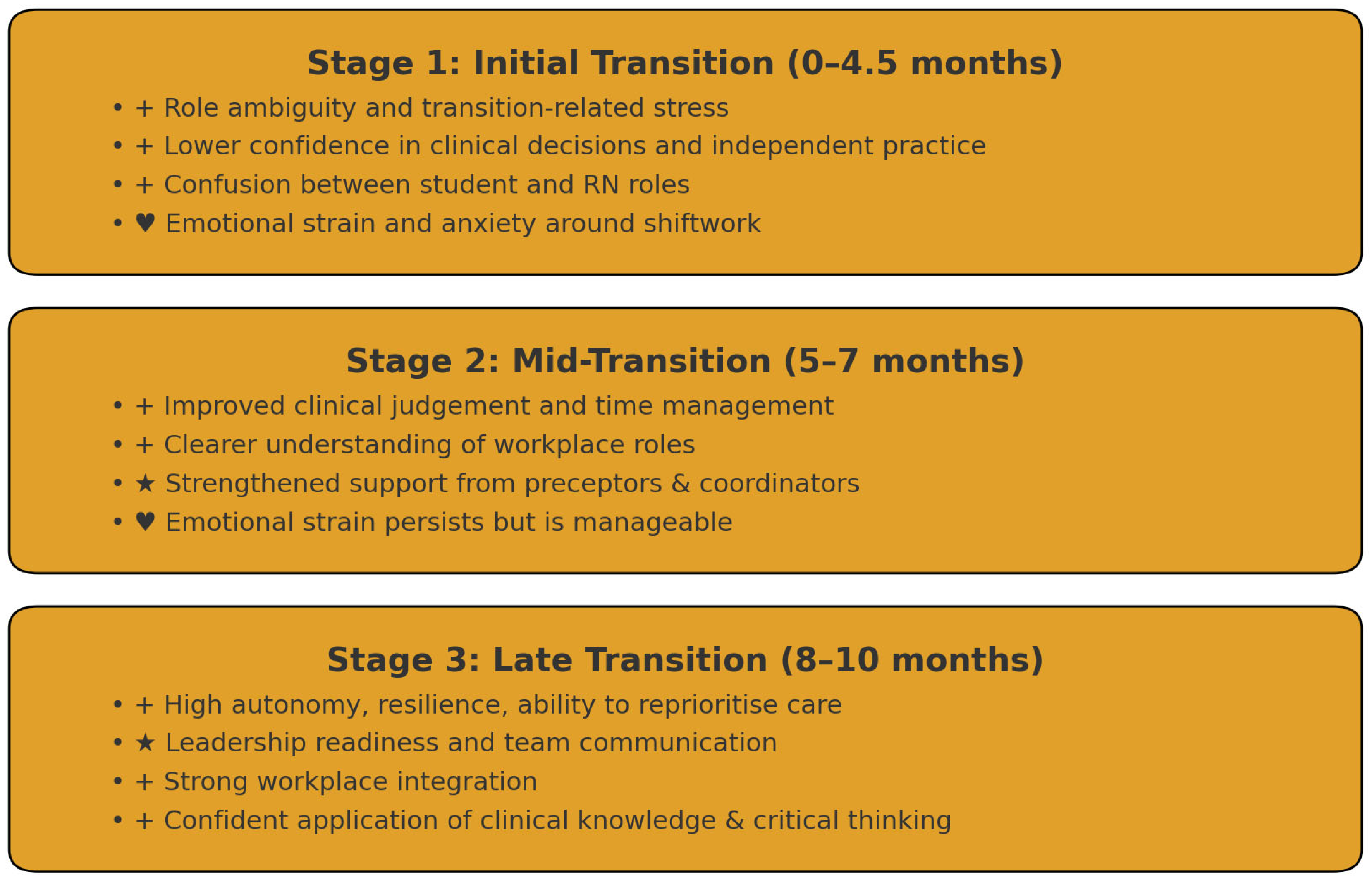

| Key Transition Variable | Stage 1 Mean (SD) | Stage 2 Mean (SD) | Stage 3 Mean (SD) | Trend |
|---|---|---|---|---|
| Confidence in clinical communication (Calling medical officer) | 4.82 (0.97) | 5.00 (0.85) | 5.20 (0.71) | ↑ Improving |
| Confidence in independent practice | 4.59 (0.77) | 4.73 (0.65) | 5.07 (0.64) | ↑ Improving |
| Ability to manage time and organise workload | 4.63 (0.70) | 4.82 (0.77) | 5.30 (0.60) | ↑ Improving |
| Calmness under pressure | 4.47 (0.77) | 4.57 (0.63) | 5.10 (0.71) | ↑ Improving |
| Understanding of role expectations | 4.89 (0.68) | 4.98 (0.66) | 5.14 (0.64) | ↑ Stable/Improving |
| Feeling respected by colleagues | 4.61 (0.87) | 4.87 (0.70) | 5.17 (0.60) | ↑ Improving |
| Feeling accepted in the workplace | 4.81 (0.73) | 4.98 (0.63) | 5.17 (0.54) | ↑ Improving |
| Comfort approaching preceptors | 5.20 (0.88) | 5.33 (0.66) | 5.52 (0.65) | ↑ Strong & Stable |
| Confidence performing required skills | 4.55 (0.79) | 4.80 (0.74) | 4.97 (0.73) | ↑ Improving |
| Confidence responding to clinical changes | 4.39 (0.77) | 4.63 (0.65) | 4.90 (0.62) | ↑ Improving |
| Workplace support for transition | 4.94 (0.74) | 5.00 (0.80) | 5.17 (0.93) | ↑ Stable/Improving |
| Considering leaving the profession | 1.99 (1.21) | 2.11 (1.19) | 1.90 (0.90) | → Low & Stable |
| Domain | Factor | Factor Description | Item Codes (Representative Items) |
|---|---|---|---|
| Responsibilities | R1 | Understanding clinical responsibilities | RS1, RS2, RS3 |
| R2 | Confidence in day-to-day practice | RS4, RS5, RS6 | |
| R3 | Adapting to workload and patient needs | RS7, RS8, RS9 | |
| R4 | Time management and responding to challenges | RS10, RS11, RS12, RS13 | |
| R5 | Workplace engagement and work–life boundaries | RS14, RS15, RS16 | |
| Role Orientation | O1 | Clarity of role expectations | RO1, RO2, RO3 |
| O2 | Accountability and early leadership skills | RO4, RO5 | |
| O3 | Respect, socialisation, and workplace belonging | RO6–RO10 | |
| O4 | Working with senior staff and decision-making | RO11–RO14 | |
| O5 | Adjustment to professional role expectations | RO15–RO17 | |
| Role Learning | L1 | Workplace acceptance and teamwork | RL1–RL4 |
| L2 | Safety, reporting, and escalation processes | RL5–RL7 | |
| L3 | Support from preceptors and coordinators | RL8–RL12 | |
| L4 | Professional identity, wellbeing, and self-care | RL13–RL17 | |
| L5 | Emotional responses during transition | RL18–RL23 | |
| Knowledge & Confidence | K1 | Preparedness for clinical practice | KN1–KN3 |
| K2 | Clinical reasoning and judgement | KN4–KN6 | |
| K3 | Expectations of clinical practice | KN7–KN10 | |
| K4 | Workplace expectations and self-assessment | KN11–KN14 | |
| K5 | Understanding of transition theory and shock | KN15–KN16 |
| Item Code | Item Description | Chi-Square Value | df | p-Value |
|---|---|---|---|---|
| RS3 | I am confident calling a medical officer about my patient | 9.949 | 4 | 0.041 |
| RS6 | I am confident with the clinical decisions that I make | 14.996 | 4 | 0.005 |
| RS7 | I sometimes confuse my previous role as a student with my current role | 24.477 | 4 | <0.001 |
| RS9 | I feel confident caring for patients’ families | 9.532 | 4 | 0.049 |
| RS10 | I am able to organise my work and manage my time effectively | 12.401 | 4 | 0.015 |
| RS11 | I am able to remain calm under pressure or when things go wrong | 16.205 | 4 | 0.003 |
| RO5 | I take a leadership role in my workplace | 17.731 | 4 | 0.001 |
| RO6 | I feel respected by the Nurses/Midwives I work with | 13.307 | 4 | 0.010 |
| RO12 | I can identify the core issue in a clinical situation | 17.435 | 4 | 0.002 |
| RL1 | I am seen as a potential leader in my workplace | 26.462 | 4 | <0.001 |
| RL7 | I feel comfortable approaching the Clinical Nurse Manager | 9.883 | 4 | 0.042 |
| RL18 | I have been involved in a clinical incident | 21.120 | 4 | <0.001 |
| RL20 | I find it difficult to sleep between shift changes due to anxiety | 12.376 | 4 | 0.015 |
| RL21 | I have taken Personal Leave due to work-related concerns | 9.606 | 4 | 0.048 |
| KN5 | I feel confident in my ability to think critically | 11.303 | 4 | 0.023 |
| Domain | Item Code | Item Description | Chi-Square | df | p-Value |
|---|---|---|---|---|---|
| Responsibilities (RS) | RS7 | I confuse student and current role | 18.112 | 4 | 0.001 |
| RS11 | I remain calm under pressure | 11.177 | 4 | 0.025 | |
| Roles (RO) | RO12 | I identify the core issue in clinical situations | 27.538 | 4 | <0.001 |
| RO14 | I am able to balance personal and work life | 10.705 | 4 | 0.030 | |
| RO15 | I receive constructive feedback without blame | 10.988 | 4 | 0.027 | |
| RO17 | I have questioned my decision to become a Nurse/Midwife | 9.545 | 4 | 0.049 | |
| Role Learning (RL) | RL1 | I am seen as a potential leader | 25.590 | 4 | <0.001 |
| RL12 | I feel comfortable approaching coworkers | 26.223 | 2 | <0.001 | |
| RL16 | My workplace supports my transition | 12.760 | 4 | 0.013 | |
| RL18 | I have been involved in a clinical incident | 36.640 | 4 | <0.001 | |
| RL19 | I worry about responsibilities before shifts | 10.494 | 4 | 0.033 | |
| RL20 | I find it difficult to sleep between shifts | 25.483 | 4 | <0.001 | |
| Knowledge & Confidence (KN) | KN1 | My formal education prepared me well | 10.190 | 4 | 0.037 |
| KN13 | I have realistic expectations of my abilities | 10.858 | 4 | 0.028 |
Disclaimer/Publisher’s Note: The statements, opinions and data contained in all publications are solely those of the individual author(s) and contributor(s) and not of MDPI and/or the editor(s). MDPI and/or the editor(s) disclaim responsibility for any injury to people or property resulting from any ideas, methods, instructions or products referred to in the content. |
© 2025 by the authors. Licensee MDPI, Basel, Switzerland. This article is an open access article distributed under the terms and conditions of the Creative Commons Attribution (CC BY) license (https://creativecommons.org/licenses/by/4.0/).
Share and Cite
Cusack, L.; Madsen, L.; Duchscher, J.B.; You, W. Growth and Adaptation of Newly Graduated Nurses Based on Duchscher’s Stages of Transition Theory and Transition Shock Model: A Longitudinal Quantitative Study. Nurs. Rep. 2025, 15, 437. https://doi.org/10.3390/nursrep15120437
Cusack L, Madsen L, Duchscher JB, You W. Growth and Adaptation of Newly Graduated Nurses Based on Duchscher’s Stages of Transition Theory and Transition Shock Model: A Longitudinal Quantitative Study. Nursing Reports. 2025; 15(12):437. https://doi.org/10.3390/nursrep15120437
Chicago/Turabian StyleCusack, Lynette, Loren Madsen, Judy Boychuk Duchscher, and Wenpeng You. 2025. "Growth and Adaptation of Newly Graduated Nurses Based on Duchscher’s Stages of Transition Theory and Transition Shock Model: A Longitudinal Quantitative Study" Nursing Reports 15, no. 12: 437. https://doi.org/10.3390/nursrep15120437
APA StyleCusack, L., Madsen, L., Duchscher, J. B., & You, W. (2025). Growth and Adaptation of Newly Graduated Nurses Based on Duchscher’s Stages of Transition Theory and Transition Shock Model: A Longitudinal Quantitative Study. Nursing Reports, 15(12), 437. https://doi.org/10.3390/nursrep15120437

