

Article

Optimizing Monitoring Frequency During Blood Transfusions: A Review of Guidelines and a Retrospective Cohort to Define a 7-Point Schedule

1
Nursing Department, National University Hospital, Singapore 119228, Singapore
2
JBI Singapore National University Hospital Nursing Centre, Singapore 119074, Singapore
3
Department of Surgery, Yong Loo Lin School of Medicine, National University of Singapore, Singapore 119228, Singapore
4
Department of Haematology-Oncology, National University Cancer Institute, Singapore 119074, Singapore
5
Blood Transfusion Services, Department of Laboratory Medicine, National University Hospital, Singapore 119074, Singapore
6
Nursing Division, National University Cancer Institute, Singapore 119074, Singapore
7
Saw Swee Hock School of Public Health, National University of Singapore, Singapore 117600, Singapore
8
Division of Surgical Oncology, National University Cancer Institute, Singapore 119228, Singapore
*
Author to whom correspondence should be addressed.
Nurs. Rep. 2025, 15(12), 421; https://doi.org/10.3390/nursrep15120421
Submission received: 15 October 2025 / Revised: 17 November 2025 / Accepted: 25 November 2025 / Published: 28 November 2025
(This article belongs to the Special Issue Clinical Nursing Care and Blood Transfusion Nursing)

Abstract

Background/Objectives: Vital signs monitoring during blood transfusion is important but inconsistently practiced across contexts. This paper aimed to consolidate the available evidence to determine the optimal monitoring frequency that balances efficiency and safety in clinical practice. Methods: Evidence was gathered through a literature review, review of international guidelines, investigation of local practices and analysis of study institution’s retrospective data on transfusion reaction patterns. Expert opinions were consulted on the proposed changes, prior to the pilot feasibility study. Results: The majority of the reviewed guidelines and practices monitored vital signs at three time-points: before transfusion, 15 min after initiation and upon completion. However, study hospital data revealed that transfusion reactions predominantly occurred within the first two hours, particularly among males aged 50–70 who received red packed cells in the oncology wards and had abnormal pre-transfusion vital signs. Thus, the original 10-point frequency practiced by the study hospital was modified to seven time-points instead of the widely adopted three time-points: prior to blood transfusion; 15 min after commencement; 30 min at the forty-fifth minute; hourly thereafter until completion; and within 1 h post-transfusion. Conclusions: Despite existing guidelines recommending only three vital signs monitoring time-points, institutional data suggests that using seven time-points is optimal to minimize missed transfusion reactions while preventing an unnecessary workload, balancing patient safety and operational efficiency. These proposed revisions will be evaluated through an upcoming pilot trial to assess their feasibility and the impact on patient outcomes.

1. Introduction

Transfusion of blood and blood components such as whole blood, packed red blood cells, plasma, platelets and cryoprecipitate are typically administered to treat hemorrhage and blood component deficiencies arising from various diseases [1]. In large countries like the United States [2], these procedures are vastly prevalent, easily reaching 10.764 million encounters in a single year. Even in small countries like Singapore, up to 119,720 units of blood are administered yearly [3]. These occurrences are likely to become more common, with many populations aging worldwide and treatment complexity increasing, especially for cancer [4].
Vital signs monitoring throughout transfusion is critical for detecting early signs of transfusion-induced reactions that range from mild allergic reactions or febrile symptoms to severe and life-threatening acute hemolysis, anaphylaxis, circulatory overload, transfusion-transmitted sepsis and acute lung injury [5]. Although seemingly basic and routine, these parameters alert the clinical team to possible impending complications that can be acted upon and prevented from worsening [6]. According to Crookston and team [7], hemodynamic deviations within the acceptable margins of 0.5 degrees Celsius body temperature, five respiratory revolutions per minute, 10 beats per minute for heart rate and 20 mmHg for blood pressure are deemed normal. Readings are thus considered abnormal if they fall outside of these stipulated ranges or manifest clinically as hives, itching, fever, chills, hypotension or dyspnea [8].
Hospitals worldwide have practiced frequent vital signs monitoring for many years without much empirical basis. While such routines ensure patient safety, excessive checks can be time-consuming and resource-intensive to perform punctually in surgical, cardiac and oncology units, where transfusions are numerous and frequent and patient acuity is high [9]. In addition, poor staffing is a longstanding issue that has been shown to lead to missed observations, increased adverse events and a prolonged length of stay in patients [10]. Given the demands for safe practice amidst scarce resources, it was necessary to review and re-evaluate the existing literature, international guidelines, local practices and institutional data to update the current blood transfusion vital signs monitoring protocol to keep abreast with evidence-based practice. Hence, this paper aimed to determine the monitoring frequency that was appropriate for practice, based on the collated evidence and institutional findings.

2. Methods

This study utilized a multi-phased approach to examine blood transfusion monitoring practices. A review of the literature was conducted using the search terms “blood transfusion”, “vital signs monitoring” and “frequency”. Thereafter, the data obtained were distilled to decipher the onset of side effects and the period of vigilance required to detect these adverse events. International guidelines were referenced, and local practices were examined.
A retrospective analysis was conducted on all transfusion encounters and reaction episodes recorded at our 1200-bed academic tertiary hospital. Data for this study was extracted from our Blood Bank’s data management system from January 2021 to December 2022. This system compiles information on all transfusion encounters and reaction episodes through established protocols within our institution. When healthcare providers suspect a transfusion reaction, they initiate a process through the EPIC electronic health record system, which prompts the completion of a transfusion reaction form and/or sending a urine (urinalysis dipstick (Beckman Coulter, iChem Velocity Urinalysis dipstick, Brea, CA, USA) for presence of blood) and blood sample (Blood group and Coombs test (QuidelOrtho, San Diego, CA, USA) for ABO incompatibility) for laboratory analysis. The time of commencement for the blood transfusion, time and characteristics of the transfusion reaction and time the transfusion was stopped or completed are documented in the transfusion reaction form. Blood bank staff then access these forms and conduct a thorough review of the patient’s electronic medical records, including clinical notes, to gather detailed information about the suspected reaction. Time-to-reaction was derived from the time of commencement of blood transfusion to time of transfusion reaction, recorded in the transfusion reaction form. To ensure inclusivity, all recorded transfusion encounters and reaction episodes that occurred in all areas of the hospital within the specified time frame (2021 to 2022) were included in the analysis, regardless of the severity or type of reaction. Descriptive statistics were used to summarize and present the data to provide an overview of reaction patterns within our institution during the two-year study period. Institutional approval was obtained and approved as ‘Review Not Required’ by the study institution’s research office for the analysis, access and use of anonymized blood transfusion data—NUH-RNR-2025-0025. An exemption was granted, on the basis that this is a retrospective review of the data. Thus, no interventions were initiated, and only de-identified data were used during the analysis.

3. Results

3.1. Literature Critique

The search did not find any official international guidelines on blood transfusion monitoring, and scientific research focusing on vital signs and their specifics was limited and vague. In a scoping review that examined nursing care for adults receiving blood transfusions, only 10 out of 19 studies (52.6%) mentioned vital signs as a key component [6]. Additionally, there was a lack of high-level interventional and comparative evidence justifying the adoption of one monitoring frequency over another. Practices varied across studies without clear reasons being given for the decisions. For example, one Brazilian study recommended monitoring the patient for the first 10 min, with vital signs being checked at 30 min, 1 h, 2 h, 3 h and 4 h [11], while others from the same country suggested continuous monitoring for adverse reactions during the entire transfusion [12,13]. Some provided brief, generic instructions to check vital signs at the beginning and end of the transfusion, or before, during and after [14,15,16,17]. A 2021 Ghanaian study advised baseline checks 30 min before transfusion [18], while an Egyptian study recommended hourly vital signs throughout the procedure [19]. Additionally, little information was available about the onset of common transfusion reactions, aside from them being classified as either acute (during or within 24 h of transfusion) or delayed (days to weeks after) [20].

3.2. Country-Specific Guidelines

Ten online resources, including a review, retrospective study and country-specific protocols that detail the intervals for documenting vital signs, were identified. A general consensus was established on obtaining baseline parameters: rechecking 15 min after initiation and at the end of the transfusion. However, there was no clear guidance regarding surveillance between the first 15 min and the end of the transfusion, which typically lasts around 4 h. Based on the findings, it seems that only guidelines from New Zealand stipulate subsequent 30 min to hourly assessments after the first check from the start of the transfusion [21,22]. Those from the United Kingdom [23,24,25] and the United States [26,27,28] did not mandate intermediary time-points, while Health District Australia [29] advised practitioners to adhere to organizational policies. Table 1 summarizes these findings.

3.3. Local Guidelines

Practices across local healthcare institutions in Singapore were studied and the varying intervals adopted by the respective sites are summarized in Table 2. All acute hospitals in Singapore monitor vital signs pre-transfusion, 15 min after commencement and post-transfusion. However, monitoring frequencies in the first and second hour diverged. Three hospitals (Study Hospital, Hospitals E and F) were monitored four times in the first hour and twice in the second hour, followed by hourly until the end of transfusion. Conversely, some hospitals have cut back on first-hour checks; three hospitals (B, C and G) only monitored 15 min after starting, then hourly until the transfusion ended. Hospital A, following an initial 15 min check, conducted regular visual observations of patients without performing routine vital sign measurements after the first hour.

3.4. Insights from Retrospective Institution Database Assessment

Retrospective data extracted from the 1200-bed study hospital were analyzed. This was undertaken to obtain a comprehensive understanding of transfusion reaction incidence rates and the time of occurrence during the transfusion to inform the appropriate vital signs monitoring interval to be adopted.
Between 2021 and 2022, a total of 48,362 units of blood products were transfused, comprising red blood cells (32,550 units), platelets (9424 units), fresh frozen plasma (2777 units) and cryoprecipitate (1013 units). There were 72 (0.15%) episodes of transfusion-related reactions (Table 3). The majority of those with such reactions were in oncology wards and received red blood cells (n = 40, 55.6%).
Transfusion reactions were formally reviewed by a pathologist who classified the type of reaction according to ISBT [32] standard definitions, using information about clinical signs and symptoms and laboratory investigations, for the purpose of documentation to patients’ charts and for national hemovigilance reporting. Our study’s definitions of non-serious include those reactions that typically only require symptomatic treatment and would only have been classified as this type of reaction if clinically mild. They would correspond to the ISBT Grade 1 (non-severe) definition, whereas serious reactions are clinically more severe, require in-patient hospitalization or prolongation of hospitalization, or necessitate medical intervention or intensive care to prevent serious threats to health. These correspond to ISBT Grade 2 (severe) and Grade 3 (life-threatening) reactions.
Patient characteristics associated with blood transfusion reactions were similar among the non-serious (n = 57) and serious (n = 15) cases (Table 4). Males predominated in both groups (60%). The most affected age groups were 61–70 years and 51–60 years, for non-serious and serious reactions, respectively. Oncology departments accounted for 29.8% of non-serious and 46.7% of serious reactions. Red blood cells were the most commonly transfused product in both groups (56.1% non-serious, 53.3% serious). Non-serious reactions typically occurred in the second hour (33.3%), while serious reactions were more common within the first hour (26.7%). Pre-transfusion fever was more prevalent in non-serious reactions, while pre-transfusion hypotension was only observed in serious reactions.
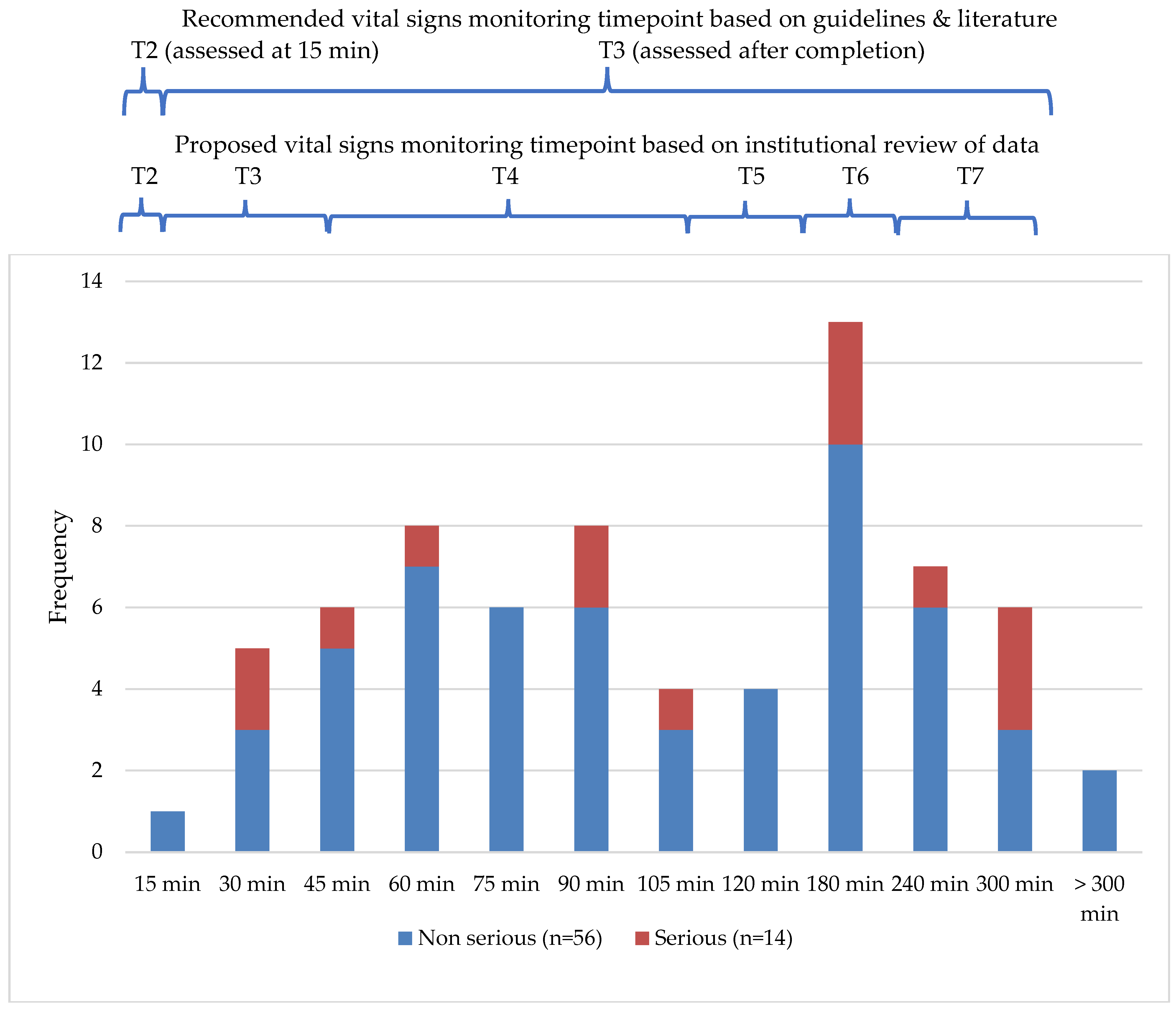
Reaction symptoms predominantly manifested within the first two hours of transfusion (n = 42, 60.0%), while the more severe reactions typically occurred at the third hour of transfusion or in the immediate hour post-transfusion (Figure 1). This means that applying the universal minimum vital signs measurement only once, 15 min after the initiation of blood transfusion and at its completion (i.e., 4th hour), could possibly result in at least 67 reaction events being missed or detected late (95.7.1%). It is also important to consider that minimally communicative, unconscious or pediatric patients may not be able to verbalize discomfort or symptomatic reactions, and hence, deviations in vital signs may be the clue to untoward effects.

4. Discussion

4.1. Proposed Changes and Justifications

Although most international guidelines and local practices recommend at least three vital signs monitoring time-points (before, at 15 min and at completion of transfusion), the data used to gauge the appropriate interval length supports the accommodation of at least seven time-points: (i) pre-transfusion; (ii) at 15 min after initiation; (iii) at 45 min (30 min interval) (iv–vi) at 105, 165 and 225 min (hourly intervals) (based on 4 h transfusion); and (vii) 1 h post-transfusion. This proposed seven time-point monitoring schedule for blood transfusions aligns with Cortez-Gann et al.’s [28] recommendation of “a regular pattern of vital sign monitoring spanning the entire transfusion”, based on a mean time-to-reaction of 1.5 h and a mean time of severe reactions of 2 h or within 8 h of transfusion. Moreover, their study also saw only a small percentage of reactions (15%) occurring in the first 15 min—this finding corroborates with ours in justifying the need for hourly checks up to the 4 h mark to avoid missed identification of a substantial number of transfusion reactions. That said, the decision to conduct a check at 45 min post-initiation instead of 30 or 60 min was made primarily based on two reasons: firstly, this time-point is positioned at the median timing, to detect early reactions whose onset spans the time frame between 30 and 60 min after the transfusion starts, as shown by the graph in Figure 1, and secondly, it presents an optimal time-point that enables a cost-effective deployment of nursing manpower, as compared to the more stringent monitoring at 15 min intervals.
In light of these considerations, 3 time-points from the existing protocol were revised from the existing 10 time-points to 7 time-points. The key differences between the current and proposed protocols are reflected in Table 5. As described earlier, these modifications were made to streamline vital signs monitoring during blood transfusions. However, the measured constituents will remain unchanged—patients will be assessed for their (i) blood pressure (BP); (ii) heart rate (HR); (iii) respiratory rate (RR); (iv) oxygen saturation (SpO2); and (v) temperature at each time-point. These will be evaluated against the universally accepted vital signs normal ranges (BP 90/60–120/80 mmHg; HR 60–100 beats per minute; RR 12–20 breaths per minute; SpO2 ≥ 95%; temperature < 37.5 degrees Celsius) to ensure that the slightest deviation is captured [33,34].
Our analysis also revealed certain patient characteristics that appeared to predispose them to a higher occurrence of transfusion reactions. These primarily included males aged 50 to 70 receiving packed red cells in oncology wards, who had an elevated body temperature and subnormal blood pressure prior to the blood transfusion. Such data concur with an existing study that reported individuals who had leukopenia (<5 × 10³/µL), were febrile or had raised diastolic blood pressure to be at risk of acute transfusion reactions in a retrospective cohort study involving 44,691 events in a Taiwanese hospital [35]. Our findings, revealing the susceptible age and gender subgroups, mirrored an Indonesian study as well [36]. Nevertheless, the identified features in this retrospective review are only exploratory, given the relatively small transfusion reaction numbers (n = 72), which could have skewed and inflated the representation of specific subgroups in the analyses.
On a separate note, the proposed reduction in unnecessary checks by three time-points from the original of ten may bring about several potential benefits to both healthcare professionals and patients. The most direct benefit in an ideal hypothetical scenario is the amount of time saved that can be channeled to other clinical activities without compromising patient safety. This would not only ensure adequate monitoring but also avoid being overly intrusive, which may be more sustainable for nurses in the long run.

4.2. Expert Panel Consultations

To ensure that the proposed changes to blood transfusion frequency monitoring were clinically sound and feasible, the team, consisting of a hematologist, registered nurses and a medical laboratory scientist, deliberated extensively. This process was necessary to ensure the patient-first approach was of the utmost priority. The input gathered from these discussions highlighted several core issues. First, care should be appropriately resourced according to patients’ clinical needs and it should take precedence over the convenient reduction in frequency that is purposed to encourage compliance. In other words, additional vital sign checks should be performed if deemed necessary, according to the healthcare professional’s discretion. Second, the team need to empower patients to be able to recognize and report the abnormalities and discomfort experienced in between the monitoring intervals, and this will require proper, rigorous patient education prior to the procedure. Third, nurses need to continue to maintain the rigor and quality of monitoring standards and requirements, as increasing the interval between time-points is not intended to diminish the importance of timely checks of any abnormalities. Beyond human factors, machines for vital signs monitoring must also be readily available to facilitate adherence to the new vital signs monitoring regimen. These insights form a foundation for implementing changes that balance patient safety with operational efficiency. These modifications can then streamline clinical workflows while allowing vigilance for potential adverse reactions, addressing the aim of the paper to determine an appropriate monitoring frequency for blood transfusion monitoring that is able to balance efficiency and safety.
Following the consensus of the proposed changes, senior nursing leaders of the oncology units, where the proposed pilot trial of the reduced frequency of vital signs monitoring would be conducted, were briefed. As the feedback received from them was generally positive, no refinements were made to the modified seven time-point vital signs monitoring frequency.

4.3. Potential Challenges and Possible Solutions

While the relaxation of vital signs monitoring frequency during blood transfusion is a calculated and evidence-supported move, one issue that might possibly arise is the delayed detection of deterioration. The proposed frequency sought to strike a balance between timely detection of reactions versus efficient use of nursing manpower. Input from stakeholders was sought: for example, pediatricians. Except for neonatology, which maintained its own protocol frequency, the revised frequency was deemed acceptable by the majority of stakeholders. That said, a multi-pronged safeguard could be incorporated to pair vital signs checking with physical assessments to compensate for the lowered frequency [37]. Future large-scale, in-depth studies determining the variables that are predictive of transfusion reactions and the onset of the respective complications will be necessary to ascertain its effectiveness and refinement.

4.4. Significance of Study

The proposed revisions to blood transfusion vital signs monitoring bear significant implications for the transformation of clinical practice among nurses. In many settings and instances where continuous vital signs measurement and documentation is not the default, timely reviews of common procedures that impose a substantial workload on nurses will be beneficial. This paves the way for improvements in other workflows, and at the same time, ensures that current practices keep abreast of scientific advancements.

4.5. Study Limitations

The proposed monitoring protocol must be applied with caution, due to several study limitations. Firstly, the review undertaken was a generic and non-systematic one. Secondly, the data analyzed in the retrospective study were from a single institution only. Transfusion reaction numbers were not huge; hence, findings were mostly suggestive and not conclusive. Also, this “relaxed” monitoring frequency should also be assessed for its suitability among those who are younger in age or have cognitive and speech impairments.

5. Conclusions

Although most healthcare institutions, locally and elsewhere, adopt a 3 time-point vital signs monitoring frequency throughout blood transfusion, our institutional findings suggest that 7 time-points may be more optimal than 3 or 10 time-points, with special attention given to certain demographic and clinical groups who are at risk of transfusion reactions. This significant modification from the original 10 time-point protocol needs to be evaluated in a pilot. At the same time, it represents an important step in devising the best clinical practices, which can potentially reduce healthcare providers’ workloads while maintaining high standards of patient care.

Author Contributions

S.Z.M.: Conceptualization, Project administration, Methodology, Data curation, Formal analysis, Investigation, Validation, Visualization, Analysis and recommendations, Writing—original draft, Writing—review and editing. S.Y.L.: Conceptualization, Methodology, Expert knowledge, Analysis and recommendations, Writing—review and editing. K.L.: Investigation, Data curation. P.C.T.: Visualization, Analysis and recommendations, Writing—review and editing. S.P.L.: Provide background to the problem, Expert knowledge, Analysis and recommendations, Writing—review and editing. S.S.R.: Analysis and endorse recommendations. S.W.W., J.L. and K.K.T.: Writing—original draft, Writing—review and editing. K.W.L.K.: Supervision, Analysis and recommendations, Writing—review and editing, Resources. All authors have read and agreed to the published version of the manuscript.

Funding

This research received no external funding.

Institutional Review Board Statement

Institutional approval was obtained and approved by the National University Health System Research Office for the conduct of research on the access and use of anonymized blood transfusion data for the purpose of publication of this quality improvement project. NUH-RNR-2025-0025 dated 9 July 2025.

Informed Consent Statement

The retrospective analysis of blood transfusion reaction data were undertaken to review reaction times and determine optimal timing for clinicians to conduct vital signs monitoring without compromising patient safety. As the intent is to improve clinical care to our patients, this analysis is considered as a quality improvement project which do not require ethics approval. Thus, no consent is required to be obtained from the patient. Furthermore, no identifiable data was extracted during the analysis of the data.

Data Availability Statement

The datasets presented in this article are not readily available, due to institutional policy. Requests to access the datasets should be directed to the National University Hospital.

Public Involvement Statement

No public involvement in any aspect of this research.

Guidelines and Standards Statement

This study primarily involves a review of guidelines and retrospective data analysis, with the aim of developing an evidence-based protocol for blood transfusion monitoring. Our work represents the foundational research and protocol development stage, which precedes any implementation efforts. While no single reporting guideline perfectly fits our multi-component study design, we have adhered to relevant elements of the STROBE (Strengthening the Reporting of Observational Studies in Epidemiology) guidelines where applicable, particularly for reporting aspects of our retrospective data analysis. Our reporting aims to provide a clear and comprehensive account of the protocol development process, setting the stage for subsequent implementation phases. We have followed the general principles of transparent and comprehensive reporting throughout our manuscript. This includes clear descriptions of our methods for guideline review, data collection and analysis and protocol development. We have strived to provide sufficient detail to ensure reproducibility and to contextualize our findings within the existing body of literature on blood transfusion monitoring. Where relevant to our study design, we have incorporated key reporting elements, such as clearly stating the study design, describing the setting and relevant dates and outlining our analytical approach. We have adapted these principles to fit the unique aspects of our study, including the guideline review and protocol development components that are not typically covered by observational study guidelines. We acknowledge that some elements that are typically included in observational studies, such as detailed participant selection criteria, comprehensive variable definitions and explicit discussion of all potential sources of bias, may not be fully elaborated in our current manuscript, due to its focus on guideline review and protocol development. However, we have aimed to address the potential limitations and sources of bias, particularly in our retrospective data analysis, to the possible extent within our study design.

Use of Artificial Intelligence

During the final drafting of the manuscript, the author used bot-NUHS (internal bot housed in the National University Hospital’s intranet) for the limited use of the bot to find appropriate terms or improve clarity of some sentences. The author used the bot to assist in drafting the section on guidelines and standards statements. The authors have reviewed and edited the output and take full responsibility for the content of this publication.

Acknowledgments

We would like to acknowledge the National University Hospital, National University Health System, Singapore for allowing us access to the data and to conduct the works.

Conflicts of Interest

The authors declare no conflicts of interest.

References

  1. Cleveland Clinic. Blood Transfusion. 2020. Available online: https://my.clevelandclinic.org/health/treatments/14755-blood-transfusion (accessed on 24 April 2025).
  2. Elflein, J. Number of Blood Transfusions in the United States in 2015, 2017, 2019, and 2021. 2024. Available online: https://www.statista.com/statistics/1204079/number-blood-tranfusions-us/ (accessed on 23 April 2025).
  3. Health Sciences Authority Singapore. Blood Facts and Figures. 2025. Available online: https://www.hsa.gov.sg/blood-donation/blood-facts-and-figures (accessed on 23 April 2025).
  4. World Health Organization. Global Cancer Burden Growing, Amidst Mounting Need for Services. 2024. Available online: https://www.who.int/news/item/01-02-2024-global-cancer-burden-growing--amidst-mounting-need-for-services (accessed on 24 April 2025).
  5. Ackfeld, T.; Schmutz, T.; Guechi, Y.; Le Terrier, C. Blood transfusion reactions—A comprehensive review of the literature including a Swiss perspective. J. Clin. Med. 2022, 11, 2859. [Google Scholar] [CrossRef]
  6. Soares, F.M.M.; Araujo, L.R.; Rodrigues, A.B.F.L.; Magalhães, D.S.; Lima, G.K.; Negri, E.C. Nursing Care for Adult Patients Undergoing Blood Transfusion: A Scoping Review. Aquichan 2025, 25, e2515. [Google Scholar] [CrossRef]
  7. Crookston, K.P.; Koenig, S.C.; Reyes, M.D. Transfusion reaction identification and management at the bedside. J. Infus. Nurs. 2015, 38, 104–113. [Google Scholar] [CrossRef]
  8. Gehrie, E.A.; Roubinian, N.H.; Chowdhury, D.; Brambilla, D.J.; Murphy, E.L.; Gottschall, J.L.; Wu, Y.; Ness, P.M.; Strauss, R.G.; Hendrickson, J.E. A multicentre study investigating vital sign changes occurring in complicated and uncomplicated transfusions. Vox Sang. 2018, 113, 160–169. [Google Scholar] [CrossRef] [PubMed]
  9. Ferraris, V.A.; Hochstetler, M.; Martin, J.T.; Mahan, A.; Saha, S.P. Blood transfusion and adverse surgical outcomes: The good and the bad. Surgery 2015, 158, 608–617. [Google Scholar] [CrossRef]
  10. Griffiths, P.; Ball, J.; Bloor, K.; Böhning, D.; Briggs, J.; Dall’Ora, C.; Iongh, A.D.; Jones, J.; Kovacs, C.; Maruotti, A. Nurse staffing levels, missed vital signs and mortality in hospitals: Retrospective longitudinal observational study. Health Serv. Deliv. Res. 2018, 6. [Google Scholar] [CrossRef]
  11. dos Santos, L.X.; Santana, C.C.d.A.P.; Oliveira, A.d.S.B. Hemotransfusion under the perspective of nursing care/A hemotransfusão sob a perspectiva do cuidado de enfermagem. Rev. Pesqui. Cuid. Fundam. Online 2021, 13, 65–71. [Google Scholar] [CrossRef]
  12. da Silva Góis, A.R.; Xavier, R.O.; Mola, R.; Lira, G.G.; de Melo Brandão, B.M.G.; da Silva Abrão, F.M. Nursing care in the transfusion of blood components to surgical patients in the perioperative period. Int. Arch. Med. 2021, 14. [Google Scholar] [CrossRef]
  13. Garcia, J.; Silva, S.S.; Meneguci, J.; Moraes-Souza, H. Profile of hemotherapy care and the safety of the transfusion process. Rev. Assoc. Médica Bras. 2022, 68, 770–774. [Google Scholar] [CrossRef]
  14. Frantz, S.R.d.S.; Vargas, M.A.d.O. Renormalization of the Nurses’ work in hemotherapy: Between prescription and reality. Texto Contexto-Enferm. 2021, 30, e20190060. [Google Scholar] [CrossRef]
  15. Villamin, C.; Bates, T.; Mescher, B.; Benitez, S.; Martinez, F.; Knopfelmacher, A.; Correa Medina, M.; Klein, K.; Dasgupta, A.; Jaffray, D.A. Digitally enabled hemovigilance allows real time response to transfusion reactions. Transfusion 2022, 62, 1010–1018. [Google Scholar] [CrossRef]
  16. Scott, S.S.; Henneman, E.A.; Nathanson, B.H.; Andrzejewski, C., Jr.; Gonzalez, M.; Walker, R.; Martinez, V.I. Use of a transfusion checklist by student nurses to improve patient safety. J. Nurses Prof. Dev. 2020, 36, 33–38. [Google Scholar] [CrossRef]
  17. Cheng, L.; Li, L.; Zhang, Y.; Deng, F.; Lan, T. Clinical nursing value of predictive nursing in reducing complications of pregnant women undergoing short-term massive blood transfusion during cesarean section. World J. Clin. Cases 2024, 12, 51. [Google Scholar] [CrossRef]
  18. Bediako, A.A.; Ofosu-Poku, R.; Druye, A.A. Safe blood transfusion practices among nurses in a major referral center in Ghana. Adv. Hematol. 2021, 2021, 6739329. [Google Scholar] [CrossRef]
  19. Aly, N.A.E.M.; El-Shanawany, S.M.; Ghoneim, T.A.M. Using failure mode and effects analysis in blood administration process in surgical care units: New categories of errors. Qual. Manag. Healthc. 2020, 29, 242–252. [Google Scholar] [CrossRef] [PubMed]
  20. Wang, Y.; Rao, Q.; Li, X. Adverse transfusion reactions and what we can do. Expert Rev. Hematol. 2022, 15, 711–726. [Google Scholar] [CrossRef] [PubMed]
  21. Southern District Health Board New Zealand. Blood Policy: Observations. 2014. Available online: https://www.clinicaldata.nzblood.co.nz/resourcefolder/observations.php?dhbid=5#:~:text=Baseline%20observations%2C%20taken%20within%20the%2060%20minutes%20before,BP%20hourly.%20Increase%20BP%20monitoring%20if%20condition%20changes. (accessed on 30 April 2025).
  22. New Zealand Blood Service. Transfusion Medicine Handbook: Guide to Good Transfusion Practice. 2019. Available online: https://www.nzblood.co.nz/healthcare-professionals/transfusion-medicine/transfusion-medicine-handbook/3-guide-to-good-transfusion-practice/3-12-administration-and-observation-of-transfusion/ (accessed on 30 April 2025).
  23. Joint United Kingdom (UK) Blood Transfusion and Tissue Transplantation Services Professional Advisory Committee (JPAC). Transfusion Practice. 2014. Available online: https://www.transfusionguidelines.org/transfusion-practice/blood-transfusion-elearning (accessed on 30 April 2025).
  24. London Health Sciences Centre. Blood Transfusion Clinical Practice Manual: Vital Signs and Monitoring Requirements During Transfusion. 2025. Available online: https://lhsc.omni-assistant.net/lab/Document/Handlers/FileStreamer.ashx?Df_Guid=63267d27-7b2a-4e7d-b192-dc1990214863&MostRecentDocument=true (accessed on 30 April 2025).
  25. National Institute for Health and Care Excellence (NICE). Blood Transfusion (NG24). 2015. Available online: https://www.nice.org.uk/guidance/ng24/resources/blood-transfusion-pdf-1837331897029 (accessed on 30 April 2025).
  26. Roback, J.; Grossman, B.; Harris, T.; Hillyer, C. Technical Manual; AABB: Bethesda, MD, USA, 2011. [Google Scholar]
  27. New York State Council on Human Blood and Transfusion Services; New York State Board for Nursing. Guidelines for Monitoring Transfusion Recipients; Wadsworth Center: Albany, NY, USA, 2023; Available online: https://www.wadsworth.org/sites/default/files/WebDoc/857758683/monitorning%20txrecip0812final.pdf (accessed on 30 April 2025).
  28. Cortez-Gann, J.; Dicarlo Gilmore, K.; Watson Foley, K.; Brooke Kennedy, M.; McGee, T.; Kring, D. Blood Transfusion Vital Sign Frequency: What Does the Evidence Say? Medsurg Nurs. 2017, 26, 89–92. [Google Scholar] [PubMed]
  29. HealthDirect Australia. Monitoring and Assessing a Patient Receiving a Blood Transfusion. 2024. Available online: https://www.ausmed.com/learn/articles/blood-transfusion-assessment (accessed on 30 April 2025).
  30. Sullivan, D.K.; Vu, T.; Richardson, G.; Castillo, E.; Martinez, F. Evaluating the frequency of vital sign monitoring during blood transfusion: An evidence-based practice initiative. Clin. J. Oncol. Nurs. 2015, 19, 516–520. [Google Scholar] [CrossRef]
  31. Dang, D.; Dearholt, S.L.; Bissett, K.; Ascenzi, J.; Whalen, M. Johns Hopkins Evidence-Based Practice for Nurses and Healthcare Professionals: Model and Guidelines; Sigma Theta Tau: Indianapolis, IN, USA, 2021. [Google Scholar]
  32. De Vries, R.R.P.; Faber, J.-C. APPENDIX B: Proposed Standard Definitions for Surveillance of Non Infectious Adverse Transfusion Reactions. In Hemovigilance: An Effective Tool for Improving Transfusion Safety; De Vries, R.R.P., Faber, J.-C., Eds.; John Wiley & Sons: Hoboken, NJ, USA, 2012. [Google Scholar]
  33. Cleveland Clinic. Vital Signs; Cleveland Clinic: Cleveland, OH, USA, 2023. [Google Scholar]
  34. Ministry of Health Singapore. Fever; Government of Singapore: Singapore, 2025. [Google Scholar]
  35. Yao, C.; Chien, J.; Chuang, H.; Ho, T. Associated factors with acute transfusion reaction from hospital online reporting events: A retrospective cohort study. J. Patient Saf. 2020, 16, e303–e309. [Google Scholar] [CrossRef]
  36. Rahajeng, E.P.; Samad, R.; Muhiddin, R. Identification of risk factors characteristics of transfusion reaction. Indones. J. Clin. Pathol. Med. Lab. 2020, 26, 266–271. [Google Scholar] [CrossRef]
  37. Roney, J.K.; Whitley, B.E.; Johnston, L.; Deleon, M.; Robnett, J.C. Should adding pain, oxygen saturation and physical assessment to vital signs become the new standard of care for detecting blood transfusion reactions? Vox Sang. 2023, 118, 109–120. [Google Scholar] [CrossRef] [PubMed]
Figure 1. Time to blood transfusion reaction (2021–2022). Note: T1 is not reflected in the graph, as it is prior to transfusion.
Nursrep 15 00421 g001
Table 1. Findings on vital signs monitoring frequency, based on online resources (n = 10).
Guideline/
Literature
CountryYearLevel of Evidence !Monitoring Frequency
Pre-BTDuringPost-BTTotal
Southern District Health Board Blood Policy/Health Otago [21]New
Zealand
2014IVYes15 min after initiation;
temperature at 30, 60, 90, 120, 150, 180, 210, 240 min BP at 15, 75, 135, 195 min
Yes *VS = 3
T° = 10
BP = 6
New Zealand Blood Service [22]New
Zealand
2019IVYes15 min after initiation;
30 min to 1 h
observations thereafter
Yes, within 1 h3
American Association of Blood Bank
(17th Edition) [26]
USA2011IVYes5 to 15 min after initiationYes *3
National Institute for Care Excellence (NICE): Blood transfusion NG24 [25]UK2015IVYesYes, but did not specify interval and frequencyYes *Unsure
New York State Council on Human Blood and Transfusion Services/New York State Board for Nursing Guidelines [27]USA2012IVYes15 min after initiationYes *3
Joint UK Blood Transfusion and Tissue Transplantation Services Professional Advisory Committee (JPAC) [23]UK2014IVYes15 min after initiationYes, within 1 h3
HealthDirect Australia/Ausmed Education [29]Australia2024IVYes15 min after initiation,
follow organization policy
Yes *3
London Health Sciences Centre [24]Canada2025IVYes15 min after initiationYes *3
Cortez-Gann et al.
Retrospective cohort study [28]
USA2017IIIYes15 min after initiationYes, within 1 h3
Sullivan et al.
Literature review [30]
-2015VYes15 min after initiationYes *3
VS: vital signs; T°: temperature; and BP: blood pressure. * Article states to monitor vital signs at the end of transfusion but did not specify the frequency. ! Level of evidence is based on the John Hopkins hierarchy of evidence [31].
Table 2. Findings on vital signs monitoring frequency during blood transfusion, based on local institution practices (n = 8).
Healthcare Institutions* Vital Signs Monitoring Time-PointMonitoring Frequency
Pre-BT1st h2nd h3rd h4th hPost-BT
Hospital AYesat 15 min; observe for 5 minRegular check on patient but no vital signs measurement requiredYes3
Hospital BYesat 15 minat 75 minat 135 minat 195 minYes6
Hospital CYesat 15 minat 75 minat 135 minat 195 minYes6
Hospital DYesat 15, 30, 45, 60 minat 120 minat 180 minat 240 minYes9
Study
Hospital
Yesat 15, 30, 45, 60 minat 90, 120 minat 180 minat 240 minYes, within 1 h10
Hospital EYesat 15, 30, 45, 60 minat 90, 120 minat 180 minat 240 minYes, within 1 h10
Hospital FYesat 15, 30, 45, 60 minat 90, 120 minat 180 minat 240 minYes, within 1 h10
Hospital GYesat 15, 30, 60 minat 90 minat 150 minat 210 minat 270, 330, 390, 45011
Pre/Post-BT: pre/post-blood transfusion. * Based on duration of 4 h transfusion.
Table 3. Prevalence and characteristics of blood transfusion reactions in 2021–2022.
Outcomes Examinedn (%)
Total units of blood transfused48,362
Incidence rate of blood transfusion reaction (overall)
Year 2021
Year 2022
72 (0.15)
27 (0.11)
45 (0.18)
Gender
Female
Male

29 (40.3)
43 (59.7)
Age
Mean; range
Below 40 years old
41–50 years old
51–60 years old
61–70 years old
71–80 years old
> 80 years old

54.0; 6.0–91.0
19 (26.5)
9 (12.5)
15 (20.8)
13 (18.0)
10 (13.9)
6 (8.3)
Nature of side-effect
Non-serious 1
Serious 2

57 (79.2)
15 (20.8)
Department in which transfusion reaction occurred
Cardiology
Emergency Department/Accident and Emergency
Intensive Care Unit
General Medicine
Obstetrics and Gynecology
Oncology
Orthopedic
Operating Theater
Pediatric
Pediatric Intensive Care Unit
General Surgery

5 (6.9)
4 (5.6)
7 (9.6)
12 (16.7)
1 (1.4)
24 (33.3)
9 (12.5)
2 (2.8)
3 (4.2)
2 (2.8)
3 (4.2)
Blood product(s) with transfusion reaction(s)
Red Blood Cells
Platelets
Fresh Frozen Plasma
Multiple Blood Products

40 (55.6)
23 (31.9)
4 (5.6)
5 (6.9)
Time to blood transfusion reaction
0–15 min
>15–30 min
>30–45 min
>45–60 min
>60–75 min
>75–90 min
>90–105 min
>105–120 min
>120–135 min
>135–150 min
>150–165 min
>165–180 min
>180–240 min
>240–300 min
>300 min
Missing n = 2 (2.8)
1 (1.4)
5 (6.9)
6 (8.3)
9 (12.5)
5 (6.9)
8 (11.2)
4 (5.6)
4 (5.6)
2 (2.8)
2 (2.8)
6 (8.3)
3 (4.2)
7 (9.6)
6 (8.3)
2 (2.8)
1 Non-serious: allergic or hypersensitivity reaction and febrile non-hemolytic transfusion reaction. 2 Serious: transfusion associated circulatory overload, hemolytic reaction, anaphylactic/severe allergic reaction, acute lung injury (TRALI) and dyspnea. Note: missing data (n = 2; platelet = 1, RBC = 1) were omitted from the analysis.
Table 4. Patient characteristics associated with blood transfusion reaction(s).
Reaction TypeNon-Serious (n = 57)Serious (n = 15)
GenderMale
(n = 34, 59.6%)
Male
(n = 9, 60.0%)
Age group61–70 years old
(n = 11, 19.3%)
51–60 years old
(n = 5, 33.3%)
DepartmentOncology
(n = 17, 29.8%)
Oncology
(n = 7, 46.7%)
Transfused blood productRBCs
(n = 32, 56.1%)
RBCs
(n = 8, 53.3%)
Time to reactionIn the second hour
(n = 19, 33.3%)
Within the first hour
(n = 4, 26.7%)
SymptomsPre-transfusion fever ≥ 37.5
(n = 10, 76.9%)
Pre-transfusion fever ≥ 37.5
(n = 3, 23.1%)
Pre-transfusion SBP < 90 mmHg
(n = 0, 0.0%)
Pre-transfusion SBP < 90 mmHg
(n = 1, 100%)
Note: numbers presented here represent the majority proportion only. RBCs: red blood cells. SBP: systolic blood pressure.
Table 5. Differences between existing and proposed protocol for frequency of vital signs monitoring.
Time-Points* Time After Start of Transfusion
Before—Existing ProtocolAfter—Proposed Protocol
T1Before transfusion (Baseline—pre)Before transfusion (Baseline—pre)
T2Time at 15 minTime at 15 min
T3Time at 30 minTime at 45 min
T4Time at 45 minTime at 105 min
T5Time at 60 minTime at 165 min
T6Time at 90 minTime at 225 min
T7Time at 120 minTime > 225 min (1 h post-transfusion)
T8Time at 180 min-
T9Time at 240 min (End of transfusion)-
T10Time > 240 min (1 h post-transfusion)-
* Timing is based on 4 h of transfusion.
Disclaimer/Publisher’s Note: The statements, opinions and data contained in all publications are solely those of the individual author(s) and contributor(s) and not of MDPI and/or the editor(s). MDPI and/or the editor(s) disclaim responsibility for any injury to people or property resulting from any ideas, methods, instructions or products referred to in the content.