


Optimizing Monitoring Frequency During Blood Transfusions: A Review of Guidelines and a Retrospective Cohort to Define a 7-Point Schedule
 , , ,
, , ,
Abstract
1. Introduction
2. Methods
3. Results
3.1. Literature Critique
3.2. Country-Specific Guidelines
3.3. Local Guidelines
3.4. Insights from Retrospective Institution Database Assessment
4. Discussion
4.1. Proposed Changes and Justifications
4.2. Expert Panel Consultations
4.3. Potential Challenges and Possible Solutions
4.4. Significance of Study
4.5. Study Limitations
5. Conclusions
Author Contributions
Funding
Institutional Review Board Statement
Informed Consent Statement
Data Availability Statement
Public Involvement Statement
Guidelines and Standards Statement
Use of Artificial Intelligence
Acknowledgments
Conflicts of Interest
References
- Cleveland Clinic. Blood Transfusion. 2020. Available online: https://my.clevelandclinic.org/health/treatments/14755-blood-transfusion (accessed on 24 April 2025).
- Elflein, J. Number of Blood Transfusions in the United States in 2015, 2017, 2019, and 2021. 2024. Available online: https://www.statista.com/statistics/1204079/number-blood-tranfusions-us/ (accessed on 23 April 2025).
- Health Sciences Authority Singapore. Blood Facts and Figures. 2025. Available online: https://www.hsa.gov.sg/blood-donation/blood-facts-and-figures (accessed on 23 April 2025).
- World Health Organization. Global Cancer Burden Growing, Amidst Mounting Need for Services. 2024. Available online: https://www.who.int/news/item/01-02-2024-global-cancer-burden-growing--amidst-mounting-need-for-services (accessed on 24 April 2025).
- Ackfeld, T.; Schmutz, T.; Guechi, Y.; Le Terrier, C. Blood transfusion reactions—A comprehensive review of the literature including a Swiss perspective. J. Clin. Med. 2022, 11, 2859. [Google Scholar] [CrossRef]
- Soares, F.M.M.; Araujo, L.R.; Rodrigues, A.B.F.L.; Magalhães, D.S.; Lima, G.K.; Negri, E.C. Nursing Care for Adult Patients Undergoing Blood Transfusion: A Scoping Review. Aquichan 2025, 25, e2515. [Google Scholar] [CrossRef]
- Crookston, K.P.; Koenig, S.C.; Reyes, M.D. Transfusion reaction identification and management at the bedside. J. Infus. Nurs. 2015, 38, 104–113. [Google Scholar] [CrossRef]
- Gehrie, E.A.; Roubinian, N.H.; Chowdhury, D.; Brambilla, D.J.; Murphy, E.L.; Gottschall, J.L.; Wu, Y.; Ness, P.M.; Strauss, R.G.; Hendrickson, J.E. A multicentre study investigating vital sign changes occurring in complicated and uncomplicated transfusions. Vox Sang. 2018, 113, 160–169. [Google Scholar] [CrossRef] [PubMed]
- Ferraris, V.A.; Hochstetler, M.; Martin, J.T.; Mahan, A.; Saha, S.P. Blood transfusion and adverse surgical outcomes: The good and the bad. Surgery 2015, 158, 608–617. [Google Scholar] [CrossRef]
- Griffiths, P.; Ball, J.; Bloor, K.; Böhning, D.; Briggs, J.; Dall’Ora, C.; Iongh, A.D.; Jones, J.; Kovacs, C.; Maruotti, A. Nurse staffing levels, missed vital signs and mortality in hospitals: Retrospective longitudinal observational study. Health Serv. Deliv. Res. 2018, 6. [Google Scholar] [CrossRef]
- dos Santos, L.X.; Santana, C.C.d.A.P.; Oliveira, A.d.S.B. Hemotransfusion under the perspective of nursing care/A hemotransfusão sob a perspectiva do cuidado de enfermagem. Rev. Pesqui. Cuid. Fundam. Online 2021, 13, 65–71. [Google Scholar] [CrossRef]
- da Silva Góis, A.R.; Xavier, R.O.; Mola, R.; Lira, G.G.; de Melo Brandão, B.M.G.; da Silva Abrão, F.M. Nursing care in the transfusion of blood components to surgical patients in the perioperative period. Int. Arch. Med. 2021, 14. [Google Scholar] [CrossRef]
- Garcia, J.; Silva, S.S.; Meneguci, J.; Moraes-Souza, H. Profile of hemotherapy care and the safety of the transfusion process. Rev. Assoc. Médica Bras. 2022, 68, 770–774. [Google Scholar] [CrossRef]
- Frantz, S.R.d.S.; Vargas, M.A.d.O. Renormalization of the Nurses’ work in hemotherapy: Between prescription and reality. Texto Contexto-Enferm. 2021, 30, e20190060. [Google Scholar] [CrossRef]
- Villamin, C.; Bates, T.; Mescher, B.; Benitez, S.; Martinez, F.; Knopfelmacher, A.; Correa Medina, M.; Klein, K.; Dasgupta, A.; Jaffray, D.A. Digitally enabled hemovigilance allows real time response to transfusion reactions. Transfusion 2022, 62, 1010–1018. [Google Scholar] [CrossRef]
- Scott, S.S.; Henneman, E.A.; Nathanson, B.H.; Andrzejewski, C., Jr.; Gonzalez, M.; Walker, R.; Martinez, V.I. Use of a transfusion checklist by student nurses to improve patient safety. J. Nurses Prof. Dev. 2020, 36, 33–38. [Google Scholar] [CrossRef]
- Cheng, L.; Li, L.; Zhang, Y.; Deng, F.; Lan, T. Clinical nursing value of predictive nursing in reducing complications of pregnant women undergoing short-term massive blood transfusion during cesarean section. World J. Clin. Cases 2024, 12, 51. [Google Scholar] [CrossRef]
- Bediako, A.A.; Ofosu-Poku, R.; Druye, A.A. Safe blood transfusion practices among nurses in a major referral center in Ghana. Adv. Hematol. 2021, 2021, 6739329. [Google Scholar] [CrossRef]
- Aly, N.A.E.M.; El-Shanawany, S.M.; Ghoneim, T.A.M. Using failure mode and effects analysis in blood administration process in surgical care units: New categories of errors. Qual. Manag. Healthc. 2020, 29, 242–252. [Google Scholar] [CrossRef] [PubMed]
- Wang, Y.; Rao, Q.; Li, X. Adverse transfusion reactions and what we can do. Expert Rev. Hematol. 2022, 15, 711–726. [Google Scholar] [CrossRef] [PubMed]
- Southern District Health Board New Zealand. Blood Policy: Observations. 2014. Available online: https://www.clinicaldata.nzblood.co.nz/resourcefolder/observations.php?dhbid=5#:~:text=Baseline%20observations%2C%20taken%20within%20the%2060%20minutes%20before,BP%20hourly.%20Increase%20BP%20monitoring%20if%20condition%20changes. (accessed on 30 April 2025).
- New Zealand Blood Service. Transfusion Medicine Handbook: Guide to Good Transfusion Practice. 2019. Available online: https://www.nzblood.co.nz/healthcare-professionals/transfusion-medicine/transfusion-medicine-handbook/3-guide-to-good-transfusion-practice/3-12-administration-and-observation-of-transfusion/ (accessed on 30 April 2025).
- Joint United Kingdom (UK) Blood Transfusion and Tissue Transplantation Services Professional Advisory Committee (JPAC). Transfusion Practice. 2014. Available online: https://www.transfusionguidelines.org/transfusion-practice/blood-transfusion-elearning (accessed on 30 April 2025).
- London Health Sciences Centre. Blood Transfusion Clinical Practice Manual: Vital Signs and Monitoring Requirements During Transfusion. 2025. Available online: https://lhsc.omni-assistant.net/lab/Document/Handlers/FileStreamer.ashx?Df_Guid=63267d27-7b2a-4e7d-b192-dc1990214863&MostRecentDocument=true (accessed on 30 April 2025).
- National Institute for Health and Care Excellence (NICE). Blood Transfusion (NG24). 2015. Available online: https://www.nice.org.uk/guidance/ng24/resources/blood-transfusion-pdf-1837331897029 (accessed on 30 April 2025).
- Roback, J.; Grossman, B.; Harris, T.; Hillyer, C. Technical Manual; AABB: Bethesda, MD, USA, 2011. [Google Scholar]
- New York State Council on Human Blood and Transfusion Services; New York State Board for Nursing. Guidelines for Monitoring Transfusion Recipients; Wadsworth Center: Albany, NY, USA, 2023; Available online: https://www.wadsworth.org/sites/default/files/WebDoc/857758683/monitorning%20txrecip0812final.pdf (accessed on 30 April 2025).
- Cortez-Gann, J.; Dicarlo Gilmore, K.; Watson Foley, K.; Brooke Kennedy, M.; McGee, T.; Kring, D. Blood Transfusion Vital Sign Frequency: What Does the Evidence Say? Medsurg Nurs. 2017, 26, 89–92. [Google Scholar] [PubMed]
- HealthDirect Australia. Monitoring and Assessing a Patient Receiving a Blood Transfusion. 2024. Available online: https://www.ausmed.com/learn/articles/blood-transfusion-assessment (accessed on 30 April 2025).
- Sullivan, D.K.; Vu, T.; Richardson, G.; Castillo, E.; Martinez, F. Evaluating the frequency of vital sign monitoring during blood transfusion: An evidence-based practice initiative. Clin. J. Oncol. Nurs. 2015, 19, 516–520. [Google Scholar] [CrossRef]
- Dang, D.; Dearholt, S.L.; Bissett, K.; Ascenzi, J.; Whalen, M. Johns Hopkins Evidence-Based Practice for Nurses and Healthcare Professionals: Model and Guidelines; Sigma Theta Tau: Indianapolis, IN, USA, 2021. [Google Scholar]
- De Vries, R.R.P.; Faber, J.-C. APPENDIX B: Proposed Standard Definitions for Surveillance of Non Infectious Adverse Transfusion Reactions. In Hemovigilance: An Effective Tool for Improving Transfusion Safety; De Vries, R.R.P., Faber, J.-C., Eds.; John Wiley & Sons: Hoboken, NJ, USA, 2012. [Google Scholar]
- Cleveland Clinic. Vital Signs; Cleveland Clinic: Cleveland, OH, USA, 2023. [Google Scholar]
- Ministry of Health Singapore. Fever; Government of Singapore: Singapore, 2025. [Google Scholar]
- Yao, C.; Chien, J.; Chuang, H.; Ho, T. Associated factors with acute transfusion reaction from hospital online reporting events: A retrospective cohort study. J. Patient Saf. 2020, 16, e303–e309. [Google Scholar] [CrossRef]
- Rahajeng, E.P.; Samad, R.; Muhiddin, R. Identification of risk factors characteristics of transfusion reaction. Indones. J. Clin. Pathol. Med. Lab. 2020, 26, 266–271. [Google Scholar] [CrossRef]
- Roney, J.K.; Whitley, B.E.; Johnston, L.; Deleon, M.; Robnett, J.C. Should adding pain, oxygen saturation and physical assessment to vital signs become the new standard of care for detecting blood transfusion reactions? Vox Sang. 2023, 118, 109–120. [Google Scholar] [CrossRef] [PubMed]


| Guideline/ Literature | Country | Year | Level of Evidence ! | Monitoring Frequency | |||
|---|---|---|---|---|---|---|---|
| Pre-BT | During | Post-BT | Total | ||||
| Southern District Health Board Blood Policy/Health Otago [21] | New Zealand | 2014 | IV | Yes | 15 min after initiation; temperature at 30, 60, 90, 120, 150, 180, 210, 240 min BP at 15, 75, 135, 195 min | Yes * | VS = 3 T° = 10 BP = 6 |
| New Zealand Blood Service [22] | New Zealand | 2019 | IV | Yes | 15 min after initiation; 30 min to 1 h observations thereafter | Yes, within 1 h | 3 |
| American Association of Blood Bank (17th Edition) [26] | USA | 2011 | IV | Yes | 5 to 15 min after initiation | Yes * | 3 |
| National Institute for Care Excellence (NICE): Blood transfusion NG24 [25] | UK | 2015 | IV | Yes | Yes, but did not specify interval and frequency | Yes * | Unsure |
| New York State Council on Human Blood and Transfusion Services/New York State Board for Nursing Guidelines [27] | USA | 2012 | IV | Yes | 15 min after initiation | Yes * | 3 |
| Joint UK Blood Transfusion and Tissue Transplantation Services Professional Advisory Committee (JPAC) [23] | UK | 2014 | IV | Yes | 15 min after initiation | Yes, within 1 h | 3 |
| HealthDirect Australia/Ausmed Education [29] | Australia | 2024 | IV | Yes | 15 min after initiation, follow organization policy | Yes * | 3 |
| London Health Sciences Centre [24] | Canada | 2025 | IV | Yes | 15 min after initiation | Yes * | 3 |
| Cortez-Gann et al. Retrospective cohort study [28] | USA | 2017 | III | Yes | 15 min after initiation | Yes, within 1 h | 3 |
| Sullivan et al. Literature review [30] | - | 2015 | V | Yes | 15 min after initiation | Yes * | 3 |
| Healthcare Institutions | * Vital Signs Monitoring Time-Point | Monitoring Frequency | |||||
|---|---|---|---|---|---|---|---|
| Pre-BT | 1st h | 2nd h | 3rd h | 4th h | Post-BT | ||
| Hospital A | Yes | at 15 min; observe for 5 min | Regular check on patient but no vital signs measurement required | Yes | 3 | ||
| Hospital B | Yes | at 15 min | at 75 min | at 135 min | at 195 min | Yes | 6 |
| Hospital C | Yes | at 15 min | at 75 min | at 135 min | at 195 min | Yes | 6 |
| Hospital D | Yes | at 15, 30, 45, 60 min | at 120 min | at 180 min | at 240 min | Yes | 9 |
| Study Hospital | Yes | at 15, 30, 45, 60 min | at 90, 120 min | at 180 min | at 240 min | Yes, within 1 h | 10 |
| Hospital E | Yes | at 15, 30, 45, 60 min | at 90, 120 min | at 180 min | at 240 min | Yes, within 1 h | 10 |
| Hospital F | Yes | at 15, 30, 45, 60 min | at 90, 120 min | at 180 min | at 240 min | Yes, within 1 h | 10 |
| Hospital G | Yes | at 15, 30, 60 min | at 90 min | at 150 min | at 210 min | at 270, 330, 390, 450 | 11 |
| Outcomes Examined | n (%) |
|---|---|
| Total units of blood transfused | 48,362 |
| Incidence rate of blood transfusion reaction (overall) Year 2021 Year 2022 | 72 (0.15) 27 (0.11) 45 (0.18) |
| Gender Female Male | 29 (40.3) 43 (59.7) |
| Age Mean; range Below 40 years old 41–50 years old 51–60 years old 61–70 years old 71–80 years old > 80 years old | 54.0; 6.0–91.0 19 (26.5) 9 (12.5) 15 (20.8) 13 (18.0) 10 (13.9) 6 (8.3) |
| Nature of side-effect Non-serious 1 Serious 2 | 57 (79.2) 15 (20.8) |
| Department in which transfusion reaction occurred Cardiology Emergency Department/Accident and Emergency Intensive Care Unit General Medicine Obstetrics and Gynecology Oncology Orthopedic Operating Theater Pediatric Pediatric Intensive Care Unit General Surgery | 5 (6.9) 4 (5.6) 7 (9.6) 12 (16.7) 1 (1.4) 24 (33.3) 9 (12.5) 2 (2.8) 3 (4.2) 2 (2.8) 3 (4.2) |
| Blood product(s) with transfusion reaction(s) Red Blood Cells Platelets Fresh Frozen Plasma Multiple Blood Products | 40 (55.6) 23 (31.9) 4 (5.6) 5 (6.9) |
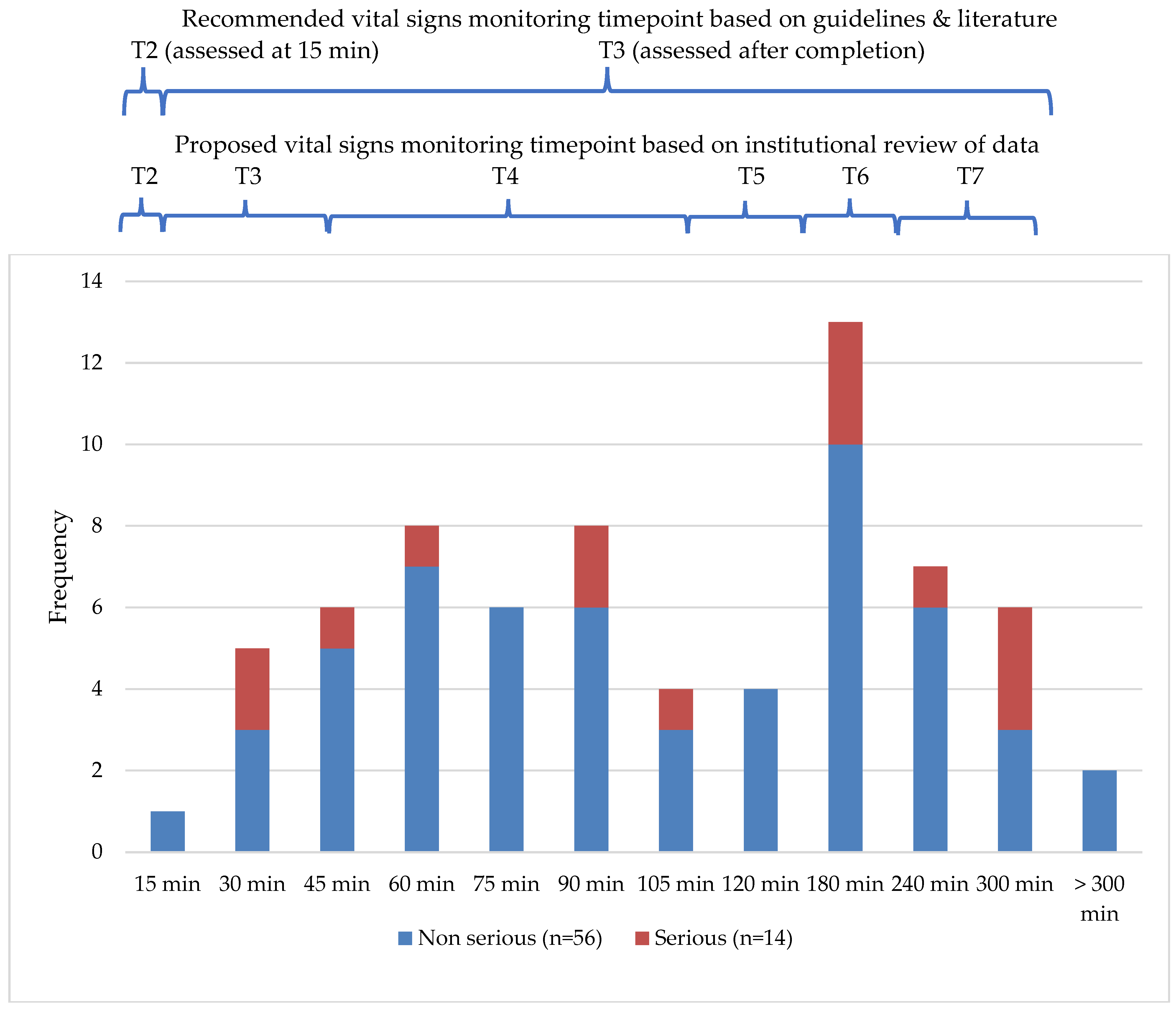
| Time to blood transfusion reaction 0–15 min >15–30 min >30–45 min >45–60 min >60–75 min >75–90 min >90–105 min >105–120 min >120–135 min >135–150 min >150–165 min >165–180 min >180–240 min >240–300 min >300 min | Missing n = 2 (2.8) 1 (1.4) 5 (6.9) 6 (8.3) 9 (12.5) 5 (6.9) 8 (11.2) 4 (5.6) 4 (5.6) 2 (2.8) 2 (2.8) 6 (8.3) 3 (4.2) 7 (9.6) 6 (8.3) 2 (2.8) |
| Reaction Type | Non-Serious (n = 57) | Serious (n = 15) |
|---|---|---|
| Gender | Male (n = 34, 59.6%) | Male (n = 9, 60.0%) |
| Age group | 61–70 years old (n = 11, 19.3%) | 51–60 years old (n = 5, 33.3%) |
| Department | Oncology (n = 17, 29.8%) | Oncology (n = 7, 46.7%) |
| Transfused blood product | RBCs (n = 32, 56.1%) | RBCs (n = 8, 53.3%) |
| Time to reaction | In the second hour (n = 19, 33.3%) | Within the first hour (n = 4, 26.7%) |
| Symptoms | Pre-transfusion fever ≥ 37.5 (n = 10, 76.9%) | Pre-transfusion fever ≥ 37.5 (n = 3, 23.1%) |
| Pre-transfusion SBP < 90 mmHg (n = 0, 0.0%) | Pre-transfusion SBP < 90 mmHg (n = 1, 100%) |
| Time-Points | * Time After Start of Transfusion | |
|---|---|---|
| Before—Existing Protocol | After—Proposed Protocol | |
| T1 | Before transfusion (Baseline—pre) | Before transfusion (Baseline—pre) |
| T2 | Time at 15 min | Time at 15 min |
| T3 | Time at 30 min | Time at 45 min |
| T4 | Time at 45 min | Time at 105 min |
| T5 | Time at 60 min | Time at 165 min |
| T6 | Time at 90 min | Time at 225 min |
| T7 | Time at 120 min | Time > 225 min (1 h post-transfusion) |
| T8 | Time at 180 min | - |
| T9 | Time at 240 min (End of transfusion) | - |
| T10 | Time > 240 min (1 h post-transfusion) | - |
Disclaimer/Publisher’s Note: The statements, opinions and data contained in all publications are solely those of the individual author(s) and contributor(s) and not of MDPI and/or the editor(s). MDPI and/or the editor(s) disclaim responsibility for any injury to people or property resulting from any ideas, methods, instructions or products referred to in the content. |
© 2025 by the authors. Licensee MDPI, Basel, Switzerland. This article is an open access article distributed under the terms and conditions of the Creative Commons Attribution (CC BY) license (https://creativecommons.org/licenses/by/4.0/).
Share and Cite
Mordiffi, S.Z.; Wan, S.W.; Lee, S.Y.; Lim, K.; Tho, P.C.; Lang, S.P.; Ramli, S.S.; Lau, J.; Tan, K.K.; Koh, K.W.L. Optimizing Monitoring Frequency During Blood Transfusions: A Review of Guidelines and a Retrospective Cohort to Define a 7-Point Schedule. Nurs. Rep. 2025, 15, 421. https://doi.org/10.3390/nursrep15120421
Mordiffi SZ, Wan SW, Lee SY, Lim K, Tho PC, Lang SP, Ramli SS, Lau J, Tan KK, Koh KWL. Optimizing Monitoring Frequency During Blood Transfusions: A Review of Guidelines and a Retrospective Cohort to Define a 7-Point Schedule. Nursing Reports. 2025; 15(12):421. https://doi.org/10.3390/nursrep15120421
Chicago/Turabian StyleMordiffi, Siti Zubaidah, Su Wei Wan, Shir Ying Lee, Karen Lim, Poh Chi Tho, Siew Ping Lang, Seri Sastika Ramli, Jerrald Lau, Ker Kan Tan, and Karen Wei Ling Koh. 2025. "Optimizing Monitoring Frequency During Blood Transfusions: A Review of Guidelines and a Retrospective Cohort to Define a 7-Point Schedule" Nursing Reports 15, no. 12: 421. https://doi.org/10.3390/nursrep15120421
APA StyleMordiffi, S. Z., Wan, S. W., Lee, S. Y., Lim, K., Tho, P. C., Lang, S. P., Ramli, S. S., Lau, J., Tan, K. K., & Koh, K. W. L. (2025). Optimizing Monitoring Frequency During Blood Transfusions: A Review of Guidelines and a Retrospective Cohort to Define a 7-Point Schedule. Nursing Reports, 15(12), 421. https://doi.org/10.3390/nursrep15120421