

Domain-Specific Associations Between Physical Activity and Tinnitus in NHANES 2015–2018



Abstract
1. Introduction
2. Materials and Methods
2.1. Participants
2.2. Physical Activity Assessment
2.3. Tinnitus Assessment
2.4. Covariates
2.5. Statistical Analysis
3. Results
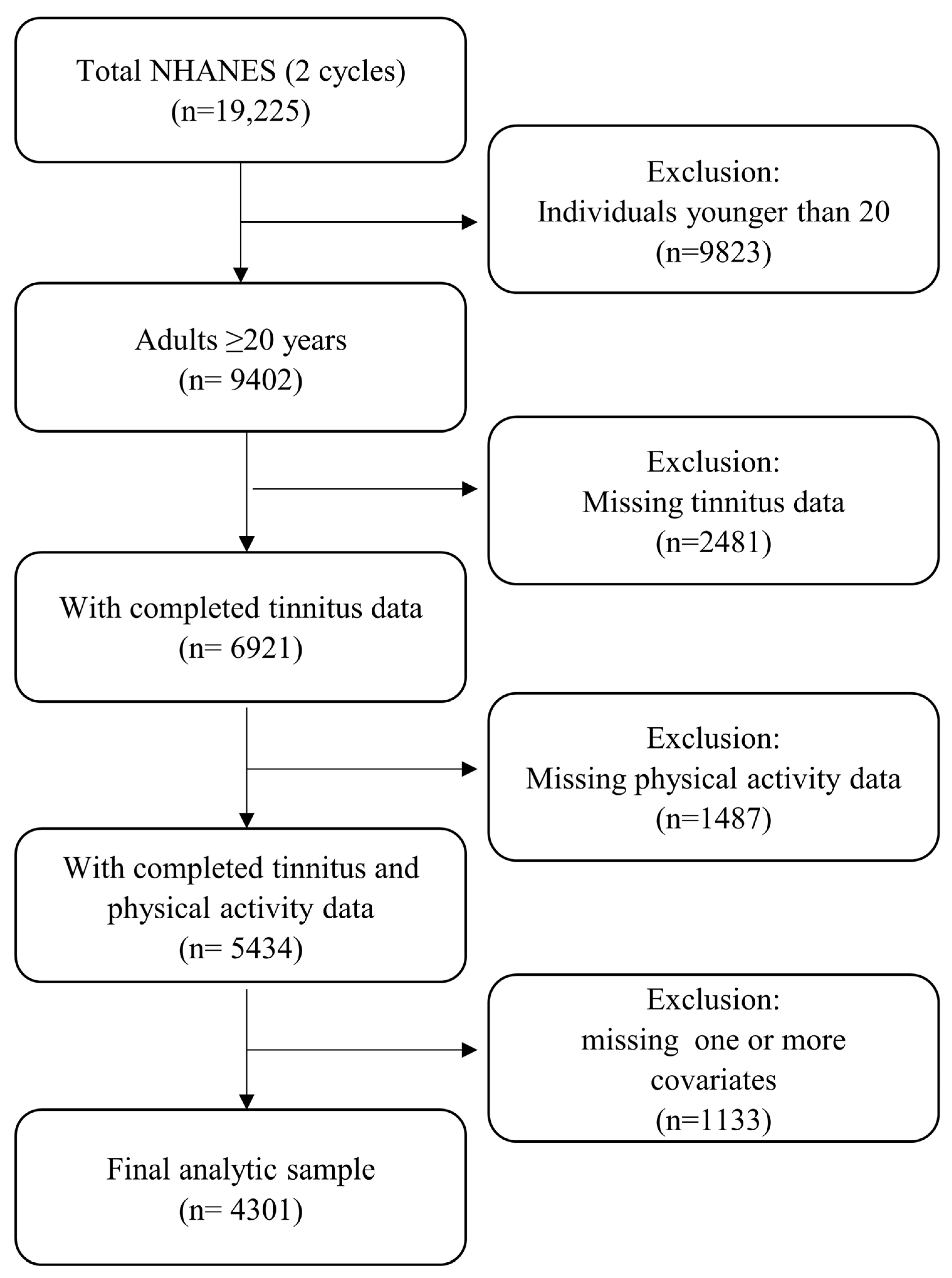
3.1. Study Sample
3.2. Association Between WORK PA and Tinnitus
3.3. Association Between NW PA and Tinnitus
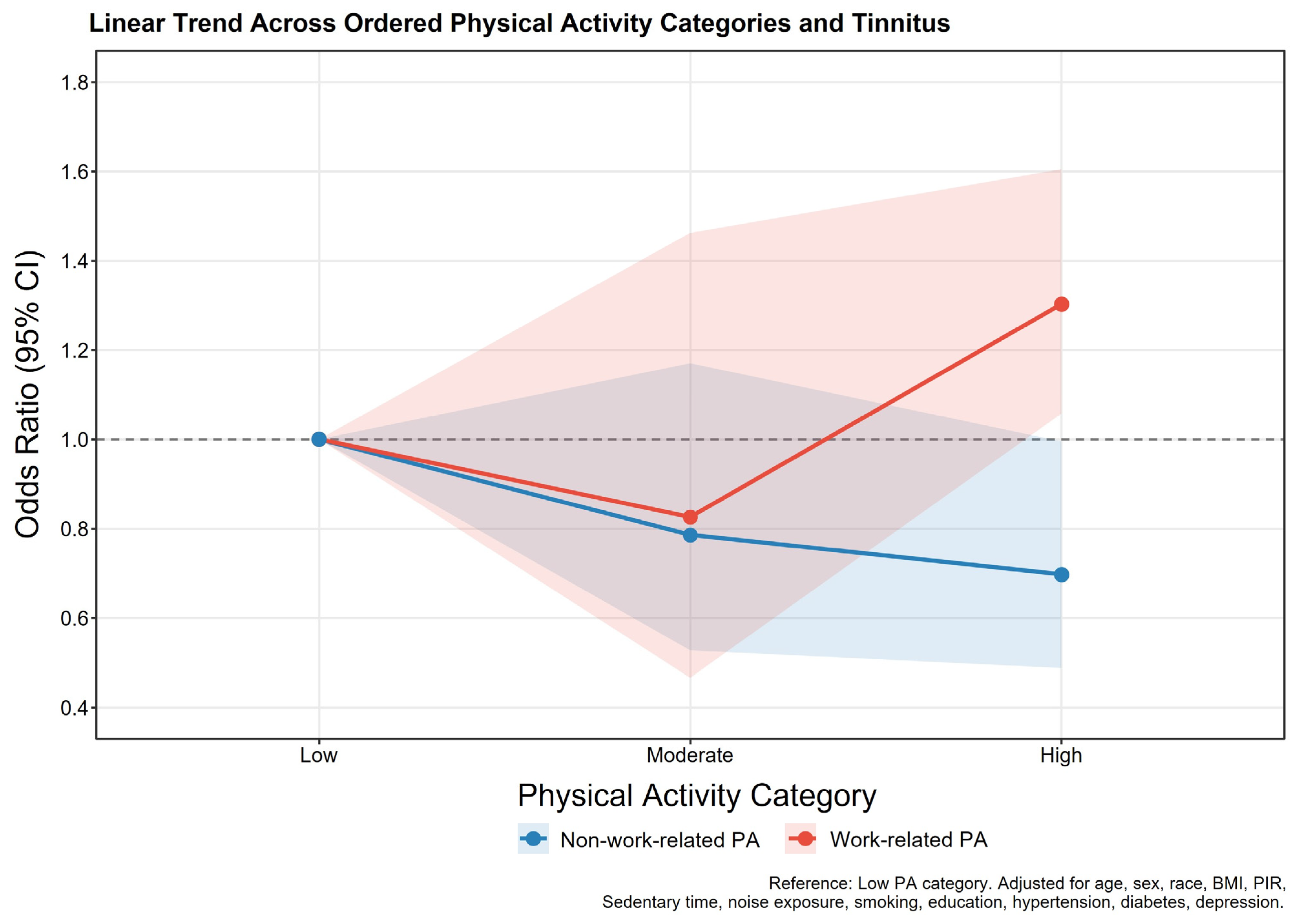
3.4. Trend Analysis
4. Discussion
5. Conclusions
Author Contributions
Funding
Institutional Review Board Statement
Informed Consent Statement
Data Availability Statement
Acknowledgments
Conflicts of Interest
References
- Bhatt, J.M.; Lin, H.W.; Bhattacharyya, N. Prevalence, Severity, Exposures and Treatment Patterns in The United States. JAMA Otolaryngol.-Head Neck Surg. 2016, 142, 959–965. [Google Scholar] [CrossRef] [PubMed]
- Cima, R.F.F.; Mazurek, B.; Haider, H.; Kikidis, D.; Lapira, A.; Noreña, A.; Hoare, D.J. A multidisciplinary European guideline for tinnitus: Diagnostics, assessment, and treatment. HNO 2019, 67, 10–42. [Google Scholar] [CrossRef]
- Kraus, W.E.; Powell, K.E.; Haskell, W.L.; Janz, K.F.; Campbell, W.W.; Jakicic, J.M.; Troiano, R.P.; Sprow, K.; Torres, A.; Piercy, K.L.; et al. Physical Activity, All-Cause and Cardiovascular Mortality, and Cardiovascular Disease. Med. Sci. Sports Exerc. 2019, 51, 1270–1281. [Google Scholar] [CrossRef]
- Mandolesi, L.; Polverino, A.; Montuori, S.; Foti, F.; Ferraioli, G.; Sorrentino, P.; Sorrentino, G. Effects of Physical Exercise on Cognitive Functioning and Wellbeing: Biological and Psychological Benefits. Front. Psychol. 2018, 9, 509. [Google Scholar] [CrossRef]
- Chalimourdas, A.; Hansen, D.; Verboven, K.; Michiels, S. The Relationship Between Physical Activity and Tinnitus Loudness and Severity: A Cross-Sectional Study. Ear Hear. 2025, 46, 1470–1478. [Google Scholar] [CrossRef] [PubMed]
- Loprinzi, P.D.; Lee, H.; Gilham, B.; Cardinal, B.J. Association between accelerometer-assessed physical activity and tinnitus, NHANES 2005–2006. Res. Q. Exerc. Sport 2013, 84, 177–185. [Google Scholar] [CrossRef] [PubMed]
- Chen, S.; Yang, X.; Jiang, Y.; Wu, F.; Li, Y.; Qiu, J.; Tong, B.; Liu, Y. Associations Between Physical Activity, Tinnitus, and Tinnitus Severity. Ear Hear. 2023, 44, 619–626. [Google Scholar] [CrossRef]
- Carpenter-Thompson, J.R.; McAuley, E.; Husain, F.T. Physical Activity, Tinnitus Severity, and Improved Quality of Life. Ear Hear. 2015, 36, 574–581. [Google Scholar] [CrossRef]
- Holtermann, A.; Krause, N.; van der Beek, A.J.; Straker, L. The physical activity paradox: Six reasons why occupational physical activity (OPA) does not confer the cardiovascular health benefits that leisure time physical activity does. Br. J. Sports Med. 2018, 52, 149–150. [Google Scholar] [CrossRef]
- Bull, F.C.; Al-Ansari, S.S.; Biddle, S.; Borodulin, K.; Buman, M.P.; Cardon, G.; Carty, C.; Chaput, J.-P.; Chastin, S.; Chou, R.; et al. World Health Organization 2020 guidelines on physical activity and sedentary behaviour. Br. J. Sports Med. 2020, 54, 1451–1462. [Google Scholar] [CrossRef]
- Wu, S.; Wang, L.; Liu, S.; Qi, J.; Shi, F.; Zhuang, H.; Qian, Y.; Mei, L.; Zhang, M. Relationship between domain-specific physical activity and cognitive function in older adults—Findings from NHANES 2011–2014. Front. Public Health 2024, 12, 1390511. [Google Scholar] [CrossRef]
- Johnson, C.L.; Paulose-Ram, R.; Ogden, C.L.; Carroll, M.D.; Kruszon-Moran, D.; Dohrmann, S.M.; Curtin, L.R. National Health and Nutrition Examination Survey: Analytic Guidelines, 1999–2010; Vital and Health Statistics Series 2; National Center for Health Statistics: Hyattsville, MD, USA, 2013; pp. 1–24.
- Zhu, S.; Ji, L.; He, Z.; Zhang, W.; Tong, Y.; Luo, J.; Hong, Z.; Zhang, Y.; Yu, D.; Zhang, Q.; et al. Association of smoking and osteoarthritis in US (NHANES 1999–2018). Sci. Rep. 2023, 13, 3911. [Google Scholar] [CrossRef]
- Manea, L.; Gilbody, S.; McMillan, D. Optimal cut-off score for diagnosing depression with the Patient Health Questionnaire (PHQ-9): A meta-analysis. CMAJ Can. Med. Assoc. J. 2012, 184, E191–E196. [Google Scholar] [CrossRef]
- Lee, J.; Kim, H.R.; Jang, T.W.; Lee, D.W.; Lee, Y.M.; Kang, M.Y. Occupational physical activity, not leisure-time physical activity, is associated with increased high-sensitivity C reactive protein levels. Occup. Environ. Med. 2021, 78, 86–91. [Google Scholar] [CrossRef]
- Xia, T.; Li, J.; Chen, L. Association of Occupational and Leisure-Time Physical Activity with Allostatic Load. Am. J. Prev. Med. 2024, 67, 328–338. [Google Scholar] [CrossRef]
- Hallman, D.M.; Jørgensen, M.B.; Holtermann, A. On the health paradox of occupational and leisure-time physical activity using objective measurements: Effects on autonomic imbalance. PLoS ONE 2017, 12, e0177042. [Google Scholar] [CrossRef]
- Rgensen, K.J. Permissible loads based on energy expenditure measurements. Ergonomics 1985, 28, 365–369. [Google Scholar] [CrossRef]
- Li, J.; Loerbroks, A.; Angerer, P. Physical activity and risk of cardiovascular disease: What does the new epidemiological evidence show? Curr. Opin. Cardiol. 2013, 28, 575. [Google Scholar] [CrossRef]
- Schubert, N.M.A.; Rosmalen, J.G.M.; Van Dijk, P.; Pyott, S.J. A retrospective cross-sectional study on tinnitus prevalence and disease associations in the Dutch population-based cohort Lifelines. Hear. Res. 2021, 411, 108355. [Google Scholar] [CrossRef]
- Zhang, Y.-P.; Gao, Q.-Y.; Gao, J.-W.; Liang, X.-T.; Guo, D.-C.; Chen, Z.-T.; Wang, J.-F.; Tang, D.-M.; Zhang, H.-F. The association between tinnitus and risk of cardiovascular events and all-cause mortality: Insight from the UK Biobank. Acta Cardiol. 2024, 79, 374–382. [Google Scholar] [CrossRef]
- Britton, M.; Bhatt, I.S. Association Between Tinnitus and Angina Pectoris in U.S. Adults: Evidence from NHANES 2009–2018. Audiol. Res. 2026, 16, 35. [Google Scholar] [CrossRef]
- Korshøj, M.; Hannerz, H.; Marott, J.L.; Schnohr, P.; Prescott, E.I.B.; Clays, E.; Holtermann, A. The Effect of Occupational Lifting on Hypertension Risk: Protocol for a Project Using Data From the Copenhagen City Heart Study. JMIR Res. Protoc. 2018, 7, e93. [Google Scholar] [CrossRef]
- Figueiredo, R.R.; Azevedo, A.A.; Penido, N.D.O. Positive Association between Tinnitus and Arterial Hypertension. Front. Neurol. 2016, 7, 171. [Google Scholar] [CrossRef]
- Kasapis, C.; Thompson, P.D. The Effects of Physical Activity on Serum C-Reactive Protein and Inflammatory Markers: A Systematic Review. J. Am. Coll. Cardiol. 2005, 45, 1563–1569. [Google Scholar] [CrossRef]
- Mennink, L.M.; Aalbers, M.W.; van Dijk, P.; van Dijk, J.M.C. The Role of Inflammation in Tinnitus: A Systematic Review and Meta-Analysis. J. Clin. Med. 2022, 11, 1000. [Google Scholar] [CrossRef]
- Themann, C.L.; Masterson, E.A. Occupational noise exposure: A review of its effects, epidemiology, and impact with recommendations for reducing its burden. J. Acoust. Soc. Am. 2019, 146, 3879–3905. [Google Scholar] [CrossRef]
- Lai, P.-Y.; Lee, C.-Y.; Chang, K.-H.; Chang, Y.-K.; Hsu, Y.-C.; Chiu, I.-M.; Tsai, S.C.-S.; Cho, D.-Y.; Lin, C.-L.; Lin, T.-H.; et al. The Risk of Developing Tinnitus and Air Pollution Exposure. Atmosphere 2025, 16, 618. [Google Scholar] [CrossRef]
- Glicksman, J.T.; Curhan, S.G.; Curhan, G.C. A prospective study of caffeine intake and risk of incident tinnitus. Am. J. Med. 2014, 127, 739–743. [Google Scholar] [CrossRef]
- Dawes, P.; Cruickshanks, K.J.; Marsden, A.; Moore, D.R.; Munro, K.J. Relationship Between Diet, Tinnitus, and Hearing Difficulties. Ear Hear. 2020, 41, 289–299. [Google Scholar] [CrossRef]



| Variable | Overall 1 N = 96,831,795 | No Tinnitus 1 N = 80,052,718 | Tinnitus 1 N = 16,779,077 | p-Value 2 |
|---|---|---|---|---|
| WORK PA | 0.054 | |||
| Low | 2706 (58.0%) | 2304 (58.7%) | 402 (54.5%) | |
| Moderate | 249 (7.2%) | 206 (7.5%) | 43 (5.9%) | |
| High | 1346 (34.8%) | 1093 (33.8%) | 253 (39.6%) | |
| NW PA | <0.001 ** | |||
| Low | 2533 (53.4%) | 2068 (51.1%) | 465 (64.6%) | |
| Moderate | 609 (16.8%) | 526 (17.2%) | 83 (14.9%) | |
| High | 1159 (29.8%) | 1009 (31.7%) | 150 (20.4%) | |
| Age, years | 47.9 (0.48) | 46.7 (0.45) | 53.7 (0.86) | <0.001 ** |
| Sex | 0.142 | |||
| Male | 2118 (48.5%) | 1740 (47.8%) | 378 (52.2%) | |
| Female | 2183 (51.5%) | 1863 (52.2%) | 320 (47.8%) | |
| Race | 0.002 ** | |||
| Mexican American | 693 (8.2%) | 560 (8.2%) | 133 (8.3%) | |
| Other Hispanic | 512 (5.9%) | 439 (6.3%) | 73 (4.2%) | |
| Non-Hispanic White | 1570 (66.9%) | 1252 (65.4%) | 318 (74.0%) | |
| Non-Hispanic Black | 904 (10.5%) | 789 (11.2%) | 115 (7.3%) | |
| Other Race/Multi-racial | 622 (8.4%) | 563 (8.95%) | 59 (6.2%) | |
| Education | 0.036 * | |||
| High school or below | 1882 (33.9%) | 1532 (32.7%) | 350 (39.4%) | |
| Some college or AA degree | 1322 (32.2%) | 1098 (31.9%) | 224 (33.3%) | |
| College graduate or above | 1097 (33.9%) | 973 (35.3%) | 124 (27.3%) | |
| Poverty–income ratio | 3.1 (0.10) | 3.0 (0.09) | 3.1 (0.13) | 0.447 |
| Smoking status | 0.087 | |||
| Never smoker | 2443 (56.2%) | 2120 (57.4%) | 323 (50.6%) | |
| Former smoker | 1029 (25.4%) | 819 (24.8%) | 210 (28.1%) | |
| Current smoker | 829 (18.4%) | 664 (17.8%) | 165 (21.3%) | |
| BMI | 29.6 (0.24) | 29.4 (0.27) | 30.5 (0.41) | 0.030 * |
| Hypertension (Yes) | 1578 (32.9%) | 1217 (30.3%) | 361 (45.4%) | <0.001 * |
| Diabetes (Yes) | 680 (11.9%) | 534 (11.0%) | 146 (16.3%) | 0.004 ** |
| Depression | <0.001 ** | |||
| No | 3952 (92.4%) | 3362 (93.6%) | 590 (86.8%) | |
| Yes | 349 (7.6%) | 241 (6.4%) | 108 (13.2%) | |
| Noise exposure (Yes) | 1769 (41.0%) | 1371 (38.0%) | 398 (55.4%) | <0.001 ** |
| Sedentary time, hour/day | 6.56 (0.09) | 6.51 (0.10) | 6.79 (0.17) | 0.113 |
| Variable | OR (95% CI) | p-Value |
|---|---|---|
| WORK PA | ||
| Low | Reference | |
| Moderate | 0.83 (0.47–1.46) | 0.476 |
| High | 1.30 (1.06–1.60) | 0.018 * |
| Sedentary time (hour/day) | 1.04 (1.002–1.082) | 0.038 * |
| Age | 1.02 (1.02–1.03) | <0.001 ** |
| PIR | 1.06 (0.99–1.14) | 0.097 |
| BMI | 1.01 (0.99–1.03) | 0.517 |
| Sex | ||
| Male | Reference | |
| Female | 1.01 (0.81–1.27) | 0.908 |
| Race | ||
| Mexican American | Reference | |
| Other Hispanic | 0.61 (0.42–0.89) | 0.015 * |
| Non-Hispanic White | 0.84 (0.59–1.2) | 0.300 |
| Non-Hispanic Black | 0.52 (0.37–0.74) | 0.001 ** |
| Other Race/Multi-racial | 0.69 (0.44–1.07) | 0.090 |
| Noise Exposure (Yes) | 1.95 (1.34–2.83) | 0.002 ** |
| Smoking | ||
| Never smoker | Reference | |
| Former smoker | 0.85 (0.58–1.23) | 0.351 |
| Current smoker | 1.05 (0.84–1.30) | 0.656 |
| Education | ||
| High school or below | Reference | |
| Some college or AA degree | 0.92 (0.68–1.24) | 0.561 |
| College graduate or above | 0.73 (0.42–1.28) | 0.246 |
| Hypertension (Yes) | 1.28 (0.93–1.76) | 0.114 |
| Diabetes (Yes) | 0.97 (0.67–1.40) | 0.838 |
| Depression (Yes) | 2.03 (1.40–2.94) | 0.001 ** |
| Variable | OR (95% CI) | p-Value |
|---|---|---|
| NW PA | ||
| Low | Reference | |
| Moderate | 0.79 (0.53–1.17) | 0.211 |
| High | 0.70 (0.488–0.995) | 0.0475 * |
| Sedentary time (hour/day) | 1.00 (0.99–1.06) | 0.148 |
| Age | 1.02 (1.02–1.03) | <0.001 *** |
| PIR | 1.07 (1.00–1.16) | 0.050 |
| BMI | 1.00 (0.98–1.02) | 0.657 |
| Sex | ||
| Male | Reference | |
| Female | 0.97 (0.78–1.22) | 0.779 |
| Race | ||
| Mexican American | Reference | |
| Other Hispanic | 0.62 (0.42–0.91) | 0.019 * |
| Non-Hispanic White | 0.88 (0.61–1.25) | 0.433 |
| Non-Hispanic Black | 0.54 (0.39–0.75) | 0.002 ** |
| Other Race/Multi-racial | 0.68 (0.43–1.06) | 0.080 |
| Noise Exposure (Yes) | 2.02 (1.40–2.91) | 0.001 ** |
| Smoking | ||
| Never smoker | Reference | |
| Former smoker | 0.85 (0.59–1.24) | 0.363 |
| Current smoker | 1.05 (0.85–1.30) | 0.631 |
| Education | ||
| High school or below | Reference | |
| Some college or AA degree | 0.94 (0.70–1.27) | 0.677 |
| College graduate or above | 0.76 (0.44–1.32) | 0.298 |
| Hypertension (Yes) | 1.25 (0.92–1.70) | 0.134 |
| Diabetes (Yes) | 0.96 (0.67–1.39) | 0.832 |
| Depression (Yes) | 1.98 (1.36–2.86) | 0.002 ** |
| Physical Activity Domain | β | OR per Category Increase | p-Value |
|---|---|---|---|
| NW PA | −0.186 | 0.83 (0.696–0.991) | 0.0406 * |
| WORK PA | 0.126 | 1.14 (1.03–1.25) | 0.017 * |
Disclaimer/Publisher’s Note: The statements, opinions and data contained in all publications are solely those of the individual author(s) and contributor(s) and not of MDPI and/or the editor(s). MDPI and/or the editor(s) disclaim responsibility for any injury to people or property resulting from any ideas, methods, instructions or products referred to in the content. |
© 2026 by the authors. Licensee MDPI, Basel, Switzerland. This article is an open access article distributed under the terms and conditions of the Creative Commons Attribution (CC BY) license.
Share and Cite
Britton, M.; Hosick, P.A. Domain-Specific Associations Between Physical Activity and Tinnitus in NHANES 2015–2018. Audiol. Res. 2026, 16, 90. https://doi.org/10.3390/audiolres16030090
Britton M, Hosick PA. Domain-Specific Associations Between Physical Activity and Tinnitus in NHANES 2015–2018. Audiology Research. 2026; 16(3):90. https://doi.org/10.3390/audiolres16030090
Chicago/Turabian StyleBritton, Mitra, and Peter A. Hosick. 2026. "Domain-Specific Associations Between Physical Activity and Tinnitus in NHANES 2015–2018" Audiology Research 16, no. 3: 90. https://doi.org/10.3390/audiolres16030090
APA StyleBritton, M., & Hosick, P. A. (2026). Domain-Specific Associations Between Physical Activity and Tinnitus in NHANES 2015–2018. Audiology Research, 16(3), 90. https://doi.org/10.3390/audiolres16030090