
Binaural Processing Deficits in Autism Spectrum Disorder



Abstract
1. Introduction
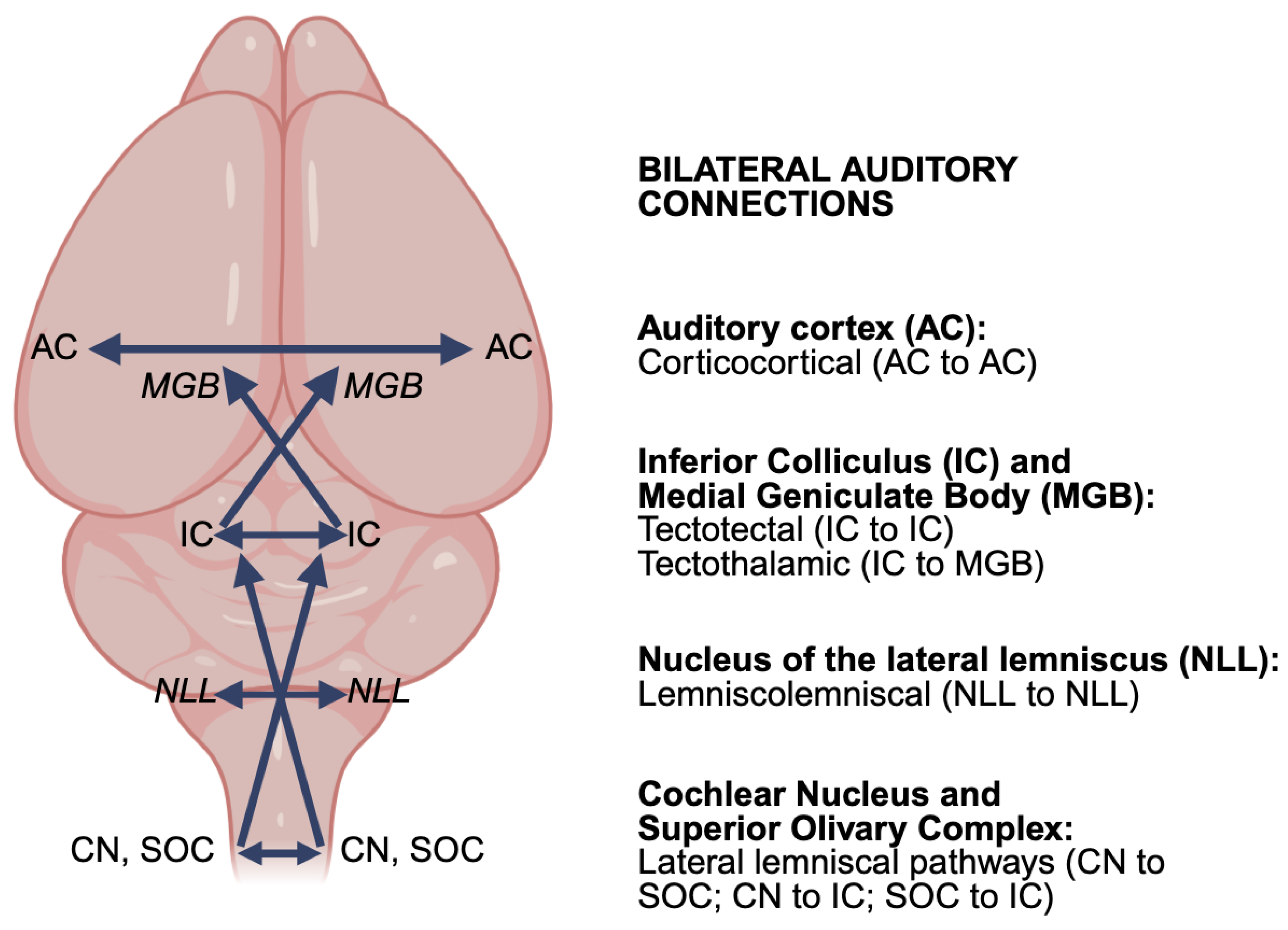
2. Bilateral Connections in the Central Auditory System
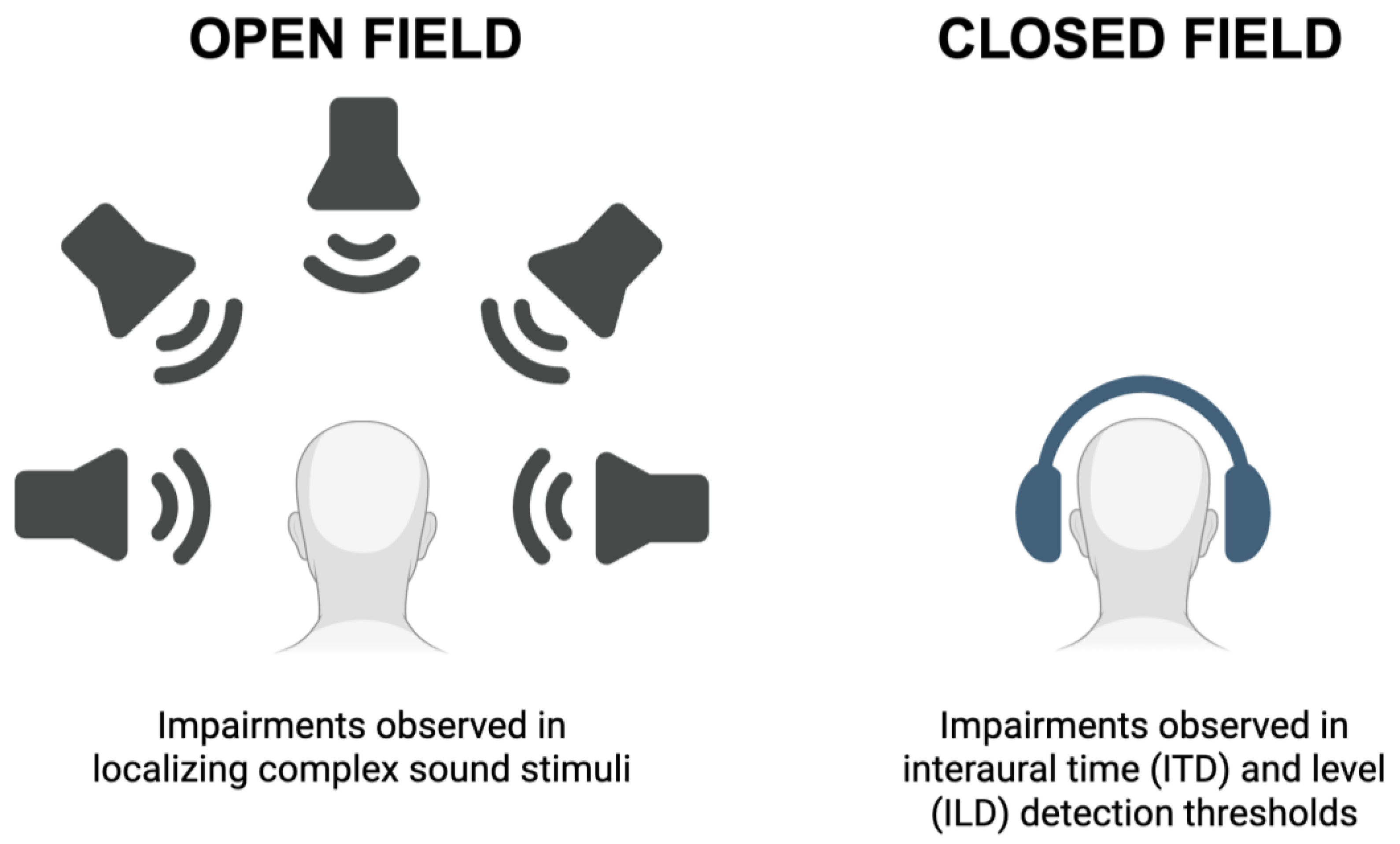
3. Binaural Processing Alterations in Autism Spectrum Disorder
4. Developmental Impact of Binaural Processing Deficits
5. Conclusions
Author Contributions
Funding
Institutional Review Board Statement
Informed Consent Statement
Data Availability Statement
Conflicts of Interest
Abbreviations
| A1 | Primary auditory cortex |
| ASD | Autism spectrum disorder |
| CN | Cochlear nucleus |
| IC | Inferior colliculus |
| ILD | Interaural level difference |
| ITD | Interaural time difference |
| LNTB | Lateral nucleus of the trapezoid body |
| LSO | Lateral superior olivary complex |
| MGB | Medial geniculate body |
| MNTB | Medial nucleus of the trapezoid body |
| MSO | Medial superior olivary complex |
| SOC | Superior olivary complex |
References
- Amaral, D.G.; Schumann, C.M.; Nordahl, C.W. Neuroanatomy of autism. Trends Neurosci. 2008, 31, 137–145. [Google Scholar] [CrossRef]
- Taurines, R.; Schwenck, C.; Westerwald, E.; Sachse, M.; Siniatchkin, M.; Freitag, C. ADHD and autism: Differential diagnosis or overlapping traits? A selective review. Atten. Defic. Hyperact. Disord. 2012, 4, 115–139. [Google Scholar] [CrossRef] [PubMed]
- Belmonte, M.K.; Cook, E.H., Jr.; Anderson, G.M.; Rubenstein, J.L.; Greenough, W.T.; Beckel-Mitchener, A.; Courchesne, E.; Boulanger, L.M.; Powell, S.B.; Levitt, P.R.; et al. Autism as a disorder of neural information processing: Directions for research and targets for therapy. Mol. Psychiatry 2004, 9, 646–663. [Google Scholar] [CrossRef] [PubMed]
- Taheri, A.; Perry, A. Exploring the proposed DSM-5 criteria in a clinical sample. J. Autism Dev. Disord. 2012, 42, 1810–1817. [Google Scholar] [CrossRef] [PubMed]
- Kanner, L. Autistic disturbances of affective contact. Nerv. Child 1943, 2, 217–250. [Google Scholar]
- Lotter, V. Epidemiology of autistic conditions in young children. Soc. Psychiatr. 1967, 1, 163–173. [Google Scholar] [CrossRef]
- Baio, J. Prevalence of autism spectrum disorders—Autism and developmental disabilities monitoring network, 14 Sites, United States, 2008. Morb. Mortal. Wkly. Rep. 2012, 61, 1–19. [Google Scholar]
- Shaw, K.A.; Williams, S.; Patrick, M.E.; Valencia-Prado, M.; Durkin, M.S.; Howerton, E.M.; Ladd-Acosta, C.M.; Pas, E.T.; Bakian, A.V.; Bartholomew, P.; et al. Prevalence and early identification of autism spectrum disorder among children aged 4 and 8 years—Autism and Developmental Disabilities Monitoring Network, 16 Sites, United States, 2022. MMWR Surveill. Summ. 2025, 74, 1–22. [Google Scholar] [CrossRef]
- Kroncke, A.P.; Willard, M.; Huckabee, H. What is Autism? History and foundations. In Assessment of Autism Spectrum Disorder: Critical Issues in Clinical, Forensic and School Settings; Kroncke, A.P., Willard, M., Huckabee, H., Eds.; Springer: Berlin, Germany, 2016; pp. 3–9. [Google Scholar]
- Zeidan, J.; Fombonne, E.; Scorah, J.; Ibrahim, A.; Durkin, M.S.; Saxena, S.; Yusuf, A.; Shih, A.; Elsabbagh, M. Global prevalence of autism: A systematic review update. Autism Res. 2022, 15, 778–790. [Google Scholar] [CrossRef]
- Zablotsky, B.; Black, L.I.; Maenner, M.J.; Schieve, L.A.; Blumberg, S.J. Estimated prevalence of autism and other developmental disabilities following questionnaire changes in the 2014 National Health Interview Survey. Natl. Health Stat. Rep. 2015, 13, 1–20. [Google Scholar]
- Zablotsky, B.; Black, L.I.; Maenner, M.J.; Schieve, L.A.; Danielson, M.L.; Bitsko, R.H.; Blumberg, S.J.; Kogan, M.D.; Boyle, C.A. Prevalence and trends of developmental disabilities among children in the United States: 2009–2017. Pediatrics 2019, 144, e20190811. [Google Scholar] [CrossRef] [PubMed]
- Rogers, S.J.; Ozonoff, S. Annotation: What do we know about sensory dysfunction in autism? A critical review of the empirical evidence. J. Child. Psychol. Psychiatr. 2005, 46, 1255–1268. [Google Scholar] [CrossRef] [PubMed]
- Marco, E.J.; Hinkley, L.B.; Hill, S.S.; Nagarajan, S.S. Sensory processing in autism: A review of neurophysiologic findings. Pediatr. Res. 2011, 69, 48R–54R. [Google Scholar] [CrossRef] [PubMed]
- Hutt, S.; Hutt, C.; Lee, D.; Ounsted, C. A behavioural and electroencephalographic study of autistic children. J. Psychiatr. Res. 1965, 3, 181–197. [Google Scholar] [CrossRef]
- DesLauriers, A.M.; Carlson, C.F. Your Child Is Asleep: Early Infantile Autism: Etiology, Treatment, and Parental Influences; Dorsey Press: Homewood, IL, USA, 1969. [Google Scholar]
- Rimland, B. Infantile Autism: The Syndrome and Its Implications for a Neural Theory of Behavior; Appleton-Century-Crofts: New York, NY, USA, 1964. [Google Scholar]
- Lau, B.K.; Emmons, K.A.; Lee, A.K.C.; Munson, J.; Dager, S.R.; Estes, A.M. The prevalence and developmental course of auditory processing differences in autistic children. Autism Res. 2023, 16, 1413–1424. [Google Scholar] [CrossRef]
- Demopoulos, C.; Skiba, S.A.; Kopald, B.E.; Bangera, N.; Paulson, K.; Lewine, J.D. Associations between rapid auditory processing of speech sounds and specific verbal communication skills in autism. Front. Psychol. 2023, 14, 1223250. [Google Scholar] [CrossRef]
- Soskey, L.N.; Allen, P.D.; Bennetto, L. Auditory spatial attention to speech and complex non-speech sounds in children with autism spectrum disorder. Autism Res. 2017, 10, 1405–1416. [Google Scholar] [CrossRef]
- Poulsen, R.; Williams, Z.; Dwyer, P.; Pellicano, E.; Sowman, P.F.; McAlpine, D. How auditory processing influences the autistic profile: A review. Autism Res. 2024, 17, 2452–2470. [Google Scholar] [CrossRef]
- Key, A.P.; Slaboch, K.D. Speech processing in autism spectrum disorder: An integrative review of auditory neurophysiology findings. J. Speech Lang. Hear. Res. 2021, 64, 4192–4212. [Google Scholar] [CrossRef]
- Ruiz Callejo, D.; Boets, B. A systematic review on speech-in-noise perception in autism. Neurosci. Biobehav. Rev. 2023, 154, 105406. [Google Scholar] [CrossRef]
- Patil, O.; Kaple, M. Sensory processing differences in individuals with autism spectrum disorder: A narrative review of underlying mechanisms and sensory-based interventions. Cureus 2023, 15, e48020. [Google Scholar] [CrossRef] [PubMed]
- Narzisi, A.; Vivanti, G.; Berloffa, S.; Milone, A.; Fantozzi, P.; Tancredi, R.; Sesso, G.; Viglione, V.; Fabbri Destro, M.; Pelagatti, S.; et al. Sensory processing in autism: A call for research and action. Front. Psychol. 2025, 16, 1584893. [Google Scholar] [CrossRef] [PubMed]
- Yin, T.C.T.; Smith, P.H.; Joris, P.X. Neural mechanisms of binaural processing in the auditory brainstem. Compr. Physiol. 2019, 9, 1503–1575. [Google Scholar] [CrossRef] [PubMed]
- Avan, P.; Giraudet, F.; Büki, B. Importance of binaural hearing. Audiol. Neurotol. 2015, 20, 3–6. [Google Scholar] [CrossRef]
- Lee, C.C.; Yanagawa, Y.; Imaizumi, K. Commissural functional topography of the inferior colliculus assessed in vitro. Hear. Res. 2015, 328, 94–101. [Google Scholar] [CrossRef]
- Lee, C.C.; Winer, J.A. Connections of cat auditory cortex: II. Commissural system. J. Comp. Neurol. 2008, 507, 1901–1919. [Google Scholar] [CrossRef]
- Lee, C.C.; Kishan, A.U.; Winer, J.A. Wiring of divergent networks in the central auditory system. Front. Neuroanat. 2011, 5, 46. [Google Scholar] [CrossRef]
- Clarke, B.A.; Lee, C.C. Inhibitory projections in the mouse auditory tectothalamic system. Brain Sci. 2018, 9, 103. [Google Scholar] [CrossRef]
- Glendenning, K.K.; Hutson, K.A.; Nudo, R.J.; Masterton, R.B. Acoustic chiasm II: Anatomical basis of binaurality in lateral superior olive of cat. J. Comp. Neurol. 1985, 232, 261–288. [Google Scholar] [CrossRef]
- Swaminathan, J.; Mason, C.R.; Streeter, T.M.; Best, V.; Roverud, E.; Kidd, G., Jr. Role of binaural temporal fine structure and envelope cues in cocktail-party listening. J. Neurosci. 2016, 36, 8250–8257. [Google Scholar] [CrossRef]
- Carlini, A.; Bordeau, C.; Ambard, M. Auditory localization: A comprehensive practical review. Front. Psychol. 2024, 15, 1408073. [Google Scholar] [CrossRef]
- Młynarski, W. Efficient coding of spectrotemporal binaural sounds leads to emergence of the auditory space representation. Front. Comp. Neurosci. 2014, 8, 26. [Google Scholar]
- Wilson, K.C.; Kornisch, M.; Ikuta, T. Disrupted functional connectivity of the primary auditory cortex in autism. Psychiaty Res. Neuroimag. 2022, 324, 111490. [Google Scholar] [CrossRef] [PubMed]
- Kulesza, R.J., Jr.; Lukose, R.; Stevens, L.V. Malformation of the human superior olive in autistic spectrum disorders. Brain Res. 2011, 1367, 360–371. [Google Scholar] [CrossRef] [PubMed]
- Kulesza, R.J., Jr.; Mangunay, K. Morphological features of the medial superior olive in autism. Brain Res. 2008, 1200, 132–137. [Google Scholar] [CrossRef]
- Schelinski, S.; Tabas, A.; von Kriegstein, K. Altered processing of communication signals in the subcortical auditory sensory pathway in autism. Hum. Brain Mapp. 2022, 43, 1955–1972. [Google Scholar] [CrossRef]
- Karavallil Achuthan, S.; Stavrinos, D.; Argueta, P.; Vanderburgh, C.; Holm, H.B.; Kana, R.K. Thalamic functional connectivity and sensorimotor processing in neurodevelopmental disorders. Front. Neurosci. 2023, 17, 1279909. [Google Scholar] [CrossRef]
- ElMoazen, D.; Sobhy, O.; Abdou, R.; AbdelMotaleb, H. Binaural interaction component of the auditory brainstem response in children with autism spectrum disorder. Int. J. Pediatr. Otorhinolaryngol. 2020, 131, 109850. [Google Scholar] [CrossRef]
- Rosenhall, U.; Nordin, V.; Sandstrom, M. Autism and hearing loss. J. Autism Dev. Disord. 1999, 29, 349–357. [Google Scholar] [CrossRef]
- Fujihira, H.; Itoi, C.; Furukawa, S. Sensitivity to interaural level and time differences in individuals with autism spectrum disorder. Sci. Rep. 2022, 12, 19142. [Google Scholar] [CrossRef]
- Visser, E.; Zwiers, M.P.; Kan, C.C.; Hoekstra, L.; van Opstal, A.J.; Buitelaar, J.K. Atypical vertical sound localization and sound-onset sensitivity in people with autism spectrum disorders. J. Psychiatry Neurosci. 2013, 38, 398–406. [Google Scholar] [CrossRef] [PubMed]
- Sanglakh Ghoochan Atigh, A.; Joghataei, M.T.; Moradkhani, S.; Alizadeh Zarei, M.; Nazari, M.A. Early auditory temporal processing deficit in children with autism spectrum disorder: The research domain criteria framework. Brain Sci. 2024, 14, 896. [Google Scholar] [CrossRef] [PubMed]
- Miron, O.; Beam, A.L.; Kohane, I.S. Auditory brainstem response in infants and children with autism spectrum disorder: A meta-analysis of wave V. Autism Res. 2018, 11, 355–363. [Google Scholar] [CrossRef] [PubMed]
- Samoylov, I.; Arcara, G.; Buyanova, I.; Davydova, E.; Pereverzeva, D.; Sorokin, A.; Tyushkevich, S.; Mamokhina, U.; Danilina, K.; Dragoy, O.; et al. Altered neural synchronization in response to 2 Hz amplitude-modulated tones in the auditory cortex of children with Autism Spectrum Disorder: An MEG study. Int. J. Psychophysiol. 2024, 203, 112405. [Google Scholar] [CrossRef]
- Mann, R.S.; Allman, B.L.; Schmid, S. Developmental changes in electrophysiological properties of auditory cortical neurons in the Cntnap2 knockout rat. J. Neurophysiol. 2023, 129, 937–947. [Google Scholar] [CrossRef]
- Castro, A.C.; Monteiro, P.A. Auditory dysfunction in animal models of autism spectrum disorder. Front. Mol. Neurosci. 2022, 15, 845155. [Google Scholar] [CrossRef]
- Lee, E.; Lee, J.; Kim, E. Excitation/Inhibition imbalance in animal models of autism spectrum disorders. Biol. Psychiatry 2017, 81, 838–847. [Google Scholar] [CrossRef]
- Wilde, C.; Constantin, L.; Thorne, P.R.; Montgomery, J.M.; Scott, E.K.; Cheyne, J.E. Auditory processing in rodent models of autism: A systematic review. J. Neurodev. Dis. 2022, 14, 48. [Google Scholar] [CrossRef]
- Gandhi, T.; Canepa, C.R.; Adeyelu, T.T.; Adeniyi, P.A.; Lee, C.C. Neuroanatomical alterations in the CNTNAP2 mouse model of autism spectrum disorder. Brain Sci. 2023, 13, 891. [Google Scholar] [CrossRef]
- Middlebrooks, J.C. Auditory system: Central pathways. In Encyclopedia of Neuroscience; Squire, L., Ed.; Academic Press: San Diego, CA, USA, 2009; pp. 745–752. [Google Scholar]
- Winer, J.A. The functional architecture of the medial geniculate body and the primary auditory cortex. In Springer Handbook of Auditory Research, Volume 1, The Mammalian Auditory Pathways: Neuroanatomy; Webster, D.B., Popper, A.N., Fay, R.R., Eds.; Springer: New York, NY, USA, 1992; pp. 222–409. [Google Scholar]
- Ryugo, D.K.; Willard, F.H.; Fekete, D.M. Differential afferent projections to the inferior colliculus from the cochlear nucleus in the albino mouse. Brain Res. 1981, 210, 342–349. [Google Scholar] [CrossRef]
- Cant, N.B.; Benson, C.G. Parallel auditory pathways: Projection patterns of the different neuronal populations in the dorsal and ventral cochlear nuclei. Brain Res. Bull. 2003, 60, 457–474. [Google Scholar] [CrossRef] [PubMed]
- Yin, T.C.T.; Chan, J.C.K. Interaural time sensitivity in medial superior olive of cat. J. Neurophysiol. 1990, 64, 465–488. [Google Scholar] [CrossRef] [PubMed]
- Park, T.J.; Klug, A.; Holinstat, M.; Grothe, B. Interaural level difference processing in the lateral superior olive and the inferior colliculus. J. Neurophysiol. 2004, 92, 289–301. [Google Scholar] [CrossRef] [PubMed]
- Franken, T.P.; Roberts, M.T.; Wei, L.; Golding, N.L.; Joris, P.X. In vivo coincidence detection in mammalian sound localization generates phase delays. Nat. Neurosci. 2015, 18, 444–452. [Google Scholar] [CrossRef]
- Nordeen, K.W.; Killackey, H.P.; Kitzes, L.M. Ascending auditory projections to the inferior colliculus in the adult gerbil, Meriones unguiculatus. J. Comp. Neurol. 1983, 214, 131–143. [Google Scholar] [CrossRef]
- Moore, D.R.; Kitzes, L.M. Projections from the cochlear nucleus to the inferior colliculus in normal and neonatally cochlea-ablated gerbils. J. Comp. Neurol. 1985, 240, 180–195. [Google Scholar] [CrossRef]
- Chen, C.; Cheng, M.; Ito, T.; Song, S. Neuronal organization in the inferior colliculus revisited with cell-type-dependent monosynaptic tracing. J. Neurosci. 2018, 38, 3318–3332. [Google Scholar] [CrossRef]
- Imaizumi, K.; Lee, C.C. Auditory thalamocortical transformations. In Encyclopedia of Computational Neuroscience; Jaeger, D., Jung, R., Eds.; Springer: New York, NY, USA, 2022; pp. 315–328. [Google Scholar]
- Winer, J.A.; Miller, L.M.; Lee, C.C.; Schreiner, C.E. Auditory thalamocortical transformation: Structure and function. Trends Neurosci. 2005, 28, 255–263. [Google Scholar] [CrossRef]
- Wenstrup, J.J. The tectothalamic system. In The Inferior Colliculus; Winer, J.A., Schreiner, C.E., Eds.; Springer: New York, NY, USA, 2005; pp. 200–230. [Google Scholar]
- Lee, C.C. Thalamic and cortical pathways supporting auditory processing. Brain Lang. 2013, 126, 22–28. [Google Scholar] [CrossRef]
- Kelly, J.B.; Liscum, A.; van Adel, B.; Ito, M. Projections from the superior olive and lateral lemniscus to tonotopic regions of the rat’s inferior colliculus. Hear. Res. 1998, 116, 43–54. [Google Scholar] [CrossRef]
- Ito, T.; Oliver, D.L. The basic circuit of the IC: Tectothalamic neurons with different patterns of synaptic organization send different messages to the thalamus. Front. Neural Circuits 2012, 6, 48. [Google Scholar] [CrossRef]
- Doucet, J.R.; Ryugo, D.K. Axonal pathways to the lateral superior olive labeled with biotinylated dextran amine injections in the dorsal cochlear nucleus of rats. J. Comp. Neurol. 2003, 461, 452–465. [Google Scholar] [CrossRef] [PubMed]
- Henkel, C.K.; Gabriele, M.L. Organization of the disynaptic pathway from the anteroventral cochlear nucleus to the lateral superior olivary nucleus in the ferret. Anat. Embryol. 1999, 199, 149–160. [Google Scholar] [CrossRef] [PubMed]
- Cant, N.B.; Casseday, J.H. Projections from the anteroventral cochlear nucleus to the lateral and medial superior olivary nuclei. J. Comp. Neurol. 1986, 247, 457–476. [Google Scholar] [CrossRef] [PubMed]
- Couchman, K.; Grothe, B.; Felmy, F. Medial superior olivary neurons receive surprisingly few excitatory and inhibitory inputs with balanced strength and short-term dynamics. J. Neurosci. 2010, 30, 17111–17121. [Google Scholar] [CrossRef]
- Goldberg, J.M.; Brown, P.B. Response of binaural neurons of dog superior olivary complex to dichotic tonal stimuli: Some physiological mechanisms of sound localization. J. Neurophysiol. 1969, 32, 613–636. [Google Scholar] [CrossRef]
- Grothe, B.; Sanes, D.H. Bilateral inhibition by glycinergic afferents in the medial superior olive. J. Neurophysiol. 1993, 69, 1192–1196. [Google Scholar] [CrossRef]
- Tsuchitani, C.; Boudreau, J.C. Single unit analysis of cat superior olive S segment with tonal stimuli. J. Neurophysiol. 1966, 29, 684–697. [Google Scholar] [CrossRef]
- Batra, R.; Kuwada, S.; Fitzpatrick, D.C. Sensitivity to interaural temporal disparities of low- and high-frequency neurons in the superior olivary complex. I. Heterogeneity of responses. J. Neurophysiol. 1997, 78, 1222–1236. [Google Scholar] [CrossRef]
- Tsuchitani, C. Functional organization of lateral cell groups of cat superior olivary complex. J. Neurophysiol. 1977, 40, 296–318. [Google Scholar] [CrossRef]
- Casseday, J.H.; Fremouw, T.; Covey, E. The inferior colliculus: A hub for the central auditory system. In Springer Handbook of Auditory Research, Volume 15: Integrative Functions in the Mammalian Auditory Pathway; Oertel, D., Popper, A.N., Fay, R.R., Eds.; Springer: New York, NY, USA, 2002; Volume 15, pp. 238–295. [Google Scholar]
- Winer, J.A. Decoding the auditory corticofugal systems. Hear. Res. 2006, 212, 1–8. [Google Scholar] [CrossRef] [PubMed]
- Reetz, G.; Ehret, G. Inputs from three brainstem sources to identified neurons of the mouse inferior colliculus slice. Brain Res. 1999, 816, 527–543. [Google Scholar] [CrossRef] [PubMed]
- Winer, J.A.; Schreiner, C.E. (Eds.) The Inferior Colliculus; Springer: New York, NY, USA, 2005; p. 705. [Google Scholar]
- Saldaña, E.; Merchán, M.A. Intrinsic and commissural connections of the rat inferior colliculus. J. Comp. Neurol. 1992, 319, 417–437. [Google Scholar] [CrossRef] [PubMed]
- Smith, P.H. Anatomy and physiology of multipolar cells in the rat inferior collicular cortex using the in vitro brain slice technique. J. Neurosci. 1992, 12, 3700–3715. [Google Scholar] [CrossRef]
- Moore, D.R.; Kotak, V.C.; Sanes, D.H. Commissural and lemniscal synaptic input to the gerbil inferior colliculus. J. Neurophysiol. 1998, 80, 2229–2236. [Google Scholar] [CrossRef]
- Ma, J.; Han, Y.; Yao, Y.; Wang, H.; Chen, M.; Fu, Z.; Chen, Q.; Tang, J. Investigation of neuron latency modulated by bilateral inferior collicular interactions using whole-cell patch clamp recording in brain slices. Neural Plast. 2021, 2021, 8030870. [Google Scholar] [CrossRef]
- Anair, J.D.; Silveira, M.A.; Mirjalili, P.; Beebe, N.L.; Schofield, B.R.; Roberts, M.T. Inhibitory NPY neurons provide a large and heterotopic commissural projection in the inferior colliculus. Front. Neural Circuits 2022, 16, 871924. [Google Scholar] [CrossRef]
- Orton, L.D.; Rees, A. Intercollicular commissural connections refine the representation of sound frequency and level in the auditory midbrain. eLife 2014, 3, e03764. [Google Scholar] [CrossRef]
- Malmierca, M.S.; Hernández, O.; Falconi, A.; Lopez-Poveda, E.A.; Merchán, M.; Rees, A. The commissure of the inferior colliculus shapes frequency response areas in rat: An in vivo study using reversible blockade with microinjection of kynurenic acid. Exp. Brain Res. 2003, 153, 522–529. [Google Scholar] [CrossRef]
- Orton, L.D.; Papasavvas, C.A.; Rees, A. Commissural gain control enhances the midbrain representation of sound location. J. Neurosci. 2016, 36, 4470–4481. [Google Scholar] [CrossRef]
- Mellott, J.G.; Foster, N.L.; Nakamoto, K.T.; Motts, S.D.; Schofield, B.R. Distribution of GABAergic cells in the inferior colliculus that project to the thalamus. Front. Neuroanat. 2014, 8, 17. [Google Scholar] [CrossRef]
- Winer, J.A.; Saint Marie, R.L.; Larue, D.T.; Oliver, D.L. GABAergic feedforward projections from the inferior colliculus to the medial geniculate body. Proc. Natl. Acad. Sci. USA 1996, 93, 8005–8010. [Google Scholar] [CrossRef] [PubMed]
- Mellott, J.G.; Beebe, N.L.; Schofield, B.R. Bilateral projections to the thalamus from individual neurons in the inferior colliculus. J. Comp. Neurol. 2019, 527, 1118–1126. [Google Scholar] [CrossRef] [PubMed]
- Pan, J.; Yang, C.; Li, R.; Li, J.; Sun, P.; Liu, Y.; Liu, K.; Liao, X.; Jia, H.; Yu, Z.; et al. Brain-wide atlas of outputs and inputs of mouse auditory cortex revealed by modified viral labeling strategies. Fundam. Res. 2025. [Google Scholar] [CrossRef]
- Rouiller, E.M.; Simm, G.M.; Villa, A.E.; de Ribaupierre, Y.; de Ribaupierre, F. Auditory corticocortical interconnections in the cat: Evidence for parallel and hierarchical arrangement of the auditory cortical areas. Exp. Brain Res. 1991, 86, 483–505. [Google Scholar] [CrossRef]
- Kaas, J.H.; Hackett, T.A. Subdivisions of auditory cortex and processing streams in primates. Proc. Natl. Acad. Sci. USA 2000, 97, 11793–11799. [Google Scholar] [CrossRef]
- Lee, C.C.; Winer, J.A. Convergence of thalamic and cortical pathways in cat auditory cortex. Hear. Res. 2011, 274, 85–94. [Google Scholar] [CrossRef]
- Code, R.A.; Winer, J.A. Columnar organization and reciprocity of commissural connections in cat primary auditory cortex (AI). Hear. Res. 1986, 23, 205–222. [Google Scholar] [CrossRef]
- Imig, T.J.; Brugge, J.F. Sources and terminations of callosal axons related to binaural and frequency maps in primary auditory cortex of the cat. J. Comp. Neurol. 1978, 182, 637–660. [Google Scholar] [CrossRef]
- Kelly, J.P.; Wong, D. Laminar connections of the cat’s auditory cortex. Brain Res. 1981, 212, 1–15. [Google Scholar] [CrossRef]
- Middlebrooks, J.C.; Dykes, R.W.; Merzenich, M.M. Binaural response-specific bands in primary auditory cortex (AI) of the cat: Topographical organization orthogonal to isofrequency contours. Brain Res. 1980, 18, 31–48. [Google Scholar] [CrossRef]
- de la Mothe, L.A.; Blumell, S.; Kajikawa, Y.; Hackett, T.A. Cortical connections of the auditory cortex in marmoset monkeys: Core and medial belt regions. J. Comp. Neurol. 2006, 496, 27–71. [Google Scholar] [CrossRef] [PubMed]
- de la Mothe, L.A.; Blumell, S.; Kajikawa, Y.; Hackett, T.A. Cortical connections of auditory cortex in marmoset monkeys: Lateral belt and parabelt regions. Anat. Rec. 2012, 295, 800–821. [Google Scholar] [CrossRef] [PubMed]
- Rock, C.; Zurita, H.; Lebby, S.; Wilson, C.J.; Apicella, A.J. Cortical circuits of callosal GABAergic neurons. Cereb. Cortex 2018, 28, 1154–1167. [Google Scholar] [CrossRef]
- Poirier, P.; Lepore, F.; Provençal, C.; Ptito, M.; Guillemot, J.P. Binaural noise stimulation of auditory callosal fibers of the cat: Responses to interaural time delays. Exp. Brain Res. 1995, 104, 30–40. [Google Scholar] [CrossRef] [PubMed]
- Molis, M.R.; Reiss, L.A.J. How abnormal binaural fusion explains hearing in noise difficulties. Hear. J. 2021, 74, 34–36. [Google Scholar] [CrossRef]
- Lepore, F.; Lassonde, M.; Poirier, P.; Schiavetto, A.; Veillette, N. Midline sensory integration in callosal agenesis. In Advances in Behavioral Biology; Lassonde, M., Jeeves, M.A., Eds.; Springer: Boston, MA, USA, 1994; Volume 42. [Google Scholar]
- Bertero, A.; Garcia, C.; Apicella, A.J. Corticofugal VIP Gabaergic projection neurons in the mouse auditory and motor cortex. Front. Neural Circuits 2021, 15, 714780. [Google Scholar] [CrossRef]
- Saldaña, E.; Feliciano, M.; Mugnaini, E. Distribution of descending projections from primary auditory neocortex to inferior colliculus mimics the topography of intracollicular projections. J. Comp. Neurol. 1996, 371, 15–40. [Google Scholar] [CrossRef]
- Terreros, G.; Delano, P.H. Corticofugal modulation of peripheral auditory responses. Front. Syst. Neurosci. 2015, 9, 134. [Google Scholar] [CrossRef]
- Keating, P.; Dahmen, J.C.; King, A.J. Context-specific reweighting of auditory spatial cues following altered experience during development. Curr. Biol. 2013, 23, 1291–1299. [Google Scholar] [CrossRef]
- Yamoah, E.N.; Pavlinkova, G.; Fritzsch, B. Molecular cascades that build and connect auditory neurons from hair cells to the auditory cortex. J. Exp. Neurol. 2025, 6, 111–120. [Google Scholar] [CrossRef]
- Lee, M.Y.; Kim, D.H.; Park, S.K.; Jun, S.B.; Lee, Y.; Choi, J.J.; Yoo, H.J.; Raphael, Y.; Oh, S.H. Disappearance of contralateral dominant neural activity of auditory cortex after single-sided deafness in adult rats. Neurosci. Lett. 2017, 657, 171–178. [Google Scholar] [CrossRef] [PubMed]
- Krasewicz, J.; Yu, W.M. Eph and ephrin signaling in the development of the central auditory system. Dev. Dyn. 2023, 252, 10–26. [Google Scholar] [CrossRef] [PubMed]
- Mrsic-Flogel, T.D.; Versnel, H.; King, A.J. Development of contralateral and ipsilateral frequency representations in ferret primary auditory cortex. Eur. J. Neurosci. 2006, 23, 780–792. [Google Scholar] [CrossRef] [PubMed]
- Kral, A. Auditory critical periods: A review from system’s perspective. Neuroscience 2013, 247, 117–133. [Google Scholar] [CrossRef]
- Persic, D.; Thomas, M.E.; Pelekanos, V.; Ryugo, D.K.; Takesian, A.E.; Krumbholz, K.; Pyott, S.J. Regulation of auditory plasticity during critical periods and following hearing loss. Hear. Res. 2020, 397, 107976. [Google Scholar] [CrossRef]
- Gonçalves, A.M.; Monteiro, P. Autism Spectrum Disorder and auditory sensory alterations: A systematic review on the integrity of cognitive and neuronal functions related to auditory processing. J. Neural Transm. 2023, 130, 325–408. [Google Scholar] [CrossRef]
- Watanabe, T.; Rees, G. Anatomical imbalance between cortical networks in autism. Sci. Rep. 2016, 6, 31114. [Google Scholar] [CrossRef]
- Wang, J.; Wang, X.; Wang, R.; Duan, X.; Chen, H.; He, C.; Zhai, J.; Wu, L.; Chen, H. Atypical resting-state functional connectivity of intra/inter-sensory networks is related to symptom severity in young boys with autism spectrum disorder. Front. Physiol. 2021, 12, 626338. [Google Scholar] [CrossRef]
- Azouz, H.G.; Kozou, H.; Khalil, M.; Abdou, R.M.; Sakr, M. The correlation between central auditory processing in autistic children and their language processing abilities. Int. J. Pediatr. Otorhinolaryngol. 2014, 78, 2297–2300. [Google Scholar] [CrossRef]
- Demopoulos, C.; Lewine, J.D. Audiometric profiles in autism spectrum disorders: Does subclinical hearing loss impact communication? Autism Res. 2016, 9, 107–120. [Google Scholar] [CrossRef] [PubMed]
- Teder-Sälejärvi, W.A.; Pierce, K.L.; Courchesne, E.; Hillyard, S.A. Auditory spatial localization and attention deficits in autistic adults. Brain Res. Cogn. Brain Res. 2005, 23, 221–234. [Google Scholar] [CrossRef] [PubMed]
- Skewes, J.C.; Gebauer, L. Brief report: Suboptimal auditory localization in autism spectrum disorder: Support for the bayesian account of sensory symptoms. J. Autism Dev. Disord. 2016, 46, 2539–2547. [Google Scholar] [CrossRef] [PubMed]
- Groen, W.B.; van Orsouw, L.; Huurne, N.; Swinkels, S.; van der Gaag, R.J.; Buitelaar, J.K.; Zwiers, M.P. Intact spectral but abnormal temporal processing of auditory stimuli in autism. J. Autism Dev. Disord. 2009, 39, 742–750. [Google Scholar] [CrossRef]
- Lepistö, T.; Kuitunen, A.; Sussman, E.; Saalasti, S.; Jansson-Verkasalo, E.; Nieminen-von Wendt, T.; Kujala, T. Auditory stream segregation in children with Asperger syndrome. Biol. Psychol. 2009, 82, 301–307. [Google Scholar] [CrossRef]
- Osorio, S.; Tan, J.; Levine, G.; Ahlfors, S.P.; Graham, S.; Mamashli, F.; Khan, S.; Joseph, R.M.; Nayal, Z.; Losh, A.; et al. Lower cortical activation and altered functional connectivity characterize passive auditory spatial attention in ASD. Autism Res. 2025, 18, 2240–2253. [Google Scholar] [CrossRef]
- Lodhia, V.; Hautus, M.J.; Johnson, B.W.; Brock, J. Atypical brain responses to auditory spatial cues in adults with autism spectrum disorder. Eur. J. Neurosci. 2018, 47, 682–689. [Google Scholar] [CrossRef]
- Brock, J.; Bzishvili, S.; Reid, M.; Hautus, M.; Johnson, B.W. Brief report: Atypical neuromagnetic responses to illusory auditory pitch in children with autism spectrum disorders. J. Autism Dev. Disord. 2013, 43, 2726–2731. [Google Scholar] [CrossRef]
- Lodhia, V.; Brock, J.; Johnson, B.W.; Hautus, M.J. Reduced object related negativity response indicates impaired auditory scene analysis in adults with autistic spectrum disorder. PeerJ 2014, 25, e261. [Google Scholar] [CrossRef]
- Sampath, S.; Aisha, S.; Neelamegarajan, D.; Jain, C.; Nisha, K.V. Comparison of a free-field and a closed-field sound source identification paradigms in assessing spatial acuity in adults with normal hearing sensitivity. J. Audiol. Otol. 2023, 27, 219–226. [Google Scholar] [CrossRef]
- Seif, A.; Shea, C.; Schmid, S.; Stevenson, R.A. A systematic review of brainstem contributions to autism spectrum disorder. Front. Integr. Neurosci. 2021, 15, 760116. [Google Scholar] [CrossRef]
- Mansour, Y.; Kulesza, R. Three dimensional reconstructions of the superior olivary complex from children with autism spectrum disorder. Hear. Res. 2020, 393, 107974. [Google Scholar] [CrossRef] [PubMed]
- Abbeduto, L.; McDuffie, A.; Thurman, A.J. The fragile X syndrome–autism comorbidity: What do we really know? Front. Genet. 2014, 5, 355. [Google Scholar]
- McCullagh, E.A.; Poleg, S.; Greene, N.T.; Huntsman, M.M.; Tollin, D.J.; Klug, A. Characterization of auditory and binaural spatial hearing in a Fragile X Syndrome mouse model. eNeuro 2020, 7, ENEURO.0300-0319.2019. [Google Scholar] [CrossRef] [PubMed]
- Chawla, A.; McCullagh, E.A. Auditory brain stem responses in the C57BL/6J Fragile X Syndrome-knockout mouse model. Front. Integr. Neurosci. 2022, 15, 803483. [Google Scholar] [CrossRef]
- Gallun, F.J. Impaired binaural hearing in adults: A selected review of the literature. Front. Neurosci. 2021, 15, 610957. [Google Scholar] [CrossRef]
- Davidson, M.M.; Weismer, S.E. A discrepancy in comprehension and production in early language development in ASD: Is it clinically relevant? J. Autism Dev. Disord. 2017, 47, 2163–2175. [Google Scholar] [CrossRef]
- Haebig, E.; Kaushanskaya, M.; Ellis Weismer, S. Lexical processing in school-age children with autism spectrum disorder and children with specific language impairment: The role of semantics. J. Autism Dev. Disord. 2015, 45, 4109–4123. [Google Scholar] [CrossRef]
- Félix, J.; Santos, M.E.; Benitez-Burraco, A. Specific language impairment, autism spectrum disorders and social (pragmatic) communication disorders: Is there overlap in language deficits? A review. J. Autism Dev. Disord. 2024, 11, 86–106. [Google Scholar] [CrossRef]
- Kellerman, G.R.; Fan, J.; Gorman, J.M. Auditory abnormalities in autism: Toward functional distinctions among findings. CNS Spectr. 2005, 10, 748–756. [Google Scholar] [CrossRef]
- Foss-Feig, J.H.; Schauder, K.B.; Key, A.P.; Wallace, M.T.; Stone, W.L. Audition-specific temporal processing deficits associated with language function in children with autism spectrum disorder. Autism Res. 2017, 10, 845–1856. [Google Scholar] [CrossRef] [PubMed]
- Reindal, L.; Nærland, T.; Weidle, B.; Lydersen, S.; Andreassen, O.A.; Sund, A.M. Structural and Pragmatic Language Impairments in Children Evaluated for Autism Spectrum Disorder (ASD). J. Autism Dev. Disord. 2023, 53, 701–719. [Google Scholar] [CrossRef] [PubMed]
- Unruh, K.E.; Sasson, N.J.; Shafer, R.L.; Whitten, A.; Miller, S.J.; Turner-Brown, L.; Bodfish, J.W. Social orienting and attention is influenced by the presence of competing nonsocial information in adolescents with autism. Front. Neurosci. 2016, 10, 586. [Google Scholar] [CrossRef] [PubMed]
- Hedger, N.; Dubey, I.; Chakrabarti, B. Social orienting and social seeking behaviors in ASD. A meta analytic investigation. Neurosci. Biobehav. Rev. 2020, 119, 376–395. [Google Scholar] [CrossRef]
- Tsuji, Y.; Imaizumi, S. Autistic traits and speech perception in social and non-social noises. Sci. Rep. 2024, 14, 1414. [Google Scholar] [CrossRef]
- Poulsen, R.; Tan, D.W.; Sowman, P.F.; McAlpine, D.; Pellicano, E. Auditory environments influence the link between Autistic traits and quality of life. Sci. Rep. 2025, 15, 10612. [Google Scholar] [CrossRef]
- Danesh, A.A.; Howery, S.; Aazh, H.; Kaf, W.; Eshraghi, A.A. Hyperacusis in autism spectrum disorders. Audiol. Res. 2021, 11, 547–556. [Google Scholar] [CrossRef]
- Rodier, P.M.; Hyman, S.L. Early environmental factors in autism. Ment. Retard. Dev. Disabil. Res. Rev. 1998, 4, 121–128. [Google Scholar] [CrossRef]
- Williams, Z.J.; He, J.L.; Cascio, C.J.; Woynaroski, T.G. A review of decreased sound tolerance in autism: Definitions, phenomenology, and potential mechanisms. Neurosci. Biobehav. Rev. 2021, 121, 1–17. [Google Scholar] [CrossRef]
- Doron, N.N.; Ledoux, J.E. Organization of projections to the lateral amygdala from auditory and visual areas of the thalamus in the rat. J. Comp. Neurol. 1999, 412, 383–409. [Google Scholar] [CrossRef]
- Kawakami, S.; Otsuka, S. Multisensory processing in autism spectrum disorders. In Autism Spectrum Disorders [Internet]; Grabrucker, A.M., Ed.; Exon Publications: Brisbane, Australia, 2021. [Google Scholar]
- Stevenson, R.A.; Siemann, J.K.; Schneider, B.C.; Eberly, H.E.; Woynaroski, T.G.; Camarata, S.M.; Wallace, M.T. Multisensory temporal integration in autism spectrum disorders. J. Neurosci. 2014, 34, 691–697. [Google Scholar] [CrossRef]
- Dwyer, P.; Takarae, Y.; Zadeh, I.; Rivera, S.M.; Saron, C.D. Multisensory integration and interactions across vision, hearing, and somatosensation in autism spectrum development and typical development. Neuropsychologia 2022, 175, 108340. [Google Scholar] [CrossRef]
- Feldman, J.I.; Dunham, K.; Cassidy, M.; Wallace, M.T.; Liu, Y.; Woynaroski, T.G. Audiovisual multisensory integration in individuals with autism spectrum disorder: A systematic review and meta-analysis. Neurosci. Biobehav. Rev. 2018, 95, 220–234. [Google Scholar] [CrossRef]



| Study | Results |
|---|---|
| Teder-Sälejärvi (2005) Ref. [122] | Behavior: Males with ASD (29–39 years old) exhibited a reduction in performance in identifying a sound source in a noisy open-field environment, although performance was unaffected in a simple localization task. EEG: Individuals with ASD exhibited a more shallow fall-off of the N1 auditory event-related potentials in the noisy sound localization task. |
| Visser et al. (2013) Ref. [44] | Behavior: Adults with ASD (~27 years old) exhibited worse performance in localizing sound in the vertical but not the horizontal domain in an open field. In addition, individuals with ASD exhibited shorter temporal binding windows for the precedence effect. |
| Brock et al. (2013) Ref. [128] | MEG: Boys with ASD (8–11 years old) lacked an object-related negativity response in both hemispheres and exhibited increased differential responses in the right hemisphere to pitch stimuli, when presented with a dichotic stimulus with ITD-related cues. |
| Lodhia et al. (2014) Ref. [129] | EEG: Adults with ASD (~22 years old) exhibited a reduction in the object-related negativity response, but no change in the P400 response, when presented with a dichotic stimulus with ITD-related cues. |
| Skewes and Gebauer (2016) Ref. [123] | Behavior: Adults with ASD (~27 years old) exhibited poorer performance in a horizontal sound localization task, i.e., pure-tone, sound intensity panned between left and right headphones. Performance of individuals with ASD was ‘more sub-optimal’ than that of controls, based on a Bayesian signal-detection model. |
| Soskey et al. (2017) Ref. [20] | Behavior: Youths with ASD (10–17 years old) exhibited worse performance on focusing on sound cues originating from in front of them in an open field. Performance deficits were correlated with severity of ASD diagnoses. |
| Lodhia et al. (2018) Ref. [127] | Behavior: Adults with ASD (~25 years old) exhibited no difference in auditory object formation based on dichotic pitch stimuli delivered through headphones. EEG: Object-related negativity response was absent for ITD-related cues, but not ILD-related cues. |
| ElMoazen et al. (2020) Ref. [41] | ABR: Children with ASD (years old) exhibited decreases in the predicted amplitude of the binaural interaction component of the auditory brainstem response, between peaks IV and VI. |
| Fujihira et al. (2022) Ref. [43] | Behavior: Adults with ASD (20–45 years old) exhibited higher threshold sensitivity to ITD and ILD cues presented through headphones. Sensitivity to ITD cues varied across a greater range, while ILD sensitivity was not as diversely distributed. |
| Osorio et al. (2025) Ref. [126] | MEG: Children with ASD (6–17 years old) exhibited reduced auditory cortical activation and altered functional connectivity between frontoparietal and auditory cortices, in an ITD swapping ‘jump’ stimulus presented through headphones. |
Disclaimer/Publisher’s Note: The statements, opinions and data contained in all publications are solely those of the individual author(s) and contributor(s) and not of MDPI and/or the editor(s). MDPI and/or the editor(s) disclaim responsibility for any injury to people or property resulting from any ideas, methods, instructions or products referred to in the content. |
© 2026 by the authors. Licensee MDPI, Basel, Switzerland. This article is an open access article distributed under the terms and conditions of the Creative Commons Attribution (CC BY) license.
Share and Cite
Kara, J.A.; Vaughn, T.B.; Gandhi, T.; Lee, C.C. Binaural Processing Deficits in Autism Spectrum Disorder. Audiol. Res. 2026, 16, 34. https://doi.org/10.3390/audiolres16020034
Kara JA, Vaughn TB, Gandhi T, Lee CC. Binaural Processing Deficits in Autism Spectrum Disorder. Audiology Research. 2026; 16(2):34. https://doi.org/10.3390/audiolres16020034
Chicago/Turabian StyleKara, John A., Tashonda B. Vaughn, Tanya Gandhi, and Charles C. Lee. 2026. "Binaural Processing Deficits in Autism Spectrum Disorder" Audiology Research 16, no. 2: 34. https://doi.org/10.3390/audiolres16020034
APA StyleKara, J. A., Vaughn, T. B., Gandhi, T., & Lee, C. C. (2026). Binaural Processing Deficits in Autism Spectrum Disorder. Audiology Research, 16(2), 34. https://doi.org/10.3390/audiolres16020034