
Endolymphatic Sac Surgery in Refractory Ménière’s Disease: Exploratory Associations and Postoperative Clinical Outcomes in a Bicentric Cohort

 , , , , , , , and
Abstract
1. Introduction
2. Materials and Methods
2.1. Patients
2.2. Surgical Techniques
2.3. Evaluation of Surgical Efficacy
2.4. Hearing Assessment
2.5. Vertigo Assessment
2.6. Ct Morphological Assessment
2.7. Statistical Analysis
3. Results
3.1. Exploratory Analysis of Factors Associated with Surgical Success and Failure
3.1.1. Demographic and Clinical Factors
3.1.2. Disease Duration
3.1.3. Vertigo Characteristics
3.1.4. Preoperative Hearing
3.1.5. CT Morphology of the Vestibular Aqueduct
3.2. Functional Outcomes
3.2.1. Early Postoperative Vertigo
3.2.2. Vertigo During Postoperative Follow-Up
3.2.3. Pure-Tone Audiometry Postoperatively
3.2.4. Speech Audiometry Postoperatively
3.2.5. Need for Additional Surgical or Non-Conservative Treatment
3.2.6. Postoperative Complications
4. Discussion
4.1. Exploratory Findings on Potential Prognostic Factors
4.2. Vertigo Control
4.3. Preservation of Hearing
4.4. Limitations
4.5. Strengths and Clinical Implications
5. Conclusions
Author Contributions
Funding
Institutional Review Board Statement
Informed Consent Statement
Data Availability Statement
Conflicts of Interest
References
- Lopez-Escamez, J.A.; Carey, J.; Chung, W.-H.; Goebel, J.A.; Magnusson, M.; Mandalà, M.; Newman-Toker, D.E.; Strupp, M.; Suzuki, M.; Trabalzini, F.; et al. Diagnostic Criteria for Menière’s Disease. J. Vestib. Res. 2015, 25, 1–7. [Google Scholar] [CrossRef]
- Rauch, S.D. Clinical Hints and Precipitating Factors in Patients Suffering from Meniere’s Disease. Otolaryngol. Clin. N. Am. 2010, 43, 1011–1017. [Google Scholar] [CrossRef]
- Nevoux, J.; Barbara, M.; Dornhoffer, J.; Gibson, W.; Kitahara, T.; Darrouzet, V. International Consensus (ICON) on Treatment of Ménière’s Disease. Eur. Ann. Otorhinolaryngol. Head Neck Dis. 2018, 135, S29–S32. [Google Scholar] [CrossRef]
- Ren, H.; Yin, T.; Lu, Y.; Kong, W.; Ren, J. Intratympanic Dexamethasone Injections for Refractory Meniere’ s Disease. Int. J. Clin. Exp. Med. 2015, 8, 6016–6023. [Google Scholar]
- Rizk, H.G.; Mehta, N.K.; Qureshi, U.; Yuen, E.; Zhang, K.; Nkrumah, Y.; Lambert, P.R.; Liu, Y.F.; McRackan, T.R.; Nguyen, S.A.; et al. Pathogenesis and Etiology of Ménière Disease: A Scoping Review of a Century of Evidence. JAMA Otolaryngol. Head. Neck Surg. 2022, 148, 360–368. [Google Scholar] [CrossRef]
- Foster, C.A.; Breeze, R.E. Endolymphatic Hydrops in Ménière’s Disease: Cause, Consequence, or Epiphenomenon? Otol. Neurotol. 2013, 34, 1210–1214. [Google Scholar] [CrossRef]
- Pender, D.J. Endolymphatic Hydrops and Ménière’s Disease: A Lesion Meta-Analysis. J. Laryngol. Otol. 2014, 128, 859–865. [Google Scholar] [CrossRef]
- Nguyen, T.T.; Lim, G.S.; Chawla, S. Delayed Post-Contrast MRI in the Assessment of Meniere’s Disease—Initial South Australian Experience. Aust. J. Otolaryngol. 2023, 1–6. [Google Scholar] [CrossRef]
- Bernaerts, A.; Vanspauwen, R.; Blaivie, C.; van Dinther, J.; Zarowski, A.; Wuyts, F.L.; Vanden Bossche, S.; Offeciers, E.; Casselman, J.W.; De Foer, B. The Value of Four Stage Vestibular Hydrops Grading and Asymmetric Perilymphatic Enhancement in the Diagnosis of Menière’s Disease on MRI. Neuroradiology 2019, 61, 421–429. [Google Scholar] [CrossRef]
- Guild, S.R. The Circulation of the Endolymph. Am. J. Anat. 1927, 39, 57–81. [Google Scholar] [CrossRef]
- Chabbert, C. Pathophysiological Mechanisms at the Sources of the Endolymphatic Hydrops, and Possible Consequences. J. Vestib. Res. 2021, 31, 289–295. [Google Scholar] [CrossRef]
- Merchant, S.N.; Adams, J.C.; Nadol, J.B. Pathophysiology of Meniere’s Syndrome: Are Symptoms Caused by Endolymphatic Hydrops? Otol. Neurotol. 2005, 26, 74–81. [Google Scholar] [CrossRef]
- Pappas, D.G., Jr.; Pappas, D.G., Sr. Vestibular Nerve Section: Long-Term Follow-Up. Laryngoscope 1997, 107, 1203–1209. [Google Scholar] [CrossRef]
- Roberts, D.S.; Slattery, W.H. Labyrinthectomy for Meniere’s Disease. Oper. Tech. Otolaryngol.-Head Neck Surg. 2016, 27, 188–193. [Google Scholar] [CrossRef]
- Véleine, Y.; Brenet, E.; Labrousse, M.; Chays, A.; Bazin, A.; Kleiber, J.-C.; Dubernard, X. Long-Term Efficacy of Vestibular Neurotomy in Disabling Ménière’s Disease and Tumarkin Drop Attacks. J. Neurosurg. 2022, 137, 1034–1040. [Google Scholar] [CrossRef]
- Gendre, A.; Bourget-Aguilar, K.; Calais, C.; Espitalier, F.; Bordure, P.; Michel, G. Evaluation of Vestibular Function Following Endolymphatic Sac Surgery. Eur. Arch. Otorhinolaryngol. 2022, 279, 1193–1201. [Google Scholar] [CrossRef]
- Peng, A.; Hu, J.; Wang, Q.; Pan, X.; Zhang, Z.; Jiang, W.; Chen, Y.; Huang, C. A Comparison of Endolymphatic Duct Blockage, Endolymphatic Sac Drainage and Endolymphatic Sac Decompression Surgery in Reversing Endolymphatic Hydrops in Meniere’s Disease. J. Otolaryngol. Head Neck Surg. 2021, 50, 70. [Google Scholar] [CrossRef]
- Maxwell, A.K.; Ishiyama, G.; Karnezis, S.; Ishiyama, A. Isolated Saccular Hydrops on High-Resolution MRI Is Associated with Full Spectrum Menière’s Disease. Otol. Neurotol. 2021, 42, 876–882. [Google Scholar] [CrossRef]
- Gargula, S.; Daval, M.; Tuset, M.-P.; Ebode, D.; Michel, J.; Ayache, D. Endolymphatic Duct Blockage and Anatomical Variations Management. Laryngoscope 2025, 135, 2097. [Google Scholar] [CrossRef]
- Derieppe, A.; Bourget-Aguilar, K.; Bordure, P.; Michel, G. Predictive Factors for Postoperative Outcome after Endolymphatic Sac Surgery. Part 1: Clinical and Prognostic STROBE Report. Eur. Ann. Otorhinolaryngol. Head Neck Dis. 2025, 142, 281–284. [Google Scholar] [CrossRef]
- Derieppe, A.; Bourget-Aguilar, K.; Bordure, P.; Michel, G. Predictive Factors for Postoperative Outcome after Endolymphatic Sac Surgery. Part 2: Quality of Life. Eur. Ann. Otorhinolaryngol. Head Neck Dis. 2025, 142, 285–287. [Google Scholar] [CrossRef]
- Schenck, A.A.; Kruyt, J.M.; Bommeljé, C.; Koopman, J.P.; Rashid, R.; van Benthem, P.; Blom, H.M. Outcomes of Endolymphatic Duct Blockage for Ménière’s Disease: An Observational Cohort Study. Am. J. Otolaryngol. Head Neck Surg. 2021, 4, 1140. [Google Scholar]
- Sood, A.J.; Lambert, P.R.; Nguyen, S.A.; Meyer, T.A. Endolymphatic Sac Surgery for Ménière’s Disease: A Systematic Review and Meta-Analysis. Otol. Neurotol. 2014, 35, 1033–1045. [Google Scholar] [CrossRef]
- Saliba, I.; Gabra, N.; Alzahrani, M.; Berbiche, D. Endolymphatic Duct Blockage: A Randomized Controlled Trial of a Novel Surgical Technique for Ménière’s Disease Treatment. Otolaryngol. Head Neck Surg. 2015, 152, 122–129. [Google Scholar] [CrossRef]
- Committee on Hearing and Equilibrium Guidelines for the Diagnosis and Evaluation of Therapy in Menière’s Disease. American Academy of Otolaryngology-Head and Neck Foundation, Inc. Otolaryngol. Head Neck Surg. 1995, 113, 181–185. [CrossRef]
- Basura, G.J.; Adams, M.E.; Monfared, A.; Schwartz, S.R.; Antonelli, P.J.; Burkard, R.; Bush, M.L.; Bykowski, J.; Colandrea, M.; Derebery, J.; et al. Clinical Practice Guideline: Ménière’s Disease. Otolaryngol.—Head Neck Surg. 2020, 162, S1–S55. [Google Scholar] [CrossRef]
- Humes, L.E. The World Health Organization’s Hearing-Impairment Grading System: An Evaluation for Unaided Communication in Age-Related Hearing Loss. Int. J. Audiol. 2019, 58, 12–20. [Google Scholar] [CrossRef]
- Olusanya, B.O.; Davis, A.C.; Hoffman, H.J. Hearing Loss Grades and the International Classification of Functioning, Disability and Health. Bull. World Health Organ. 2019, 97, 725–728. [Google Scholar] [CrossRef]
- Bernard, J.; Ebode, D.; Vishnumurthy, P.; Maniaci, A.; Tuset, M.-P.; Lentini, M.; Haddad, R.; Iannella, G.; Daval, M.; Michel, J.; et al. Vestibular Aqueduct and Temporal Bone Radioanatomy in Patients with and Without Meniere Disease: A Retrospective Cross-Sectional Analysis with Implications for Endolymphatic Sac Surgery. Clin. Exp. Otorhinolaryngol. 2025, 18, 162–170. [Google Scholar] [CrossRef]
- Gerritsen, F.R.; Schenck, A.A.; Locher, H.; van de Berg, R.; van Benthem, P.P.; Blom, H.M. The Evolution of Intractable Ménière’s Disease: Attacks Resolve over Time. Front. Neurol. 2024, 15, 1469276. [Google Scholar] [CrossRef]
- Perez-Garrigues, H.; Lopez-Escamez, J.A.; Perez, P.; Sanz, R.; Orts, M.; Marco, J.; Barona, R.; Tapia, M.C.; Aran, I.; Cenjor, C.; et al. Time Course of Episodes of Definitive Vertigo in Meniere’s Disease. Arch. Otolaryngol. Head Neck Surg. 2008, 134, 1149–1154. [Google Scholar] [CrossRef]
- Huppert, D.; Strupp, M.; Brandt, T. Long-Term Course of Menière’s Disease Revisited. Acta Otolaryngol. 2010, 130, 644–651. [Google Scholar] [CrossRef]
- Jiang, Y.; Zeng, Y.; Wang, Q.; Hu, J.; Li, W.; Yang, T.; Deng, K.; Zhou, Z.; Farah, C.; Peng, A.; et al. Long-Term Vestibular and Audiometric Results in Meniere’s Patients Following Endolymphatic Duct Blockage, Sac Drainage or Sac Decompression. Eur. Arch. Otorhinolaryngol. 2025. [Google Scholar] [CrossRef]
- Szott, F.A.; Westhofen, M.; Hackenberg, S. Is Endolymphatic Sac Surgery an Efficient Treatment of Menière’s Disease Patients? A Systematic Literature Search and Meta-Analysis. Eur. Arch. Otorhinolaryngol. 2023, 280, 1119–1128. [Google Scholar] [CrossRef]
- Savastano, M.; Guerrieri, V.; Marioni, G. Evolution of Audiometric Pattern in Meniere’s Disease: Long-Term Survey of 380 Cases Evaluated According to the 1995 Guidelines of the American Academy of Otolaryngology-Head and Neck Surgery. J. Otolaryngol. 2006, 35, 26–29. [Google Scholar] [CrossRef] [PubMed]
- Belinchon, A.; Perez-Garrigues, H.; Tenias, J.M. Evolution of Symptoms in Ménière’s Disease. Audiol. Neurootol. 2012, 17, 126–132. [Google Scholar] [CrossRef] [PubMed]
- Liu, Y.; Pyykkö, I.; Naganawa, S.; Marques, P.; Gurkov, R.; Yang, J.; Duan, M. Consensus on MR Imaging of Endolymphatic Hydrops in Patients with Suspected Hydropic Ear Disease (Meniere). Front. Surg. 2022, 9, 874971. [Google Scholar] [CrossRef]
- Popkirov, S.; Staab, J.P.; Stone, J. Persistent Postural-Perceptual Dizziness (PPPD): A Common, Characteristic and Treatable Cause of Chronic Dizziness. Pract. Neurol. 2018, 18, 5–13. [Google Scholar] [CrossRef] [PubMed]



| Total | Success (A–B) | Failure (C–D–F) | ||
|---|---|---|---|---|
| Sex | ||||
| Female | 26/45 (57.8%) | 19/30 (63.3%) | 7/15 (46.7%) | |
| Male | 19/45 (42.2%) | 11/30 (36.7%) | 8/15 (53.3%) | p = 0.29 |
| Side | ||||
| Right ear | 17/45 (37.8%) | 13/30 (43.3%) | 4/15 (26.7%) | |
| Left ear | 28/45 (62.2%) | 17/30 (56.7%) | 11/15 (73.3%) | p = 0.28 |
| Center | ||||
| Hospital 1 | 40/45 (88.9%) | 26/30 (86.6%) | 14/15 (93.3%) | |
| Hospital 2 | 5/45 (11.1%) | 4/30 (13.3%) | 1/15 (6.6%) | p = 0.51 |
| Surgical technique | ||||
| EDB | 34/45 (75%) | 21/30 (70%) | 13/15 (86.6%) | |
| ESS | 10/45 (22.2%) | 8/30 (26.6%) | 2/15 (13.3%) | |
| ESD | 1/45 (2.2%) | 1/30 (3.3%) | 0/15 (0%) | p = 0.43 |
| Age (mean +/− SD) | 54.4 +/− 12.6 | 54.3 (+/−12) | 54.7 (+/−14.1) | p = 0.91 |
| Mean duration of disease evolution before surgery (years +/− standard deviation) | 7 (+/−7.6) | 8.1 (+/−8.6) | 4.5 (+/−4.4) | p = 0.14 |
| Vestibular aqueduct width in preoperatively CT scan (mm) | 2.9 (+/−2.0) | 2.9 (+/−2.1) | 2.8 (+/−2.0) | p = 0.83 |
| Presence of migraine symptoms | 11/45 (24%) | 8/30 (27%) | 3/15 (20%) | p = 0.72 |
| Vertigo | ||||
| Mean number of vertigo attacks before surgery (+/−SD) | 6.7 (+/−6.3) | 7.1 (+/−6.7) | 5.7 (+/−5.3) | p = 0.48 |
| Presence of preoperative Tumarkin attacks | 9/45 (20%) | 7/30 (23.3%) | 2/15 (13.3%) | p = 0.43 |
| Hearing | ||||
| Mean pure tone average on preoperative audiometry (+/−SD) | 59.7 (+/−17.5) | 58.4 (+/−16.7) | 62.3 (+/−19.3) | p = 0.49 |
| Preoperative speech audiometry (%) | 37.2 (+/−42.4) | 39.5% (+/−42.5) | 32.7 (+/−43.1) | p = 0.62 |
| Presence of preoperative hearing fluctuations | 29/45 (64.4%) | 19/30 (63.3%) | 10/15 (66.7%) | p = 0.83 |
| Preoperative audiometry staging | ||||
| 1 | 2/45 (4.4%) | 2/30 (6.6%) | 0/15 (0%) | |
| 2 | 5/45 (11.1%) | 4/30 (13.3%) | 1/15 (6.66%) | |
| 3 | 30/45 (66.7%) | 19/30 (63.3%) | 11/15 (73.3%) | |
| 4 | 8/45 (17.8%) | 5/30 (16.7%) | 3/15 (20%) | p = 0.65 |
| Total population size | 45 (100%) | 30/45 (66.7%) | 15/45 (33.3%) | |
| Success (A–B) | Failure (C–D–F) | Total | ||
|---|---|---|---|---|
| <5 years | 16/29 (55.2%) | 13/29 (44.8%) | 29/45 (64.4%) | |
| >5 years | 14/16 (87.5%) | 2/16 (13.3%) | 16/45 (35.6%) | p = 0.029 |
| Success (A–B) | Failure (C–D–F) | Total | ||
|---|---|---|---|---|
| <1 attack/week | 13/30 (43.3%) | 5/15 (33.3%) | 18/45 (40%) | |
| 1 to 2 attacks/week | 8/30 (26.7%) | 7/15 (46.7%) | 15/45 (33.3%) | |
| >10 attacks/month | 9/30 (30%) | 3/15 (20%) | 12/45 (26.7%) | p = 0.40 |
| Success (A–B) | Failure (C–D–F) | Total | ||
|---|---|---|---|---|
| Ascending curve | 6/30 (20%) | 3/14 (21.4%) | 9/44 (20.4%) | |
| Descending curve | 5/30 (16.6%) | 2/14 (14.3%) | 7/44 (15.9%) | |
| Flat curve | 15/30 (50%) | 5/14 (35.7%) | 20/44 (45.4%) | |
| Bell-shape curve | 4/30 (13.3%) | 4/14 (28.6%) | 8/44 (18.2%) | p = 0.45 |
| Success (A–B) | Failure (C–D–F) | Total | ||
|---|---|---|---|---|
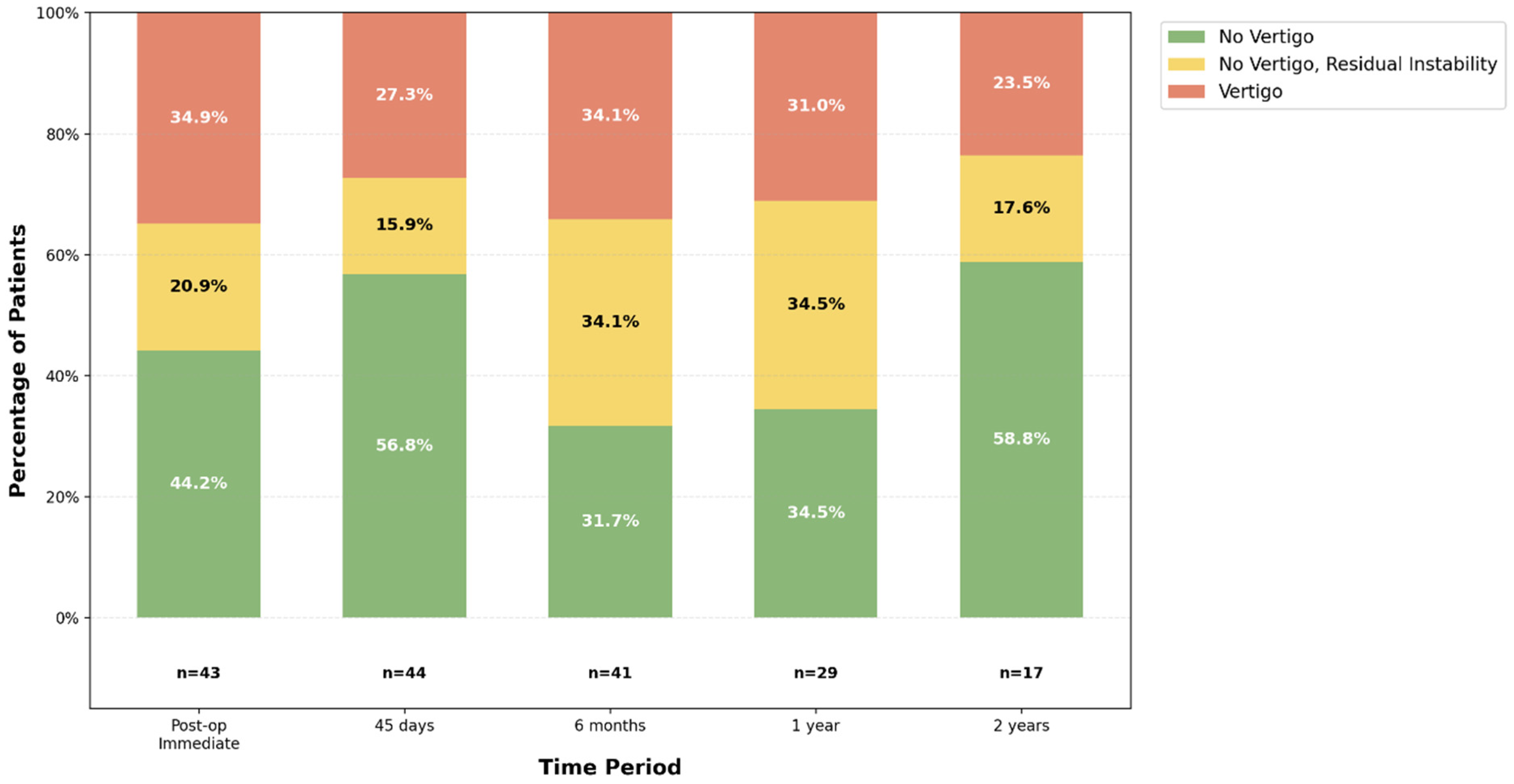
| No vertigo attack | 18/19 (94.7%) | 1/19(5.2%) | 19 (44.2%) | |
| Instability | 5/9 (55.6%) | 4/9 (44.4%) | 9 (20.9%) | |
| Vertigo attacks | 6/15 (40%) | 9/15 (60%) | 15 (34.9%) | p = 0.0023 |
| Postoperative | 45 Days | 6 Month | 1 Year | 2 Years | |
|---|---|---|---|---|---|
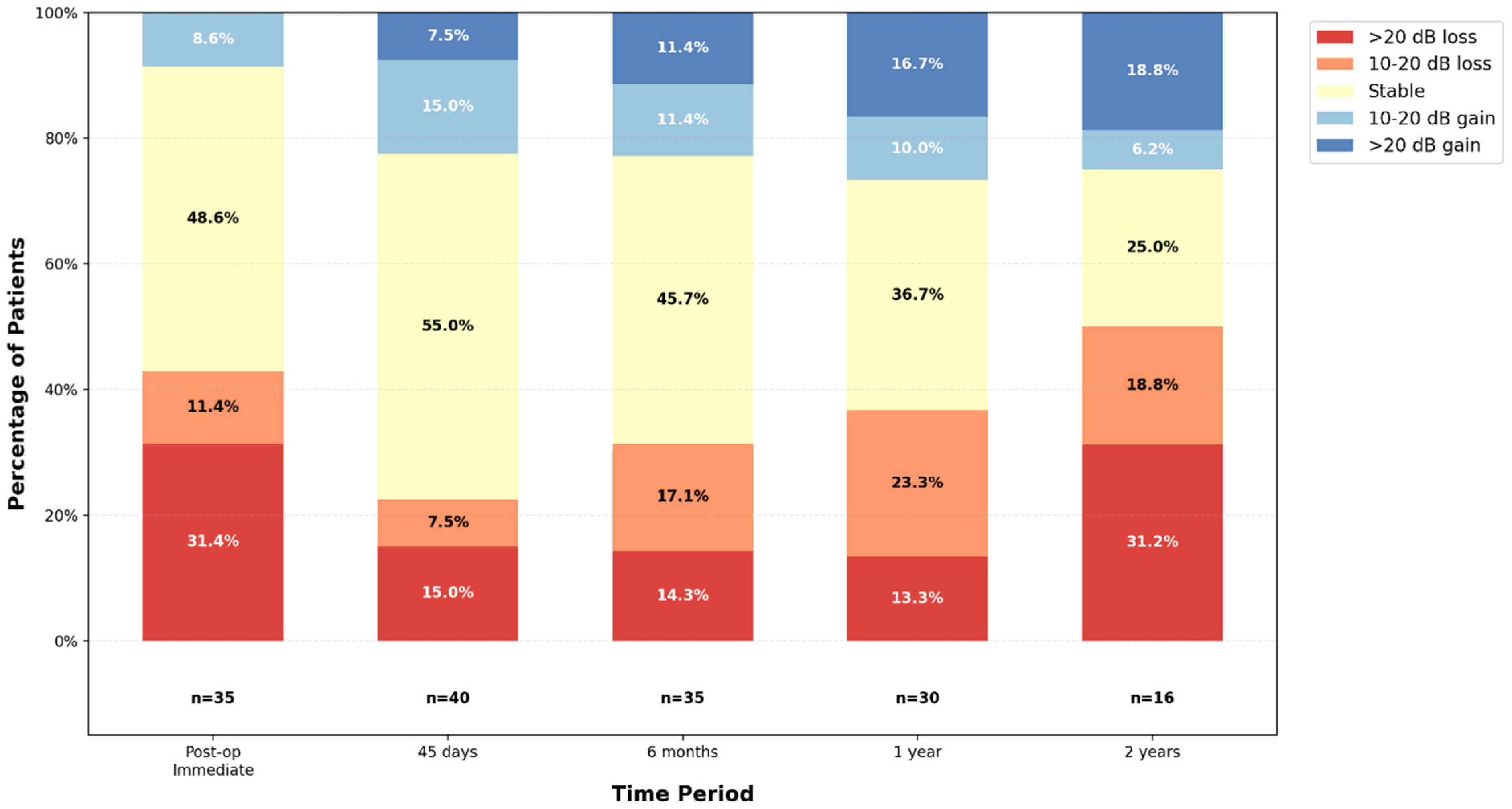
| Bone-conduction Pure tone audiometry (dB) | −13.9 (+/−19.6) | −1.6 (+/−16.5) | −2.0 (+/−18.8) | −1.7 (+/−21.1) | −6.1 (+/−27.0) |
| Speech audiometry | NA | +2.1% (+/−48.8) | +2.6% (+/−46.0) | −10.2% (+/−49.8) | −18.6% (+/−43.2) |
Disclaimer/Publisher’s Note: The statements, opinions and data contained in all publications are solely those of the individual author(s) and contributor(s) and not of MDPI and/or the editor(s). MDPI and/or the editor(s) disclaim responsibility for any injury to people or property resulting from any ideas, methods, instructions or products referred to in the content. |
© 2026 by the authors. Licensee MDPI, Basel, Switzerland. This article is an open access article distributed under the terms and conditions of the Creative Commons Attribution (CC BY) license.
Share and Cite
Lebelle, E.; Tuset, M.-P.; Haddad, R.; Ebode, D.; Levy, D.; Ros, L.; Mat, Q.; Daval, M.; Michel, J.; De Charnace, L.; et al. Endolymphatic Sac Surgery in Refractory Ménière’s Disease: Exploratory Associations and Postoperative Clinical Outcomes in a Bicentric Cohort. Audiol. Res. 2026, 16, 15. https://doi.org/10.3390/audiolres16010015
Lebelle E, Tuset M-P, Haddad R, Ebode D, Levy D, Ros L, Mat Q, Daval M, Michel J, De Charnace L, et al. Endolymphatic Sac Surgery in Refractory Ménière’s Disease: Exploratory Associations and Postoperative Clinical Outcomes in a Bicentric Cohort. Audiology Research. 2026; 16(1):15. https://doi.org/10.3390/audiolres16010015
Chicago/Turabian StyleLebelle, Eleonore, Maria-Pia Tuset, Ralph Haddad, Dario Ebode, Daniel Levy, Laetitia Ros, Quentin Mat, Mary Daval, Justin Michel, Laure De Charnace, and et al. 2026. "Endolymphatic Sac Surgery in Refractory Ménière’s Disease: Exploratory Associations and Postoperative Clinical Outcomes in a Bicentric Cohort" Audiology Research 16, no. 1: 15. https://doi.org/10.3390/audiolres16010015
APA StyleLebelle, E., Tuset, M.-P., Haddad, R., Ebode, D., Levy, D., Ros, L., Mat, Q., Daval, M., Michel, J., De Charnace, L., & Gargula, S. (2026). Endolymphatic Sac Surgery in Refractory Ménière’s Disease: Exploratory Associations and Postoperative Clinical Outcomes in a Bicentric Cohort. Audiology Research, 16(1), 15. https://doi.org/10.3390/audiolres16010015