Article

The Role of Phosphorus-Potassium Nutrition in Synchronizing Flowering and Accelerating Generation Turnover in Sugar Beet


by
Aleksandra Yu. Kroupina
,
Pavel Yu. Kroupin
*,
Mariya N. Polyakova
,
Malak Alkubesi
,
Alana A. Ulyanova
,
Daniil S. Ulyanov
,
Natalya Yu. Svistunova
,
Alina A. Kocheshkova
,
Gennady I. Karlov
and
Mikhail G. Divashuk
All-Russian Research Institute of Agricultural Biotechnology, Moscow 127434, Russia
*
Author to whom correspondence should be addressed.
Int. J. Plant Biol. 2026, 17(1), 5; https://doi.org/10.3390/ijpb17010005
Submission received: 5 November 2025 / Revised: 9 December 2025 / Accepted: 20 December 2025 / Published: 5 January 2026
(This article belongs to the Section Plant Reproduction)

Abstract

Speed breeding technologies offer a promising avenue for accelerating crop improvement, yet their application to biennial crops like sugar beet remains constrained by extended generation cycles. This study examined the effects of supplemental phosphorus-potassium (PK) nutrition on the development of two hybrids under a speed-breeding protocol. Plants received one of four nutritional regimes: PK supplementation, potassium (K) supplementation, standard Knop’s solution (KS), or nutrient deficiency (D). Digital phenotyping confirmed that adequate nutrition maintained photosynthetic health, as deficiency significantly reduced NDVI and increased PSRI by 75 days. The most notable, genotype-specific effects were observed in reproductive architecture. PK nutrition significantly increased the median number of flower stalks by 17% in Smart Iberia KWS (21.0 vs. 18.0) and substantially in Dubravka KWS (33.0 vs. 1.0). PK also supported root development, increasing mini-steckling weight by 45–183% under white light. In the generative phase, plants under PK nutrition consistently showed the highest progression to flowering and capsule formation. A consistent increase in median 1000-seed weight of 24–36% was associated with PK treatment. In conclusion, supplementing standard nutrition with phosphorus and potassium enhances key yield-related architectural traits and supports reproductive development in sugar beet under speed-breeding conditions, with the magnitude of response depending on genotype. This provides a practical basis for optimizing mineral nutrition to improve the efficiency of accelerated breeding protocols. This provides a practical basis for optimizing mineral nutrition to improve the efficiency of speed breeding protocols.

1. Introduction

Sugar beet (Beta vulgaris L.) is a crop of critical importance for global sugar production, serving as a key commodity for both food security and bioeconomic development [1]. However, conventional breeding of this biennial species typically requires 10–12 years to develop new varieties due to its obligatory vernalization requirement and prolonged generation cycle. This extended timeline presents significant challenges for addressing emerging agricultural constraints and market demands.
Speed breeding technologies have emerged as a transformative approach for accelerating crop improvement, enabling up to 4–6 generations annually through optimized environmental control [2,3,4]. While successfully implemented in numerous annual crops, the application of speed breeding to sugar beet remains constrained by incomplete understanding of the physiological and nutritional factors regulating reproductive development under accelerated conditions. Current protocols achieve bolting induction through photothermal treatments but often result in asynchronous flowering and variable seed set, limiting their practical utility in breeding programs [5]. Recent breakthroughs have identified novel genetic resources, including the ‘BLOND’ germplasm capable of flowering without vernalization under 24 h photoperiods [6], offering promising avenues for accelerating the breeding cycle while maintaining agronomic performance in field conditions
The transition to reproductive development in sugar beet involves complex integration of vernalization, photoperiod perception, and endogenous signaling pathways. Molecular studies have identified key regulators including the antagonistic FLOWERING LOCUS T homologs BvFT1 and BvFT2, which mediate the floral transition in response to environmental cues [7]. Concurrently, phytochrome signaling mechanisms translate light quality information into developmental responses, with far-red radiation demonstrating particular efficacy in promoting bolting [8,9,10]. The genetic control of flowering behavior has been extensively utilized in beet breeding programs, where the B allele conditioning annual habit enables more efficient development of sterile inbreds [11]. However, the coordination between these signaling pathways and mineral nutrition remains poorly characterized, representing a critical knowledge gap in speed breeding optimization. Furthermore, comparative studies in related biennial species like carrot reveal substantial genotype-dependent variation in vernalization requirements, though photoperiod responses post-vernalization may be neutral [12], highlighting the need for species-specific optimization of flowering regulation.
Emerging evidence suggests that phosphorus and potassium nutrition may play previously underappreciated roles in flowering time regulation beyond their established functions in energy metabolism and osmoregulation [13,14,15]. Phosphorus, as a component of ATP, nucleic acids, and phospholipids, governs energy status and biosynthetic capacity, while potassium regulates phloem transport, stomatal conductance, and osmotic homeostasis [16,17]. Recent research in model species indicates that phosphorus availability influences flowering time through PHOSPHATE1-mediated translocation and its interaction with gibberellin signaling pathways [18,19], while potassium deficiency can impair phloem mobility of florigenic signals [20]. Nevertheless, the specific mechanisms through which these nutrients modulate reproductive development in sugar beet remain largely unexplored.
The selection of appropriate genetic materials for this investigation was based on contrasting phenological characteristics and commercial significance. The hybrid Dubravka KWS is characterized by high yield flexibility and an extended harvesting period, making it suitable for early, intermediate, and late harvesting [21,22]. It represents a normal-yielding type (NE) with high sugar yield per hectare and is often used as a standard in comparative trials [23]. In contrast, Smart Iberia KWS is a normal-type (N) hybrid recommended for mid-season harvesting, known for its high root yield, complex disease resistance, and adaptability to intensive production systems [24]. The inclusion of these hybrids belonging to different maturity groups in a speed breeding experiment is of particular practical interest, as it allows for the assessment of whether nutritional optimization strategies can be universally applied or need to be tailored to specific genotypic and phenological profiles, following the precedent of selecting diverse germplasm to capture variation in vernalization responsiveness as demonstrated in other biennial crops [12].
This study addresses fundamental questions regarding the capacity of mineral nutrition to accelerate and synchronize reproductive development in sugar beet speed breeding systems. We hypothesized that optimized phosphorus-potassium nutrition would enhance flowering synchrony and reduce generation time through integrated effects on vegetative establishment, photosynthetic performance, and floral transition signaling. Specifically, our objectives were to (i) quantitatively assess the effects of phosphorus and potassium supplementation on developmental kinetics from vegetative growth through seed maturation, (ii) characterize genotypic variation in nutritional responsiveness across multiple phenotypic levels, and (iii) evaluate the practical utility of nutritional optimization for enhancing breeding program efficiency and predictability.
By elucidating the interplay between mineral nutrition and reproductive development, this research aims to establish evidence-based protocols for accelerating genetic gain in sugar beet improvement programs while contributing to fundamental understanding of nutrient-flowering crosstalk in biennial crops under controlled environment conditions.

2. Materials and Methods

2.1. Plant Material and Growth Conditions

Two first-generation heterotic sugar beet hybrids (F1), Smart Iberia KWS and Dubravka KWS, were selected for this study based on their contrasting reproductive characteristics and commercial significance. The two first-generation heterotic sugar beet hybrids (F1), Smart Iberia KWS and Dubravka KWS, were selected for this study based on their contrasting reproductive characteristics and commercial significance.
All experiments were conducted in controlled-environment facilities (climate chambers and phytotrons) at the All-Russia Research Institute of Agricultural Biotechnology, Moscow, Russia, during 2024–2025. Seed sterilization and germination were conducted under controlled conditions. Polished non-pelleted seeds were rinsed under running water at room temperature for 30 min, treated with the fungicide “Maxim Dachnik” (Syngenta, Saint-Sauveur, France) at a concentration of 2 mL/L for 30 min, and air-dried on sterile filter paper. Seeds were sown at a depth of 0.5 cm in 264-cell trays (10 mL cell volume) filled with neutralized high-moor peat substrate (“Agrobalt-S,” LLC. Pindstrup, Mytishchi, Russia), with one seed per cell in 21 June 2024. Trays were maintained under a 22/2 h photoperiod at day/night temperatures of +25 °C/+20 °C, 50% relative humidity, and LED illumination providing an average PPFD of 750 µmol/m2/s (white spectrum), calibrated using a PG200N spectrometer (United Power Research Technology Corp., Zhunan Township, Taiwan).
At the developed cotyledon stage (14 days post-sowing), seedlings were transplanted into 800 mL pots containing a peat-sand-vermiculite-agroperlite mixture (5:1:1:0.5 v/v), ensuring minimal root disturbance.

2.2. Experimental Design and Nutritional Treatments

The mineral nutrition experiment employed a completely randomized design with two factors: genotype (Smart Iberia KWS, Dubravka KWS) and nutrition regime. Four nutritional treatments were established 52 days after sowing:
(i)
Deficiency (D): Irrigation with distilled water only (negative control)
(ii)
Knop’s solution (KS): Weekly application of 50 mL/plant of standard solution containing Ca(NO3)2 (1 g/L), MgSO4 (0.25 g/L), K2HPO4 (0.25 g/L), KCl (0.125 g/L), and FeSO4 (0.125 g/L), yielding final concentrations of N 170.8 mg/L, P 44.5 mg/L, K 112.2 mg/L (N:P:K = 3.8:1.0:4.0)
(iii)
Additional potassium (K): KS followed by 30 mL of KCl (12 g/L), resulting in total concentrations of N 170.8 mg/L, P 44.5 mg/L, K 2471.1 mg/L (N:P:K = 3.8:1.0:88.9)
(iv)
Additional phosphorus-potassium (PK): KS followed by 30 mL of KH2PO4 (40 g/L), yielding total concentrations of N 170.8 mg/L, P 3441.4 mg/L, K 4420.7 mg/L (N:P:K = 1.0:32.2:41.4)
The experiment employed a complete factorial design with varying number of biological replicates per treatment and genotype combination: deficiency (D)—6 plants per genotype, Knop’s solution (KS)—24 plants per genotype, additional potassium (K)—18 plants per genotype, and additional phosphorus-potassium (PK)—18 plants per genotype (Figure S1). The lower number of replicates in the deficiency treatment was due to space constraints.

2.3. Foliar Applications

To ensure uniform micronutrient supply across all experimental groups, standardized foliar treatments were applied using a fine-dispersion mister (creating 50–100 µm droplets) until complete leaf coverage was achieved. The application sequence was as follows:
Day 35: Single application of MS microsalt solution (7.5 mL/L) supplemented with “Immunotsitofit” (0.167 g/kg ethyl ester of arachidonic acid; 1 tablet/1.5 L; Agropromyshlennaya Kompaniya “Ginkgo,” Moscow, Russia)
Weekly applications: “Microvit Optima” (10 mL/L; Elitnye Agrosistemy, Voskresensk, Russia) containing TN 5 g/L, P2O5 1.5 g/L, K2O 2.3 g/L, Mg 0.9 g/L, SO3 9 g/L, Fe 1.9 g/L, Mn 1.3 g/L, B 0.5 g/L, Cu 0.5 g/L, Mo 0.18 g/L, Co 0.03 g/L, combined with boric acid (0.31 g/L)
Bi-weekly applications: “Siliplant Universal” (NEST-M, Moscow, Russia) at concentrations of 2.3 mL/L (2–3 leaf pairs) or 2.67 mL/L (≥4 leaf pairs), containing Si ≥ 7%, K 1%, and chelated microelements: Fe 0.3 g/L, Mg 0.1 g/L, Cu 0.7 g/L, Zn 0.08 g/L, Mn 0.3 g/L, Mo 0.06 g/L, Co 0.015 g/L, B 0.09 g/L
All plants received irrigation with distilled water based on substrate moisture monitoring to prevent differential water stress. Disease and pest control measures were implemented as required across all experiments.

2.4. Digital Phenotyping and Data Acquisition

Digital phenotyping was conducted using the TraitFinder system (Phenospex, Heerlen, The Netherlands) equipped with dual F400-X PlantEye multispectral scanners. The system employs active LED illumination across RGB (red: 632 nm, green: 535 nm, blue: 472 nm) and near-infrared (735 nm) spectra, with integrated calibration against certified reference panels. Scans were performed at 48, 60, 67, and 75 days after sowing, with 3 technical replicates per plant. Derived parameters included digital biomass (3D voxel-based volume estimation) and spectral indices: NDVI ([NIR − Red]/[NIR + Red]) and PSRI ([Red − Blue]/NIR). Phenotyping was terminated at 75 days after sowing (DAS) due to canopy closure and overlapping foliage compromising measurement accuracy. Photographic recording was carried out using the camera of the Tecno CAMON 20 Premier 5G smartphone (Tecno Mobile Limited, Hong Kong, China).

2.5. Evaluation of Mini-Steckling Formation Under Different Light Regimes

To assess the interaction between mineral nutrition and light quality on mother root development, plants were divided into two photoperiodic treatments 76 days after sowing: (i) White light control (W): Maintained under initial conditions (22/2 h photoperiod, +23 °C/+20 °C day/night temperatures, 40% humidity, LED white light at PPFD 750 µmol/m2/s); (ii) Far-red enriched light (FR): Transferred to chambers providing supplemental far-red radiation (22/2 h photoperiod, +23 °C/+20 °C day/night temperatures, 40% humidity, LED illumination with PPFD 256 µmol/m2/s, photon flux density 291 µmol/m2/s, far-red:red ratio 0.5:1).
The vegetation period concluded at 133 days after sowing. Root systems were carefully extracted, washed to remove substrate residues, and blotted dry before weighing using a Pocket Scale MH-500 (precision ±0.01 g). The experimental design maintained balanced replication across treatments: under white light, each hybrid × nutrition combination included 2 plants (D, K, PK) or 4 plants (KS); under far-red light, replication comprised 3 plants (D, K, PK) while KS included 7 plants (Smart Iberia KWS) and 5 plants (Dubravka KWS).

2.6. Generative Development and Seed Production Analysis

Vernalization protocols were implemented to induce reproductive transition. Plants were subjected to 84 days of cold treatment under controlled conditions: 22/2 h photoperiod, +6 °C/+5 °C day/night temperatures, 85% humidity, and LED white light (PPFD 60 µmol/m2/s). Following vernalization (day 84), plants at the third true-leaf stage were transferred to generative growth chambers providing 22/2 h photoperiod, +23 °C/+20 °C day/night temperatures, 40% humidity, and LED white/far-red light (PPFD 256 µmol/m2/s, photon flux density 291 µmol/m2/s, far-red:red ratio 0.5:1).
Mineral nutrition treatments (D, KS, K, PK) commenced on day 87 following the protocols described in Section 2.2. Foliar applications (excluding MS microsalts and “Immunotsitofit”) initiated on day 89 and continued until seed set. Fertigation was terminated upon visible seed formation. Phenological stages (bolting, bud formation, flowering, capsule development) were recorded weekly using standardized developmental scales.
The experiment employed a complete factorial design with 33 plants per hybrid distributed across nutritional treatments: 3 plants (D), 12 plants (KS), 9 plants (K), and 9 plants (PK) (Figure S2). For plants successfully completing reproductive development, architectural and yield parameters were quantified at maturity: main stem length (cm), number of flowering shoots, seed number and mass per plant (g), and 1000-seed weight (g) calculated as 1000 × (total seed mass/total seed number).

2.7. Statistical Analysis

Accumulated thermal time was calculated as growing degree days (GDD) to account for the physiological effect of temperature on development. The calculation was performed according to the methodology of Tsialtas and Maslaris [25], which incorporates both lower and upper temperature thresholds for sugar beet. The GDD accumulation was calculated using the formula: GDD = Σ(Ti − Tbase), where Tbase is the base temperature of 3 °C, and Ti is the effective daily temperature. To enhance precision under our controlled 22/2 h photoperiod regime, we modified the standard approach by calculating Ti as a time-weighted average of the day and night temperatures, rather than a simple arithmetic mean.
Statistical analysis was conducted using R software (version 4.3.1). Data structure and appropriate method selection followed a predefined hierarchical decision tree (see Supplementary Materials, File S1: ANALYSIS_DECISIONS.md), which prioritized meeting the assumptions of parametric tests while maintaining statistical power.
For repeated-measures data from digital phenotyping (digital biomass, NDVI, PSRI), a multi-step model selection procedure was applied:
1.
Initial linear mixed-effects models (LMM) were fitted with genotype, nutrition, time (as a numeric variable), and their two-way interactions as fixed effects, and plant identity as a random effect (random intercept).
2.
Assumptions of normality (Shapiro–Wilk test on residuals) and homoscedasticity (Levene’s test) were formally assessed.
3.
Where violations occurred, a systematic “rescue preprocessing” protocol was initiated: this included evaluating Generalized Linear Mixed Models (GLMM) with alternative distributions (gamma, log-normal, inverse Gaussian), applying normalizing transformations (log, square-root, Yeo-Johnson), and implementing enhanced outlier detection (e.g., residual-level winsorization).
4.
The final model for each index was selected based on the lowest Akaike Information Criterion (AIC) and successful fulfillment of parametric assumptions. This resulted in: a square-root transformed LMM with an AR(1) correlation structure for digital biomass; an untransformed LMM for NDVI; and a Yeo-Johnson transformed LMM for PSRI.
5.
Post hoc pairwise comparisons were conducted using Tukey’s HSD test (p < 0.05) on estimated marginal means. As a robustness check, key findings were validated using non-parametric Generalized Estimating Equations (GEE).
For the time-to-event data of phenological stage attainment (bolting, budding, flowering, capsule formation), survival analysis was employed to properly account for right-censored observations (i.e., plants that failed to reach a given stage). The Kaplan–Meier estimator was used for non-parametric visualization. The proportional hazards assumption was tested for Cox models. For the bolting stage, where this assumption was violated, a parametric accelerated failure time (AFT) model with a log-logistic distribution was fitted to estimate time ratios. Model selection for parametric survival models was based on the lowest AIC. Pairwise comparisons between nutrition treatments within each genotype were performed using the log-rank test.
For cross-sectional data (mini-steckling weight and seed yield parameters), data distributions were assessed for normality and homogeneity of variances. Due to the factorial design with unbalanced sample sizes, non-normal distributions, and the presence of very small groups (n ≤ 3 in some genotype × nutrition combinations), non-parametric methods were applied. The main effects of genotype, nutrition, and their interaction were tested using Kruskal–Wallis rank-sum tests. Pairwise comparisons were conducted using the Mann–Whitney U test with Bonferroni correction for multiple comparisons. Effect sizes are reported as eta-squared (η2) for Kruskal–Wallis tests and Cohen’s d for pairwise comparisons. Bootstrap confidence intervals (95%, 1000 resamples) were calculated for group medians to provide robust estimates of central tendency and variability.
All values are presented as estimated marginal mean ± standard error for parametric analyses or median with 95% confidence interval for non-parametric and survival analyses. Statistical significance was defined at p < 0.05. Graphics were generated using ggplot2 in R and Microsoft Excel 2021.

3. Results

3.1. Digital Biomass Dynamics

To address violations of parametric assumptions, a systematic rescue preprocessing approach was implemented for the digital biomass (DB) data. Preprocessing included cell-level (Genotype × Time × Nutrition combination) winsorization of outliers, followed by enhanced residual-level outlier detection (2.5 SD threshold) and square-root transformation (√mm3) for normalization. An autoregressive correlation structure of order 1 (AR1) was incorporated into the final model to account for temporal dependence. As differential nutrient treatments commenced after the first measurement, their effects on biomass were validly assessed only from 60 days after sowing (DAS) (File S1).
Analysis of the post-treatment period (60–75 DAS) using the preprocessed data revealed a limited and genotype-specific response to nutrient amendments. The only statistically significant pairwise differences detected during this phase were observed in the Dubravka KWS hybrid, which achieved higher square-root-transformed biomass under the phosphorus-potassium (PK) treatment compared to both the standard Knop’s solution (KS) and the deficiency control (D) by 75 DAS (Table 1). For the Smart Iberia KWS hybrid, no significant differences were found among any nutrient treatments, including comparisons with D. In total, only 3 out of 112 pairwise comparisons for digital biomass were statistically significant (Bonferroni-adjusted p < 0.05). These results indicate that, under the present experimental conditions, digital biomass accumulation during the observed vegetative stage showed limited sensitivity to the applied mineral nutrition regimes, with a genotype-specific response evident only in the Dubravka hybrid.

3.2. Photosynthetic Performance and Plant Senescence (NDVI and PSRI)

Statistical analysis of the spectral data was conducted using linear mixed-effects models. For the Normalized Difference Vegetation Index (NDVI), the initial model with random slopes for time met parametric assumptions and was retained. For the Plant Senescence Reflectance Index (PSRI), which exhibited severe initial non-normality, a successful rescue preprocessing was applied, involving IQR-based outlier detection and a simplified random intercept-only structure, which achieved normality of residuals. All models included plant identity as a random effect to account for repeated measures and specified two-way interactions to assess main effects and pairwise interactions while maintaining statistical power. A significant overall influence of the mineral nutrition regime on photosynthetic performance and senescence dynamics was confirmed (p < 0.05 for the nutrition factor at 75 DAS) (File S1). As treatments were applied post-initial measurement, effects are reported from 60 DAS onward.
A clear and consistent pattern emerged between deficient and adequate nutrition treatments. Nutrient deficiency (D) induced a progressive decline in NDVI and a marked increase in PSRI by 75 DAS, confirming stress-related chlorophyll degradation (Figure 1, Table 1). Statistical analysis revealed 13 significant pairwise comparisons for NDVI and 20 for PSRI (Bonferroni-adjusted p < 0.05), underscoring the high sensitivity of these indices to the treatments.
Conversely, all treatments providing adequate nutrition—Knop’s solution (KS), additional potassium (K), and additional phosphorus-potassium (PK)—were effective in maintaining photosynthetic integrity and delaying senescence compared to the deficient control. For NDVI, all three adequate nutrition treatments resulted in significantly higher values than D in both hybrids at 75 DAS, with no significant differences among themselves (Table 1). For PSRI in the Smart Iberia hybrid, KS, K, and PK all yielded significantly lower values than D and were statistically equivalent. In the Dubravka hybrid, KS and K had significantly lower PSRI than D, while PK showed an intermediate PSRI value that was significantly higher than KS but still lower than D (Table 1). Significant Genotype × Nutrition interactions were also detected, indicating that genotypic responses to nutrition are context-dependent.
This pattern confirms that adequate mineral nutrition, whether provided as a balanced solution (KS) or with targeted supplementation (K or PK), generally preserved photosynthetic function and delayed senescence under speed-breeding conditions compared to nutrient deficiency. However, the effects on biomass accumulation (DB) and senescence dynamics (PSRI) were markedly genotype-specific. Overall, the spectral indices NDVI and PSRI demonstrated greater sensitivity to variations in mineral nutrition than digital biomass, providing more robust indicators of physiological status under the tested conditions.

3.3. Influence of Mineral Nutrition on Mother Root (Mini-Steckling) Formation

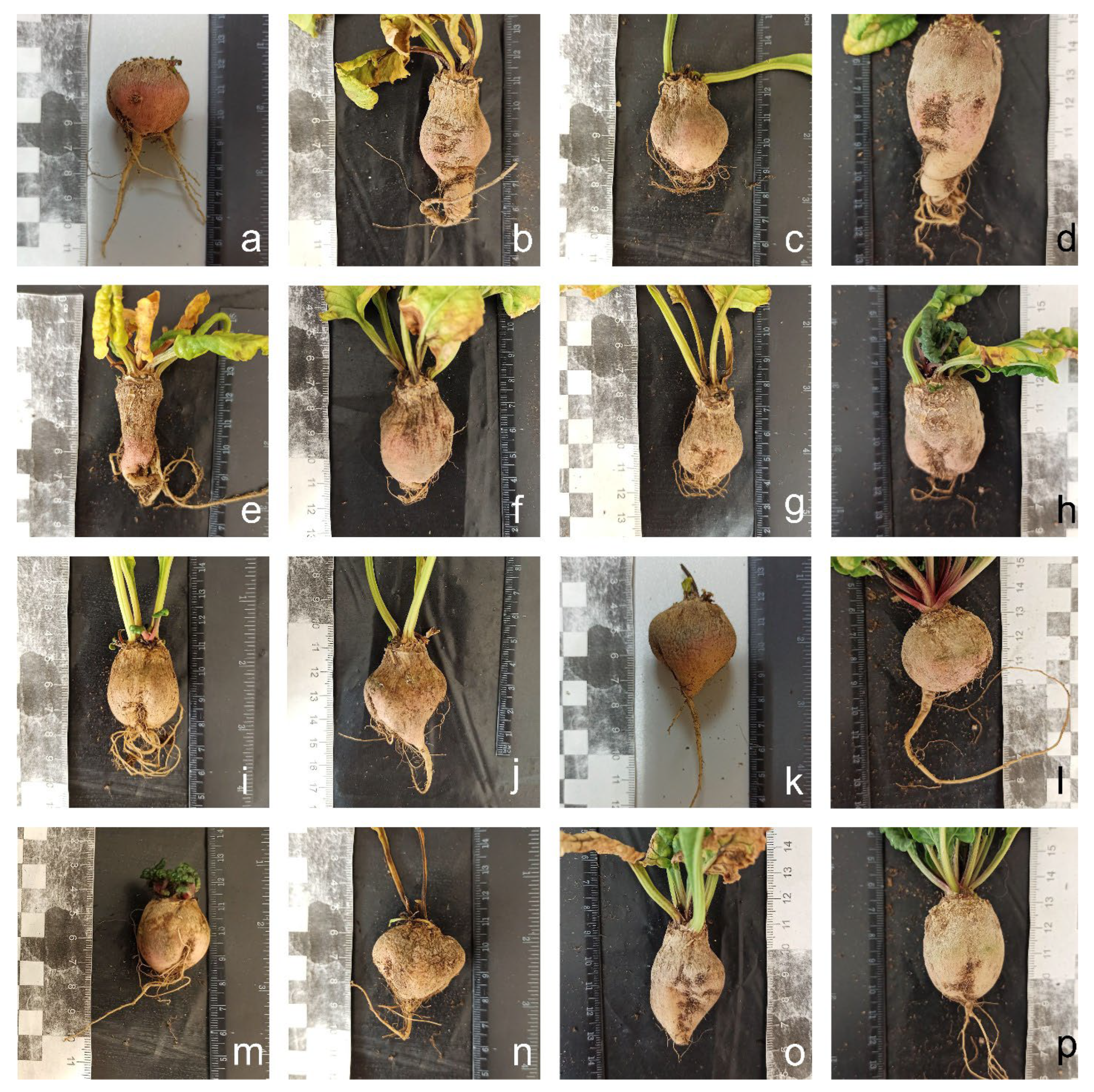
Given the constraints of small and unbalanced sample sizes in the complex 3-way factorial design (Genotype × Nutrition × Lighting), non-parametric methods were employed for robust statistical analysis. The Kruskal–Wallis test revealed a highly significant main effect of the nutritional regime on mini-steckling fresh weight (p < 0.0001, η2 = 0.485), indicating that nutrition alone explained nearly half of the observed variance (Figure 2). In contrast, no statistically significant main effects were detected for genotype (p = 0.834, η2 ≈ 0) or lighting (p = 0.149, η2 = 0.023). Crucially, significant two-way interactions were identified: Nutrition × Genotype (p = 0.0004) and Nutrition × Lighting (p = 0.0002). No significant Genotype × Lighting interaction was found (p = 0.148) (File S1). These results indicate that the substantial impact of nutrition on root mass is strongly context-dependent, varying with both genetic background and light quality, while genotype and lighting factors primarily manifest their influence through these interactions rather than as independent effects.
Stratified post hoc analysis (Bonferroni-corrected Mann–Whitney U tests) within each lighting condition and genotype revealed specific treatment differences (Table 2). Supplemental phosphorus-potassium (PK) nutrition generally promoted the formation of the heaviest mini-stecklings, although the magnitude of this advantage was modulated by the significant interactions.
For the Smart Iberia KWS hybrid under white light (W), PK nutrition resulted in a median weight of 24.85 g [95% bootstrap CI: 24.81–24.89], which was significantly greater than the deficiency (D) and Knop’s solution (KS) treatments, but not statistically different from the additional potassium (K) treatment. A marked attenuation of this PK benefit was observed under far-red (FR) light, where the median weight dropped to 18.16 g [16.57–19.84]—a 27% reduction compared to PK under white light. This suggests a negative interaction between FR enrichment and PK-mediated root growth in this genotype.
The response pattern differed for the Dubravka KWS hybrid. Under white light, PK nutrition produced mini-stecklings of comparable weight to those under K nutrition, with both treatments outperforming the D and KS controls. Contrary to the Smart Iberia hybrid, supplemental FR light did not diminish the benefit of PK nutrition for Dubravka. Under FR light, PK treatment still yielded the heaviest mini-stecklings (18.79 g [18.70–20.98]), representing a 75.3% increase over the deficient control within the same light regime.
In summary, nutrition was the primary determinant of mini-steckling weight. However, the optimal nutritional strategy for maximizing root mass is not universal but depends critically on the genetic constitution of the hybrid and the light environment, as evidenced by the significant two-way interactions. This underscores the necessity of developing tailored cultivation protocols that consider these complex factor interdependencies in controlled environments.

3.4. The Influence of Mineral Nutrition on Generative Development Following Vernalization

The progression through reproductive stages was analyzed using survival analysis, which accounts for plants that failed to reach a given endpoint (censored data). The analytical strategy was tailored for each stage: Cox proportional hazards models were used when the assumption of proportional hazards was met; otherwise, parametric Accelerated Failure Time (AFT) models were selected based on goodness-of-fit (AIC) (File S1).
Censoring rates escalated sharply across the phenological sequence—from 13.6% at bolting to 69.7% at capsule formation—indicating that a majority of plants did not complete the full reproductive cycle, creating a progressive developmental bottleneck (Table 3).
For the initial bolting stage, the proportional hazards assumption was violated, leading to the selection of a log-logistic AFT model. This analysis confirmed a significant genotype effect: Smart Iberia KWS initiated bolting approximately 10.6% faster than Dubravka KWS (Time Ratio = 0.894, p = 0.025). The effect of PK nutrition showed a strong trend toward delaying bolting (Time Ratio = 0.923, p = 0.051), though it did not cross the conventional 0.05 threshold.
The capacity for statistical inference diminished in later stages due to high censoring. While Cox models were fitted for budding and flowering, and a parametric model for capsule formation, the sparsity of events (e.g., only 20 plants formed capsules) resulted in wide confidence intervals and unstable estimates, preventing the detection of statistically significant treatment effects at the p < 0.05 level.
However, a notable biological pattern emerged upon examining the data structure. The PK treatment was consistently associated with the most advanced development among the nutrition treatments. For the Smart Iberia KWS hybrid, PK nutrition resulted in the highest number of plants reaching flowering (8 of 9) and capsule formation (7 of 9), with the lowest censoring rates at these stages (11% and 22%, respectively). A similar trend was observed for Dubravka KWS, where the only two plants that formed capsules both belonged to the PK treatment group.
Thus, while a statistically significant effect of PK nutrition was not formally confirmed for late reproductive stages—largely due to the severe data limitations imposed by high overall failure rates—the consistent observation that plants receiving supplemental phosphorus-potassium were disproportionately represented among those achieving advanced development suggests a biologically meaningful trend. This pattern indicates that PK nutrition may support reproductive success under speed-breeding conditions, warranting further investigation with larger cohorts or modified protocols to reduce censoring.
In summary, the timing of initial reproduction (bolting) was primarily determined by genotype. For subsequent, critical stages of flowering and seed set, the influence of mineral nutrition could not be robustly quantified with the available data, but descriptive trends point toward a potential positive role of combined phosphorus-potassium supplementation in promoting reproductive progression.
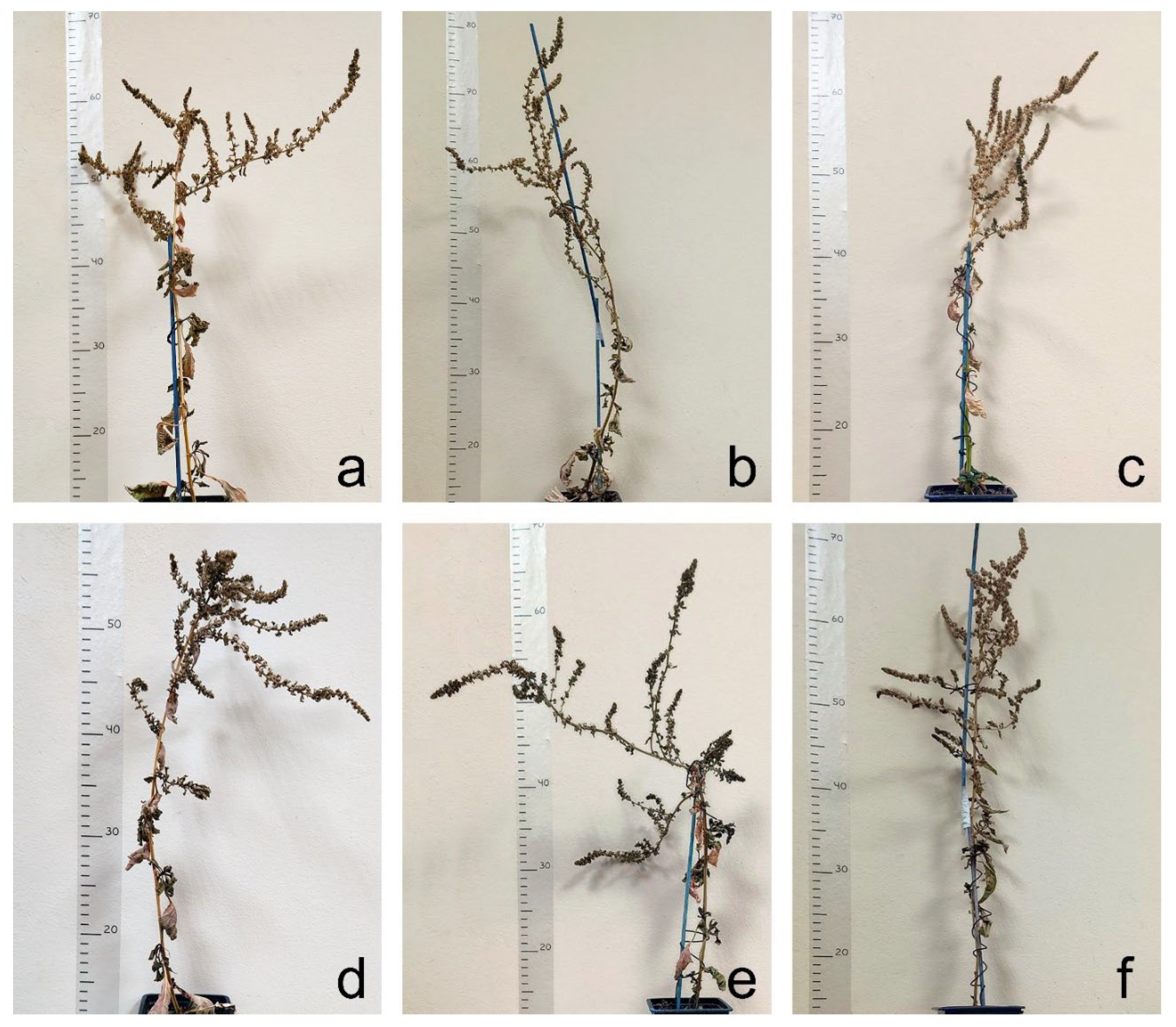
Due to the limited and unbalanced sample sizes resulting from the high rate of developmental failure in later reproductive stages, non-parametric statistical methods were employed to analyze seed yield components and architectural traits (Figure 3). The analysis included complete cases, acknowledging that missing data for seed traits (19.4% of observations) primarily represented plants that failed to produce seeds, a biologically meaningful outcome.
A significant main effect of both genotype (Kruskal–Wallis, p = 0.036, η2 = 0.148) and mineral nutrition (p = 0.037, η2 = 0.209) was detected for flower stalk number, indicating a medium effect size for both factors (File S1). Pairwise comparisons within genotypes revealed a significant positive effect of phosphorus-potassium (PK) supplementation (Table 4). For the Smart Iberia KWS hybrid, PK nutrition resulted in a higher number of flower stalks compared to the standard Knop’s solution (KS) (median: 21.0 vs. 18.0; p < 0.05). A similar, statistically significant advantage of PK over KS was observed for the Dubravka KWS hybrid (median: 33.0 vs. 1.0; p < 0.05), though this comparison should be interpreted with caution due to the very small sample size (n = 3 per group). Furthermore, a significant genotype effect was evident under PK nutrition, with Dubravka KWS producing more stalks than Smart Iberia KWS (median: 33.0 vs. 21.0; p = 0.039).
For 1000-seed weight, the effect of nutrition approached statistical significance (Kruskal–Wallis, p = 0.095) with a small-to-medium effect size (η2 = 0.123). The PK treatment consistently yielded the highest median weight across both genotypes (21.4 g for Smart Iberia KWS and 20.9 g for Dubravka KWS), representing a notable increase compared to the KS control. The pairwise comparison between PK and KS treatments showed a strong trend (p = 0.1037 after Bonferroni correction), supported by a large Cohen’s d effect size (−1.419), suggesting a biologically meaningful positive influence of PK nutrition on seed filling.
No statistically significant main effects of genotype or nutrition were detected for seed number per plant, total seed weight per plant, or flower stalk length (all p > 0.05, η2 ≈ 0). However, descriptive statistics revealed relevant trends. For instance, under PK nutrition, the Dubravka KWS hybrid achieved the highest median values for both seed number (374) and seed weight per plant (7.80 g), although high variability precluded statistical significance.

4. Discussion

4.1. Practical Implementation of PK Nutrition in Speed Breeding Systems

Our findings suggest that phosphorus-potassium (PK) nutrition could be a valuable approach for supporting reproductive development in sugar beet under speed breeding conditions. The observed trends, such as the potential delay in bolting time and the higher proportion of plants reaching advanced reproductive stages under PK nutrition, provide initial metrics for breeding program optimization. These results have immediate practical implications, particularly given the historical challenges associated with sugar beet’s obligate vernalization requirement and prolonged generation cycles [6,14].
The implementation methodology offers significant advantages in terms of scalability and compatibility with existing infrastructure. The simple amendment of standard Knop’s solution with KH2PO4 [4,26] allows for seamless integration into current breeding pipelines without requiring substantial capital investment. This approach maintains the practical utility of Knop’s solution while addressing its inherent limitations in micronutrient composition through targeted foliar supplementation [27,28].
The methodology, based on amending a standard nutrient solution, is straightforward and could be readily integrated into existing breeding pipelines. Future work should include economic analysis to evaluate the cost–benefit ratio of PK supplementation at scale. While comprehensive cost–benefit assessment would require larger-scale implementation, the marginal cost of phosphorus and potassium supplements appears substantially offset by the value of accelerated genetic gain and improved operational efficiency [29,30]. For commercial seed producers, the enhanced flowering synchrony translates to more predictable pollination windows, reduced labor requirements for multiple harvest passes, and improved seed lot uniformity [31].

4.2. Genotype-Specific Responses and Breeding Applications

The differential response patterns observed between Smart Iberia KWS and Dubravka KWS reveal a crucial genetic dimension in nutritional management strategies. Smart Iberia’s more pronounced responsiveness to PK supplementation—evident in its significant increase in flower stalk number and a trend toward higher digital biomass—suggests a genotype-specific capacity for nutrient utilization and conversion to reproductive output [32,33]. This aligns with emerging understanding of genetic variation in nutrient efficiency traits across crop species [34,35].
The more conservative response profile of Dubravka KWS provides equally valuable insights for breeding program design. While this hybrid reached bolting later than Smart Iberia overall its more moderate response to PK supplementation suggests either genetic constraints in nutrient signaling pathways or alternative resource allocation strategies [33,36]. This variation underscores the importance of developing genotype-specific management protocols rather than universal nutritional recommendations.
From a practical breeding perspective, these findings enable more precise resource allocation. Breeding programs working with responsive genotypes can maximize returns through aggressive PK supplementation, while more conservative approaches may be warranted for less responsive materials. Furthermore, the observed variation in nutritional responsiveness between genotypes suggests this could be a selectable trait, opening opportunities for further research into its genetic control and potential for marker-assisted selection and the development of breeding populations specifically selected for efficiency under speed breeding conditions [33,37].

4.3. Nutritional Optimization and System Refinement

While our study establishes clear benefits of PK nutrition, several aspects require refinement for optimal implementation. The nutrient concentrations employed, though effective in demonstrating physiological responses, represent initial rather than optimized levels [38,39]. Systematic dose–response studies across diverse genetic materials are needed to establish concentration thresholds that maximize benefits while minimizing potential environmental impacts and resource inputs.
The temporal dynamics of nutrient application emerge as another critical factor. Our results indicate that pre-vernalization nutritional status establishes the physiological foundation for subsequent reproductive success, emphasizing the importance of early intervention. This aligns with studies in other species demonstrating that pre-induction nutrient status can significantly influence flowering time and floral competence [35,40]. The integration of PK nutrition with other environmental management strategies, particularly light quality manipulation, presents additional opportunities for system optimization [13,41].
The observed synergy between phosphorus and potassium merits particular attention in protocol development. Phosphorus’s role in energy metabolism and nucleic acid synthesis complements potassium’s functions in phloem transport and osmotic regulation, creating integrated benefits across multiple physiological processes [42,43]. This synergy explains why combined PK nutrition consistently outperformed individual nutrient supplementation in our study.

4.4. Limitations and Future Research Directions

While our study provides initial phenotypic evidence suggesting potential benefits of PK nutrition benefits, several important questions remain unanswered. The molecular mechanisms underlying the observed influence on reproductive development and architecture (e.g., delayed bolting, increased stalk number) require comprehensive characterization through transcriptomic analyses of key flowering pathway genes (e.g., BvFT1, BvFT2, BvBTC1) under different nutritional regimes [32,44,45]. Such investigations would bridge the gap between phenotypic observations and genetic regulation.
The interaction between nutritional treatments and other environmental factors represents another critical research frontier. Building on the observed Nutrition × Lighting interaction in our study, systematic investigation of how PK nutrition interacts with other light qualities, temperature regimes, and vernalization protocols would enable development of truly integrated management systems [26,40]. Given the genotype-specific responses observed here between two commercial hybrids, expanded screening across a wider range of germplasm, including breeding lines and wild relatives, is needed to provide more comprehensive understanding of the genetic architecture underlying nutritional responsiveness [33,37].
To enhance practicality, future studies should explore optimizing application protocols, including determining the critical timing for PK application and testing split-dose regimens. The development of sensor-based nutrient management systems, combined with automated phenotyping platforms, could create dynamic, data-driven breeding environments that optimize nutritional inputs in real time [4,29].

5. Conclusions

This study demonstrates that supplementing standard nutrition with phosphorus and potassium (PK) influences key traits in sugar beet under speed breeding. Our findings reveal genotype-dependent responses, with PK nutrition consistently promoting a more prolific reproductive architecture (increased flower stalk number) and supporting the formation of heavier mother roots (mini-stecklings). While the primary vegetative biomass showed limited sensitivity, spectral indices (NDVI/PSRI) confirmed that adequate nutrition is crucial for maintaining plant health.
The progression through generative stages was strongly genotype-dependent, with one hybrid bolting significantly faster. Although high rates of developmental failure limited statistical power for late reproductive stages, descriptive trends indicated that PK nutrition was associated with a higher proportion of plants successfully reaching flowering and seed set. Similarly, while effects on final seed yield components were not statistically robust, there was a consistent trend toward higher individual seed weight under PK nutrition.
In conclusion, PK nutrition emerges as a practical tool to enhance specific components of speed breeding efficiency, particularly reproductive structure development and root quality. The observed genotype-specificity underscores the need for tailored nutrition protocols. Future research should focus on optimizing PK application timing and dosage, and on understanding the genetic basis of these differential responses to further harness nutritional management for accelerated breeding.

Supplementary Materials

The following supporting information can be downloaded at: https://www.mdpi.com/article/10.3390/ijpb17010005/s1, File S1. R Analysis Scripts, Output, and Processed Dataset; Figure S1. Experimental design and timeline for the vegetative phase: digital phenotyping and mini-steckling production; Figure S2. Experimental design and timeline for the generative phase: vernalization, flowering induction, and seed yield assessment.

Author Contributions

Conceptualization, A.Y.K. and M.G.D.; methodology, A.Y.K., M.N.P. and N.Y.S.; software, P.Y.K., A.A.U. and D.S.U.; validation, A.Y.K., P.Y.K., M.N.P., A.A.U., D.S.U. and A.A.K.; formal analysis, A.Y.K., P.Y.K. and D.S.U.; investigation, A.Y.K., M.N.P., M.A., A.A.U., D.S.U. and N.Y.S.; resources, M.N.P., M.A., N.Y.S., A.A.K., G.I.K. and M.G.D.; data curation, A.Y.K., P.Y.K., M.A., A.A.U., D.S.U. and N.Y.S.; writing—original draft preparation, A.Y.K. and P.Y.K.; writing—review and editing, A.Y.K., P.Y.K., A.A.K., G.I.K. and M.G.D.; visualization, A.Y.K. and P.Y.K.; supervision, A.Y.K., A.A.K., G.I.K. and M.G.D.; project administration, A.A.K., G.I.K. and M.G.D.; funding acquisition, A.A.K. and G.I.K. All authors have read and agreed to the published version of the manuscript.

Funding

This work was supported by the Ministry of Science and Higher Education of the Russian Federation under State Task FGUM-2023-0002.

Data Availability Statement

The original contributions presented in this study are included in the article/Supplementary Materials. Further inquiries can be directed to the corresponding author.

Conflicts of Interest

Authors declare that there is no conflict of Interest.

References

  1. FAOSTAT FAOSTAT. Food and Agriculture Organization. Available online: https://www.fao.org/faostat (accessed on 9 December 2025).
  2. Divashuk, M.G.; Blinkov, A.O.; Kocheshkova, A.A.; Kroupin, P.Y.; Svistunova, N.Y.; Radzeniece, S.B.; Karlov, G.I. Practical Experience in Acceleration of Plant Development Under Controlled Growing Conditions. In Proceedings of the Plant Genetics, Genomics, Bioinformatics and Biotechnology (PlantGen 2023), Kazan, Russia, 10–15 July 2023; p. 102. [Google Scholar]
  3. Marenkova, A.G.; Blinkov, A.O.; Radzeniece, S.; Kocheshkova, A.A.; Karlov, G.I.; Lavygina, V.A.; Patrushev, M.V.; Divashuk, M.G. Testing and Modification of the Protocol for Accelerated Growth of Malting Barley under Speed Breeding Conditions. Nanotechnol. Russ. 2024, 19, 808–814. [Google Scholar] [CrossRef]
  4. Watson, A.; Ghosh, S.; Williams, M.J.; Cuddy, W.S.; Simmonds, J.; Rey, M.-D.; Asyraf Md Hatta, M.; Hinchliffe, A.; Steed, A.; Reynolds, D.; et al. Speed Breeding Is a Powerful Tool to Accelerate Crop Research and Breeding. Nat. Plants 2018, 4, 23–29. [Google Scholar] [CrossRef] [PubMed]
  5. Abo-Elwafa, S.F.; Abdel-Rahim, H.M.; Abou-Salama, A.M.; Teama, E.A. Sugar Beet Floral Induction and Fertility: Effect of Vernalization and Day-Length Extension. Sugar Tech 2006, 8, 281–287. [Google Scholar] [CrossRef]
  6. Kuroda, Y.; Kuranouchi, T.; Okazaki, K.; Takahashi, H.; Taguchi, K. Biennial Sugar Beets Capable of Flowering without Vernalization Treatment. Genet. Resour. Crop Evol. 2024, 71, 823–834. [Google Scholar] [CrossRef]
  7. Jaggard, K.W.; Wickens, R.; Webb, D.J.; Scott, R.K. Effects of Sowing Date on Plant Establishment and Bolting and the Influence of These Factors on Yields of Sugar Beet. J. Agric. Sci. 1983, 101, 147–161. [Google Scholar] [CrossRef]
  8. Blinkov, A.O.; Nagamova, V.M.; Minkova, Y.V.; Svistunova, N.Y.; Radzeniece, S.; Kocheshkova, A.A.; Sleptsov, N.N.; Freymans, A.V.; Panchenko, V.V.; Chernook, A.G.; et al. A Higher Far-Red Intensity Promotes the Transition to Flowering in Triticale Grown under Speed Breeding Conditions. Vestn. VOGiS 2025, 29, 896–904. [Google Scholar] [CrossRef]
  9. Simpson, G.G.; Dean, C. Arabidopsis, the Rosetta Stone of Flowering Time? Science 2002, 296, 285–289. [Google Scholar] [CrossRef]
  10. Chen, C.; Huang, W.; Hou, K.; Wu, W. Bolting, an Important Process in Plant Development, Two Types in Plants. J. Plant Biol. 2019, 62, 161–169. [Google Scholar] [CrossRef]
  11. Goodman, R.M. Breeding Biennial Crops. In Encyclopedia of Plant and Crop Science; Taylor & Francis: New York, NY, USA, 2004. [Google Scholar]
  12. Wohlfeiler, J.; Alessandro, M.S.; Morales, A.; Cavagnaro, P.F.; Galmarini, C.R. Vernalization Requirement, but Not Post-Vernalization Day Length, Conditions Flowering in Carrot (Daucus carota L.). Plants 2022, 11, 1075. [Google Scholar] [CrossRef]
  13. Li, J.; Li, G.; Wang, H.; Deng, X.W. Phytochrome Signaling Mechanisms. Arab. Book 2011, 9, e0148. [Google Scholar] [CrossRef]
  14. Milford, G.F.J.; Jarvis, P.J.; Walters, C. A Vernalization-Intensity Model to Predict Bolting in Sugar Beet. J. Agric. Sci. 2010, 148, 127–137. [Google Scholar] [CrossRef]
  15. Kroupin, P.Y.; Kroupina, A.Y.; Karlov, G.I.; Divashuk, M.G. Root Causes of Flowering: Two Sides of Bolting in Sugar Beet. Agronomy 2023, 13, 2671. [Google Scholar] [CrossRef]
  16. Jaggard, K.W.; Qi, A.; Armstrong, M.J. A Meta-Analysis of Sugarbeet Yield Responses to Nitrogen Fertilizer Measured in England Since 1980. J. Agric. Sci. 2009, 147, 287–301. [Google Scholar] [CrossRef]
  17. Hoffmann, C.M. Root Quality of Sugarbeet. Sugar Tech 2010, 12, 276–287. [Google Scholar] [CrossRef]
  18. Laufer, D.; Nielsen, O.; Wilting, P.; Koch, H.-J.; Märländer, B. Yield and Nitrogen Use Efficiency of Fodder and Sugar Beet (Beta vulgaris L.) in Contrasting Environments of Northwestern Europe. Eur. J. Agron. 2016, 73, 124–132. [Google Scholar] [CrossRef]
  19. Bhadoria, P.S.; Steingrobe, B.; Claassen, N.; Liebersbach, H. Phosphorus Efficiency of Wheat and Sugar Beet Seedlings Grown in Soils with Mainly Calcium, or Iron and Aluminium Phosphate. Plant Soil 2002, 246, 41–52. [Google Scholar] [CrossRef]
  20. Khorassani, R.; Hettwer, U.; Ratzinger, A.; Steingrobe, B.; Karlovsky, P.; Claassen, N. Citramalic Acid and Salicylic Acid in Sugar Beet Root Exudates Solubilize Soil Phosphorus. BMC Plant Biol. 2011, 11, 121. [Google Scholar] [CrossRef]
  21. Bunin Yelets State University; Gulidova, V.; Zakharov, V. Bunin Yelets State University Productivity of Promising Sugar Beet Hybrids in the Lipetsk Region. VAGAU 2024, 235, 18–25. [Google Scholar] [CrossRef]
  22. Dubravka KWS. Available online: https://www.kws.com/ru/ru/produkty/sakharnaya-svekla/obzor-gibridov/dubravka-kws/ (accessed on 9 December 2025).
  23. Putilina, L.N.; Gribanova, N.P.; Lazutina, N.A. Complex Evaluation and Selection of Domestic Sugar Beet Breeding Material by Productivity and Technological Quality. Russ. Agric. Sci. 2021, 47, 113–117. [Google Scholar] [CrossRef]
  24. Smart Iberia KWS. Available online: https://www.kws.com/kz/ru/produkty/saharnaja-svekla/smart-iberia-kws/ (accessed on 9 December 2025).
  25. Tsialtas, J.T.; Maslaris, N. The Effect of Temperature, Water Input and Length of Growing Season on Sugar Beet Yield in Five Locations in Greece. J. Agric. Sci. 2014, 152, 177–187. [Google Scholar] [CrossRef]
  26. Kabade, P.G.; Kumar, S.; Kohli, A.; Singh, U.M.; Sinha, P.; Singh, V.K. Speed Breeding 3.0: Mainstreaming Light-Driven Plant Breeding for Sustainable Genetic Gains. Trends Biotechnol. 2025, 43, 2462–2478. [Google Scholar] [CrossRef] [PubMed]
  27. Zewail, R.M.Y.; El-Gmal, I.S.; Khaitov, B.; El-Desouky, H.S.A. Micronutrients through Foliar Application Enhance Growth, Yield and Quality of Sugar Beet (Beta vulgaris L.). J. Plant Nutr. 2020, 43, 2275–2285. [Google Scholar] [CrossRef]
  28. Bhadra, T.; Mahapatra, C.K.; Hosenuzzaman, M.; Gupta, D.R.; Hashem, A.; Avila-Quezada, G.D.; Abd_Allah, E.F.; Hoque, M.A.; Paul, S.K. Zinc and Boron Soil Applications Affect Athelia Rolfsii Stress Response in Sugar Beet (Beta vulgaris L.) Plants. Plants 2023, 12, 3509. [Google Scholar] [CrossRef] [PubMed]
  29. Imam, Z.; Sultana, R.; Parveen, R.; Swapnil; Singh, D.; Sinha, S.; Sahoo, J.P. Understanding the Concept of Speed Breeding in Crop Improvement: Opportunities and Challenges Towards Global Food Security. Trop. Plant Biol. 2024, 17, 1–23. [Google Scholar] [CrossRef]
  30. Gimeno-Páez, E.; Prohens, J.; Moreno-Cerveró, M.; De Luis-Margarit, A.; Díez, M.J.; Gramazio, P. Agronomic Treatments Combined with Embryo Rescue for Rapid Generation Advancement in Tomato Speed Breeding. Hortic. Plant J. 2025, 11, 239–250. [Google Scholar] [CrossRef]
  31. Romano, A. Seed Production and Certification in Sugar Beet. In Sugar Beet Cultivation, Management and Processing; Springer Nature: Singapore, 2022; pp. 91–120. [Google Scholar]
  32. Pin, P.A.; Benlloch, R.; Bonnet, D.; Wremerth-Weich, E.; Kraft, T.; Gielen, J.J.L.; Nilsson, O. An Antagonistic Pair of FT Homologs Mediates the Control of Flowering Time in Sugar Beet. Science 2010, 330, 1397–1400. [Google Scholar] [CrossRef]
  33. Ravi, S.; Campagna, G.; Della Lucia, M.C.; Broccanello, C.; Bertoldo, G.; Chiodi, C.; Maretto, L.; Moro, M.; Eslami, A.S.; Srinivasan, S.; et al. SNP Alleles Associated with Low Bolting Tendency in Sugar Beet. Front. Plant Sci. 2021, 12, 693285. [Google Scholar] [CrossRef]
  34. Cho, H.; Choi, I.; Shahzad, Z.; Brandizzi, F.; Rouached, H. Nutrient Cues Control Flowering Time in Plants. Trends Plant Sci. 2025, 30, 1274–1285. [Google Scholar] [CrossRef]
  35. Zhang, Y.; Liu, B.; Kong, F.; Chen, L. Nutrient-Mediated Modulation of Flowering Time. Front. Plant Sci. 2023, 14, 1101611. [Google Scholar] [CrossRef]
  36. Kuroda, Y.; Takahashi, H.; Okazaki, K.; Taguchi, K. Molecular Variation at BvBTC1 Is Associated with Bolting Tolerance in Japanese Sugar Beet. Euphytica 2019, 215, 43. [Google Scholar] [CrossRef]
  37. Li, J.; Liu, X.; Yao, Q.; Xu, L.; Li, W.; Tan, W.; Wang, Q.; Xing, W.; Liu, D. Tolerance and Adaptation Characteristics of Sugar Beet (Beta vulgaris L.) to Low Nitrogen Supply. Plant Signal. Behav. 2023, 18, 2159155. [Google Scholar] [CrossRef] [PubMed]
  38. Rozema, J.; Cornelisse, D.; Zhang, Y.; Li, H.; Bruning, B.; Katschnig, D.; Broekman, R.; Ji, B.; Van Bodegom, P. Comparing Salt Tolerance of Beet Cultivars and Their Halophytic Ancestor: Consequences of Domestication and Breeding Programmes. AoB Plants 2015, 7, plu083. [Google Scholar] [CrossRef] [PubMed]
  39. Aallam, Y.; Dhiba, D.; El Rasafi, T.; Lemriss, S.; Haddioui, A.; Tarkka, M.; Hamdali, H. Growth Promotion and Protection against Root Rot of Sugar Beet (Beta vulgaris L.) by Two Rock Phosphate and Potassium Solubilizing Streptomyces spp. under Greenhouse Conditions. Plant Soil 2022, 472, 407–420. [Google Scholar] [CrossRef]
  40. Cho, L.; Yoon, J.; An, G. The Control of Flowering Time by Environmental Factors. Plant J. 2017, 90, 708–719. [Google Scholar] [CrossRef]
  41. Blinkov, A.O.; Kroupin, P.Y.; Dmitrieva, A.R.; Kocheshkova, A.A.; Karlov, G.I.; Divashuk, M.G. Speed Breeding: Protocols, Application and Achievements. Front. Plant Sci. 2025, 16, 1680955. [Google Scholar] [CrossRef]
  42. Broadley, M.; Brown, P.; Cakmak, I.; Rengel, Z.; Zhao, F. Function of Nutrients. In Marschner’s Mineral Nutrition of Higher Plants; Elsevier: Amsterdam, The Netherlands, 2012; pp. 191–248. ISBN 978-0-12-384905-2. [Google Scholar]
  43. Hasanuzzaman, M.; Bhuyan, M.; Nahar, K.; Hossain, M.; Mahmud, J.; Hossen, M.; Masud, A.; Moumita; Fujita, M. Potassium: A Vital Regulator of Plant Responses and Tolerance to Abiotic Stresses. Agronomy 2018, 8, 31. [Google Scholar] [CrossRef]
  44. Zhang, C.; Li, S.; Wang, Y.; Long, J.; Li, X.; Ke, L.; Xu, R.; Wu, Z.; Pi, Z. Vernalization Promotes Bolting in Sugar Beet by Inhibiting the Transcriptional Repressors of BvGI. Plant Mol. Biol. 2024, 114, 67. [Google Scholar] [CrossRef]
  45. Dally, N.; Xiao, K.; Holtgräwe, D.; Jung, C. The B2 Flowering Time Locus of Beet Encodes a Zinc Finger Transcription Factor. Proc. Natl. Acad. Sci. USA 2014, 111, 10365–10370. [Google Scholar] [CrossRef]
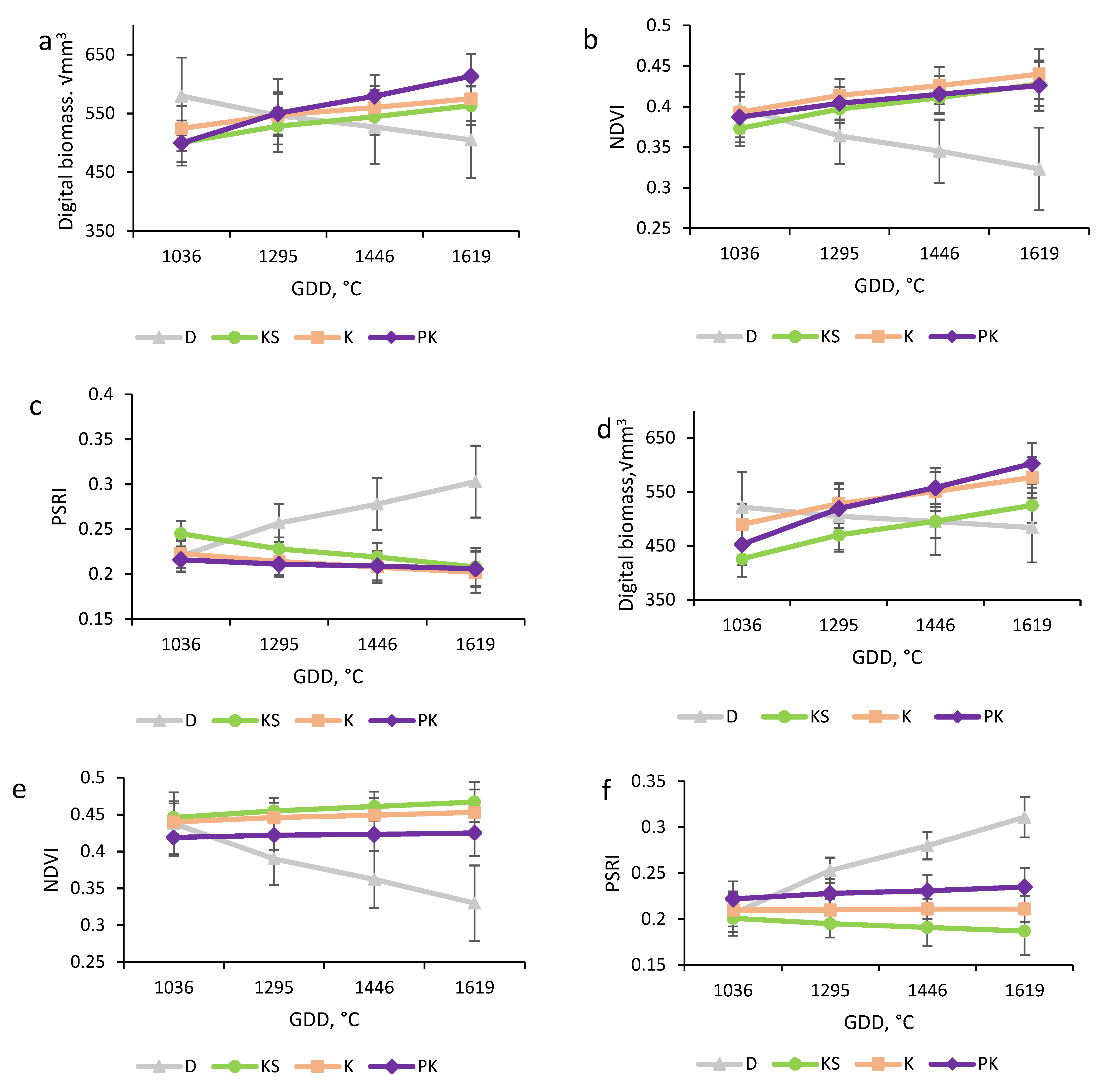
Figure 1. Dynamics of digital biomass ((a,d) square-root transformed (√mm3)), NDVI (b,e), and PSRI ((c,f) Yeo-Johnson-transformed) in Smart Iberia KWS (ac) and Dubravka KWS (df) hybrids under different mineral nutrition regimes measured at 48, 60, 67, and 75 days after sowing. Vertical bars indicate ±95% confidence intervals. D, nutrient deficiency; KS, Knop’s solution; K, additional potassium; PK, additional phosphorus-potassium nutrition.
Ijpb 17 00005 g001
Figure 2. Morphology of sugar beet mini-stecklings produced under speed breeding conditions. Representative root structures of Smart Iberia KWS (ah) and Dubravka KWS (ip) hybrids grown under: mineral nutrient deficiency (a,e,i,m), Knop’s solution (b,f,j,n), additional potassium nutrition (c,g,k,o), and additional phosphorus-potassium nutrition (d,h,l,p) grown under white light conditions (ad,il) and far-red light supplementation (eh,mp).
Ijpb 17 00005 g002
Figure 3. Representative flower stalks developed under speed breeding protocol with far-red light supplementation. Smart Iberia KWS hybrid (ac) and Dubravka KWS hybrid (df) under different mineral nutrition regimes: Knop’s solution (a,d), additional potassium (b,e), and additional phosphorus-potassium nutrition (c,f).
Ijpb 17 00005 g003
Table 1. Effect of mineral nutrition on digital biomass, NDVI, and PSRI in sugar beet hybrids Smart Iberia KWS and Dubravka KWS during early vegetative growth.
ParameterDAS (GDD, °C)Genotype
Smart Iberia KWSDubravka KWS
Treatment (Number of Plants)
D (6)KS (24)K (18)PK (18)D (6)KS (24)K (18)PK (18)
Digital
biomass, √mm3
48 (1036)579.634 ab ± 65.531500.651 b ± 33.204524.605 ab ± 38.172499.826 ab ± 38.172522.139 ab ± 65.497426.239 a ± 33.204489.975 ab ± 38.172452.820 ab ± 38.172
60 (1295)546.486 a ± 62.016528.558 a ± 31.022547.116 a ± 35.816550.312 a ± 35.816505.184 a ± 61.983470.339 a ± 31.022528.679 a ± 35.816519.498 a ± 35.816
67 (1446)527.150 a ± 62.263544.837 a ± 31.176560.248 a ± 35.982579.762 a ± 35.982495.293 a ± 62.231496.064 a ± 31.176551.257 a ± 35.982558.394 a ± 35.982
75 (1619)505.051 ab ± 64.619563.442 ab ± 32.640575.255 ab ± 37.563613.418 ab ± 37.563483.990 a ± 64.585525.464 a ± 32.640577.059 ab ± 37.563602.846 b ± 37.563
NDVI48 (1036)0.398 ab ± 0.0420.373 b ± 0.0220.393 ab ± 0.0250.387 ab ± 0.0250.438 ab ± 0.0420.446 a ± 0.0220.440 ab ± 0.0250.419 ab ± 0.025
60 (1295)0.364 ab ± 0.0350.397 a ± 0.0170.414 ab ± 0.0200.404 ab ± 0.0200.390 a ± 0.0350.455 b ± 0.0170.446 ab ± 0.0200.422 ab ± 0.020
67 (1446)0.345 acd ± 0.0390.411 abdf ± 0.0200.426 bef ± 0.0230.415 abcdef ± 0.0230.362 ab ± 0.0390.461 ce ± 0.0200.449 cdef ± 0.0230.423 abcdef ± 0.023
75 (1619)0.323 ac ± 0.0510.428 bd ± 0.0270.440 bd ± 0.0310.426 bd ± 0.0310.330 ab ± 0.0510.467 cd ± 0.0270.453 cd ± 0.0310.425 cd ± 0.031
PSRI48 (1036)0.220 ab ± 0.0170.245 b ± 0.0140.223 ab ± 0.0160.216 ab ± 0.0140.206 ab ± 0.0240.201 a ± 0.0150.210 ab ± 0.0180.222 ab ± 0.019
60 (1295)0.257 acd ± 0.0210.228 abdf ± 0.0130.214 bef ± 0.0150.211 bef ± 0.0140.253 ab ± 0.0140.195 ce ± 0.0150.210 cdef ± 0.0120.228 abcdef ± 0.016
67 (1446)0.278 acd ± 0.0290.219 bef ± 0.0160.208 bef ± 0.0180.209 bef ± 0.0160.280 ab ± 0.0150.191 ce ± 0.0200.211 cdef ± 0.0110.231 df ± 0.017
75 (1619)0.303 acd ± 0.0400.208 bef ± 0.0210.202 bef ± 0.0230.206 bef ± 0.0200.311 ab ± 0.0220.187 ce ± 0.0260.211 cdef ± 0.0140.235 df ± 0.021
Data are presented as estimated marginal means ±95% confidence intervals. Digital biomass values are square-root transformed (√mm3). PSRI values were analyzed using Yeo-Johnson-transformed data. Different superscript letters indicate statistically significant differences between treatments within each hybrid and time point (Tukey HSD test, p < 0.05). Abbreviations: D—nutrient deficiency; KS—Knop’s solution; K—additional potassium; PK—additional phosphorus-potassium; DAS—days after sowing; GDD—growing degree days (°C).
Table 2. Weight of mini-stecklings obtained from plants of the Smart Iberia KWS and Dubravka KWS hybrids cultivated under white (W) light and with added far-red (FR) light under different mineral nutrition regimes.
TreatmentSmart Iberia KWSDubravka KWS
LightMineral NutritionWeight, gNumber of Plants% vs. DWeight, gNumber of Plants% vs. D
WD9.45 adf [7.82–11.08]20.011.11 abc [10.78–11.44]20.0
KS15.18 beh [11.88–17.97]460.614.69 deg [13.77–15.68]432.2
K16.80 bceghi [13.58–20.02]277.816.34 defghi [15.68–17.01]247.1
PK24.85 cgi [24.81–24.89]2163.016.14 fhi [12.60–19.68]245.3
FRD6.02 adf [5.86–7.43]30.010.72 abc [9.33–10.82]30.0
KS13.44 beh [11.43–16.24]6123.310.89 deg [9.19–14.64]51.6
K9.51 bceghi [6.57–14.81]358.014.37 defghi [12.85–16.93]334.0
PK18.16 cgi [16.57–19.84]3201.718.79 fhi [18.70–20.98]375.3
Designations: D, deficiency, KS, Knop’s solution, K, additional potassium, PK, additional phosphorus-potassium. Values represent median weight in grams with bootstrap 95% confidence intervals in brackets. Different superscript letters within each lighting condition and genotype indicate statistically significant differences based on stratified post hoc Mann–Whitney U tests (p < 0.05, Bonferroni corrected).
Table 3. Time to phenological stage attainment (GDD) and censoring patterns for sugar beet hybrids under different mineral nutrition regimes.
Smart Iberia KWSDubravka KWS
Bolting
NutritionNEventsCensoredCensoring RateMedian GDDNEventsCensoredCensoring RateMedian GDD
D33002295.42 abcdef33002727.08 abcdef
KS1212002273.83 bf12750.422403.33 acde
K99002273.83 cef9720.222424.92 abd
PK99002317.00 de9720.222424.92 abcf
Budding
D3120.673115.583120.673115.58
KS121110.082489.6712480.673115.58
K9810.112468.089270.783115.58
PK9810.112489.679360.673115.58
Flowering
D30313374.5830313374.58
KS12660.53201.92121110.923374.58
K9630.332878.179180.893374.58
PK9810.112878.179180.893374.58
Capsules
D30313547.2530313547.25
KS12570.583547.251201213547.25
K9630.333547.2590913547.25
PK9720.223547.259270.783547.25
Different superscript letters indicate statistically significant differences (log-rank test, p < 0.05) between nutrition treatments within the same genotype and stage. Treatments sharing at least one letter are not significantly different. Grouping is shown only for the bolting stage, where low censoring enabled robust comparisons.
Table 4. Descriptive statistics for seed yield and reproductive architecture traits by genotype and nutrition treatment.
Treatment
(Genotype × Nutrition)
1000-Seed Weight (g)Seed Number per PlantSeed Weight per Plant (g)Flower Stalk Length (cm)Flower Stalk Number
Dubravka KWS × KS14.71 a34.00 a0.50 a33.00 a
[21.11–61.22]
1.00 ac
Dubravka KWS × K26.61 a124.00 a3.30 a57.00 a38.00 ab
Dubravka KWS × PK20.86 a
[19.55–24.74]
374.00 a
[194.00–404.00]
7.80 a
[4.80–7.90]
63.00 a
[63.00–71.00]
33.00 bd
[30.00–35.00]
Smart Iberia KWS × KS15.72 a
[14.69–19.60]
153.00 a
[111.08–332.26]
2.95 a
[2.02–4.92]
49.00 a
[40.00–64.58]
18.00 bd
[9.50–22.83]
Smart Iberia KWS × K19.24 a
[13.79–20.90]
219.00 a
[128.46–252.33]
4.20 a
[2.43–4.83]
58.00 a
[50.00–61.00]
20.50 cd
[17.00–21.83]
Smart Iberia KWS × PK21.36 a
[18.83–22.21]
192.00 a
[116.39–210.87]
4.10 a
[2.49–4.47]
57.50 a
[55.62–60.50]
21.00 ac
[19.25–24.62]
Values represent medians with 95% confidence intervals in brackets (calculated via bootstrap resampling). Superscript letters indicate statistically significant differences based on pairwise Mann–Whitney U tests with Bonferroni correction within each trait (separately for genotype and nutrition factors). Different letters denote significant differences (p < 0.05). For groups with n = 1, confidence intervals are not estimable.
Disclaimer/Publisher’s Note: The statements, opinions and data contained in all publications are solely those of the individual author(s) and contributor(s) and not of MDPI and/or the editor(s). MDPI and/or the editor(s) disclaim responsibility for any injury to people or property resulting from any ideas, methods, instructions or products referred to in the content.