
Physical Therapy Surveillance in Children with Acute Lymphoblastic Leukemia: A Quality Improvement Initiative

 , ,
, ,  ,
,
Abstract
1. Introduction
2. Materials and Methods
2.1. Study Design
2.2. Sampling and Participants
2.3. Procedures
2.4. Data Sources
2.5. Statistical Analysis
2.5.1. Recruitment Rates
2.5.2. Completion Rates
2.5.3. Physical Function Outcomes
2.5.4. HRQOL Outcomes
2.5.5. Self-Reported Symptoms and Deficits
2.5.6. Service Provision
3. Results
3.1. Feasibility Outcomes
3.1.1. Recruitment Rates
3.1.2. Completion Rates
3.2. Physical Function Outcomes
3.2.1. Prevalence of Deficits in PT Surveillance Standard Physical Function Outcomes
3.2.2. Additional Physical Function Outcomes
3.3. HRQOL Outcomes
3.4. Self-Reported Symptoms and Deficits
3.5. Service Provision
4. Discussion
4.1. Limitations
4.2. Future Directions
5. Conclusions
Supplementary Materials
Author Contributions
Funding
Institutional Review Board Statement
Informed Consent Statement
Data Availability Statement
Acknowledgments
Conflicts of Interest
Abbreviations
| ALL | Acute Lymphoblastic Leukemia |
| AROM | Active Range of Motion |
| BOT-2 | Bruininks–Oseretsky Test of Motor Proficiency (2nd edition) |
| CIPN | Chemotherapy-induced Peripheral Neuropathy |
| FP1-6 | Foot Posture Index |
| HRQOL | Health-related Quality of Life |
| ped-mTNS | Pediatric-modified Total Neuropathy Scale |
| PedsQL | Pediatric Quality of Life Inventory version 4.0 |
| PT | Physical Therapy |
| PROM | Passive Range of Motion |
| ROM | Range of Motion |
| 6MWT | Six-minute Walk Test |
References
- National Cancer Institute (US). Childhood Acute Lymphoblastic Leukemia Treatment (PDQ®): Health Professional Version. In PDQ Cancer Information Summaries 2025; National Cancer Institute (US): Bethesda, MD, USA, 2025. [Google Scholar]
- Canadian Cancer Society. Childhood Leukemia Statistics. Available online: https://www.cancer.ca/en/cancer-information/cancer-type/leukemia-childhood/statistics/?region=qc#:~:text=The%20most%20recent%20incidence%20statistics,diagnosed%20with%20acute%20myelogenous%20leukemia (accessed on 11 January 2026).
- Inaba, H.; Pui, C.-H. Advances in the Diagnosis and Treatment of Pediatric Acute Lymphoblastic Leukemia. J. Clin. Med. 2021, 10, 1926. [Google Scholar] [CrossRef]
- Hartman, A.; van den Bos, C.; Stijnen, V.; Pieters, R. Decrease in peripheral muscle strength and ankle dorsiflexion as long-term side effects of treatment for childhood cancer. Pediatr. Blood Cancer 2008, 50, 833–837. [Google Scholar] [CrossRef]
- Ness, K.K.; Hudson, M.M.; Pui, C.H.; Green, D.M.; Krull, K.R.; Huang, T.T.; Robison, L.L.; Morris, E.B. Neuromuscular impairments in adult survivors of childhood acute lymphoblastic leukemia: Associations with physical performance and chemotherapy doses. Cancer 2012, 118, 828–838. [Google Scholar] [CrossRef]
- Ness, K.K.; DeLany, J.P.; Kaste, S.C.; Mulrooney, D.A.; Pui, C.; Chemaitilly, W.; Karlage, R.E.; Lanctot, J.Q.; Howell, C.R.; Lu, L.; et al. Energy balance and fitness in adult survivors of childhood acute lymphoblastic leukemia. Blood 2015, 125, 3411–3419. [Google Scholar] [CrossRef]
- Gilchrist, L.; Tanner, L. Gait Patterns in Children with Cancer and Vincristine Neuropathy. Pediatr. Phys. Ther. 2016, 28, 16–22. [Google Scholar] [CrossRef]
- Wright, M.J.; Galea, V.; Barr, R.D. Proficiency of balance in children and youth who have had acute lymphoblastic leukemia. Phys. Ther. 2005, 85, 782–790. [Google Scholar] [CrossRef] [PubMed]
- Gilchrist, L.S.; Tanner, L.R. Short-Term Recovery of Balance Control: Association with Chemotherapy-Induced Peripheral Neuropathy in Pediatric Oncology. Pediatr. Phys. Ther. 2018, 30, 119–124. [Google Scholar] [CrossRef] [PubMed]
- Tanner, L.; Sencer, S.; Hooke, M.C. The Stoplight Program: A Proactive Physical Therapy Intervention for Children with Acute Lymphoblastic Leukemia. J. Pediatr. Oncol. Nurs. 2017, 34, 347–357. [Google Scholar] [CrossRef] [PubMed]
- Green, J.L.; Knight, S.J.; McCarthy, M.; De Luca, C.R. Motor functioning during and following treatment with chemotherapy for pediatric acute lymphoblastic leukemia. Pediatr. Blood Cancer 2013, 60, 1261–1266. [Google Scholar] [CrossRef]
- Bornstein, M.H.; Scrimin, S.; Putnick, D.L.; Capello, F.; Maurice, H.O.; De Falco, S.; Carli, M.; Pillon, M. Neurodevelopmental Functioning in Very Young Children Undergoing Treatment for Non-CNS Cancers. J. Pediatr. Psychol. 2012, 37, 660–673. [Google Scholar] [CrossRef]
- Wright, M.J.; Twose, D.M.; Gorter, J.W. Gait characteristics of children and youth with chemotherapy induced peripheral neuropathy following treatment for acute lymphoblastic leukemia. Gait Posture 2017, 58, 139–145. [Google Scholar] [CrossRef]
- Lavoie Smith, E.M.; Li, L.; Chiang, C.; Thomas, K.; Hutchinson, R.J.; Wells, E.M.; Ho, R.H.; Skiles, J.; Chakraborty, A.; Bridges, C.M.; et al. Patterns and severity of vincristine-induced peripheral neuropathy in children with acute lymphoblastic leukemia. J. Peripher. Nerv. Syst. 2015, 20, 37–46. [Google Scholar] [CrossRef]
- Gilchrist, L.S.; Marais, L.; Tanner, L. Comparison of two chemotherapy-induced peripheral neuropathy measurement approaches in children. Support. Care Cancer 2014, 22, 359–366. [Google Scholar] [CrossRef]
- Moore, R.J.; Groninger, H. Chemotherapy-Induced Peripheral Neuropathy in Pediatric Cancer Patients. Cureus 2013, 5, e124. [Google Scholar] [CrossRef]
- Wickham, R. Chemotherapy-induced peripheral neuropathy: A review and implications for oncology nursing practice. Clin. J. Oncol. Nurs. 2007, 11, 361–376. [Google Scholar] [CrossRef]
- Smolik, S.; Arland, L.; Hensley, M.A.; Schissel, D.; Shepperd, B.; Thomas, K.; Rodgers, C. Assessment Tools for Peripheral Neuropathy in Pediatric Oncology: A Systematic Review From the Children’s Oncology Group. J. Pediatr. Oncol. Nurs. 2018, 35, 267–275. [Google Scholar] [CrossRef]
- Weiner, L.; Brannagan, T. Peripheral Neuropathy in Cancer (Chapter 50). In Cancer Rehabilitation Principles and Practices, 2nd ed.; Stubblefield, M., Ed.; Springer: New York, NY, USA, 2019; pp. 658–676. [Google Scholar] [CrossRef]
- Ramchandren, S.; Leonard, M.; Mody, R.J.; Donohue, J.E.; Moyer, J.; Hutchinson, R.; Gurney, J.G. Peripheral neuropathy in survivors of childhood acute lymphoblastic leukemia. J. Peripher. Nerv. Syst. 2009, 14, 184–189. [Google Scholar] [CrossRef] [PubMed]
- Jain, P.; Gulati, S.; Seth, R.; Bakhshi, S.; Toteja, G.S.; Pandey, R.M. Vincristine-induced neuropathy in childhood ALL (acute lymphoblastic leukemia) survivors: Prevalence and electrophysiological characteristics. J. Child Neurol. 2014, 29, 932–937. [Google Scholar] [CrossRef] [PubMed]
- Ness, K.K.; Jones, K.E.; Smith, W.A.; Spunt, S.L.; Wilson, C.L.; Armstrong, G.T.; Srivastava, D.K.; Robison, L.L.; Hudson, M.M.; Gurney, J.G. Chemotherapy-Related Neuropathic Symptoms and Functional Impairment in Adult Survivors of Extracranial Solid Tumors of Childhood: Results From the St. Jude Lifetime Cohort Study. Arch. Phys. Med. Rehabil. 2013, 94, 1451–1457. [Google Scholar] [CrossRef] [PubMed]
- Wright, M.; Twose, D.; Gorter, J. Multidimensional Outcome Measurement of Children and Youth with Neuropathy Following Treatment of Leukemia: Cross-sectional Descriptive Report. Rehabil. Oncol. 2019, 37, 160–166. [Google Scholar] [CrossRef]
- Hartman, A.; van den Bos, C.; Stijnen, T.; Pieters, R. Decrease in motor performance in children with cancer is independent of the cumulative dose of vincristine. Cancer 2006, 106, 1395–1401. [Google Scholar] [CrossRef]
- Wacker, K.; Tanner, L.; Ovans, J.; Mason, J.; Gilchrist, L. Improving Functional Mobility in Children and Adolescents Undergoing Treatment for Non-Central Nervous System Cancers: A Systematic Review. PM R 2017, 9, S385–S397. [Google Scholar] [CrossRef]
- Beulertz, J.; Bloch, W.; Prokop, A.; Rustler, V.; Fitzen, C.; Herich, L.; Streckmann, F.; Baumann, F.T. Limitations in Ankle Dorsiflexion Range of Motion, Gait, and Walking Efficiency in Childhood Cancer Survivors. Cancer Nurs. 2016, 39, 117–124. [Google Scholar] [CrossRef]
- Ness, K.K.; Armstrong, G.T.; Kundu, M.; Wilson, C.L.; Tchkonia, T.; Kirkland, J.L. Frailty in childhood cancer survivors. Cancer 2015, 121, 1540–1547. [Google Scholar] [CrossRef]
- Kızılocak, H.; Okcu, F. Late Effects of Therapy in Childhood Acute Lymphoblastic Leukemia Survivors. Turk. J. Hematol. 2019, 36, 1–11. [Google Scholar] [CrossRef]
- Stout, N.L.; Silver, J.K.; Alfano, C.M.; Ness, K.K.; Gilchrist, L.S. Long-Term Survivorship Care After Cancer Treatment: A New Emphasis on the Role of Rehabilitation Services. Phys. Ther. 2019, 99, 10–13. [Google Scholar] [CrossRef]
- Rossi, F.; Ricci, F.; Botti, S.; Bertin, D.; Breggie, S.; Casalaz, R.; Cervo, M.; Ciullini, P.; Coppo, M.; Cornelli, A.; et al. The Italian consensus conference on the role of rehabilitation for children and adolescents with leukemia, central nervous system, and bone tumors, part 1: Review of the conference and presentation of consensus statements on rehabilitative evaluation of motor aspects. Pediatr. Blood Cancer 2020, 67, e28681. [Google Scholar] [CrossRef] [PubMed]
- Heath, S. Cancer rehabilitation for children: A model with potential. Eur. J. Cancer Care 1996, 5, 139–142. [Google Scholar] [CrossRef] [PubMed]
- Knoerl, R.; Gilchrist, L.; Kanzawa-Lee, G.A.; Donohoe, C.; Bridges, C.; Lavoie Smith, E.M. Proactive Rehabilitation for Chemotherapy-Induced Peripheral Neuropathy. Semin. Oncol. Nurs. 2020, 36, 150983. [Google Scholar] [CrossRef] [PubMed]
- Harris, P.A.; Taylor, R.; Thielke, R.; Payne, J.; Gonzalez, N.; Conde, J.G. Research electronic data capture (REDCap)—A metadata-driven methodology and workflow process for providing translational research informatics support. J. Biomed. Inform. 2009, 42, 377–381. [Google Scholar] [CrossRef]
- Houghton, K.M. Review for the generalist: Evaluation of pediatric foot and ankle pain. Pediatr. Rheumatol. 2008, 6, 6. [Google Scholar] [CrossRef]
- Lansky, S.B.; List, M.A.; Lansky, L.L.; Ritter-Sterr, C.; Miller, D.R. The measurement of performance in childhood cancer patients. Cancer 1987, 60, 1651–1656. [Google Scholar] [CrossRef] [PubMed]
- Folio, M.R.; Fewell, R.R. Peabody Developmental Motor Scales, 2nd ed.; Pro-ed.: Austin, TX, USA, 2000. [Google Scholar]
- American Thoracic Society. ATS statement: Guidelines for the six-minute walk test. Am. J. Respir. Crit. Care Med. 2002, 166, 111–117. [Google Scholar] [CrossRef]
- Baker, C.; Wong, D. Wong-Baker Faces Pain Rating Scale. Available online: https://wongbakerfaces.org/ (accessed on 11 January 2026).
- Whittle, M.W. Clinical gait analysis: A review. Hum. Mov. Sci. 1996, 15, 369–387. [Google Scholar] [CrossRef]
- Boyce, W.F.; Gowland, C.; Rosenbaum, P.L.; Lane, M.; Plews, N.; Goldsmith, C.H.; Russell, D.J.; Wright, V.; Potter, S.; Harding, D. The Gross Motor Performance Measure: Validity and responsiveness of a measure of quality of movement. Phys. Ther. 1995, 75, 603–613. [Google Scholar] [CrossRef] [PubMed]
- Gilchrist, L.S.; Tanner, L. The pediatric-modified total neuropathy score: A reliable and valid measure of chemotherapy-induced peripheral neuropathy in children with non-CNS cancers. Support. Care Cancer 2013, 21, 847–856. [Google Scholar] [CrossRef] [PubMed]
- Keenan, A.-M.; Redmond, A.C.; Horton, M.; Conaghan, P.G.; Tennant, A. The Foot Posture Index: Rasch Analysis of a Novel, Foot-Specific Outcome Measure. Arch. Phys. Med. Rehabil. 2007, 88, 88–93. [Google Scholar] [CrossRef]
- Bruininks, R.H. Bruininks-Oseretsky Test of Motor Proficiency; American Guidance Service: Circle Pines, MN, USA, 1978. [Google Scholar]
- Varni, J.W.; Burwinkle, T.M.; Katz, E.R.; Meeske, K.; Dickinson, P. The PEDsQL in Pediatric Cancer: Reliability and validity of the Pediatric Quality of Life inventory Generic Core Scales, Multidimensional Fatigue Scale, and Cancer Module. Cancer 2002, 94, 2090–2106. [Google Scholar] [CrossRef]
- Lynn, T.; Laura, G. Safety of Symptom-Based Modification of Physical Therapy Interventions in Pediatric Oncology Patients with and Without Low Blood Counts. Rehabil. Oncol. 2017, 35, 3–8. [Google Scholar] [CrossRef]
- Beverung, L.M.; Varni, J.W.; Panepinto, J.A. Clinically Meaningful Interpretation of Pediatric Health-related Quality of Life in Sickle Cell Disease. J. Pediatr. Hematol. Oncol. 2015, 37, 128–133. [Google Scholar] [CrossRef]
- Šnajdrová, T.; Patrmanová, E.; Jevič, F.; Bořilová, K.; Hrdoušková, M.; Musálek, M. Clinical applicability of short form of Bruininks-Oseretsky Test of Motor Proficiency Second Edition in patients after treatment of acute lymphoblastic leukemia. Front. Pediatr. 2023, 11, 1071572. [Google Scholar] [CrossRef]
- Tay, C.G.; Lee, V.W.M.; Ong, L.C.; Goh, K.J.; Ariffin, H.; Fong, C.Y. Vincristine-induced peripheral neuropathy in survivors of childhood acute lymphoblastic leukaemia. Pediatr. Blood Cancer 2017, 64, e26471. [Google Scholar] [CrossRef]
- Hung, S.H.; Rankin, A.; Virji-Babul, N.; Pritchard, S.; Fryer, C.; Campbell, K.L. Associating Physical Activity Levels with Motor Performance and Physical Function in Childhood Survivors of Acute Lymphoblastic Leukemia. Physiother. Can. 2017, 69, 57–64. [Google Scholar] [CrossRef]
- Hanna, S.; El-Ayadi, M.; Abdelazeim, F. Identifying fine motor difficulties in children with acute lymphoblastic leukemia: A scoping review. Support. Care Cancer 2024, 32, 488. [Google Scholar] [CrossRef]
- Tanner, L.R.; Demers, C.; Schorr, E.N.; Rosenberg, N.S.; Hooke, M.C.; Turcotte, L.M.; Treat-Jacobson, D. Impact of chemotherapy-induced peripheral neuropathy on physical function in pediatric cancer survivors: A systematic review. J. Cancer Surviv. 2025. [Google Scholar] [CrossRef]
- L’Hotta, A.J.; Randolph, S.B.; Reader, B.; Lipsey, K.; King, A.A. Clinical practice guideline and expert consensus recommendations for rehabilitation among children with cancer: A systematic review. CA A Cancer J. Clin. 2023, 73, 524–545. [Google Scholar] [CrossRef]
- Smith, E.M.L.; Kuisell, C.; Kanzawa-Lee, G.A.; Bridges, C.M.; Alberti, P.; Cavaletti, G.; Saad, R.; Park, S. Approaches to measure paediatric chemotherapy-induced peripheral neurotoxicity: A systematic review. Lancet Haematol. 2020, 7, e408–e417. [Google Scholar] [CrossRef] [PubMed]
- Lu, Q.; Krull, K.R.; Leisenring, W.; Owen, J.E.; Kawashima, T.; Tsao, J.C.I.; Zebrack, B.; Mertens, A.; Armstrong, G.T.; Stovall, M.; et al. Pain in long-term adult survivors of childhood cancers and their siblings: A report from the Childhood Cancer Survivor Study. Pain 2011, 152, 2616–2624. [Google Scholar] [CrossRef] [PubMed]
- Alberts, N.M.; Gagnon, M.M.; Stinson, J.N. Chronic pain in survivors of childhood cancer: A developmental model of pain across the cancer trajectory. Pain 2018, 159, 1916–1927. [Google Scholar] [CrossRef] [PubMed]
- Schulte, F.S.M.; Patton, M.; Alberts, N.M.; Kunin-Batson, A.; Olson-Bullis, B.A.; Forbes, C.; Russell, K.B.; Neville, A.; Heathcote, L.C.; Karlson, C.W.; et al. Pain in long-term survivors of childhood cancer: A systematic review of the current state of knowledge and a call to action from the Children’s Oncology Group. Cancer 2021, 127, 35–44. [Google Scholar] [CrossRef]
- Lamore, K.; Bourdeau, C.; Alos, N.; Bertout, L.; Curnier, D.; Drouin, S.; Krajinovic, M.; Laverdière, C.; Lippé, S.; Marcil, V.; et al. Contributing Factors of Unmet Needs Among Young Adult Survivors of Childhood Acute Lymphoblastic Leukemia with Comorbidities. J. Adolesc. Young Adult Oncol. 2020, 10, 462–475. [Google Scholar] [CrossRef]
- Coluzzi, F.; Rocco, M.; Green Gladden, R.; Persiani, P.; Thur, L.A.; Milano, F. Pain Management in Childhood Leukemia: Diagnosis and Available Analgesic Treatments. Cancers 2020, 12, 3671. [Google Scholar] [CrossRef] [PubMed]
- Eiser, C.; Stride, C.B.; Vora, A.; Goulden, N.; Mitchell, C.; Buck, G.; Adams, M.; Jenney, M.E.M.; the National Cancer Research Institute Childhood Leukaemia Sub-Group; UK Childhood Leukaemia Clinicians Network. Prospective evaluation of quality of life in children treated in UKALL 2003 for acute lymphoblastic leukaemia: A cohort study. Pediatr. Blood Cancer 2017, 64, e26615. [Google Scholar] [CrossRef]
- Klages, K.L.; Gibson, C.A.; Barnett, K.A.; Schwartz, L.E.; Hicks, C.A.; Norris, R.E.; Kashikar-Zuck, S.; Pai, A.L.H. Systematic Review of Pain Assessment Measures Used in Pediatric Acute Lymphoblastic Leukemia. Psycho-Oncology 2025, 34, e70063. [Google Scholar] [CrossRef]
- Brand, K.; Al-Rais, A. Pain assessment in children. Anaesth. Intensive Care Med. 2019, 20, 314–317. [Google Scholar] [CrossRef]
- Bansal, M.; Sharma, K.K.; Vatsa, M.; Bakhshi, S. Comparison of health-related quality of life of children during maintenance therapy with acute lymphoblastic leukemia versus siblings and healthy children in India. Leuk. Lymphoma 2013, 54, 1036–1041. [Google Scholar] [CrossRef]
- Jankowska-Polańska, B.; Sliwiński, M.; Świątoniowska, N.; Butrym, A.; Mazur, G. Quality of life in children with acute lymphoblastic leukaemia. Scand. J. Caring Sci. 2020, 34, 380–389. [Google Scholar] [CrossRef] [PubMed]
- Ospina, P.A.; Pritchard, L.; Eisenstat, D.D.; McNeely, M.L. Advancing Pediatric Oncology Rehabilitation: Survey Findings of Health Professionals’ Perceptions of Barriers to Care and a Framework for Action. Cancers 2023, 15, 693. [Google Scholar] [CrossRef] [PubMed]
- Gohar, S.F.; Marchese, V.; Comito, M. Physician referral frequency for physical therapy in children with acute lymphoblastic leukemia. Pediatr. Hematol. Oncol. 2010, 27, 179–187. [Google Scholar] [CrossRef]
- Rodwin, R.L.; Ma, X.; Ness, K.K.; Kadan-Lottick, N.S.; Wang, R. Physical Therapy Utilization Among Hospitalized Patients with Pediatric Acute Lymphoblastic Leukemia. JCO Oncol. Pract. 2022, 18, e1060–e1068. [Google Scholar] [CrossRef]
- Montgomery, M.; Huang, S.; Cox, C.L.; Leisenring, W.M.; Oeffinger, K.C.; Hudson, M.M.; Ginsberg, J.; Armstrong, G.T.; Robison, L.L.; Ness, K.K.; et al. Physical therapy and chiropractic use among childhood cancer survivors with chronic disease: Impact on health-related quality of life. J. Cancer Surviv. 2011, 5, 73–81. [Google Scholar] [CrossRef]
- Wang, C.P.; Syrkin-Nikolau, M.; Farnaes, L.; Shen, D.; Kanegaye, M.; Kuo, D.J. Screening for Chemotherapy-Induced Peripheral Neuropathy and Utilization of Physical Therapy in Pediatric Patients Receiving Treatment for Hematologic Malignancies. Blood 2020, 136, 16–17. [Google Scholar] [CrossRef]
- Lewandowska, A. The Needs of Parents of Children Suffering from Cancer—Continuation of Research. Children 2022, 9, 144. [Google Scholar] [CrossRef]
- Cheung, A.T.; Li, W.H.C.; Ho, L.L.K.; Chan, G.C.F.; Chung, J.O.K. Parental perspectives on promoting physical activity for their children surviving cancer: A qualitative study. Patient Educ. Couns. 2021, 104, 1719–1725. [Google Scholar] [CrossRef]
- Nieto, C.; Kadan-Lottick, N.S.; Ross, W.L.; Santiago-Rivera, Y.; Sandbo, C.; Hild, M.; Bryant, S.; Barnhorst, M.; Appel, B.; Mendoza, J.A. Increasing Physical Activity in Children During Cancer Treatment: A Qualitative Study of Parents’ Perspectives. Pediatr. Blood Cancer 2025, 72, e31961. [Google Scholar] [CrossRef] [PubMed]
- Paul, V.; Inhestern, L.; Sigmund, D.; Winzig, J.; Rutkowski, S.; Escherich, G.; Bergelt, C. Addressing gaps and enhancing experiences in support services for families of pediatric cancer survivors. Pediatr. Res. 2025, 98, 168–173. [Google Scholar] [CrossRef] [PubMed]
- Weller, L.J.R.; Cavers, D.G.; Rowa-Dewar, N. Parents’ perceptions and experiences of physical activity in childhood cancer survivors in Singapore: A qualitative study. Singap. Med. J. 2025, 66, 314–320. [Google Scholar] [CrossRef]
- Wright, H.; Hou, S.H.J.; Henry, B.; Drummond, R.; Mendonça, K.; Forbes, C.; Rahamatullah, I.; Duong, J.; Erker, C.; Taccone, M.S.; et al. Barriers and Enablers to Engaging with Long-Term Follow-Up Care Among Canadian Survivors of Pediatric Cancer: A COM-B Analysis. Curr. Oncol. 2025, 32, 427. [Google Scholar] [CrossRef]
- Ospina, P.A.; Shah, P.; Dhaliwal, L.; Fisher, S.; Wilson, B.A.; Pritchard, L.; Eisenstat, D.D.; McNeely, M.L. Parent Perspectives on Physical Therapy for Their Child with Acute Lymphoblastic Leukemia: The Light at the End of the Tunnel. Curr. Oncol. 2026, 33, 60. [Google Scholar] [CrossRef] [PubMed]
- L’Hotta, A.J.; Beam, I.A.; Thomas, K.M. Development of a comprehensive pediatric oncology rehabilitation program. Pediatr. Blood Cancer 2020, 67, e28083. [Google Scholar] [CrossRef]
- Mizrahi, D.; Martiniuk, A.; Hibbert, L.; Govender, D.; Sibbald, T.; Mitchell, R.; Millard, N.; Ha, L.; Ragusa, D.; Brown, K.; et al. Implementing an online-delivered exercise program for childhood cancer survivors: A hybrid effectiveness-implementation protocol for the MERRIER study. JSAMS Plus 2025, 5, 100095. [Google Scholar] [CrossRef]
- Ospina, P.A.; Fisher, S.; Wilson, B.A.; Pritchard, L.; Eisenstat, D.D.; Tandon, P.; McNeely, M.L. Pediatric Early Rehabilitation in ACute Lymphoblastic LEukemia (PEACE): A Proof-of-Concept Study of an Enhanced Hybrid Delivery Format (Trial Protocol). Rehabil. Oncol. 2025, 43, 182–190. [Google Scholar] [CrossRef]
- Youdas, J.W.; Krause, D.A.; Egan, K.S.; Therneau, T.M.; Laskowski, E.R. The effect of static stretching of the calf muscle-tendon unit on active ankle dorsiflexion range of motion. J. Orthop. Sports Phys. Ther. 2003, 33, 408–417. [Google Scholar] [CrossRef]
- Zito, M.; Driver, D.; Parker, C.; Bohannon, R. Lasting effects of one bout of two 15-second passive stretches on ankle dorsiflexion range of motion. J. Orthop. Sports Phys. Ther. 1997, 26, 214–221. [Google Scholar] [CrossRef]
- Reeve, B.B.; McFatrich, M.; Mack, J.W.; Maurer, S.H.; Jacobs, S.S.; Freyer, D.R.; Withycombe, J.S.; Baker, J.N.; Castellino, S.M.; Lin, L.; et al. Validity and Reliability of the Pediatric Patient-Reported Outcomes version of the Common Terminology Criteria for Adverse Events. JNCI J. Natl. Cancer Inst. 2020, 112, 1143–1152. [Google Scholar] [CrossRef]
- Liao, H.; Mao, P.; Hwang, A. Test-retest reliability of balance tests in children with cerebral palsy. Dev. Med. Child Neurol. 2001, 43, 180–186. [Google Scholar] [PubMed]
- Condon, C.; Cremin, K. Static Balance Norms in Children. Physiother. Res. Int. J. Res. Clin. Phys. Ther. 2014, 19, 1–7. [Google Scholar] [CrossRef]
- Cunha, M.T.; Rozov, T.; De Oliveira, R.C.; Jardim, J.R. Six-minute walk test in children and adolescents with cystic fibrosis. Pediatr. Pulmonol. 2006, 41, 618–622. [Google Scholar] [CrossRef] [PubMed]
- Nixon, P.A.; Joswiak, M.L.; Fricker, F.J. A six-minute walk test for assessing exercise tolerance in severely ill children. J. Pediatr. 1996, 129, 362–366. [Google Scholar] [CrossRef]
- Hooke, M.C.; Garwick, A.W.; Neglia, J.P. Assessment of Physical Performance Using the 6-Minute Walk Test in Children Receiving Treatment for Cancer. Cancer Nurs. 2013, 36, E9–E16. [Google Scholar] [CrossRef] [PubMed]
- Tanner, L.R.; Hooke, M.C.; Hinshon, S.; Hansen, C.R. Effect of an Ankle Foot Orthosis Intervention for Children with Non-Central Nervous System Cancers: A Pilot Study. Pediatr. Phys. Ther. 2015, 27, 425–431. [Google Scholar] [CrossRef]
- Hartman, A.; Hop, W.; Takken, T.; Pieters, R.; van den Heuvel-Eibrink, M. Motor Performance and Functional Exercise Capacity in Survivors of Pediatric Acute Lymphoblastic Leukemia. Pediatr. Blood Cancer 2013, 60, 494–499. [Google Scholar] [CrossRef]
- Borg, G.A.V. Psychophysical bases of perceived exertion./Les bases psychophysiques de la perception del’ effort. Med. Sci. Sports Exerc. 1982, 14, 377–381. [Google Scholar] [CrossRef]
- Vanhelst, J.; Fardy, P.S.; Salleron, J.; Béghin, L. The six-minute walk test in obese youth: Reproducibility, validity, and prediction equation to assess aerobic power. Disabil. Rehabil. 2013, 35, 479–482. [Google Scholar] [CrossRef]
- Fadida, Y.; Shapira-Vadler, O.; Spasser, R.; Frenkel-Toledo, S. Reproducibility and smallest real differences of walking and Energy Expenditure Index in children and adolescents with an acquired brain injury. NeuroRehabilitation 2019, 45, 19–24. [Google Scholar] [CrossRef] [PubMed]
- Drendel, A.L.; Kelly, B.T.; Ali, S. Pain Assessment for Children: Overcoming Challenges and Optimizing Care. Pediatr. Emerg. Care 2011, 27, 773–781. [Google Scholar] [CrossRef]
- Garra, G.; Singer, A.J.; Taira, B.R.; Chohan, J.; Cardoz, H.; Chisena, E.; Thode, H.C., Jr. Validation of the Wong-Baker FACES Pain Rating Scale in pediatric emergency department patients. Acad. Emerg. Med. 2010, 17, 50–54. [Google Scholar] [CrossRef]
- Gilchrist, L.S.; Tanner, L.R.; Ness, K.K. Short-term recovery of chemotherapy-induced peripheral neuropathy after treatment for pediatric non-CNS cancer. Pediatr. Blood Cancer 2017, 64, 180–187. [Google Scholar] [CrossRef] [PubMed]
- Bruininks, R.H.; Bruininks, B.D. BOT-2: Bruininks-Oseretsky Test of Motor Proficiency, 2nd ed.; Pearson Assessments: Minneapolis, MN, USA, 2005. [Google Scholar]
- Piscione, P.J.; Bouffet, E.; Timmons, B.; Courneya, K.S.; Tetzlaff, D.; Schneiderman, J.E.; de Medeiros, C.B.; Bartels, U.; Mabbott, D.J. Exercise training improves physical function and fitness in long-term paediatric brain tumour survivors treated with cranial irradiation. Eur. J. Cancer 2017, 80, 63–72. [Google Scholar] [CrossRef] [PubMed]
- Piscione, P.J.; Bouffet, E.; Mabbott, D.J.; Shams, I.; Kulkarni, A.V. Physical functioning in pediatric survivors of childhood posterior fossa brain tumors. Neuro-Oncology 2014, 16, 147–155. [Google Scholar] [CrossRef]
- Wuang, Y.-P.; Su, C.-Y. Reliability and responsiveness of the Bruininks-Oseretsky Test of Motor Proficiency-Second Edition in children with intellectual disability. Res. Dev. Disabil. 2009, 30, 847–855. [Google Scholar] [CrossRef] [PubMed]
- Morrison, S.C.; Ferrari, J. Inter-rater reliability of the Foot Posture Index (FPI-6) in the assessment of the paediatric foot. J. Foot Ankle Res. 2009, 2, 26. [Google Scholar] [CrossRef] [PubMed]
- Gijon-Nogueron, G.; Martinez-Nova, A.; Alfageme-Garcia, P.; Montes-Alguacil, J.; Evans, A.M. International normative data for paediatric foot posture assessment: A cross-sectional investigation. BMJ Open 2019, 9, e023341. [Google Scholar] [CrossRef] [PubMed]



| Demographics | Overall N = 20, 100% |
|---|---|
| Child Age Upon Enrollment (Mean, SD, range) | |
| Age, years | 8.24 (3.42) 4–16 years |
| Biological Sex (n, %) | |
| Female | 6 (30%) |
| Male | 14 (70%) |
| Height (Median, range) | |
| Centimeters, cm | 135.9 (105.3–177.2 cm) |
| Weight (Median, range) | |
| Kilograms, kg | 30.5 (19–95.6 kg) |
| Body Mass Index (BMI) (Mean, SD, range) | |
| BMI | 19.70 (5.24) (14.69–33.79) |
| Primary Carer’s Current Employment Status (n, %) | |
| Not employed (disability) | 2 (10%) |
| Homemaker | 8 (40%) |
| Full Time | 9 (45%) |
| Temporarily Unemployed | 2 (10%) |
| Annual Family Income (n, %) | |
| <$CAD 60,000 | 4 (20%) |
| >$CAD 60,000 | 13 (65%) |
| Prefer not to answer | 3 (15%) |
| Type of Residential Area (n, %) | |
| Edmonton Metropolitan Area | 12 (60%) |
| Alberta/Northwest Territories rural and remote residence | 8 (40%) |
| Primary Carer Living in the Same Residence as Child (n, %) | |
| Yes | 20 (100%) |
| Type of Acute Lymphoblastic Leukemia (n, %) | |
| B-cell | 17 (85%) |
| T-cell | 3 (15%) |
| Children’s Oncology Group Risk Level (n, %) | |
| Standard | 12 (60%) |
| High | 8 (40%) |
| Chemotherapy Treatment Phase (n, %) | |
| Consolidation | 4 (20%) |
| Maintenance | 16 (80%) |
| Additional Concurrent Medical Conditions (n, %) | |
| High Blood Pressure | 1 (5%) |
| None | 19 (95%) |
| Past Medical Conditions (n, %) | |
| Seizures | 2 (10%) |
| Congenital heart malformation | 1 (5%) |
| Liver impairment | 1 (5%) |
| Bilateral inguinal hernia | 1 (5%) |
| None | 15 (75%) |
| Cumulative Vincristine Dosage (n = 19) (Median, range) | |
| Dosage, mg/m2 | 28.4 (16.4–58 mg/m2) |
| Outcomes (N = 20) | Score Classification at Initial Assessment N (%) | Initial Assessment Classification of Participants with a Follow-Up Assessment N (%) | Change in Score Classification for Participants with a Follow-Up Assessment N; ↑ ↓ = |
|---|---|---|---|
| Ankle dorsiflexion ROM | |||
| AROM (Right) | Normal 4 (20%) Moderate 12 (60%) Severe 4 (20%) | Normal 1 (5%) Moderate 8 (40%) Severe 3 (15%) | Normal 3 ↑ Moderate 2 ↓ Severe 7 ↑ |
| AROM (Left) | Normal 4 (20%) Moderate 12 (60%) Severe 4 (20%) | Normal 2 (10%) Moderate 7 (35%) Severe 3 (15%) | Normal 4 ↑ Moderate 3 ↓ Severe 5 ↑ |
| PROM (Right) | Normal 7 (35%) Moderate 10 (50%) Severe 3 (15%) | Normal 4 (20%) Moderate 5 (25%) Severe 3 (15%) | Normal 2 ↓ Moderate 5 = Severe 5 ↑ |
| PROM (Left) | Normal 7 (35%) Moderate 11 (55%) Severe 2 (10%) | Normal 3 (15%) Moderate 7 (35%) Severe 2 (10%) | Normal 4 ↑ Moderate 4 ↓ Severe 4 ↑ |
| Lansky scale | Normal 17 (85%) Moderate 3 (15%) Severe 0 | Normal 5 (25%) Moderate 0 Severe 0 | Normal 4 ↓ Moderate 1 ↑ Severe 0 = |
| Single-leg balance test | |||
| Right | Normal 8 (40%) Affected 12 (60%) | Normal 3 (15%) Affected 6 (30%) | Normal 5 ↑ Affected 4 ↓ |
| Left | Normal 9 (45%) Affected 11 (55%) | Normal 5 (25%) Affected 4 (20%) | Normal 6 ↑ Affected 3 ↓ |
| FACES pain scale | Normal 16 (80%) Moderate 4 (20%) Severe 0 | Normal 8 (40%) Moderate 2 (10%) Severe 0 | Normal 7 ↓ Moderate 3 ↑ Severe 0 = |
| Observational gait analysis | |||
| Base of support | Normal 15 (75%) Moderate 5 (25%) Severe 0 | Normal 11 (55%) Moderate 5 (25%) Severe 0 | Normal 10 ↓ Moderate 6 ↑ Severe 0 = |
| Foot progression | Normal 13 (65%) Moderate 6 (30%) Severe 1 (5%) | Normal 10 (50%) Moderate 6 (30%) Severe 0 | Normal 10 = Moderate 5 ↓ Severe 1 ↑ |
| Gait speed | Normal 15 (75%) Moderate 5 (25%) Severe 0 | Normal 11 (55%) Moderate 5 (25%) Severe 0 | Normal 12 ↑ Moderate 4 ↓ Severe 0 = |
| Proximal strength | Normal 19 (95%) Moderate 1 (5%) Severe 0 | Normal 15 (75%) Moderate 1 (5%) Severe 0 | Normal 14 ↓ Moderate 2 ↑ Severe 0 = |
| Half-kneel to stand | Normal 9 (45%) Moderate 11 (55%) Severe 0 | Normal 0 Moderate 3 (15%) Severe 0 | Normal 1 ↑ Moderate 2 ↓ Severe 0 = |
| 6MWT | Normal 8 (40%) Moderate 9 (45%) Severe 3 (15%) | - | - |
| Outcomes (N = 20) | Score Classification at Assessment N (%) |
|---|---|
| Ped-mTNS (n = 19) | |
| Sensory | Normal 10 (53%) Affected 9 (47%) |
| Functional | Normal 6 (32%) Affected 13 (68%) |
| Autonomic | Normal 10 (53%) Affected 9 (47%) |
| Light touch | Normal 6 (32%) Affected 13 (68%) |
| Pin sensibility | Normal 11 (58%) Affected 8 (42%) |
| Vibration (n = 18) | Normal 16 (89%) Affected 2 (11%) |
| Strength | Normal 8 (42%) Affected 11 (58%) |
| Deep tendon reflexes | Normal 5 (%) Affected 14 (74%) |
| Total score | Normal 5 (26%) Affected 14 (74%) |
| FP1-6 | |
| Right | Normal 13 (65%) Moderate 6 (30%) Severe 1 (5%) |
| Left | Normal 12 (60%) Moderate 5 (25%) Severe 3 (15%) |
| BOT-2 (short form) | Normal 9 (45%) Moderate 7 (35%) Severe 4 (20%) |
| Outcome | Overall N = 20 Mean (SD) Range |
|---|---|
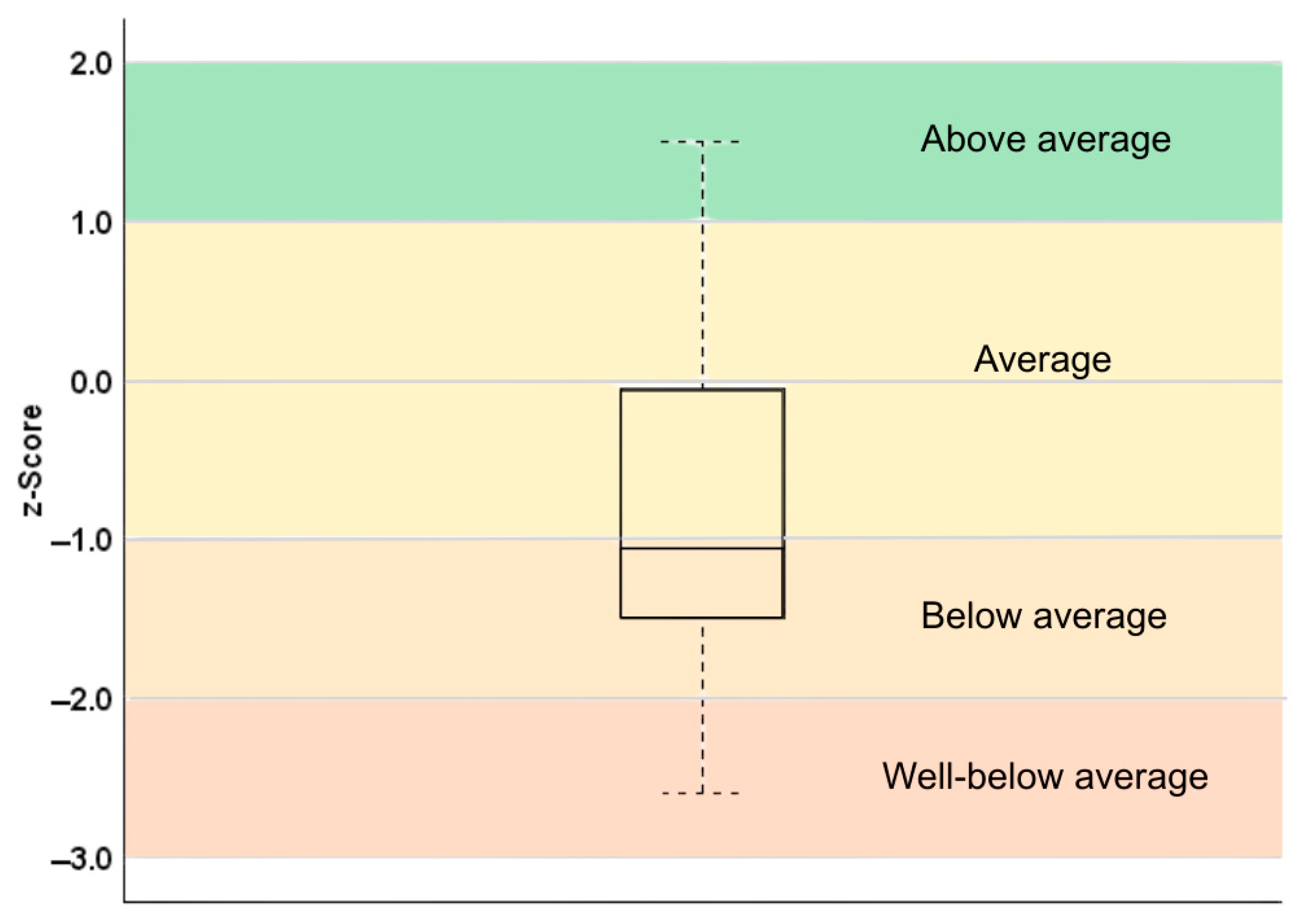
| BOT-2 (SF) standard score | 42.6 (11.31) 24–65 |
| FP1-6 | |
| Right foot | 3.9 (2.85) 0–10 |
| Left foot | 5.1 (2.56) 1–10 |
| ped-mTNS (n = 19) | |
| Sensory | 0.73 (0.96) 0–3 |
| Functional | 0.89 (0.71) 0–2 |
| Autonomic | 0.78 (0.89) 0–2 |
| Light touch | 1.68 (1.41) 0–4 |
| Pin sensibility | 0.57 (0.93) 0–4 |
| Vibration (n = 18) | 0.16 (0.5) 0–2 |
| Strength | 0.63 (0.58) 0–2 |
| Deep tendon reflexes | 1.47 (1.46) 0–4 |
| Total score | 6.9 (3.45) 0–16 |
| PedsQL | Baseline (n = 19) Mean (SD) | 1-Month (n = 17) Mean (SD) | 2-Month (n = 15) Mean (SD) | 3-Month (n = 20) Mean (SD) |
|---|---|---|---|---|
| Pain and hurt | 65.1 (17) | 66.9 (17.6) | 65.7 (20.3) | 66.9 (16.9) |
| Nausea | 68.2 (18.9) | 66.5 (17.1) | 65.7 (20.3) | 70 (16.1) |
| Procedural anxiety | 58.3 (24.1) | 55.9 (23.7) | 68.3 (20.7) | 66.7 (15.8) |
| Treatment anxiety | 71.1 (22.3) | 76 (16.1) | 76.7 (22.1) | 77.9 (16.9) |
| Worry | 75.9 (23.4) | 73 (21.4) | 77.8 (20.8) | 76.3 (21.3) |
| Cognitive problems | 69.1 (16) | 70.5 (14) | 72.8 (15.2) | 70.8 (18.3) |
| Perceived physical appearance | 81.6 (17.9) | 72.1 (22.2) | 81.7 (20.2) | 76.2 (22.3) |
| Communication | 76.3 (18.3) | 65.2 (23.2) | 66.7 (24.4) | 71.7 (17.2) |
| Total PedsQL score | 70.6 (13.1) | 68.1 (11.8) | 72 (13.3) | 72 (11.4) |
| PedsQL Subscales | Mean (SD) | Difference in Relation to Reference |
|---|---|---|
| Procedural anxiety | 62.2 (21.4) | Lowest mean (reference score) |
| Pain and hurt | 66.2 (17.7) | p = 0.279 |
| Nausea | 67.7 (17.7) | p = 0.186 |
| Communication | 70.3 (20.7) | p = 0.036 |
| Cognitive problems | 70.7 (15.8) | p = 0.026 |
| Treatment anxiety | 75.4 (19.2) | p < 0.001 * |
| Worry | 75.7 (21.4) | p < 0.001 * |
| Perceived physical appearance | 77.8 (20.7) | p < 0.001 * |
Disclaimer/Publisher’s Note: The statements, opinions and data contained in all publications are solely those of the individual author(s) and contributor(s) and not of MDPI and/or the editor(s). MDPI and/or the editor(s) disclaim responsibility for any injury to people or property resulting from any ideas, methods, instructions or products referred to in the content. |
© 2026 by the authors. Licensee MDPI, Basel, Switzerland. This article is an open access article distributed under the terms and conditions of the Creative Commons Attribution (CC BY) license.
Share and Cite
Ospina, P.A.; Fisher, S.; Wilson, B.A.; Pritchard, L.; Eisenstat, D.D.; Fuengeling, C.; McNeely, M.L. Physical Therapy Surveillance in Children with Acute Lymphoblastic Leukemia: A Quality Improvement Initiative. Pediatr. Rep. 2026, 18, 36. https://doi.org/10.3390/pediatric18020036
Ospina PA, Fisher S, Wilson BA, Pritchard L, Eisenstat DD, Fuengeling C, McNeely ML. Physical Therapy Surveillance in Children with Acute Lymphoblastic Leukemia: A Quality Improvement Initiative. Pediatric Reports. 2026; 18(2):36. https://doi.org/10.3390/pediatric18020036
Chicago/Turabian StyleOspina, Paula A., Sara Fisher, Beverly A. Wilson, Lesley Pritchard, David D. Eisenstat, Cindy Fuengeling, and Margaret L. McNeely. 2026. "Physical Therapy Surveillance in Children with Acute Lymphoblastic Leukemia: A Quality Improvement Initiative" Pediatric Reports 18, no. 2: 36. https://doi.org/10.3390/pediatric18020036
APA StyleOspina, P. A., Fisher, S., Wilson, B. A., Pritchard, L., Eisenstat, D. D., Fuengeling, C., & McNeely, M. L. (2026). Physical Therapy Surveillance in Children with Acute Lymphoblastic Leukemia: A Quality Improvement Initiative. Pediatric Reports, 18(2), 36. https://doi.org/10.3390/pediatric18020036