
Article

Effects of Lactic Acid Bacteria Cultures on Lipid Profile and Volatile Compounds of Reduced–Sodium Fermented Sausages


by
Marcello Lima Bertuci
1,2,*,
Victoria Diniz Shimizu-Marin
1,
Carlos Alberto Alves Junior
1,
Livia Padilha Lima
1,
Svetoslav Dimitrov Todorov
2,*,
Suzana Caetano da Silva Lannes
3,
Ana Lúcia Barretto Penna
4 and
Andrea Carla da Silva Barretto
4
1
Graduate Program in Food, Nutrition and Food Engineering, São Paulo State University, São José do Rio Preto 15054-000, SP, Brazil
2
ProBacLab, Department of Food Science and Experimental Nutrition, Faculty of Pharmaceutical Sciences, University of São Paulo, São Paulo 05508-090, SP, Brazil
3
Department of Pharmaceutical Technology, Faculty of Pharmaceutical Sciences, University of São Paulo, São Paulo 05508-000, SP, Brazil
4
Department of Food Technology and Engineering, Institute of Biosciences, Humanities and Exact Sciences, São Paulo State University, São José do Rio Preto 15054-000, SP, Brazil
*
Authors to whom correspondence should be addressed.
Microbiol. Res. 2026, 17(9), 186; https://doi.org/10.3390/microbiolres17090186
Submission received: 12 August 2026 / Revised: 3 September 2026 / Accepted: 11 September 2026 / Published: 20 September 2026
(This article belongs to the Topic Fermented Food: Health and Benefit, 2nd Edition)

Abstract

This study evaluated the effect of different lactic acid bacteria (LAB) strains on the fatty acid composition and volatile profile of reduced-sodium fermented sausages. Six treatments were produced: a control with a standard sodium content (Con) and five reduced-sodium treatments, including NAR and four inoculated with different LAB strains. Fatty acids were analyzed by GC-FID and volatile compounds by HS-SPME/GC–MS, followed by a multivariate analysis. Reduced sodium and LAB inoculation did not significantly affect the total lipid content or the overall fatty acid profile, although minor differences were observed in individual fatty acids. In contrast, both factors markedly influenced the volatile profile. A total of 51 volatile compounds were identified, with carboxylic acids as the predominant class and terpenes as the most diverse. The LAB strains modulated volatile formation in a strain-dependent manner, with Lacticaseibacillus rhamnosus GG showing higher organic acid production. The correlation analysis indicated that polyunsaturated fatty acids were positively associated with aldehydes and alcohols, whereas carboxylic acids were mainly linked to microbial metabolism. These findings demonstrate that selected LAB strains can modulate flavor-related biochemical pathways, representing a promising strategy for improving the aromatic quality of reduced-sodium fermented sausages.

1. Introduction

Consumers are increasingly demanding meat products with reduced sodium [1]. This trend is driven by concerns related to the excessive consumption of ultra-processed foods, which often contain emulsifiers, microparticles (such as titanium dioxide), thickeners, stabilizers, flavors, and colorants, as well as changes in lifestyle patterns over the years [2,3]. Consequently, the meat industry is facing a growing demand for products containing lower concentrations of synthetic preservatives, stimulating research into strategies for reducing or replacing these additives without compromising product safety and quality characteristics [4].
In the meat product sector, there is a growing demand for products with a reduced sodium content, driven by increasing consumer awareness of the relationship between excessive sodium intake and chronic health conditions such as hypertension and cardiovascular diseases [5]. Sodium chloride (NaCl) plays a fundamental role in the formulation of meat products, contributing to flavor, color, texture, and other essential sensory characteristics, and its reduction represents a challenge, as it can significantly impact the product’s safety and the physical, chemical, and sensory properties [6]. Moreover, the World Health Organization (WHO) recommends that adults consume less than 5 g of salt (sodium chloride) per day, which corresponds to less than 2000 mg of sodium. This is considered the maximum permitted daily intake for maintaining cardiovascular health and reducing the risk of hypertension and related diseases [7].
An alternative strategy to meet the demand for sodium chloride reduction is the use of lactic acid bacteria (LAB), which are microorganisms that perform various functions in the food industry, improving fermentation processes in terms of the physicochemical and technological properties and acting as biopreservatives. Selected LAB cultures support sodium-reduction strategies in fermented sausages by promoting acidification, contributing to microbial stability, and influencing biochemical reactions involved in flavor development. Therefore, LAB should be considered adjunct or bioprotective cultures rather than direct substitutes for sodium chloride. Some LAB strains can also confer probiotic properties [8,9].
Most meat products contain significant amounts of proteins and lipids, which are essential components for flavor, aroma, and texture formation, and their concentration directly influences the sensory quality [2]. Proteins contribute to texture development and flavor-active compound generation through proteolysis and amino acid catabolism during fermentation and ripening. Lipids are also fundamental to human nutrition, providing energy and essential fatty acids with potential health benefits [10]. However, the presence of unsaturated fatty acids can compromise the oxidative stability of foods, reducing the shelf life of the product. In addition to negatively impacting sensory characteristics, lipid oxidation can lead to the loss of nutrients and the formation of potentially toxic compounds [11].
LAB exhibit notable antioxidant properties that contribute to the protection of host tissues, particularly by limiting lipid oxidative damage. Many LAB strains can scavenge reactive oxygen species, produce antioxidant metabolites such as exopolysaccharides and glutathione, and upregulate host antioxidant enzymes. These activities reduce lipid peroxidation, a key process in cellular membrane damage and food spoilage. LAB helps maintain membrane integrity in vivo and enhance the oxidative stability of fermented foods by stabilizing fatty acids and preventing the formation of harmful oxidation products. They have a dual action of direct radical neutralization and the modulation of host defenses and the positions of lipid structures [12].
Fermented sausage is a traditional meat product made from pork, pork fat, and spices [13]. During processing, the meat mass is fermented, and starter cultures are added to reduce the pH value and water activity, promoting safety and the development of the desired sensory characteristics [14]. Among the starter cultures used, LAB play a fundamental role in the fermentation process and contribute to the final quality of the product [15].
The fatty acid composition of fermented sausage directly influences its texture, sensory profile, and oxidative stability and is modulated by ripening processes. A NaCl reduction may influence lipid oxidation and the formation of volatile compounds in fermented meat products, depending on the extent of NaCl reduction and the salt replacement strategy employed. A pro-oxidant effect has been associated with changes in the meat cellular environment, the release of iron from heme-containing compounds, and the inhibition of endogenous antioxidant enzymes. However, the magnitude of this effect depends on the NaCl concentration, processing conditions, and composition of the meat matrix. LAB plays a crucial role because certain strains have lipolytic activity, promoting the controlled release of free fatty acids and the formation of desirable volatile compounds, such as esters and ketones, which contribute to the development of the product’s characteristic aroma. Some LAB have an antioxidant capacity, reducing the oxidative degradation of lipids and reducing the adverse effects of lower salt concentrations [16].
The volatile compounds present in fermented meat products determine their sensory profile and are formed by biochemical reactions during the ripening process. The composition of these compounds is influenced by factors such as the presence of microbiota, the processing conditions, and the ingredients used [17].
Among the main classes of volatile compounds in sausages are aldehydes, which are formed by the oxidation of unsaturated fatty acids and are responsible for herbaceous and rancid notes; ketones, which are generated by microbial activity and give fruity and buttery aromas; and organic acids, which are derived from the degradation of lipids and carbohydrates and intensify acidic and spicy notes [18]. Esters, which are formed via esterification reactions between alcohols and carboxylic acids, contribute to fruity aroma notes, whereas alcohols, which are produced through amino acid catabolism and fatty acid degradation pathways, contribute to alcoholic and sweet sensory attributes in fermented meat products [19,20]. Sulfur compounds, phenols, and terpenes, which are derived from amino acid catabolism, spice incorporation, and smoking processes, also play a significant role in shaping the product’s sensory profile [21].
The formation of these volatile compounds is strongly influenced by the fermentative microbiota, especially LAB; the meat lipid profile; and the ripening conditions, such as the time, temperature, and humidity. Reduced sodium can modify the oxidative stability and enzymatic activity, resulting in changes in the composition of volatile compounds and, consequently, the aroma and flavor of the final product [22].
This study aimed to evaluate the impact of different strains of LAB on the composition of fatty acids and volatile compounds in fermented sausages with a reduced sodium content to understand their implications for sensory quality.

2. Materials and Methods

2.1. Lactic Acid Bacteria

Leuconostoc (Leu.) mesenteroides subsp. mesenteroides SJRP55, a potential probiotic strain [23] from the Lactic Acid Bacteria Culture Collection of São Paulo State University, UNESP (CCLAB-UNESP, WDCM1182); Lactiplantibacillus (Lpb.) plantarum ST8SH, a bacteriocinogenic strain [24]; and Lacticaseibacillus (Lbs.) paracasei BGP1 (BGP1, SACCO®—Campinas, Brazil) and Lacticaseibacillus (Lbs.) rhamnosus LGG (LGG, Chr-Hansen Ind. and Com. Ltd.®, Valinhos, Brazil) were used. All lactobacilli strains were cultured in de Mann, Rogosa, Sharpe broth (MRS, Acumedia, Lansing, MI, USA) and stored in sterile 20% glycerol at −80 °C. Each strain was reactivated in MRS broth and incubated for 24 h under aerobic conditions at 37 °C for 24 h.

2.2. Low-Sodium Fermented Sausage

Six different treatments were prepared according to the methodology described by Bertuci [25]: one control (Con) and five reduced-sodium treatments. Among these, one treatment was produced only with starter culture (NAR), while the remaining four included reduced-sodium combined with the inoculation of one of the LAB strains: Lbs. rhamnosus LGG, Lbs. paracasei BGP1, Leu. mesenteroides subsp. mesenteroides SJRP55, or Lpb. plantarum ST8SH. The bacteria cultures were cultivated under appropriate conditions, centrifuged, and washed twice with a sterile 0.85% saline solution. The resulting suspensions were adjusted to an approximate concentration of 8 log CFU/mL based on optical density measurements at 600 nm using a spectrophotometer, according to the method described by Bertuci et al. [8].
The LAB strains were incorporated into the reduced-sodium fermented sausage treatments using the following ingredients (Table 1): pork meat (85 g per 100 g), pork back fat (15 g per 100 g), sucrose (2 g per 100 g), sodium chloride (NaCl) (2.5 g per 100 g) for the control treatment (Con), (1.88 g per 100 g), potassium chloride (KCl) (0.62 g per 100 g) for the remaining treatments, sodium erythorbate (0.5 g per 100 g), sodium nitrite (0.015 g per 100 g), sodium nitrate (0.015 g per 100 g), white pepper (0.2 g per 100 g), garlic (0.3 g per 100 g), and nutmeg (0.3 g per 100 g), and the starter culture Bactoferm T-SPX (Chr. Hansen, Hoersholm, Denmark) (0.025 g per 100 g), composed of Pediococcus pentosaceus and Staphylococcus xylosus. The pork meat was ground through a 10 mm plate, while the pork back fat was ground through an 8 mm plate using a meat grinder (Beccaro, Rio Claro, Brazil), before mixing with the other ingredients. The remaining ingredients were then incorporated, and the mixture was mixed using an automatic blender (Frigomaq, Chapecó, Brazil) for approximately 5 min while maintaining the temperature near 7 °C. Subsequently, the inoculum containing the proper LAB culture was added to the treatments.
Each batch was prepared individually, and all instruments and equipment used were sanitized before proceeding to the next batch. The ingredients were added during the mixing stage, before stuffing. The mixtures were stuffed into collagen casings measuring 15 cm long and 50 mm in diameter. The temperature and relative humidity (RH%) were controlled during the 20-day ripening as follows: 25 °C/95% RH (Day 1), 23 °C/91% RH (Day 3), 22 °C/89% RH (Day 4), 21 °C/87% RH (Day 5), 20 °C/85% RH (Day 6), 18 °C/85% RH (Day 7), and 15 °C/75% RH (from Day 8 onwards, continuing until the water activity fell below 0.92). The air velocity was consistently maintained at 0.5 m/s throughout the process. The six treatments were manufactured with the same ingredients, and technology twice, on different days. Three replicate samples from each treatment and batch were collected on Day 20 of ripening. All analyses were performed in triplicate.

2.3. Lipid Content

Lipid analyses were performed using Soxhlet extraction according to the procedures described by the Association of Official Analytical Chemists [26].

2.4. Determination of the Fatty Acids

Fatty acid extraction from fermented sausages was performed according to the methodology described by Antoniassi et al. [27]. The samples were homogenized using a household grinder. The material (5 g) was transferred to a Falcon tube, and 10 mL of a solution of n-hexane/Milli-Q water (1:2 v/v) was added. The mixture was homogenized in a vortex (Vortex Genius 3, IKA-Werke GmbH & Co. KG, Staufen, Germany) for 30 s, submitted to an ultrasonic bath (USC-1850, Unique, Indaiatuba, Brazil) for 5 min, and centrifuged (CR-G111, Hitachi, Tokyo, Japan). The upper phase was collected, and the procedure was repeated, combining the obtained fractions, which were then dried in a rotary evaporator (Hei-Vap Advantage, Heidolph, Schwabach, Germany) at 30 °C.
The organic phase was collected, and 1.5 mL of n-hexane was added, followed by 0.5 mL of 2 M KOH in methanol to perform the methylation and obtain the fatty acid methyl esters. The mixture was stirred for 1 min, and the upper phase was separated and transferred to a flask.
The method used for lipid extraction and derivatization [26] was the theoretical response factor of the flame ionization detector (FID) of the AOCS Ce 1h 05 method. The analysis conditions were as follows: GC 17 A Shimadzu/Class GC 10 gas chromatograph software (Shimadzu Corporation, Kyoto, Japan); SP-2560 (biscyanopropyl polysiloxane) fused silica chromatographic column with 100 m and a 0.25 mm internal diameter; column temperature programming: isotherm at 140 °C for 5 min, followed by heating at 4 °C/min to 240 °C and remaining at that temperature for 30 min; vaporizer temperature: 250 °C; detector temperature: 260 °C; carrier gas: helium (1 mL/min); and sample split ratio: 1/100.

2.5. Volatile Compounds

The determination of volatile compounds was performed according to the methodology described by Wagner and Franco [28]. The frozen sample was chopped and homogenized using a household grinder. Then, 5 g of the sample was transferred to a 24 mL headspace vial (Chromatography Research Supplies) and immediately sealed with a polytetrafluoroethylene (PTFE) septum. The samples underwent a 15 min pre-equilibration time at the same temperature used for each extraction before extraction. Then, the SPME needle was introduced into each vial through the septum, exposing the fiber to the sample headspace for a set extraction time. Finally, the fiber was collected into the needle, which was then inserted into the injection port of the GC.
The volatile compounds were identified using a Perkin Elmer clarus 680 gas chromatograph (Waltham, MA, USA) coupled to a Perkin Elmer Clarus 600T mass spectrometer (GC/MS). The volatile compounds were desorbed from the SPME fiber for 1 min in the gas chromatograph injector at 250 °C in splitless mode. The volatile compounds were separated on a Nukol fused silica capillary column (Supelco, Sigma-Aldrich, St. Louis, MO, USA) with a 30 m × 0.32 mm × 0.25 μm film thickness. Helium was used as the carrier gas, with a constant flow of 1.1 mL⋅min−1. The temperature of the detector was maintained at 250 °C.
The oven temperature was programed as follows: maintained at 40 °C for 5 min, followed by an increase of 3 °C/min up to 120 °C, with a plateau of 5 min, and then an increase of 3 °C/min up to the final temperature of 180 °C, maintained for 5 min. The GC/MS interface temperature was 230 °C, and the scan was performed in the range of m/z 45–200. The compounds were identified by comparing the unknown mass spectra with those available in the National Institute of Standards and Technology library or in published data.

2.6. Statistical Analysis

Fatty acid data were analyzed based on differences in the dependent variables using an analysis of variance (ANOVA) in a completely randomized block design, applying a generalized linear model (GLM). Comparisons between means were evaluated using the Tukey test at a significance level of 95% (p ≤ 0.05). All statistical analyses were performed using Statistica 7.0 (Statsoft Inc., Tulsa, OK, USA).
The relative abundance (%) of volatile compound classes was calculated based on the sum of the peak areas obtained by a gas chromatography–mass spectrometry (GC–MS) analysis, with the results expressed as a percentage of the total chromatographic area for each sample. The identified compounds were grouped into chemical classes, and compounds that could not be identified were assigned to the class “unknown”.
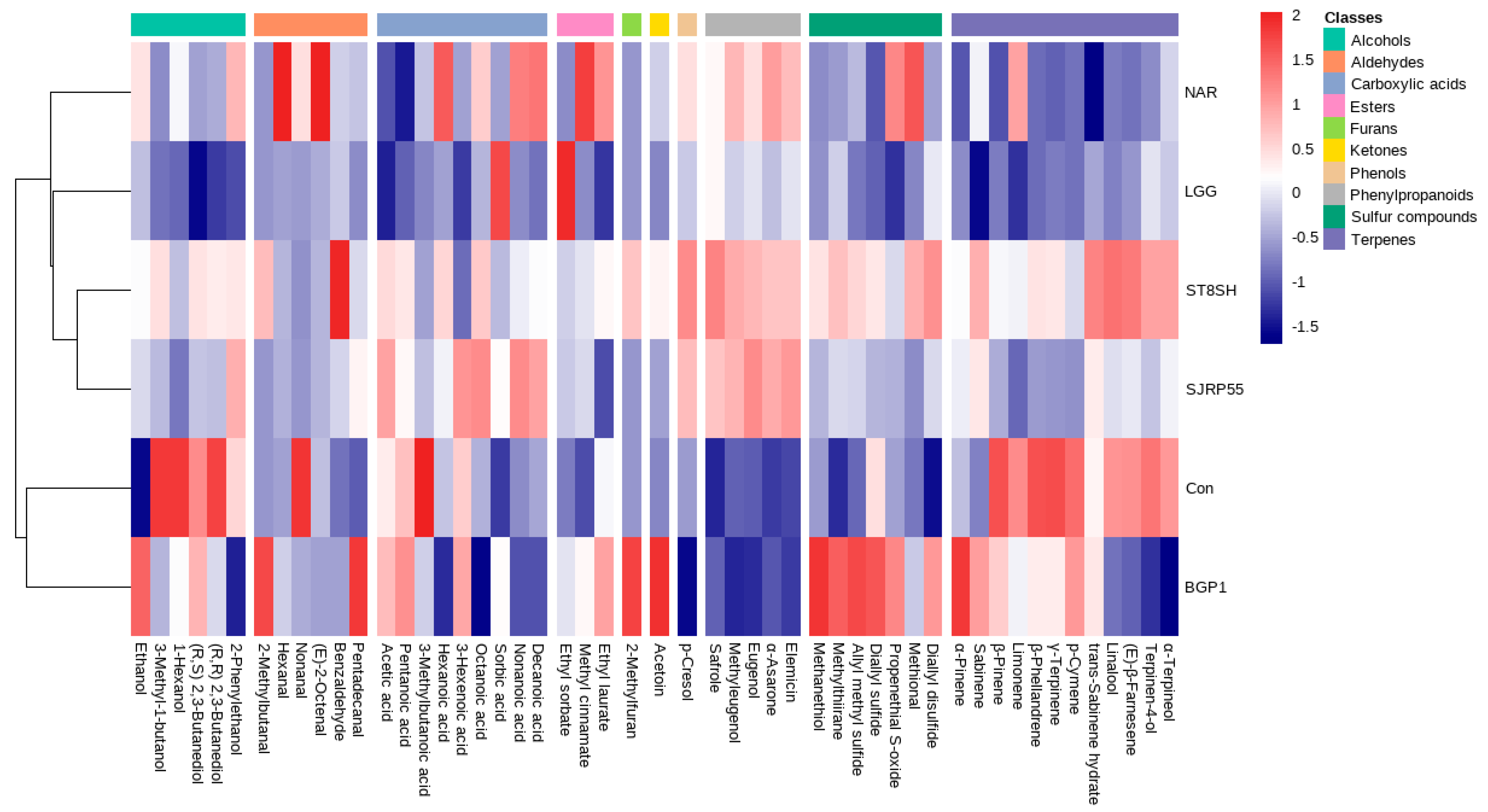
A heatmap was constructed for the multivariate analysis to visualize differences in the volatile profiles among samples. Before the analysis, the data were autoscaled by compound (mean-centered and divided by the standard deviation) to allow for a comparison across samples. The Euclidean distance was used as the similarity metric, and Ward’s method (Ward) was used for hierarchical clustering (D2) for the samples. No column clustering was applied.
All data processing and visualization were performed using R software [29], with the packages ggplot2 [30], dplyr [31], and pheatmap [32].

3. Results and Discussion

3.1. Lipid Content and FA Profile

The lipid content (total fat) in the reduced-sodium fermented sausage samples with LAB application showed no significant differences (p > 0.05, Table 2), with values ranging from 28.53% for the treatment with Lbs. paracasei BGP1 and reduced-sodium to 29.53% for the treatment with Lbs. rhamnosus LGG and reduced-sodium. The lipid content in fermented meat products is an important factor in determining sensory quality attributes such as the texture and flavor, in addition to contributing to the product’s physicochemical characteristics [33]. Therefore, the absence of significant differences is relevant, indicating that the reduced sodium and LAB application did not interfere with the lipid content when compared with C and the reduced-sodium control (NAR) treatment. Similar results were observed by Magra et al. [34] after 21 days of the ripening of dry fermented sausages with total fat replacement by an extra virgin olive oil emulsion and indigenous LAB (Lactobacillus acidophilus Alce LMGP21381, Lacticaseibacillus casei 62, Latilactobacillus sakei 65, and Pediococcus pentosaceus 156).
In our previous study conducted under the same experimental conditions, the application of LAB strains in reduced-sodium fermented sausages demonstrated important effects on the physicochemical and technological parameters, including a pH reduction (4.53 to 4.49), water activity (0.900 to 0.896), weight loss (43.65% to 40.84%), texture profile, color parameters, and oxidative stability (1.416 to 1.208 mg MDA/kg) on the 20th day of ripening [25]. Although no significant differences were observed in proximate composition parameters such as the moisture, protein, lipid, and ash contents among the treatments, the inoculated strains contributed to distinct technological behaviors throughout fermentation and ripening. Furthermore, LAB application influenced the texture parameters, particularly the hardness, cohesiveness, springiness, and chewiness, as well as instrumental color attributes, indicating the ability of these cultures to modulate the structural and technological characteristics of reduced-sodium fermented sausages.
Overall, the fatty acid profile showed small variations among the treatments (Table 3), although some individual fatty acids differed significantly (p ≤ 0.05). Monounsaturated fatty acids (MUFAs) were the predominant fraction in all treatments, followed by saturated fatty acids (SFAs) and polyunsaturated fatty acids (PUFAs). Regarding individual fatty acids, oleic acid (C 18:1 n-9) was the most abundant compound across treatments, with values ranging from 38.38% to 40.87%. The highest content was observed in the Lpb. plantarum ST8SH treatment group, whereas Lbs. paracasei BGP1 had the lowest value (p ≤ 0.05). Similarly, palmitic acid (C16:0) and linoleic acid (C 18:2 n-6) represented an important fraction of the lipid profile, with significantly higher values in the Lbs. rhamnosus LGG and Lbs. paracasei BGP1 treatments than in Leu. mesenteroides subsp. mesenteroides SJRP5 and Lpb. plantarum ST8SH. Variations in myristic acid (C14:0) and palmitoleic acid (C16:1) were also observed among the treatments; Lpb. plantarum ST8SH showed the highest concentrations of both fatty acids (p ≤ 0.05).
Stearic acid (C18:0) was the predominant SFA detected for saturated fatty acids; however, no significant differences were observed among the treatments (p > 0.05), indicating that the presence of different LAB strains did not markedly affect the formation of this fatty acid. This behavior may be associated with the limited lipolytic activity of LAB, which generally exhibit lower lipase and esterase activities than endogenous muscle enzymes and coagulase-negative staphylococci. Lipid hydrolysis in fermented meat products primarily occurs through the action of lipolytic enzymes that catalyze the breakdown of triacylglycerols (TGs) into free fatty acids (FFAs), which can subsequently participate in oxidation and flavor-forming reactions [35]. Although some LAB strains are capable of producing esterases, their contribution to lipid hydrolysis is often strain-dependent and less pronounced. In contrast, other SFAs (C14:0, C16:0 and C20:0) showed slight, but significant, variations, with the highest value observed in Lpb. plantarum ST8SH and the highest C20:0 observed in Lbs. paracasei BGP1, suggesting a subtle strain-specific influence on lipid metabolism and fatty acid release.
The proportion of SFAs, PUFAs and MUFAs observed in the present study was higher than values typically reported for fermented meat products, where these fatty acids are generally present as a minor component [36,37].
When grouped into lipid classes, the SFA values ranged from 33.30% to 35.34%, with slightly lower levels observed in Con and higher levels in Lbs. paracasei BGP1. Conversely, the MUFA contents ranged from 40.02% to 43.1%; Lpb. plantarum ST8SH presented the highest proportion among the treatments. These differences may be partially explained by the distinct biochemical characteristics of Lbs. paracasei and Lpb. plantarum. The PUFA values ranged from 22.53% to 26.28%, with slightly lower levels observed in Leu. mesenteroides subsp. mesenteroides SJRP55 and higher levels in Lbs. paracasei BGP1. Leuconostoc species are obligately heterofermentative LAB, characterized by a more limited metabolic capacity and a reduced lipid transformation-related enzymatic repertoire [38]. In contrast, Lpb. plantarum is a facultatively heterofermentative species with a more versatile metabolism, including a broader range of enzymatic activities such as esterases, which may modestly contribute to lipid hydrolysis and fatty acid modification. In addition, Lpb. plantarum exhibits a greater adaptability to different environmental conditions, potentially enhancing its interaction with endogenous enzymes and influencing fatty acid release and transformation during ripening [39]. The differences observed in the SFA, MUFA and PUFA proportions among the treatments were relatively small and may be associated with strain-dependent effects during fermentation and ripening. However, because only the total fatty acids were determined, the present results do not allow for direct conclusions regarding lipolytic activity or the specific metabolic mechanisms responsible for these differences.

3.2. Volatile Compounds in Fermented Sausages

A total of 51 volatile compounds belonging to 10 chemical classes were identified across all treatments: terpenes (n = 12), carboxylic acids (n = 9), sulfur compounds (n = 7), aldehydes (n = 6), alcohols (n = 6), phenylpropanoids (n = 5), esters (n = 3), ketones (n = 1), furans (n = 1), and phenols (n = 1). The number of compounds detected per sample ranged from 47 (Con and NAR) to 51 (Lpb. plantarum ST8SH), with Lbs. paracasei BGP1, Lbs. rhamnosus LGG, and Leu. mesenteroides subsp. mesenteroides SJRP55 presenting 48, 49, and 49 compounds, respectively. Figure 1 illustrates the relative contribution of each chemical class to the total volatile profile of each treatment. Carboxylic acids were predominant in all treatments, especially in the inoculated samples, and they enhanced the microbial metabolic activity associated with carbohydrate fermentation, amino acid catabolism, and lipid degradation. These compounds are commonly associated with the characteristic acidic and cheesy notes of fermented meat products and may be produced by LAB through the oxidation of fatty acids or microbial metabolism [40].
Terpenes were also highly abundant in all treatments and are mainly derived from spices commonly used in the manufacture of fermented sausages, particularly black pepper and garlic. Because these compounds primarily originate from seasoning ingredients rather than microbial metabolism, their presence was consistent among the treatments. Similarly, phenylpropanoids and some sulfur compounds are probably associated with spice-derived compounds, especially garlic-derived sulfur constituents [41].
Differences among the treatments were mainly associated with variations in the relative abundance of acids, alcohols, aldehydes, and sulfur compounds, indicating strain-dependent LAB metabolic activities. Alcohols may originate from amino acid degradation and lipid oxidation pathways, whereas aldehydes, particularly unsaturated fatty acids, are generally considered secondary products of lipid oxidation [42]. The higher diversity of volatile compounds observed in Lpb. plantarum ST8SH suggests that the proteolytic and lipolytic activities of the selected strains contributed to the formation of a more complex volatile profile. Additionally, several compounds were detected, but not identified (designated as unknown) because they could not be characterized by mass spectral library matching; nevertheless, their relative peak areas were included in the volatile profile for completeness.
A heatmap with hierarchical clustering was constructed to better visualize the distribution and relative abundance of volatile compounds across treatments (Figure 2). The dendrogram grouped the samples into two major clusters. The cluster comprising the Con and BGP1 treatments suggests that the Lbs. paracasei BGP1 strain did not significantly alter the volatile profile compared with the Con treatment, indicating that BGP1 may exhibit lower metabolic activity toward lipid oxidation and amino acid catabolism pathways associated with volatile formation. The remaining reduced-sodium treatments formed a second cluster, confirming that sodium reduction alone was sufficient to modify the volatile composition of the fermented sausages (NAR vs. Con). Sodium chloride (NaCl) plays an important role in multiple biochemical and physicochemical processes during fermented meat processing, including microbial selection, enzyme activity, and lipid oxidation. These factors collectively contribute to proteolysis and aroma development during fermentation and ripening. Accordingly, changes in the NaCl concentration may influence the formation of volatile compounds in fermented meat products, as previously reported in dry-fermented sausages [22].
NAR and Lbs. rhamnosus LGG showed greater similarity within this second cluster, whereas Lpb. plantarum ST8SH and Leu. mesenteroides subsp. mesenteroides SJRP55 formed a distinct subcluster for the strain-dependent modulation of volatile compound production. These differences are likely associated with each LAB strain’s specific metabolic characteristics, including proteolytic, lipolytic, and amino acid catabolic activities. LAB cultures may contribute to the formation of volatiles through the degradation of branched-chain amino acids, carbohydrate fermentation, and fatty acid metabolism, generating compounds such as aldehydes, alcohols, acids, esters, and sulfur-containing volatiles [43]. The distinct clustering patterns observed in Figure 2 indicate that the evaluated strains influenced aroma development through different biochemical pathways and metabolic capacities.
Terpenes are the most diverse chemical class, and their occurrence in fermented meat products is frequently attributed to the addition of spices during treatments, contributing to the sweet, pleasant fragrance characteristic of fermented dry sausages [44,45]. Terpinen-4-ol was the predominant constituent across all treatments, with relative proportions ranging from 2.23% (Lbs. paracasei BGP1) to 6.85% (Con). The highest value was observed in Con, whereas the reduced-sodium treatment (NAR) presented one of the lowest proportions (3.34%). These effects may be associated with the role of NaCl in modulating water activity, protein solubility, and microbial metabolism during fermentation, which can indirectly influence the formation and retention of volatile compounds. Lactic acid bacteria used in fermented meat products are generally considered salt-tolerant microorganisms, allowing their metabolic activity to persist under typical fermentation conditions and contribute to flavor compound development [46]. Notably, the reduced-sodium ST8SH and LGG samples showed higher proportions of terpinen-4-ol (6.19% and 4.48%, respectively) than the NAR samples, indicating a possible strain-dependent influence of LAB on terpene modulation. Terpenes in fermented sausages are primarily derived from spices, such as black pepper, garlic, and other seasonings, added during treatments rather than being synthesized by LAB. However, LAB may indirectly affect the terpene abundance through enzymatic biotransformation, precursor compound hydrolysis, or oxidation reduction conditions during ripening, which can alter the release, conversion, or retention of terpene compounds within the meat matrix [45]. Similarly, Xu et al. [47] detected terpinen-4-ol in all treatment groups of Sichuan-style fermented sausages, with the highest relative areas observed in samples containing LAB-based starter cultures. These authors also suggested that the strains, such as Ltb. curvatus and D. hansenii, may not only modulate the retention of terpene compounds, but also actively promote the release of flavor compounds derived from spices. The effect of strain-specific modulation and the sodium content on the terpene profile can also be observed in the heatmap presented in Figure 2, where the NAR and LGG treatments generally displayed lower relative abundances of terpene compounds. Since terpenes are primarily derived from spices used in fermented sausage treatments, these differences are likely associated with variations in compound retention and release during fermentation and drying. Sodium reduction may alter the meat matrix, water activity, and lipid interactions, thereby affecting the retention and volatilization of terpene compounds. In addition, LAB’s strain-dependent metabolic activities may indirectly influence terpene abundance through enzymatic transformations or interactions with oxidative processes during ripening [44]. Carboxylic acids were the most abundant chemical class across all treatments, with total relative proportions ranging from 23.37% (Con) to 62.27% (Lbs. rhamnosus LGG). In this class, sorbic acid was the dominant compound, followed by acetic acid, 3-methylbutanoic acid, 3-hexenoic acid, and decanoic acid, which together accounted for the majority of the carboxylic acid fraction in all treatments. The formation of these carboxylic acids during fermentation and ripening is commonly associated with lipolysis and subsequent lipid oxidation reactions.
In addition to their predominance, the high levels of carboxylic acids in LGG samples intensified the microbial metabolic activity, likely associated with enhanced carbohydrate fermentation and amino acid catabolism. Acids such as acetic acid are primarily formed via heterofermentative pathways, including 3-methylbutanoic acid, which originates from the catabolism of amino acids such as leucine through transamination and decarboxylation reactions [48]. The elevated abundance of these compounds in LGG samples may be associated with the strain-specific metabolic activity of Lbs. rhamnosus LGG during fermentation and ripening. Previous research conducted with fermented sausages demonstrated that the addition of LGG significantly affected the formation and relative abundance of volatile organic compounds, confirming that this strain can modulate the volatile profile of fermented meat products [49].
The differences observed among the treatments can also be partially attributed to the reduction in the sodium content. Lower NaCl levels increase water activity and modify microbial dynamics, potentially enhancing proteolytic and lipolytic enzymatic activity. These changes may favor the release of free fatty acids and amino acid-derived compounds, which serve as volatile formation precursors [48]. This is consistent with the distinct clustering of NAR relative to Con in the heatmap, indicating that reduced sodium alone is sufficient to alter the biochemical pathways involved in aroma development. Aldehydes and alcohols are mainly associated with lipid oxidation and subsequent reduction reactions [50]. Aldehydes, such as hexanal, are widely recognized as indicators of lipid oxidation, contributing to green and rancid notes, whereas their corresponding alcohols may arise from microbial reduction processes, often resulting in milder aroma descriptors [51].
The heatmap (Figure 2) enabled the identification of compound-specific patterns associated with each treatment. The clustering of the ST8SH and SJRP55 samples suggests a similar metabolic behavior, possibly characterized by a balanced production of acids and other volatile compounds, while the proximity between NAR and LGG indicates that LGG maintains a volatile profile closer to the reduced-sodium control, albeit with intensified acid production. The similarity between the Con and BGP1 samples reinforces the limited impact of this strain on the overall volatilome.
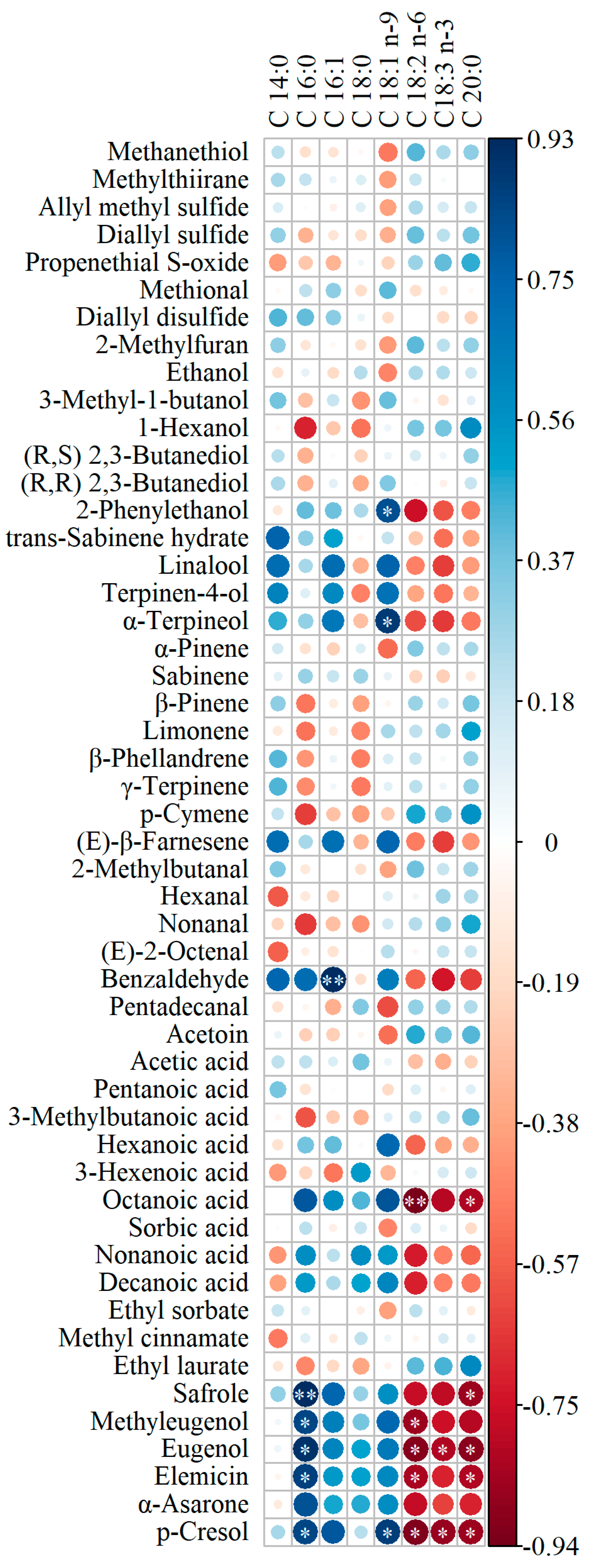
The correlation analysis between fatty acids (FAs) and volatile compounds (Figure 3) revealed distinct patterns associated with their biochemical origin. C18:3 n-3 was predominantly positively correlated with aldehydes, alcohols, and other oxidation-derived compounds. These results are consistent with the well-established mechanism undergoing peroxidation, leading to the formation of hydroperoxides that subsequently decompose into a wide range of volatile compounds [52].
Carboxylic acids, such as acetic, butanoic, and hexanoic acids, showed weak or negative correlations with fatty acids, supporting the hypothesis that these compounds are mainly derived from microbial metabolism rather than lipid oxidation. Similarly, sulfur compounds and terpenes exhibited low or inconsistent correlations with fatty acids, reinforcing their origin from amino acid degradation and spice-derived components, respectively [53].
The correlation analysis also revealed that phenylpropanoid compounds, including safrole, methyleugenol, eugenol, elemicin, α-asarone, and p-cresol, were positively correlated with C16:0 and negatively correlated with C18:2 n-6, C18:3 n-3 and C20:0. This pattern suggests a possible metabolic relationship between the fatty acid profile and phenylpropanoid accumulation in fermented sausages. The metabolic flux may be preferentially directed toward lipid metabolism in environments where longer-chain saturated fatty acids predominate, potentially limiting the availability of shared precursors or cofactors required for phenylpropanoid biosynthesis. Correlations were obtained from the overall data set and do not allow for attribution to specific LAB strains. Nevertheless, strain-level evidence suggests that the microorganisms used in this study may differentially influence lipid metabolism. Leu. mesenteroides subsp. mesenteroides SJRP55 affects lipid metabolism and modifies fatty acid profiles in fermented matrices, indicating potential involvement in lipid transformation processes [54]. Similarly, Lpb. plantarum has been associated with the modulation of fatty acid degradation pathways in fermented meat systems, which may contribute to changes in lipid-derived metabolites [55]. Although Lbs. paracasei BGP1 and Lbs. rhamnosus LGG are not primarily characterized as lipolytic organisms, their application in fermented food systems may indirectly influence lipid metabolism through microbial interactions and fermentation environment modifications. Therefore, these associations are consistent with previous studies reporting that lipid hydrolysis and oxidation in fermented sausages significantly contribute to the formation of fatty acid-derived volatile compounds during ripening [56].

4. Conclusions

The results demonstrate that reduced sodium, combined with a culture starter and the application of LAB, can be successfully implemented in fermented sausages without significantly affecting the total lipid content or drastically altering the overall fatty acid profile. Although minor variations were observed in individual fatty acids, the general distribution of SFAs, MUFAs and PUFAs remained stable across treatments, indicating that reduced sodium or LAB inoculation did not markedly compromise the lipid composition.
The volatile profile was influenced by both the reduced-sodium content and specific LAB strains. However, the effects of the different LAB strains were more pronounced and strain-dependent than those associated with sodium reduction alone, highlighting the important role of microbial selection in shaping the volatilome. Distinct patterns were observed in the formation of key volatile compounds, particularly organic acids and terpene-related compounds.
The predominance of carboxylic acids in some treatments, especially Lbs. rhamnosus LGG, highlights the strong contribution of microbial metabolism to flavor development, while the correlation analysis confirmed that lipid oxidation remains a major pathway for the formation of aldehydes and alcohols. The coexistence of lipid- and microbial-derived pathways reinforces the complexity of aroma formation in fermented sausages. Although the present study demonstrated that sodium reduction and LAB inoculation influenced the volatile profile of fermented sausages, no sensory evaluation was performed. Therefore, the impact of these chemical changes on aroma perception and the overall product acceptability remains unclear. Further studies, including sensory analyses, are necessary to better understand the effects of sodium reduction and the application of different LAB cultures on the sensory quality of fermented sausages.

Author Contributions

M.L.B.: conceptualization, investigation, writing—original draft, writing—review and editing, visualization, methodology, formal analysis, data curation. V.D.S.-M.: investigation, writing—original draft, methodology, formal analysis, data curation. C.A.A.J.: formal analysis, data curation. L.P.L.: methodology, formal analysis, data curation. S.D.T.: writing—review and editing. S.C.d.S.L.: writing—review and editing. A.L.B.P.: conceptualization, writing—review and editing, supervision. A.C.d.S.B.: conceptualization, writing—review and editing, project administration, supervision, funding acquisition. All authors have read and agreed to the published version of the manuscript.

Funding

This study was funded by the Brazilian Federal Agency for Support and Evaluation of Graduate Education (CAPES, Process No. 88887.624270/2021-00).

Institutional Review Board Statement

Not applicable.

Informed Consent Statement

Not applicable.

Data Availability Statement

The data will be made available upon request.

Conflicts of Interest

The authors declare no conflicts of interest.

References

  1. Bis-Souza, C.V.; Penna, A.L.B.; Barretto, A.C.D. Applicability of potentially probiotic Lactobacillus casei in low-fat Italian type salami with added fructooligosaccharides: In vitro screening and technological evaluation. Meat Sci. 2020, 168, 108186. [Google Scholar] [CrossRef] [Scilit] [PubMed]
  2. Flores, M.; Piornos, J.A. Fermented meat sausages and the challenge of their plant-based alternatives: A comparative review on aroma-related aspects. Meat Sci. 2021, 182, 108636. [Google Scholar] [CrossRef] [Scilit] [PubMed]
  3. Maki, K.A.; Sack, M.N.; Hall, K.D. Ultra-processed foods: Increasing the risk of inflammation and immune dysregulation? Nat. Rev. Immunol. 2024, 24, 453–454. [Google Scholar] [CrossRef] [Scilit] [PubMed]
  4. Yong, H.I.; Kim, T.K.; Choi, H.D.; Jang, H.W.; Jung, S.; Choi, Y.S. Clean Label Meat Technology: Pre-Converted Nitrite as a Natural Curing. Food Sci. Anim. Resour. 2021, 41, 173–184. [Google Scholar] [CrossRef] [Scilit] [PubMed]
  5. Delgado-Pando, G.; Ekonomou, S.I.; Stratakos, A.C.; Pintado, T. Clean label alternatives in meat products. Foods 2021, 10, 1615. [Google Scholar] [CrossRef] [Scilit] [PubMed]
  6. Alves-Junior, C.A.; Bellucci, E.R.B.; Bertuci, M.L.; Santos, J.M.; Barretto, A.C.D.S. Effect of collagen in Italian type salami with NaCl reduction on the physicochemical and technological properties. Int. J. Food Sci. Technol. 2024, 59, 7589–7597. [Google Scholar] [CrossRef] [Scilit]
  7. World Health Organization (WHO). Sodium Reduction; World Health Organization: Geneva, Switzerland, 2026; Available online: https://www.who.int/news-room/fact-sheets/detail/sodium-reduction (accessed on 20 March 2026).
  8. Bertuci, M.L.; Alves-Junior, C.A.; Souza, C.V.B.; Penna, A.L.B.; Barretto, A.C.S. Bio preservation capacity of potentially probiotic Lacticaseibacillus strains in fermented sausage. Int. J. Food Sci. Technol. 2023, 58, 6253–6262. [Google Scholar] [CrossRef] [Scilit]
  9. Kaveh, S.; Hashemi, S.M.B.; Abedi, E.; Amiri, M.J.; Conte, F.L. Bio-preservation of meat and fermented meat products by lactic acid bacteria strains and their antibacterial metabolites. Sustainability 2023, 15, 10154. [Google Scholar] [CrossRef] [Scilit]
  10. Sirini, N.; Munekata, P.E.; Lorenzo, J.M.; Stegmayer, M.Á.; Pateiro, M.; Pérez-Álvarez, J.Á.; Rosmini, M. Development of healthier and functional dry fermented Sausages: Present and future. Foods 2022, 11, 1128. [Google Scholar] [CrossRef] [Scilit] [PubMed]
  11. Islam, F.; Imran, A.; Nosheen, F.; Fatima, M.; Arshad, M.U.; Afzaal, M.; Ijaz, N.; Noreen, R.; Mehta, S.; Biswas, S.; et al. Functional roles and novel tools for improving-oxidative stability of polyunsaturated fatty acids: A comprehensive review. Food Sci. Nutr. 2023, 11, 2471–2482. [Google Scholar] [CrossRef] [PubMed]
  12. Cheng, Z.; Yan, X.; Wu, J.; Weng, P.; Wu, Z. Effects of freeze drying in complex lyoprotectants on the survival, and membrane fatty acid composition of Lactobacillus plantarum L1 and Lactobacillus fermentum L2. Cryobiology 2022, 105, 1–9. [Google Scholar] [CrossRef] [Scilit] [PubMed]
  13. Loffi, C.; Cirlini, M.; Cavalca, N.; Saccani, G.; Virgili, R.; Galaverna, G.; Tedeschi, T. Changes in proteolysis and volatile fraction of nitrite-free Italian-type salami modified in formulation and processing. Int. J. Food Sci. Tech 2024, 59, 5587–5597. [Google Scholar] [CrossRef] [Scilit]
  14. Tukel, O.; Sengun, I. Production of probiotic fermented salami using Lacticaseibacillus rhamnosus, Lactiplantibacillus plantarum, and Bifidobacterium lactis. J. Food Sci. 2024, 89, 2956–2973. [Google Scholar] [CrossRef] [Scilit] [PubMed]
  15. Pérez-Burillo, S.; Pastoriza, S.; Gironés, A.; Avellaneda, A.; Francino, M.P.; Rufián-Henares, J.A. Potential probiotic salami with dietary fiber modulates metabolism and gut microbiota in a human intervention study. J. Funct. Foods 2020, 66, 103790. [Google Scholar] [CrossRef] [Scilit]
  16. Chen, Q.; Hu, Y.; Wen, R.; Wang, Y.; Qin, L.; Kong, B. Characterisation of the flavour profile of dry fermented sausages with different NaCl substitutes using HS-SPME-GC-MS combined with electronic nose and electronic tongue. Meat Sci. 2021, 172, 108338. [Google Scholar] [CrossRef] [Scilit] [PubMed]
  17. Kirkyol, M.; Akköse, A. Investigation of textural and physicochemical changes during the manufacturing process of pastirma, a dry-cured meat product. Food Sci. Technol. Int. 2022, 29, 739–747. [Google Scholar] [CrossRef] [Scilit] [PubMed]
  18. Wen, R.; Dong, Z.; Lv, Y.; Liu, H.; Bayana, B.; Kong, B.; Chen, Q. Comparative evaluation of the flavour-promoting role of autochthonous yeast strains on dry sausages. LWT 2023, 184, 115032. [Google Scholar] [CrossRef] [Scilit]
  19. Liu, Y.; Cao, Y.; Yohannes Woldemariam, K.; Zhong, S.; Yu, Q.; Wang, J. Antioxidant effect of yeast on lipid oxidation in salami sausage. Front. Microbiol. 2023, 13, 1113848. [Google Scholar] [CrossRef] [Scilit] [PubMed]
  20. Nie, X.; Jia, X.; Kang, X.; Pu, H.; Ling, Z.; Wang, X.; Yu, X.; Zhang, Y.; Liu, D.; Zhao, Z. Effects of isolated Saccharomyces cerevisiae on the metabolites and volatile organic compounds of Chinese-style sausage. Food Res. Int. 2024, 197, 115269. [Google Scholar] [CrossRef] [Scilit] [PubMed]
  21. Nobile, M.; Chiesa, L.M.; Arioli, F.; Panseri, S. Bio-based packaging combined to protective atmosphere to manage shelf life of salami to enhance food safety and product quality. Meat Sci. 2024, 207, 109366. [Google Scholar] [CrossRef] [Scilit] [PubMed]
  22. Almeida, M.A.; Fadda, S.G.; Vicente, M.Á.S.; Villanueva, N.D.M.; da Silva Pinto, J.S.; Castillo, C.J.C. Study of the volatile compounds of dry fermented sausage with salt reduction and its relationship with sensory acceptance. Food Prod. Process. Nutr. 2024, 6, 53. [Google Scholar] [CrossRef] [Scilit]
  23. De Paula, A.T.; Jeronymo-Ceneviva, A.B.; Silva, L.F.; Todorov, S.D.; Franco, B.D.G.M.; Penna, A.L.B. Leuconostoc mesenteroides SJRP55: A potential probiotic strain isolated from Brazilian water buffalo mozzarella cheese. Ann. Microbiol. 2015, 65, 899–910. [Google Scholar] [CrossRef] [Scilit]
  24. Todorov, S.D.; Holzapfel, W.; Nero, L.A. Characterization of a novel bacteriocin produced by Lactobacillus plantarum ST8SH and some aspects of its mode of action. Ann. Microbiol. 2016, 66, 949–962. [Google Scholar] [CrossRef] [Scilit]
  25. Bertuci, M.L.; Junior, C.A.A.; Todorov, S.D.; Penna, A.L.B.; da Silva Barretto, A.C. Lactic Acid Bacteria as Bioprotective Cultures in Reduced-sodium Fermented Sausages: Technological Performance and Post-slicing Control of Listeria innocua. Food Bioprocess Technol. 2026, 19, 198. [Google Scholar] [CrossRef] [Scilit]
  26. AOAC. Official Methods of Analysis of the Association of Official Analytical Chemists, 19th ed.; AOAC International: Gaithersburg, MD, USA, 2012. [Google Scholar]
  27. Antoniassi, R.; Wilhelm, A.; Machado, A.D.F.; Guedes, A.; Bizzo, H. Otimização do Método Hartman e Lago de Preparação de Ésteres Metílicos de Ácidos Graxos. Embrapa Agroindústria de Alimentos-Boletim de Pesquisa e Desenvolvimento (INFOTECA-E). 2018. Available online: https://www.infoteca.cnptia.embrapa.br/infoteca/handle/doc/1105249 (accessed on 8 January 2026).
  28. Wagner, R.; Franco, M.R.B. Effect of the variables time and temperature on volatile compounds extraction of salami by solid phase microextraction. Food Anal. Methods 2012, 5, 1186–1195. [Google Scholar] [CrossRef] [Scilit]
  29. R Core Team. R: A Language and Environment for Statistical Computing; R Foundation for Statistical Computing: Vienna, Austria, 2022; Available online: https://www.R-project.org/ (accessed on 3 April 2026).
  30. Wickham, H. Data analysis. In ggplot2: Elegant Graphics for Data Analysis; Springer International Publishing: Cham, Switzerland, 2016; pp. 189–201. [Google Scholar]
  31. Wickham, H.; François, R.; Henry, L.; Müller, K.; Vaughan, D. Dplyr: A Grammar of Data Manipulation. 2023. Available online: https://CRAN.R-project.org/package=dplyr (accessed on 20 April 2026).
  32. Kolde, R. pheatmap: Pretty Heatmaps; R Package Version 1.0.12. 2019. Available online: https://CRAN.R-project.org/package=pheatmap (accessed on 3 April 2026).
  33. Siachou, C.; Zampouni, K.; Katsanidis, E. Bigels as fat replacers in fermented sausages: Physicochemical, microbiological, sensory, and nutritional characteristics. Gels 2023, 9, 340. [Google Scholar] [CrossRef] [Scilit] [PubMed]
  34. Magra, T.; Soultos, N.; Dovas, C.; Papavergou, E.; Lazou, T.; Apostolakos, I.; Dimitreli, G.; Ambrosiadis, I. Dry fermented sausages with total replacement of fat by extra virgin olive oil emulsion and indigenous lactic acid bacteria. Food Technol. Biotechnol. 2021, 59, 267–281. [Google Scholar] [CrossRef] [Scilit] [PubMed]
  35. Tatiyaborworntham, N.; Oz, F.; Richards, M.P.; Wu, H. Paradoxical effects of lipolysis on the lipid oxidation in meat and meat products. Food Chem. X 2022, 14, 100317. [Google Scholar] [CrossRef] [Scilit] [PubMed]
  36. Łepecka, A.; Szymański, P.; Okoń, A. Indigenous lactic acid bacteria as antioxidant agents in the production of organic raw fermented sausages. Antioxidants 2024, 13, 1305. [Google Scholar] [CrossRef] [Scilit] [PubMed]
  37. Likić, V.A. Extraction of pure components from overlapped signals in gas chromatography-mass spectrometry (GC-MS). BioData Min. 2009, 2, 6. [Google Scholar] [CrossRef] [Scilit] [PubMed]
  38. Candeliere, F.; Sola, L.; Busi, E.; Rossi, M.; Amaretti, A.; Raimondi, S. The metabolism of Leuconostoc genus decoded by comparative genomics. Microorganisms 2024, 12, 1487. [Google Scholar] [CrossRef] [Scilit] [PubMed]
  39. Yilmaz, B.; Bangar, S.P.; Echegaray, N.; Suri, S.; Tomasevic, I.; Manuel-Lorenzo, J.; Melekoglu, E.; Rocha, J.M.; Ozogul, F. The impacts of Lactiplantibacillus plantarum on the functional properties of fermented foods: A review of current knowledge. Microorganisms 2022, 10, 826. [Google Scholar] [CrossRef] [Scilit] [PubMed]
  40. Xia, L.; Qian, M.; Cheng, F.; Wang, Y.; Han, J.; Xu, Y.; Zhang, K.; Tian, J.; Jin, Y. The effect of lactic acid bacteria on lipid metabolism and flavor of fermented sausages. Food Biosci. 2023, 56, 103172. [Google Scholar] [CrossRef] [Scilit]
  41. Han, J.; Wang, Y.; Xu, Y.; Gu, Y.; Zhang, K.; Tian, J.; Jin, Y. Effects of compound fermentation of lactic acid bacteria IMAUJBP3 and IMAUJBR3 on the characteristic flavors and metabolites of mutton fermented sausages. LWT 2024, 212, 116995. [Google Scholar] [CrossRef] [Scilit]
  42. Hu, Y.; Tian, Y.; Zhu, J.; Wen, R.; Chen, Q.; Kong, B. Technological characterization and flavor-producing potential of lactic acid bacteria isolated from traditional dry fermented sausages in northeast China. Food Microbiol. 2022, 106, 104059. [Google Scholar] [CrossRef] [Scilit] [PubMed]
  43. Montanari, C.; Barbieri, F.; Gardini, G.; Magnani, R.; Gottardi, D.; Gardini, F.; Tabanelli, G. Effects of starter cultures and type of casings on the microbial features and volatile profile of fermented sausages. Fermentation 2022, 8, 683. [Google Scholar] [CrossRef] [Scilit]
  44. Bleicher, J.; Ebner, E.E.; Bak, K.H. Formation and analysis of volatile and odor compounds in meat—A review. Molecules 2022, 27, 6703. [Google Scholar] [CrossRef] [Scilit] [PubMed]
  45. Zhao, S.; Yue, J.; Wang, Y.; Shao, J.; Li, Z.; Li, M. The regulation of volatile flavor compounds in fermented meat products mediated by microorganisms: A review. Food Biosci. 2024, 62, 105180. [Google Scholar] [CrossRef] [Scilit]
  46. Bertuci, M.L.; Bis Souza, C.V.; Alves, C.A., Jr.; Todorov, S.D.; Penna, A.L.B.; Barretto, A.C.d.S. Bioprotective and Technological Roles of Lactic Acid Bacteria in Reduced-Sodium Fermented Sausages. Foods 2025, 14, 3758. [Google Scholar] [CrossRef] [Scilit] [PubMed]
  47. Xu, B.; Qiu, W.; Liu, Y.; Gong, F.; Liu, Q.; Chen, J.; Tang, Y.; Su, C.; Tang, J.; Zhang, D.; et al. Exploring the regulation of metabolic changes mediated by different combined starter cultures on the characteristic flavor compounds and quality of Sichuan-style fermented sausages. Food Res. Int. 2025, 208, 116114. [Google Scholar] [CrossRef] [Scilit] [PubMed]
  48. Tabanelli, G.; Barbieri, F.; Banos, A.; Madero, J.M.G.; Daza, M.V.B.; Cortimiglia, C.; Milani, G.; Bassi, D.; Gardini, F.; Montanari, C. Companilactobacillus alimentarius: An extensive characterization of strains isolated from spontaneous fermented sausages. Int. J. Food Microbiol. 2024, 410, 110489. [Google Scholar] [CrossRef] [Scilit] [PubMed]
  49. Bis-Souza, C.V.; Pateiro, M.; Domínguez, R.; Lorenzo, J.M.; Penna, A.L.B.; Barretto, A.C.S. Volatile profile of fermented sausages with commercial probiotic strains and fructooligosaccharides. J. Food Sci. Technol. 2019, 56, 5465–5473. [Google Scholar] [CrossRef] [Scilit] [PubMed]
  50. Liu, Y.; Hu, Y.; Huang, D.; Bayinbate, B.; Zheng, S.; Xu, B. The effects of fermented sausage quality driven by reduction of NaCl: Investigation into the microbial community and flavor profiles. Food Res. Int. 2025, 204, 115867. [Google Scholar] [CrossRef] [Scilit] [PubMed]
  51. Wang, Y.; Wang, Z.; Han, Q.; Xie, Y.; Zhou, H.; Zhou, K.; Li, X.; Xu, B. Comprehensive insights into the evolution of microbiological and metabolic characteristics of the fat portion during the processing of traditional Chinese bacon. Food Res. Int. 2022, 155, 110987. [Google Scholar] [CrossRef] [Scilit] [PubMed]
  52. Geng, L.; Liu, K.; Zhang, H. Lipid oxidation in foods and its implications on proteins. Front. Nutr. 2023, 10, 1192199. [Google Scholar] [CrossRef] [Scilit] [PubMed]
  53. Woldemariam, K.Y.; Wang, Z.; Cai, M.; Li, M.; Jiang, W.; Hu, Z.; Li, J.; Tang, W.; Jiao, Y.; Liu, Y.; et al. Lipid hydrolysis, oxidation, and fatty acid formation pathway mapping of synergistically fermented sausage and characterization of lipid mediating genes. J. Agric. Food Chem. 2024, 72, 17536–17548. [Google Scholar] [CrossRef] [Scilit] [PubMed]
  54. Borges, D.O.; Matsuo, M.M.; Bogsan, C.S.B.; da Silva, T.F.; Casarotti, S.N.; Penna, A.L.B. Leuconostoc mesenteroides subsp. mesenteroides SJRP55 reduces Listeria monocytogenes growth and impacts on fatty acids profile and conjugated linoleic acid content in fermented cream. LWT 2019, 107, 264–271. [Google Scholar] [CrossRef] [Scilit]
  55. Yang, Y.; Zhou, G.; Ding, Y.; Shi, W.; Chen, Y.; Ge, C.; Xu, B.; Yang, L. Microbiota dynamics and metabolic mechanisms in fermented sausages inoculated with Lactiplantibacillus plantarum and Staphylococcus xylosus. Food Res. Int. 2025, 201, 115680. [Google Scholar] [CrossRef] [Scilit] [PubMed]
  56. Lorenzo, J.M.; Bedia, M.; Bañón, S. Relationship between flavour deterioration and the volatile compound profile of semi-ripened sausage. Meat Sci. 2013, 93, 614–620. [Google Scholar] [CrossRef] [Scilit] [PubMed]
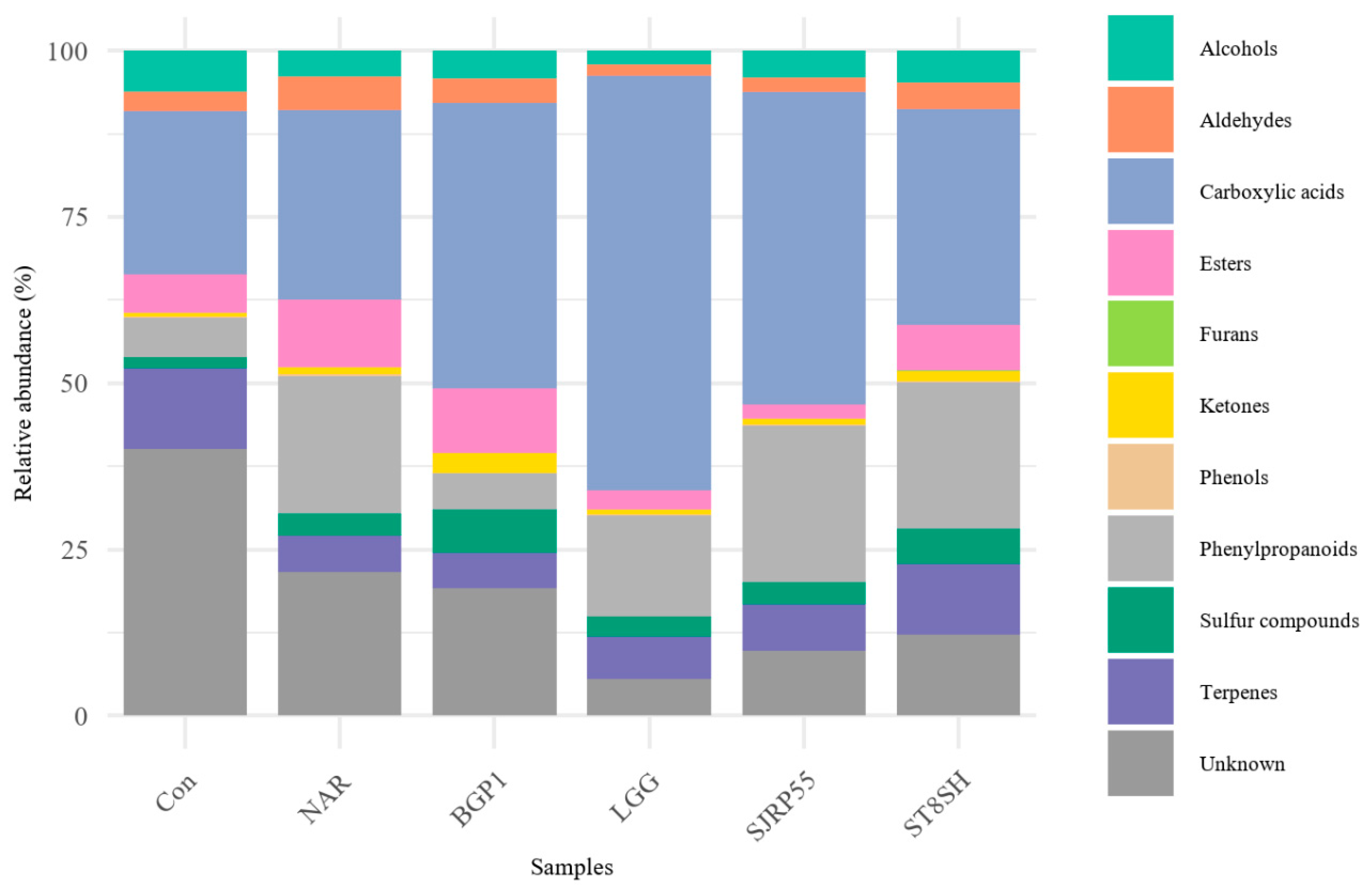
Figure 1. Relative abundance (%) of volatile compound classes in reduced-sodium fermented sausages. All treatments were inoculated with the starter culture Bactoferm T-SPX. The treatments differed according to their sodium content and the adjunct lactic acid bacteria strains added as follows: Con: control; NAR: reduced-sodium; LGG: reduced-sodium with Lbs. rhamnosus LGG; BGP1: reduced-sodium with Lbs. paracasei BGP1; SJRP55: reduced-sodium with Leu. mesenteroides subsp. mesenteroides SJRP55; ST8SH: reduced-sodium with Lpb. plantarum ST8SH.
Microbiolres 17 00186 g001
Figure 2. Heatmap of volatile compounds in reduced-sodium fermented sausages. The colors correspond to normalized mean levels from high (red) to low (blue). All treatments were inoculated with the starter culture Bactoferm T-SPX. The treatments differed according to their sodium content and the adjunct lactic acid bacteria strains added as follows: Con: control; NAR: reduced-sodium; LGG: reduced-sodium with Lbs. rhamnosus LGG; BGP1: reduced-sodium with Lbs. paracasei BGP1; SJRP55: reduced-sodium with Leu. mesenteroides subsp. mesenteroides SJRP55; ST8SH: reduced-sodium with Lpb. plantarum ST8SH. The data were autoscaled by compound (mean-centered and divided by the standard deviation). Hierarchical clustering of samples was performed using the Euclidean distance and Ward’s method (Ward, D2), while compounds were displayed according to predefined chemical classes. Class annotation is shown to highlight the distribution of compound groups across samples.
Microbiolres 17 00186 g002
Figure 3. Correlation matrix between fatty acids and volatile compounds identified in fermented sausages. The colors correspond to normalized mean levels from positive (blue) to negative (red) correlations. All treatments were inoculated with the starter culture Bactoferm T-SPX. The treatments differed according to their sodium content and the adjunct lactic acid bacteria strains added as follows: Con: control; NAR: reduced-sodium; LGG: reduced-sodium with Lbs. rhamnosus LGG; BGP1: reduced-sodium with Lbs. paracasei BGP1; SJRP55: reduced-sodium with Leu. mesenteroides subsp. mesenteroides SJRP55; ST8SH: reduced-sodium with Lpb. plantarum ST8SH. * p ≤ 0.01; ** p ≤ 0.05.
Microbiolres 17 00186 g003
Table 1. Formulations utilized in this study for the production of fermented meat products.
Ingredients (%)CNARLGGBGP1SJRP55ST8SH
Pork meat858585858585
Pork backfat151515151515
Sodium chloride2.51.881.881.881.881.88
Potassium chloride-0.620.620.620.620.62
Sucrose222222
Sodium erythorbate0.050.050.050.050.050.05
Garlic0.30.30.30.30.30.3
Nutmeg0.30.30.30.30.30.3
White pepper0.20.20.20.20.20.2
Starter culture0.0250.0250.0250.0250.0250.025
Sodium nitrite0.0150.0150.0150.0150.0150.015
Sodium nitrate0.0150.0150.0150.0150.0150.015
LAB--0.10.10.10.1
All treatments were inoculated with the starter culture Bactoferm T-SPX. The treatments differed according to the sodium content and the adjunct lactic acid bacteria strains added as follows: Con: control; NAR: sodium reduction; SJRP55: sodium reduction with Leu. mesenteroides subsp. mesenteroides SJRP55; ST8SH: sodium reduction Lpb. plantarum ST8Sh; LGG: sodium reduction with Lbs. rhamnosus LGG; BGP1: sodium reduction with Lc. paracasei BGP1.
Table 2. Effect of lactic acid bacteria strain on fat content of reduced-sodium fermented sausages.
TreatmentsLipid (%)
Con28.96
NAR29.31
LGG29.53
BGP128.53
SJRP5528.76
ST8SH29.21
SEM0.86
p-value0.88 ns
SEM: standard error of mean. ns: not significant (p > 0.05). All treatments were inoculated with the starter culture Bactoferm T-SPX. The treatments differed according to their sodium content and the adjunct lactic acid bacteria strains added as follows: Con: control; NAR: reduced-sodium; LGG: reduced sodium with Lbs. rhamnosus LGG; BGP1: reduced-sodium with Lbs. paracasei BGP1; SJRP55: reduced-sodium with Leu. mesenteroides subsp. mesenteroides SJRP55; ST8SH: reduced-sodium with Lpb. plantarum ST8SH.
Table 3. Effect of lactic acid bacteria strain on fatty acids of reduced-sodium fermented sausages *.
Fatty AcidsConNALGGBGP1SJRP55ST8SHp-ValueSEM
C14:01.58 ab1.41 b1.59 ab1.53 ab1.48 b1.79 a0.020.48
C16:021.03 b21.38 b21.44 ab21.12 b21.93 a21.91 a0.000.11
C16:11.79 bc1.78 bc1.83 b1.64 c1.86 b2.23 a0.000.05
C18:09.8310.1510.0010.1710.889.900.08 ns0.13
C18:1 n-939.99 ab40.02 ab39.18 bc38.38 c39.94 ab40.87 a0.000.24
C18:2 n-623.19 ab22.73 abc23.38 a24.51 a20.89 c21.47 bc0.000.38
C18:3 n-31.72 ab1.73 ab1.72 ab1.77 a1.64 b1.62 b0.020.02
C 20:00.86 a0.85 a0.83 ab0.88 a0.78 b0.79 b0.000.01
SFAs33.3033.7933.8635.3435.0734.39
MUFAs41.7841.841.0140.0241.843.1
PUFAs24.9124.4625.126.2822.5323.09
* Fatty acids are represented in the following manner: the first number indicates the number of carbons, while the second represents the number of double bonds. SFAs, saturated fatty acids; MUFAs, monounsaturated fatty acids; PUFAs, polyunsaturated fatty acids. SEM: standard error of mean. Different letters indicate significant differences in the Tukey test (p ≤ 0.05). ns: not significant (p > 0.05). All treatments were inoculated with the starter culture Bactoferm T-SPX. The treatments differed according to their sodium content and the adjunct lactic acid bacteria strains added as follows: Con: control; NAR: reduced-sodium; LGG: reduced-sodium with Lbs. rhamnosus LGG; BGP1: reduced-sodium with Lbs. paracasei BGP1; SJRP55: reduced-sodium with Leu. mesenteroides subsp. mesenteroides SJRP55; ST8SH: reduced-sodium with Lpb. plantarum ST8SH.
Disclaimer/Publisher’s Note: The statements, opinions and data contained in all publications are solely those of the individual author(s) and contributor(s) and not of MDPI and/or the editor(s). MDPI and/or the editor(s) disclaim responsibility for any injury to people or property resulting from any ideas, methods, instructions or products referred to in the content.