Article

Ecological Characterization and Taxonomic Divergence of Microbial Communities Along the Oral–Upper Gastrointestinal Axis

1
Department of Dental Hygiene, College of Health and Medical Sciences, Cheongju University, 298 Daesung-ro, Cheongwon-gu, Cheongju 28503, Republic of Korea
2
Department of Microbiology and Immunology, Chonnam National University Medical School, Hwasun-gun 58128, Republic of Korea
*
Author to whom correspondence should be addressed.
Microbiol. Res. 2026, 17(6), 116; https://doi.org/10.3390/microbiolres17060116
Submission received: 11 April 2026 / Revised: 7 June 2026 / Accepted: 13 June 2026 / Published: 17 June 2026
(This article belongs to the Section Microbial Ecology and Microbiomes)

Abstract

Background: The upper gastrointestinal (GI) tract is a complex environment characterized by sharp physicochemical gradients. While the oral microbiome is a major source of microbial seeding for downstream organs, it remains unclear how these communities correlate and diverge across different anatomical sites. This study provides a high-resolution re-analysis of a comprehensive multi-site dataset to delineate the microbial architecture and ecological signatures along the oral–upper GI axis. Method: Human oral, esophageal, gastric mucosal, and gastric juice microbiome sequencing data were retrieved from the publicly available National Center for Biotechnology Information (NCBI) BioProject PRJNA1049979 database. Using these publicly available 16S rRNA sequencing data, we performed an integrated ecological analysis. Microbial diversity, taxonomic composition, and niche-specific community structures were evaluated using Quantitative Insights Into Microbial Ecology 2 (QIIME2) and R-based tools, including linear discriminant analysis effect size (LEfSe) and phylogenetic mapping. Results: The esophageal microbiome showed significantly greater richness and evenness than the oral cavity and stomach. Beta diversity analysis demonstrated clear compositional separation between oral and downstream upper GI communities, whereas gastric samples, particularly gastric juice, showed greater heterogeneity. Although major phyla were shared across sites, their relative abundances differed markedly. Oral samples were enriched with periodontal-associated taxa, including Porphyromonas, Prevotella, Alloprevotella, and Fusobacterium. In contrast, gastric mucosal samples were enriched with Akkermansia muciniphila and Helicobacter pylori, whereas gastric juice was characterized by Sarcina ventriculi, Fusobacterium periodonticum, and Clostridium perfringens. These findings indicate both taxonomic continuity and pronounced site-specific ecological divergence along the oral–upper GI axis. Conclusion: The oral cavity, esophagus, stomach, and gastric juice share a common microbial framework but exhibit distinct community restructuring driven by local environmental selection. This study provides a detailed ecological view of the oral–upper GI microbiome and highlights the importance of site-specific microbial organization in upper GI health and disease.

1. Introduction

The upper gastrointestinal (GI) tract is the initial portion of the digestive system, encompassing the mouth (oral cavity), esophagus, stomach, and the first part of the small intestine [1]. Beyond serving as a conduit for food passage, the upper GI tract plays a pivotal role in digestion, nutrient absorption, mucosal immune regulation, and host–microbe interactions [2]. GI axis is characterized by marked physicochemical gradients, including variations in oxygen tension, pH, mucus composition, nutrient availability, and peristaltic flow, which may consist of various microbial communities [2]. The human microbiome exerts diverse physiological functions essential for host health, including nutrient metabolism, vitamin synthesis, maintenance of epithelial barrier integrity, immune maturation, and modulation of inflammatory responses [3]. Through dynamic host–microbe interactions, microbial communities contribute to metabolic homeostasis and immune balance across mucosal surfaces [4]. Recent studies indicate that oral microbial dysbiosis is associated with both oral diseases (e.g., periodontitis and dental caries) and upper gastrointestinal disorders, including gastroesophageal reflux disease, gastritis, and upper GI malignancies [5]. The oral cavity continuously releases microorganisms through saliva and dental plaque, and these microbes are repeatedly delivered to the esophageal and gastric mucosa via swallowing.
Microbial crosstalk among organs is increasingly recognized as an important indicator of human health and systemic homeostasis [6]. Emerging evidence suggests that the upper GI microbiome plays a significant role in the pathophysiology of esophageal and gastric diseases, including reflux esophagitis, Barrett’s esophagus, chronic gastritis, and gastric cancer [7]. In particular, the gastric lumen represents an extreme and highly selective niche due to acid exposure [8], but its microbial architecture relative to gastric mucosal communities has not been comprehensively evaluated. Recent meta-analyses demonstrate that periodontal disease is associated with an approximately 17% increased risk of gastric adenocarcinoma, suggesting that chronic oral inflammation and sustained microbial exposure may contribute to gastric carcinogenesis [9]. Nevertheless, despite growing recognition of inter-organ microbial interactions, it remains unclear how the oral microbiome correlates with microbial communities in other organs. Multiple studies have detected oral-associated taxa in the esophagus and stomach, yet whether these organisms undergo functional restructuring remains incompletely understood.
In the present study, we comprehensively characterized microbial communities across the oral cavity, esophagus, gastric mucosa, and gastric juice using publicly available 16S rRNA sequencing data reported by She et al. [10]. While studies of regional microbial variation have revealed important physiological roles of the microbiome, only a limited number of investigations have addressed the heterogeneity of microbial communities across different anatomical sites within the same individual [10]. She et al. advanced this field by profiling the microbiome from lumen mucosa, gastric juice, and surface samples from 53 sites of 7 surface organs (oral cavity, stomach, esophagus, small intestine, appendix, large intestine, and skin) were collected from 33 subjects to give a total of 1608 samples [10]. Although She et al. provided a comprehensive body-wide microbiome atlas across multiple surface organs, their analysis was designed primarily to describe broad inter-organ and intra-organ biogeographical patterns [10]. In the present study, we re-analyzed the same public dataset with a more focused emphasis on the oral–upper gastrointestinal axis, including the oral cavity, esophagus, gastric mucosa, and gastric juice. This focused framework allowed us to examine taxonomic continuity, site-specific divergence, and niche-associated microbial enrichment across anatomically connected upper GI compartments. In addition, rather than using PacBio full-length 16S rRNA data as the main quantitative abundance dataset, we used PacBio-derived full-length ASVs to construct an optimized reference database for taxonomic assignment of Illumina V3–V4 amplicon data. Therefore, the novelty of this study lies in its focused oral–upper GI ecological framework and its PacBio-informed taxonomic classification strategy for V3–V4-based microbiome profiling.
By integrating alpha- and beta-diversity analyses with taxonomic profiling at the phylum, genus, and species levels, we aimed to characterize microbial community variation along the oral–upper gastrointestinal axis. Specifically, this study sought to (1) assess taxonomic overlap and ecological continuity between oral and upper gastrointestinal communities, (2) identify site-specific taxonomic signatures and abundance patterns across anatomical regions, and (3) determine the discriminative taxa associated with organ-specific community structures. Through this ecological framework, we aimed to provide a comprehensive view of the continuity and divergence of microbial communities across the upper gastrointestinal tract.

2. Materials and Methods

2.1. Data Retrieval

The raw sequencing data have been retrieved from NCBI GenBank BioProject ID PRJNA1049979. The samples were collected from 33 subjects from different anatomical sites. For each subject, samples were collected from multiple anatomical sites along the oral–upper gastrointestinal axis. The analyzed dataset consisted of 198 oral samples from six oral sites, 110 esophageal samples from four esophageal sites, 117 gastric mucosal samples from four stomach sites, and 33 gastric juice samples, resulting in a total of 458 samples. The oral sites included the left buccal mucosa (LC, n = 33), right buccal mucosa (RC, n = 33), upper hard palate (UM, n = 33), lower hard palate (LM, n = 33), upper lip (UL, n = 33), and lower lip (LL, n = 33). The esophageal sites included the thoracic esophagus (ESOM, n = 32), abdominal esophagus (ZA1, n = 25), zigzag line (Z, n = 29), and cardiac orifice (ZB1, n = 24). The gastric mucosal sites included the fundus (SF, n = 33), body (SB, n = 29), antrum (SA, n = 29), and pylorus (PY, n = 26), and gastric juice (GJ, n = 33) was analyzed as a separate anatomical group. The Illumina V3–V4 16S rRNA sequencing dataset was used as the primary dataset for diversity analysis, taxonomic profiling, and differential abundance analysis. PacBio full-length 16S rRNA sequencing data were used to construct an optimized, study-specific reference database.

2.2. Reference Database Construction and Taxonomic Assignment

PacBio full-length 16S rRNA data served as a reference-enhancement resource rather than as the primary dataset for community abundance comparisons. For PacBio full-length 16S rRNA data, primers were removed and reads were oriented using Divisive Amplicon Denoising Algorithm 2 (DADA2) (v1.26.0). Reads were filtered according to quality and length criteria, denoised using the DADA2 PacBio error model, and chimeric sequences were removed to generate high-resolution full-length amplicon sequence variants (ASVs). The PacBio-derived ASVs were utilized to construct an optimized, study-specific reference database [11]. To obtain representative taxa and optimize database size, phylogenetic trees were constructed using align-to-tree-mafft-fasttree, and terminal branches were trimmed at a threshold of 0.0005 using the drop.tip function in the ape package. Taxonomic assignment of these ASVs was conducted through a hierarchical BLAST (v2.16.0) search against the NCBI reference database. Sequences with a homology hit >97% were assigned to the Species level. ASVs failing this threshold were further blasted against the SILVA database. Taxonomic nomenclature was defined based on homology thresholds: >97% for Species, >95% for Genus, and >90% for Family. The optimized PacBio-derived ASV sequences and their taxonomy were then used to train a Naive Bayes classifier for taxonomic assignment of Illumina V3–V4 ASVs. It should be noted that 16S rRNA gene sequencing primarily characterizes bacterial communities; therefore, the ecological patterns described in this study mainly reflect bacterial community structure and composition rather than the full diversity of microorganisms.

2.3. 16S rRNA Sequence Processing and QIIME2 Workflow

For Illumina V3–V4 16S rRNA data, paired-end reads were processed in QIIME2 (v2023.9.0) using DADA2 to generate ASVs. The Illumina ASVs were classified using the PacBio-informed optimized reference classifier. The resulting Illumina feature table, taxonomic classification table, rooted phylogenetic tree, and metadata were imported into phyloseq for downstream analyses. Therefore, all diversity analyses, taxonomic abundance comparisons, Permutational Multivariate Analysis of Variance (PERMANOVA), LEfSe, and ALDEx2 analyses were performed using the Illumina V3–V4 abundance table with taxonomy assigned using the optimized PacBio-informed reference database.

2.4. Bioinformatics Processing and Data Integration

Sequence data were processed and integrated using the phyloseq (v1.46.0) package in R. Feature tables, taxonomic classifications, and rooted phylogenetic trees were imported from QIIME2 artifacts using the qiime2R package. To ensure data quality, samples with fewer than 1000 total reads were excluded from downstream analysis. Five samples were removed after quality control. The final number of analyzed samples remained 453. Detailed preprocessing statistics, including input, filtered, denoised, merged, and non-chimeric read counts for each anatomical group and sampling site, are provided in Supplementary Table S1. Rarefaction curves were generated to assess whether sequencing depth was sufficient to capture ASV richness across anatomical sources. Taxonomic filtering was performed to remove sequences unclassified at the Phylum level. For phylogenetic visualizations, a circular tree was constructed using the top 2000 taxa (ranked by relative abundance) and annotated with Phylum-level classifications and a heatmap of mean relative abundances across anatomical sources.

2.5. Alpha and Beta Diversity Analysis

Microbial community richness and evenness were assessed using multiple alpha diversity indices, including Chao1 and the Shannon index and beta diversity was evaluated based on Bray–Curtis distance matrices. Because multiple samples were obtained from the same subjects, repeated sampling was accounted for in the statistical analyses. For alpha-diversity analysis, Chao1 and Shannon indices were additionally evaluated using linear mixed-effects models, with anatomical source or site as a fixed effect and subject ID as a random intercept. These analyses were performed to confirm that the observed site-associated differences were not driven by treating repeated samples from the same subject as independent observations. For beta-diversity analysis, Bray–Curtis distance matrices were analyzed using PERMANOVA with 999 permutations, with permutations restricted within subject identity to account for non-independence among samples from the same individual. Pairwise PERMANOVA comparisons were also performed using subject-restricted permutations, and p-values were adjusted using the Benjamini–Hochberg method. Homogeneity of multivariate dispersion was assessed using PERMDISP based on Bray–Curtis distances. Distances to group centroids were calculated using the betadisper function in the vegan package, and significance was tested using permutation tests with 999 permutations. PERMDISP was performed both among anatomical sources and among sampling sites within each anatomical source. Principal Coordinates Analysis (PCoA) was employed to visualize community clustering, with 95% confidence ellipses calculated for each primary source group.

2.6. Taxonomic Composition and Commonly Observed Microbes

Relative abundances were calculated by normalizing read counts at the Phylum, Genus, and Species levels. Community composition was visualized using stacked bar plots for the top 10 Phyla and top 20 Genera and Species. The commonly observed microbes across the upper GI tract was identified using Venn diagrams generated with the ggVennDiagram package. Minimum abundance for taxa were based on mean relative abundance thresholds: >0.1% for Phyla and >0.01% for Genera and Species.

2.7. Differential Abundance and Statistical Modeling

Biomarkers associated with specific GI sources were identified with Linear Discriminant Analysis Effect Size (LEfSe) using CPM-normalized data with an LDA score threshold of >3.0 and a significance level of α = 0.05. Robustness of differential abundance was further validated using ALDEx2 (v1.38.0), employing a Dirichlet-multinomial model to account for the compositional nature of the data. For targeted analysis of specific taxa (e.g., Helicobacter pylori, Akkermansia muciniphila), differences in relative abundance were assessed using the Kruskal–Wallis test followed by Dunn’s post hoc test with BH correction.

3. Results

3.1. Diversity and Abundance of Microbiota in Upper GI Track

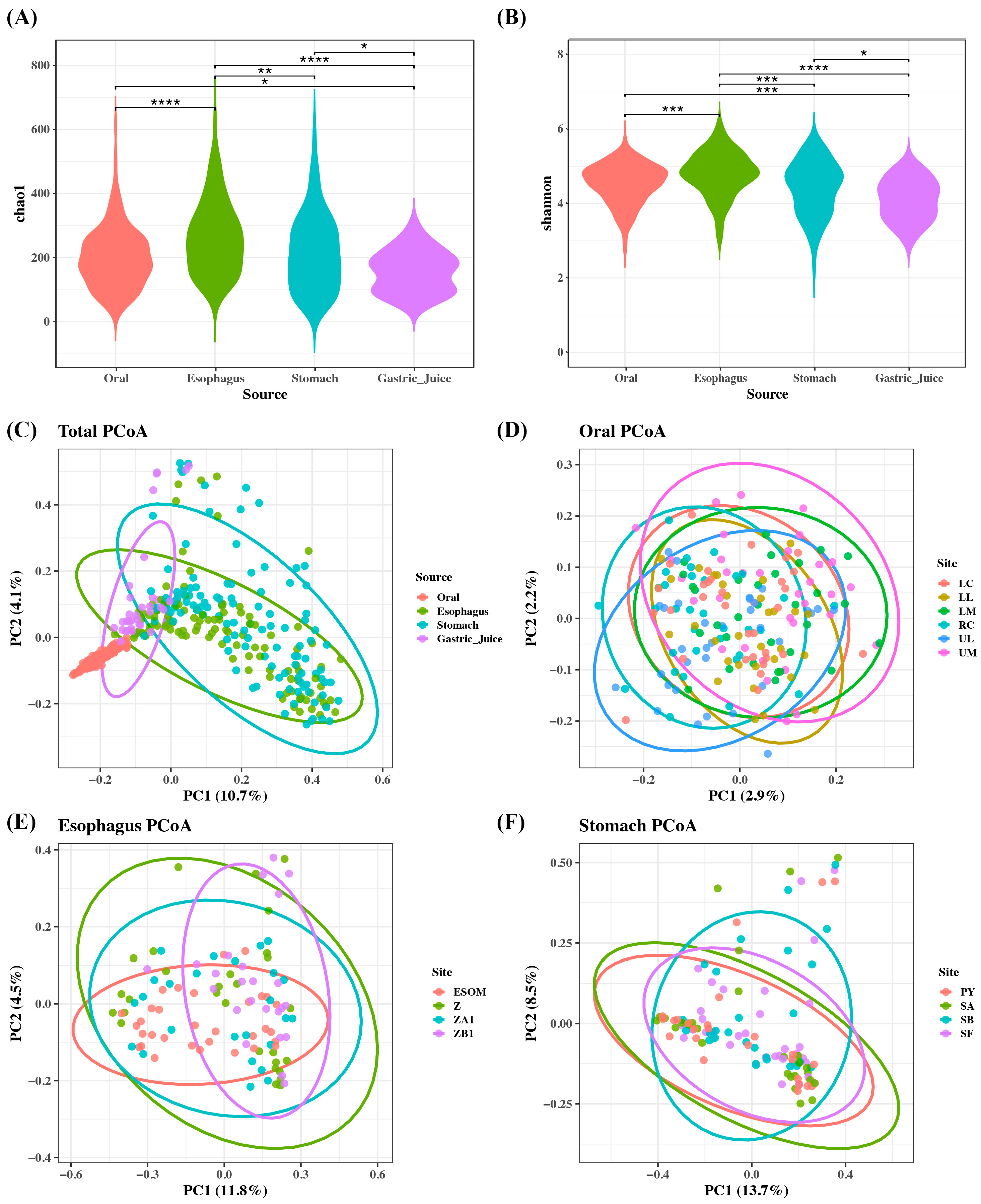
To evaluate microbial richness and evenness, alpha diversity was assessed using the Chao1 and Shannon indices. Because multiple samples were obtained from the same subjects, alpha-diversity differences were tested using linear mixed-effects models with anatomical source as a fixed effect and subject identity as a random intercept. Anatomical source was significantly associated with both Chao1 richness (F = 13.41, p = 2.25 × 10⁻⁸) and Shannon diversity (F = 15.46, p = 1.46 × 10⁻⁹) (Supplementary Table S2). Esophageal samples showed significantly higher Chao1 and Shannon indices than oral, gastric mucosal, and gastric juice samples, indicating greater microbial richness and evenness in the esophageal microbiome (Figure 1A,B). In contrast, gastric juice samples showed significantly lower alpha diversity than the other anatomical sources, consistent with stronger environmental selection within the gastric lumen. No significant difference was observed between oral and gastric mucosal samples for either Chao1 or Shannon diversity. These results indicate that alpha diversity varies significantly along the oral–upper GI axis, with the highest diversity in the esophagus and the lowest diversity in gastric juice.
Beta diversity was assessed using Bray–Curtis distances to evaluate differences in microbial community composition across anatomical sources and sampling sites. Principal coordinate analysis (PCoA) revealed clear separation of oral samples from esophageal, gastric mucosal, and gastric juice samples, indicating distinct microbial community structures along the oral–upper GI axis (Figure 1C). To account for repeated sampling from the same participants, PERMANOVA was performed using permutations restricted by subject identity. Anatomical source remained significantly associated with microbial community composition after controlling for subject-level repeated sampling. All pairwise comparisons among oral, esophageal, gastric mucosal, and gastric juice samples were significant after Benjamini–Hochberg correction (all adjusted p = 0.001) (Supplementary Table S3). The strongest separation was observed between oral and stomach samples (F = 32.09, R2 = 0.0944), followed by oral and esophageal samples (F = 22.62, R2 = 0.0697). Gastric juice also differed significantly from gastric mucosal samples (F = 8.39, R2 = 0.0540), supporting a distinct luminal gastric microbiome. Site-level analysis further showed a significant overall effect of sampling site (F = 4.49, R2 = 0.1256, p = 0.001). Because sampling sites were nested within anatomical sources, intra-source site effects were evaluated separately. Although PCoA plots showed substantial overlap among sub-sites within the oral cavity and esophagus (Figure 1D,E), subject-restricted PERMANOVA detected significant but modest site-level differences within the esophagus (F = 1.79, R2 = 0.0483, adjusted p = 0.0015), oral cavity (F = 1.40, R2 = 0.0360, adjusted p = 0.0015), and stomach mucosa (F = 1.19, R2 = 0.0308, adjusted p = 0.002). Stomach samples showed broader dispersion in PCoA space, with gastric juice separated from gastric mucosal samples (Figure 1F), consistent with greater compositional heterogeneity in the gastric environment. Together, these results indicate that anatomical source is the dominant determinant of beta-diversity variation along the oral–upper GI axis, while finer site-level differences also contribute modestly to community heterogeneity.
To determine whether beta-diversity differences were influenced by unequal within-group variability, PERMDISP was performed using Bray–Curtis distances (Supplementary Table S4 and Figure S2). PERMDISP showed significant differences in dispersion among anatomical sources (F = 37.48, p = 0.001). Pairwise analysis demonstrated that gastric juice samples had significantly greater dispersion than gastric mucosal samples (adjusted p = 8.62 × 10⁻⁷) and esophageal samples (adjusted p = 0.015), but not oral samples (adjusted p = 0.906). Site-level PERMDISP showed significant dispersion differences within the oral cavity (F = 3.49, p = 0.003), whereas dispersion did not differ significantly among esophageal sites (F = 1.27, p = 0.385) or gastric mucosal sites (F = 0.24, p = 0.850). These findings indicate that the broader distribution of gastric juice samples in PCoA space reflects increased within-group heterogeneity in addition to anatomical source-associated compositional differences.

3.2. Site-Specific Taxonomic Composition of the Oral, Esophageal, and Gastric Microbiome

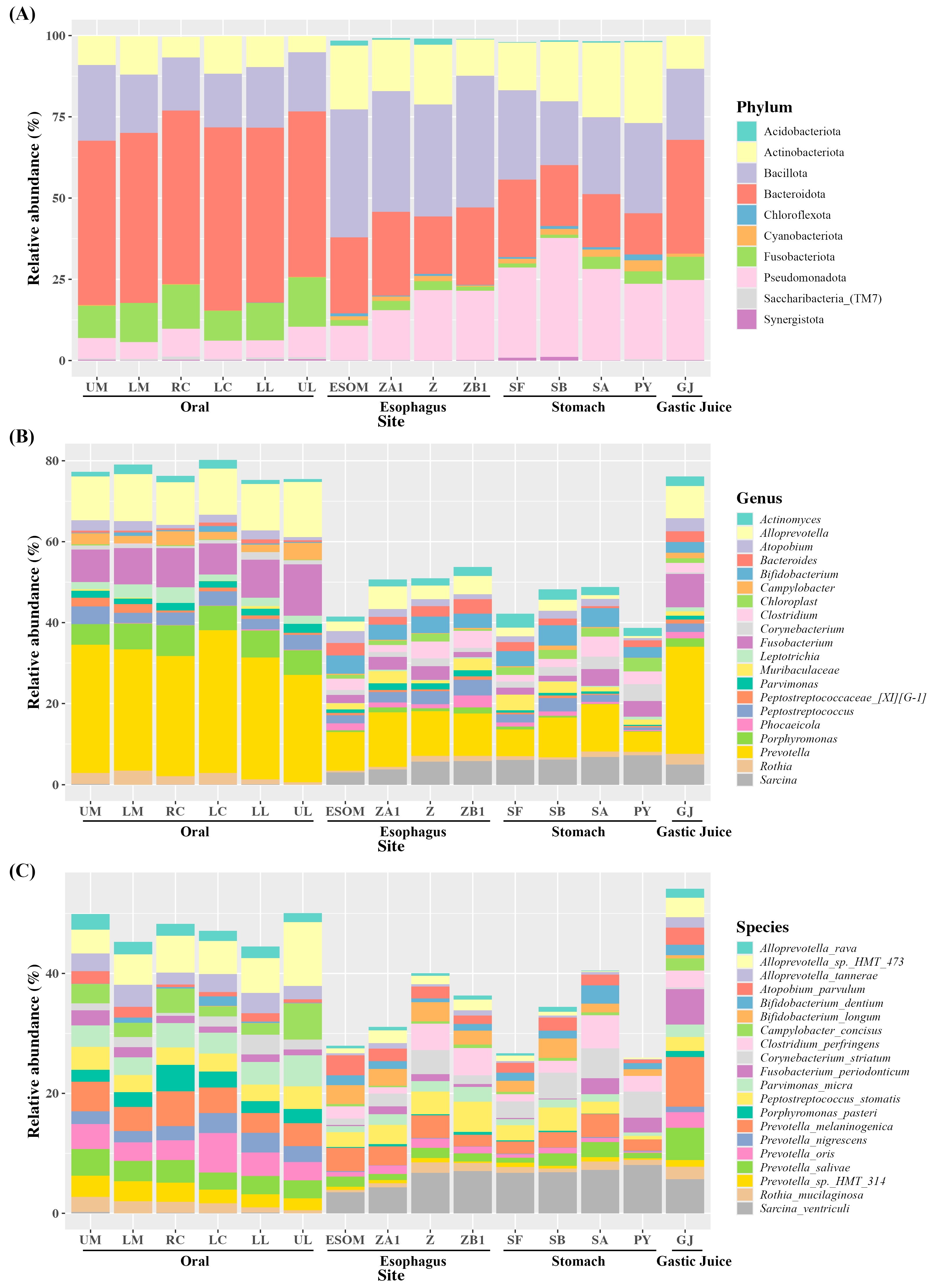
Next, the relative abundances of microbial communities were analyzed at various taxonomic levels across sampling sites (Figure 2). At the phylum level, the five dominant phyla—Bacteroidota, Bacillota, Pseudomonadota, Actinobacteriota, and Fusobacteriota—were consistently across oral, esophageal, and gastric samples (Figure 2A). Oral samples were characterized by a predominance of Bacteroidota, followed by Bacillota and Fusobacteriota. In esophageal samples, Bacillota constituted the dominant phylum, with Bacteroidota and Pseudomonadota also contributing substantially. In contrast, gastric samples were characterized by a relative enrichment of Pseudomonadota, followed by Bacillota and Bacteroidota (Figure 2A). Although the major phyla were shared across all three anatomical sites, gastric juice samples displayed a distinct compositional pattern, showing a comparatively lower mean relative abundance of Actinobacteriota and a higher proportion of Bacteroidota compared to other gastric sampling sites.
At the genus level, microbial composition exhibited greater site-dependent variation (Figure 2B). Prevotella was dominant genus across all samples (Figure 2B), but the second dominant genus differed among sites. Alloprevotella ranked second in the oral samples, whereas Sarcina was second in the esophagus and stomach. A gradual decrease in the relative abundance of Alloprevotella was observed along the oral–esophageal–gastric axis, accompanied by a corresponding increase in Sarcina. Notably, gastric juice samples again showed a distinct genus-level profile, with Fusobacterium emerging as a major component alongside Alloprevotella and Sarcina.
At the species level, the relative abundance patterns in oral samples were distinct from those in the esophagus and stomach (Figure 2C). In the oral samples, Alloprevotella sp._HMT_473 was the most abundant species, while Sarcina ventriculi was the most abundant species in the esophagus and stomach samples. The average abundance of Sarcina ventriculi increased from 0.07% in the oral samples to 5.41% in the esophagus and 7.13% in the stomach. Gastric juice samples exhibited unique species-level abundance patterns compared to other stomach sites (Figure 2C).
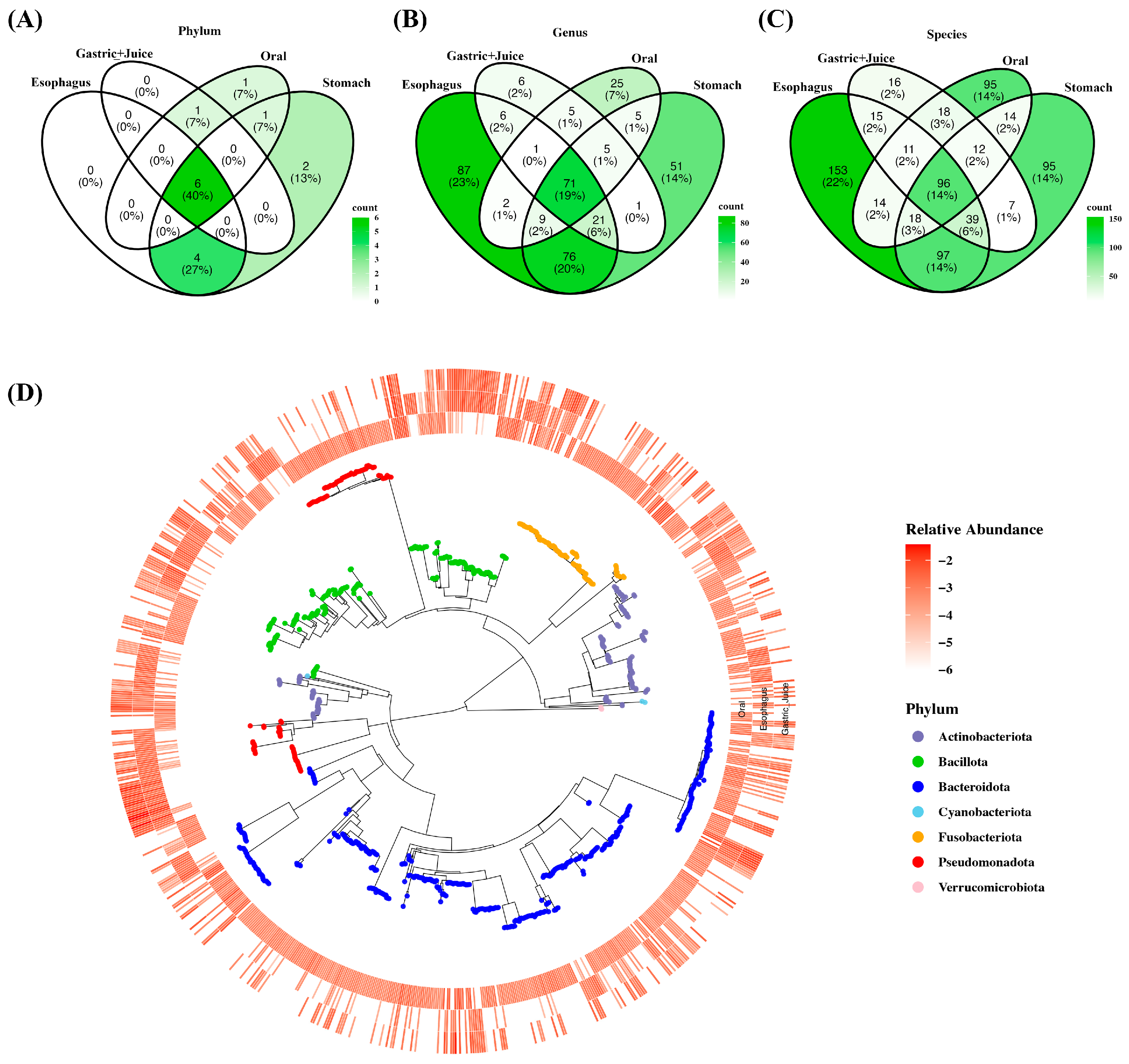
Next, the number of taxa detected at each taxonomic level was compared across the oral cavity, esophagus, and stomach to evaluate the degree of taxonomic overlap and site specificity (Figure 3A). At the phylum level, six phyla (40%) were commonly detected across oral, esophageal, and gastric samples (Figure 3A). Four phyla (27%) were both detected in the esophagus and stomach, two phyla (13%) were shared exclusively stomach. One phylum (7%) in oral sites was shared between the esophagus and stomach.
At the genus level, 71 genera (19%) were detected across all four sampling sites (Figure 3B). In addition, 76 genera (20%) were shared exclusively between the esophagus and stomach. Site-specific genera included 25 genera (7%) unique to the oral cavity, 87 genera (23%) unique to the esophagus, and 51 genera (14%) unique to the stomach.
At the species level, a total of 96 species (14%) were commonly detected across all four sites (Figure 3C). In contrast, 97 species (14%) were shared between the esophagus and stomach, while 95 species (14%) were unique to the oral cavity, 153 species (22%) were specific to the esophagus, 95 species (14%) were unique to the stomach, and 16 species (2%) were unique in the gastric juice. Taken together, most taxa were shared across the three sampling sites, with more unique taxa found in the esophagus and stomach compared to the oral samples.
To visualizes the phylogenetic context of these shared and unique taxa, a phylogenetic tree of the top 2000 microbial taxa was constructed, incorporating site-specific relative abundance across oral, esophageal, and gastric juice samples (Figure 3D). The accompanying heatmap of mean relative abundance indicates that, although many taxa were detected across all three sampling sites, their relative abundance differed by site. Closely related taxa within the phylogenetic tree displayed variable abundance patterns among oral, esophageal, and gastric juice samples, with some taxa showing higher relative abundance in specific sites and others exhibiting low or similar abundance across sites.

3.3. Differential Analysis: Linear Discriminant Analysis (LDA) Analysis

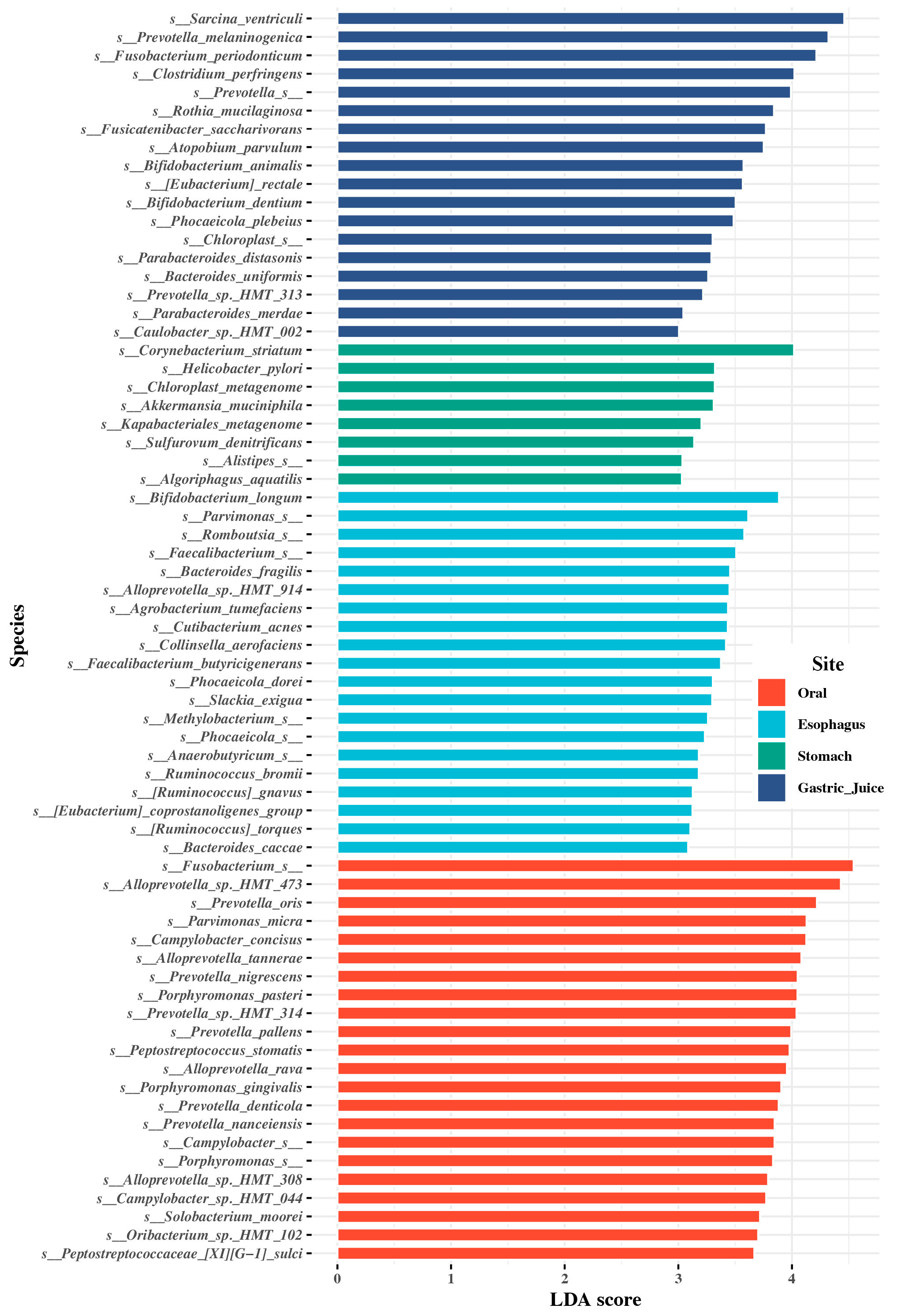
To identify microbial species differentially enriched across the oral, esophagus, stomach, and gastric juice, LEfSe and ALDEx2 analysis were performed at the species level (Figure 4). The corresponding results, including effect sizes and adjusted p-values, are provided in Supplementary Table S6. Oral samples were characterized by the enrichment of numerous periodontal-associated species, including Fusobacterium spp., Alloprevotella spp. (e.g., Alloprevotella sp. HMT 473, A. tannerae, A. rava, Alloprevotella sp._HMT_4308), Prevotella spp. (e.g., P. nigrescens, P. oris, HMT 314, P. pallens, P. denticola, P. nanceiensis), Parvimonas micra, Porphyromonas spp. (e.g., P. pasteri, P. gingivalis) and Peptostreptococcus_stomatis. These taxa showed high LDA scores, indicating strong discriminatory power for the oral microbiome and reflecting a community structure dominated by anaerobic, biofilm-associated oral pathogens.
In esophageal samples, several species related to oral-derived and transitional taxa were significantly enriched, including Agrobacterium tumefaciens, and Bifidobacterium longum, these species may represent microbes capable of persisting in the esophageal environment, which is continuously exposed to oral microbiota while experiencing distinct physicochemical conditions.
Stomach mucosal samples were distinguished by the enrichment of taxa such as Akkermansia muciniphila, Bifidobacterium animalis, Helicobacter pylori, Alistipes spp., and Sulfurovum denitrificans, reflecting a microbial profile distinct from both oral and esophageal communities.
In contrast, gastric juice samples were characterized by the enrichment of species such as Sarcina ventriculi, Prevotella melaninogenica, Fusobacterium periodonticum, and Clostridium perfringens. The predominance of these taxa highlights a distinct microbial signature in the gastric lumen, potentially reflecting acid tolerance, fermentative metabolism, and survival under highly selective conditions.
Several ASVs showed site-associated species-level assignments, including ASVs assigned to Akkermansia muciniphila and Helicobacter pylori in gastric mucosal samples and ASVs assigned to Sarcina ventriculi, Fusobacterium periodonticum, and Clostridium perfringens in gastric juice samples. To evaluate the reliability of selected species-level assignments, ASVs corresponding to H. pylori, A. muciniphila, S. ventriculi, and C. perfringens were additionally searched against both the NCBI 16S rRNA reference database and the PacBio-derived reference database. The classifier-assigned species labels were concordant with the top BLAST species-level results for these selected taxa, supporting the taxonomic consistency of these assignments (Supplementary Table S5). However, because these results are based on 16S rRNA amplicon sequencing, they should be interpreted as reference-supported species-level assignments rather than definitive genome-level identification.
Collectively, LEfSe analysis revealed clear site-specific microbial signatures along the oral–upper GI tract, supporting the presence of distinct ecological niches shaped by local environmental constraints and selective pressures.

3.4. Site-Specific Relative Abundance of Selected Bacterial Genera and Species

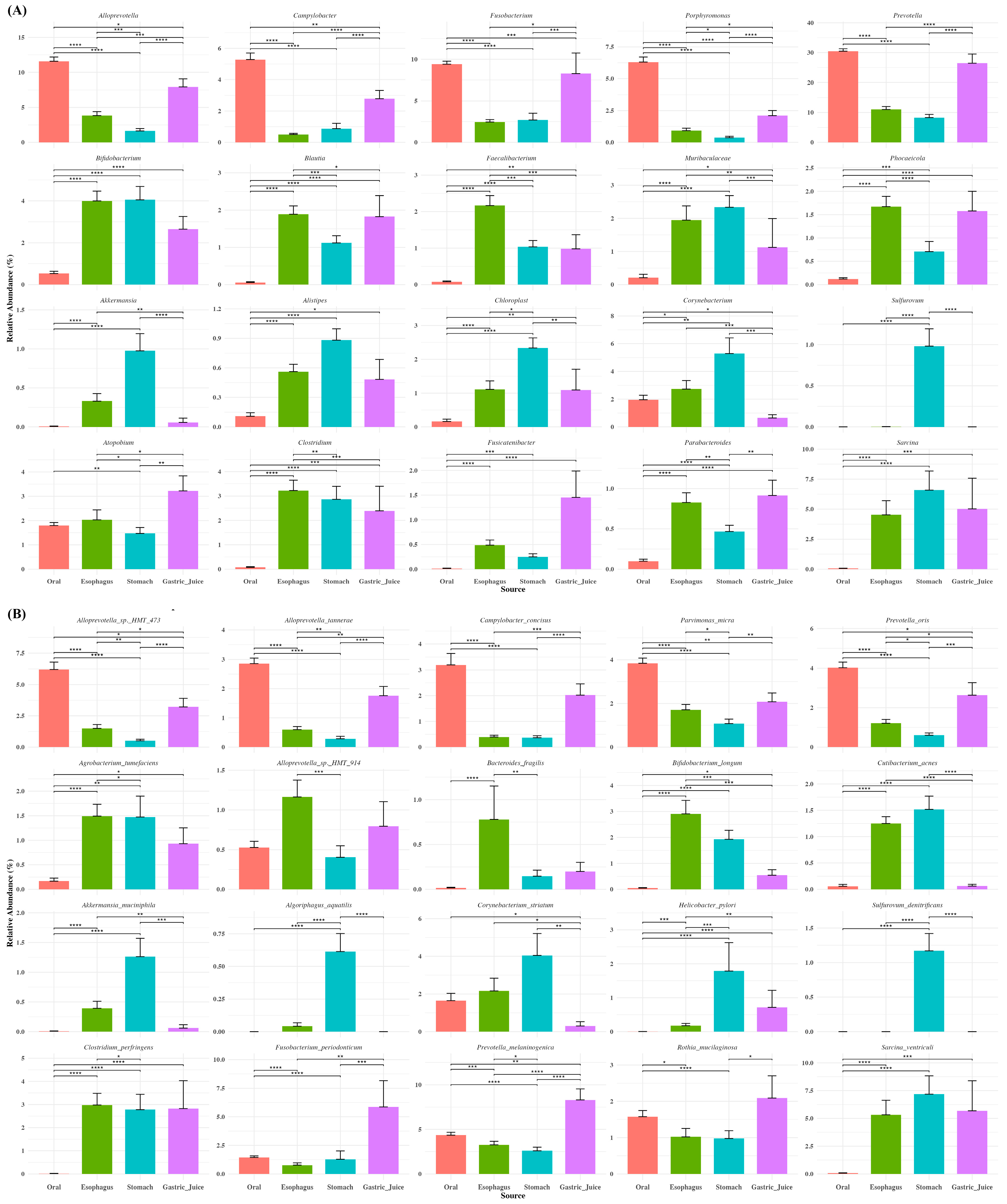
Finally, to evaluate site-specific microbial distribution patterns, the relative abundance of selected bacterial genera and species was compared across oral, esophageal, stomach, and gastric juice samples (Figure 5). At the genus level, several taxa showed clear site-dependent abundance differences (Figure 5A). Prevotella, Alloprevotella, Porphyromonas, and Fusobacterium exhibited the highest relative abundance in oral samples, with reduced abundance in esophageal and gastric mucosal samples. These genera remained detectable across all sites but displayed lower proportions outside the oral cavity. In contrast, Bacteroides, Bifidobacterium, and Faecalibacterium showed higher relative abundance in esophageal and gastric mucosal samples compared to oral samples. Akkermansia and Helicobacter were predominantly enriched in stomach mucosal samples. Meanwhile, Sarcina and Clostridium demonstrated higher relative abundance in gastric juice compared with other sites.
At the species level, the relative abundance of selected species showed clear site-dependent differences across oral, esophageal, stomach, and gastric juice samples (Figure 5B). Oral samples were characterized by higher abundance of Alloprevotella tannerae, Alloprevotella sp. HMT 473, Campylobacter concisus, Porphyromonas gingivalis, and Prevotella denticola, all of which decreased in downstream sites. Esophageal samples showed relatively higher abundance of Bacteroides fragilis, Bifidobacterium longum, and Faecalibacterium butyricigenerans compared with the oral cavity. Gastric mucosal samples were distinguished by increased abundance of Akkermansia muciniphila and Helicobacter pylori. In contrast, gastric juice samples exhibited elevated abundance of Sarcina ventriculi, Fusobacterium periodonticum, and Prevotella melaninogenica, while Clostridium perfringens showed higher abundance in both esophageal and gastric juice samples than in oral samples. Overall, these species displayed distinct abundance gradients across the oral–upper gastrointestinal tract.

4. Discussion

In this study, we comprehensively characterized the microbial landscape along the oral–upper gastrointestinal (GI) axis by integrating diversity and compositional analyses. Although the oral cavity, esophagus, and stomach are anatomically continuous, our results clearly demonstrate that microbial communities exhibit both continuity and site-specific divergence across upper GI microbial communities.
When alpha diversity was compared, the esophageal microbiome exhibited significantly higher alpha diversity compared to the oral cavity and stomach, suggesting that the esophagus may not merely serve as a passive transit pathway but instead harbors a distinct and independent microbial ecological niche (Figure 1D). Despite its anatomical complexity, the continuous circulation of saliva and constant inter-surface contact contribute to the formation of an integrated microbial ecosystem [12]. The clear separation of oral samples from esophageal and gastric samples in beta diversity analysis further supports the presence of distinct ecological constraints along the oral–upper GI axis. The gastric microbiome showed greater variability, particularly in gastric fluid samples, which may reflect fluctuations in environmental conditions such as gastric acidity and dietary intake (Figure 1C). This heterogeneity likely reflects the strong influence of acid exposure, oxygen tension, nutrient availability, and host-derived factors within the gastric lumen [13]. Collectively, these findings support the notion that each region of the upper gastrointestinal tract possesses distinct physiological conditions and colonization environments, leading to the establishment of site-specific microbial community structures.
At taxonomic level, site specificity became more pronounced. Although five dominant phylum were shared across all sites, their relative proportions differed markedly (Figure 2A). This pattern is consistent with previous reports suggesting that the upper GI tract shares a common microbial composition derived largely from the oral microbiome, yet undergoes site-dependent restructuring driven by local physicochemical conditions [14,15]. The gradual decline of Alloprevotella along the oral–esophageal–gastric axis, accompanied by a progressive increase in Sarcina ventriculi, suggests a shift from biofilm-associated oral anaerobes to acid-tolerant fermentative organisms (Figure 2C). Sarcina ventriculi is known to survive under acidic conditions and has been associated with delayed gastric emptying and mucosal injury [16]. The increasing abundance of Sarcina in the stomach and gastric juice therefore likely reflects ecological adaptation rather than passive translocation. Phylogenetic tree analysis showed that closely related bacteria had different abundance patterns across anatomical sites, indicating that evolutionary similarity does not necessarily lead to similar ecological roles in the upper GI tract (Figure 3B).
LEfSe analysis revealed strong enrichment of classical periodontal-associated taxa (e.g., Porphyromonas gingivalis, Prevotella spp., Alloprevotella spp., Parvimonas micra) in oral samples (Figure 4). These taxa are well-recognized anaerobic biofilm-associated organisms and key contributors to periodontal dysbiosis [17,18]. Their marked reduction in esophageal and gastric samples indicates that, despite continuous swallowing, many strict anaerobes may not efficiently colonize downstream environments. Nevertheless, detection of oral-derived species in the esophagus supports the concept that oral microbiota contributes to the upper GI microbial pool. Emerging evidence links oral pathogens such as P. gingivalis to esophageal and gastric pathologies, potentially through inflammatory or carcinogenic pathways [19]. Although abundance decreased downstream, even low-level persistence may be biologically relevant.
When several species of interest were further evaluated, the selected species formed coherent site-dependent gradients: oral enrichment of periodontal pathogen (Alloprevotella tannerae, Alloprevotella sp. HMT 473, Campylobacter concisus, Porphyromonas gingivalis, Prevotella denticola), esophageal enrichment of gut-associated taxa (Bacteroides fragilis, Bifidobacterium longum, Faecalibacterium butyricigenerans), gastric mucosal enrichment of organisms (Akkermansia muciniphila, Helicobacter pylori), and gastric luminal enrichment of acid-tolerant/fermentative or opportunistic organisms (Sarcina ventriculi, Fusobacterium periodonticum, Prevotella melaninogenica, Clostridium perfringens). These gradients support a model in which disease-relevant ecological filters (inflammation, acidity, and motility) shape the oral–esophageal–gastric microbial axis.
The highest relative abundance of classical periodontal-associated genera and species (e.g., Porphyromonas/Porphyromonas gingivalis, Prevotella/Prevotella denticola, Alloprevotella spp.) have been implicated beyond oral disease. For example, P. gingivalis has been detected in esophageal squamous cell carcinoma and has been experimentally linked to tumor progression through host signaling and inflammatory pathways, suggesting that oral pathobionts may contribute to esophageal carcinogenic processes when ecological or host barriers are compromised [19]. In addition, Campylobacter concisus has been frequently associated with Barrett’s esophagus and reflux-related esophageal diseases. This bacterium is microaerophilic and produces lipopolysaccharide (LPS), which may promote inflammatory response [20]. These characteristics suggest that such bacteria may preferentially grow in inflamed esophageal environments. Importantly, the clear decrease of these oral anaerobes in downstream sites suggests that most periodontal bacteria mainly remain in the oral cavity and are less able to stably colonize the esophagus and stomach. However, even small amounts of these bacteria may still be clinically important, as growing evidence links oral microbes with esophageal diseases. Gastric mucosa was enriched with Akkermansia muciniphila and Helicobacter pylori, organisms known to colonize the mucosal layer and interact closely with host epithelial and immune system [20,21,22]. B. fragilis have a toxigenic factor capable of driving mucosal inflammation and tumor-promoting signaling in the intestine [23]; therefore, its enrichment in the upper GI tract requires cautious interpretation or functional analyses. H. pylori is a well-established driver of chronic gastritis and gastric carcinogenesis, and it is also known to remodel the gastric microbial community, potentially enabling or suppressing co-colonizing taxa [24]. In contrast, gastric juice was enriched with Sarcina ventriculi and Fusobacterium periodonticum, taxa which can be detected in gastric environments and may be associated with acidic or fermentative conditions [25,26]. These results indicate that the stomach should not be regarded as a single homogeneous environment but rather as comprising at least two ecologically distinct niches: the mucosal-associated microbiome and the luminal microbiome. The strong inter-sample variability observed in gastric juice further supports the dynamic and highly selective nature of the gastric lumen.
Several limitations are that this study relied on publicly available 16S rRNA sequencing data, which limited control over host-related factors such as diet, medication use, oral health status, and underlying diseases. In addition, 16S rRNA analysis provides limited functional and strain-level resolution, preventing detailed characterization of microbial activities. Although the use of a PacBio-informed full-length 16S rRNA reference database improved taxonomic assignment and selected species-level ASVs were concordant with BLAST results against both NCBI 16S and PacBio-derived reference databases, short-read V3–V4 sequencing has inherent limitations in resolving closely related bacterial species. Therefore, species-level findings, including assignments to H. pylori, A. muciniphila, S. ventriculi, and C. perfringens, should be interpreted cautiously as 16S-based taxonomic inferences. Confirmation by full-length 16S sequencing, shotgun metagenomics, targeted qPCR, or culture-based methods would be required for definitive species- or strain-level validation. Future studies integrating metagenomic or multi-omics approaches will be necessary to better understand functional interactions within the upper GI microbiome.
In conclusion, our findings demonstrate that although the oral cavity, esophagus, and stomach are anatomically continuous, microbial communities exhibit both shared taxa and clear site-specific divergence. These patterns suggest that physicochemical gradients and host–microbe interactions shape distinct ecological niches along the upper GI tract. Collectively, this study provides new insights into the ecological organization of the oral–upper GI microbiome and highlights the importance of considering inter-organ microbial interactions in understanding upper GI health and disease.


Supplementary Materials

The following supporting information can be downloaded at: https://www.mdpi.com/article/10.3390/microbiolres17060116/s1, Figure S1: Rarefaction curves by anatomical source. Rarefaction curves showing observed ASV richness as a function of sequencing depth for oral, esophageal, gastric mucosal, and gastric juice samples. Most curves showed a steep initial increase followed by gradual plateauing, supporting generally sufficient sequencing depth for downstream diversity comparisons. Figure S2: PERMDISP analysis of site-level dispersion within anatomical sources. Homogeneity of multivariate dispersion was assessed using PERMDISP based on Bray–Curtis distances. Boxplots show the distance of each sample to the site centroid within each anatomical source, including esophagus, oral cavity, and stomach mucosa. Individual points represent samples. Gastric juice was not included in the within-source site-level PERMDISP analysis because it represented a single sampling category. Detailed PERMDISP results are provided in Supplementary Table S4. Table S1. Summary of sequencing preprocessing by anatomical source and sampling site. Table S2. Subject-controlled alpha-diversity analysis using linear mixed-effects models. Table S3. Subject-restricted PERMANOVA results for Bray–Curtis beta diversity. Table S4. PERMDISP analysis of multivariate dispersion by anatomical source and sampling site. Table S5. BLAST validation of selected species-level ASV assignments using NCBI 16S rRNA and PacBio-derived reference databases. Table S6. Differential-abundance analysis results from LEfSe and ALDEx2 at the species level.

Author Contributions

Y.S., contributed to data analysis, and interpretation, drafted and critically wrote the manuscript; H.S.N. contributed to conception, design, data acquisition, interpretation, critically revised the manuscript. All authors have read and agreed to the published version of the manuscript.

Funding

This research received no external funding.

Institutional Review Board Statement

Not applicable.

Informed Consent Statement

Not applicable.

Data Availability Statement

The raw sequencing data presented in this study are openly available in the NCBI GenBank database under BioProject ID PRJNA1049979 (https://www.ncbi.nlm.nih.gov/, accessed on 17 June 2024). All data used in this study can be accessed through the corresponding BioProject repository.

Conflicts of Interest

The authors declare no conflicts of interest.

Abbreviations

GIGastrointestinal
LDAlinear discriminant analysis
PCoAPrincipal coordinate analysis
NCBINational Center for Biotechnology Information
LDADifferential Analysis: linear discriminant analysis

References

  1. Ahluwalia, B.; Magnusson, M.K.; Öhman, L. Mucosal immune system of the gastrointestinal tract: Maintaining balance between the good and the bad. Scand. J. Gastroenterol. 2017, 52, 1185–1193. [Google Scholar] [CrossRef] [PubMed]
  2. Liao, D.H.; Zhao, J.; Gregersen, H. Gastrointestinal tract modelling in health and disease. World J. Gastroenterol. 2009, 15, 169–176. [Google Scholar] [CrossRef] [PubMed]
  3. Cho, I.; Blaser, M.J. The human microbiome: At the interface of health and disease. Nat. Rev. Genet. 2012, 13, 260–270. [Google Scholar] [CrossRef] [PubMed]
  4. Hooper, L.V.; Littman, D.R.; Macpherson, A.J. Interactions between the microbiota and the immune system. Science 2012, 336, 1268–1273. [Google Scholar] [CrossRef] [PubMed]
  5. Turner, J.R. Intestinal mucosal barrier function in health and disease. Nat. Rev. Immunol. 2009, 9, 799–809. [Google Scholar] [CrossRef] [PubMed]
  6. Lee, J.Y.; Tsolis, R.M.; Bäumler, A.J. The microbiome and gut homeostasis. Science 2022, 377, eabp9960. [Google Scholar] [CrossRef] [PubMed]
  7. Wang, J.K.; Yang, Y.S. Upper gastrointestinal microbiota and digestive diseases. World J. Gastroenterol. 2013, 19, 1541–1550. [Google Scholar] [CrossRef] [PubMed]
  8. Beasley, D.E.; Koltz, A.M.; Lambert, J.E.; Fierer, N.; Dunn, R.R. The Evolution of Stomach Acidity and Its Relevance to the Human Microbiome. PLoS ONE 2015, 10, e0134116. [Google Scholar] [CrossRef] [PubMed]
  9. Xia, M.; Lei, L.; Zhao, L.; Xu, W.; Zhang, H.; Li, M.; Hu, J.; Cheng, R.; Hu, T. The dynamic oral–gastric microbial axis connects oral and gastric health: Current evidence and disputes. npj Biofilms Microbiomes 2025, 11, 1. [Google Scholar] [CrossRef] [PubMed]
  10. She, J.J.; Liu, W.Z.; Ding, X.M.; Guo, G.; Han, J.; Shi, F.Y.; Lau, H.C.; Ding, C.G.; Xue, W.; Shi, W.; et al. Defining the biogeographical map and potential bacterial translocation of microbiome in human ‘surface organs’. Nat. Commun. 2024, 15, 427. [Google Scholar] [CrossRef] [PubMed]
  11. Han, H.; Choi, Y.H.; Kim, S.Y.; Park, J.H.; Chung, J.; Na, H.S. Optimizing microbiome reference databases with PacBio full-length 16S rRNA sequencing for enhanced taxonomic classification and biomarker discovery. Front. Microbiol. 2024, 15, 1485073. [Google Scholar] [CrossRef] [PubMed]
  12. Marsh, P.D.; Do, T.; Beighton, D.; Devine, D.A. Influence of saliva on the oral microbiota. Periodontol. 2000 2015, 70, 80–92. [Google Scholar] [CrossRef] [PubMed]
  13. Human Microbiome Project Consortium. Structure, function and diversity of the healthy human microbiome. Nature 2012, 486, 207. [Google Scholar] [CrossRef] [PubMed]
  14. Bik, E.M.; Eckburg, P.B.; Gill, S.R.; Relman, D.A. Molecular analysis of the bacterial microbiota in the human stomach. Proc. Natl. Acad. Sci. USA 2006, 103, 732–737. [Google Scholar] [CrossRef] [PubMed]
  15. Martinez-Guryn, K.; Leone, V.; Chang, E.B. Regional Diversity of the Gastrointestinal Microbiome. Cell Host Microbe 2019, 26, 314–324. [Google Scholar] [CrossRef] [PubMed]
  16. Lam-Himlin, D.; Tsiatis, A.C.; Montgomery, E.; Pai, R.K.; Brown, J.A.; Razavi, M.; Lamps, L.; Eshleman, J.R.; Bhagavan, B.; Anders, R.A. Sarcina organisms in the gastrointestinal tract: A clinicopathologic and molecular study. Am. J. Surg. Pathol. 2011, 35, 1700–1705. [Google Scholar] [CrossRef] [PubMed]
  17. Hajishengallis, G. Periodontitis: From microbial immune subversion to systemic inflammation. Nat. Rev. Immunol. 2015, 15, 30–44. [Google Scholar] [CrossRef] [PubMed]
  18. Darveau, R.P. Periodontitis: A polymicrobial disruption of host homeostasis. Nat. Rev. Microbiol. 2010, 8, 481–490. [Google Scholar] [CrossRef] [PubMed]
  19. Chen, M.F.; Lu, M.; Hsieh, C.; Chen, W. Porphyromonas gingivalis promotes tumor progression in esophageal squamous cell carcinoma. Cell. Oncol. 2021, 44, 373–384. [Google Scholar] [CrossRef]
  20. Kaakoush, N.O.; Castaño-Rodríguez, N.; Man, S.M.; Mitchell, H.M. Is Campylobacter to esophageal adenocarcinoma as Helicobacter is to gastric adenocarcinoma? Trends Microbiol. 2015, 23, 455–462. [Google Scholar] [CrossRef] [PubMed]
  21. Fakharian, F.; Asgari, B.; Nabavi-Rad, A.; Sadeghi, A.; Soleimani, N.; Yadegar, A.; Zali, R.Z. The interplay between Helicobacter pylori and the gut microbiota: An emerging driver influencing the immune system homeostasis and gastric carcinogenesis. Front. Cell Infect. Microbiol. 2022, 15, 953718. [Google Scholar] [CrossRef] [PubMed]
  22. Fang, J.; Zhang, H.; Zhang, X.; Lu, X.; Liu, J.; Li, H.; Huang, J. Akkermansia muciniphila improves gastric cancer treatment by modulating the immune microenvironment. Future Microbiol. 2024, 9, 481–494. [Google Scholar] [CrossRef] [PubMed]
  23. Sears, C.L.; Geis, A.L.; Housseau, F. Bacteroides fragilis subverts mucosal biology: From symbiont to colon carcinogenesis. J. Clin. Investig. 2014, 124, 4166–4172. [Google Scholar] [CrossRef] [PubMed]
  24. Iino, C.; Shimoyama, T. Impact of Helicobacter pylori infection on gut microbiota. World J. Gastroenterol. 2021, 27, 6224–6230. [Google Scholar] [CrossRef] [PubMed]
  25. Attri, N.; Pareek, R.; Dhanetwal, M.; Khan, F.M.; Patel, S. Sarcina ventriculi associated gastritis. Mimicking lymphoma on endoscopy. Indian. J. Pathol. Microbiol. 2023, 66, 165–167. [Google Scholar] [CrossRef] [PubMed]
  26. Strauss, J.; White, A.; Ambrose, C.; McDonald, J.; Allen-Vercoe, E. Phenotypic and genotypic analyses of clinical Fusobacterium nucleatum and Fusobacterium periodonticum isolates from the human gut. Anaerobe 2008, 14, 301–309. [Google Scholar] [CrossRef] [PubMed]
Figure 1. Diversity of microbial communities across anatomical sources and specific sampling sites in the upper gastrointestinal tract. Alpha diversity indices of microbial communities. (A,B) Violin plots represent microbial richness measured by the Chao1 index (A) and evenness measured by the Shannon index (B) across primary anatomical sources. Horizontal brackets indicate significant differences between groups determined by pairwise Wilcoxon rank-sum tests (* p < 0.05, ** p < 0.01, *** p < 0.001, **** p < 0.0001). (CF) Beta diversity and community structure. Principal Coordinates Analysis (PCoA) based on Bray–Curtis distances shows the clustering of microbial communities. (C) Total PCoA: Ordination of all samples colored by anatomical source. Detailed community structure within specific organs, including (D) Oral (left buccal mucosa; LC/lower lip; LL/lower hard palate; LM/right buccal mucosa; RC/upper lip; UL/upper hard palate; UM) (E) Esophagus (thoracic esophagus; ESOM/zigzag line; Z/abdominal esophagus; ZA1/cardiac orifice; ZB1) and (F) Stomach (pylorus; PY/antrum; SA/body; SB/fundus; SF). Percentages on the axes represent the variance explained by the first two principal coordinates (PC1 and PC2). Ellipses represent 95% confidence intervals for each group.
Microbiolres 17 00116 g001
Figure 2. Relative abundance of microbiome depending on sampling sites. (A) Phylum level, (B) Genus level, and (C) Species level. For genus and species level, top 20 most abundant taxa from oral, esophagus, stomach and gastric juice samples were plotted. Oral (upper hard palate; UM/lower hard palate; LM/right buccal mucosa; RC/Left buccal mucosa; LC/lower lip, LL/upper lip; UL), Esophagus (the thoracic esophagus; ESOM/abdominal esophagus; ZA1/zigzag line; Z/cardiac orifice; ZB1), Stomach (Fundus; SF body; SB/antrum; SA/pylorus; PY), Gastric Juice (GJ).
Microbiolres 17 00116 g002
Figure 3. Phylogenetic distribution and shared core microbiome across upper gastrointestinal anatomical sources. (AC) Core microbiome shared across sources. Venn diagrams illustrate the overlap of unique taxa among the four anatomical sources at the Phylum, Genus, and Species levels. Taxa were included based on mean relative abundance thresholds: 0.1% for Phyla and 0.01% for Genera and Species. The central intersection represents the “core” microbiome consistently present across all sampled regions of the upper GI tract. (D) Phylogenetic tree of the top 2000 taxa. A circular phylogenetic tree displays the evolutionary relationships of the most abundant 2000 taxa identified in the study. Heatmap Annotation: The outer concentric rings represent the mean relative abundance of each taxon within the four anatomical sources.
Microbiolres 17 00116 g003
Figure 4. Comparisons of microbiota among various sampling sites that presented significantly different. The analysis was performed using linear discriminant analysis (LDA) and effect size (LEfSe) analysis. LDA scores > 3.0 are displayed.
Microbiolres 17 00116 g004
Figure 5. Relative abundance of significant microbial taxa across anatomical sources of the upper gastrointestinal tract. (A) Genus-level relative abundance of selected significant taxa. Bar plots illustrate the mean relative abundance (%) of 12 genera across the four anatomical sources. (B) Species-level relative abundance of selected significant taxa. Bar plots illustrate the mean relative abundance (%) of 14 species across the same anatomical sources. The featured taxa were selected based on their common significance across both LEfSe and ALDEx2 analyses. Each bar represents the mean relative abundance, with error bars indicating the standard error (SE). Differences in abundance across sources were determined using the Kruskal–Wallis test, followed by Dunn’s post hoc test with Benjamini–Hochberg (BH) adjustment for multiple comparisons. Horizontal brackets and significance symbols indicate statistically significant pairs (0.05 ≥ p.adj). (* p < 0.05, ** p < 0.01, *** p < 0.001, **** p < 0.0001).
Microbiolres 17 00116 g005
Disclaimer/Publisher’s Note: The statements, opinions and data contained in all publications are solely those of the individual author(s) and contributor(s) and not of MDPI and/or the editor(s). MDPI and/or the editor(s) disclaim responsibility for any injury to people or property resulting from any ideas, methods, instructions or products referred to in the content.