
Article

Multiple Infections, Recombination, and Hypermutation During a 12-Month Prospective Study of Five HIV-1 Infected Individuals

by
Fernando M. Rodrigues
1,†,
Paula Prieto-Oliveira
2,3,†,
Jean P. Zukurov
4,
Wagner T. Alkmim
1,
Michel M. Soane
4,
Michelle Camargo
4,
Sabri S. Sanabani
5,
Esper G. Kallas
6,
Maria Cecília Sucupira
4,
Ricardo Sobhie Diaz
4,
Denis Jacob Machado
2,3,* and
Luiz Mario Janini
1,4,*
1
Department of Microbiology, Immunology and Parasitology, Federal University of São Paulo, 862 Botucatu Street, 6th Floor, Vila Clementino, São Paulo 04023-062, SP, Brazil
2
Department of Bioinformatics and Genomics, College of Computing and Informatics, University of North Carolina at Charlotte, 9201 University City Blvd., Charlotte, NC 28223, USA
3
Computational Intelligence to Predict Health and Environmental Risks Center, University of North Carolina at Charlotte, 9331 Robert D. Snyder Rd., Charlotte, NC 28223, USA
4
Department of Medicine, Infectious Diseases Division, Federal University of São Paulo, 740 Botucatu Street, 5th Floor, Vila Clementino, São Paulo 04023-062, SP, Brazil
5
Laboratory of Medicine Laboratorial (LIM03), Hospital das Clínicas, Faculty of Medicine, University of São Paulo, São Paulo 05403-010, SP, Brazil
6
Faculty of Medicine, University of São Paulo, 455 Dr. Arnaldo Blvd., São Paulo 01246-903, SP, Brazil
*
Authors to whom correspondence should be addressed.
These authors contributed equally to this work.
Microbiol. Res. 2026, 17(2), 30; https://doi.org/10.3390/microbiolres17020030

Submission received: 15 October 2025 / Revised: 21 December 2025 / Accepted: 20 January 2026 / Published: 27 January 2026

Abstract

The considerable HIV-1 genetic diversity has several implications for viral adaptive and evolutionary capabilities. Its genetic diversity is due to its high mutational rates derived from the error-prone viral reverse transcriptase activity, which generates highly heterogeneous viral populations. Moreover, genetic diversity can also increase due to intra- or intersubtype viral genomic recombination following multiple infections. This study examines HIV-1 intersubtype recombinant viruses and their increased genomic diversity over a 12-month period in five individuals from São Paulo state, Brazil. We collected peripheral blood mononuclear cells once every three months from selected participants at five distinct visits. Molecular clones of 1.15 Kbp fragments of the Pol polyprotein, spanning the protease and a portion of the reverse transcriptase (RT) genes, were generated by bulk PCR. Pol sequences were used for evolutionary analysis, including phylogenetics (using TnT), genetic diversity (using Highlighter), and hypermutation frequency (using Hypermut). Recombination detection experiments were conducted with a jumping profile-hidden Markov model (jpHMM), SimPlot++, and RDP5. We observed great genetic diversity and frequent recombination events in all patients. Furthermore, most of the patients presented hypermutations. These findings highlight the dynamic nature of HIV-1 genetic diversity, driven by frequent recombination and hypermutation, which can accelerate viral adaptation and diversification, underscoring the challenges for treatment, prevention, and disease control.

1. Introduction

HIV-1 persists and adapts through remarkable genetic diversity, which underlies its capacity for immune evasion, antiretroviral resistance, and lifelong infection [1,2,3,4]. This diversity arises from three major mechanisms: high mutation rates, recombination, and host-driven hypermutation. Reverse transcriptase (RT) operates with low fidelity, with an estimated error frequency of 3.4 × 10 5 per nucleotide per reverse-transcribed genome, corresponding to roughly three errors for every ten replication cycles [5,6,7]. Coupled with short generation times, high viral loads, and the production of up to 10 10 virions per day during acute infection [8,9], this leads to highly heterogeneous viral populations known as quasispecies [10,11,12].
Beyond mutation, recombination is a powerful driver of HIV-1 diversification [2,13]. Reverse transcriptase frequently switches templates 2–3 times during the replication of the viral genome [14,15], resulting in a recombination rate of 3.0 × 10 4 per site per replication cycle [14,16]. This occurs approximately ten times more frequently than the accumulation of point mutations [17], highlighting that recombination is an intrinsic feature of HIV-1 replication [13,18,19]. By facilitating the exchange of large genomic fragments, recombination accelerates viral adaptation and enables rapid exploration of new fitness landscapes [14,20,21,22].
Recombination also shapes the global HIV-1 pandemic by giving rise to circulating recombinant forms (CRFs) and unique recombinant forms (URFs) [3,23,24,25]. According to the Los Alamos HIV-1 Sequence Database, at least 158 CRFs have been described to date [26], ranging from simple two-subtype mosaics to complex recombinants derived from multiple parental lineages [27,28]. Some CRFs represent “second-generation” recombinants containing structural segments of earlier CRFs [29]. Alongside these circulating forms, patient-specific URFs are frequently reported [30,31,32,33]. CRFs and URFs collectively account for roughly 29% of all HIV-1 strains globally, followed by subtype C (23%) and subtype A (17%) [34]. Among CRFs, CRF01_AE represents 42% of global cases, followed by CRF07_BC (28%) [34].
In Brazil, the distribution of HIV-1 subtypes and recombinants reflects this global complexity. Subtype B predominates (64.0%), followed by subtype C (13.2%), F1 (10.9%), BF recombinants (7.3%), BC recombinants (3.9%), and other rare forms (0.7%) [35]. The frequent co-circulation of multiple subtypes increases the likelihood of multiple infections, where two or more viral strains establish infection within the same individual, facilitating ongoing recombination and potentially altering disease progression [36,37,38,39,40,41]. Distinguishing single infections caused by stable recombinants from multiple infections involving actively recombining strains is therefore essential [38,42,43].
In contrast to recombination and mutation, APOBEC3-driven hypermutation generates defective proviruses lacking coding capacity [44]. Hypermutation involves excessive guanine-to-adenine substitutions introduced by the host apolipoprotein B mRNA editing enzyme catalytic polypeptide-like 3 (APOBEC3) family, particularly APOBEC3G [45,46]. While APOBEC3G activity can inactivate viral genomes, HIV-1 counters this host defense via the Vif protein, which promotes APOBEC3G degradation [47].
Here, we investigated intra-host HIV-1 diversity dynamics in five individuals from São Paulo, Brazil, over a 12-month period. We assessed the contribution of multiple infections, recombination, and hypermutation to viral genomic diversity. By analyzing molecular clones across five time points, we aimed to identify previously undetected subtypes, patient-specific recombinants, and hidden superinfections, thereby enhancing our understanding of HIV-1 evolutionary processes in a highly recombinant epidemic [48].

2. Materials and Methods

2.1. Patient Selection and Sampling

Five patients (BR1052, BR1114, BR1117, BR2028, and BR2038) were included in this project. These individuals were part of a cohort study previously conducted at the Federal University of São Paulo (UNIFESP) [49]. This research was approved by the Research Ethics Committee of the Federal University of São Paulo (accession number 1919/10). All these patients signed an Informed Consent Term and agreed to donate blood samples. All individuals were strictly treatment-naive throughout follow-up.
Blood samples obtained during the first visit (V1) were used to generate near full-length HIV-1 genome sequences [50]. The inclusion criteria for HIV-1 infected patients in this study were as follows: (1) evidence of recent infection detected by the STARHS test (serologic testing algorithm for recent HIV seroconversion); (2) identification of recombination in the HIV-1 sequence from V1 using SimPlot++ v1.3 [51]; and (3) availability of four consecutive blood samples, from visit two (V2) to visit five (V5), each spaced at three-month intervals. The total follow-up period was one year.
Sequences from the first visit are deposited in NCBI’s GenBank under the following accession numbers: PX482743 (BR1052), JN692478 (BR1114), PX482744 (BR1117), JN692437 (BR2028), and PX482745 (BR2038). All 199 clone sequences from V2 to V5 are also available in GenBank under accession numbers PX449047–PX449245.

2.2. DNA Extraction, Quantification, and Amplification

Peripheral blood mononuclear cells (PBMCs) were separated as described previously [52]. Cellular DNA from each sample was extracted using the QIAamp Viral DNA Mini Kit (Qiagen, Hilden, Germany), following the manufacturer’s instructions. The extracted DNA was quantified using a NanoDrop 2000c spectrophotometer (Thermo Scientific, Waltham, MA, USA), measuring absorbance at 560 nm.
Proviral DNA from each patient visit was amplified by nested bulk PCR, generating a 1.15 Kbp fragment spanning the protease gene and a portion of the reverse transcriptase (RT) gene. All analyses in this study were performed exclusively on this same fragment. Such region was selected due to the identification of recombination breakpoints in V1 sequences. PCR products were cloned and sequenced as described below.
For the first round of the nested PCR, reactions were set up with the following components: 25.0 mU Platinum® Taq DNA Polymerase (Invitrogen, Carlsbad, CA, USA), 0.4 mM of dNTPs (GE Healthcare, Piscataway, NJ, USA), 2.5 mM of MgCl2, Tris-HCl 1.0× buffer (pH 8.3), and 0.8 µM of each primer:
  • POL1 (HXB2 pos. 1839–1863): 5′–GGGAGTGGGGGGACCCGGCCATAA–3′
  • INBO1R (HXB2 pos. 3791–3772): 5′–CATTTGGCCTTTGCCCCTGCTTCTGTT–3′
The cycling conditions for the first round were: 35 cycles (94 °C for 45 s, 55 °C for 45 s, and 72 °C for 2.5 min), preceded by an initial incubation at 94 °C for 5 min and followed by a final extension at 72 °C for 7 min.
For the second round of the nested PCR, 5.0 µL of the first-round product was transferred to the same reaction mix as above, using the following primers:
  • K1 (HXB2 pos. 2147–2166): 5′–CAGAGCCAACAGCCCCACCA–3′
  • K2 (HXB2 pos. 3309–3338): 5′–TTTCCCCACTAACTTCTGTATGTCCTTGACA–3′
Cycling conditions for the second round were: 35 cycles (94 °C for 45 s, 55 °C for 45 s, and 72 °C for 1.5 min), preceded by a 5 min initial denaturation at 94 °C and followed by a final extension of 5 min at 72 °C. PCR products were confirmed by 1% agarose gel electrophoresis.

2.3. Cloning and Plasmid Preparation

Following amplification, PCR products were cloned using the Topo TA Cloning Kit (Invitrogen, Carlsbad, CA, USA) and transformed into One Shot TOP10 Chemically Competent Escherichia coli cells (Invitrogen, Carlsbad, CA, USA). At least ten clones were generated from each patient’s visit.
Plasmid DNA was extracted from positive clones using the QIAprep Miniprep Kit (Qiagen, Hilden, Germany), according to the manufacturer’s instructions.

2.4. Sanger Sequencing

Purified plasmid DNA was sequenced using the BigDye Terminator v3.1 Cycle Sequencing Kit (Applied Biosystems, Foster City, CA, USA) on an ABI 3130xL Genetic Analyzer (Applied Biosystems, Foster City, CA, USA). The primers used for sequencing were:
  • RTInt (HXB2 pos. 3018–3042): 5′–CCAGCAATATTCCAAAGTAGCAGTA–3′
  • DP10 (HXB2 pos. 2201–2223): 5′–CAACTCCCTCTCAGAAGCAGGAGCCG–3′
  • F2 (HXB2 pos. 3301–3321): 5′–GTATGTCATTGACAGTCCAGC–3′
  • K1 (HXB2 pos. 2147–2166): 5′–CAGAGCCAACAGCCCCACCA–3′
  • K2 (HXB2 pos. 3309–3338): 5′–TTTCCCCACTAACTTCTGTATGTCCTTGACA–3′
Sequenced fragments were detected using a Rapid Gel XL 6% cartridge (Amersham, Little Chalfont, UK) in TBE 1.0× buffer for 30 min at 54 °C and 1300 V, with laser potency set to 25%.

2.5. Sequence Alignments

Generated sequences were collected using Sequencing Analysis Software v5.4 (Applied Biosystems, USA), and contigs were assembled with a minimum overlap of 30 bp and a minimum combination threshold of 99–100%. Consensus sequences were then determined with Sequencher Analysis Software v4.5.
All sequences had their HIV-1 identities confirmed using the BLAST tool, version 2.17.0 [53]. Raw sequences from all visits were aligned and trimmed to focus on the clone regions, selecting only the relevant fragments (Pol polyprotein) for further analysis (Supplementary Materials, alignments 1052_aligned.fasta, 1114_aligned.fasta, 1117_aligned.fasta, 2028_aligned.fasta, and 2038_aligned.fasta). To address stop codons in some polyproteins, we used a custom Python version 3.13.5 script (Supplementary Materials, program LORFS.py) to identify and extract the longest open reading frame (ORF) for each sequence. The resulting ORFs were aligned in Geneious Prime® v2025.0.3 using translation alignment (Geneious algorithm, global alignment with free end gaps, PAM-250 cost matrix, standard genetic code, translation frame = 1, gap open penalty = 12, gap extension penalty = 3, two refinement iterations) (Supplementary Materials, alignments extended_lorfs.fasta). This alignment was used for phylogenetic inference, genetic diversity analysis, hypermutation detection, and intrapatient recombination analysis with RDP5 v5.63 [54].
In addition, a second custom Python script (Supplementary Materials, program Translate.py) was developed to translate all nucleotide sequences (Supplementary Materials, other files translated_extended_lorfs.fasta) and verify their coding capacity. Sequences identified with deleterious mutations were subsequently aligned with MAFFT v7.0 [55] to maximize overall similarity and facilitate the detection of putative recombinants (Supplementary Materials, alignment 1052_aligned.nexus, 1114_aligned.nexus, 1117_aligned.nexus, 2028_aligned.nexus, and 2038_aligned.nexus). These alignments were then analyzed with SimPlot++ v1.3 [51].

2.6. Phylogenetic Inference and Diversity Analysis

We used phylogenetic inference, along with the Highlighter online tool [56], to detect genetic diversity and multiple viral variants. To perform the phylogenetic analysis, we included clones from visits V2 to V5 of the five patients.
Four complete HIV-1 genomes were included as an outgroup: AB485641 (subtype B), AF005494 (subtype F), AY169816 (subtype O), and AF286228 (subtype C). These sequences represent major HIV-1 subtypes and were used to provide phylogenetic context for the analysis.
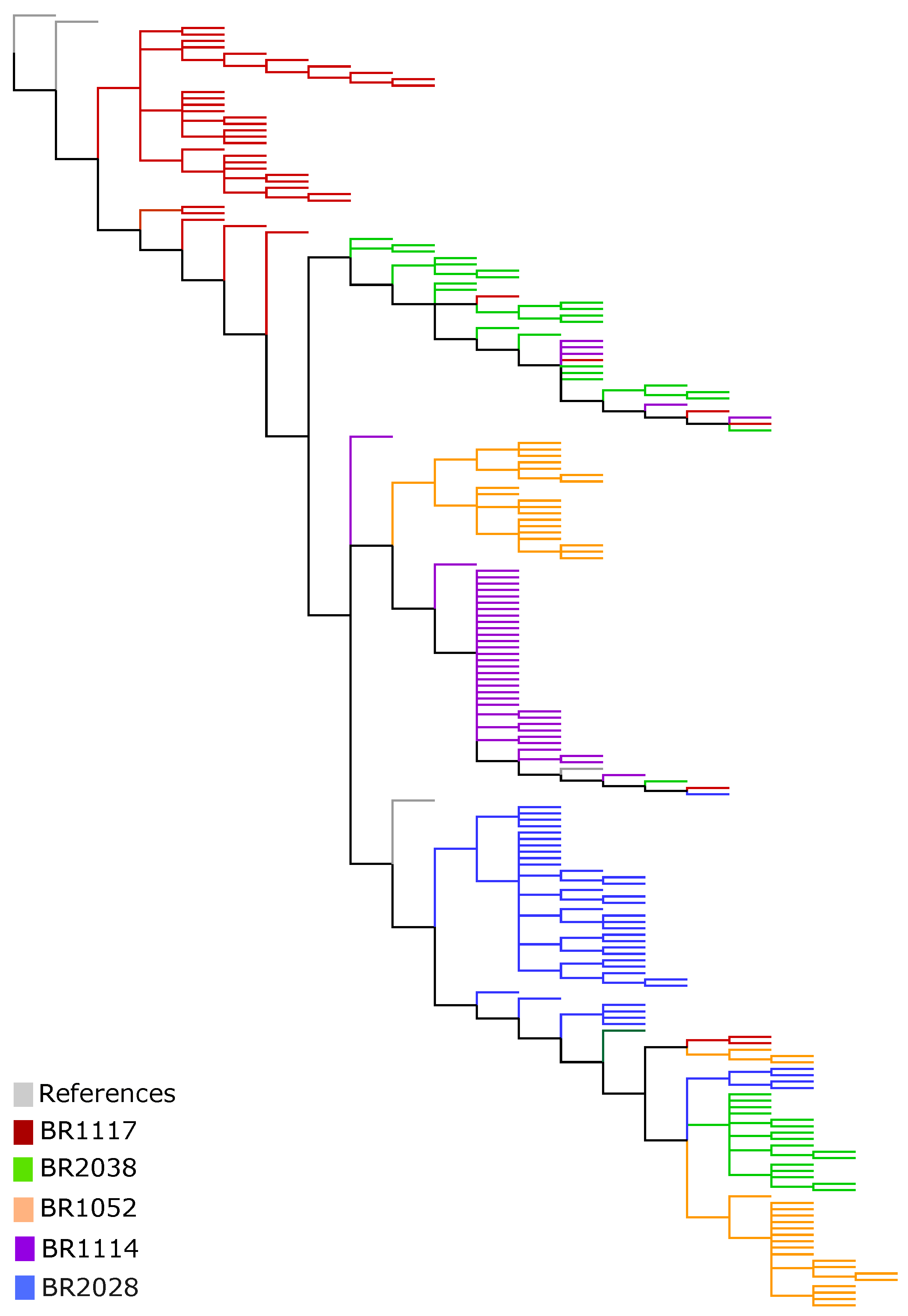
We employed the TNT v1.6 [57,58] without taxon limit for the phylogenetic tree search under the parsimony optimality criterion (Supplementary Materials, program Script.RUN). The parameters used for tree search were xmult= level 5 chklevel 3 replicates 1000. Each tree search experiment was replicated 10 times. The most parsimonious trees from all replicates were used to produce the final strict consensus tree (Figure 1).
The final tree was visually inspected for evidence of long-branch attraction (LBA) following the protocol described in [59]. LBA is a potential source of topological distortion under the parsimony criterion, typically recognized when unusually long branches cluster together within otherwise short-branched clades. Although most often associated with parsimony, analogous artifacts can also arise under maximum likelihood and Bayesian inference. Under parsimony, however, LBA can be directly tested by sequentially removing long branches and assessing whether this alters the inferred placement of their putative sister groups.
To evaluate how well patient identity and visit information were reflected in the phylogeny, we calculated the Consistency Index (CI) and Retention Index (RI) using TNT v1.6. CI measures the minimum number of possible steps relative to the observed steps for a character, while RI quantifies the degree to which synapomorphies are preserved despite homoplasy. Three single-character matrices were constructed: (i) patients as multistate characters, (ii) visits as multistate characters, and (iii) a compound state representing each patient–visit combination. Outgroups were coded as state 0. CI and RI were obtained using the STATS.RUN macro distributed with TNT, applied to the maximum parsimony tree inferred from the aligned HIV-1 sequences.
We also used YBYRÁ [60] to rank terminals with the potential to behave as wildcards. Wildcards are taxa with unstable phylogenetic placement that occupy multiple alternative positions across equally parsimonious trees, thereby reducing resolution and often collapsing clades into polytomies. Identifying putative wildcards highlights terminals that may represent problematic sequences, such as chimeras, contaminants, incomplete fragments, or data with excessive ambiguities. This process enables their examination under reciprocal illumination, helping to distinguish genuine lack of phylogenetic signal from localized topological instability or error, and providing a clearer view of the underlying tree structure.
For each patient, we prepared alignments that included the V1 genome as a reference along with all sequences from subsequent visits (Supplementary Materials, alignments 1052_aligned.fasta, 1114_aligned.fasta, 1117_aligned.fasta, 2028_aligned.fasta, and 2038_aligned.fasta), and analyzed them using the Highlighter online tool [56].

2.7. Recombination Detection

The programs jpHMM (jumping profile Hidden Markov Model) [61] and SimPlot++ v1.3 [51] were used to identify putative recombination events among the different HIV-1 subtypes. We selected one reference sequence for each subtype to run SimPlot++. Their GenBank accession numbers were: DQ676872 (A1), AF286238 (A2), K03455 (B), U52953 (C), K03454 (D), AF077336 (F1), AY371158 (F2), AF084936 (G), AF190127 (H), EF614151 (J), AJ249235 (K), and MN271384 (L). These references were selected from the Los Alamos HIV Sequence Database [26]. One sequence from each time point of every patient was aligned with reference sequences representing all subtypes. The length of the alignment was adjusted according to the length of the smallest sequence, as the PHI test calculation does not accept gaps at the end of sequences.
RDP5 v5.63 [54] was used to detect intrapatient recombinations with the following algorithms: RDP [62], GENECONV [63], Bootscan [64], Maxchi [65], Chimaera [66], SiScan [67], and 3seq [68]. We only accepted putative recombination events that were detected by four or more of these algorithms.

2.8. Detection of Hypermutation

Hypermutations of clone sequences from visits V2 to V5 were assessed by the Hypermut online tool [69], using V1 sequences as references. This software estimates a value for each performed test corresponding to the result of a Fisher’s exact test comparing a control sample (which must contain the lowest possible index of G-to-A substitutions) to one or more samples [69]. The patients’ sequences with a p-value lower than 5% were considered to be hypermutated.

3. Results

3.1. Demographic and Clinical Characteristics of the Study Cohort

Most of the patients were male, infected through the sexual route, and had an average age of 30.79 years at the time they were included in the cohort study. Also at that time, their average CD4 cell count was 529 cells/mL, with a viral load of 21.100 copies of RNA/mL (log = 4.32) (Table 1).

3.2. Sequence Alignment, Phylogenetics, and Diversity Analysis

Most HIV-1 clones from the patient BR1052 were defective (87.5%), except for only five sequences (12.5%). The BR1114 had 25 defective clones (64.1%) and 14 translation-competent (35.9%). The BR1117 exhibited 22 defective sequences (55%) and 18 translation-competent (45%). For the BR2028, there were 28 (70%) defective clones and 12 translation-competent (30%). Finally, most sequences from the BR2038 were defective (75%), except for 10 sequences (25%). Defective proviral genomes observed here likely originate from endogenous processes such as APOBEC-mediated hypermutation, polymerase errors, and stochastic replication dynamics.
To evaluate how well patient identity and visit information were reflected in the phylogeny, we coded these labels as multi-state characters and calculated their Consistency Index (CI) and Retention Index (RI) using TNT v1.6. The patient character showed the strongest fit to the tree (RI = 0.880, CI = 0.208), indicating that viral sequences from the same patient tended to form clades, even if not perfectly. In contrast, the visit character displayed much weaker clustering (RI = 0.322, CI = 0.038), suggesting that temporal sampling within patients contributed less to the phylogenetic structure, which was expected. The compound patient–visit character yielded intermediate values (RI = 0.474, CI = 0.180), consistent with the expectation that while visits introduce additional variation, patient identity remains the primary organizing factor of viral relatedness.
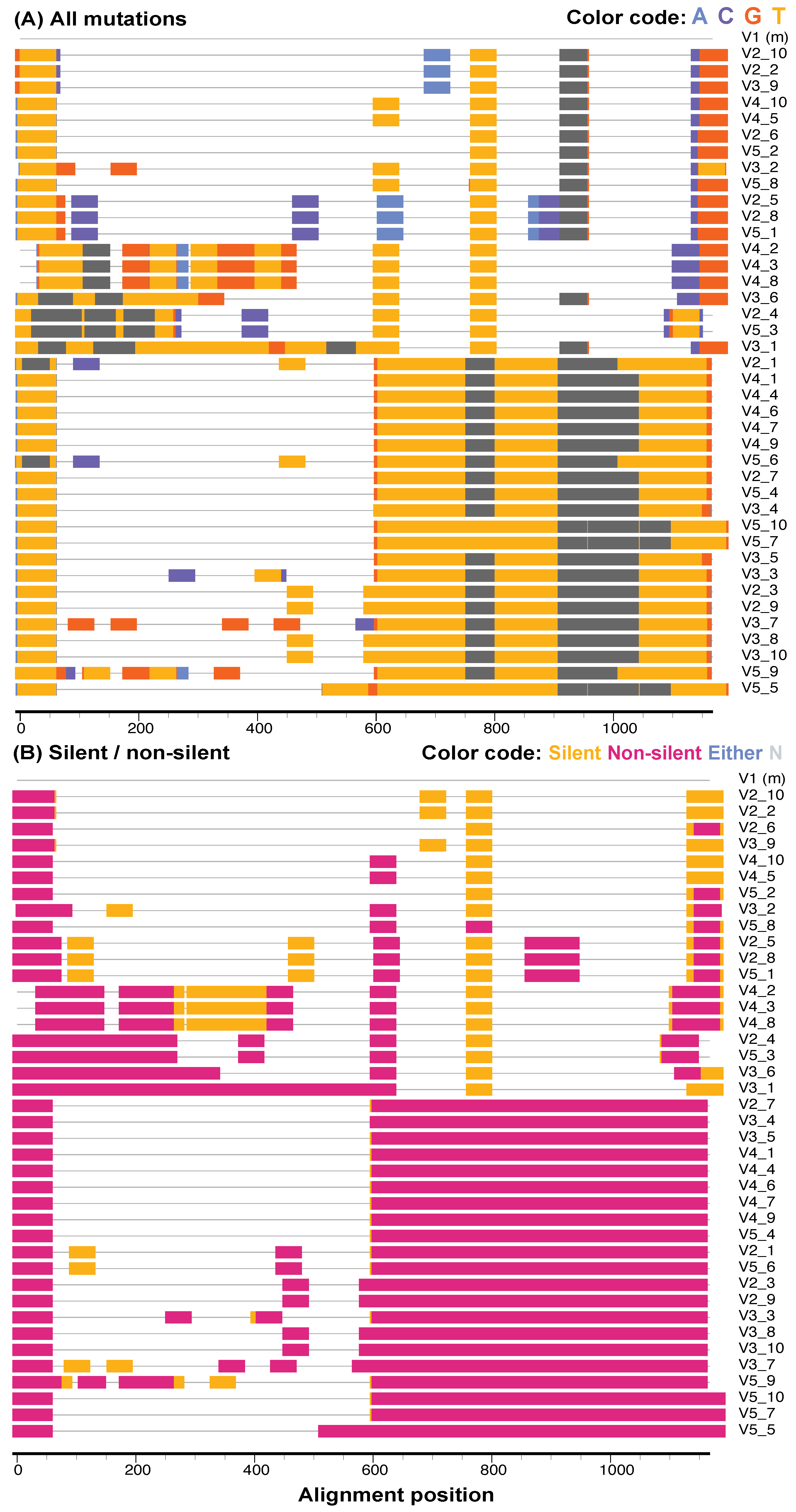
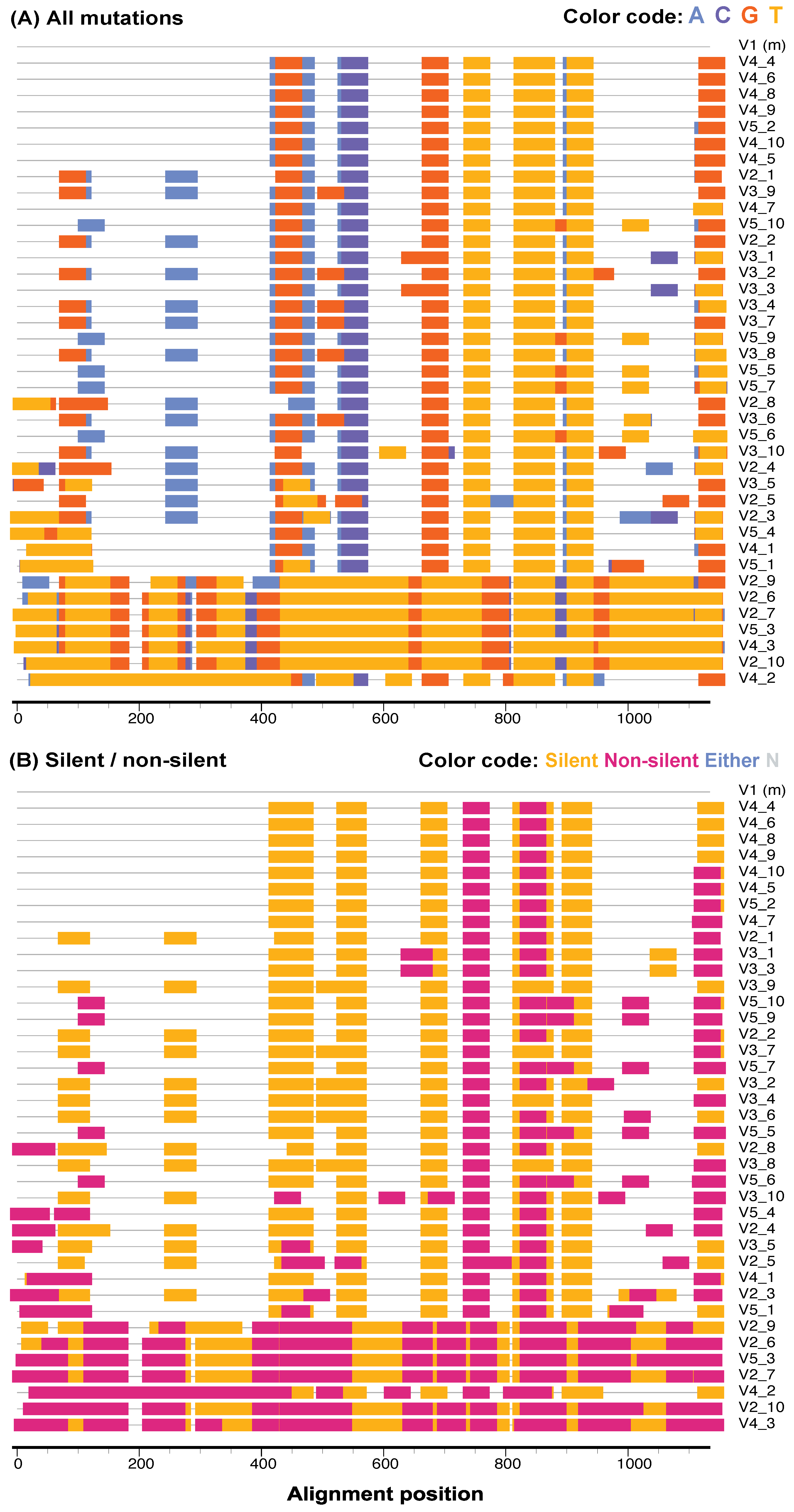
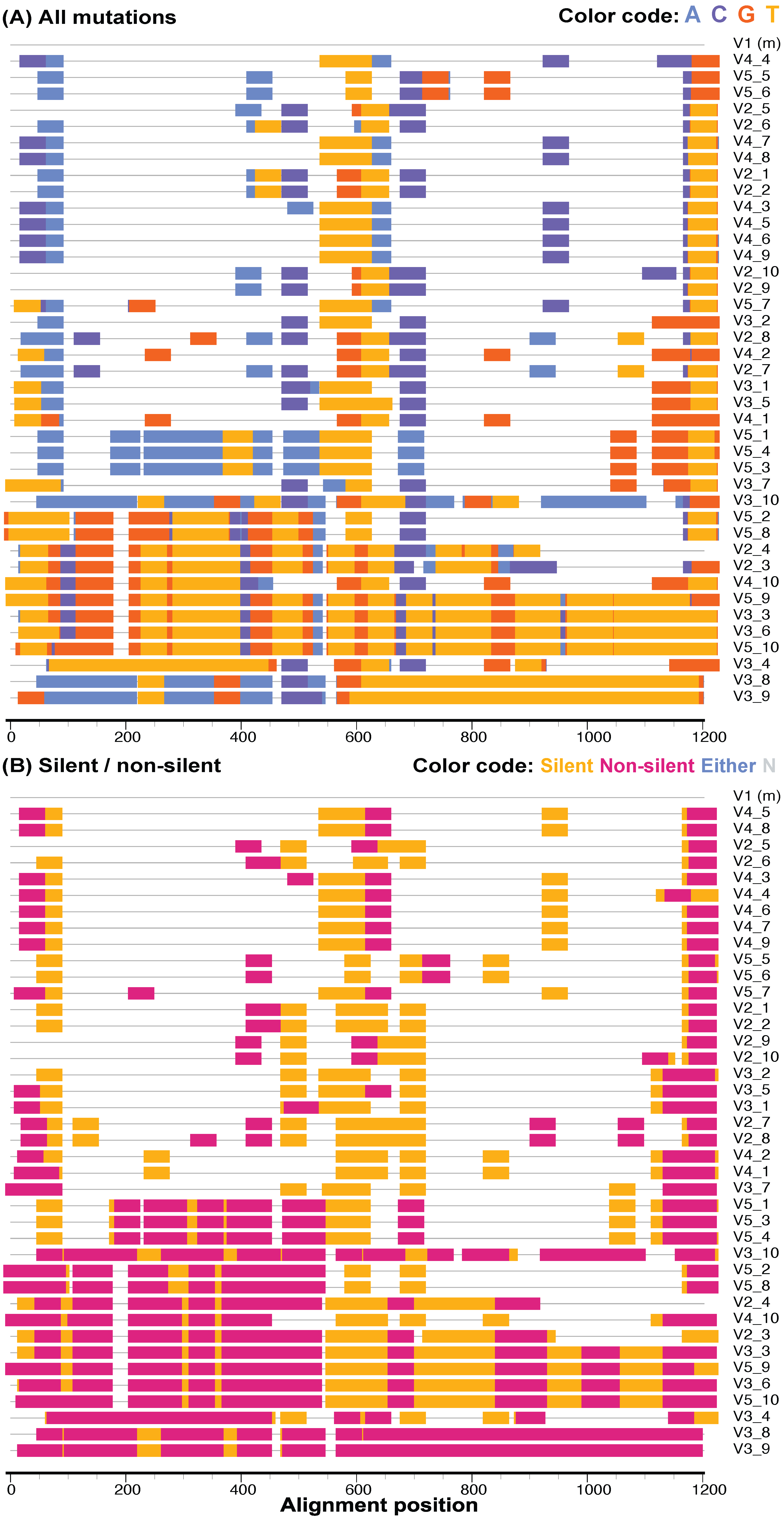
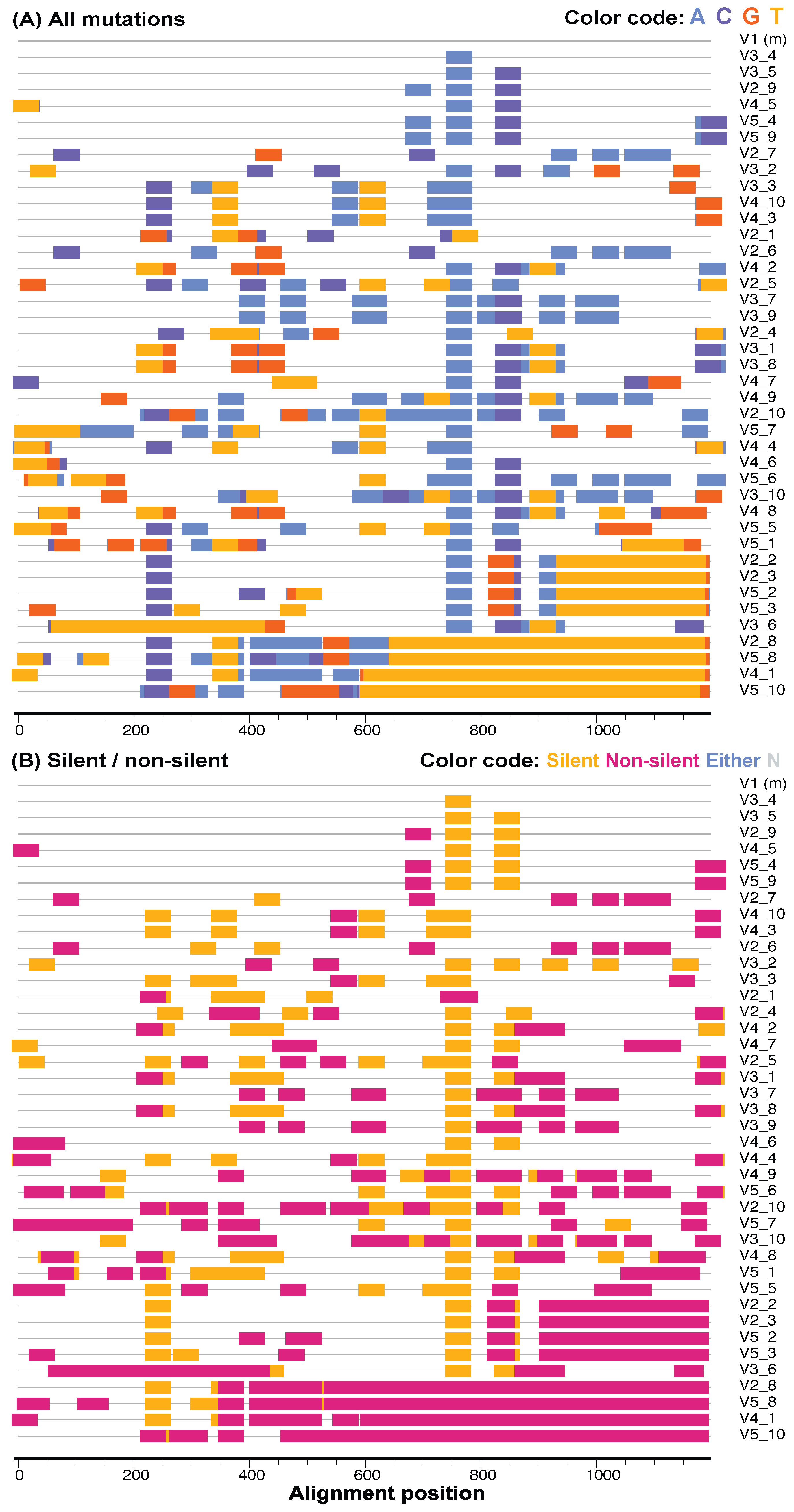
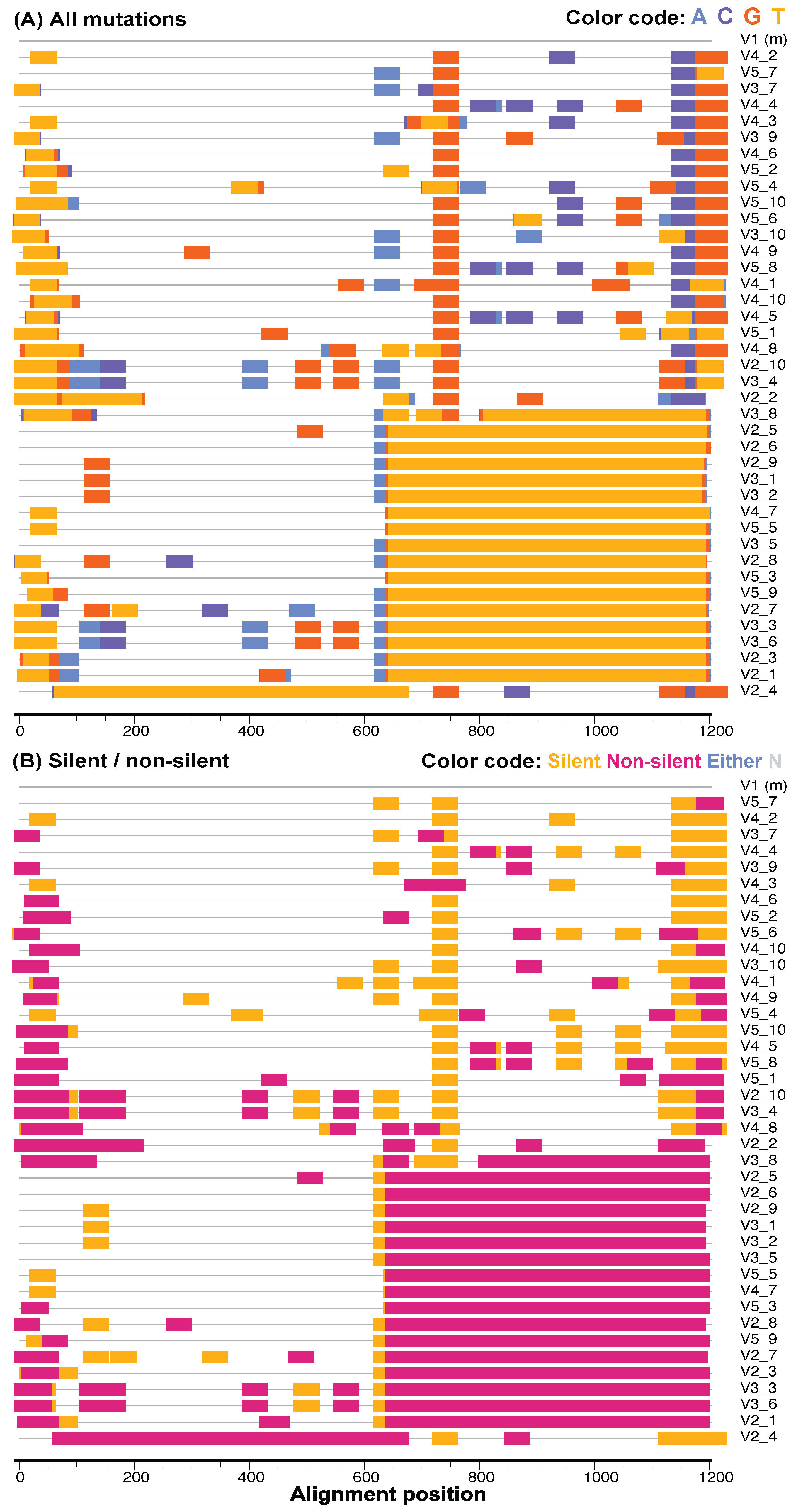
Complementing this tree-based analysis, Highlighter plots (Figure 2, Figure 3, Figure 4, Figure 5 and Figure 6) revealed clusters of sequences defined by shared mutations relative to a reference sequence.
We note that, not all of the clusters observed in the Highlighter plots (Figure 2, Figure 3, Figure 4, Figure 5 and Figure 6) corresponded to sister clades in the phylogenetic tree. This difference reflects the underlying logic of the methods: while phylogenetic trees represent inferred evolutionary relationships, Highlighter compares each sequence to a master and groups them by overall similarity and mutational patterns (including transitions, transversions, synonymous/non-synonymous substitutions, or APOBEC signatures). As a result, Highlighter can highlight recombination or hypermutation events and generate similarity-based clusters that do not necessarily mirror clades in the evolutionary tree. Thus, the combination of tree-based indices (CI/RI) and similarity-based visualization provides complementary perspectives on intra-patient HIV diversity.

3.3. jpHMM Results

The jpHMM results are summarized in Table 2 (complete data in Supplementary Materials, Table S1).
In BR1052, jpHMM identified recombination in V1 and in most clones from V2–V5, except for two sequences of unidentified subtype (4.88%). The detected subtypes included 34 BF1 (82.93%), three BF1H (7.31%), one DF1K (2.44%), and one BF1K (2.44%). In BR1114, most sequences were recombinant, except six clones of pure subtype, with the following distribution: 32 BC (80%), six B (15%), one BCJ (2.5%), and one CDJ (2.5%). In BR1117, most clones were pure subtypes, with only 11 recombinants: 25 F1 (60.98%), six BF1 (14.63%), five DF1 (12.19%), four B (9.76%), and one BDF1 (2.44%). In BR2028, recombination was rare (three clones): 38 B (92.68%), two BJ (4.88%), and one BF1 (2.44%). Finally, in BR2038, most clones were pure subtypes, with only five recombinants: 36 B (87.8%), three A2B (7.32%), one BK (2.44%), and one BF1 (2.44%). Overall, jpHMM indicated that all patients had multiple infections and novel recombination events, including new subtypes, across visits. These findings corroborate the phylogenetic and genetic diversity analyses.

3.4. SimPlot++ Results

The SimPlot++ results are presented in Table 3 (complete data in the Supplementary Materials, Table S2).
In BR1052, the PHI test detected recombination only in V1 (BF1 subtype). Although plots suggested recombination across clones, PHI tests were not significant, likely due to short parent sequences and recombination breakpoints near the 3′ end. After adjusting the V1 sequence length to match the smallest clone and realigning to subtype references, the PHI test remained insignificant. In BR1114, BR1117, and BR2028, significant PHI values were found even for sequences classified as pure subtypes, reflecting the PHI test’s sensitivity to any recombination—including within-subtype events. In BR1114, we observed 33 BC (82.5%) and seven B (17.5%) sequences, all recombinants. BR1117 showed 30 BF1 (73.17%), one BDF1 (2.44%), five F1 (12.20%), and five B (12.20%), of which 10 sequences (seven BF1, two B, one F1) were not recombinant. In BR2028, the V1 sequence was recombinant (BF1 subtype), and all 40 clones were subtype B; of these, 12 were recombinant by PHI. In BR2038, the V1 sequence was recombinant (BF1 subtype), while all 40 clones were subtype B, none showing recombination. Thus, SimPlot++ confirmed multiple infections in all patients except BR1052.

3.5. RDP5 Results

RDP5 detected 14 intrapatient recombinants in BR1052, 10 in BR1114, 12 in BR1117, seven in BR2028, and two in BR2038 (Table 4). These results suggest variable rates of intrapatient recombination among patients, reflecting differences in the evolutionary dynamics of HIV-1 within hosts.

3.6. Hypermutation Analysis

BR1052 (Table 5; Supplementary Materials, Table S3) and BR2038 (Table 5; Supplementary Materials, Table S4) exhibited a single hypermutated sequence in V3 and V2, respectively. These hypermutated sequences accounted for 2.5% of the total sequences obtained from these patients.
BR1114 exhibited four hypermutated clones, all detected in V5, accounting for 10.26% of the total sequences obtained from this patient (Table 5; Supplementary Materials, Table S5). Similarly, BR2028 (Table 5; Supplementary Materials, Table S6) presented four hypermutated clones (10.26%), distributed across V2 (one clone), V3 (one clone), V4 (one clone), and V5 (one clone).
Finally, BR1117 (Table 5; Supplementary Materials, Table S7) did not exhibit any hypermutated sequences.

4. Discussion

Our study followed the simultaneous processes of diversification and viral evolution in five patients over the course of one year, using real longitudinal HIV sequences obtained directly from infected individuals. Throughout this period, we repeatedly observed multiple evolutionary forces acting at the same time within the viral populations, including the accumulation of synonymous and non-synonymous mutations, recombination events, and hypermutation. This longitudinal approach clearly reveals that a single viral sampling point is insufficient to capture or explain the complexity and dynamics of the evolutionary processes taking place in vivo. To our knowledge, very few studies have examined these evolutionary forces simultaneously—synonymous and non-synonymous mutation, recombination, and hypermutation—using real patient-derived viral sequences collected over such an extended period. The dataset we generated is therefore unusually rich and provides valuable biological material for investigating HIV evolution directly within patients, while also serving as high-quality input for in silico evolutionary modeling. In the current treatment scenario, where most individuals are on antiretroviral therapy with suppressed viral loads, studies of this nature have become nearly impossible because longitudinal, naturally evolving viral populations are no longer accessible.
Accordingly with our results indicating a large portion of retrieved clones from each patient as defective, a crucial factor shaping HIV evolution is that the vast majority of proviral sequences integrated into host cells are defective, harboring large deletions, frameshifts, premature stop codons, or widespread hypermutation. As a consequence, only a small fraction of the proviral reservoir is truly replication-competent, which dramatically reduces the effective population size of HIV even when the absolute number of infected cells appears large. Because most proviruses cannot contribute to productive infection, the evolutionary trajectory of HIV is determined by the far smaller subset capable of completing the replication cycle. This reduction in effective population size intensifies the impact of stochastic forces on HIV evolution. In such constrained populations, random sampling effects and genetic drift can outweigh natural selection, allowing neutral or mildly deleterious variants to persist, rise in frequency, or even become fixed simply by chance. Recurrent population bottlenecks during replication cycles, immune-driven reductions in viral diversity further amplify these stochastic dynamics. Thus, the evolutionary landscape of HIV is shaped not only by deterministic selection but also by the randomness imposed by the limited number of competent genomes participating in replication, making the overall evolutionary trajectory more unpredictable.
Phylogenetic and genetic diversity analysis, together with recombination intersubtype results, demonstrated that all patients included in our study had multiple infections and recombinant HIV-1 sequences. Nunes et al. [48] also observed a very high frequency of intersubtype recombinant HIV-1 sequences in patients with multiple infections. Of 17 multiple-infection cases found in their study, 16 had intersubtype recombinant sequences. The results of the two tools used in this study to detect intersubtype recombinations were not identical. Across the five visits, jpHMM detected more intersubtype recombinations than SimPlot++, identifying new events in all patients, whereas SimPlot++ detected new recombinations only in BR1117. This discrepancy likely reflects the distinct algorithms employed by the two tools. SimPlot++ relies on percent identity between the query sequence and a panel of reference sequences in a sliding window [51], whereas jpHMM uses a probabilistic framework that models each subtype as a profile hidden Markov model and infers recombination breakpoints from the most probable path through the model [70,71]. Consequently, jpHMM is generally more sensitive to detecting recombination breakpoints, while SimPlot++ may overlook events that do not generate strong shifts in similarity across windows. Taken together, these results suggest that relying on a single tool may underestimate the frequency of recombination, and that combining approaches provides a more comprehensive picture of HIV-1 diversity. We also used RDP5 to detect intrapatient recombination independently of the sequence subtype. The number of intrapatient recombinants identified in each patient varied widely, from two to 14. These findings suggest that the recombination rate can vary drastically according to the host conditions. Upon considering all our recombination analyses, we argue that the HIV-1 diversity observed in our study is strongly shaped by recombination, and that its detection depends on the analytical strategy employed. While jpHMM proved more sensitive in identifying recombinant forms, SimPlot++ offered a more conservative view, reinforcing the importance of using complementary tools to capture the full extent of viral diversity.
Regarding the variation in recombination breakpoints, such variability is expected in a probabilistic framework, which naturally predicts a higher frequency of events within certain intervals without requiring each individual breakpoint to be mechanistically explained. Multiple intraviral factors can influence breakpoint positions, including secondary and tertiary RNA structures, the dynamics and abundance of the nucleocapsid protein, fluctuations in the supply and exhaustion of dNTPs within the capsid, the similarity between RNA templates during copy-choice recombination, and the relative abundance of available templates. These influences arise primarily from viral and intracellular processes. At the host-organism level, selective pressures can shape the expansion of specific recombinant lineages, but they do not directly determine the diversity of breakpoint locations themselves.
Taken together, these considerations highlight the need to clearly articulate in the manuscript how each evolutionary force impacts the viral population. Mutation introduces diversity that may be neutral, advantageous, or deleterious; deterministic natural selection constrains that diversity by favoring fitter variants; genetic drift introduces stochasticity and can drive the fixation of variants independently of their fitness; recombination reshuffles genomes, enabling rescue and escape; and hypermutation acts as a form of lethal mutagenesis. These processes are visibly reflected in our data, with synonymous and non-synonymous mutations highlighted in the alignment plots and the phylogenetic trees revealing both recombinant structure and the extent of hypermutation. Altogether, our study captures the concurrent action of multiple evolutionary forces on HIV populations in vivo over an extended period, incorporating the additional evolutionary pressure imposed by a highly defective proviral reservoir and the resulting reduction in effective population size. Such a comprehensive view of HIV evolution is increasingly rare in the literature and, under current clinical conditions, unlikely to be reproduced.
All patients harbored multiple HIV infections whether through superinfection or co-infection which significantly amplify viral diversity and accelerate evolutionary change. When distinct HIV subtypes or genetically divergent strains infect the same host, their simultaneous replication creates conditions that favor the formation of heterozygous virions containing RNA genomes from different lineages. During reverse transcription, HIV’s copy-choice mechanism allows the reverse transcriptase enzyme to switch templates between these divergent RNAs, generating recombinant genomes that integrate into host cells. This process dramatically increases the range of genetic combinations available to the virus, producing mosaic genomes that combine mutations and structural features from distinct subtypes.
The introduction of highly divergent viral lineages into the same replication environment expands the mutational space far beyond what would be achievable through mutation alone. Recombination between different subtypes can rapidly generate variants with novel phenotypic properties, including altered antigenic profiles, differences in replicative capacity, and modified susceptibility to immune responses or antiviral pressures. Because recombination can unite advantageous mutations that evolved independently in different viral backgrounds, it represents an efficient route for the virus to explore adaptive solutions that would otherwise require multiple sequential mutational steps.
One of the most consequential outcomes of such mixed infections is the acceleration of immune escape. Distinct subtypes often differ substantially in the epitopes recognized by host immune responses. Through recombination, HIV can effectively “borrow” escape mutations from one subtype and introduce them into the genomic context of another, producing variants that evade existing antibody or T-cell responses more efficiently than either parental strain. The mosaic nature of these recombinants can also make immune recognition more difficult. Thus, the presence of multiple HIV subtypes in the same host creates evolutionary opportunities that substantially increase viral diversity and generate recombinant forms with enhanced potential for immune escape. This process contributes to the emergence of circulating recombinant forms (CRFs) and unique recombinant forms (URFs), which collectively play a major role in global HIV genetic diversity. In this sense, mixed-subtype infections do not merely add to the pool of viral variants, they fundamentally reshape the evolutionary landscape of HIV by enabling rapid adaptive shifts that would be far less accessible through mutation-driven evolution alone.
Hypermutation has a profoundly deleterious impact on HIV genomes. Driven primarily by APOBEC3-mediated cytidine deamination, hypermutation introduces clusters of G-to-A substitutions that frequently generate stop codons, frameshifts, or amino acid changes incompatible with protein function. As a result, most hypermutated genomes are replication-incompetent and contribute to the large pool of defective proviruses within infected cells. Although hypermutation increases apparent sequence diversity, it effectively acts as a form of lethal mutagenesis, removing large fractions of the viral population from the replicating pool. This reduces the number of genomes available for selection and shifts the evolutionary balance toward stochastic processes, as the effective population size becomes constrained by the small subset of intact, functional genomes that remain.
The frequency of hypermutation in our study varied between 0 and 10.26%, considering all the clones of each patient separately. Kieffer et al. [72] also observed a low frequency of hypermutation in HIV-1. They found no hypermutation in the reverse transcriptase (RT) and protease sequences from plasma virus but detected hypermutations in 6.8% of RT sequences and 6.3% of protease sequences from the latent cellular reservoir. In contrast, de Lima-Stein et al. [73] observed hypermutation in 31.2% of analyzed samples. Taken together, these findings suggest that the extent of HIV-1 hypermutation varies widely depending on the genomic region analyzed, the biological source of the sequences, and the patient population studied. In our cohort, the relatively low levels of hypermutation are consistent with prior reports, reinforcing the view that while APOBEC3-mediated editing contributes to viral diversification, its overall frequency in vivo may be limited by the action of viral proteins such as Vif which directs APOBEC to the proteasome.
The current study is not free from limitations, including those imposed by the relatively small number of patients included. We expect that research involving a larger number of individuals could provide a more accurate response. Furthermore, the length of studied fragment encompassing just a portion of the pol region including partial protease e reverse transcriptase gene could be perceived as insufficient at the moment of genomic sequencing. However, sampling this limited subgenomic fragment was enough allowing for the observation of simultaneous evolutionary processes acting on HIV populations over time.
Our study provides valuable insights into the dynamic genetic diversity of HIV-1 over time, with a particular focus on intersubtype recombinant viruses. Longitudinal analyses of this kind remain scarce, yet they are critical for understanding how recombination and mutation interact within hosts to generate novel variants. By documenting these processes across multiple visits and individuals, we demonstrate the continual emergence of diverse viral populations, which has direct implications for contributing to either viral adaptation, treatment strategies, vaccine design, or the broader understanding of HIV-1 evolutionary dynamics.
Our study highlights the dynamic nature of HIV-1 genetic diversity, driven by mutation, frequent recombination, and hypermutation. Together, these processes generate a continually shifting viral landscape that complicates treatment, undermines prevention strategies, and challenges vaccine design. By capturing longitudinal evidence of these mechanisms in multiple patients, we provide direct insights into the evolutionary forces shaping HIV-1 within hosts. Future studies with larger cohorts will be essential to extend these findings, but our results already underscore the need to consider recombination and hypermutation alongside mutation as central drivers of HIV-1 evolution and persistence.

Supplementary Materials

The following supporting information can be downloaded from Zenodo (DOI: https://doi.org/10.5281/zenodo.14940589, accessed on 19 January 2026). Supplementary tables: Table S1—jpHMM.csv: it contains all the recombination results (positives and negatives) generated by jpHMM for all patients. Table S2—SimPlot.csv: it contains all the recombination results (positives and negatives) generated by SimPlot++ for all patients. Table S3—Hypermut_1052.csv: it contains all the Hypermut results (positives for hypermutations and negatives) of the BR1052. Table S4—Hypermut_2038.csv: it contains all the Hypermut results (positives for hypermutations and negatives) of the BR2038. Table S5—Hypermut_1114.csv: it contains all the Hypermut results (positives for hypermutations and negatives) of the BR1114. Table S6—Hypermut_2028.csv: it contains all the Hypermut results (positives for hypermutations and negatives) of the BR2028. Table S7—Hypermut_1117.csv: it contains all the Hypermut results (positives for hypermutations and negatives) of the BR1117. Supplementary scripts: LORFS.py—a Python script that extends sequences containing the longest ORFs of the patient sequences from visit two to visit five. The script adjusts the fragments to be multiples of three (codons) in the first reading frame. These sequences may include stop codons but are guaranteed to contain the longest ORF. It generates a file named extended_lorfs.fasta. Translate.py—a Python script that translates the nucleotide sequences in frame 1 from the patients included in this study. It generates a file named translated_extended_lorfs.fasta. Script.RUN—script used in TNT v1.6 for the phylogenetic tree search under the parsimony optimality criterion. Supplementary alignments: 1052_aligned.fasta—it contains all sequences from patient BR1052 aligned by Geneious Prime® v2025.0.3. 1114_aligned.fasta—it contains all sequences from patient BR1114 aligned by Geneious Prime® v2025.0.3. 1117_aligned.fasta—it contains all sequences from patient BR1117 aligned by Geneious Prime® v2025.0.3. 2028_aligned.fasta—it contains all sequences from patient BR2028 aligned by Geneious Prime® v2025.0.3. 2038_aligned.fasta—it contains all sequences from patient BR2038 aligned by Geneious Prime® v2025.0.3. 1052_aligned.nexus—it contains all sequences from patient BR1052 aligned by MAFFT v7.0. 1114_aligned.nexus—it contains all sequences from patient BR1114 aligned by MAFFT v7.0. 1117_aligned.nexus—it contains all sequences from patient BR1117 aligned by MAFFT v7.0. 2028_aligned.nexus—it contains all sequences from patient BR2028 aligned by MAFFT v7.0. 2038_aligned.nexus—it contains all sequences from patient BR2038 aligned by MAFFT v7.0. extended_lorfs.fasta—it contains the extended aligned sequences with the longest ORFs from visit two to visit five. Other supplemenatry files: translated_extended_lorfs.fasta—it contains amino acid sequences translated from extended_lorfs.fasta.

Author Contributions

F.M.R.: formal analysis, investigation, and writing—original draft; P.P.-O.: data curation, formal analysis, investigation, software, validation, and visualization; J.P.Z.: formal analysis and investigation; W.T.A.: investigation; M.M.S.: investigation; M.C.: investigation and writing—original draft; S.S.S.: investigation, resources, and writing—original draft; E.G.K.: resources; M.C.S.: investigation and writing—original draft; R.S.D.: investigation and writing—original draft; D.J.M.: methodology, project administration, resources, software, and supervision. L.M.J.: conceptualization, methodology, funding acquisition, investigation, resources, supervision, project administration, and writing—original draft. All authors collaborated on writing—review & editing. All authors have read and agreed to the published version of the manuscript.

Funding

L. M. J. received funding support from the São Paulo Research Foundation (FAPESP), Special Project 2020/08943-5, titled “Study on Vaccine Response-Inducing Components in Clinical Trials of ChAdOx1 nCOV-19 Vaccine.” F. M. R. was supported by the Coordenação de Aperfeiçoamento de Pessoal de Nível Superior (CAPES).

Institutional Review Board Statement

This research was approved by the Research Ethics Committee of the Federal University of São Paulo (accession number 1919/10, approved on 17 December 2010).

Informed Consent Statement

Informed consent was obtained from all subjects involved in the study.

Data Availability Statement

All Supplementary Tables and additional digital materials, including scripts and sequence alignments, are available in Zenodo (DOI: https://doi.org/10.5281/zenodo.14940589, accessed on 19 January 2026). Sequences from the first visit are deposited in NCBI’s GenBank under the following accession numbers: PX482743 (BR1052), JN692478 (BR1114), PX482744 (BR1117), JN692437 (BR2028), and PX482745 (BR2038). All 199 clone sequences from V2 to V5 are also available in GenBank under accession numbers PX449047–PX449245.

Conflicts of Interest

The authors declare no conflicts of interest.

References

  1. McCutchan, F.E. Global epidemiology of HIV. J. Med. Virol. 2006, 78, S7–S12. [Google Scholar] [CrossRef]
  2. Suryavanshi, G.W.; Dixit, N.M. Emergence of recombinant forms of HIV: Dynamics and scaling. PLoS Comput. Biol. 2007, 3, e205. [Google Scholar]
  3. Ramirez, B.C.; Simon-Loriere, E.; Galetto, R.; Negroni, M. Implications of recombination for HIV diversity. Virus Res. 2008, 134, 64–73. [Google Scholar] [CrossRef]
  4. Vijay, N.; Vasantika; Ajmani, R.; Perelson, A.S.; Dixit, N.M. Recombination increases human immunodeficiency virus fitness, but not necessarily diversity. J. Gen. Virol. 2008, 89, 1467–1477. [Google Scholar] [CrossRef]
  5. Elena, S.F.; Sanjuán, R. Adaptive value of high mutation rates of RNA viruses: Separating causes from consequences. J. Virol. 2005, 79, 11555–11558. [Google Scholar] [CrossRef] [PubMed]
  6. Elena, S.F.; Miralles, R.; Cuevas, J.M.; Turner, P.E.; Moya, A. The two faces of mutation: Extinction and adaptation in RNA viruses. Iubmb Life 2000, 49, 5–9. [Google Scholar]
  7. Dapp, M.J.; Heineman, R.H.; Mansky, L.M. Interrelationship between HIV-1 fitness and mutation rate. J. Mol. Biol. 2013, 425, 41–53. [Google Scholar] [CrossRef] [PubMed]
  8. Dimitrov, D.; Willey, R.; Sato, H.; Chang, L.J.; Blumenthal, R.; Martin, M. Quantitation of human immunodeficiency virus type 1 infection kinetics. J. Virol. 1993, 67, 2182–2190. [Google Scholar] [CrossRef]
  9. Perelson, A.S.; Neumann, A.U.; Markowitz, M.; Leonard, J.M.; Ho, D.D. HIV-1 dynamics in vivo: Virion clearance rate, infected cell life-span, and viral generation time. Science 1996, 271, 1582–1586. [Google Scholar] [CrossRef] [PubMed]
  10. Domingo, E.; Baranowski, E.; Ruiz-Jarabo, C.M.; Martín-Hernández, A.M.; Sáiz, J.C.; Escarmís, C. Quasispecies structure and persistence of RNA viruses. Emerg. Infect. Dis. 1998, 4, 521. [Google Scholar] [CrossRef]
  11. Moya, A.; Holmes, E.C.; González-Candelas, F. The population genetics and evolutionary epidemiology of RNA viruses. Nat. Rev. Microbiol. 2004, 2, 279–288. [Google Scholar] [CrossRef]
  12. Lee, H.Y.; Perelson, A.S.; Park, S.C.; Leitner, T. Dynamic correlation between intrahost HIV-1 quasispecies evolution and disease progression. PLoS Comput. Biol. 2008, 4, e1000240. [Google Scholar] [CrossRef]
  13. Galetto, R.; Negroni, M. Mechanistic features of recombination in HIV. Aids Rev. 2005, 7, 92–102. [Google Scholar] [PubMed]
  14. Zhuang, J.; Jetzt, A.E.; Sun, G.; Yu, H.; Klarmann, G.; Ron, Y.; Preston, B.D.; Dougherty, J.P. Human immunodeficiency virus type 1 recombination: Rate, fidelity, and putative hot spots. J. Virol. 2002, 76, 11273–11282. [Google Scholar] [CrossRef] [PubMed]
  15. Bocharov, G.; Ford, N.J.; Edwards, J.; Breinig, T.; Wain-Hobson, S.; Meyerhans, A. A genetic-algorithm approach to simulating human immunodeficiency virus evolution reveals the strong impact of multiply infected cells and recombination. J. Gen. Virol. 2005, 86, 3109–3118. [Google Scholar] [CrossRef]
  16. Jetzt, A.E.; Yu, H.; Klarmann, G.J.; Ron, Y.; Preston, B.D.; Dougherty, J.P. High rate of recombination throughout the human immunodeficiency virus type 1 genome. J. Virol. 2000, 74, 1234–1240. [Google Scholar] [CrossRef]
  17. Neher, R.A.; Leitner, T. Recombination rate and selection strength in HIV intra-patient evolution. PLoS Comput. Biol. 2010, 6, e1000660. [Google Scholar]
  18. An, W.; Telesnitsky, A. HIV-1 genetic recombination: Experimental approaches and observations. AIDS Rev. 2002, 4, 195–212. [Google Scholar]
  19. Rhodes, T.D.; Nikolaitchik, O.; Chen, J.; Powell, D.; Hu, W.S. Genetic recombination of human immunodeficiency virus type 1 in one round of viral replication: Effects of genetic distance, target cells, accessory genes, and lack of high negative interference in crossover events. J. Virol. 2005, 79, 1666–1677. [Google Scholar] [CrossRef] [PubMed]
  20. Burke, D.S. Recombination in HIV: An important viral evolutionary strategy. Emerg. Infect. Dis. 1997, 3, 253. [Google Scholar] [CrossRef]
  21. Promadej-Lanier, N.; Thielen, C.; Hu, D.J.; Chaowanachan, T.; Gvetadze, R.; Choopanya, K.; Vanichseni, S.; Mcnicholl, J.M. Cross-reactive T cell responses in HIV CRF01_AE and B’-infected intravenous drug users: Implications for superinfection and vaccines. AIDS Res. Hum. Retroviruses 2009, 25, 73–81. [Google Scholar] [CrossRef]
  22. Schlub, T.E.; Smyth, R.P.; Grimm, A.J.; Mak, J.; Davenport, M.P. Accurately measuring recombination between closely related HIV-1 genomes. PLoS Comput. Biol. 2010, 6, e1000766. [Google Scholar] [CrossRef] [PubMed]
  23. Zhang, M.; Foley, B.; Schultz, A.K.; Macke, J.P.; Bulla, I.; Stanke, M.; Morgenstern, B.; Korber, B.; Leitner, T. The role of recombination in the emergence of a complex and dynamic HIV epidemic. Retrovirology 2010, 7, 25. [Google Scholar] [CrossRef]
  24. Templeton, A.R.; Kramer, M.G.; Jarvis, J.; Kowalski, J.; Gange, S.; Schneider, M.F.; Shao, Q.; Zhang, G.W.; Yeh, M.F.; Tsai, H.L.; et al. Multiple-infection and recombination in HIV-1 within a longitudinal cohort of women. Retrovirology 2009, 6, 54. [Google Scholar] [CrossRef] [PubMed]
  25. Charpentier, C.; Nora, T.; Tenaillon, O.; Clavel, F.; Hance, A.J. Extensive recombination among human immunodeficiency virus type 1 quasispecies makes an important contribution to viral diversity in individual patients. J. Virol. 2006, 80, 2472–2482. [Google Scholar] [CrossRef]
  26. Los Alamos National Laboratory. HIV Sequence Database. HIV Circulating Recombinant Forms (CRFs). 2023. Available online: https://www.hiv.lanl.gov/components/sequence/HIV/crfdb/crfs.comp (accessed on 28 October 2024).
  27. Carr, J.K.; Wolfe, N.D.; Torimiro, J.N.; Tamoufe, U.; Mpoudi-Ngole, E.; Eyzaguirre, L.; Birx, D.L.; McCutchan, F.E.; Burke, D.S. HIV-1 recombinants with multiple parental strains in low-prevalence, remote regions of Cameroon: Evolutionary relics? Retrovirology 2010, 7, 39. [Google Scholar] [CrossRef]
  28. McCutchan, F.E.; Sankale, J.L.; M’Boup, S.; Kim, B.; Tovanabutra, S.; Hamel, D.J.; Brodine, S.K.; Kanki, P.J.; Birx, D.L. HIV type 1 circulating recombinant form CRF09_cpx from west Africa combines subtypes A, F, G, and may share ancestors with CRF02_AG and Z321. AIDS Res. Hum. Retroviruses 2004, 20, 819–826. [Google Scholar] [CrossRef] [PubMed]
  29. Konings, F.A.; Haman, G.R.; Xue, Y.; Urbanski, M.M.; Hertzmark, K.; Nanfack, A.; Achkar, J.M.; Burda, S.T.; Nyambi, P.N. Genetic analysis of HIV-1 strains in rural eastern Cameroon indicates the evolution of second-generation recombinants to circulating recombinant forms. JAIDS J. Acquir. Immune Defic. Syndr. 2006, 42, 331–341. [Google Scholar] [CrossRef]
  30. Fernández, M.F.; Golemba, M.D.; Terrones, C.; Paradiso, P.; Nassif, J.C.; Bologna, R.; Mangano, A.; Sen, L.; Aulicino, P.C. Emergence of novel A/G recombinant HIV-1 strains in Argentina. AIDS Res. Hum. Retroviruses 2015, 31, 293–297. [Google Scholar] [CrossRef]
  31. Niculescu, I.; Paraschiv, S.; Paraskevis, D.; Abagiu, A.; Batan, I.; Banica, L.; Otelea, D. Recent HIV-1 outbreak among intravenous drug users in Romania: Evidence for cocirculation of CRF14_BG and subtype F1 strains. AIDS Res. Hum. Retroviruses 2015, 31, 488–495. [Google Scholar] [CrossRef]
  32. Aulicino, P.C.; Bello, G.; Guimaraes, M.L.; Ruchansky, D.; Rocco, C.; Mangano, A.; Morgado, M.G.; Sen, L. Longitudinal analysis of HIV-1 BF1 recombinant strains in vertically infected children from Argentina reveals a decrease in CRF12_BF pol gene mosaic patterns and high diversity of BF unique recombinant forms. Infect. Genet. Evol. 2011, 11, 349–357. [Google Scholar] [CrossRef]
  33. de Oliveira, C.M.; Almeida, F.J.; Rodrigues, R.; Crozatti, M.; Vazquez, C.M.P.; do Socorro Carneiro Ferrão, M.; Campeas, A.E.; Marques, S.R.; Berezin, E.N.; de Macedo Brígido, L.F. High frequency of BF mosaic genomes among HIV-1-infected children from Sao Paulo, Brazil. Arch. Virol. 2008, 153, 1799–1806. [Google Scholar] [CrossRef]
  34. Williams, A.; Menon, S.; Crowe, M.; Agarwal, N.; Biccler, J.; Bbosa, N.; Ssemwanga, D.; Adungo, F.; Moecklinghoff, C.; Macartney, M.; et al. Geographic and Population Distributions of Human Immunodeficiency Virus (HIV)–1 and HIV-2 Circulating Subtypes: A Systematic Literature Review and Meta-analysis (2010–2021). J. Infect. Dis. 2023, 228, 1583–1591. [Google Scholar] [CrossRef]
  35. Gräf, T.; Bello, G.; Andrade, P.; Arantes, I.; Pereira, J.M.; da Silva, A.B.P.; Veiga, R.V.; Mariani, D.; Boullosa, L.T.; Arruda, M.B.; et al. HIV-1 molecular diversity in Brazil unveiled by 10 years of sampling by the national genotyping network. Sci. Rep. 2021, 11, 15842. [Google Scholar] [CrossRef]
  36. Brigido, L.F.; Nunes, C.C.; Oliveira, C.M.; Knoll, R.K.; Ferreira, J.L.P.; Freitas, C.A.; Alves, M.A.; Dias, C.; Rodrigues, R.; Program, R.C. HIV type 1 subtype C and CB Pol recombinants prevail at the cities with the highest AIDS prevalence rate in Brazil. AIDS Res. Hum. Retroviruses 2007, 23, 1579–1586. [Google Scholar] [CrossRef]
  37. Kuwata, T.; Miyazaki, Y.; Igarashi, T.; Takehisa, J.; Hayami, M. The rapid spread of recombinants during a natural in vitro infection with two human immunodeficiency virus type 1 strains. J. Virol. 1997, 71, 7088–7091. [Google Scholar] [CrossRef]
  38. Muñoz-Nieto, M.; Perez-Alvarez, L.; Thomson, M.; García, V.; Ocampo, A.; Casado, G.; Delgado, E.; Miralles, C.; de Parga, E.V.; Sierra, M.; et al. HIV type 1 intersubtype recombinants during the evolution of a dual infection with subtypes B and G. AIDS Res. Hum. Retroviruses 2008, 24, 337–343. [Google Scholar] [CrossRef] [PubMed]
  39. Streeck, H.; Li, B.; Poon, A.F.; Schneidewind, A.; Gladden, A.D.; Power, K.A.; Daskalakis, D.; Bazner, S.; Zuniga, R.; Brander, C.; et al. Immune-driven recombination and loss of control after HIV superinfection. J. Exp. Med. 2008, 205, 1789–1796. [Google Scholar] [CrossRef]
  40. Fung, I.C.H.; Gambhir, M.; van Sighem, A.; de Wolf, F.; Garnett, G.P. Superinfection with a heterologous HIV strain per se does not lead to faster progression. Math. Biosci. 2010, 224, 1–9. [Google Scholar] [CrossRef] [PubMed]
  41. Alves, B.M.; Siqueira, J.D.; Prellwitz, I.M.; Botelho, O.M.; Da Hora, V.P.; Sanabani, S.; Recordon-Pinson, P.; Fleury, H.; Soares, E.A.; Soares, M.A. Estimating HIV-1 genetic diversity in Brazil through next-generation sequencing. Front. Microbiol. 2019, 10, 749. [Google Scholar] [CrossRef] [PubMed]
  42. Van der Kuyl, A.C.; Cornelissen, M. Identifying HIV-1 dual infections. Retrovirology 2007, 4, 67. [Google Scholar] [CrossRef]
  43. Powell, R.L.; Lezeau, L.; Kinge, T.; Nyambi, P.N. Longitudinal quasispecies analysis of viral variants in HIV type 1 dually infected individuals highlights the importance of sequence identity in viral recombination. AIDS Res. Hum. Retroviruses 2010, 26, 253–264. [Google Scholar] [CrossRef]
  44. Janini, M.; Rogers, M.; Birx, D.R.; McCutchan, F.E. Human immunodeficiency virus type 1 DNA sequences genetically damaged by hypermutation are often abundant in patient peripheral blood mononuclear cells and may be generated during near-simultaneous infection and activation of CD4+ T cells. J. Virol. 2001, 75, 7973–7986. [Google Scholar] [CrossRef]
  45. Köck, J.; Blum, H.E. Hypermutation of hepatitis B virus genomes by APOBEC3G, APOBEC3C and APOBEC3H. J. Gen. Virol. 2008, 89, 1184–1191. [Google Scholar] [CrossRef] [PubMed]
  46. Mangeat, B.; Turelli, P.; Caron, G.; Friedli, M.; Perrin, L.; Trono, D. Broad antiretroviral defence by human APOBEC3G through lethal editing of nascent reverse transcripts. Nature 2003, 424, 99–103. [Google Scholar] [CrossRef] [PubMed]
  47. Stopak, K.; de Noronha, C.; Yonemoto, W.; Greene, W.C. HIV-1 Vif blocks the antiviral activity of APOBEC3G by impairing both its translation and intracellular stability. Mol. Cell 2003, 12, 591–601. [Google Scholar] [CrossRef]
  48. Nunes, E.R.D.M.; Zukurov, J.P.; Maricato, J.T.; Sucupira, M.C.A.; Diaz, R.S.; Janini, L.M.R. Analysis of HIV-1 protease gene reveals frequent multiple infections followed by recombination among drug treated individuals living in São Paulo and Santos, Brazil. PLoS ONE 2014, 9, e84066. [Google Scholar] [CrossRef]
  49. Sanabani, S.S.; Pastena, É.R.d.S.; da Costa, A.C.; Martinez, V.P.; Kleine-Neto, W.; de Oliveira, A.C.S.; Sauer, M.M.; Bassichetto, K.C.; Oliveira, S.M.S.; Tomiyama, H.T.I.; et al. Characterization of partial and near full-length genomes of HIV-1 strains sampled from recently infected individuals in Sao Paulo, Brazil. PLoS ONE 2011, 6, e25869. [Google Scholar] [CrossRef]
  50. de Sa-Filho, D.J.; Soares, M.d.S.; Candido, V.; Gagliani, L.H.; Cavaliere, E.; Diaz, R.S.; Caseiro, M.M. HIV type 1 pol gene diversity and antiretroviral drug resistance mutations in Santos, Brazil. AIDS Res. Hum. Retroviruses 2008, 24, 347–353. [Google Scholar] [CrossRef]
  51. Samson, S.; Lord, É.; Makarenkov, V. SimPlot++: A Python application for representing sequence similarity and detecting recombination. Bioinformatics 2022, 38, 3118–3120. [Google Scholar] [CrossRef] [PubMed]
  52. Kallas, E.G.; Bassichetto, K.C.; Oliveira, S.M.; Goldenberg, I.; Bortoloto, R.; Moreno, D.M.F.C.; Kanashiro, C.; Chaves, M.M.S.; Sucupira, M.C.A.; Diniz, A.; et al. Establishment of the serologic testing algorithm for recent human immunodeficiency virus (HIV) seroconversion (STARHS) strategy in the city of Sao Paulo, Brazil. Braz. J. Infect. Dis. 2004, 8, 399–406. [Google Scholar] [CrossRef]
  53. BLAST: Basic Local Alignment Search Tool. 2024. Available online: https://blast.ncbi.nlm.nih.gov/Blast.cgi (accessed on 15 November 2024).
  54. Martin, D.P.; Varsani, A.; Roumagnac, P.; Botha, G.; Maslamoney, S.; Schwab, T.; Kelz, Z.; Kumar, V.; Murrell, B. RDP5: A computer program for analyzing recombination in, and removing signals of recombination from, nucleotide sequence datasets. Virus Evol. 2021, 7, veaa087. [Google Scholar] [CrossRef]
  55. Katoh, K.; Standley, D.M. MAFFT multiple sequence alignment software version 7: Improvements in performance and usability. Mol. Biol. Evol. 2013, 30, 772–780. [Google Scholar] [CrossRef]
  56. Keele, B.F.; Giorgi, E.E.; Salazar-Gonzalez, J.F.; Decker, J.M.; Pham, K.T.; Salazar, M.G.; Sun, C.; Grayson, T.; Wang, S.; Li, H.; et al. Identification and characterization of transmitted and early founder virus envelopes in primary HIV-1 infection. Proc. Natl. Acad. Sci. USA 2008, 105, 7552–7557. [Google Scholar] [CrossRef]
  57. Goloboff, P.A.; Farris, J.S.; Nixon, K.C. TNT, a free program for phylogenetic analysis. Cladistics 2008, 24, 774–786. [Google Scholar] [CrossRef]
  58. Goloboff, P.A.; Morales, M.E. TNT version 1.6, with a graphical interface for MacOS and Linux, including new routines in parallel. Cladistics 2023, 39, 144–153. [Google Scholar] [CrossRef] [PubMed]
  59. Jacob Machado, D.; de Bernadi Schneider, A.; Guirales, S.; Janies, D.A. FLAVi: An enhanced annotator for viral genomes of Flaviviridae. Viruses 2020, 12, 892. [Google Scholar] [CrossRef]
  60. Machado, D.J. YBYRÁ facilitates comparison of large phylogenetic trees. BMC Bioinform. 2015, 16, 204. [Google Scholar] [CrossRef] [PubMed]
  61. Schultz, A.K.; Zhang, M.; Leitner, T.; Kuiken, C.; Korber, B.; Morgenstern, B.; Stanke, M. A jumping profile Hidden Markov Model and applications to recombination sites in HIV and HCV genomes. BMC Bioinform. 2006, 7, 265. [Google Scholar] [CrossRef]
  62. Martin, D.; Rybicki, E. RDP: Detection of recombination amongst aligned sequences. Bioinformatics 2000, 16, 562–563. [Google Scholar] [CrossRef]
  63. Padidam, M.; Sawyer, S.; Fauquet, C.M. Possible emergence of new geminiviruses by frequent recombination. Virology 1999, 265, 218–225. [Google Scholar] [CrossRef]
  64. Salminen, M.O.; Carr, J.K.; Burke, D.S.; McCUTCHAN, F.E. Identification of breakpoints in intergenotypic recombinants of HIV type 1 by bootscanning. AIDS Res. Hum. Retroviruses 1995, 11, 1423–1425. [Google Scholar] [CrossRef] [PubMed]
  65. Smith, J.M. Analyzing the mosaic structure of genes. J. Mol. Evol. 1992, 34, 126–129. [Google Scholar] [CrossRef]
  66. Posada, D.; Crandall, K.A. Evaluation of methods for detecting recombination from DNA sequences: Computer simulations. Proc. Natl. Acad. Sci. USA 2001, 98, 13757–13762. [Google Scholar] [CrossRef] [PubMed]
  67. Gibbs, M.J.; Armstrong, J.S.; Gibbs, A.J. Sister-scanning: A Monte Carlo procedure for assessing signals in recombinant sequences. Bioinformatics 2000, 16, 573–582. [Google Scholar] [CrossRef]
  68. Boni, M.F.; Posada, D.; Feldman, M.W. An exact nonparametric method for inferring mosaic structure in sequence triplets. Genetics 2007, 176, 1035–1047. [Google Scholar] [CrossRef]
  69. Rose, P.P.; Korber, B.T. Detecting hypermutations in viral sequences with an emphasis on G→A hypermutation. Bioinformatics 2000, 16, 400–401. [Google Scholar] [CrossRef]
  70. Schultz, A.K.; Zhang, M.; Bulla, I.; Leitner, T.; Korber, B.; Morgenstern, B.; Stanke, M. jpHMM: Improving the reliability of recombination prediction in HIV-1. Nucleic Acids Res. 2009, 37, W647–W651. [Google Scholar] [CrossRef] [PubMed]
  71. Zhang, M.; Schultz, A.K.; Calef, C.; Kuiken, C.; Leitner, T.; Korber, B.; Morgenstern, B.; Stanke, M. jpHMM at GOBICS: A web server to detect genomic recombinations in HIV-1. Nucleic Acids Res. 2006, 34, W463–W465. [Google Scholar] [CrossRef]
  72. Kieffer, T.L.; Kwon, P.; Nettles, R.E.; Han, Y.; Ray, S.C.; Siliciano, R.F. G→A hypermutation in protease and reverse transcriptase regions of human immunodeficiency virus type 1 residing in resting CD4+ T cells in vivo. J. Virol. 2005, 79, 1975–1980. [Google Scholar] [CrossRef]
  73. de Lima-Stein, M.L.; Alkmim, W.T.; Bizinoto, M.C.d.S.; Lopez, L.F.; Burattini, M.N.; Maricato, J.T.; Giron, L.; Sucupira, M.C.A.; Diaz, R.S.; Janini, L.M. In vivo HIV-1 hypermutation and viral loads among antiretroviral-naive Brazilian patients. AIDS Res. Hum. Retroviruses 2014, 30, 867–880. [Google Scholar] [CrossRef] [PubMed]
Figure 1. Strict consensus tree from parsimony analysis (using TnT). The tree includes sequences from visits 2 to 5 of all five patients. Black branches indicate internal nodes that are not attributed to any reference sequences or specific lineages.
Microbiolres 17 00030 g001
Figure 2. Highlighter plots for patient BR1052. Patient codes (one per line) are presented as visit number and clone number. (A) Mismatches between the clones in relation to the sequence obtained in the first visit. The dark grey blocks indicate insertion or deletions (gaps). (B) Synonymous and non-synonymous mutations in each of the clones in relation to the sequence obtained from the first patient visit.
Microbiolres 17 00030 g002
Figure 3. Highlighter plots for patient BR1114. Patient codes are presented as visit number and clone number. (A) Mismatches between the clones in relation to the sequence obtained in the first visit. (B) Synonymous and non-synonymous mutations in each of the clones in relation to the sequence obtained from the first patient visit.
Microbiolres 17 00030 g003
Figure 4. Highlighter plots for patient BR1117. Patient codes are presented as visit number and clone number. (A) Mismatches between the clones in relation to the sequence obtained in the first visit. (B) Synonymous and non-synonymous mutations in each of the clones in relation to the sequence obtained from the first patient visit.
Microbiolres 17 00030 g004
Figure 5. Highlighter plots for patient BR2028. Patient codes are presented as visit number and clone number. (A) mismatches between the clones in relation to the sequence obtained in the first visit. (B) Synonymous and non-synonymous mutations in each of the clones in relation to the sequence obtained from the first patient visit.
Microbiolres 17 00030 g005
Figure 6. Highlighter plots for patient BR2038. Patient codes are presented as visit number and clone number. (A) Mismatches between the clones in relation to the sequence obtained in the first visit. (B) Synonymous and non-synonymous mutations in each of the clones in relation to the sequence obtained from the first patient visit.
Microbiolres 17 00030 g006
Table 1. Demographic and clinical characteristics of the five patients at study entry (Visit 1). All presumed routes of infection are sexual. Patient age is given by years. The CD4+ count unit is cells/µL. Viral load is expressed by RNA copies/mL, whith scaled Log10 values inside parenthesis. Standard deviations (SD) are shown in the last line. M: Male. F: Female.
Patient IDSexAgeCD4+ CountViral Load
BR1052M2851215,000 (4.18)
BR1114M3248528,000 (4.45)
BR1117M3561018,500 (4.27)
BR2028F2949825,000 (4.40)
BR2038M3064019,000 (4.28)
Mean ± SD30.8 ± 2.6529 ± 6521,100 ± 5200 (4.32 ± 0.11)
Table 2. Recombination events detected by jpHMM in the five patients included in our study.
PatientVisitCloneSubtypeParent 1Parent 2Parent 3Start–End
10521 BF1F1B 115-1187, 1590-2392, 8528-8607
105221BF1BF1 865-1084
105222BF1HBF1H1-42 (H), 867-1086 (F1)
105223BF1BF1 866-1085
105225BF1BF1 846-1086
105226BF1BF1 867-1086
105227BF1BF1 866-1085
105228BF1BF1 846-1086
105229BF1BF1 866-1085
1052210BF1HBF1H1-42 (H), 867-1086 (F1)
105231DF1KKDF1453-857 (D), 858-1077 (F1)
105232BF1BF1 859_1077
105233BF1BF1 866-1085
105234BF1BF1 866-1085
105235BF1BF1 866-1085
105236BF1KBKF11-251 (K), 864-1003 (F1)
105237BF1BF1 866-1085
105238BF1BF1 866-1085
105239BF1HBF1H1-42 (H), 867-1086 (F1)
1052310BF1BF1 866-1085
105241BF1BF1 866-1085
105242BF1BF1 836-1055
105243BF1BF1 836-1055
105244BF1BF1 866-1085
105245BF1BF1 867-1086
105246BF1BF1 866-1085
105247BF1BF1 866-1085
105248BF1BF1 836-1055
105249BF1BF1 866-1085
1052410BF1BF1 867-1086
105251BF1BF1 846-1086
105252BF1BF1 867-1086
105254BF1BF1 866-1085
105255BF1BF1 865-1084
105256BF1BF1 865-1084
105257BF1BF1 865-1084
105258BF1BF1 867-1086
105259BF1BF1 865-1084
1052510BF1BF1 865-1084
11141 BCCB 1622-1082, 6104-6973
111421BCCB 1-381
111422BCCB 1-394
111423BCJCBJ1-41 (J), 42-394 (B)
111424BCCB 1-393
111425BCCB 1-381
111428BCCB 1-379
111431BCCB 1-394
111432BCCB 1-383
111433BCCB 1-394
111434BCCB 1-394
111435BCCB 1-393
111436BCCB 1-394
111437BCCB 1-394
111438BCCB 1-394
111439BCCB 1-394
1114310BCCB 1-381
111441BCCB 1-391
111442CDJCDJ1-102 (J), 103-385 (D)
111444BCCB 1-394
111445BCCB 1-394
111446BCCB 1-394
111447BCCB 1-394
111448BCCB 1-394
111449BCCB 1-394
1114410BCCB 1-394
111451BCCB 1-392
111452BCCB 1-394
111454BCCB 1-393
111455BCCB 1-394
111456BCCB 1-394
111457BCCB 1-394
111459BCCB 1-394
1114510BCCB 1-394
11171 BF1BF1 1695-1820, 3150-3796, 4189-4631, 8029-8829
111724BF1BF1 794-1036
111732BF1F1B 973-1086
111735DF1F1D 973-1085
111741BF1F1B 973-1086
111742DF1F1D 973-1086
1117410BDF1F1BD1-396 (B), 970-1082 (D)
111751DF1F1D 973-1086
111752BF1BF1 633-1084
111753DF1F1D 973-1085
111754DF1F1D 973-1086
111758BF1BF1 633-1084
20281 BF1BF1 952-1685
202855BJBJ 1-39
202857BJBJ 1-63
20381 BF1F1B 245-4381
203824BKBK 1-274
203833A2BBA2 1-34
203836A2BBA2 1-34
203851A2BBA2 1-36
Table 3. Recombinations detected by SimPlot++ in the patients included in our study. PHI was calculated over 1000 permutations.
PatientVisitClonePHISubtypeParent 1Parent 2
10521 0.00 × 10 0 BF1F1B
1114228.00 × 10 3 BCCB
1114231.20 × 10 2 BCCB
1114241.70 × 10 2 BCCB
1114251.20 × 10 2 BCCB
1114261.30 × 10 2 B
1114279.00 × 10 3 B
1114281.00 × 10 2 B
1114291.10 × 10 2 B
11142108.00 × 10 3 B
1114311.60 × 10 2 BCCB
1114321.60 × 10 2 BCCB
1114338.00 × 10 3 BCCB
1114341.60 × 10 2 BCCB
1114351.00 × 10 2 BCCB
1114361.40 × 10 2 BCCB
1114371.20 × 10 2 BCCB
1114389.00 × 10 3 BCCB
1114397.00 × 10 3 BCCB
11143101.60 × 10 2 BCCB
1114414.00 × 10 2 BCCB
1114424.80 × 10 2 BCCB
1114433.40 × 10 2 B
1114442.50 × 10 2 BCCB
1114453.50 × 10 2 BCCB
1114464.20 × 10 2 BCCB
1114473.30 × 10 2 BCCB
1114484.20 × 10 2 BCCB
1114493.40 × 10 2 BCCB
11144104.00 × 10 2 BCCB
1114512.00 × 10 3 BCCB
1114520.00 × 10 0 BCCB
1114532.00 × 10 3 B
1114542.00 × 10 3 BCCB
1114551.00 × 10 3 BCCB
1114562.00 × 10 3 BCCB
1114570.00 × 10 0 BCCB
1114593.00 × 10 3 BCCB
11145103.00 × 10 3 BCCB
11171 0.00 × 10 0 BF1BF1
20281 0.00 × 10 0 BF1BF1
2028314.10 × 10 2 B
20381 0.00 × 10 0 BF1F1B
Table 4. Recombinations detected by RDP5 in the patients included in our study. Minor and major columns indicate the minor and major parents, respectivelly. Major: Major parents. Algorithms: R = RDP; G = GENECONV; B = Bootscan; M = Maxchi; C = Chimaera; S = SiSscan; T = 3seq. Symbols: ! = The recombinant sequence may have been misidentified (one of the identified parents might be the recombinant); ? = Only one parent and a recombinant need to be in the alignment for a recombination event to be detectable. The sequence listed as unknown was used to infer the existence of a missing parental sequence; * = The actual breakpoint position is undetermined.
Detection Methods
RecombinantsMinorMajorStart-EndRGBMCST
!1052_V5_5, 1052_V2_3, 1052_V2_9, 1052_V3_10, 1052_V3_3-5, 1052_V3_8, 1052_V4_1, 1052_V4_4, 1052_V4_6-7, 1052_V4_9, 1052_V5_101052_V5_1, 1052_V2_10, 1052_V2_2, 1052_V2_5-6, 1052_V2_8, 1052_V3_2, 1052_V3_9, 1052_V4_10, 1052_V4_5, 1052_V5_2, 1052_V5_8?(1052_V5_3), ?(1052_V2_4)4-410XXXXXXX
!1114_V4_21114_V3_6, 1114_V1, 1114_V2_1-2, 1114_V2_4, 1114_V2_5, 1114_V3_1, 1114_V3_3-4, 1114_V3_7-10, 1114_V4_10, 1114_V4_4-9, 1114_V5_10, 1114_V5_2, 1114_V5_5-7, 1114_V5_9?(1114_V4_3), ?(1114_V2_10), ?(1114_V2_6-7), ?(1114_V2_9), ?(1114_V5_3)403-1102XXXXXXX
!1114_V5_3, 1114_V2_6-7, 1114_V4_3?(1114_V4_1), ?(1114_V3_1), ?(1114_V3_3)1114_V3_3, 1114_V4_1, 1114_V5_11076-80XXXXXXX
!1114_V2_9?(1114_V3_6), ?(1114_V4_1), ?(1114_V5_1), ?(1114_V5_4)1114_V4_1, 1114_V1, 1114_V2_1-2, 1114_V2_4-5, 1114_V2_8, 1114_V3_1-10, 1114_V4_4-10, 1114_V5_10, 1114_V5_2, 1114_V5_5-7, 1114_V5_91061-81XXXXXXX
!1114_V4_1, 1114_V5_41114_V2_5?(1114_V3_6)324-1078 XXXXXX
1114_V5_11114_V2_4-5, 1114_V3_6315-854XXXXXXX
!1114_V2_51114_V2_8?(1114_V2_4)869-398--XX-XX
!1114_V2_5?(1114_V2_10)1114_V2_3, 1114_V2_1-2, 1114_V2_4, 1114_V2_8, 1114_V3_1-9, 1114_V4_4-10, 1114_V5_2, 1114_V5_5-7, 1114_V5_9-10409*-450X--X-XX
!1117_V4_101117_V4_1, 1117_V3_41117_V3_3360-1052XXXXXXX
!1117_V3_41117_V2_8, 1117_V1, 1117_V2_1-2, 1117_V2_5-7, 1117_V2_9-10, 1117_V3_1, 1117_V3_10, 1117_V3_2, 1117_V3_5, 1117_V3_7, 1117_V4_1-9, 1117_V5_1-8?(1117_V3_3), ?(1117_V3_6), ?(1117_V5_10)422-1141XXXXXXX
!1117_V2_4, 1117_V2_31117_V3_6, 1117_V3_3, 1117_V5_9-101117_V1, 1117_V2_10, 1117_V2_8, 1117_V3_1, 1117_V3_10, 1117_V3_7-8, 1117_V4_1, 1117_V4_4, 1117_V4_6, 1117_V5_1, 1117_V5_3-7,42-628XXXXXXX
1117_V5_8, 1117_V5_21117_V3_11117_V3_3, 1117_V3_6, 1117_V5_9-10489-999XXXXXXX
1117_V3_7?(1117_V5_7)1117_V3_8-10,4*-52XXXXXXX
!1117_V4_1, 1117_V3_1[P], 1117_V3_51117_V5_91117_V4_3, 1117_V4_5-91025-1088-XXX-XX
!1117_V5_91117_V5_10?(1117_V5_4)100-628*--XXXXX
!1117_V3_3?(1117_V3_1), ?(1117_V2_6-9), ?(1117_V3_5), ?(1117_V4_1), ?(1117_V4_3), ?(1117_V4_5-9), ?(1117_V5_7)1117_V5_10108-628*---XXXX
!2028_V4_1?(2028_V2_10)2028_V5_8517*-605XX-XXXX
2028_V4_62028_V5_1, 2028_V5_82028_V5_8, 2028_V2_1, 2028_V2_10, 2028_V2_4-7, 2028_V3_1-3, 2028_V3_7-10, 2028_V4_2, 2028_V4_7, 2028_V4_9, 2028_V5_7, 2028_V5_9997-359XXXXXXX
!2028_V5_6?(2028_V5_8)2028_V2_1, 2028_V2_4-6, 2028_V3_2-3, 2028_V3_8-9, 2028_V4_4, 2028_V4_7, 2028_V5_5, 2028_V5_927-308XXXXXXX
!2028_V5_12028_V2_1?(2028_V2_10)181-924-XXXXXX
!2028_V5_82028_V3_3, 2028_V1, 2028_V2_1, 2028_V2_5-7, 2028_V2_9, 2028_V3_10, 2028_V3_2, 2028_V3_4-5, 2028_V3_7, 2028_V3_9, 2028_V4_10, 2028_V4_3, 2028_V4_5, 2028_V4_7, 2028_V4_9?(2028_V4_8)1069-359XXXXXXX
!2028_V5_52028_V2_52028_V2_4, 2028_V3_10121-871-XXXXXX
!2028_V4_42028_V3_10, 2028_V1, 2028_V3_3-4,?(2028_V3_3), ?(2028_V3_10)1053-75--XX-XX
!2038_V4_1?(2038_V2_4)2038_V3_4837-261--XXXXX
!2038_V2_22038_V5_2, 2038_V4_8?(2038_V2_1), ?(2038_V2_3)272-888-XXX-XX
Table 5. Hypermutations found in the patients included in our study. The p-values indicates the results of Fisher’s exact test. All the values are significant and bellow 5%.
Sequencesp-Value (%)G → AGGGAGCGT
1052_V3_14.24197921
1114_V5_52.574300
1114_V5_104.2863300
1114_V5_74.2863300
1114_V5_94.4763300
2028_V2_101.141601501
2028_V3_100.21128300
2028_V4_90.23128300
2028_V5_72.3471600
2038_V2_40.2339516612
Disclaimer/Publisher’s Note: The statements, opinions and data contained in all publications are solely those of the individual author(s) and contributor(s) and not of MDPI and/or the editor(s). MDPI and/or the editor(s) disclaim responsibility for any injury to people or property resulting from any ideas, methods, instructions or products referred to in the content.