


Abstract
Quality control of drinking water is essential for safeguarding public health, particularly in densely populated urban environments. Environmental microbiological monitoring can complement conventional surveillance by providing deeper insights into the dissemination of pathogens and antimicrobial resistance genes within aquatic systems. In this study, we assessed the quality of wastewater and treated water from two urban water supply systems, representing the southern and northern regions of Porto Alegre, Rio Grande do Sul, Brazil, across four climatic seasons between 2024 and 2025. Fifteen water samples were analyzed, including raw water from Guaíba Lake and treated water collected from public distribution points. The Water Quality Index was calculated, microbiological indicators were quantified, and carbapenem resistance genes were detected using molecular assays. Most treated water samples complied with established bacteriological standards; however, the blaOXA-48-like gene was recurrently detected in both wastewater and treated water. No resistance genes were identified during the summer, whereas the blaVIM gene was detected exclusively in spring samples. The presence of carbapenem resistance genes in the absence of cultivable coliforms suggests the persistence of extracellular DNA or viable but non-culturable bacteria, highlighting limitations inherent to conventional microbiological monitoring. Integrating classical microbiological methods with molecular assays enables a more comprehensive assessment of water quality and strengthens evidence-based decision-making within a One Health framework.
1. Introduction
Monitoring water quality is fundamental to protecting public health, preserving environmental integrity, and promoting sustainable development. Continuous and integrated surveillance systems enable the early detection of potential risks, thereby reducing the incidence of waterborne infections and the associated burden on healthcare systems. In this context, wastewater-based epidemiology has emerged as a powerful approach for real-time monitoring of disease circulation within populations. Waterborne diseases, resulting from pathogenic microorganisms or chemical contaminants in aquatic environments, remain particularly prevalent in regions with inadequate sanitation infrastructure. Therefore, the identification and monitoring of microbial indicator organisms are essential for assessing the microbiological quality of water and for supporting timely and effective preventive interventions [1,2,3].
Antimicrobial resistance (AMR) represents an escalating global public health threat. A major driver of this phenomenon is the environmental dissemination of antibiotic-resistant bacteria and their associated resistance genes. The release of antibiotics and resistant microorganisms into aquatic environments through domestic and hospital effluents creates critical hotspots for resistance selection and maintenance, as previously documented in urban water bodies such as the Dilúvio Stream in Porto Alegre. Of particular concern is the detection of carbapenemase-producing bacteria, including those harboring KPC, NDM, VIM, and OXA-48 enzymes, which confer resistance to last-line antimicrobial therapies. These resistance genes are frequently located on mobile genetic elements, facilitating horizontal gene transfer across microbial communities and promoting their persistence and spread within diverse aquatic ecosystems [4,5,6,7,8,9,10]. Collectively, these findings highlight the need to assess water systems not only for pathogenic microorganisms but also for antimicrobial resistance determinants.
Although viral pathogens were not evaluated in this study, the successful application of molecular surveillance for the detection of SARS-CoV-2 in Porto Alegre demonstrates the broader value of integrating molecular tools into water quality monitoring frameworks [11,12,13,14]. This experience highlights the growing importance of combining classical microbiological methods with molecular approaches to achieve more comprehensive and sensitive water surveillance.
Porto Alegre’s water supply and sanitation system serves more than 99.5% of the population and is supported by a robust infrastructure comprising Water Treatment Plants (WTP), Raw Water Pumping Stations (RWPS), Treated Water Pumping Stations (TWPS), and multiple reservoirs. Approximately 80% of the wastewater generated in the city undergoes treatment [15,16]. Nevertheless, comprehensive water quality assessment requires moving beyond the physicochemical and microbiological parameters currently defined by regulatory standards. Conventional monitoring approaches may fail to detect emerging biological hazards, including antimicrobial resistance determinants, that can persist even after water treatment.
Molecular methods such as quantitative PCR (qPCR) provide high sensitivity and specificity for the detection of antimicrobial resistance genes, including carbapenemase-encoding loci such as KPC, NDM, IMP, VIM, and OXA-type variants [17,18,19]. These techniques enable the identification of resistance determinants that may persist in aquatic environments even in the absence of cultivable bacteria, thereby exposing critical limitations of conventional microbiological monitoring [20]. Consequently, the incorporation of molecular assays into water quality surveillance enhances the early detection of emerging antimicrobial resistance risks [21]. Despite their demonstrated value, such approaches are not yet routinely implemented in urban water monitoring programs.
Traditional microbiological monitoring of water quality relies primarily on the detection of cultivable indicator organisms, an approach that fails to account for viable but non-culturable bacteria and extracellular antimicrobial resistance genes [22,23]. Urban aquatic environments have increasingly been recognized as reservoirs of these genetic determinants, even when treated water complies with established bacteriological standards [22]. In particular, genes associated with carbapenem resistance represent an emerging concern for both public health and environmental microbiology [19]. Integrating classical microbiological methods with quantitative molecular approaches can substantially improve the sensitivity and interpretive power of water quality surveillance, enabling a more comprehensive assessment of urban water systems [24]. Accordingly, the objective of this study was to investigate the spatial distribution and seasonal dynamics of carbapenem resistance genes in urban water systems, with the aim of identifying potential hotspots and periods of increased occurrence. Microbiological indicators and the Water Quality Index were used as complementary tools to support the interpretation of molecular findings.
2. Materials and Methods
2.1. Sample Collection and Sampling Sites
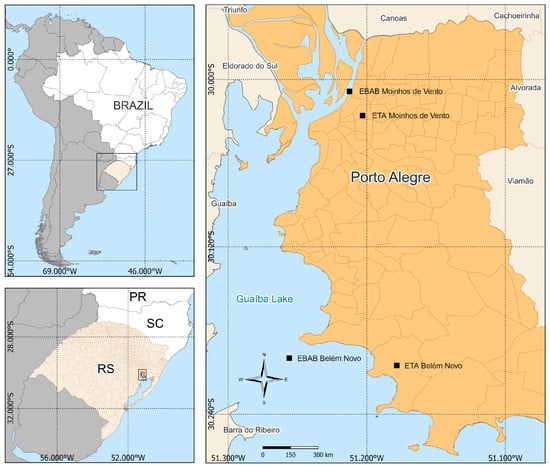
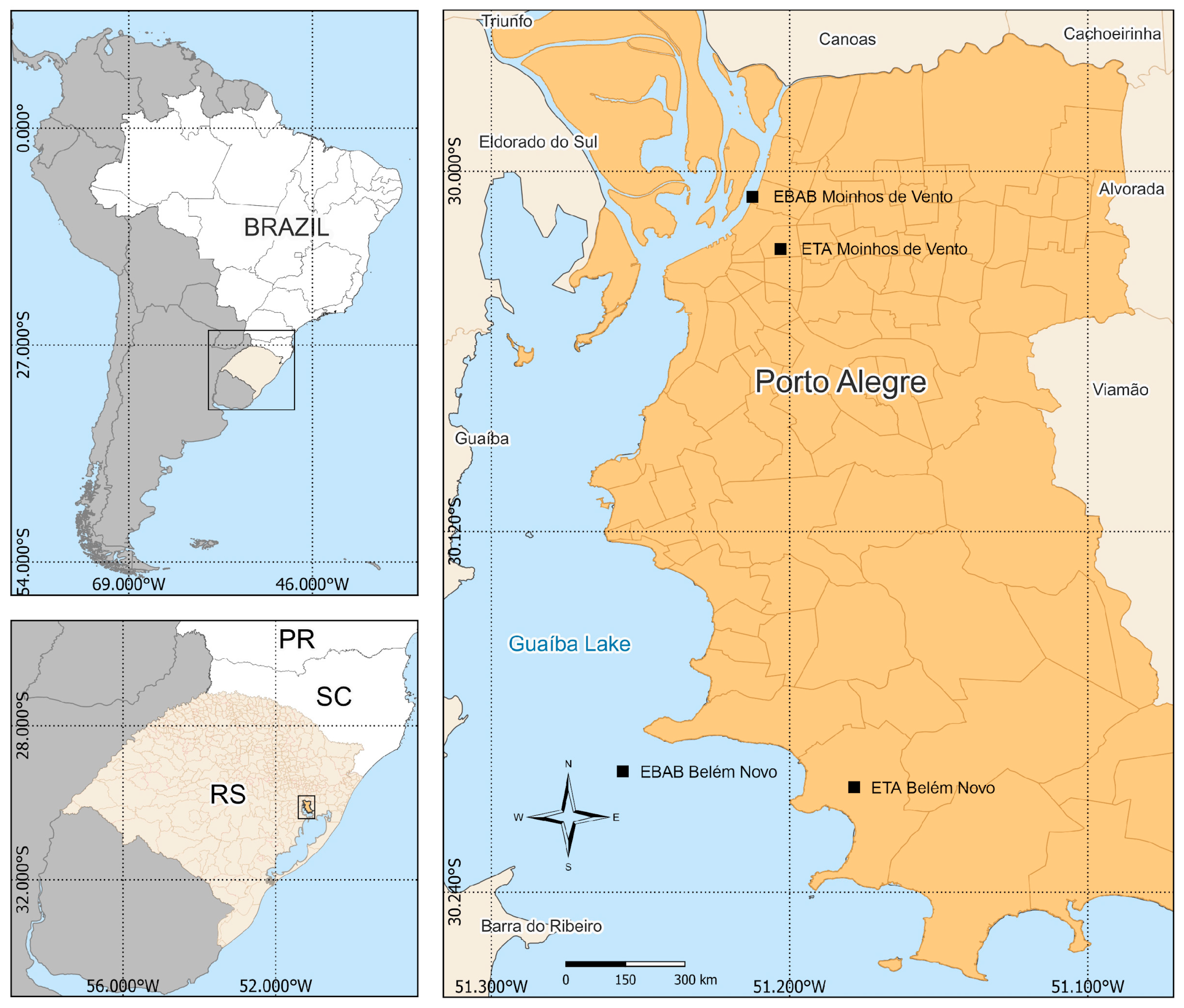
The study was conducted over a one-year period in Porto Alegre, Rio Grande do Sul, Brazil (Figure 1). Sampling was performed across four climatic seasons (winter, spring, summer, and autumn) to capture seasonal variability in water quality parameters. Detailed information on sample identification, geographic coordinates, and the main characteristics of each sampling site is provided in Figure 1 and Table 1.
Figure 1.
Geographic location of the sampling sites for raw and treated water in the two urban sanitation systems of Porto Alegre, Rio Grande do Sul, Brazil. Raw water samples were collected at Raw Water Pumping Stations (EBAB), and treated water samples were collected at Water Treatment Plants (ETA). Base cartographic data were obtained from the Brazilian Institute of Geography and Statistics (IBGE) and adapted for this study. Shapefiles were downloaded from the IBGE geosciences repository (2024–2025, available on https://www.ibge.gov.br/geociencias/downloads-geociencias.html (accessed on 15 December 2025), and map visualization was produced using QGIS software (version 3.44.5).
Table 1.
Identification and main characteristics of wastewater and treated water sampling sites.
Raw (untreated) water samples were collected at two sites in Guaíba Lake: one located in the northern region, adjacent to the Moinhos de Vento Raw Water Pumping Station (EBAB Moinhos de Vento), and another in the southern region, near the Belém Novo Raw Water Pumping Station (EBAB Belém Novo). These locations correspond to the sampling points RLN and RLS, respectively.
Treated (potable) water samples were collected at two public squares supplied by distinct water distribution systems. One sampling point was located in the Moinhos de Vento neighborhood (TPN), supplied by the Moinhos de Vento Water Treatment Plant (WTP Moinhos de Vento), while the other was located in the Belém Novo neighborhood (TPS), supplied by the Belém Novo Water Treatment Plant (WTP Belém Novo).
Raw water samples were collected by the State Environmental Protection Foundation (FEPAM), whereas treated water samples were collected by the National Service for Industrial Training (SENAI). Sampling followed a seasonal design, with four quarterly sampling campaigns conducted from winter 2024 to summer 2025, resulting in a total of 15 samples. Following collection, all samples were transported under refrigerated conditions and maintained at 4 °C until laboratory processing.
The following methodological considerations apply: (i) for raw water samples, part of the physicochemical dataset was provided by FEPAM, as these analyses were performed in situ; and (ii) for molecular assays targeting antimicrobial resistance genes, samples were transported to the SENAI microbiology laboratory, where they underwent a filtration step as described in a subsequent section.
2.2. Physicochemical Analyses
Dissolved oxygen (DO), pH, and water temperature were measured in situ using a ProDSS multiparameter water quality meter (YSI–Xylem, Yellow Springs, OH, USA). All remaining physicochemical analyses were conducted at the SENAI Physicochemical Laboratory in accordance with standardized methods for the examination of water and wastewater. The parameters analyzed included chloride (Method 4110 B), biochemical oxygen demand (BOD5, Method 5210 D), phosphate (Method 4110 B), nitrate (Method 4110 B), total solids (Method 2540 B), and turbidity (Method 2130 B) [25].
2.3. Microbiological Analyses
Microbiological analyses for total coliforms, thermotolerant coliforms, Escherichia coli, and heterotrophic bacteria were performed at the SENAI Microbiology Laboratory following standardized methods for the examination of water and wastewater. Thermotolerant coliforms were quantified using Methods 9221 B and 9221 E, total coliforms and E. coli were determined using Method 9223, and heterotrophic plate counts were conducted according to Methods 9215 A and 9215 B [25].
2.4. Water Quality Index (WQI) Determination
The Water Quality Index (WQI) was calculated based on the evaluation of the following parameters: water temperature, chlorides, sampling site altitude, dissolved oxygen, fecal coliforms, pH, BOD5, nitrate, phosphate, turbidity, and total solids. The criteria used for WQI calculation primarily reflect contamination associated with domestic sewage discharge, as well as effluents originating from industrial, agricultural, and urban solid waste sources [26]. Each parameter was assigned a specific weighting factor and evaluated using standardized rating curve, in accordance with the established WQI methodology.
2.5. Interpretation of Physicochemical and Microbiological Analyses
The interpretation of physicochemical and microbiological results was based on current Brazilian environmental and public health regulations. For raw water samples, the reference framework was CONAMA Resolution No. 357/2005 [27] which classifies surface water bodies and establishes environmental quality standards and effluent discharge limits. Under this resolution, Guaíba Lake is classified as a freshwater body (salinity ≤ 0.5%) of Class 2, indicating suitability for human consumption following conventional treatment [27].
For treated water samples, evaluations were conducted in accordance with Ministry of Health Ordinance GM/MS No. 888/2021 [28], which defines procedures for the control and surveillance of drinking water quality in Brazil. Parameters not explicitly addressed in this ordinance were assessed using the criteria established in Consolidation Ordinance No. 5/GM/MS, issued on 28 September 2017 [28,29].
2.6. Detection of Carbapenem Resistance Genes
Water samples were filtered at the SENAI Microbiology Laboratory using hydrophilic polytetrafluoroethylene (PTFE) membranes (0.45 µm pore size, 47 mm diameter; Filtrilo®, Colombo, PR, Brazil) under vacuum using a Millipore filtration system. For raw water samples, 350 mL were filtered per membrane, whereas 1 L was filtered for treated water samples. Each sampling site was processed in biological triplicate.
Genomic DNA was extracted from the filters using the DNeasy PowerWater Kit (Qiagen®, Hilden, Germany), following the manufacturer’s instructions. DNA concentration, purity, and integrity were assessed by spectrophotometry (NanoDrop™, Thermo Fisher Scientific, Wilmington, DE, USA), fluorometry (Qubit™, Thermo Fisher Scientific, Waltham, MA, USA), and agarose gel electrophoresis (Table S1 and Figure S1). DNA amplifiability was verified by conventional PCR targeting the 16S rRNA gene [30]. All samples were retained for downstream analysis regardless of initial DNA quality metrics.
Quantitative PCR (qPCR) assays were performed in technical triplicate using a StepOne™ Real-Time PCR System and PowerUp™ SYBR™ Green Master Mix (Thermo Fisher Scientific, Waltham, MA, USA). Primers targeting the IMPa, KPC, NDM, OXA-48-like, and VIM carbapenemase genes were selected based on previously published studies [31,32]. Standard curves ranging from 1010 to 105 copies/µL were generated from serial dilutions, each run in technical triplicate, to calculate amplification efficiency (E = 10^(−1/slope)) and enable absolute quantification. Assay specificity was confirmed by melting curve analysis. Cycle threshold (Ct) values were adjusted manually, and samples exhibiting high technical variability (standard deviation > 0.5) were retested as part of the quality control procedures.
3. Results and Discussion
3.1. Physicochemical Analyses
The results of the physicochemical analyses of raw and treated water samples, together with the corresponding regulatory reference values, are presented in Table 2.
Table 2.
Physicochemical parameters of wastewater and treated water samples collected across four climatic seasons in Porto Alegre, RS, Brazil, with corresponding regulatory reference values.
For raw water samples, the only parameter exceeding the limits established by the Brazilian National Environmental Council (CONAMA) Resolution No. 357/2005 [27] was biochemical oxygen demand (BOD) in the RLS sample collected during spring (13 mg/L), indicating an increased organic load. BOD reflects the amount of oxygen required for microbial decomposition of organic matter in aquatic environments, and elevated values may result from natural organic inputs, enhanced microbial activity, or the discharge of domestic, industrial, or agricultural effluents. Environmental factors such as pH, temperature, and nutrient availability may further influence BOD dynamics [33,34]. When considered alongside the remaining physicochemical parameters measured at the same site and season, this deviation appeared to be an isolated event and was most likely associated with elevated concentrations of natural organic matter, including leaf litter, plant debris, woody material, and organic-rich sediments.
For treated water samples, pH values at the TPN sampling site remained below the acceptable regulatory range throughout all sampling periods, with a mean value of 5.57. At the TPS site, the winter sample exhibited a pH of 5.49, while pH values in the remaining seasons were close to the lower regulatory threshold (mean = 6.03). Overall, these results indicate a trend toward slight acidity in the treated water, suggesting insufficient pH adjustment during the treatment process. In contrast, raw water at the corresponding intake locations exhibited near-neutral mean pH values of 7.08 (RLN) and 7.34 (RLS). The marked decrease in pH following treatment therefore points to ineffective pH correction, potentially reflecting operational issues such as inadequate dosing of alkalinizing agents or excessive use of acidic coagulants. Such imbalances may compromise the chemical stability of the finished water supplied to consumers [33,35].
Contextual factors should also be considered when interpreting the TPN winter sample. In August 2024, the Moinhos de Vento Water Treatment Plant underwent an emergency shutdown to repair a major water transmission pipeline, resulting in service interruptions that affected water supply to 21 neighborhoods in Porto Alegre. Although plant operations resumed in early September, coinciding with the sampling period, water distribution was still in the process of being gradually reestablished. According to guidance from the municipal water authority, prolonged service interruptions can lead to the mobilization of sediments within the distribution network, temporarily altering water color and taste. Although these particles are generally regarded as non-hazardous, their resuspension may have contributed to the physicochemical variability observed during this sampling event.
3.2. Microbiological Analyses
The results of the microbiological analyses for raw and treated water samples are summarized in Table 3.
Table 3.
Seasonal variation in bacteriological parameters of wastewater and treated water samples collected in Porto Alegre, RS, Brazil.
To assess hygienic quality, total coliforms and heterotrophic bacteria were quantified. These microbial groups are ubiquitous in the environment, occurring naturally in soil, vegetation, and aquatic ecosystems, and their presence may reflect general environmental contamination rather than direct fecal pollution [1]. Although no specific regulatory limits are established for raw water, these parameters provide a useful proxy for evaluating the overall microbiological condition of the sampled sites. In contrast, for treated water, both indicators are used to identify potential failures in disinfection processes or deficiencies within the distribution network. In this study, all treated water samples complied with the limits established by current Brazilian regulations [27,28,29], demonstrating the effectiveness of the water treatment and distribution systems.
Sanitary quality was assessed through the detection of thermotolerant coliforms and Escherichia coli. The presence of these microorganisms indicates recent fecal contamination, with E. coli serving as a more specific indicator of elevated sanitary risk and potential pathogen occurrence [1]. Among raw water samples, thermotolerant coliform concentrations exceeded the limits established by Brazilian regulations only at the RLN sampling site during winter and spring, suggesting episodic fecal contamination events at this location.
Under Brazilian legislation (CONAMA Resolution No. 357/2005) [27], E. coli may be used as a surrogate indicator for thermotolerant coliforms, provided that its concentration does not exceed 80% of the total count [27]. While the detection of E. coli strongly reflects recent fecal pollution, reliance on this indicator alone may reduce interpretive resolution when quantitative data on thermotolerant coliforms are available. As expected for adequately treated drinking water, E. coli was not detected in any treated water samples throughout the study periods, supporting the effectiveness of disinfection processes and the integrity of the distribution system.
Overall, both water treatment systems evaluated (TPN and TPS) effectively removed fecal contamination and sanitary indicator organisms. Even during periods of elevated microbial loads in raw water, such as winter at the RLN site, the corresponding treated water samples (e.g., TPN–winter) showed complete absence of indicator microorganisms. These findings confirm the satisfactory microbiological performance of the treatment operations across all sampling periods.
3.3. Determination of the Water Quality Index (WQI)
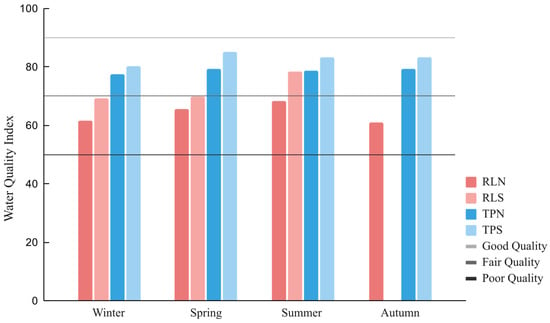
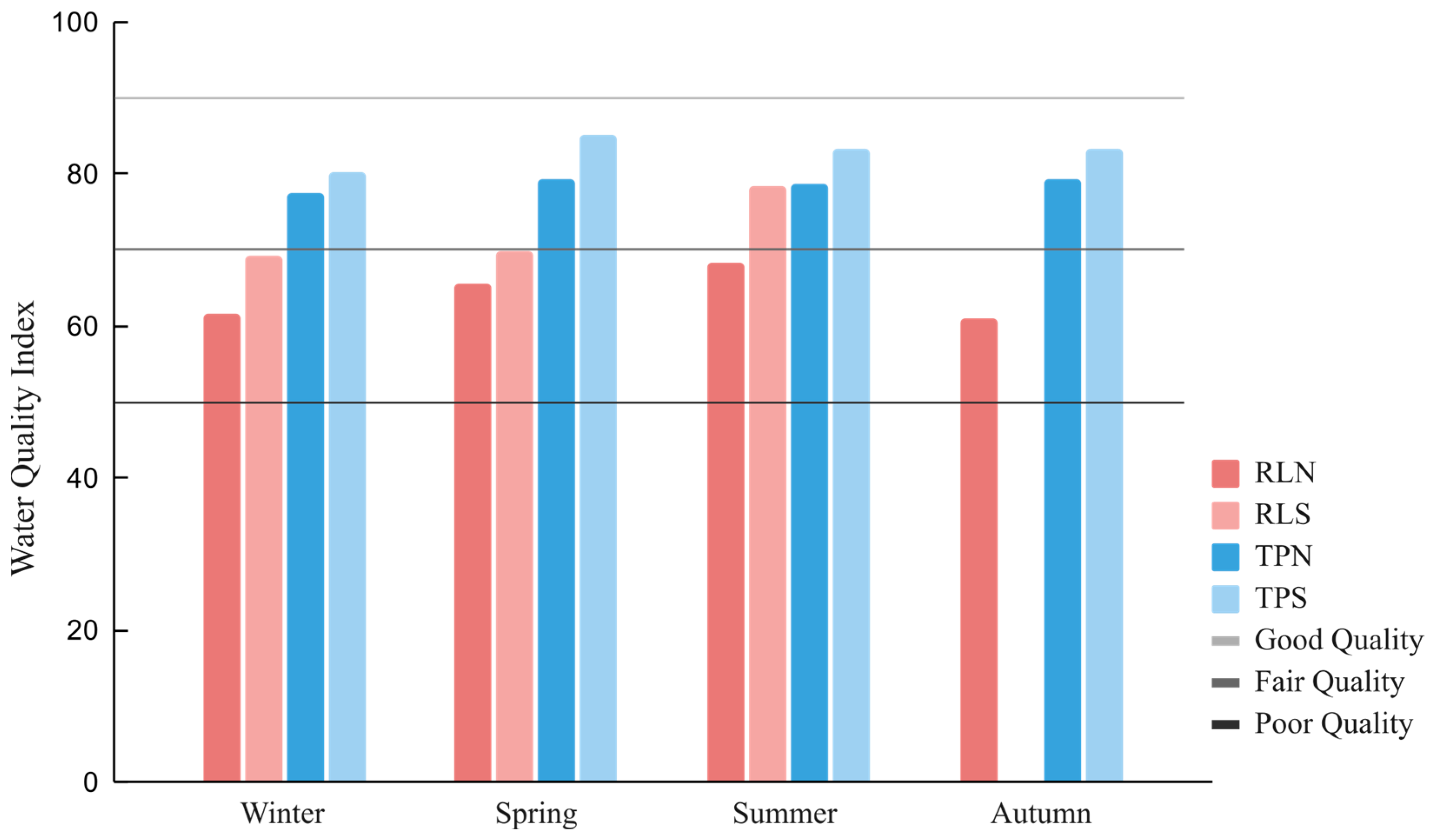
The Water Quality Index (WQI) analysis provided an integrated assessment of the environmental condition of both raw and treated water samples across the four climatic seasons evaluated (Figure 2).
Figure 2.
Seasonal variation in the Water Quality Index (WQI) in wastewater and treated water samples collected in Porto Alegre, RS, Brazil. RLN: North Lake wastewater; RLS: South Lake wastewater; TPN: North Square treated water; TPS: South Square treated water. Horizontal reference lines indicate WQI classification thresholds for poor, fair, and good water quality.
The criteria used for WQI calculation are primarily based on indicators of contamination associated with domestic sewage discharge, as well as effluents from industrial, agricultural, and urban solid waste sources [36]. Although WQI determination is not a regulatory requirement for treated water, its inclusion in this study served as a complementary approach, enabling a quantitative and integrative comparison of water quality before and after treatment.
For treated water samples, WQI values reflected the efficiency of treatment processes, with substantial reductions observed in key parameters such as turbidity, organic matter, coliforms, and nutrient concentrations. These improvements, together with the stabilization of physicochemical variables known to negatively affect environmental quality, reinforce the overall effectiveness of the treatment systems applied.
In contrast, raw water samples exhibited clear seasonal variability, with higher WQI values recorded during the summer period. This pattern may be attributed to more favorable hydrological and environmental conditions characteristic of this season, including increased solar radiation, higher temperatures, and enhanced microbial inactivation, which collectively contribute to reductions in turbidity and fecal contamination indicators [37,38]. Such seasonal improvement is consistent with patterns described for subtropical lake systems, where climatic dynamics exert a strong influence on water quality parameters.
3.4. Detection of Carbapenem Resistance Genes
The results of the molecular analyses are presented in Table 4.
Table 4.
Seasonal quantification of carbapenem resistance gene copy numbers in wastewater and treated water samples from Porto Alegre, RS, Brazil (copies/100 mL).
Recurrent detection of the blaOXA-48-like gene was observed at all raw and treated water sampling sites across most seasons. During autumn, the simultaneous occurrence of three carbapenem resistance genes (blaOXA-48-like, blaKPC, and blaNDM) was detected at the RLN sampling site, with notably high copy numbers. The blaVIM gene was detected exclusively during spring, whereas no antimicrobial resistance genes were detected in any sample collected during summer. The blaIMPa gene was not detected in any of the samples analyzed. This seasonal distribution may reflect temporal fluctuations in antibiotic usage patterns, hospital discharge dynamics, or differences in the environmental stability and persistence of resistance genes, all of which warrant further investigation.
Urban aquatic environments are increasingly recognized as reservoirs of multidrug-resistant bacteria and antimicrobial resistance genes (ARGs), largely due to continuous inputs from domestic sewage, hospital effluents, and diffuse urban sources that promote the selection and dissemination of ARGs within aquatic systems [39,40,41,42]. Among the five epidemiologically relevant carbapenemase genes investigated (blaKPC, blaIMPa, blaNDM, blaVIM, blaOXA-48-like), blaOXA-48-like was the most prevalent, showing consistent detection across sites and seasons in both raw and treated water samples. This widespread occurrence suggests high environmental persistence and ongoing introduction from anthropogenic sources, in agreement with reports from recreational waters, freshwater environments, and drinking water systems worldwide [31,43,44].
The genes blaVIM, blaKPC, and blaNDM were detected sporadically, with isolated events occurring primarily during spring and autumn. The concurrent detection of three carbapenemase genes in autumn suggests an episodic contribution of wastewater, potentially associated with irregular discharges or increased domestic and hospital effluent inputs, as described for other urban aquatic systems [40,45]. The exclusive detection of blaVIM in spring, together with the absence of blaIMPa throughout the study period, may indicate a low regional prevalence of certain carbapenemase families or the lack of significant emission sources during the monitoring timeframe [42].
A clear seasonal influence was observed. The absence of detectable ARGs during summer may be partly explained by a combination of environmental and hydrological factors. Higher temperatures and increased solar radiation can promote extracellular DNA degradation and reduce bacterial persistence in aquatic environments [46]. In addition, hydrological conditions typical of subtropical regions, such as increased precipitation and higher water volumes during summer, may enhance dilution effects, resulting in lower detectable concentrations of ARGs in water samples [47,48]. In contrast, spring was the season with the highest frequency of ARG detection, including occurrences in treated water samples that otherwise complied with conventional bacteriological criteria. These findings further underscore the limitations of monitoring strategies based exclusively on cultivable indicator organisms and support the integration of molecular approaches into routine water quality surveillance.
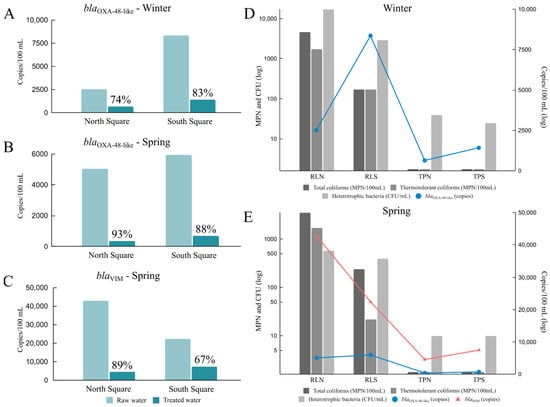
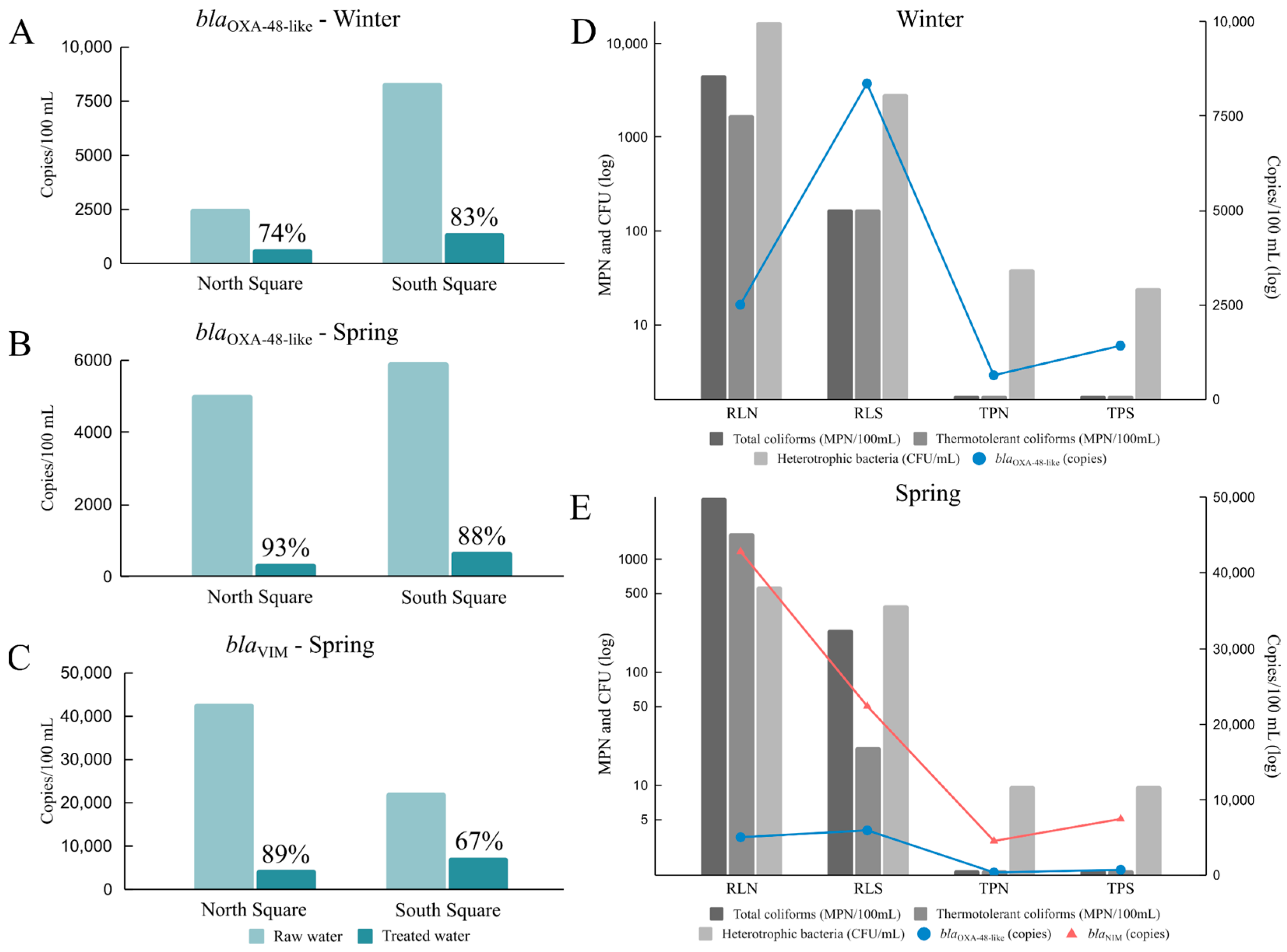
Seasonal patterns in the occurrence and reduction in carbapenem resistance genes are illustrated in Figure 3.
Figure 3.
Seasonal distribution of carbapenem resistance genes and bacteriological parameters in raw and treated water samples. Quantification of the blaOXA-48-like gene during winter (A) and spring (B), and of the blaVIM gene during spring (C), including the corresponding percentage reductions in copy number per 100 mL between raw and treated water in the northern and southern zones of Porto Alegre, Rio Grande do Sul, Brazil. Relationships between bacteriological indicators and the most prevalent resistance genes are shown for winter (D) and spring (E). RLN: North Lake wastewater; RLS: South Lake wastewater; TPN: North Square treated water; TPS: South Square treated water.
The percentage reduction in gene copy numbers per 100 mL for blaOXA-48-like and blaVIM genes (Figure 3A–C) was calculated based on the difference between raw wastewater and treated water samples for each region of the city. This approach allows estimation of the efficiency of the treatment processes in removing resistance genes, as well as assessment of potential seasonal variability. In parallel, Figure 3D,E present an integrated analysis combining bacteriological indicators and ARG detection, highlighting the seasons associated with the highest occurrence of these genes.
The detection of ARGs in treated water despite the absence of cultivable coliforms may indicate the persistence of extracellular DNA (eDNA) and/or may be partly explained by the presence of viable but non-culturable (VBNC) bacteria, phenomena that have been reported in both drinking water and wastewater treatment systems [45,46,49]. The VBNC state is recognized as a bacterial survival strategy under environmental stress conditions, including disinfection processes and nutrient limitation, in which cells may remain metabolically active and retain genetic material while evading detection by culture-based methods [50]. Previous and more recent studies suggest that water and wastewater treatment processes may induce or maintain VBNC populations, which can harbor antibiotic resistance genes and potentially contribute to their persistence in treated water [51,52]. Although chlorination is effective for microbial inactivation, it may not completely degrade free DNA, thereby allowing ARGs to persist after treatment [53]. In contrast, advanced treatment technologies, such as the combined application of ultraviolet radiation and hydrogen peroxide, have demonstrated greater efficiency in reducing extracellular genetic material and ARG signals [54]. Consequently, even treatment systems that comply with conventional microbiological standards may act as reservoirs of resistance genes with the potential for horizontal gene transfer, reinforcing the need to incorporate molecular-based surveillance into routine water quality monitoring programs [4].
3.5. Limitations of the Study
This study has several limitations that should be considered when interpreting the results. First, due to logistical, operational, and budgetary constraints, the number of sampling sites was limited to two drinking water treatment systems representing the northern and southern regions of the city. Although these systems are geographically distinct and environmentally relevant, the limited spatial coverage restricts the generalization of the findings to the entire urban water supply network.
In addition, the study was designed as an observational and exploratory environmental investigation aimed at characterizing seasonal trends in microbiological, physicochemical, and molecular parameters, rather than providing statistically powered spatial comparisons. Because environmental water quality data are inherently influenced by seasonal, hydrological, and geographical variability, the interpretation of the results focuses primarily on temporal patterns, and inferential statistical analyses were not applied.
Another limitation concerns the absence of wastewater sampling at the southern site (RLS) during the autumn campaign, which could not be conducted due to adverse meteorological conditions that compromised field safety and operational feasibility. Despite this gap, the dataset obtained from the remaining seasons and sampling sites provides a consistent basis for evaluating seasonal dynamics and the occurrence of carbapenem resistance genes. Moreover, data from the northern wastewater site (RLN) collected during the same period offer an environmentally comparable reference, as both sites are influenced by similar hydrological conditions and by Guaíba Lake.
An additional limitation of this study is the absence of an internal reference gene for normalization of qPCR data. Absolute gene copy numbers were therefore obtained without normalization, which may introduce variability related to differences in DNA extraction efficiency or the presence of residual PCR inhibitors. Consequently, fine-scale quantitative comparisons between samples should be interpreted with caution. To mitigate this limitation, all DNA extracts were evaluated for quality, concentration, and integrity, and sample amplifiability was confirmed by conventional PCR targeting the 16S rRNA gene. Furthermore, qPCR assays were supported by validated standard curves generated from synthetic positive controls, ensuring reliable amplification performance. As a result, while absolute quantification may be affected, the qualitative detection of target genes and the interpretation of seasonal trends, the primary focus of this study, remain robust.
Overall, although these limitations should be acknowledged, they do not invalidate the study’s conclusions. Instead, they underscore the need for future investigations with expanded spatial coverage, increased replication, and longer monitoring periods to further validate and extend the findings reported here.
4. Conclusions
This study demonstrates that carbapenem resistance genes can be detected in urban aquatic systems even when treated water complies with conventional bacteriological standards. The recurrent occurrence of the blaOXA-48-like gene in both raw and treated water, together with the seasonal detection of blaVIM, highlights the environmental persistence of clinically relevant resistance determinants and their temporal variability. The absence of resistance genes during summer and their restricted detection to specific seasons and sampling sites indicate the influence of environmental and operational factors on their occurrence and stability.
The detection of resistance genes in treated water in the absence of cultivable coliforms underscores the limitations of traditional microbiological monitoring and reinforces the value of molecular approaches as complementary tools for water quality surveillance. Integrating microbiological indicators, molecular data, and physicochemical parameters enables a more comprehensive understanding of antimicrobial resistance dynamics in urban aquatic environments.
Overall, the findings contribute to the field of environmental microbiology by emphasizing the importance of incorporating molecular-based monitoring into routine surveillance programs and by supporting the adoption of a One Health approach to better address the dissemination of antimicrobial resistance across interconnected environmental, human, and animal systems. From a One Health perspective, the environmental detection of blaOXA-48-like, a carbapenem resistance gene of high clinical relevance, highlights the potential role of urban water systems as interfaces for antimicrobial resistance dissemination, with possible implications for human and animal health through environmental exposure and horizontal gene transfer. Collectively, these results underscore the strategic value of integrating molecular surveillance into national drinking water monitoring programs, thereby strengthening early detection and risk mitigation efforts.
Supplementary Materials
The following supporting information can be downloaded at: https://www.mdpi.com/article/10.3390/microbiolres17010021/s1. Table S1. DNA concentration, purity, integrity, and 16S rRNA gene PCR amplification results. Figure S1. Verification of amplification of products obtained for the 16S rRNA gene region (~1500 bp) by electrophoresis on a 1.5% agarose gel (80 V, 40 min).
Author Contributions
Conceptualization, L.H., T.M.d.M. and F.S.C.; Methodology, L.H. and T.M.d.M.; Validation, L.H., T.M.d.M., L.C.T. and H.M.J.; Formal analysis, L.H. and T.M.d.M.; Funding acquisition: L.C.T., H.M.J., E.E.G.,. A.A.d.S. and F.S.C.; Investigation, L.H. and T.M.d.M.; Resources, L.C.T., H.M.J., E.E.G., A.A.d.S. and F.S.C.; Software: L.H. and T.M.d.M.; Visualization: L.H. and T.M.d.M.; Data curation, L.H. and T.M.d.M.; Writing—original draft preparation, L.H. and T.M.d.M.; Writing—review and editing, L.H., T.M.d.M., E.E.G., A.A.d.S. and F.S.C.; Supervision, L.C.T., H.M.J., A.A.d.S. and F.S.C.; Project administration, T.M.d.M., L.C.T., H.M.J., A.A.d.S. and F.S.C. All authors have read and agreed to the published version of the manuscript.
Funding
The study was conducted as part of the project “Mapping of the Sewage Treatment System with a View to Improving Drinking Water Quality”, developed under Technological Cooperation Agreement No. 43483 between the SENAI Institute of Innovation in Polymer Engineering and the SENAI Institute of Technology in Leather and Environment. Project partners included Agrega Pesquisa e Desenvolvimento em Biotecnologia Ltda. and the Federal University of Rio Grande do Sul (UFRGS).
Institutional Review Board Statement
Not applicable.
Informed Consent Statement
Not applicable.
Data Availability Statement
Data supporting the findings of this study are available from the corresponding author upon reasonable request. No publicly archived datasets were generated or analyzed during the current study.
Acknowledgments
The authors acknowledge the financial support provided by SENAI. The authors also thank FEPAM, Agrega Pesquisa e Desenvolvimento em Biotecnologia Ltda., and the Federal University of Rio Grande do Sul (UFRGS) for their institutional partnership and technical collaboration. F.S.C. is CNPq research fellow.
Conflicts of Interest
The authors declare no conflicts of interest.
References
- Fundação Nacional de Saúde (FUNASA). Manual Prático de Análise de Água, 4th ed.; Coordenação de Comunicação Social: Brasília, Brazil, 2013. Available online: https://bvsms.saude.gov.br/bvs/publicacoes/analise_agua_bolso.pdf (accessed on 13 April 2025).
- Franco, B.D.G.d.M.; Landgraf, M. Microbiologia de Alimentos, 1st ed.; Editora Atheneu: Rio de Janeiro, Brazil, 2008. [Google Scholar]
- Secretaria Estadual de Saúde de São Paulo (SES/SP). Doenças Relacionadas à Água ou de Transmissão Hídrica: Perguntas e Respostas e Dados Estatísticos; Secretaria Estadual de Saúde de São Paulo (SES/SP): São Paulo, Brazil, 2009. Available online: https://www.saude.sp.gov.br/resources/cve-centro-de-vigilancia-epidemiologica/areas-de-vigilancia/doencas-transmitidas-por-agua-e-alimentos/doc/2009/2009dta_pergunta_resposta.pdf (accessed on 13 April 2025).
- Hu, Y.; Jiang, L.; Sun, X.; Wu, J.; Ma, L.; Zhou, Y.; Lin, K.; Luo, Y.; Cui, C. Risk assessment of antibiotic resistance genes in the drinking water system. Sci. Total Environ. 2021, 800, 149650. [Google Scholar] [CrossRef] [Scilit]
- Johnson, C.L.; Setterfield, M.A.; Hassanain, W.A.; Wipat, A.; Pocock, M.; Faulds, K.; Graham, D.; Keegan, N. Multiplex detection of the big five carbapenemase genes using solid-phase recombinase polymerase amplification. Analyst 2024, 149, 1527–1536. [Google Scholar] [CrossRef] [Scilit]
- Hanna, N.; Tamhankar, A.J.; Stålsby Lundborg, C. Antibiotic concentrations and antibiotic resistance in aquatic environments of the WHO Western Pacific and South-East Asia regions: A systematic review and probabilistic environmental hazard assessment. Lancet Planet. Health 2023, 7, e45–e54. [Google Scholar] [CrossRef] [Scilit]
- World Health Organization (WHO). Antibacterial Agents in Clinical Development: An Analysis of the Antibacterial Clinical Development Pipeline; World Health Organization: Geneva, Switzerland, 2020; Available online: https://www.who.int/publications-detail-redirect/9789240000193 (accessed on 13 April 2025).
- Sanganyado, E.; Gwenzi, W. Antibiotic resistance in drinking water systems: Occurrence, removal, and human health risks. Sci. Total Environ. 2019, 669, 785–797. [Google Scholar] [CrossRef] [Scilit] [PubMed]
- Agência Nacional de Vigilância Sanitária (ANVISA). Resistência Antimicrobiana é Ameaça Global; Agência Nacional de Vigilância Sanitária (ANVISA): Brasília, Brazil, 2019. Available online: https://www.gov.br/anvisa/pt-br/assuntos/noticias-anvisa/2019/resistencia-antimicrobiana-e-ameaca-global-diz-oms (accessed on 13 April 2025).
- Ministério da Saúde. Plano de Ação Nacional de Prevenção e Controle da Resistência aos Antimicrobianos no Âmbito da Saúde Única 2018–2022 (PAN-BR); Ministério da Saúde: Brasília, Brazil, 2018. Available online: https://bvsms.saude.gov.br/bvs/publicacoes/plano_prevencao_resistencia_antimicrobianos.pdf (accessed on 13 April 2025).
- Hegarty, B.; Dai, Z.; Raskin, L.; Pinto, A.; Wigginton, K.; Duhaime, M. A Snapshot of the Global Drinking Water Virome: Diversity and Metabolic Potential Vary with Residual Disinfectant Use. Water Res. 2022, 30, 118484. [Google Scholar] [CrossRef] [Scilit]
- Aschidamini Prandi, B.; Mangini, A.T.; Santiago Neto, W.; Jarenkow, A.; Violet-Lozano, L.; Campos, A.A.S.; Colares, E.R.D.C.; Buzzetto, P.R.O.; Azambuja, C.B.; Trombin, L.C.B.; et al. Wastewater-Based Epidemiological Investigation of SARS-CoV-2 in Porto Alegre, Southern Brazil. Sci. One Health 2023, 3, 100008. [Google Scholar] [CrossRef] [Scilit]
- Chapron, C.D.; Ballester, N.A.; Fontaine, J.H.; Frades, C.N.; Margolin, A.B. Detection of Astroviruses, Enteroviruses, and Adenovirus Types 40 and 41 in Surface Waters Collected and Evaluated by the Information Collection Rule and an Integrated Cell Culture-Nested PCR Procedure. Appl. Environ. Microbiol. 2000, 66, 2520–2525. [Google Scholar] [CrossRef] [Scilit]
- Prado, T.; Miagostovich, M.P. Virologia ambiental e saneamento no Brasil: Uma revisão narrativa. Cad. Saúde Pública 2014, 30, 1367–1378. [Google Scholar] [CrossRef] [Scilit] [PubMed]
- DMAE. Informações sobre a água. Departamento Municipal de Água e Esgotos de Porto Alegre. Available online: https://prefeitura.poa.br/dmae/informacoes-agua (accessed on 13 April 2025).
- DMAE. Informações educação ambiental—Informações sobre o esgoto, o tratamento e os cuidados. Departamento Municipal de Água e Esgotos de Porto Alegre. Available online: https://prefeitura.poa.br/sites/default/files/usu_doc/sites/dmae/Folder%20%C3%A1gua%20-%20compressed%20(1).pdf (accessed on 13 April 2025).
- Bustin, S.A.; Benes, V.; Garson, J.A.; Hellemans, J.; Huggett, J.; Kubista, M.; Mueller, R.; Nolan, T.; Pfaffl, M.W.; Shipley, G.L.; et al. The MIQE guidelines: Minimum information for publication of quantitative real-time PCR experiments. Clin. Chem. 2009, 55, 611–622. [Google Scholar] [CrossRef] [Scilit]
- Smith, C.J.; Osborn, A.M. Advantages and limitations of quantitative PCR (Q-PCR)-based approaches in microbial ecology. FEMS Microbiol. Ecol. 2009, 67, 6–20. [Google Scholar] [CrossRef] [Scilit] [PubMed]
- Manaia, C.M.; Macedo, G.; Fatta-Kassinos, D.; Nunes, O.C. Antibiotic resistance in urban aquatic environments: Can it be controlled? Appl. Microbiol. Biotechnol. 2016, 100, 1543–1557. [Google Scholar] [CrossRef] [Scilit]
- Paruch, L. Molecular Diagnostic Tools Applied for Assessing Microbial Water Quality. Int. J. Environ. Res. Public Health 2022, 19, 5128. [Google Scholar] [CrossRef] [Scilit]
- Rompré, A.; Servais, P.; Baudart, J.; de-Roubin, M.R.; Laurent, P. Detection and Enumeration of Coliforms in Drinking Water: Current Methods and Emerging Approaches. J. Microbiol. Methods 2002, 49, 31–54. [Google Scholar] [CrossRef] [Scilit]
- Abebe, T.A.; Gebreyes, D.S.; Abebe, B.A.; Yitayew, B. Antibiotic-Resistant Bacteria and Resistance Genes in Drinking Water Source in North Shoa Zone, Amhara Region, Ethiopia. Front. Public Health 2024, 12, 1422137. [Google Scholar] [CrossRef] [Scilit] [PubMed]
- Caliskan-Aydogan, O.; Alocilja, E.C. A Review of Carbapenem Resistance in Enterobacterales and Its Detection Techniques. Microorganisms 2023, 11, 1491. [Google Scholar] [CrossRef] [Scilit] [PubMed]
- Rose, J.B.; Hofstra, N.; Hollmann, E.; Katsivelis, P.; Medema, G.J.; Murphy, H.M.; Naughton, C.C.; Verbyla, M.E. Global microbial water quality data and predictive analytics: Key to health and meeting SDG 6. PLoS Water 2023, 2, e0000166. [Google Scholar] [CrossRef] [Scilit]
- American Public Health Association (APHA). Standard Methods for the Examination of Water and Wastewater, 23rd ed.; American Public Health Association: Washington, DC, USA, 2017. [Google Scholar]
- CETESB—Companhia Ambiental do Estado de São Paulo. Índice de Qualidade das Águas (IQA): Métodos e Aplicações; CETESB: São Paulo, Brazil, 2023. Available online: https://cetesb.sp.gov.br/aguasinteriores/wp-content/uploads/sites/12/2022/11/Apendice-E-Indices-de-Qualidade-das-Aguas.pdf (accessed on 13 April 2025).
- Conselho Nacional do Meio Ambiente (CONAMA). Resolução No. 357, de 17 de Março de 2005; Ministério do Meio Ambiente: Brasília, Brazil, 2005. Available online: https://conama.mma.gov.br/?id=450&option=com_sisconama&task=arquivo.download (accessed on 13 April 2025).
- Ministério da Saúde. Portaria GM/MS No. 888, de 4 de Maio de 2021; Ministério da Saúde: Brasília, Brazil, 2021; pp. 1–29. Available online: https://www.in.gov.br/en/web/dou/-/portaria-gm/ms-n-888-de-4-de-maio-de-2021-318461562 (accessed on 13 April 2025).
- Ministério da Saúde. Portaria de Consolidação No. 5, de 28 de Setembro de 2017; Ministério da Saúde: Brasília, Brazil, 2017; pp. 1–856. Available online: https://portalsinan.saude.gov.br/images/documentos/Legislacoes/Portaria_Consolidacao_5_28_SETEMBRO_2017.pdf (accessed on 13 April 2025).
- Weisburg, W.G.; Barns, S.M.; Pelletier, D.A.; Lane, D.J. 16S ribosomal DNA amplification for phylogenetic study. J. Bacteriol. 1991, 173, 697–703. [Google Scholar] [CrossRef] [Scilit]
- Mahon, B.M.; Brehony, C.; Cahill, N.; McGrath, E.; O’Connor, L.; Varley, A.; Cormican, M.; Ryan, S.; Hickey, P.; Keane, S.; et al. Detection of OXA-48-like-producing Enterobacterales in Irish recreational water. Sci. Total Environ. 2019, 690, 1–6. [Google Scholar] [CrossRef] [Scilit] [PubMed]
- Mentasti, M.; Prime, K.; Sands, K.; Khan, S.; Wootton, M. Rapid detection of IMP, NDM, VIM, KPC and OXA-48-like carbapenemases from Enterobacteriales and Gram-negative non-fermenter bacteria by real-time PCR and melt-curve analysis. Eur. J. Clin. Microbiol. Infect. Dis. 2019, 38, 2029–2036. [Google Scholar] [CrossRef] [Scilit]
- Ministério da Saúde. Vigilância e Controle da Qualidade da Água para Consumo Humano; Série B; Ministério da Saúde: Brasília, Brazil, 2006. Available online: https://bvsms.saude.gov.br/bvs/publicacoes/vigilancia_controle_qualidade_agua.pdf (accessed on 13 April 2025).
- Valente, J.P.S.; Padilha, P.M.; Silva, A.M.M. Oxigênio dissolvido (OD), demanda bioquímica de oxigênio (DBO) e demanda química de oxigênio (DQO) como parâmetros de poluição no ribeirão Lavapés/Botucatu-SP. Eclética Química 1997, 22, 49–66. [Google Scholar] [CrossRef] [Scilit]
- von Sperling, M.; Verbyla, M.E.; Oliveira, S.M.A.C. Assessment of Treatment Plant Performance and Water Quality Data: A Guide for Students, Researchers and Practitioners; IWA Publishing: London, UK, 2017. [Google Scholar] [CrossRef] [Scilit]
- Uddin, M.G.; Nash, S.; Olbert, A.I. A review of water quality index models and their use for assessing surface water quality. Ecol. Indic. 2021, 122, 107218. [Google Scholar] [CrossRef] [Scilit]
- Davies-Colley, R.J.; Bell, R.G.; Donnison, A.M. Sunlight inactivation of enterococci and fecal coliforms in sewage effluent diluted in seawater. Appl. Environ. Microbiol. 1994, 60, 2049–2058. [Google Scholar] [CrossRef] [Scilit]
- Bahlaoui, M.A.; Baleux, B.; Troussellier, M. Dynamics of pollution-indicator and pathogenic bacteria in high-rate oxidation wastewater treatment ponds. Water Res. 1997, 31, 630–638. [Google Scholar] [CrossRef] [Scilit]
- Amos, G.C.; Hawkey, P.M.; Gaze, W.H.; Wellington, E.M. Waste water effluent contributes to the dissemination of CTX-M-15 in the natural environment. J. Antimicrob. Chemother. 2014, 69, 1785–1791. [Google Scholar] [CrossRef] [Scilit]
- Rizzo, L.; Manaia, C.; Merlin, C.; Schwartz, T.; Dagot, C.; Ploy, M.C.; Michael, I.; Fatta-Kassinos, D. Urban wastewater treatment plants as hotspots for antibiotic resistant bacteria and genes spread into the environment: A review. Sci. Total Environ. 2013, 447, 345–360. [Google Scholar] [CrossRef] [Scilit]
- Ferro, G.; Guarino, F.; Castiglione, S.; Rizzo, L. Antibiotic resistance spread potential in urban wastewater effluents disinfected by UV/H2O2 process. Sci. Total Environ. 2016, 560–561, 29–35. [Google Scholar] [CrossRef] [Scilit]
- Mahmoud, N.E.; Altayb, H.N.; Gurashi, R.M. Detection of carbapenem-resistant genes in Escherichia coli isolated from drinking water in Khartoum, Sudan. J. Environ. Public Health 2020, 2020, 2571293. [Google Scholar] [CrossRef] [Scilit]
- Tafoukt, R.; Touati, A.; Leangapichart, T.; Bakour, S.; Rolain, J.M. Characterization of OXA-48-like-producing Enterobacteriaceae isolated from river water in Algeria. Water Res. 2017, 120, 185–189. [Google Scholar] [CrossRef] [Scilit] [PubMed]
- Brooks, J.P.; Adeli, A.; McLaughlin, M.R. Microbial ecology, bacterial pathogens, and antibiotic resistant genes in swine manure wastewater as influenced by three swine management systems. Water Res. 2014, 57, 96–103. [Google Scholar] [CrossRef] [Scilit] [PubMed]
- Mao, D.; Yu, S.; Rysz, M.; Luo, Y.; Yang, F.; Li, F.; Hou, J.; Mu, Q.; Alvarez, P.J.J. Prevalence and proliferation of antibiotic resistance genes in two municipal wastewater treatment plants. Water Res. 2015, 85, 458–466. [Google Scholar] [CrossRef] [Scilit] [PubMed]
- Tsvetanova, Z.; Boshnakov, R. Antimicrobial Resistance of Waste Water Microbiome in an Urban Waste Water Treatment Plant. Water 2025, 17, 39. [Google Scholar] [CrossRef] [Scilit]
- Peng, J.; Wang, D.; He, P.; Wei, P.; Zhang, L.; Lan, W.; Zhang, X.; Guan, J.; Chen, Y.; Li, W.; et al. Seasonal dynamics of antibiotic resistance genes and mobile genetic elements in a subtropical coastal ecosystem: Implications for environmental health risks. Environ. Res. 2024, 257, 119298. [Google Scholar] [CrossRef] [Scilit]
- Barrantes-Jiménez, K.; Mendoza-Guido, B.; Morales-Mora, E.; Rivera-Montero, L.; Montiel-Mora, J.; Chacón-Jiménez, L.; Rojas-Jiménez, K.; Arias-Andrés, M. Influence of Seasonality and Pollution on the Presence of Antibiotic Resistance Genes and Potentially Pathogenic Bacteria in a Tropical Urban River. Antibiotics 2025, 14, 798. [Google Scholar] [CrossRef] [Scilit]
- Ramalho, R.; Mezzomo, L.C.; Machado, W.; da Silva Morais Hein, C.; Müller, C.Z.; da Silva, T.C.B.; Jank, L.; Lamas, A.E.; da Costa Ballestrin, R.A.; Wink, P.L.; et al. The occurrence of antimicrobial residues and antimicrobial resistance genes in urban drinking water and sewage in Southern Brazil. Braz. J. Microbiol. 2022, 53, 1483–1489. [Google Scholar] [CrossRef] [Scilit] [PubMed]
- Lin, H.; Ye, C.; Chen, S.; Zhang, S.; Yu, X. Viable but non-culturable E. coli induced by low level chlorination have higher persistence to antibiotics than their culturable counterparts. Environ. Pollut. 2017, 230, 242–249. [Google Scholar] [CrossRef] [Scilit] [PubMed]
- Zhang, M.; Wang, X.; Deng, X.; Zheng, S.; Zhang, W.; He, J.Z.; Yu, X.; Feng, M.; Ye, C. Viable but non-culturable state formation and resuscitation of different antibiotic-resistant Escherichia coli induced by UV/chlorine. Water Res. 2024, 261, 122011. [Google Scholar] [CrossRef] [Scilit]
- Oliver, J.D. Recent findings on the viable but nonculturable state in pathogenic bacteria. FEMS Microbiol. Rev. 2010, 34, 415–425. [Google Scholar] [CrossRef] [Scilit]
- Zhang, S.; Zhang, Y.; Wang, Y.; Liu, X.; Li, M.; Fang, H.; Kong, M. Effect of antibiotics, antibiotic-resistant bacteria, and extracellular antibiotic resistance genes on the fate of ARGs in marine sediments. Sci. Total Environ. 2023, 891, 164305. [Google Scholar] [CrossRef] [Scilit] [PubMed]
- Umar, S.A.; Tasduq, S.A. Ozone Layer Depletion and Emerging Public Health Concerns—An Update on Epidemiological Perspective of the Ambivalent Effects of Ultraviolet Radiation Exposure. Front. Oncol. 2022, 12, 866733. [Google Scholar] [CrossRef] [Scilit]

Disclaimer/Publisher’s Note: The statements, opinions and data contained in all publications are solely those of the individual author(s) and contributor(s) and not of MDPI and/or the editor(s). MDPI and/or the editor(s) disclaim responsibility for any injury to people or property resulting from any ideas, methods, instructions or products referred to in the content. |
© 2026 by the authors. Licensee MDPI, Basel, Switzerland. This article is an open access article distributed under the terms and conditions of the Creative Commons Attribution (CC BY) license.