
Chemical Profiling and Biological Evaluation of Matricaria pubescens as a Promising Source of Antioxidant and Anti-Resistance Agents

 , ,
, ,  ,
,
Abstract
1. Introduction
2. Materials and Methods
2.1. Plant Material
2.2. Extract Preparation
- Aqueous Decoction: 5 g of powdered herbal material were boiled in 500 mL of distilled water for 15 min. The decoction was then filtered, and the filtrate was evaporated to dryness [17].
- Organic Solvent Maceration: 50 g of powdered plant material was immersed in 500 mL of either methanol–water (70:30, v/v) or petroleum ether–water (70:30, v/v). The mixtures were kept at room temperature (estimated at 25 ± 2 °C) and shielded from light for 48 h while being continuously stirred at around 50 rpm. After filtering the resultant mixes, a rotary evaporator (BUCHI Rotavapor R-210 characterized by V-700 vacuum pump, Flawil, Switzerland) was used to concentrate the filtrates to dryness at 40 °C and reduced pressure. After that, the dried extracts were kept at −20 °C until they could be examined further [18].
2.3. Determination of Extraction Yield
2.4. Phytochemical Analysis of Matricaria pubescens Extracts
2.4.1. Preliminary Phytochemical Screening
2.4.2. Quantitative Phytochemical Assays
- ➢
- Total Phenolic Content (TPC)
- ➢
- Condensed Tannin Content (TC)
- ➢
- Total Flavonoid Content (TFC)
2.5. Antioxidant Activity
2.5.1. Radical Scavenging Assay (DPPH)
2.5.2. Reducing Power Capacity (RPC)
2.5.3. ABTS Radical Cation Decolorization Assay
2.6. Evaluation of Antimicrobial Activity
2.6.1. Microbial Strains
2.6.2. Antimicrobial Activity
- ➢
- Disc Diffusion Method
- Negative control: 10% DMSO.
- Positive control: Fluconazole (at 25 µg/disc) for fungi and Imipenem (at 10 µg/disc) for bacteria.
- Not sensitive: inhibition zone diameter < 8 mm.
- Sensitive: 9–14 mm.
- Very sensitive: 15–19 mm.
- ➢
- Broth Microdilution Method
- Negative control: medium + microorganism + DMSO.
- Positive control: medium + microorganism + Imipenem or Fluconazole.
- Growth control: medium + microorganism (no extract).
2.7. Statistical Analysis
3. Results
3.1. Yield of Crude Extracts from M. pubescens
3.2. Phytochemical Screening
3.3. Quantification of Bioactive Compounds
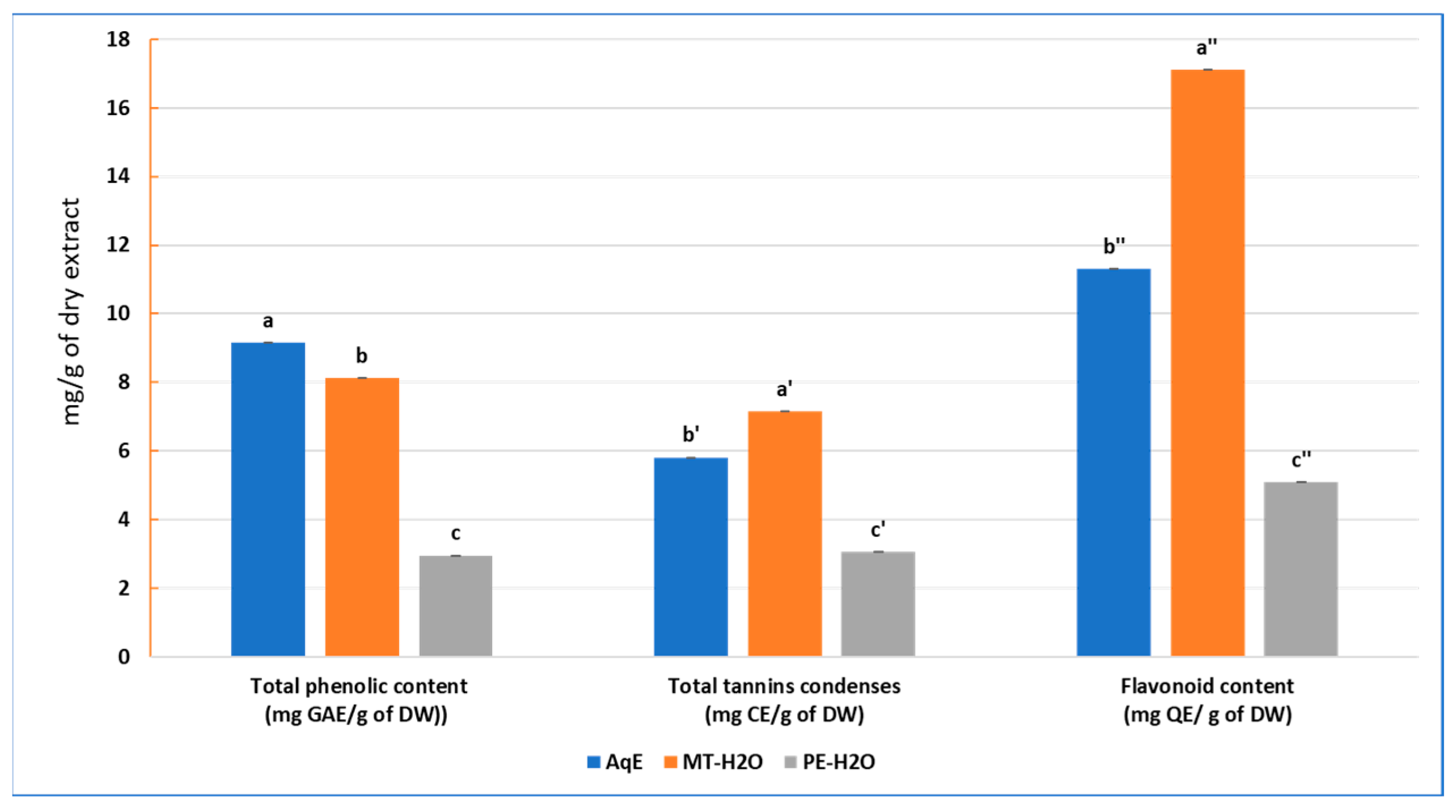
3.3.1. Total Phenolic Content
3.3.2. Condensed Tannins Content
3.3.3. Total Flavonoid Content
3.3.4. Antioxidant Activity of M. pubescens Extracts
DPPH Radical Scavenging Assay
ABTS Radical Cation Scavenging Assay
Ferric Reducing Power Assay
3.3.5. Antimicrobial Activity
Disc Diffusion Assay on Agar Medium
- Non-sensitive strains include all those exposed to the petroleum ether extract. Pseudomonas aeruginosa (for all extracts). and Salmonella abony (for PE-H2O and aqueous extracts).
- Sensitive strains include B. subtilis, S. aureus, C. albicans, and T. rubrum for the aqueous extract. and E. coli and C. albicans for the hydro-methanolic extract.
- Highly sensitive strains were limited to B. subtilis, S. aureus, and T. rubrum, in response to the MT-H2O extract.
Minimum Inhibitory Concentration (MIC) and Minimum Fungicidal Concentration (MFC) of M. pubescens
4. Discussion
5. Conclusions
Author Contributions
Funding
Institutional Review Board Statement
Informed Consent Statement
Data Availability Statement
Acknowledgments
Conflicts of Interest
References
- Roosta, R.A.; Moghaddasi, R.; Hosseini, S.S. Export target markets of medicinal and aromatic plants. J. Appl. Res. Med. Aromat. Plants 2017, 7, 84–88. [Google Scholar] [CrossRef]
- Aware, C.B.; Patil, D.N.; Suryawanshi, S.S.; Mali, P.R.; Rane, M.R.; Gurav, R.G.; Jadhav, J.P. Natural bioactive products as promising therapeutics: A review of natural product-based drug development. S. Afr. J. Bot. 2022, 151, 512–528. [Google Scholar] [CrossRef]
- Napagoda, M.; Wijesundara, D. Medicinal plants as sources of novel therapeutics: The history, present, and future. Chem. Nat. Prod. Phytochem. Pharm. Med. Plants 2022, 3, 4–18. [Google Scholar]
- Aye, M.M.; Aung, H.T.; Sein, M.M.; Armijos, C. A review on the phytochemistry, medicinal properties and pharmacological activities of 15 selected Myanmar medicinal plants. Molecules 2019, 24, 293. [Google Scholar] [CrossRef]
- Muteeb, G.; Rehman, M.T.; Shahwan, M.; Aatif, M. Origin of antibiotics and antibiotic resistance, and their impacts on drug development: A narrative review. Pharmaceuticals 2023, 16, 1615. [Google Scholar] [CrossRef]
- Rana, M.S.; Hur, S.J. Antibiotics in livestock and their effects on human health: Mini review. Resour. Sci. Res. 2022, 4, 12–20. [Google Scholar] [CrossRef]
- Chaudhary, A.S. A review of global initiatives to fight antibiotic resistance and recent antibiotics’ discovery. Acta Pharm. Sin. B 2016, 6, 552–556. [Google Scholar] [CrossRef]
- Rudramurthy, G.R.; Swamy, M.K.; Sinniah, U.R.; Ghasemzadeh, A. Nanoparticles: Alternatives against drug-resistant pathogenic microbes. Molecules 2016, 21, 836. [Google Scholar] [CrossRef]
- Maiza, K.; de La Perrière, R.B.; Hammiche, V. Pharmacopée traditionnelle saharienne: Sahara septentrional. In Proceedings of the 2nd European Symposium on Ethnopharmacology and the 11th International Conference on Ethnomedicine, Heidelberg, Germany, 24–27 March 1993; ORSTOM: Marseille, France; pp. 24–27. [Google Scholar]
- Ozenda, P. Flore et Végétation du Sahara, 3rd ed.; CNRS: Paris, France, 1991; p. 662.
- Maiza, K.; Hammiche, V.; Maiza Benabdesselam, F. Traditional medicine in North Sahara: The “Deffi”. Life Sci. Leafl. 2011, 6, 551–560. [Google Scholar]
- Ben-Moussa, M.T.B.; Hadef, Y.; Bouncer, H.; Oudjehih, M.; Beichi, F.; Aouidane, S.; Benaldjia, H. Enquête ethnobotanique sur Matricaria pubescens (Desf.) Schultz (Asteraceae) auprès de la population des régions sud-est d’Algérie. Thérapeutique 2020, 35, 1–17. [Google Scholar]
- Taibi, K.; Abderrahim, L.A.; Boussaid, M.; Taibi, F.; Achir, M.; Souana, K.; Benaissa, T.; Farhi, K.H.; Naamani, F.Z.; Said, K.N. Unraveling the ethnopharmacological potential of medicinal plants used in Algerian traditional medicine for urinary diseases. Eur. J. Integr. Med. 2021, 4, 101333. [Google Scholar] [CrossRef]
- Elhasnaoui, A.; Janah, I.; El-Haidani, A.; Lahrach, N. Medicinal knowledge and ethnopharmacological applications of Matricaria pubescens (Desf.) Sch.Bip in the Draa-Tafilalet region, Morocco. Ethnobot. Res. Appl. 2025, 30, 1–9. [Google Scholar] [CrossRef]
- Elhasnaoui, A.; Janah, M.; Ait Tastift, M.; El-Haidani, A.; Lahrach, N. Comprehensive review on Matricaria pubescens: Traditional uses, chemical composition, and pharmacological potential. Sci. Afr. 2025, 29, e02865. [Google Scholar] [CrossRef]
- Metrouh-Amir, H.; Duarte, C.M.; Maiza, F. Solvent effect on total phenolic contents, antioxidant, and antibacterial activities of Matricaria pubescens. Ind. Crops Prod. 2015, 67, 249–256. [Google Scholar] [CrossRef]
- Sqalli, H.; El Ouarti, A.; Ennabili, A.; Ibnsouda, S.; Farah, A.; Haggoud, A.; Houari, A.; Iraqui, M. Évaluation de l’effet antimycobactérien de plantes du centre-nord du Maroc. Bull. Pharm. Sci. 2007, 146, 271–288. [Google Scholar]
- Durazzo, A.; Lucarini, M.; Souto, E.B.; Cicala, C.; Caiazzo, E.; Izzo, A.A.; Novellino, E.; Santini, A. Polyphenols: A concise overview on the chemistry, occurrence, and human health. Phytother. Res. 2019, 33, 2221–2243. [Google Scholar] [CrossRef]
- Bimakr, M.; Rahman, R.A.; Taip, F.S.; Ganjloo, A.; Salleh, L.M.; Selamat, J.; Hamid, A.; Zaidul, I.S.M. Comparison of different extraction methods for the extraction of major bioactive flavonoid compounds from spearmint (Mentha spicata L.) leaves. Food Bioprod. Process. 2011, 89, 67–72. [Google Scholar] [CrossRef]
- Bolliger, H.R.; Brenner, M.; Gänshirt, H.; Mangold, H.K.; Seiler, H.; Stahl, E.; Waldi, D. Spray reagents for thin-layer chromatography. In Thin-Layer Chromatography: A Laboratory Handbook; Stahl, E., Ed.; Springer: Berlin/Heidelberg, Germany, 1965; pp. 483–502. [Google Scholar]
- Finar, I.L. Stereochemistry and Chemistry of Natural Products, 2nd ed.; Longman: Singapore, 1986; p. 682. [Google Scholar]
- Evans, W.C.; Trease, G.E. Trease and Evans’ Pharmacognosy, 14th ed.; W.B. Saunders: London, UK, 1996. [Google Scholar]
- Kokate, C.K. Practical Pharmacognosy; Vallabh Prakashan Publication: New Delhi, India, 1999; p. 115. [Google Scholar]
- Bruneton, J. Pharmacognosie—Phytochimie, Plantes Médicinales, 4th ed.; Revue et Augmentée; Lavoisier, Tec & Doc—Éditions Médicales Internationales: Paris, France, 2009; p. 1288. [Google Scholar]
- Chaouche, T.; Haddouchi, F.; Bekkara, F.A. Phytochemical study of roots and leaves of the plant Echium pycnanthum Pomel. Der Pharm. Lett. 2011, 3, 1–4. [Google Scholar]
- Li, H.B.; Wong, C.C.; Cheng, K.W.; Chen, F. Antioxidant properties in vitro and total phenolic contents in methanol extracts from medicinal plants. LWT Food Sci. Technol. 2008, 41, 385–390. [Google Scholar] [CrossRef]
- Xu, B.J.; Chang, S.K. A comparative study on phenolic profiles and antioxidant activities of legumes as affected by extraction solvents. J. Food Sci. 2007, 72, S159–S166. [Google Scholar] [CrossRef]
- Ayyobi, N.; Fattahi, M. Induction effects of colchicine and chitosan on rosmarinic acid production in hairy root cultures of Zarrin-Giah (Dracocephalum kotschyi Boiss). Iran. J. Biol. 2017, 30, 1–13. [Google Scholar]
- Von Gadow, A.; Joubert, E.; Hansmann, C.F. Comparison of the antioxidant activity of aspalathin with that of other plant phenols of rooibos tea (Aspalathus linearis), α-tocopherol, BHT, and BHA. J. Agric. Food Chem. 1997, 45, 632–638. [Google Scholar] [CrossRef]
- Oyaizu, M. Studies on products of browning reaction: Antioxidative activities of products of browning reaction prepared from glucosamine. Jpn. J. Nutr. Diet. 1986, 44, 307–315. [Google Scholar] [CrossRef]
- Boussaada, O.; Ammar, S.; Saidana, D.; Chriaa, J.; Chraif, I.; Daami, M.; Helal, A.N.; Mighri, Z. Chemical composition and antimicrobial activity of volatile components from capitula and aerial parts of Rhaponticum acaule DC growing wild in Tunisia. Microbiol. Res. 2008, 163, 87–95. [Google Scholar] [CrossRef] [PubMed]
- Ponce, A.G.; Fritz, R.; Del Valle, C.; Roura, S.I. Antimicrobial activity of essential oils on the native microflora of organic Swiss chard. LWT Food Sci. Technol. 2003, 36, 679–684. [Google Scholar] [CrossRef]
- Mann, C.M.; Markham, J.L. A new method for determining the minimum inhibitory concentration of essential oils. J. Appl. Microbiol. 1998, 84, 538–544. [Google Scholar] [CrossRef]
- Yeshi, K.; Crayn, D.; Ritmejerytė, E.; Wangchuk, P. Plant secondary metabolites produced in response to abiotic stresses have potential application in pharmaceutical product development. Molecules 2022, 27, 313. [Google Scholar] [CrossRef]
- Hilal, B.; Khan, M.M.; Fariduddin, Q. Recent advancements in deciphering the therapeutic properties of plant secondary metabolites: Phenolics, terpenes, and alkaloids. Plant Physiol. Biochem. 2024, 211, 108674. [Google Scholar] [CrossRef] [PubMed]
- Temerdashev, Z.A.; Chubukina, T.K.; Vinitskaya, E.A.; Kiseleva, N.V. Chromatographic assessment of the concentration of phenolic compounds in wild chamomile (Matricaria chamomilla L.) extracts obtained under various extraction conditions. J. Anal. Chem. 2023, 78, 497–506. [Google Scholar] [CrossRef]
- Nawaz, H.; Shad, M.A.; Rehman, N.; Andaleeb, H.; Ullah, N. Effect of solvent polarity on extraction yield and antioxidant properties of phytochemicals from bean (Phaseolus vulgaris) seeds. Braz. J. Pharm. Sci. 2020, 56, e17129. [Google Scholar] [CrossRef]
- Hosseini, H.; Bolourian, S.; Yaghoubi Hamgini, E.; Ghanuni Mahababadi, E. Optimization of heat- and ultrasound-assisted extraction of polyphenols from dried rosemary leaves using response surface methodology. J. Food Process Preserv. 2018, 42, e13778. [Google Scholar] [CrossRef]
- Dalila, G.; Abdelkader, A.; Reda, B.A.; Moufida, H.; Djamila, M. Phytochemical screening and evaluation of antibacterial and antifungal properties of extracts of Matricaria pubescens (Desf) growing in southwest Algeria. Egypt. Acad. J. Biol. Sci. C Physiol. Mol. Biol. 2022, 14, 511–515. [Google Scholar] [CrossRef]
- Makhloufi, A.; Moussaoui, A.; Lazouni, H.A. Antibacterial activities of essential oil and crude extracts from Matricaria pubescens (Desf.) growing wild in Bechar, southwest of Algeria. J. Med. Plant Res. 2012, 6, 3124–3128. [Google Scholar]
- Palaiogiannis, D.; Chatzimitakos, T.; Athanasiadis, V.; Bozinou, E.; Makris, D.P.; Lalas, S.I. Successive solvent extraction of polyphenols and flavonoids from Cistus creticus L. leaves. Oxygen 2023, 3, 274–286. [Google Scholar] [CrossRef]
- Vermerris, W.; Nicholson, R. Isolation and identification of phenolic compounds: A practical guide. In Phenolic Compound Biochemistry; Springer: Dordrecht, The Netherlands, 2006; pp. 151–196. [Google Scholar]
- González-Montelongo, R.; Lobo, M.G.; González, M. Antioxidant activity in banana peel extracts: Testing extraction conditions and related bioactive compounds. Food Chem. 2010, 119, 1030–1039. [Google Scholar] [CrossRef]
- Shahidi, F.; Ambigaipalan, P. Phenolics and polyphenolics in foods, beverages and spices: Antioxidant activity and health effects—A review. J. Funct. Foods 2015, 18, 820–897. [Google Scholar] [CrossRef]
- Muanda, F.N. Identification de Polyphénols, Evaluation de Leur Activité Antioxydante et Etude de Leurs Propriétés Biologiques. Ph.D. Thesis, Université Paul Verlaine-Metz, Metz, France, 2010. [Google Scholar]
- De Rossi, L.; Rocchetti, G.; Lucini, L.; Rebecchi, A. Antimicrobial potential of polyphenols: Mechanisms of action and microbial responses—A narrative review. Antioxidants 2025, 14, 200. [Google Scholar] [CrossRef]
- Nisa, L.; Landis, B.N.; Giger, R.; Leuchter, I. Pharyngolaryngeal involvement by varicella-zoster virus. J. Voice 2013, 27, 636–641. [Google Scholar] [CrossRef] [PubMed]
- Oulahal, N.; Degraeve, P. Phenolic-rich plant extracts with antimicrobial activity: An alternative to food preservatives and biocides? Front. Microbiol. 2022, 12, 753518. [Google Scholar] [CrossRef]
- Górniak, I.; Bartoszewski, R.; Króliczewski, J. Comprehensive review of antimicrobial activities of plant flavonoids. Phytochem. Rev. 2019, 18, 241–272. [Google Scholar] [CrossRef]
- Elhasnaoui, A.; Janah, I.; Amssayef, A.; Haidani, A.; Lahrach, N. Ethnopharmacological survey of medicinal plants used in traditional treatment of respiratory system disorders in the Southeast region of Morocco. Plant Sci. Today 2024, 11. [Google Scholar] [CrossRef]
- Elhasnaoui, A.; Janah, I.; El Bouny, H.E.; Amssayef, A.; Haidani, A.; Lahrach, N. Medicinal plants used in the treatment of urogenital disorders in the Drâa-Tafilalet region of Southeastern Morocco: An ethnobotanical survey. Sci. Afr. 2024, 26, e02464. [Google Scholar] [CrossRef]


| Extracts | Yield (%) |
|---|---|
| Aqueous | 16 |
| Methanol-water (70/30) | 12 |
| Petroleum ether-water (70/30) | 3.5 |
| Compound Class | AqE | MT-H2O | PE-H2O |
|---|---|---|---|
| Alkaloids | ++ | ++ | + |
| Polyphenols | ++ | ++ | + |
| Flavonoids | ++ | +++ | + |
| Tannins | + | + | ++ |
| Quinones | − | − | − |
| Anthraquinones | − | − | − |
| Saponins | − | + | − |
| Phytosterols, Sesquiterpenes, Terpenoids | + | +++ | ++ |
| Extract | DPPH | RPC | ABTS |
|---|---|---|---|
| AqE | 3.82 ± 0.03 c | 12.23 ± 0.12 c | 9.25 ± 0.10 c |
| MT-H2O | 3.15 ± 0.04 b | 9.10 ± 0.06 b | 7.32 ± 0.06 b |
| PE-H2O | 5.48 ± 0.07 d | 14.40 ± 0.08 d | 11.27 ± 0.09 d |
| BHT | 0.04 ± 0.001 a | 2.41 ± 0.13 a | 0.21 ± 0.002 a |
| Extract | S. aureus | B. subtilis Subsp. Spizizenii | S. abony | E. coli | P. aeruginosa | K. pneumonie | C. albicans | T. rubrum |
|---|---|---|---|---|---|---|---|---|
| AqE | 10 ± 0.19 c | 12 ± 0.11 c | 8 ± 0.32 b | 6 ± 0.00 c | 6 ± 0.00 b | 6 ± 0.00 b | 10 ± 0.25 c | 10 ± 0.34 c |
| MT-H2O | 30 ± 0.32 b | 32 ± 0.48 b | 8 ± 0.60 b | 10 ± 0.65 b | 6 ± 0.00 b | 6 ± 0.00 b | 12 ± 0.38 b | 17 ± 0.41 b |
| PE-H2O | 6 ± 0.00 d | 6 ± 0.00 d | 6 ± 0.00 c | 6 ± 0.00 c | 6 ± 0.00 b | 6 ± 0.00 b | 6 ± 0.00 d | 6 ± 0.00 d |
| Imipenem | 42 ± 0.56 a | 40 ± 0.12 a | 38 ± 0.17 a | 36 ± 0.30 a | 24 ± 0.15 a | 25 ± 0.10 a | ND | ND |
| Fluconazole | ND | ND | ND | ND | ND | ND | 28 ± 0.25 a | 18 ± 0.28 a |
| S. aureus | B. subtilis Subsp. Spizizenii | S. abony | E. coli | P. aeruginosa | K. pneumonie | C. albicans | T. rubrum |
|---|---|---|---|---|---|---|---|
| 0.93 | 0.93 | 15 | 7.5 | 30 | 15 | 7.5 | 7.5 |
Disclaimer/Publisher’s Note: The statements, opinions and data contained in all publications are solely those of the individual author(s) and contributor(s) and not of MDPI and/or the editor(s). MDPI and/or the editor(s) disclaim responsibility for any injury to people or property resulting from any ideas, methods, instructions or products referred to in the content. |
© 2025 by the authors. Licensee MDPI, Basel, Switzerland. This article is an open access article distributed under the terms and conditions of the Creative Commons Attribution (CC BY) license (https://creativecommons.org/licenses/by/4.0/).
Share and Cite
Abdelhadi, E.; Iman, J.; Mohamed, A.-E.-M.; Khalid, S.; Ismail, B.; Mohamed, E.; Nadia, L.; Ahmed, E.-H. Chemical Profiling and Biological Evaluation of Matricaria pubescens as a Promising Source of Antioxidant and Anti-Resistance Agents. Microbiol. Res. 2025, 16, 258. https://doi.org/10.3390/microbiolres16120258
Abdelhadi E, Iman J, Mohamed A-E-M, Khalid S, Ismail B, Mohamed E, Nadia L, Ahmed E-H. Chemical Profiling and Biological Evaluation of Matricaria pubescens as a Promising Source of Antioxidant and Anti-Resistance Agents. Microbiology Research. 2025; 16(12):258. https://doi.org/10.3390/microbiolres16120258
Chicago/Turabian StyleAbdelhadi, Elhasnaoui, Janah Iman, Ait-El-Mokhtar Mohamed, Sellam Khalid, Bouadid Ismail, Eddouks Mohamed, Lahrach Nadia, and El-Haidani Ahmed. 2025. "Chemical Profiling and Biological Evaluation of Matricaria pubescens as a Promising Source of Antioxidant and Anti-Resistance Agents" Microbiology Research 16, no. 12: 258. https://doi.org/10.3390/microbiolres16120258
APA StyleAbdelhadi, E., Iman, J., Mohamed, A.-E.-M., Khalid, S., Ismail, B., Mohamed, E., Nadia, L., & Ahmed, E.-H. (2025). Chemical Profiling and Biological Evaluation of Matricaria pubescens as a Promising Source of Antioxidant and Anti-Resistance Agents. Microbiology Research, 16(12), 258. https://doi.org/10.3390/microbiolres16120258