
Systematic Review

Molecular Identification of Escherichia coli Isolated from Street Foods: Global Evidence and Public Health Implications

by
Carmine Fusaro
1,
Natalia Guerrero-Vargas
2,
Yohanna Sarria-Guzmán
2,
Nancy Serrano-Silva
3,*,
Jaime E. Bernal
4,
Karina Ríos-Montes
5,
Haydee Eliza Romero Luna
6,
Josué Antonio Del Ángel Zumaya
7,
Audry Peredo-Lovillo
7 and
Francisco Erik González-Jiménez
7,*
1
Facultad de Ingenierías, Universidad de San Buenaventura, Calle Real de Ternera No. 30-966, Cartagena de Indias CP 130010, Bolívar, Colombia
2
Facultad de Ingenierías, Universidad de Cartagena, Carrera 6, Cl. de la Universidad No. 36-100, Cartagena de Indias CP 130015, Bolívar, Colombia
3
Secretaría Ejecutiva de la Comisión Intersecretarial de Bioseguridad de Organismos Genéticamente Modificados (Cibiogem), Av. Insurgentes Sur 1582, Col. Crédito Constructor, Benito Juárez, Ciudad de México 03940, Mexico
4
Facultad de Medicina, Universidad del Sinú, Av. El Bosque, Transv. 54 No. 30-729, Cartagena de Indias CP 130001, Bolívar, Colombia
5
Facultad de Ciencias de la Salud, Universidad de San Buenaventura, Calle Real de Ternera No. 30-966, Cartagena de Indias CP 130001, Bolívar, Colombia
6
Tecnológico Nacional de México, Instituto Tecnológico de Orizaba, Oriente 9 952, Emiliano Zapata, Orizaba 94320, Veracruz, Mexico
7
Facultad de Ciencias Químicas, Universidad Veracruzana, Oriente 6 1009, Rafael Alvarado, Orizaba 94430, Veracruz, Mexico
*
Authors to whom correspondence should be addressed.
Microbiol. Res. 2025, 16(12), 253; https://doi.org/10.3390/microbiolres16120253
Submission received: 21 September 2025 / Revised: 9 November 2025 / Accepted: 24 November 2025 / Published: 4 December 2025
(This article belongs to the Collection Public Health and Quality Aspects Related to Animal Productions)

Abstract

Escherichia coli (E. coli) pathotypes present in contaminated food, street food, or water are major contributors to foodborne illnesses. Polymerase chain reaction (PCR) methods are widely applied to detect and confirm E. coli pathotypes in food samples, thereby supporting outbreak prevention efforts. The objective of this study was to provide a comprehensive and reliable review of the molecular identification of E. coli isolated from street foods and to examine its public health implications. The review followed the “Preferred Reporting Items for Systematic Reviews and Meta-Analyses” (PRISMA) guidelines and included data retrieved from seven electronic scientific databases covering the period from 1 January 2015, to 15 August 2025. Relevant full-text articles were identified using the search string (“Street food”) AND (Escherichia coli), and only those that met established inclusion and exclusion criteria were selected. A total of 23 studies from Asia, Africa, Europe, and Latin America were included. These studies analyzed a wide range of street foods and beverages. MacConkey Agar and Eosin Methylene Blue Agar were the primary culture media used for the growth and isolation of E. coli. PCR was employed in 50% of the studies to amplify specific DNA segments, enabling the identification of eight E. coli pathotypes: EHEC, ETEC, EAEC (Eagg), EIEC, EPEC, UPEC, DAEC, and APEC. Additionally, a few studies reported phylogroups such as A, B1, B2, C, D, E, and Clade 1. The prevalence of E. coli in street foods varied widely, ranging from 0.5% in Chile to 100% in Mexico. Overall, this systematic review provides an updated scientific overview highlighting persistent challenges in street food safety and E. coli contamination. Across studies, three recurring issues were identified: (1) inadequate and unhygienic vending locations, (2) poor quality of food, and (3) inappropriate food preparation practices. These findings underscore the need for strategic interventions. The evidence presented could support governments and the scientific community in advancing research on E. coli in street foods and implementing corrective measures at local or regional scales, such as educational campaigns for vendors and consumers.

1. Introduction

Street food includes a wide range of foods (meat, poultry, seafood, fruits, vegetables, and grains) and beverages (water, fruit juices, milkshakes, and coffee) that are prepared and sold by street vendors in public sites (streets, marketplaces, train stations, sidewalk stalls, and public transport stops) for immediate consumption without further processing or preparation [1,2,3]. Approx. 2.5 billion customers worldwide consume street food every day [4] due to their affordability and practicality [5].
Street food micro-industries, which are generally unregulated, informal, or quasi-clandestine, provide employment for rural and urban citizens in many areas of developing countries [6]. However, many street vendors exhibit bad food-handling practices and low hygienic standards (environmental contamination) during their activities [7,8,9,10,11]; consequently, street meals, which are ideal places for the growth of pathogenic microorganisms, are potential vehicles of foodborne bacterial diseases [12]. The pathogens, such as Klebsiella pneumonia, Staphylococcus aureus, Salmonella spp., Listeria monocytogenes, and E. coli, can cause mild or severe disease symptoms that include fever, headache, nausea, vomiting, abdominal pain, and severe diarrhea [13,14,15,16].
In particular, E. coli is a Gram-negative, usually motile, non-spore-forming, chemoorganotrophic, facultative anaerobic bacillus belonging to the Enterobacteriaceae family [17,18,19]; the bacteria inhabit the gastrointestinal tracts of the intestines of warm-blooded animals, including humans, forming part of the gut microbiota and protecting the gastrointestinal epithelium from other pathogenic microorganisms [20,21]. However, E. coli commensal strains can acquire specific virulence attributes, causing a broad spectrum of diseases [22,23], including cholecystitis, bacteremia, cholangitis, urinary tract infections, and traveler’s diarrhea [24].
Based on virulence factors, infection sites, and disease mechanisms, pathogenic E. coli have been divided into two main groups: Intestinal Pathogenic E. coli (IPEC) and Extraintestinal Pathogenic E. coli (ExPEC) [25].
The IPEC group comprises six pathogenic pathotypes that cause different diseases, namely (1) diffusely adherent E. coli (DAEC)—diarrhea in children; (2) enteroaggregative E. coli (EAEC)—persistent diarrhea; (3) enterohemorrhagic E. coli (EHEC)—hemorrhagic colitis and hemolytic–uremic syndrome; (4) enteroinvasive E. coli (EIEC)—watery diarrhea and dysentery; (5) enteropathogenic E. coli (EPEC)—diarrhea in children and animals; and (6) enterotoxigenic E. coli (ETEC)—traveler’s diarrhea [26,27,28].
The ExPEC group comprises five variants that can colonize and induce disease in bodily sites outside of the gastrointestinal tract, namely (1) avian pathogenic E. coli (APEC)—colibacillosis in avian species; (2) mammary pathogenic E. coli (MPEC)—bovine mastitis; (3) neonatal meningitis E. coli (NMEC)—neonatal meningitis; (4) sepsis-associated E. coli (SEPEC)—septicemia; (5) uropathogenic E. coli (UPEC)—urinary tract infection [29,30,31,32,33]. Four E. coli pathotypes: ETEC, EPEC, EHEC, and EIEC, frequently found in contaminated food, street food, or water, are responsible for foodborne illnesses [34].
Pathotypes refer to groups of E. coli strains classified according to their virulence factors, mechanisms of infection, and clinical symptoms. These classifications are based on phenotypic traits and pathogenic behavior in humans or animals [20,25]. In contrast, phylogroups refer to genetically distinct lineages of E. coli, determined through molecular analyses of conserved genes, which reflect evolutionary relationships and ecological adaptations [20,35,36,37].
E. coli is divided into several phylogroups based on genetic diversity, which is closely related to their ecological niches and pathogenic potential. Historically, four main phylogroups (A, B1, B2, and D) were identified [36], but research has expanded this classification, and a more refined classification [37] has described eight phylogroups (A, B1, B2, C, D, E, F, and Escherichia cryptic clade I). Additional phylogroups, G and H, have also been identified through whole-genome sequence analyses [38,39]. Recently, a large-scale genome analysis of E. coli expanded this further, identifying 14 distinct phylogroups, with each group showing genetic distinctions based on core gene differences and varied gene gain/loss patterns [35]. These phylogroups are not just genetic subdivisions but also align with specific ecological niches and disease-causing potential. For instance, phylogroups B2 and D are more commonly associated with extra-intestinal infections, while groups like A and B1 are more prevalent in commensal strains [35,37]. This refined understanding of phylogroup structure allows for better epidemiological tracking and characterization of E. coli strains.
Rapid and accurate molecular methods are currently used to detect or confirm E. coli pathotypes in food and other samples [19,40]; the polymerase chain reaction (PCR) methods that are applied in many laboratories include conventional PCR, multiplex PCR, quadruplex PCR, nested PCR, quantitative PCR (qPCR), reverse-transcription PCR (RT-PCR), and Droplet Digital PCR (ddPCR) [41,42,43].
Molecular E. coli characterization in food samples can be confirmed with multiple marker genes such as adk, agg, arpA, bfpA, chuA, cyd, eaeA, eagg, elt, esth, estp, fliCH7, gadA, hlyA, ipaH, lacY, lacZ, lt, malB, phoA, rbfO157, rfbE, st, stx 1, stx 2, TspE4.C2, uidA, uspA, yjaA, and 16SrDNA [41,44,45,46,47,48,49,50,51,52].
E. coli is used as a more specific indicator of fecal contamination than other fecal coliform species [19,53,54,55]. Infection prevention for E. coli requires control measures at all stages of the food chain, from agricultural production, manufacturing, to preparation of foods in both commercial establishments, household kitchens, or street food stands [56]. Molecular methods allow for quick analysis of food samples and possible early detection of infection focal points [57].
Scientific studies oriented to analyze primary sources of E. coli outbreaks, such as raw or undercooked ground-meat products, raw milk, and vegetables sold in the streets of many cities, are essential activities to achieve food safety and to improve the quality of life and psychophysical health of humans worldwide.
A previous systematic review by Koumassa et al. [58] indicated that bacteria such as E. coli are frequently identified in street food sold in developing countries due to poor hygiene practices and knowledge, inadequate preparation methods, substandard packaging, and poor environmental conditions, while Heredia & García [59] suggested that foods of animal origin are potential vehicles of foodborne pathogens. As a further example, E. coli exceeded the acceptable limits in 20.8% of grilled-pork samples tested by Anihouvi et al. [60] in Benin. Even the data collected by Salamandane et al. [2] pointed in the same direction: the microbiological quality of water and street food sold in Maputo (Mozambique) was generally unsatisfactory for human consumption due to contamination with E. coli.
A complex and multidisciplinary approach based on relevant and recent studies is required to prevent and control outbreaks of foodborne pathogens while at the same time promoting food safety. The objective was to present a comprehensive and reliable report on the molecular identification of E. coli isolated from street foods on a global scale. For the first time, in addition to the standard information (i.e., country, food type, sample size, and E. coli prevalence), molecular parameters (i.e., DNA extraction and detection methods, target genes, and product sizes) were also collected and analyzed, offering readers a broader view of this public health problem. Starting from our results, governments and the scientific community could further study E. coli in street food and, at the same time, carry out corrective actions or educational hygienic campaigns with vendors and citizens worldwide.

2. Materials and Methods

The systematic review of the literature was performed according to the standardized method of Preferred Reporting Items for Systematic Reviews and Meta-Analyses (PRISMA) and the statement guidelines and the checklist of Moher et al. [61]. Supplementary File S1 presents the PRISMA checklist for this study.

2.1. Search Strategy

Searching the literature published from 1 January 2015 to 15 August 2025 was carried out by an author (YSG). Seven electronic scientific databases, including ISI Web of Science (Clarivate Analytics, London, UK), EBSCOhost (EBSCO Industries, Birmingham, AL, USA), EMBASE (Elsevier, Amsterdam, The Netherlands), Science Direct (Elsevier, Amsterdam, The Netherlands), SciELO (São Paulo Research Foundation—FAPESP, São Paulo, São Paulo, Brazil), Scopus (Elsevier, Amsterdam, The Netherlands), PubMed (National Library of Medicine of USA—NLM, Bethesda, MD, USA), were searched individually for the relevant full-text articles using the following search string:
(((street food [Title/Abstract]) OR (street foods [Title/Abstract])) AND (Escherichia coli [Title/Abstract])) OR (E. coli [Title/Abstract]) Filters: from 2015–2025.

2.2. Inclusion Criteria

The inclusion criteria applied to full-texts for assessing their eligibility were (a) original articles focusing on the molecular identification of E. coli isolated from street foods, (b) articles published from 1 January 2015 to 15 August 2025, (c) articles written in English, (d) studies limited to street food, (e) molecular identification of E. coli, and (f) articles published in peer-reviewed journals inserted in the Scimago Quartiles Rankings (SJR) database.

2.3. Exclusion Criteria

The exclusion criteria applied to full-texts for assessing their eligibility were (a) abstracts not associated with the full article, (b) articles published in non-peer-reviewed sources, (c) articles not written in English, (d) reviews of literature or meta-analyses, (e) letter to the editor, (f) data note, (g) short communication, and (h) studies with high risk of bias based on the Joanna Briggs Institute (JBI) tool [62].

2.4. Selection of Studies

The identified articles were compiled using Mendeley Desktop Reference Management System 2.111.0, and the duplicates were removed. Subsequently, two authors (Y.S.-G. and N.G.-V.) independently screened titles and abstracts. Irrelevant titles were removed. A third author (C.F.) made a final decision when two reviewers had differing opinions.
Inclusion and exclusion criteria were subsequently applied to full texts to assess the eligibility of the selected published material. Two authors (Y.S.-G and N.G.-V.) independently analyzed the full-text papers, and only those that met all criteria were finally selected. Disagreements between the two researchers were resolved through consultation with a third author (C.F.).

2.5. Data Extraction Matrix

Article—level data were extracted from each selected paper; subsequently, it was summarized and tabulated in an analysis matrix developed in MS Excel® (Excel for Microsoft 365). The summarized information was organized in eighteen columns with the following subjects: (a) reference, (b) country, (c) rural/urban, (d) sample collection period, (e) quartile, (f) risk of bias, (g) food type, (h) sample size, (i) sample weight, (j) isolation of E. coli, (k) DNA extraction method, (l) detection method, (m) target gene, (n) product size, (o) sample size, (p) positive samples, (q) prevalence, and (r) confidence interval (CI).

2.6. Quality Assessment

The standard tool, JBI, was used to assess the quality and risk of bias of the observational studies [62]. The tool is commonly used as guidance for conducting reviews, qualitative studies, prevalence/incidence analysis, diagnostic tests, mixed-method analyses, and scoping reviews.
The checklist consists of nine questions, each with four possible answers (yes, no, unclear, and not applicable). The JBI tool has a score-rating system to assess the quality of studies: high quality (7–9), moderate (4–6), and low quality (less than 4) (Supplementary File S2). Two researchers (Y.S.-G. and N.G.-V.) separately assessed the risk of bias. Disagreements between the two researchers were resolved through consultation with a third author (CF).

3. Results

3.1. Literature Search

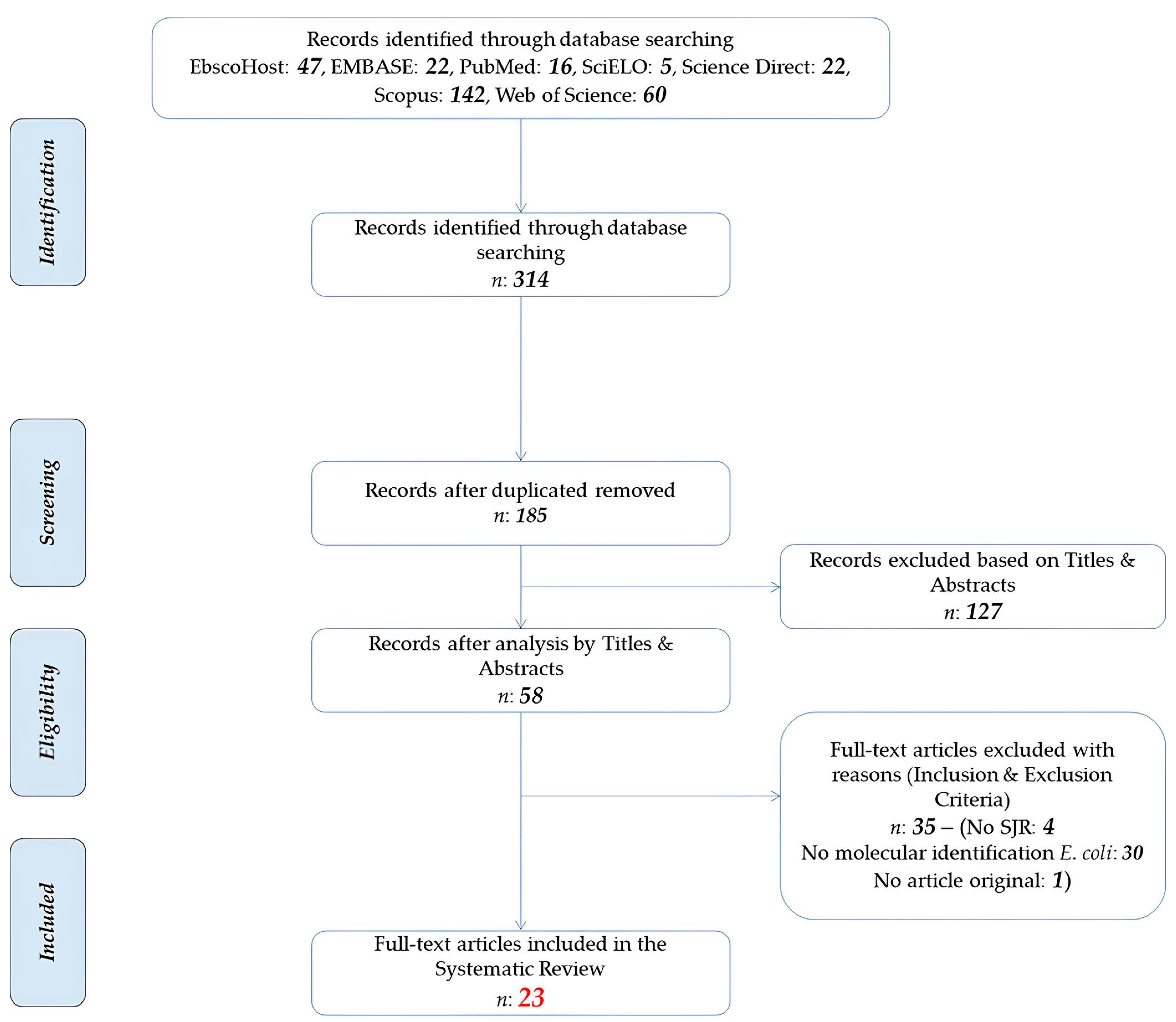
The PRISMA Statement flow diagram that indicates the four phases of the literature search (identification, screening, eligibility, and inclusion) is shown in Figure 1. During the identification phase, a total of 314 articles were recorded. Duplicates were automatically removed via bibliographic management software; the remaining 188 articles were screened for title and abstract pertinence. Only 58 articles that have passed the screening phase were assessed based on pre-established inclusion and exclusion criteria. Finally, 23 articles [63,64,65,66,67,68,69,70,71,72,73,74,75,76,77,78,79,80,81,82,83,84,85] were included in this systematic review.

3.2. Characteristics of the Selected Studies

The basic characteristics of the selected studies, i.e., country, region (rural/urban), sample collection period (months), SJR quartile, and risk of bias (score, moderate/low), are summarized in Table 1.
Eleven of twenty-three studies (47.8%) were developed in Asian countries, i.e., Bangladesh [65,68,72,82], India [71,81], Indonesia [66,76], Iraq [83], and Malaysia [69,74]. Six studies (26.1%) were performed in African countries, i.e., Algeria [84], Egypt [73], Nigeria [70], and South Africa [63,67,78]. Five studies (21.7%) were implemented in American countries, i.e., Brazil [67], Chile [80], Ecuador [79,85], and Mexico [75]. Only one study was performed in Europe (Lisbon, Portugal) [64].
All studies included in this review were conducted in urban or peri-urban contexts; the length of the sample collection periods varied from one [72,83] to thirty-four months [64].
All selected articles were published in journals belonging to the SJR database; more specifically, six articles (26.1%) were published in Q1 SJR journals [70,72,73,75,78,84], seven articles (30.4%) in Q2 SJR journals [64,68,77,79,80,81,83], five articles (21.7%) in Q3 SJR journals [63,66,69,74,85], and five articles (21.7%) were found in Q4 SJR journals [65,67,71,76,82].
Thirteen studies (56.5%) had a low risk of bias [64,68,70,72,73,75,77,78,79,80,81,83,84], while ten studies (43.5%) showed a moderate risk of bias [63,65,66,67,69,71,74,76,82,85].

3.3. Pre-Enrichment and Isolation Culture Media

Different types of street foods (beef, poultry, seafood, cheese, eggs, fruits, vegetables, and grains) and beverages (sodas and fruit juices) were analyzed. Collected samples (weight between 1 and 50 g) from various street vendors were mashed or homogenized.
Before molecular identification, most studies used culture-based methods to improve the recovery of E. coli from food matrices (Table 2). Frequently, the food samples were inoculated in buffered peptone water medium for pre-enrichment culture; this preliminary methodological step was applied in thirteen of the selected studies (56.5%) [64,66,68,71,73,74,77,78,79,80,81,83,84]. Various culture media, i.e., liquid media (nutrient broths) and solid media (Agar plates), were used for the growth and isolation of E. coli in the laboratory. The most commonly used growth media were (1) MacConkey Agar (employed in eleven studies—47.8%) [68,70,71,72,73,75,80,81,82,83,84], (2) Eosin methylene blue Agar (employed in nine studies—39.1%) [67,68,69,71,72,75,78,79,81], and (3) Plate Count Agar (employed in four studies—17.4%) [67,73,74,79]. Most of the studies focused on identifying diarrheagenic E. coli pathotypes (IPEC), including EHEC, ETEC, EAEC, EIEC, EPEC, and APEC, confirming the clinical and epidemiological relevance of the isolates.

3.4. Molecular Identification of E. coli

The main characteristics of the applied experimental methodologies are presented in Table 2.
All DNA extraction methods performed in the selected studies followed some common procedure steps, i.e., (1) disruption of cytoplasmic and nuclear membranes, (2) denaturation of nucleoprotein complexes, (3) inactivation of nucleases and other enzymes, (4) removal of biological and chemical contaminants (lipids, proteins, and other nucleic acids), and finally (5) DNA precipitation. The selected DNA extraction method depends on multiple factors, including cost, time, and contamination risks. The boiling method was applied to extract the genomic DNA from E. coli isolates in seven studies (30.4%) [67,70,72,74,79,83,85], while the DNA manual extraction was realized in four studies (17.4%) [69,71,81,82]. Frequently, DNA extraction was carried out through commercial kits, such as (1) Colony PCR [65,73,75], (2) Quick-gDNA Miniprep kit (Zymo Research, Irvine, USA) [77,78], (3) ZR Fungal/Bacterial DNA MiniPrep™ Kit [63], (4) Wizard ® Genomic DNA Purification Kit [66], (5) Macherey-Nagel NucleoSpin Tissue kit (Macherey-Nagel, Hoerdt, France) [84]. Only two groups of authors did not declare the DNA extraction method applied in their methodological protocols [68,80].
The polymerase chain reaction (PCR), sometimes called “molecular photocopying”, was used to amplify small segments of E. coli DNA in twelve studies (52.2%) [64,66,67,68,69,70,71,72,77,78,79,82]. Multiplex PCR, which is characterized by amplifying multiple sequences in a single reaction, was used in nine studies (39.1%) [64,65,73,74,75,77,80,81,83]. Quadruplex PCR was implemented in four studies (19.0%) [65,77,84,85]. The qPCR and RT-PCR methods were implemented in a few protocols [63,64,76].
Six different E. coli pathotypes were detected, more specifically: (1) EHEC in twelve studies [63,64,67,69,70,73,74,76,77,78,80,81], (2) ETEC in six studies [64,72,75,78,81,83], (3) EAEC [64,78,81], (4) EIEC [78,81], (5) UPEC [75], (6) DAEC [75], and (7) APEC [65]. Various phylogroups, such as A, B1, B2, C, D, E, and Clade1, were detected in a few studies [65,77,84,85].
All studies complemented PCR-based detection with sequencing to confirm the identity of E. coli strains, virulence genes, or to analyze pathogenic gene variants (Table 3). These sequencing studies allowed researchers to confirm the specificity of the PCR amplicons and to assess the genetic diversity among isolates: 16SrDNA—1500 bp [63], 16SrDNA—996 bp [65], 16SrDNA (V3-V4)—465 bp [79], 16SrDNA (V3-V5)—600 bp [82], adk—536 bp [68], agg—254 bp [81], arpA—400 bp [65,77,85], astA—110 bp [64], chuA—288 bp [65,77,84,85], estA—147 bp [64]; eaeA—384 pb [64,67,70,73,76,78,81], elt—511 bp [83], eltB—322 bp [64], esth—172 bp [83], estp—120 bp [73], fliCH7—247 bp [70,73,74], gadA—373 bp [84], hlyA—534 bp [73], ipaH—619 bp [66,78], lt—450 bp [72,75,76,81], vat—289 bp [75], cnf1—498 bp [75], hylA—1177 bp [75], afa—809 bp [75], rfbE—296 bp [73], rfbO157—259 bp [70,74], st—160 bp [72,76,81], stx 1—180 bp [64,67,69,70,73,74,76,78,80,81], stx 2—255 pb [64,67,70,73,74,76,78,80,81], TspE4.C2—152 bp [65,77,84,85], uidA—166 bp [65,71,83], uspA—884 bp [65], and yjaA—211 bp [65,77,84,85].

3.5. Prevalence of E. Coli in Street Food

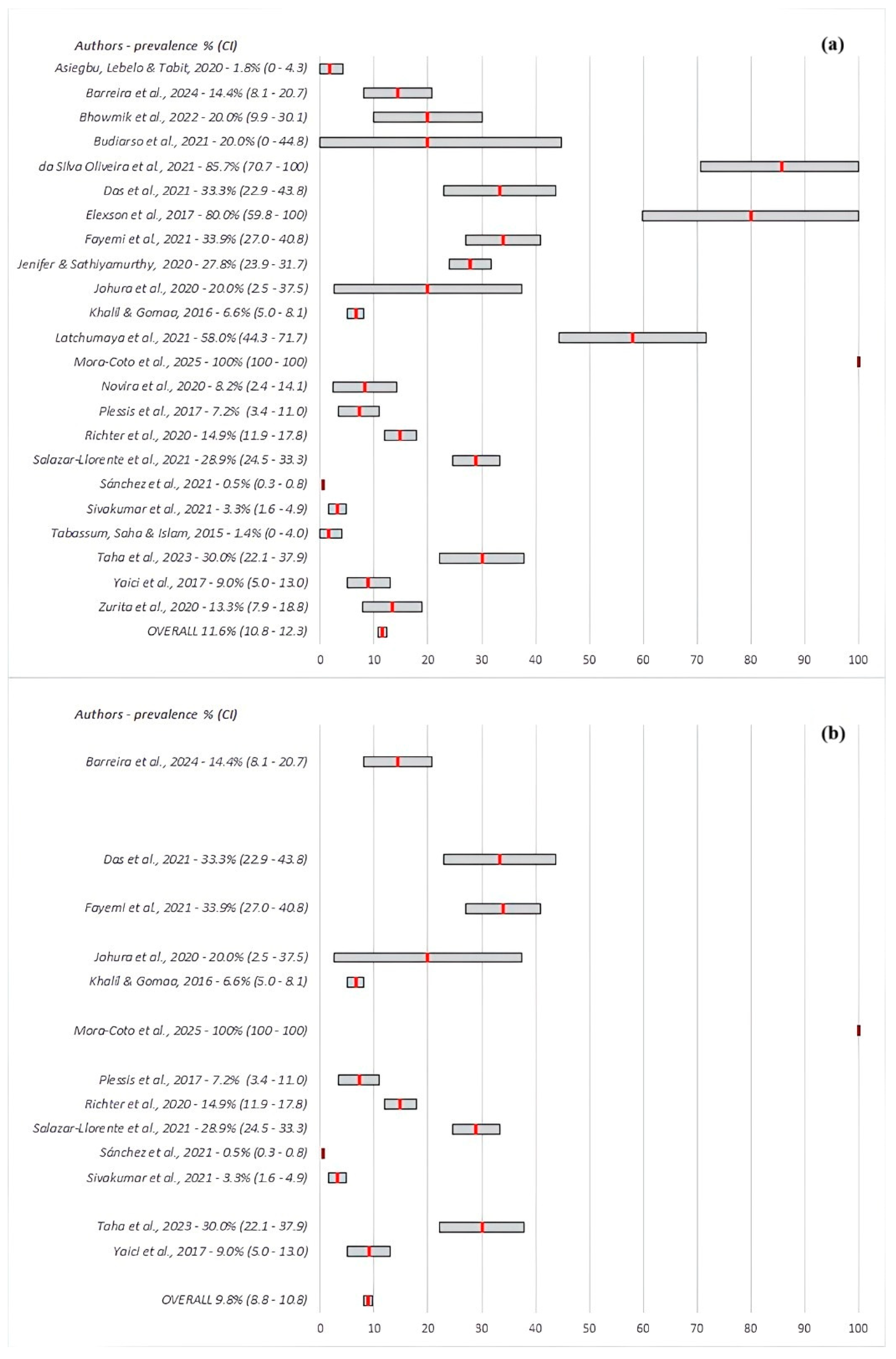
The selected studies indicated different sample sizes, from 10 [66] to 3300 food samples [80]. The street food E. coli prevalence (Figure 2a) ranged between 0.5% (Chile) [80] and 100% (Mexico) [75].
Seven studies (30.4%) reported E. coli prevalence greater than 30.0% [67,68,69,70,74,75,83]. Eight studies (34.8%) reported E. coli prevalence between 10.0% and 30.0% [64,65,66,71,72,78,79,85]. Eight studies (34.8%) reported E. coli prevalence less than 10.0% [63,73,76,77,80,81,82,84].
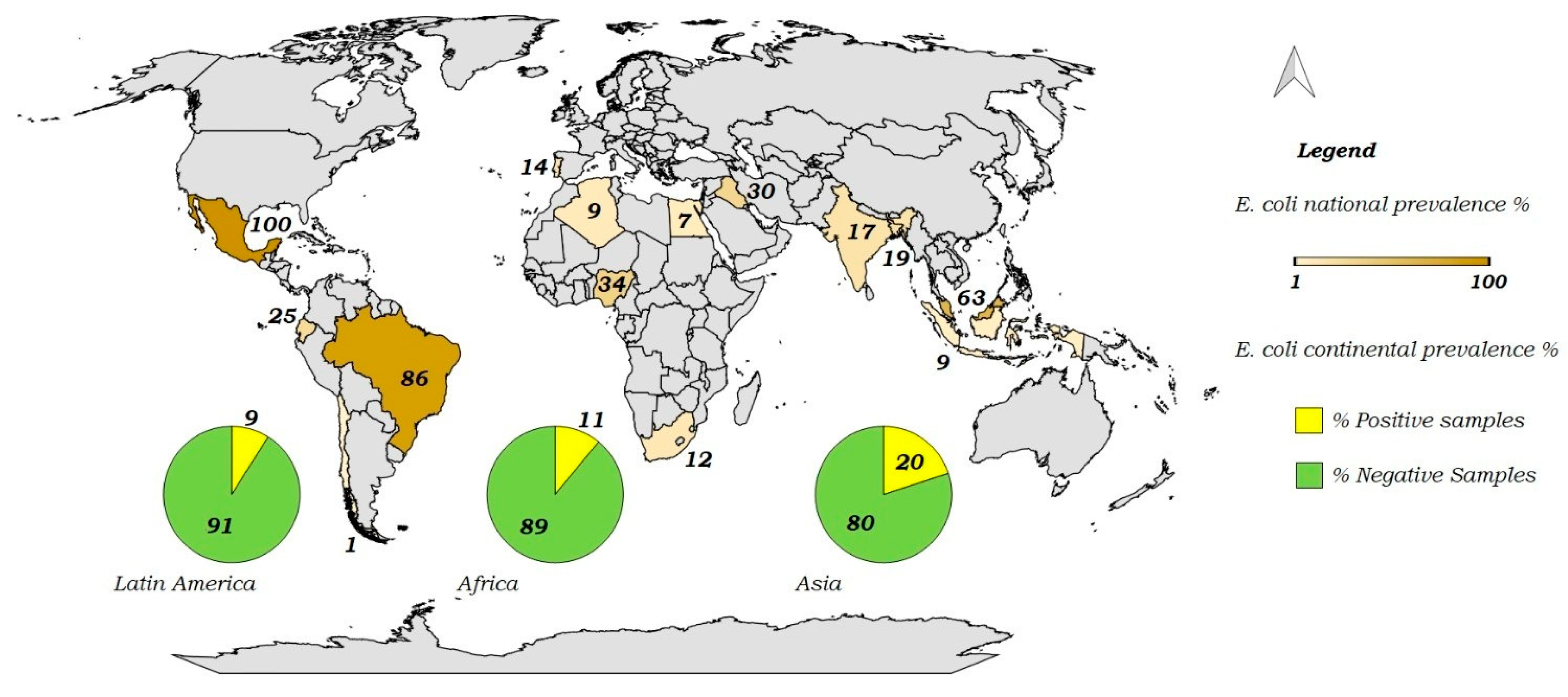
The E. coli overall prevalence (world average) in analyzed street food was 11.6% (901/7795). The greater continental E. coli prevalence was calculated based on Asian data (19.6%—285/1452); the street food E coli prevalence in Africa and Latin America street foods were equal to 11.0% (237/2160) and 8.9% (362/4065), respectively (Figure 3). The study carried out in Europe reported an E. coli prevalence of 14.4% (17/118) in the analyzed street food sold in Lisbon (Portugal). The overall prevalence decreased from 11.6% to 9.8% when only studies with a low risk of bias were considered (Figure 2b).
At the national level, the E. coli prevalence calculated based on data from India and Bangladesh (neighboring countries) was comparable, more specifically 16.5% (India) and 18.5% (Bangladesh).

4. Discussion

Street food is a mass phenomenon that transcends cultural boundaries and geographical distances [86,87] due to its low cost, wide availability, and unique flavor [86,88].
However, the global popularity of street food has raised concerns about its quality and potential bacterial contamination, as foodborne diseases have become more prevalent in recent years and pathogenic bacteria have been linked to street food [12,89,90]. Foods containing bacteria, viruses, fungi, or parasites cause around 200 diseases of variable clinical manifestations, from mild diarrhea to cancer [8,12,91], and nearly 600 million people get sick after eating contaminated food [12,92,93]. According to Pires et al. [94], almost half of foodborne diseases in the United States occur due to agricultural products, and at least one-third of the cases involve pathogenic bacteria. Furthermore, nearly 50% of the foodborne outbreaks in Europe are related to food [95]. At a global level, numerous diseases associated with food pathogens emerge every year, E. coli being one of the most frequently found [96].
Although not all E. coli strains are pathogenic, nonpathogenic strains can acquire virulent genes through horizontal gene transfer, potentially becoming harmful to human health [20,26,43,48]. These pathogenic strains can cause both extraintestinal and intestinal pathologies. However, human extraintestinal infections have increased lately [20,43,97]. E. coli is related to animal products, which, in turn, are a basis for contamination for other products and the environment that surrounds them [22,98]; in many regions worldwide, including America, Europe, Asia, and Africa, various strains related to raw meats, raw milk, ready-to-eat meats, vegetables, poultry, fruits, cereals, among others, have been reported [22,96,98,99].
The results of this systematic review have revealed the widespread presence of E. coli in street foods in various urban and peri-urban contexts. The overall prevalence (world average) of E. coli in street foods was 11.6% (Figure 2a), demonstrating that a significant proportion of food consumed on public roads is contaminated by this pathogen, posing a risk to public health. This finding is aligned with data reported in regional studies from the United States and Europe, which have indicated that up to 50% of foodborne illness outbreaks are linked to contamination of raw or minimally processed food products by bacterial pathogens, including E. coli [94,95].
In addition, the prevalence of E. coli varies considerably between continents (Figure 3), with Asia having the highest prevalence (19.6%), followed by Africa (11.0%) and Latin America (8.9%); this variability may be related to multiple factors, including hygienic conditions during food handling, sanitary infrastructure, local regulations, cultural practices in different countries [100,101,102], as well as the educational level of the sellers [103,104,105,106,107]. These observations reflect patterns documented in international literature, where limited sanitary infrastructure, informal food economies, and lack of regulatory oversight are associated with increased microbial risks in street foods [8,98].
Likewise, notable differences were observed between the types of food analyzed. The studies reviewed address a wide range of foods, from meat products to fruits and beverages. However, the lack of a standardized approach to sampling and molecular analysis could have influenced the disparity in the results between studies. Heterogeneity in sample collection periods, ranging from one to twenty-one months (Table 1), may also have affected the findings.
Regarding molecular identification methodologies, the PCR technique was widely used in studies to detect E. coli, which underscores the importance of this technique as a robust tool for the identification of pathogens in food samples, as well as for the understanding of their genetic diversity and their relationship with different ecological niches and pathogenic potential. The identification of pathotypes and phylogroups not only provides a more detailed view of the genetic structure of E. coli but also has practical implications for epidemiology and public health by facilitating better traceability of the strains and their pathogenic capacity. For example, phylogroups B2 and D are commonly associated with extraintestinal infections, while phylogroups A and B1 are usually predominant in commensal strains [35,37].
A recent Mexican study by Mora-Coto et al. [75] provides further evidence on this issue; the researchers analyzed 189 street food samples (vegetables and fruits) collected over three years and found that all of them (100%) were contaminated with E. coli. Importantly, both the intestinal (ETEC, DAEC) and the extraintestinal (UPEC) pathotypes were identified, alongside a concerning trend of antibiotic resistance. These findings reinforce the notion that street foods can act not only as vehicles of pathogenic E. coli, but also as reservoirs of antimicrobial resistance (AMR), increasing the risk for difficult-to-treat infections and underscoring the urgent need for stricter hygienic practices. Growing evidence indicates that E. coli isolated from street food can also harbor AMR, posing an additional threat to public health. Several studies included in this review, such as those by Fayemi et al. [70], Yaici et al. [84], and Zurita et al. [85], reported that E. coli isolates from street foods exhibited AMR to commonly used antibiotics, such as ampicillin, tetracycline, and ciprofloxacin. Studies from Latin America and Africa have observed the coexistence of virulence and resistance genes, which highlights the potential for horizontal gene transfer and the emergence of multidrug-resistant pathotypes. These findings emphasize the urgent need to strengthen antimicrobial stewardship, improve hygiene practices, and implement routine surveillance programs targeting foodborne bacteria in informal food markets.
The expanded classification of E. coli also allows for a more precise differentiation between pathogenic and non-pathogenic strains, which is crucial for the early detection of infectious outbreaks and the management and control of foodborne illness. It is therefore important to further refine genetic identification techniques to enhance food safety [8,17,35,48].
The prevalence of pathogenic E. coli in street foods, such as EHEC, ETEC, and other variants, poses a significant threat to food safety, especially in developing countries, where sanitary control systems may be limited. The detection of various virulent genes in these studies reinforces the need for stricter preventive and control measures to reduce food contamination and protect public health. The widespread occurrence of virulent E. coli pathotypes frequently implicated in global foodborne outbreaks is consistent with reports from the WHO and regional surveillance systems [34,96].
The studies reviewed in this study showed that street food is an increasingly popular option, especially for those who view this field as a simple business opportunity. However, it is necessary to understand the influence that the quality of these foods has on people, taking into account that the number of people affected by the consumption of contaminated food is increasing more and more. In addition, the alarming prevalence of E. coli in street foods has been reported in various regions of the world, underscoring the importance of improving hygienic practices in food handling both in urban and peri-urban settings [64,67,69,74]. The high prevalence reported in several Asian countries suggests the importance of strengthening sanitary control systems in these regions.
Molecular techniques, especially PCR, have proven to be key tools in the identification of E. coli in food. However, it is critical to adopt standardized procedures for sample collection and molecular identification in order to obtain more comparable results across studies. Conventional PCR was the most frequently used technique for detecting E. coli in street foods. It was employed in 52.2% of the selected studies, probably due to its low cost, accessibility, and reliability in limited laboratory conditions [64,66,67,68,69,70,71,72,77,78,79,82]. However, the multiplex and quadruplex PCR variants used in 39.1% and 17.4% of the selected studies, respectively, were more efficient and could detect multiple virulence genes or phylogroups simultaneously, reducing analysis time and the number of false negatives [64,65,73,74,75,77,80,81,83,84,85]. In contrast, qPCR showed superior sensitivity and allowed for accurate quantification of gene copies, although its use was limited (8.7% of selected studies) by cost and equipment requirements [63,64]. The use of RT-PCR was marginal (4.3% of selected studies), but it demonstrated strong potential for detecting virulence factors in complex food matrices with high specificity [76]. Overall, the results indicate that, in street food contexts, multiplex PCR and qPCR represent an optimal balance between reliability and applicability, whereas conventional PCR remains the most widely adopted method due to its operational feasibility in resource-limited settings.
Finally, the findings of this review point to the urgent need to implement stricter food safety policies, especially in those countries with a high prevalence of E. coli in street foods, and to promote training programs for street vendors to ensure safe food-handling practices.
For instance, the Codex Alimentarius, developed by the FAO and WHO, provides specific hygiene guidelines for preparing and selling food in public places; the regional codes derived from it represent concrete steps towards ensuring food safety and protecting public health worldwide [108,109]. The hygiene rules aim to ensure safe food handling, control chemical and bacterial contamination, maintain proper food temperature preservation, and promote good hygiene practices among handlers and within the environment [3]. We firmly believe that local authorities, particularly in developing countries, should accurately share information about the hygiene standards set out in the Codex with street vendors. At the same time, science-based risk assessments are needed to quickly identify local sources of contamination and outbreaks; surveys are also required to evaluate the level of awareness among both sellers and consumers regarding food safety and hygiene.
To strengthen food safety regulations in the context of street food, practical interventions should focus on three key areas: (1) implementing mandatory certification and regular training programs for street food vendors on hygienic food handling and pathogen prevention, (2) establishing low-cost, mobile microbiological testing units to enable rapid on-site detection of pathogenic E. coli, and (3) promoting standardized protocols for food sampling and molecular detection across regions. Additionally, integrating food safety education into public campaigns can improve people’s awareness and promote shared responsibility among consumers and vendors. These strategies, when supported by local authorities and adapted to the socio-economic context of each region, can significantly reduce the prevalence of illnesses caused by E. coli in street foods.
In summary, the studies analyzed in this review employed diverse methodological approaches: (1) the sample size ranged from 10 to 3300 and the sample weight from 1 to 50 g; (2) the food types included a wide variety of products, e.g., cheeses, meat, sandwiches, fresh vegetables, fruits, and juices; (3) the collection period ranged from one to 34 months; (4) the culture media for E. coli recovery were primarily MacConkey Agar, Eosin methylene blue Agar, and Plate Count Agar; (5) the DNA extraction was carried out through several different methods and commercial kits; (6) the five detection methods were PCR, qPCR, multiplex PCR, quadruplex PCR, and RT-PCR; (7) finally, 33 E. coli target genes were employed. Different methods for DNA extraction and different PCR protocols introduced variations in the sensitivity and specificity of the tests to be considered when analyzing the results. For all these reasons, the results are very varied and heterogeneous, making a meta-analysis difficult.
We considered that sampling strategies that involve the use of various types of foods may increase the risk of bias during all stages of analysis. Therefore, we recommend analyzing only one type of food or drink per study and using standard and highly sensitive methods. We also recommend repeating the sampling and molecular analyses at least twice a year, in both the dry and wet seasons. The results of the molecular analyses may differ greatly because the rainwater and the dew can contain a range of parasites, bacteria, and other pathogenic microorganisms due to fecal contamination from animal droppings and other human sources [110]. We are well aware that molecular detection methods depend on various factors, including the availability of instruments and reagents, as well as the budget allocated to the investigation. The qPCR showed greater sensitivity than conventional PCR, but its use is generally limited due to cost and equipment requirements.

5. Conclusions

Street food is a business that grows exponentially worldwide but, at the same time, is a critical public health issue. Increasingly, studies report data on street food contaminated by microorganisms (i.e., bacteria and viruses), chemical agents (i.e., pesticides and heavy metals), and particulate matter (i.e., glass, metal, and plastic). Unhygienic food contaminated by E. coli could cause great risks to human health, especially in the developing countries of Asia and Africa.
This systematic review summarizes recent scientific information about the presence of E. coli in street food worldwide. For molecular identification, various street foods from each country and different methods were used; for DNA extraction, the most commonly used was manual extraction, and for DNA detection, the most frequently used method was PCR. The street food E. coli prevalence ranged between 0.5% (Chile) and 100% (Mexico). Since E. coli is widely recognized as an indicator of fecal contamination, its detection in ready-to-eat street foods points to deficiencies in sanitation during food preparation, storage, or vending. Most microbial contamination is attributed to health problems in general.
Food safety regulations play a crucial role in protecting consumers and preserving the integrity, quality, and safety of street food. Legal frameworks of selling food on the street indicate specific requirements for vendors worldwide, specifying food sanitary standards and establishment sanitation procedures. Local authorities have the difficult task of monitoring street food vendors and enforcing hygiene and food safety standards.
Science-based risk assessments (such as molecular and rapid tests) are periodically needed at a local level to promptly identify sources of contamination or outbreaks. Hygiene surveys are also needed to gain a clear picture of the hygiene education among street vendors and consumers.
Based on the results of this systematic review, governments and the scientific community could further study E coli in street food and carry out corrective actions.

Supplementary Materials

The following supporting information can be downloaded at: https://www.mdpi.com/article/10.3390/microbiolres16120253/s1, Supplementary File S1: PRISMA Checklist, Supplementary File S2: Quality assessment of included studies.

Author Contributions

Conceptualization, C.F. and Y.S.-G.; methodology, Y.S.-G. and N.G.-V.; formal analysis, C.F., N.S.-S., and J.E.B.; investigation, Y.S.-G. and F.E.G.-J.; data curation, C.F. and F.E.G.-J.; writing—original draft preparation, K.R.-M. and H.E.R.L.; writing—review and editing, J.A.D.Á.Z.; supervision, A.P.-L. All authors have read and agreed to the published version of the manuscript.

Funding

This research received no external funding.

Data Availability Statement

Data are available upon request.

Conflicts of Interest

The authors declare that they have no known competing financial interests or personal relationships that could have appeared to influence the work reported in this paper.

References

  1. Fusaro, C.; Miranda-Madera, V.; Serrano-Silva, N.; Bernal, J.E.; Ríos-Montes, K.; González-Jiménez, F.E.; Ojeda-Juárez, D.; Sarria-Guzmán, Y. Antibiotic-Resistant Bacteria Isolated from Street Foods: A Systematic Review. Antibiotics 2024, 13, 481. [Google Scholar] [CrossRef]
  2. Salamandane, A.; Malfeito-Ferreira, M.; Brito, L. The Socioeconomic Factors of Street Food Vending in Developing Countries and Its Implications for Public Health: A Systematic Review. Foods 2023, 12, 3774. [Google Scholar] [CrossRef] [PubMed]
  3. Wiatrowski, M.; Czarniecka-Skubina, E.; Trafiałek, J.; Rosiak, E. An evaluation of the hygiene practices of Polish street food vendors in selected food trucks and stands. Foods 2021, 10, 2640. [Google Scholar] [CrossRef]
  4. Ma, L.; Chen, H.; Yan, H.; Wu, L.; Zhang, W. Food safety knowledge, attitudes, and behavior of street food vendors and consumers in Handan, a third tier city in China. BMC Public Health 2019, 19, 1128. [Google Scholar] [CrossRef]
  5. Tacardon, E.R.; Ong, A.K.S.; Gumasing, M.J.J. The perception of food quality and food value among the purchasing intentions of street foods in the capital of the Philippines. Sustainability 2023, 15, 12549. [Google Scholar] [CrossRef]
  6. Moloi, M.; Lenetha, G.G.; Malebo, N.J. Microbial levels on street foods and food preparation surfaces in Mangaung Metropolitan Municipality. Health SA Gesondheid 2021, 26, 1407. [Google Scholar] [CrossRef]
  7. Adane, M.; Teka, B.; Gismu, Y.; Halefom, G.; Ademe, M. Food hygiene and safety measures among food handlers in street food shops and food establishments of Dessie Town, Ethiopia: A community-based cross-sectional study. PLoS ONE 2018, 13, e0196919. [Google Scholar] [CrossRef]
  8. Al Banna, M.H.; Kundu, S.; Brazendale, K.; Ahinkorah, B.O.; Disu, T.R.; Seidu, A.A.; Okyere, J.; Khan, M.S.I. Knowledge and awareness about food safety, foodborne diseases, and microbial hazards: A cross-sectional study among Bangladeshi consumers of street-vended foods. Food Control 2022, 134, 108718. [Google Scholar] [CrossRef]
  9. Campos, J.; Gil, J.; Mourão, J.; Peixe, L.; Antunes, P. Ready-to-eat street-vended food as a potential vehicle of bacterial pathogens and antimicrobial resistance: An exploratory study in Porto region, Portugal. Int. J. Food Microbiol. 2015, 206, 1–6. [Google Scholar] [CrossRef] [PubMed]
  10. Sousa, S.; Morais, I.L.D.; Albuquerque, G.; Gelormini, M.; Casal, S.; Pinho, O.; Motta, C.; Damasceno, A.; Moreira, P.; Breda, J.; et al. A cross-sectional study of the street foods purchased by customers in urban areas of Central Asia. Nutrients 2021, 13, 3651. [Google Scholar] [CrossRef] [PubMed]
  11. Wu, J.; Gong, S.; Guo, Z.; Bai, L. Street food vendors’ hygienic and handling practices in China: Checklist development and observational assessment. Food Control 2024, 166, 110765. [Google Scholar] [CrossRef]
  12. Compaore, M.K.A.; Kpoda, S.D.; Bazie, R.B.S.; Ouedraogo, M.; Valian, M.; Gampene, M.L.; Yakoro, A.; Nikiema, F.; Belemlougri, A.; Meda, N.S.B.R.; et al. Microbiological quality assessment of five common foods sold at different points of sale in Burkina-Faso. PLoS ONE 2022, 17, e0258435. [Google Scholar] [CrossRef]
  13. Baloch, A.B.; Yang, H.; Feng, Y.; Xi, M.; Wu, Q.; Yang, Q.; Tang, J.; He, X.; Xiao, Y.; Xia, X. Presence and antimicrobial resistance of Escherichia coli in ready-to-eat foods in Shaanxi, China. J. Food Prot. 2017, 80, 420–424. [Google Scholar] [CrossRef]
  14. Moges, M.; Rodland, E.K.; Argaw, A. Ethiopian street foods: Working conditions and governance perspectives. A qualitative study. Environ. Health Insights 2024, 18, 11786302241241414. [Google Scholar] [CrossRef]
  15. Tadesse, G.; Mitiku, H.; Teklemariam, Z.; Marami, D. Salmonella and Shigella among asymptomatic street food vendors in the Dire Dawa city, Eastern Ethiopia: Prevalence, antimicrobial susceptibility pattern, and associated factors. Environ. Health Insights 2019, 13, 1178630219853581. [Google Scholar] [CrossRef]
  16. Zhang, S.; Wu, Q.; Zhang, J.; Lai, Z.; Zhu, X. Prevalence, genetic diversity, and antibiotic resistance of entero-toxigenic Escherichia coli in retail ready-to-eat foods in China. Food Control 2016, 68, 236–243. [Google Scholar] [CrossRef]
  17. Aladhadh, M.A. Review of modern methods for the detection of foodborne pathogens. Microorganisms 2023, 11, 1111. [Google Scholar] [CrossRef]
  18. Ali, S.; Alsayeqh, A.F. Review of major meat-borne zoonotic bacterial pathogens. Front. Public Health 2022, 10, 1045599. [Google Scholar] [CrossRef]
  19. Jang, J.; Hur, H.G.; Sadowsky, M.J.; Byappanahalli, M.N.; Yan, T.; Ishii, S. Environmental Escherichia coli: Ecology and public health implications—A review. J. Appl. Microbiol. 2017, 123, 570–581. [Google Scholar] [CrossRef] [PubMed]
  20. Denamur, E.; Clermont, O.; Bonacorsi, S.; Gordon, D. The population genetics of pathogenic Escherichia coli. Nat. Rev. Microbiol. 2021, 19, 37–54. [Google Scholar] [CrossRef] [PubMed]
  21. Moreira de Gouveia, M.I.; Bernalier-Donadille, A.; Jubelin, G. Enterobacteriaceae in the human gut: Dynamics and ecological roles in health and disease. Biology 2024, 13, 142. [Google Scholar] [CrossRef]
  22. Adzitey, F.; Huda, N.; Shariff, A.H.M. Phenotypic antimicrobial susceptibility of Escherichia coli from raw meats, ready-to-eat meats, and their related samples in one health context. Microorganisms 2021, 9, 326. [Google Scholar] [CrossRef]
  23. Méndez-Moreno, E.; Caporal-Hernandez, L.; Mendez-Pfeiffer, P.A.; Enciso-Martinez, Y.; De la Rosa López, R.; Valencia, D.; Arenas-Hernández, M.M.; Ballesteros-Monrreal, M.G.; Barrios-Villa, E. Characterization of diarrheagenic Escherichia coli strains isolated from healthy donors, including a triple hybrid strain. Antibiotics 2022, 11, 833. [Google Scholar] [CrossRef] [PubMed]
  24. Bagaya, J.; Ssekatawa, K.; Nakabiri, G.; Nsubuga, J.; Kitibwa, A.; Kato, C.D.; Sembajwe, L.F. Molecular characterization of Carbapenem-resistant Escherichia coli isolates from sewage at Mulago National Referral Hospital, Kampala: A cross-sectional study. Ann. Microbiol. 2023, 73, 28. [Google Scholar] [CrossRef]
  25. Kaper, J.B.; Nataro, J.P.; Mobley, H.L. Pathogenic Escherichia coli. Nat. Rev. Microbiol. 2004, 2, 123–140. [Google Scholar] [CrossRef]
  26. Kinds of E. coliE. coli Infection—CDC (14 May 2024). Available online: https://www.cdc.gov/ecoli/about/kinds-of-ecoli.html (accessed on 28 October 2025).
  27. Vanstokstraeten, R.; Crombé, F.; Piérard, D.; Castillo Moral, A.; Wybo, I.; De Geyter, D.; Janssen, T.; Caljon, B.; Demuyser, T. Molecular characterization of extraintestinal and diarrheagenic Escherichia coli blood isolates. Virulence 2022, 13, 2032–2041. [Google Scholar] [CrossRef] [PubMed]
  28. Wang, D.; Ji, X.; Jiang, B.; Yuan, Y.; Liang, B.; Sun, S.; Zhu, L.; Liu, J.; Guo, X.; Yin, Y.; et al. Prevalence of antibiotic resistance and virulence genes in Escherichia coli carried by migratory birds on the Inner Mongolia Plateau of Northern China from 2018 to 2023. Microorganisms 2024, 12, 1076. [Google Scholar] [CrossRef] [PubMed]
  29. Campos, F.C.; Castilho, I.G.; Rossi, B.F.; Bonsaglia, É.C.; Dantas, S.T.; Dias, R.C.; Fernandes Júnior, A.; Hernandes, R.T.; Camargo, C.H.; Ribeiro, M.G.; et al. Genetic and antimicrobial resistance profiles of mammary pathogenic E. coli (MPEC) isolates from bovine clinical mastitis. Pathogens 2022, 11, 1435. [Google Scholar] [CrossRef]
  30. Kathayat, D.; Lokesh, D.; Ranjit, S.; Rajashekara, G. Avian Pathogenic Escherichia coli (APEC): An Overview of Virulence and Pathogenesis Factors, Zoonotic Potential, and Control Strategies. Pathogens 2021, 10, 467. [Google Scholar] [CrossRef]
  31. Liu, Y.; Zhu, M.; Fu, X.; Cai, J.; Chen, S.; Lin, Y.; Jiang, N.; Chen, S.; Lin, Z. Escherichia coli causing neonatal meningitis during 2001–2020: A study in eastern China. Int. J. Gen. Med. 2021, 14, 3007–3016. [Google Scholar] [CrossRef]
  32. Pitout, J.D. Extraintestinal pathogenic Escherichia coli: A combination of virulence with antibiotic resistance. Front. Microbiol. 2012, 3, 9. [Google Scholar] [CrossRef]
  33. Whelan, S.; Lucey, B.; Finn, K. Uropathogenic Escherichia coli (UPEC)-associated urinary tract infections: The molecular basis for challenges to effective treatment. Microorganisms 2023, 11, 2169. [Google Scholar] [CrossRef]
  34. Feng, P.; Weagant, S.D.; Jinneman, K. Bacteriological Analytical Manual: Diarrheagenic Escherichia coli. U.S. Food and Drug Administration. 2011. Available online: https://www.fda.gov/food/laboratory-methods-food/bam-diarrheagenic-escherichia-coli (accessed on 9 July 2025).
  35. Abram, K.; Udaondo, Z.; Bleker, C.; Wanchai, V.; Wassenaar, T.M.; Robeson, M.S.; Ussery, D.W. Mash-based analyses of Escherichia coli genomes reveal 14 distinct phylogroups. Commun. Biol. 2021, 4, 117. [Google Scholar] [CrossRef] [PubMed]
  36. Clermont, O.; Bonacorsi, S.; Bingen, E. Rapid and simple determination of the Escherichia coli phylogenetic group. Appl. Environ. Microbiol. 2000, 66, 4555–4558. [Google Scholar] [CrossRef]
  37. Clermont, O.; Christenson, J.K.; Denamur, E.; Gordon, D.M. The Clermont Escherichia coli phylo-typing method revisited: Improvement of specificity and detection of new phylo-groups. Environ. Microbiol. Rep. 2013, 5, 58–65. [Google Scholar] [CrossRef]
  38. Clermont, O.; Dixit, O.V.; Vangchhia, B.; Condamine, B.; Dion, S.; Bridier-Nahmias, A.; Denamur, E.; Gordon, D. Characterization and rapid identification of phylogroup G in Escherichia coli, a lineage with high virulence and antibiotic resistance potential. Environ. Microbiol. 2019, 21, 3107–3117. [Google Scholar] [CrossRef] [PubMed]
  39. Lu, S.; Jin, D.; Wu, S.; Yang, J.; Lan, R.; Bai, X.; Liu, S.; Meng, Q.; Yuan, X.; Zhou, J.; et al. Insights into the evolution of pathogenicity of Escherichia coli from genomic analysis of intestinal E. coli of Marmota himalayana in Qing-hai–Tibet plateau of China. Emerg. Microbes Infect. 2016, 5, 1–9. [Google Scholar] [CrossRef]
  40. Rani, A.; Ravindran, V.B.; Surapaneni, A.; Mantri, N.; Ball, A.S. Review: Trends in point-of-care diagnosis for Escherichia coli O157:H7 in food and water. Int. J. Food Microbiol. 2021, 349, 109233. [Google Scholar] [CrossRef]
  41. Costa-Ribeiro, A.; Azinheiro, S.; Roumani, F.; Prado, M.; Lamas, A.; Garrido-Maestu, A. Multiplex Real-Time PCR for the Detection of Shiga Toxin-Producing Escherichia coli in Foods. In PCR: Methods and Protocols; Springer: New York, NY, USA, 2023; pp. 63–73. [Google Scholar] [CrossRef]
  42. He, L.; Simpson, D.J.; Gänzle, M.G. Detection of enterohaemorrhagic Escherichia coli in food by droplet digital PCR to detect simultaneous virulence factors in a single genome. Food Microbiol. 2020, 90, 103466. [Google Scholar] [CrossRef]
  43. Jesser, K.J.; Levy, K. Updates on defining and detecting diarrheagenic Escherichia coli pathotypes. Curr. Opin. Infect. Dis. 2020, 33, 372–380. [Google Scholar] [CrossRef]
  44. Aurich, S.; Wolf, S.A.; Prenger-Berninghoff, E.; Thrukonda, L.; Semmler, T.; Ewers, C. Genotypic Characterization of Uropathogenic Escherichia coli from Companion Animals: Predominance of ST372 in Dogs and Human-Related ST73 in Cats. Antibiotics 2024, 13, 38. [Google Scholar] [CrossRef] [PubMed]
  45. Bölin, I.; Wiklund, G.; Qadri, F.; Torres, O.; Bourgeois, A.L.; Savarino, S.; Svennerholm, A.M. Enterotoxigenic Escherichia coli with STh and STp genotypes is associated with diarrhea both in children in areas of endemicity and in travelers. J. Clin. Microbiol. 2006, 44, 3872–3877. [Google Scholar] [CrossRef] [PubMed]
  46. Dias, R.C.; Dos Santos, B.C.; Dos Santos, L.F.; Vieira, M.A.; Yamatogi, R.S.; Mondelli, A.L.; Sadatsune, T.; Sforcin, J.M.; Gomes, T.A.; Hernandes, R.T. Diarrheagenic Escherichia coli pathotypes investigation revealed atypical enteropathogenic E. coli as putative emerging diarrheal agents in children living in Botucatu, São Paulo State, Brazil. Apmis 2016, 124, 299–308. [Google Scholar] [CrossRef]
  47. Doumith, M.; Day, M.J.; Hope, R.; Wain, J.; Woodford, N. Improved multiplex PCR strategy for rapid assignment of the four major Escherichia coli phylogenetic groups. J. Clin. Microbiol. 2012, 50, 3108–3110. [Google Scholar] [CrossRef]
  48. Godambe, L.P.; Bandekar, J.; Shashidhar, R. Species specific PCR based detection of Escherichia coli from Indian foods. 3 Biotech. 2017, 7, 130. [Google Scholar] [CrossRef]
  49. He, X.; Quiñones, B.; McMahon, S.; Mandrell, R.E. A single-step purification and molecular characterization of functional Shiga toxin 2 variants from pathogenic Escherichia coli. Toxins 2012, 4, 487–504. [Google Scholar] [CrossRef]
  50. Paton, A.W.; Paton, J.C. Detection and characterization of Shiga toxigenic Escherichia coli by using multiplex PCR assays for stx1, stx2, eaeA, enterohemorrhagic E. coli hlyA, rfbO111, and rfbO157. J. Clin. Microbiol. 1998, 36, 598–602. [Google Scholar] [CrossRef]
  51. Wang, G.; Clark, C.G.; Rodgers, F.G. Detection in Escherichia coli of the genes encoding the major virulence factors, the genes defining the O157:H7 serotype, and components of the type 2 Shiga toxin family by multiplex PCR. J. Clin. Microbiol. 2002, 40, 3613–3619. [Google Scholar] [CrossRef]
  52. Wirth, T.; Falush, D.; Lan, R.; Colles, F.; Mensa, P.; Wieler, L.H.; Karch, H.; Reeves, P.R.; Maiden, M.C.; Ochman, H.; et al. Sex and virulence in Escherichia coli: An evolutionary perspective. Mol. Microbiol. 2006, 60, 1136–1151. [Google Scholar] [CrossRef]
  53. Farnleitner, A.H.; Kreuzinger, N.; Kavka, G.G.; Grillenberger, S.; Rath, J.; Mach, R.L. Simultaneous Detection and Differentiation of Escherichia coli Populations from Environmental Freshwaters by Means of Sequence Variations in a Fragment of the β-d-Glucuronidase Gene. Appl. Environ. Microbiol. 2000, 66, 1340–1346. [Google Scholar] [CrossRef] [PubMed]
  54. Figueroa-Ducoing, B.K.; Carrillo-Sanchez, A.K.; Rivera-Gutierrez, S.; Rios-Muñiz, D.; Estrada-Garcia, T.; Cerna-Cortes, J.F. In Mexico City, fresh-squeezed street-vended orange juice is contaminated with fecal coliforms, Escherichia coli, and Shiga toxin-producing E. coli: A potential risk for acquiring foodborne diseases. Food Sci. Technol. 2022, 42, e52022. [Google Scholar] [CrossRef]
  55. Li, E.; Saleem, F.; Edge, T.A.; Schellhorn, H.E. Biological indicators for fecal pollution detection and source tracking: A review. Processes 2021, 9, 2058. [Google Scholar] [CrossRef]
  56. World Health Organization. E. coli. World Health Organization. 2018. Available online: https://www.who.int/news-room/fact-sheets/detail/e-coli (accessed on 24 August 2025).
  57. Alhadlaq, M.A.; Mujallad, M.I.; Alajel, S.M. Detection of Escherichia coli O157:H7 in imported meat products from Saudi Arabian ports in 2017. Sci. Rep. 2023, 13, 4222. [Google Scholar] [CrossRef]
  58. Koumassa, O.A.B.; Ouétchéhou, R.; Hounsou, M.; Zannou, O.; Dabadé, D.S. Factors influencing street-vended foods quality and safety in developing countries: A review. Discov. Food 2025, 5, 18. [Google Scholar] [CrossRef]
  59. Heredia, N.; García, S. Animals as sources of food-borne pathogens: A review. Anim. Nutr. 2018, 4, 250–255. [Google Scholar] [CrossRef]
  60. Anihouvi, D.G.H.; Kpoclou, Y.E.; Abdel Massih, M.; Iko Afé, O.H.; Assogba, M.F.; Covo, M.; Scippo, M.L.; Hounhouigan, D.J.; Anihouvi, V.; Mahillon, J. Microbiological characteristics of smoked and smoked-dried fish processed in Benin. Food Sci. Nutr. 2019, 7, 1821–1827. [Google Scholar] [CrossRef]
  61. Moher, D.; Liberati, A.; Tetzlaff, J.; Altman, D.G.; The PRISMA Group. Preferred reporting items for systematic reviews and meta-analyses: The PRISMA statement. Int. J. Surg. 2010, 8, 336–341. [Google Scholar] [CrossRef]
  62. Munn, Z.; Moola, S.; Lisy, K.; Riitano, D.; Tufanaru, C. Methodological guidance for systematic reviews of observational epidemiological studies reporting prevalence and cumulative incidence data. JBI Evid. Implement. 2015, 13, 147–153. [Google Scholar] [CrossRef] [PubMed]
  63. Asiegbu, C.V.; Lebelo, S.L.; Tabit, F.T. Microbial quality of ready-to-eat street vended food groups sold in the Johannesburg Metropolis, South Africa. J. Food Qual. Hazards Control 2020, 7, 18–26. [Google Scholar] [CrossRef]
  64. Barreira, M.J.; Marcos, S.; Flores, C.V.; Lopes, T.T.; Moura, I.B.; Correia, C.B.; Saraiva, M.; Batista, R. Microbiological quality of ready-to-eat street foods in Lisbon, Portugal. Discov. Food 2024, 4, 45. [Google Scholar] [CrossRef]
  65. Bhowmik, A.; Goswami, S.; Sirajee, A.S.; Ahsan, S. Phylotyping, pathotyping and phenotypic characteristics of Escherichia coli isolated from various street foods in Bangladesh. J. Microbiol. Biotechnol. Food Sci. 2022, 12, e4619. [Google Scholar] [CrossRef]
  66. Budiarso, T.Y.; Prihatmo, G.; Restiani, R.; Pakpahan, S.; Puteri, Y. Isolation and detection of enteroinvasive Escherichia coli from skewered meatballs by using ipaH gene. Int. Food Res. J. 2021, 28, 337–341. [Google Scholar] [CrossRef]
  67. da Silva Oliveira, S.; dos Santos, I.G.C.; Dias, B.P.; Nascimento, C.A.; Rodrigues, E.M.; Ribeiro Junior, J.C.; Alfieri, A.A.; Alexandrino, B. Hygienic-health quality and microbiological hazard of clandestine Minas Frescal cheese commercialized in north Tocantins, Brazil. Semin. Ciênc. Agrár. 2021, 42, 679–694. [Google Scholar] [CrossRef]
  68. Das, T.; Islam, M.Z.; Rana, E.A.; Dutta, A.; Ahmed, S.; Barua, H.; Biswas, P.K. Abundance of mobilized colistin resistance gene (mcr-1) in commensal Escherichia coli from diverse sources. Microb. Drug Resist. 2021, 27, 1585–1593. [Google Scholar] [CrossRef]
  69. Elexson, N.; Yuhanis, F.N.; Malcolm, T.T.H.; New, C.Y.; Chang, W.S.; Ubong, A.; Kuan, C.H.; Loo, Y.Y.; Thung, T.Y.; Son, R. Occurrence of Escherichia coli harbouring stx genes in popiah, a Malaysian street food. Food Res. 2017, 1, 29–32. [Google Scholar] [CrossRef]
  70. Fayemi, O.E.; Akanni, G.B.; Elegbeleye, J.A.; Aboaba, O.O.; Njage, P.M. Prevalence, characterization and antibiotic resistance of Shiga toxigenic Escherichia coli serogroups isolated from fresh beef and locally processed ready-to-eat meat products in Lagos, Nigeria. Int. J. Food Microbiol. 2021, 347, 109191. [Google Scholar] [CrossRef] [PubMed]
  71. Jenifer, A.; Sathiyamurthy, K. Molecular Screening of β-glucuronidase and Class 1 Integron of Escherichia coli from Ready-to-Eat Foods in Tiruchirappalli, Tamil Nadu. J. Pure Appl. Microbiol. 2020, 14, 2181–2187. [Google Scholar] [CrossRef]
  72. Johura, F.T.; Tasnim, J.; Barman, I.; Biswas, S.R.; Jubyda, F.T.; Sultana, M.; George, C.M.; Camilli, A.; Seed, K.D.; Ahmed, N.; et al. Colistin-resistant Escherichia coli carrying mcr-1 in food, water, hand rinse, and healthy human gut in Bangladesh. Gut Pathog. 2020, 12, 5. [Google Scholar] [CrossRef]
  73. Khalil, R.K.; Gomaa, M.A. Prevalence and characterization of Shiga toxin-producing Escherichia coli (STEC) in fruits and vegetables sold at local street markets in Alexandria, Egypt. LWT 2016, 74, 199–210. [Google Scholar] [CrossRef]
  74. Latchumaya, S.R.; Hameed, M.N.S.S.; Arkappan, P.; Sreedharam, R.J.; Sandrasaigaran, P. Assessment of bacteriological quality and Escherichia coli O157:H7 in ready-to-eat street foods. Food Res. 2021, 5, 98–105. [Google Scholar] [CrossRef]
  75. Mora-Coto, D.; Moreno-Vélez, P.; Luna-Muñoz, J.; Moreno-Campuzano, S.; Ontiveros-Torres, M.A. Intestinal and Extraintestinal Pathotypes of Escherichia coli Are Prevalent in Food Prepared and Marketed on the Streets from the Central Zone of Mexico and Exhibit a Differential Phenotype of Resistance Against Antibiotics. Antibiotics 2025, 14, 406. [Google Scholar] [CrossRef] [PubMed]
  76. Novira, D.P.; Rahayu, W.P.; Nuraida, L.; Nurjanah, S.; Komalasari, E. Prevalence and quantity of pathogenic Escherichia coli in ice-based beverages in Bogor, Indonesia. Malays. J. Microbiol. 2020, 16, 159–166. [Google Scholar] [CrossRef]
  77. Plessis, E.M.; Govender, S.; Pillay, B.; Korsten, L. Exploratory study into the microbiological quality of spinach and cabbage purchased from street vendors and retailers in Johannesburg, South Africa. J. Food Prot. 2017, 80, 1726–1733. [Google Scholar] [CrossRef]
  78. Richter, L.; Plessis, E.D.; Duvenage, S.; Korsten, L. High prevalence of multidrug resistant Escherichia coli isolated from fresh vegetables sold by selected formal and informal traders in the most densely populated Province of South Africa. J. Food Sci. 2021, 86, 161–168. [Google Scholar] [CrossRef]
  79. Salazar-Llorente, E.; Morales, M.; Sornoza, I.; Mariduena-Zavala, M.G.; Gu, G.; Nou, X.; Ortiz, J.; Maldonado-Alvarado, P.; Cevallos-Cevallos, J.M. Microbiological quality of high-demand food from three major cities in Ecuador. J. Food Prot. 2021, 84, 128–138. [Google Scholar] [CrossRef]
  80. Sánchez, F.; Fuenzalida, V.; Ramos, R.; Escobar, B.; Neira, V.; Borie, C.; Lapierre, L.; López, P.; Venegas, L.; Dettleff, P.; et al. Genomic features and antimicrobial resistance patterns of Shiga toxin-producing Escherichia coli strains isolated from food in Chile. Zoonoses Public Health 2021, 68, 226–238. [Google Scholar] [CrossRef]
  81. Sivakumar, M.; Abass, G.; Vivekanandhan, R.; Anukampa; Singh, D.K.; Bhilegaonkar, K.; Kumar, S.; Grace, M.R.; Dubal, Z. Extended-spectrum beta-lactamase (ESBL) producing and multidrug-resistant Escherichia coli in street foods: A public health concern. J. Food Sci. Technol. 2021, 58, 1247–1261. [Google Scholar] [CrossRef]
  82. Tabassum, A.; Saha, M.L.; Islam, M.N. Prevalence of multi-drug resistant bacteria in selected street food and water samples. Bangladesh J. Bot. 2015, 44, 621–627. [Google Scholar] [CrossRef]
  83. Taha, Z.M.; Mustafa, S.I.; Ahmed, C.J.; Mikaeel, F.B.; Ali, M.M.; Khudr, A.I.; Ali, S.Z.; Haji, M.L. Multidrug-resistant and clonal dispersion of enterotoxigenic Escherichia coli from ready-to-eat meat products in Duhok province, Iraq. Iraqi J. Sci. 2023, 37, 275–282. [Google Scholar] [CrossRef]
  84. Yaici, L.; Haenni, M.; Métayer, V.; Saras, E.; Zekar, F.M.; Ayad, M.; Touati, A.; Madec, J.Y. Spread of ESBL/AmpC-producing Escherichia coli and Klebsiella pneumoniae in the community through ready-to-eat sandwiches in Algeria. Int. J. Food Microbiol. 2017, 245, 66–72. [Google Scholar] [CrossRef] [PubMed]
  85. Zurita, J.; Yánez, F.; Sevillano, G.; Ortega-Paredes, D.; Paz y Miño, A. Ready-to-eat street food: A potential source for dissemination of multidrug-resistant Escherichia coli epidemic clones in Quito, Ecuador. Lett. Appl. Microbiol. 2020, 70, 203–209. [Google Scholar] [CrossRef]
  86. Loukieh, M.; Mouannes, E.; Abou Jaoudeh, C.; Hanna Wakim, L.; Fancello, F.; Bou Zeidan, M. Street foods in Beirut city: An assessment of the food safety practices and of the microbiological quality. J. Food Saf. 2018, 38, e12455. [Google Scholar] [CrossRef]
  87. Nahar, K.; Rahman, M.M.; Raja, A.; Thurston, G.D.; Gordon, T. Exposure assessment of emissions from mobile food carts on New York City streets. Environ. Pollut. 2020, 267, 115435. [Google Scholar] [CrossRef] [PubMed]
  88. Hossen, M.T.; Ferdaus, M.J.; Hasan, M.M.; Lina, N.N.; Das, A.K.; Barman, S.K.; Paul, D.K.; Roy, R.K. Food safety knowledge, attitudes and practices of street food vendors in Jashore region, Bangladesh. Food Sci. Technol. 2020, 41, 226–239. [Google Scholar] [CrossRef]
  89. Contreras, C.P.A.; Cardoso, R.D.C.V.; da Silva, L.N.N.; Cuello, R.E.G. Street food, food safety, and regulation: What is the panorama in Colombia? A review. J. Food Prot. 2020, 83, 1345–1358. [Google Scholar] [CrossRef]
  90. Yakubu, M.; Gaa, P.K.; Kalog, G.L.S.; Mogre, V. The competence of street food vendors to provide nutritious and safe food to consumers: A cross-sectional survey among street food vendors in Northern Ghana. J. Nutr. Sci. 2023, 12, e83. [Google Scholar] [CrossRef] [PubMed]
  91. Paudyal, N.; Anihouvi, V.; Hounhouigan, J.; Matsheka, M.I.; Sekwati-Monang, B.; Amoa-Awua, W.; Atter, A.; Ackah, N.B.; Mbugua, S.; Asagbra, A.; et al. Prevalence of foodborne pathogens in food from selected African countries—A meta-analysis. Int. J. Food Microbiol. 2017, 249, 35–43. [Google Scholar] [CrossRef]
  92. Madilo, F.K.; Islam, M.N.; Letsyo, E.; Roy, N.; Klutse, C.M.; Quansah, E.; Darku, P.A.; Amin, M.B. Foodborne pathogens awareness and food safety knowledge of street-vended food consumers: A case of university students in Ghana. Heliyon 2023, 9, e17795. [Google Scholar] [CrossRef]
  93. Magqupu, S.; Katiyatiya, C.L.; Chikwanha, O.C.; Strydom, P.E.; Mapiye, C. Street Pork Vendors’ hygiene and safety practices and their determinants in the Cape Metropole District, South Africa. J. Food Prot. 2024, 87, 100197. [Google Scholar] [CrossRef]
  94. Pires, A.F.; Stover, J.; Kukielka, E.; Haghani, V.; Aminabadi, P.; de Melo Ramos, T.; Jay-Russell, M.T. Salmonella and Escherichia coli prevalence in meat and produce sold at farmers’ markets in Northern California. J. Food Prot. 2020, 83, 1934–1940. [Google Scholar] [CrossRef]
  95. Czarniecka-Skubina, E.; Trafiałek, J.; Wiatrowski, M.; Głuchowski, A. An evaluation of the hygiene practices of European street food vendors and a preliminary estimation of food safety for consumers, conducted in Paris. J. Food Prot. 2018, 81, 1614–1621. [Google Scholar] [CrossRef]
  96. Giri, S.; Kudva, V.; Shetty, K.; Shetty, V. Prevalence and characterization of extended-spectrum β-lactamase-producing antibiotic-resistant Escherichia coli and Klebsiella pneumoniae in ready-to-eat street foods. Antibiotics 2021, 10, 850. [Google Scholar] [CrossRef]
  97. Liao, N.; Borges, C.A.; Rubin, J.; Hu, Y.; Ramirez, H.A.; Chen, J.; Zhou, B.; Zhang, Y.; Zhang, R.; Jiang, J.; et al. Prevalence of β-lactam drug-resistance genes in Escherichia coli contaminating ready-to-eat lettuce. Foodborne Pathog. Dis. 2020, 17, 739–742. [Google Scholar] [CrossRef]
  98. Geresu, M.A.; Regassa, S. Escherichia coli O157:H7 from food of animal origin in Arsi: Occurrence at catering establishments and antimicrobial susceptibility profile. Sci. World J. 2021, 2021, 6631860. [Google Scholar] [CrossRef]
  99. McMahon, T.; Abdelmesih, M.; Gill, A. Evaluation of DNA extraction methods for the detection of Shiga toxin producing Escherichia coli in food by polymerase chain reaction. Int. J. Food Microbiol. 2023, 404, 110317. [Google Scholar] [CrossRef]
  100. Basurra, R.S.; Tunung, R.; Kavita, C.; Ribka, A.; Chandrika, M.; Ubong, A. Consumption practices and perception of ready-to-eat food among university students and employees in Kuala Lumpur, Malaysia. Food Res. 2021, 5, 246–251. [Google Scholar] [CrossRef]
  101. Mohd Nawawee, N.S.; Abu Bakar, N.F.; Zulfakar, S.S. Microbiological safety of street-vended beverages in Chow Kit, Kuala Lumpur. Int. J. Environ. Res. Public Health 2019, 16, 4463. [Google Scholar] [CrossRef] [PubMed]
  102. Soon, J.M. Rapid Food Hygiene Inspection Tool (RFHiT) to assess hygiene conformance index (CI) of street food vendors. LWT 2019, 113, 108304. [Google Scholar] [CrossRef]
  103. Barros, E.R.; Pons, W.; Young, I.; McEwen, S.A.; Papadopoulos, A. The Effect of Food Handler Certification on Food Premises in Ontario, Canada. Foodborne Pathog. Dis. 2020, 17, 472–478. [Google Scholar] [CrossRef] [PubMed]
  104. Derso, T.; Tariku, A.; Ambaw, F.; Alemenhew, M.; Biks, G.A.; Nega, A. Socio-demographic factors and availability of piped fountains affect food hygiene practice of food handlers in Bahir Dar Town, northwest Ethiopia: A cross-sectional study. BMC Res. Notes 2017, 10, 628. [Google Scholar] [CrossRef]
  105. Desye, B.; Tesfaye, A.H.; Daba, C.; Berihun, G. Food safety knowledge, attitude, and practice of street food vendors and associated factors in low-and middle-income countries: A systematic review and meta-analysis. PLoS ONE 2023, 18, e0287996. [Google Scholar] [CrossRef] [PubMed]
  106. Porusia, M.; Sapavi, N.A.M.; Shaifuddin, S.N.M. Knowledge and attitudes of food safety and its associated factors among street food consumers in Kuala Kangsar, Perak, Malaysia. J. Health Transl. Med. 2023, 26, 333–341. [Google Scholar] [CrossRef]
  107. Werkneh, A.A.; Tewelde, M.A.; Gebrehiwet, T.A.; Islam, M.A.; Belew, M.T. Food safety knowledge, attitude and practices of street food vendors and associated factors in Mekelle city, Northern Ethiopia. Heliyon 2023, 9, e15126. [Google Scholar] [CrossRef] [PubMed]
  108. Isoni Auad, L.; Cortez Ginani, V.; Dos Santos Leandro, E.; Farage, P.; Costa Santos Nunes, A.; Puppin Zandonadi, R. Development of a Brazilian Food Truck Risk Assessment Instrument. Int. J. Environ. Res. Public Health 2018, 15, 2624. [Google Scholar] [CrossRef]
  109. Gargiulo, A.H.; Duarte, S.G.; Campos, G.Z.; Landgraf, M.; Franco, B.D.G.M.; Pinto, U.M. Food Safety Issues Related to Eating in and Eating Out. Microorganisms 2022, 10, 2118. [Google Scholar] [CrossRef]
  110. Kleinheinz, G.T.; McDermott, C.M.; Hughes, S.; Brown, A. Effects of Rainfall on E. coli Concentrations at Door County, Wisconsin Beaches. Int. J. Microbiol. 2009, 2009, 876050. [Google Scholar] [CrossRef]
Figure 1. PRISMA flow diagram.
Microbiolres 16 00253 g001
Figure 2. (a) Street food E. coli prevalence in the selected studies [63,64,65,66,67,68,69,70,71,72,73,74,75,76,77,78,79,80,81,82,83,84,85]. (b) Street food E. coli prevalence in studies with low risk of bias [64,68,70,72,73,75,77,78,79,80,81,83,84]. Note—(CI): Confidence Interval; |: mean E. coli prevalence.
Microbiolres 16 00253 g002
Figure 3. National and continental street food E. coli prevalence in the selected studies. E. coli national prevalence: Algeria—9%, 18/200 (Yaici et al., 2017 [84]: 18/200); Bangladesh—19%, 43/232 (Bhowmik et al., 2022 [65]: 12/60; Das et al., 2021 [68]: 26/78; Johura et al., 2020 [72]: 4/20; Tabassum, Saha & Islam, 2015 [82]: 1/74); Brazil—86%, 18/21 (da Silva Oliveira et al., 2021 [67]: 18/21); Chile—0.5%, 18/3300 (Sánchez et al., 2021 [80]: 18/3300); Ecuador—25%, 137/555 (Salazar-Llorente et al., 2021 [79]: 117/405; Zurita et al., 2020 [85]: 20/150); Egypt—7%, 62/945 (Khalil & Gomaa, 2016 [73]: 62/945); India—17%, 153/930 (Jenifer & Sathiyamurthy, 2020 [71]: 139/500; Sivakumar et al., 2021 [81]: 14/430); Indonesia—9%, 9/95 (Budiarso et al., 2021 [66]: 2/10; Novira et al., 2020 [76]: 7/85); Iraq—30, 39/130 (Taha et al., 2023 [83]: 39/130); Malaysia—63%, 41/65 (Elexson et al., 2017 [69]: 12/15; Latchumaya et al., 2021 [74]: 29/50); Mexico—100%, 189/189 (Mora-Coto et al., 2025 [75]: 189/189); Nigeria—34%, 61/180 (Fayemi et al., 2021 [70]: 61/180); Portugal 14%, 17/118 (Barreira et al., 2024 [64]: 17/118); South Africa—12%, 96/835 (Asiegbu, Lebelo, & Tabit, 2020 [63]: 2/110; Plessis et al., 2017 [77]: 13/180; Richter et al., 2020 [78]: 81/545). E. coli continental prevalence: Asia—20%, 285/1452; Africa—11%, 237/2160; Latin America—9%, 362/4065.
Microbiolres 16 00253 g003
Table 1. Basic characteristics of selected studies.
CountryRural/UrbanSample Collection Period (Months)QuartileJBI
Score (%)
Risk of BiasReference
South AfricaUrbanFebruary 2016–August 2017
(19)
Q37/9
(77.7)
ModerateAsiegbu, Lebelo, & Tabit, 2020 [63]
PortugalUrbanMarch 2019–December 2022
(46)
Q27/9
(77.7)
LowBarreira et al., 2024 [64]
BangladeshUrbanMarch–May 2017
(3)
Q46/9
(66.6)
ModerateBhowmik et al., 2022 [65]
IndonesiaUrbanN.D.Q37/9
(77.7)
ModerateBudiarso et al., 2021 [66]
BrazilUrbanApril–June, 2019
(3)
Q46/9
(66.6)
Moderateda Silva Oliveira et al., 2021 [67]
BangladeshUrbanJanuary–October, 2018
(10)
Q27/9
(77.7)
LowDas et al., 2021 [68]
MalaysianUrbanN.D.Q37/9
(77.7)
ModerateElexson et al., 2017 [69]
NigeriaUrbanJune–August, 2019
(3)
Q19/9
(100)
LowFayemi et al., 2021 [70]
IndiaUrbanN.D.Q46/9
(66.6)
ModerateJenifer & Sathiyamurthy, 2020 [71]
BangladeshUrbanJune, 2018
(1)
Q19/9
(100)
LowJohura et al., 2020 [72]
EgyptUrbanDecember 2013–December 2014
(13)
Q19/9
(100)
LowKhalil & Gomaa, 2016 [73]
MalaysianUrbanOctober 2019–February 2020
(5)
Q37/9
(77.7)
ModerateLatchumaya et al., 2021 [74]
MexicoUrban2021–2023
(N.D.)
Q19/9
(100)
LowMora-Coto et al., 2025 [75]
IndonesiaUrbanN.D.Q46/9
(66.6)
ModerateNovira et al., 2020 [76]
South AfricaUrbanNovember 2014–February 2015
(4)
Q27/9
(77.7)
LowPlessis et al., 2017 [77]
South AfricaUrbanSeptember 2017–May 2018
(9)
Q19/9
(100)
LowRitcher et al., 2021 [78]
EcuadorUrbanN.D.Q27/9
(77.7)
LowSalazar-Llorente et al., 2021 [79]
ChileUrbanJanuary–October 2019
(10)
Q27/9
(77.7)
LowSánchez et al., 2021 [80]
IndiaUrbanSeptember 2015–May 2017
(21)
Q27/9
(77.7)
LowSivakumar et al., 2021 [81]
BangladeshUrbanN.D.Q46/9
(66.6)
ModerateTabassum, Saha & Islam, 2015 [82]
IraqUrbanApril, 2022
(1)
Q27/9
(77.7)
LowTaha et al., 2023 [83]
ArgeliaUrbanFebruary 2013–March 2014
(14)
Q19/9
(100)
LowYaici et al., 2017 [84]
EcuadorUrbanNovember 2016–January 2017
(3)
Q37/9
(77.7)
ModerateZurita et al., 2020 [85]
Note. N.D.: not declared, JBI: Joanna Briggs Institute.
Table 2. Molecular methods for identification of Escherichia coli in this systematic review.
Food Type
&
Number of Samples
Sample Weight
(g or mL)
Culture Media for
E. coli
Recovery
DNA Extraction MethodDetection MethodPathotype/PhylogroupTarget GeneProduct Size (bp)Reference
Starch
Beef
Poultry
Fish
Vegetables
Sandwiches
110
25HiCromeTM enrichment broth
(Sigma-Aldrich, Johannesburg South Africa)
ZR Fungal/Bacterial DNA MiniPrep™
Kit
(Zymo Research Irvine, US)
qPCREHEC (O15:H7)16SrDNA1500Asiegbu, Lebelo, & Tabit, 2020 [63]
Patties
Salt cod fritters
Croissants
Donuts
Sandwiches
Fresh vegetables
Fruits
Juices
118
25Peptone waterBioRobot EZ1 automated extraction method (Qiagen, Hilden Germany)qPCREHECstx 1180Barreira et al., 2024 [64]
stx 2255
eaeA384
Multiplex PCRETECeltB322
estA147
PCREAECastA110
Fried street foods
Salads
Mashed
Juices
60
10Phosphate-buffered saline
Kligler’s iron Agar
Colony PCRMultiplex PCRAPECuspA884Bhowmik et al., 2022 [65]
N.D.uidA166
ARDRAN.D.16SrDNA996
Quadruplex PCRA—B1—C—D—EarpA400
chuA288
yjaA211
TspE4.C2152
Skewered meatballs
10
25Peptone water
Chromocult coliform Agar
Wizard® Genomic DNA Purification KitPCREIECipaH619Budiarso et al., 2021 [66]
Cheese
21
N.D.Eosin methylene blue Agar
Plate count Agar
Boiling
Microwave heating
Enzymatic digestion
Guanidine isothiocyanate
Shaking—pure phenol
PCREHECeaeA384da Silva Oliveira et al., 2021 [67]
stx 1180
stx 2255
Handmade juices
Salad
Chotpoti
78
10Peptone water
MacConkey Agar
Eosin methylene blue Agar
N.D.PCRN.D.Adk536Das et al., 2021 [68]
Popiah
15
10Sterile physiological saline
Eosin methylene blue Agar
Manual extractionPCREHECstx 1180Elexson et al., 2017 [69]
Fresh beef
Minced meat
Kilishi
Roasted beef
180
10Tryptic soy broth
MacConkey Agar
Tryptone soy Agar
BoilingPCREHECstx 1180Fayemi et al., 2021 [70]
stx 2255
eaeA384
rfbO157259
fliCH7247
Vegetables
Meat products
500
10Peptone water
Xylose lysine deoxycholate Agar
MacConkey Agar
Eosin methylene blue Agar
Manual extraction PCRN.D.uidA166Jenifer & Sathiyamurthy, 2020 [71]
Sugarcane
Fruit juices

20
N.D.MacConkey Agar

Eosin methylene blue Agar
BoilingPCRETECLt450Johura et al., 2020 [72]
St160
Fruits
Vegetables
945
25Peptone water
MacConkey Agar
Plate count
Agar
Colony PCRMultiplex PCREHECstx 1180Khalil & Gomaa, 2016 [73]
stx 2255
eaeA384
rfbE296
fliCH7247
hlyA534
Hot dogs
Sausages
Fish
Squid gravies
Smoked pork
50
25Peptone water
Plate count Agar
Chromocult coliform Agar
BoilingMultiplex PCREHECstx 1180Latchumaya et al., 2021 [74]
stx 2255
rbfO157259
fliCH7247
Vegetables
Shakes
Juices
Meat products
189
N.D.MacConkey Agar
Eosin methylene blue Agar
Colony PCRMultiplex PCRETECLt450Mora-Coto et al., 2025 [75]
UPECVat289
cnf1498
hylA1177
DAECAfa809
Ice-based beverages
85
10Brain heart infusion brothChelex 100RT-PCRETECLt450Novira et al., 2020 [76]
St160
EHECeaeA384
stx 1180
stx 2255
Cabbage heads
Spinaches
180
25Peptone water
Petrifilm 3 m
Quick-gDNA Miniprep
Kit
(Zymo Research, Irvine, US)
Multiplex PCREHECstx 1180Plessis et al., 2017 [77]
stx 2255
eaeA384
Quadruplex PCRA—C—E—Clade1arpA400
chuA288
yjaA211
TspE4.C2152
PCRCtrpA219
EarpA301
Vegetables
545
50Peptone water
Coliform count plates Agar
Eosin methylene blue Agar
Quick-gDNA Miniprep
Kit
(Zymo Research, Irvine, US)
PCRETECLt450Richter et al., 2021 [78]
St160
EPECbfpA324
EHECeaeA384
stx 1180
stx 2255
EAECEagg630
EIECipaH619
Bolon
Encebollado
Sauces
Ceviche
Fruit
Fruit juices
Cheese
Raw chicken
Ground beef
405
10Peptone water
Plate count Agar
Eosin methylene blue Agar
BoilingPCRN.D.16SrDNA (V3-V4)465Salazar-Llorente et al., 2021 [79]
Beef
Pork
Fish
Shrimps
Vegetables
Hot dogs
Fruit juices
3300
25Peptone water
MacConkey Agar
N.D.Multiplex PCREHECstx 1180Sánchez et al., 2021 [80]
stx 2255
Raw
Lassi
Rasmalai
Burfi
Pedha
Curd
Rasgulla
Salad
Chutney
Masala
430
N.D.Peptone water
MacConkey Agar
Eosin methylene blue Agar
Manuel extractionMultiplex PCREHECstx 1180Sivakumar et al., 2021 [81]
stx 2255
eaeA384
EPECbfpA324
ETECLt450
St160
EAECAgg254
Velpuri
74
N.D.Nutrient Agar
MacConkey Agar
Manual extractionPCRN.D.16SrDNA
(V3-V5)
600Tabassum, Saha & Islam, 2015 [82]
Shawarma
Red meat
Kebab
Burgers
130
10Peptone water
Coliform Agar
MacConkey Agar
BoilingMultiplex PCRN.D.uidA166Taha et al., 2023 [83]
ETECElt511
Esth172
Estp120
Sandwiches
200
25Buffered tryptone water
MacConkey Agar
Macherey-Nagel NucleoSpin Tissue kit
(Macherey-Nagel,
Hoerdt, France)
Quadruplex PCRA—B1—DchuA288Yaici et al., 2017 [84]
yjaA211
TspE4.C2152
gadA373
Sauces
Ceviche
Salad
Cheese
150
1Brilliant green bile broth
ESBL CHROM Agar
BoilingQuadruplex PCRA—B1—B2—DarpA400Zurita et al., 2020 [85]
chuA288
yjaA211
TspE4.C2152
Note. E. coli: Escherichia coli; N.D.: not declared; PCR: Polymerase Chain Reaction; qPCR: Quantitative Polymerase Chain Reaction; RT-PCR: Reverse-Transcription Polymerase Chain Reaction; ARDRA: Amplified Ribosomal DNA Restriction Analysis; APEC: Avian Pathogenic E. coli; ETEC: Enterotoxigenic E. coli; EPEC: Enteropathogenic E. coli; EAEC: Enteroaggregative E. coli; EHEC: Enterohemorrhagic E. coli; UPEC: Uropathogenic E. coli; DAEC: Diffusely adherent E. coli; EIEC: Enteroinvasive E. coli.
Table 3. Molecular targets used for E. coli pathotype identification and characterization in the included studies.
GeneAssociated
Pathotype
FunctionReferences
stx 1, stx 2EHECShiga toxins—cause hemorrhagic colitis and HUS[64,67,69,70,73,74,76,78,80,81]
eaeAEHEC, EPECIntimin—adherence to intestinal cells[64,67,70,73,76,78,81]
lt, stETECEnterotoxins—cause traveler’s diarrhea[72,75,76,81]
ipaHEIECInvasion plasmid antigen—intracellular spread[66,78]
bfpAEPECBundle-forming pilus—initial adherence
aggR, astAEAECAggregative adherence regulator and toxin[64]
rfbO157, fliCH7EHECO and H antigen markers—serotyping of O157:H7[70,73,74]
vat, cnf1, hylAUPECAssociated with host cell damage, cytotoxicity, and tissue invasion[75]
afaDAECFimbrial adhesins linked to the diffuse adherence pattern[75]
uspAAPECUropathogenic-specific protein—associated with avian strains[65]
uidAN.D.β-glucuronidase—generic E. coli marker[65,71,83]
16SrDNAN.D.Ribosomal RNA—universal bacterial identifier[63,65,79,82]
Note. N.D.: not declared; EHEC: Enterohemorrhagic; EPEC: Enteropathogenic E. coli; ETEC: Enterotoxigenic E. coli; EIEC: Enteroinvasive E. coli; EAEC: Enteroaggregative E. coli; UPEC: Uropathogenic E. coli; DAEC: Diffusely adherent E. coli; APEC: Avian Pathogenic E. coli.
Disclaimer/Publisher’s Note: The statements, opinions and data contained in all publications are solely those of the individual author(s) and contributor(s) and not of MDPI and/or the editor(s). MDPI and/or the editor(s) disclaim responsibility for any injury to people or property resulting from any ideas, methods, instructions or products referred to in the content.