Article

Skew Angle Optimization for Cogging Torque Reduction in 12-Pole/15-Slot Axial Flux PMSMs

School of Electrical Engineering, Institute of Engineering, Suranaree University of Technology, Nakhon Ratchasima 30000, Thailand
*
Author to whom correspondence should be addressed.
World Electr. Veh. J. 2026, 17(4), 192; https://doi.org/10.3390/wevj17040192
Submission received: 11 March 2026 / Revised: 2 April 2026 / Accepted: 3 April 2026 / Published: 6 April 2026
(This article belongs to the Section Propulsion Systems and Components)

Abstract

Axial Flux Permanent Magnet Synchronous Motors (AFPMSMs) are gaining increasing attention for their application in electric vehicle (EV) drive systems. Their high torque density and compact axial geometry make them attractive for high-performance EV drive systems. However, cogging torque remains a major challenge, degrading low-speed drivability, noise performance, and control stability. This article proposes a magnet skew on rotor modulation structure using a genetic algorithm (GA) to reduce cogging torque in AFPMSMs utilizing a 12/15 non-integer pole/slot arrangement. The objective of optimization is to simultaneously reduce cogging torque under identical electromagnetic constraints. A complete three-dimensional finite element model (3D-FEM) incorporating nonlinear magnetic material properties has been developed to evaluate the electromagnetic field distribution and torque components. The results indicate that a 12/15 non-integer pole/slot arrangement improves harmonic distribution and extends the operating range with lower cogging torque compared to integer pole/slot designs. Combined with GA-optimized skew angles, this reduces peak-to-peak cogging torque to less than 50%. This design is ideally suited for the traction requirements of electric vehicles, including premium electric vehicles where smooth operation at low speeds is critical.

1. Introduction

Axial flux permanent magnet synchronous machines (AFPMSMs) have gained increasing attention for electric vehicle (EV) propulsion due to their high torque density, compact axial form factor, and strong suitability for integration into in-wheel and e-axle drivetrain architectures [1,2,3]. Compared to conventional radial flux machines, AFPMSMs have shorter axial lengths and higher packing efficiency, which are highly desirable for today’s EV platforms that require lightweight and space-constrained drive systems. Furthermore, axial field permanent magnet machines exhibit advantages in terms of compactness and torque-to-weight ratio, supporting the potential of these machines for traction-oriented electric drive systems [4].
Despite these advantages, AFPMSMs inherently exhibit torque pulsations, primarily in the form of cogging torque. These undesired oscillatory torque components are mainly caused by the interaction between the permanent magnet (PM) field distribution and the spatial permeance variation introduced by stator slotting. In EV traction systems, torque pulsations can deteriorate low-speed drivability, increase acoustic noise and vibration, and impose additional control burden on the inverter–motor system, particularly under urban driving conditions involving frequent start–stop operations and low-speed maneuvering [5,6]. Moreover, practical traction motors are sensitive to manufacturing tolerances and assembly deviations, which may further affect torque smoothness and performance consistency, highlighting the importance of robust design methodologies and accurate electromagnetic evaluation [7].
To reduce torque vibration in axial flux machines, several techniques have been studied, including permanent magnet forming, opening modification, pole shifting, and rotor/magnet skew [8,9,10]. Among these methods, skewing is considered the most practical and easily fabricated, as it is an axial phase shift that effectively averages the torque-thrust component along the machine length. However, excessive skew can increase cogging torque and leakage rates, indicating that skew angles should be chosen carefully through a systematic design process rather than through trial and error [11].
Meanwhile, non-integer pole/slot arrangements are gaining increasing attention due to their inherent ability to distribute the harmonics of cogging torque by increasing the least common factor (LCM) between the number of poles and the number of slots. This harmonic dispersion mechanism reduces the periodic alignment of rotor magnets with stator slot openings, thereby lowering cogging torque amplitude and improving torque smoothness, especially at low speeds [12]. Supporting this viewpoint, comparative investigations have reported that cogging torque varies substantially across different slot/pole combinations and that the corresponding LCM values can be used to interpret changes in cogging periodicity and magnitude [13]. However, systematic studies integrating non-integer pole/slot configurations with skew angle selection based on optimization under identical electromagnetic constraints remain limited, particularly for AFPMSMs aimed at electric vehicle drive systems.
To address this research gap, this paper proposes a genetic algorithm (GA)-based rotor skew angle optimization framework for AFPMSMs employing a non-integer 12/15 pole/slot configuration. The optimization objective is formulated to simultaneously minimize cogging torque. A full three-dimensional finite element method (3D-FEM) model incorporating nonlinear magnetic material properties is used to evaluate electromagnetic performance and ensure accurate prediction of torque pulsations.
The remaining sections of this article are organized as follows: Section 2 provides an overview of AFPMSM topologies and their integration into EV/HEV drivetrains. Section 3 discusses the mathematical principles of cogging torque and reduction strategies. Section 4 illustrates the proposed 12/15 pole/slot AFPMSM structure and explains the GA optimization technique. Section 5 details the 3D-FEM and the initial pole/slot selection. Section 6 discusses the optimization results, demonstrating the efficiency of the optimal skew angle and comparing it with existing techniques. Finally, Section 7 summarizes the research findings.

2. Topologies and Pulsating Torque Components in AFPMSMs

2.1. Overview of AFPM Topologies

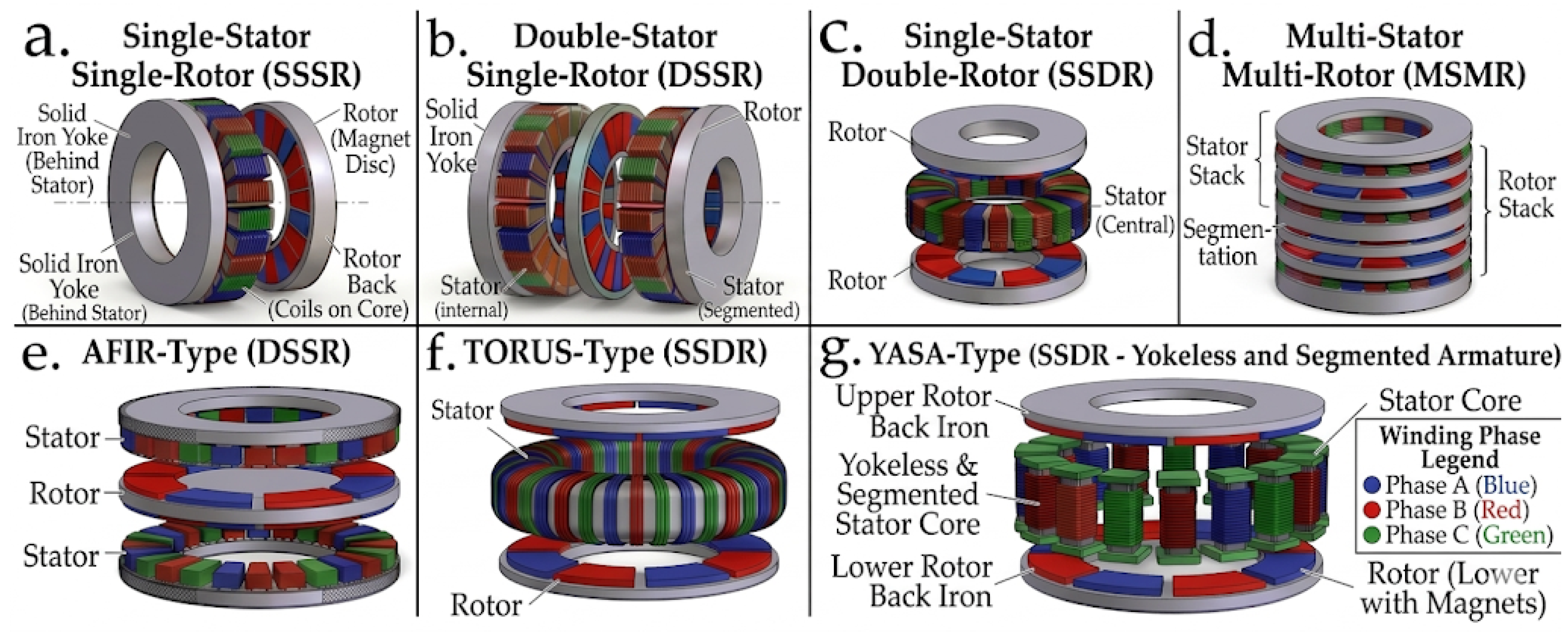
Axial-flux permanent magnet (AFPM) machines can be classified in two complementary ways. The first classification considers the quantity and arrangement of stator and rotor plates, which directly affects manufacturability, axial force balance, and torque generation capacity. The second classification focuses on the magnetic core and winding architecture (e.g., TORUS, YASA, and AFIR), which mainly affects heat dissipation, iron loss, and cogging torque characteristics [14]. To provide a clear visual representation of these structural variations, Figure 1 illustrates the composite views of various mainstream AFPMSM topologies, ranging from basic single-stator/single-rotor designs to advanced yokeless architectures. Furthermore, Table 1 summarizes the most common AFPM (Axial Flux Permanent Magnet) configurations and their key trade-offs.
In reality, DSSRs and SSRs are often used when high torque is required, but SSRs are more popular for less complex and inexpensive prototyping applications. MSMR (Multiple Disc) structures offer the highest torsional strength but involve the most complex assembly and thermal design processes. Due to their high torsional rigidity, TORUS and YASA family structures are often used in high-tensile applications. Meanwhile, the YASA architecture provides distinct benefits in modular cooling and enhanced maintainability, a critical advantage that is increasingly supported by advanced 3D dynamic lumped-parameter thermal network analyses for high-efficiency energy systems [15]. The compact size, excellent torsional rigidity, and low inertia of AFIR structures make them attractive. To maintain air gap symmetry, these structures must meet stringent mechanical standards [14], such as precise alignment and uniform material properties, to ensure optimal performance and efficiency in energy systems.

2.2. Applications for Axial-Flux Motors in EV/HEV Drivetrains

Axial flux permanent magnet motors (AFPMs) are getting a lot of interest to power electric and hybrid vehicles (EV/HEV) since they have a lot of torque, are small in length, and can be put together in modules. For current electric drive systems that need small and highly efficient drive units, AFPMs’ designs can provide a greater torque-to-weight ratio and configuration flexibility than traditional radial-flux motors. Importantly, this trend is not limited to academic prototypes; AFPMs are already being used in real-world applications, from high-performance passenger cars to commercial electric vehicle platforms and emerging electric mobility systems [16].
Between 2020 and 2024, AFPM technology proved its feasibility through several promising projects. Rotary electric motors were used in hybrid drive systems in high-performance vehicles such as the Ferrari SF90 Stradale and McLaren Artura. These vehicles overcome space and efficiency limitations by utilizing a flat design and high-power density of AFPMSM. Manufacturers and inventors are always working on AFPM (Axial Flux Permanent Magnet) solutions to make things like electric trucks, buses, and industrial transport vehicles more efficient, including designs for electric axles. Innovative simultaneous power supply solutions, such as the prototype for a shaft drive, demonstrate the scalability of the AFPM architecture in terms of power and efficiency requirements [17].
These real-world examples demonstrate the broader application of AFPMs in various electrical systems, beyond just specialized uses.
In the automotive industry, AFPMs are used in a wide variety of engine types, each with unique advantages in terms of temperature control, mechanical complexity, and cylinder volume. Integrated electric shaft (e-axle) design is a widely used approach that combines the drive motor, inverter, and power transmission system into a single, compact unit. This saves installation space, reduces assembly complexity, and improves power transmission efficiency by minimizing mechanical connections [1,14]. This drivetrain design allows the motor to operate using less energy while still generating high torque at the wheels. This electric axle design is suitable for driving both the front and rear axles of both electric passenger cars and electric commercial vehicles.
Alternatively, close-to-wheel (near-wheel) AFPM modules locate the motor adjacent to the wheel and typically couple it with a short drive shaft and a compact reduction gear. By enabling multiple motors to be installed, for example, at the front and rear axles, or even individually at each wheel, this architecture facilitates advanced vehicle functions such as torque vectoring, improved traction control, and enhanced cornering stability.
However, mounting the motor close to the wheel requires more complex coordination and can result in higher system costs due to the need for additional drive units and inverters. In-wheel motor mounting means embedding the drive motor directly into the wheel hub (single-box in-wheel module), eliminating or removing traditional powertrain components such as drive shafts and differentials [3]. This configuration allows automatic four-wheel drive (AWD) systems to distribute torque directly to each wheel. It also offers high tuning flexibility. Such configurations can improve agility and traction distribution, particularly for vehicles requiring nimble handling and precise wheel torque management. Nevertheless, in-wheel motors increase unsprang mass, which can adversely affect ride comfort and road-holding performance. Furthermore, the surrounding environment of the rubber hub is another significant limitation for heat dissipation, sealing, and durability, making the design and testing process more challenging for center-mounted drivetrains.
For EV/HEV platforms requiring minimal drivetrain modification or compact centralized integration, AFPMs can also be installed on the crankshaft or central shaft line (central drive) [18]. This arrangement helps to reduce the number of joints and mechanical interfaces, which can help to reduce mechanical losses and the overall weight of the system. This engine mounting method offers advantages over traditional wheel designs, particularly in simplifying safety measures during emergencies.
Furthermore, centralized drive systems simplify maintenance and reduce protection complexity in harsh environments compared to wheel-mounted installations. Conversely, the capacity to regulate torque independently at each wheel is constrained by the common drive path typically employed for motor torque transmission, unless actuators or supplementary control methodologies are incorporated. The selection of AFPMs’ integration ultimately hinges on the performance and design considerations specific to the intended vehicle. Nevertheless, integrated electric axle architectures and centralized drive systems are generally favored, owing to their compact form factor, system-level simplicity, and optimization potential. Near-wheel and in-wheel configurations, however, provide enhanced flexibility for independent wheel torque control and advanced vehicle dynamics, albeit at the expense of increased integration complexity and more demanding thermal and mechanical specifications. The growing advancements and uses of AFPM technology in both high-end and commercial electric vehicles suggest a trend toward wider use in future electric drive systems. These real-world adoptions are summarized in Table 2.

3. Cogging Torque Reduction Strategies

3.1. Cogging Torque Formula

Cogging torque arises from changes in magnetic reluctance within the air gap. This phenomenon is caused by the interaction between the rotor’s permanent magnets and the stator slots.
This torque, referred to as cogging torque (Tcog), which is present even when no current flows through the stator, can be calculated by taking the derivative of the magnetic co-energy with respect to the rotor’s position ( θ ) , as expressed in Equation (1) [19,20]:
T cog ( θ ) = W ( θ ) θ
In this equation, W(θ) represents magnetic co-energy, and θ denotes the mechanical angle of the rotor. In axial flux permanent magnet synchronous motors (AFPMSMs), the three-dimensional nature of the magnetic flux paths, along with how torque density changes from the center to the edge, means that cogging torque is very sensitive to both the motor’s design and the details of the numerical model used to analyze it. Therefore, accurately predicting cogging torque requires using full 3D finite element modeling (FEM) with very detailed mesh grids [21]. Furthermore, optimizing the geometrical features of the magnets, such as employing specific trapezoidal profiles, plays a pivotal role in mitigating aerodynamic windage losses and improving overall energy conversion efficiency [22].

3.2. Non-Integer Pole/Slot Configuration

Non-integer pole/slot combinations reduce cogging torque by dispersing harmonic components of the air gap permeance function. The number of cogging torque periods per mechanical revolution is governed by the least common multiple (LCM) of the pole and slot numbers, as given in Equation (2) [23]:
N cog = 2 p Q L C M ( 2 p , Q )
where Ncog is the number of cogging torque periods, p is the number of pole pairs, and Q is the number of stator slots. The 12/15 configuration investigated in this study increases harmonic dispersion and reduces the amplitude of cogging torque compared with integer configurations [24]. Recent investigations into EV traction motors underscore that an optimized stator slot and rotor pole combination inherently maximizes the LCM, thereby effectively suppressing cogging torque while preserving operational efficiency [25]. Furthermore, this specific fractional-slot topology not only facilitates exceptional harmonic dispersion but also yields a comparatively high winding factor, which is crucial for maintaining high average torque. By strategically selecting a configuration that balances a maximized LCM with an optimal pole-to-slot ratio, the proposed design fundamentally mitigates torque ripple sources without compromising the power density required for demanding EV traction applications.

3.3. Skewing Strategy

Skewing introduces an axial phase shift that averages cogging torque components along the machine length. The effective skewed torque (Tskew) can be approximated using Equation (3) [26]:
T skew ( θ ) = 1 L 0 L T θ + k z d z
where L is the axial length, k is the skew coefficient, and dz represents the infinitesimal length along the z-axis. Although skewing is useful, too much of it can increase the cogging torque and the leakage flux. This study highlights the need for a design approach based on optimization [27].

4. Proposed AFPMSMs Model and Optimization Methodology

4.1. AFPMSMs’ Configuration

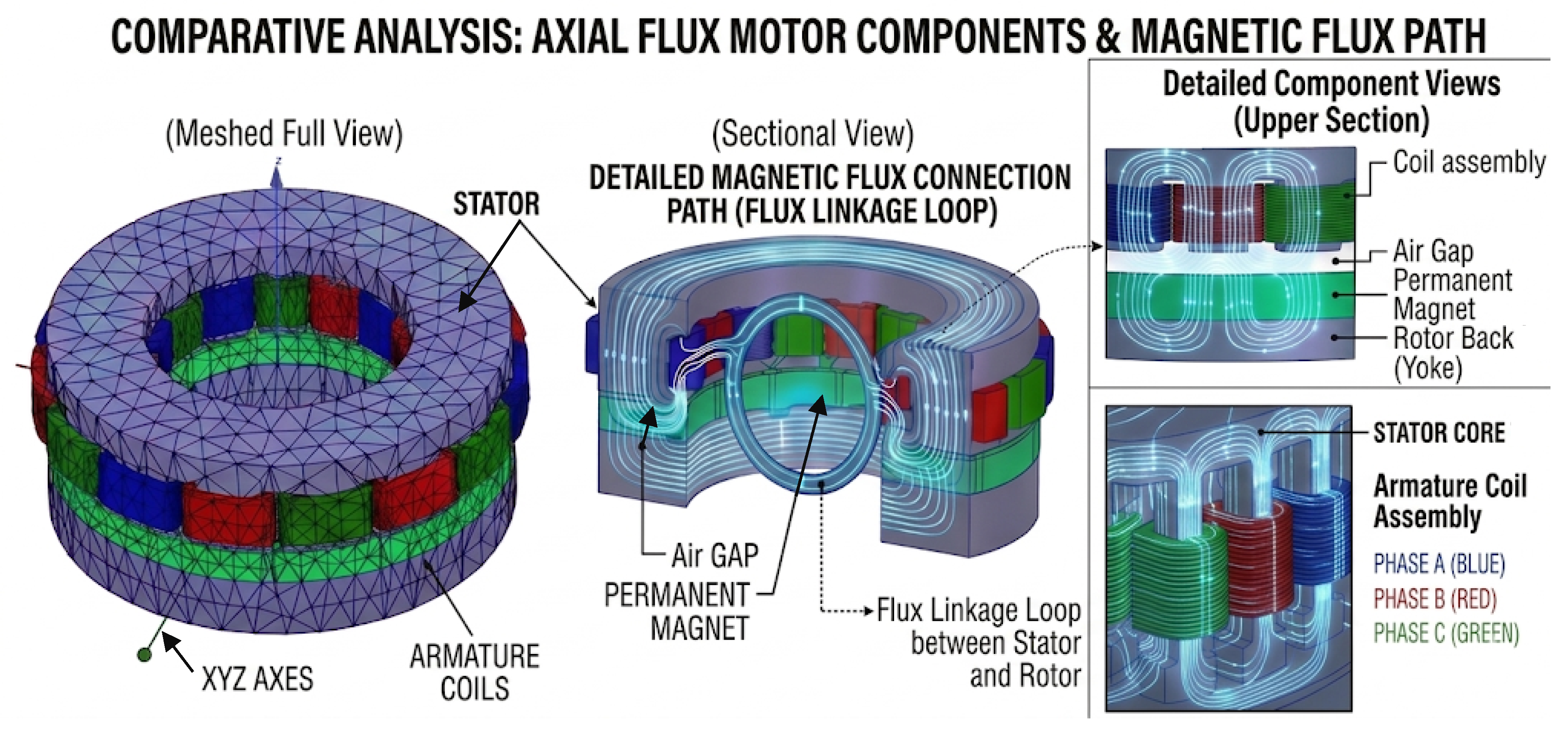
The 3-D finite element method (FEM) model, developed in Ansys Electronics Maxwell 2018 R2, is illustrated in Figure 2. To accurately simulate the electromagnetic behavior, specific material properties were assigned to the model hierarchy: copper for the armature coils, NdFeB for the surface-mounted permanent magnets, and Steel_1008 for the magnetic cores. These components are encapsulated within the surrounding vacuum domain. The investigated axial-flux permanent magnet synchronous motor (AFPMSM) features a 12-pole/15-slot configuration, operating at an electrical frequency of 390 Hz. Key geometric and operational parameters are detailed in Table 3. To mitigate artificial flux leakage, the computational domain is enclosed within a cylindrical vacuum band. In 3D finite element modeling utilizing Ansys Maxwell, the motor must be encapsulated within a sufficiently padded cylindrical air domain to compute the surrounding magnetic vector potential accurately. By applying the zero-tangential magnetic field (Ht = 0) boundary condition to the outer enclosure of this air region, the boundary acts as a perfect magnetic insulator. This computational setup prevents the flux lines from being unnaturally truncated at the motor’s physical surfaces, allowing the near-field fringing leakage and axial end-effects to naturally decay and complete their continuous loops entirely within the meshed air domain, thereby yielding highly accurate 3D torque evaluations [28]. For spatial discretization, a tetrahedral mesh was employed, featuring localized refinement at the air gap, tooth tips, and magnet edges. This mesh strategy is critical for accurately resolving high magnetic field gradients and ensuring precise torque predictions [29]. Furthermore, to specifically evaluate the cogging torque, the simulation was conducted with unexcited stator coils (zero current) and at a quasi-static rotational speed of 1 rpm, analogous to manual rotation.

4.2. Optimization-Based Approaches

Recent research has demonstrated an increasing application of metaheuristic optimization algorithms in tackling the nonlinear and multi-parameter complexities inherent in electric machine design. Genetic algorithms (GAs), particle swarm optimization (PSO), and differential evolution (DE) have all demonstrated efficacy in the refinement of both geometric configurations and operational parameters. This helps to reduce cogging torque without negatively impacting overall performance [30,31,32].
Genetic algorithms (GAs) are especially useful for optimizing axial flux permanent magnet synchronous motors (AFPMSMs). This is because they can explore large design spaces and handle the multiple goals often found in electromagnetic design problems [27].
Moreover, multi-objective frameworks have gained prominence in electric vehicle (EV) traction applications, as the reduction in cogging torque necessitates a trade-off with efficiency considerations [33].
The genetic algorithm (GA) optimization method determines a skew angle that minimizes the combined objective function, thus ensuring torque consistency. The GA convergence behavior across several generations is detailed in Table 4.
The optimized skew angle significantly reduces the peak-to-peak cogging torque, concurrently maintaining the average torque close to the desired value. This confirms the GA’s effectiveness in managing nonlinear design trade-offs for AFPMSMs’ torque pulsation suppression [33]. Specifically, within the context of light electric vehicles, such as golf carts, optimization frameworks like GA have been proven to substantially mitigate no-load cogging torque under multiple operating conditions [34].
Metaheuristic optimization techniques have gained traction in electric machine design, primarily because of their capacity to manage nonlinear electromagnetic behaviors and multi-parameter interdependencies. Typically, the optimization procedure commences with the random initialization of a population, succeeded by fitness assessment via the objective function. Subsequently, selection, crossover, and mutation operators are iteratively applied to produce superior candidate solutions. The iterative process persists until a designated termination criterion is satisfied, which may include either the achievement of a predefined maximum generation count or the observation of negligible improvements in fitness. This research integrates the optimization procedure with three-dimensional finite element analysis (3D-FEM) to facilitate a precise assessment of torque-related performance characteristics.
Moreover, experimental validation can be used to further confirm the reliability of the optimized design. The rotor skew angle α is selected as the design variable to minimize cogging torque while maintaining average torque capability. The feasible range for α is strictly bounded between 0° and 35°. This range covers the theoretical slot pitch (24°) while preventing adjacent magnets from geometrically overlapping, which would render the 3D modeling and physical manufacturing unfeasible. The constrained optimization problem is formulated as shown in Equation (4):
m i n i m i z e T c o g ( α ) ,       0 ° 3 5 °
The genetic algorithm (GA) process begins by randomly creating a population within the defined boundaries. This is followed by evaluating the electromagnetic performance of each individual using the finite element method (FEM). The primary objective is to evaluate the peak-to-peak cogging torque, as formulated in Equation (5):
T c o g ( θ , α ) c o g , p k p k ( α ) = m a x ( T c o g ( θ , α ) ) m i n ( T c o g ( θ , α ) )
where θ is the rotor mechanical angle, Tcog is the instantaneous cogging torque, and Tcog, pk-pk represents the peak-to-peak cogging torque.
Subsequently, the algorithm repeatedly applies specific reproduction operators to create better candidate solutions. Additionally, an elitism strategy is used to preserve the best solution from each generation. The process is repeated until a predefined stopping criterion is satisfied, such as reaching the maximum number of generations or observing negligible fitness improvement. To explicitly define this GA implementation, the mathematical formulations for the fitness evaluation and reproduction operators are detailed as follows:
  • Fitness Function:
To evaluate the suitability of each candidate solution, the fitness function F ( α ) is defined as the inverse of the objective function to map the minimization problem into a fitness maximization context, as expressed in Equation (6) [27]:
F ( α ) = 1 T c o g , p k p k ( α ) + ϵ
where ϵ is a diminutive constant preventing division by zero.
2.
Selection Operator:
A Roulette Wheel selection mechanism is employed, where the probability of selection (Pi) for the i-th individual ( α i ) is determined by its fitness relative to the total fitness of all individuals ( α j ) in a population of size Npop, calculated using Equation (7) [34]:
P i = F ( α i ) j = 1 N pop F ( α j )
3.
Crossover and Mutation Operators:
An arithmetic crossover produces offspring ( α c h i l d ) from parent solutions ( α p 1 , α p 2 ) using a random weighting factor β [0, 1], as shown in Equation (8) [27]:
α c h i l d = β α p 1 + ( 1 β ) α p 2
To prevent local convergence, a Gaussian mutation is applied to produce the final mutated angle ( α m u t a t e d ), where N ( 0 , σ 2 ) represents a random value drawn from a normal distribution with a mean of zero and a variance of σ 2 , as formulated in Equation (9) [34]:
α m u t a t e d = α c h i l d + N ( 0 , σ 2 )
Table 4 illustrates GA convergence behavior across generations. The optimization process converges on a skew angle that effectively reduces the objective function. As a result, the optimized skew angle significantly reduces the peak-to-peak cogging torque.
This confirms that GA is highly effective for handling nonlinear design parameters in AFPMSMs’ torque pulsation suppression [34].
The genetic algorithm parameters were configured based on the recommended defaults in Ansys Optimetrics. Preliminary evaluations with finer parameter resolutions yielded negligible improvements while substantially increasing computational time, confirming that the selected settings provide an optimal balance between accuracy and simulation efficiency.
Table 5 offers a comparative examination of key metaheuristic optimization algorithms utilized in electric machine design, synthesized from existing literature. This comparison indicates that while methods such as NSGA-II (Non-dominated Sorting Genetic Algorithm II) and MOMVO (Multi-Objective Multi-Verse Optimizer) exhibit strong multi-objective exploration capabilities, they often entail substantial computational requirements.
Furthermore, practical implementation constraints within the Ansys Optimetrics framework—which does not natively integrate certain heuristic algorithms without requiring highly complex co-simulation setups—necessitated the selection of a robust, built-in optimizer.
Moreover, PSO, notwithstanding its rapid convergence, is susceptible to premature convergence at local optima. Therefore, considering both the theoretical advantages highlighted in the literature and the seamless built-in integration capabilities with the 3D-FEM software, GA is identified as the most appropriate methodology for this investigation. Its resilience to structural and magnetic nonlinearities is ideally suited to the design constraints of the motor under consideration.

5. Modeling 3D Finite Element Simulation

A full 3D-FEM model is shown in Figure 2. Incorporating nonlinear magnetic material properties, this model was employed to compute magnetic flux density and cogging torque. To definitively eliminate spatial discretization errors, a rigorous mesh independence analysis was conducted [21]. The torque evaluations fully stabilized at approximately 77,000 elements; further densification yielded negligible deviations and only increased computational time. Consequently, the final evaluation was executed using exactly 77,460 tetrahedral elements, ensuring absolute numerical accuracy.
To establish the optimal pole and slot combination under stringent dimensional constraints typical of in-wheel EV applications [3], an initial performance evaluation was conducted using the Ansys RMxprt analytical tool. This co-simulation approach provides a rapid and robust preliminary assessment of fundamental characteristics—including baseline cogging torque, phase currents, and total efficiency—prior to extensive 3D-FEM validation [35]. Table 6 presents the efficiency of different pole/slot configurations. The main goal was to achieve a minimum operating efficiency of 80%. At the same time, the pole-to-slot ratio needed to be suitable to avoid making manufacturing too complicated and to reduce magnetic leakage. Notably, the preliminary analytical results demonstrate that non-integer pole/slot configurations exhibit distinctly superior efficiency, whereas integer combinations merely border the 80% minimum threshold.
As observed in the comparative results, while several configurations met the 80% efficiency threshold, the 12-pole and 15-slot (12p/15s) combination yielded the highest overall efficiency at 95.60%. The design shows a good balance, offering both excellent electromagnetic properties and a practical pole/slot ratio.
Therefore, the 12p/15s configuration was chosen as the starting point for the following three-dimensional finite element analysis and geometric optimization.
Although theoretical evaluations suggest that topologies with a higher LCM (e.g., 12/21) yield marginally lower baseline cogging torque, the 12/15 configuration was strategically selected. It perfectly balances superior overall efficiency (95.60%) and high fundamental winding factors, while significantly reducing manufacturing complexity and copper costs. The inherently higher baseline cogging torque is then effectively neutralized by the proposed GA-skewing methodology.
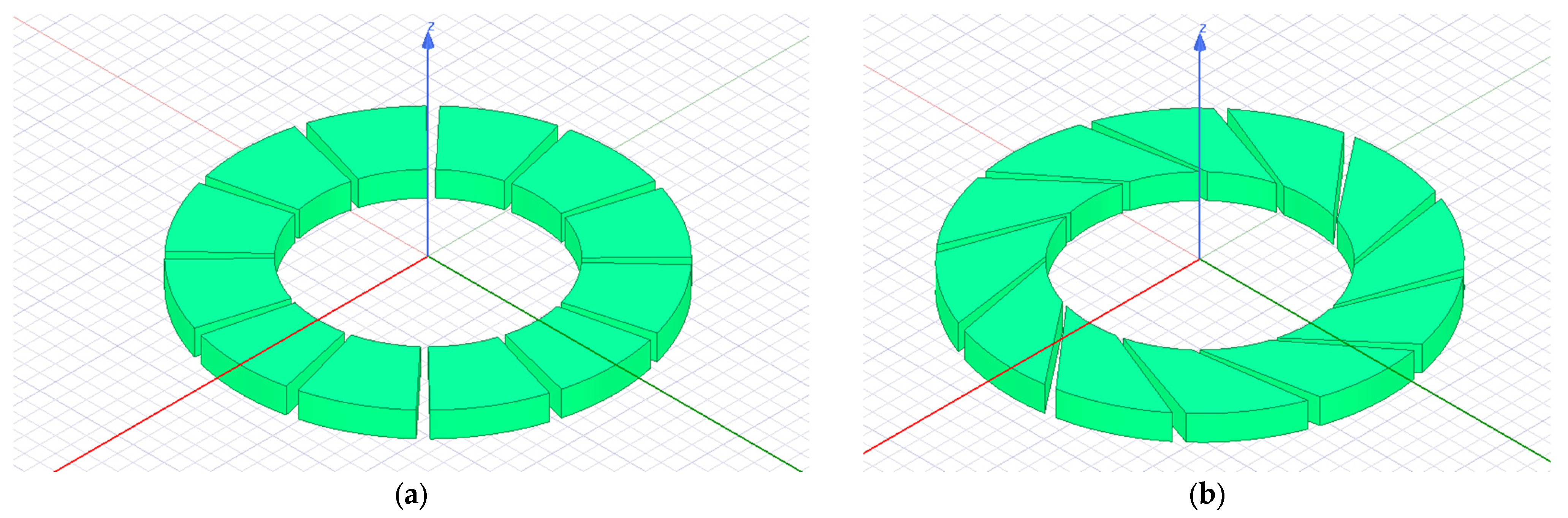
Figure 3 shows the three-dimensional permanent magnet arrangements of the 12/15 AFPMSMs used in the detailed 3D-FEM analysis. Specifically, Figure 3a shows the original, unskewed baseline rotor geometry (0°) before optimization, where the magnets are evenly aligned along the radial axis. This common arrangement often causes sudden changes in how space allows things to move through it. This happens because the rotor poles and the stator slot openings interact at the same time, which leads to significant changes in torque.
In contrast, Figure 3b shows the rotor with structural modifications, using the best skew angle of 26.92°. The angle was determined using the Genetic Algorithm (GA) optimization method.
The introduction of this specific angular displacement facilitates a gradual distribution of the magnetic interaction between the rotor poles and the stator teeth along the axial dimension, as opposed to an instantaneous occurrence. This deliberate phase-shifting mechanism effectively smooths the air-gap flux density distribution, thereby functioning as the principal method for reducing the predominant harmonics and significantly diminishing the peak-to-peak cogging torque. Under rated on-load conditions (3900 rpm), the application of the optimal 26.92° skew angle reduced the average rated torque slightly from 6.12 N·m to 5.76 N·m (a 5.88% decrease), while significantly improving the Back-EMF waveform quality by decreasing the THD from 5.2% to 1.8%.
Furthermore, a sensitivity analysis reveals that a manufacturing tolerance of ±1° in the skew angle only slightly increases the cogging torque to 195.4 mN·m, maintaining a highly robust performance compared to the unskewed baseline.
Furthermore, under the 390 Hz rated current condition, the optimized skew angle effectively suppresses the spatial harmonics of the loaded electromagnetic torque. The peak-to-peak ripple torque amplitude is significantly reduced from 0.447 N·m in the unskewed baseline to 0.155 N·m, ensuring stable motor control and minimizing structural vibrations during practical EV operations [26].
Maxwell’s equations, expressed using the magnetic vector potential (A), describe the electromagnetic field of the proposed device. Equation (10) presents the main expression describing the anisotropic magnetic behavior of the materials.
x 1 μ x A x + y 1 μ y A y + z 1 μ z A z σ A t = J 0 + [ ( H c y x H c x y ) i + ( H c z y H c y z ) j + ( H c x z H c z x ) k ]
In this context, μx, μy, and μz represent the Cartesian coordinate permeability, while σ represents the conductivity and J0 represents the current density supplied within the stator windings. The vectors Hcx, Hcy, and Hcz represent the force field components of the permanent magnet. Numerical analysis often uses a finite element framework. The magnetic field is divided into square sections, and the equation is solved to find the magnetic vector potential (A). After A is found, the spatial derivative is calculated to determine the magnetic flux density (B), which is then used to create the flux density distribution shown in Figure 3. The field results are then used to determine torque-related quantities such as cogging torque. This anisotropic formula effectively represents the magnetic flux density and saturation paths in the area, consistent with previous FEM investigations [2,7,33].

6. Results and Discussion

6.1. Effect of Non-Integer Pole/Slot Configuration

The substantial reduction in cogging torque is fundamentally attributed to the mismatched alignment between the stator slots and rotor poles. Such a fractional-slot configuration prevents simultaneous magnetic interactions during each rotation cycle, facilitating the mutual cancellation of localized cogging torque components. Consequently, this creates non-overlapping periods of magnetic attraction. Based on experimental evaluations, the 12/15 topology was specifically selected as the optimal fractional configuration, demonstrating exceptional structural suitability and achieving a peak operating efficiency of 95.60%, thereby ensuring superior overall motor performance.

6.2. Effect of Skew Angle and Flux Density Distribution

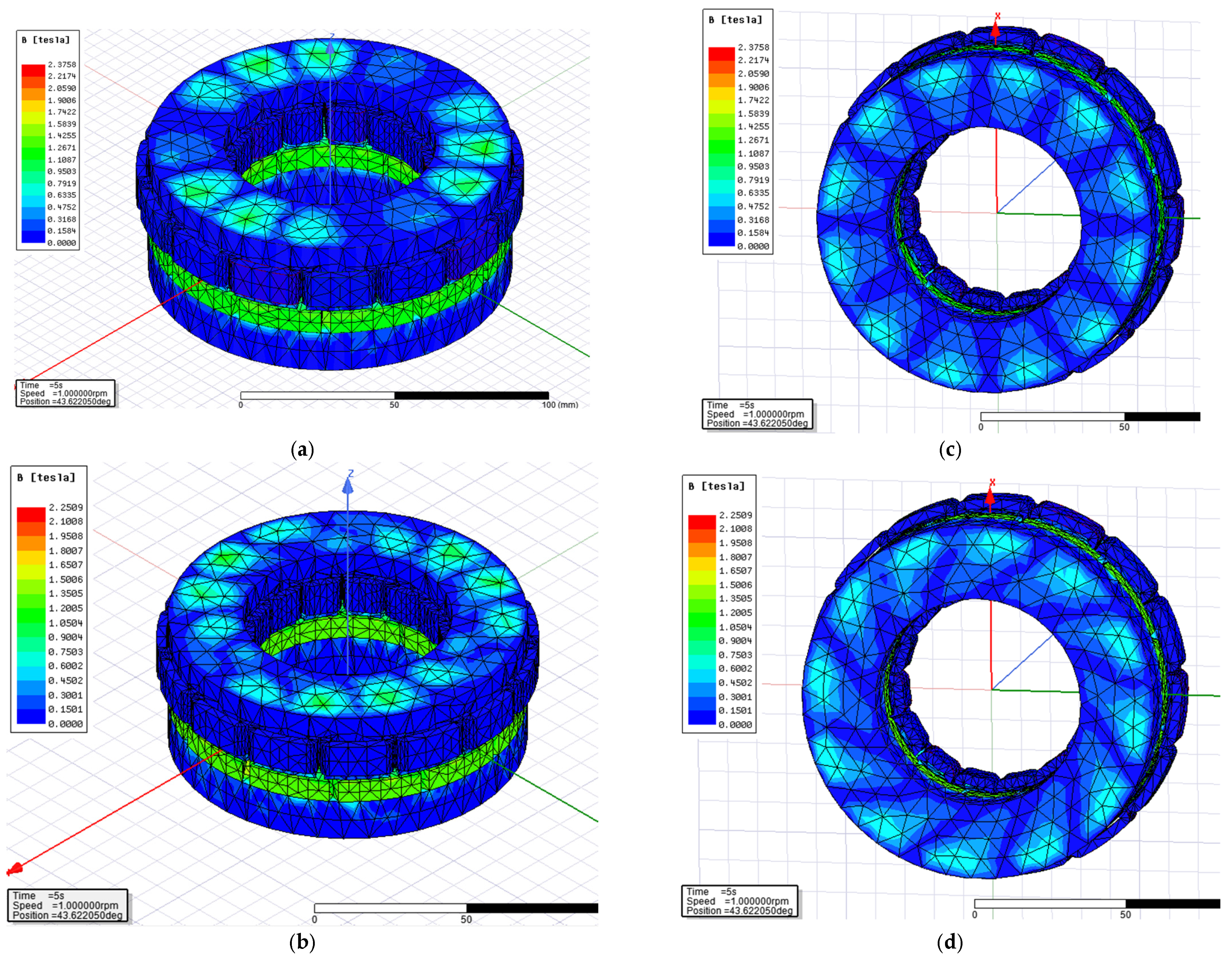
The optimal rotor skew angle was determined through a systematic optimization process aimed at minimizing cogging torque. This optimization effect is directly supported by magnetic flux distribution behavior. As depicted in the finite element analysis (FEM) results in Figure 4, the flux density is effectively maintained between 0.8 T and 1.2 T. Specifically, the top view in Figure 4a,b reveals that the magnetic flux is concentrated in accordance with the number of stator teeth, whereas the bottom view illustrates in Figure 4c,d that the flux concentration corresponds precisely to the number of skewed rotor permanent magnets. This localized maximum flux concentration behavior aligns comprehensively with recent analytical models aimed at maximizing torque density in axial flux machines for electric mobility [36].
Although high flux concentrations and localized magnetic saturation areas are evident near the stator tooth tips, the optimized skew configuration effectively balances these electromagnetic interactions. These FEM-derived field characteristics are highly consistent with the analytical calculations and align well with established trends documented in [10,11,23,33].
By effectively redistributing these localized high-flux regions along the axial length, the skewing mechanism not only minimizes the abrupt permeance variations but also prevents premature and deep magnetic saturation within the stator core. This phenomenon is particularly critical at the stator tooth tips, where intense flux crowding typically occurs during the direct alignment of rotor magnets and stator teeth. By mitigating this concentration, the skewed rotor profile ensures that the magnetic material operates predominantly within its linear region, which directly contributes to a more predictable and stable torque response across a broader range of operational loads. Furthermore, avoiding excessive localized saturation has a secondary benefit of reducing localized iron losses and mitigating potential thermal hotspots. Consequently, the optimized skew design achieves a highly harmonious balance, maximizing the electromagnetic utilization of the 12/15 fractional-slot configuration while comprehensively suppressing undesirable torque pulsations.
Although skewed solid magnets can induce localized flux concentrations (reaching 0.8 T to 1.2 T), the associated eddy current losses and potential thermal hotspots are effectively mitigated in high-performance EV manufacturing. This is practically achieved by slicing the permanent magnets into thin axial and circumferential segments and applying insulating varnish coatings, which reliably interrupt the conductive paths of the eddy currents.
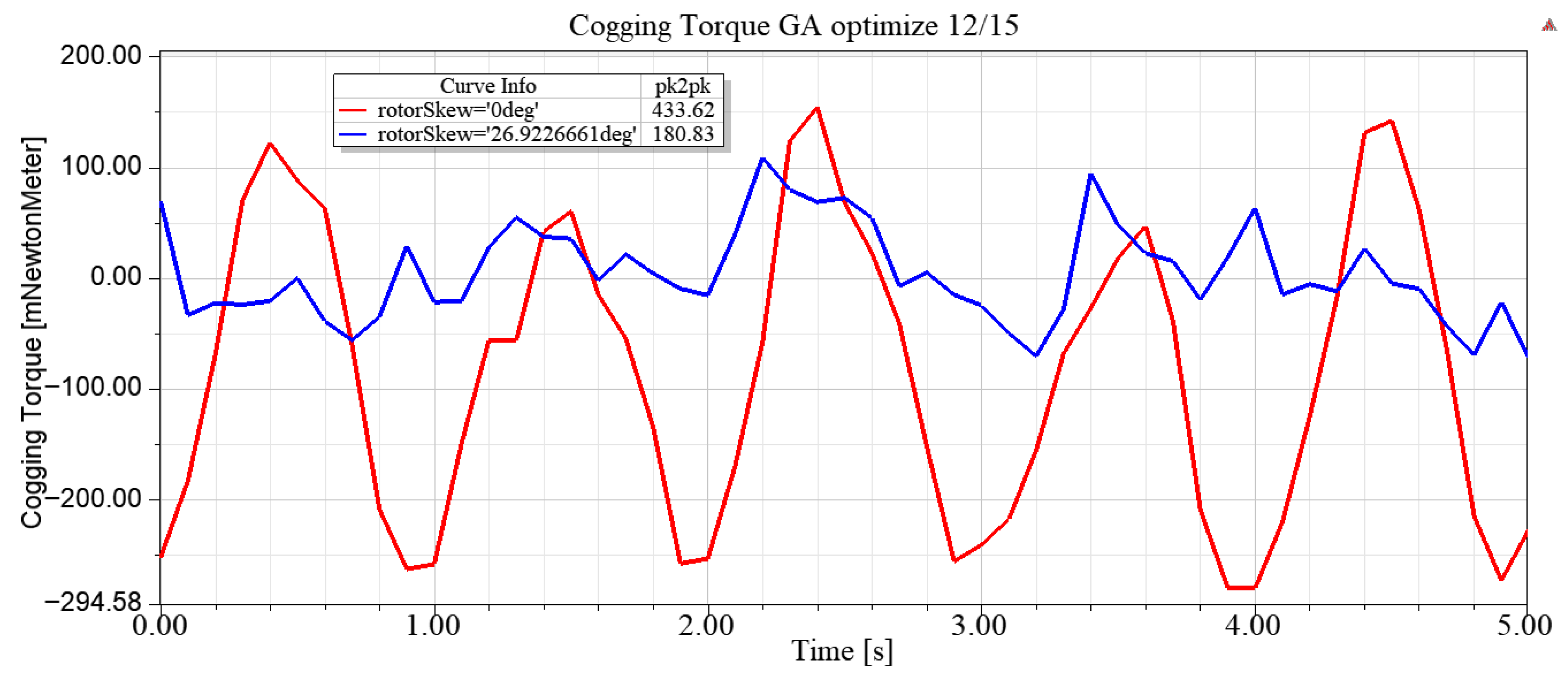
As illustrated in Figure 5, the optimization outcomes derived from the Genetic Algorithm (GA) reveal a substantial decrease in cogging torque. Employing an optimal rotor skew angle of 26.92°, the peak-to-peak cogging torque was effectively diminished from 433.62 mN·m (associated with the non-skewed rotor) to 180.83 mN·m. This constitutes a 58.3% reduction in peak-to-peak cogging torque. Furthermore, the waveform analysis indicates that the optimized configuration (illustrated by the blue line) displays a considerably smoother profile in contrast to the baseline (represented by the red line), a characteristic that is essential for mitigating acoustic noise and mechanical vibrations in precision motor applications. From a comprehensive system-level perspective, this significant suppression of cogging torque translates directly to enhanced low-speed drivability and superior NVH (Noise, Vibration, and Harshness) performance for electric vehicles. In the absence of a traditional internal combustion engine, the acoustic profile of the traction motor becomes highly perceptible; thus, smoothing the torque output is paramount for passenger comfort.
Furthermore, the minimized torque ripple substantially reduces the mechanical stress and fatigue exerted on the drivetrain components, which consequently extends the operational lifespan of the transmission and reduction gear systems. From a control standpoint, this inherent physical reduction in torque pulsation relieves the computational burden on the motor drive inverter. It allows the motor controller to achieve stable and highly efficient current regulation without relying heavily on complex, software-based active harmonic compensation or torque ripple cancellation algorithms, especially during delicate maneuvers such as parking or navigating through heavy urban stop-and-go traffic.

6.3. Comparison with Existing Techniques

To comprehensively evaluate the effectiveness of the proposed methodology, a comparative analysis was conducted against various conventional cogging torque reduction techniques reported in the recent literature. As detailed in Table 7, the reduction percentages for existing methods—including magnet shaping, slot shifting, and dual-skew configurations—were synthesized from established benchmark studies [8,9,10,24,25,26].
While traditional standalone techniques generally achieve a cogging torque reduction ranging from 35% to 50%, the proposed approach synergistically combines the harmonic dispersion of a 12/15 non-integer pole/slot configuration with a GA-optimized rotor skew angle. Consequently, this combinatorial optimization method achieves a superior peak-to-peak cogging torque reduction of 58.3%.
This significant improvement highlights that the proposed design methodology outperforms conventional single-variable techniques, offering a highly effective and robust solution for minimizing torque pulsations in EV traction applications where smooth low-speed drivability is critical.

7. Conclusions & Future Work

This study introduced a genetic algorithm (GA)-based framework for optimizing rotor skew angles. The main goal was to reduce cogging torque in axial flux permanent magnet synchronous motors (AFPMSMs) with a non-integer 12/15 pole/slot arrangement, specifically for electric vehicle (EV) traction applications. The methodology employs harmonic dispersion, achieved through non-integer slot/pole selection, in conjunction with an optimization-driven skew angle design. Consequently, this methodology effectively reduces cogging torque. A detailed three-dimensional finite element method (FEM) model, which included nonlinear magnetic properties, was employed to evaluate electromagnetic performance and facilitate accurate predictions of torque pulsation [23,24,26].
The findings support the idea that the non-integer arrangement reduces the initial cogging torque compared to the integer setup. Moreover, using a genetic algorithm to optimize skewing improves the smoothness of the torque without significantly changing its average value. Subsequent investigations will involve expanded multi-objective optimization, integrating further geometric parameters, and experimental validation via prototype measurements. Ultimately, the proposed design methodology offers a highly practical and computationally efficient pathway for developing next-generation electric vehicles.

Author Contributions

Conceptualization, I.P. and P.P.-l.-o.; methodology, I.P.; software and intellectual property. Validation, I.P., and P.P.-l.-o.; formal analysis, I.P.; investigation, I.P.; resources, P.P.-l.-o.; data curation, I.P.; writing—original draft preparation, I.P.; writing—review and editing, I.P. and P.P.-l.-o.; visualization, I.P.; supervision, P.P.-l.-o.; project administration, P.P.-l.-o. All authors have read and agreed to the published version of the manuscript.

Funding

This research was funded by the project subsidies from the SUT Research and Development Fund.

Data Availability Statement

The original contributions presented in this study are included in the article. Further inquiries can be directed to the corresponding author.

Conflicts of Interest

The authors declare no conflicts of interest.

Abbreviations

The following abbreviations are used in this manuscript:
3D-FEMThree-Dimensional Finite Element Method
AFIRAxial Flux Interior Rotor
AFPMAxial-Flux Permanent Magnet
AFPMSMAxial-Flux Permanent Magnet Synchronous Machine
AWDAll-Wheel Drive
DEDifferential Evolution
e-axleElectric Axle
EMElectric Machine
EVElectric Vehicle
FEMFinite Element Method
GAGenetic Algorithm
HEVHybrid Electric Vehicle
HzHertz
IDInner Diameter
LAxial Length
LCMLeast Common Multiple
MSMRMulti-Stator Multi-Rotor
N·mNewton–Meter
NSGA-IINon-dominated Sorting Genetic Algorithm II
MOMVOMulti-Objective Multi-Verse Optimizer
ODOuter Diameter
pk–pkPeak-to-Peak
PMPermanent Magnet
PMSMPermanent Magnet Synchronous Machine
PSOParticle Swarm Optimization
rpmRevolutions Per Minute
SSDRSingle Stator Double Rotor
THDTotal Harmonic Distortion
TORUSToroidal Core Axial Flux Permanent Magnet
VVolt
YASAYokeless and Segmented Armature

References

  1. Yang, Y.P.; Shih, G.Y. Optimal Design of an Axial-Flux Permanent-Magnet Motor for an Electric Vehicle Based on Driving Scenarios. Energies 2016, 9, 285. [Google Scholar] [CrossRef]
  2. Zhao, J.; Han, Q.; Dai, Y.; Hua, M. Study on the Electromagnetic Design and Analysis of Axial Flux Permanent Magnet Synchronous Motors for Electric Vehicles. Energies 2019, 12, 3451. [Google Scholar] [CrossRef]
  3. Kim, S.-B.; Hong, M.-K.; Kim, H.-G.; Ko, S.-H.; Kim, W.-H. A Study on the Design Process of a 1.8 kW In-Wheel Type AFPMSM Motor. Energies 2025, 18, 5619. [Google Scholar] [CrossRef]
  4. Kurt, E. Optimization of a 3-kW axial flux permanent magnet generator with variable air gap. Int. Trans. Electr. Energy Syst. 2021, 31, e13074. [Google Scholar] [CrossRef]
  5. Pranjić, F.; Virtič, P. Cogging Torque Reduction Techniques in Axial Flux Permanent Magnet Machines: A Review. Energies 2024, 17, 1089. [Google Scholar] [CrossRef]
  6. Bilal, M.; Ikram, J.; Fida, A.; Bukhari, S.S.H.; Haider, N.; Ro, J.-S. Performance Improvement of Dual Stator Axial Flux Spoke Type Permanent Magnet Vernier Machine. IEEE Access 2021, 9, 64179–64188. [Google Scholar] [CrossRef]
  7. Tong, W.; Dai, S.; Li, S.; Li, J.; Tang, R. Modeling and Analysis of Axial Flux Permanent Magnet Machines With Coexistence of Rotor Radial Deviation and Angular Eccentricity. IEEE Trans. Energy Convers. 2020, 35, 2181–2190. [Google Scholar] [CrossRef]
  8. Usman, H.; Ikram, J.; Alimgeer, K.S.; Yousuf, M.; Bukhari, S.S.H.; Ro, J.-S. Analysis and Optimization of Axial Flux Permanent Magnet Machine for Cogging Torque Reduction. Mathematics 2021, 9, 1738. [Google Scholar] [CrossRef]
  9. Polat, M. Performance Analysis and Reduction of Torque Ripple of Axial Flux Permanent Magnet Synchronous Motor Manufactured for Electric Vehicles. IEEE Trans. Magn. 2021, 57, 8106809. [Google Scholar] [CrossRef]
  10. Wirtayasa, K.; Hsiao, C.Y. Performances comparison of axial-flux permanent-magnet generators for small-scale vertical-axis wind turbine. Alexandria Eng. J. 2022, 61, 1201–1215. [Google Scholar] [CrossRef]
  11. Islam, Z.; Khan, F.; Ullah, B.; Milyani, A.H.; Ahmed Azhari, A. Design and Analysis of Three Phase Axial Flux Permanent Magnet Machine with Different PM Shapes for Electric Vehicles. Energies 2022, 15, 7533. [Google Scholar] [CrossRef]
  12. Guo, T.; Cao, Y.; Qian, Z.; Xia, J.; Kang, X.; Xia, G.; Yang, Y.; Zhang, W.; Wang, Y.; Wu, G. Influence of Magnetic Pole Stepping Combined with Auxiliary Stator Slots on the Stability of Dual-Rotor Disc Motors. Energies 2023, 16, 7512. [Google Scholar] [CrossRef]
  13. Yousuf, M.; Khan, F.; Ikram, J.; Badar, R.; Bukhari, S.S.H.; Ro, J. Reduction of Torque Ripples in Multi-Stack Slotless Axial Flux Machine by Using Right Angled Trapezoidal Permanent Magnet. IEEE Access 2021, 9, 22760–22773. [Google Scholar] [CrossRef]
  14. Hao, Z.; Ma, Y.; Wang, P.; Luo, G.; Chen, Y. A Review of Axial-Flux Permanent-Magnet Motors: Topological Structures, Design, Optimization and Control Techniques. Machines 2022, 10, 1178. [Google Scholar] [CrossRef]
  15. Mohamed, A.H.; Hemeida, A.; Rasekh, A.; Vansompel, H.; Arkkio, A.; Sergeant, P. A 3D Dynamic Lumped Parameter Thermal Network of Air-Cooled YASA Axial Flux Permanent Magnet Synchronous Machine. Energies 2018, 11, 774. [Google Scholar] [CrossRef]
  16. Amin, S.; Madanzadeh, S.; Khan, S.; Bukhari, S.S.H.; Akhtar, F.; Ro, J.S. Effect of the magnet shape on the performance of coreless axial flux permanent magnet synchronous generator. Electr. Eng. 2022, 104, 959–968. [Google Scholar] [CrossRef]
  17. Hong, M.-K.; Pyo, H.-J.; Song, S.-W.; Jung, D.-H.; Kim, W.-H. A Study on the Improvement of Power Density of Axial Flux Motors for Collaborative Robot Joints through Same-Direction Skew. Machines 2023, 11, 591. [Google Scholar] [CrossRef]
  18. Wirtayasa, K.; Hsiao, C.Y.; Yang, N.C. High-Performance Five-Phase Axial Flux Permanent Magnet Generator for Small-Scale Vertical Axis Wind Turbine. Appl. Sci. 2022, 12, 3632. [Google Scholar] [CrossRef]
  19. Ishikawa, T.; Slemon, G.R. Reduction of cogging torque in permanent magnet motors. IEEE Trans. Magn. 1988, 24, 2901–2903. [Google Scholar] [CrossRef]
  20. Howe, D.; Zhu, Z.Q. The influence of finite element discretisation on the prediction of cogging torque in permanent magnet excited motors. IEEE Trans. Magn. 1992, 28, 1080–1083. [Google Scholar] [CrossRef]
  21. Haddad, R.Z. Iron Loss Analysis in Axial Flux Permanent Magnet Synchronous Motors With Soft Magnetic Composite Core Material. IEEE Trans. Energy Convers. 2022, 37, 295–303. [Google Scholar] [CrossRef]
  22. Rasekh, A.; Sergeant, P.; Vierendeels, J. Development of Correlations for Windage Power Losses Modeling in an Axial Flux Permanent Magnet Synchronous Machine with Geometrical Features of the Magnets. Energies 2016, 9, 1009. [Google Scholar] [CrossRef]
  23. Aydin, M.; Zhu, Z.Q.; Howe, D. Minimization of Cogging Torque in Axial-Flux Permanent-Magnet Machines: Design Concepts. IEEE Trans. Magn. 2007, 43, 3614–3622. [Google Scholar] [CrossRef]
  24. Jia, L.; Lin, M.; Le, W.; Li, N.; Kong, Y. Dual-Skew Magnet for Cogging Torque Minimization of Axial Flux PMSM With Segmented Stator. IEEE Trans. Magn. 2019, 56, 7507306. [Google Scholar] [CrossRef]
  25. Guo, L.; Wang, H. Research on Stator Slot and Rotor Pole Combination and Pole Arc Coefficient in a Surface-Mounted Permanent Magnet Machine by the Finite Element Method. World Electr. Veh. J. 2021, 12, 26. [Google Scholar] [CrossRef]
  26. Kumar, P.; Srivastava, R.K. Effect of Relative Slot-Opening Shift on Cogging Torque and Performance of an Axial Flux Permanent Magnet Machine. J. Inst. Eng. India Ser. B 2019, 100, 117–122. [Google Scholar] [CrossRef]
  27. Mahmoudi, A.; Kahourzade, S.; Rahim, N.A. Design, Analysis, and Prototyping of an Axial-Flux Permanent Magnet Motor Based on Genetic Algorithm and Finite-Element Analysis. IEEE Trans. Magn. 2013, 49, 1479–1492. [Google Scholar] [CrossRef]
  28. Yi, F.; Zhang, C. Quasi-3-D Analytical Method of Open-Circuit Magnetic Field for Yokeless and Segmented Armature Machine. IEEE Trans. Magn. 2023, 59, 8104310. [Google Scholar] [CrossRef]
  29. Ge, W.; Xiao, Y.; Cui, F.; Liu, W.; Wu, X. Rapid Design of Structural Parameters of Axial-flux Micro-motor Based on Deep Learning. J. Electr. Eng. Technol. 2024, 19, 4941–4951. [Google Scholar] [CrossRef]
  30. Wu, S.; Wang, B.; Zhang, T.; Gu, Q. Design Optimization and Electromagnetic Performance Analysis of an Axial-Flux Permanent Magnet Brushless DC Motor with Unequal-Thickness Magnets. Appl. Sci. 2022, 12, 7863. [Google Scholar] [CrossRef]
  31. Yu, Y.; Pan, Y.; Chen, Q.; Zeng, D.; Hu, Y.; Goh, H.-H.; Niu, S.; Zhao, Z. Cogging Torque Minimization of Surface-Mounted Permanent Magnet Synchronous Motor Based on RSM and NSGA-II. Actuators 2022, 11, 379. [Google Scholar] [CrossRef]
  32. Ge, W.; Xiao, Y.; Cui, F.; Wu, X.; Liu, W. Optimization Comparison of Torque Performance of Axial-Flux Permanent-Magnet Motor Using Differential Evolution and Cuckoo Search. Actuators 2024, 13, 255. [Google Scholar] [CrossRef]
  33. Shokri, M.; Rostami, N.; Behjat, V.; Pyrhonen, J.; Rostami, M. Comparison of Performance Characteristics of Axial-Flux Permanent-Magnet Synchronous Machine With Different Magnet Shapes. IEEE Trans. Magn. 2015, 51, 8115206. [Google Scholar] [CrossRef]
  34. Wu, W.; Li, D.; Wang, W. Optimized Design of a Permanent Magnet Machine for Golf Carts Under Multiple Operating Conditions. World Electr. Veh. J. 2025, 16, 680. [Google Scholar] [CrossRef]
  35. Mersha, T.K.; Du, C. Co-Simulation and Modeling of PMSM Based on Ansys Software and Simulink for EVs. World Electr. Veh. J. 2022, 13, 4. [Google Scholar] [CrossRef]
  36. Baranov, G.; Zolotarev, A.; Ostrovskii, V.; Karimov, T.; Voznesensky, A. Analytical Model for the Design of Axial Flux Induction Motors with Maximum Torque Density. World Electr. Veh. J. 2021, 12, 24. [Google Scholar] [CrossRef]
Figure 1. Composite view of various Axial Flux Permanent Magnet Synchronous Motor (AFPMSM) topologies: (a) Single-Stator Single-Rotor (SSSR); (b) Double-Stator Single-Rotor (DSSR); (c) Single-Stator Double-Rotor (SSDR); (d) Multi-Stator Multi-Rotor (MSMR); (e) AFIR-Type (DSSR); (f) TORUS-Type (SSDR); (g) YASA-Type (SSDR—Yokeless and Segmented Armature).
Wevj 17 00192 g001
Figure 2. Proposed AFPMSM model: non-integer pole/slot configurations.
Wevj 17 00192 g002
Figure 3. AFPMSM magnet with non-integer pole/slot ratios (12/15): (a) 0°, (b) 26.92°.
Wevj 17 00192 g003
Figure 4. Magnetic flux density distributions related to cogging torque for the AFPMSM with non-integer pole/slot ratios (12/15): (a) 0° (top views), (b) 26.92° (top views); (c) 0° (bottom views), (d) 26.92° (bottom views).
Wevj 17 00192 g004
Figure 5. Comparison of cogging torque waveforms for the 12/15 pole/slot AFPMSMs before and after Genetic Algorithm (GA) optimization.
Wevj 17 00192 g005
Table 1. Comparison of AFPM topologies and structural families.
TypeStructureAdvantagesLimitations
1. SSSR
(Single-Stator Single-Rotor)
(a.) [14]
1 stator and 1 rotor- Simple structure
- Easy manufacturing
- Good cooling accessibility
- Lower torque/power density than multi-disc types
- Axial force may be unbalanced.
(depends on design)
2. DSSR
(Double-Stator Single-Rotor)
(b.) [6]
2 stators sandwiching 1 rotor- High torque capability
- High power density
- Better flux utilization
- More complex assembly
- Cooling becomes more
difficult due to stacked discs.
3. SSDR
(Single-Stator Double-Rotor)
(c.) [12]
1 stator between 2 rotors- High torque density
- Better axial-force symmetry
Compact high-torque layout
- Requires precise air-gap alignment and more complex manufacturing and mechanical design.
4. MSMR/multi-disc
(Multi-Stator Multi-Rotor)
(d.) [13]
Multiple stator/rotor discs stacked- Highest torque/power
- Suitable for heavy loads and traction applications
- Highest complexity and cost.
- Thermal management and assembly are challenging.
5. AFIR
(Axial Flux Interior Rotor)
(e.) [14]
Interior rotor with PMs interacting between two stator sides- Low rotor inertia
- High torque density
- Compact rotor design
- Tight mechanical tolerances required.
- Alignment is critical to avoid unbalanced forces.
6. TORUS
(Toroidal Core AFPM)
(f.) [14]
Toroidal (ring-shaped) stator core with PM excitation- Good electromagnetic utilization
- Can be optimized for ripple or loss
- Winding/manufacturing can be complex.
- Cooling depends on packaging.
7. YASA
(Yokeless and Segmented Armature) (g.) [15]
Yokeless segmented stator and double-sided rotors- Excellent thermal management
- High torque density
- Modular maintenance/repair
- More parts and assembly steps Rigidity and tolerance control are critical.
Table 2. Practical Applications of AFPMSM in Electric Drive Systems.
Use CaseVehicle/ProjectMotor Type/RoleNotes & Reference
1. High-Performance Hybrid SupercarFerrari SF90 Stradale’sThe YASA axial-flux e-motor serves as its P2 traction machineThis technology is used in the real world, contributing to hybrid propulsion and producing a combined output of about 987 horsepower [14,15].
2. Hybrid Sports CarMcLaren ArturaAn axial flux electric machine in a hybrid drivetrainA ~95 PS (~70 kW) electric motor supports the hybrid system [14].
3. Commercial EV/eDrive Systems (Industry)Saietta/eDriveProprietary axial flux drivetrain modulesR&D and system development for electric axles and wheel-hub motors [2,3].
4. Electric Aviation PrototypeRolls-Royce Spirit of InnovationMultiple axial-flux motors for high-speed flightDemonstrates scalability of AFPMSMs beyond automotive [16,17].
5. High-Power Prototype (Power Density)YASA/Mercedes-AMG prototype~550 kW motor, ~13 kg (≈42 kW/kg)Cutting-edge high-power-density axial flux design [15,18].
Table 3. Main design parameters of the proposed AFPMSMs.
ParameterMotor (12/15)Unit
Rated Power2.5kW
Rated Speed3900rpm
Rated Voltage220V
Electrical Frequency390Hz
Air-Gap Length1mm
Poles/Slots12/15
Stator OD/ID120/70mm
Stator Core Length25mm
Rated Torque6.12N·m
Magnet Mass0.398kg
Table 4. GA optimization parameters.
ParameterMotor (12/15)
Population size30
Number of generations50
Crossover rate1.0
Mutation rate1.0
Selection methodRoulette wheel
Selection pressure10
Number of parents10
Number of survivors (Elite)3
Stopping criteriaMax Generation/Elapsed Time
Table 5. Comparison of Metaheuristic Optimization Methods in Electric Machine Design.
MethodOptimization FocusTypical ObjectivesKey Remarks & Reference
GASingle/Multi-objectivePM mass, efficiency, sinusoidal voltageRobust for nonlinear problems; requires parameter tuning [24]
NSGA-IIMulti-objective (Pareto)Air-gap field, EM noise,
harmonic constraints
Suitable for trade-off analysis; computationally intensive [28]
PSOSingle/Multi-objectiveFlux density, THD,
Rotor inertia
Fast convergence; may get trapped in a local optimum [14,29]
MOMVOMulti-objectiveVolume,
Joule-loss efficiency
Strong exploration; less common in motor design literature [14]
Table 6. Suitable pole and slot combination.
Number of PolesNumber of SlotsEfficiency (%)
81291.39
81585.63
81886.87
82184.67
82480.35
101292.61
101595.33
101893.90
102192.64
102492.61
121595.60
121894.63
122195.40
122480.25
Underlined values indicate the selected optimal pole/slot configuration.
Table 7. Comparison of cogging torque reduction techniques.
TechniqueCogging ReductionRef.
Magnet shaping35%[8,9,10]
Slot shift45%[26]
Dual-skew magnet50%[24]
Non-integer slot/pole selection40%[25]
Proposed (GA + 12/15 + skew)58.3%This work
Disclaimer/Publisher’s Note: The statements, opinions and data contained in all publications are solely those of the individual author(s) and contributor(s) and not of MDPI and/or the editor(s). MDPI and/or the editor(s) disclaim responsibility for any injury to people or property resulting from any ideas, methods, instructions or products referred to in the content.