
Article

Optimization of Route Design and Scheduling for Heterogeneous Fleets with Electric Vessel Charging Requirements


1
College of Navigation, Jimei University, Xiamen 361021, China
2
Law School, Institute of Maritime Law, University of Southampton, Southampton SO17 1BJ, UK
*
Author to whom correspondence should be addressed.
World Electr. Veh. J. 2026, 17(3), 147; https://doi.org/10.3390/wevj17030147
Submission received: 28 January 2026 / Revised: 12 March 2026 / Accepted: 13 March 2026 / Published: 15 March 2026
(This article belongs to the Section Automated and Connected Vehicles)

Abstract

With the rapid development of all-electric ships (AESs) and the growing emphasis on sustainable shipping, there is an increasing need for effective scheduling solutions that address the unique challenges associated with AESs, such as battery limitations and charging infrastructure constraints. However, existing studies primarily focus on simplified scenarios, overlooking the complexities inherent in multi-port and multi-vessel shipping networks. To bridge this gap, this paper develops a Mixed-Integer Linear Programming (MILP) model aimed at minimizing total operational costs, specifically targeting the scheduling optimization problem in heterogeneous fleet feeder shipping networks, while explicitly considering charging requirements and time window constraints. To tackle the computational challenges posed by large-scale and strongly constrained scenarios, this study designs an optimization algorithm based on Adaptive Large Neighborhood Search (ALNS), incorporating a two-stage strategy and a destroy–repair mechanism to progressively refine solutions. Based on data from the Yangtze River feeder network, numerical experiments demonstrate the feasibility and effectiveness of the proposed model and algorithm. Additionally, a sensitivity analysis on battery capacity explores the effects of variations in key technical parameters on all-electric ship utilization and overall operational costs.

1. Introduction

Compared to road and rail transport, inland waterborne transport offers significant advantages, including large capacity, low energy consumption, and clear cost-effectiveness, making it a crucial component of regional integrated transport systems. In recent years, driven by ongoing improvements in China’s inland waterways and sustained growth in shipping demand, inland shipping on the Yangtze River has become increasingly prominent in both the economic and logistics sectors. However, more than 95% of inland vessels continue to rely heavily on conventional diesel-powered engines, resulting in relatively low energy efficiency and high pollutant emissions, thereby placing inland shipping under growing pressure to prioritize energy saving, emission reduction, and sustainable development [1].
With the continued growth in greenhouse gas emissions from the shipping sector, the International Maritime Organization (IMO) has set explicit emission reduction targets, requiring ships built after 2025 to reduce greenhouse gas emissions by about 30% relative to the 2005 baseline [2]. The global push for carbon neutrality has driven green shipping technologies and management optimization to the forefront of the research. Various technical and managerial measures have been proposed, including the rapid development of liquefied natural gas (LNG), shore power, hybrid powertrains, and all-electric ships. Among these, ship electrification and the use of renewable energy are widely regarded as two of the most promising decarbonization pathways [3]. AESs, with their zero local emissions, low noise, and potential operational cost advantages, are seen as a promising decarbonization solution for inland shipping. However, despite the emergence of numerous AES applications and supporting infrastructure projects worldwide, significant challenges persist, including limited battery capacity, prolonged charging times, and uncertain operational ranges, all of which constrain the optimization of energy utilization while maintaining transport efficiency [4].
In inland feeder transport, vessel scheduling, routing decisions, network layout, and energy replenishment strategies are highly coupled. Although existing studies have advanced their respective areas, notable limitations still exist. On the one hand, conventional optimization methods for fuel vessel scheduling are relatively mature but difficult to extend directly to AESs due to battery range limits and nonlinear charging time constraints. On the other hand, many studies on AESs focus on single vessel speed–energy management or simple point-to-point routing, and less attention has been paid to complex feeder network settings that simultaneously involve (i) return time windows, (ii) multiport cargo assignment, and (iii) coordinated selection of charging facilities. In this paper, to keep the problem tractable and focus on network-level decisions, a fixed sailing speed is assumed, and speed is not treated as a decision variable.
To address these gaps, this paper focuses on inland feeder operations characterized by a fuel–electric heterogeneous fleet, charging constraints, and hub return time windows. An optimization modeling approach and solution algorithm framework were employed, and their feasibility and effectiveness were validated through numerical experiments based on Yangtze River feeder data. The main contributions are as follows:
  • A joint optimization model is developed for heterogeneous fleets in inland feeder transport that simultaneously considers hub return time windows, cargo flow temporal constraints, and charging/range constraints of AESs within a unified framework.
  • An ALNS algorithm with a two-level evaluation mechanism is designed to handle the strong coupling between charging decisions and route selection. Fast feasibility checks are integrated with precise cost evaluation, effectively balancing solution quality and computational efficiency for large-scale instances.
  • The impact of integrating AESs on the cost structure and carbon emissions is analyzed through a case study based on Yangtze River feeder network data. Additionally, a sensitivity analysis of battery capacity was conducted to examine how key technical parameters influence all-electric ship utilization and total operational cost, providing quantitative insights to support the green transition of inland shipping.
The remainder of this paper is organized as follows. Section 2 reviews the related literature. Section 3 presents the heterogeneous fleet joint optimization model, including problem definition, objective function, and constraints. Section 4 introduces the proposed ALNS-based algorithm and its core mechanisms. Section 5 reports numerical experiments and sensitivity analysis based on Yangtze River feeder network data. Finally, Section 6 concludes the paper and outlines directions for future research.

2. Literature Review

Vessel routing and scheduling are central problems in shipping management. This study focuses on heterogeneous fleets composed of traditional fuel-based vessels and AESs, operated in a feeder network under specific spatiotemporal constraints. Accordingly, this section reviews related research from two perspectives: (1) network design and operational scheduling of fuel-based vessels and (2) joint routing optimization of AESs and energy management. Limitations of existing studies are discussed at the end of this section.

2.1. Network Design and Operational Scheduling of Fuel-Based Vessels

Research on route network design and operational scheduling of fuel-based vessels has developed a relatively systematic methodology. At the strategic and tactical levels, liner shipping network design and hub-and-spoke planning have been widely studied; such research often couples network design with service constraints (e.g., transshipment time limits) to improve competitiveness and operational feasibility [5,6]. At the operational level, vessel deployment, route selection, and cargo allocation are frequently determined jointly. Integrated frameworks that simultaneously optimize fleet configuration, paths, and cargo flows have been proposed to enhance overall transport efficiency and service capability [7,8,9].
In operational scheduling, fuel consumption is a central consideration and is closely related to sailing speed. Christian Vad Karsten and Harilaos N Psaraftis et al. examine the trade-off between sailing speed and energy consumption or routing and scheduling decisions [5,10]. Furthermore, incorporating uncertainties and penalty mechanisms associated with port operation and service constraints has emerged as a key approach to improve solution reliability and practical implementability [11,12]. These studies provide an essential modeling foundation for the problem addressed in this paper, including feeder route planning, vessel assignment, cargo allocation, and hub time window constraints.
With the advancement of green shipping initiatives and low-carbon policies, environmental factors have been increasingly integrated into shipping optimization. De-Chang Li et al. evaluated the economic performance and emission reduction of alternative-fuel vessels in inland transport from both energy and environmental perspectives [13]. Yadong Wang et al. introduced emission trading mechanisms at the policy level, incorporated carbon costs into objective functions, and examined the effects of carbon tax changes on vessel type selection and operational strategies [14]. Accordingly, jointly accounting for fuel and electricity consumption as well as carbon emission costs within a cost minimization objective has become an important modeling direction for low-carbon operations.

2.2. Joint Routing Optimization of AESs and Energy Management

The key to optimizing AES operations lies in coordinating voyage/route decisions with energy management. Operational decisions, such as routing and speed, directly affect propulsion energy consumption and battery depletion, while energy state variables (e.g., state of charge (SOC)) in turn constrain reachability and operational safety. Consequently, energy state tracking and scheduling decisions should be integrated within a unified optimization framework [4,15,16,17,18]. In integrated modeling approaches, Jingjie Gao et al. embed factors such as sailing time, route options, and policy impacts into decision variables and employ techniques such as piecewise linearization to transform the problems into solvable mixed integer linear programs, thereby improving operability and economic performance under multiple constraints [19]. Annie Lin et al. emphasize robustness and resilience by incorporating operational rules within joint optimization frameworks [20].
From the perspective of recharging–energy system coupling, interactions between shore power charging and port-side power systems (e.g., microgrids and electricity pricing mechanisms) are critical to AES operational cost and feasibility. Yuechuan Tao et al. investigated the coordinated operation of AES fleets and port microgrids, proposing flexible sailing schedules and integrated energy management strategies [15]. Additionally, factors such as electricity price forecasts, probabilistic uncertainties, and voltage constraints are incorporated to capture the ship–port coupling mechanisms [16,21,22,23,24]. Beyond shore power charging, engineering technologies such as high-power wireless charging have also been explored to improve at-berth charging efficiency and increase operational flexibility [25].
Regarding replenishment modes and system-level extensions, battery swapping (e.g., swappable containerized batteries) can reduce replenishment time and improve reachability, thereby providing additional operational flexibility for AES voyage scheduling [4,26]. Meanwhile, mobile charging has been used to model both charging location decisions and charging scheduling for AESs in a more complex maritime environments [27]. At the multi-vessel and system level, joint scheduling models for AESs, considering routing, battery swapping, and port coordination, have been proposed to reduce charging costs and promote the utilization of renewable energy [28]. Furthermore, joint optimization of fleet replacement and charging infrastructure investment provides quantitative decision support for shipping companies undergoing an electrification transition [29]. Epameinondas K Koumaniotis et al. explore modeling and solution approaches for routing and sustainable operational scheduling of AESs [30]. Regarding inland waterways, Zhongzhen Yang et al. combine innovative AES designs with carbon policy considerations to quantitatively evaluate emission reductions and cost impacts in regional transport systems [31].
In summary, existing research provides a solid methodological foundation for AES operational optimization across multiple dimensions, including single-vessel joint optimization, ship–port energy system coupling, and multi-vessel or planning-level decision making. Nonetheless, differences remain when compared with the heterogeneous fleet (fuel–electric) feeder network considered in this paper, particularly with respect to the combination of decision elements and the strength of constraint coupling. Specifically, this paper simultaneously accounts for coordinated deployment of fuel vessels and AESs, multi-port cargo allocation and vessel assignment within a feeder network, hub-return time window constraints, and feasibility constraints associated with AES charging and operating range. To address these challenges, a unified heterogeneous fleet optimization model incorporating charging and time window constraints is developed, and a scalable metaheuristic algorithm is proposed to efficiently solve medium- and large-scale instances.

3. Optimization Model

3.1. Problem Description

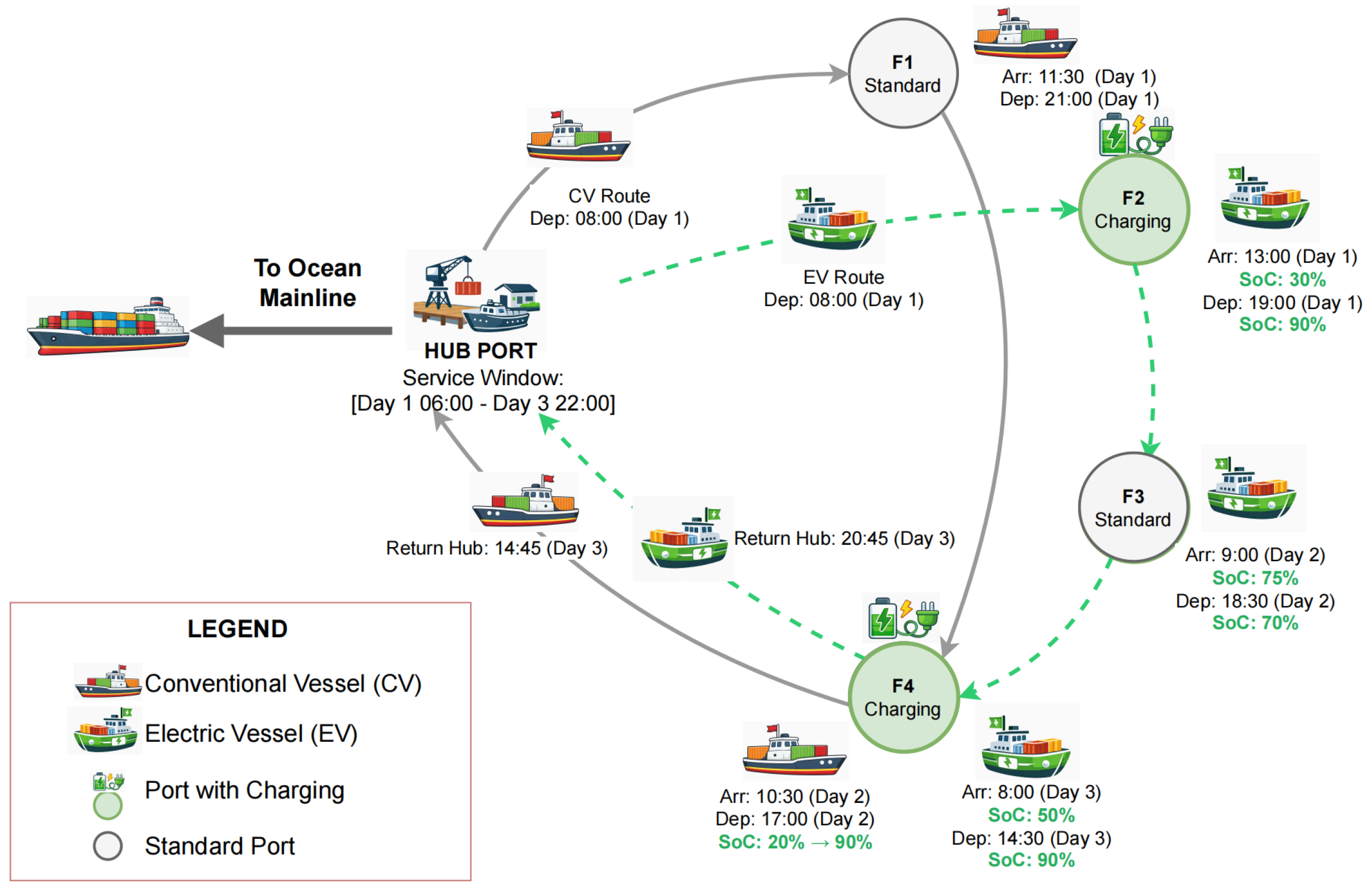
In container shipping networks, feeder transport serves as a critical link connecting hub ports with hinterland ports, facilitating the consolidation and distribution of cargo. To support the global transition toward green and low-carbon shipping, some shipping companies have begun to introduce AESs and other new-energy vessels into traditional fleets, forming heterogeneous operational fleets. Although such operations can reduce carbon emissions, they also increase the complexity of route design and vessel scheduling. For instance, traditional feeder network design primarily balances vessel capacity, sailing speed, and operational costs, whereas the introduction of AESs additionally requires consideration of range limitations, charging or battery-swapping needs, and the availability of charging facilities along the route.
Accordingly, this study focuses on feeder route network optimization with heterogeneous fleets (as illustrated in Figure 1). Specifically, a shipping company must make joint decisions for a heterogeneous fleet consisting of both fuel-based ships and AESs, including planning the port call sequence for each vessel, assigning vessels to specific routes, and allocating appropriate cargo volumes to these routes. The objective is to minimize total operational costs while meeting all hinterland cargo demands and ensuring that vessels return to the hub port within a specified time window to connect with mainline services. An integrated optimization model is developed to jointly optimize route structure, fleet characteristics, operational allocation, and charging strategies, thereby fully capturing the economic and environmental benefits of heterogeneous fleets.

3.2. Model Assumptions

To simplify the practical problem and formulate a mathematical model, the following assumptions are adopted:
  • Within the planning horizon, cargo demand between ports is constant.
  • The operational fleet comprises fuel-based ships and AESs, each with known characteristics (e.g., capacity, design speed, variable sailing cost, and fixed activation cost).
  • For AESs, characteristics such as battery capacity, energy consumption per unit distance, and charging or battery-swapping durations are considered deterministic.
  • Port information in the network is known, including inter-port distances and which ports are equipped to provide charging or battery-swapping services for AESs.
  • At designated charging ports, AESs are replenished with sufficient energy within the standard port turnaround time. In practice, high-power shore charging (or battery swapping) is typically planned as part of routine port operations at equipped nodes, and charging can be scheduled in parallel with cargo handling.
  • Vessels sail at a constant speed between ports, and stochastic or unexpected en-route delays are neglected. The vessels typically cruise near an economical speed, and the input data (distance, service time, and cost rates) are aggregated at the voyage level. Moreover, small random delays can be absorbed by schedule slack in port operations and the hub return time window.

3.3. Notation

For clarity, the sets, indices, parameters, and variables used in the model are defined as follows.

3.3.1. Sets and Indices

  • N: set of all ports, where 0 denotes the hub port.
  • N F : set of hinterland ports, N F N .
  • N C : set of ports with charging or battery swapping capability, N C N .
  • K: set of all available vessels.
  • K E : set of AESs, K E K .
  • K F : set of fuel-based vessels, K F = K K E .
  • i , j : port indices, i , j N .
  • k: vessel index, k K .

3.3.2. Parameters

  • D i j : total cargo demand from port i to port j (twenty-foot equivalent units, TEU).
  • d i j : sailing distance from port i to port j (km).
  • T i s : service (loading/unloading) time at port i (h).
  • [ E 0 , L 0 ] : target time window for returning to the hub, where E 0 is the earliest arrival time and L 0 is the latest arrival time (h).
  • Q k : maximum carrying capacity of vessel k (TEU).
  • C k f : fixed activation cost of vessel k, including depreciation, insurance, crew wages, and routine maintenance that do not vary with sailing distance; for AESs, this term also amortizes battery degradation and lifetime cost over the operational horizon (RMB).
  • P E , P L : unit time penalty costs for returning earlier than E 0 or later than L 0 , respectively (RMB/h).
  • B k : full battery capacity of AES k, k K E (kWh).
  • v: unified sailing speed of vessels (km/h).
  • p F : fuel price (RMB/kg).
  • p e l : electricity price (cost per unit of electricity) (RMB/kWh).
  • p C : carbon tax price (RMB/ton CO2).
  • γ k F : carbon emission factor of fuel consumption for fuel-based vessel k (ton CO2/ton fuel).
  • γ E : average carbon emission factor of the power grid (ton CO2/MWh).
  • F k empty : fuel consumption per unit distance for empty fuel-based vessel k (kg/km).
  • F k add : additional fuel consumption per unit distance per unit load for fuel-based vessel k (kg/km/TEU).
  • E k empty : electricity consumption per unit distance for empty AES k (kWh/km).
  • E k add : additional electricity consumption per unit distance per unit load for AES k (kWh/km/TEU).
  • M: a sufficiently large positive constant used for logical expressions in constraints (RMB).

3.3.3. Decision Variables

  • x i j k : binary variable; equals 1 if vessel k sails directly from port i to port j and 0 otherwise.
  • u k : binary variable; equals 1 if vessel k is activated and 0 otherwise.
  • q i j k : cargo volume transported by vessel k from port i to port j (TEU).
  • y i j k : binary variable; equals 1 if demand ( i , j ) is transported by vessel k, and 0 otherwise.

3.3.4. Auxiliary Variables

  • t i k : continuous variable; arrival time of vessel k at port i (h).
  • b i k : continuous variable; remaining battery energy of AES k K E upon arriving at port i (kWh).
  • e k , l k : continuous variables; early and late return time of vessel k to the hub, respectively (h).
  • l o a d i k : continuous variable; load of vessel k when departing port i (TEU).
  • f i j k : continuous variable; total fuel consumption of fuel-based vessel k on leg ( i , j ) (kg).
  • h i j k : continuous variable; total electricity consumption of AES k K E on leg ( i , j ) (kWh).
  • w i j k : continuous variable used to linearize the product of load and arc selection decision (TEU).

3.4. Optimization Model

A mixed integer linear programming model is formulated to solve the heterogeneous fleet routing problem with time window and charging constraints.

3.4.1. Objective Function

The objective function (1) aims to minimize the total cost, which consists of five components: (i) the fixed costs of all activated vessels; (ii) penalty costs incurred when a vessel fails to return to the hub within the designated time window; (iii) fuel costs for fuel-based vessels; (iv) electricity costs for AESs (calculated based on electricity price p e l and electricity consumption h i j k ); and (v) carbon emission costs, converted using the carbon tax price, including emissions associated with both fuel and electricity consumption.
min Z = k K C k f u k + k K ( P E e k + P L l k ) + k K F i N j N , j i p F f i j k + k K E i N j N , j i p e l h i j k + p C k K F i N j N , j i γ k F f i j k + k K E i N j N , j i γ E h i j k

3.4.2. Constraints

Route flow balance and structural constraints:
i N , i j x i j k = l N , l j x j l k
j N F x 0 j k = u k
i N F x i 0 k = u k
Constraint (2) is the flow balance constraint, ensuring that once a vessel enters any hinterland port it must also depart, maintaining route continuity. Constraints (3) and (4) require that any activated vessel ( u k = 1 ) must depart from the hub and ultimately return to the hub.
Demand satisfaction and route–precedence coupling constraints:
k K q i j k = D i j
q i j k D i j y i j k
2 y i j k l N , l i x i l k + l N , l j x l j k
t j k t i k + T i s M · ( 1 y i j k )
Constraint (5) ensures demand satisfaction. Constraints (6) and (7) link the demand assignment indicator y i j k to the route of vessel k, so that demand ( i , j ) can be transported by vessel k only if it visits both ports i and j. Constraint (8) is a key precedence constraint that enforces the physical logic of pickup before delivery whenever y i j k = 1 .
Load accumulation and capacity constraints:
l o a d 0 k = j N F q 0 j , k
l o a d j k l o a d i k l N q l j k + l N q j l k M ( 1 x i j k )
l o a d j k l o a d i k l N q l j k + l N q j l k + M ( 1 x i j k )
l o a d i k Q k
Constraint (9) initializes the vessel load when departing the hub. Constraints (10) and (11) define load changes at port calls due to unloading and loading operations. Constraint (12) is the capacity constraint, ensuring that the load at any node does not exceed the vessel’s maximum capacity.
Energy consumption calculation and linearization constraints:
f i j k = d i j ( F k empty x i j k + F k add w i j k )
h i j k = d i j ( E k empty x i j k + E k add w i j k )
w i j k Q k x i j k
w i j k l o a d i k
w i j k l o a d i k ( 1 x i j k ) Q k
Constraints (13) and (14) compute fuel consumption for fuel-based vessels and electricity consumption for AESs, respectively. Because energy consumption depends on the carried load, a nonlinear term arises (the product of load l o a d i k and arc selection variable x i j k ). The auxiliary variable w i j k is introduced to linearize this product. Specifically, w i j k is a linear surrogate for l o a d i k · x i j k , such that w i j k = l o a d i k when arc ( i , j ) is selected by vessel k ( x i j k = 1 ), and w i j k = 0 when the arc is not selected ( x i j k = 0 ). Constraints (15)–(17) are standard McCormick envelope constraints for the product of a binary variable and a continuous variable. In particular, Constraint (16) w i j k l o a d i k is dimensionally consistent: both w i j k and l o a d i k represent load (e.g., tons or TEU), while x i j k is a dimensionless 0–1 variable. Therefore, this set of constraints maintains linear solvability while precisely expressing the logic that a load contribution exists only when the arc is selected.
Time and sequencing constraints:
t j k t i k + T i s + d i j v x i j k M ( 1 x i j k )
t 0 k t i k + T i s + d i 0 v x i 0 k M ( 1 x i 0 k )
e k E 0 t 0 k
l k t 0 k L 0
Constraints (18) and (19) enforce time consistency between consecutive port visits. Constraints (20) and (21) compute the early and late return time relative to the target time window.
AES range and charging constraints:
b j k B k h i j k + M ( 1 x i j k )
b j k b i k h i j k + M ( 1 x i j k )
b i k 0
The model assumes that when a vessel departs from the hub (0) and any charging-capable port ( i N C ), its battery is fully charged. Constraint (22) specifies the battery level after departing a charging port. Constraint (23) specifies the battery level after departing a non-charging port. Constraint (24) ensures that the battery level is nonnegative at every port.

4. Solution Algorithm: A Metaheuristic Framework Based on ALNS

4.1. Problem Characteristics and Solution Approach

The proposed MILP model jointly optimizes route networks, vessel assignment, and cargo allocation for heterogeneous fleets. Essentially, it is a variant of the Vehicle Routing Problem (VRP) that integrates multiple complex constraints (e.g., charging and time windows) and is therefore NP-hard. For practical instances, directly solving it with commercial solvers (e.g., Gurobi or CPLEX) is often hindered by combinatorial explosion, making it difficult to obtain high-quality feasible solutions within acceptable computation time.
Given this complexity, metaheuristics are commonly used in both academia and industry to balance solution quality and computational efficiency. This study develops a metaheuristic algorithm based on ALNS. The core concept involves iteratively destroying a portion of the current solution and then repairing it, thereby enabling a systematic exploration within a large neighborhood of the solution space. Compared with traditional local search methods, ALNS is more effective at escaping local optima through more disruptive operators.

4.2. Algorithm Framework

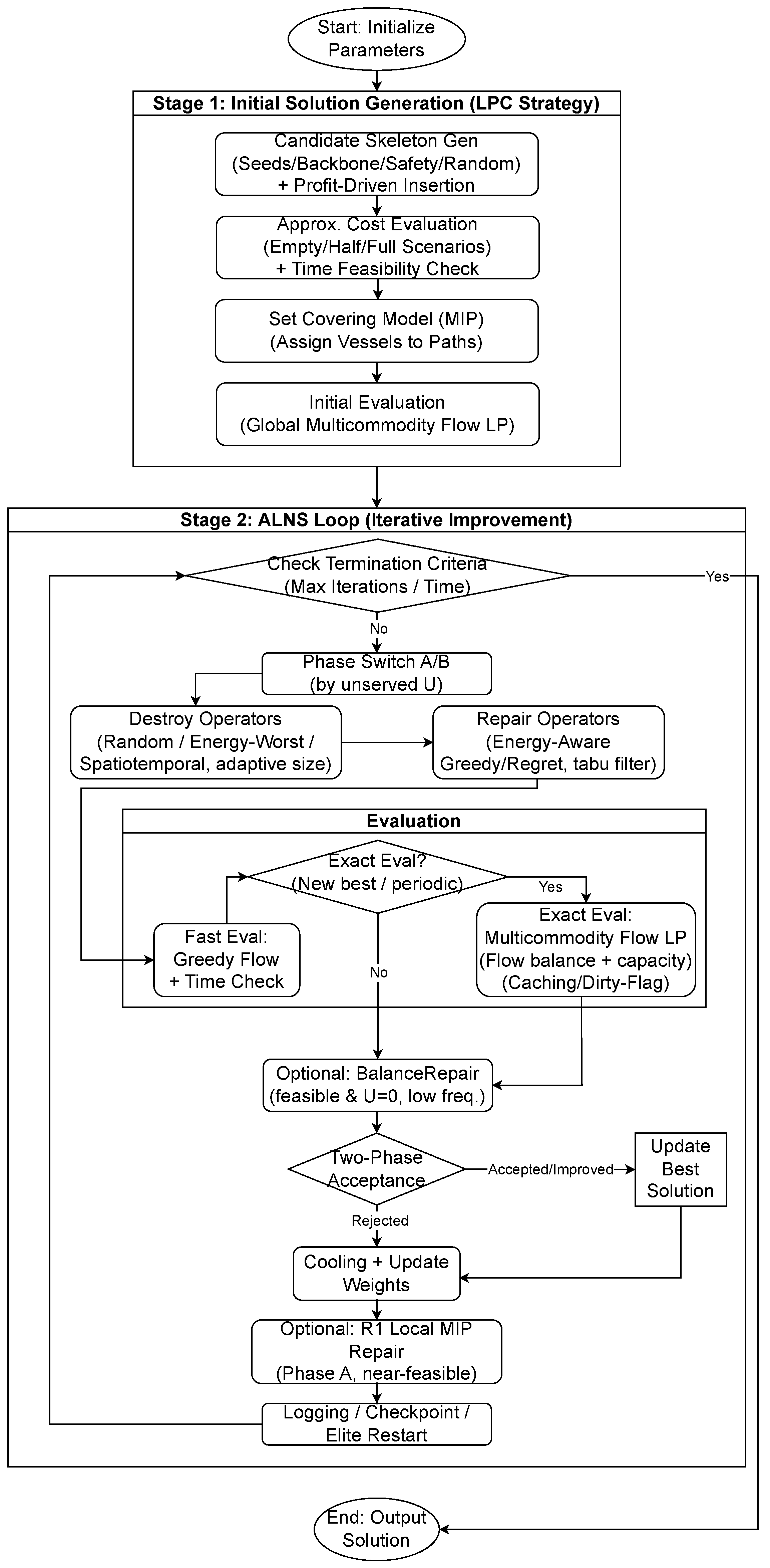
As illustrated in Figure 2, the algorithm framework consists of two main stages: a carefully designed staged heuristic that rapidly constructs a high-quality initial solution, providing a strong starting point for subsequent iterative optimization, and an iterative ALNS loop, which, starting from the initial solution, explores the solution space through diverse combinations of destroy and repair operators to continuously improve solution quality.
This method aims to balance feasibility under complex constraints with acceptable computational cost. It is specifically designed to handle the heterogeneous fleet feeder network problem, integrating routing, vessel assignment, cargo allocation, and charging constraints in a unified framework. First, a two-phase acceptance criterion is adopted to balance feasibility exploration and cost optimization. In Phase A (feasibility phase), the algorithm prioritizes rapidly eliminating unserved demand using a strict acceptance rule: solutions that reduce the unserved amount U are unconditionally accepted, while solutions that increase U are rejected until a feasible solution is obtained ( U = 0 ). In Phase B (optimization phase), the algorithm focuses on cost reduction, applying a simulated annealing criterion within the feasible region to allow probabilistic acceptance of cost-worsening moves, thereby escaping local optima. If infeasibility reappears during the search, the algorithm automatically switches back to Phase A. Second, neighborhood structures are defined within the ALNS destroy and repair framework. Destroy operators remove a subset of demands from the current solution with different biases to free search space, while repair operators reinsert demands or open new routes under capacity, time window, and battery constraints. A short-term memory (tabu) mechanism is introduced to prevent ineffective cycles of immediate removal and reinsertion, thereby improving both search effectiveness and solution diversity. Third, a two-level evaluation scheme is used to control computational overhead: in most iterations, a fast and approximate evaluation based on greedy cargo allocation is employed to screen candidate solutions. An exact evaluation, formulated as a global cargo flow linear program (LP), is triggered only when a candidate solution may update the incumbent best or at periodic checkpoints. Mathematically, this evaluation-layer LP is obtained by fixing the discrete route/vessel decisions (the port sequence and vessel type assignments) and optimizing the remaining continuous operational variables (cargo allocation and charging) subject to linear constraints (flow balance, leg capacity, time consistency, and battery SOC feasibility), yielding the best-response cost for the given decision-layer configuration. This approach significantly reduces the computational cost of frequent LP solves while preserving evaluation accuracy. Fourth, to enhance implementability and interpretability, additional refinement and post-processing modules are integrated. These include a local exact repair operator (R1) applied near feasibility to reinforce solution recovery and, after feasibility is achieved, an infrequent hub-return time balancing post-processing step to improve workload distribution across routes.

4.3. Solution and Hierarchical Structure

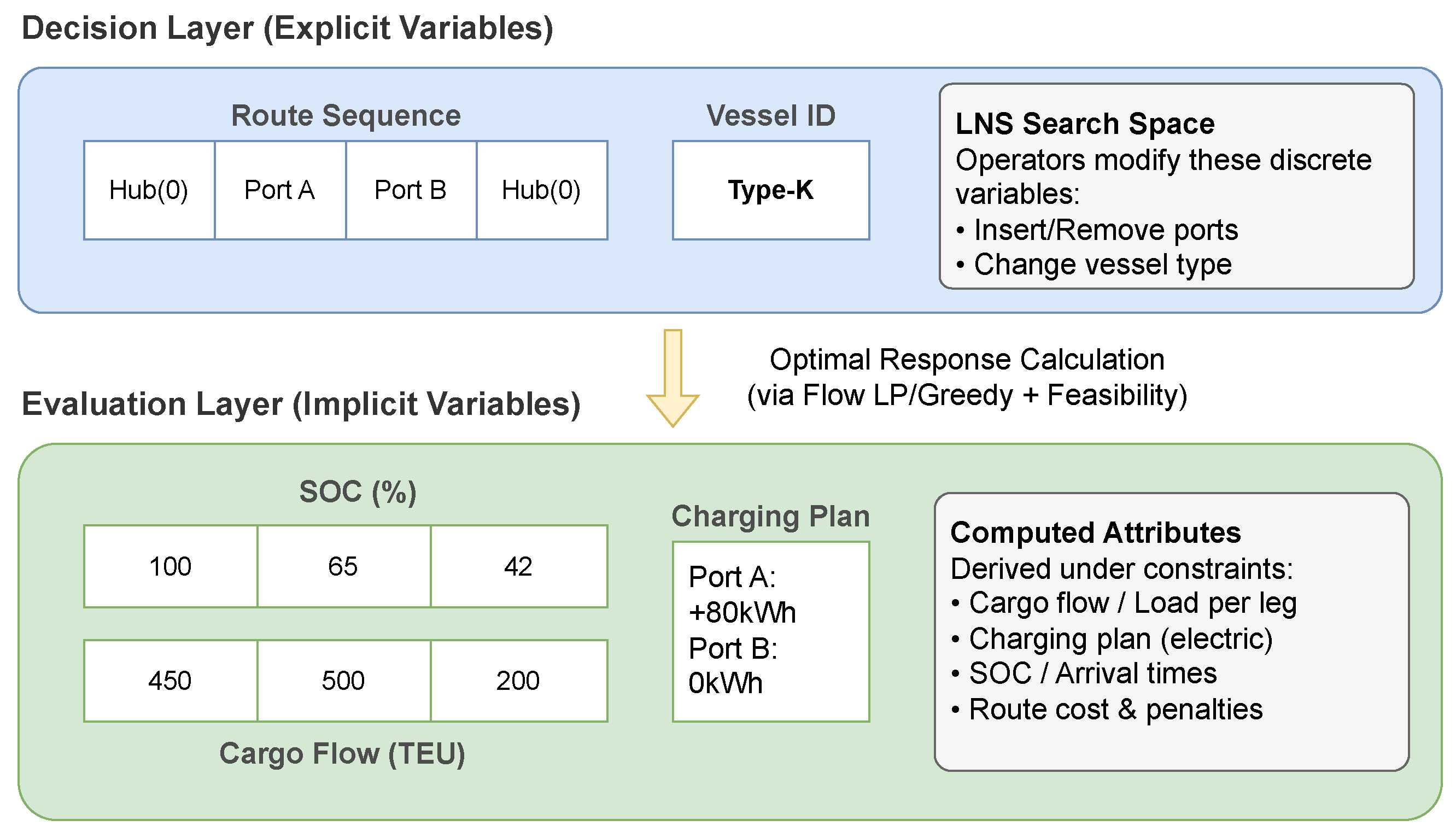
To clarify the objects manipulated by the algorithm, Figure 3 illustrates the hierarchical structure of the solution representation. In the proposed algorithm, a complete solution S consists of a set of routes { r 1 , r 2 , , r m } .
Each route r i contains information at two levels. In particular, the decision layer defines a candidate discrete configuration to be explored by ALNS, while the evaluation layer provides a deterministic best-response evaluation by optimizing the remaining continuous operational decisions for the given configuration:
  • Decision layer (explicit variables): As shown in the upper part of the figure, these variables are directly manipulated by the ALNS operators, including the port visiting sequence and the assigned vessel type. Neighborhood search is mainly conducted at this level by modifying visit orders or swapping vessel types.
  • Evaluation layer (implicit variables): As shown in the lower part of the figure, these variables are computed by the evaluation function, including charging amounts at ports, the detailed cargo flow allocation, and related timing/energy states. These variables are not directly perturbed during neighborhood search; instead, they represent the best response given the decision layer variables, obtained by solving an embedded LP subproblem. For a fixed candidate solution S (i.e., the set of selected route legs and vessel assignments), the evaluation-layer LP keeps the binary routing decisions fixed and minimizes the operational cost by optimizing continuous variables such as cargo flows q i j k , schedule-related variables (e.g., arrival times), and battery-related variables (e.g., SOC and charging), subject to linearized constraints for demand fulfillment, capacity, time windows, and energy feasibility, and returns the corresponding optimal objective value as the exact evaluation of S.
This hierarchical structure decouples the complex mixed-integer problem: the ALNS focuses on the discrete combinatorial component (routes and vessel types), while the sub-algorithm optimizes continuous operational parameters (cargo flows and battery energy), substantially reducing overall search difficulty.

4.4. Initial Solution Generation: A Hybrid Strategy Based on Linear Profit Coverage

The performance of a metaheuristic largely depends on the quality of the initial solution. For linear and regional networks (e.g., Yangtze River feeder), a hybrid approach based on a linear profit coverage strategy is proposed. Through multi-dimensional seeding and a profit-driven insertion mechanism, it rapidly constructs an initial set of routes that covers key cargo demands and exhibits high feasibility.
  • Step 1: Multi-strategy generation of candidate route skeletons
To ensure diversity and coverage in the initial solution space, the algorithm generates candidate route skeletons using complementary strategies and then expands them into complete routes using a unified profit-driven filling mechanism.
  • Demand pair seeding: This strategy prioritizes the service of key cargo demands. The algorithm computes a composite weight for each origin–destination (OD) pair (defined as the product of volume and distance) and selects the top K OD pairs as seeds. For each seeded OD pair, a skeleton route [hub → origin → destination → hub] is constructed, ensuring that key demands are transported with either direct or minimal-stop patterns.
  • Generalized backbone construction: To build backbone routes that span the network, this strategy selects anchor ports based on geographic distance. The algorithm identifies the farthest ports from the hub as well as key midstream ports and constructs skeleton routes [hub → anchor port → hub], thereby enhancing spatial coverage and accommodating long distance transport demands.
  • Safety net (fallback) strategy: To prevent peripheral ports from being omitted due to complex spatiotemporal constraints, the algorithm enforces the generation of a simple round trip route [hub → that port → hub] for each non-hub port. This fallback mechanism ensures feasibility of the initial solution by guaranteeing that each port is reachable via at least one feasible path.
  • Random augmentation: To increase diversity and explore potentially high-quality combinations ignored by deterministic rules, the algorithm randomly selects several non-hub port pairs and generates skeleton routes with random perturbations. This procedure helps avoid the initial solution from being trapped in local optima induced by deterministic construction.
  • Step 2: Profit-driven insertion and filling
For each skeleton route generated in the previous step, the algorithm fills the route using a greedy insertion mechanism based on the net profit increment. The core motivation is to make intelligent selective calling decision: without significantly increasing sailing costs, the route can automatically accommodate key demands along the way (typically those with large volume and long distance), thereby improving the overall utility of the route. Specifically, for each candidate port, the algorithm computes the net profit increment resulting from inserting the port at the optimal position on the current route:
Δ G a i n = Δ U d e m a n d ( Δ D i s t a n c e × C v a r + Δ T × C t i m e )
Here, Δ U d e m a n d denotes the increase in potential demand throughput resulting from the port insertion (i.e., volume × distance ), representing the system utility of serving these key demands. The subtracted term accounts for the additional distance and time cost, where C v a r represents the estimated average variable cost per unit distance. The port is inserted only if Δ G a i n > 0 and the maximum detour distance and time window constraints are satisfied. This mechanism allows routes to automatically identify and incorporate key nodes along the path.
  • Step 3: Approximate cost evaluation and vessel type assignment
The generated candidate route set often contains many overlapping or suboptimal paths. To select a better route combination and assign appropriate vessels, an optimization model based on set covering is used. Because exact cargo allocation is not performed in the initial stage, vessel loads and energy consumption can only be approximated. To improve computational efficiency and ensure that an initial solution can be obtained, a fast approximate evaluation and a relaxed set-covering mechanism are introduced:
  • Fast heuristic cost estimation: Given the potentially large initial candidate set, exact evaluation for each candidate is computationally expensive. To address this, a rapid estimation strategy is adopted. For each route–vessel pair, time feasibility is first verified based on the total route length L r and the time window limit T w i n d o w . The variable cost is then estimated in preset load scenarios l { empty , half , full } , weighted by w l , and combined with the vessel’s fixed cost to obtain an approximate cost C k r . This enables rapid screening of the initial route set.
  • Relaxed set-covering model: To avoid infeasibility of the initial solution arising from limited fleet size or overly tight constraints, an unserved-demand penalty mechanism is introduced, transforming the classic set-covering problem into a soft-constraint model.
  • Decision variables:
    • x k r { 0 , 1 } : equals 1 if vessel k is assigned to route r.
    • z o d { 0 , 1 } : auxiliary variable; equals 1 if demand ( o , d ) is not covered.
  • Objective function:
    min k K r R C k r x k r + P p e n a l t y ( o , d ) D z o d
  • Constraints:
    k K r R a r , o d x k r + z o d 1 , ( o , d ) D
    r R x k r 1 , k K
Here, P p e n a l t y is a large penalty coefficient (e.g., 10 5 ) used to prioritize coverage. This model guarantees that, under any resource constraints, it can return a feasible initial plan that may contain locally unserved demands, which will be repaired by the subsequent ALNS algorithm. By solving this model, the algorithm selects an initial fleet schedule that covers as much demand as possible with minimal expected cost from a large pool of candidate paths.

4.5. ALNS Optimization Framework

4.5.1. Two-Level Solution Evaluation and Hybrid Optimization Strategy

During ALNS iterations, evaluating a candidate solution requires determining cargo allocation and charging strategies. Solving the LP subproblem exactly at every iteration would result in significant computational overhead. Therefore, a two-level evaluation mechanism is adopted: approximate evaluation is applied in most iterations to reduce computational cost, while exact evaluation is performed only when necessary. This approach balances solution quality and computational efficiency, ensuring high search performance while strictly satisfying physical and operational constraints.
  • Approximate evaluation mode: In most iterations, the algorithm estimates the quality of a candidate solution in a heuristic and lightweight approach. Specifically, cargo allocation is performed via a greedy strategy that sorts demand by unit transport cost, with an overall complexity of approximately O ( N log N ) . Meanwhile, instead of performing complex exact computations, a rapid time feasibility check is conducted using sailing speed, total route distance, and the time window limit. This approximate evaluation enables candidate solutions in the neighborhood to be screened at millisecond-level, substantially reducing evaluation overhead during iterations.
  • Exact evaluation mode: Exact evaluation is activated when the rapid approximate evaluation indicates that a new solution may improve the incumbent best, or when a predefined periodic checkpoint is reached. In this mode, a global multicommodity flow LP is formulated and solved to allocate cargo precisely across the network, providing a reliable assessment of the objective value. In addition, a dirty-flag mechanism is introduced: energy and time calculations are recomputed only for routes whose paths or loads have changed significantly, while cached results are reused for unchanged routes. This approach controls the computational cost of exact evaluation without compromising accuracy.
Mathematically, given a candidate solution where the route structure and vessel type of each route are fixed (i.e., x i j k is fixed by the decision layer), the evaluation-layer LP allocates OD demands to the available vessel legs. Let A = { ( i , j , k ) x i j k = 1 } denote the set of active legs in the candidate solution, and let D denote the set of OD demands. For each commodity ( o , d ) D and each active leg ( i , j , k ) A , let f o d i j k 0 be the transported amount on that leg. The LP can be written as
min ( i , j , k ) A c i j k ( o , d ) D f o d i j k
s . t . ( n , j , k ) A f o d n j k ( i , n , k ) A f o d i n k = D o d , n = o D o d , n = d 0 , otherwise ( o , d ) D , n N
( o , d ) D f o d i j k Q k , ( i , j , k ) A
f o d i j k 0 , ( o , d ) D , ( i , j , k ) A
where c i j k is a leg-level marginal cost coefficient (derived from fuel/electricity and carbon cost parameters for the fixed route and vessel type). The LP outputs an exact cargo allocation and its associated cost, which is used to rank candidate solutions and update the incumbent best.

4.5.2. Destroy and Repair Operators

To address the characteristics of AES feeder networks, such as limited cruising range and stringent charging requirements, this study customizes the traditional ALNS operators, with a focus on enhancing the algorithm’s adaptability to battery constraints and route structures.
  • Customized destroy operators
The destroy phase aims to selectively remove suboptimal route segments to free the search space for optimization. In addition to the conventional random removal operator used to maintain population diversity, problem-specific removal strategies are introduced:
  • High-energy-consumption worst removal: Unlike traditional distance-based removal, this operator prioritizes legs with the highest unit transport costs or those that cause sharp drops in battery SOC. This encourages the algorithm to identify more energy-efficient paths and select more appropriate charging nodes during the repair phase.
  • Spatiotemporal related removal: Considering the port cluster characteristics of the feeder network, this operator calculates an association strength based on geographical proximity and time window tightness between ports. It removes groups of demands with strong spatiotemporal correlation, allowing the algorithm to reconstruct more compact and efficient transport sub-tours.
  • Energy-aware repair operators
The core of the repair operators lies in reinserting removed demands into routes while restoring energy feasibility. The traditional insertion logic is improved by proposing the following:
  • Energy-aware greedy insertion: When calculating insertion costs, the algorithm synchronously considers the cascading impact of the insertion action on the battery SOC of subsequent nodes. If a direct insertion leads to energy infeasibility, the algorithm will trigger a charging remedy mechanism to attempt to increase charging duration at preceding or current capable ports, or inserting charging nodes.
  • Regret insertion considering charging opportunities: When calculating regret values, penalty costs caused by insufficient energy are included, prioritizing demands that would be difficult to accommodate later due to limited charging opportunities if not scheduled immediately. Through this mechanism, the algorithm dynamically balances transport efficiency and charging flexibility while restoring a feasible and well-structured solution.

5. Case Study

5.1. Parameter Settings and Data Sources

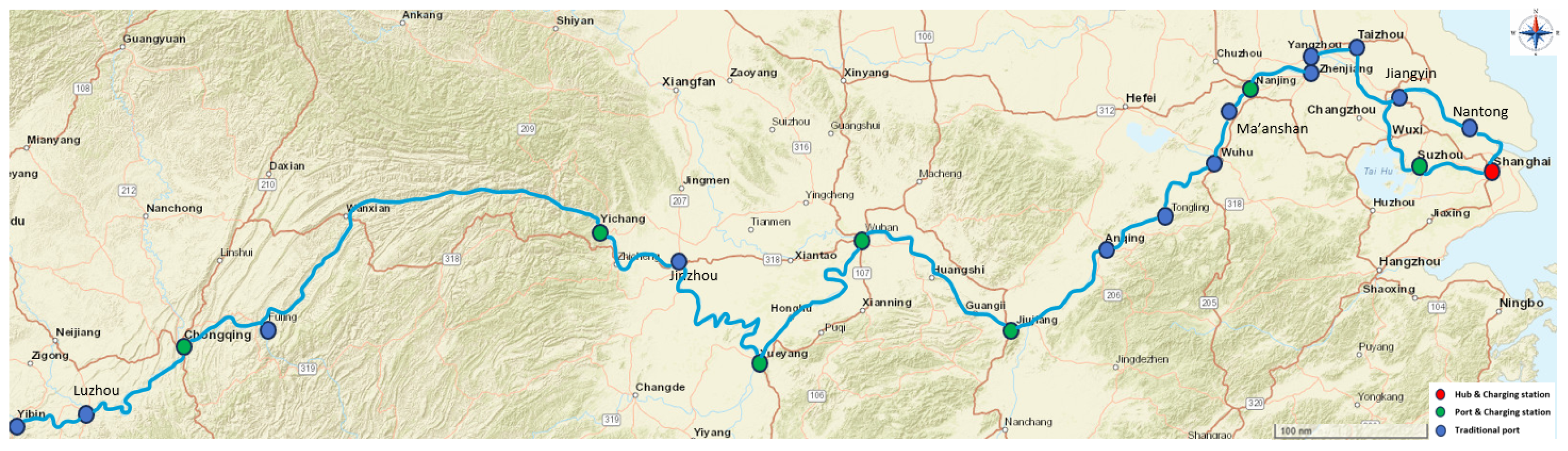
An inland shipping network in the Yangtze River Economic Belt is used as the case study, covering 21 major river ports from downstream Shanghai to upstream Yibin (Figure 4). The base experimental data, including port topology, inter-port distances, and OD demand distribution, are derived from the Yangtze feeder collection and distribution scenario in Li et al. [32], while other related operational parameters are set with reference to Zhang et al. [33]. Based on these references, the data are extended and configured as follows: (1) for AESs, battery capacities, energy consumption rates, and charging efficiencies are set based on typical inland/coastal all-electric container ships; (2) following shore power infrastructure plans along the Yangtze River, high-power charging berths are assumed at eight key nodes: Shanghai, Suzhou, Nanjing, Jiujiang, Wuhan, Yueyang, Yichang, and Chongqing; and (3) a carbon tax and grid emission factor are introduced to reflect economic and environmental cost differences associated with different energy sources. Shanghai is designated as the regional hub for major cargo consolidation and distribution. Distances between adjacent ports are listed in Table 1, and the total waterway length is 2924 km.
A heterogeneous fleet of 60 vessels is constructed, including 30 fuel-based vessels and 30 AESs. All vessels have a standardized maximum capacity of 100 TEU. To simplify operational complexity and reflect an economical sailing speed for inland shipping, a uniform speed of 10 km/h is assumed for all vessels. At this speed, fuel-based vessels generate carbon emissions proportional to fuel consumption (emission factor 3.15 t CO2/t fuel) and do not face range limitations. AESs are equipped with a uniform battery capacity of 18,000 kWh and must recharge at designated charging ports, imposing a complex constraint in route planning.
To quantify the economic and environmental benefits, the model incorporates a detailed cost structure. Fuel and electricity price parameters are set according to typical inland marine diesel rates and commercial/industrial shore power electricity tariffs in China. In the baseline scenario, the fuel price is 6.0 RMB/kg (=6000 RMB/ton) and electricity price is 0.8 RMB/kWh. A carbon tax of 100.0 RMB/ton CO2 is introduced to reflect the impact of low-carbon policy. For AESs, indirect emissions associated with electricity consumption are computed using the average grid emission factor γ E = 0.58 kg CO2/kWh (consistent with the model definition) and are included in the carbon tax together with direct emissions from fuel consumption of fuel-based vessels.
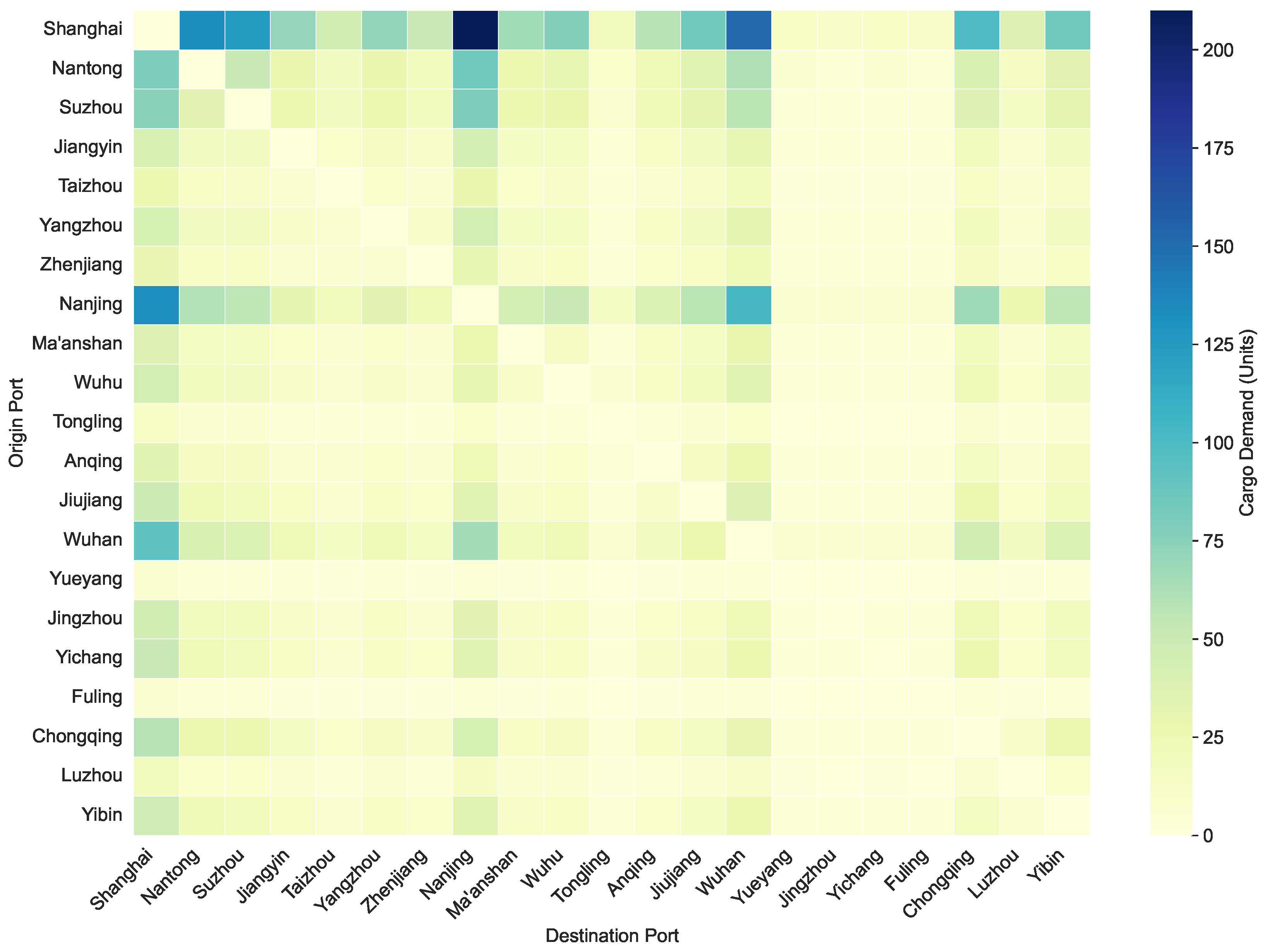
The OD demand distribution is shown in Figure 5, illustrating cargo consolidation and distribution patterns centered on core ports such as Shanghai, Nanjing, Wuhan, and Chongqing.

5.2. Algorithm Performance Comparison

To systematically evaluate the algorithm’s feasibility and optimization performance across different scales, nine scenarios were constructed and categorized into three tiers based on the number of ports | N | : small-scale ( | N | 8 , S1, S2, S3), medium-scale ( 10 | N | 14 , M1, M2, M3), and large-scale ( | N | 16 , L1, L2, L3). Except for the baseline scenario L3, the scenarios are generated by tiered scaling (or subsetting) of the port network, fleet size, and demand volume, forming a continuous gradient of difficulty for both fine-grained comparison and realistic scale stress testing. The parameters and the number of charging ports are summarized in Table 2.
To evaluate the effectiveness and scalability of the proposed heuristic framework across different scales, a comparative experiment was designed using both an exact solver and the proposed heuristic algorithm. The MILP exact solver (IBM ILOG CPLEX Optimization Studio 12.8, IBM Corporation, Armonk, NY, USA) was employed to provide reference solutions, while the proposed heuristic (ALNS with a two-phase strategy and hybrid evaluation) served as the primary solution method. All experiments were carried out in the same computing environment (Windows 10; CPU: AMD Ryzen 5 4600H processor, Advanced Micro Devices, Santa Clara, CA, USA) with a uniform stopping criterion: a maximum runtime of 3600 s for both the exact solver and the heuristic. Other key parameters and random seeds are provided in the appendix or code configuration. Experiments were organized by scale: small, medium, and large.
Table 3 presents a comparison of CPLEX, the proposed heuristic, and a classic ALNS baseline across different scenarios. Both heuristics are evaluated under the same time limit of 3600 s, with Time (s) reporting the average time-to-best solution from the run logs. For S1–S3, both heuristics quickly generate high-quality solutions. However, the classic ALNS often converges prematurely to inferior solutions (e.g., S2: 139 s with a GAP of 4.82%), whereas the proposed heuristic continues to improve and achieves a smaller gap (256.63 s with a GAP of 1.50%).
As the number of ports increases and the complexity of routing, charging, and time-window constraints grows, the advantages of the proposed heuristic become increasingly pronounced. It consistently achieves lower objective values and improves both solution quality and time-to-best (objective 6.74 × 10 6 , 2120.71 s) compared with the classic ALNS baseline (objective 1.08 × 10 7 , 2846.79 s). These results are consistent with the algorithm design described in Section 4.5, where the two-phase search strategy and hybrid evaluation mechanism enable sustained improvements for large-scale instances.

5.3. Result Analysis

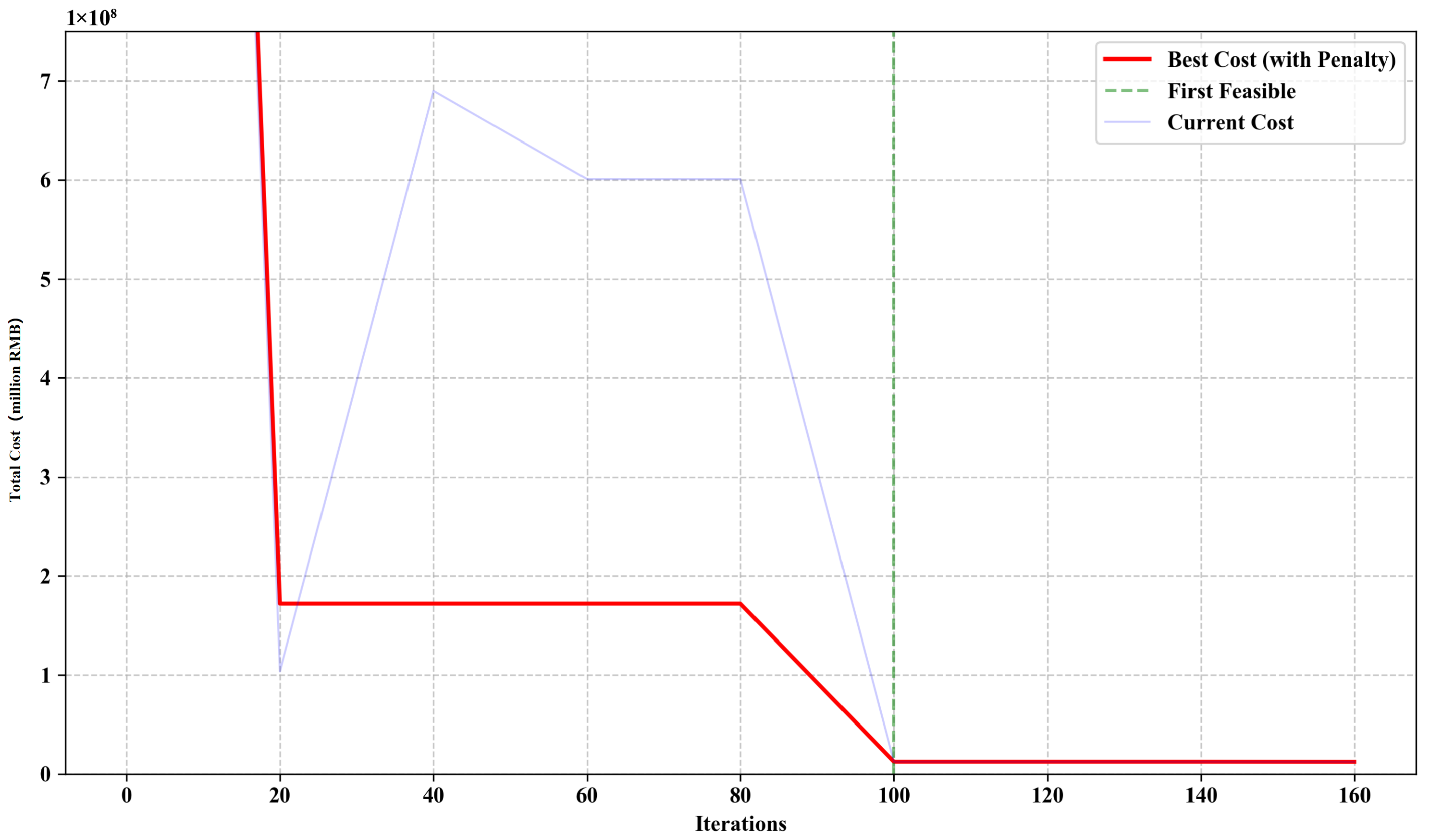
Figure 6 shows the convergence curve for the baseline scenario. The results indicate that the algorithm identifies a feasible solution in the early stage of iteration (around the 100th iteration) and then enters a phase dominated by optimization. The best cost decreases from approximately 1.24 × 10 7 RMB and gradually converges to 1.224 × 10 7 RMB, stabilizing after roughly 160 iterations. This process is consistent with the two-phase search (feasibility followed by optimization) proposed in this paper.
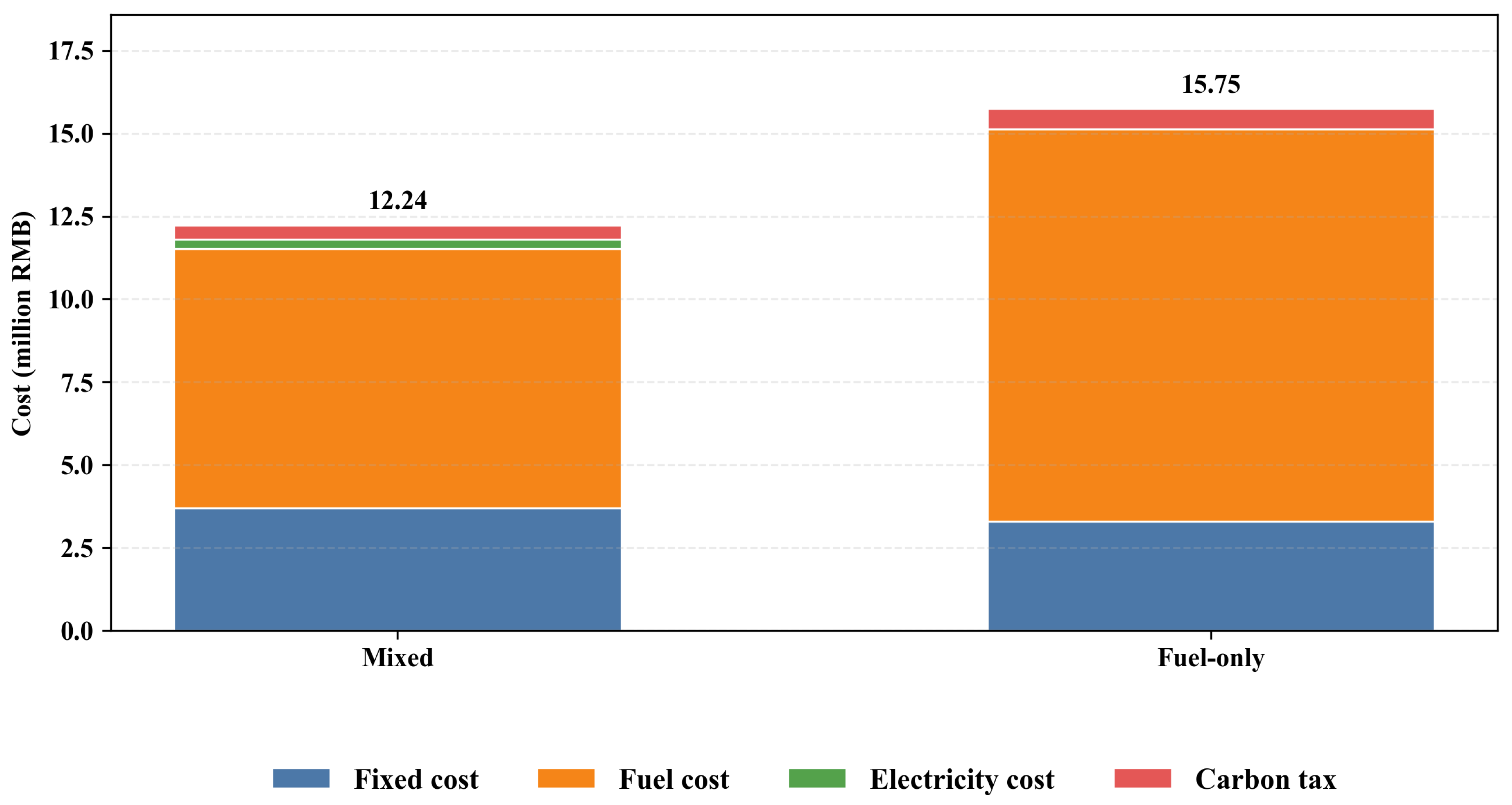
To investigate the benefits of incorporating AESs, a comparison of the total cost and cost components was conducted between the baseline scenario (Mixed, i.e., a heterogeneous fleet with AESs) and the Fuel-Only scenario (allowing only conventional fuel-based vessels), as shown in Figure 7. The total cost of the Fuel-Only scenario is about 1.575 × 10 7 RMB, while the total cost of the heterogeneous fleet is about 1.224 × 10 7 RMB, representing a reduction of about 3.51 × 10 6 RMB (approximately 22.3%).
In terms of cost components, the overall cost advantage primarily stems from a significant decrease in fuel costs. Although the introduction of AESs increases fixed costs (about 3.70 × 10 6 RMB vs. 3.30 × 10 6 RMB for the Fuel-Only scenario) and electricity costs (about 2.79 × 10 5 RMB), these additional expenses are more than offset by the fuel savings achieved by substituting electricity for diesel, resulting in a lower total cost. Specifically, the fuel cost for the Fuel-Only scenario is about 1.183 × 10 7 RMB, whereas in the heterogeneous fleet it decreases to 7.83 × 10 6 RMB, representing a reduction of roughly 4.00 × 10 6 RMB.
This comparison demonstrates that, while satisfying operational constraints such as range, recharging, and time windows, the reasonable deployment and scheduling of AESs can reduce overall system operational costs, providing quantitative evidence for the benefits of a low-carbon fleet structure.
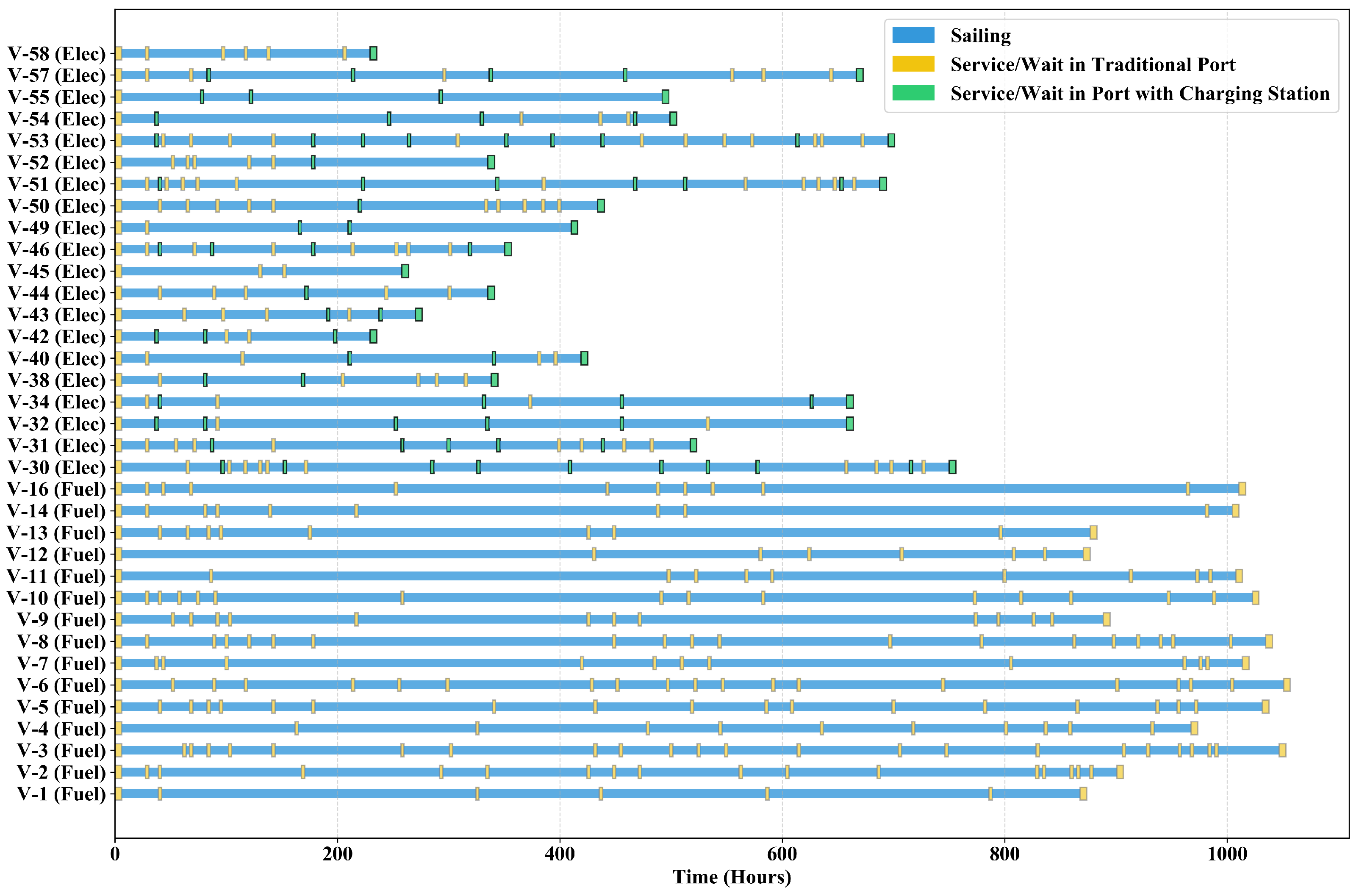
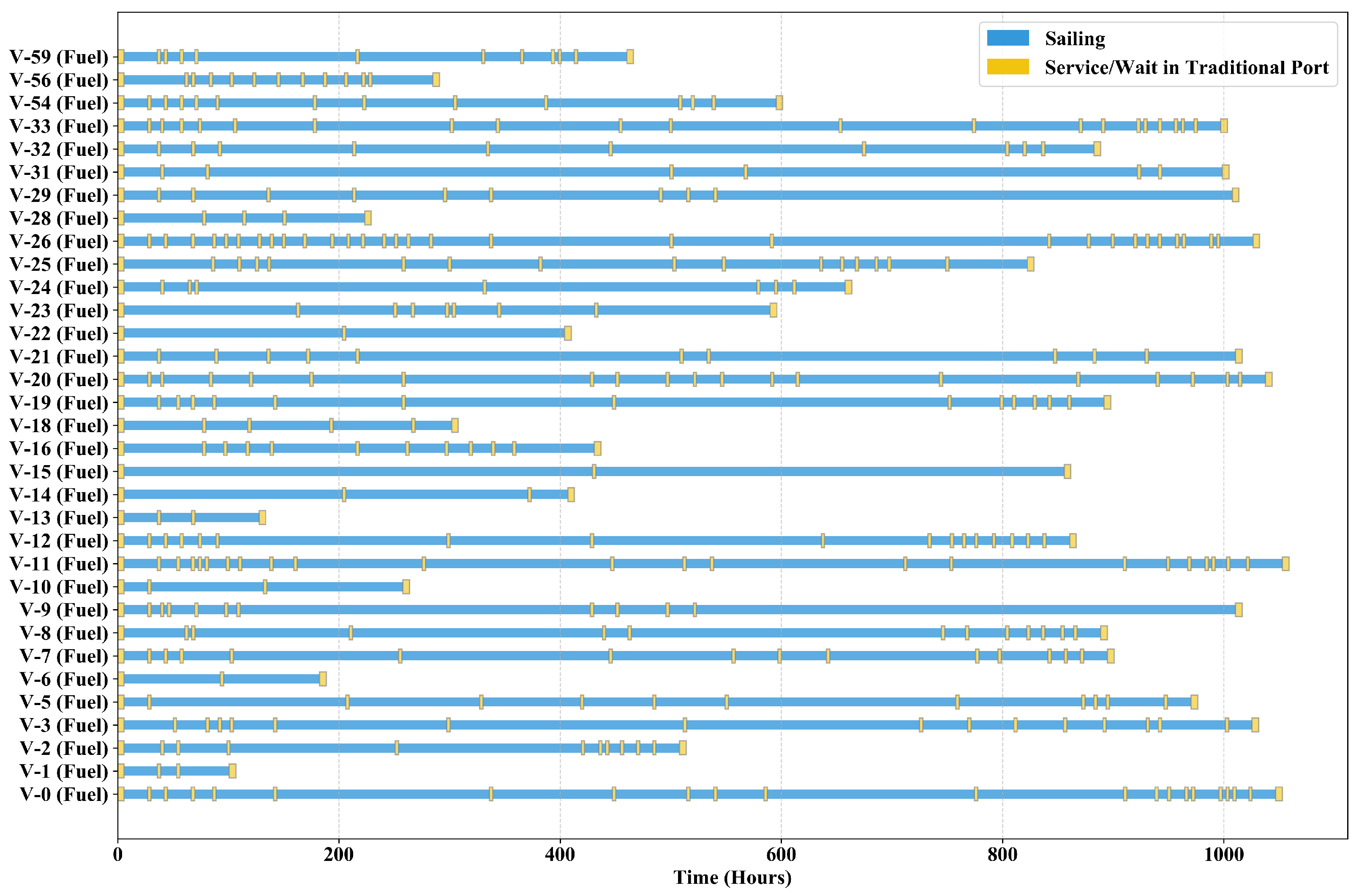
To further illustrate the temporal executability of the solution, Figure 8 presents the Gantt chart of vessel scheduling in the baseline scenario. This chart visually displays the schedule of sailing, port operation, and replenishment activities for each vessel within the planning horizon, enabling verification of check route conflicts, shore power usage, and compliance with hub return time window constraints. Statistical analysis of the data indicates that a total of 37 vessels are activated in the baseline scenario, including 22 AESs and 15 fuel-based vessels. The Gantt chart comprises 723 time segments: 343 sailing segments, 306 port operation segments, and 74 charging segments. In the time bars for AESs, green charging segments appear intermittently, averaging approximately 3.4 charging events per vessel (up to 11 events), reflecting the operational cycle of arrival–operation–replenishment–departure. Furthermore, the latest return times of most vessels are close to, but do not exceed, the upper bound of the planning horizon (1080 h). For instance, the maximum end time in the plotted data is approximately 1062.7 h, indicating that the scheduling results generally satisfy the hub return time window constraint while maintaining a small operational margin.
Figure 9 presents the Gantt chart of vessel scheduling for the Fuel-Only scenario, where the scheduling process consists only of two types of activities: sailing and port service/waiting. Analysis of the exported plotting data (Figure 9) indicates that a total of 33 vessels are activated in this scenario, with the Gantt chart comprising 773 time segments: 370 sailing segments and 403 port operation/waiting segments. Compared with the baseline scenario, the fuel-only scenario activates four fewer vessels, while the total number of time segments increases by 50. Further analysis of the route statistics shows that the average sailing distance per vessel in the Fuel-Only scenario is approximately 3928.3 km, higher than the 3504.9 km observed in the baseline scenario. These differences are reasonable as a fuel-only fleet tends to concentrate transport tasks on fewer vessels to reduce fixed vessel usage costs.
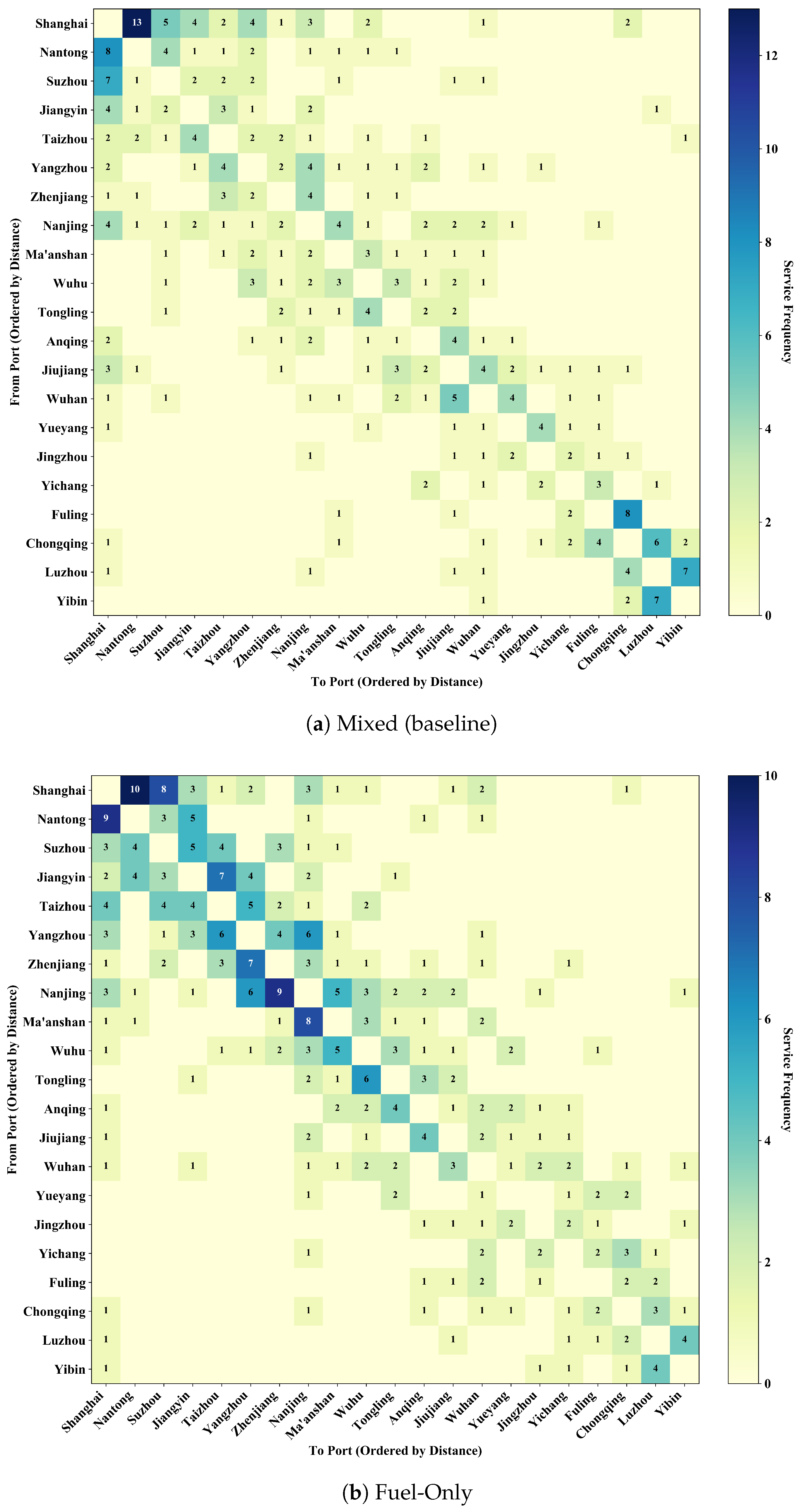
Figure 10 compares the service frequency heatmaps for the baseline and Fuel-Only scenarios. The results reveal a segmented clustering pattern along the river: round trips between the downstream hub and its adjacent ports are more frequent; for example, the Shanghai–Nantong route has the highest service frequency (13 trips in both directions), and Shanghai also maintains strong connectivity with nodes such as Suzhou, Jiangyin, and Nanjing. The midstream region forms a secondary cluster centered on Wuhan and its upstream and downstream nodes, while the upstream chain (Chongqing–Luzhou–Yibin) maintains moderate service frequency, reflecting the network’s ability to cover remote demands. Overall, under spatiotemporal and range/recharging constraints, the algorithm favors a service organization characterized by high-frequency short segments combined with key-node transfers, effectively controlling detours and minimizing energy consumption.
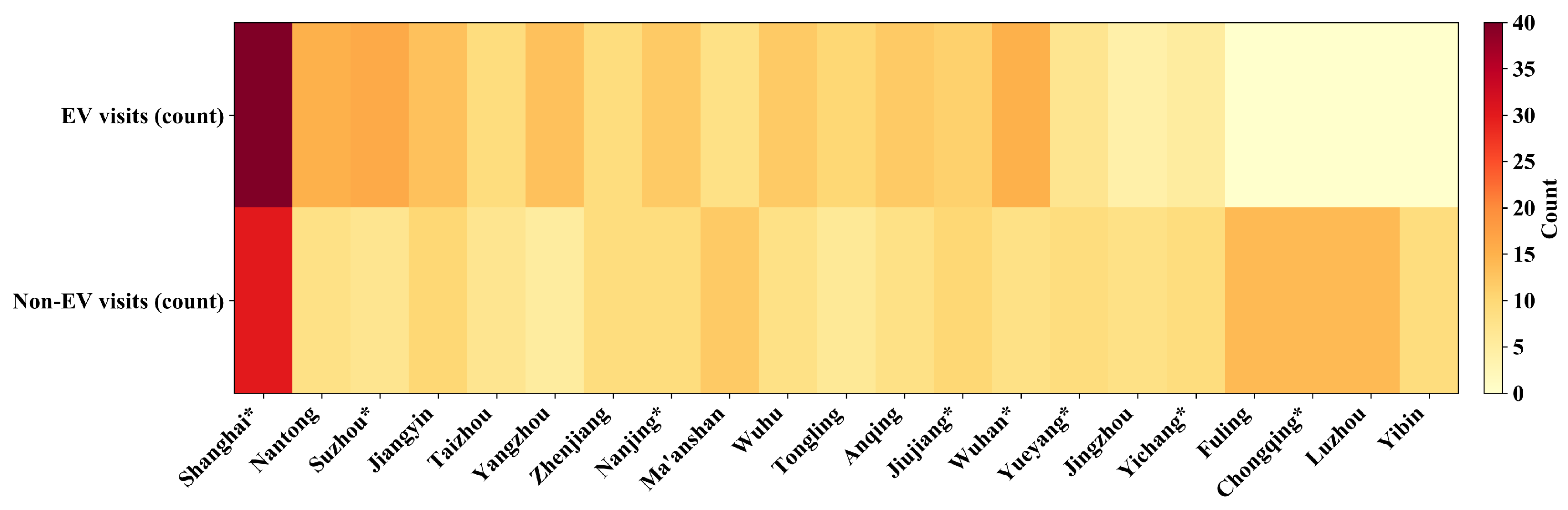
From a route-level perspective, the similarity between the two panels in Figure 10 suggests that the heterogeneous fleet achieves cost reductions without making drastic changes to route topology. Instead, the primary adjustment involves reallocating vessel types along the same high-frequency short- to medium-length segments. Combined with the shorter average sailing distance per vessel in the Mixed scenario (3504.9 km vs. 3928.3 km in Fuel-Only) and the vessel-type visit pattern shown in Figure 11; these results indicate that fuel cost savings are primarily driven by substituting electricity for diesel on energy-intensive shuttle missions around charging clusters, rather than by fundamentally restructuring the network into longer-distance routes.
To further illustrate differences in vessel deployment, port visit frequency was analyzed using the Gantt data from the baseline scenario, as shown in Figure 11. The first row reports the number of port visits by AESs, while the second row shows visits by non-AESs. Ports marked with an asterisk (*) are equipped with charging facilities. The results indicate that, in the Mixed scenario, AES operations are concentrated around charging-capable ports and their nearby segments. Compared with fuel-based vessels, AESs exhibit a more limited operational range; beyond Yichang, transport activities decline due to battery constraints. These observations suggest that the proposed algorithm effectively incorporates both energy consumption and replenishment requirements of AESs. By combining the segment-level service patterns in Figure 10 with vessel-type-specific visit statistics in Figure 11, it is evident that AESs are primarily assigned to downstream and midstream short- to medium-distance shuttle missions clustered around charging nodes, where frequent round trips and dense demand allow them to exploit the cost advantage of electricity. In contrast, fuel-based vessels serve a complementary role on longer upstream legs beyond the effective range of the charging network, ensuring network coverage while avoiding excessive charging detours.

5.4. Sensitivity Analysis

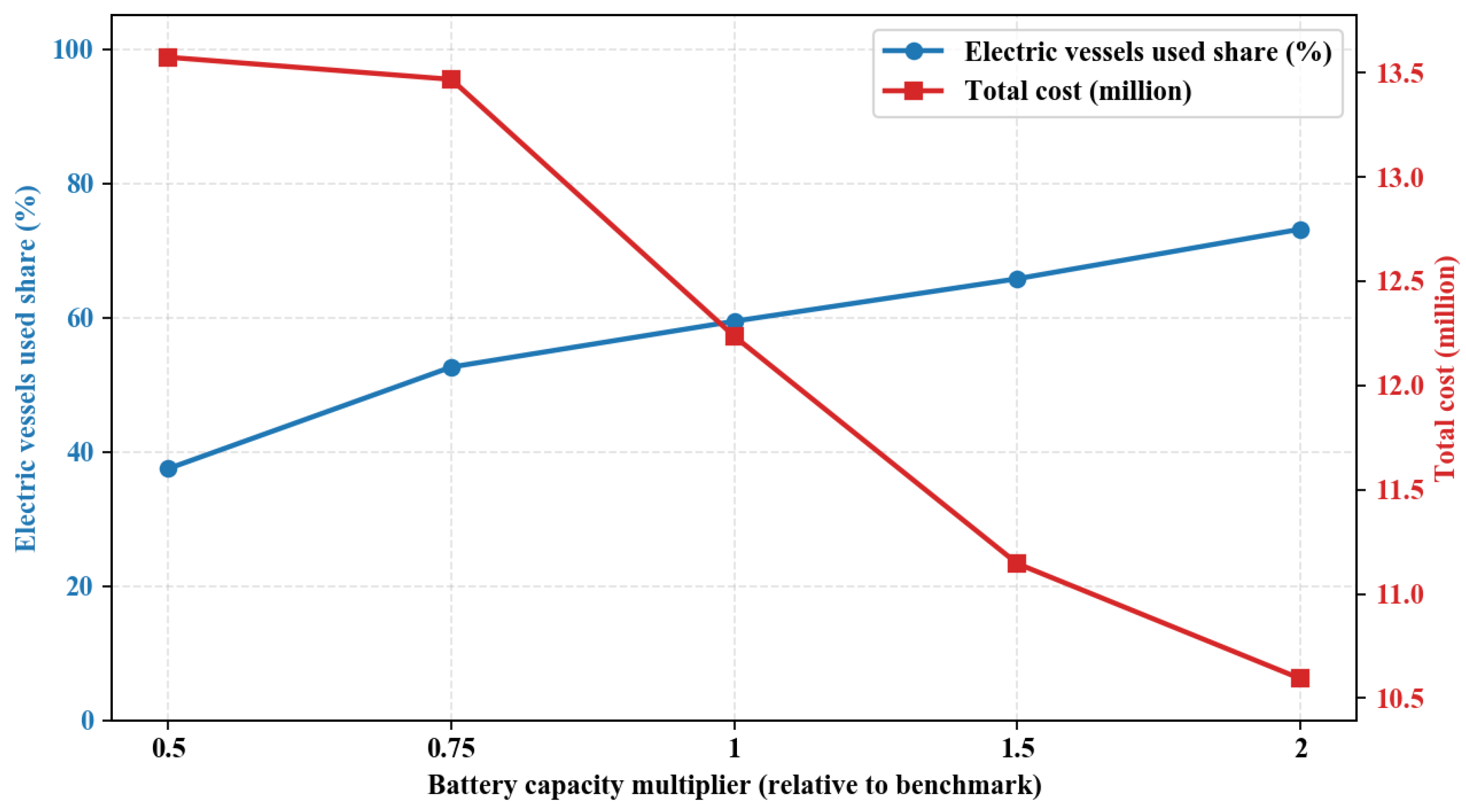
Sensitivity analysis was conducted to evaluate whether the conclusions are dependent on specific parameter settings and to identify the key drivers of system performance. Considering the influence of AES utilization range and charging infrastructure, this study focuses on the battery capacity multiplier as a key technical parameter to examine how changes in AES range capability affect fleet activation and total costs.
All other network, demand, fleet size, and cost parameters were kept consistent with the baseline scenario. Only the AES battery capacity was perturbed using multipliers of 0.5, 0.75, 1.0, 1.5, and 2.0, where 1.0 represents the baseline scenario. The other levels were implemented by scaling the baseline battery capacities by the respective multipliers.
Figure 12 presents the resulting AES activation ratio and total cost with these variations. When battery capacity increases from 0.5 to 1.5 times the baseline, the actual activation ratio of AESs rises from 37.5% to 65.8%, while the total cost decreases from 13.57 million RMB to 11.15 million RMB. Further increasing the capacity to 2.0 results in an activation ratio of 73.2% and a total cost of 10.59 million RMB, indicating a diminishing marginal improvement accompanied by minor fluctuations. This result reflects that as the total battery capacity increases, the range constraint gradually transitions from a tight constraint to a non-dominant constraint, allowing higher utilization of AESs and contributing to total cost reductions. Moreover, the findings demonstrate that the proposed algorithm effectively accounts for range and recharging constraints of AESs, providing feasible and practical solutions for real-world operations.

6. Conclusions and Future Work

This paper studies a feeder transport planning problem with a heterogeneous fleet (fuel-based and AESs), incorporating charging constraints, and hub return time window limitation. A MILP model is developed to minimize total cost, integrating fuel costs, electricity costs, and carbon tax within a unified objective function. To solve this complex problem, an ALNS-based heuristic framework is proposed, featuring a two-phase strategy (feasibility first, optimization second), enabling scalable search with strong coupling of routing, vessel assignment, cargo allocation, and charging feasibility constraints.
The case study of the Yangtze River feeder network shows that the proposed heuristic quickly attains feasibility and subsequently converge to a stable cost level in the baseline scenario. Compared with the Fuel-Only scenario, the Mixed baseline reduces total cost by about 16.2%, primarily due to a substantial reduction in fuel costs that outweighs the increase in fixed and electricity cost. Performance comparison across different scenarios indicates that the heuristic produces feasible solutions for medium and large instances under a fixed time limit, while exact MILP solving is practical only for small instances. Sensitivity analysis on battery capacity further shows that increasing battery capacity generally enhances AES utilization and reduces total cost, although marginal improvements diminish and minor fluctuations occur at higher capacity multipliers.
Although this study provides an implementable modeling and solution approach for feeder network planning with heterogeneous fleets, several directions remain for future research. First, this study primarily assumes deterministic demand and parameters, and does not explicitly account for real-world uncertainties such as demand fluctuations or variability in charging resource availability. Future work could incorporate a stochastic/robust optimization approach or scenario-based evaluation frameworks to enhance solution resilience. In addition, environmental factors in inland shipping (e.g., river current, wind, and weather conditions) could be incorporated to capture their impacts on sailing resistance and energy consumption, thereby improving real-world applicability. Second, the framework could be extended to jointly optimize technical parameters and operational strategies. For example, sailing speed could be treated as a decision variable, enabling the joint optimization of speed, energy consumption, and time windows. This would allow a more detailed analysis of the trade-off between energy savings and service level, and assess how speed-control policies influence the coordinated deployment of heterogeneous fleets. Third, future work may explore data-driven and intelligent decision-making methods, such as reinforcement learning, and their integration with metaheuristic approaches. Such methods could enable online decision-making and adaptive search under more complex conditions, including dynamic demand, stochastic port operations, and charging resource congestion, thereby enhancing robustness and transferability in practical operations.

Author Contributions

P.H.: Writing—Review and Editing, Supervision, Project Administration, Funding Acquisition, Conceptualization. Y.J.: Writing—Original Draft, Writing—Review and Editing, Methodology, Formal Analysis, Investigation, Data Curation, Visualization. H.C.: Writing—Review and Editing, Writing—Original Draft, Methodology, Validation, Formal Analysis, Project Administration. J.W.: Writing—Review and Editing, Supervision, Methodology, Validation, Data Curation. P.Z.: Writing—Review and Editing, Supervision, Methodology, Funding Acquisition, Conceptualization, Project Administration. All authors have read and agreed to the published version of the manuscript.

Funding

The work was supported by the National Social Science Fund of China (Grant No. 23&ZD138) and the Start-up Grant for Natural Sciences of Jimei University (Grant No. ZQ2025035).

Data Availability Statement

The original contributions presented in this study are included in the article. Further inquiries can be directed to the corresponding author.

Acknowledgments

The authors extend their sincere thanks to the anonymous reviewers for their valuable comments and suggestions, which greatly improved the quality of this manuscript.

Conflicts of Interest

The authors declare no conflicts of interest.

References

  1. Gaber, M.; El-Banna, S.; El-Dabah, M.; Hamad, M. Intelligent Energy Management System for an all-electric ship based on adaptive neuro-fuzzy inference system. Energy Rep. 2021, 7, 7989–7998. [Google Scholar] [CrossRef]
  2. Kim, K.; Park, K.; Lee, J.; Chun, K.; Lee, S.H. Analysis of battery/generator hybrid container ship for CO2 reduction. IEEE Access 2018, 6, 14537–14543. [Google Scholar] [CrossRef]
  3. Kanellos, F. Optimal power management with GHG emissions limitation in all-electric ship power systems comprising energy storage systems. IEEE Trans. Power Syst. 2013, 29, 330–339. [Google Scholar] [CrossRef]
  4. Zhang, Y.; Sun, L.; Fan, T.; Ma, F.; Xiong, Y. Speed and energy optimization method for the inland all-electric ship in battery-swapping mode. Ocean Eng. 2023, 284, 115234. [Google Scholar] [CrossRef]
  5. Karsten, C.V.; Brouer, B.D.; Pisinger, D. Competitive liner shipping network design. Comput. Oper. Res. 2017, 87, 125–136. [Google Scholar] [CrossRef]
  6. Zhou, S.; Ji, B.; Song, Y.; Yu, S.S.; Zhang, D.; Van Woensel, T. Hub-and-spoke network design for container shipping in inland waterways. Expert Syst. Appl. 2023, 223, 119850. [Google Scholar] [CrossRef]
  7. Lin, D.Y.; Liu, H.Y. Combined ship allocation, routing and freight assignment in tramp shipping. Transp. Res. Part E Logist. Transp. Rev. 2011, 47, 414–431. [Google Scholar] [CrossRef]
  8. Lin, D.Y.; Chang, Y.T. Ship routing and freight assignment problem for liner shipping: Application to the Northern Sea Route planning problem. Transp. Res. Part E Logist. Transp. Rev. 2018, 110, 47–70. [Google Scholar] [CrossRef]
  9. Li, D.C.; Yang, H.L. Ship routing in inland waterway liner transportation with foldable and standard empty containers repositioning. Ocean Eng. 2023, 285, 115391. [Google Scholar] [CrossRef]
  10. Psaraftis, H.N.; Kontovas, C.A. Ship speed optimization: Concepts, models and combined speed-routing scenarios. Transp. Res. Part C Emerg. Technol. 2014, 44, 52–69. [Google Scholar] [CrossRef]
  11. Aydin, N.; Lee, H.; Mansouri, S.A. Speed optimization and bunkering in liner shipping in the presence of uncertain service times and time windows at ports. Eur. J. Oper. Res. 2017, 259, 143–154. [Google Scholar] [CrossRef]
  12. Bian, Y.; Yan, W.; Hu, H.; Li, Z. Feeder scheduling and container transportation with the factors of draught and bridge in the Yangtze River, China. J. Mar. Sci. Eng. 2021, 9, 964. [Google Scholar] [CrossRef]
  13. Li, D.C.; Yang, H.L.; Xing, Y.W. Economic and emission assessment of LNG-fuelled ships for inland waterway transportation. Ocean Coast. Manag. 2023, 246, 106906. [Google Scholar] [CrossRef]
  14. Wang, Y.; Zhu, S.; Iris, Ç. An exact algorithm for fleet co-deployment and slot co-chartering in a sustainable shipping alliance under emissions trading system. Eur. J. Oper. Res. 2025, 327, 450–468. [Google Scholar] [CrossRef]
  15. Tao, Y.; Qiu, J.; Lai, S.; Sun, X.; Zhao, J. Flexible voyage scheduling and coordinated energy management strategy of all-electric ships and seaport microgrid. IEEE Trans. Intell. Transp. Syst. 2022, 24, 3211–3222. [Google Scholar] [CrossRef]
  16. Wen, S.; Jin, X.; Zheng, Y.; Wang, M. Probabilistic coordination of optimal power management and voyage scheduling for all-electric ships. IEEE Trans. Transp. Electrif. 2023, 10, 3661–3669. [Google Scholar] [CrossRef]
  17. Hein, K.; Xu, Y.; Wilson, G.; Gupta, A.K. Coordinated optimal voyage planning and energy management of all-electric ship with hybrid energy storage system. IEEE Trans. Power Syst. 2020, 36, 2355–2365. [Google Scholar] [CrossRef]
  18. Huang, Y.; Lan, H.; Hong, Y.Y.; Wen, S.; Fang, S. Joint voyage scheduling and economic dispatch for all-electric ships with virtual energy storage systems. Energy 2020, 190, 116268. [Google Scholar] [CrossRef]
  19. Gao, J.; Lan, H.; Zhang, X.; Iu, H.; Hong, Y.Y.; Yin, H. A coordinated generation and voyage planning optimization scheme for all-electric ships under emission policy. Int. J. Electr. Power Energy Syst. 2024, 156, 109698. [Google Scholar] [CrossRef]
  20. Lin, A.; Wen, S.; Zhu, M.; Ding, Z.; Ding, T. Joint optimal energy management and voyage scheduling for economic and resilient operation of all-electric ships considering safe return. IEEE Trans. Ind. Appl. 2023, 59, 5304–5313. [Google Scholar] [CrossRef]
  21. Wen, S.; Zhao, T.; Tang, Y.; Xu, Y.; Zhu, M.; Fang, S.; Ding, Z. Coordinated optimal energy management and voyage scheduling for all-electric ships based on predicted shore-side electricity price. IEEE Trans. Ind. Appl. 2020, 57, 139–148. [Google Scholar] [CrossRef]
  22. Sun, X.; Qiu, J.; Tao, Y.; Liu, H.; Zhao, J. Customized coordinated voltage regulation and voyage scheduling for all-electric ships in seaport microgrids. IEEE Trans. Sustain. Energy 2024, 15, 1515–1527. [Google Scholar] [CrossRef]
  23. Wen, S.; Dong, Z.; Zhao, T.; Zhu, M.; Huang, Y. Hierarchical game theory-based optimal power management for both seaports and ships. Energy 2024, 313, 133748. [Google Scholar] [CrossRef]
  24. Yang, T.; Cao, B.; Wang, C. Joint generation and voyage scheduling of all-electric ships considering power supply capacity constraints. IEEE Trans. Appl. Supercond. 2024, 34, 5403204. [Google Scholar] [CrossRef]
  25. Guidi, G.; Suul, J.A.; Jenset, F.; Sorfonn, I. Wireless charging for ships: High-power inductive charging for battery electric and plug-in hybrid vessels. IEEE Electrif. Mag. 2017, 5, 22–32. [Google Scholar] [CrossRef]
  26. Gu, M.; Wen, S.; Zhu, M.; Chen, C.; Huang, Y. Voyage optimization for all-electric vessels integrated with swappable containerized battery. In Proceedings of the 2021 11th International Conference on Power and Energy Systems (ICPES), Shanghai, China, 18–20 December 2021; pp. 586–591. [Google Scholar]
  27. Ren, B.; Li, Y.; Wen, X.; Ma, H.L. The offshore mobile charging vessel location and electric vessels charging scheduling problem. Ocean Eng. 2025, 339, 122181. [Google Scholar] [CrossRef]
  28. Lu, Z.; Wen, S.; Gu, M.; Wang, W.; Zhu, M.; Ma, J. Coordinated Route and Operation Scheduling for All-Electric Ship Clusters. In Proceedings of the 2025 IEEE Industry Applications Society Annual Meeting (IAS), Taipei, China, 15–20 June 2025; IEEE: New York, NY, USA, 2025; pp. 1–8. [Google Scholar]
  29. Cui, Z.; Fu, X.; Jin, H.; Chen, A.; Wang, K. Transitioning to electrification: Optimal strategies for ship fleet replacement. Transp. Res. Part C Emerg. Technol. 2025, 174, 105079. [Google Scholar] [CrossRef]
  30. Koumaniotis, E.K.; Kanellos, F.D. Optimal routing and sustainable operation scheduling of large ships with integrated full-electric propulsion. Sustainability 2024, 16, 10662. [Google Scholar] [CrossRef]
  31. Yang, Z.; Sun, Y.; Lian, F.; Feng, H.; Li, G. Optimization of river container port-access transport based on the innovatively designed electric ship in the Yangtze River Delta. Ocean Coast. Manag. 2024, 248, 106976. [Google Scholar] [CrossRef]
  32. Li, D.C.; Yang, H.L. Designing scheduled route for river liner shipping services with empty container repositioning. Expert Syst. Appl. 2024, 247, 123246. [Google Scholar] [CrossRef]
  33. Zhang, Y.; Sun, L.; Ma, F.; Wu, Y.; Jiang, W.; Fu, L. Collaborative optimization of the battery capacity and sailing speed considering multiple operation factors for a battery-powered ship. World Electr. Veh. J. 2022, 13, 40. [Google Scholar] [CrossRef]
Figure 1. Schematic of a heterogeneous fleets’ feeder shipping network.
Wevj 17 00147 g001
Figure 2. Solution framework based on ALNS.
Wevj 17 00147 g002
Figure 3. Hierarchical solution representation: decision layer and evaluation layer.
Wevj 17 00147 g003
Figure 4. Yangtze River feeder port network and charging port configuration.
Wevj 17 00147 g004
Figure 5. Heatmap of the OD demand matrix.
Wevj 17 00147 g005
Figure 6. Convergence curve in the baseline scenario.
Wevj 17 00147 g006
Figure 7. Cost comparison between the baseline (Mixed) and the diesel-only fleet (Fuel-Only).
Wevj 17 00147 g007
Figure 8. Gantt chart of vessel scheduling in the baseline scenario.
Wevj 17 00147 g008
Figure 9. Gantt chart of vessel scheduling in the Fuel-Only scenario.
Wevj 17 00147 g009
Figure 10. Service frequency heatmaps in the baseline (Mixed) and Fuel-Only scenarios.
Wevj 17 00147 g010
Figure 11. Baseline (Mixed) node visit heatmap by vessel type.
Wevj 17 00147 g011
Figure 12. Sensitivity analysis on battery capacity multiplier.
Wevj 17 00147 g012
Table 1. Adjacent river segments and distances along the Yangtze River (km).
SegmentDistanceSegmentDistance
Shanghai → Nantong128Tongling → Anqing113
Nantong → Suzhou51Anqing → Jiujiang196
Suzhou → Jiangyin19Jiujiang → Wuhan251
Jiangyin → Taizhou69Wuhan → Yueyang231
Taizhou → Yangzhou62Yueyang → Jingzhou244
Yangzhou → Zhenjiang19Jingzhou → Yichang232
Zhenjiang → Nanjing77Yichang → Fuling528
Nanjing → Ma’anshan48Fuling → Chongqing120
Ma’anshan → Wuhu48Chongqing → Luzhou254
Wuhu → Tongling104Luzhou → Yibin130
Table 2. Scenario set and parameter settings.
ScenarioGroupPortsVesselsDemandsHorizon (h)Charging Ports
S1Small4367202
S2Small68307202
S3Small815607203
M1Medium10221007203
M2Medium12301507203
M3Medium14382007205
L1Large16452607206
L2Large18523307207
L3Large216040610808
Table 3. Performance comparison of different solution methods across instance scales.
ScenarioExact Solver (MILP, CPLEX)Proposed Heuristic (ALNS)Classic ALNS (Heuristic Rules)
Objective (RMB)Time (s)Objective (RMB)Time (s)GAP (%)Objective (RMB)Time (s)GAP (%)
S1 1.03 × 10 5 0.16 1.03 × 10 5 0.070.00 1.03 × 10 5 0.030.00
S2 6.85 × 10 5 558.91 6.95 × 10 5 256.631.5 7.18 × 10 5 1394.82
S3 1.55 × 10 6 3600 * 1.67 × 10 6 2862.887.55 1.89 × 10 6 187321.94
M13600 * 2.16 × 10 6 2402.56 2.26 × 10 6 1619.70
M23600 * 3.97 × 10 6 2259.67 4.24 × 10 6 1894.29
M33600 * 4.53 × 10 6 1828.32 5.82 × 10 6 2048.09
L13600 * 5.49 × 10 6 1821.92 7.51 × 10 6 2214.88
L23600 * 5.76 × 10 6 2458.68 1.29 × 10 7 2135.53
L33600 * 6.74 × 10 6 2120.71 1.08 × 10 7 2846.79
Note: * indicates the CPLEX time limit is reached; – indicates that a comparable objective value is not available within the time limit (or the solve is not completed). For the two ALNS variants, Time (s) reports the average time-to-best (first reaching the final best objective value) extracted from run logs. GAP (%) is computed for both ALNS variants relative to the CPLEX reference value (reported only when CPLEX provides a reference objective value).
Disclaimer/Publisher’s Note: The statements, opinions and data contained in all publications are solely those of the individual author(s) and contributor(s) and not of MDPI and/or the editor(s). MDPI and/or the editor(s) disclaim responsibility for any injury to people or property resulting from any ideas, methods, instructions or products referred to in the content.