Article

Design and Control of Active Brake Pedal Simulator with Brake Feel Index-Based Optimization

1
Chongqing Engineering Research Center for Advanced Intelligent Manufacturing Technology, Chongqing Three Gorges University, Chongqing 404120, China
2
College of Mechanical Engineering, Chongqing Three Gorges University, Chongqing 404120, China
3
Chongqing Engineering Technology Research Center for Light Alloy and Processing, Chongqing Three Gorges University, Chongqing 404120, China
*
Author to whom correspondence should be addressed.
World Electr. Veh. J. 2026, 17(3), 116; https://doi.org/10.3390/wevj17030116
Submission received: 5 February 2026 / Revised: 23 February 2026 / Accepted: 24 February 2026 / Published: 26 February 2026
(This article belongs to the Section Manufacturing)

Abstract

Brake-by-wire systems eliminate the mechanical linkage between the brake pedal and wheel actuators, resulting in the loss of the natural and familiar braking feel perceived by the driver. To address this issue, this study proposes an active brake pedal simulator based on a linear motor and springs, aiming to simulate the adaptive pedal feel and ensure safety performance. Firstly, this paper established a structural model of the pedal simulator and designed a force compensation strategy to reproduce the target pedal characteristic curve of the traditional hydraulic braking system. Subsequently, the system was verified through Adams simulation and real vehicle experiments under slow, normal, and emergency braking conditions. The experimental results show that the initial design exhibited a relatively “soft” pedal feel, with a brake feel index score of 62.31. By optimizing the spring stiffness and feedback force composition, the brake feel index score was significantly improved to 92.21. The optimized pedal simulator is capable of achieving precise pedal force tracking and adaptive adjustment of pedal feel, and still providing basic and reliable pedal force feedback, even in the event of motor failure. Therefore, the designed pedal simulator provides a practical and effective solution for improving the pedal feel of the brake-by-wire system, demonstrating strong application potential.

1. Introduction

The brake-by-wire (BBW) system has been rapidly developed in recent years due to its advantages such as rapid response and flexible control, as well as its ability to better integrate with advanced driver assistance systems and autonomous driving technologies [1,2,3]. Compared with hydraulic braking systems, the BBW system removes the mechanical and hydraulic linkage between the brake pedal and wheel actuator. It uses electrical cables to transmit braking signals and energy. This structural change results in the loss of the interaction feel between the driver and BBW system, making it impossible for the driver to perceive braking feedback from the road [4,5]. To solve this problem, BBW must use a brake pedal simulator to simulate the pedal force of the hydraulic brake system, so that the driver can experience the traditional “brake pedal feel” [6].
The brake pedal simulator is composed of a pedal mechanism, a force feedback device, sensors, a drive system, and a control system [7]. Its main function is to replicate the relationship between the driver’s pedal input force and the vehicle’s actual braking force, thereby providing a realistic pedal feel [8]. The pedal mechanism includes not only the brake pedal mechanism but also incorporates damping mechanisms such as springs, spring–hydraulic devices, or spring–electric devices, which provide different pedal stiffnesses [9]. The sensors and the controller are used to detect the pedal’s position and the driver’s operational behavior in real time and then transmit these signals to the braking system for further processing. The force feedback device and drive system provide real-time force feedback through electric or hydraulic actuators, enabling the driver to have a good brake pedal feel.
The brake pedal feel is the subjective perception of the driver regarding the vehicle and the road during the braking process. It is an important factor in evaluating the braking performance of a vehicle [10]. The brake pedal feel is usually quantified as a nonlinear relationship curve between the pedal travel and pedal force, which is known as the pedal characteristic curve [11,12]. As vehicle performance and comfort continue to improve, drivers’ requirements for the driving experience are also increasing. Therefore, the brake system needs to provide different braking feels under various braking scenarios [13]. Studies have shown that by adopting different response characteristics, the driver’s perception of braking performance can be significantly improved, and the driver’s reaction capabilities can also be enhanced [14]. Brake pedal simulators can be classified into two categories: passive pedal simulators and active pedal simulators. Passive pedal simulators are typically composed of elastic elements and lever mechanisms. They have a simple structure and are easy to maintain, but they can only simulate one type of braking characteristic. The active pedal simulator includes an active pedal force modulation device, which can adjust the braking feel according to different braking conditions and the driver’s requirements [15]. During low-speed braking, longer pedal travel and lower pedal feedback force are desired, resulting in a “softer” brake feel. During emergency braking, short pedal travel and high pedal feedback force are required, resulting in a “firmer” brake feel. During normal braking, the brake pedal feel is intermediate, falling between the softer feel of low-speed braking and the firmer feel of emergency braking [16].
In recent years, the technology of active pedal simulators has made significant progress, especially in the areas of electric drive and electronic control force feedback systems [17]. An advanced pedal simulator based on electromechanical actuators and intelligent control algorithms has been proposed to enhance response speed, feedback accuracy and system reliability [18]. Aoki Y. developed a passive brake pedal simulator using spring and rubber, providing drivers with a basic brake pedal feel [19]. Force feedback technology is a key technology in brake pedal simulators. Force feedback systems based on magnetorheological (MR) fluids can precisely control the pedal’s torque by adjusting the fluid’s viscosity through an electric current. It can also provide a different braking feel under different braking conditions [20,21]. Ebert converted subjective evaluation of brake pedal feel into objective quantifiable indicators through comprehensive data analysis [22]. Pan conducted experiments on various types of passenger cars and analyzed the impact of different factors on brake pedal feel [15]. The brake pedal simulator is also applied in the optimization of braking systems. By simulating different pedal stiffnesses and feedback mechanisms, it improves the brake system’s responsiveness and comfort [23]. By integrating the brake pedal simulator with the autonomous driving system, it is possible to enhance the braking response capability in autonomous driving mode, thereby improving safety and comfort [24].
To address the issue of braking feel loss in BBW systems, this paper designs an active brake pedal simulator based on a linear motor. By using a spring and linear motor, the simulator is able to provide active pedal feedback force, ensuring a basic pedal feedback feel even in the event of motor failure. This paper first establishes the mechanical model of a brake pedal simulator and performs Adams simulation. Subsequently, vehicle experiments are conducted to verify the feasibility of the proposed solution under slow, normal, and emergency braking conditions. Finally, the performance of the simulator is quantitatively evaluated and optimized based on the brake feel index (BFI).

2. Design of Brake Pedal Simulator

2.1. The Principle of Brake Pedal Simulator

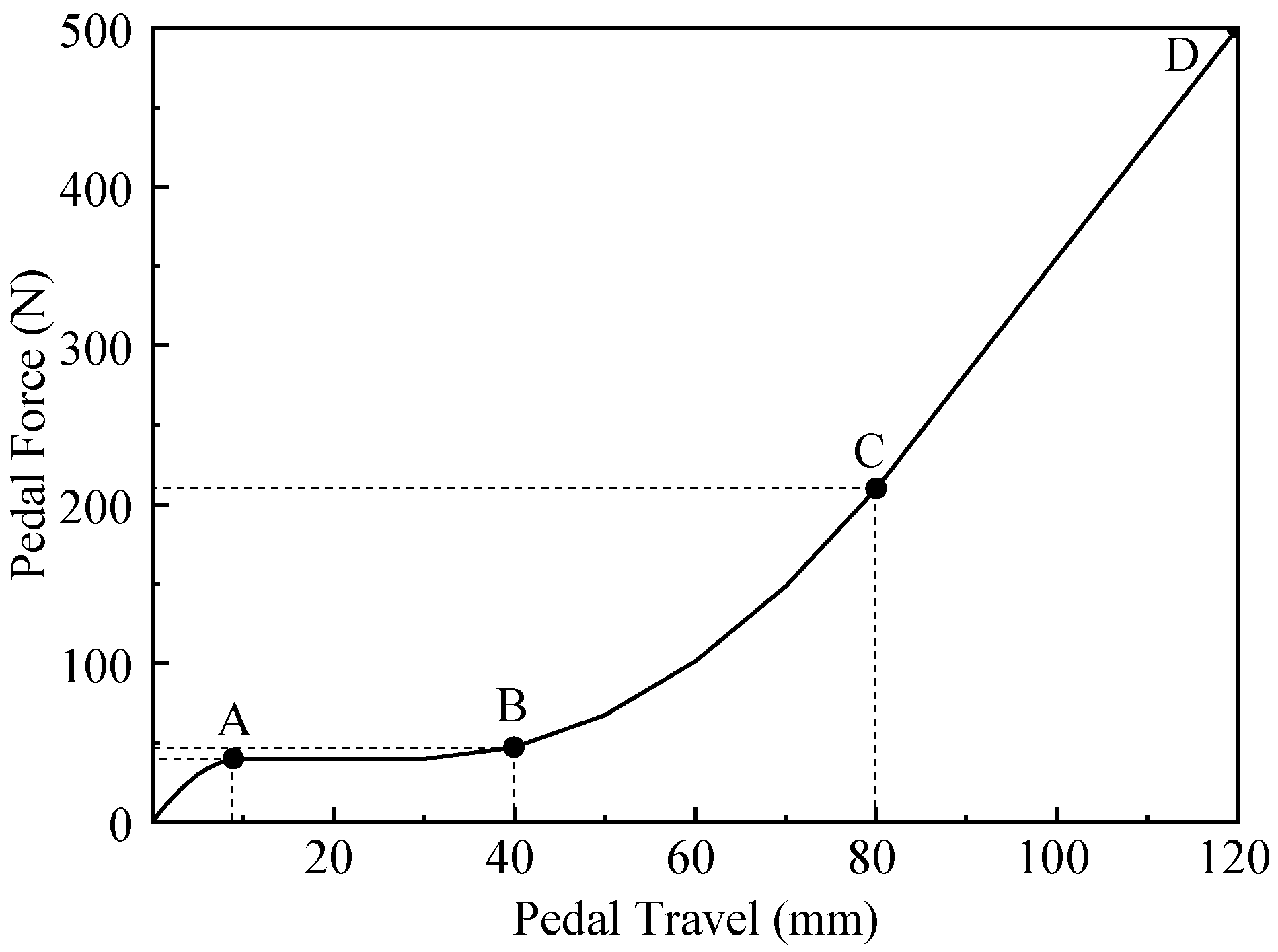
BBW systems eliminate the mechanical connection between the brake pedal and the wheel brake units, resulting in the loss of the driver’s familiar brake pedal feedback. Therefore, hydraulic or electric actuators are required to replicate the characteristics of traditional brake pedals [20]. The pedal characteristic of a conventional hydraulic braking system is a nonlinear curve. This curve is called the ideal pedal characteristic curve, as shown in Figure 1 [25].
In Figure 1, the OA section is the initial stage of pressing the brake pedal, during which the brake clearance and mechanical gaps are eliminated. The vacuum booster is not functioning at this stage, and both pedal force and displacement increase slightly. In the AB section, the vacuum booster becomes active. Due to the assistance of the vacuum booster, the pedal’s travel increases rapidly while the pedal’s force remains nearly constant. In the BC section, the assistance from the vacuum booster gradually reaches its maximum. Both pedal force and pedal travel increase simultaneously. In the CD section, the vacuum booster has reached its maximum capacity and is unable to provide further assistance. Consequently, the pedal force applied by driver is transmitted directly to the brake’s master cylinder. As a result, the pedal’s force increases significantly, while the pedal’s travel changes little, resulting in a “firm” brake pedal feel [12].
The active brake pedal simulator must replicate a pedal characteristic curve similar to that shown in Figure 1. Moreover, it should be capable of adaptive modulation of the characteristic curve after point B according to different braking conditions [26]. Under mild braking conditions, the BCD section should be lower than the one shown in Figure 1, providing the driver with a better brake pedal feel. Under emergency braking conditions, the BCD section should be higher than the one shown in Figure 1, so that the braking system can provide sufficient braking force and give the driver a stronger brake pedal feel. For normal braking, the BCD section should be consistent with the target curve shown in Figure 1, and the pedal simulator should provide a normal brake pedal feel.
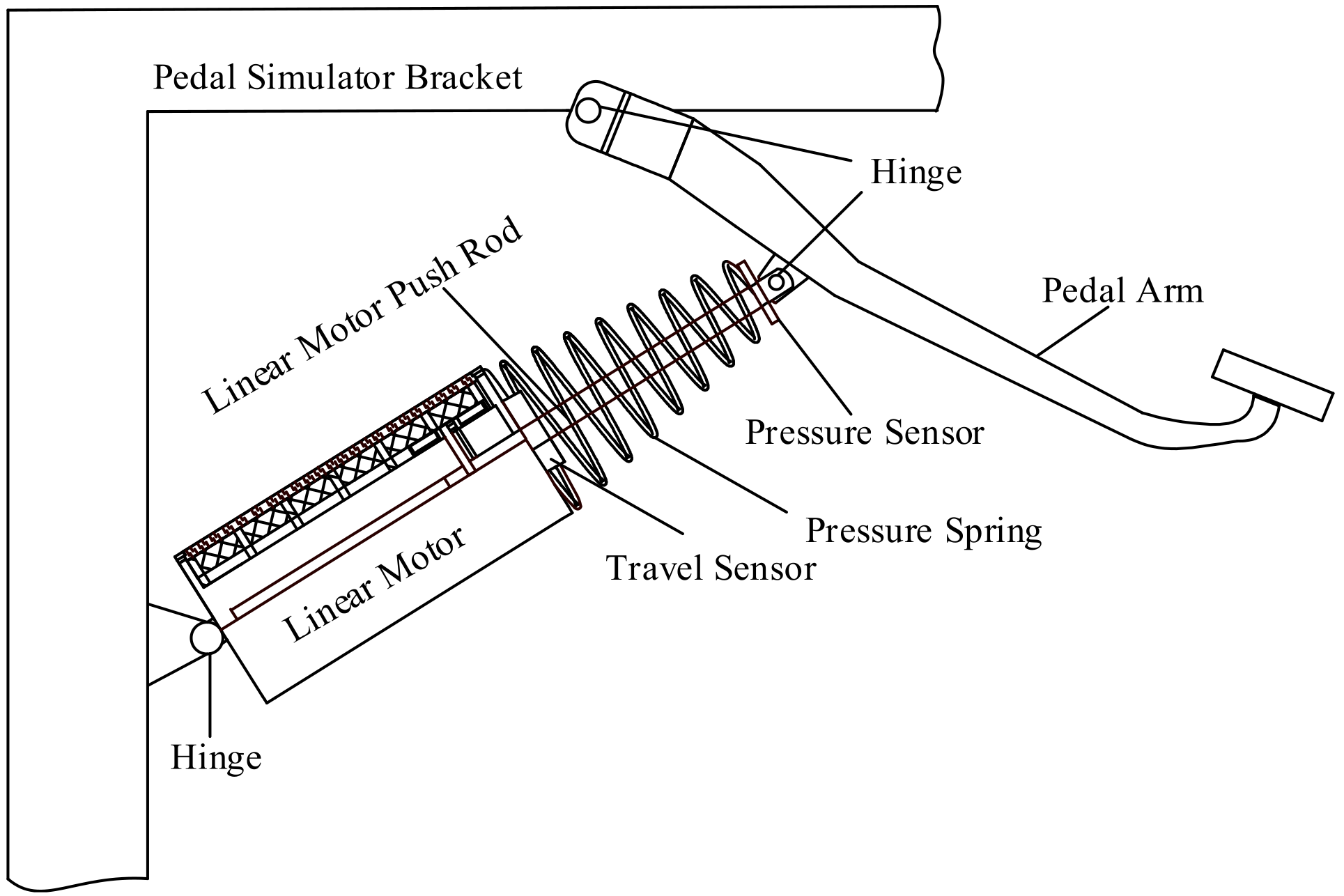
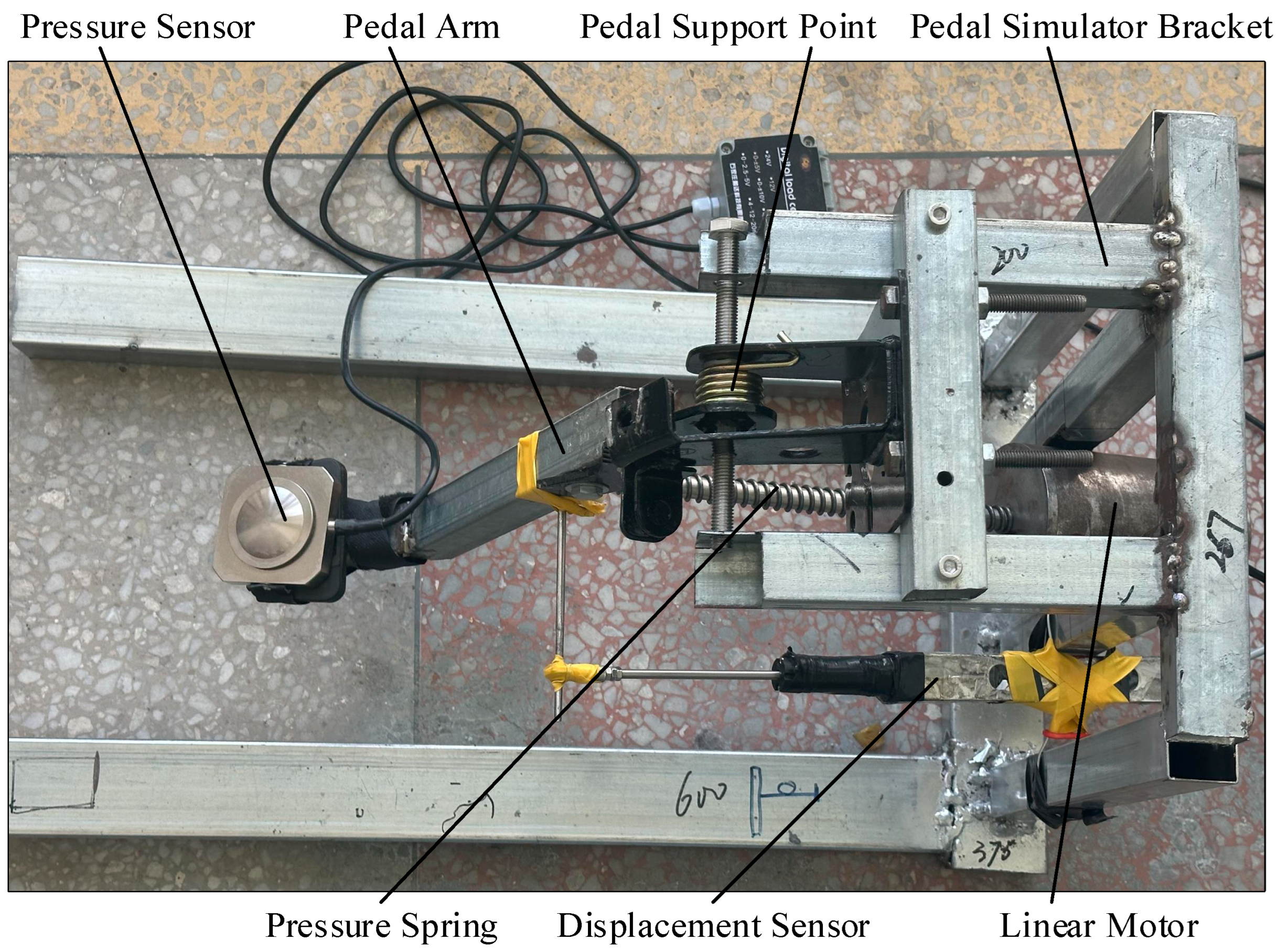
To achieve the aforementioned brake feedback adjustment functionality, this paper designs a novel active pedal simulator based on a linear motor, as shown in Figure 2, with its structure illustrated in Figure 3. The simulator mainly consists of the linear motor, push rod, return spring, displacement sensor, and pressure sensor. During braking, the driver depresses the brake pedal, overcoming the force of the return spring and driving the motor push rod to move. The pressure sensor and travel sensor collect the pedal movement data and transmit it to the brake controller. The brake controller calculates the driver’s braking demand based on the collected data. On one hand, it converts the braking demand into wheel braking forces and transmits them to the controllers of each wheel brake unit. On the other hand, the pedal simulator calculates the necessary pedal feedback force according to the braking scenario and regulates the linear motor’s thrust accordingly. This force, combined with the return spring force, forms the total pedal feedback, simulating a brake feel similar to that of a traditional hydraulic braking system. After the driver releases the brake pedal, the linear motor stops operation, and the motor pushes the rod along with its mover to return to their original positions under the action of the return spring.

2.2. Pedal Feedback Force Strategy

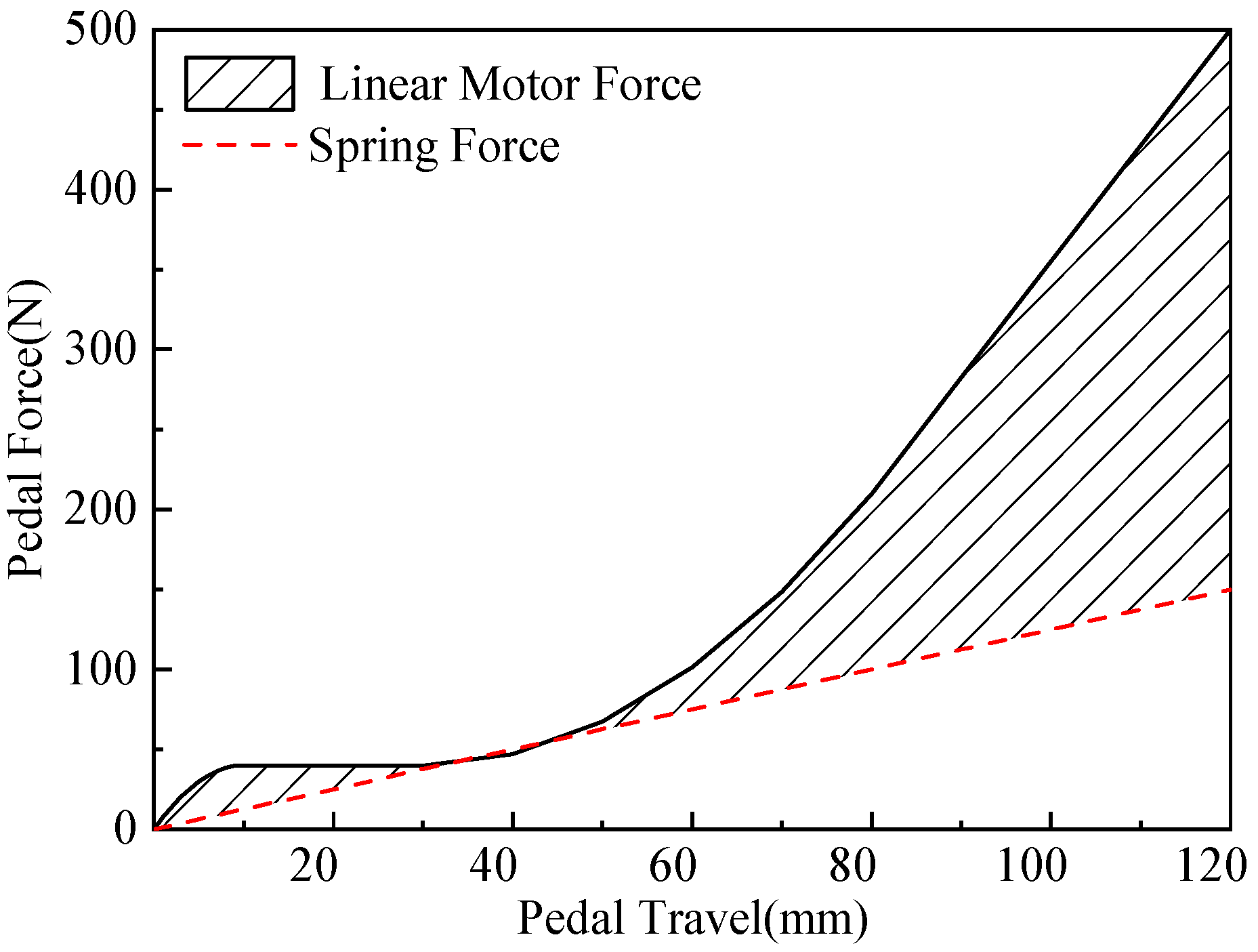
In the design of the active pedal simulator, the pedal feedback force is provided jointly by a spring and linear motor. In the preliminary design, the team adopted a spring with low stiffness to provide the basic feedback force, which is proportional to the pedal travel and tangential to the target pedal characteristic curve. The linear motor compensates for the difference between the target pedal characteristic curve and the spring force, as shown in Figure 4.
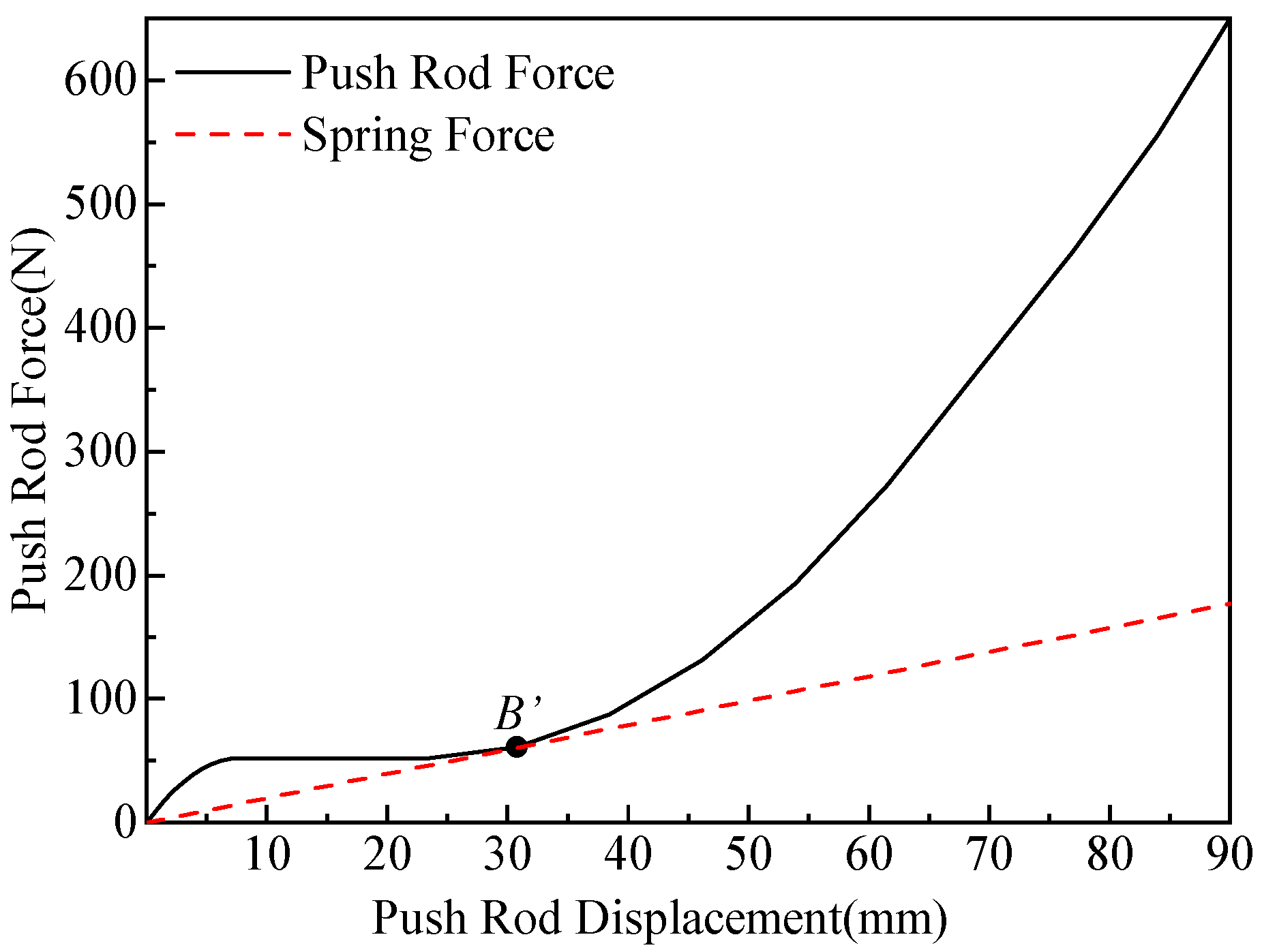
According to Federal Motor Vehicle Safety Standard No. 135 (FMVSS 135), the maximum pedal force for passenger cars is specified as 500 N, and the full pedal travel is 120 mm [27]. In contrast, the regulations in Europe, the United Kingdom and China mainly follow the braking regulations of the United Nations Economic Commission for Europe, such as ECE R13H. These regulations define pedal force as the key test parameter, but do not set a specific maximum value. However, the typical pedal force range considered in ECE-based testing and vehicle design is consistent with internationally accepted ergonomic limits, and 500 N is widely adopted as the upper bound. The effective stroke of the linear motor designed in this study is 90 mm; therefore, the optimal pedal lever ratio is 1.33. Based on this, the “pedal force–pedal travel” curve can be converted into a “push rod force–push rod displacement” curve, as shown in Figure 5.
In Figure 5, the spring force curve is tangent to the pedal characteristic curve at point B. Using graphical methods, the spring stiffness can be estimated to be approximately 1.97 N/mm. To reduce research costs, the spring was not newly designed or fabricated; instead, a commercially available spring with the required stiffness was selected. The specific parameters are listed in Table 1.

2.3. Mechanical Model of the Brake Pedal Simulator

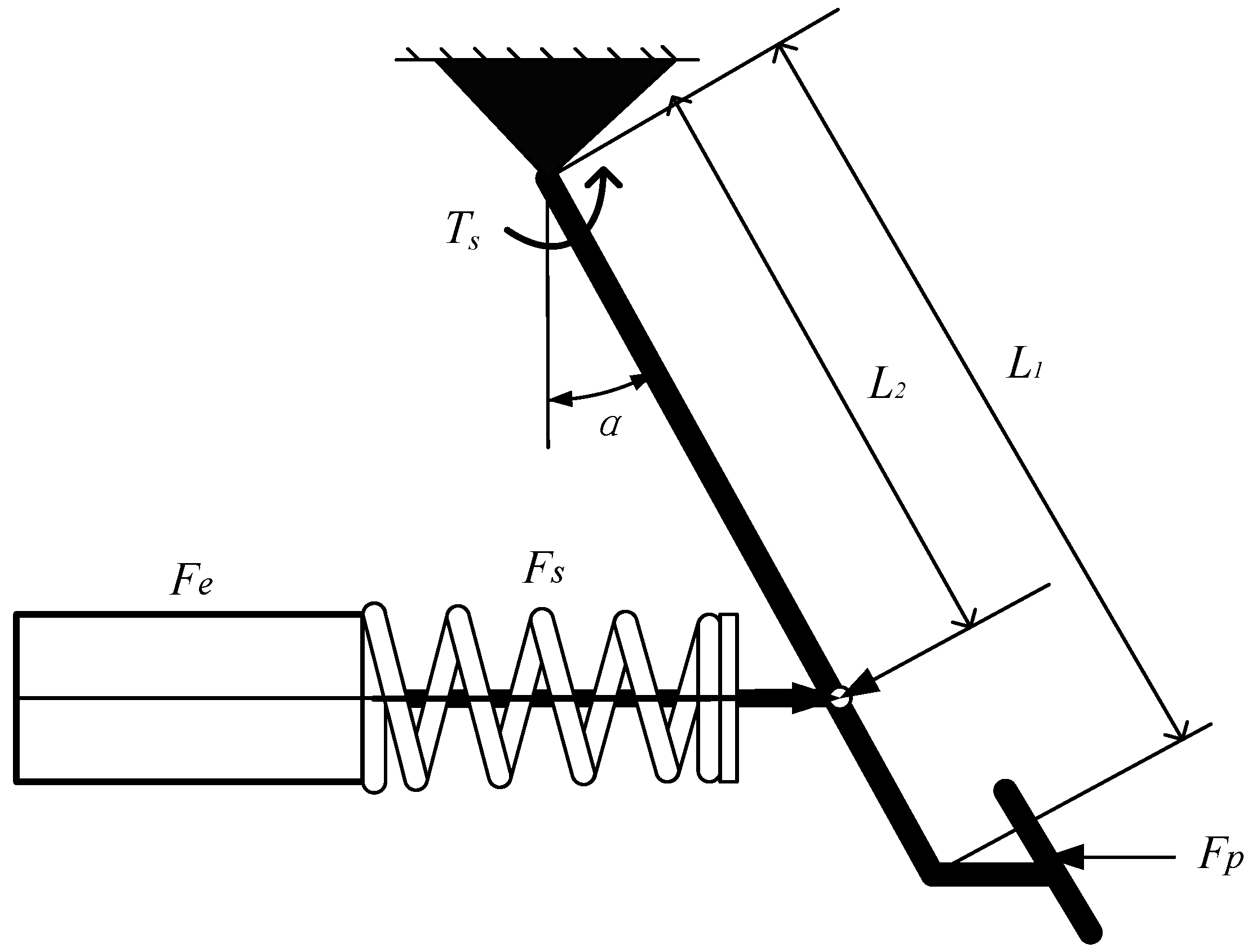
To facilitate analysis, the pedal simulator in this study is simplified as a static lever model. Only the effects of the return spring and the lever ratio on the pedal characteristic curve are considered. The simplified structure is shown in Figure 6.
The relationship among the pedal travel, the displacement of the motor push rod, and the compression of the return spring is as follows [28]:
S p = S e L 1 L 2
S F s = S e + S F s 0
where S p is the pedal travel, S e is the displacement of the linear motor push rod, S F s is the compression of the helical compression spring, L 1 is the length of the brake pedal arm, L 2 is the moment arm of the force applied by the linear motor push rod, and S F s 0 is the initial pre-compression of the spring.
The relationship among the linear motor thrust, the pedal force, and the spring force is expressed as follows [28]:
F e = 0 ,       F e < F s 0 F p L 1 P S e L 2 L 2 ,       F e F s 0
where F e is the thrust force of the linear motor, P is the stiffness of the spring, F p is the pedal force applied by the driver, and F s 0 is the preloaded force of the spring.
The specific dimensional parameters of the brake pedal are provided in Table 2. The calculated required thrust force supplied by the linear motor is 484.04 N.

3. Design of the Linear Motor

The linear motor can flexibly provide thrust of varying magnitudes, and its output force is easy to control. Therefore, it can effectively compensate for the spring force [29]. Considering the application scenario of the linear motor and the installation conditions of the brake pedal, the motor housing should not exceed 100 mm in size. Taking into account the motor power, a 24 V DC power supply is adopted. Based on the effective travel of the brake pedal and the pedal’s lever ratio, the working stroke of the motor is set to 90 mm. In addition, considering partial force loss during the transmission process, the thrust of the linear motor is tentatively set to not less than 500 N. The design specifications of the linear motor are shown in Table 3.

3.1. Structural Design of the Stator

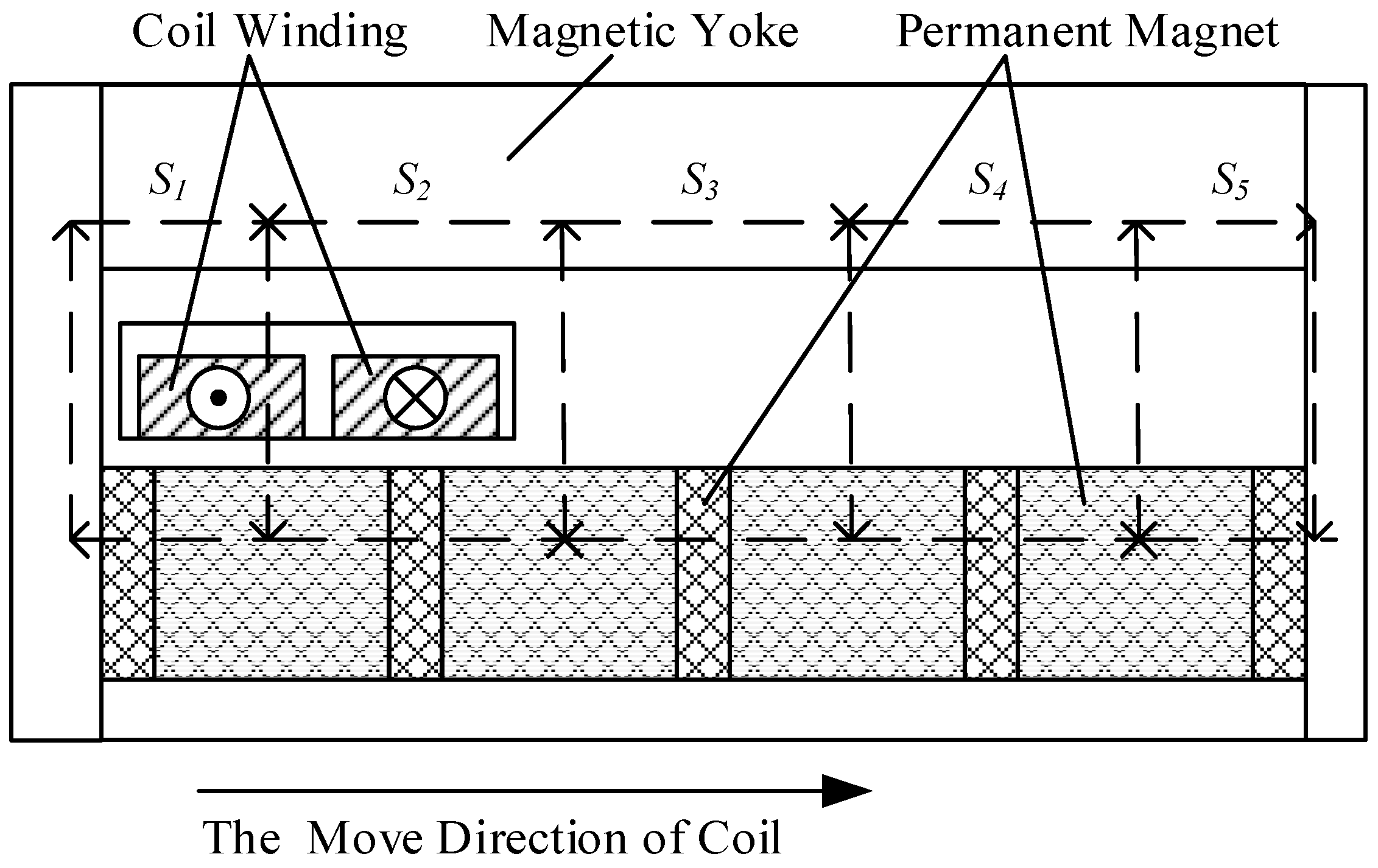
The stator of the linear motor is composed of permanent magnets and a magnetic yoke made of low-carbon steel, including the end caps, housing, and iron core, as shown in Figure 7. NdFeB N48H is selected as the permanent magnet material. The magnets are arranged in a Halbach array and mounted directly onto the inner surface of the housing, forming the stator excitation circuit together with the iron core and end caps. The Halbach permanent magnet array consists of axially and radially magnetized magnets arranged in specific sequence to enhance the magnetic field on the coil side while weakening it on the opposite side. This configuration helps reduce magnetic flux leakage and improves the effective utilization of magnetic flux density. To reduce the costs and in view of the motor’s relatively long operating stroke and overall cost-effectiveness, commercially available permanent magnets are selected.
Axially magnetized permanent magnets benefit from mature processing techniques and are easy to manufacture. However, radially magnetized permanent magnets cannot be directly magnetized as a whole and can be assembled using eight radially magnetized arc-shaped magnets. The corresponding stator parameters are presented in Table 4.

3.2. Structural Design of the Mover

The mover mainly consists of the coil form and two coil windings. Two coil sets are energized independently. Based on the required electromagnetic force and the coils’ positions within the magnetic field, either one set or both sets of coils are energized to provide pedal feedback force to the driver. After releasing the brake pedal, the coils stop being energized, and the coils and push rod are returned to their initial positions by the pre-compressed spring.
As shown in Table 4, the air gap width is 13 mm. With the coil former having sufficient strength, the distance between the inner wall of the coil former and the iron core is 0.2 mm, and the gap between the outer edge of the former and the permanent magnet is 0.5 mm. This ensures good concentricity and facilitates assembly. The thickness of the former’s inner wall is 2 mm to guarantee adequate strength. The detailed parameters of the mover are listed in Table 5.
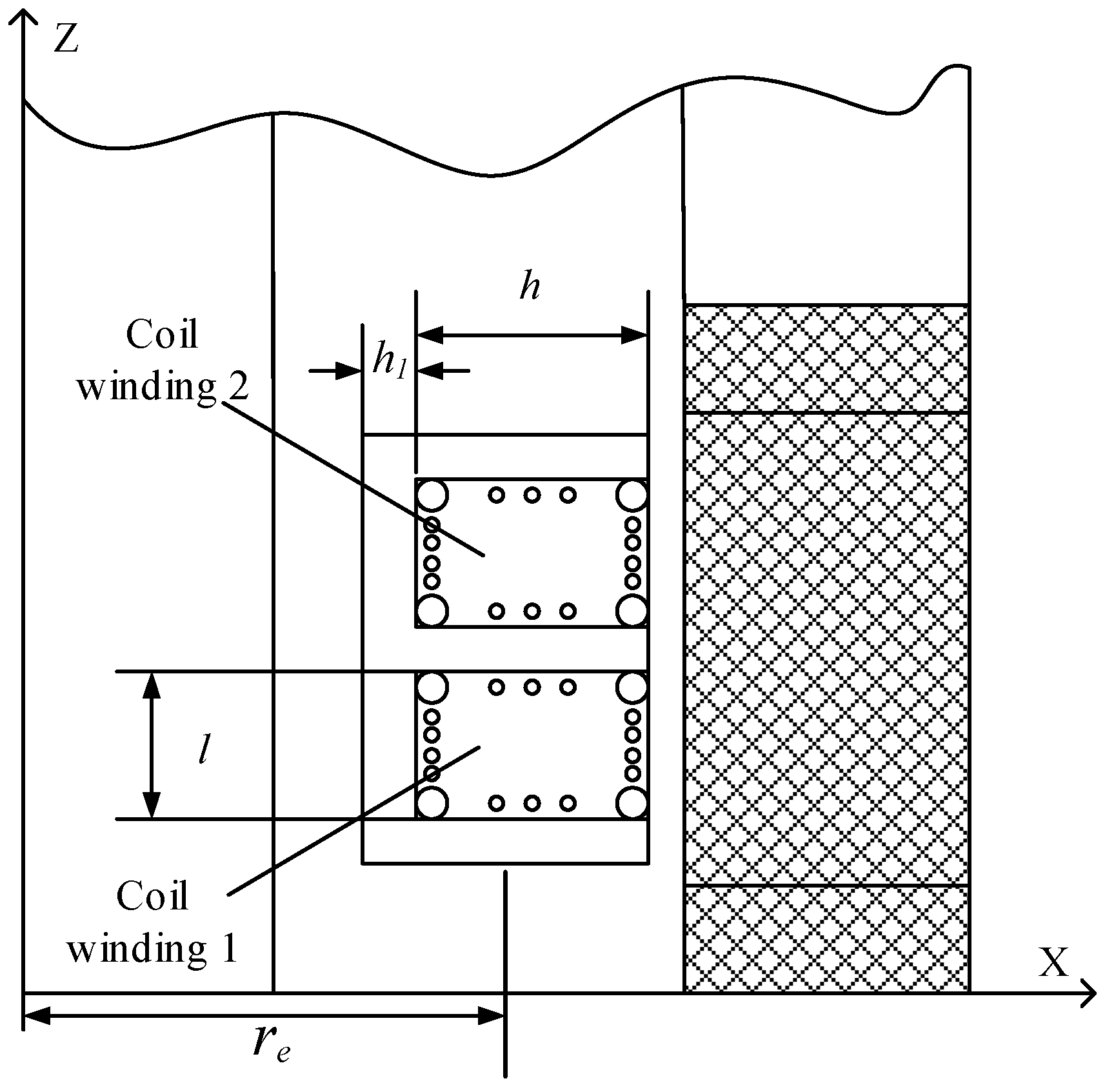
The linear motor adopts a moving-coil structure, with the coil windings serving as the moving component. Both high-temperature resistance and electrical insulation must be considered. As shown in Table 5, the groove depth of the coil former is 10.3 mm, the height of the coil former is 24.5 mm, and the wall thickness is 2 mm. Therefore, the total height of the two grooves is 20.5 mm. Considering that the coil consist of two independent windings, in order to facilitate wiring and keep both the input and output terminals on the same side, coil winding 1 is wound with an even number of layers, while coil winding 2 must be wound with an odd number of layers. This ensures that both windings remain within the coil former grooves, as shown in Figure 8.
The groove depth h of the former is 10.3 mm, and the total height of the two coil windings is 20.5 mm. The height l of a single coil winding is 8 mm, and the cross-sectional area of single groove is 82.4 mm2. r represents the distance from the central axis of the linear motor to the center of the coil winding.
Coil winding 2 has only one more layer than winding 1. When calculating the linear motor thrust, it is assumed that the lengths of windings 1 and 2 are equal, and the total thrust is twice that generated by winding 1. Therefore, the motor thrust is given by
F e = 2 F 1 = 2 B g i l 1
where F 1 is the electromagnetic force generated by coil 1, i is the current, and l 1 is the length of coil winding 1.
Enameled copper wire with a diameter of 0.85 mm is used to wind the two coil windings. Considering the tightness of manual winding, an insulating varnish layer is applied after each layer to ensure the firmness of the coil. As a result, coil winding 1 consists of seven layers, while coil winding 2 consists of eight layers. The parameters of the coil windings are listed in Table 6.

4. Braking Feel Simulation and Experiment

4.1. Braking Pedal Simulation Based on Adams

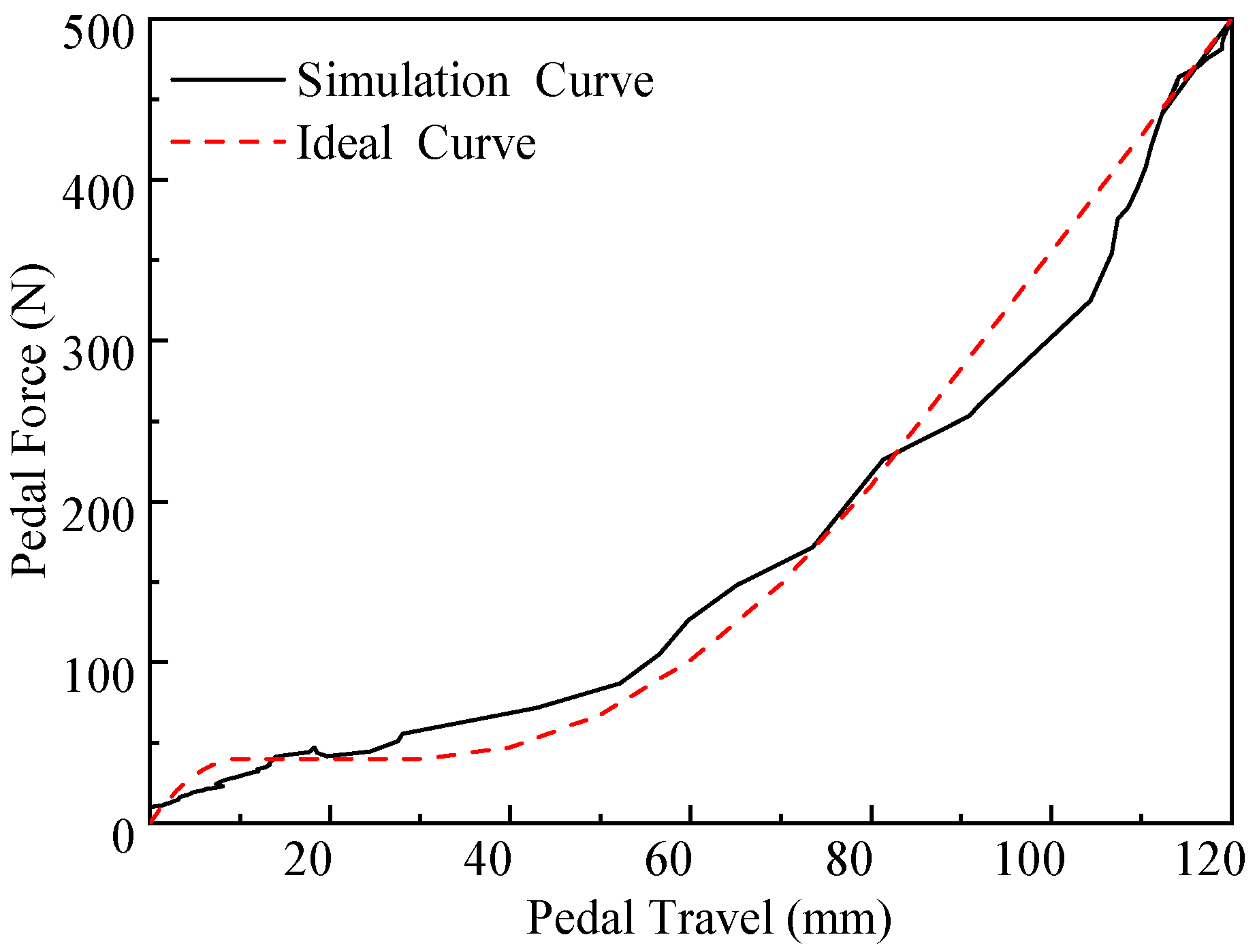
The pedal simulator model was first constructed in SolidWorks 2018 and subsequently imported into Adams for dynamic simulation. The main components included the pedal lever, pivot joint, linear motor, spring, and supporting structure. The pedal lever was modeled as the rigid body with a rotational joint at the pivot point. The linear motor was modeled using a translational joint with an applied force input corresponding to the control force, while the spring was modeled using a linear spring element with defined stiffness and preload. To facilitate analysis, the non-moving components were hidden or merged. Subsequently, constraints were applied based on the component’s parameters, material properties, and assembly relationships. Then, initial motion conditions were set, and sensors for measuring pedal force and pedal travel were added. Finally, travel input was applied to the pedal to simulate the driver’s pedal operation. The travel range was set from 0 mm to the maximum travel of the pedal. The output force at the pedal was recorded during the simulation, and the corresponding force–travel relationship was obtained. This relationship represents the simulated pedal characteristic curve. The simulated pedal characteristic curve was compared with the predefined ideal pedal characteristic curve, as shown in Figure 9.
As shown in Figure 9, the dashed line represents the ideal pedal characteristic curve, while the solid line represents the pedal characteristic curve obtained from the Adams simulation. During the simulation, the electromagnetic force of the linear motor was set as time-varying thrust, and the applied pedal force load also varied with time, simulating the conventional brake pedal characteristic curve. Since the pedal lever is connected to the linear motor push rod via a movable hinge, the pedal lever rotates around the pedal pivot in a circular motion, while the linear motor is fixed and the push rod moves linearly. During the conversion from circular motion to linear motion, the motion angle exists, preventing the pedal force from being fully converted into the thrust applied to the push rod, resulting in a non-smooth simulated pedal characteristic curve.

4.2. Experimental Study of the Brake Pedal Simulator

After completing the fabrication and assembly of the brake pedal simulator, braking experiments were conducted on an experiment vehicle under different braking conditions. The purpose of the experiment was to collect signals of brake pedal force and pedal travel by pressing the brake pedal, in order to obtain the force–displacement relationship curve and verify the rationality of the brake pedal simulator designed in this study. For safety reasons, the experiment vehicle was fixed on a stationary bench, with the wheels suspended and allowed to rotate freely. The experiment vehicle was connected to the brake pedal simulator by cables. The maximum velocity of the experiment vehicle was limited to 50 km/h. Finally, experiments including pulse braking, slow braking, normal braking, and emergency braking were completed.
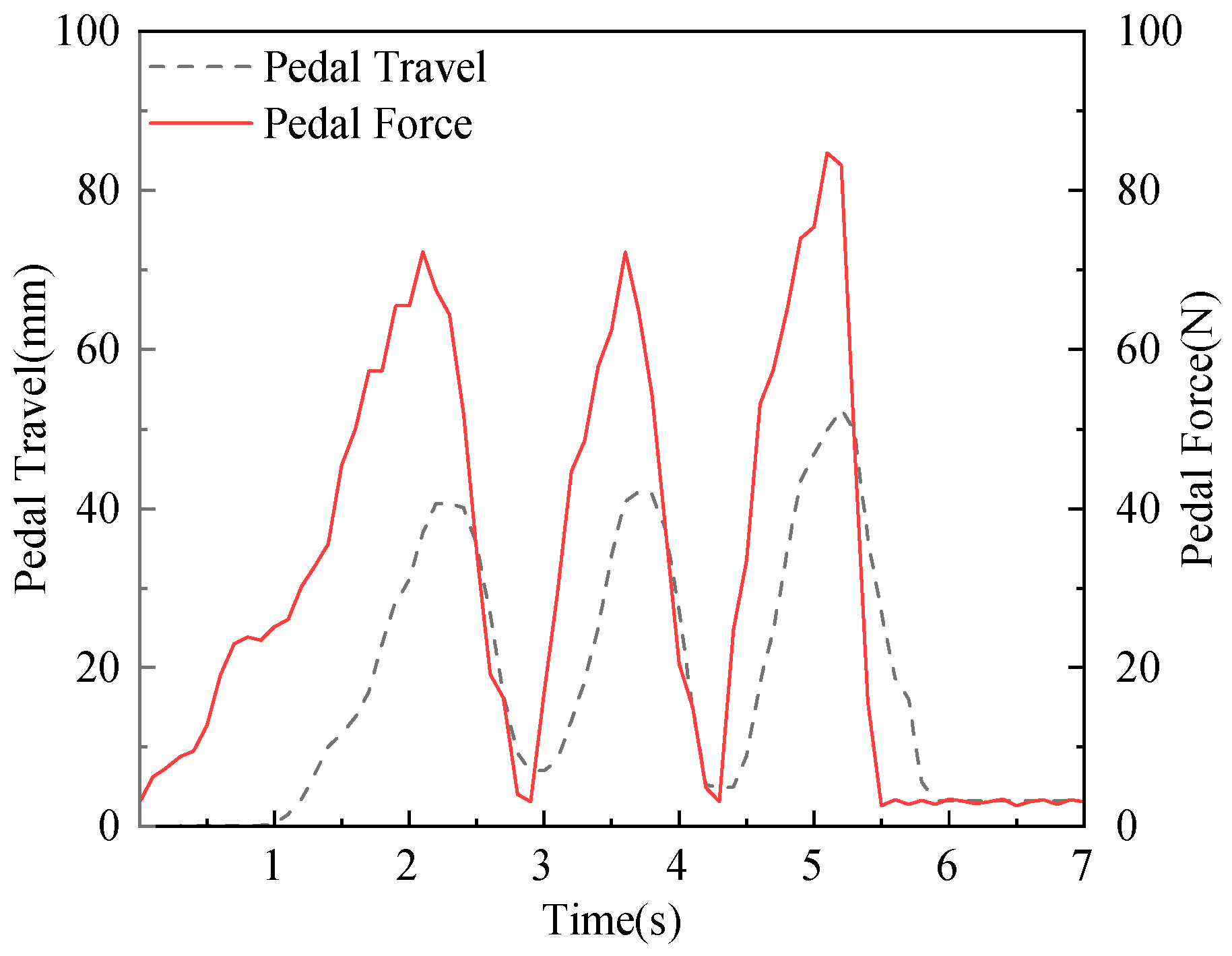
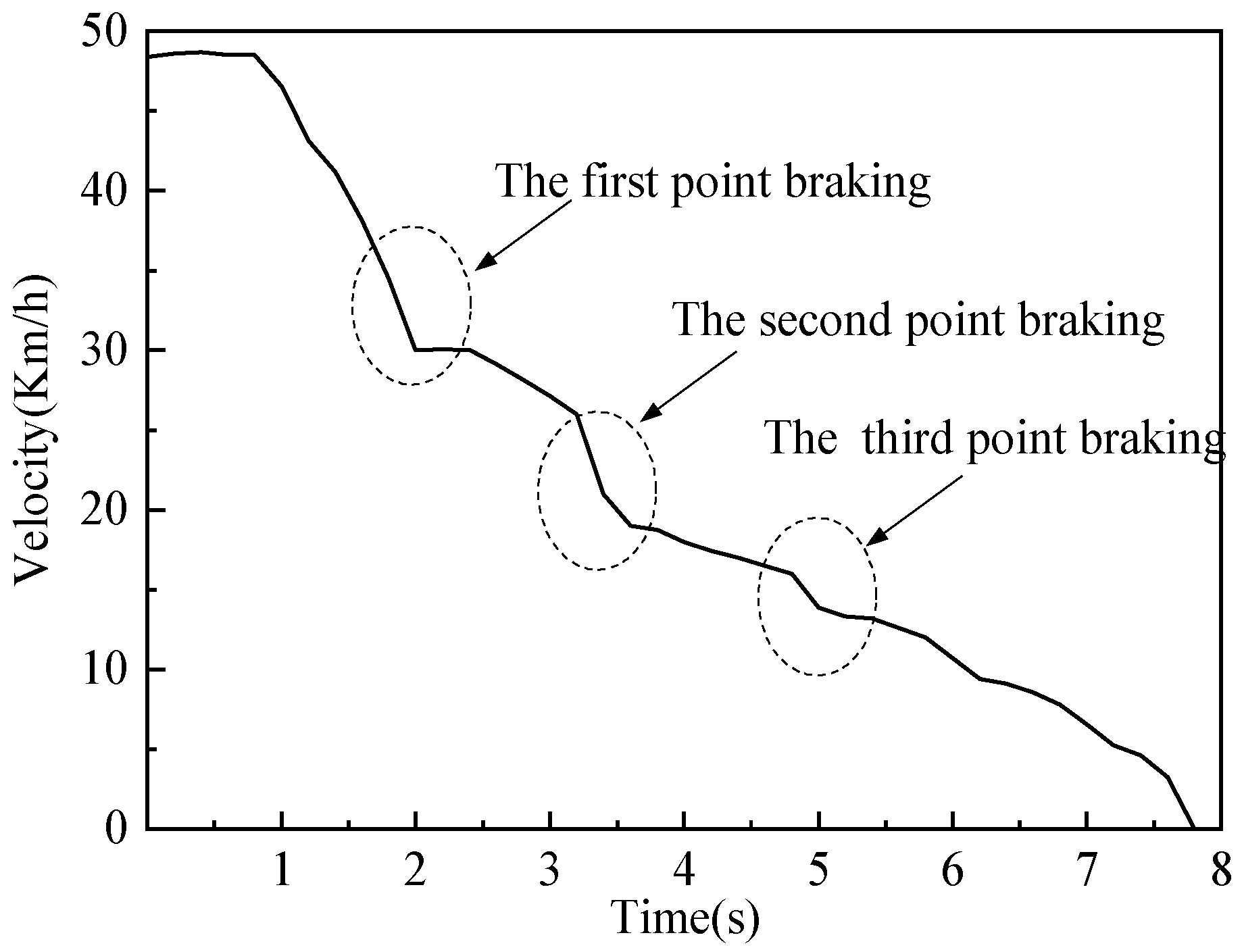
The pulse braking experiment serves as preparation for the other three braking experiments. This experiment is to verify the functioning of all components of the brake pedal simulator, such as the normal operation of the linear motor, smooth transmission of the brake signal, and whether the vehicle exhibits braking performance, ensuring the smoothness and safety of subsequent experiments. As shown in Figure 10, the variation trends of the pedal force and pedal travel during pulse braking are consistent. The maximum pedal force is 84 N, and the maximum pedal travel is 52 mm. As shown in Figure 11, the vehicle’s velocity shows a fluctuating downward trend. With each press of the brake pedal, the vehicle’s speed drops rapidly; once the pedal is released, the speed decreases more gradually in contrast. The entire braking process lasted for 7.8 s. This experiment demonstrated that the vehicle’s speed exhibited good responsiveness to the changes in pedal travel and pedal force. Hence, further experimental investigations could be conducted.
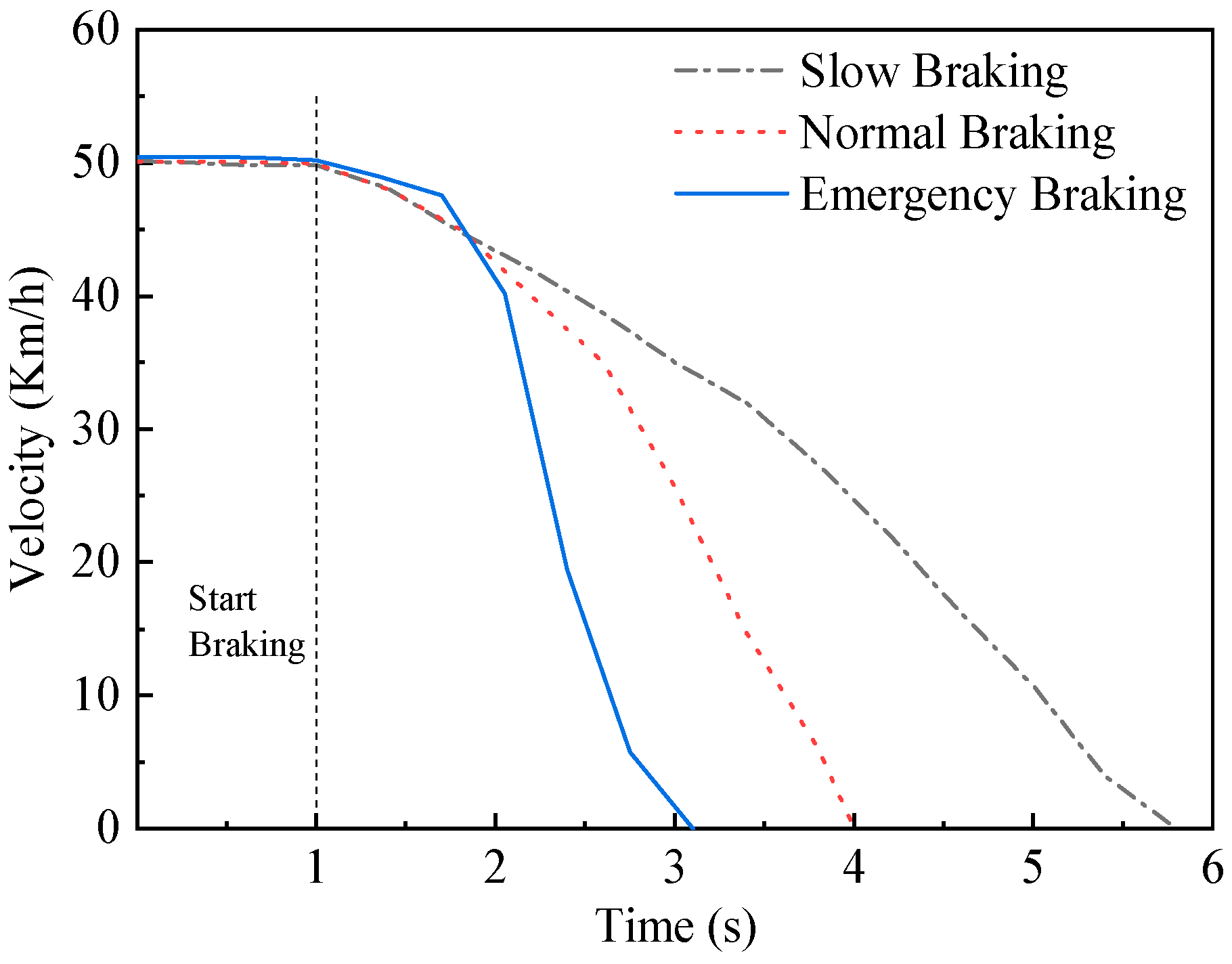
Slow braking requires small pedal force, slightly longer pedal travel, and smooth deceleration of the vehicle. As shown in Figure 12, the vehicle begins braking from 50 km/h, and the braking process lasts for 4.7 s. As shown in Figure 13, the pedal force gradually increases to 50 N as the pedal’s travel ranges from 0 to 40 mm. As the pedal’s travel increases from 40 mm to 90 mm, the pedal’s force increases rapidly and the vehicle’s deceleration increases accordingly. From 90 mm to 120 mm, the pedal’s force changes little, eventually reaching 231 N. The overall relationship between pedal force and displacement is smooth, corresponding well to the expected pedal characteristic curve.
In normal braking, the pedal characteristic curve should closely match the ideal curve. As shown in Figure 12, the vehicle begins braking from 50 km/h and takes 3 s to decelerate to 0. The measured pedal force is slightly higher than the ideal pedal force when the pedal travel ranges from 40 to 70 mm. Between 70 mm and 120 mm of pedal travel, there is no obvious increase in pedal force and it maintains a trend similar to the previous segment, indicating a softer braking response in the later stage. This is likely due to factors such as internal friction and assembly errors, which cause the actual thrust of the linear motor to be less than the theoretical electromagnetic force. As a result, the experimental curve is lower than the simulated curve. However, the overall trend of the experimental curve is consistent with that of the ideal pedal characteristic curve. In an emergency braking condition, the velocity decreases from 50 km/h to 0 within 2.1 s. When the pedal travel ranges from 0 to 60 mm, the pedal force changes smoothly with displacement. The pedal force increases rapidly after 60 mm and eventually reaches 415 N.
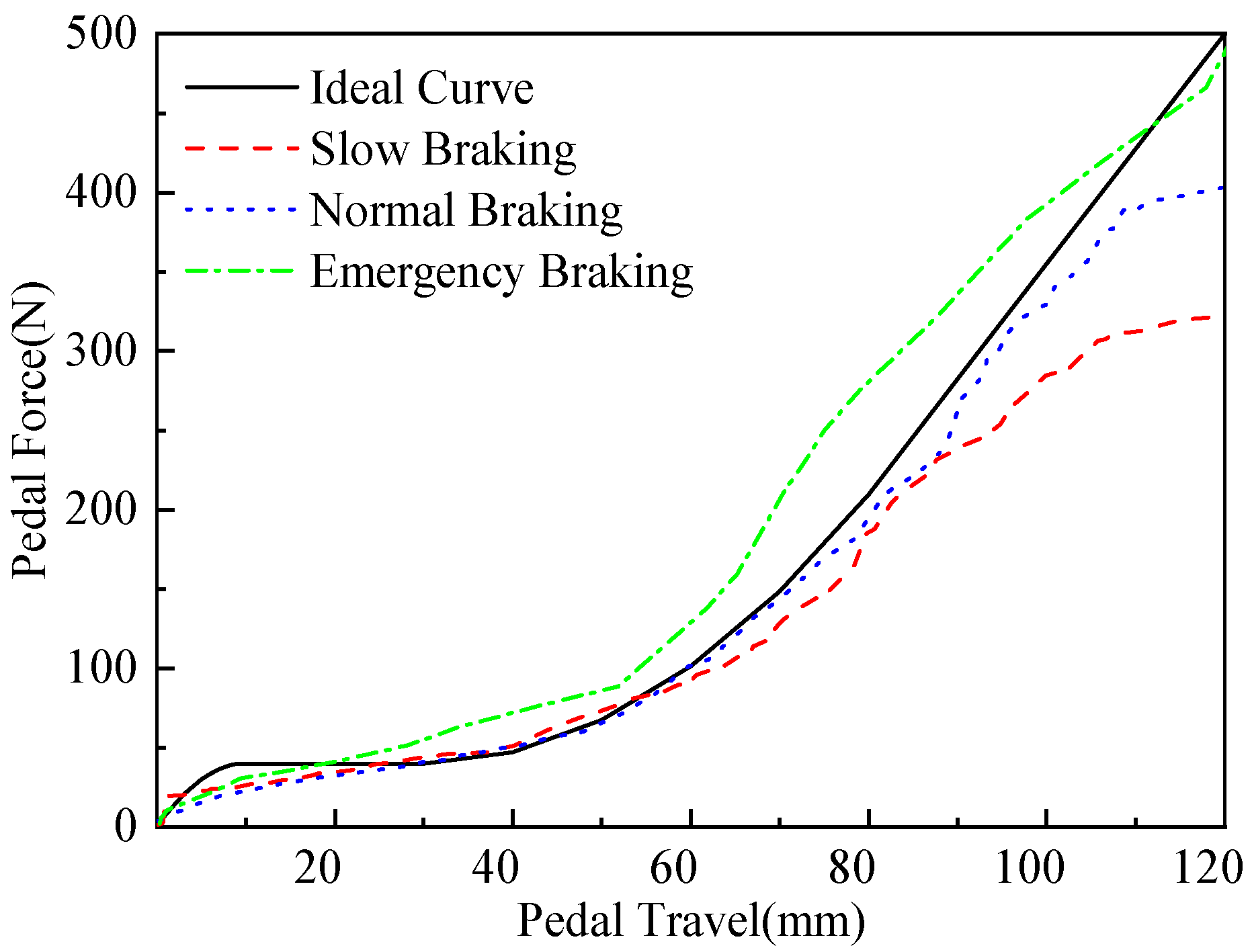
The three experiments’ characteristic curves have the same change trend as the ideal curve, which confirms the feasibility of the scheme proposed in this study. However, only in the slow braking experiment, does the characteristic curve meet the requirement of being below the ideal curve. The characteristic curves for normal and emergency braking are also below the ideal curve in the latter half, thus failing to meet the predefined standards. The actual pedal feel is relatively “soft” and does not provide the desired “firm” feel, thus requiring further optimization.

5. Evaluation and Optimization of the Brake Pedal Simulator

The pedal simulator should not only meet the basic requirements of pedal characteristics, but also provide a good braking feel. Braking feel evaluation consists of both subjective and objective evaluation. Each individual evaluation method has its inherent limitations [6]. The brake feel index (BFI) takes into account both the driver’s subjective perception and objective parameters. It is based on experimental curves such as pedal force–pedal travel, pedal force–deceleration, and pedal travel–deceleration, thereby establishing an evaluation system that reflects subjective feel through objective data [6]. As a result, it has been widely adopted, and the evaluation indicators are listed in Table 7.

5.1. Brake Feel Evaluation

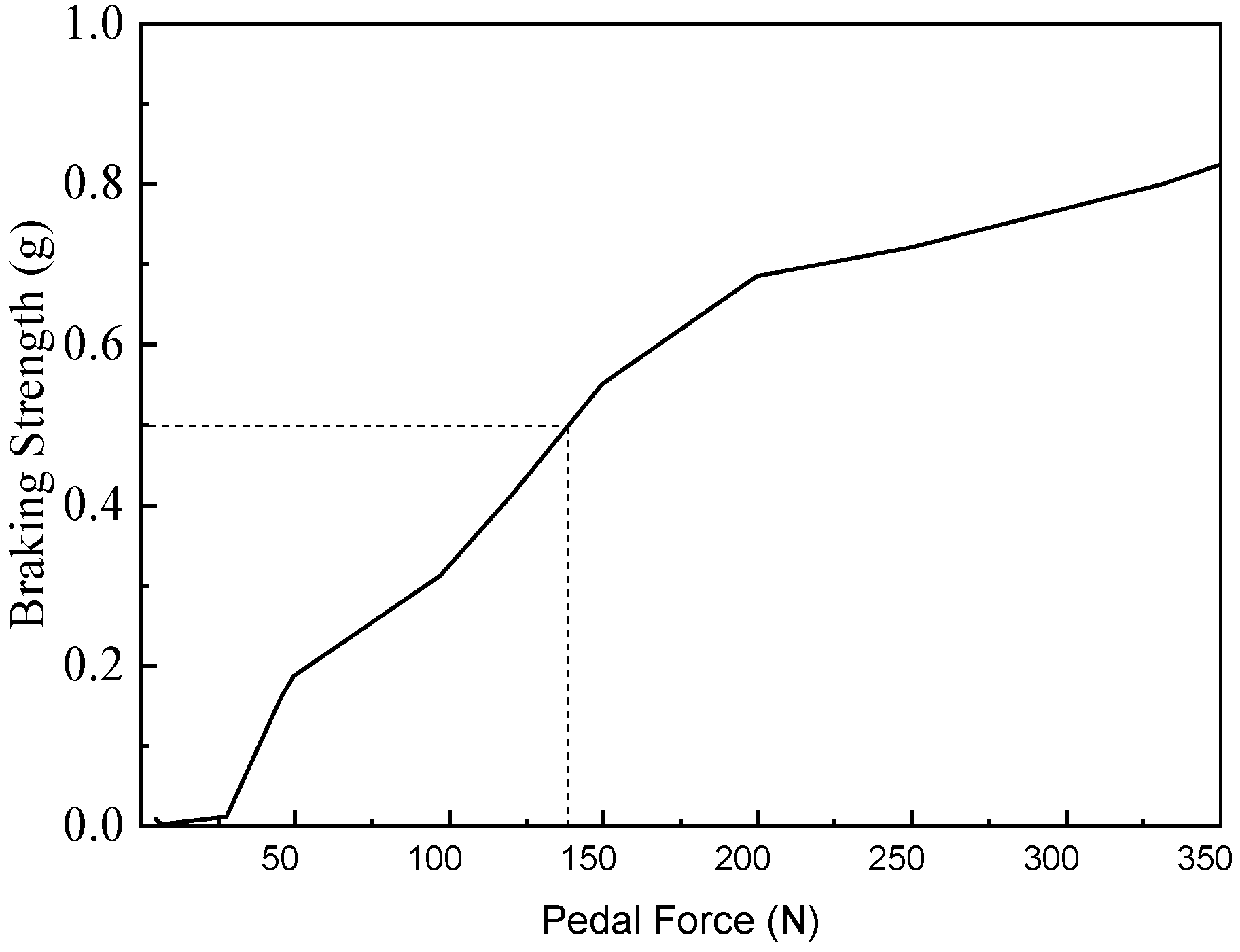
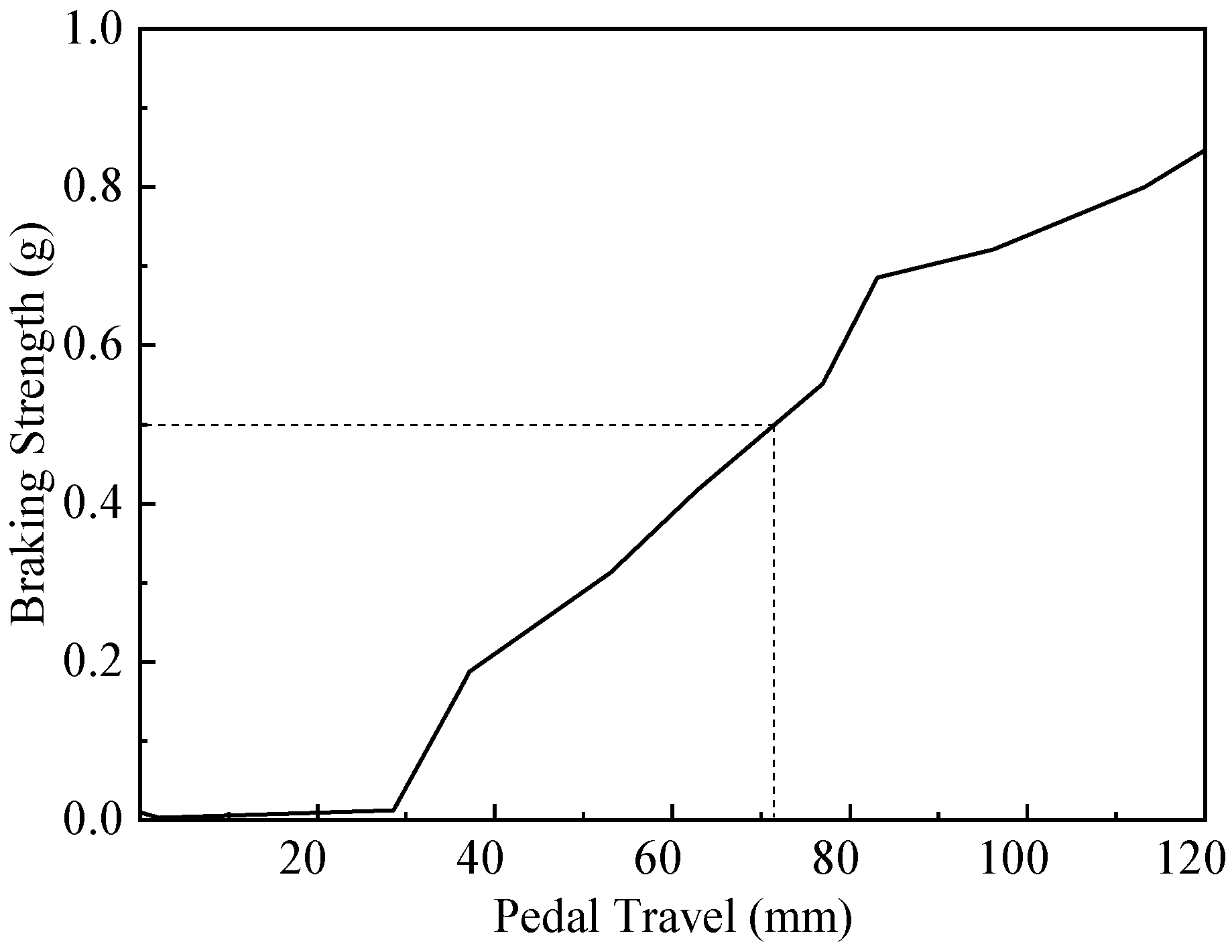
In order to verify the performance of the proposed brake pedal simulator, the brake feel under the normal braking condition is evaluated. Under this braking condition, a pedal force–deceleration curve and a pedal travel–deceleration curve are shown in Figure 14 and Figure 15, respectively.
The preload force of the brake pedal is 17 N. The initial pedal force and pedal travel are 45 N and 28 mm, respectively. At the deceleration of 0.5 g, the pedal force and pedal travel are 140 N and 71 mm, respectively. The pedal force at maximum deceleration is 305 N. The pedal force linearity index is 0.97. The specific brake feel evaluation scores are presented in Table 8.
The BFI indicates that the overall brake feel score remains relatively low. At the initial stage of braking, both the pedal force and displacement are moderate; however, the pedal force becomes excessive and the pedal travel is relatively long at 0.5 g deceleration, resulting in a “prolonged” brake feel. Therefore, the brake pedal simulator must resolve the issue of soft brake feel, which can be improved by adjusting the lever ratio and increasing the feedback force.

5.2. Optimization of Brake Pedal Simulator Characteristics

The brake pedal simulator feels “soft”, meaning that smaller brake pedal force is required to achieve the same braking effect. Although a “soft” brake pedal helps reduce fatigue, it diminishes the driver’s perception of braking intensity. Especially during emergency braking, insufficient pedal force may give the driver a false impression of brake failure.
The “soft” brake pedal can be improved by reducing the lever ratio of the pedal arm. That is, with the linear motor thrust and spring force unchanged, reducing the lever ratio will result in a greater pedal feedback force perceived by the driver. However, adjusting the pedal feedback force by changing the lever ratio requires modifications to the overall structure of the simulator. On the other hand, the feedback force is composed of the spring force and the motor thrust. Increasing either force will increase the pedal feedback force. However, increasing the motor thrust requires redesigning the linear motor, which involves a longer development time and higher costs. Therefore, increasing the spring’s stiffness is an effective approach. It not only involves shorter development time and lower manufacturing costs but also reduces the load of the linear motor. Therefore, it will also enhance the durability of the brake pedal simulator [30]. The composition of the optimized pedal feedback force is shown in Figure 16.
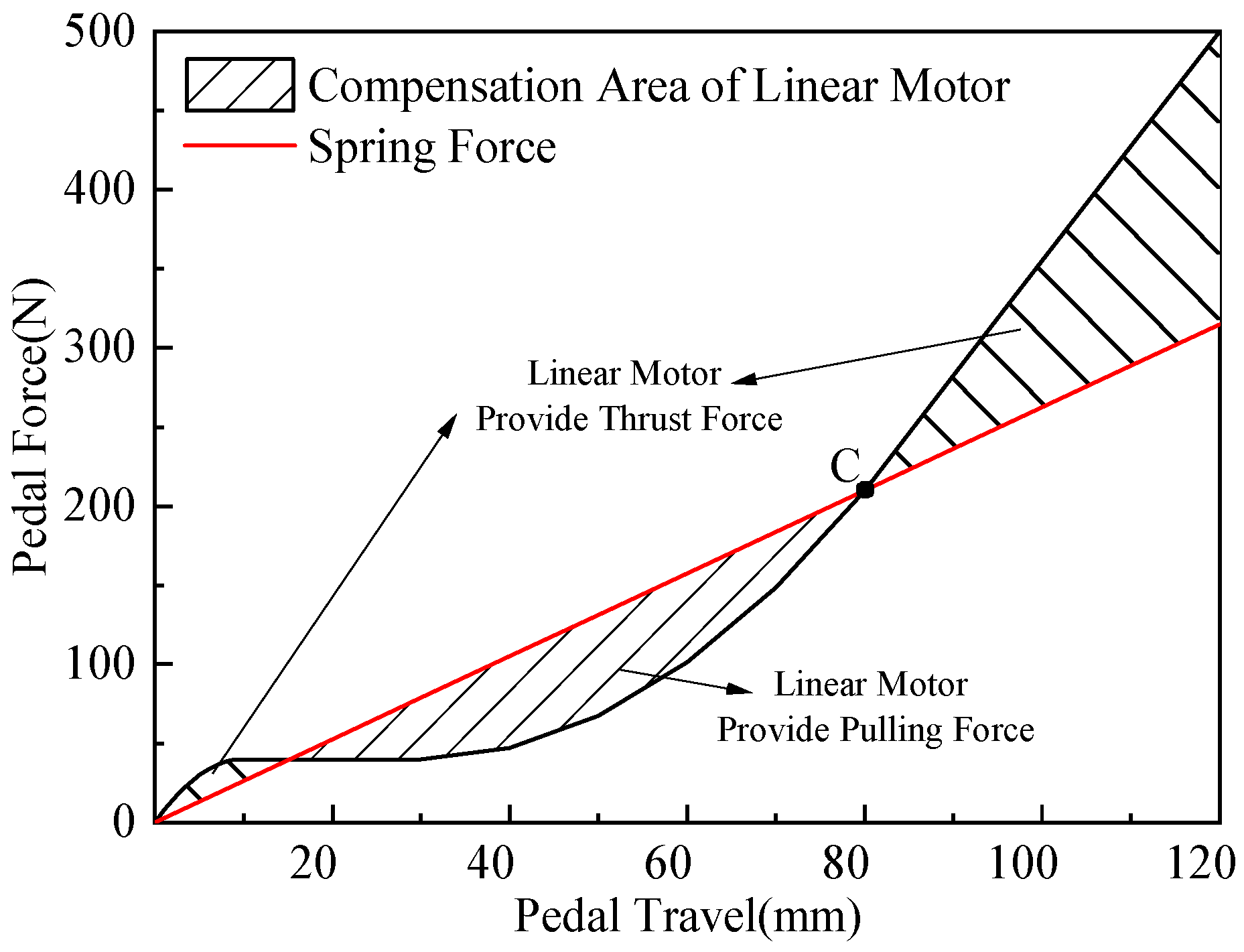
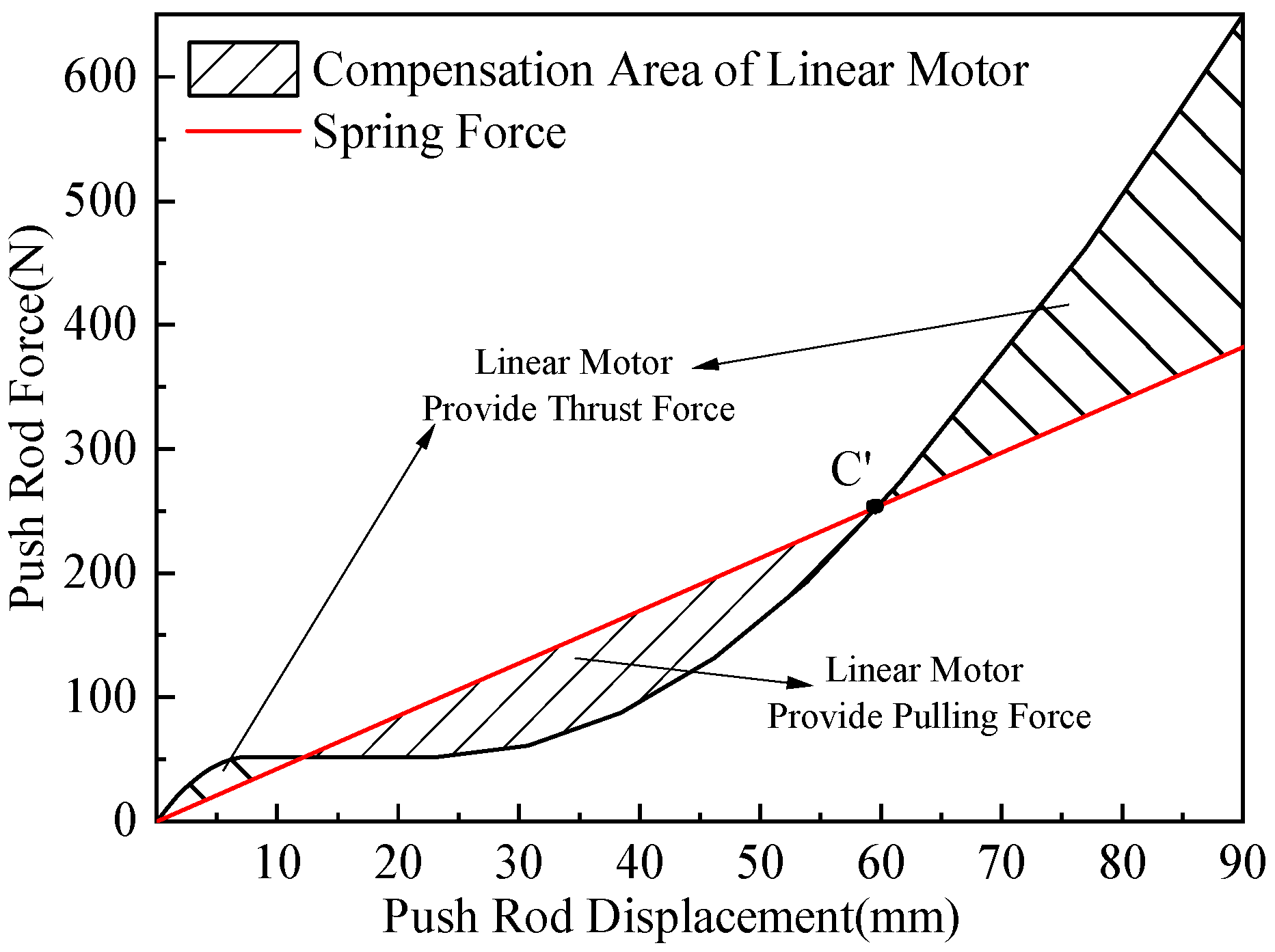
Point C in Figure 16 represents the vacuum booster reaching its maximum assistance capacity. The vacuum booster can no longer provide additional assistance beyond this point, and the force applied by the driver acts directly on the master brake cylinder. The horizontal axis of pedal travel in Figure 16 is converted to the linear motor push rod displacement, and the vertical axis of pedal force is converted to the resultant force at the connection point between the motor push rod and the pedal arm, as shown in Figure 17. Thus, point C (80, 210) in Figure 16 corresponds to point C’ (61.5, 273) in Figure 17. From point C’, the spring’s stiffness can be estimated as 4.43 N/mm. The optimized spring parameters are shown in Table 9.
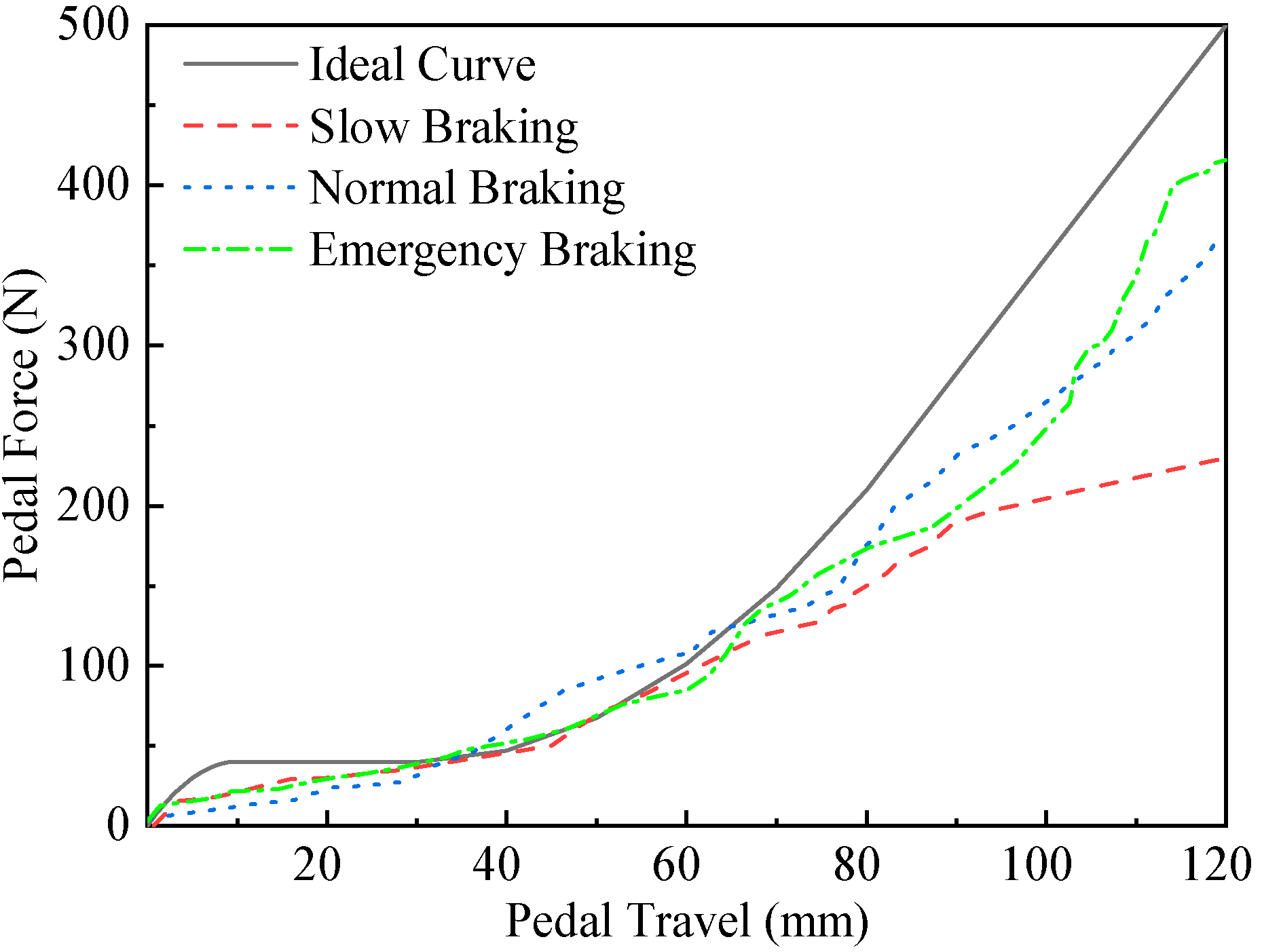
The optimized spring was installed in the brake pedal simulator for experimenting, and the three groups of optimized characteristic curves were obtained, as shown in Figure 18. It can be seen that the slow braking characteristic curve is slightly lower than the ideal curve; the normal braking characteristic curve closely matches the ideal curve; and the emergency braking characteristic curve is slightly higher than the ideal curve, which compensates for the previously insufficient pedal force and the “soft” pedal feel. In all three experiments, the maximum pedal force was less than 500 N, and the simulator successfully met the driver’s varying pedal force demands under different braking conditions. The optimized brake feel was also evaluated using the BFI assessment system, with scores shown in Table 10.
As shown in Table 10, the optimized parameters of each evaluation indicator are closer to the target values, resulting in a higher overall score. At the initial stage of braking, the system is sensitive and responds quickly; the pedal force is slightly below the target value and the pedal’s travel is slightly shorter at a deceleration of 0.5 g, allowing the vehicle to brake more quickly and providing a good braking feel. By adjusting the spring’s stiffness, the BFI score increased from 62.31 to 92.21. The improved brake pedal feel is excellent and effectively improves the overall braking performance.
In order to further demonstrate the performance and advantages of the proposed active brake pedal simulator, this paper also compares it with existing solutions, including a passive simulator based on springs, an active simulator based on magnetorheological (MR) fluid, and an active simulator based on a rotary motor; the specific parameters are shown in Table 11 [7,20].
Compared with the active simulator based on magnetorheological fluid, the proposed scheme has a faster response speed, lower maintenance requirements and simpler system structure. Compared with the active simulator based on a rotary motor, the proposed scheme also offers faster response speed, higher force control accuracy and higher reliability. Furthermore, this proposed solution can maintain the basic pedal feel and feedback through the springs when the motor fails, which significantly enhances safety and reliability. Therefore, the proposed solution achieves an optimal balance in terms of response performance, force control accuracy, reliability and system cost.


6. Conclusions

This paper proposes an active brake pedal simulator based on a linear motor. The pedal feedback force is provided cooperatively by the linear motor and spring, enabling the adjustment of pedal characteristics under different braking conditions. The simulation and experimental results indicate the following:
(1)
The established mechanical model of the brake pedal simulator and the simulation results can effectively reflect the variation trend of the ideal pedal characteristic curve. Additionally, the linear motors play a crucial role in the control of pedal feel, offering rapid response, precise force tracking, and adjustable feedback characteristics.
(2)
The vehicle experiments verified the feasibility of the simulator under slow, normal, and emergency braking conditions; however, the initial design exhibited relatively low feedback force in the mid-to-late stages, resulting in a “soft pedal” phenomenon. By increasing the spring’s stiffness, the optimized simulator achieved a significant improvement in the BFI score to 92.21, exhibiting more sensitive brake response and pedal feel closer to the ideal state.
(3)
The proposed solution features simple structure and controllable cost, demonstrating engineering application potential and providing technical reference for the performance optimization of active brake pedal simulators and BBW systems.

Author Contributions

Conceptualization, X.G.; methodology, C.H. and H.Y.; validation, R.X. and H.Z.; data curation, Y.L. and H.Y.; writing—original draft preparation, C.H. and Y.L.; writing—review and editing, C.H. and C.C. All authors have read and agreed to the published version of the manuscript.

Funding

This research was supported by Chongqing Natural Science Foundation Projects (Grant No. CSTB2024NSCQ-MSX0420), the Science and Technology Research Program of Chongqing Municipal Education Commission (Grant No. KJQN202401205) and the Science and Technology Project of Wanzhou District (Grant No. WZSTC-20240002).

Data Availability Statement

The original contributions presented in this study are included in the article. Further inquiries can be directed to the corresponding author.

Conflicts of Interest

The authors declare no conflicts of interest.
References

  1. Li, C.; Zhuo, G.; Tang, C.; Xiong, L.; Tian, W.; Qiao, L.; Cheng, Y.; Duan, Y. A Review of Electro-Mechanical Brake (EMB) System: Structure, Control and Application. Sustainability 2023, 15, 4514. [Google Scholar] [CrossRef]
  2. Song, J.; Zhu, C.; Ren, X. A review on current status of electro-mechanical brake actuator for intelligent and electric vehicles. In Proceedings of the International Conference on Frontiers of Traffic and Transportation Engineering (FTTE 2024), SPIE 13645, Lanzhou, China, 22–24 November 2024. [Google Scholar] [CrossRef]
  3. Li, D.; Tan, C.; Ge, W.; Cui, J.; Gu, C.; Chi, X. Review of Brake-by-Wire System and Control Technology. Actuators 2022, 11, 80. [Google Scholar] [CrossRef]
  4. Wand, K.; Tang, J.; Liu, C. Analysis and design on the pedal feeling simulator of brake-by-wire. Mach. Tool Hydraul. 2011, 39, 108–111. [Google Scholar] [CrossRef]
  5. Liu, H.; Liu, W.; Lin, G. Design and improvement of brake pedal feel emulator in electro-hydraulic brake system. J. Zhejiang Univ. (Eng. Sci.) 2018, 52, 2271–2278. [Google Scholar] [CrossRef]
  6. Day, A.; Ho, H.; Hussain, K.; Johnstone, A. Brake system simulation to predict brake pedal feel in a passenger car. In SAE 2009 Brake Colloquium and Exhibition; SAE Technical Paper 2009-01-3043; SAE International: Warrendale, PA, USA, 2009. [Google Scholar] [CrossRef]
  7. Flad, M.; Rothfuss, S.; Diehm, G.; Hohmann, S. Active brake pedal feedback simulator based on electric drive. SAE Int. J. Passeng. Cars-Electron. Electr. Syst. 2014, 7, 189–200. [Google Scholar] [CrossRef]
  8. Aleksendric, D.; Cirovic, V.; Smiljanic, D. Brake pedal feel control model. In SAE Brake Colloquium & Exhibition-33rd Annual; SAE Technical Paper 2015-01-2674; SAE International: Warrendale, PA, USA, 2015. [Google Scholar] [CrossRef]
  9. Yang, S.; Deng, W.; Liu, H.; He, R.; Qian, L.; Sun, W.; Gao, J. Studies on Brake Pedal Feeling Based on a Novel Mechatronic Booster; SAE Technical Paper 2016-01-0014; SAE International: Warrendale, PA, USA, 2016. [Google Scholar] [CrossRef]
  10. Musa, P.; Lima, R.; Molina, N.; Squadrani, F. Brake pedal feel improvement, 1-D calculation. In 15th SAE Brasil International Brake and Motion Control Colloquium & Engineering Exhibition; SAE Technical Paper 2021-36-0426; SAE International: Warrendale, PA, USA, 2022. [Google Scholar] [CrossRef]
  11. Bolognesi Prado, W.; Iombriller, S.; Silva, M.; Oliveira, L. Brake Pedal Feeling Comfort Analysis for Trucks with Pneumatic Brake System; SAE Technical Paper 2019-01-2140; SAE International: Warrendale, PA, USA, 2019. [Google Scholar] [CrossRef]
  12. Yin, F.; Wang, M.; Jiang, Y.; Kang, Y. A Passenger Car Brake Pedal Feel Analysis Model Based on Integrated Brake-by-Wire System; SAE Technical Paper 2021-01-0975; SAE International: Warrendale, PA, USA, 2021. [Google Scholar] [CrossRef]
  13. de Groot, S.; de Winter, J.C.F.; Mulder, M.; Wieringa, P.A. Car racing in a simulator: Validation and assessment of brake pedal stiffness. Presence Teleoperators Virtual Environ. 2011, 20, 47–61. [Google Scholar] [CrossRef]
  14. Ho, H.P. The Influence of Braking System Component Design Parameters on Pedal Force and Displacement Characteristics. Ph.D. Thesis, University of Bradford, Bradford, UK, 2009. [Google Scholar]
  15. Pan, H.; Guo, X.; Pei, X.; Dong, X. Modeling, simulation and experimental analysis of brake pedal feel for passenger car. In WCX™ 17: SAE World Congress Experience; SAE Technical Paper 2017-01-1371; SAE International: Warrendale, PA, USA, 2017. [Google Scholar] [CrossRef]
  16. Zamzamzadeh, M.; Saifizul, A.A.; Ramli, R.; Soong, M.F. Dynamic simulation of brake pedal force effect on heavy vehicle braking distance under wet road conditions. Int. J. Automot. Mech. Eng. 2016, 13, 3555–3563. [Google Scholar] [CrossRef]
  17. Zhang, M.; Zhang, H. Research on the Configuration and Control of Active Braking System Based on E-Booster. Int. J. Automot. Technol. 2025, 26, 1655–1671. [Google Scholar] [CrossRef]
  18. Shetti, R.R.; Kudale, S.; Naik, N.; Bisen, B.; Kotak, V.; Dudhewar, S.; Bhagat, A.; Durgaprasad, H.N.V. Design and Validation of a Collapsible Brake Pedal System for Lower-Leg Protection in Frontal Impacts. In Symposium on International Automotive Technology (2026); SAE Technical Paper 2026-26-0500; SAE International: Warrendale, PA, USA, 2026. [Google Scholar] [CrossRef]
  19. Aoki, Y.; Suzuki, K.; Nakano, H.; Akamine, K.; Shirase, T.; Sakai, K. Development of hydraulic servo brake system for cooperative control with regenerative brake. In SAE World Congress & Exhibition; SAE Technical Paper 2007-01-0868; SAE International: Warrendale, PA, USA, 2007. [Google Scholar] [CrossRef]
  20. Wang, D.; Wang, B.; Zi, B.; Bai, X.; Chen, W. Development and control of a magnetorheological damper-based brake pedal simulator for vehicle brake-by-wire systems. Chin. J. Mech. Eng. 2022, 35, 136. [Google Scholar] [CrossRef]
  21. Karabulut, M.G. Development of MR-Fluid Based Semi-Active Dampers to Be Used in Haptic Devices. Ph.D. Thesis, Izmir Institute of Technology, Izmir, Turkey, 2017. [Google Scholar]
  22. Ebert, D.; Kaatz, R. Objective Characterization of Vehicle Brake Feel; SAE Technical Paper; SAE International: Warrendale, PA, USA, 1994. [Google Scholar] [CrossRef]
  23. Mims, L.; Brooks, J.; Gangadharaiah, R.; Jenkins, C.; Melnrick, K. Development of an emergency braking training research program using a driving simulator with haptic pedal feedback. Proc. Hum. Factors Ergon. Soc. Annu. Meet. 2023, 67, 2144–2149. [Google Scholar] [CrossRef]
  24. Ji, Q.; Zheng, L.; Bi, Y.; Pang, H. Review of brake-by-wire technology for low-speed and autonomous vehicles. World Electr. Veh. J. 2024, 15, 581. [Google Scholar] [CrossRef]
  25. Meng, D.; Zhang, L.; Yu, Z. A dynamic model for brake pedal feel analysis in passenger cars. Proc. Inst. Mech. Eng. Part D J. Automob. Eng. 2015, 230, 955–968. [Google Scholar] [CrossRef]
  26. Liu, Y.; Sun, Z.; Ji, W. Development of composite brake pedal stroke simulator for electro-hydraulic braking system. In SAE 2014 World Congress & Exhibition; SAE Technical Paper 2014-01-0117; SAE International: Warrendale, PA, USA, 2014. [Google Scholar] [CrossRef]
  27. National Highway Traffic Safety Administration (NHTSA). Federal Motor Vehicle Safety Standard No. 135: Light Vehicle Brake Systems (49 CFR § 571.135); U.S. Department of Transportation: Washington, DC, USA, 2025. Available online: https://www.ecfr.gov/current/title-49/subtitle-B/chapter-VII/subchapter-C/part-571/subpart-B/section-571.135 (accessed on 19 January 2026).
  28. Thomas, G. Fundamentals of Vehicle Dynamics; SAE International: Warrendale, PA, USA, 2021. [Google Scholar]
  29. Renton, D.; Elbestawi, M.A. Motion control for linear motor feed drives in advanced machine tools. Int. J. Mach. Tools Manuf. 2001, 41, 479–507. [Google Scholar] [CrossRef]
  30. Miao, J.; Yao, M.; Wen, P.; Chai, H. Optimization for springs of electronic brake pedal simulator. In IOP Conference Series: Materials Science and Engineering; IOP Publishing: Bristol, UK, 2019; Volume 612, p. 032064. [Google Scholar] [CrossRef]
Figure 1. Ideal pedal characteristic curve.
Wevj 17 00116 g001
Figure 2. Active pedal simulator based on linear motor.
Wevj 17 00116 g002
Figure 3. Structural diagram of the brake pedal simulator.
Wevj 17 00116 g003
Figure 4. Schematic diagram of the feedback force composition of the active pedal simulator.
Wevj 17 00116 g004
Figure 5. Push rod force–push rod displacement curve.
Wevj 17 00116 g005
Figure 6. Mechanical model of the active pedal simulator.
Wevj 17 00116 g006
Figure 7. Quarter-sectional structural diagram of linear motor.
Wevj 17 00116 g007
Figure 8. Schematic diagram of coil winding.
Wevj 17 00116 g008
Figure 9. Simulation characteristic curve of brake pedal simulator.
Wevj 17 00116 g009
Figure 10. Pulse braking: pedal force and pedal travel.
Wevj 17 00116 g010
Figure 11. Pulse braking: vehicle velocity.
Wevj 17 00116 g011
Figure 12. Vehicle velocity.
Wevj 17 00116 g012
Figure 13. Characteristic curve of brake pedal simulator.
Wevj 17 00116 g013
Figure 14. Pedal force–deceleration curve.
Wevj 17 00116 g014
Figure 15. Pedal travel–deceleration curve.
Wevj 17 00116 g015
Figure 16. Optimized pedal feedback force composition diagram.
Wevj 17 00116 g016
Figure 17. Push rod displacement–push rod force curve.
Wevj 17 00116 g017
Figure 18. Optimized brake pedal characteristic curves.
Wevj 17 00116 g018
Table 1. Spring parameters.
ParameterValueParameterValue
Stiffness1.71 N/mmMean Diameter16 mm
Wire Diameter2.5 mmOuter Diameter18.5 mm
Working Stroke90 mmPreload Amount11 mm
Table 2. Brake pedal parameters.
Parameter L 1 L 2 S e P
Value300 mm230 mm90 mm1.71
Table 3. Linear motor design specifications.
ParameterValue
Supply VoltageDC 24 V
Effective Stroke=90 mm
Maximum Thrust≥500 N
Table 4. Stator structural parameters.
ParameterValue
Outer radius of motor, r044 mm
Housing wall thickness, e5 mm
Outer radius of permanent magnet, rₘ039 mm
Inner radius of permanent magnet, rₘᵢ28.55 mm
Axial height of ring-shaped magnet, lₙ4.2 mm
Radial thickness of permanent magnet10.45 mm
Axial height of arc-shaped magnet, lₘ24.5 mm
Air gap width13 mm
Table 5. Mover structural parameters.
ParameterValue
Air   gap   width ,   l g 13 mm
Gap   between   former   outer   edge   and   permanent   magnet ,   g 0.5 mm
Distance   between   former   inner   wall   and   iron   core ,   h 2 0.2 mm
Coil   former   groove   depth ,   h 10.3 mm
Coil   former   thickness ,   h 1 2 mm
Coil former height24.5 mm
Table 6. Coil parameters.
ParameterValue
Outer diameter of enameled wire0.85 mm
Total number of turns in winding 1 (N)63
Height of single coil groove (l)8 mm
Total length of winding 1 (l1)9060 mm
Resistance of winding 10.316 Ω
Table 7. Evaluation Indicators of BFI.
ParameterWeightMax ScoreTarget ValueScoring Method
Pedal preload force (N)7%713Deduct 1.25 for every 4.45 N above target
Initial pedal force (N)7%727Deduct 1.25 for every 4.45 N above target
Initial pedal travel (mm)25%2523Deduct 2.5 for every 2.5 mm above target
Pedal force at 0.5 g deceleration (N)12%1280Deduct 1.25 for every 4.45 N above target
Pedal travel at 0.5 g deceleration (mm)12%1230Deduct 1.25 for every 5 mm above target; deduct 1.25 if below target by more than 2.5 mm
Pedal force at max deceleration under full load (N)25%25223Deduct 1.25 for every 17.8 N above target
Pedal force linearity index12%120.85–1.05Deduct 1.25 for every 0.025 deviation from target range
Total100%100
Table 8. BFI score.
Table 8. BFI score.
Evaluation IndicatorTarget ValueMeasured ValueBFI Score
Pedal preload force (N)13175.88
Initial pedal force (N)27451.94
Initial pedal travel (mm)232820.00
Pedal force at 0.5 g deceleration (N)801400
Pedal travel at 0.5 g deceleration (mm)30713.25
Pedal force at maximum deceleration (N)22330519.24
Pedal force linearity index0.85–1.050.9712.00
Total Score 62.31
Table 9. Optimized spring parameters.
ParameterValueParameterValue
Stiffness4.52 N/mmMean Diameter18.5 mm
Wire Diameter3.5 mmOuter Diameter22 mm
Working Stroke90 mmPreload Amount11 mm
Table 10. Optimized BFI scores.
Evaluation IndicatorTarget ValueOptimized Parameter ValueBFI Score
Pedal preload force (N)13175.88
Initial pedal force (N)27286.72
Initial pedal travel (mm)231825.00
Pedal force at 0.5 g deceleration (N)807012.00
Pedal travel at 0.5 g deceleration (mm)303710.25
Pedal force at maximum deceleration (N)22328920.36
Pedal force linearity index0.85–1.050.9912.00
Total Score 92.21
Table 11. Performance comparison of different pedal simulators.
Comparison IndicatorsPassive Spring SimulatorActive Simulator Based on MRActive Simulator Based on Rotary MotorActive Simulator Based on Linear Motor
Response timeInstantaneous50–100 ms30–80 ms10–20 ms
Force control accuracyLowHighHighExcellent
Safety redundancy capabilityHighLowLowExcellent
Control complexityLowHighHighMedium
Structural complexityLowHighMediumMedium
System costLowHighMediumMedium
Maintenance requirementsLowHighMediumLow
Disclaimer/Publisher’s Note: The statements, opinions and data contained in all publications are solely those of the individual author(s) and contributor(s) and not of MDPI and/or the editor(s). MDPI and/or the editor(s) disclaim responsibility for any injury to people or property resulting from any ideas, methods, instructions or products referred to in the content.