
Multi-Criteria Decision-Making Framework for Sustainable Innovation Management in the Mexican Medical Device Manufacturing Industry: An Exploratory and Interdisciplinary Analysis
 , and
, and
Abstract
1. Introduction
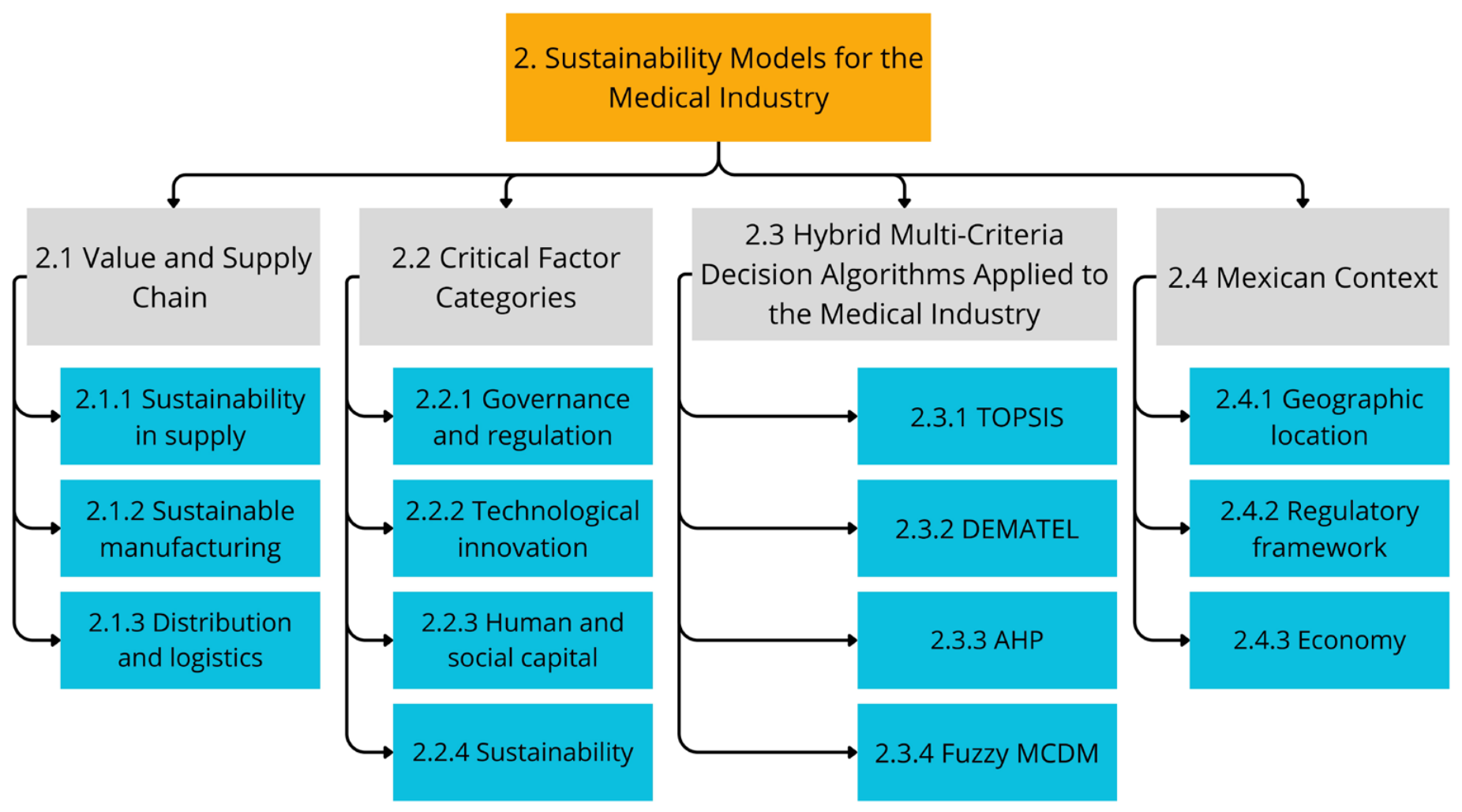
2. Problem Taxonomy
3. Literature Review
4. Identifying Gaps and Open Challenges
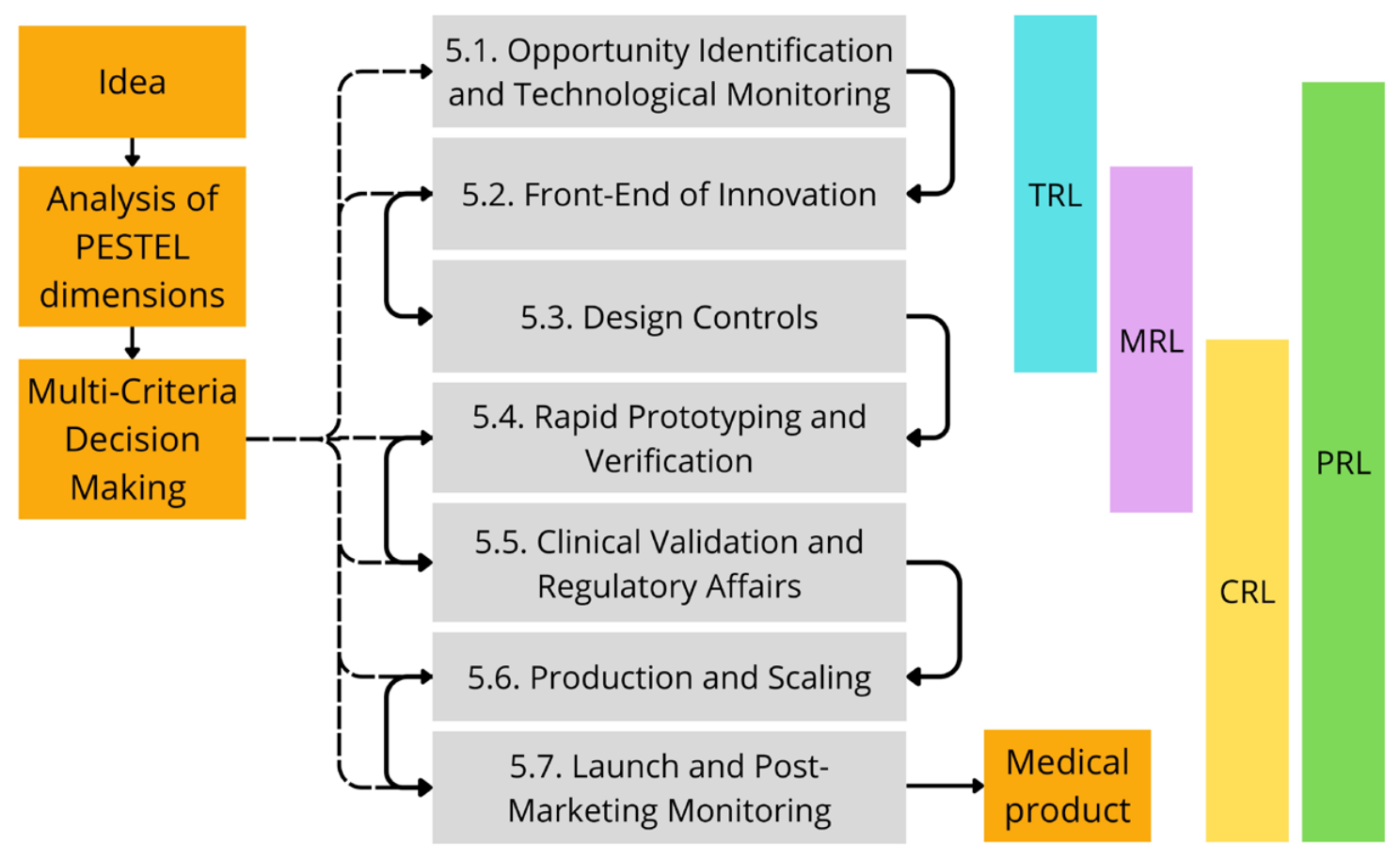
5. Innovation Management to Solve the Open Challenges
5.1. Opportunity Identification and Technological Monitoring
5.2. Front End of Innovation
5.3. Design Controls
5.4. Rapid Prototyping and Verification
5.5. Clinical Validation and Regulatory Affairs
5.6. Production and Scaling
5.7. Launch and Post-Marketing Monitoring
5.8. MCDM and Maturity Levels in the Value Chain
6. Administrative Implications
7. Conclusions
Author Contributions
Funding
Institutional Review Board Statement
Informed Consent Statement
Data Availability Statement
Acknowledgments
Conflicts of Interest
Abbreviations
| AHP | Analytic Hierarchy Process |
| CMs | Contract Manufacturers |
| CoCoSo | Combined Compromise Solution |
| COPRAS | Complex Proportional Assessment |
| CRLs | Customer Readiness Levels |
| DEMATEL | Decision-Making Trial and Evaluation Laboratory |
| IoT | Internet of Things |
| MCDM | Multi-Criteria Decision Making |
| MRLs | Manufacturing Readiness Levels |
| OEM | Original Equipment Manufacturing |
| PRLs | Policy Readiness Levels |
| R&D | Research and Development |
| TOPSIS | Technique for Order of Preference by Similarity to Ideal Solution |
| TRLs | Technology Readiness Levels |
| WASPAS | Weighted Aggregate Sum of Products Assessment |
| IMMEX | Industria Manufacturera, Maquiladora y de Servicios de Exportación |
| COFEPRIS | Comisión Federal para la Protección contra Riesgos Sanitarios |
| QFD | Quality Function Deployment |
| RBWM | Robust Best–Worst Method |
| PLTs | Probabilistic Language Terms |
| FUCOM | Full Consistency Method |
| FDA | Food and Drug Administration |
| EMA | European Medicines Agency |
References
- Javanmardi, E.; Maresova, P.; Xie, N.; Mierzwiak, R. Exploring business models for managing uncertainty in healthcare, medical devices, and biotechnology industries. Heliyon 2024, 10, e25962. [Google Scholar] [CrossRef] [Scilit] [PubMed]
- Jim, W.; James, E.; Lisa, L.; Jason, H.; Shanthi, S. Pulse of the Industry: Medical Technology Report 2023. Available online: https://www.ey.com/content/dam/ey-unified-site/ey-com/en-us/campaigns/life-sciences/documents/ey-pulse-of-the-industry-medical-technology-report-2023.pdf (accessed on 7 May 2026).
- Secretaria de Economía. Sector de Dispositivos Médicos e Industria Farmacéutica. Available online: https://ventanillaunica.economia.gob.mx/media/20250604_Disp.%20m%C3%A9dicos%20e%20industria%20farmac%C3%A9utica%201T%202025.pdf (accessed on 7 May 2026).
- Gereffi, G.; Hamrick, D. Industrial Upgrading and Cluster Development in the Medical Device and Aerospace Sectors in Baja California, Mexico. Available online: https://www.cepal.org/en/publications/87055-industrial-upgrading-and-cluster-development-medical-device-and-aerospace-sectors (accessed on 7 May 2026).
- Salazar, J.M. El Sector/Clúster de Dispositivos Médicos de Costa Rica. Estudio de Caso. Banco Interamericano de Desarrollo. Available online: https://publications.iadb.org/es/el-sectorcluster-de-dispositivos-medicos-de-costa-rica-estudio-de-caso (accessed on 7 May 2026).
- Montesinos, L.; Checa Rifá, P.; Rifá Fabregat, M.; Maldonado-Romo, J.; Capacci, S.; Maccaro, A.; Piaggio, D. Sustainability across the Medical Device Lifecycle: A Scoping Review. Sustainability 2024, 16, 1433. [Google Scholar] [CrossRef] [Scilit]
- Bai, Y.; Liu, Y.; Han, S.; Song, W. Enhancing sustainability in medical product supply chains: The role of remanufacturing and government subsidies. Heliyon 2024, 10, e33963. [Google Scholar] [CrossRef] [Scilit] [PubMed]
- Nejad, A.A. Leagile and sustainable supplier selection problem in the Industry 4.0 era: A case study of the medical devices using hybrid multi-criteria decision making tool. Environ. Sci. Pollut. Res. 2022, 30, 13418–13437. [Google Scholar] [CrossRef] [Scilit]
- Santa, R.; Ferrer, M.; Tegethoff, T.; Scavarda, A. An investigation of the impact of human capital and supply chain competitive drivers on firm performance in a developing country. PLoS ONE 2022, 17, e0274592. [Google Scholar] [CrossRef] [Scilit] [PubMed]
- Leong, W.Y. Circular Economy Through Green Additive Manufacturing in Medical Device Manufacturing. Eng. Proc. 2026, 129, 1. [Google Scholar] [CrossRef] [Scilit]
- Sathiya, V. Reshaping healthcare supply chain using chain-of-things technology and key lessons experienced from COVID-19 pandemic. Socio-Econ. Plan. Sci. 2023, 85, 101510. [Google Scholar] [CrossRef] [Scilit]
- Zavadskas, E.K.; Govindan, K.; Antucheviciene, J.; Turskis, Z. Hybrid multiple criteria decision-making methods: A review of applications for sustainability issues. Econ. Res.-Ekon. Istraž. 2016, 29, 857–887. [Google Scholar] [CrossRef] [Scilit]
- Momena, A.F.; Gazi, K.H.; Mondal, S.P. Multi-Criteria Decision Analysis for Sustainable Medicinal Supply Chain Problems with Adaptability and Challenges Issues. Logistics 2025, 9, 31. [Google Scholar] [CrossRef] [Scilit]
- Saatchi, R. Fuzzy Logic Concepts, Developments and Implementation. Information 2024, 15, 656. [Google Scholar] [CrossRef] [Scilit]
- Agrawal, D.; Gupta, S.; Dusad, C.; Meena, M.; Dangayach, G.; Jagtap, S. Identifying enablers for a circular healthcare supply chain: An integrated fuzzy DEMATEL-MMDE approach with hesitant information. Clean. Eng. Technol. 2025, 24, 100882. [Google Scholar] [CrossRef] [Scilit]
- Utar, H. Elsewhere in North America: How U.S. Tarrifs on China boosted Mexico’s Manufacturing Employment and Output. Available online: https://www.ifo.de/en/cesifo/publications/2026/working-paper/elsewhere-north-america-how-u.s.-tariffs-china-boosted-mexicos (accessed on 7 May 2026).
- United States Trade Representative. 2025 National Trade Estimate Report on Foreign Trade Barrirers. Available online: https://ustr.gov/sites/default/files/files/Press/Reports/2025NTE.pdf (accessed on 7 May 2026).
- ISO 13485:2016; Medical Devices—Quality Management Systems—Requirements for Regulatory Purposes. International Organization for Standardization: Geneva, Switzerland, 2016.
- ISO 14971:2019; Medical Devices—Application of Risk Management to Medical Devices. International Organization for Standardization: Geneva, Switzerland, 2019.
- ISO 14155:2026; Clinical Investigation of Medical Devices for Human Subjects—Good Clinical Practice. International Organization for Standardization: Geneva, Switzerland, 2026.
- Benreguieg, A.; Montuori, L.; Alcázar-Ortega, M.; Siano, P. Multi-Criteria Decision Analysis for Assessing Green Hydrogen Suitability in MENA FFED Countries. Sustainability 2026, 18, 2157. [Google Scholar] [CrossRef] [Scilit]
- Sarker, M.R.; LeHew, M.L.A.; Vaughan, Y. A Strategic Case Analysis of the U.S. Leather and Hide Industry. Sustainability 2026, 18, 5583. [Google Scholar] [CrossRef] [Scilit]
- Amirhaeri, Y.; Hadavi, H.; Kantor, I. Emerging and Conventional Pathways for Sustainable Ammonia Production: Technology Readiness, Economics, and Environmental Performance. Processes 2026, 14, 1973. [Google Scholar] [CrossRef] [Scilit]
- Li, J.; Zhang, G.; Wang, X. Supply Chain Concentration and Enterprise Resilience: Evidence from China. Systems 2026, 14, 386. [Google Scholar] [CrossRef] [Scilit]
- Lyu, F.; Zhang, J.; Liu, F.; Chu, H. Decision Optimization of Manufacturing Supply Chain Based on Resilience. Sustainability 2025, 17, 6519. [Google Scholar] [CrossRef] [Scilit]


| Element of Taxonomy | Publication | Technical Contribution | Methodology | Performance Metrics | Limitations and Restrictions |
|---|---|---|---|---|---|
| 2.1.1, 2.3.1, 2.3.3 | Nejad (2022) [8] | Prioritizing critical sustainability, Industry 4.0, and leagile (lean and agile) indicators in supplier selection. | Review of the previous literature and use of RBWM. Comparison using the AHP-TOPSIS method. | Determining sustainability and agility as critical factors for selecting suppliers. | The analysis overlooks the customer factor and fails to account for material-specific performance, suggesting that future research should incorporate the QFD and recognize that a supplier’s suitability may vary depending on the specific supply being sourced. |
| 2.1.2, 2.2.1, 2.2.4 | Bai et al., (2024) [7] | Evaluation of different scenarios to promote sustainability through manufacturing and remanufacturing. The impact of government subsidies is also assessed. | Comparison of three game models using mathematical analysis based on the previous literature and the law of diminishing returns. | Mathematical demonstration of higher performance in a system where the OEM certifies the remanufacturing company. Qualitative recommendations to consider remanufacturing as a viable alternative. | A strictly mathematical–theoretical methodology that does not consider factors such as business strategies, quality level, and regulatory frameworks. |
| 2.2.2, 2.2.4, 2.3.1 | Leong (2025) [10] | Development of a circular economy through additive manufacturing, reducing environmental impact, and taking into consideration applicable regulations. | Comparison of medical device archetypes, measuring the potential of the circular economy using TOPSIS. | A reduction of between 38% and 68% in greenhouse gas emissions, with energy savings of 54%. Qualitatively, a roadmap for Industry 5.0 is suggested, bringing the product closer to the user through additive manufacturing. | The range of applications of additive manufacturing and the properties of the materials used reduce the options of products that can be produced by this technology currently. |
| 2.1.1 | Momena et al. (2025) [13] | Definition of critical factors for the sustainability of supply chains based on quantitative/qualitative analysis, definition of arithmetic operations for sets of PLTs. | MCDM combined with PLTs is the solution to uncertainty in the system. | Identifying “Collaboration and Communication” as a critical factor for sustainability. Using the subscript degree and deviation degree functions. | The emphasis is firmly on the supply chain, with a carefully selected group of contributors. The study is biased, as most of the assessments and conclusions are derived from the opinions of two experts. The study also suggests future analyses that consider fuzzy numbers. |
| 2.1.1, 2.2.2, 2.3.2 | Sathiya (2023) [11] | Integration of the IoT and blockchain to strengthen supply chains in the medical supply industry. | Use of IoT, blockchain, and analytics through DEMATEL. | Proposed chain of things (CoT) model to strengthen the supply chain. | DEMATEL may present problems when encountering uncertain or incompatible information; therefore, the use of neutrosophic logic is proposed. |
| 2.1.1, 2.3.2 | Agrawal et al. (2025) [15] | Identifying critical factors in supply chains under a circular logistics system. | Fuzzy DEMATE | Identifying “long-term planning” as the main factor. Identifying “corporate social responsibility” as the main enabler. | Although supported by the DEMATEL methodology, it utilizes the knowledge of Indian experts, which may bias the study and influence the results within the specific context of India. Furthermore, the research findings suggest further investigation using fuzzy AHP, fuzzy TOPSIS, and fuzzy FUCOM. |
| 2.4.1, 2.4.3 | Gereffi & Hamrick (2026) [4] | Industrial upgrade to the medical device and aerospace industries, specifically in Baja California, Mexico. | Comprehensive analysis of the medical device manufacturing sector in Baja California, background review. | Recommendations for public policy in Baja California that encourage the development of both clusters in the region. | Conclusions based qualitatively on historical information, without a quantitative basis. |
| 2.2.3 | Santa et al. (2022) [9] | Determining the effect of human capital on the performance of companies of different sizes. | Hypothesis confirmation using equation models, based on company surveys. | It is concluded that human capital has an indirect positive impact on organizational performance, in combination with cost and quality policies. | The study focused on the agro-industrial region of Colombia. |
Disclaimer/Publisher’s Note: The statements, opinions and data contained in all publications are solely those of the individual author(s) and contributor(s) and not of MDPI and/or the editor(s). MDPI and/or the editor(s) disclaim responsibility for any injury to people or property resulting from any ideas, methods, instructions or products referred to in the content. |
© 2026 by the authors. Published by MDPI on behalf of the Market Access Society. Licensee MDPI, Basel, Switzerland. This article is an open access article distributed under the terms and conditions of the Creative Commons Attribution (CC BY) license.
Share and Cite
Cozain-Hernández, J.; López-Leyva, J.A.; Ponce-Camacho, M.A.; Ramos-García, V.M. Multi-Criteria Decision-Making Framework for Sustainable Innovation Management in the Mexican Medical Device Manufacturing Industry: An Exploratory and Interdisciplinary Analysis. J. Mark. Access Health Policy 2026, 14, 41. https://doi.org/10.3390/jmahp14030041
Cozain-Hernández J, López-Leyva JA, Ponce-Camacho MA, Ramos-García VM. Multi-Criteria Decision-Making Framework for Sustainable Innovation Management in the Mexican Medical Device Manufacturing Industry: An Exploratory and Interdisciplinary Analysis. Journal of Market Access & Health Policy. 2026; 14(3):41. https://doi.org/10.3390/jmahp14030041
Chicago/Turabian StyleCozain-Hernández, José, Josué Aarón López-Leyva, Miguel Angel Ponce-Camacho, and Víctor Manuel Ramos-García. 2026. "Multi-Criteria Decision-Making Framework for Sustainable Innovation Management in the Mexican Medical Device Manufacturing Industry: An Exploratory and Interdisciplinary Analysis" Journal of Market Access & Health Policy 14, no. 3: 41. https://doi.org/10.3390/jmahp14030041
APA StyleCozain-Hernández, J., López-Leyva, J. A., Ponce-Camacho, M. A., & Ramos-García, V. M. (2026). Multi-Criteria Decision-Making Framework for Sustainable Innovation Management in the Mexican Medical Device Manufacturing Industry: An Exploratory and Interdisciplinary Analysis. Journal of Market Access & Health Policy, 14(3), 41. https://doi.org/10.3390/jmahp14030041