1. Introduction
Cloud, edge, artificial intelligence (AI) and the Internet of Things (IoT) are transforming the landscape of distributed computing. While centralized cloud infrastructures still provide elastic capacity, maturity and wide platform services, they have become inadequate for applications demanding low latency, local data processing, mobility support, privacy protection and context-aware decision-making capabilities. In the context of emerging workloads, including autonomous systems, industrial digital twins, augmented reality, smart healthcare, intelligent transportation, real-time video analytics and large-scale cyber-physical systems, computation is required to be executed closer to data sources and end-users than only in the remote cloud regions [
1,
2,
3,
4]. This trend has led to the proliferation of architectures that move away from cloud-centric and towards cloud–edge continuums, where devices, edge nodes, fog/MEC infrastructures, regional clouds and central clouds work together as a distributed execution fabric.
Serverless computing is one of the most powerful programming and execution paradigms in the cloud-based world. The Function-as-a-Service paradigm lets the developer deploy small event-driven functions, while the platform provisions, scales, fails and controls them. The model enhances agility in development, reduces the burden of infrastructure management and allows for fine-grained scaling and billing. These properties make serverless computing appealing for apps that have bursts of activity, that are event-driven, and that are triggered by data. Serverless functions are known for being stateless, short-running, pay-per-use, and automatic scaling, as well as having managed event sources [
4,
5,
6].
The extension of serverless computing into cloud–edge environments changes the problem substantially. Edge resources are CPU, memory, storage, energy, connectivity and geographically distributed; heterogeneous; and administratively diverse. When a function is pushed to the edge of a hyperscale cloud, it could face cold start delays, image distribution overhead, limited warm container availability, network jitter, or state placement issues. However, cloud–edge serverless execution is not only about the number of function instances to be created but also about where the functions have to run, how to route the requests, which state should be kept local, when to migrate the functions, how to establish trust, and whether the benefits of serverless execution justify the energy, carbon and cost overheads [
7,
8,
9,
10].
There has been significant research progress in the last few years on individual components of the field. Studies on autoscaling include reactive, predictive, and hybrid policies [
11]; cold start studies include pre-warming, lightweight virtualization, data reuse, and invocation prediction [
12]; placement and offloading studies include latency-aware and QoS-aware execution across cloud and edge sites [
2]; workflow studies include function composition, data movement, and orchestration overhead [
3]; and security studies include Denial-of-Wallet exposure, side channels, provenance, and secure edge workflows [
13,
14]. While serverless functions have traditionally been used for basic web backends, parallel work has expanded their usage to federated learning, IoT pipelines, digital twins, MLOps, and domain-specific analytics [
7,
15,
16,
17].
In spite of these advances, there is still a lack of integration in the literature. Numerous studies focus on optimizing a single mechanism like autoscaling or offloading but not taking into account the interaction with cold starts, workflow state, energy usage, trust policy, platform interoperability, or industrial deployment constraints. Most of the existing surveys are limited to a specific aspect of the problem, such as autoscaling, function offloading, integration of IoT devices, or cloud-to-edge computing, and do not provide a comprehensive understanding of the interplay between these mechanisms to ensure a seamless lifecycle for cloud–edge serverless execution [
4,
9,
11,
18]. This fragmentation makes it difficult to get a handle on the field; there is a need for a consolidated review that will showcase not only which techniques exist, but how they are connected, where they fail, what assumptions are required to deploy them and what design principles should inform future platforms.
This article fills that void by redefining the cloud–edge serverless computing as an orchestration and governance issue. The main idea is that the serverless function in cloud–edge environment should be considered in terms of interacting goals: latency, scalability, data locality, reliability, security, trust, operational cost, energy consumption, carbon exposure, and reproducibility. If a scheduler can reduce latency but increase the idle warm pools, egress cost, carbon intensity and/or security risk, it cannot be considered to be the optimal scheduler. Likewise, a platform that offers elasticity but lacks strong state management, observability, and interoperability is unlikely to meet industrial needs. A critical review is thus required to transcend descriptive summaries and reveal the trade-offs, immaturities, and tensions in the field.
1.1. Motivation and Research Gap
There are three reasons for this review. First, cloud–edge serverless computing is fast emerging as a real consideration because of the increasing need for elastic computing at the edge of the data, such as for AI, IoT event streams, real-time analytics, and distributed cyber-physical applications. Second, the conceptual frameworks that organize the research is lagging behind it. While all the concepts are important, they are discussed individually and are operationally intertwined. Third, the progress of industrial serverless platforms and open-source FaaS frameworks are also moving in parallel with academic research, necessitating the need to compare mechanisms with deployment realities.
It is not a trivial problem to identify that there is no other survey that covers serverless. The missing link is a cross-layer, critical synthesis of the behavior of serverless functions as lifecycle managed entities in distributed cloud–edge infrastructures. It must link the architectural underpinnings, runtime systems, autoscaling, placement, workflows, security, sustainability, platform ecosystems, and application domains together. It should also highlight literature that is well developed, less developed, and literature that needs to be focused on future research that is reproducible and industrially relevant.
1.2. Guiding Review Questions
RQ1. What architectural patterns and platform ecosystems enable serverless functions across cloud–edge environments?
RQ2. How do existing approaches manage autoscaling, cold start mitigation, function placement, offloading, migration, and request routing under edge constraints?
RQ3. How are serverless workflows, stateful execution, and data-intensive functions supported across heterogeneous cloud–edge infrastructures?
RQ4. What roles do AI, federated learning, and intelligent scheduling play in cloud–edge serverless orchestration?
RQ5. How do security, privacy, trust, provenance, and Denial-of-Wallet exposure affect serverless function execution across distributed sites?
RQ6. How are energy consumption, carbon awareness, cost, and sustainability incorporated into serverless function lifecycle decisions?
RQ7. What unresolved research, benchmarking, interoperability, and industrial-deployment challenges must be addressed to mature the field?
1.3. Major Contributions
C1. Extensive critical analysis of cloud–edge serverless computing. The review brings together the recent progress in serverless computing in the cloud, edge, fog and MEC domains, and connects the mechanisms proposed by cloud-native platforms with distributed systems and edge orchestration research.
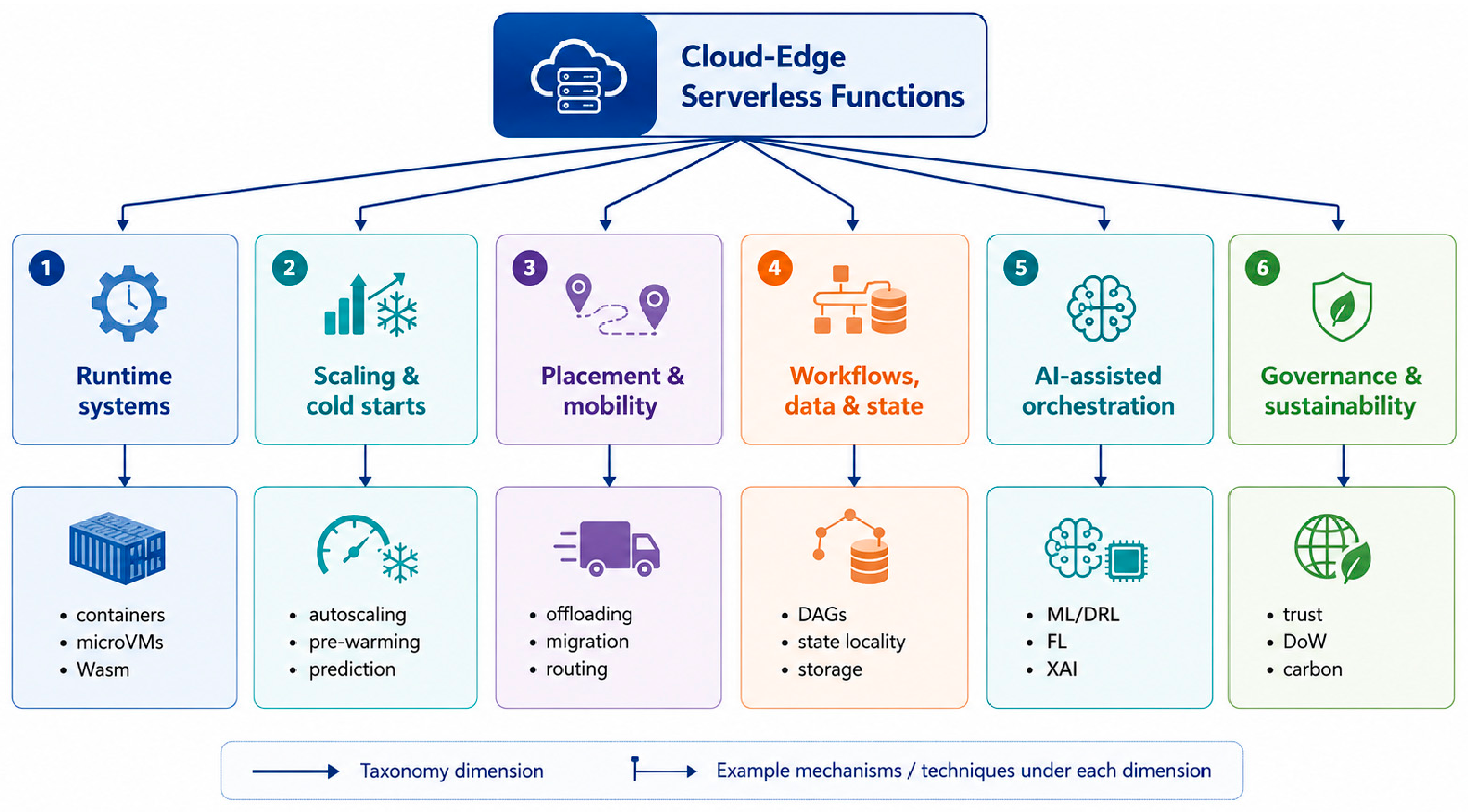
C2. Multidimensional classification of serverless mechanisms. The paper proposes a taxonomy that categorizes research based on runtime systems, autoscaling, cold start mitigation, placement, offloading, migration, workflow orchestration, state management, intelligent scheduling, security, sustainability, platform ecosystems and application domains.
C3. Critical review of assumptions, maturity and readiness for deployment. Rather than describing each study individually, the review critically examines scalability assumptions, evaluation limitations, reproducibility gaps, industrial relevance, and trade-offs involving latency, cost, energy, carbon emissions, data locality, reliability, and trust.
C4. Integrated conceptual framework. The paper introduces a framework that establishes a relationship between application needs, runtime context, orchestration intelligence, governance policies, and system-level outcomes, and how cloud–edge serverless decisions relate to each other across the function’s lifecycle.
C5. Next-generation platform research agenda. The review points to future directions such as trustworthy orchestration, carbon-aware scheduling, stateful edge functions, cross-provider interoperability, explainable AI-driven resource management, reproducible benchmarking and sustainable cloud–edge infrastructures.
1.4. Organization of the Paper
The rest of the article is structured as follows:
Section 2 sets the boundaries for the review, outlines the literature identification strategy, classifies the evidence and describes the research landscape.
Section 3 builds on the conceptual elements of cloud–edge serverless computing.
Section 4 compares this review with the literature on surveys. The architectural evolution and suggested taxonomy are presented in
Section 5. Each of the
Section 6,
Section 7,
Section 8,
Section 9,
Section 10,
Section 11 and
Section 12 discusses key mechanisms in a critical manner: runtime systems, autoscaling, cold starts, placement, workflows, state management, AI-driven orchestration, security, and sustainability.
Section 13 explores the industrial serverless platforms and open-source serverless ecosystem. Evaluation, benchmarks and reproducibility are the topics of
Section 14. The integrated conceptual framework and design principles are proposed in
Section 15. In
Section 16, lessons are synthesized. Research challenges and future directions are given in
Section 17.
Section 18 discusses practical and industrial implications. Threats to validity and review limitations are presented in
Section 19, and the paper is concluded in
Section 20.
2. Review Scope and Literature Identification
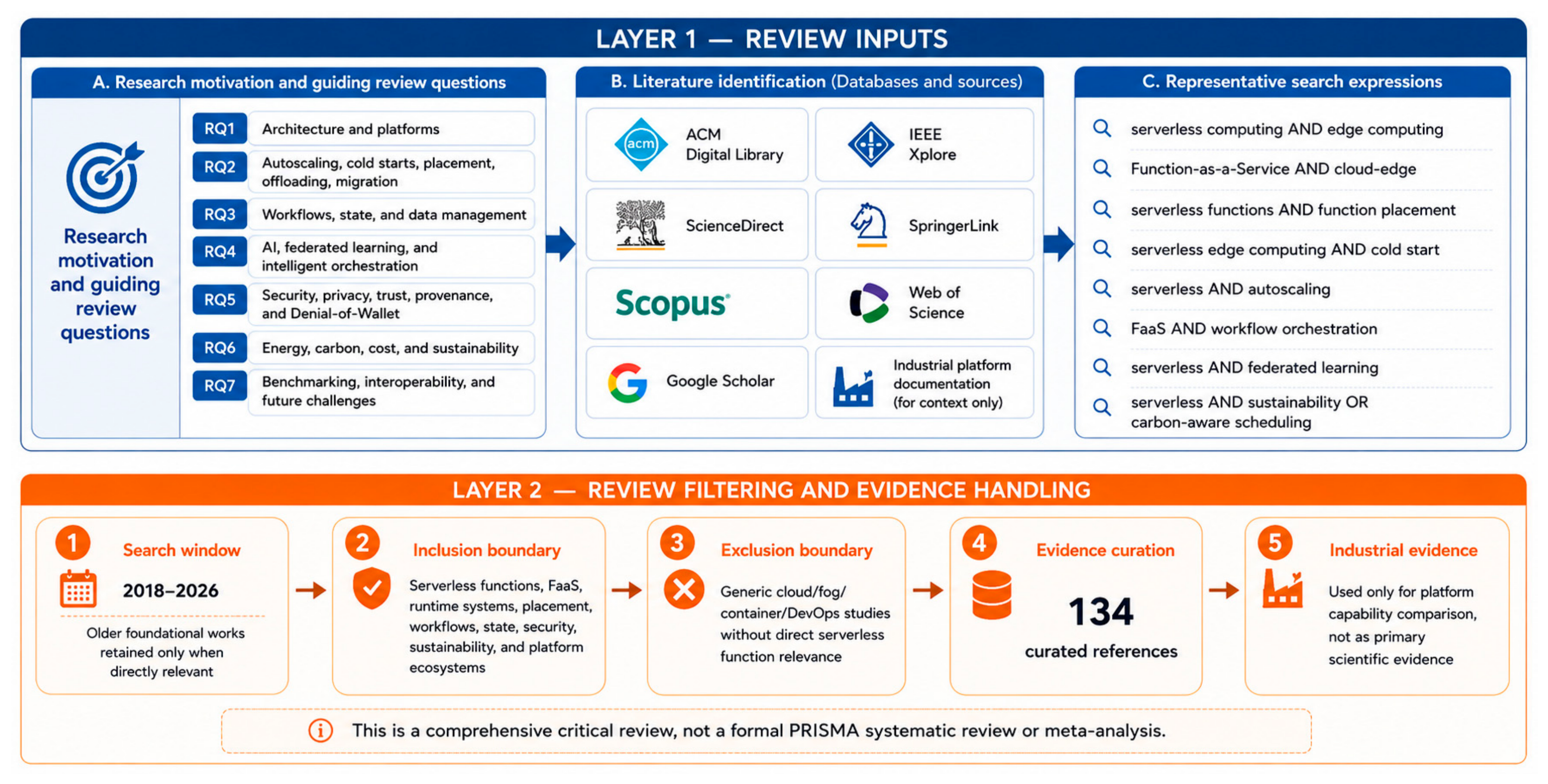
This article is framed as a comprehensive critical review rather than a formal systematic literature review or statistical meta-analysis. This choice directly reflects the objective of the paper: to synthesize a field that is constantly changing and multidisciplinary, with evidence spread across several areas such as serverless computing, cloud-native systems, edge computing, IoT, federated learning, security, sustainability, workflow orchestration and industrial platform engineering. While the review can be a strictly protocol-driven exercise of counting publications and mapping narrow topics, the present review cannot be so narrowly focused, as cloud–edge serverless computing features interactions across layers rather than any single intervention or evaluation metric [
19].
The major search window focused on the literature from 2018 through 2026, which was when these concepts of edge serverless, cloud continuum orchestration, WebAssembly runtimes, Knative-style platforms, and carbon-aware cloud research emerged. Earlier works were kept only where they laid the groundwork for new concepts, such as the critical review methodology, scientific serverless workflows, and early serverless architectures based on containers. Papers that directly impact on the execution of FaaS, cloud–edge placement, cold start mitigation, platform/runtime design, workflow/state management, security, sustainability, and reproducible evaluation were prioritized. If the terminology was unclear, studies were only included if it impacted the serverless function lifecycle, not generic cloud, fog, container or DevOps operations. There was a separation of industrial sources from peer-reviewed evidence; these latter were used only for a comparison of the practical capacities of the platforms.
The review is carried out through a transparent, reproducible and critically interpretative process of literature identification. The iterative search of major scholarly databases and publisher libraries was used to identify the relevant literature, such as ACM Digital Library, IEEE Xplore, ScienceDirect, SpringerLink, Scopus, Web of Science and Google Scholar. Searches were performed by merging serverless computing and FaaS terms, as well as cloud–edge concepts and mechanism-specific terms. Examples of representative search expressions were “serverless computing” AND “edge computing”; “Function-as-a-Service” AND “cloud-edge”; “serverless functions” AND “function placement”; “serverless edge computing” AND “cold start”; “serverless” AND “autoscaling”; “FaaS” AND “workflow orchestration”; “serverless” AND “federated learning”; and “serverless” AND “sustainability” OR “carbon-aware scheduling”.
Peer-reviewed journal articles, leading conference papers, influential survey papers, and technically significant papers that describe mechanisms directly relevant to the execution of serverless applications in the cloud–edge environment were prioritized. Only when materials were industrial documents, white papers, or platform materials that clarified the capabilities and/or limitations of major serverless platforms were they considered; these were not considered to be peer-reviewed empirical evidence. When they set up important concepts, like Function-as-a-Service, scientific serverless workflows, and cloud–edge continuum computing [
5,
6,
20], they retained the foundational works.
The review is intentionally not comprehensive of any broad cloud–edge, fog computing, DevOps, or container orchestration studies unless they are directly relevant to the execution of serverless functions, design of the runtime substrate, orchestration mechanisms, governance of the edge, security, or sustainability. This is significant because the manuscript is not a general review of cloud–edge–fog. It focuses on the serverless function lifecycle in cloud–edge environments, including trigger, place, warm, scale, migrate, compose, secure, monitor, and evaluate. The scope of this review, the inclusion priorities, and the exclusion boundaries are defined in
Table 1, and are used to limit the scope of the manuscript.
2.1. Analytical Review Strategy
Thematic coding and critical comparison of the selected literature were used for analysis. The studies were categorized based on the main mechanisms they employed, such as runtime systems, autoscaling, cold start mitigation, function placement, offloading and migration, workflow orchestration, state management, AI-assisted scheduling, security and trust, sustainability, industrial platforms, and application domains. The review within each theme will compare assumptions, control variables, optimization objectives, evaluation settings, metrics, datasets, testbeds, and reported limitations.
Taxonomy is done deductively and inductively. Deductively, the review starts with the questions that guide the review and the serverless function lifecycle: triggering, deployment, scheduling, execution, scaling, interaction with state, composition, monitoring, and termination. Inductively, other categories are derived from the recurring patterns in literature that include warm pool management, topology-aware placement, serverless federated learning, workflow fusion, Denial-of-Wallet exposure, and carbon-aware scheduling. This way, the taxonomy is not forced but is developed based on the conceptual structure of a serverless system and the mechanisms that are repeatedly observed in the studies.
Critical evaluation involves the five common questions: What problem does the study address? What are the assumptions that allow the solution to be feasible? What are the indicators of the claims? What are the compromises that are not mentioned or not fully elaborated? What about the transferability of the approach to heterogeneous cloud–edge environments? These questions assist in differentiating between developed contributions and ideas that are in the early stages and provide a more productive and productive review for Q1 scholarly synthesis. The analytical lenses used in synthesizing the selected literature are summarized in
Table 2.
2.2. Literature Identification and Evidence Handling
As this article is a comprehensive critical review, the literature identification process is focused on coverage, relevance and analytical value and not necessarily on formal PRISMA counting. However, the review ensures transparency by recording the sources of search, representative search terms, priorities for inclusion, boundaries for exclusion and dimensions for synthesis. The search process may be extended to a PRISMA flow if a target journal requires a formal systematic protocol, including database-specific retrieval counts, removal of duplicate records, and screening of records.
To minimize bias, the review equates recent work with foundational research, and academic mechanisms with industrial platform realities. Although the serverless and cloud–edge technologies evolve rapidly, recent works are given preference, and older works are kept where they present interesting concepts or general lessons that can be reused in evaluations. Survey papers are primarily employed to help place the review and to identify gaps; primary studies are employed to analyze mechanisms, evidence, and trade-offs.
2.2.1. Inclusion and Exclusion Criteria
The inclusion and exclusion criteria underlying the construction of
Table 1 are specified as follows: a study was included if it (i) directly concerned the execution, orchestration, or governance of serverless functions (Function-as-a-Service, FaaS) in a cloud, edge, fog, or cloud–edge continuum setting; (ii) reported a mechanism, architecture, empirical measurement, or critical analysis relevant to at least one stage of the serverless function lifecycle (trigger, place, warm, scale, migrate, compose, secure, monitor, evaluate); or (iii) constituted a foundational or methodological work required to ground the review’s methodology, terminology, or a seminal concept subsequently built upon by the reviewed corpus, irrespective of publication year. A study was excluded, or retained only as background material, if it (i) addressed general cloud, fog, or edge computing without a specific, identifiable connection to serverless or FaaS execution; (ii) addressed generic virtual machine or container scheduling, or DevOps tooling, without shaping serverless runtime behavior specifically; (iii) constituted non-technical commentary, marketing material, or an unsupported claim without a verifiable mechanism or evaluation; or (iv) was a duplicate, a preprint superseded by a peer-reviewed version of the same work, or an extended-abstract version of a paper already included in its full form.
2.2.2. Screening Process and Scope
This review is framed as a comprehensive critical review rather than a formal PRISMA protocol systematic review and is accordingly not accompanied by a database-by-database PRISMA flow diagram. Table 24 provides the structural scaffold for such a flow, reporting each screening stage, its purpose, and the field the corresponding count occupies, in support of methodological transparency for readers accustomed to PRISMA-style reporting. The principal reasons full-text-assessed records were subsequently excluded are reported qualitatively as follows: (a) the study’s central contribution concerned generic cloud, edge, or fog resource management without a serverless-specific mechanism; (b) the study addressed container or virtual machine orchestration in a DevOps context unconnected to the FaaS execution model; (c) the study was non-technical, an opinion piece, or vendor marketing material without a verifiable technical claim; or (d) the study was a duplicate, an extended abstract, or an earlier preprint superseded by a more complete peer-reviewed version already included.
2.3. Evidence Classification
The evidence reviewed can be grouped into six overlapping categories: The major studies presented in core cloud–edge serverless include function placement, function offloading, cold starts, scaling, workflows, and edge runtime design. FaaS execution and composition, as well as cold start behavior, can be understood by the serverless cloud-only studies. Edge, fog and cloud continuum works help in understanding the issues of heterogeneity, task offloading, latency minimization and resource constraints. Security and governance works include analysis of trust, provenance, denial of wallet and side-channel risk. Energy and carbon aspects are added by sustainability studies. Last, but not least, industrial and open-source platforms provide practical deployment capabilities and limitations.
Table 3 provides a description of the various types of evidence and their function in the review.
2.4. Descriptive Landscape of Cloud–Edge Serverless Research
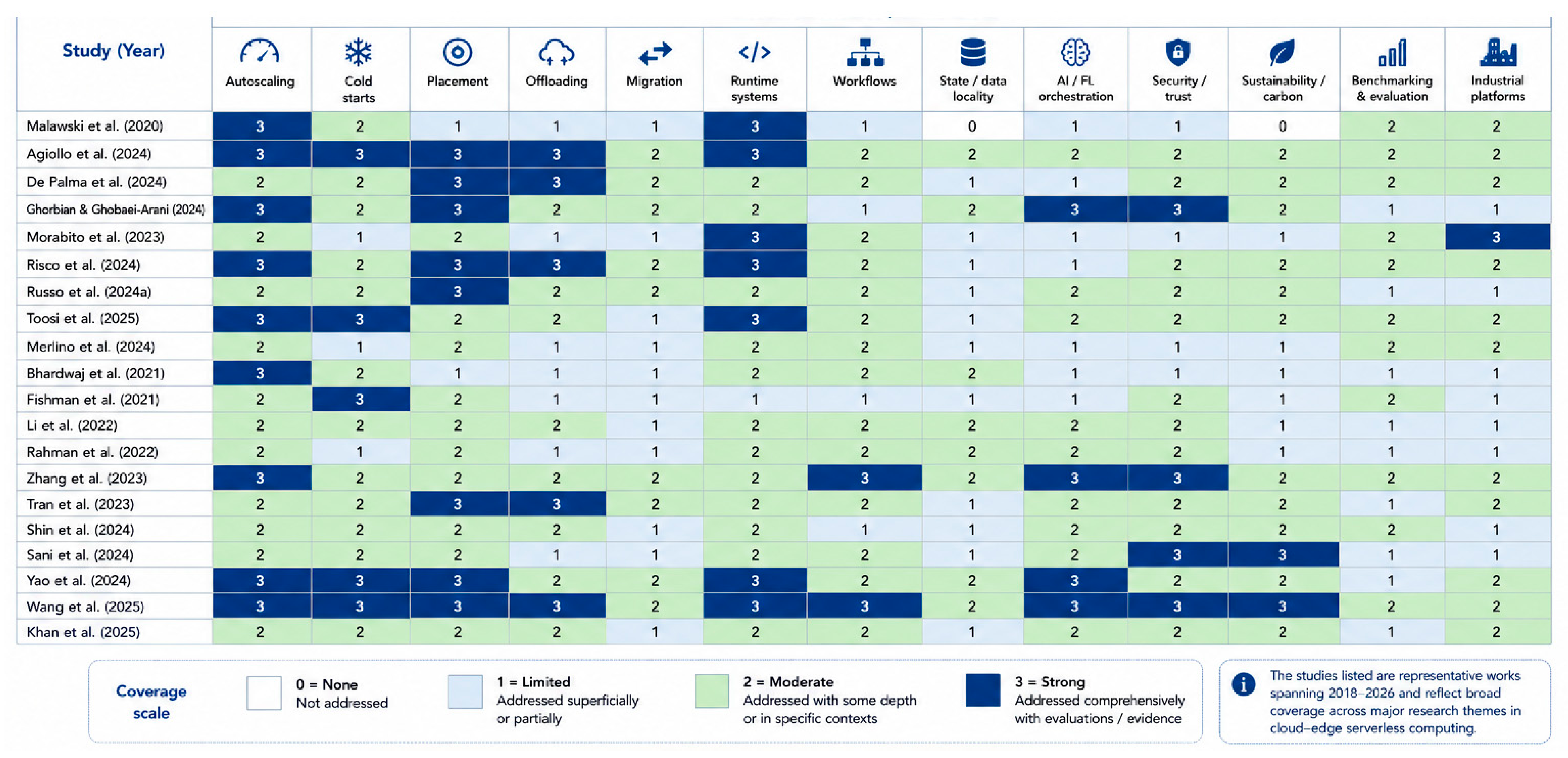
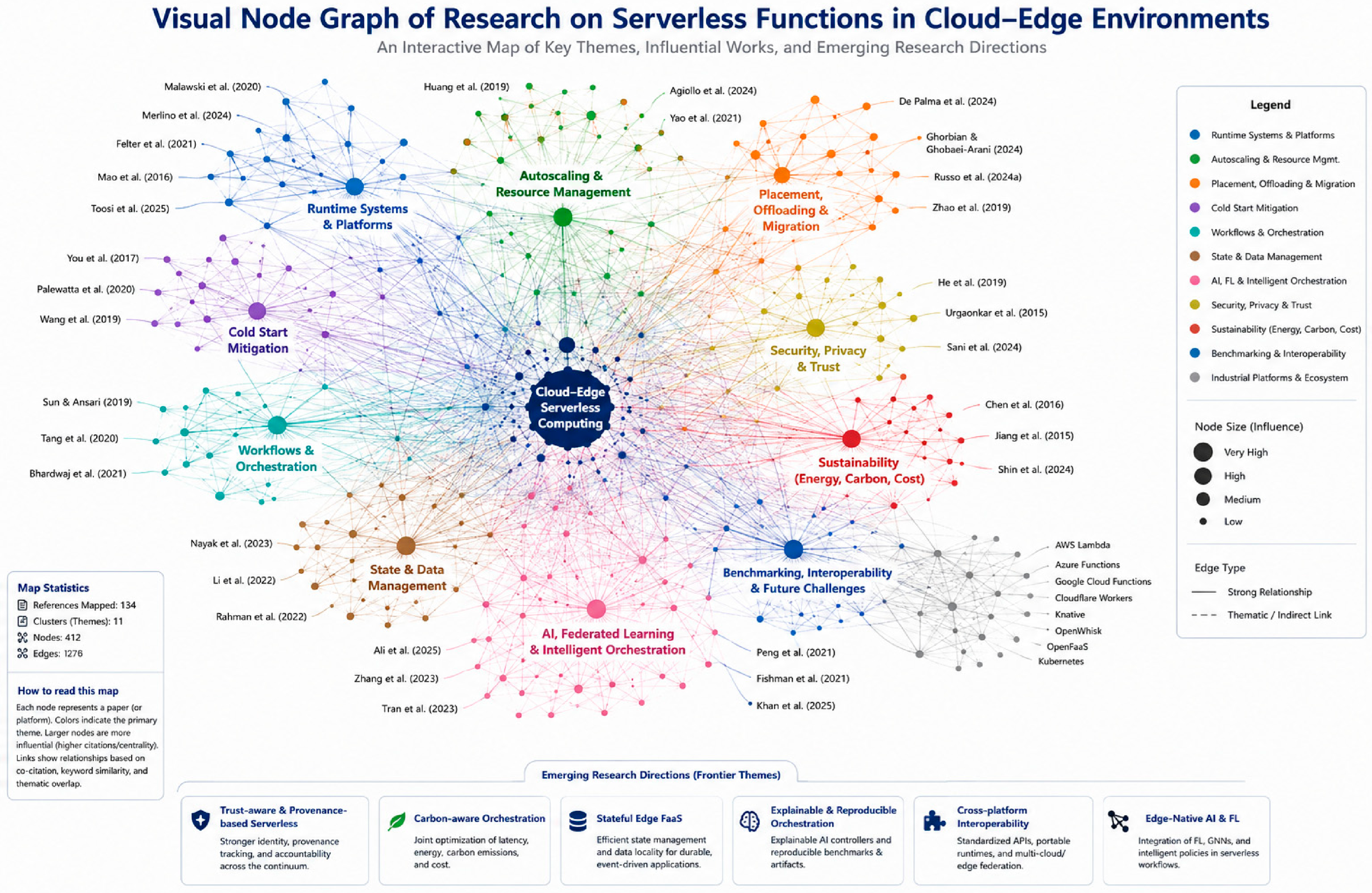
This section describes the landscape of cloud–edge serverless research. For the critical synthesis, the corpus was organized descriptively prior to thematic interpretation, in order to have an evidence-informed basis. This mapping is not provided as a formal bibliometric analysis but as a structured presentation of the evidence base that informed the critical review. Following broad contextual items that were not directly related to serverless function execution, runtime substrates, orchestration, governance, security, sustainability, and platform context, the final corpus consists of 134 curated references. These are studies on core serverless topics and carefully curated contextual papers on cloud–edge/fog resource management, container orchestration, AI-driven edge computing, security, sustainability, and cloud–edge applications in specific domains. This coverage is represented in the form of a study-level evidence heatmap in
Figure 1, showcasing the extent to which the paper’s evidence is provided for the analysis dimensions covered by the reviewed works.
Core serverless and FaaS sources support the analysis of function execution, runtime management, workflow support, cold start behavior, and edge-oriented FaaS platforms [
21,
22,
23,
24,
25,
26,
27,
28,
29].
Runtime substrate and platform operation sources inform the discussion of containers, cloud-native execution, lifecycle management, migration, and deployment overheads [
30,
31,
32,
33,
34,
35,
36,
37,
38,
39,
40,
41]. Additional sources in this category further clarify the same evidence stream [
42,
43,
44].
Cloud–edge, fog, and continuum resource management studies are used as contextual evidence for placement, task offloading, scheduling, latency, and mobility constraints [
45,
46,
47,
48,
49,
50,
51,
52,
53,
54,
55,
56]. Additional sources in this category further clarify the same evidence stream [
57,
58,
59,
60,
61,
62,
63,
64,
65,
66,
67,
68]. Additional sources in this category further clarify the same evidence stream [
69,
70,
71].
AI-enabled and domain-specific cloud–edge studies provide evidence for emerging application pressure from FL, video analytics, smart systems, digital twins, remote sensing, and cyber-physical workloads [
72,
73,
74,
75,
76,
77,
78,
79,
80,
81,
82,
83]. Additional sources in this category further clarify the same evidence stream [
84,
85,
86,
87,
88].
Security, trust, and governance studies support the analysis of side channels, data integrity, secure offloading, blockchain-assisted coordination, trustworthy scheduling, and edge–cloud attack exposure [
89,
90,
91,
92,
93,
94,
95,
96,
97,
98,
99,
100]. Additional sources in this category further clarify the same evidence stream [
101,
102,
103,
104,
105].
Sustainability and cost/energy optimization studies inform the review’s treatment of energy-aware placement, carbon-aware scheduling, and green cloud–edge execution [
106,
107,
108,
109,
110,
111,
112].
Additional cloud-native and edge context studies were retained only where they clarified infrastructure or platform assumptions [
113,
114,
115,
116].
Figure 2 complements this descriptive mapping by visualizing the reviewed corpus as thematic clusters, influential works, and emerging directions.
The temporal distribution shows that the majority of reviewed works are in the last few years, with a significant group in 2024–2025. This is a testament to the speed at which serverless is moving towards edge orchestration, federated learning, digital twins, containerized platforms and sustainable computing. To support review methodology and early cloud/serverless concepts, works prior to 2018 are retained.
The mapping additionally reveals that the field is uneven. Carbon-aware function warming, stateful edge FaaS, cross-provider interoperability, trust-aware placement, explainable orchestration, and reproducible benchmarking are areas that are still less developed, while autoscaling, cold start mitigation, latency-aware placement, and containerized runtime execution are more mature. This imbalance drives the taxonomy, lessons learnt, and future research agenda of later sections.
Two clarifications regarding
Figure 2 are warranted. First,
Figure 2 represents a broader thematic and co-citation landscape rather than a plot of the review’s own 134-reference core corpus in isolation; as its caption indicates, it visualizes research themes, influential works, and emerging directions, and its accompanying map statistics report 412 nodes across the visualization, compared with the 134 references formally cited in the core corpus (
Table 4). The figure therefore intentionally incorporates a small number of highly influential, frequently co-cited foundational works that fall outside the core 2018–2026 corpus and outside the review’s own reference list, represented as high-influence anchor nodes within their respective thematic clusters. The study of [
117], an early and widely cited edge computing vision paper, anchors the runtime systems and platforms cluster, and [
118], an early and highly cited survey on mobile edge computing from the communication perspective, is positioned within the cold-start mitigation cluster by the underlying co-citation analysis consistent with the criterion established in
Section 2, whereby pre-2018 works are retained only where they ground a methodology or a seminal concept.
Second, regarding the absence of a visibly 2026-labeled node in
Figure 2: the reference list does include 2026 publications, including [
119] on neighbor-aware container warming, [
8] on OpenWhisk-based platforms, and [
120] on carbon- and migration-aware scheduling, indicating that the corpus is not without 2026 evidence.
Figure 2, however, is a static visualization generated at an earlier stage of corpus curation and does not yet reflect the literature added subsequently. This figure will be regenerated from the updated corpus prior to camera-ready submission.
Figure 3 provides a summary of the critical review methodology and synthesis process that was followed to identify the literature, collect evidence, code the evidence into themes, develop a taxonomy, and synthesize the review findings. The pattern of descriptive publication years of the expanded evidence base is reported in
Table 4.
Table 5 and
Table 6 provide a summary of the evidence distribution by descriptive and evidence pattern synthesis, respectively, to support the critical review by major research themes.
3. Conceptual Foundations of Cloud–Edge Serverless Computing
Serverless computing is often described as a cloud service model where the developer provides functions, and the provider manages resource provisioning, scaling, and billing. This definition represents the operational abstraction but it is not complete for cloud–edge environments. The distributed edge model also introduces event routing, runtime selection, function image distribution, state affinity, locality policies, trust constraints, observability, and cross-layer coordination to the serverless model. Thus, cloud–edge serverless computing can be considered as a managed distributed execution model that dynamically distributes small units of computation across heterogeneous sites triggered by events.
The key difference between the traditional cloud FaaS and the cloud–edge FaaS is the execution substrate. Centralized cloud platforms run functions in relatively homogeneous data centers that have rich networking and storage and monitoring capabilities and have been well provisioned for autoscaling. Functions can run on edge servers, gateways, fog/MEC nodes, regional clouds, or central clouds in cloud–edge environments. These sites vary in resource capacity, network reliability, security posture, energy profile and administrative control. The control plane needs to expose enough information about policies to achieve reliable deployment and yet hide some of this complexity from the developers [
2,
3,
121].
The other important base is stateless abstraction and stateful application reality. Typically, serverless platforms promote the use of stateless functions, since they are easier to scale and fail-safe. Cloud–edge applications, however, require local context of the sensor, caching of machine learning models, user sessions, workflow state, and local data stores. In the era of scientific workflows, digital twins, federated learning and data-intensive serverless pipelines, edge FaaS systems are increasingly required to explicitly manage state and data locality [
5,
15,
122].
Cloud–edge serverless systems also change the definition of elasticity. Elasticity typically means scaling up or down the number of function instances in a cloud-only serverless system. Elasticity is part of the continuum that also encompasses geographical elasticity, warm pool placement, request rerouting, edge-to-cloud spillover, function migration, and data-aware scheduling. A function can not just scale, but also move, duplicate, merge, split, or be warmed up in advance at a predicted location [
8,
10,
20,
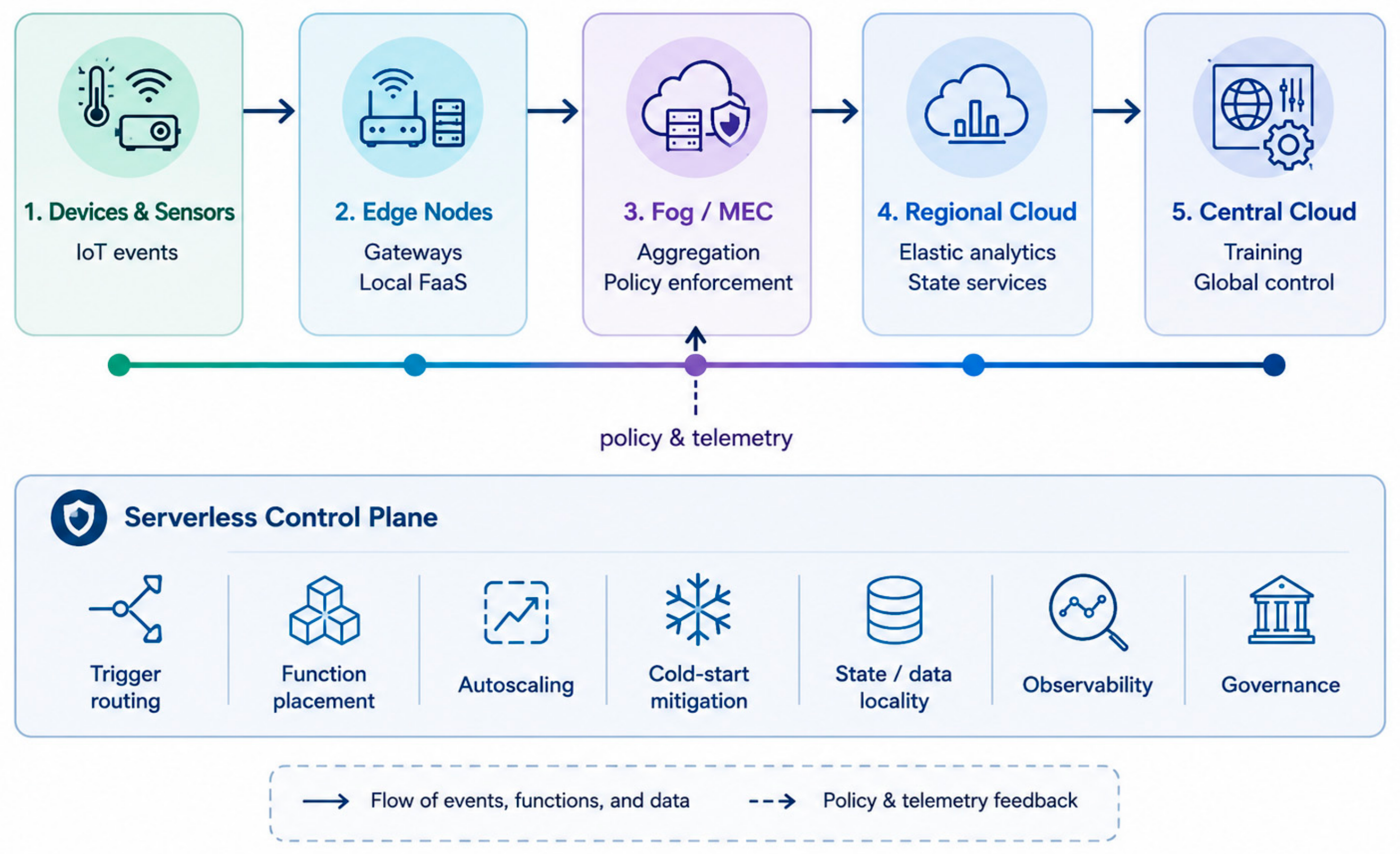
123]. The cloud–edge serverless execution continuum and interaction between distributed execution layers and the serverless control plane are shown in
Figure 4.
Table 7 highlights some of the conceptual differences between cloud–edge and cloud-only serverless computing.
4. Positioning Against the Existing Review and Survey Literature
There are a number of survey streams that are applicable to this review. While there are various cloud-native and serverless scaling mechanisms (e.g., reactive, predictive, and hybrid scaling), these mechanisms are generally considered within the context of performance control and do not fully account for edge placement, economic attacks, sustainability, and trust [
11,
18]. Function offloading surveys highlight the decision factors involved in offloading serverless functions between edge and cloud sites, but they tend to consider latency, bandwidth, energy and privacy as separate variables instead of a problem of lifecycle governance [
9].
Other survey streams cover nearby areas. The serverless-IoT reviews focus on the mapping of event-driven IoT integration and deviceless abstractions but offer less insights into the management of function lifecycles, stateful workflows, and cloud–edge governance [
1,
16]. Perspectives of cloud-to-edge continuum focus on distributed execution and application fabrics but are often agenda-setting rather than mechanism-level syntheses [
4,
121]. Security-oriented and sustainability-oriented works are important, but they are not necessarily found in the literature on scheduling and runtime [
2,
124,
125,
126].
The novelty of the present review is not only being about serverless edge computing. Its value is in combining all these flows into a cross-layer view of the serverless function as a lifecycle-managed, policy-controlled and sustainability-aware execution entity. This is especially significant as it is important to make decisions about the warmth, placement, routing, state, and choice of platform in a coordinated manner, as each decision influences the other in terms of latency, cost, energy, trust, and operational evidence.
Table 8 compares this review to other survey streams and explains the additional value of this review and
Table 9 offers a detailed comparison with selected review streams and surveys.
A dimension marking comparison alone does not fully convey why the cross-layer lifecycle governance perspective of this review is distinct from prior work;
Table 8 and
Table 9 are therefore supplemented here with a more critical reading of representative recent serverless edge surveys and a quantitative interpretation of the ratings reported in
Table 9. The systematic literature review of Batool and Kanwal [
128], for example, synthesizes serverless edge architecture, QoS metrics, and application domains into a taxonomy, yet stops at design-level classification: placement, autoscaling, state management, platform maturity, and sustainability are catalogued separately rather than connected as interacting stages of a single governed function lifecycle, so warm pool energy, cross-provider migration cost, and evaluation reproducibility remain disconnected concerns in that taxonomy. The offloading-centric survey of Ghorbian and Ghobaei-Arani [
9] models latency, energy, and privacy as independent decision variables rather than as jointly governed lifecycle stages, and the serverless-IoT reviews [
1,
16] concentrate on event-driven device integration without extending into workflow state, industrial platform readiness, or benchmark reproducibility the gaps this review addresses in
Section 9,
Section 13 and
Section 14, respectively. A quantitative reading of
Table 9 reinforces this point: across the four rated dimensions (cloud–edge focus, security, sustainability, and taxonomy), no prior review stream is rated “Strong” or “Yes” on more than two of the four simultaneously (the function offloading survey [
9] being the closest, at two of four), whereas the present review integrates all four dimensions by design and extends them with the state management, industrial platform, and reproducibility axes developed in
Section 9,
Section 13 and
Section 14. This depth-of-coverage contrast, rather than dimension marking alone, substantiates the cross-layer lifecycle governance perspective claimed in
Section 1.3.
The differences and advantages of this review relative to two closely related primary studies on digital twin deployment are summarized as follows: Yang et al. [
129] formulate a two-timescale, accuracy-aware online optimization for deploying human digital twins across an end–edge–cloud collaborative framework, jointly optimizing virtual twin construction, task offloading, and communication/computation resource allocation under energy and delay constraints; this is a mechanism-level optimization contribution for one class of stateful, twin-centric workload rather than a cross-domain review of function-lifecycle governance. Bellavista and Di Modica [
130] report a distributed and hybrid digital twin architecture for industrial manufacturing and facility management settings, addressing interoperability and hybrid cloud–edge placement of twin components in a specific industrial deployment context. Relative to both, the present review differs in scope and purpose: rather than proposing a new twin deployment algorithm or a single-domain architecture, it treats digital twin and embodied learning workloads as one instance of the broader class of stateful, latency- and trust-sensitive cloud–edge functions whose placement, warm pool, workflow, and governance requirements are analyzed systematically across the taxonomy developed in
Section 5,
Section 6,
Section 7,
Section 8,
Section 9,
Section 10,
Section 11,
Section 12,
Section 13 and
Section 14. The practical advantage of this broader treatment is that lessons from twin deployment optimization such as the two-timescale separation between slow-changing generic models and fast-changing personalized state [
129] generalize to other lifecycle governance problems addressed in this review, including workflow state locality and trust-aware placement (
Section 9 and
Section 11), rather than remaining specific to human digital twin services alone.
5. Evolution and Taxonomy of Cloud–Edge Serverless Computing
The evolution and taxonomy of cloud–edge serverless computing is examined. Viewing the evolution of serverless computing, it can be interpreted as a move from the “cloud-only function execution” to the “continuum-native, policy-aware function execution”. The initial FaaS systems focused on ease of deployment, automatic scaling, and pay-as-you-go pricing. The research further extended to scientific workflows, multi-cloud containerized serverless architectures, and data-intensive workloads, demonstrating that functions can be used for more than just web APIs [
5,
6,
122].
A second stage was added that enabled topology-aware and containerized serverless execution. When edge functions are deployed across multiple cloud regions, the concept of a serverless control plane that takes topology into account was shown to be useful, as it allowed to schedule data-intensive functions to the edge [
8,
20]. A third phase brought serverless to the Internet of Things, digital twins and application fabrics from the cloud to the edge, in which functions are activated by event-driven device data, sensor streams and cyber-physical systems [
1,
15,
16].
The fourth stage is now on AI-driven, sustainable, and trustworthy serverless orchestration. Invocation prediction and scaling is done using machine learning, offloading using deep reinforcement learning, distributed model training using serverless federated learning and sustainability-aware research using energy and carbon concerns as first-class execution concerns [
7,
14,
131,
132]. The new frontier is not serverless at the edge, it is adaptive, explainable, accountable, carbon-aware serverless execution across the continuum.
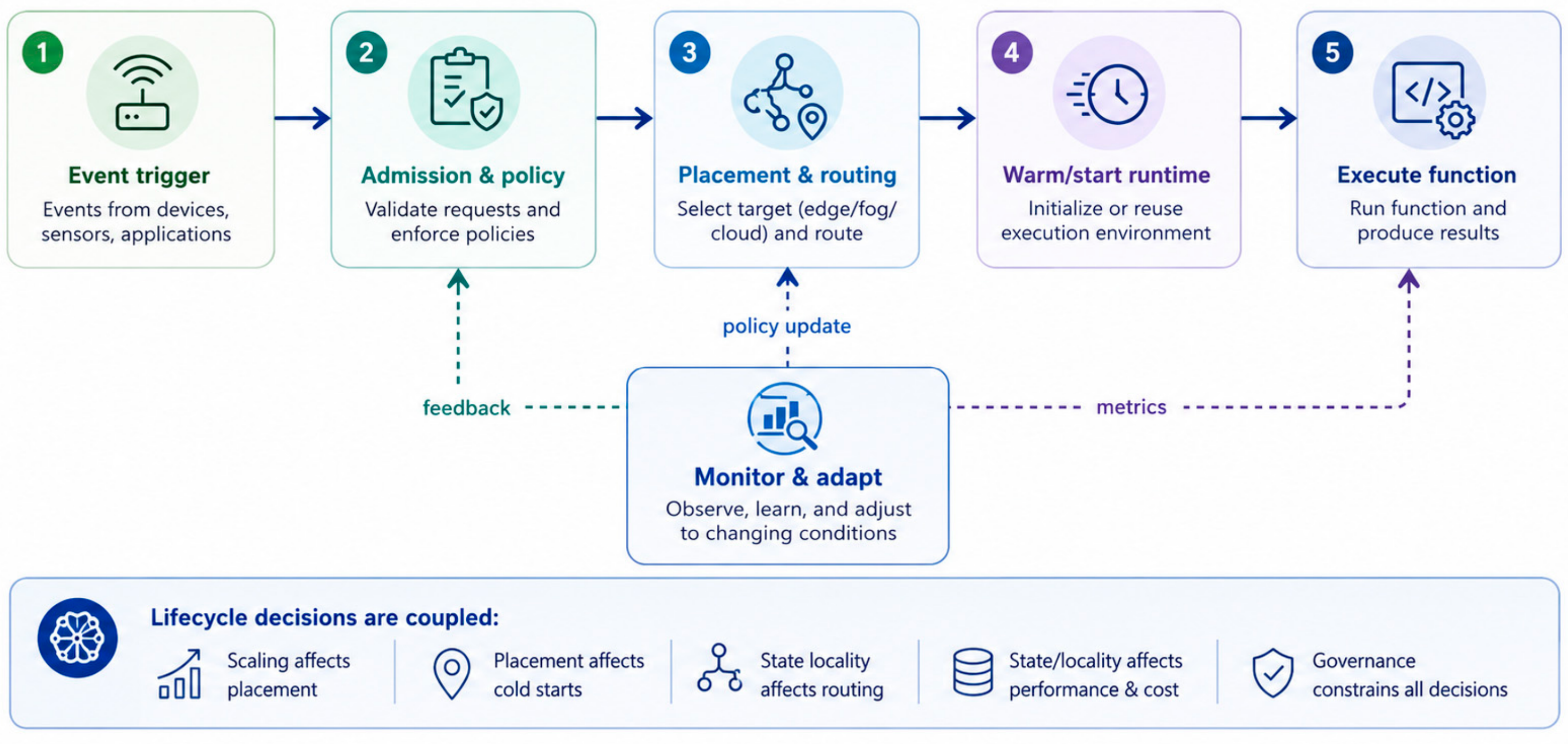
Figure 5 shows a summary of the serverless function lifecycle in cloud–edge environments, and
Figure 6 categorizes the review’s multidimensional taxonomy of mechanisms. The taxonomy of core serverless mechanisms and unresolved issues is shown in
Table 10.
6. Runtime Systems and Platform Substrates
The feasibility of serverless computing at the edge depends on runtime design. Cloud FaaS platforms depend on the ready-to-use, infrastructure that can quickly establish isolated execution contexts. This assumption is less strong in an edge setting as nodes may have less memory, slower storage, intermittent connectivity and less spare capacity. In addition to startup latency, runtime overhead also impacts placement feasibility, energy usage, and multi-tenant isolation.
Evidence-based synthesis. Overall, runtime research on the reviewed corpus shows that the edge becomes more noticeable in terms of startup overhead, isolation, image size and packaging compared to centralized clouds. The primary conflict is about the appropriate choice of substrate: Containers have advantages of maturity and portability; MicroVMs have advantages of a greater sense of isolation; WebAssembly has advantages of rapid start-up and portability but lacks mature system interfaces and observability support. The evidence is still limited when comparing apples to apples in heterogeneous edge hardware.
Despite their drawbacks, containers still represent the clear choice of substrate for open-source FaaS solutions, as they are toolchain-ready, portable, and allow for integration with Kubernetes-based orchestration. In edge environments, however, starting up the containers and distributing images can be expensive, particularly if they have large dependencies or infrequent invocation patterns. MicroVMs can enhance isolation and might decrease some attack surfaces but can add management overhead. While the adoption of WebAssembly is gaining momentum, the availability of system interface integrations, observability, and stateful applications is still in development [
20,
133].
This includes the open-source platforms Knative, OpenFaaS, Apache OpenWhisk, Fission and Nuclio, which are examples of different approaches to design trade-offs. Knative presents some advantages of the integration with Kubernetes, such as event-driven autoscaling and Kubernetes complexity. OpenWhisk offers a well-established action-oriented programming model and has been extended with topology-aware scheduling [
8]. OpenFaaS focuses on simplicity and portability, and Nuclio on performance of data and event-processing workloads. These are often deployed together with KubeEdge, message brokers, and local registries on the edge to minimize latency and increase availability.
Table 11 indicates the runtime and platform substrates used to deploy serverless applications in the cloud–edge case study.
7. Autoscaling and Cold Start Mitigation
The heart of serverless computing is its ability to automatically scale resources in response to events, a feature known as autoscaling. The typical cloud-native approaches to autoscaling policies include reactive, predictive, and hybrid policies. Reactive policies are based on the current data, like request rate, queue length, CPU utilization, memory usage, or latency. Predictive policies anticipate future needs, based on previous invocations, time series models or machine learning features. Hybrid policies are hybrid defenses that combine the speed of reactive control with the latency of prediction [
11,
18].
Evidence-based synthesis. The majority of autoscaling and cold start studies report on latency, cold start time, throughput, or resource utilization, and only a handful report on warm pool energy, carbon, cost exposure, or security implications. This leads to an evidence gap: techniques that appear to work well under P95 latency can be problematic when considering the additional factors of idle energy, carbon intensity, memory reservation and multi-tenant fairness.
In cloud–edge scenarios, autoscaling is an integral part of placement and routing. If the workload is latency sensitive and data source is very close to an edge node, creating new function instance at the cloud may not meet the request. On the other hand, if demand is mispredicted, it is a waste of limited memory and energy to create a warm instance at an edge node. For edge serverless platforms and the case of predicting invocations, hybrid autoscaling and predictive invocation models have promising results but are mostly dependent on the stability of workload patterns and may fail in the presence of adversarial traffic or bursty IoT events [
13,
131,
132].
One of the most apparent drawbacks of serverless computing is the latency for its cold start. It comes from runtime creation, container/microVM start-up, dependency loading, image pull, and user code start-up. This is more of an issue at the edge since nodes cannot keep warm instances for all functions. Cold-start mitigation strategies involve pre-warming, shared container warming, snapshotting, runtime reuse, lightweight virtual machines, WebAssembly-based execution, dependency trimming, and predictive invocation [
12,
119,
133,
134].
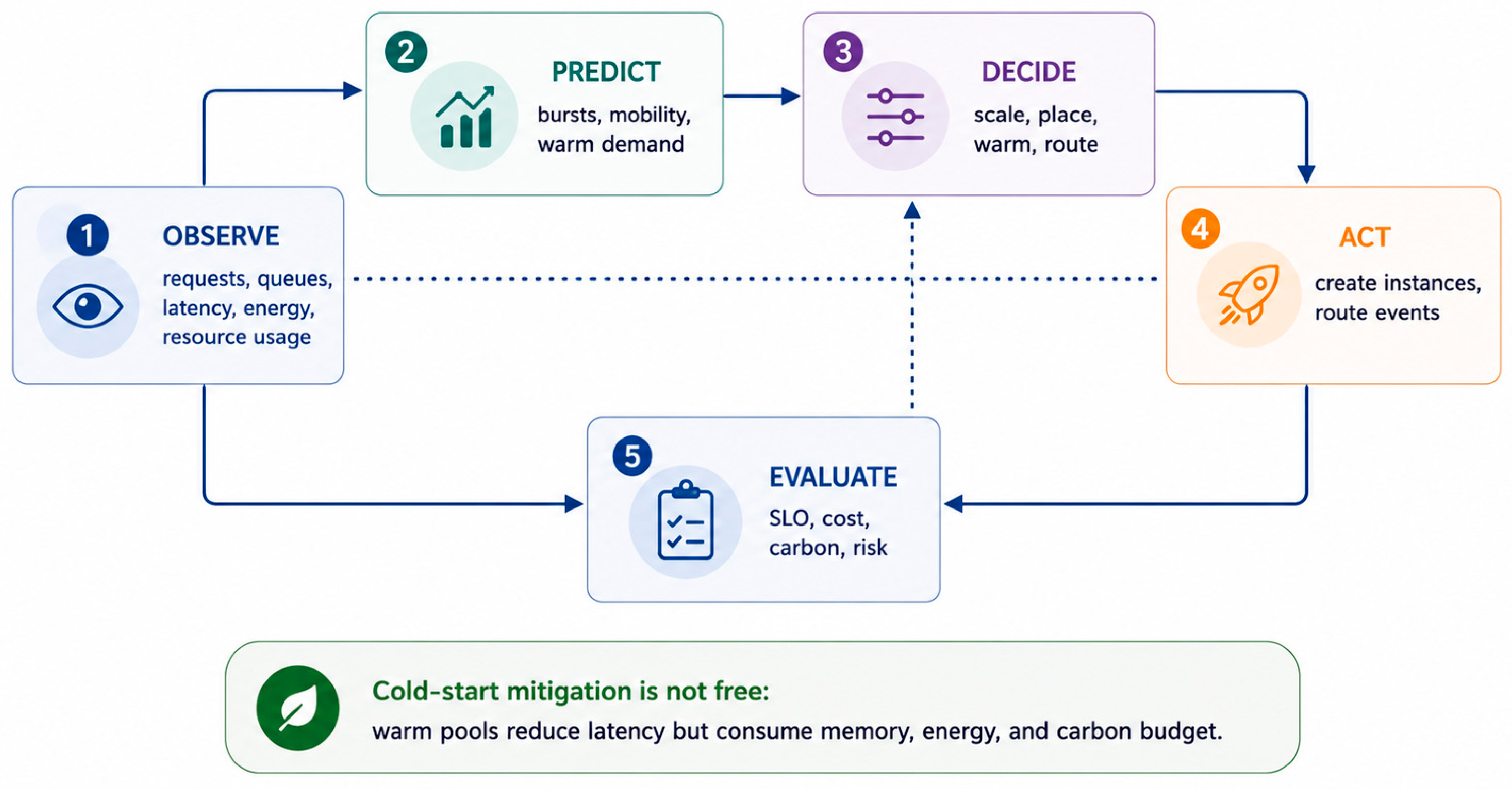
One of the main strengths and weaknesses of much of the literature is that cold start mitigation is considered a latency problem purely. In the continuum there are consequences for cost, energy, carbon, security and fairness due to warming. Running a lot of functions warm at geographically distributed edge locations will lower P95 latency but will also lead to higher idle energy and carbon exposure. Warm pool control therefore should be considered a multi-objective problem, rather than a one-dimensional optimization of response time, for a Q1-level research agenda. The autoscaling and cold start control loop that links observation, prediction, decision-making, action and evaluation is summarized in
Figure 7.
Table 12 summarizes the trade-offs and autoscaling and cold start mitigation strategies.
8. Function Placement, Offloading, and Migration
The problem of positioning functions is central to the serverless paradigm in cloud–edge scenarios. The platform needs to determine if a function should run on an edge node on the device, on a fog/MEC server, or on a regional cloud or central cloud. The selection is based on the following criteria: latency, resources, input data size, bandwidth, mobility, state affinity, privacy, trust, energy, carbon intensity, and operational cost [
3,
9,
135,
136].
Evidence-based synthesis. Placement and offloading analyses are in general consensus that latency is affected positively by edge execution only under favorable network distance, data locality, and resource availability. Many evaluations, however, are based on simulation or small-scale testbeds and lack the ability to simulate policy constraints, attestation, provider borders, and the carbon intensity. It restricts production cloud–edge deployments to be transferable.
This problem has been tackled recently by rescheduling across the cloud-to-edge continuum, by offloading and migration frameworks, by QoS-aware offloading policies and by deep reinforcement learning for function offloading [
3,
10,
14,
123]. The findings from these studies indicate that placement should not be fixed. Things like edge capacity, mobility, network quality, workload peaks and privacy limitations will evolve and change over time. Adaptive placement policies are therefore required that can route, move or spill over function executions on serverless platforms while maintaining SLOs and state consistency.
The significance of topology-aware allocation is that topologies are more critical than just compute capacity to the performance of an edge. This paper, TAPP OpenWhisk, extends the ideas of topology priorities and locality hints to serverless scheduling [
8]. For data-intensive serverless edge scheduling, it can be seen that data location, container packaging, and storage access are also limiting factors [
20]. Therefore, a practical placement system should take into account computation and data transfers as well.
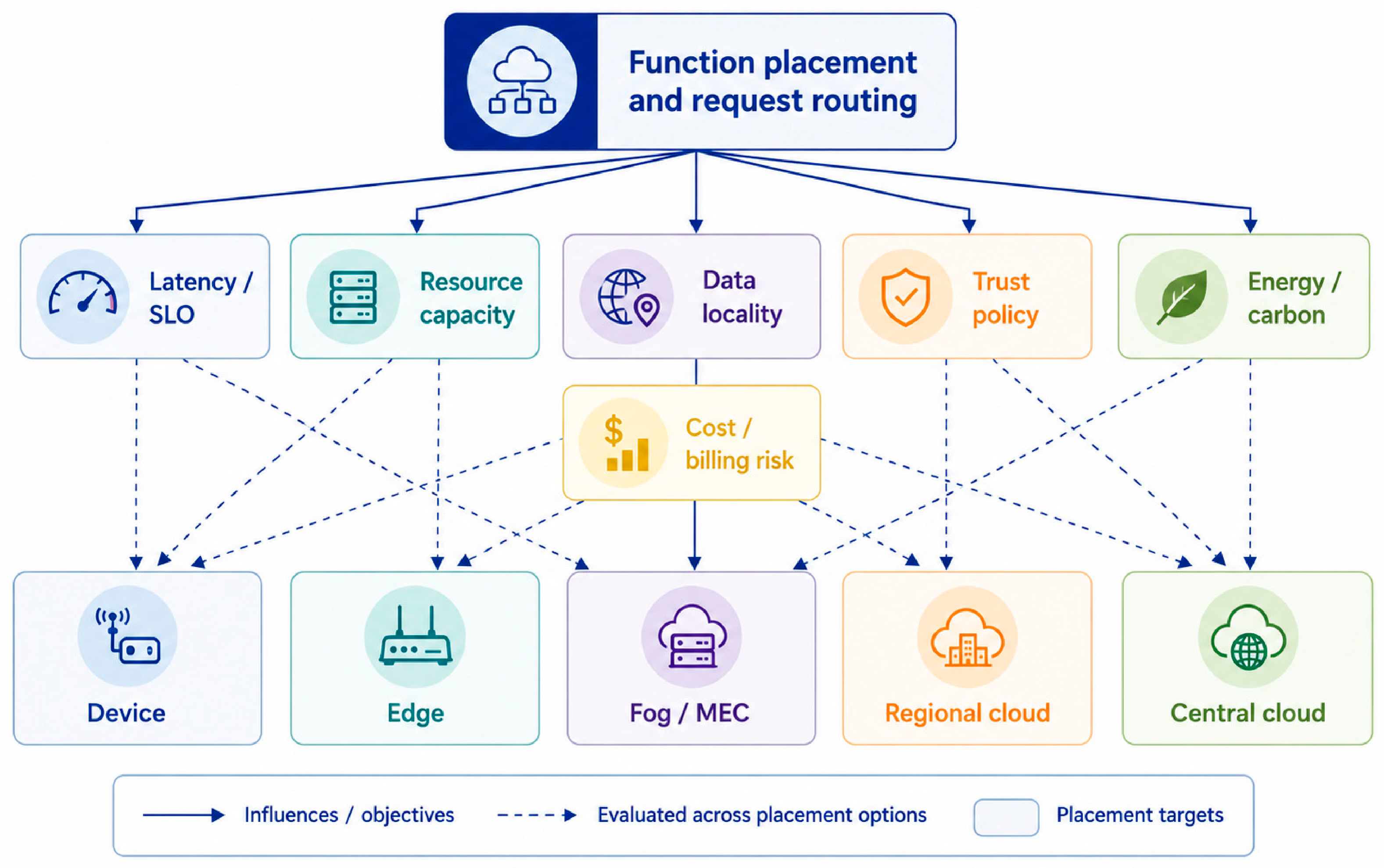
There is a problem, however, with many placement studies in that they underrepresent governance. Low latency nodes do not have to be trusted nodes, low carbon sites may not meet privacy requirements, and cost-effective paths may expose more to Denial-of-Wallet or unreliable edge infrastructure. For future placement models, hard constraints like trust, compliance and data residency, as well as soft ones like latency, cost and carbon should be integrated. The multi-objective placement model to link latency, resource capacity, data locality, trust, cost and energy/carbon objectives is shown in
Figure 8.
Table 13 shows a comparison of function placement and mobility strategies in cloud–edge environments.
9. Serverless Workflows, Data-Intensive Functions, and State Management
Cloud–edge applications increasingly require more than isolated stateless function execution. These include event chains, data pipelines, machine learning models, sensor streams, digital twin state, session state, and workflow dependencies. The classical serverless paradigm of stateless functions with short lifetimes is thus not enough for many edge applications [
5,
15,
122].
Evidence-based synthesis. While it is agreed that function chains and data pipelines play an essential role in realistic serverless systems, there is no agreement on how to handle state without conflict with elasticity. The evidence is strongest for cloud workflows and data intensive functions, weaker for stateful edge workflows in mobility, intermittent connectivity and policy bound data placement.
Scientific workflows early on showed that FaaS can perform computations with dataflows but also revealed limitations on function duration, data movement, storage coupling and orchestration overhead [
5]. In the case of Big Data, serverless reference architectures further the conversation with a focus on storage function co-design and stateful operators [
122]. The disadvantage of function fusion techniques is that it can decrease modularity, independent scaling and fault isolation [
137].
On the edge, moving state to the cloud can easily consume the majority of execution time and/or violate data locality or privacy requirements. An edge serverless platform should differentiate among the types of state: ephemeral, durable, cached, model, session, and policy-bound. It should also be state local and consistent, be able to replicate, migrate, and fail safe. If it is not explicitly mandated by the state, the developer can create custom extensions of external storage patterns that violate the simplicity of serverless and raise latency.
Data-Intensive Serverless Edge Computing sums up the idea that moving the computation to the data is often cheaper than moving the data to the computation. This is especially true for video analytics, remote sensing, industrial sensors and digital twins. It, however, involves schedulers to consider the location of data, network bandwidth, sensitivity of data, and dependencies between functions, as opposed to processing function calls as individual requests [
20,
138].
Table 14 outlines workflow, data and state management patterns for serverless applications deployed in the cloud/edge environment.
10. AI, Federated Learning, and Intelligent Orchestration
AI comes in two complementary ways to cloud–edge serverless computing: as a workload, and as a control mechanism. Serverless functions are a workload that can enable inference pipelines, federated learning coordination, drift detection, data preprocessing and digital twin analytics. AI is used for control as an aid in invocation prediction, autoscaling, placement, offloading, anomaly detection, and adaptive scheduling [
7,
14,
15,
131].
Evidence-based synthesis. Invocation prediction, scaling, offloading, and FL coordination are exciting opportunities for AI-based orchestration, but the evidence is mixed. While the interpretation of predictive ML studies is easier, the placement using DRL can be more complex but more difficult to reproduce, tune, explain and validate in real testbeds.
A point of convergence is the serverless federated learning. FL workflow is a cyclical process of client selection, distribution of models, local training, aggregation and evaluation. Platforms that are serverless can help to coordinate these steps elastically between edge resources and cloud resources to ease the burden of managing the infrastructure. EneA-FL illustrates an energy efficient orchestration that allows for balancing learning quality with energy use, and PopFL and IoT-oriented serverless FL illustrate a scalable participant coordination in dynamic edge environments [
7,
17,
139].
AI-controlled techniques are also becoming known. Predictive models can predict invocations and minimize cold starts, feature-engineered scaling methods can optimize resource allocation under dynamic network and resources conditions [
14,
131,
132]. AI controllers, however, present new research challenges such as reward design, explainability, training cost and robustness, adversarial behavior, and the transfer gap between simulation and real testbeds.
The main problem is that intelligent orchestration should not evolve into a black box control plane. For sensitive cloud/edge environments, operators want to understand why a function was deployed on a node, why they have a warm pool, why a request was sent to the cloud, and how the carbon, cost, and security constraints were taken into consideration. Explainable AI and auditable decision logs are then crucial for the industrial deployment.
Table 15 compares AI and optimization techniques for the cloud–edge serverless orchestration.
11. Security, Privacy, Economic Risk, and Trust
The serverless computing model impacts security because it is fine-grained, event-driven, short-lived, and platform-managed. The attack surface is increased when there are cloud–edge environments in which functions could run on a variety of different nodes from multiple different providers, organizations, or operators. Security issues encompass trigger abuse, event injection, dependency vulnerability, leakage of secrets, escape of containers or microVMs, side-channel leakage, insecure routing, weak provenance, compromised edge nodes, and billing abuse [
2,
125].
Evidence-based synthesis. Security studies have revealed four key concerns: DoW, side channels, provenance, dependency risk, and untrusted edge nodes; and these are not typically expressed as strict requirements for autoscaling or placement algorithms. The literature thus also suggests the use of trust-aware scheduling, in which the execution of the task is not allowed if there are requirements for auditability and/or attestation and/or data residency.
Denial-of-Wallet is a serverless risk that is very unique. Since serverless systems are billed by usage, attackers can generate long running jobs, a high number of invocations or memory intensive jobs that can lead to unnecessarily high bills. In IoT and cloud–edge environments, the risk is exacerbated when physical-world events, sensor storms or compromised devices, or distributed triggers amplify billing exposure. Public datasets for the detection of DoW is helpful as it improves the reproducibility and allows for comparison of different detection methods [
125,
140].
Workflow security and provenance are also critical. Secure-by-design serverless workflows provide an example of how policy and provenance can be incorporated into edge–cloud execution paths [
2]. This is important because a function chain may cross multiple sites and administrative domains. With weak provenance, operators have no means to prove that data was processed on a given node, on which policy, or if a function was applied on an attested node, or not. Research on the trustworthy edge–cloud continuum also suggests that the trustworthiness of the infrastructure should not be taken for granted and rather be evaluated dynamically [
127].
Privacy and data locality go hand-in-hand with placement. A function should not be run on a node just because that node’s latency is low, but because the function has to meet data residency, privacy, consent and attestation requirements. This changes how security is handled from “post-deployment control” to “scheduling constraint”. Future systems should be capable of rejecting placements that fail to meet policy, select nodes with good evidence, and log auditable decisions.
Table 16 provides a summary of security, private, and trust issues in cloud–edge serverless systems.
12. Sustainability, Energy, Carbon, and Cost-Aware Execution
The growing importance of sustainability in cloud-native and serverless computing. While serverless execution may be more efficient by only provisioning resources when they are used, it can also be a hidden sustainability cost. Even though individual functions may seem efficient, multiple factors can contribute to higher energy usage, such as warm pools, repeated image distribution, inefficient data transfer, redundant edge replicas, and lack of coordination in scaling operations [
124,
126].
Evidence-based synthesis. Energy and sustainability studies reveal that pay-per-use elasticity is not enough for serverless efficiency. Lowest latency placement does not necessarily have the lowest carbon placement, and the aggressive pre-warming may decrease cold starts with an increase of energy used in idle modes. With this in mind, full-path accounting in runtime, network, storage, and warm pools is required for carbon-aware edge FaaS.
The study of energy-aware serverless brings to light the importance of considering energy consumption from the outset of application design, its measurement, and its control at runtime, rather than as a secondary consideration [
126]. Furthermore, serverless federated learning illustrates how orchestration can optimize accuracy, latency and energy consumption in edge applications [
7]. But energy-aware scheduling is not equal to carbon-aware scheduling. Carbon relies on the intensity of the local grid, the time of day electricity mix, availability of renewables, cooling overhead, and embodied infrastructure.
Cross-layer carbon accounting is thus necessary for cloud–edge serverless computing. The following factors should be taken into account when making a placement decision: device energy, network transfer, edge execution, fog/MEC execution, regional/cloud execution, storage, image distribution, and warm pool energy. A function deployed at the edge can help lower the energy consumption and latency in the network but can be more carbon-intensive or need more warm instances when the edge site is carbon-intensive or has many warm instances.
There is a strong connection between cost and sustainability. Considerations for deployment include pay-per-use billing, egress charges, storage operations, image distribution, and warm pool reservations. Placement should be done with cost in mind, but not just for billing; it should also take SLOs, data locality, security and carbon into account. A future serverless platform should provide green service-level goals that include P95 latency, cold start probability, energy per invocation, gCO2e per invocation and cost per workflow. In
Table 17, we provide a list of metrics for assessing the sustainability and cost of serverless cloud–edge systems.
13. Industrial Serverless Platforms and Open-Source Ecosystem
The real-world limits of cloud–edge serverless computing are defined by the industrial serverless platforms. Managed event-driven execution is available at various spots across the network through public cloud platforms like AWS Lambda, Lambda@Edge, Azure Functions, Google Cloud Functions, and Cloudflare Workers. For private clouds, hybrid deployments and research prototypes, there are open-source platforms like Knative, OpenFaaS, Apache OpenWhisk, Fission, and Nuclio that offer more control. But, industrial and open-source systems have significant differences in the aspects of portability, observability, behavior during cold start, platform lock-in, edge support, workflow integration, and governance.
Managed cloud platforms make deployment easy and offer out of the box integration with storage, identity, event buses, monitoring and billing. The downside to them is that sometimes they do not offer fine-grained control over placement, runtime internals, and warm pool energy and migration across providers. Open-source may be more flexible and extensible for research but will need an operator and may not be as developed in areas like security, autoscaling, and observability. This leaves a gap between algorithm use in the classroom and platforms in the field.
Improved algorithms are not enough for industrial applicability. Platforms need to make placement evidence, function provenance, carbon and energy metrics, state locality controls, reproducible benchmarking tools, and policy-portable configuration available. If these attributes are missing, organizations cannot be assured that their serverless workloads can be deployed into regulated, latency sensitive, or sustainability sensitive cloud–edge environments. Industrial and open-source serverless platform categories are compared in
Table 18.
The comparison in
Table 18 catalogues platform categories and their structural strengths and limitations but does not quantify real multi-operator, cross-cloud–edge deployment behavior. Because vendors rarely disclose per-invocation operational telemetry, the most reliable real operational indicators currently available come from independent measurement studies rather than from platform documentation, and the most relevant of these are summarized here. Using published AWS and Azure region data (provider-declared PUE/WUE figures, land occupancy disclosures, and the public 2019 Azure Functions workload trace), Attenni et al. [
120] show that cross-region migration of FaaS workloads carries a measurable but bounded footprint overhead: in their AWS-based scenario, data-transfer-related migration accounted for roughly 0.85–12.67% of the total carbon footprint of a scheduling decision (with corresponding overheads of 0.89–5.47% for water and 1.01–7.68% for land use, depending on the scheduling policy and optimization target), while spatial shifting of workloads across regions still achieved 20–85% reductions in the optimized footprint metric relative to a local execution baseline. This confirms that cross-domain migration overhead is real and non-negligible, while also showing that, for FaaS workloads specifically, it is typically small relative to the achievable sustainability gains—a finding that published FaaS platform documentation does not report and that the qualitative comparison in
Table 18 alone could not convey. Complementary carbon and energy accounting studies for commercial and open-source FaaS platforms [
124,
126] similarly point to the absence of vendor-reported per-invocation carbon and migration telemetry as a structural limitation of today’s industrial platforms, reinforcing the platform-provenance and carbon metric gaps identified in
Table 18 and revisited as a future research priority in
Section 17.
14. Evaluation, Benchmarks, and Reproducibility
Today, the evaluation process in cloud–edge serverless computing is still heterogeneous. Different traces, different workloads, different simulators, different metrics, different hardware profiles, different network models and different edge assumptions are used in the studies. This is because there is a lot of heterogeneity in this data, which makes direct comparison hard. What works in simulation might not work on the real edge nodes with limited memory, slow image pulling, intermittent connectivity, and different runtime behaviors.
Evidence-based synthesis. The most significant methodological weakness is reproducibility. The studies reviewed differ in the traces, simulators, hardware profiles, function images and metrics used, making it difficult to make direct comparisons. Progress at Q1 level will require shared workloads and other artifacts, availability of open-source controllers, and standardized reporting of latency, energy, cost, cold starts and violations of SLOs.
Typical metrics are mean latency, P95/P99 latency, cold start time, throughput, resource utilization, bandwidth consumption, migration overhead, energy consumption, cost, and SLO violations. But less information is reported in regard to reproducibility artifacts like source code, workload traces, container images, dataset links or complete configuration. Lack of common standards decreases the field’s progress over time.
A better evaluation culture would feature microbenchmarks, as well as end-to-end application benchmarks. Microbenchmarks are required to separate the runtime start-up, image pulling, request routing, scheduling latency, and warm pool overhead. DoW attack scenarios, federated learning, scientific workflows, and video analytics require end-to-end benchmarks for IoT streams and digital twins. Benchmarks should also include the failure rate, tail latency, energy, carbon, and cost.
Reproducible cloud–edge serverless benchmarking is especially difficult due to the physical distribution and dynamism of edge environments. However, the field can enhance by sharing workloads, testbed descriptions, simulator configurations, container images and traces. Standardized profiles for small edge, medium fog/MEC, regional cloud, and central cloud resources would facilitate a more level playing field for the comparison of placement, scaling and workflow algorithms.
Table 19 provides a summary of the dimensions that are recommended for future studies on cloud–edge serverless.
Table 19 specifies what future studies should report, but this alone does not yet constitute a unified benchmark library that could be adopted directly. To make the recommendation actionable, it is noted that several open artifacts already cover parts of the dimensions in
Table 19 and could, in combination, form the basis of such a library rather than requiring one to be built from scratch. For open workload traces, the Azure Functions trace released by Shahrad et al. [
141] provides two consecutive weeks of per-minute invocation counts and execution time percentiles from a production FaaS deployment and is already the most widely reused trace for cold start and autoscaling studies. For representative function workloads and deployment/evaluation infrastructure, FunctionBench [
142] and the Serverless Benchmark Suite (SeBS) [
143] provide, respectively, a set of CPU-, memory-, and I/O-bound micro-applications and a systematically specified, multi-cloud benchmark suite with accompanying deployment scripts and an evaluation methodology designed explicitly for reproducibility and cross-study interpretability. For edge hardware test templates specifically, EdgeFaaSBench [
144] characterizes 14 serverless workloads across heterogeneous edge devices (Raspberry Pi 4B, Jetson Nano), reporting cold/warm start times, resource utilization, and concurrency effects that are otherwise missing from cloud-centric suites. None of these artifacts alone spans every dimension listed in
Table 19; for example, none report the security/economics or data/state dimensions in a standardized way, and this fragmentation is itself evidence of a persisting gap.
Table 19 is therefore better read as a gap analysis against this existing artifact base rather than a specification written from a blank state: refs. [
141,
142,
143,
144] already give the field open traces, representative workloads, and edge hardware templates, so the remaining, still-missing piece is a standardized reproducible evaluation specification for the security/economics and data/state dimensions—stated here explicitly as a concrete call to action for the community.
This review is a critical synthesis rather than a primary empirical study, and it therefore does not itself generate new benchmark data; nonetheless, concrete, quantitative results already published in the primary literature are incorporated at three points that were previously described only qualitatively. First, at the mechanism level, application-level cold start optimization has been shown to reduce code loading latency by up to 78.95% (28.78% on average) and total end-to-end response latency by up to 42.05% (19.21% on average) across real-world FaaS applications on AWS Lambda and Google Cloud Functions [
145], giving
Section 7’s discussion of cold start mitigation a concrete performance magnitude rather than a qualitative claim alone. Second, at the platform level, a month-long analysis of 85 billion production requests and 11.9 million cold starts from a commercial serverless cloud platform found that cold start duration and its dominant component vary substantially by region: up to 7 s and dependency deployment/scheduling-dominated in one region, versus up to 3 s and pod allocation-dominated in another [
146], evidence that directly substantiates, with real production-scale numbers, the platform heterogeneity argument made qualitatively in
Section 13. Third, at the sustainability level, the carbon and migration overhead figures already reported in
Section 13 (20–85% carbon footprint reduction from spatial shifting, against a 0.85–12.67% migration overhead [
120]) themselves constitute exactly this kind of mechanism-level, quantitative comparison. No new benchmark study is introduced here; rather, each of the three data points above is drawn from, and cited to, a primary study that measured it, consistent with the role of a critical review—as distinct from an experimental paper—in substantiating analytical claims with quantitative evidence.
15. Integrated Conceptual Framework and Design Principles
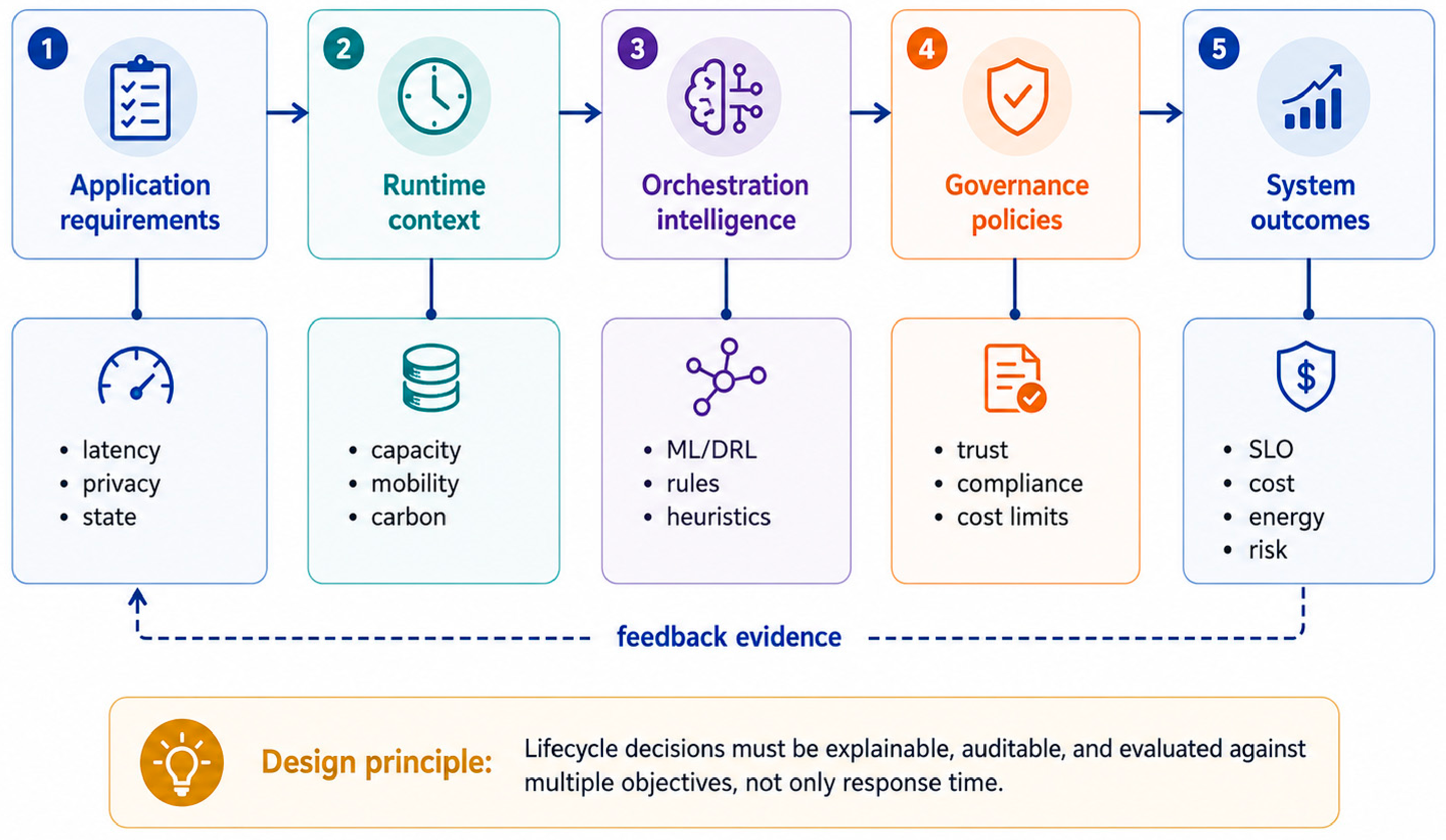
The reviewed literature suggests that the cloud–edge serverless computing should be considered as a problem of lifecycle governance. Application requirements are what the system needs to do, runtime context specifies possible execution sites, orchestration intelligence specifies placement, warming, scaling, routing, migrating and composing of functions, governance policies constrain execution through security, privacy, provenance, cost, and compliance, and the system outcomes feed back for adaptation.
This integrated framework is summarized in
Figure 9. It is not intended to be a specific platform architecture. Rather, it is a conceptual model to explain the interaction of decisions regarding function lifecycles. The overall message is that placement, scaling, warming, routing, migration, fusion, and state handling should not be implemented as stand-alone “modules”. The feasibility and implications of each decision will alter the others.
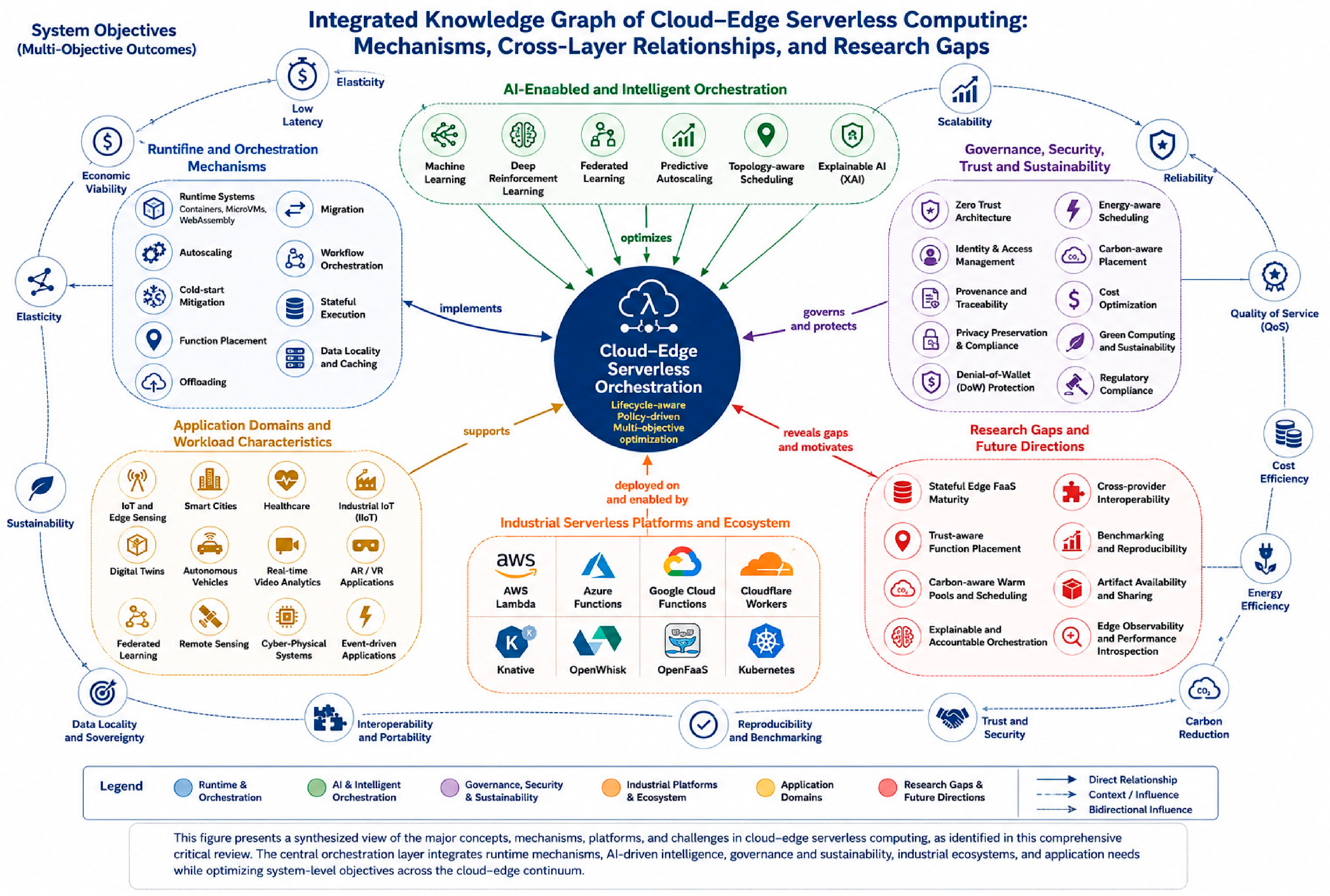
From the review six design principles emerge. The first is requirement-driven: the latency, data locality, privacy, cost and energy requirements should be explicitly specified. Second, autoscaling needs to be context-sensitive; demand surges, mobility, network quality, edge capacity and carbon intensity should influence warm-up and routing decisions. Third, state be regarded as a first class continuum resource. Fourth, sensitive workloads should not be allowed to be scheduled without trust. Fifth, sustainability should be assessed throughout the implementation process, from warm pools, storage, to image distribution and network transfer. Sixth, orchestration should be explainable, auditable and strong with the assistance of AI. These relationships are further synthesized as an integrated knowledge graph in
Figure 10.
Table 20 maps the integrated framework to design principles for next-generation platforms.
16. Lessons Learned from the Critical Review
The cross-layer synthesis provides a number of lessons which are relevant to the research and practice communities. These lessons bring together the landscape description, taxonomy, platform comparison, and the discussion of the benchmarking into practical design insights. A critical review was conducted and the main lessons learned are summarized in
Table 21.
This synthesis is organized explicitly around the seven guiding review questions introduced in
Section 1.2, so that the connection between the research questions and the review’s findings is stated rather than left implicit. Table 25 maps each RQ to the section(s) in which it is primarily addressed, summarizes the corresponding synthesized finding, and states the main gap that motivates the future research agenda in
Section 17.
17. Research Challenges and Future Directions
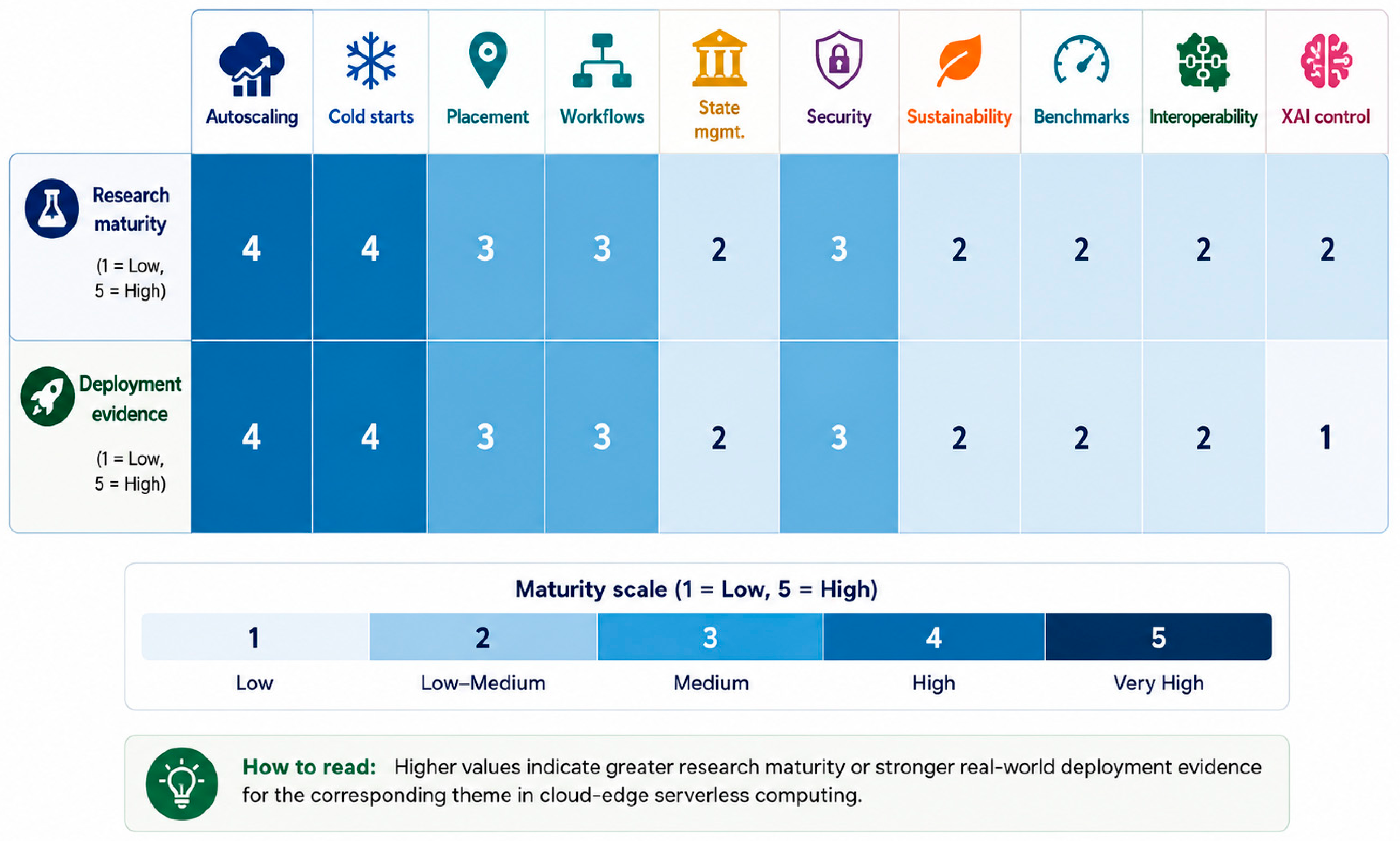
Cloud–edge serverless research is not even at the same level of maturity. The evidence base for autoscaling, cold start mitigation, and latency-aware placement is relatively well developed. Less mature: workflow state management, trust-aware placement, carbon-aware orchestration, interoperability, explainable AI control. A summary of this maturity pattern and where most further research is required is given in
Figure 11.
There are still many issues with carbon-aware function lifecycle management. Future research should develop schedulers to simultaneously optimize latency, cold start probability, data locality, privacy, energy and carbon. Carbon-aware warming is particularly significant due to the fact that warm pools are not detected in a lot of efficiency analyses, but they can be substantial at distributed edge sites during idle periods.
The second is that stateful serverless edge computing needs more powerful abstractions. In the real world, you need sessions, cached models, workflow context and policy-bound data. Going forward, support for state locality, state migration, consistency levels and failure recovery should be achieved while minimizing the need for the developer to implement ad hoc external storage designs.
Thirdly, the orchestration should be made trustworthy as a part of the function lifecycle. Placement and routing should be affected by the security, provenance, identity, attestation, and Denial-of-Wallet protection of the parts. If a node is not trustworthy, then it shall not be able to execute sensitive functions, even if such a node has a low latency.
Fourth, interoperability and portability are yet to be resolved. Serverless functions may rely on event formats, identity systems, observability tools, state services and triggers that are specific to the provider. Research should build portable function descriptors, policy languages and workflow models that are able to reach across cloud, edge and multiple providers.
Fifth, for operational trust, there must be explainable AI-driven orchestration. Opaque controllers are hard to certify, debug, and control, while placement and scaling could be enhanced with the use of AI and DRL controllers. The desired features in future systems are to integrate learning-based optimization, interpretable constraints, audit logs, and human-in-the-loop control.
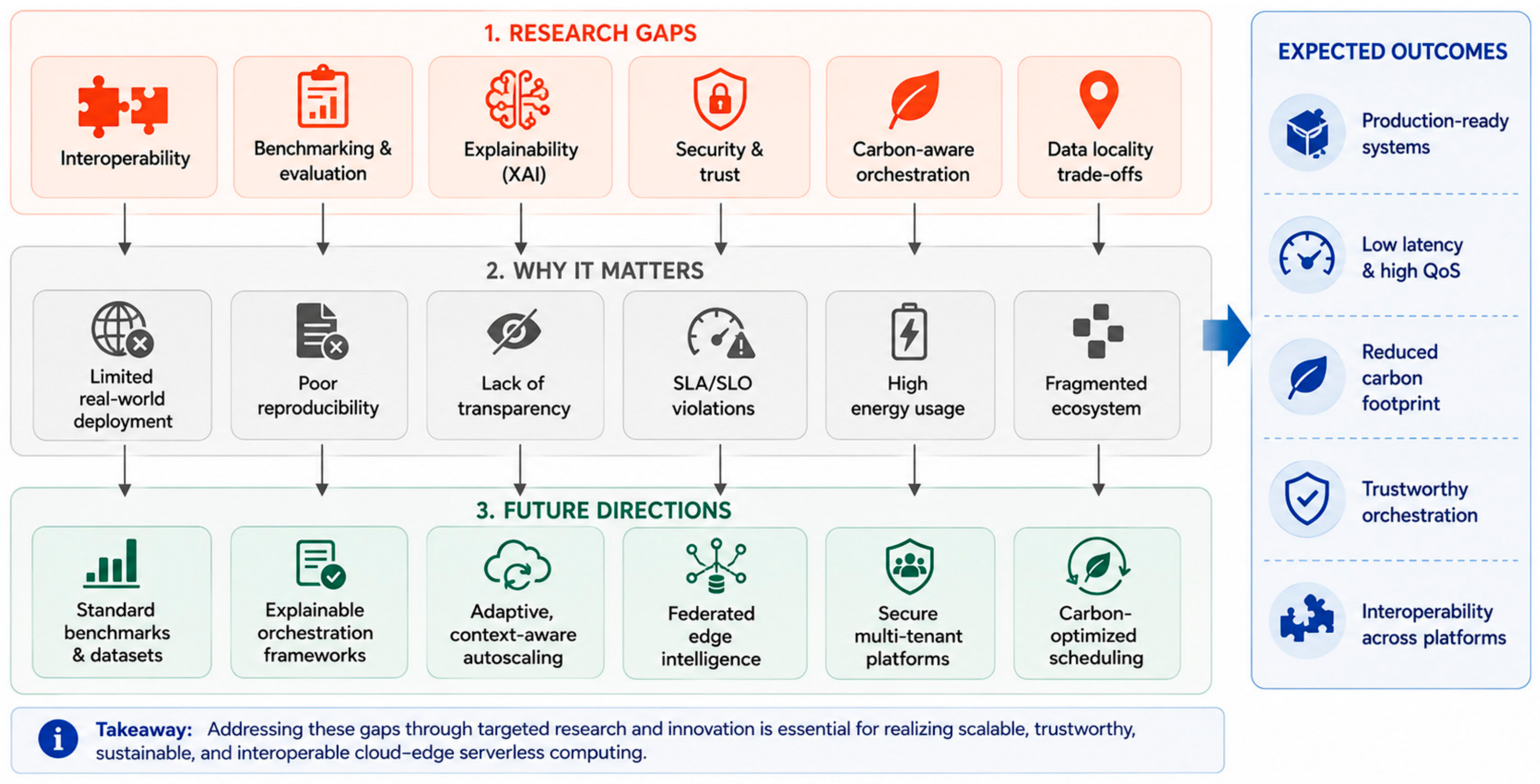
Table 22 shows the future research agenda with research questions and evaluation measures. As shown in
Figure 12 synthesizes the most important research gaps, their practical consequences, the corresponding future directions, and the expected outcomes for next-generation cloud–edge serverless systems.
The future research agenda in
Table 22 concentrates on cloud–edge-native optimization directions because that is where most primary studies reviewed in
Section 5,
Section 6,
Section 7,
Section 8,
Section 9,
Section 10,
Section 11,
Section 12,
Section 13 and
Section 14 are located; cross-domain fusion scenarios, however, deserve explicit treatment rather than remaining implicit, and a corresponding row, “Cross-domain fusion serverless,” has been added to
Table 22 and is discussed here. Space–air–ground integrated edge computing extends the placement and trust problems addressed in
Section 8 and
Section 11 to a substantially more heterogeneous and intermittently connected substrate: recent work on digital twin-assisted space–air–ground integrated multi-access edge computing for the low-altitude economy [
147] shows that jointly optimizing digital twin construction and task offloading across satellite, aerial, and ground tiers requires online, decentralized optimization, because the centralized placement decisions surveyed in
Section 8 do not scale across such widely varying link budgets and mobility patterns. Industrial digital twins, discussed above in
Section 4 [
129,
130], extend the state management problem of
Section 9 into long-lived, continuously synchronized virtual–physical state rather than the comparatively short-lived function invocation state around which this review’s taxonomy was originally built, suggesting that the taxonomy would benefit from an explicit “twin state” category alongside the workflow state category already present in
Section 9. Vehicular networking serverless computing, illustrated by Alam et al.’s proposal for serverless vehicular edge computing for the Internet of Vehicles [
148] applies FaaS execution to roadside unit and connected vehicle infrastructure under hard real-time and mobility constraints that go beyond the cold start and placement literature synthesized in
Section 6,
Section 7 and
Section 8, since function-placement decisions must additionally account for predictable vehicle trajectories and V2X communication reliability. Together, these three strands indicate that the lifecycle governance taxonomy developed in this review is extensible to emerging distributed-computing environments beyond cloud–edge serverless proper, and the new row in
Table 22 gives this direction concrete, measurable research questions consistent with the reproducibility agenda of
Section 14.
18. Practical and Industrial Implications
The review indicates a requirement for richer control surfaces to be exposed on serverless platforms for cloud providers and edge-platform operators. The basic invocation logs and scaling knobs are not sufficient for cloud–edge deployment. Operators require placement evidence, cold start diagnostics, state locality controls, carbon and energy metrics, cost risk dashboards and provenance logs. These capabilities are extremely critical in regulated sectors where auditability and accountability are important.
The serverless edge architecture needs function classification for application architects. Any function whose latency is critical should be located close to the users and/or the data source. Data-sensitive functions should be placed close to the protected data. Regional or central clouds might be better options for compute-intensive functions. Fusion may be useful for functions that have strong dependencies; separation may be useful for fault-sensitive functions. A function profile should thus consist of the following parameters: latency tolerance, input size, state requirement, privacy requirements, energy sensitivity, permissible execution sites.
Cloud–edge serverless execution presents questions of governance for policymakers and standardization bodies. Functions can easily and almost undetected span administrative lines. Provenance, edge attestation, policy portability, billing transparency, carbon accounting and audit evidence are all areas where standards are required. If there is no such standard, then there is a possibility that serverless systems will be hard to certify in applications related to healthcare, industrial automation, smart grid, autonomous systems, and public sector services.
19. Threats to Validity and Review Limitations
This review is not a protocol-driven systematic literature review but is a critical literature review that is a comprehensive assessment of the literature. The advantage of this is its conceptual integration across a variety of research communities, but it has the disadvantage of not having exhaustive statistical coverage of every publication. The review documents sources of search, representatives of search, priorities for inclusion, boundaries for exclusion and analytical lenses to overcome this limitation.
A second danger is that of using ambiguous terms. There is inconsistent use of terms like serverless, FaaS, cloud–edge, edge cloud, fog, MEC, cloud continuum, and distributed serverless in the literature. Some papers refer to serverless in the context of managed cloud services, others in the context of open-source FaaS, deployed on Kubernetes or edge nodes. This review aims to solve this problem by concentrating on the function lifecycle instead of only on the terms.
The third threat is related to evidence heterogeneity. The platform, workload, data, testbed, simulator, metrics, and deployment assumptions vary across the reviewed studies. This heterogeneity makes direct quantitative comparison difficult and a meta-analysis inappropriate. The paper thus focuses on taxonomy, on pointing to mechanism-level comparison and critical interpretation, and not on the pooling of statistical effects.
A fourth danger is related to technology obsolescence. The evolution of the serverless platforms, edge frameworks, runtime, and cloud services are fast changing. The information on platform capabilities might not be accurate because new features may be added by the platform providers. The review does not just look at the features of the platform today, but at some of the longstanding tensions found in the design, placement, cold start, state, trust, sustainability and interoperability.
A fifth danger relates to evidence of industries. The documentation on the platform and vendor claims are not independently verified. Only peer-reviewed research is used to provide the basis for technical synthesis, and industrial materials are used to discuss realities of deployment and platform capabilities.
Table 23: Threats to validity and mitigation measures in the review.
Table 24 illustrates the PRISMA-style literature screening flow and
Table 25 shows synthesis of review findings.
20. Conclusions
Cloud–edge environments are a new paradigm for distributed computing, and serverless functions play a major role in this new paradigm. While this model shares the advantages of event-driven, elastic, and developer-abstracted clouds, it also poses challenging lifecycle decisions on runtime selection, autoscaling, cold start mitigation, placement, offloading, migration, workflow composition, state management, security, trust, cost, energy, and carbon.
This review has demonstrated that mechanisms need to be examined together in the field. Cold starts and energy use are affected by autoscaling; latency, trust and data locality are affected by placement; state and fault isolation are affected by workflow composition; explainability and reproducibility are affected by AI-assisted control; and sustainability relies not on a single function invocation, but on the entirety of the execution path. Cloud–edge serverless computing is thus a multi-objective orchestration and governance problem and the proposed taxonomy and integrated framework places it in that context.
The future of serverless platforms need to be adaptive, trustworthy, interoperable and sustainability conscious. They will need to deliver elastic function execution with the exposure of evidence regarding function run sites, rationale for placement decisions, how state was managed, security policies, cost and carbon impact. Progress in the future will rely on the ability to have reproducible benchmarks, carbon-aware control of lifecycle, stateful abstraction of edge functions, trust-aware placement, cross-provider portability and explainable AI-driven orchestration. This paper brings all these challenges together into the same critical review to serve as a starting point for researchers and practitioners who are designing serverless systems on the cloud–edge continuum.
The actionable takeaways of this review are made explicit here and differentiated by audience, rather than restating the taxonomy above. For platform designers and engineers, three concrete engineering priorities emerge from the evidence synthesized in
Section 6,
Section 7,
Section 8,
Section 9,
Section 10,
Section 11,
Section 12,
Section 13 and
Section 14: (1) expose placement and warm pool decisions as inspectable evidence (run-site, rationale, energy/carbon cost) rather than opaque scheduler internals, since
Section 13 shows that today’s commercial and open-source platforms alike withhold exactly this telemetry; (2) budget explicitly for cross-region migration overhead when implementing spatial carbon-aware scheduling, since the measured overhead is bounded (≈8–13% of the optimized footprint metric in the worst case reported in
Section 13) but not zero, so migration-aware admission control is preferable to unconditional shifting; and (3) adopt or contribute to the open benchmark artifacts identified in
Section 14 (the Azure Functions trace, SeBS, FunctionBench, EdgeFaaSBench) as a default evaluation baseline rather than building bespoke, non-reusable test harnesses for every new placement or autoscaling proposal. For researchers, the synthesis points to two specific, underexplored problems rather than a generic call for “more work”: first, no reviewed study jointly reports cold-start probability, placement locality, and carbon intensity for the same workload under the same scheduler, which is the precise multi-objective evaluation gap identified in
Section 12 and
Section 17 and the reason
Table 22 specifies joint evaluation metrics rather than single-objective ones; second, the state management literature (
Section 9) and the digital twin and vehicular serverless literature (
Section 17) each treat long-lived state differently (workflow context, twin synchronization state, and vehicle trajectory state, respectively), and reconciling these into one portable state locality abstraction is, on the evidence reviewed here, still an open architectural problem rather than an implementation detail. These takeaways are intended to be falsifiable and specific enough to guide a follow-up empirical study or a platform roadmap, rather than a restatement of the taxonomy presented earlier in this review.




 ,
,