1. Introduction
Automatic human posture recognition is an important computer vision capability for intelligent monitoring, rehabilitation, assistive technologies, sports analysis, and human–machine interaction [
1]. The ability to distinguish fundamental body configurations such as standing, sitting, lying, and bending can provide useful contextual information for systems that observe or respond to human physical states. In practical applications, however, posture recognition systems must achieve reliable classification while remaining suitable for repeated or continuous use under variations in body configuration and image quality.
A fundamental consideration in vision-based posture recognition is the representation of the human body. Conventional RGB images contain not only posture-related information but also clothing, texture, illumination, facial or appearance information, and background context. Some of these visual cues may assist classification, but they can also introduce nuisance variation and expose information that is unnecessary for recognizing body configuration. Silhouette representation provides an alternative in which the body contour and overall geometric structure are retained while much of the appearance and scene information is suppressed [
2,
3]. Consequently, silhouettes provide a compact representation for posture analysis and are relevant to privacy-conscious human monitoring. Nevertheless, removing appearance information also makes recognition strongly dependent on body geometry and silhouette quality. Occlusion, incomplete body visibility, truncation, overlapping limbs, and geometrically similar postures can therefore make silhouette-based classification challenging [
4].
Deep convolutional neural networks (CNNs) have substantially advanced visual recognition by learning hierarchical representations directly from image data [
4]. However, training deep networks from scratch generally requires large labeled datasets and substantial computational resources. This requirement is particularly important in posture recognition, where task-specific datasets may be considerably smaller than general-purpose image datasets. Transfer learning provides a practical alternative by adapting representations learned from large source datasets to a target classification problem [
5,
6]. Through transfer learning, established CNN architectures [
7,
8] can therefore be applied to posture recognition without requiring complete model training from random initialization.
A variety of pretrained CNN architectures have been investigated for posture and related human-action classification, including VGG, Inception, DenseNet, ResNet, TL-MobileNet (MobileNetV1), and Xception-based models [
9,
10,
11,
12,
13]. These architectures differ considerably in depth, connectivity, convolutional operations, and computational design. ResNet architectures employ residual connections that facilitate the optimization of deeper networks, whereas MobileNet was designed around depthwise separable convolutions to reduce computational complexity. Xception similarly makes extensive use of depthwise separable convolution but adopts a different architectural organization. Previous studies demonstrate that transfer learning can achieve strong posture classification performance; however, reported results are obtained using different datasets, class definitions, image representations, preprocessing procedures, augmentation strategies, and validation protocols. Consequently, performance values reported across independent studies do not provide a controlled basis for determining whether observed differences arise from architecture selection or from differences in experimental conditions.
This limitation is particularly relevant to silhouette-based posture recognition. Much of the existing transfer learning literature considers RGB images, pose representations, yoga images, or sensor-derived signals. In contrast, comparatively limited attention has been given to controlled comparisons of established transfer learning architectures using silhouette representations. Unlike appearance-based classification, silhouette recognition requires models to discriminate posture predominantly from body shape and spatial configuration. An architecture that performs strongly when texture, clothing, or contextual cues are available is therefore not necessarily the architecture that will generalize most effectively when those cues are suppressed. Moreover, comparisons based only on final accuracy provide limited information about whether a model has learned generalizable posture characteristics or has fitted the training data more strongly than the validation and test data.
These observations lead to three research questions addressed in this study:
RQ1: How do TL-ResNet-18, TL-ResNet-50, TL-MobileNet, and TL-Xception compare for four-class human posture classification using silhouette images under a consistent experimental protocol?
RQ2: Which of the evaluated transfer learning configurations demonstrates the strongest generalization behavior when training, validation, and test performance are considered together using Accuracy, F1-score, and ROC-AUC?
RQ3: What class-level error patterns are observed among the evaluated transfer learning configurations for silhouette-based posture recognition?
To address these questions, this study conducts a controlled comparative evaluation of TL-ResNet-18, TL-ResNet-50, TL-MobileNet, and TL-Xception for classifying four fundamental human postures: standing, sitting, lying, and bending. The models are evaluated using the same silhouette dataset and a common experimental protocol comprising identical preprocessing and augmentation procedures, a 70%/15%/15% training–validation–test partition, a 40-epoch training schedule, and the same evaluation criteria. The comparison therefore focuses on differences among the evaluated transfer learning configurations in the experimental setting rather than on performance values obtained under heterogeneous conditions.
The experimental findings show meaningful differences in classification and generalization behavior among the four evaluated architectures. TL-MobileNet achieved the strongest overall test performance, obtaining 93.47% Accuracy, a 93.00% F1-score, and a 99.25% ROC-AUC. TL-Xception achieved the highest validation Accuracy of 95.56% and matched TL-MobileNet’s test ROC-AUC of 99.25%, whereas TL-ResNet-18 and TL-ResNet-50 achieved lower held-out Accuracy. Analysis of the confusion matrices further showed that classification errors remained across the four posture categories, providing the basis for examining class-level error patterns among the evaluated transfer learning configurations.
Accordingly, the main contributions of this study are as follows:
Comparative architecture evaluation: Four established CNN architectures, TL-ResNet-18, TL-ResNet-50, TL-MobileNet, and TL-Xception, are evaluated for the same four-class silhouette-based posture recognition problem under a common experimental protocol.
Generalization-oriented evaluation: Model behavior is examined across training, validation, and test partitions using the reported Accuracy, F1-score, and ROC-AUC metrics, enabling the architectures to be evaluated beyond training performance alone.
Error-oriented analysis: Confusion matrices and class-specific Precision, Recall, and F1-scores are examined to characterize class-level prediction behavior and identify the posture categories for which classification errors remain across the evaluated architectures.
Comparative performance under the evaluated setting: Under the evaluated experimental split, TL-MobileNet achieved the highest observed test Accuracy and F1-score among the four architectures, while TL-MobileNet and TL-Xception achieved the same test ROC-AUC. These results represent descriptive performance under the evaluated protocol and do not establish statistically significant superiority.
The study contributes to the development of human-centered intelligent systems by examining whether reliable posture information can be extracted from a representation that suppresses much of the appearance information contained in conventional RGB imagery. Such capabilities are potentially relevant to smart healthcare, rehabilitation, assistive monitoring, sports analysis, and human–machine interaction within increasingly connected intelligent environments. The present work establishes the classification evidence required for this direction, while real-world deployment, computational benchmarking, privacy evaluation, and validation across independent datasets remain subjects for future investigation.
The remainder of this paper is organized as follows.
Section 2 reviews related work on vision-based posture recognition, transfer learning, silhouette representations, and lightweight architectures, and subsequently identifies the research gap this study addresses.
Section 3 describes the dataset, preprocessing procedures, experimental protocol, transfer learning architectures, and evaluation measures.
Section 4 presents and discusses the experimental results.
Section 5 examines error modes, study limitations, and threats to validity. Finally,
Section 6 summarizes the principal findings and outlines directions for future research.
2. Related Work
Human posture recognition has been investigated using multiple sensing and representation paradigms, including conventional RGB images, silhouettes, skeletal or landmark representations, depth information, and wearable sensors. These approaches provide different information to the recognition model and consequently present different classification challenges. RGB images retain detailed appearance and environmental context; silhouettes emphasize body shape; skeletal approaches represent posture using estimated anatomical landmarks; and sensor-based methods infer body state from physical motion measurements. Because these representations differ substantially in information content and acquisition conditions, performance reported across different posture recognition paradigms should be interpreted within the corresponding experimental context rather than compared solely through classification accuracy.
2.1. Vision-Based and Sensor-Based Human Posture Recognition
Deep learning approaches have demonstrated strong capabilities for image-based human posture recognition. Studies using the MPII Human Pose Dataset have evaluated AlexNet, VGG16, and CNN-based models combined with hyperparameter optimization [
9]. The reported results showed very high training performance but lower validation performance, demonstrating that strong fitting of the training data does not necessarily translate into equivalent generalization. Such findings highlight the importance of considering validation and test behavior when evaluating deep posture classification architectures, rather than selecting models based solely on training accuracy.
Other studies have investigated alternative convolutional and hybrid classification strategies. Depthwise separable CNN representations combined with support vector machine classifiers have been reported to improve classification performance [
10]. These approaches demonstrate that learned convolutional features can be effectively combined with conventional classifiers; however, additional processing stages may increase the complexity of the overall recognition pipeline. ResNet- and Hourglass-based approaches have also been investigated for still image posture recognition [
14], demonstrating the applicability of deep architectures to body configuration analysis while also highlighting reproducibility challenges when proprietary datasets are used.
Sensor-based approaches provide a substantially different solution to posture recognition. Smartphone inertial measurement unit data, including inertial and magnetic sensor measurements, have been classified using Random Forest, SVM, decision tree, KNN, ANN, and LSTM approaches, with high classification performance reported in physiotherapy-oriented applications [
15]. Such systems can provide useful motion information without requiring image acquisition. However, sensor-based and image-based approaches represent different deployment paradigms: sensor-based systems require measurements from devices associated with the user, whereas vision-based systems infer posture from remotely acquired visual information. The present study focuses specifically on the latter setting.
2.2. Transfer Learning for Posture Classification
Transfer learning has become increasingly important for posture recognition because task-specific posture datasets are often smaller than the large datasets typically required to train deep CNN architectures from scratch. Previous studies have therefore investigated pretrained VGG, Inception, DenseNet, ResNet, MobileNet, Xception, and related architectures [
9,
10,
11,
12,
13]. Collectively, these studies demonstrate that pretrained visual representations can be successfully adapted to posture classification tasks.
Comparative studies have nevertheless produced different rankings of architectures. Investigations using the MPII Human Pose Dataset have evaluated MobileNetV2, Xception, AlexNet, and InceptionV3, while hybrid architectures such as OptiMobileX have combined MobileNetV2 and Xception features to improve classification performance [
11]. OptiMobileX reported 96.52% test accuracy and a 99.50% ROC-AUC, illustrating the potential benefit of combining complementary convolutional representations. However, hybrid architectures also alter model complexity, making it difficult to isolate the contributions of individual backbones.
Transfer learning methods have also been applied to yoga posture recognition. Studies using relatively small yoga datasets have reported competitive performance for VGG16, VGG19, DenseNet201, ResNet50V2, and MobileNetV2 [
12]. Other work using data from participants performing multiple postures reported strong classification performance for MobileNet- and DenseNet-based transfer learning models with data augmentation [
13]. CNN-based methods have similarly been evaluated on the Yoga-82 dataset [
16]. These studies reinforce the effectiveness of deep transfer learning for recognizing structured human body configurations.
However, direct numerical comparison among these studies is problematic. Dataset size, posture definitions, image acquisition, class distribution, augmentation, preprocessing, optimization settings, and evaluation protocols vary across investigations. A model reporting higher accuracy in one study therefore cannot automatically be considered superior to a model evaluated under different conditions. This methodological heterogeneity motivates controlled comparisons of architectures in which candidate models are trained and evaluated on the same data and using the same protocol.
2.3. Silhouette-Based and Privacy-Conscious Posture Recognition
Silhouette representations provide a distinct approach to visual posture analysis because they retain the overall shape and geometry of the human body while suppressing much of the texture, color, clothing, and background information present in RGB imagery [
2,
3]. This characteristic can reduce appearance-related nuisance variation and makes silhouettes relevant to privacy-conscious visual monitoring, particularly when detailed appearance information is unnecessary for the target recognition task.
Reducing appearance information, however, introduces its own recognition challenges. Silhouette-based classification depends heavily on body contour quality and geometric separability among classes. Occlusion can remove discriminative body regions, truncation can produce incomplete body shapes, and overlapping limbs can alter the visible contour. In addition, transitional or borderline body configurations may exhibit geometric characteristics shared by more than one posture category [
4]. For example, a partially bent standing posture may exhibit features of both standing and bending. At the same time, some seated configurations can share bending-related shape characteristics depending on body orientation and visibility.
These properties make silhouette classification an important setting for the controlled evaluation of CNN architectures. CNN architectures differ in depth, receptive field behavior, feature extraction, and convolutional design, and these differences may influence their ability to learn discriminative geometric patterns when appearance and contextual cues are largely removed. Nevertheless, compared with research on general RGB posture recognition and pose estimation, controlled comparisons of multiple established transfer learning architectures for silhouette posture classification remain limited. This motivates the evaluation conducted in the present study.
2.4. Lightweight Architectures and Human-Centered Applications
The computational characteristics of CNN architectures are also relevant to the longer-term development of posture recognition systems. Human-centered monitoring applications may ultimately operate on mobile, embedded, or other resource-constrained platforms, creating interest in architectures designed to reduce computational requirements. MobileNet addresses this objective through depthwise separable convolutions, which reduce computational cost compared with conventional convolutional operations [
7]. ResNet architectures instead employ residual connections to facilitate optimization of deep networks, while Xception uses depthwise separable convolutions within a different architectural organization [
8].
Previous posture recognition studies have reported competitive classification results using MobileNet-based architectures [
11,
12,
13], suggesting that lightweight architectural design does not necessarily prevent strong predictive performance. This observation is relevant when considering future smart healthcare, rehabilitation, assistive monitoring, and human–machine interaction systems in which recognition may eventually need to operate close to the point of data acquisition.
Nevertheless, architectural design and experimentally demonstrated deployment efficiency should be distinguished. A model designed to be computationally economical cannot be assumed to achieve a particular inference latency, memory footprint, energy consumption, or frame rate on a target device without direct measurement. Accordingly, the present study evaluates classification performance rather than device-level computational efficiency. The lightweight design of MobileNet is considered in assessing its potential practical relevance, while deployment benchmarking is outside the experimental scope.
2.5. Pose Estimation and Hybrid Approaches
Beyond direct posture classification, pose estimation and hybrid deep learning methods have expanded the range of techniques for recognizing human states. Multilabel CNN frameworks have been investigated for human posture tracking [
17], while BlazePose-based approaches combine landmark estimation with deep neural classification for dynamic posture analysis [
18]. Such methods can provide richer information than direct categorical classification because they explicitly estimate body landmarks or pose structure.
These approaches, however, address a somewhat different objective from the present study. Landmark-based systems rely on successful pose estimation before subsequent interpretation, whereas silhouette classification directly maps body-shape representations to posture categories. Hybrid methods can similarly improve predictive performance by combining multiple representations or classifiers, but they make it more difficult to determine how an individual pretrained architecture behaves under controlled conditions. Consequently, the present study evaluates the selected CNN architectures individually rather than proposing a hybrid architecture.
Table 1 summarizes the principal characteristics of the representative studies discussed above. The comparison highlights substantial variation in input representations, datasets, model architectures, and evaluation protocols across existing posture recognition research. Although strong classification performance has been reported, this methodological heterogeneity limits direct architecture-level comparisons and underpins the research gaps discussed in
Section 2.6.
2.6. Research Gap and Study Positioning
Despite substantial progress in human posture recognition, several research gaps remain relevant to silhouette-based transfer learning. First, as evidenced by the studies summarized in
Table 1, previous investigations employ heterogeneous datasets, posture definitions, input representations, preprocessing procedures, model configurations, and evaluation protocols [
9,
10,
11,
12,
13,
14,
15,
16,
17,
18]. Consequently, differences among independently reported performance values cannot be attributed solely to neural architecture selection. A model reporting higher accuracy in one study cannot therefore be assumed to outperform another architecture evaluated on a different dataset or under a different experimental protocol.
Second, much of the existing literature focuses on RGB imagery, pose landmarks, yoga images, or sensor-derived measurements. In contrast, comparatively limited attention has been given to controlled comparisons of transfer learning architectures using silhouette representations. This distinction is important because silhouette-based classification relies predominantly on body shape and geometric configuration after much of the texture, clothing, color, and scene information available in conventional RGB imagery has been suppressed. Consequently, architecture behavior observed using appearance-rich images may not necessarily translate directly to silhouette-based posture recognition.
Third, existing comparative studies frequently emphasize final classification accuracy, with less attention given to generalization behavior and the characteristics of classification errors. High training performance does not necessarily indicate strong performance on unseen samples; therefore, examining training, validation, and test behavior jointly provides a more informative assessment of model generalization. Furthermore, analysis of confusion matrices together with class-specific Precision, Recall, and F1-scores can provide insight into class-level prediction behavior and reveal which posture categories remain more difficult to distinguish within the evaluated classification setting.
These gaps are particularly relevant when comparing CNN architectures with different design characteristics. ResNet architectures employ residual learning to facilitate the optimization of deeper networks, whereas MobileNet and Xception incorporate depthwise separable convolutions within different architectural designs [
19,
20]. Evaluating these architectures under a common experimental protocol therefore provides an opportunity to investigate how the implemented architectural configurations are reflected in classification and generalization performance when the available visual information is predominantly geometric. Although lightweight architectures such as MobileNet are potentially relevant to future mobile, embedded, and resource-constrained human-centered systems, the present study evaluates classification performance rather than computational deployment efficiency. Accordingly, latency, memory consumption, energy use, and device-level computational performance are outside the scope of the current experimental evaluation.
To address the identified gaps, this study conducts a controlled comparison of four transfer learning configurations: TL-ResNet-18, TL-ResNet-50, TL-MobileNet, and TL-Xception for four-class silhouette-based human posture recognition. All four architectures are evaluated using the same dataset, preprocessing and augmentation procedures, data-partitioning strategy, training schedule, and evaluation criteria. Model performance is examined using Accuracy, F1-score, and ROC-AUC together with training, validation, and test behavior. Confusion matrices and class-specific Precision, Recall, and F1-scores are additionally examined to characterize class-level prediction-error patterns among the four posture categories.
Accordingly, the objective of this study is not to establish the universal superiority of a particular CNN architecture, but to determine which of the four evaluated transfer learning configurations achieves the strongest classification performance and generalization behavior under the evaluated silhouette-based experimental setting. By controlling the principal experimental conditions across the four models, the study enables a more direct comparative evaluation of the implemented transfer learning configurations than can be obtained by comparing performance values reported independently across heterogeneous studies. The conclusions are therefore restricted to the dataset, posture classes, and experimental protocol evaluated in this work.
3. Materials and Methods
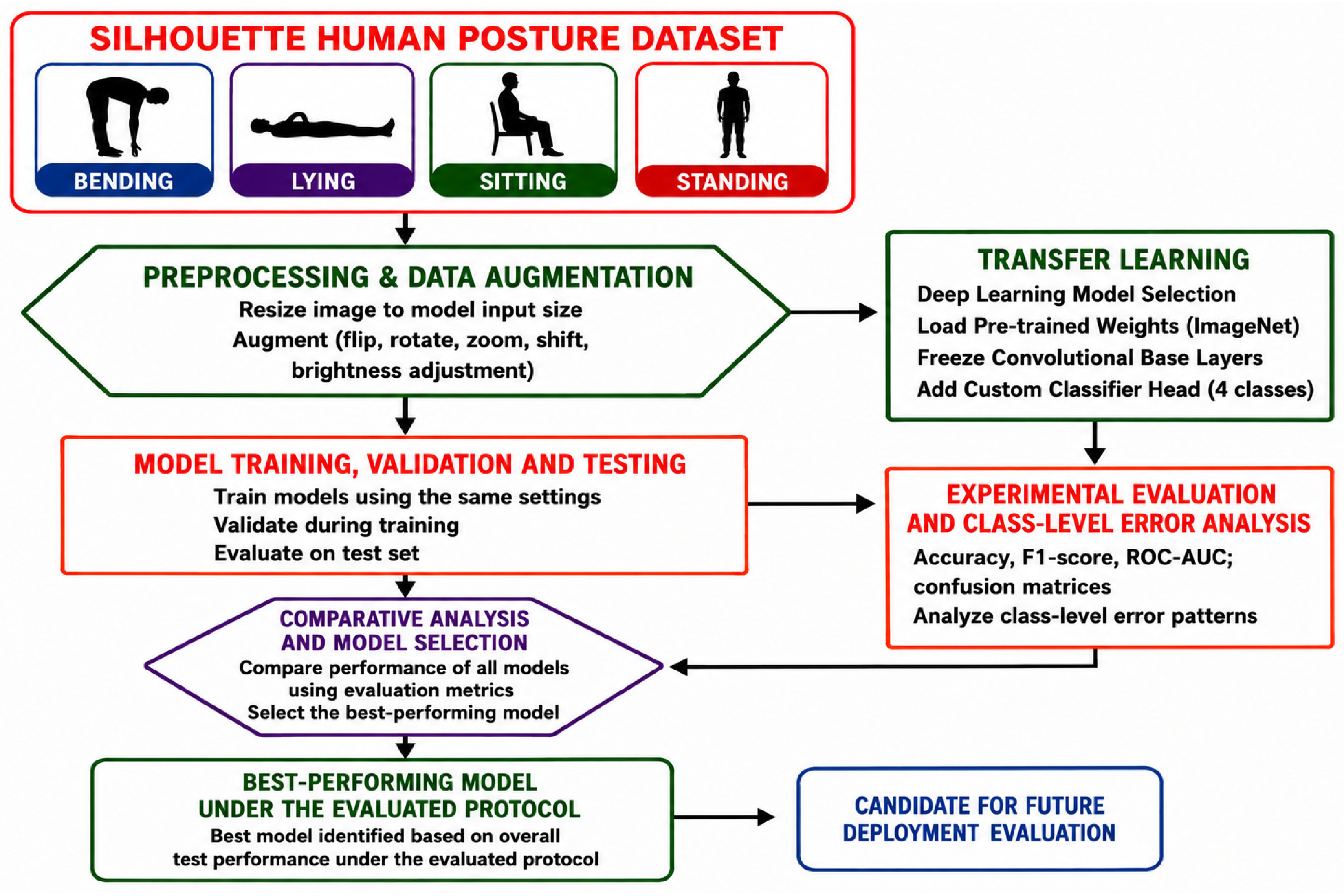
This study employed a controlled experimental framework to compare four transfer learning configurations for silhouette-based human posture classification: TL-ResNet-18, TL-ResNet-50, TL-MobileNet, and TL-Xception. To enable architecture-level comparison, the models were evaluated using the same four-class posture dataset and a common preprocessing, augmentation, training, and evaluation procedure. The overall experimental workflow is illustrated in
Figure 1 and comprises dataset preparation, image preprocessing and augmentation, transfer learning model adaptation, model training and validation, testing, performance evaluation, and error analysis.
3.1. Dataset Description
The human posture dataset used in this study was obtained from the Kaggle repository [
21]. It consists of silhouette images representing four fundamental human posture classes: standing, sitting, lying, and bending. The images contain variations in body pose and orientation, providing samples for evaluating posture classification based primarily on the human body shape and geometric configuration. Such posture information has significant potential for integration into Internet of Medical Things (IoMT)-based healthcare systems, where automated posture recognition can support continuous patient monitoring, elderly care assistance, rehabilitation, and remote healthcare applications. In particular, recognition of standing and sitting postures can provide information on mobility and daily physical activity. In contrast, recognition of lying postures can support monitoring of bedridden patients and changes in the in-bed body position. Bending-posture recognition can further contribute to monitoring potentially unsafe movements and physical activities. Previous studies have demonstrated the applicability of computer vision-based posture recognition for monitoring the elderly and automated fall detection in healthcare environments [
22]. At the same time, deep learning-based posture classification has also been investigated for health-monitoring systems using silhouette representations [
23]. Moreover, IoMT-based in-bed pose monitoring has been explored for applications, including sleep assessment and pressure ulcer risk monitoring [
24]. Furthermore, IoMT-enabled posture prediction has been investigated as a component of smart healthcare systems, demonstrating the potential of automated posture recognition for continuous and intelligent healthcare monitoring [
25].
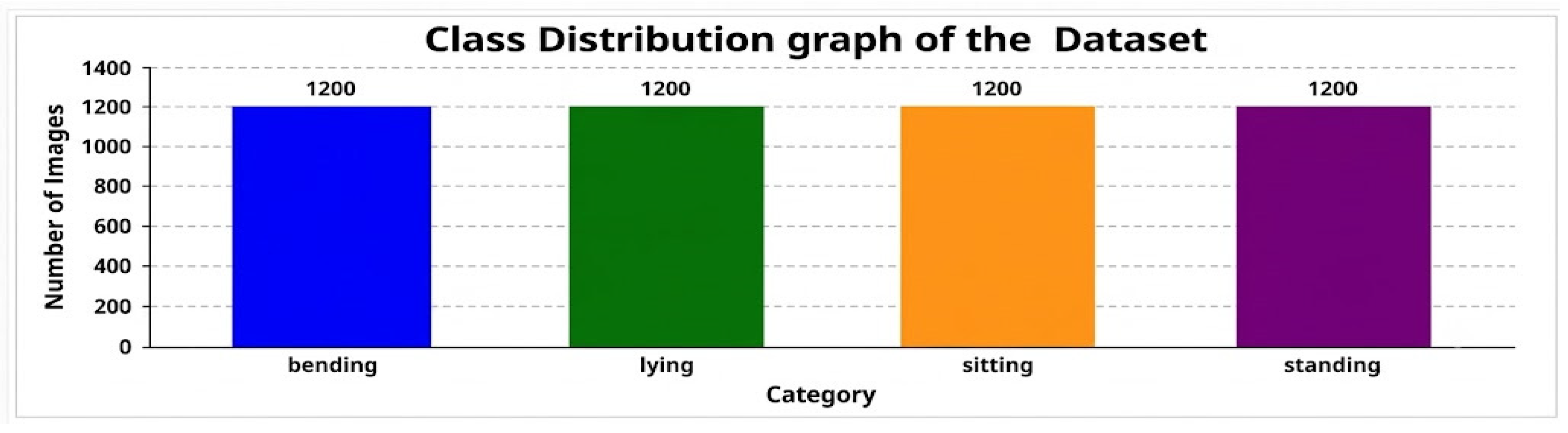
The dataset contained 4800 images, with an equal distribution of 1200 images per class: bending, lying, sitting, and standing. The source images were standardized to a resolution of 512 × 512 pixels as part of dataset preparation. The resulting dataset had a total storage size of approximately 44.97 MB. Unlike appearance-rich RGB images, silhouette representations suppress much of the texture and background information while emphasizing the geometric characteristics of the human body. This representation is therefore suitable for investigating posture classification performance when classification is based predominantly on body shape and geometric configuration. Within a future IoMT framework, the resulting posture recognition approach could potentially serve as a vision-based monitoring component, with recognized posture information transmitted to healthcare platforms for continuous observation, remote assistance, or caregiver notification. However, IoMT integration and deployment were not experimentally evaluated in the present study.
The class distribution of the dataset is shown in
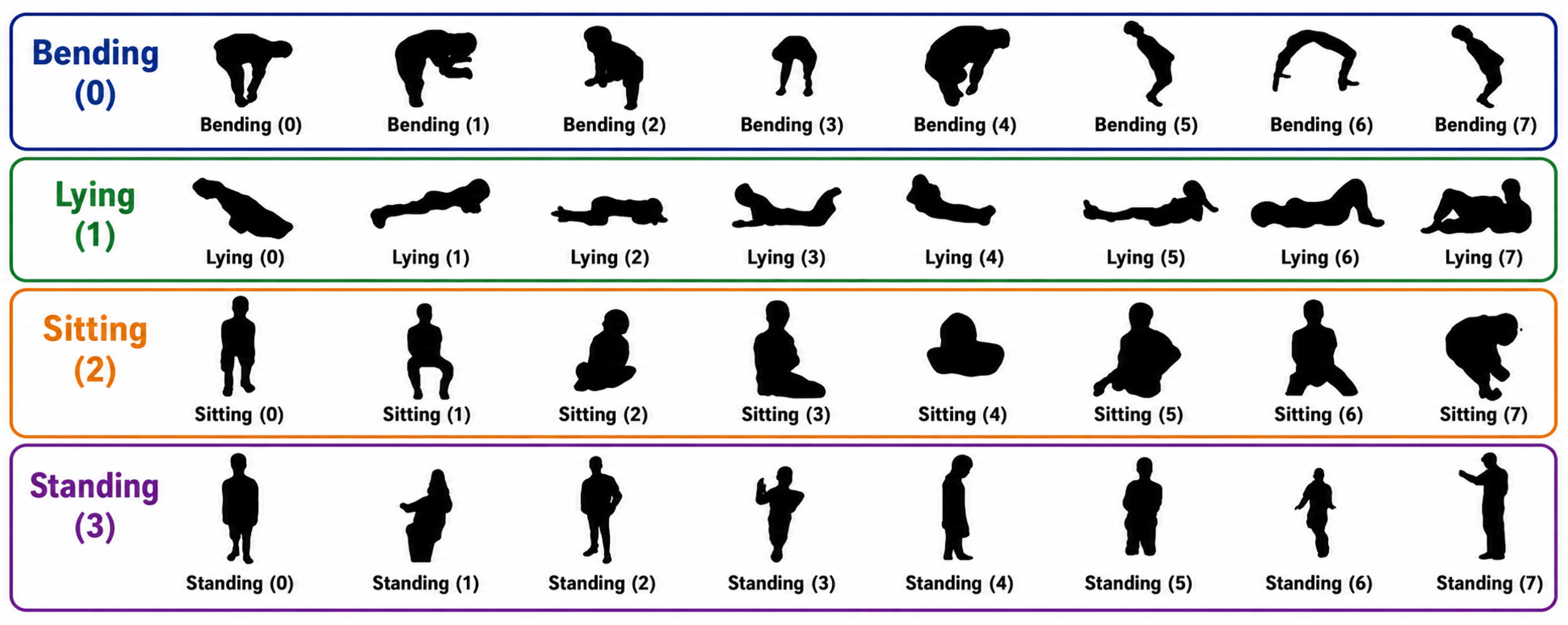
Figure 2, indicating a balanced distribution across the four posture categories. Representative silhouette samples from each posture class are shown in
Figure 3.
3.2. Data Preprocessing and Augmentation
We applied a common preprocessing procedure to all silhouette images to ensure a consistent input format across the evaluated architectures. During dataset preparation, the source images were standardized to 512 × 512 pixels and then resized to 96 × 96 pixels before being supplied to the deep learning models. The 96 × 96 input resolution was used consistently across all evaluated architectures. Although this reduced resolution decreases input dimensionality, the present study did not conduct a systematic resolution- ablation experiment; therefore, 96 × 96 should be regarded as the common input configuration adopted in this experiment rather than an experimentally established optimal resolution.
Following resizing to 96 × 96 pixels, the images were represented using three channels and cast to a 32-bit floating-point format. We normalized pixel intensities by dividing each value by 255.0, transforming the original [0, 255] range to [0.0, 1.0]. The same channel representation and normalization procedures were applied across the evaluated architectures. No architecture-specific ImageNet preprocess_input function was applied; instead, the common [0.0, 1.0] normalization was used consistently. We performed these deterministic preprocessing operations before dataset partitioning and before supplying images to the data generation and model training pipeline.
Data augmentation was applied only to the training images to increase sample diversity and reduce sensitivity to variations in body position, orientation, scale, and image appearance. We implemented the augmentation procedure using the Keras ImageDataGenerator. Specifically, we augmented the training images with a rotation range of 15°, width and height shifts of 0.1, a brightness range of 0.8–1.2, a shear range of 0.15, a zoom range of 0.1, and horizontal flipping. The preprocessing and augmentation parameters used in the experiment are summarized in
Table 2.
The augmentation operations introduced controlled transformations while retaining the underlying posture category. Rotation and translation accounted for variations in body orientation and image position, whereas zooming and shearing introduced moderate geometric variation. Brightness adjustment introduced intensity variation, while horizontal flipping generated mirrored representations of the available training samples. These transformations were intended to increase variation within the training data and support model generalization to unseen samples.
3.3. Dataset Partitioning
The dataset was partitioned into 70% training, 15% validation, and 15% testing subsets using class-stratified sampling based on the posture labels. The partitioning was performed in two stages: the initial training–temporary split used a random state of 32, followed by an equal division of the temporary subset into validation and test subsets using a random state of 42. This procedure preserved the class distribution across the three subsets.
The test subset remained strictly unobserved during model training, hyperparameter tuning, and validation-based training decisions, including early stopping and learning rate adjustment. The same data partitions were used for all four evaluated architectures to ensure a consistent comparative evaluation.
The source dataset consists of individual silhouette images; however, explicit subject and sequence identifiers were not available in the dataset metadata. Consequently, strictly subject-disjoint or sequence-disjoint partitioning could not be enforced or independently verified, and the possibility that images of the same individual occurred in different subsets cannot be completely excluded. This limitation should be considered when interpreting the reported generalization performance.
3.4. Transfer Learning Framework
Transfer learning was adopted to leverage ImageNet-learned visual representations for the evaluated posture classification architectures. Pretrained convolutional backbones were adapted to the four-class silhouette posture classification task using architecture-specific fine-tuning configurations.
For the pretrained backbones, earlier feature extraction layers were frozen to retain previously learned visual representations, while selected deeper layers were fine-tuned using the posture dataset. The original classification components were replaced or adapted with task-specific classification layers to produce predictions for the four target classes: standing, sitting, lying, and bending. Details of the implementation, fine-tuning strategy, and classification head for each architecture are provided in
Section 3.4.1,
Section 3.4.2,
Section 3.4.3 and
Section 3.4.4.
Four CNN backbone architectures were investigated: ResNet-18, ResNet-50, MobileNetV1, and Xception. The corresponding transfer learning configurations are referred to throughout this study as TL-ResNet-18, TL-ResNet-50, TL-MobileNet, and TL-Xception, respectively.
3.4.1. TL-ResNet-18
TL-ResNet-18 was adapted for four-class human posture classification using silhouette images. Each input image was resized to 96 × 96 pixels and normalized before being processed by the network. The ResNet-18 architecture was implemented in TensorFlow/Keras following the residual network structure described in [
26].
ResNet-18 employs residual blocks with skip connections that facilitate gradient propagation through the network [
26]. The convolutional feature extraction stage was followed by global average pooling and a task-specific classification head for predicting the four posture categories.
The classification head consisted of a fully connected layer with 512 neurons and ReLU activation, followed by dropout with a rate of 0.4, a second fully connected layer with 128 neurons and ReLU activation, followed by dropout with a rate of 0.2, and a final 4-neuron Softmax output layer corresponding to the four posture classes. The implemented model contained 11,519,748 total parameters, comprising 11,510,148 trainable parameters and 9600 non-trainable parameters. All layers except the final 30 layers were frozen, allowing the selected deeper layers to be fine-tuned for the posture classification task.
3.4.2. TL-ResNet-50
TL-ResNet-50 was developed using the same silhouette-based classification framework. Input images were normalized before being supplied to the network. The model employed a ResNet-50 backbone initialized with pretrained ImageNet weights. All layers except the final thirty layers were frozen, allowing the deeper layers to be fine-tuned for the posture classification task while retaining previously learned visual representations in the earlier layers.
ResNet-50 contains a deeper residual architecture than ResNet-18 and uses skip connections to support gradient propagation through the network [
27]. The extracted feature maps were processed with global average pooling, followed by a fully connected classification layer, to generate predictions for the four posture categories.
3.4.3. TL-MobileNet (MobileNetV1 Backbone)
MobileNetV1 was used as the backbone architecture for the TL-MobileNet configuration. The ImageNet-pretrained convolutional base was loaded without its original classification head and adapted to the four-class posture classification task. Input images were normalized before being supplied to the network. All layers except the final 25 layers were frozen, allowing the selected deeper layers to be fine-tuned for the target task.
MobileNet employs depthwise separable convolutions to reduce the computational requirements of conventional convolutions while retaining effective feature extraction capabilities [
28,
29]. After the convolutional backbone, global average pooling, dropout, and fully connected layers with ReLU activation were used, followed by a final SoftMax layer that produced probabilities for the four posture classes.
MobileNet’s lightweight architecture makes it particularly relevant to this study’s comparative objective. However, the present experiment evaluates classification performance rather than device-level computational efficiency; inference latency, memory consumption, FLOPs, and energy consumption were not measured.
3.4.4. TL-Xception
The TL-Xception model was adapted for the same four-class silhouette posture classification task. Each image was normalized before being processed by the network. The model employed an Xception backbone initialized with pretrained ImageNet weights. All layers except the final thirty layers were frozen, allowing the deeper layers to be fine-tuned using the posture dataset.
Xception employs depthwise separable convolutions organized within its characteristic architecture to separate spatial and cross-channel feature extraction [
27,
30]. The resulting feature maps were processed with global average pooling, followed by a fully connected classification layer that produced predictions for the standing, sitting, lying, and bending classes.
3.5. Common Training Protocol
To support a consistent comparative evaluation of the four transfer learning configurations, a common training protocol was adopted across the experiments. TL-ResNet-18, TL-ResNet-50, TL-MobileNet, and TL-Xception were initialized using pretrained ImageNet weights and adapted to the four-class silhouette posture classification task. The preprocessing and data augmentation procedures described in
Section 3.2 and
Table 2 were applied within the experimental framework, while the dataset was divided into training, validation, and test subsets according to the 70:15:15 partition described in
Section 3.3.
Each model was trained for a maximum of 40 epochs using the Adam optimizer with an initial learning rate of 0.0003 and a batch size of 32. Sparse categorical cross-entropy was employed as the loss function. Early stopping monitored validation accuracy with a patience of 15 epochs, and the weights corresponding to the best observed validation accuracy were restored (restore_best_weights = True). Adaptive learning rate reduction was also monitored for validation accuracy, with a reduction factor of 0.2 and a patience of 7 epochs. Consequently, the model used for subsequent evaluation corresponded to the best validation accuracy weights restored by the early-stopping procedure rather than necessarily the weights obtained at the final training epoch. The exact selected epoch number was not explicitly retained in the available training records.
Although the principal training settings were held constant across the four architectures, the fine-tuning configurations varied with the pretrained backbone. For TL-ResNet-18, TL-ResNet-50, and TL-Xception, we froze all layers except the final 30 layers, whereas for TL-MobileNet, we froze all layers except the final 25 layers. Thus, the earlier pretrained layers remained fixed feature extractors, while the selected deeper layers were allowed to adapt to the silhouette posture classification task. We configured the task-specific classification heads according to the respective model implementations, as described in
Section 3.4.1,
Section 3.4.2,
Section 3.4.3 and
Section 3.4.4. Consequently, the comparison should be interpreted as an evaluation of the implemented transfer learning configurations under a common experimental protocol, rather than as a strict isolation of backbone architecture alone.
Table 3 summarizes the common training settings and architecture-specific fine-tuning configurations.
3.6. Evaluation Metrics
The four transfer learning architectures were evaluated using Accuracy, F1-score, and ROC-AUC. These metrics were selected to provide complementary perspectives on classification performance.
Accuracy measures the proportion of correctly classified test samples and is defined as:
Precision measures the proportion of positive predictions that are correctly classified:
whereas Recall represents the proportion of actual positive samples correctly identified:
Here, denote true positives, true negatives, false positives, and false negatives, respectively.
The F1-score represents the harmonic mean of Precision and Recall:
For the multiclass problem, the Precision, Recall, and F1-score were interpreted on a class-specific One-vs-Rest basis, where each posture class was considered the positive class against the remaining classes. Class-specific Precision, Recall, and F1-scores were obtained using Scikit-learn’s classification_report, which also provides macro-average and weighted-average values. Because the dataset was balanced across the four posture classes, with equal class support within each data partition, the macro- and weighted-average F1-scores were equivalent at the reported precision. The aggregate F1-scores reported in the comparative results were derived from these multiclass classification reports.
ROC-AUC was evaluated using a One-vs-Rest (OvR) formulation. The four posture labels were binarized, and a separate ROC curve was generated for each posture class by comparing that class against all remaining classes. For each class, the AUC was calculated from the corresponding false positive and true positive rates across classification thresholds. The aggregate ROC-AUC values reported in
Table 4 were calculated using prevalence-weighted averaging of the four class-specific OvR AUC values, whereby each class-specific AUC was weighted according to the proportion of true samples belonging to that class. Because the four posture classes had equal support within each data partition, the weighted-average and macro-average ROC-AUC values were equivalent for the present dataset.
3.7. Error Analysis
In addition to the aggregate evaluation metrics, confusion matrices and class-specific classification metrics were examined to characterize class-level prediction behavior across the four posture categories. The confusion matrices were used to identify correct predictions and misclassification patterns among the standing, sitting, lying, and bending classes. Class-specific Precision, Recall, and F1-scores, obtained from the classification reports, were additionally examined to assess differences in classification performance among the four posture categories. This class-level error analysis complements the aggregate Accuracy, F1-score, and ROC-AUC results by providing further insight into the prediction behavior and dominant error patterns of the evaluated transfer learning architectures.
4. Results and Discussion
This section presents the comparative performance of the four transfer learning configurations, TL-ResNet-18, TL-ResNet-50, TL-MobileNet, and TL-Xception, for four-class silhouette-based human posture classification. The models are compared using the Accuracy, F1-score, and ROC-AUC across the training, validation, and test partitions. In addition, to aggregate performance, the analysis considers differences between training and held-out performance, as well as class-level confusion patterns. The results are interpreted within the evaluated dataset and experimental protocol rather than as evidence of universal architectural superiority.
4.1. Overall Performance Comparison
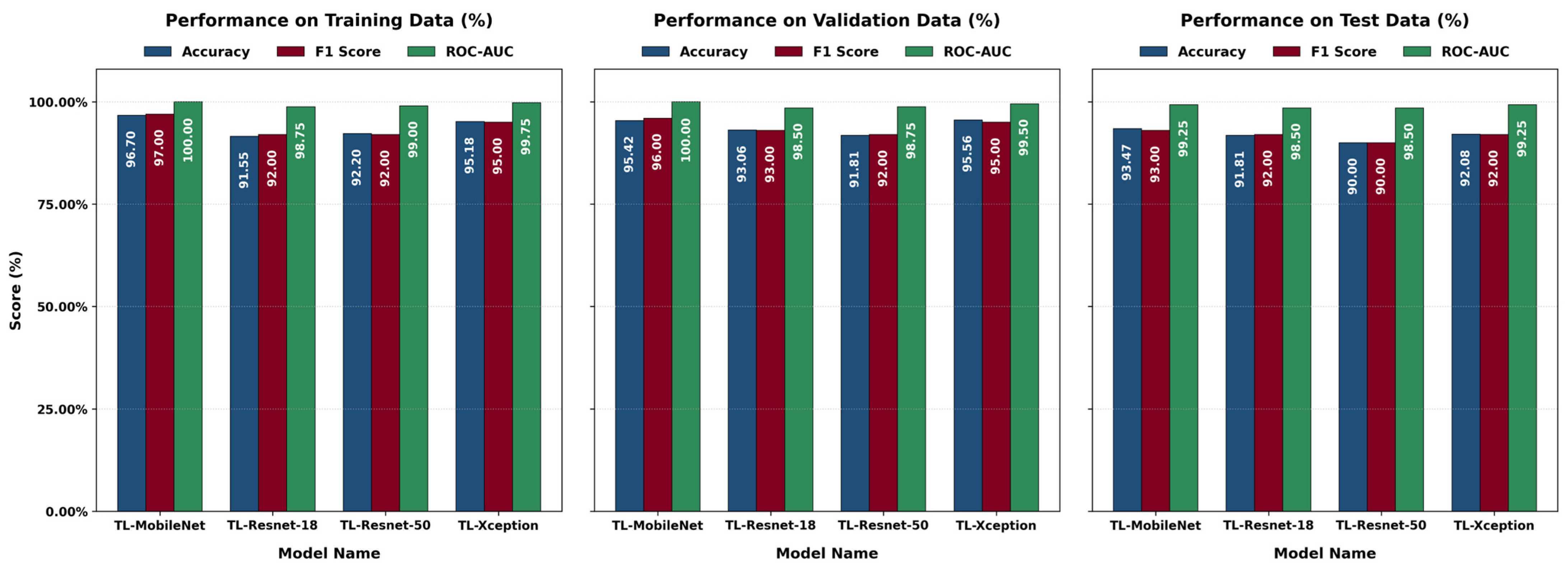
Table 4 presents the training, validation, and test performance of TL-ResNet-18, TL-ResNet-50, TL-MobileNet, and TL-Xception in terms of Accuracy, F1-score, and ROC-AUC (OvR, weighted).
Figure 4 provides a graphical comparison of the test performance of the four architectures. The results enable examination of the relative classification behavior of the evaluated transfer learning configurations within the common silhouette-based experimental setting.
The results show differences in classification performance among the four architectures. On the held-out test set, TL-MobileNet achieved the highest Accuracy (93.47%) and F1-score (93.00%), followed by TL-Xception with 92.08% Accuracy and a 92.00% F1-score. TL-ResNet-18 achieved 91.81% Accuracy and a 92.00% F1-score, whereas TL-ResNet-50 obtained 90.00% for both metrics. For ROC-AUC, TL-MobileNet and TL-Xception jointly achieved the highest reported test value of 99.25%, compared with 98.50% for both residual architectures.
Although TL-MobileNet achieved higher observed test Accuracy and F1-score values than TL-Xception under the evaluated split, the experiment was not repeated across multiple random seeds. Therefore, the present results cannot establish run-to-run variability or the statistical significance of the observed differences. Accordingly, the relative performance of TL-MobileNet and TL-Xception should be interpreted descriptively within the evaluated experimental setting rather than as evidence of statistically significant superiority.
Overall, TL-MobileNet achieved the highest observed held-out Accuracy and F1-score, while sharing the highest ROC-AUC with TL-Xception. However, the ranking did not remain consistent across all data partitions. TL-Xception achieved the highest validation Accuracy (95.56%), marginally exceeding TL-MobileNet (95.42%). This difference motivates further examination of training, validation, and test behavior rather than selecting a model based on a single partition or metric.
4.2. Training, Validation, and Test Behavior
Comparison of training, validation, and test performance provides insight into the generalization behavior of the evaluated architectures. As shown in
Table 4, TL-ResNet-50 achieved training, validation, and test accuracies of 92.20%, 91.81%, and 90.00%, respectively. The difference between its training and test Accuracy was 2.20 percentage points, indicating reduced performance on held-out test samples.
TL-ResNet-18 exhibited a different pattern, achieving 91.55% training Accuracy, 93.06% validation Accuracy, and 91.81% test Accuracy. Its test Accuracy exceeded its training Accuracy by 0.26 percentage points, while its validation Accuracy was also higher than its training Accuracy. This pattern may be associated with augmentation during training or differences in the relative difficulty of the data partitions; however, the available experiment does not establish a specific cause.
TL-MobileNet achieved 96.70% training Accuracy, 95.42% validation Accuracy, and 93.47% test Accuracy, corresponding to a training-to-test difference of 3.23 percentage points. Although a reduction was observed between the training and test partitions, TL-MobileNet retained the highest test Accuracy among the four architectures.
TL-Xception achieved 95.18% training Accuracy, 95.56% validation Accuracy, and 92.08% test Accuracy. Similar to TL-ResNet-18, its validation Accuracy slightly exceeded its training Accuracy, while its test Accuracy was lower than both. The difference between training and test Accuracy was 3.10 percentage points.
Overall, the absolute differences between training and test Accuracy ranged from 0.26 to 3.23 percentage points across the four architectures. The differences among training, validation, and test performance demonstrate that model behavior cannot be assessed solely from training or validation results. In particular, TL-Xception achieved the highest validation Accuracy, whereas TL-MobileNet achieved the highest test Accuracy, reinforcing the importance of evaluating the final models on a separate held-out test partition.
4.3. Comparison of Accuracy, F1-Score, and ROC-AUC
Accuracy, F1-score, and ROC-AUC provide complementary perspectives on model performance. Accuracy represents the overall proportion of correctly classified samples, while the F1-score considers the balance between Precision and Recall. ROC-AUC provides an additional assessment of class discrimination capability across classification thresholds. Considering these measures jointly therefore provides a broader assessment of classification performance than relying on Accuracy alone.
The test results in
Table 4 show that TL-MobileNet ranked first in both Accuracy and F1-score, achieving 93.47% and 93.00%, respectively. TL-Xception achieved the second-highest test Accuracy (92.08%), while TL-Xception and TL-ResNet-18 obtained the same reported F1-score of 92.00%. TL-ResNet-50 produced the lowest test Accuracy and F1-score, both at 90.00%.
A slightly different pattern was observed for ROC-AUC. All four architectures achieved high test ROC-AUC values, ranging from 98.50% to 99.25%. TL-MobileNet and TL-Xception jointly achieved the highest reported value of 99.25%, whereas TL-ResNet-18 and TL-ResNet-50 each achieved 98.50%. Consequently, TL-MobileNet did not outperform TL-Xception on ROC-AUC, despite achieving a higher test Accuracy and F1-score.
Taken together, the three metrics show that TL-MobileNet achieved the strongest observed overall test performance under the evaluated experimental setting, obtaining the highest held-out Accuracy and F1-score while sharing the highest ROC-AUC with TL-Xception. At the same time, the equivalent ROC-AUC values obtained by TL-MobileNet and TL-Xception demonstrate that the relative ranking depends on the evaluation criterion considered. These findings describe the evaluated dataset, split, and implemented transfer learning configurations and do not establish the statistically significant or universal superiority of TL-MobileNet.
4.4. Model-Specific Classification Behavior
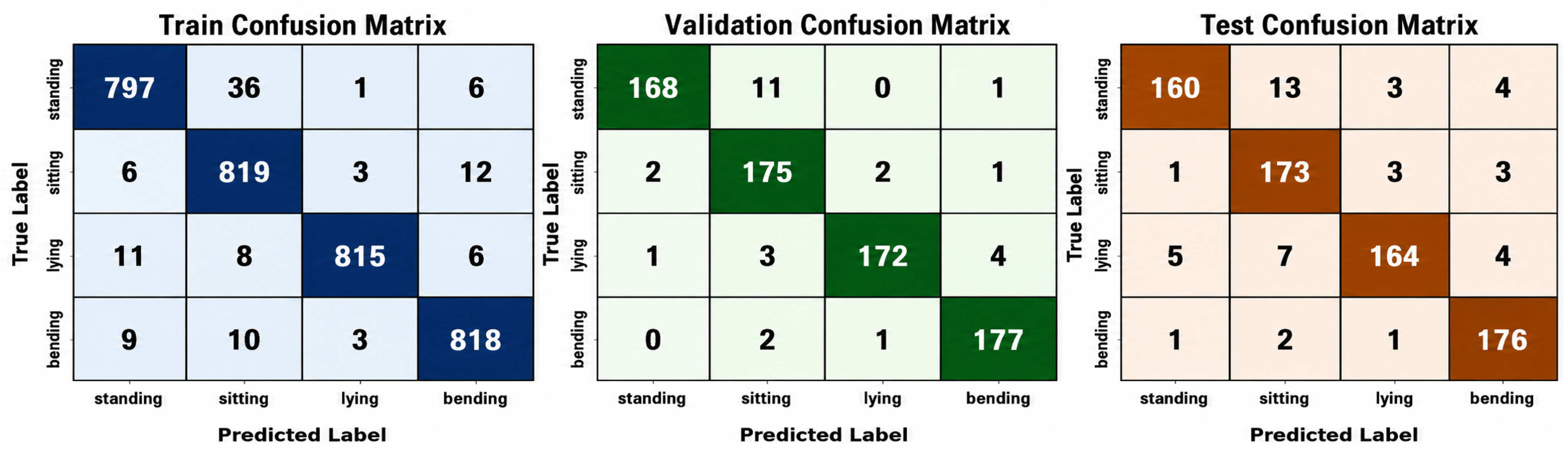
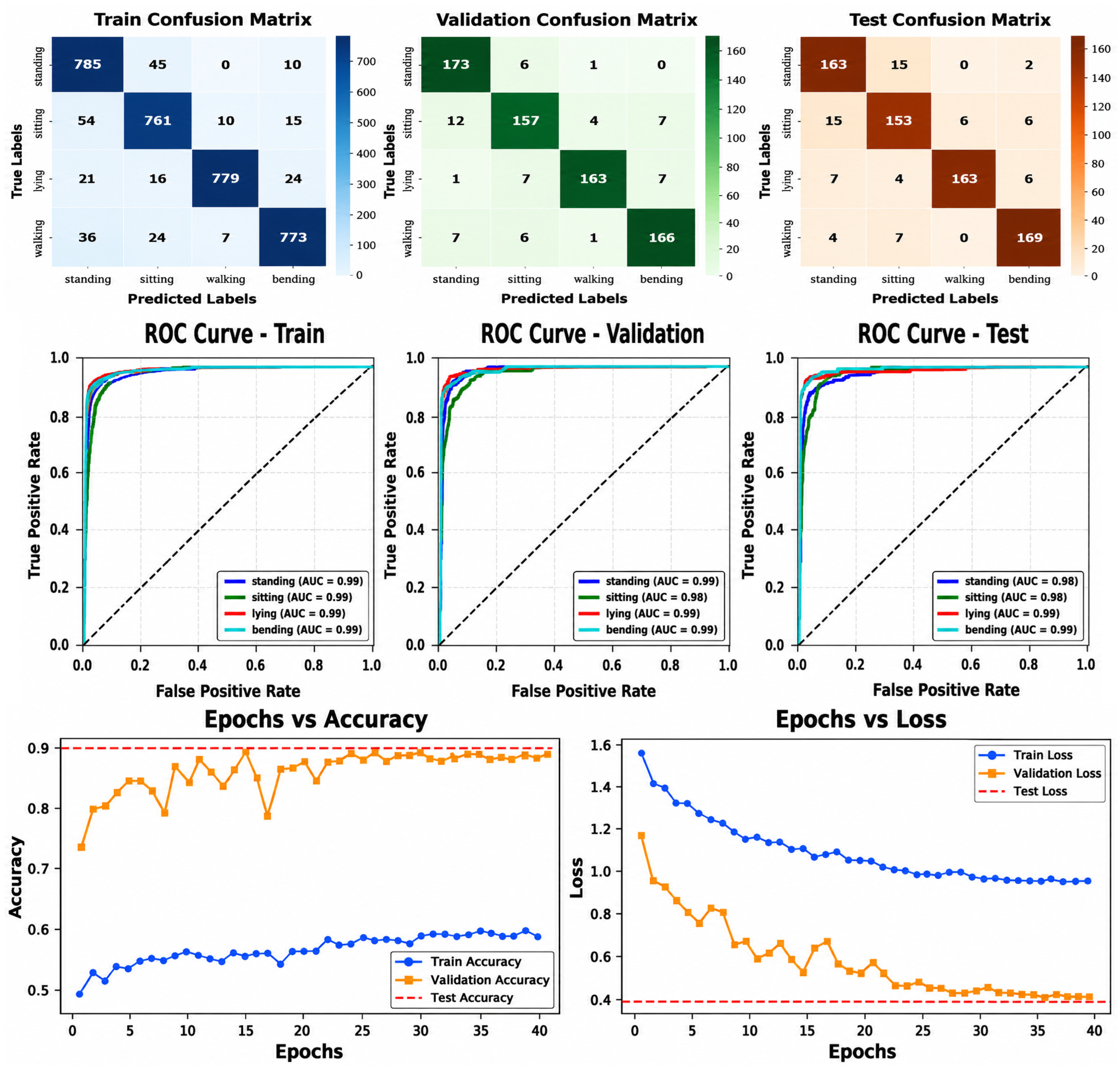
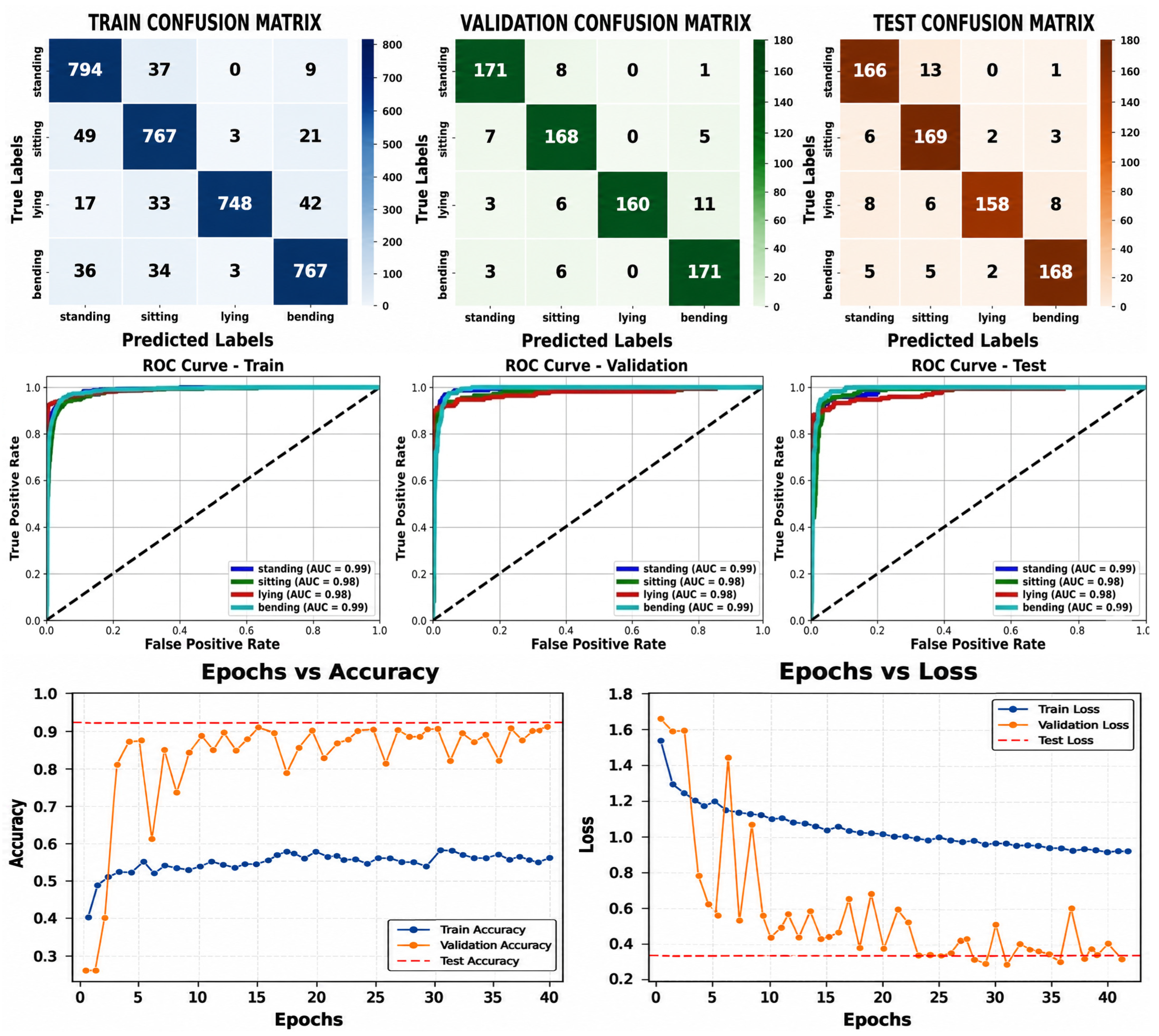
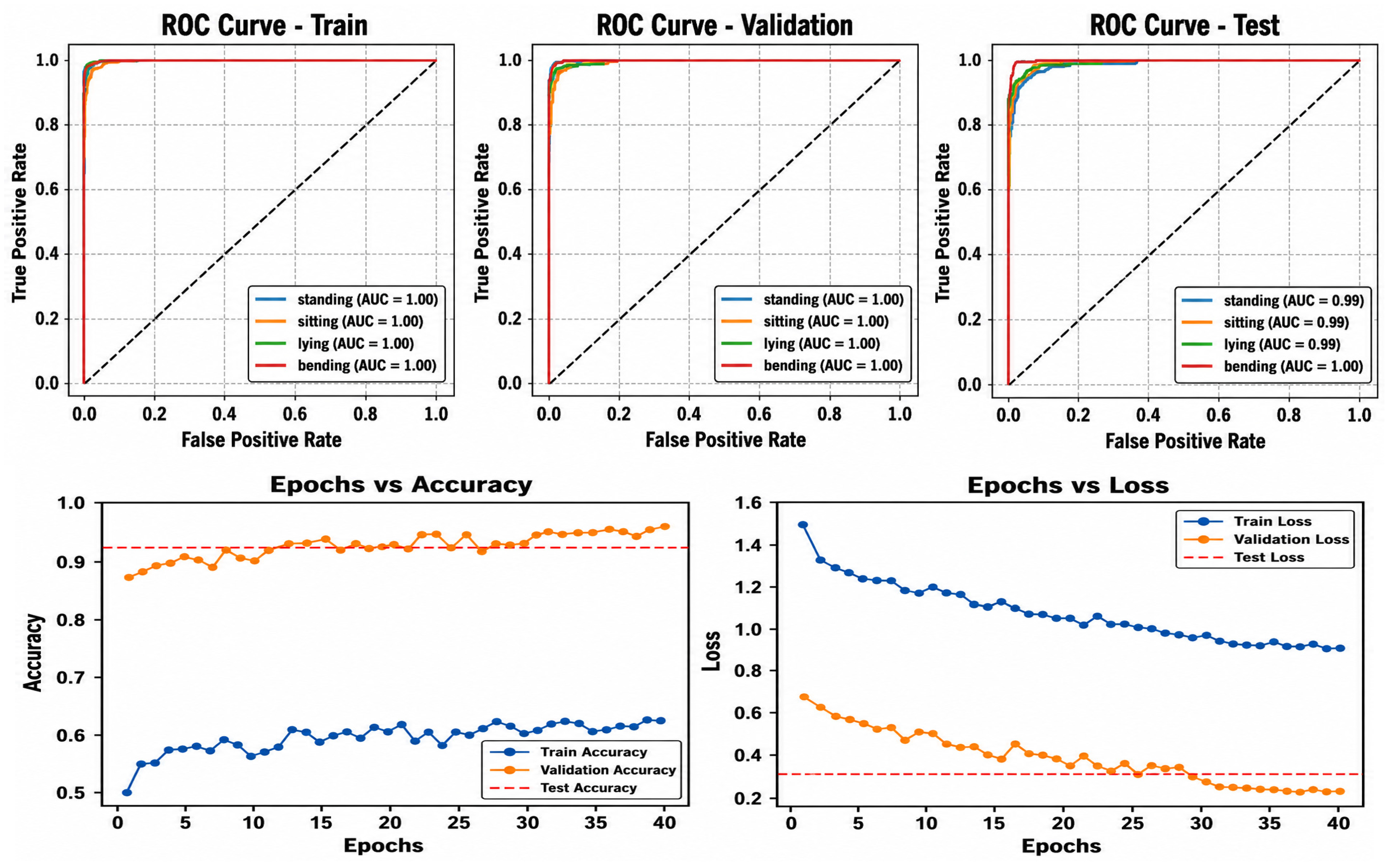
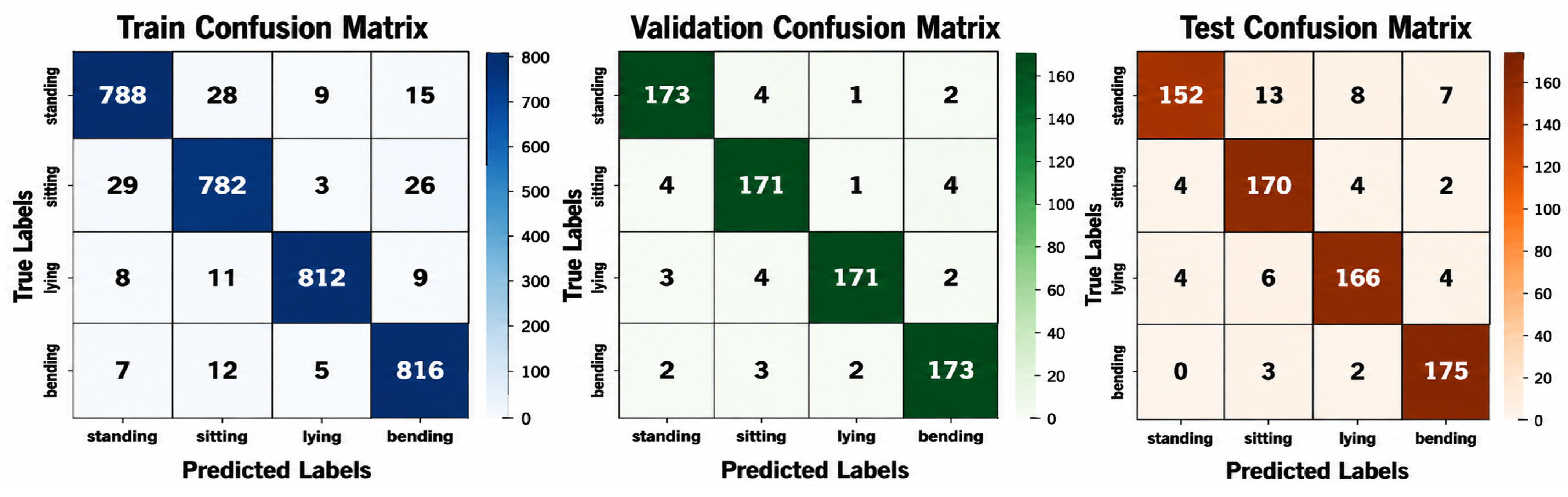
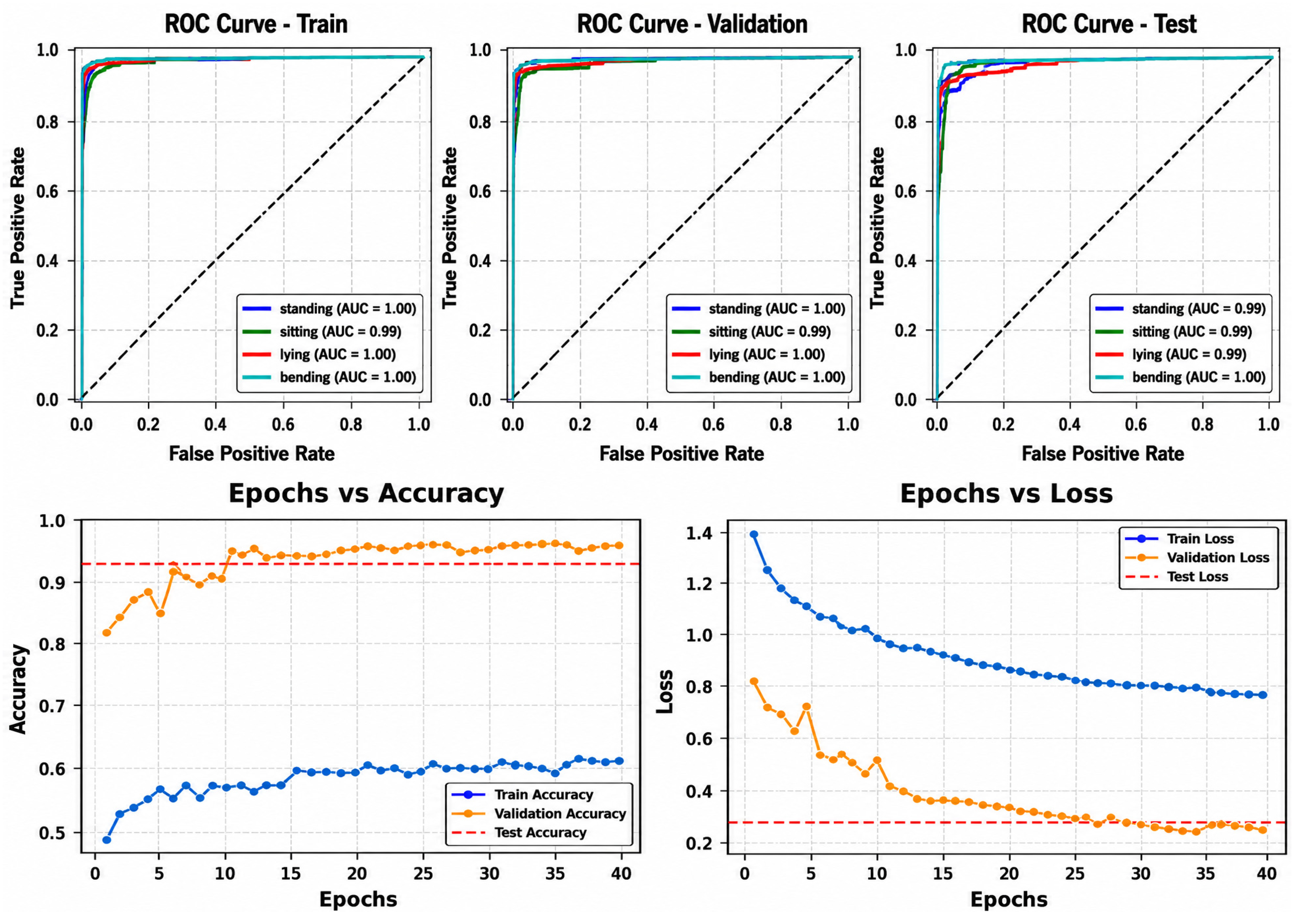
The individual confusion matrices, ROC curves, and epoch-wise Accuracy and loss curves provide additional information about each model’s classification behavior. These results are presented in
Figure 5,
Figure 6,
Figure 7 and
Figure 8.
TL-ResNet-50 achieved the lowest test Accuracy (90.00%) and F1-score (90.00%) among the four evaluated models, although its test ROC-AUC remained high at 98.50%. TL-ResNet-18 achieved a higher test Accuracy of 91.81% and F1-score of 92.00%, while obtaining the same test ROC-AUC of 98.50%. Under the present experimental conditions, therefore, the implemented TL-ResNet-50 configuration did not improve held-out classification performance relative to TL-ResNet-18.
TL-MobileNet achieved the highest observed overall test performance, with an Accuracy of 93.47%, an F1-score of 93.00%, and a ROC-AUC of 99.25%. These results indicate that the implemented TL-MobileNet configuration was effective in discriminating among the four silhouette posture classes in the evaluated dataset. However, the classification results should not be interpreted as evidence of superior computational efficiency. Although MobileNet is designed as a lightweight CNN architecture, inference latency, memory consumption, computational cost, and energy consumption were not measured in the present experiment.
TL-Xception also demonstrated strong classification performance, achieving 92.08% test Accuracy, a 92.00% F1-score, and a 99.25% ROC-AUC. Its test Accuracy was 1.39 percentage points lower than that of TL-MobileNet, while the two models achieved the same reported test ROC-AUC. Thus, both TL-MobileNet and TL-Xception demonstrated high class discrimination performance under the evaluated setting, while TL-MobileNet achieved higher observed held-out Accuracy and F1-score.
4.5. Error and Misclassification Analysis
Although aggregate performance metrics provide an overall assessment of classification performance, they do not fully describe how prediction errors are distributed across the four posture classes. Therefore, the test confusion matrices shown in
Figure 5,
Figure 6,
Figure 7 and
Figure 8 were examined to identify class-level error patterns for TL-ResNet-50, TL-ResNet-18, TL-MobileNet, and TL-Xception. Class-specific Precision, Recall, and F1-scores were additionally derived from the corresponding test confusion matrices and are summarized in
Table 5. Because the test partition contained 180 samples for each posture class, individual misclassification counts can also be expressed as class-normalized error percentages.
The confusion matrices reveal a recurrent standing-to-sitting misclassification pattern across all four evaluated configurations. For TL-ResNet-50, 15 of the 180 standing samples were classified as sitting, corresponding to 8.33% of the standing class. The corresponding standing-to-sitting error was 13 samples (7.22%) for each of TL-ResNet-18, TL-MobileNet, and TL-Xception. However, the reverse sitting-to-standing error was not equally pronounced across all models. TL-ResNet-50 misclassified 15 sitting samples as standing (8.33%), whereas the corresponding counts were six (3.33%) for TL-ResNet-18, one (0.56%) for TL-MobileNet, and four (2.22%) for TL-Xception. Thus, the standing–sitting confusion was particularly symmetric for TL-ResNet-50 but predominantly directional from standing to sitting for the other configurations.
Additional model-specific error patterns were also observed. For TL-ResNet-18, eight lying samples were classified as standing and another eight as bending, corresponding to 4.44% of the lying class in each case. TL-MobileNet misclassified seven lying samples as sitting (3.89%) and five as standing (2.78%). For TL-Xception, standing was the most difficult class in terms of Recall (0.84); in addition to the 13 standing samples classified as sitting, eight were classified as lying (4.44%) and seven as bending (3.89%). These errors explain why TL-Xception achieved high Precision for standing (0.95) while obtaining a lower Recall for that class.
The class-specific metrics further demonstrate that recognition performance was not uniform across the four posture categories. For TL-ResNet-50, sitting produced the lowest F1-score (0.85), whereas lying and bending each achieved 0.93. TL-ResNet-18 showed comparatively similar F1-scores across the four classes, ranging from 0.91 to 0.93, although lying had the lowest Recall (0.88). TL-MobileNet achieved its highest class-specific F1-score for bending (0.96), with bending also obtaining the highest Recall (0.98). For TL-Xception, bending similarly produced the highest F1-score (0.95), whereas standing produced the lowest F1-score (0.89) and Recall (0.84). These results demonstrate that the aggregate scores reported in
Table 4 conceal meaningful differences in class-specific recognition behavior.
Overall, the quantitative error analysis shows that standing-to-sitting confusion was the most consistently observed directional error across the four evaluated transfer learning configurations, while the remaining error patterns varied by model. Nevertheless, the present experiment did not systematically categorize individual misclassified samples according to visual conditions such as occlusion, truncation, viewing orientation, overlapping limbs, or ambiguous body configurations. Consequently, these factors cannot be established as causes of the observed errors. The present analysis identifies quantitative class-level prediction patterns within the evaluated test set, whereas determining their underlying visual causes would require a systematic sample-level investigation.
4.6. Relation to the Research Questions
Regarding RQ1, the four transfer learning configurations exhibited different classification performance under the common silhouette-based experimental framework. Test Accuracy ranged from 90.00% for TL-ResNet-50 to 93.47% for TL-MobileNet. Notably, the implemented TL-ResNet-50 configuration did not outperform TL-ResNet-18, indicating that greater network depth did not translate into higher classification performance under the evaluated conditions.
Regarding RQ2, no single transfer learning configuration dominated every training, validation, and test metric. TL-Xception achieved the highest validation Accuracy (95.56%), whereas TL-MobileNet achieved the highest observed test Accuracy (93.47%) and F1-score (93.00%) and matched TL-Xception’s test ROC-AUC (99.25%). Considering performance across the three partitions, both models demonstrated strong generalization behavior; however, using held-out test performance as the primary criterion for final model assessment, TL-MobileNet demonstrated the strongest observed overall test performance. Because the experiments used a single data split without repeated runs across multiple random seeds, these differences should be interpreted descriptively rather than as evidence of statistically significant superiority.
Regarding RQ3, the class-level analysis revealed that misclassification patterns were not uniformly distributed across the four posture categories. Standing-to-sitting confusion was the most consistently observed directional error across all four evaluated configurations, accounting for 8.33% of standing samples for TL-ResNet-50 and 7.22% for TL-ResNet-18, TL-MobileNet, and TL-Xception. Additional model-specific error patterns were also observed. TL-ResNet-18 showed its lowest class-specific Recall for lying (0.88), TL-MobileNet achieved its highest class-specific F1-score for bending (0.96), and TL-Xception showed its lowest Recall for standing (0.84). These findings demonstrate that the aggregate performance metrics conceal meaningful differences in class-specific recognition behavior. However, because individual misclassified samples were not systematically categorized according to their visual characteristics, the underlying causes of these errors cannot be established from the present experiment.
4.7. Discussion and Implications
The experimental findings demonstrate that greater network depth did not necessarily translate into improved silhouette-based posture classification performance under the evaluated conditions. TL-ResNet-50 did not outperform the shallower TL-ResNet-18, while TL-MobileNet achieved the highest held-out Accuracy and F1-score among the four evaluated architectures. These findings reinforce the motivation established in
Section 2: performance values reported independently across heterogeneous posture recognition studies cannot be used to infer architecture superiority when datasets, input representations, preprocessing procedures, and evaluation protocols differ. Evaluating multiple architectures within a common experimental framework provides a more direct basis for architecture-level comparison.
The results also highlight architectural design differences in the present silhouette-based classification task. TL-MobileNet and TL-Xception, both of which employ depthwise separable convolutions, achieved the highest reported test ROC-AUC of 99.25%, while TL-MobileNet additionally obtained the highest test Accuracy (93.47%) and F1-score (93.00%). In contrast, increasing the residual network depth from ResNet-18 to ResNet-50 did not improve held-out classification performance. These findings indicate that greater architectural depth or complexity alone was not associated with improved performance for the evaluated dataset. However, this experiment compared complete architectures rather than isolating the contribution of individual components; therefore, the observed performance differences cannot be attributed solely to specific convolutional mechanisms.
Previous transfer learning studies have similarly reported competitive performance of MobileNet-based architectures on posture-related classification tasks [
11,
12,
13]. However, direct numerical comparison with these studies should be interpreted cautiously because they employed different datasets, input representations, posture definitions, model configurations, and evaluation protocols. The present results therefore do not establish superiority over previously reported approaches. Rather, they demonstrate that TL-MobileNet performed strongly relative to TL-ResNet-18, TL-ResNet-50, and TL-Xception when evaluated in the same silhouette-based experimental setting.
From the perspective of future human-centered intelligent systems, the performance of TL-MobileNet is particularly relevant because MobileNet was designed for computationally constrained vision applications. Silhouette-based posture recognition could contribute to intelligent monitoring, rehabilitation, assistive environments, human–machine interaction, and other connected smart systems where reducing reliance on appearance-rich imagery may be desirable. This potential application context also aligns the study with human-centered networked and smart-system scenarios in which visual recognition can form part of a broader connected sensing and decision-support pipeline. Nevertheless, the present study evaluates classification performance rather than deployment efficiency or direct privacy preservation. Consequently, conclusions regarding real-time suitability, computational efficiency, privacy protection, or edge-device deployment require dedicated experimental evaluation.
Finally, the findings should be interpreted within the boundaries of the present experiment. We conducted the comparison using a single silhouette dataset and the reported training–validation–test partition. External dataset evaluation, cross-dataset validation, computational benchmarking, and device-level deployment assessment were not performed. Accordingly, the results establish that TL-MobileNet achieved the strongest overall classification performance under the evaluated dataset and experimental protocol, rather than demonstrating universal superiority across posture datasets, subjects, acquisition conditions, or deployment environments.
5. Limitations and Challenges
Several limitations should be considered when interpreting the results. First, the experiments used a single silhouette-based dataset containing four posture classes: standing, sitting, lying, and bending. The dataset was partitioned at the image level using class-stratified sampling. Because explicit subject and sequence identifiers were unavailable, we could not independently verify subject-disjoint or sequence-disjoint partitioning. Consequently, the reported results represent image-level generalization under the evaluated split rather than confirmed subject-independent generalization.
Second, the results were obtained using a single training–validation–test partition without repeated experiments across multiple random seeds. Therefore, the authors could not establish standard deviations, confidence intervals, or the statistical significance of the observed differences, particularly between TL-MobileNet and TL-Xception. External- or cross-dataset validation was also not performed. Future work should therefore include repeated experiments and independent datasets to provide stronger evidence of generalization.
Third, the transfer learning configurations were not fully identical across the four models. TL-ResNet-18, TL-ResNet-50, and TL-Xception fine-tuned the final 30 layers, whereas TL-MobileNet fine-tuned the final 25 layers, and the task-specific classification heads also differed. Consequently, the observed differences may reflect both backbone characteristics and architecture-specific adaptation. A more strictly controlled comparison should employ equivalent fine-tuning criteria and standardized classification heads.
The common 96 × 96 input resolution is also a limitation because the authors did not conduct a systematic multi-resolution experiment. Therefore, this resolution should not be interpreted as experimentally optimal. In addition, the study used dataset-provided silhouettes without evaluating an image segmentation stage. In practical applications, segmentation errors may affect subsequent posture classification. The study also did not compare silhouettes with RGB, depth, skeletal, or multimodal representations.
The class-level analysis identified recurrent errors, particularly standing-to-sitting misclassification, but it did not systematically categorize individual errors by occlusion, truncation, viewing orientation, overlapping limbs, or other visual characteristics. Consequently, the present experiment cannot establish the underlying visual causes of the observed errors.
Finally, although MobileNet is designed for computationally constrained applications, we did not measure inference latency, throughput, memory consumption, FLOPs, energy consumption, or device-level performance. The present results therefore demonstrate classification performance rather than computational or deployment efficiency. Evaluation of real-time, mobile, embedded, and IoMT deployment remains an important direction for future work.
6. Conclusions
This study comparatively evaluated four transfer learning configurations, TL-ResNet-18, TL-ResNet-50, TL-MobileNet, and TL-Xception, under a common experimental protocol for four-class human posture classification using silhouette images. The models were evaluated using Accuracy, F1-score, and ROC-AUC. TL-MobileNet achieved the highest observed test Accuracy (93.47%) and F1-score (93.00%) and, together with TL-Xception, achieved the highest test ROC-AUC (99.25%). TL-ResNet-18 and TL-ResNet-50 achieved test accuracies of 91.81% and 90.00%, respectively. Under the evaluated conditions, the implemented TL-ResNet-50 configuration did not improve held-out classification performance relative to TL-ResNet-18.
The class-level analysis further revealed that classification performance was not uniform across the four posture categories. Standing-to-sitting confusion was the most consistently observed directional error across the four evaluated configurations, demonstrating that aggregate performance metrics can conceal meaningful class-specific error patterns. Overall, TL-MobileNet showed the strongest held-out performance; however, the results describe the evaluated dataset, split, and implemented transfer learning configurations and do not establish statistically significant or universal superiority.
The findings are subject to several limitations, including image-level rather than verified, subject-independent partitioning; a single experimental split without repeated random-seed evaluation; architecture-specific fine-tuning configurations; and the use of a fixed 96 × 96 input resolution without multi-resolution analysis. In addition, the study used dataset-provided silhouettes without evaluating an image segmentation stage. Computational efficiency, real-time performance, and device-level deployment were also not experimentally evaluated.
Future work should therefore include subject-independent evaluation, repeated experiments across multiple random seeds, validation on larger and independent datasets, multi-resolution analysis, and evaluation using automatically segmented silhouettes. Standardized fine-tuning configurations should also be considered to more strictly isolate backbone-related differences. Finally, computational benchmarking on mobile, embedded, and IoMT-oriented platforms should evaluate inference latency, memory consumption, computational cost, and energy requirements to determine practical deployment potential.




 ,
,