
SDAP-K: A Kerberos-Assisted Secure Data Auditing Protocol for Cloud Storage

 ,
,
Abstract
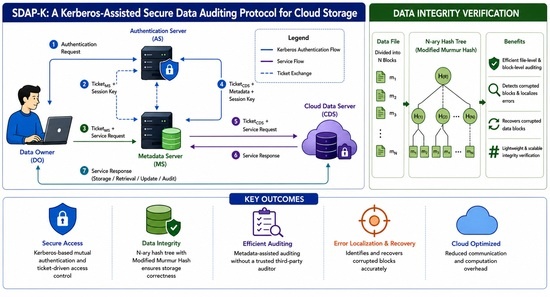
1. Introduction
- (i)
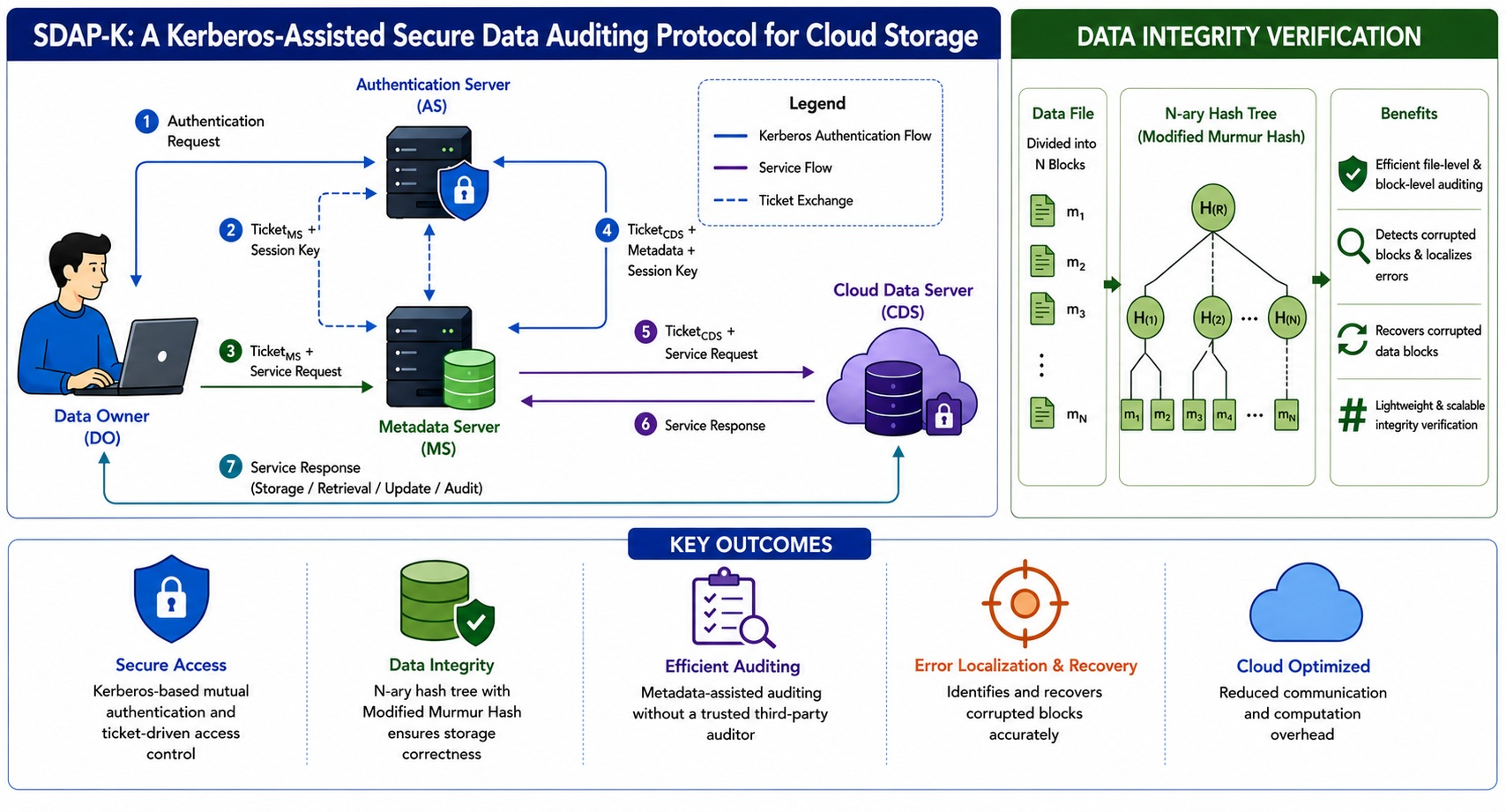
- A Kerberos-assisted authenticated cloud auditing architecture is proposed to secure service interactions among data owners, metadata servers, and cloud storage servers through mutual authentication and ticket-based access control.
- (ii)
- An N-ary hash tree-based integrity verification mechanism with the Modified Murmur hashing algorithm is introduced to support lightweight file-level and block-level auditing of outsourced cloud data without requiring a trusted third-party auditor.
- (iii)
- A metadata-assisted auditing framework is developed to facilitate efficient management of auditing information and reduce the burden on data owners during integrity verification operations.
- (iv)
- An error localization and data recovery mechanism is incorporated to identify corrupted blocks and support data correctness validation during storage, retrieval, and auditing processes.
- (v)
- A reproducible experimental evaluation framework to measure the computation, communication, and auditing overhead of SDAP-K over different file sizes, block sizes, and N-ary tree branching factors.
2. Literature Review
2.1. Cloud Data Auditing and Integrity Verification
2.2. Privacy-Preserving and Lightweight Auditing Approaches
2.3. Authentication-Based Cloud Security Approaches
2.4. Metadata Management, Dynamic Operations, and Error Localization
2.5. Recent Trends in Cloud Auditing and Security
2.6. Research Gap and Motivation
3. Problem Statement
3.1. System Model
- Data Owner (DO): The person who owns the data and performs storage, retrieval, update, and auditing operations on outsourced cloud data.
- Authentication Server (AS): A trusted authentication entity that authenticates identities, issues tickets, and establishes sessions between authorized users and cloud services.
- Metadata Server (MS): A metadata management entity that oversees keeping the auditing information, such as block identifiers, storage block ordering, integrity verification parameters, and audit-related metadata.
- Cloud Data Server (CDS): The cloud storage provider that stores the outsourced data and processes the storage, retrieval, update, and auditing requests.
Trust Assumptions
- AS and MS are assumed to be semi-trusted entities that correctly execute authentication and metadata management operations but may become targets of compromise attempts.
- CDS is considered honest-but-curious and may attempt to hide data corruption, delete infrequently accessed data, or provide incomplete responses during auditing.
- Data Owners securely maintain their private credentials and cryptographic keys.
- Standard cryptographic primitives are assumed to provide their intended security properties.
- Secure channels are available for initial key distribution among trusted entities.
- FID: File identifier;
- Version: Metadata version number;
- n: Number of data blocks;
- N: N-ary tree branching factor;
- SBO: Storage Block Ordering;
- H: Set of block hash values;
- R: Root hash;
- TS: Timestamp;
- SigDO (MD): Data Owner’s digital signature (or MAC) over the metadata.
3.2. Threat Model
3.2.1. External Adversary
3.2.2. Malicious Cloud Server
- Modify stored data blocks;
- Delete infrequently accessed files;
- Conceal storage failures;
- Return incomplete audit responses.
3.2.3. Insider Adversary
3.2.4. Attack Surfaces
- Unauthorized service access;
- Replay attacks;
- Man-in-the-middle attacks;
- Forgery attempts;
- Data modification attacks;
- Data deletion attacks;
- Metadata misuse attacks.
3.3. Research Problem and Design Challenges
- Initially, many integrity verification frameworks depend on trusted third-party auditors, adding additional trust assumptions and management complexity.
- Second, metadata maintenance could be a cumbersome task for data owners, especially with large datasets and dynamic updates.
- Third, authentication mechanisms and integrity auditing mechanisms are usually designed independently, which leads to fragmented security architectures.
- Finally, most of the existing auditing schemes focus on integrity verification but provide limited support for error localization and data recovery.
3.4. Security and Functional Goals
3.4.1. Security Goals
- Authentication Service Access: To enable both parties to authenticate each other and to enable authenticated authorization for services to the cloud storage service.
- Confidentiality: Guard communications channels and outsourced data against unauthorized disclosure.
- Integrity checking: Enable the data owners to check the correctness of the outsourced data without downloading the whole data set.
- Replay Resistance: Protect against an attacker re-sending previously sent authentication or service messages.
- Prevent unauthorized access: Restrict cloud operations to authenticated and authorized entities.
3.4.2. Operational Goals
- File-Level Auditing: Support integrity checks of the complete outsourced files.
- Block-Level Auditing: Allows you to verify only the data blocks that are in dispute.
- Dynamic Data Operations: Support for outsourced data storage, retrieval, and update operations.
- Metadata Management: Centralized storage and distribution of auditing metadata.
- Error Localization and Recovery: Detect corrupted data blocks and enable recovery of data correctness after audit failures.
3.4.3. Performance Objectives
- Low Communication Overhead: Reduce communication costs for storage, retrieval, and auditing operations.
- Lightweight Computation: Alleviate the computational load of data owners and cloud servers.
- Scalable Metadata Management: Provide efficient metadata management for large-scale cloud storage environments.
- Practical Deployment: Make deployment possible in enterprise and cloud service environments, with centralized authentication and metadata coordination.
4. Preliminaries
4.1. Cryptographic Foundations
4.1.1. Symmetric Encryption
4.1.2. Public Key Cryptography:
4.1.3. Hash Function
| Algorithm 1: Modified Murmur Hashing Technique |
|
- h ( . ) is a cryptographic function;
- {0,1} * denotes an arbitrary-length input;
- {0,1} 32 denotes a fixed-length output (32 bits for MMH-32).
- mi is the ith data block;
- Hi is the corresponding block digest.
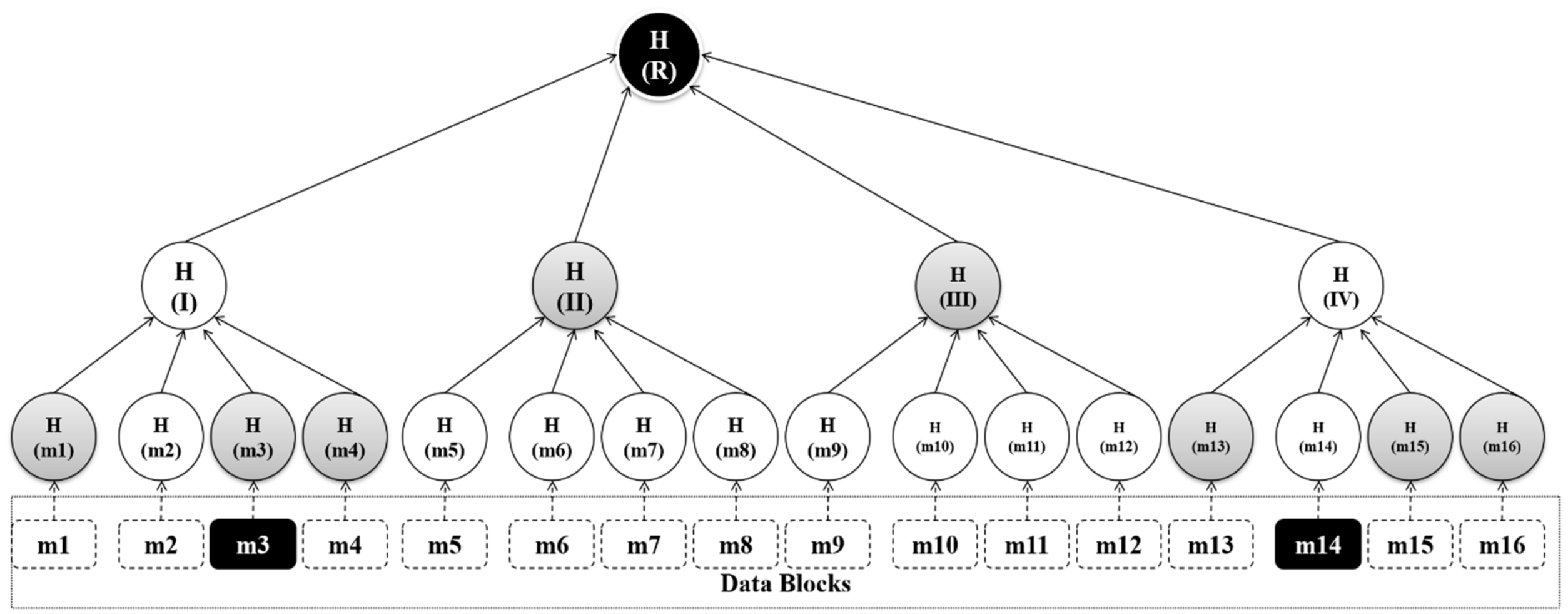
4.2. N-Ary Hash Tree Construction
- ║ denotes concatenation;
- k ≤ N is the number of child nodes.
- R is the root digest;
- t is the number of parent nodes at the previous level.
Complexity Analysis
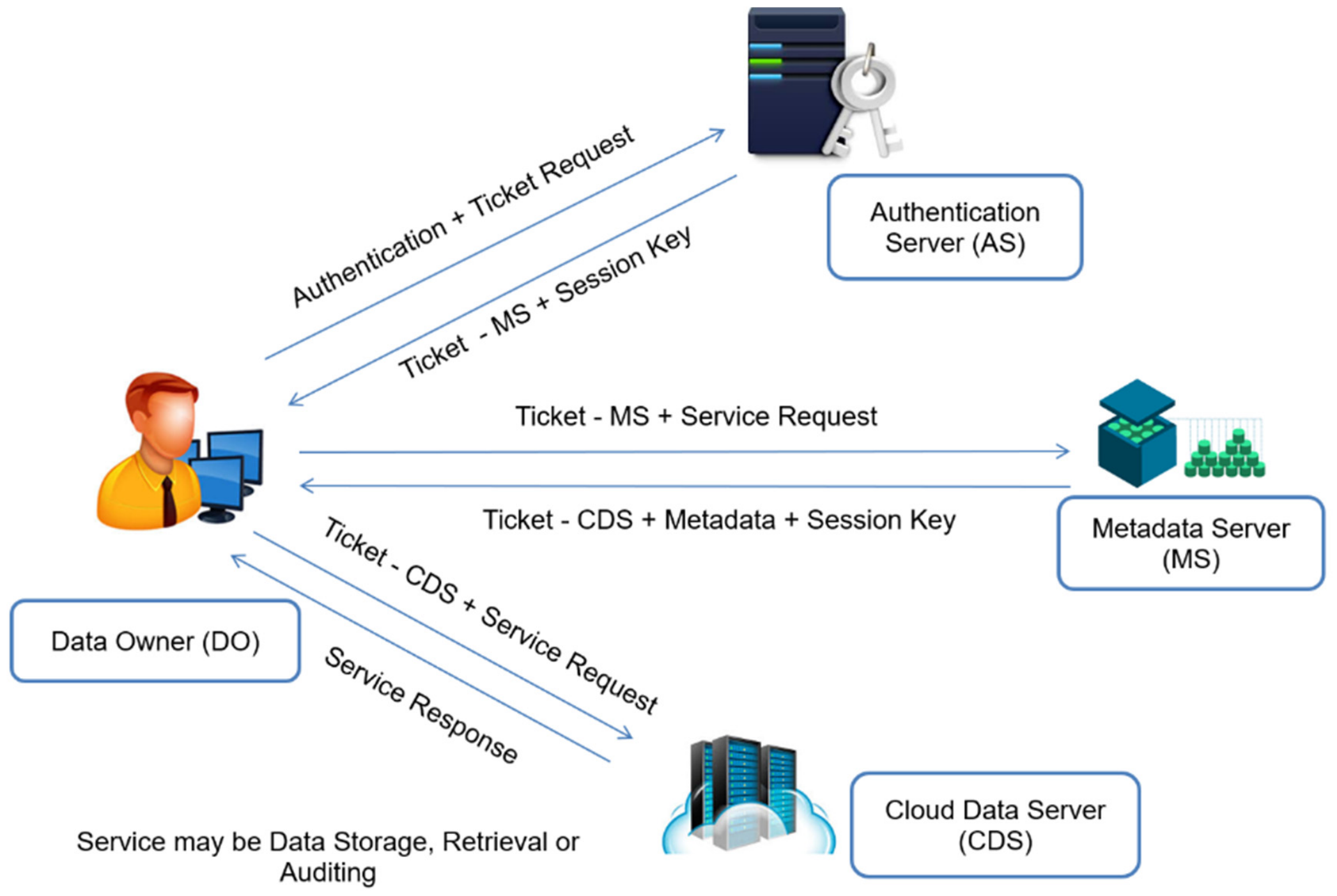
4.3. Kerberos-Based Authenticated Service Exchange
- Authentication Server (AS);
- Metadata Server (MS);
- Cloud Data Server (CDS);
- Data Owner (DO);
- DO authenticates with the AS;
- AS sends MS a service ticket;
- MS authenticates the ticket and provides a service ticket for CDS;
- CDS provides services such as storage, retrieval, updating, and auditing.
Message Complexity
4.4. Integrity Verification Model
4.5. Formal Protocol Definition
4.6. Notations
| (PB, PR) | Public key and private key pairs |
| || | Concatenation |
| ⌈·⌉ | Ceiling function |
| ACL | Access Control List |
| ADc | Prevents access from a workstation initiated to another workstation |
| AS | Authentication Server |
| ATc | Generated by DO to validate TK |
| AuthPathi | N-ary authentication path |
| B | Set of block names corresponding to M |
| CDS | Cloud Data Server |
| D | Depth (height) of the N-ary hash tree |
| DF/F | Data File/Filename |
| DO | Data Owner. |
| E | Error block set |
| e | Error blocks hashed block name |
| EDF | Encrypted Data File |
| EK (m) | Symmetric Encryption |
| EK() | Symmetric encryption function with K |
| EK(·) | Symmetric encryption using key K |
| FA/BA | File-level/Block-level Auditing |
| FID | Unique file identifier. |
| fs/bs | File size/block size |
| H = {H1, H2, …, Hn} | Set of block hash values |
| h(·) | Collision-resistant cryptographic hash function |
| h(B′) | Set of hash block names used for update |
| h(B) | Set of the hashed block names |
| h(F) | Hashed file name |
| h(m) | MMH-32 hash function |
| h(M′)/h(M′) | Set of computed hash values of data blocks |
| h(M) | Set of hashed data blocks |
| h(Me) | Hash values of Me |
| h(R) | Hashed root value of N-ary hash tree |
| h(R′)/h(RN)/h(RN′) | Computed hash root value |
| H′ | Updated block hash set |
| Hc | Hash values of challenged blocks |
| Hi = h (mi) | Hash value of the ith data block |
| I | Challenge Index Set |
| IDDO/IDAS/IDMS/IDCDS | Identity of DO/AS/MS/CDS |
| IHV′ | Computed Intermediate Hash Values |
| IHV | Intermediate Hash Values |
| K/n | Key file/number of blocks |
| k | Number of challenged blocks |
| KDO-AS | Secret key—to enable and access communications of DO and AS |
| KDO-CDS | Session key—to enable and access communications of DO and CDS |
| KDO-MS | Session key—to enable and access communications of DO and MS |
| LT | Ticket Lifetime |
| m/C | Set of blocks to be challenged |
| M = {m1, m2, …, mn} | Set of data blocks obtained by dividing EDF |
| M | Actual data blocks of DF |
| MACk(m) | Message authentication code |
| MD = {FID, n, N, SBO, H, R} | Metadata maintained by the Metadata Server |
| Me | Data blocks corresponding to e |
| mi | The ith encrypted data block. |
| mij | Data block corresponding to challenge index |
| MS | Metadata Server |
| N | Branching factor/N-ary hash tree—the number of child nodes |
| Nonce/N1/N2 | Nonce—Random Value |
| Nonce | Random Nonce |
| Op | Operation type |
| R = NHT(H) | Root hash computed from the set of block hash values using the N-ary hash tree/authentic root hash stored in Metadata Server |
| R | Root hash generated by the N-ary hash tree |
| R(e) | Replicas of error blocks e |
| R′ | Updated root hash/reconstructed root hash from challenge response |
| S/R/U | Storage/Retrieval/Update |
| SBO | Storage Block Ordering |
| Scope | Authorization Scope |
| SigDO (MDnew) | Data Owner Signature (or MAC) |
| SigFDO(m) | Digital signature |
| SK/K | Symmetric key used for secure communication |
| Tag(mi) | Authentication Tag |
| Times | Ticket time settings [from, till, renew] |
| TKMS/TKCDS | Ticket used by DO to access MS/CDS |
| TS/TS′ | Time Stamp/Updated Time Stamp |
| Version + 1 | Updated metadata version |
5. Proposed Scheme
5.1. Overview of the SDAP-K Architecture
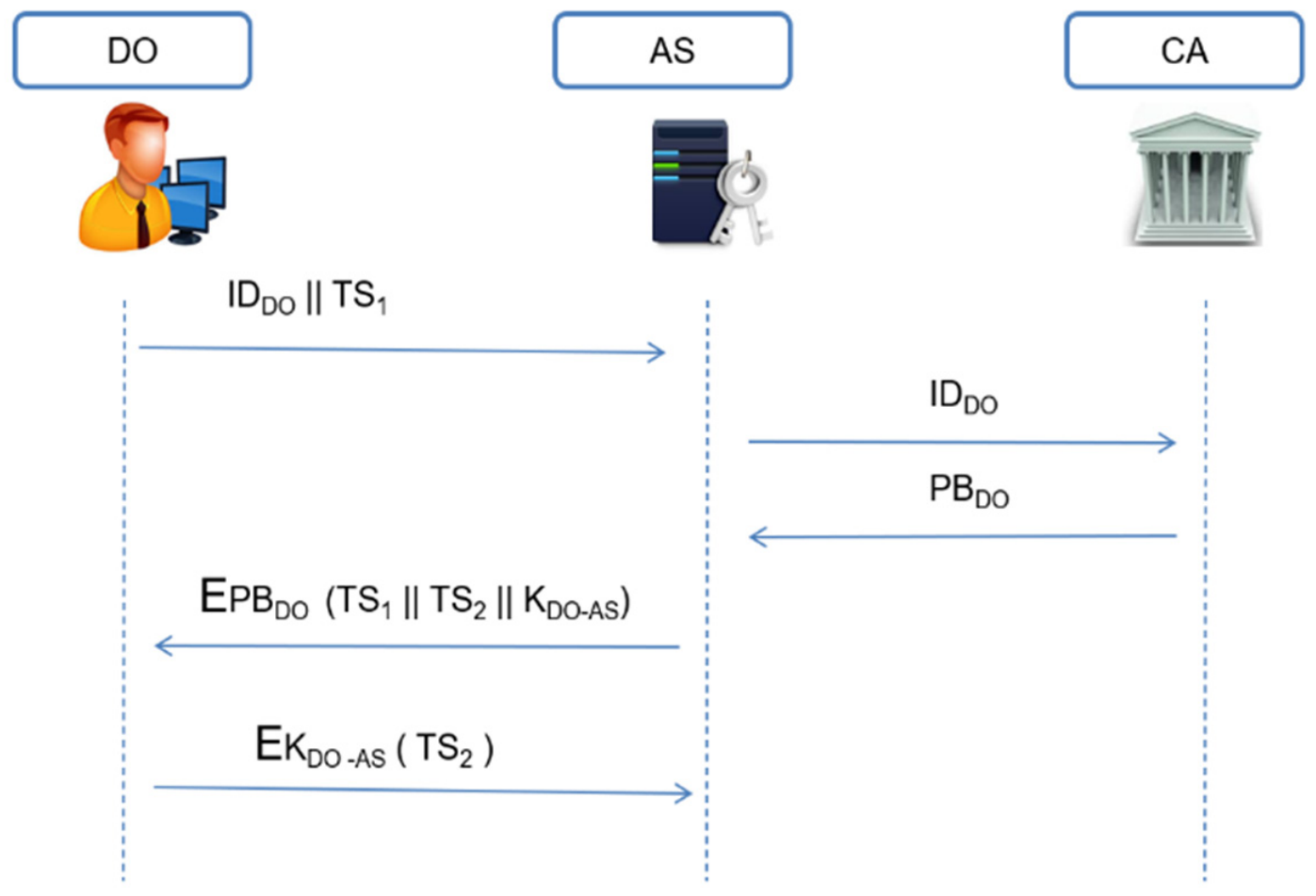
5.2. Authenticated Service Exchange
Kerberos Ticket Structure and Authorization
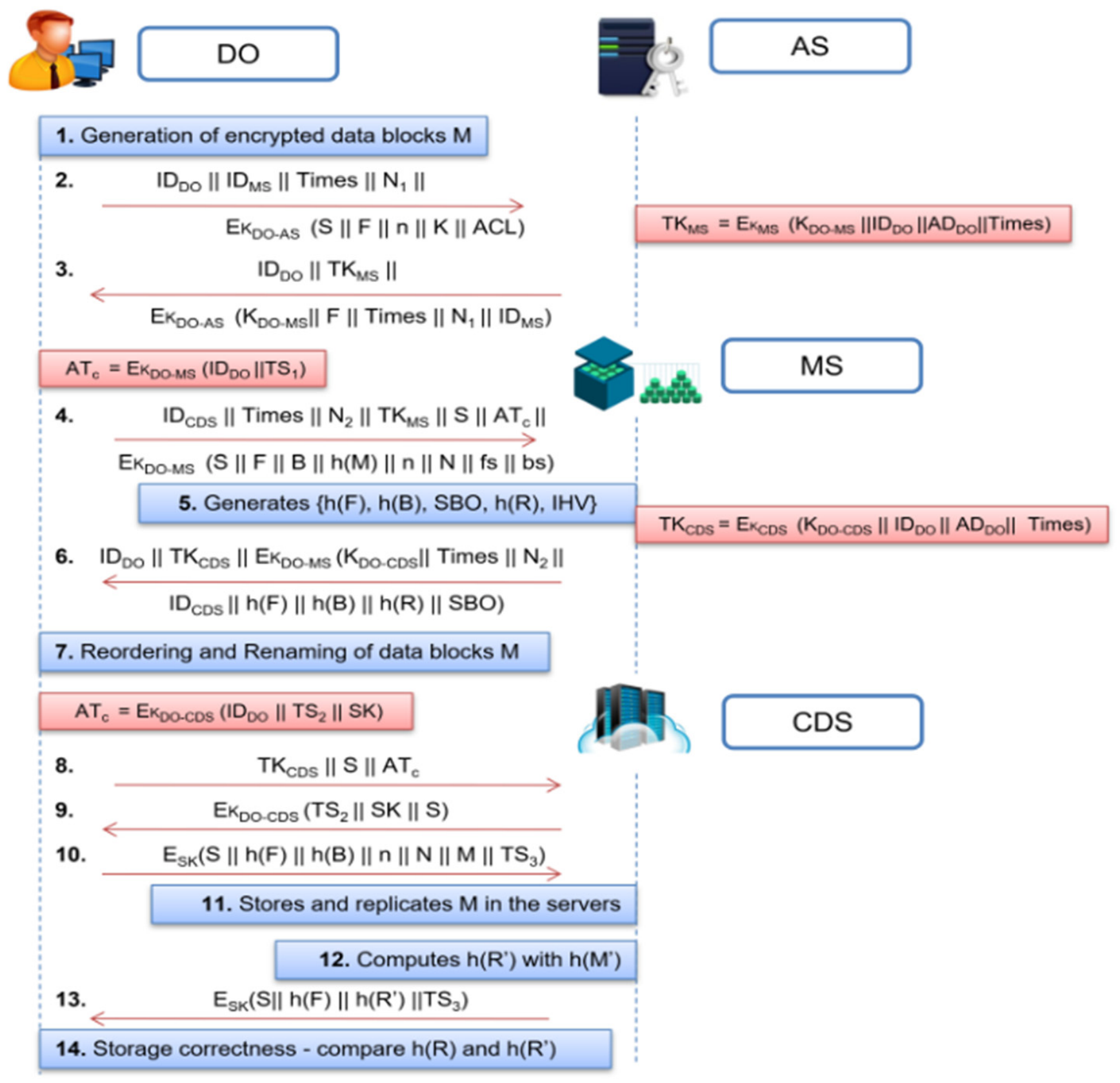
5.3. Secure Data Storage Procedure
| Algorithm 2: Data Storage |
| Input: Data file (DF), branching factor (N) |
| Output: Stored data blocks and metadata (MD) |
| Step 1: Divide (DF) into (n) blocks: (DF = {m1, m2,…, mn}) |
| Step 2: Compute block hashes: (Hi = h(mi)) |
| Step 3: Construct an N-ary hash tree and compute the root (R). |
| Step 4: Generate metadata (MD = {FID, n, N, SBO, H, R}). |
| Step 5: Store metadata in MS. |
| Step 6: Send ordered encrypted data blocks to CDS. |
| Step 7: CDS stores blocks and computes (R′). |
| Step 8: If (R′ = R), storage is verified; otherwise, initiate error localization. |
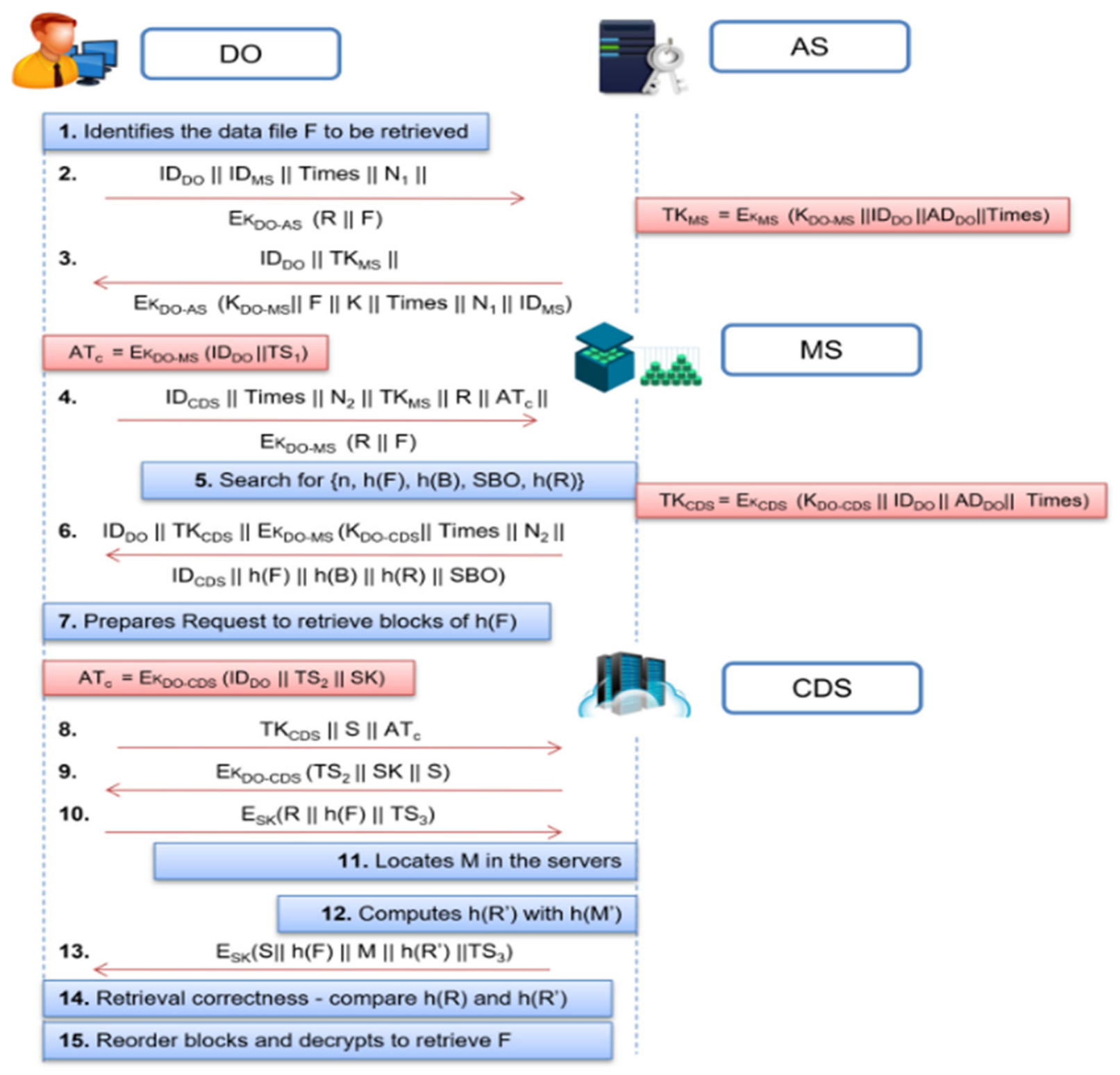
5.4. Secure Data Retrieval Procedure
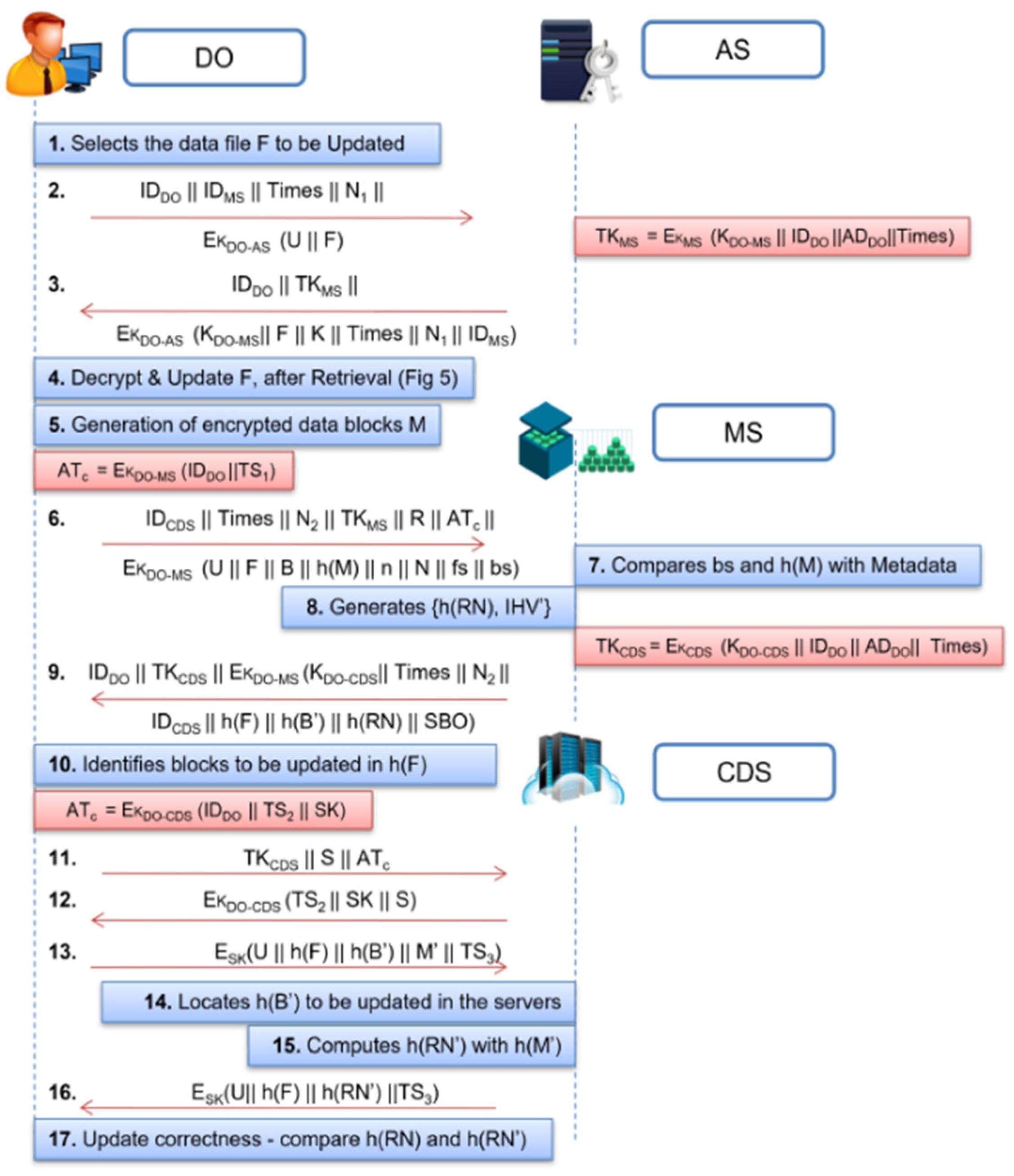
5.5. Dynamic Data Update Procedure
Metadata Version Synchronization
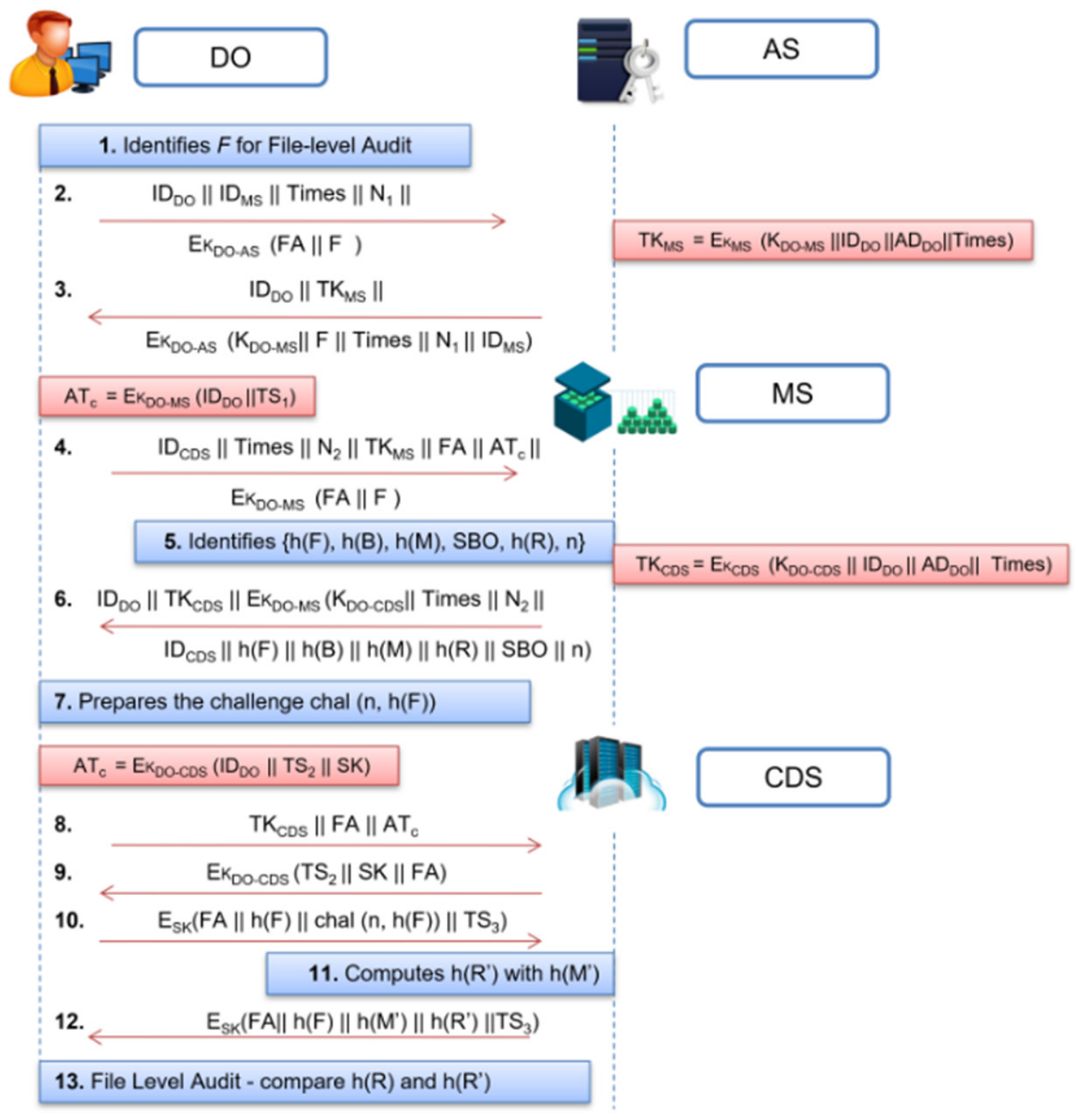
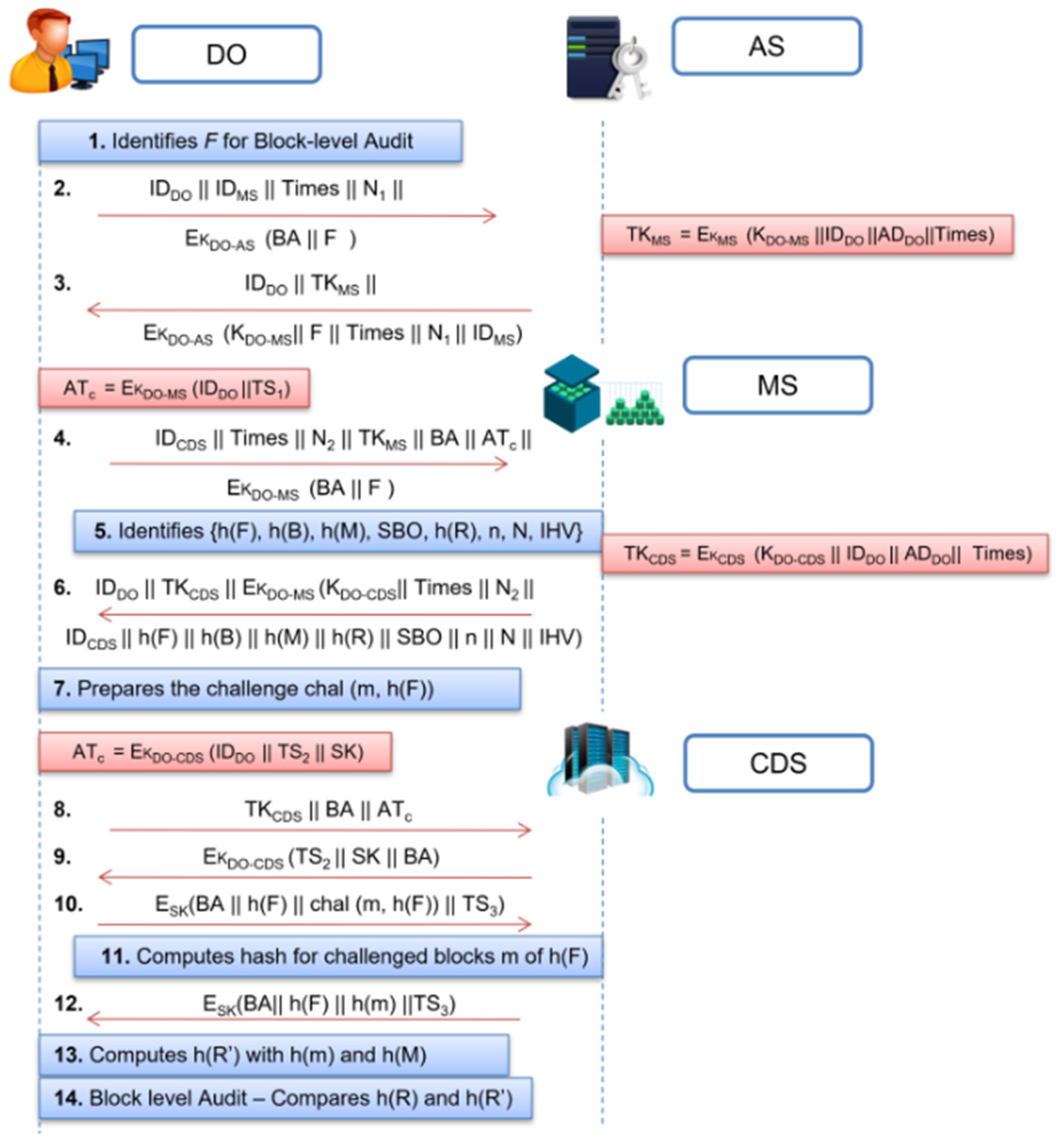
5.6. File—Level Auditing
| Algorithm 3: File-Level Auditing |
| Input: File identifier (FID), metadata (MD) |
| Output: Integrity verification result |
| Step 1: DO obtains (R) from MS. |
| Step 2: DO sends file-level challenge (ChalF = (FIDn)) to CDS |
| Step 3: CDS computes root hash (R′). |
| Step 4: DO compares (R′) with (R). |
| Step 5: If (R′ = R), return TRUE. |
| Step 6: Otherwise, return FALSE and initiate error localization. |
5.7. Block—Level Auditing
| Algorithm 4: Block-Level Auditing |
| Input: File identifier (FID), challenge index set (I), metadata (MD) |
| Output: Integrity verification result |
| Step 1: DO selects challenge index set (I = {i1, i2, …, ik}) |
| Step 2: DO generates (Nonce, TS) and sends ChalB = {FID, I, Nonce, TS} |
| Step 3: CDS returns ProofB = {Tag(mi), AuthPathi, Nonce, TS} |
| Step 4: DO verifies nonce freshness and the authentication path, and reconstructs the root hash. |
| Step 5: Accept only if Nonce, TS, AuthPath, and Root Hash are valid |
| Step 6: Otherwise, return FALSE and initiate error localization. |
5.8. Error Localization and Recovery
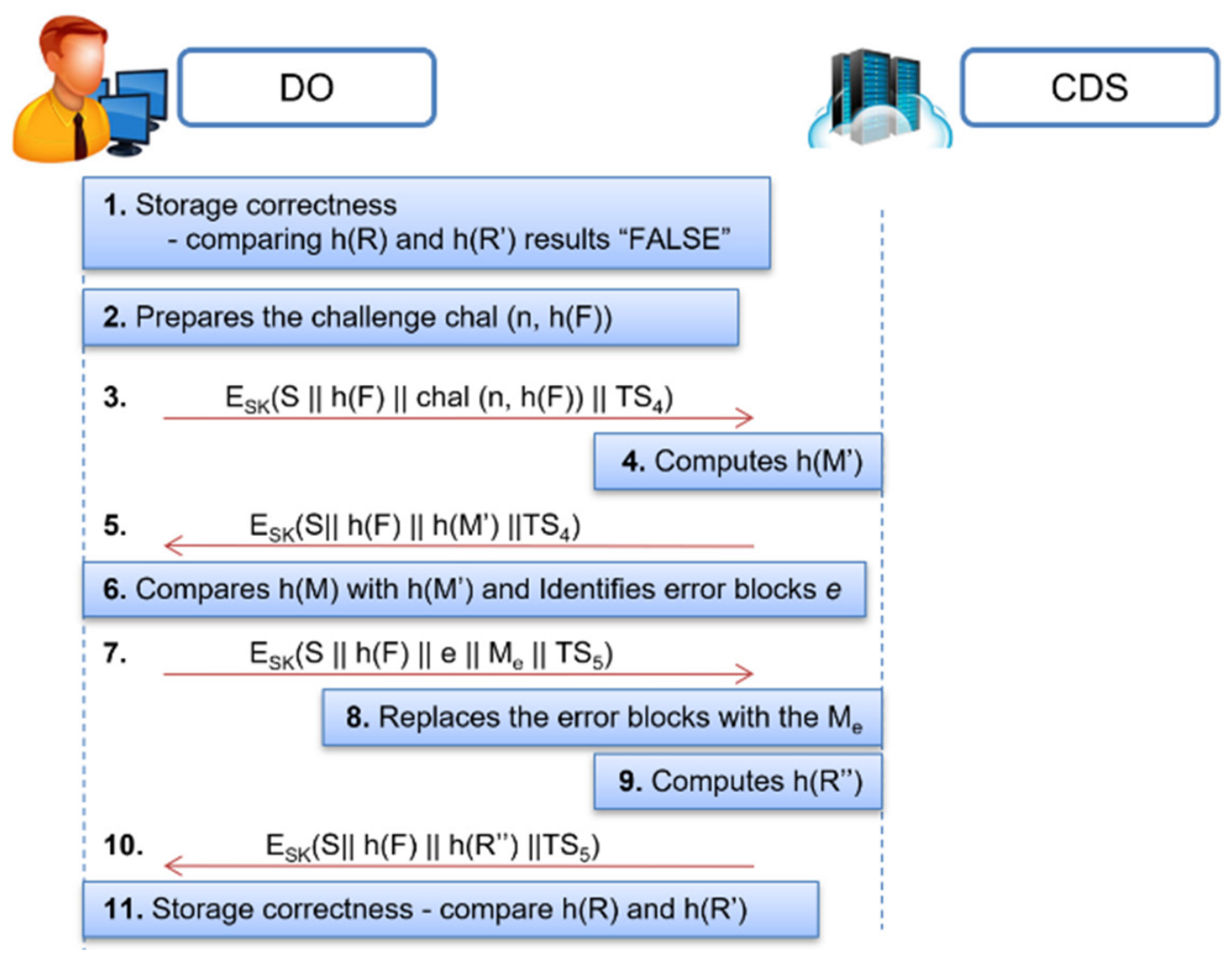
5.8.1. Data Storage—Error Localization and Recovery
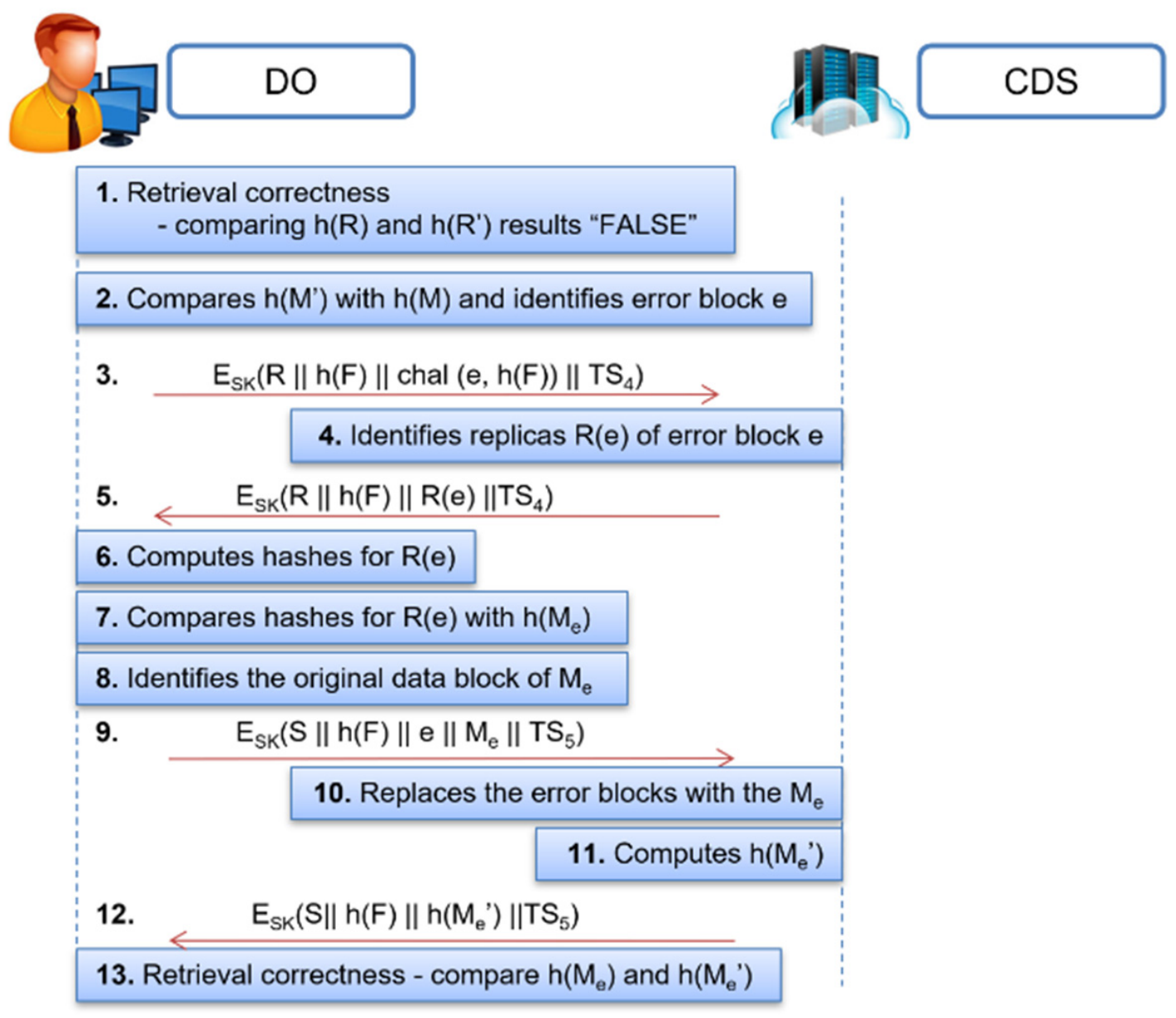
5.8.2. Data Retrieval—Error Localization and Recovery
5.8.3. Replica Validation and Recovery
5.9. Complexity and Scalability Analysis
6. Security Analysis
6.1. Security Model and Assumptions
6.1.1. Adversary Model
- External Network Adversary: An external adversary can intercept, modify, replay, or inject messages exchanged between the Data Owner (DO), Authentication Server (AS), Metadata Server (MS), and Cloud Data Server (CDS). However, the adversary is assumed to be unable to break standard cryptographic primitives in polynomial time.
- Malicious Cloud Data Server: The CDS can try to delete, modify, replace, or hide corrupted data blocks. It can also try to return incorrect auditing responses. But the CDS does not have the Data Owner’s private keys or valid Kerberos session credentials.
- Insider Adversary: A legitimate but malicious user may attempt to abuse authorized access, request unauthorized metadata, or perform improper auditing operations. These are prevented through ticket-based authorization and access control.
6.1.2. Cryptographic Assumptions
- AES-256provides secure encryption for authenticated communication.
- , where is assumed to be a collision-resistant hash function.
6.2. Authentication Security
6.3. Integrity Verification Security
6.4. Resistance to Replay Attacks
6.4.1. Timestamp Freshness Verification
- = current system time;
- = timestamp received in the request;
- = maximum allowable time difference.
6.4.2. Ticket Validity Condition
- = ticket issuance time;
- = ticket expiration time.
6.4.3. Replay Detection Condition
6.4.4. Authentication Acceptance Decision
6.4.5. Optional Nonce-Based Freshness
- = received nonce;
- = set of previously accepted nonces;the final replay-resistance condition becomes
6.5. Resistance to Man-in-the-Middle Attacks
6.6. Resistance to Forgery and Unauthorized Access
6.6.1. Ticket Forgery
6.6.2. Metadata Forgery
6.6.3. Data Block Forgery
6.7. Error Localization Security
- = set of corrupted (error) data blocks;
- = authentic hash value of block ;
- = received or recomputed the hash value of the block ;
- = total number of data blocks.
- = recovered block hash set;
- = root hash after recovery;
- = N-ary hash tree construction function.
6.8. Security Feature Comparison
6.9. Trust Assumptions and Limitations
- Initially, AS and MS are trusted or semi-trusted entities. If AS is compromised, authentication tickets and access control decisions may be affected. If MS is compromised, the integrity of metadata may be at risk. Therefore, secure server hardening, audit logging, access control, and metadata backup mechanisms should be included in practical deployment.
- Second, session keys and private credentials must be protected. If a valid user credential or session key is compromised, an adversary may impersonate the user until the corresponding ticket expires or the key is revoked. Therefore, ticket lifetime management, key revocation, and credential protection are necessary.
- Third, SDAP—K does not primarily address denial-of-service attacks. An adversary may attempt to disrupt access to AS, MS, or CDS. Replication, load balancing, and failover deployment can reduce this risk.
- Finally, the proposed framework is designed as a practical, authenticated cloud auditing architecture. It provides security under stated cryptographic and operational assumptions, but it is not intended to replace fully decentralized, blockchain-based, or formally verified cryptographic auditing systems.
7. Performance Analysis
7.1. Experimental Setup
7.2. Evaluation Metrics
- Computation Overhead: Time required for processing storage, retrieval, update, and auditing operations;
- Communication Overhead: The network communications required between protocol entities;
- Auditing Latency: Time taken for integrity verification;
- Metadata Overhead: Storage needed to store auditing metadata;
- Scalability: How performance behaves as the number of data blocks increases.
- = average execution time;
- = execution time of the experimental run;
- = total number of experimental runs.
7.3. Fairness of Comparative Evaluation
Baseline Schemes for Comparison
7.4. Communication Overhead Analysis
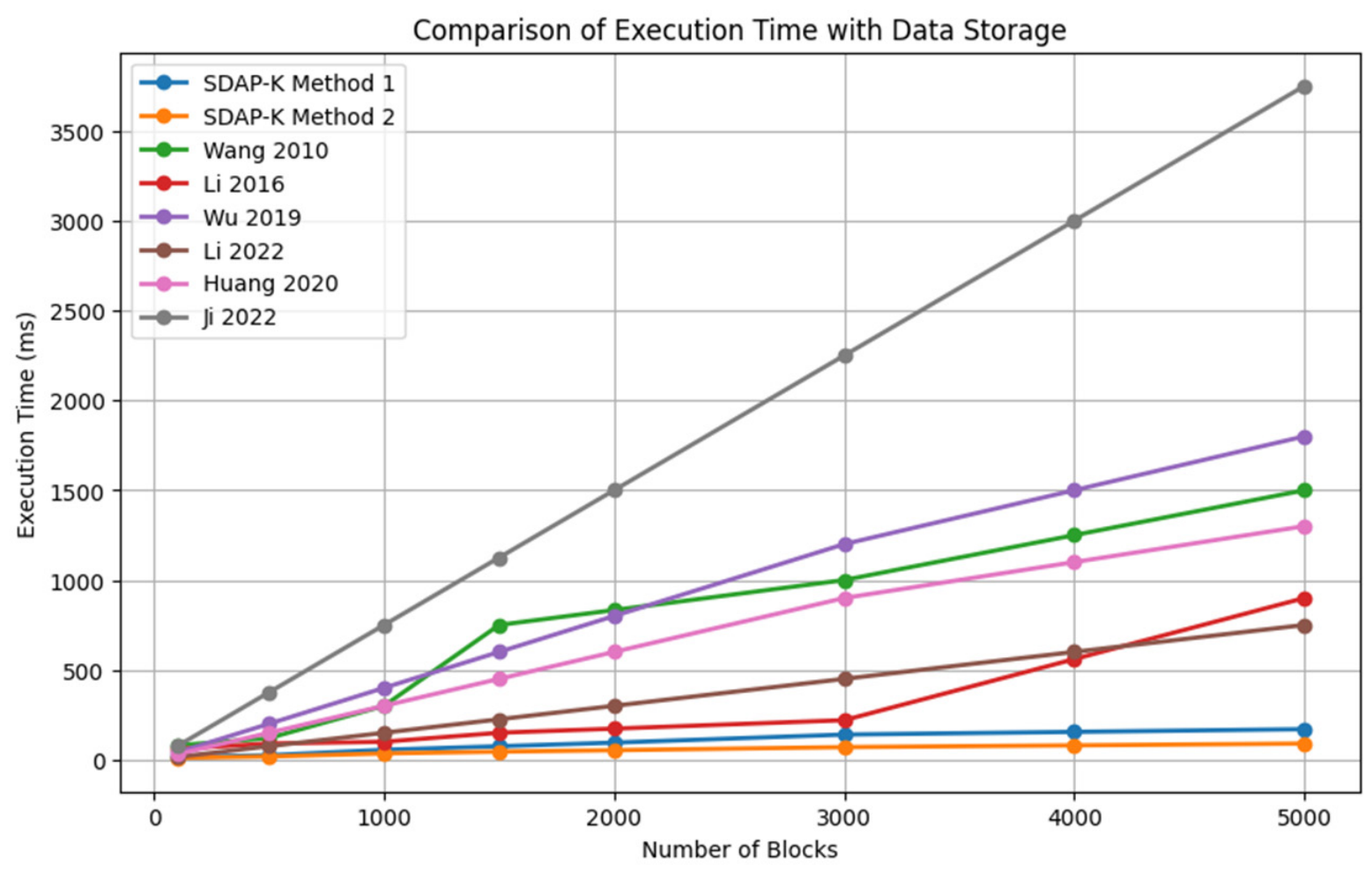
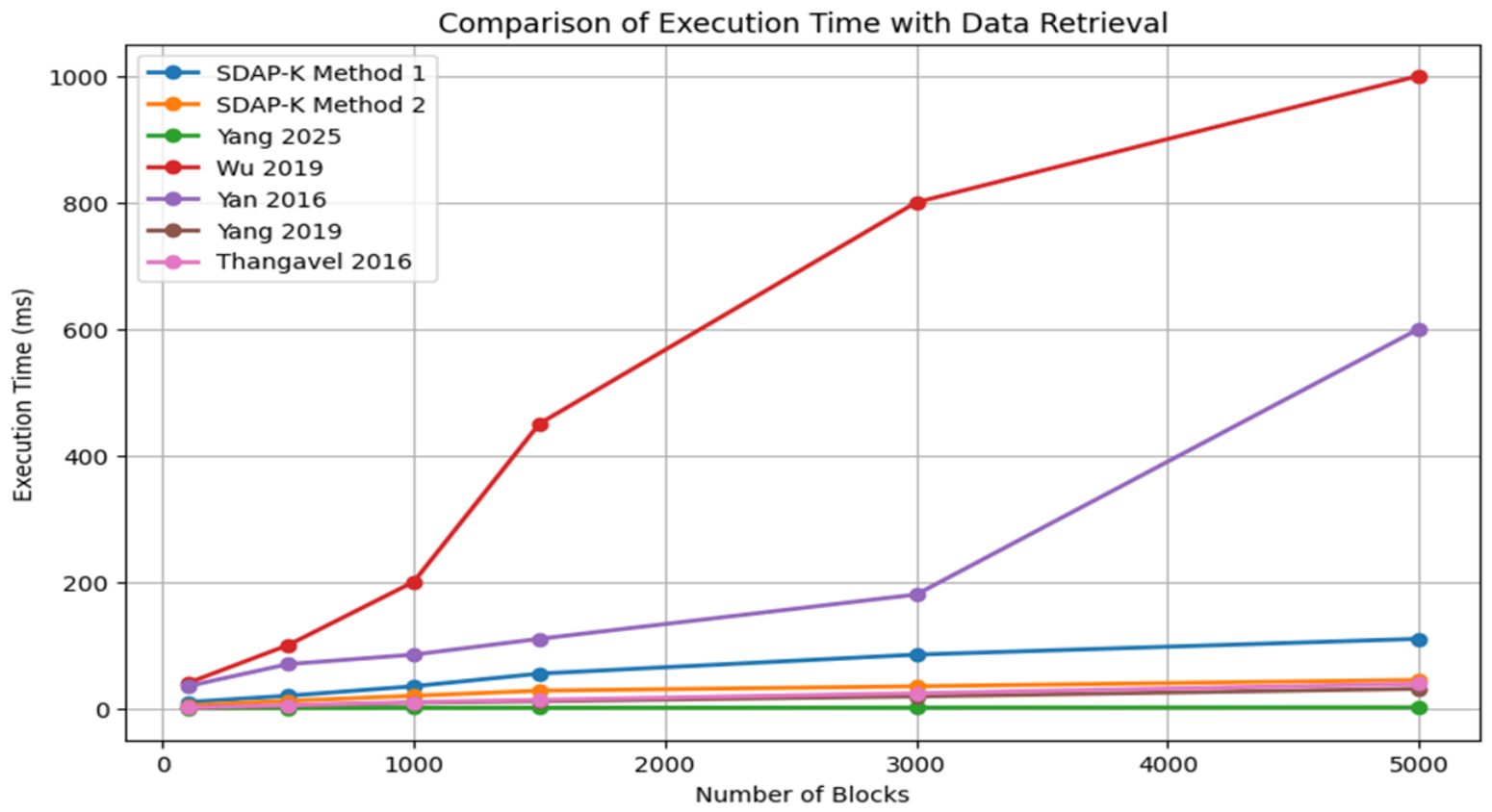
7.5. Storage and Retrieval Performance
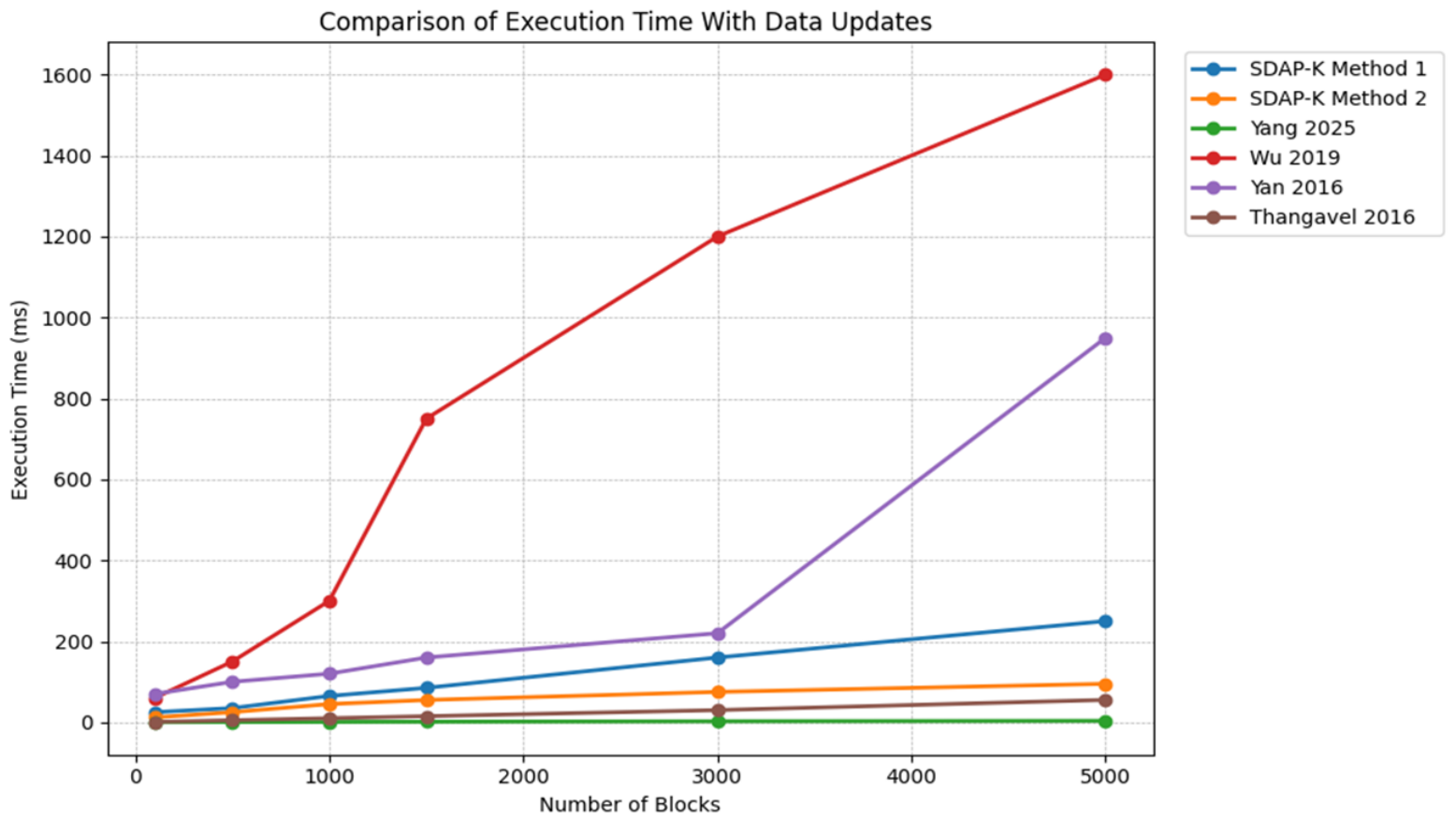
7.6. Dynamic Data Update Performance
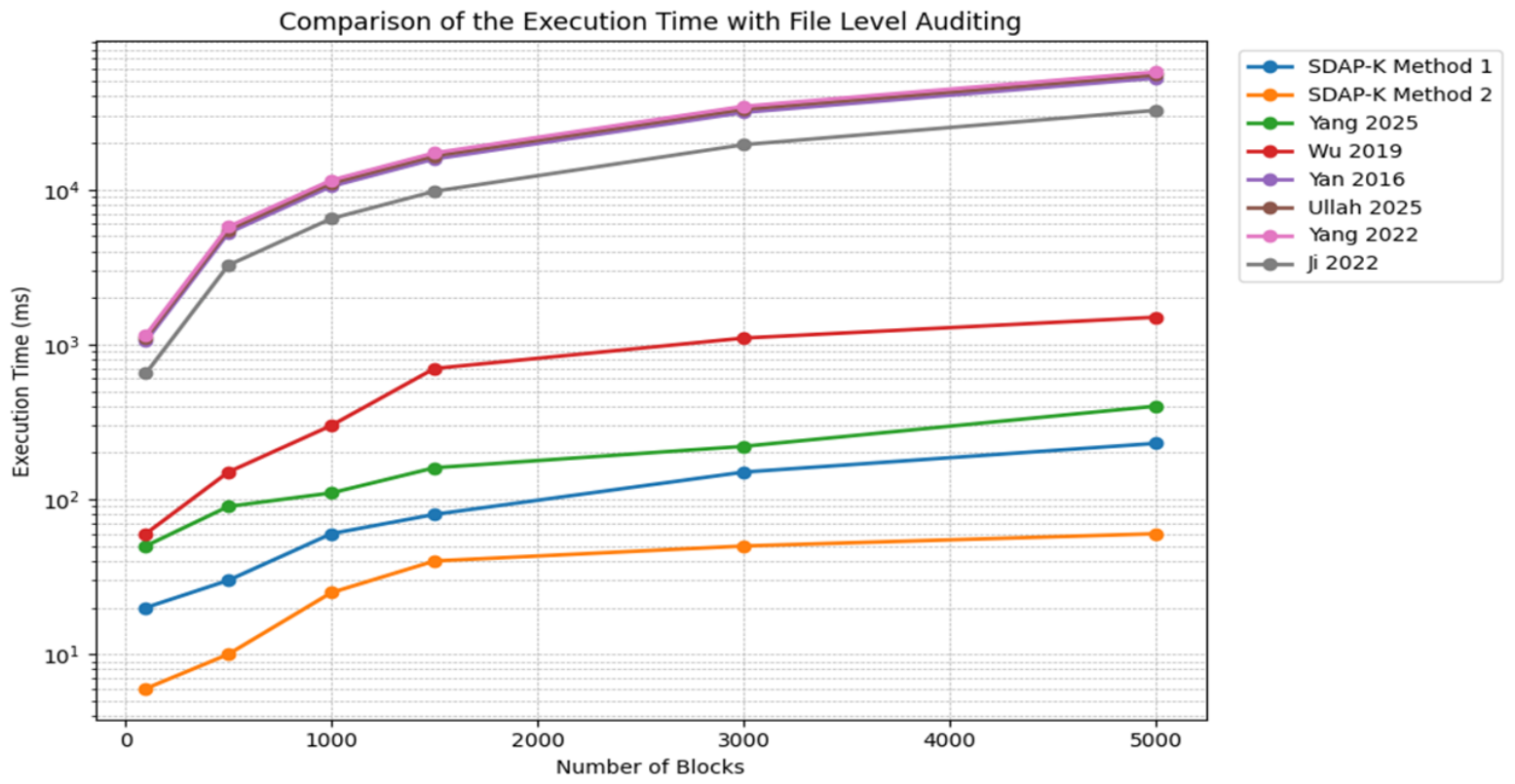
7.7. File-Level Auditing Performance
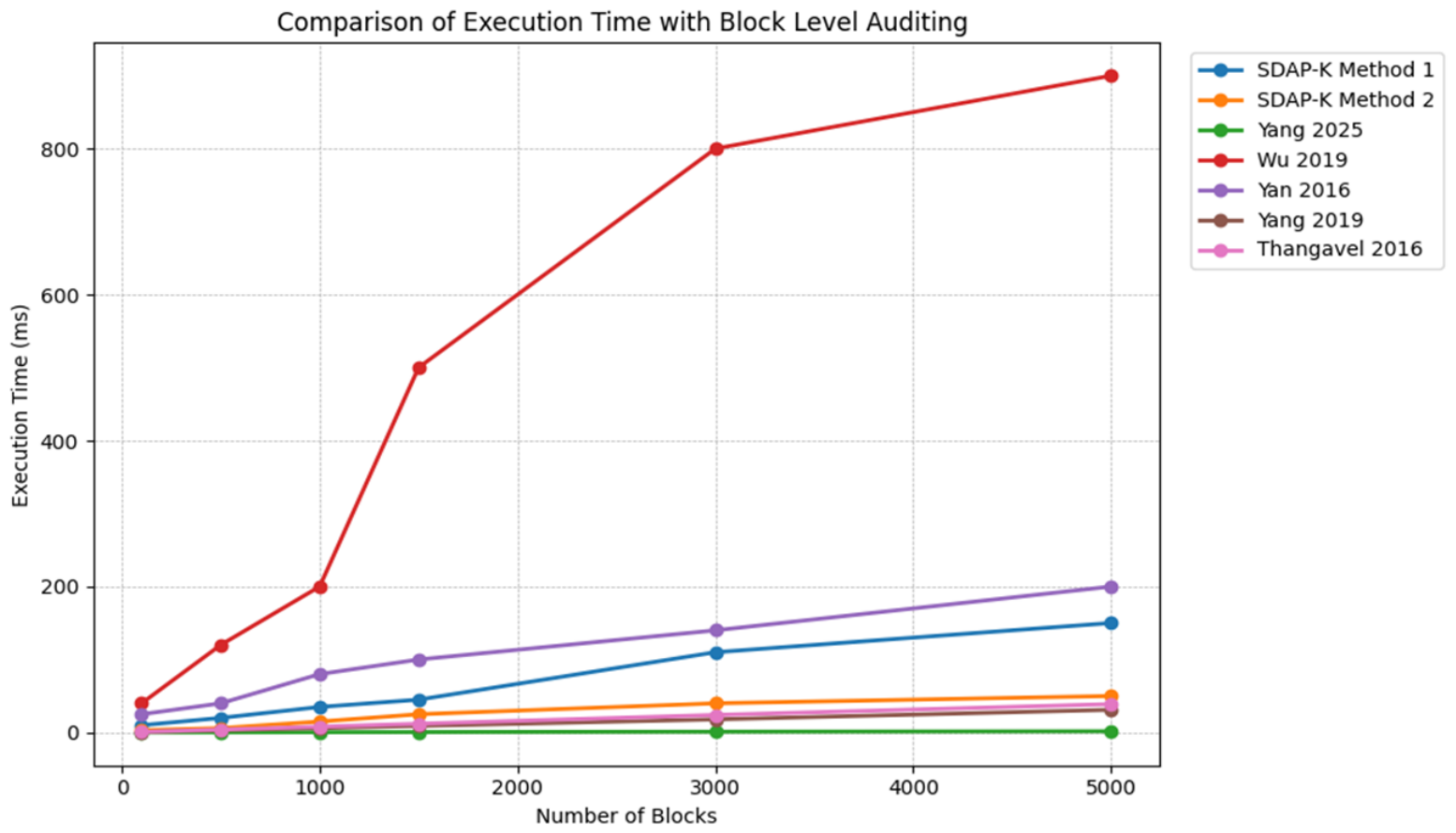
7.8. Block-Level Auditing Performance
- (k) is the number of challenged blocks;
- (n) is the total number of blocks;
- (N) is the N-ary tree branching factor.
- = depth (height) of the N-ary hash tree;
- = total number of data blocks (leaf nodes);
- = branching factor of the N-ary hash tree;
- ⌈.⌉ = ceiling function.
Effect of N-Ary Branching Factor
7.9. Scalability Analysis
7.10. Security and Overhead Tradeoff Discussion
Centralization and Deployment Tradeoffs
7.11. Discussion
7.11.1. Interpretation of Performance Results
7.11.2. Impact of Kerberos Authentication
7.11.3. Impact of Metadata Server
7.11.4. Scalability and Bottlenecks
7.11.5. Security–Performance Tradeoff
7.11.6. Limitations
8. Conclusions
Author Contributions
Funding
Data Availability Statement
Acknowledgments
Conflicts of Interest
References
- Guan, X.; Chang, J.; Zhang, W. Secure data sharing scheme with privacy-preserving and certificateless integrity auditing in cloud storage. Comput. Commun. 2024, 224, 285–301. [Google Scholar] [CrossRef]
- Yang, C.; Liu, Y.; Ding, Y.; Liang, H. Secure data migration from fair contract signing and efficient data integrity auditing in cloud storage. J. Netw. Comput. Appl. 2025, 239, 104173. [Google Scholar] [CrossRef]
- Liu, Y. Build an audit Framework for data privacy Protection in Cloud Environment. Procedia Comput. Sci. 2024, 247, 166–175. [Google Scholar] [CrossRef]
- Liu, Y. The Latest Application and Security Analysis of Cryptography in Cloud Storage Data Audit. Procedia Comput. Sci. 2025, 259, 984–990. [Google Scholar] [CrossRef]
- Tiwari, S.K.; Neogi, S.G. Design and Implementation of Enhanced Security Algorithm for Hybrid Cloud using Kerberos. SN Comput. Sci. 2023, 4, 430. [Google Scholar] [CrossRef]
- Jiang, H.-C.; Feng, C.-S.; Yuan, D. Enabling public and privacy-preserving auditability for cloud storage. In Proceedings of the 2016 International Conference on Machine Learning and Cybernetics (ICMLC), Jeju, Republic of Korea, 10–13 July 2016; Volume 1, pp. 24–28. [Google Scholar] [CrossRef]
- Wang, Q.; Wang, C.; Ren, K.; Lou, W.; Li, J. Enabling public auditability and data dynamics for storage security in cloud computing. IEEE Trans. Parallel Distrib. Syst. 2010, 22, 847–859. [Google Scholar] [CrossRef]
- Li, J.; Zhang, L.; Liu, J.K.; Qian, H.; Dong, Z. Privacy-preserving public auditing protocol for low-performance end devices in cloud. IEEE Trans. Inf. Forensics Secur. 2016, 11, 2572–2583. [Google Scholar] [CrossRef]
- Yu, Y.; Au, M.H.; Ateniese, G.; Huang, X.; Susilo, W.; Dai, Y.; Min, G. Identity-based remote data integrity checking with perfect data privacy preserving for cloud storage. IEEE Trans. Inf. Forensics Secur. 2016, 12, 767–778. [Google Scholar] [CrossRef]
- Aujla, G.S.; Chaudhary, R.; Kumar, N.; Das, A.K.; Rodrigues, J.J. SecSVA: Secure storage, verification, and auditing of big data in the cloud environment. IEEE Commun. Mag. 2018, 56, 78–85. [Google Scholar] [CrossRef]
- Liu, Z.; Wang, S.; Duan, S.; Ren, L.; Wei, J. Dynamic data integrity auditing based on hierarchical merkle hash tree in cloud storage. Electronics 2023, 12, 717. [Google Scholar] [CrossRef]
- Wu, G.; Mu, Y.; Susilo, W.; Guo, F.; Zhang, F. Privacy-preserving certificateless cloud auditing with multiple users. Wirel. Pers. Commun. 2019, 106, 1161–1182. [Google Scholar] [CrossRef]
- Yan, H.; Li, J.; Han, J.; Zhang, Y. A novel efficient remote data possession checking protocol in cloud storage. IEEE Trans. Inf. Forensics Secur. 2016, 12, 78–88. [Google Scholar] [CrossRef]
- Wang, Y.; Wu, Q.; Qin, B.; Shi, W.; Deng, R.H.; Hu, J. Identity-based data outsourcing with comprehensive auditing in clouds. IEEE Trans. Inf. Forensics Secur. 2016, 12, 940–952. [Google Scholar] [CrossRef]
- Shajina, A.R.; Varalakshmi, P. A novel dual authentication protocol (DAP) for multi-owners in cloud computing. Clust. Comput. 2017, 20, 507–523. [Google Scholar] [CrossRef]
- Yang, C.; Song, B.; Ding, Y.; Ou, J.; Fan, C. Efficient data integrity auditing supporting provable data update for secure cloud storage. Wirel. Commun. Mob. Comput. 2022, 2022, 5721917. [Google Scholar] [CrossRef]
- Wang, L.; Guan, R.; Hu, J.; Chen, Z. A Cloud Storage Auditing Scheme Based on Identity-Based Signature. In Proceedings of the 2025 IEEE 8th Information Technology and Mechatronics Engineering Conference (ITOEC), Chongqing, China, 17–18 March 2025; Volume 8, pp. 576–581. [Google Scholar] [CrossRef]
- Thangavel, M.; Varalakshmi, P.; Sridhar, S.; Sindhuja, R. Privacy Preserving Public Auditing in Cloud: Literature Review. In Cloud Security: Concepts, Methodologies, Tools, and Applications; IGI Global Scientific Publishing: Hershey, PA, USA, 2019; pp. 2059–2083. [Google Scholar] [CrossRef]
- Thangavel, M.; Varalakshmi, P.; Sindhuja, R.; Sridhar, S. A survey on provable data possession in cloud storage. In Proceedings of the 2016 Eighth International Conference on Advanced Computing (ICoAC), Chennai, India, 19–21 January 2017; pp. 25–31. [Google Scholar] [CrossRef]
- Data Breaches. 2017. Available online: https://www.crn.com/slide-shows/security/300089736/the-10-biggest-data-breaches-of-2017-so-far (accessed on 22 July 2026).
- Data Breaches. 2016. Available online: http://www.crn.com/slide-shows/security/300081491/the-10-biggest-data-breaches-of-2016-so-far (accessed on 22 July 2026).
- Data Breaches. 2015. Available online: https://www.crn.com/slide-shows/security/300077563/the-10-biggest-data-breaches-of-2015-so-far (accessed on 22 July 2026).
- Murmur Hash. Available online: https://en.wikipedia.org/wiki/MurmurHash (accessed on 22 July 2026).
- Li, J.; Yan, H.; Zhang, Y. Efficient identity-based provable multi-copy data possession in multi-cloud storage. IEEE Trans. Cloud Comput. 2019, 10, 356–365. [Google Scholar] [CrossRef]
- Li, R.; Wang, X.A.; Yang, H.; Niu, K.; Tang, D.; Yang, X. Efficient certificateless public integrity auditing of cloud data with designated verifier for batch audit. J. King Saud. Univ.-Comput. Inf. Sci. 2022, 34, 8079–8089. [Google Scholar] [CrossRef]
- Huang, L.; Zhou, J.; Zhang, G.; Zhang, M. Certificateless public verification for data storage and sharing in the cloud. Chin. J. Electron. 2020, 29, 639–647. [Google Scholar] [CrossRef]
- Zhou, L.; Fu, A.; Yang, G.; Wang, H.; Zhang, Y. Efficient certificateless multi-copy integrity auditing scheme supporting data dynamics. IEEE Trans. Dependable Secur. Comput. 2020, 19, 1118–1132. [Google Scholar] [CrossRef]
- Yang, C.; Tao, X.; Zhao, F. Publicly verifiable data transfer and deletion scheme for cloud storage. Int. J. Distrib. Sens. Netw. 2019, 15, 1550147719878999. [Google Scholar] [CrossRef]
- Wang, M.; Yu, J.; Shen, W.; Hao, R. Privacy-preserving time-based auditing for secure cloud storage. IEEE Trans. Inf. Forensics Secur. 2024, 19, 7866–7878. [Google Scholar] [CrossRef]
- Zhang, W.; Jiao, H.; Yan, Z.; Wang, X.; Khan, M.K. Security analysis and improvement of a public auditing scheme for secure data storage in fog-to-cloud computing. Comput. Secur. 2023, 125, 103019. [Google Scholar] [CrossRef]
- Ullah, F.; Pun, C.-M.; Mohmand, M.I.; Mahendran, R.K.; Khan, A.A.; Alhammad, S.M.; Rodrigues, J.J.; Farouk, A. Privacy-aware secure data auditing for cloud-based intelligence of things environment. IEEE Internet Things J. 2025, 12, 15288–15303. [Google Scholar] [CrossRef]
- Thangavel, M.; Varalakshmi, P.; Sridhar, S. An analysis of privacy preservation schemes in cloud computing. In Proceedings of the 2016 IEEE International Conference on Engineering and Technology (ICETECH), Coimbatore, India, 14–16 March 2016; pp. 146–151. [Google Scholar] [CrossRef]
- Yang, C.; Liu, Y.; Zhao, F.; Zhang, S. Provable data deletion from efficient data integrity auditing and insertion in cloud storage. Comput. Stand. Interfaces 2022, 82, 103629. [Google Scholar] [CrossRef]
- Yu, H.; Yang, Z.; Waqas, M.; Tu, S.; Han, Z.; Halim, Z.; Sinnott, R.O.; Parampalli, U. Efficient dynamic multi-replica auditing for the cloud with geographic location. Future Gener. Comput. Syst. 2021, 125, 285–298. [Google Scholar] [CrossRef]
- Gudeme, J.R.; Pasupuleti, S.K.; Kandukuri, R. Certificateless multi-replica public integrity auditing scheme for dynamic shared data in cloud storage. Comput. Secur. 2021, 103, 102176. [Google Scholar] [CrossRef]
- Ji, Y.; Shao, B.; Chang, J.; Xu, M.; Xue, R. Identity-based remote data checking with a designated verifier. J. Cloud Comput. 2022, 11, 7. [Google Scholar] [CrossRef]



| Ref. | Authentication | Integrity Auditing | TPA Required | Dynamic Updates | Error Localization | Metadata Management | Public Auditing | Privacy Preservation | Formal Verification |
|---|---|---|---|---|---|---|---|---|---|
| [5] | ✓ | × | × | N/A | × | × | × | × | × |
| [6] | ✓ | × | × | N/A | × | × | × | × | × |
| [7] | × | ✓ | ✓ | ✓ | × | Partial | ✓ | ✓ | × |
| [8] | × | ✓ | ✓ | Limited | × | Partial | ✓ | ✓ | × |
| [9] | ✓ | × | × | N/A | × | × | × | × | × |
| [10] | ✓ | × | × | N/A | × | × | × | × | × |
| [11] | × | ✓ | ✓ | ✓ | × | Partial | ✓ | × | × |
| [12] | × | ✓ | × | ✓ | × | Partial | ✓ | ✓ | × |
| [15] | ✓ | × | × | N/A | × | × | × | × | × |
| [16] | × | ✓ | × | ✓ | × | Partial | ✓ | × | × |
| [17] | × | ✓ | ✓ | ✓ | × | Partial | ✓ | × | × |
| [24] | × | ✓ | × | ✓ | × | Partial | ✓ | ✓ | × |
| [25] | × | ✓ | × | ✓ | × | Partial | ✓ | ✓ | × |
| [29] | × | ✓ | ✓ | Limited | × | Partial | ✓ | ✓ | × |
| [30] | × | ✓ | × | ✓ | × | Partial | ✓ | ✓ | × |
| [31] | Partial | ✓ | × | ✓ | × | Partial | ✓ | × | × |
| [33] | ✓ | × | × | N/A | × | × | × | × | × |
| [35] | × | ✓ | ✓ | ✓ | × | Partial | ✓ | × | × |
| SDAP-K | ✓ | ✓ | × | ✓ | ✓ | ✓ | × | × | × |
| Operation | Complexity |
|---|---|
| Tree Construction | O(n) |
| File—Level Auditing | O(n) |
| Block—Level Auditing | O(logn) |
| Root Verification | O(1) |
| Exchange | Messages |
|---|---|
| DO-AS | 2 |
| DO-MS | 2 |
| DO-CDS | 2 |
| Component | Definition |
|---|---|
| Entities | Data Owner (DO), Authentication Server (AS), Metadata Server (MS), Cloud Data Server (CDS) |
| Keys | Long-term secret keys, Kerberos session keys, encryption keys |
| Service Tickets | Kerberos tickets authorizing specific cloud operations |
| Metadata Record | (MD = {FID, Version, n, N, SBO, H, R, TS, Sig_{DO}(MD)}) |
| Audit Challenge | (Chal_B = {FID, I, Nonce, TS}) |
| Audit Response | (Proof_B = {Tag(m_i), AuthPath_i, Nonce, TS}) |
| Verification Rule | Accept only if ticket, nonce, timestamp, authentication path, and root hash are valid |
| Message | Description | Security Purpose |
|---|---|---|
| M1 | DO → AS: Authentication request | User authentication |
| M2 | AS→ DO: Metadata Server ticket | Session key establishment and authorization |
| M3 | DO → MS: Ticket + Authenticator | Mutual authentication and replay protection |
| M4 | MS→ DO: Cloud Data Server ticket | Authorization for cloud service access |
| M5 | DO → CDS: Ticket + Authenticator | Secure service request (STORE, RETRIEVE, UPDATE, FILE_AUDIT, BLOCK_AUDIT, RECOVERY) |
| M6 | CDS → DO: Encrypted service response | Secure communication and service completion |
| Operation | Complexity |
|---|---|
| Block hashing | O(n) |
| N-ary hash tree construction | O(n) |
| File-level auditing | O(n) |
| Block-level auditing | O(klogNn) |
| Metadata lookup | O(logn) |
| Error localization | O(n) |
| Root verification | O(1) |
| Attack | Protocol Fields | Defense Mechanism |
|---|---|---|
| Replay Attack | Timestamp, Nonce, Ticket Lifetime | Replay cache, timestamp freshness, ticket expiration |
| Impersonation Attack | User Identity, Session Key, Kerberos Ticket | Mutual authentication and secret session keys |
| Unauthorized Operation | Operation Type, Authorization Scope | Operation-scope verification |
| Wrong Service Access | Service Identity | Service identity verification at MS/CDS |
| Expired Ticket Attack | Ticket Lifetime | Ticket expiration check |
| Metadata Tampering | Owner Signature/MAC | Signature/MAC verification |
| Data Modification | Root Hash, Authentication Path | MMH-32 hash verification and N-ary authentication path |
| Security Claim | Protocol Mechanism | Assumption |
|---|---|---|
| Replay resistance | Timestamp, nonce, ticket lifetime, replay cache | Bounded clock skew |
| Impersonation resistance | Kerberos tickets and session keys | Secret long-term keys |
| Unauthorized access prevention | Operation-bound service tickets | Correct access-control policy |
| Metadata integrity | Owner signature/MAC over metadata | Signature/MAC unforgeability |
| Metadata freshness | Version number and timestamp | Monotonic version control |
| Audit soundness | Nonce-bound block proof and authentication path | MMH-32 collision resistance |
| Data modification detection | N-ary hash-tree root verification | Collision-resistant hash function |
| Recovery correctness | Replica/block verification before replacement | At least one valid replica exists |
| Security Features | Existing Auditing Schemes | Proposed SDAP-K |
|---|---|---|
| Mutual authentication | Partial | Yes |
| Ticket-based service access | Limited | Yes |
| File-level auditing | Yes | Yes |
| Block-level auditing | Yes | Yes |
| Metadata management | Partial | Yes |
| Error localization | Limited | Yes |
| Replay Protection | Limited | Timestamp, nonce, and ticket expiration |
| TPA Dependency | Often Required | Not Required |
| Parameter | Specification |
|---|---|
| Experimental Platform | Eucalyptus Cloud Computing Environment |
| Deployment Model | Private cloud/Local cloud simulation |
| Cloud Components | Data Owner (DO), Authentication Server (AS), Metadata Server (MS), Cloud Data Server (CDS) |
| Server Deployment | AS, MS, and CDS deployed as independent service components (or specify if simulated on a single machine) |
| Processor (CPU) | Intel Core i7/Intel Xeon (specify actual model) [USA] |
| Main Memory (RAM) | 16 GB DDR4 |
| Storage Device | 512 GB SSD |
| Operating System | Ubuntu Linux 22.04 LTS (or actual version) |
| Hash Function | Modified Murmur Hash |
| Network Configuration | Gigabit Ethernet (1 Gbps) |
| File Sizes Evaluated | 100 MB to 5000 MB |
| Number of Data Blocks | 100–5000 blocks |
| N-ary Tree Branching Factor | 5, 10, 15, 20, 25, and 30 |
| Performance Metrics | Storage time, Retrieval time, Update time, File-level auditing time, Block-level auditing time, Communication overhead |
| Message Component | Bytes (Approx Size) | Communication Phase |
|---|---|---|
| Kerberos Service Ticket | 180–250 | Authentication |
| Authenticator | 48–64 | Authentication |
| Session Key Information | 32 | Authentication |
| Metadata Record | 150–300 | Storage/Update |
| Audit Challenge | 32–64 | Auditing |
| Audit Proof | 128–256 | Auditing |
| N-ary Authentication Path | 32 × Tree Depth | Auditing |
| Root Hash (MMH-32) | 32 | Verification |
| Branching Factor (N) | Tree Depth | Hash Computation | Authentication Path Size | Communication Overhead | Metadata Storage | Overall Performance |
|---|---|---|---|---|---|---|
| 5 | High | High | Small | Low | Low | Baseline |
| 10 | Medium | Medium | Medium | Medium | Medium | Balanced |
| 15 | Lower | Lower | Medium | Medium | Medium | Medium |
| 20 | Low | Low | Higher | Higher | Higher | Selected for Evaluation |
| 25 | Lower | Very Low | High | High | High | Higher Communication Cost |
| 30 | Lowest | Lowest | Very High | Highest | Highest | Highest Communication Cost |
Disclaimer/Publisher’s Note: The statements, opinions and data contained in all publications are solely those of the individual author(s) and contributor(s) and not of MDPI and/or the editor(s). MDPI and/or the editor(s) disclaim responsibility for any injury to people or property resulting from any ideas, methods, instructions or products referred to in the content. |
© 2026 by the authors. Licensee MDPI, Basel, Switzerland. This article is an open access article distributed under the terms and conditions of the Creative Commons Attribution (CC BY) license.
Share and Cite
Murugan, T.; Badusha, N.A.N.M.; Malarvizhi Kumar, P.; Perumal, V. SDAP-K: A Kerberos-Assisted Secure Data Auditing Protocol for Cloud Storage. Future Internet 2026, 18, 411. https://doi.org/10.3390/fi18080411
Murugan T, Badusha NANM, Malarvizhi Kumar P, Perumal V. SDAP-K: A Kerberos-Assisted Secure Data Auditing Protocol for Cloud Storage. Future Internet. 2026; 18(8):411. https://doi.org/10.3390/fi18080411
Chicago/Turabian StyleMurugan, Thangavel, Nasurudeen Ahamed Noor Mohamed Badusha, Priyan Malarvizhi Kumar, and Varalakshmi Perumal. 2026. "SDAP-K: A Kerberos-Assisted Secure Data Auditing Protocol for Cloud Storage" Future Internet 18, no. 8: 411. https://doi.org/10.3390/fi18080411
APA StyleMurugan, T., Badusha, N. A. N. M., Malarvizhi Kumar, P., & Perumal, V. (2026). SDAP-K: A Kerberos-Assisted Secure Data Auditing Protocol for Cloud Storage. Future Internet, 18(8), 411. https://doi.org/10.3390/fi18080411