4.1. Exploratory Factor Analysis (EFA)
The adequacy of the dataset for factor analysis was first assessed using the Kaiser–Meyer–Olkin (KMO) measure of sampling adequacy and Bartlett’s test of sphericity. The KMO value reached 0.862, indicating very good suitability of the data for factor extraction. In addition, Bartlett’s test of sphericity was statistically significant (χ2 = 2237.870, df = 253, p < 0.001), confirming that the correlation matrix contained sufficient inter-item correlations to justify the application of exploratory factor analysis.
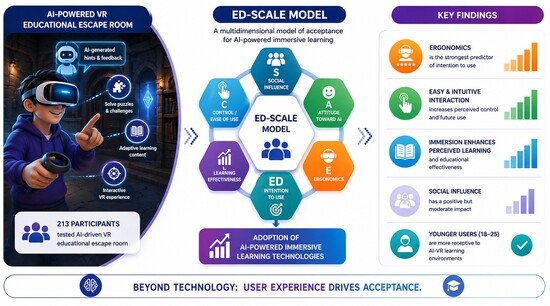
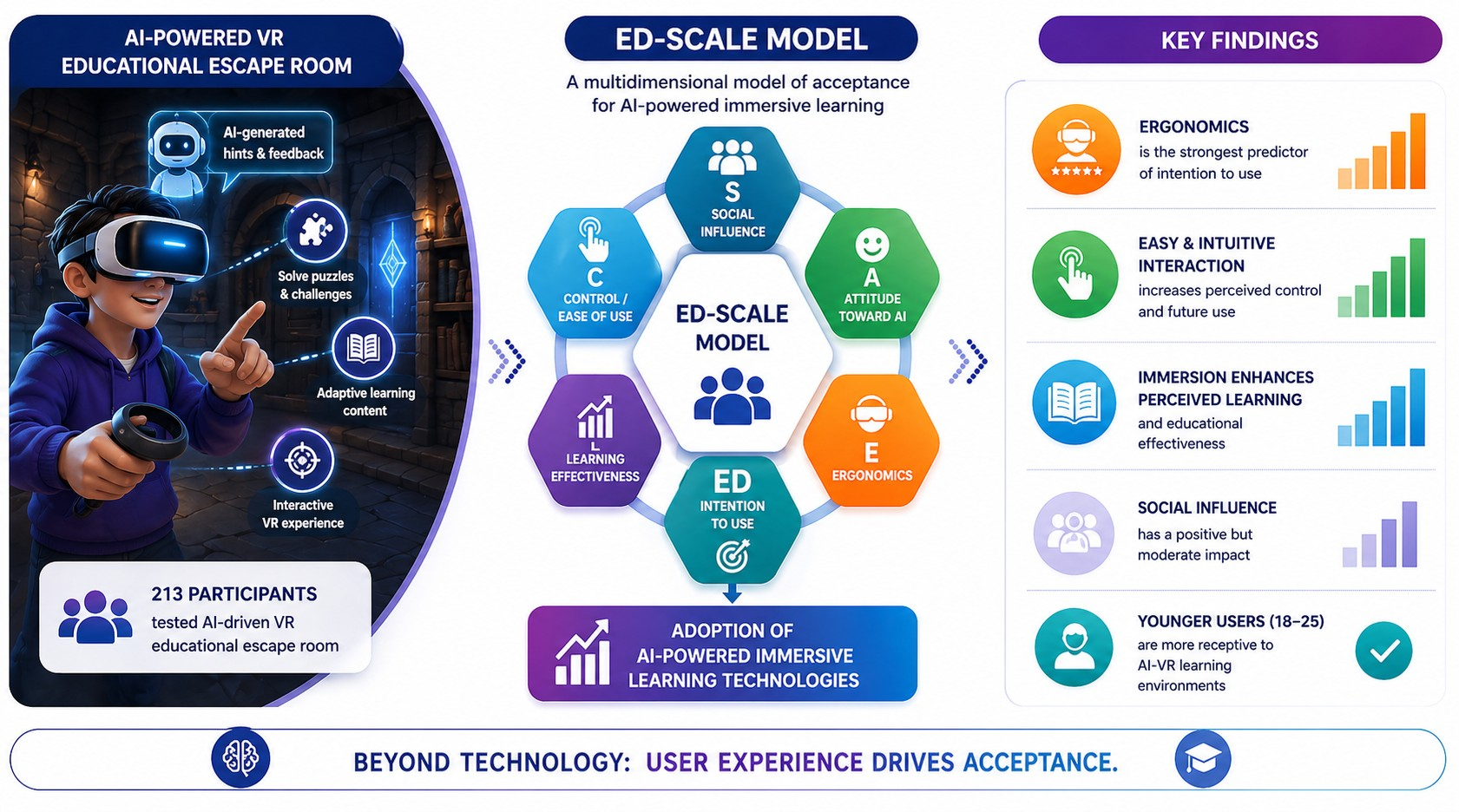
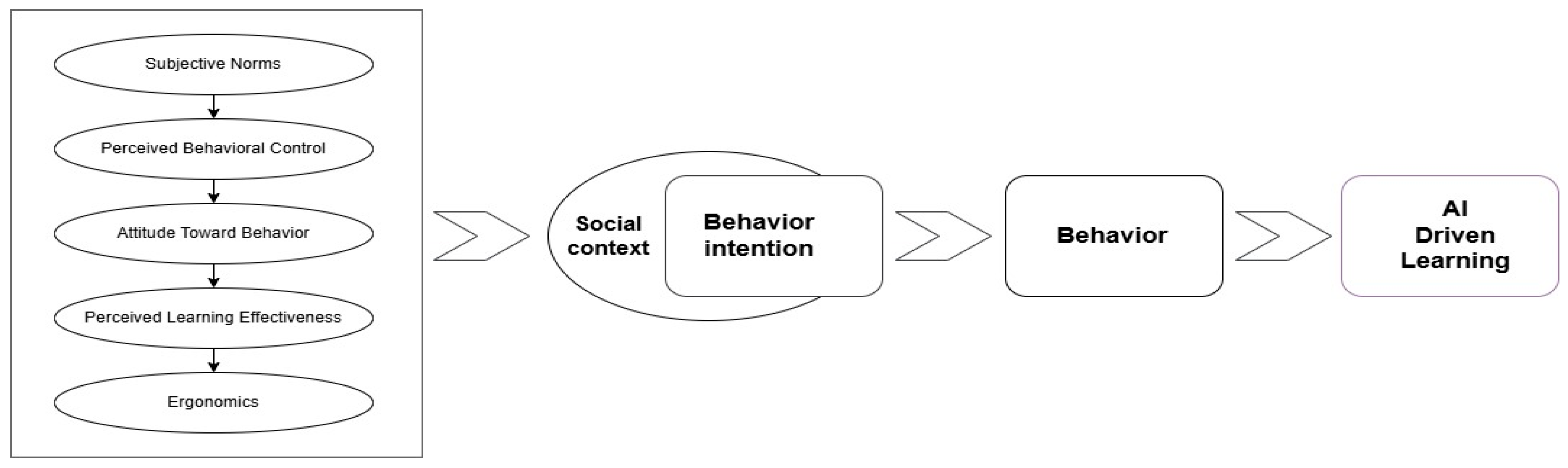
An exploratory factor analysis was conducted to examine the underlying structure of the ED-SCALE instrument. This solution is consistent with the theoretical conceptualization of the ED-SCALE model, which includes Subjective Norms (S), Perceived Behavioral Control (C), Attitude toward Behavior (A), Perceived Learning Effectiveness (L), Ergonomics (E), and Intention to Use in Education (ED). The retained factor solution accounted for 47.15% of the total variance, as in
Table 3. Although moderate, this level of explained variance is considered acceptable in exploratory research, particularly given the complexity and multidimensionality of user perceptions in immersive learning environments, and suggests a reasonably latent structure underlying the measured constructs.
While the EFA extracted six factors, the empirical structure exhibited a degree of conceptual overlap rather than perfectly discrete dimensions. Specifically, items related to perceived usefulness, attitudes, and behavioral intentions loaded onto shared factors. This alignment reflects the theoretical interdependence inherent in behavioral models (e.g., TAM), where cognitive evaluations and intentionality are naturally conflated. Such findings are consistent with the exploratory nature of this study and suggest that, in this specific context, participants may perceive these constructs as a single, integrated evaluative dimension.
4.2. Factorial Structure and Construct Validity
Although the Exploratory Factor Analysis (EFA) extracted six factors, according to
Table 4, the empirical structure did not replicate the theoretical dimensions in a discrete manner. Instead, several items from conceptually related constructs loaded together, indicating a partial overlap between perceived usefulness, favorable attitudes, and future behavioral intention. Such patterns are common in exploratory research involving newly developed behavioral models, where constructs are often theoretically interconnected and experienced holistically by the participants.
Factor 1: Educational Value and Adoption Intention is the most substantial, primarily defined by items L1, L2, L3, L4, ED1, ED2, A2, A3, C6, and E5. This factor integrates educational effectiveness, motivational engagement, and future adoption intention. The results suggest that respondents tend to perceive educational value and their readiness to use the technology as a single, integrated evaluative dimension rather than separate cognitive processes.
Factor 2: Comfort and Affective Experience integrates comfort-related evaluations (E5) with affective attitudinal components (A1). Notably, item E5 exhibited cross-loading between Factor 1 and Factor 2, suggesting that physical comfort in an immersive environment serves both as a functional requirement and an affective driver of the overall experience. This indicates that physical ergonomics are intrinsically linked to the user’s emotional state during the simulation.
Factor 3: Operational Ergonomics and Interaction Control, defined by items C4 and E2, focuses on the practical interaction with VR hardware, including device adjustment and controller use. This dimension confirms the presence of a distinct operational component related to the ease of hardware interaction.
Factor 4: Navigation Clarity and Spatial Confidence (represented by item E3) is linked to interaction cues and navigation clarity. It reflects the user’s ability to identify signals and understand the virtual environment, representing a specific component of interaction self-efficacy.
Factors 5 and 6 are residual latent components, show limited item saturation, and have lower eigenvalues, preventing robust standalone interpretation. However, their emergence suggests the existence of minor latent nuances within the ED-SCALE framework that may require further refinement or a larger sample size to reach statistical maturity.
4.6. Descriptive Statistics
Table 5 shows the descriptive statistics indicators calculated based on the answers given by the participants. As can be seen, the mean values for the ergonomics items (E1–E6) are relatively high (between 3.98 and 4.42), indicating a general positive perception of the ergonomics of virtual reality devices. Item E4 (“Observation of virtual items is clear”) has the highest mean (4.4231), suggesting that participants consider the observation of virtual items to be clear. The lowest mean is recorded for item E3 (Sound adjustment is easy), at 3.9808, and suggests that participants find sound adjustment relatively easy, but not as easy as other aspects of ergonomics.
Subjective Norms Cluster (S1–S2): The values for these two questions show how social perceptions and group pressures can influence the use of VR technology (H1). The low mean of responses to the question S1 “I have friends who have used virtual reality already” indicates that exposure to virtual reality is limited among respondents in this sample. At the same time, respondents acknowledge being influenced by their friends’ expectations, which shape their behaviors (S2).
Perceived Behavioral Control (C1–C6): The high means for items in this cluster (around 4.23 to 4.52) indicate that participants perceive the AI-driven VR application as easy to use and intuitive, and they have a strong perception of control during application use.
Attitude Toward Behavior Cluster (A1–A3): The mean scores for questions in this cluster also reflect a generally positive attitude toward using VR applications, which may result from the participant’s tech events profile (maybe more prone to technology). A high-to-medium score on A2 suggests openness to experimenting with new technologies, while a high score on A3 indicates a strong intention to use AI and VR frequently in the future; however, the results also imply the presence of a certain level of apprehension that tempers responses, preventing them from being overwhelmingly positive. The intention to frequently use AI&VR in the future strongly correlates with the Perceived Behavioral Control (C) cluster.
Learning Perceived Effectiveness Cluster (L1–L4): High scores in this cluster reflect perceptions of the AI-based VR application’s pedagogical effectiveness, particularly in enhancing engagement and motivation for learning. Additionally, high scores in this area suggest that participants recognize VR’s positive impact on the learning process, with L3 and L4 likely yielding the highest average scores—highlighting an appreciation for the technology’s utility and immersive nature. A significant correlation underlines the connection between the perception that AI-driven VR systems are useful for learning and the perceived ease of interaction with AI-personalized VR content (with C1 (r = 0.269, p ≤ 0.000) and with C6 (r = 0.426, p ≤ 0.000)).
Ergonomics Cluster (E1–E6): The average mean values for this cluster indicate a generally positive perception regarding the ergonomics of our AI-driven virtual reality devices (mean values ranging from 3.91 to 4.53). The highest means were recorded for E1 (4.5305) and E4 (4.4231), which suggests that the clarity of virtual elements is good and easy to adjust, and the lowest average score was for E3 (3.9155), indicating that sound adjustment should be more attentively constructed. Significantly variable results were recorded for E6, which reflects discomfort (dizziness), suggesting that some participants experienced physical difficulties related to the use of VR devices.
Furthermore, a considerable number of items were found to correlate strongly with the six variables included in the ergonomics cluster (E1–6), providing robust evidence of the central role of this construct, as in
Table 6. This convergence suggests that ergonomics is not a peripheral factor, but rather a key dimension influencing users’ perceptions and interactions with immersive technologies. Among these correlated items, particular attention is given to the intention to use in education such technologies, which emerges as a highly relevant indicator. This reinforces the argument that ergonomics should be systematically incorporated into any theoretical model aiming to explain and understand the acceptance of immersive technologies, as it captures essential aspects that directly influence users’ willingness to adopt and continue using these systems.
Intention to Use in Education Cluster (ED1-ED2): This cluster measures the participant’s intention to continue using generative AI and VR technology and to recommend it to others. High scores indicate a strong tendency toward the adoption and promotion of these technologies in the future.
A significant positive correlation was found between feeling comfortable with the headset and controllers (E5) and: 1. the intention to use AI-driven VR for learning (ED1) (r = 0.313, p ≤ 0.000) and 2. recommendation to use this technology to other colleagues (ED2) (r = 0.371, p ≤ 0.000).
Age:
An inversely proportional correlation was identified between age and several key perceptions related to AI-driven VR. Specifically, as age decreases, respondents report a higher perceived ease of use of VR devices, including adjusting the equipment and using controllers (C1: r = −0.194, p ≤ 0.005; C4: r = −0.189, p ≤ 0.006). Younger participants also perceive VR as more comfortable to use, indicating greater agreement with feeling at ease with the headset and controllers (A1: r = −0.555, p ≤ 0.000; A2: r = −0.314, p ≤ 0.000) and intention to use them frequently (A3: r = −0.456, p ≤ 0.000). In addition, age is negatively correlated with the perceived effectiveness of VR for learning, as younger individuals are more likely to agree that AI-personalized VR content enhances engagement (L1: r = −0.432, p ≤ 0.000; L2: r = −0.399, p ≤ 0.000; L3: r = −0.446, p ≤ 0.000; L4: r = −0.501, p ≤ 0.000). This can be explained by the fact that older participants developed their learning habits during periods when such technologies were not available, relying instead on more traditional study methods. As a result, they may find it more difficult to adapt to and fully appreciate newer, immersive tools, whereas younger individuals, who are more accustomed to digital environments, perceive them as more engaging and effective. This trend also extends to younger participants’ greater openness toward further experimentation with such technologies and their intention to use VR in educational contexts (ED1: r = −0.277, p ≤ 0.000; ED2: r = −0.350, p ≤ 0.000). They are more likely to express a clear willingness to adopt this technology in the future and to promote it among peers and acquaintances, reinforcing their role as early adopters. Overall, this suggests that younger users not only find VR easier and more comfortable to use but also perceive it as a more valuable and desirable learning tool.
Studies level:
The Pearson coefficient reveals a significant inverse correlation between education level and the perception that using virtual reality devices is easy (E2: r = −0.279, p ≤ 0.000) and comfortable (E5: r = −0.292, p ≤ 0.000). While this finding may seem counterintuitive, it can be understood in the context of digital natives’ greater familiarity with AI and VR technology, suggesting that the ease of adjusting devices is less related to formal education and more to practical experience with ICT devices. In fact, VR technologies appear particularly valuable for individuals with lower formal education, as they can provide an alternative to traditional learning methods and help bridge gaps for those who did not fully engage with conventional study approaches. These results highlight the critical importance of ergonomics, confirming that ease of use and comfort are essential factors in making VR an effective and accessible learning tool for all users, regardless of educational background.
Perception of time in the AI-driven immersive reality:
Table 7 shows the average time (expressed in minutes) spent by study participants to test the AI-based VR application. Actual time is the time measured for each test participant by the researchers. Perceived time is the time each participant estimated they spent using the app, thus reflecting each participant’s subjective perception.
The real time ranged from 2 to 25 min testing the app, while participants estimated that they spent between 2 and 30 min. On average, subjects spent approximately 11 min using the VR app and estimated, on average, that they spent approximately 9.5 min testing the VR app. Interpretation of these values indicates that the perceived time is generally less than the actual time spent using the app. It is possible that immersion in the VR space and active engagement in the app’s activities created the feeling that they spent less time than the actual duration. However, the variation is quite large, suggesting that some subjects may perceive the time spent differently than others.



 ,
,