1. Introduction
Context-aware mobile applications increasingly operate in environments characterized by intermittent connectivity, high mobility, and limited infrastructure support, such as rural logistics, remote healthcare delivery, and vehicular systems [
1,
2]. In these scenarios, applications must continue to function reliably despite network disruptions, ensuring timely decision-making and consistent enforcement of contextual rules.
Most existing context-aware architectures remain fundamentally cloud-centric. While cloud-based platforms simplify global coordination and data aggregation, they introduce increased latency and reduced availability in delay-prone environments [
3]. As a result, applications often fail to provide reliable behavior precisely in the conditions where context awareness is most critical.
Offline-first and local-first approaches have emerged as a promising paradigm for improving availability and resilience in distributed applications operating under intermittent connectivity [
4]. However, traditional offline mechanisms typically rely on simplistic local storage models and ad hoc conflict resolution strategies, which are insufficient for complex context-aware applications. These limitations become evident when applications are required to reason locally over contextual rules and reconcile conflicting updates across distributed nodes.
This paper addresses these challenges by presenting CAMS-F Edge DTN, an edge-centric runtime designed to support offline-first context-aware applications operating under intermittent connectivity. The proposed approach extends the CAMS domain-specific language (DSL) with declarative constructs for semantic reconciliation and opportunistic synchronization. At runtime, CAMS F Edge DTN combines Conflict-Free Replicated Data Types (CRDTs) [
5], opportunistic communication channels such as Bluetooth and Wi-Fi Direct, and MQTT-SN messaging [
6] to support asynchronous state convergence across mobile, vehicular, and edge nodes.
2. Contributions
This paper makes the following contributions to the design of resilient context-aware mobile systems operating under intermittent connectivity:
We extend the CAMS domain-specific language with declarative constructs that enable developers to specify offline-first behavior, semantic reconciliation strategies, and opportunistic synchronization policies at the modeling level. These extensions allow context-aware applications to explicitly define how distributed state and contextual rules should behave under intermittent connectivity.
- 2.
Edge-Centric Runtime Architecture for Offline-First Context Reasoning
We propose a runtime architecture that supports decentralized execution of context-aware logic directly at edge nodes. The runtime integrates CRDT-based replication, opportunistic communication channels (Bluetooth and Wi-Fi Direct), and MQTT-SN messaging to enable reliable state propagation and asynchronous synchronization across mobile, vehicular, and edge devices.
- 3.
Integration of Semantic Conflict Resolution with Distributed State Replication
The proposed approach incorporates domain-specific reconciliation policies defined within the DSL, allowing application semantics to guide conflict resolution during synchronization. This mechanism enables context-dependent prioritization (e.g., clinical urgency or perishability of goods), improving correctness and robustness compared to purely data-centric replication strategies.
- 4.
Experimental Evaluation in Edge-Centric Scenarios with Intermittent Connectivity
We evaluate CAMS F Edge DTN through controlled experiments and realistic case studies involving rural logistics and healthcare distribution scenarios. The results demonstrate improvements in data freshness and rule availability compared with traditional cloud-dependent synchronization approaches, while preserving low-latency local decision-making and deterministic state convergence.
3. Background and Related Work
3.1. Context-Aware Systems and Offline-First Applications
Context-aware systems adapt their behavior based on environmental, temporal, and user-related information [
1]. In mobile and IoT environments, maintaining consistent context-aware behavior under intermittent connectivity remains a significant challenge. Offline-first application design promotes local execution and deferred synchronization to improve availability [
4], but most approaches provide limited support for semantic conflict resolution and context-aware reasoning.
Recent research has explored local-first and offline-first architectures that maintain application state locally while synchronizing updates asynchronously once connectivity becomes available. These approaches improve resilience and user experience in mobile environments where connectivity disruptions are common [
7]. However, most existing offline-first frameworks focus primarily on data synchronization mechanisms and do not explicitly support context-aware reasoning or semantic reconciliation policies required in complex distributed edge applications.
3.2. Delay-Tolerant Networking and Opportunistic Communication
Delay-Tolerant Networking (DTN) addresses communication in environments where stable end-to-end connectivity cannot be assumed [
8]. DTN techniques rely on store-and-forward mechanisms and opportunistic contacts, making them suitable for mobile and rural scenarios. Technologies such as Bluetooth and Wi-Fi Direct have been widely used to enable peer-to-peer data exchange in such environments [
9,
10].
Prior work has investigated opportunistic mobile networking and delay-tolerant network architectures, where mobile nodes exchange information through short-range communication technologies while infrastructure nodes act as temporary synchronization hubs [
11]. While these approaches significantly improve communication resilience in challenged networks, they typically focus on
message routing and delivery guarantees, leaving application-level synchronization and context-aware decision-making largely unaddressed. Edge-centric approaches emphasize bringing computation closer to data sources to improve latency, availability, and resilience in distributed environments [
12].
3.3. CRDTs and Distributed Consistency
Conflict-Free Replicated Data Types (CRDTs) provide a formal foundation for achieving eventual consistency in distributed systems without coordination [
5]. CRDTs have been successfully applied to collaborative systems and distributed storage, but their use in context-aware mobile applications remains limited.
Recent studies highlight the potential of CRDT-based replication for
edge and mobile systems, where decentralized state management and asynchronous synchronization are required to support offline operation [
13]. By ensuring deterministic convergence across distributed replicas without requiring centralized coordination, CRDTs provide a suitable mechanism for resilient edge environments. However, purely data-centric CRDT approaches often lack mechanisms to incorporate
domain semantics and contextual priorities that influence conflict resolution in context-aware applications.
3.4. Positioning of CAMS F Edge DTN
Existing work in context-aware systems, DTN, and CRDT-based synchronization addresses complementary aspects of resilient application design but rarely integrates these elements within a unified, model-driven framework. CAMS F Edge DTN addresses this gap by combining declarative context modeling, semantic reconciliation policies, delay-tolerant synchronization, and local reasoning within a single runtime architecture.
3.5. Model-Driven Frameworks for Context-Aware Mobile Applications
Model-driven approaches have been widely adopted to manage the complexity of distributed and mobile systems by elevating models and domain-specific abstractions as primary engineering artifacts. Model-Driven Engineering (MDE) promotes higher levels of abstraction and automated code generation, enabling developers to reason about system behavior at the model level while improving maintainability and scalability in distributed environments [
10,
14].
In the domain of context-aware mobile applications, edge-centric architectures have emerged as a key paradigm for reducing latency and improving resilience under intermittent connectivity. By relocating computation and decision-making closer to data sources, edge computing enables applications to maintain operational continuity and responsiveness in mobile and resource-constrained environments [
15]. Recent work on edge-enabled IoT systems highlights the importance of combining local processing with distributed synchronization mechanisms to support resilient context-aware services [
16].
Within this research line, the CAMS framework introduced a model-driven approach that employs domain-specific languages and automated code generation to support the development of context-aware mobile applications integrating IoT services and geolocation platforms [
17]. A subsequent evolution of this work led to CAMS-F, which explored cross-platform development using Flutter and cloud-backed services, with particular attention to low-connectivity and edge-oriented scenarios [
15].
Modern distributed applications increasingly adopt local-first and eventually consistent architectural models to support resilient offline operation. Such approaches rely on decentralized state management and asynchronous synchronization to tolerate network disruptions while preserving application correctness [
12,
15]. However, many existing frameworks treat offline synchronization as an implementation concern rather than a first-class modeling construct.
CAMS F Edge DTN advances this landscape by integrating model-driven abstractions with declarative offline-first policies, semantic reconciliation, and delay-tolerant synchronization mechanisms. By embedding these capabilities directly into the DSL and runtime architecture, the proposed approach enables systematic reasoning about offline behavior and conflict resolution, addressing key limitations observed in prior model-driven frameworks for context-aware mobile systems operating under intermittent connectivity.
4. Materials and Methods
This section describes the materials, architectural components, and methodological steps underlying CAMS F Edge DTN, the proposed runtime for context-aware, offline-first applications operating under intermittent connectivity.
4.1. Overview of CAMS F Edge DTN
CAMS F Edge DTN is designed as an edge-centric runtime that enables context-aware applications to operate reliably in environments where continuous network connectivity cannot be assumed. The approach combines declarative context modeling, local rule evaluation, and delay-tolerant synchronization mechanisms to ensure availability, consistency, and resilience.
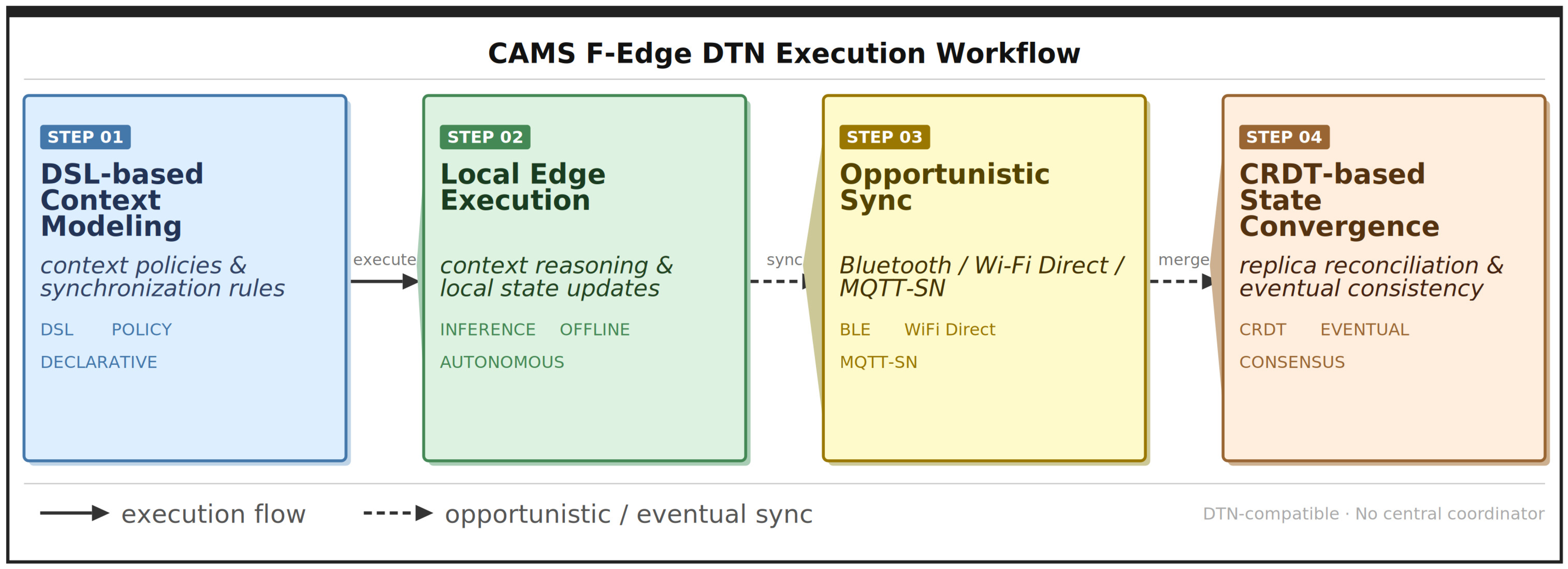
The overall workflow follows four main stages:
- (i)
Context modeling and policy specification at the DSL level.
- (ii)
Local execution and reasoning at edge nodes.
- (iii)
Opportunistic synchronization across heterogeneous communication channels.
- (iv)
Asynchronous reconciliation and convergence of distributed state.
This design allows applications to evaluate contextual rules locally while deferring synchronization until suitable connectivity becomes available, reducing dependence on cloud-centric coordination. As shown in
Figure 1, the CAMS F Edge DTN workflow integrates DSL-based context modeling, local reasoning at edge nodes, opportunistic synchronization across heterogeneous communication channels, and CRDT-based asynchronous reconciliation to ensure eventual state convergence under intermittent connectivity.
4.2. DSL Extensions for Delay-Tolerant Context Reasoning
CAMS F Edge DTN extends the CAMS domain-specific language with constructs that explicitly support offline-first execution and delay-tolerant environments. These extensions allow developers to declare synchronization and reconciliation behavior at the model level rather than embedding such logic directly into application code.
The DSL introduces declarative policies for:
Semantic reconciliation of conflicting updates;
Prioritization of context-dependent data (e.g., clinical urgency or perishability);
Opportunistic synchronization strategies based on connectivity and proximity.
By elevating these concerns to the DSL, CAMS F Edge DTN ensures that offline behavior and conflict resolution remain consistent, analyzable, and traceable throughout the application lifecycle.
4.3. DSL Configuration Examples
To illustrate how the proposed DSL supports the configuration of context-aware offline-first applications, this section presents representative DSL snippets that define edge devices, synchronization policies, and communication protocols. To illustrate how the proposed DSL supports the configuration of context-aware offline-first applications, this section presents representative DSL snippets that define edge devices, synchronization policies, and communication protocols. Listings 1 and 2 illustrate representative DSL configurations.
| Listing 1. DSL configuration for an offline-first sensor node. |
application HospitalMonitoring {
context WardEnvironment
device VitalSensor {
connectivity intermittent
protocol MQTT_SN
sync_strategy CRDT_GCounter
storage local_edge
}
policy OfflineFirst {
reasoning local
synchronization eventual
}
} |
| Listing 2. DSL configuration for an edge gateway. |
application EdgeGateway {
context SmartClinic
device GatewayNode {
connectivity intermittent
protocol MQTT_SN
sync_strategy OR_Set_CRDT
}
policy ContextAwareSync {
trigger connectivity_restored
reconciliation CRDT_merge
}
} |
These examples illustrate how synchronization policies, device characteristics, and communication mechanisms can be declaratively specified at the DSL level.
4.4. Runtime Architecture
The runtime architecture of CAMS F Edge DTN follows a layered design that separates context reasoning, synchronization, and communication concerns.
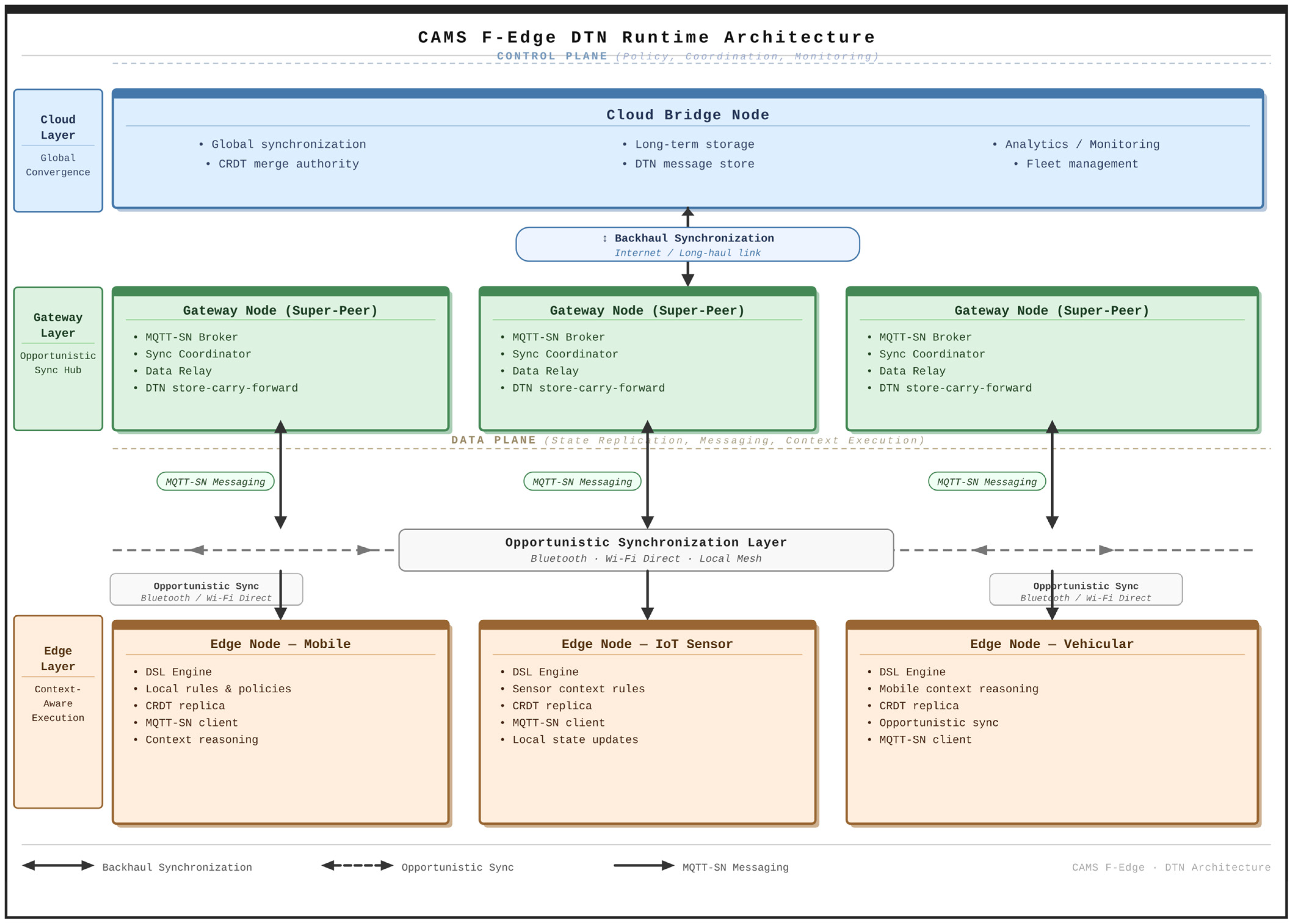
At the edge, mobile nodes execute context-aware logic locally, maintaining replicated state and evaluating contextual rules without reliance on cloud connectivity. Super-peer nodes, such as vehicular or gateway devices, act as aggregation points to facilitate opportunistic data exchange. A cloud bridge provides eventual global synchronization and long-term persistence when connectivity permits.
The architecture distinguishes between:
A control plane, responsible for policy interpretation, telemetry, and coordination;
A data plane, which handles state replication, messaging, and context propagation.
This separation improves scalability and allows independent evolution of communication and reasoning components.
Figure 2 illustrates the layered architecture of CAMS F Edge DTN, highlighting the interactions among edge nodes, gateway super-peers, and the cloud bridge, as well as the separation between the control and data planes that enables scalable, resilient context-aware execution under intermittent connectivity.
4.5. Synchronization and Messaging Mechanisms
To support robust synchronization under intermittent connectivity, CAMS F Edge DTN combines multiple communication mechanisms.
State replication is based on Conflict-Free Replicated Data Types (CRDTs), ensuring eventual consistency without coordination. Delta-state CRDTs are used to minimize communication overhead during synchronization.
4.5.1. CRDT Structures and Reconciliation
In the proposed runtime, several CRDT structures are used depending on the application semantics. These include:
G-Counter CRDT for monotonic event accumulation;
Observed-Remove Set (OR-Set) for replicated collections with concurrent insertions and removals;
Last-Writer-Wins Register (LWW-Register) for state variables where the most recent update should prevail.
These structures guarantee
strong eventual consistency without requiring centralized coordination. Algorithm 1 describes the CRDT reconciliation procedure.
| Algorithm 1. CRDT Replica Reconciliation |
Input: Local replica L, Remote replica R
for each element e in R do
if e.timestamp > L.timestamp then
update L with e
end if
end for
merge metadata vectors
resolve concurrent updates using CRDT merge rules
return updated replica L |
4.5.2. Replica Reconciliation Procedure
When connectivity between nodes becomes available, replicas exchange their local state and apply CRDT merge operations to reconcile concurrent updates.
Because CRDT operations are associative, commutative, and idempotent, replicas deterministically converge toward a consistent global state.
For messaging, the runtime employs MQTT-SN, which is well suited for constrained and intermittently connected environments. Opportunistic communication channels, including Bluetooth and Wi-Fi Direct, are leveraged to exchange state updates during transient contacts between nodes.
This hybrid communication strategy enables flexible and resilient data propagation across mobile, vehicular, and edge environments.
4.6. Local Reasoning and Semantic Conflict Resolution
A key feature of CAMS F Edge DTN is its support for local reasoning under offline conditions. Contextual rules are evaluated directly at edge nodes, allowing applications to make decisions even in the absence of network connectivity.
When conflicts arise due to concurrent updates, semantic conflict resolution policies defined at the DSL level are applied. These policies allow domain-specific priorities to influence reconciliation outcomes, such as favoring critical healthcare updates over less urgent data or prioritizing perishable logistics information.
By integrating semantic reconciliation with CRDT-based synchronization, CAMS F Edge DTN ensures that eventual convergence preserves application intent rather than relying solely on low-level data merging.
Security and Privacy Considerations
Although the evaluation scenarios do not involve human subjects, the proposed architecture incorporates privacy-aware design principles. Contextual data processing is primarily performed at edge nodes, reducing exposure of sensitive information to centralized infrastructures. Communication channels such as MQTT-SN can be secured through authenticated gateways and encrypted transport mechanisms, ensuring data integrity and confidentiality during synchronization.
4.7. Implementation Environment
The CAMS F Edge DTN prototype was implemented using Flutter and Dart for mobile edge nodes, enabling cross-platform deployment. MQTT-SN brokers were configured to support lightweight messaging, and opportunistic communication was implemented using standard Bluetooth and Wi-Fi Direct APIs.
The runtime was deployed across mobile devices, vehicular nodes, and cloud-based bridges to support the experimental scenarios described in subsequent sections. This implementation represents a representative realization of the proposed architecture rather than a platform-specific solution.
5. Case Studies
5.1. Case Study Description
To illustrate the applicability of CAMS F Edge DTN in real-world environments, we consider a last-mile logistics scenario operating under intermittent connectivity conditions. The case study focuses on the distribution of temperature-sensitive pharmaceutical products across rural and semi-rural areas, where continuous network access cannot be guaranteed.
Delivery vehicles and mobile operators rely on context-aware mobile applications to manage delivery routes, geofencing rules, priority constraints, and environmental conditions such as temperature and location. Decisions must often be taken locally at the device level, including rerouting, delivery prioritization, and alert generation, even when connectivity to cloud services is unavailable.
This scenario represents a broad class of edge-centric applications in logistics, healthcare, and humanitarian operations, where offline-first behavior and eventual consistency are essential requirements rather than optional features.
5.2. Experimental Setup
The experimental setup consists of three types of nodes reflecting the layered architecture of CAMS F Edge DTN. Mobile edge nodes represent delivery operators equipped with smartphones running Flutter-based applications generated from the CAMS DSL. These nodes host local context sensors, a rule engine, CRDT replicas, and local storage, enabling autonomous operation under disconnected conditions.
Vehicular gateways act as super-peer nodes, aggregating state updates from nearby mobile devices and facilitating opportunistic data exchange using Bluetooth and Wi-Fi Direct. Lightweight messaging between nodes is implemented using MQTT-SN, allowing efficient communication over constrained and transient links.
A cloud bridge is deployed to provide eventual global synchronization, long-term persistence, and monitoring services when network connectivity becomes available. The cloud layer does not participate in real-time decision-making but serves as a convergence and observability point for distributed state.
Connectivity disruptions are emulated by periodically disabling network access for mobile nodes, with disconnection intervals ranging from 30 s to several minutes, reflecting realistic rural mobility conditions.
The experimental prototype was deployed on Android smartphones running Flutter-based applications generated from the CAMS DSL. Mobile nodes used Bluetooth and Wi-Fi Direct for opportunistic communication, while MQTT-SN messaging was implemented through a lightweight broker deployed on an edge gateway device. Connectivity disruptions were emulated using controlled network toggling scripts, allowing repeatable disconnection intervals between 30 and 300 s. All experiments were executed on a small-scale testbed composed of three mobile nodes and one gateway node.
5.3. Observed Behavior Under Intermittent Connectivity
During disconnected operation, edge nodes continue to evaluate contextual rules locally based on sensor input and locally available state. Delivery decisions, alerts, and rule-triggered actions remain available without reliance on cloud services, demonstrating the offline-first properties of the proposed runtime.
When nodes encounter each other opportunistically or reconnect through super-peers, CRDT-based state updates are exchanged incrementally, ensuring eventual convergence without requiring centralized coordination. Semantic conflict resolution policies defined at the DSL level are applied when concurrent updates occur, prioritizing critical deliveries and perishable items.
Once connectivity to the cloud bridge is restored, the aggregated state is synchronized asynchronously, enabling global visibility, auditing, and long-term analytics. Importantly, temporary inconsistencies observed during disconnected operation do not compromise system correctness, as convergence is guaranteed by the underlying CRDT mechanisms.
These observations confirm that CAMS F Edge DTN effectively supports resilient context-aware behavior in environments characterized by intermittent connectivity, mobility, and heterogeneous communication channels.
6. Evaluation
The evaluation assesses the effectiveness of CAMS F Edge DTN in terms of latency, operational availability, state convergence, and resilience under intermittent connectivity, using the experimental setup described in
Section 5. The experimental design follows a controlled evaluation methodology, allowing reproducibility and consistent comparison with baseline approaches.
The evaluation focuses on the proposed runtime’s ability to maintain context-aware behavior during network disruptions and to guarantee eventual consistency once connectivity is restored.
To assess the benefits of the proposed architecture, we compare CAMS F Edge DTN against a baseline cloud-centric synchronization model in which contextual rules and application state are primarily maintained on centralized infrastructure, and mobile devices rely on periodic synchronization with remote services. This baseline reflects the behavior of many traditional context-aware mobile systems operating under intermittent connectivity conditions.
6.1. Evaluation Setup
The evaluation was conducted using the experimental setup described in
Section 4, consisting of mobile edge nodes, vehicular super-peers, and an optional cloud bridge. Experiments were performed under controlled connectivity disruptions, with disconnection intervals ranging from
30 s to 300 s to simulate realistic rural and mobile environments.
Each experiment was repeated multiple times to account for variability in node encounters, message delays, and synchronization opportunities. Metrics were collected locally at edge nodes and aggregated asynchronously through the cloud bridge when connectivity became available.
The evaluation metrics were selected to directly assess the architectural objectives of CAMS F Edge DTN, namely operational availability during connectivity disruptions, latency of local reasoning at edge nodes, and deterministic convergence of distributed state after reconnection. The methodology ensures repeatability by using controlled connectivity disruptions and consistent experimental conditions.
6.2. Latency Analysis
Latency was measured as the time required for context updates and rule-triggered events to propagate across nodes under different connectivity conditions. We report both the median (P50) and tail (P90) latency to capture worst-case behavior.
Table 1 presents end-to-end latency under different connectivity conditions.
6.3. Availability and Offline Resilience
Availability was measured as the proportion of time during which contextual rules and application logic remained operational despite connectivity loss. The evaluation compares the proposed CAMS F Edge DTN runtime with a cloud-centric baseline architecture, in which contextual reasoning depends on continuous connectivity to remote services.
Table 2 presents the observed availability levels under intermittent connectivity conditions. The baseline cloud-centric architecture was evaluated under the same controlled connectivity disruptions described in
Section 6.1. In this configuration, contextual reasoning depends on remote cloud services, causing rule evaluation to fail during disconnection periods. As a result, the observed operational availability ranged between 62–71% across repeated experiments.
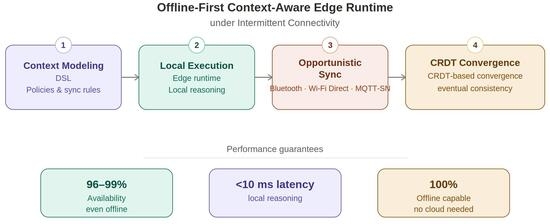
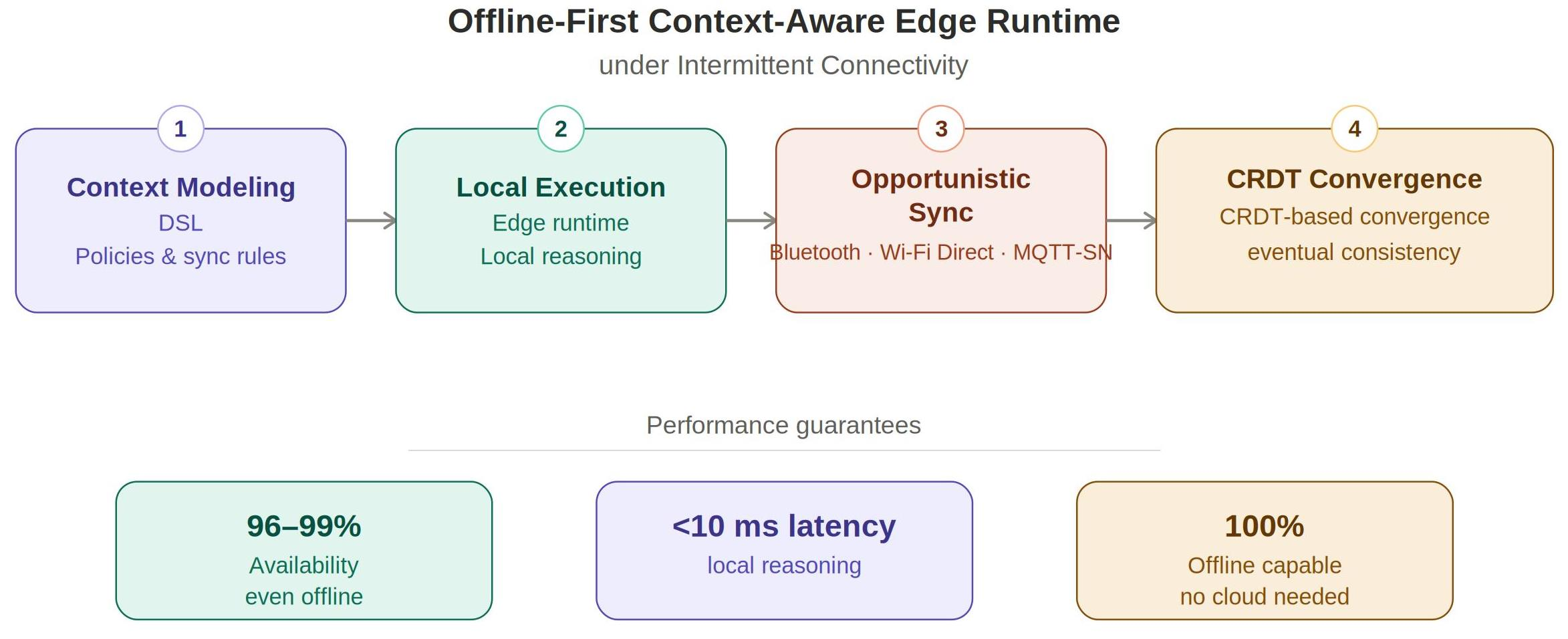
In contrast, CAMS F Edge DTN maintains 96–99% availability during intermittent connectivity and 100% availability under fully offline conditions due to its ability to execute contextual reasoning locally at edge nodes.
These results demonstrate that the proposed architecture significantly improves operational resilience by enabling offline-first execution and asynchronous synchronization, reducing dependency on centralized cloud coordination.
The results confirm that CAMS F Edge DTN significantly improves availability compared to cloud-dependent approaches, maintaining full operational capability during offline periods.
6.4. State Convergence and Consistency
To evaluate convergence, we measured the time required for distributed replicas to reach a consistent state after reconnection, following periods of concurrent updates.
Table 3 reports state convergence after disconnection periods.
All experiments achieved eventual consistency without manual intervention, validating the effectiveness of CRDT-based replication combined with DSL-level semantic reconciliation policies.
6.5. Discussion
These results confirm that the proposed edge-centric architecture delivers measurable improvements over the cloud-centric baseline under identical connectivity-disruption conditions. The evaluation demonstrates that CAMS F Edge DTN effectively balances offline-first execution with eventual synchronization. Local reasoning ensures immediate responsiveness, while opportunistic communication and super-peer aggregation enable efficient state propagation under mobility and network constraints. These results clearly demonstrate the effectiveness of the proposed approach under varying connectivity conditions.
Compared with the cloud-centric baseline architecture used in the evaluation, the proposed approach demonstrates improved resilience and availability in challenged connectivity environments while preserving deterministic state convergence through CRDT-based replication.
Importantly, the system avoids the trade-off between availability and consistency commonly observed in cloud-centric architectures. Instead, it provides predictable convergence behavior while preserving application intent through domain-specific conflict resolution.
These results suggest that edge-centric, offline-first architectures constitute a promising direction for resilient context-aware systems operating under intermittent connectivity.
The proposed architecture addresses key limitations of existing approaches by combining CRDT-based synchronization with semantic conflict resolution and local reasoning. This integration ensures that context-aware applications can maintain consistent behavior under intermittent connectivity while preserving application intent during reconciliation.
7. Threats to Validity
As with any experimental study involving distributed and edge-centric systems, this work is subject to several threats to validity. We discuss the main limitations and potential sources of bias below.
7.1. Construct Validity
A potential threat to construct validity arises from the selection of evaluation metrics used to assess latency, availability, and convergence. While these metrics are commonly adopted in the evaluation of distributed and delay-tolerant systems, they may not fully capture all aspects of application-level quality, such as user experience or long-term operational costs.
To mitigate this threat, we focused on metrics directly aligned with the design goals of CAMS F Edge DTN, namely offline-first behavior, resilience under intermittent connectivity, and eventual consistency. Future studies could complement the current evaluation with user-centric or domain-specific quality indicators.
7.2. Internal Validity
Internal validity may be affected by the controlled nature of the experimental setup, particularly in the emulation of connectivity disruptions and node mobility. Although disconnection intervals and opportunistic encounters were designed to reflect realistic rural and mobile scenarios, they cannot fully reproduce the unpredictability of real-world environments.
We mitigated this risk by varying the disconnection durations, repeating experiments multiple times, and analyzing both median and tail latency values. Nevertheless, unforeseen interactions between mobility patterns and synchronization behavior may influence results in uncontrolled deployments.
7.3. External Validity
The primary case study focuses on last-mile logistics and pharmaceutical distribution, which may limit the generalizability of results to other application domains. However, the selected scenario is representative of a broader class of context-aware applications operating under intermittent connectivity, including healthcare, humanitarian logistics, and smart mobility.
Moreover, the architectural principles underlying CAMS F Edge DTN—such as local reasoning, CRDT-based replication, and opportunistic synchronization—are domain-agnostic. We therefore argue that the observed benefits are transferable to similar edge-centric systems, although further validation in additional domains is desirable.
7.4. Implementation Validity
The prototype implementation relies on specific technologies, including Flutter, MQTT-SN, and selected CRDT libraries, which may introduce technology-dependent behavior. Performance characteristics could vary when alternative frameworks, messaging protocols, or hardware platforms are employed.
To reduce implementation bias, the proposed approach emphasizes architectural patterns and declarative modeling rather than platform-specific optimizations. The prototype should thus be regarded as a representative realization of the approach rather than a fully optimized production system.
7.5. Summary
Despite these limitations, we believe that the evaluation provides a faithful and transparent assessment of the proposed approach. The identified threats do not invalidate conclusions but instead delineate the scope within which the results should be interpreted. Addressing these threats on larger-scale and long-term deployments constitutes an important direction for future work.
8. Conclusions
This paper presented CAMS F Edge DTN, a context-aware runtime designed to support offline-first execution, delay-tolerant synchronization, and local reasoning in environments characterized by intermittent connectivity. The proposed approach extends the CAMS model-driven framework with declarative mechanisms for semantic reconciliation and opportunistic synchronization, enabling resilient application behavior at the edge without reliance on continuous cloud connectivity.
By combining DSL-based context modeling, CRDT-based state replication, opportunistic communication channels, and lightweight messaging through MQTT-SN, CAMS F Edge DTN addresses key limitations of cloud-centric architectures in mobile and edge-centric scenarios. The results obtained from the realistic case studies and controlled experiments demonstrate that the approach significantly improves availability, reduces effective latency for context-aware decisions, and guarantees eventual consistency under varying connectivity conditions.
The evaluation confirms that local reasoning at edge nodes allows applications to remain operational during disconnection periods, while asynchronous convergence mechanisms ensure global state consistency once connectivity is restored. Importantly, semantic conflict resolution policies defined at the model level preserve application intent during reconciliation, avoiding common inconsistencies observed in purely data-centric offline approaches.
Despite these promising results, this work represents a first step toward fully resilient context-aware systems for edge environments. Future work will focus on extending the proposed runtime with advanced features such as multicloud orchestration, federated learning for context prediction, and enhanced privacy-aware synchronization policies. Additionally, large-scale deployments across diverse application domains will be explored to further validate scalability and generalizability.
Overall, CAMS F Edge DTN provides a practical and extensible foundation for the development of robust context-aware applications operating under challenging connectivity conditions, contributing to the advancement of edge-centric and offline-first system design.
Author Contributions
Conceptualization, N.I.H. and E.R.G.-T.; methodology, E.R.G.-T.; software, E.R.G.-T. and R.M.T.; validation, N.I.H., E.R.G.-T. and P.B.; formal analysis, E.R.G.-T.; investigation, E.R.G.-T. and R.M.T.; resources, N.I.H.; data curation, R.M.T.; writing—original draft preparation, E.R.G.-T.; writing—review and editing, N.I.H., P.B. and E.E.G.; visualization, E.R.G.-T. and E.E.G.; supervision, N.I.H.; project administration, N.I.H. All authors have read and agreed to the published version of the manuscript.
Funding
This research received no external funding.
Data Availability Statement
The data supporting the findings of this study are available from the corresponding author upon reasonable request.
Conflicts of Interest
The authors declare no conflicts of interest.
Abbreviations
The following abbreviations are used in this manuscript:
| CAMS | Context-Aware Mobile Systems |
| DTN | Delay-Tolerant Networking |
| DSL | Domain-Specific Language |
| MQTT-SN | Message Queuing Telemetry Transport for Sensor Networks |
References
- Dey, A.K. Understanding and using context. Pers. Ubiquitous Comput. 2001, 5, 4–7. [Google Scholar] [CrossRef] [Scilit]
- Baldauf, M.; Dustdar, S.; Rosenberg, F. A Survey on context-aware systems. Int. J. Ad Hoc Ubiquitous Comput. 2007, 2, 263–277. [Google Scholar] [CrossRef] [Scilit]
- Satyanarayanan, M. The emergence of edge computing. Computer 2017, 50, 30–39. [Google Scholar] [CrossRef] [Scilit]
- Kleppmann, M.; Wiggins, A.; Van Hardenberg, P.; McGranaghan, M. Local-first software: You own your data, in spite of the cloud. Proc. ACM Program. Lang. 2021, 5, 154–178. [Google Scholar] [CrossRef] [Scilit]
- Shapiro, M.; Preguiça, N.; Baquero, C.; Zawirski, M. Conflict-free replicated data types. In Proceedings of the 13th International Symposium on Stabilization, Safety, and Security of Distributed Systems (SSS 2011), Grenoble, France, 10–12 October 2011; Springer: Berlin/Heidelberg, Germany, 2011; LNCS 6976; pp. 386–400. [Google Scholar]
- Hunkeler, U.; Truong, H.L.; Stanford-Clark, A. MQTT-SN—A publish/subscribe protocol for Wireless Sensor Networks. In Proceedings of the International Conference on Communication Systems Software and Middleware (COMSWARE), Bangalore, India, 6–10 January 2008. [Google Scholar] [CrossRef] [Scilit]
- Varghese, B.; Buyya, R. Next generation cloud computing: New trends and research directions. Future Gener. Comput. Syst. 2018, 79, 849–861. [Google Scholar] [CrossRef] [Scilit]
- Fall, K. A delay-tolerant network architecture for challenged internets. In Proceedings of ACM SIGCOMM 2003, Karlsruhe, Germany, 25–29 August 2003; ACM: New York, NY, USA, 2003. [Google Scholar]
- Conti, M.; Giordano, S. Mobile ad hoc networking: Milestones, challenges, and new research directions. IEEE Commun. Mag. 2014, 52, 85–96. [Google Scholar] [CrossRef] [Scilit]
- Shi, W.; Cao, J.; Zhang, Q.; Li, Y.; Xu, L. Edge computing: Vision and challenges. IEEE Internet Things J. 2016, 3, 637–646. [Google Scholar] [CrossRef] [Scilit]
- Jain, S.; Fall, K.; Patra, R. Routing in a delay tolerant network. In Proceedings of the 2004 Conference on Applications, Technologies, Architectures, and Protocols for Computer Communications (SIGCOMM ‘04), Portland, OR, USA, 30 August–3 September 2004; ACM: New York, NY, USA, 2004; pp. 145–158. [Google Scholar] [CrossRef] [Scilit]
- Zhao, Y.; Wang, W.; Li, Y.; Colman Meixner, C.; Tornatore, M.; Zhang, J. Edge Computing and Networking: A Survey on Infrastructures and Applications. IEEE Access 2019, 7, 101213–101230. [Google Scholar] [CrossRef] [Scilit]
- Bieniusa, A.; Zawirski, M.; Preguiça, N.; Shapiro, M.; Baquero, C.; Balegas, V.; Duarte, S. An Optimized Conflict-Free Replicated Set. arXiv 2012, arXiv:1210.3368. [Google Scholar] [CrossRef] [Scilit]
- Schmidt, D.C. Guest Editor’s Introduction: Model-Driven Engineering. Computer 2006, 39, 25–31. [Google Scholar] [CrossRef] [Scilit]
- Herrera, N.H.; Rivera, R.; Gómez-Torres, E.; Challiol, C. CAMS-F: Extending the context-aware mobile systems framework for cross-platform development with Flutter, Firebase, and Google Maps. In Proceedings of the Future Technologies Conference (FTC) 2025, Volume 3; Arai, K., Ed.; Lecture Notes in Networks and Systems; Springer: Cham, Switzerland, 2026; Volume 1677. [Google Scholar] [CrossRef] [Scilit]
- Vogels, W. Eventually consistent. Commun. ACM 2009, 52, 40–44. [Google Scholar] [CrossRef] [Scilit]
- Herrera, N.; Gómez-Torres, E.; Baldeón, P.; Toasa, R. CAMS: A model-based framework for context-aware mobile applications with IoT and Azure Maps integration. In ICT for Intelligent Systems; Arai, K., Ed.; Smart Innovation, Systems and Technologies; Springer: Singapore, 2025; Volume 325, pp. 139–149. [Google Scholar] [CrossRef] [Scilit]
| Disclaimer/Publisher’s Note: The statements, opinions and data contained in all publications are solely those of the individual author(s) and contributor(s) and not of MDPI and/or the editor(s). MDPI and/or the editor(s) disclaim responsibility for any injury to people or property resulting from any ideas, methods, instructions or products referred to in the content. |





 ,
,