


Abstract
Non-orthogonal multiple access (NOMA) has been identified as one of the key technologies for 6G capacity and latency gains. However, existing implementation challenges of the NOMA technique, related to carrier, timing, and phase offsets, successive interference cancellation (SIC) error propagation, packet loss dynamics, and host to software defined radios processing jitter, create obstacles in the practical implementation of NOMA. This paper bridges the gap between theory and hardware by introducing a complete two-user NOMA transmit–receive chain on a low-cost ADALM-Pluto software defined radio (SDR) platform. The proposed implementation integrates matched filtering, offset estimation and correction, SIC with waveform reconstruction and subtraction, and reliability reinforcement via rate-1/2 convolutional coding with Viterbi decoding. We have performed a complete validation of the proposed design in both downlink and uplink modes. We collected data regarding the packet-level and system-related metrics, such as end-to-end latency, bit error rate (BER), and success rate. Moreover, we demonstrate the implementation of the uplink NOMA without need for expensive GPS-disciplined oscillators by leveraging the Pluto Rev-C dual-transmit channels that share a common oscillator. We present detailed experimental results at 915 MHz with BPSK modulation for the downlink performance, and also show a full implementation of the uplink NOMA. We observe excellent reliability for the downlink setup and good reliability for the uplink system.
1. Introduction
The non-orthogonal multiple access (NOMA) technique is widely adopted in 6G networks due to its capability to improve the network’s capacity and latency, given that multiple users can communicate simultaneously over the same time and frequency resources with the receiver [1,2]. However, the complexity of implementing the NOMA technique depends on the successful implementation of the successive interference cancellation (SIC) technique at the receiver [3,4]. The latter is resource-intensive, and accurate decoding of the received signals needs to be performed, as one decoding mistake can corrupt the subsequent received signals [5]. Moreover, tight synchronization is needed for the uplink operation, which in real implementations relies on expensive GPS-based oscillators or additional signaling overhead that needs to be imposed in the implementation in order to successfully decode the signals [6]. Aiming at addressing these research gaps, this paper introduces an over-the-air two-user prototype tested on a low-cost ADALM Pluto software defined radio (SDR) platform. The ADALM Pluto is a low-cost SDR that was developed by Analog Devices for learning purposes. It uses the AD9363 transceiver chip and supports full-duplex operation. It can operate from 325 MHz to 3.8 GHz. It communicates with the host computer via a USB 2.0 interface [7]. The proposed implementation realizes the full transmit–receive chain with matched filtering and offset corrections supplemented by the SIC technique at the receiver. Also, forward error correction is added using rate-1/2 convolution coding with Viterbi decoding to improve the robustness of the proposed solution. The proposed prototype is validated both in the uplink and downlink communication paradigms [8,9], where an uplink design leverages the dual transmit channels that share the same oscillator to support the inherent synchronization [10], and the overall framework is evaluated via packet-level tests that log the corresponding latency, bit error performance, and success rate. This research is positioned as a measurement-driven experimental study. Specifically, we do not propose a new NOMA algorithm, but we introduce a reproducible end-to-end over-the-air chain and extract implementation-grounded insights on reliability and latency bottlenecks. The goal of this research is to delineate an operating region where low-cost SDR-based NOMA can achieve reliable decoding, and to clarify what practical factors limit performance beyond the existing idealized simulations available in the literature.
2. Related Work
2.1. The End-to-End NOMA Prototype Gap
Existing research approaches in the field of non-orthogonal multiple access deal with the theory, algorithm design, and, sometimes, hardware demonstrations [11]. However, there are significant gaps in existing models that lack demonstrations of end-to-end error resilient prototypes that operate under real synchronization, decoding, and packet loss constraints [12]. Focusing on theoretical approaches, non-orthogonal multiple access has been studied in order to improve timeliness and delay-oriented objectives, such as explicitly tying the multiplexing and the decoding order to the age of information reduction, considering latency-sensitive status-update systems [13]. Also, alternative approaches have been used to analyze the delay-centric performance, and it has been attempted to identify operating regions under realistic traffic and reliability requirements. Furthermore, NOMA has been used in emerging applications to study new coupling constraints beyond the classic sum-rate maximization, such as cross-layer physical and medium access co-design for next-generation vehicular networks dealing with reliability, queuing, and scheduling and accounting for the feasibility of the decoding process [14]. The problem of low-complexity downlink transmission strategies has been studied in [15] for intelligent reflecting surfaces or IRS-supported integrated satellite–terrestrial networks, targeting the computational tractability of the proposed solution. Moreover, NOMA has been adopted in integrated sensing and communication (ISAC) networks, where the interference is used to benefit communication, but at the same time, dedicated sensing waveforms are used. The SIC technique has been used to mitigate the sensing-to-communication interference [16]. Also, recent studies have performed detailed performance analysis to derive the outage probability, ergodic communication rate, and sensing rate expressions accounting for fading and inter-user interference. Focusing on the waveform processing level, the error propagation problem has been studied using the SIC technique, and advanced algorithms have been introduced, such as multiple-decision-aided cancellation by exploring multiple branches in the decision-tree and pruning candidates in order to balance the complexity and the performance of the overall system [17]. Novel designs have tried to reduce the need for interference cancellation by using symbol-level precoding in order to allow for the interference to be experienced within the desired decision region and avoid an expensive cancellation chain in low-cost end points [18]. Few studies have focused on validating the overall implementation over the air. Limited research works have dealt with the uplink implementation details under carrier frequency and timing offsets [19] or control download modulation tests [20]. NOMA broadly includes power-domain NOMA, where users are multiplexed via power superposition and separated via SIC, and code-domain NOMA, where users share the same time–frequency resources but are distinguished by sparse or codebook structures. A representative code-domain NOMA scheme is Sparse Code Multiple Access (SCMA), which maps the user bits directly to sparse multidimensional codewords and supports overloaded access with low-complexity message-passing detection [21]. In this work, we focus on power-domain NOMA and provide an end-to-end OTA SDR prototype with SIC integrated with FEC for improved robustness.
2.2. Power-Domain NOMA Designs
Power-domain NOMA has been adopted in the cellular-resource layer [22], dealing with the multi-cell downlink and studying the coupling between the decoding order and power allocation [23]. Also, downlink designs have been introduced for massive device connectivity, addressing the problem of optimizing the power allocation in order to improve the sum-rate and fairness [24]. The main implementation bottlenecks of the NOMA technique have been analyzed in [25], focusing particularly on the imperfect channel information, the selection of coding and modulation, and the heterogeneous Quality of Service (QoS) constraints. Targeting at extending the coverage and improving the reliability, relay-assisted NOMA implementations have been introduced, and they exploit diversity and bidirectional traffic patterns by quantifying the outage and ergodic sum-rate behavior, accounting for fading and inter-user interference [26]. Focusing on the link-design level, the concept of hybrid NOMA was recently introduced [27], as an extension to OMA time-slotting, by benefiting from the compatibility constraints and SIC design choices rather than only the superposition property. The symbol rate diversity has also been explored, where the authors in [28] derive bit error rate (BER) expressions and they demonstrate that the system’s reliability can improve by assigning longer symbol durations to delay-tolerant users in order to stabilize the SIC technique. The security and robustness of the NOMA-operating systems have also been studied by introducing a covert uplink NOMA framework in [29]. Also, the authors in [30] have analyzed the code-table choices, and they have experimented with varying symbol rates to meet the BER targets. Several recent experimental studies have also focused on the implementation of NOMA in Multi-User Multiple-Input Multiple-Output (MU-MIMO) systems [31].
2.3. Robust Waveform and Coding Designs, Mobility, and Coexistence
Beyond the power optimization in NOMA systems, recent approaches have dealt with the problem of symbol clusters becoming too close after superposition, which results in high levels of error propagation [32]. Aiming at dealing with the synchronization constraints, the authors of [33] studied different coding and modulation choices to address the research gap between the theoretical analysis of NOMA and the practical implementation of it within rate-splitting multiple access systems. Moreover, the near-field NOMA implementation in [34] leverages spherical-wave beamfocusing and beam-splitting in order to introduce a novel user grouping and a favorable far-to-near SIC order under hybrid beamforming. The mobility challenge has been addressed based on an orthogonal time frequency space (OTFS) NOMA implementation in [35] by placing high-mobility users in the delay–Doppler domain and, at the same time, serving low-mobility users in the time–frequency domain. The problem of the coexistence of NOMA with other multiple access systems has been studied in [36], and application-driven implementations of NOMA have recently arisen [37,38].
2.4. Contributions
Despite the research efforts that have been performed in the recent literature focusing on the NOMA theory, SIC algorithms, and application-driven optimization approaches, there still exists a research gap regarding end-to-end, error-resilient, over-the-air prototyping of NOMA technology to deal with the implementation-level constraints that exist in NOMA decoding, and specifically synchronization, carrier, timing, and phase offsets, SIC error propagation, packet loss, and latency under real host–SDR interactions. Aiming at addressing these research gaps, we introduce a two-user over-the-air NOMA prototype on a low-cost ADALM Pluto SDR, which deploys the full transmit–receive chain consisting of matched filtering, offset corrections, and the SIC technique. Our goal is to enhance the decoding robustness by integrating forward error correction using rate-1/2 convolutional coding with Viterbi decoding. Our validation is performed in both the downlink and uplink with packet-level measurements of latency, BER, and success rate. The main contributions of this research are summarized as follows.
- We develop an end-to-end two-user NOMA system transmitting packets and including matched filtering, offset estimation and correction, SIC decoding, and waveform reconstruction (subtraction) in a complete over-the-air workflow.
- Our goal is to mitigate SIC error propagation in the decoding process. Thus, we incorporate rate-1/2 convolutional coding and Viterbi decoding to improve the reliability mechanism in the prototype’s processing chain.
- An uplink NOMA scenario is demonstrated by utilizing the dual transmit channels sharing the same oscillator (Pluto Rev-C dual-channel capability). Our proposed implementation utilizes the inherent synchronization and also makes the uplink SIC feasible without requiring expensive timing hardware.
- The proposed prototype is evaluated using a Monte Carlo analysis, where we capture measurements regarding the end-to-end latency, BER, and success rate in order to reflect on the practical performance under real SDR control and processing conditions.
- Aiming at evaluating the end-to-end performance, we quantify the effect of host–SDR interaction and processing overheads, i.e., observed latency and jitter behavior, which is typically not provided in theoretical studies of NOMA implementation.
2.5. Outline
The remainder of this paper is organized as follows. The fundamentals of NOMA are discussed in Section 3 by analyzing downlink and the uplink operations, SIC processing, and the basic limitations that exist in real implementations. In Section 4, the proposed two-user SDR design is presented by analyzing the packet structure and the pipelines of the downlink and uplink transmitter and receiver, including the offset corrections, SIC, and forward error correction (FEC) integration. The experimental setup is discussed in Section 5 and the packet-level evaluation methodologies are presented, while we measure the latency, BER, and success rate for both downlink and the uplink communication. Finally, Section 6 concludes the paper and discusses our future research directions.
3. Non-Orthogonal Multiple Access
Non-orthogonal multiple access has been proposed as a method for enhancing data rates in next-generation wireless systems. In traditional multiple access techniques, a single frequency or time resource is allocated to a single user at a specific transmission event. In the NOMA system, multiple users can use the same frequency to transmit their data at the same time. NOMA uses power domain multiplexing, where multiple devices can transmit using different transmission powers over the same center frequency [39]. NOMA can be used for both uplink and downlink communication and has the potential to enhance the system capacity significantly. Another potential use case is bandwidth-constrained systems. If a system has a very high number of users with strict latency requirements, NOMA can be used as a solution to tackle both the bandwidth and frequency requirements. However, NOMA comes with its own complexity and overhead. Since multiple users transmit their data over the same frequency resource, the signals appear as a superimposed signal at the receiver. The receiver then has to perform successive interference cancellation for the recovery of the data. The SIC process can be very complex and experience an avalanche effect in terms of error. If one of the users is decoded erroneously, it can propagate to all future data decoding. That is why it is important to design a robust system capable of handling transmission errors.
3.1. Downlink NOMA
Downlink NOMA systems are comparatively simpler systems. In such a system, a base station (BS) will combine information intended for multiple users and transmit it over a single center frequency. During the combination, signals intended for different users are given different power levels. The near users, i.e., the users with better channel conditions, are given less power, and the far users, i.e., the users with worse channel conditions, are given a higher amount of power. At the receiver, the signals are decoded from strongest to weakest depending on the received signal strength. The strongest signal is decoded first; then, the waveform is reconstructed and subtracted from the total received superpositioned signal. This is the successive interference cancellation process. For the farthest user, the SIC process takes fewer iterations, whereas for the near users, the SIC process requires a higher number of iterations in the decoding process.
3.2. Uplink NOMA
Uplink NOMA is very useful for data aggregation as it can collect information from multiple devices over a single frequency. The signals naturally superimpose over the air due to the additive property of the additive white Gaussian channel. However, for proper decoding, the signals need to arrive at the receiver in such a way that constructive interference happens. So, proper synchronization between the transmitting devices is of paramount importance. The transmitters use different power levels. The far users use a higher amount of power, and the near users use a lower amount of power. At the receiver, the SIC process is performed for the recovery of the data.
3.3. Successive Interference Cancellation
Successive interference cancellation is a technique that enables the transmission of multiple users’ data over the same frequency. The signals superimpose naturally over the air in the case of uplink NOMA and for downlink NOMA, they are transmitted after combining them at the base station.
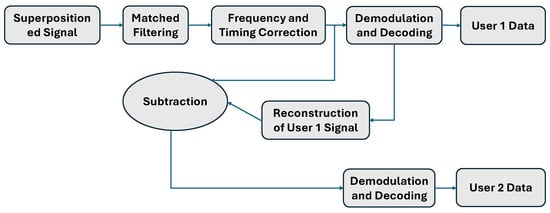
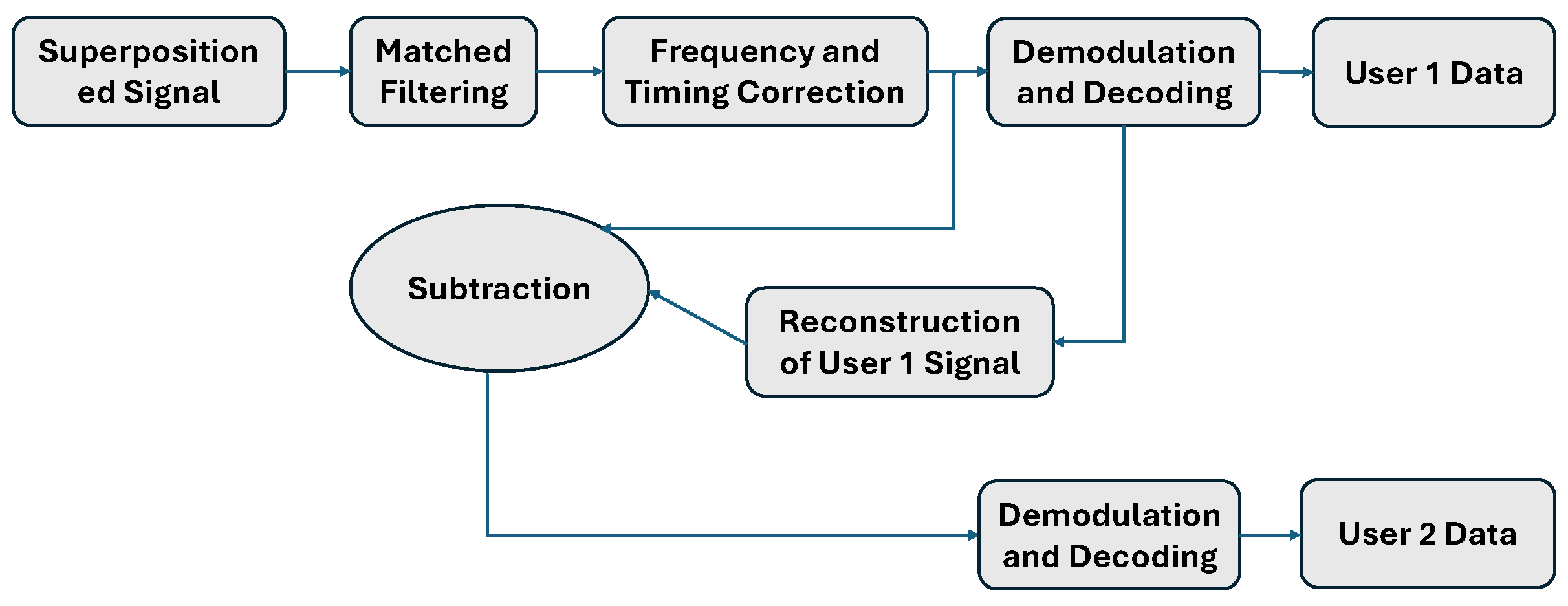
The receiver will capture the superpositioned signal and perform matched filtering, frequency offset compensation, and timing error corrections. Then, it will decode the strongest signal first. The decoded signal will be reconstructed and subtracted from the superpositioned signal. The remaining signal is then decoded, and the process will continue depending upon the number of users. A flow graph of this is shown in Figure 1.
Figure 1.
Successive interference cancellation flow graph.
3.4. Limitations and Overheads
The biggest limitation of NOMA is the complexity of the receiver. The SIC process can be resource-intensive and is prone to the “avalanche effect” of errors. If one user’s signal is decoded incorrectly, then the error can propagate to all future decoding. For uplink NOMA, the signals have to be synchronized to ensure constructive interference at the receiver. This can require highly stable GPS disciplined clocks (GPSDO) or signaling-based synchronization between the transmitter. GPSDO can be expensive and might not be suitable for various applications due to cost constraints. Signaling-based synchronization can add additional overhead to the system. However, in specific use cases, e.g., bandwidth-constrained systems, NOMA can be a viable solution. For our implementation, we utilized the available dual transmission channels in the rev-C version of the ADALM Pluto SDR. As they share the same clock, the transmitters are synchronized. We used error-correcting coding to reduce the risk of SIC error propagation.
4. Proposed Method
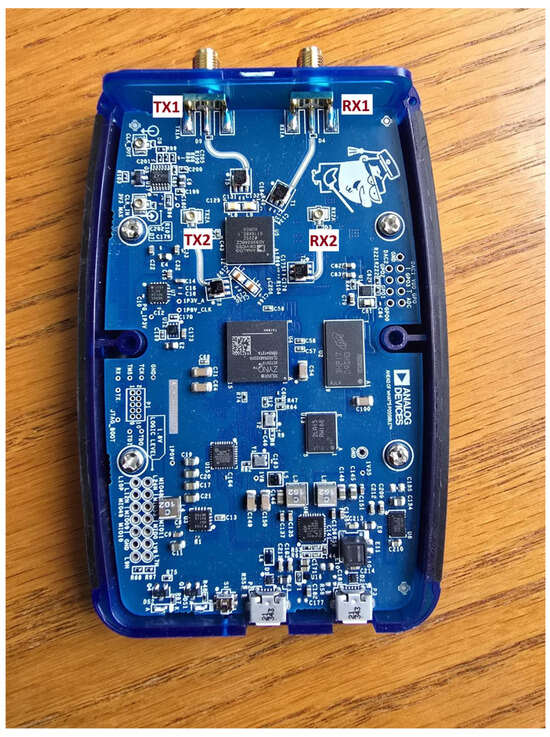
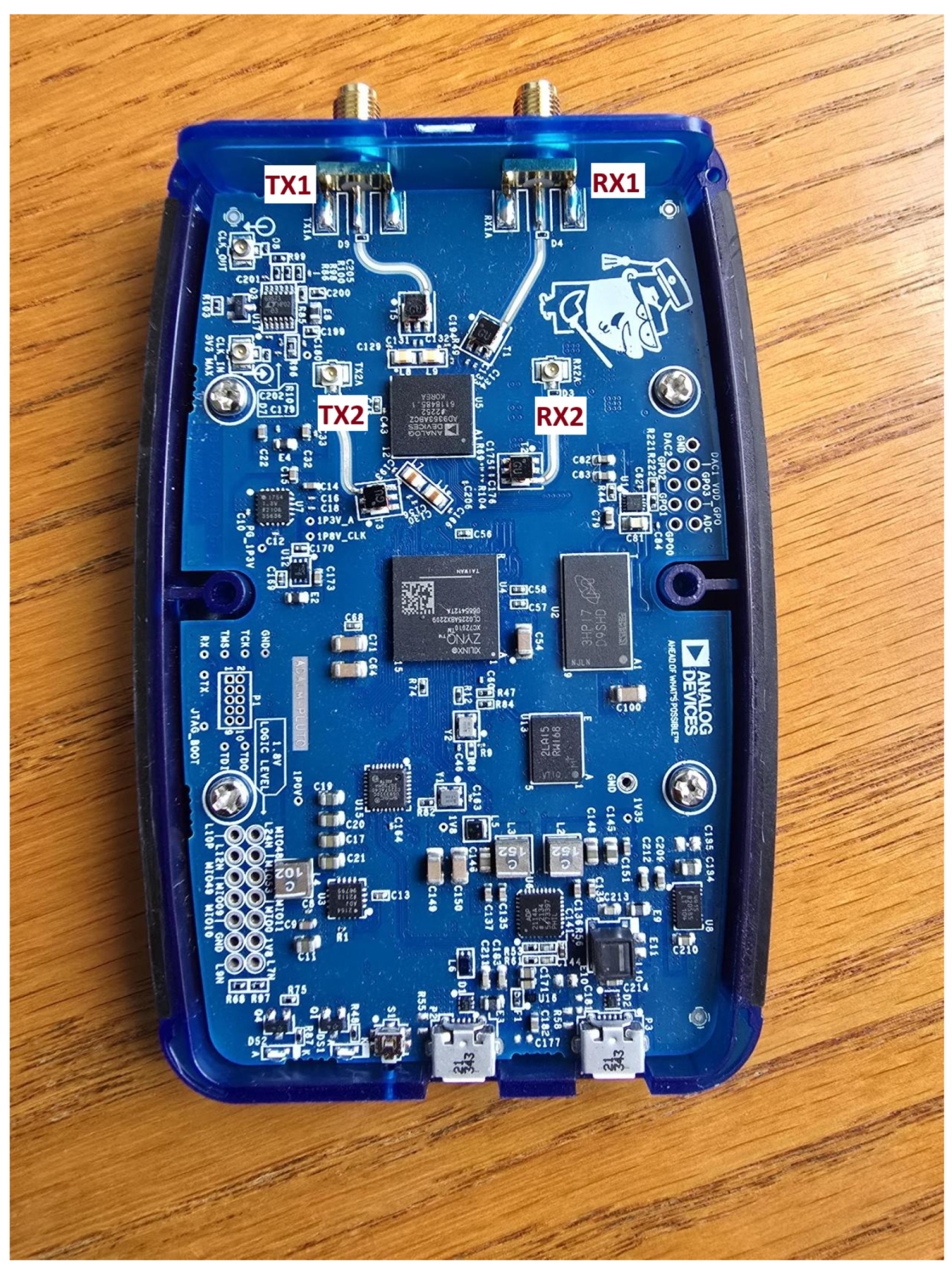
In our paper, we consider a two-user NOMA system. We demonstrate both the downlink and uplink implementation. For our implementation, we use the ADALM Pluto Software Defined Radio, hereafter referred to as PlutoSDR [7]. We use the Rev-C version of the PlutoSDR and use firmware version 0.39. ADALM Pluto is a low-cost SDR that can operate in full-duplex mode. It uses the AD9363 RF transceiver chip from Analog Devices [7]. The Rev-C version can be operated in AD9361 compatible mode. In this mode, the SDR can operate in dual TX (transmission) and RX (reception) modes. The second TX and RX channels are by default not connected to any SubMiniature version A (SMA) output. With two U.FL to SMA connectors, we can connect the RF antennas to those channels and operate the SDR in dual-channel mode. The board is shown in Figure 2.
Figure 2.
ADALM Pluto SDR (RevC).
4.1. Packet Structure
Each packet is 1024 samples in size. We use 31-symbol Zadoff-Chu sequence as preambles [40]. The main payload is a 13-byte-long ASCII string that is converted to bits. The payload is encoded using a rate- convolutional encoder. The preamble and the encoded payload are upsampled with a factor 4. We use 4 samples at the front of the packet and 8 samples at the end of the packet as guard symbols to protect against inter-symbol interference (ISI). A total of 56 symbols are padded at the end of the payload to make the frame size 1024 symbols exactly.
4.2. Downlink Implementation
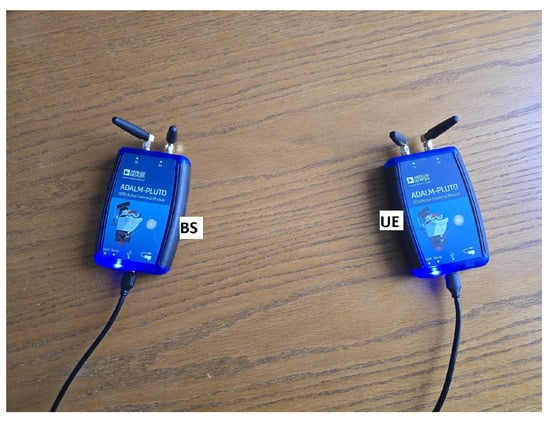
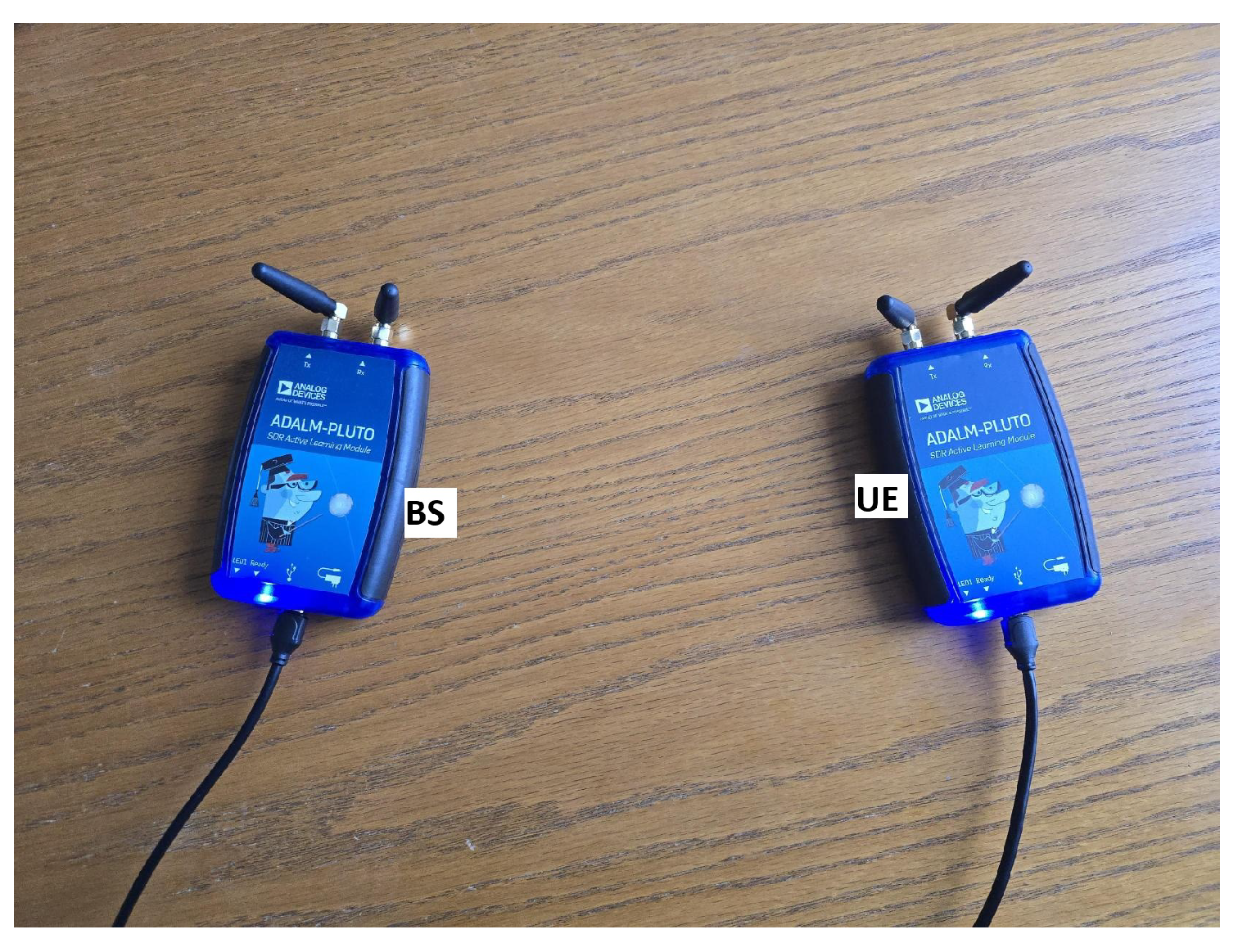
For the downlink implementation, we operate the PlutoSDRs in regular AD9363 mode as the dual channels are not needed for the current implementation. We use two SDRs for this implementation, where one of them is operating as the base station and the other as the end user (UE). The setup is shown in Figure 3.
Figure 3.
Downlink setup.
4.2.1. Transmitter Pipeline
The packet structure has been described previously. For the implementation, we use binary phase shift keying (BPSK) modulation. We use a root raised cosine (RRC) filter for pulse shaping [41]. The roll-off factor for the RRC filter is 0.35 and the filter span is 8. The signals are transmitted in the 915 MHz ISM band. The modulated waveforms are added at the base station before transmission. The transmitter assigns different power levels and to the two users. We assign higher power to UE1, i.e., . So, at the receiver, UE1 will be decoded first. The power constraint is .
If x1 and x2 are the signals of the two users, then the superpositioned signal is
4.2.2. Receiver Pipeline
The receiver will capture the superposed signal and will apply matched filtering. The RX side RRC filter has the exact same parameter as the TX side RRC filter and their combination forms the matched filter that results in a raised cosine filter response. After matched filtering, we perform frequency offset correction. Since we are using BPSK modulation, we can employ the squaring method for frequency offset estimation and correction [42]. We obtain the timing offset by cross-correlating with the known preamble. Again, with the preamble, we estimate the residual phase offset and apply the appropriate correction to the received signal. Then, we downsample the signal and detect the frame boundary with the help of the preamble and extract the data symbols.
After that, we demodulate and decode the strongest user (UE1). Then, UE1’s waveform is reconstructed and subtracted from the total received signal. This process removes the contribution of UE1 from the superpositioned signal. The residual signal is demodulated and decoded, and that gives us the UE2 data.
4.3. Uplink Implementation
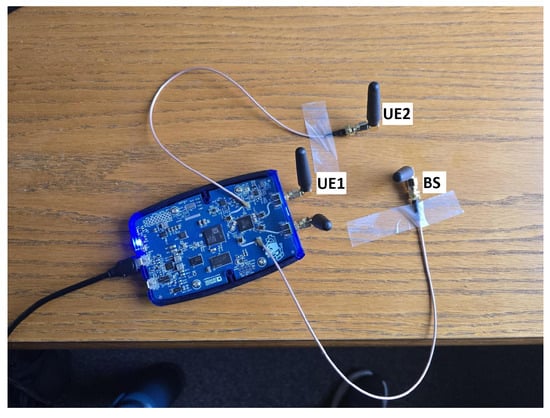
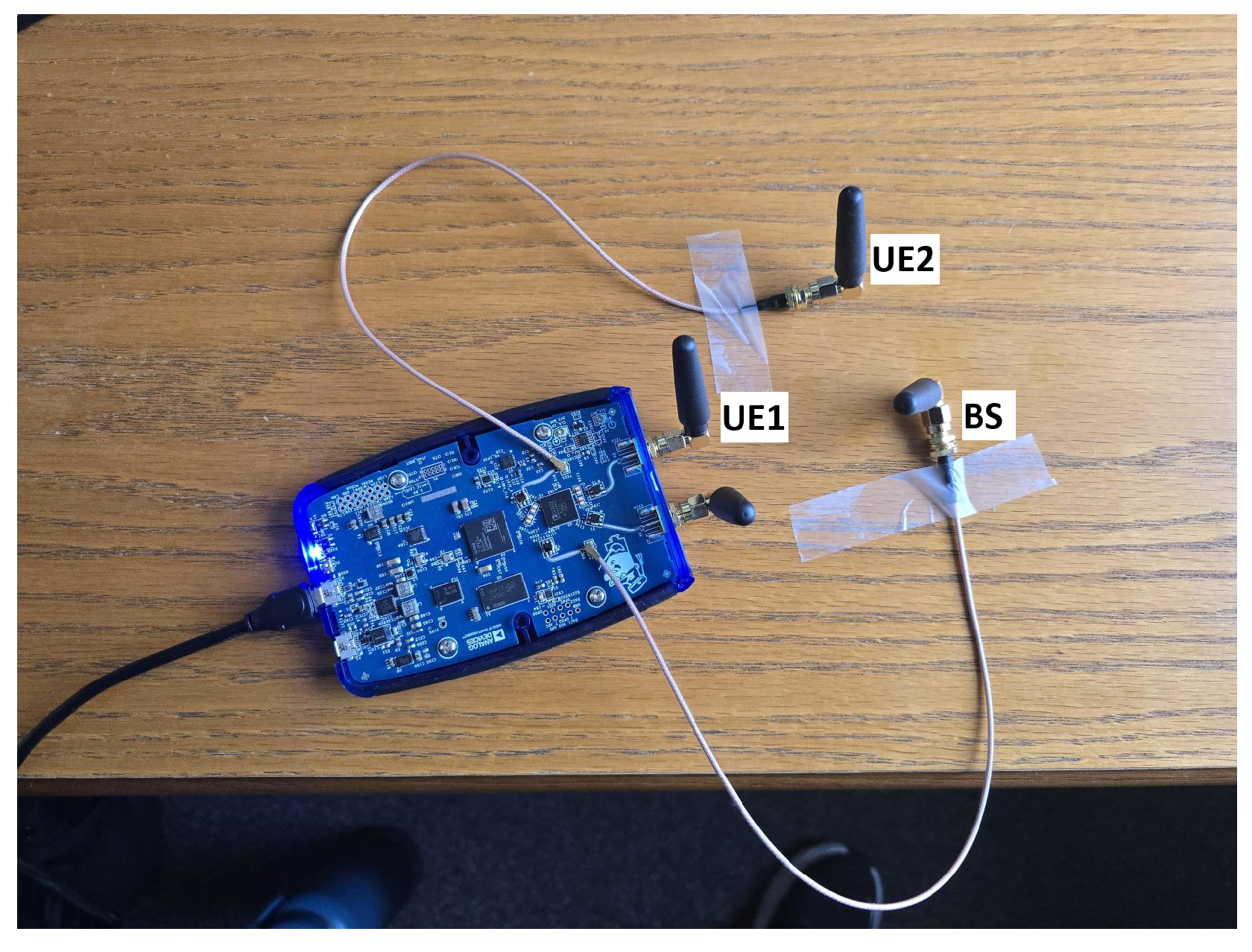
The implementation of a NOMA system via the uplink is challenging. The signals need to arrive at the receiver in a synchronized manner in order to ensure a constructive superposition of the signals. Our implementation uses the dual transmission channel of the Pluto SDR rev-C. Since both channels use the same oscillator, the signals are inherently synchronized. By proper positioning of the antenna, we achieve a good superposition of the signals at the receiver. The uplink setup is shown in Figure 4.
Figure 4.
Uplink setup.
4.3.1. Transmitter Pipeline
The transmission pipeline is mostly similar to the downlink setup. We modulate the encoded bitstream with BPSK modulation and apply the RRC filter for pulse shaping. However, in this setup, we do not add the signals before transmission. Instead, we transmit the signals using the two transmission channels using different transmission gains. The signals are transmitted over the same carrier frequency, and due to the additive nature of the Gaussian channel, they superimpose naturally over the air.
4.3.2. Receiver Pipeline
The receiver pipeline is similar to the downlink setup. We apply matched filtering. Then, CFO estimation and compensation are performed. Afterwards, the timing and phase offsets are estimated and corrected. We decoded the stronger signal first, reconstructed the waveform, and then subtracted it from the superposition signal. We decoded the weaker signal from the residue.
5. Testing & Validation
We implemented our system using the ADALM Pluto SDR. The system parameters, unless otherwise stated, are shown in Table 1.
Table 1.
System parameters.
We use convolutional encoding for forward error correction (FEC). The SDRs were controlled via the pyadi-IIO library and programmed with Python from a host computer. The firmware version of the SDRs is v0.39. We utilized the Commpy library for convolutional encoding and Viterbi decoding. The used convolution code has a coding rate of and has a constraint length of 7. The generator polynomials are 171 and 133 (octal).
For both the uplink and downlink systems, we run a Monte Carlo test, transmit 100 packets, and log the latency and the success rate of transmissions. If even a single bit is found to be erroneous, we conclude that as a failure. It is noted that each configuration is evaluated over 100 packets, which is sufficient to validate feasibility and measure latency distributions, but it limits the statistical resolution of a very low BER. However, it should be clarified that observing zero errors does not mean the BER is exactly zero. It only indicates that the BER is below what can be resolved given the total number of decoded bits. Thus, in the rest of our testing and validation process, we interpret zero BER as a measurement resolution for indicative testing purposes. All reported results correspond to a fixed PHY operating point (selected modulation, coding and packet structure) and a fixed two-user power-domain NOMA configuration chosen to enable stable SIC-based decoding in the OTA SDR setup. The purpose of the evaluation is to characterize end-to-end behavior (i.e., latency distributions and packet success outcomes) and to extract implementation insights at this operating point, rather than to present a full parameter-sweep optimization across modulation, power ratios, and channel conditions.
5.1. Downlink Results
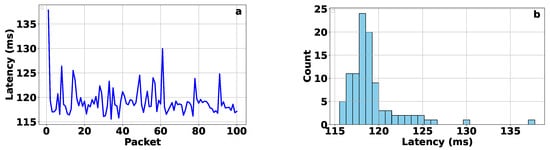
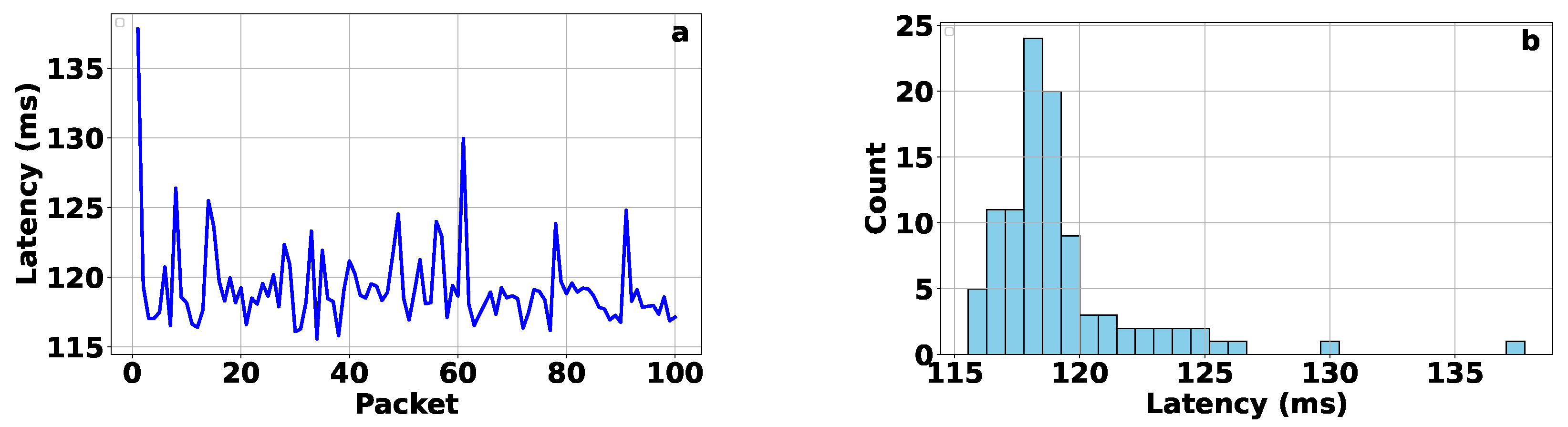
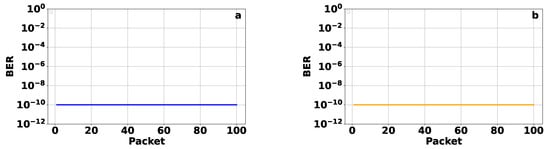
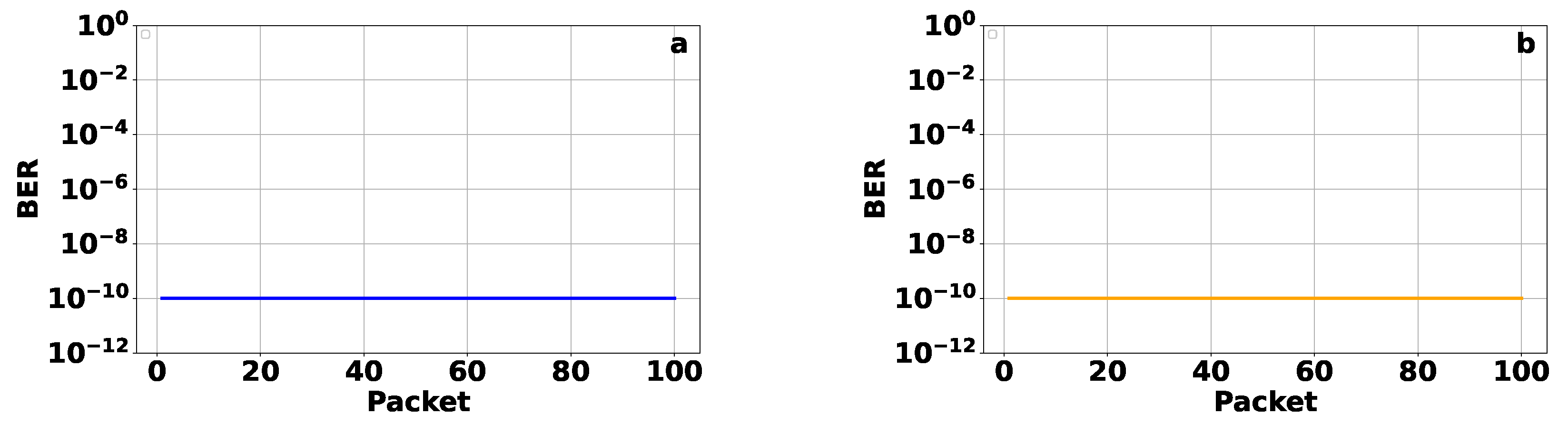
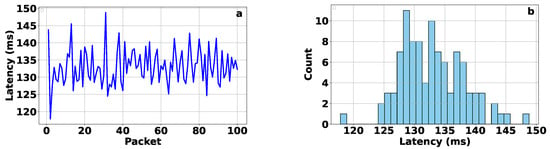
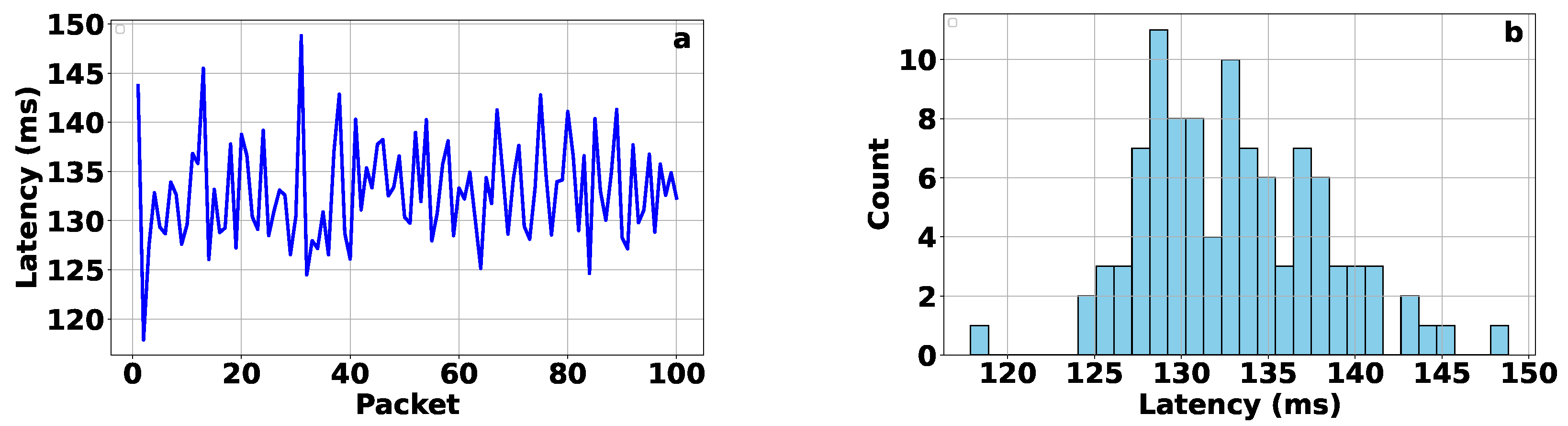
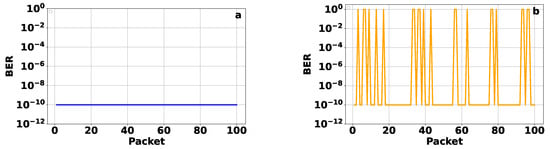
Figure 5a shows the average end-to-end latency for each packet. The average latency was found to be 119.2 ms. There exists a communication jitter between the SDR and the host PC. The jitter can be quite large [43]. Due to this jitter and the fact that Python processing can be slow, the latency appears to be higher than necessary. The distribution of the latency is shown in Figure 5b. However, the system demonstrates good error performance. For the downlink system, the BER for each packet is shown in Figure 6. For both UE1 and UE2, in all cases, BER is found to be zero across the evaluated packets. Since Figure 6 uses a logarithmic y-axis, zeros cannot be plotted directly. Therefore, we display these zero-BER instances at only for presentation purposes, and they should be read as a zero observed BER rather than as a measured BER floor.
Figure 5.
Downlink average latency analysis: (a) end-to-end latency and (b) latency distribution.
Figure 6.
Downlink bit error rate (BER) packet by packet: (a) UE1 and (b) UE2.
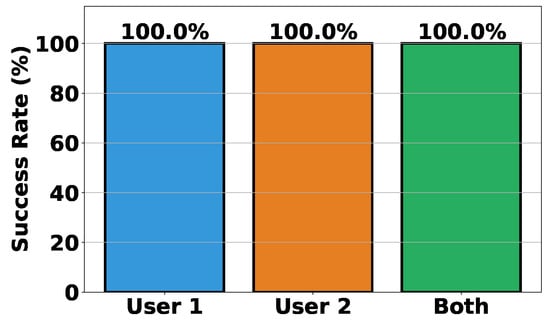
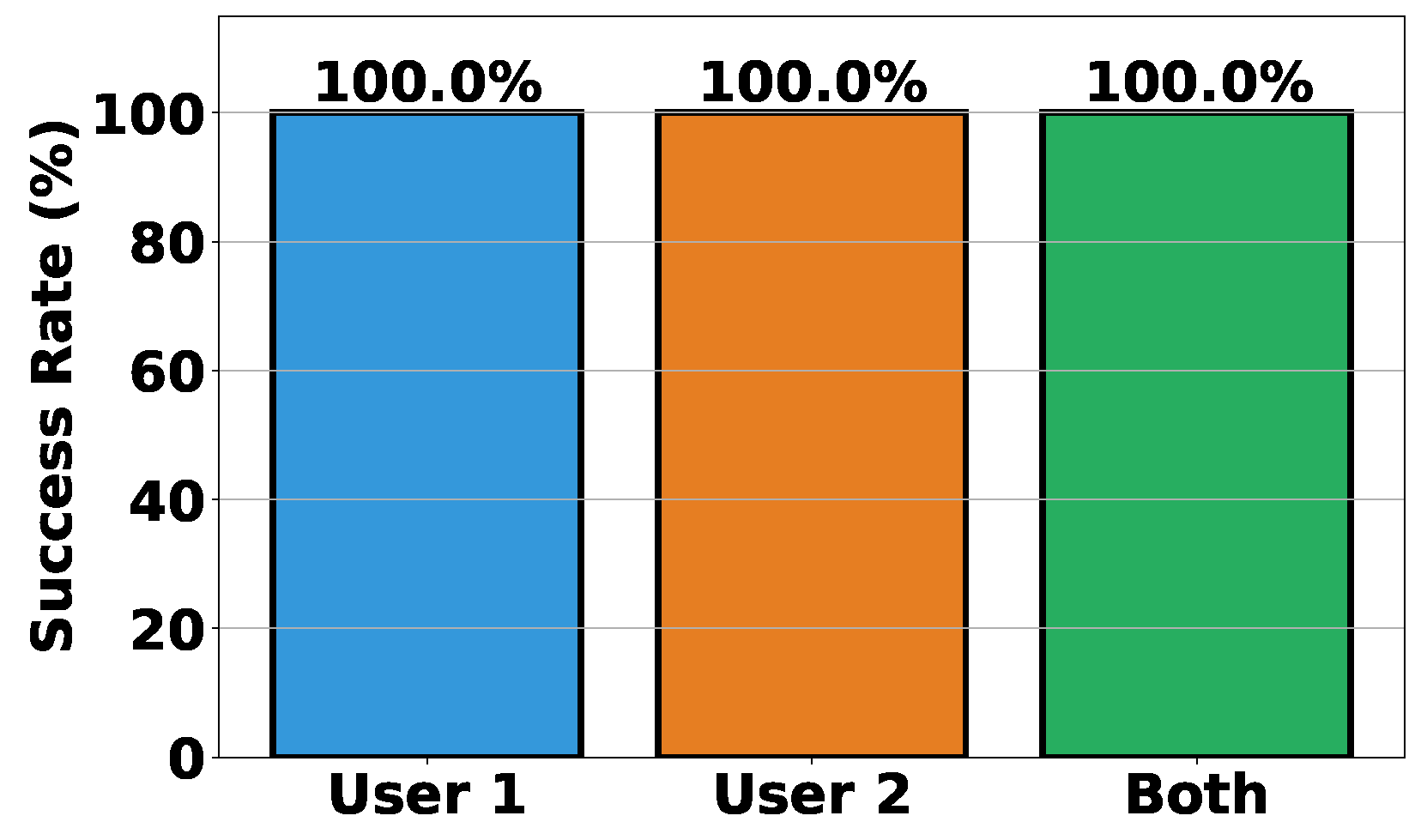
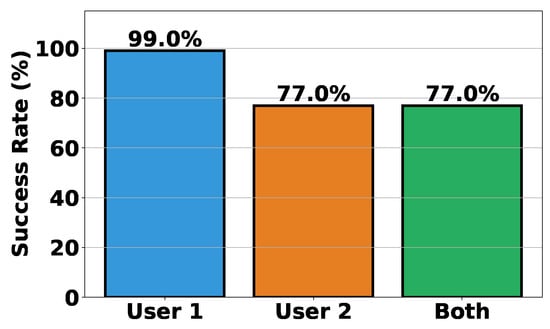
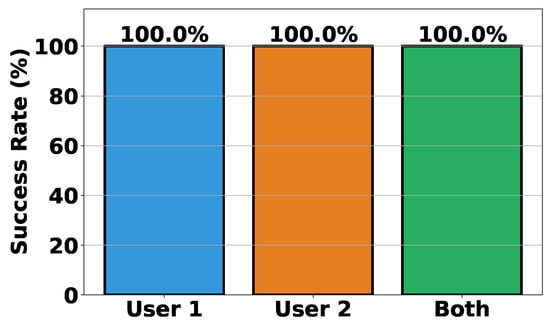
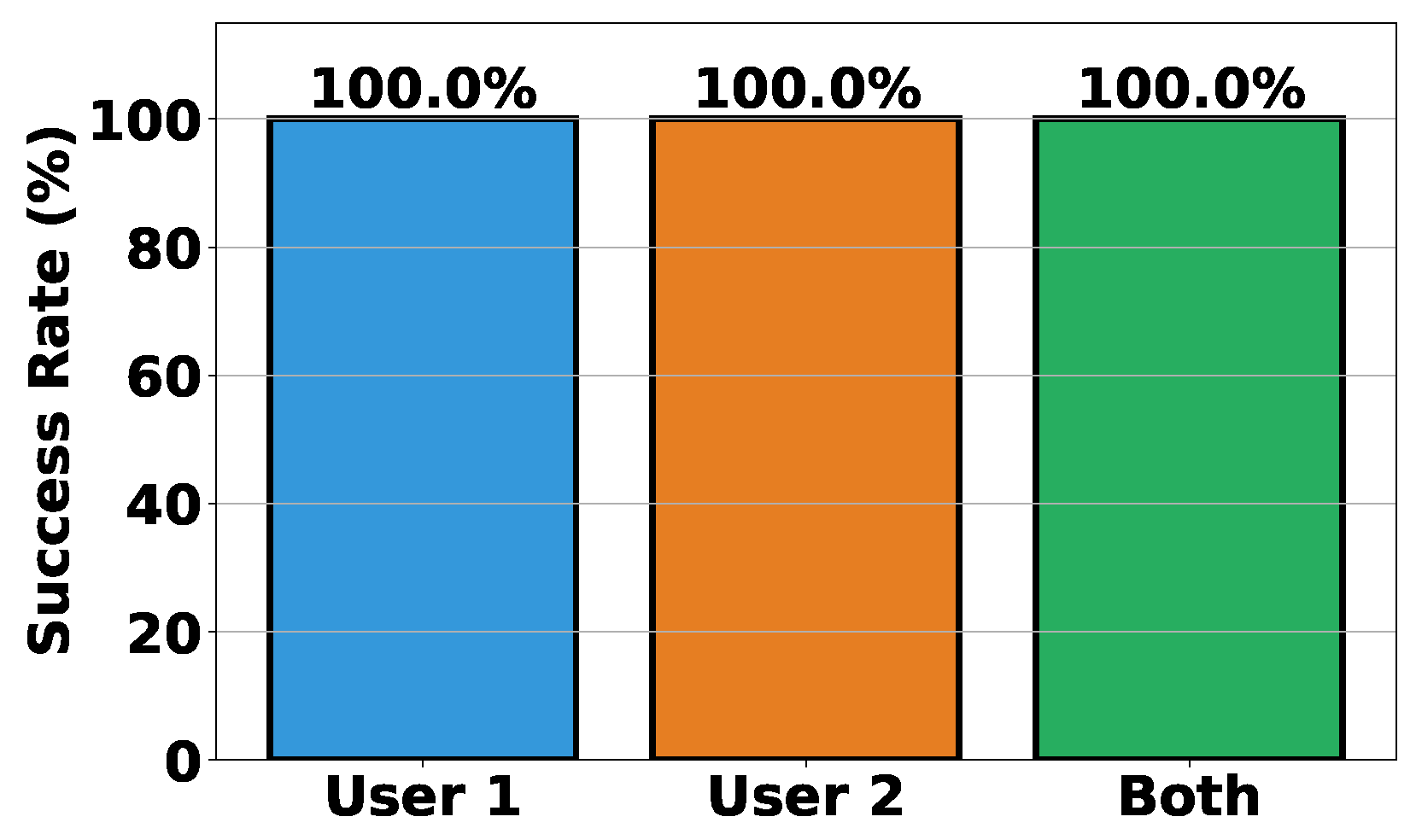
Our developed systems demonstrate very good performance in terms of reliability, achieving complete success in recovering data for both UEs. The success statistics for UE1 and UE2 are shown in Figure 7. For the downlink setup, we combined the signals at the base station and transmitted them using the transmission channel. By combining, i.e., ensuring perfect superposition at the BS, decoding and recovery at the receivers become much more reliable. This is the inherent benefit of a downlink setup, which does not exist for an uplink scenario.
Figure 7.
Success rate of downlink transmission.
5.2. Uplink Results
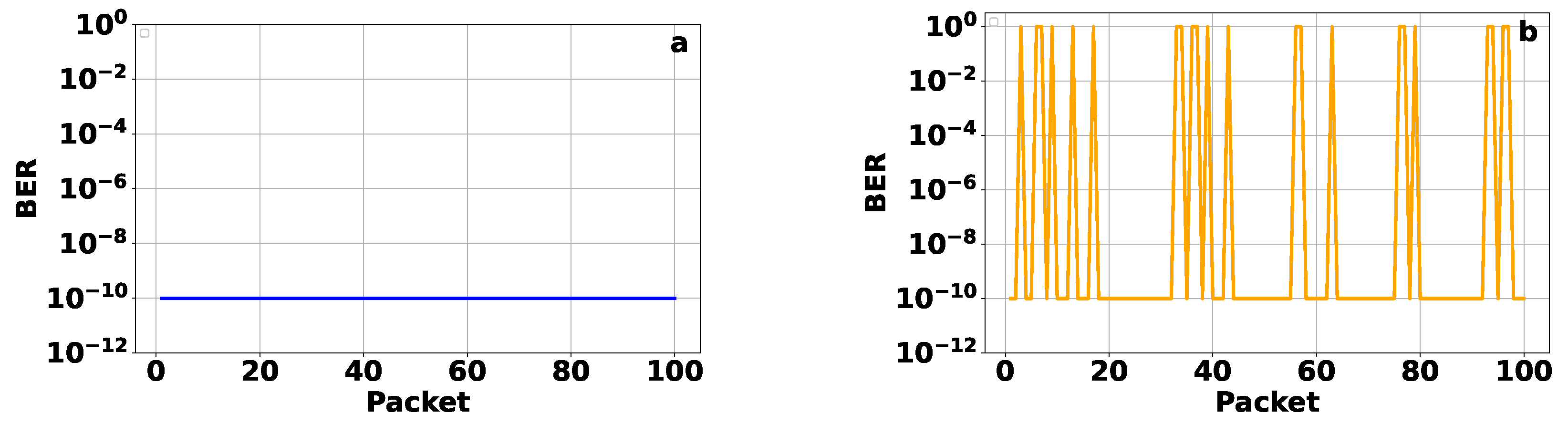
The latency characteristics of the uplink setup are shown in Figure 8. The average end-to-end latency for each packet in the uplink system is shown in Figure 8a. The average latency is 133 ms. As mentioned earlier, the communication jitter between the SDR and the PC significantly contributes to the demonstrated latency value here. The latency distribution is shown in Figure 8b. The BER performance is shown in Figure 9a,b. In the event of zero BER, we demonstrate the low BER value of .
Figure 8.
Uplink average latency analysis: (a) end-to-end latency and (b) latency distribution.
Figure 9.
Uplink bit error rate (BER) packet by packet: (a) UE1 and (b) UE2.
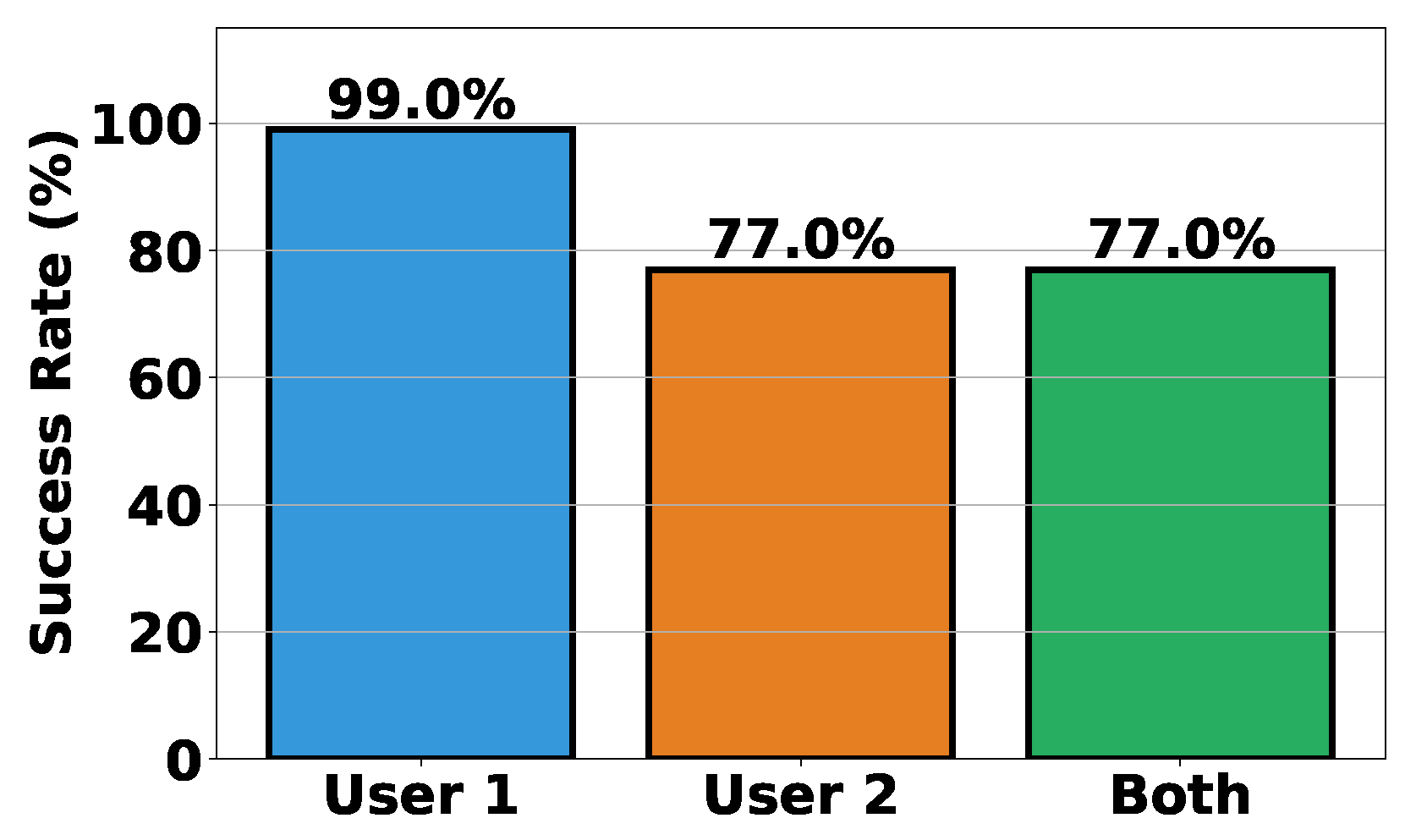
We observe that the uplink system has instances of reception error. Although the transmissions from both channels are inherently synchronized, the path the signal takes can affect the quality of the received superpositioned signal. We observed that proper placement of the antennas is crucial for achieving successful recovery. The success rate can be further improved if directional antennas are used. The success statistics of the uplink system are shown in Figure 10.
Figure 10.
Success rate of uplink transmission.
The UE1 has a higher amount of power allocated to it. This helps with its recovery, as shown in Figure 10. UE1 is decoded successfully 99% of the time. One of User 1’s packets was lost. UE2 has a lower amount of power, and without proper beamforming direction, the superposition quality can decrease, and the decoding performance can worsen, as demonstrated by the achieved success rate of 77%. However, the implementation shows that by ensuring proper synchronization and beamforming, uplink NOMA can be implemented in practical systems. It is highlighted that UE2 is decoded after SIC subtraction of UE1. Thus, UE2 performance is directly affected by the residual interference left after reconstructing and subtracting UE1. Even with synchronized transmission, differences in the propagation paths and multipath reflections can prevent perfect over-the-air superposition. Specifically, changes in antenna placement alter the received amplitude and phase relationship and channel structure, and they increase the reconstruction mismatch as well as leave a larger residual interference component after SIC. This residual interference disproportionately impacts UE2 (the weaker user). Thus, UE2 success is lower and the uplink NOMA is more sensitive to placement than the downlink. It is also noted that all of the reported uplink experiments were conducted under a fixed PHY configuration and a fixed laboratory OTA arrangement (hardware, carrier, packet structure, and processing pipeline held constant). The observed uplink variability is therefore attributed to the over-the-air superposition conditions (relative received power and phase) induced by antenna placement and multipath, which are known to affect SIC subtraction residuals.
5.3. Comparative Analysis
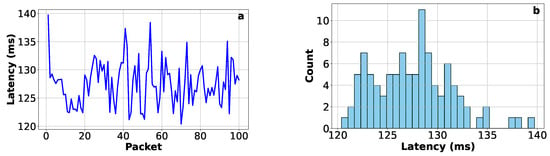
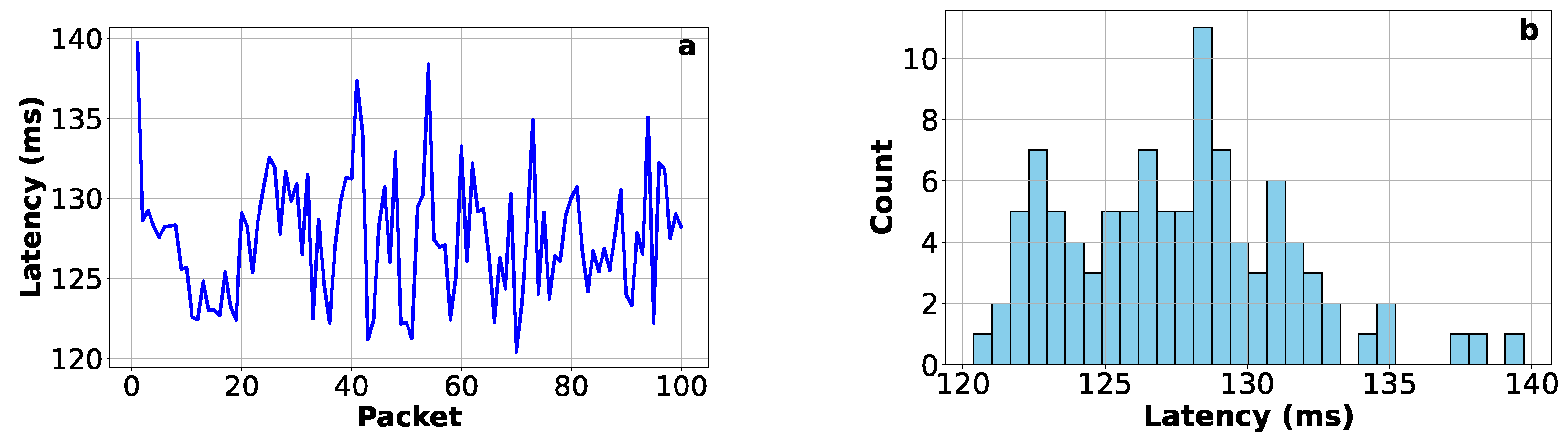
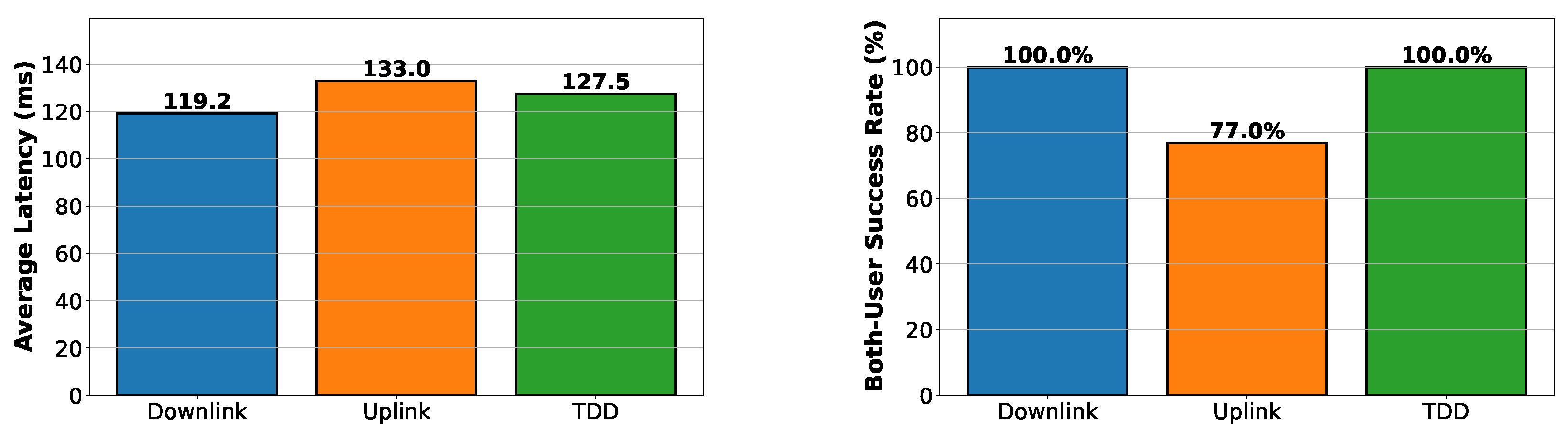
To compare the NOMA system with an orthogonal multiple access (OMA) scheme, we designed a time division duplex (TDD) system. We used the same carrier frequency, packet structure, and SDR parameters as the NOMA system for a one-to-one comparison. The TDD system has a very good success rate, achieving 100% packet recovery for both users, as shown in Figure 11. The average latency was 127.53 ms. The end-to-end latency and the latency distributions are shown in Figure 12.
Figure 11.
Success rate of TDD system.
Figure 12.
TDD system average latency analysis: (a) end-to-end latency and (b) latency distribution.
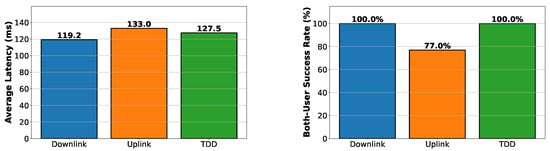
For latency, we account for the time gap between transmission, which was set to 3 ms. In terms of end-to-end latency, the TDD and NOMA systems’ performance is quite similar, with a difference of a few milliseconds. A comparison of the three systems is shown in Figure 13.
Figure 13.
Comparative analysis of average latency and success rate.
However, the time on the air for a single packet is µs. In NOMA, one packet contains information for both users, so the effective time on the air is half that of TDD for transmitting data for two users. So, the NOMA system has a higher potential for scaling up than the TDD system, as it allows us to perform multiple transmissions in a single slot. The choice between NOMA and OMA methods will depend on the system constraints.
5.4. Analysis of the Observed BER
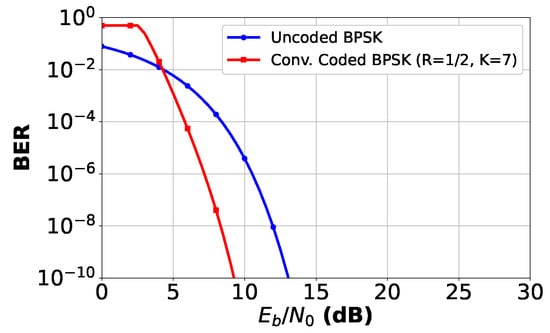
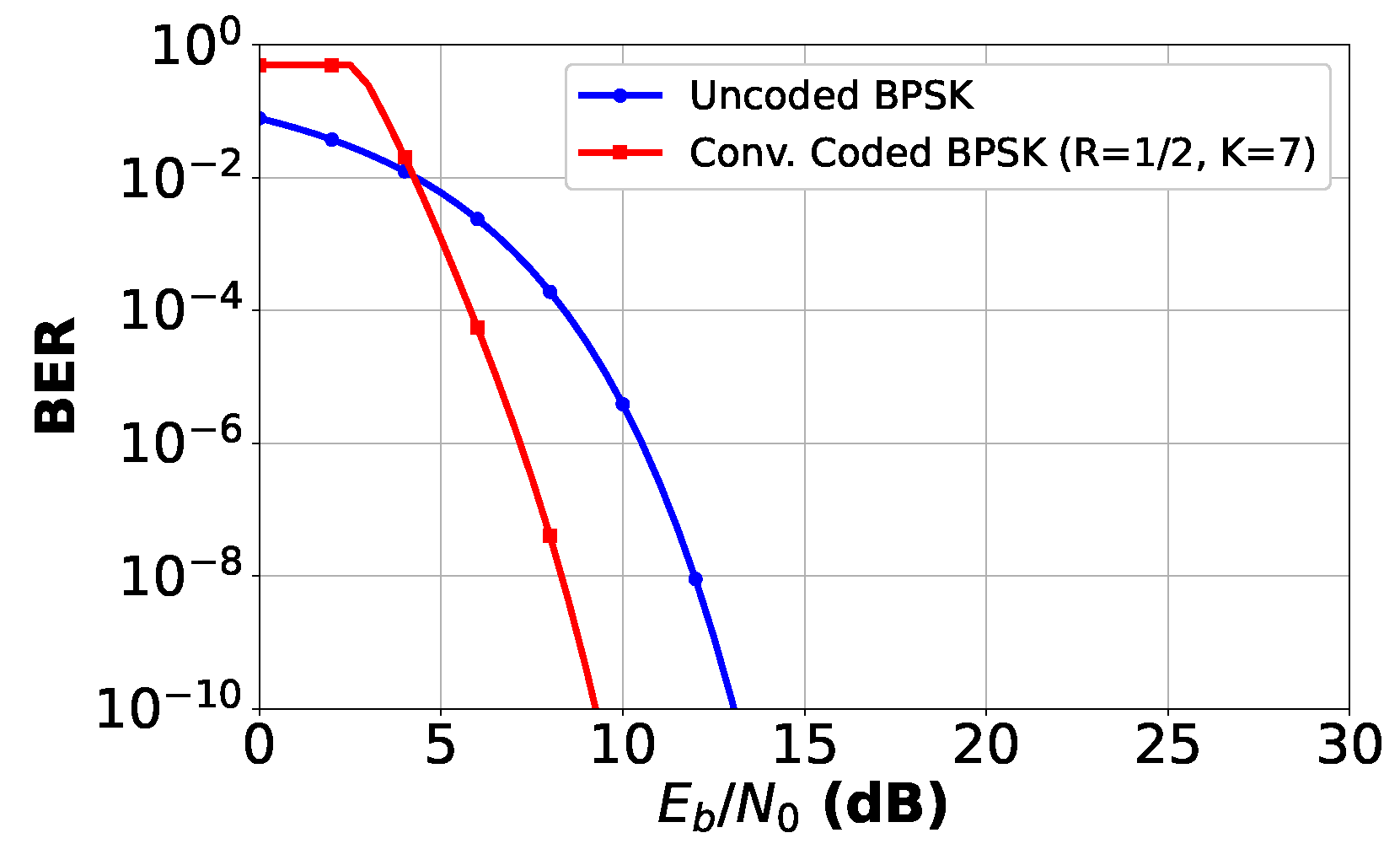
In our setup, we use BPSK modulation with convolutional encoding. We conducted a theoretical BER vs. analysis for a BPSK link with and without convolutional error-correcting coding. The analysis is shown in Figure 14.
Figure 14.
BER vs. for BPSK System.
We also estimated the from our testing. With the used parameters and setup, our observed ranged from 16 to 18 dB. With such a range and convolutional coding, we achieve a virtually error-free communication link.
6. Conclusions
We implemented a reliable NOMA system for both uplink and downlink scenarios. The downlink implementation performs very well with extremely high success rates. The uplink implementation validates the concept of NOMA uplink. Although we use multi-channel transmission from the same SDR for this, the demonstration shows a method for a reliable uplink implementation. With the help of GPSDO and directional antennas, it is possible to decouple the transmissions to multiple devices, and our signal processing chain shows that if we can ensure synchronization between the transmissions, we can successfully perform successive interference cancellation and recover user data with a high degree of accuracy. Quantitatively, the prototype achieves an average end-to-end latency of 119.2 ms in downlink and 133 ms in uplink under the current Python/host–SDR control stack. Our future work includes implementing an intelligent reflecting surfaces (IRS)-aided distributed NOMA system. Also, our current and future work explores a more robust SIC method in the event of imperfect synchronization between the transmitters, while also extending the current research in a multi-transmitter environment.
Author Contributions
Implementation, D.A.; testing and data collection; D.A.; supervision, E.E.T. All authors have read and agreed to the published version of the manuscript.
Funding
This research received no external funding.
Data Availability Statement
The original contributions presented in this study are included in the article. Further inquiries can be directed to the corresponding author.
Conflicts of Interest
The authors declare no conflicts of interest.
References
- Gao, S.; Wang, Y.; Feng, N.; Wei, Z.; Zhao, J. Deep reinforcement learning-based video offloading and resource allocation in NOMA-enabled networks. Future Internet 2023, 15, 184. [Google Scholar] [CrossRef] [Scilit]
- Diamanti, M.; Fragkos, G.; Tsiropoulou, E.E.; Papavassiliou, S. Unified User Association and Contract-Theoretic Resource Orchestration in NOMA Heterogeneous Wireless Networks. IEEE Open J. Commun. Soc. 2020, 1, 1485–1502. [Google Scholar] [CrossRef] [Scilit]
- Wang, J.; Song, X.; Ma, Y. A novel resource allocation scheme in NOMA-based cellular network with D2D communications. Future Internet 2020, 12, 8. [Google Scholar] [CrossRef] [Scilit]
- Diamanti, M.; Tsiropoulou, E.E.; Papavassiliou, S. The Joint Power of NOMA and Reconfigurable Intelligent Surfaces in SWIPT Networks. In Proceedings of the 2021 IEEE 22nd International Workshop on Signal Processing Advances in Wireless Communications (SPAWC), Lucca, Italy, 27–30 September 2021; IEEE: New York, NY, USA, 2021; pp. 621–625. [Google Scholar] [CrossRef] [Scilit]
- Li, R.; Xu, L. Joint Optimization of Radio and Computational Resource Allocation in Uplink NOMA-Based Remote State Estimation. Sensors 2025, 25, 4686. [Google Scholar] [CrossRef] [Scilit]
- Wu, C.J.; Lin, C.Y.; Huang, Y.C. Polar Coding and Early SIC Decoding for Uplink Heterogeneous NOMA. Entropy 2025, 27, 1167. [Google Scholar] [CrossRef] [Scilit]
- Analog Devices, Inc. ADALM-PLUTO Evaluation Board—Software-Defined Radio Active Learning Module. 2026. Available online: https://www.analog.com/en/resources/evaluation-hardware-and-software/evaluation-boards-kits/adalm-pluto.html (accessed on 10 January 2026).
- Tae-Kyoung, K. BER-Constrained Power Allocation for Uplink NOMA Systems with One-Bit ADCs. Mathematics 2025, 13, 4039. [Google Scholar]
- Rauniyar, A.; Østerbø, O.N.; Håkegård, J.E.; Engelstad, P. Exploiting cooperative downlink NOMA in D2D communications. Sensors 2023, 23, 3958. [Google Scholar] [CrossRef] [Scilit]
- Mohsan, S.A.H.; Li, Y.; Zhang, Z.; Ali, A.; Xu, J. Uplink and downlink noma based on a novel interference coefficient estimation strategy for next-generation optical wireless networks. Photonics 2023, 10, 569. [Google Scholar] [CrossRef] [Scilit]
- Wang, Z.; Liu, Y.; Mu, X.; Ding, Z. NOMA Inspired Interference Cancellation for Integrated Sensing and Communication. In Proceedings of the ICC 2022—IEEE International Conference on Communications, Seoul, Republic of Korea, 16–20 May 2022; IEEE: New York, NY, USA, 2022; pp. 3154–3159. [Google Scholar] [CrossRef] [Scilit]
- Abeywickrama, S.; Liu, L.; Chi, Y.; Yuen, C. Over-the-Air Implementation of Uplink NOMA. In Proceedings of the GLOBECOM 2017—2017 IEEE Global Communications Conference, Singapore, 4–8 December 2017; IEEE: New York, NY, USA, 2017; pp. 1–6. [Google Scholar] [CrossRef] [Scilit]
- Ding, Z.; Schober, R.; Poor, H.V. Unveiling the Importance of NOMA for Reducing AoI. In Proceedings of the ICC 2023—IEEE International Conference on Communications, Rome, Italy, 28 May–1 June 2023; IEEE: New York, NY, USA, 2023; pp. 2233–2238. [Google Scholar] [CrossRef] [Scilit]
- Allouis, A.; Dayoub, I. PHY/MAC Cross-Layer Design using NOMA for Next Generation C-V2X. In Proceedings of the ICC 2025—IEEE International Conference on Communications, Montreal, QC, Canada, 8–12 June 2025; IEEE: New York, NY, USA, 2025; pp. 5664–5669. [Google Scholar] [CrossRef] [Scilit]
- Liu, X.; Lin, M.; Guo, H.; Tan, M.; Ouyang, J.; Quck, T.Q. Low-Complexity Downlink Transmission with NOMA for IRS-Aided Integrated Satellite-Terrestrial Network. In Proceedings of the GLOBECOM 2023—2023 IEEE Global Communications Conference, Kuala Lumpur, Malaysia, 4–8 December 2023; IEEE: New York, NY, USA, 2023; pp. 1411–1416. [Google Scholar] [CrossRef] [Scilit]
- Ouyang, C.; Zhang, X.; Liu, Y. Performance Analysis of Downlink NOMA-ISAC. In Proceedings of the GLOBECOM 2023—2023 IEEE Global Communications Conference, Kuala Lumpur, Malaysia, 4–8 December 2023; IEEE: New York, NY, USA, 2023; pp. 7393–7398. [Google Scholar] [CrossRef] [Scilit]
- Ling, B.; Dong, C.; Dai, J.; Lin, J. Multiple Decision Aided Successive Interference Cancellation Receiver for NOMA Systems. IEEE Wirel. Commun. Lett. 2017, 6, 498–501. [Google Scholar] [CrossRef] [Scilit]
- Xu, Y.; Fang, F.; Wang, S.; Cai, D. SIC-Free NOMA Designs Via Symbol-Level Precoding. In Proceedings of the GLOBECOM 2023—2023 IEEE Global Communications Conference, Kuala Lumpur, Malaysia, 4–8 December 2023; IEEE: New York, NY, USA, 2023; pp. 3621–3626. [Google Scholar] [CrossRef] [Scilit]
- Zohdy, M.; Tajer, A.; Shamai, S. Broadcast Approach to Uplink NOMA: Queuing Delay Analysis. Entropy 2022, 24, 1757. [Google Scholar] [CrossRef] [Scilit] [PubMed]
- Garnier, J.R.; Fabre, A.; Farès, H.; Bonnefoi, R. On the Performance of QPSK Modulation Over Downlink NOMA: From Error Probability Derivation to SDR-Based Validation. IEEE Access 2020, 8, 66495–66507. [Google Scholar] [CrossRef] [Scilit]
- Miuccio, L.; Panno, D.; Riolo, S. An Energy-Efficient DL-Aided Massive Multiple Access Scheme for IoT Scenarios in Beyond 5G Networks. IEEE Internet Things J. 2023, 10, 7936–7959. [Google Scholar] [CrossRef] [Scilit]
- Islam, S.M.R.; Avazov, N.; Dobre, O.A.; Kwak, K.-s. Power-Domain Non-Orthogonal Multiple Access (NOMA) in 5G Systems: Potentials and Challenges. IEEE Commun. Surv. Tutor. 2017, 19, 721–742. [Google Scholar] [CrossRef] [Scilit]
- Rezvani, S.; Jorswieck, E.A.; Yamchi, N.M.; Javan, M.R. Optimal SIC Ordering and Power Allocation in Downlink Multi-Cell NOMA Systems. IEEE Trans. Wirel. Commun. 2022, 21, 3553–3569. [Google Scholar] [CrossRef] [Scilit]
- Sirait, R.; Hardjawana, W.; Wibisono, G. Performance of Downlink NOMA for a Massive IoT Network Over a Nakagami-m Fading Channel With Optimized Power Allocation. IEEE Access 2023, 11, 67779–67790. [Google Scholar] [CrossRef] [Scilit]
- Khan, A.R.; Sohaib, S. Cooperative NOMA, Prototyping and Experimental Evaluation Using SDR. IEEE Trans. Veh. Technol. 2021, 70, 2872–2876. [Google Scholar] [CrossRef] [Scilit]
- Hesam, A.; Bastami, A.H.; Abdel-Hafez, M.A. Performance Analysis of NOMA-Based Transmission in Two-Way Relay Network. IEEE Access 2024, 12, 37051–37068. [Google Scholar] [CrossRef] [Scilit]
- Ding, Z. A Study on the Optimality of Downlink Hybrid NOMA. IEEE Signal Process. Lett. 2025, 32, 511–515. [Google Scholar] [CrossRef] [Scilit]
- Yahya, H.; Alsusa, E.; Al-Dweik, A. Design and Performance Analysis of Multirate-NOMA. IEEE Open J. Commun. Soc. 2024, 5, 4354–4370. [Google Scholar] [CrossRef] [Scilit]
- Sherazi, S.; Kim, S.W.; Khokhar, A. Covert NOMA in Uplink: A Two-User Framework. In Proceedings of the ICC 2024—IEEE International Conference on Communications, Denver, CO, USA, 9–13 June 2024; IEEE: New York, NY, USA, 2024; pp. 3328–3333. [Google Scholar] [CrossRef] [Scilit]
- Qi, Y.; Zhang, X.; Vaezi, M. Over-the-Air Implementation of NOMA: New Experiments and Future Directions. IEEE Access 2021, 9, 135828–135844. [Google Scholar] [CrossRef] [Scilit]
- Gómez-Cuba, F.; Pena-Sande, M. Successive Interference Cancellation Implementation for ns-3 MU-MIMO mmWave Module. In Proceedings of the WNS3’24: 2024 Workshop on ns-3, Barcelona, Spain, 5–6 June 2024; Association for Computing Machinery: New York, NY, USA, 2024; pp. 45–53. [Google Scholar] [CrossRef] [Scilit]
- Vaezi, M.; Zhang, X. Interference-Aware Super-Constellation Design for NOMA. In Proceedings of the ICC 2025—IEEE International Conference on Communications, Montreal, QC, Canada, 8–12 June 2025; IEEE: New York, NY, USA, 2025; pp. 1668–1673. [Google Scholar] [CrossRef] [Scilit]
- Jafarkhani, H.; Maleki, H.; Vaezi, M. Modulation and Coding for NOMA and RSMA. Proc. IEEE 2024, 112, 1179–1213. [Google Scholar] [CrossRef] [Scilit]
- Zuo, J.; Mu, X.; Liu, Y. Near-Field Non-Orthogonal Multiple Access Communications. In Proceedings of the GLOBECOM 2023—2023 IEEE Global Communications Conference, Kuala Lumpur, Malaysia, 4–8 December 2023; IEEE: New York, NY, USA, 2023; pp. 649–654. [Google Scholar] [CrossRef] [Scilit]
- Hedhly, W.; Musavian, L.; Thomos, N. OTFS-NOMA System for MIMO Communication Networks with Spatial Diversity. In Proceedings of the ICC 2024—IEEE International Conference on Communications, Denver, CO, USA, 9–13 June 2024; IEEE: New York, NY, USA, 2024; pp. 569–574. [Google Scholar] [CrossRef] [Scilit]
- Ding, Z.; Schober, R.; Vincent Poor, H. Design of Downlink Hybrid NOMA Transmission. IEEE Trans. Wirel. Commun. 2024, 23, 19587–19602. [Google Scholar] [CrossRef] [Scilit]
- Amhaz, A.; Elhattab, M.; Assi, C.; Sharafeddine, S. Integrated Sensing and Communication: NOMA vs. Cooperative NOMA. In Proceedings of the GLOBECOM 2023—2023 IEEE Global Communications Conference, Kuala Lumpur, Malaysia, 4–8 December 2023; IEEE: New York, NY, USA, 2023; pp. 407–412. [Google Scholar] [CrossRef] [Scilit]
- Vamvakas, P.; Tsiropoulou, E.E.; Papavassiliou, S.; Baras, J.S. Optimization and resource management in NOMA wireless networks supporting real and non-real time service bundling. In Proceedings of the 2017 IEEE Symposium on Computers and Communications (ISCC), Heraklion, Greece, 3–6 July 2017; IEEE: New York, NY, USA, 2017; pp. 697–703. [Google Scholar] [CrossRef] [Scilit]
- Diamanti, M.; Tsiropoulou, E.E.; Papavassiliou, S. Resource Orchestration in UAV-assisted NOMA Wireless Networks: A Labor Economics Perspective. In Proceedings of the ICC 2021—IEEE International Conference on Communications, Montreal, QC, Canada, 14–23 June 2021; IEEE: New York, NY, USA, 2021; pp. 1–6. [Google Scholar] [CrossRef] [Scilit]
- Chu, D. Polyphase codes with good periodic correlation properties (Corresp.). IEEE Trans. Inf. Theory 1972, 18, 531–532. [Google Scholar] [CrossRef] [Scilit]
- Cubukcu, E. Root raised cosine (RRC) filters and pulse shaping in communication systems. In Proceedings of the AIAA Conference, Pasadena, CA, USA, 11–13 September 2012; NASA: Washington, DC, USA, 2012; number JSC-CN-26387. [Google Scholar]
- Cowley, W.G.; Rice, M.; McLean, A.N. Estimation of Frequency Offset in Mobile Satellite Modems. In Proceedings of the Third International Mobile Satellite Conference (IMSC), Pasadena, CA, USA, 16–18 June 1993; NASA: Washington, DC, USA, 1993; NASA Technical Report. [Google Scholar]
- Şahin, A. A Demonstration of Over-the-Air Computation for Federated Edge Learning. In Proceedings of the 2022 IEEE Globecom Workshops (GC Wkshps), Rio de Janeiro, Brazil, 4–8 December 2022; IEEE: New York, NY, USA, 2022; pp. 1821–1827. [Google Scholar] [CrossRef] [Scilit]

Disclaimer/Publisher’s Note: The statements, opinions and data contained in all publications are solely those of the individual author(s) and contributor(s) and not of MDPI and/or the editor(s). MDPI and/or the editor(s) disclaim responsibility for any injury to people or property resulting from any ideas, methods, instructions or products referred to in the content. |
© 2026 by the authors. Licensee MDPI, Basel, Switzerland. This article is an open access article distributed under the terms and conditions of the Creative Commons Attribution (CC BY) license.