1. Introduction
The software development is increasingly shaped by automated continuous integration and continuous deployment (CI/CD) pipelines that enable rapid delivery and frequent change. These pipelines integrate source control, build systems, dependency management, testing, and deployment into tightly coupled workflows. While many of the underlying technologies and programming languages have existed for decades, the automation and velocity introduced by CI/CD pipelines alter how software defects and vulnerabilities propagate [
1]. Security issues that once remained localized can now move quickly from source code into deployed environments with limited human oversight. As a result, the primary shift is not the emergence of entirely new classes of vulnerabilities, but the speed and scale at which insecure changes can be introduced and released [
2].
DevSecOps has emerged as a response to this shift by advocating for the continuous integration of security controls into development workflows. Instead of relying on periodic audits or late-stage security reviews, DevSecOps emphasizes automated analysis performed during code authoring, pull requests, and build execution [
3]. Standard mechanisms include Static application security testing (SAST), Dynamic application security testing (DAST), software composition analysis (SCA), and automated detection of exposed secrets. In practice, organizations often implement these controls using a combination of third-party tools and platform-specific features. This results in fragmented security visibility, duplicated configuration effort, and inconsistent enforcement of security policies across teams and environments [
4].
This fragmentation is particularly evident in organizations operating within the Microsoft development ecosystem, where GitHub and Azure DevOps (ADO) are frequently used in parallel. GitHub has become the dominant platform for collaborative source control and pull-request-driven development, while Azure DevOps remains deeply embedded in enterprise build, release, and project management workflows. Historically, these platforms offered different security capabilities and integration models, forcing organizations to deploy separate security tooling for each environment. GitHub Advanced Security (GHAS) was initially introduced as a native security offering for GitHub Enterprise, providing code scanning based on CodeQL, secret detection, and dependency vulnerability alerts [
5]. The introduction of GHAS for Azure DevOps extends this security model into ADO pipelines, enabling the same analysis engine to operate across both platforms.
This paper offers a design-oriented and qualitative evaluation of GHAS as a cross-platform DevSecOps mechanism. The aim is to examine how it functions across GitHub and Azure DevOps, to analyze the architectural and configuration patterns required for deployment at scale, and to identify the operational trade-offs that arise when GHAS is used as a primary security control [
6,
7]. The analysis focuses on observable behaviors, configuration constraints, and documented limitations. The study is guided by the need to clarify whether GHAS can realistically serve as a unifying security layer in organizations that maintain heterogeneous development environments and to examine the consistency of GHAS capabilities between GitHub and Azure DevOps, the governance implications of centralized versus decentralized configuration models, and the extent to which GHAS reduces or shifts operational burden rather than eliminating it [
8,
9]. Particular attention is given to areas where automated scanning introduces well-known challenges, such as false positives, alert fatigue, and the interpretation of findings that may not be exploitable in practice. The paper provides a reference model for organizations evaluating the integration of security automation into multi-platform CI/CD environments [
10,
11]. The findings are intended to support informed decision-making by highlighting where GHAS meaningfully reduces integration complexity and where additional tooling, process adaptation, or empirical validation may still be required.
2. Paper Overview and Objectives
This study provides a comprehensive evaluation and implementation of GitHub Advanced Security across both GitHub and Azure DevOps environments to enable a unified, organization-wide DevSecOps framework. The initiative responds to the growing demand for integrated security automation within modern CI/CD pipelines. By analyzing GHAS’s operational effectiveness, architectural fit, and governance potential, the paper aims to establish a repeatable model for enterprises seeking to embed continuous security assurance at every stage of the software delivery process [
1].
The main goal is to validate GHAS as a cross-platform security solution that delivers consistent, automated, and developer-centric protection across GitHub and Azure DevOps (ADO). As both platforms are increasingly used in parallel within hybrid organizations, security fragmentation has become a recurring challenge. The analysis tests whether GHAS can function as a unifying layer, harmonizing vulnerability detection, policy enforcement, and risk management. GHAS can be evaluated through several dimensions:
Technical Functionality—Assessing the configuration, performance, and integration of core modules: CodeQL for code scanning, secret scanning for credential exposure prevention, and dependency scanning for open-source vulnerability detection.
Operational Integration—Measuring the ease of deployment within GitHub Actions and ADO Pipelines, compatibility with existing CI/CD automation, and adaptability to various team workflows.
Governance and Compliance Alignment—Determining how GHAS supports enterprise governance frameworks, including auditability, data retention, and access control.
Scalability and Maintainability—Evaluating GHAS’s behavior in large organizations managing hundreds of repositories and thousands of developers, where automation and visibility are essential.
The outcome of this assessment is a validated implementation blueprint for deploying GHAS across Microsoft-based development ecosystems with predictable performance, consistent reporting, and reduced administrative overhead.
2.1. Fragmented Security Visibility
In modern enterprises, application development often occurs in both GitHub and Azure DevOps environments. Each platform has historically implemented security tools independently: GitHub has used native GHAS, and ADO has relied on third-party or custom scanners [
2]. This creates fragmented security visibility, preventing security teams from obtaining a unified view of risk across their software supply chain. Fragmentation manifests in several operational points:
Divergent Toolchains: GitHub repositories may use GHAS or external scanners, while Azure DevOps papers depend on other integrations such as SonarQube or WhiteSource. These tools generate inconsistent findings, leading to confusion during triage.
Inconsistent Reporting: Security dashboards differ in scope and format. A vulnerability flagged in GitHub may not appear in ADO, creating blind spots for enterprise risk management.
Duplication of Effort: Separate scanning configurations, policies, and workflows increase maintenance complexity and human error probability.
Compliance Gaps: Without consolidated audit trails, organizations struggle to prove uniform enforcement of security policies to auditors or regulators.
Delayed Remediation: Fragmented insights slow down triage and resolution, increasing mean time to remediate vulnerabilities.
This lack of centralization undermines DevSecOps principles by isolating development teams from a shared security framework. It also reduces the effectiveness of governance functions, as risk cannot be accurately quantified or managed across mixed platforms [
3,
4]. The business consequence is elevated exposure to supply chain attacks, higher operational costs, and limited trust in vulnerability data.
2.2. Strategic Security Goals
To address the above challenges, this study defines strategic goals that align security, development, and operations into a unified DevSecOps model:
Unify Vulnerability Management—Establish a single, consistent framework for vulnerability detection and reporting across all GitHub and Azure DevOps repositories. This includes defining standardized scanning templates, consolidating CodeQL configurations, and enforcing consistent policies for secret scanning and dependency auditing. Centralized dashboards will enable leadership and security teams to view risk posture in real time, regardless of repository or hosting location [
5].
Improve Developer Adoption and Efficiency—Developers are most effective when security feedback is integrated directly into their workflow. The paper aims to enhance developer experience by surfacing GHAS findings in pull requests, build logs, and pipeline summaries. The goal is to encourage immediate remediation without external tickets or context switching. A focus on education, automation, and user-friendly tooling ensures that developers view GHAS as a productivity enabler rather than a compliance obstacle.
Advance Governance and Compliance Integration—GHAS provides granular role-based access control, audit logs, and policy enforcement capabilities. The paper leverages these features to standardize compliance processes and ensure traceability of security actions. Aligning with enterprise frameworks such as NIST 800-53 and ISO 27001, GHAS can serve as both a monitoring and documentation tool to demonstrate continuous compliance [
6].
Promote Cross-Platform Consistency—Security controls and configurations should not depend on where the code resides. Whether a repository lives in GitHub Enterprise Cloud, GitHub Enterprise Server, or Azure DevOps, scanning coverage and remediation workflows must behave uniformly. Achieving this consistency builds trust among developers, simplifies governance, and accelerates organization-wide DevSecOps maturity.
Enable Data-Driven Risk Management—By aggregating results from GHAS across both platforms, the organization gains quantitative insight into code quality and security posture. Metrics such as vulnerability density, remediation velocity, and scan coverage rates can be tracked over time, allowing leadership to prioritize investments and demonstrate measurable improvements [
7].
2.3. Target Environments and Expected Outcomes
The implementation targets two complementary environments that form the backbone of Microsoft’s development ecosystem:
GitHub is a leading platform for collaborative software development, serving as the hub for both open-source and private enterprise codebases. It provides deep integration with GitHub Actions for CI/CD automation, along with a mature GHAS implementation that supports native code scanning, secret detection, and dependency analysis. GHAS results are presented directly in the developer’s interface, in pull requests, in issues, and in security dashboards, creating a continuous feedback loop.
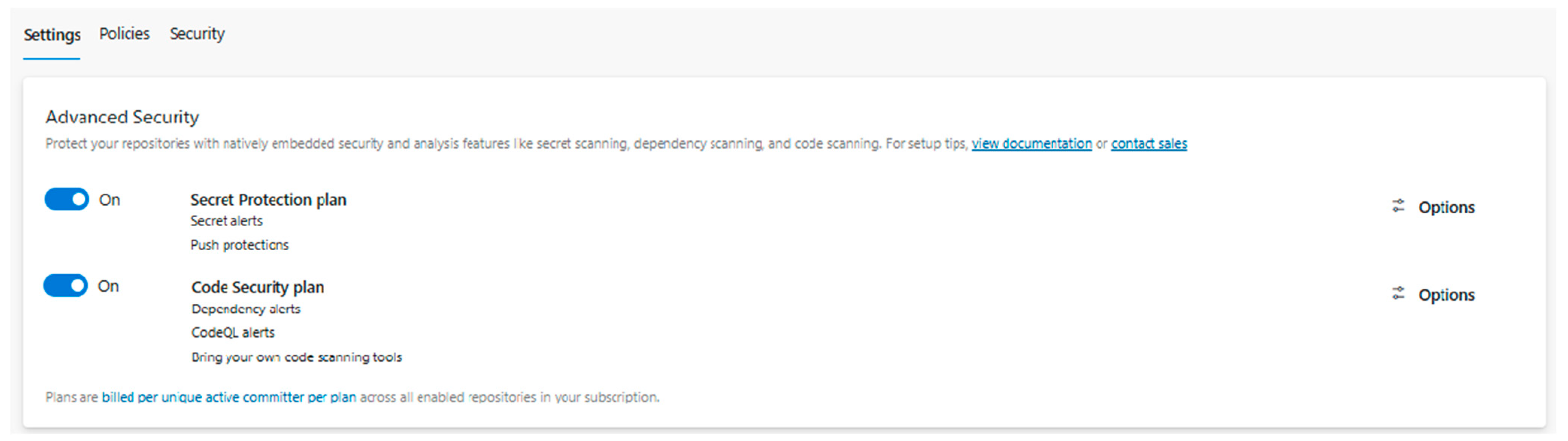
Azure DevOps (ADO) remains a key component of enterprise delivery pipelines, particularly for organizations managing legacy applications, complex release orchestration, and large-scale deployments integrated with Azure infrastructure. GHAS for ADO extends the same scanning capabilities to this environment, allowing CodeQL and secret scanning to run natively within ADO Pipelines. It integrates with Azure Active Directory (AAD) for access management and Azure Monitor for centralized logging, ensuring that security insights flow seamlessly into the enterprise observability stack.
The coexistence of GitHub and ADO in large enterprises reflects a practical reality: teams often use GitHub for innovation-driven papers and ADO for enterprise-grade delivery pipelines. This dual-environment strategy requires a unified security layer that bridges the operational and governance gaps. GHAS fulfills this role by standardizing scanning behavior, reporting structures, and compliance data between both systems [
8,
9]. The anticipated results of GHAS implementation across GitHub and Azure DevOps include the following:
Unified Security Visibility: Centralized dashboards allow security teams to correlate findings across GitHub and Azure DevOps without jumping between multiple tools, reducing cognitive overhead. This unified view creates a consistent taxonomy of vulnerabilities, enabling more apparent prioritization and streamlined triage workflows. Cross-platform insights also help identify systemic issues, such as recurring insecure coding patterns or dependency risks affecting multiple repositories. By aggregating results into shared analytics platforms like Azure Monitor or Power BI, organizations can generate trend analyses and benchmark performance across teams. Unified visibility supports better resource allocation as leadership gains precise information on where remediation efforts are most needed. Integration with enterprise SIEM systems enhances the ability to detect wider attack campaigns that may involve code-level indicators. This capability lays the groundwork for enterprise-wide threat modeling, informed by real-time insights into code security posture [
10].
Reduced Risk Exposure: Early detection shortens the vulnerability lifecycle, reducing the window in which insecure code can be exploited. Automated scanning prevents high-risk flaws from propagating downstream into release candidates or production builds. GHAS operates on every commit and pull request, avoiding the accumulation of latent defects that would otherwise be expensive to fix later. Dependency scanning mitigates the risk introduced by open-source components, which represent one of the most common attack vectors in modern supply chains. Secret scanning stops credential leaks at the source, preventing attackers from moving laterally through compromised tokens. Consistent scanning across GitHub and ADO ensures no codebase becomes a blind spot. With continuous feedback, security teams can shift from reactive firefighting to proactive hardening, reducing the organization’s overall attack surface.
Improved Developer Productivity: Developers receive actionable insights directly into the tools they use daily, reducing context switching and improving focus. Automated remediation suggestions accelerate the correction of common vulnerabilities without requiring deep security expertise. Integrated annotations in pull requests let developers fix issues before merging, reducing rework. Eliminating manual scanning processes frees teams to focus on feature delivery rather than administrative tasks. GHAS consolidates results into a unified interface. Developers no longer need to interpret inconsistent rules or formatting across multiple security tools. Inline explanations help educate developers about secure coding practices, improving long-term proficiency. GHAS’s integration with IDE extensions strengthens early detection, allowing issues to be resolved before code is even pushed to the repository [
11].
Operational Efficiency: Centralized policy management reduces the overhead associated with maintaining separate configurations for GitHub and ADO environments. Automated workflows eliminate the need for manual scheduling or cross-team coordination of security tasks. Native integration with identity and access management tools simplifies onboarding and reduces permission drift. Consolidating tools lowers licensing costs and reduces the operational burdens of maintaining multiple vendors. Shared dashboards reduce duplication of reporting efforts and streamline security governance. GHAS’s cloud-native architecture removes infrastructure maintenance, lowering operational complexity for security teams. Standardized scanning rules create predictable outcomes across repositories, simplifying exception handling and compliance workflows.
Audit Readiness: GHAS automatically captures evidence of scans, findings, and remediation activity, reducing the manual work typically required for audits. Timestamped logs and traceability artifacts support regulatory frameworks that demand demonstrable security controls. Centralized reporting enables auditors to verify compliance across both GitHub and ADO without relying on siloed documentation. Automated dependency tracking ensures organizations maintain an up-to-date inventory of open-source components, a common requirement in compliance audits. Integration with Azure Monitor and SIEM platforms strengthens the audit trail by preserving immutable security events. Real-time insights help organizations prepare for audits continuously rather than in periodic, stressful cycles. This integrated model supports frameworks such as ISO 27001, SOC 2, and NIST by providing consistent, repeatable, and verifiable evidence [
12,
13].
Cultural Transformation: Embedding GHAS into daily workflows reinforces the expectation that security is a shared responsibility across development teams. Real-time feedback helps normalize secure coding practices, reducing resistance to security controls. GHAS surfaces issues early and automatically, developers perceive security not as a blocker but as an integral part of engineering quality. Visibility into security trends fosters healthy competition between teams to reduce vulnerabilities and improve scores. Documentation and in-tool guidance support continuous learning, gradually building a stronger security culture. Cross-functional collaboration improves as developers, operations teams, and security engineers use a standardized system and shared data. Over time, these practices reduce reliance on centralized security teams for routine checks, enabling a more distributed and mature DevSecOps culture.
Beyond its technical deliverables, this paper demonstrates a scalable model for unifying DevSecOps practices in multi-platform organizations. By operationalizing GHAS across GitHub and Azure DevOps, enterprises can move from reactive, fragmented security management to proactive, standardized governance. Effective DevSecOps maturity is achieved through integration, automation, and shared accountability among developers, security engineers, and compliance teams. This initiative positions GHAS as both a technical solution and a strategic enabler, bridging the divide between developer productivity and enterprise-grade security [
3,
7,
14]. The lessons learned and frameworks defined through this implementation will inform best practices for organizations seeking to establish holistic, cross-platform security automation.
3. Background and Related Work
3.1. DevSecOps and Software Supply Chain Security
Modern software delivery relies on complex toolchains composed of source code repositories, build systems, dependency managers, artifact registries, and deployment automation. This interconnectedness is not new. The widespread adoption of CI/CD pipelines has increased the speed and automation with which changes move from development to production. As a result, security failures can propagate more rapidly, and remediation windows may be significantly shortened. In this context, security risks are less a consequence of new vulnerabilities and more a function of accelerated exposure and reduced manual oversight [
15].
DevSecOps addresses these challenges by integrating security mechanisms directly into development and delivery workflows. Rather than treating security validation as a separate or final-stage activity, DevSecOps emphasizes continuous and automated analysis aligned with developer actions. Typical controls include static application security testing (SAST) to identify insecure coding patterns, software composition analysis (SCA) to detect vulnerabilities in third-party dependencies, and secret detection to prevent credential leakage. These controls operationalize the principle of “shift-left” security, in which vulnerabilities are identified as early as possible in the software lifecycle [
5,
16].
Despite broad conceptual agreement on DevSecOps principles, practical implementations vary widely. Organizations frequently adopt multiple tools, each addressing a specific security domain or development environment. This results in fragmented security visibility, inconsistent policy enforcement, and duplicated configuration effort. Furthermore, automated scanning introduces known challenges, including false positives, limited exploitability context, and alert fatigue, which can reduce developer trust in security tooling if not carefully managed. As a result, effective DevSecOps adoption depends not only on tool capabilities but also on how well those tools integrate into existing workflows and governance structures.
Software supply chain security has become a central concern within this area, mainly due to the extensive use of third-party and open-source components. Modern applications often rely on deep dependency trees, including transitive dependencies that developers do not explicitly reference. While vulnerabilities can exist in any software component, transitive dependencies present a particular challenge because they reduce visibility and complicate remediation planning. DevSecOps tooling increasingly focuses on maintaining accurate dependency inventories and continuously monitoring vulnerability disclosures. Such approaches remain constrained by the quality of advisory data and the practical relevance of reported issues [
17].
3.2. Overview of GitHub Advanced Security
GHAS is an application security platform integrated into GitHub Enterprise that combines static code analysis, dependency vulnerability detection, and secret scanning. Its design aligns with CI/CD-native security approaches by embedding analysis results directly into developer workflows, such as pull requests and repository dashboards. Rather than introducing a separate scanning infrastructure, GHAS operates within the same identity, access control, and automation frameworks used for source code management.
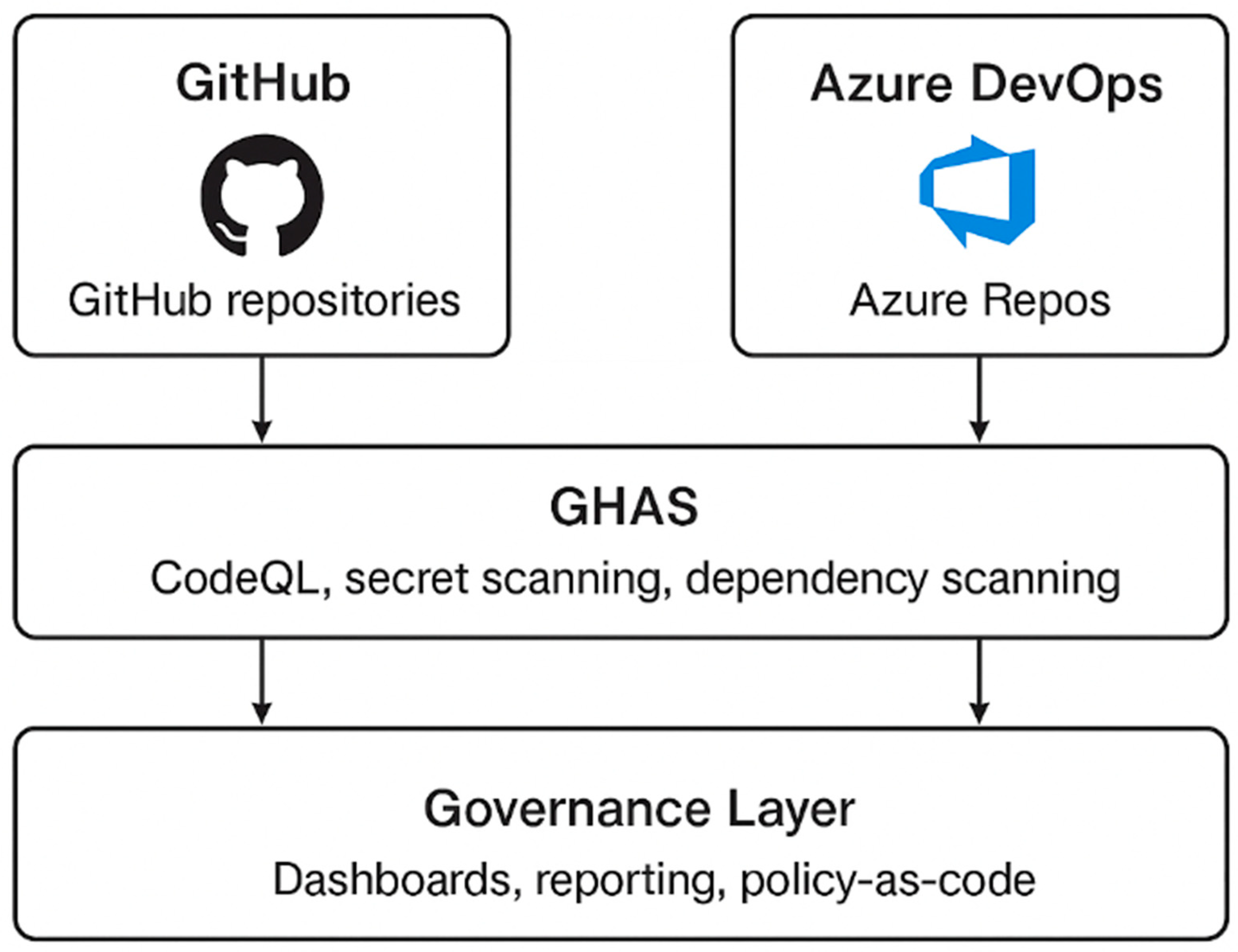
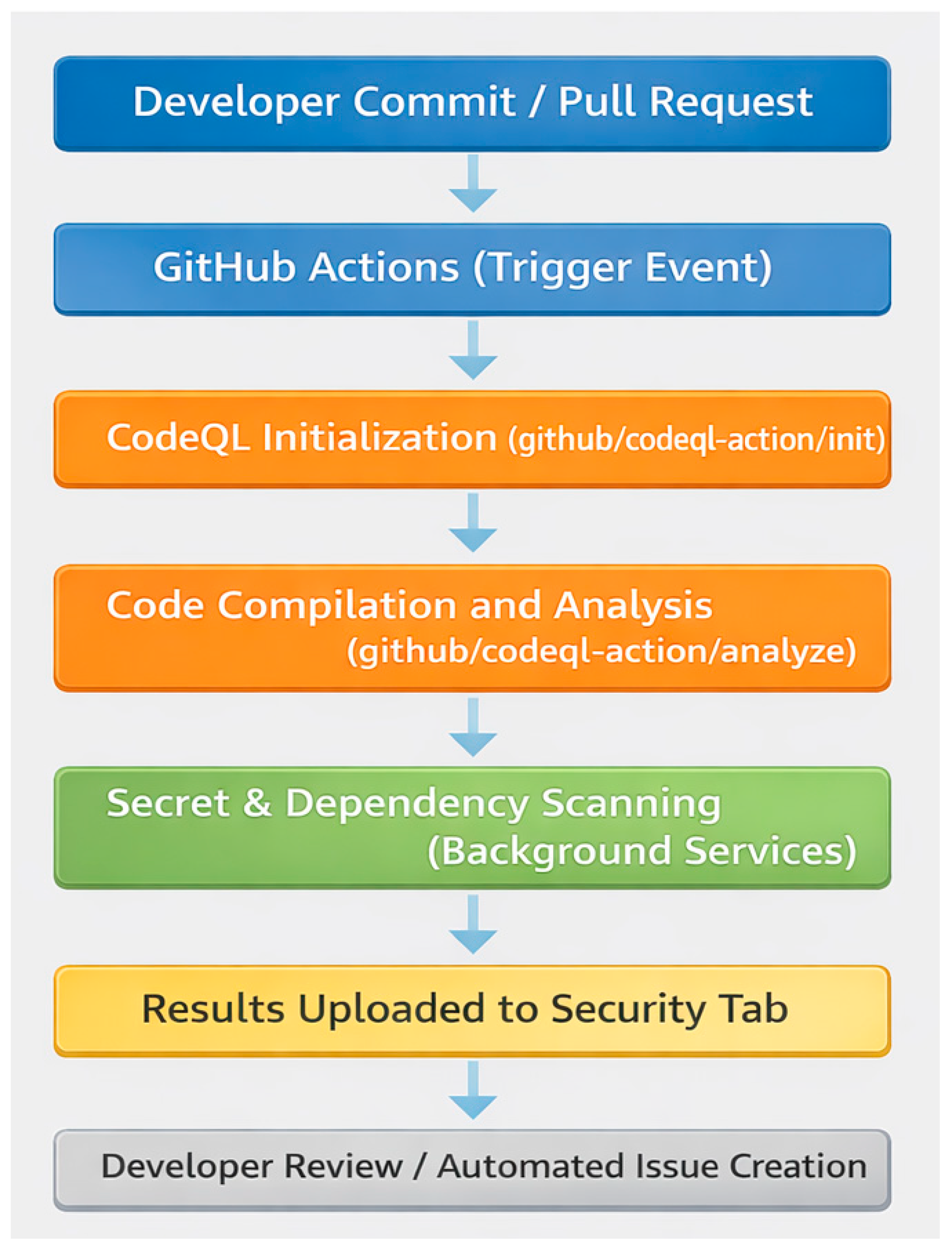
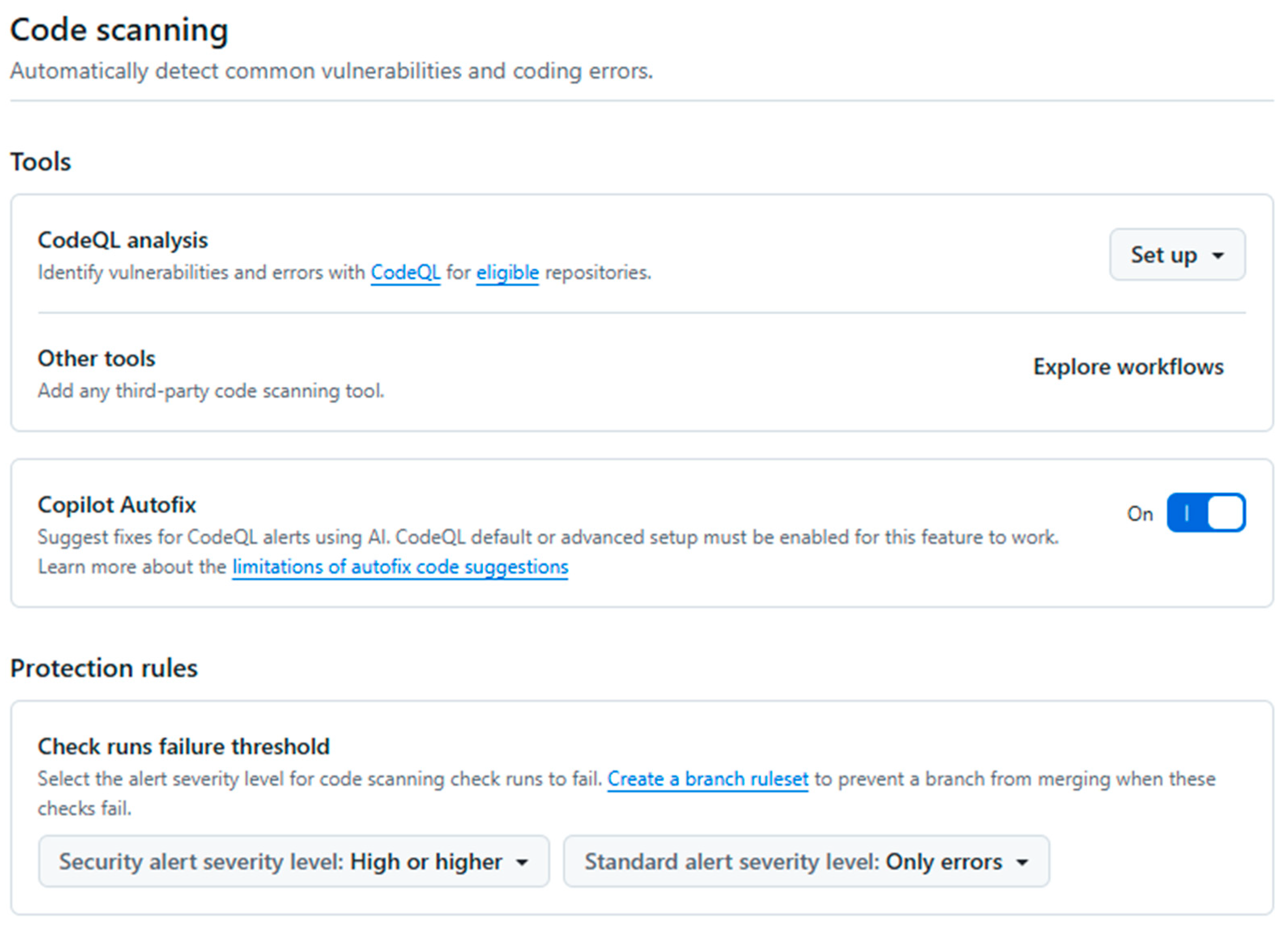
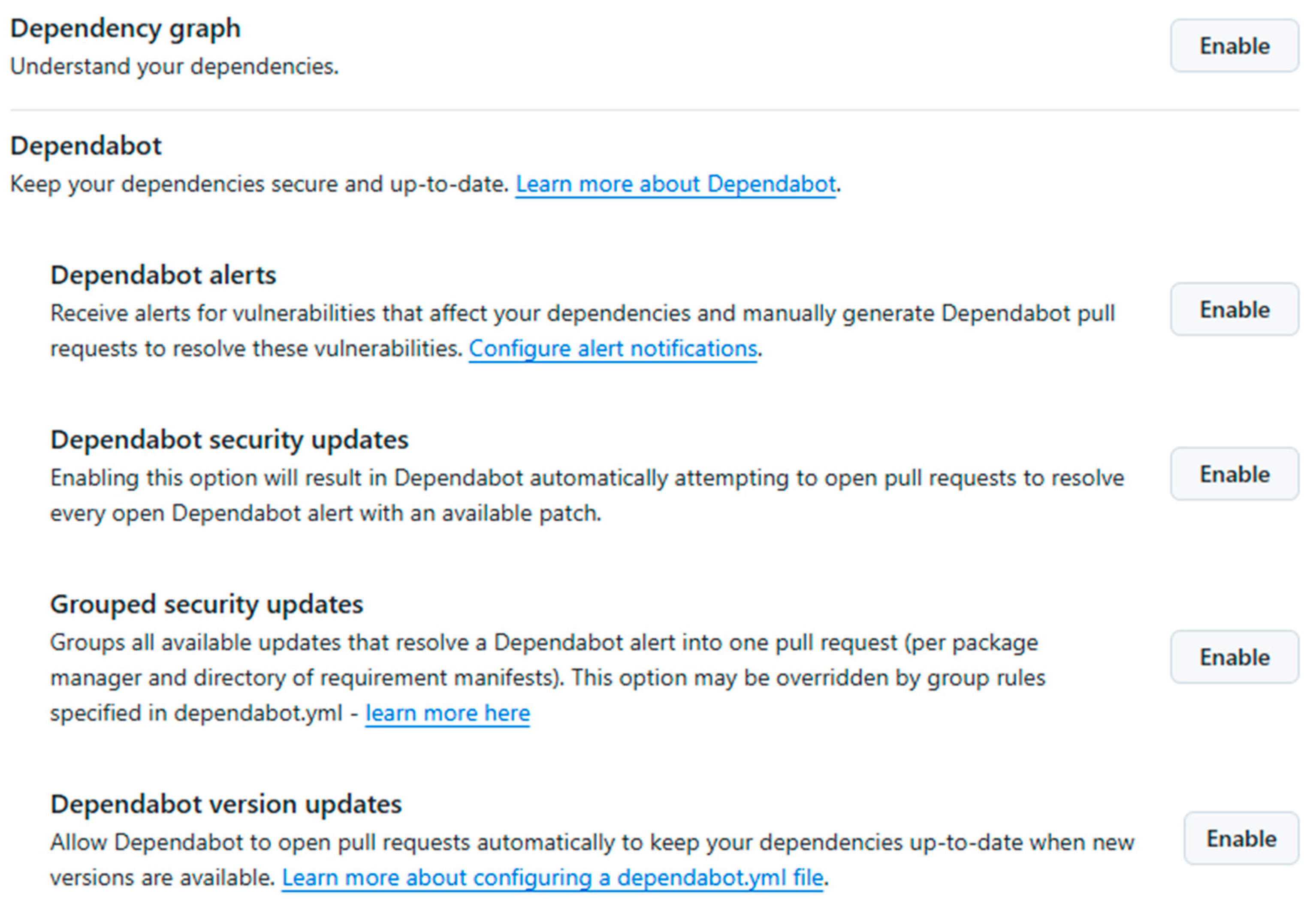
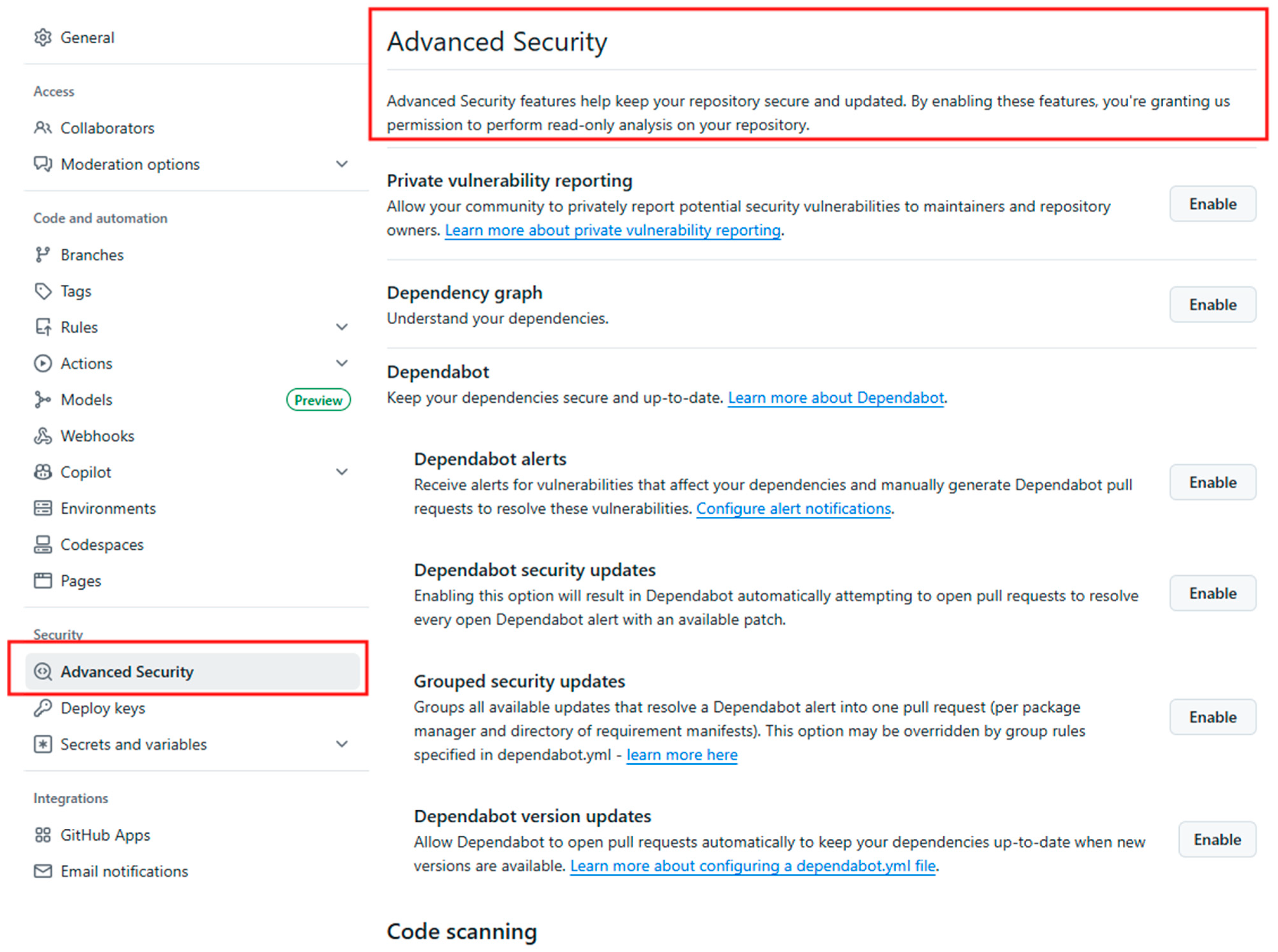
At a functional level, GHAS provides three primary capabilities: code scanning with CodeQL, secret detection using predefined and customizable patterns, and dependency vulnerability alerts from curated advisory databases, as shown in
Figure 1. These capabilities correspond to common categories found across application security tooling, including SAST, SCA, and credential exposure detection. What distinguishes GHAS is not the innovation of these mechanisms but their co-location within the development platform, which reduces the need for external integrations and additional operational overhead [
10,
18].
CodeQL, the static analysis engine underlying GHAS code scanning, represents source code as a queryable database, enabling data-flow and control-flow analysis across multiple programming languages. While this approach allows expressive vulnerability detection, prior studies and practitioner reports note that developing custom queries requires specialized expertise and can introduce a learning curve. As with other SAST tools, scan results may include findings that are syntactically correct but not exploitable in practice, necessitating contextual interpretation by developers or security engineers.
Secret scanning in GHAS focuses on detecting accidental inclusion of credentials such as API keys, tokens, and certificates within repositories. Detection is based on both known credential formats and organization-defined patterns. While automated detection reduces the likelihood of long-lived credential exposure, it does not eliminate the need for secure secret storage and rotation practices within CI/CD pipelines. Dependency scanning relies on mapping declared and transitive dependencies to known vulnerability advisories. As with other SCA tools, the effectiveness of this approach depends on the completeness of dependency graphs and the relevance of vulnerability disclosures to actual runtime usage [
15,
19].
The introduction of GHAS for Azure DevOps extends these capabilities into ADO pipelines, enabling similar analysis workflows for repositories managed outside GitHub. While the underlying analysis engines are shared, differences in platform architecture lead to variations in feature maturity, configuration models, and feedback latency. These differences are relevant when evaluating GHAS as a cross-platform solution rather than as a GitHub-specific feature set.
3.3. Related Tools and Ecosystem
GHAS operates within a broader ecosystem of application and supply chain security tools, many of which provide overlapping capabilities. Static analysis platforms such as SonarQube and Checkmarx focus on code quality and vulnerability detection across multiple languages. Software composition analysis tools such as Snyk and OWASP Dependency-Check emphasize open-source dependency monitoring and license compliance. Other platforms, including Veracode and Aqua Security, extend coverage into DAST dynamic analysis, container security, and runtime protection.
These tools differ in deployment models, integration depth, and governance capabilities. External scanners often require separate authentication systems, infrastructure provisioning, and CI/CD integration steps, which can increase operational complexity. Conversely, CI/CD-integrated tools reduce setup overhead but may offer less flexibility or slower feature parity across platforms. No single tool comprehensively addresses all aspects of application and supply chain security, and mature DevSecOps programs typically combine multiple solutions to balance coverage, accuracy, and operational cost, as shown in
Table 1.
Comparative studies and industry reports suggest that tool adoption is influenced as much by workflow integration and organizational alignment as by detection accuracy alone. Tools that surface findings directly within developer workflows tend to achieve higher engagement, whereas tools that require context switching or manual triage may face resistance to adoption. Tighter integration does not eliminate fundamental challenges, such as false positives, prioritizing non-exploitable findings, or the need for developer education [
1,
16].
In this context, GHAS should be viewed as one implementation of CI/CD-integrated security rather than a definitive solution. Its value lies in reducing integration friction and centralizing certain classes of security analysis, while its limitations reflect broader constraints shared across automated scanning tools. Understanding these trade-offs is essential when evaluating GHAS as part of a multi-tool DevSecOps strategy rather than as a standalone security control. The tools summarized in
Table 1 were selected based on their frequent appearance in the DevSecOps and application security literature, as well as their representative coverage of major security domains, including static application security testing (SAST), software composition analysis (SCA), and cloud-native or container security. The characterization of each tool’s strengths and limitations is derived from prior comparative studies and systematic reviews of DevSecOps tooling [
1,
2,
3,
4,
16], as well as from official documentation and industry reports provided by the tool vendors [
7,
8,
9,
10,
11].
Unlike externally integrated tools, GHAS embeds these security capabilities directly into the source control and CI/CD platforms, reducing integration overhead and configuration fragmentation, an issue repeatedly highlighted in DevSecOps adoption studies [
1,
2,
3].
4. Solution Architecture
The purpose of the solution architecture is to examine how GitHub Advanced Security can be deployed as a unifying security mechanism across both GitHub and Azure DevOps (ADO) environments while preserving platform-specific workflows. Rather than describing a single prescriptive implementation, this section analyzes architectural design choices that influence scalability, governance, and operational overhead in multi-platform DevSecOps environments. The architecture is therefore presented as a reference model for reasoning about trade-offs rather than as a deployment blueprint.
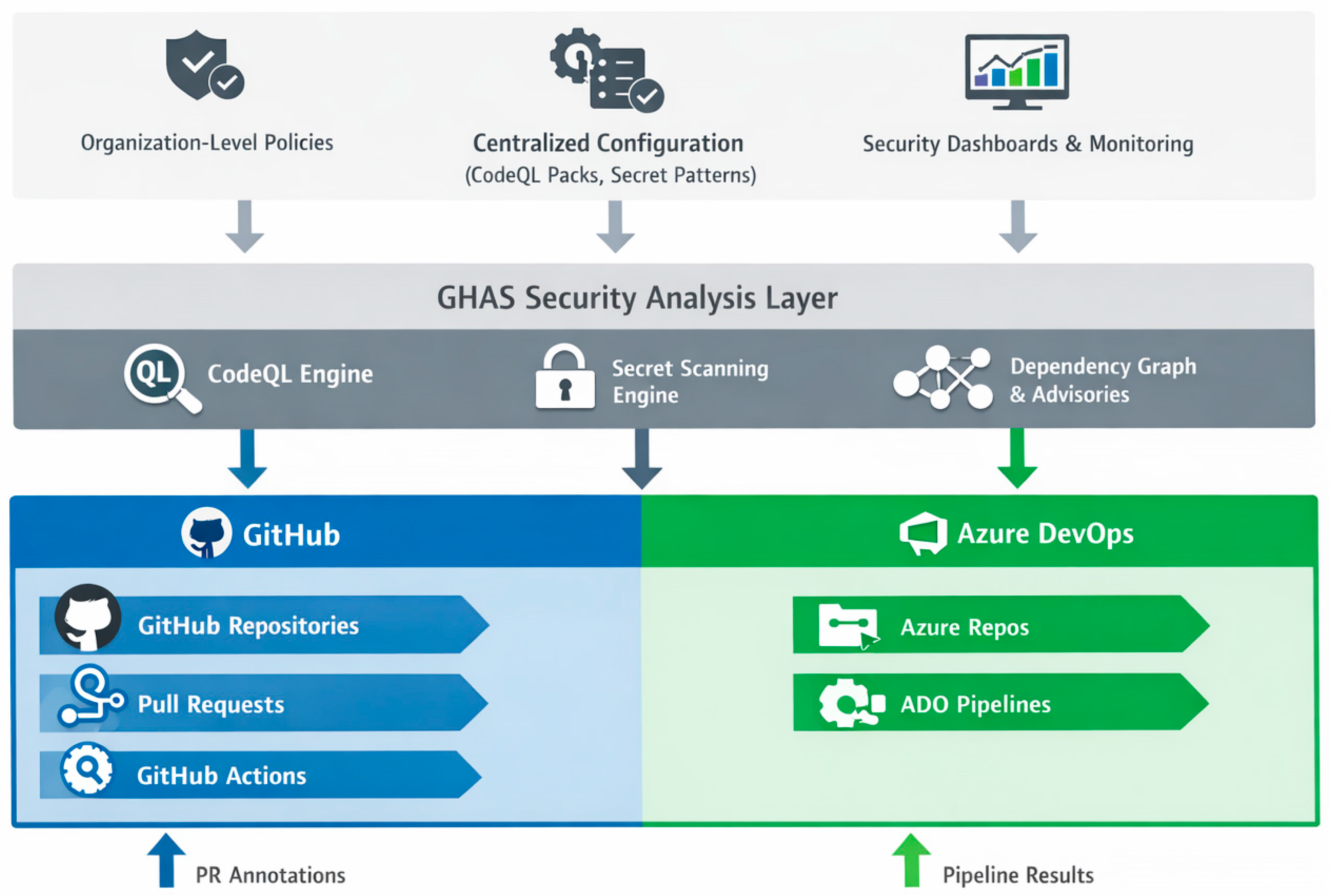
To clarify the architectural rationale behind the proposed DevSecOps model,
Figure 1 illustrates the GHAS-specific execution and governance structure across GitHub and Azure DevOps. Unlike generic DevSecOps reference architectures, this model reflects how GitHub Advanced Security decouples security analysis from CI/CD orchestration while enforcing configuration and policy controls at the organization level. The figure highlights the separation between platform-dependent execution environments and a shared, platform-independent security analysis layer, explaining the need for centralized configuration and consistent governance in heterogeneous development ecosystems.
As shown in
Figure 1, GitHub Advanced Security decouples security analysis from CI/CD orchestration while enforcing configuration and policy controls at organization level, which directly influences the architectural separation discussed in the following subsections.
Organizations operating both GitHub and Azure DevOps face a structural challenge: security controls must remain consistent across platforms that differ in event models, pipeline orchestration, and feedback mechanisms. A centralized security engine that operates independently of repository location can reduce fragmentation, but only if it integrates cleanly with each platform’s native workflows. GHAS addresses this challenge by decoupling security analysis from pipeline orchestration while embedding results back into developer-facing interfaces [
20].
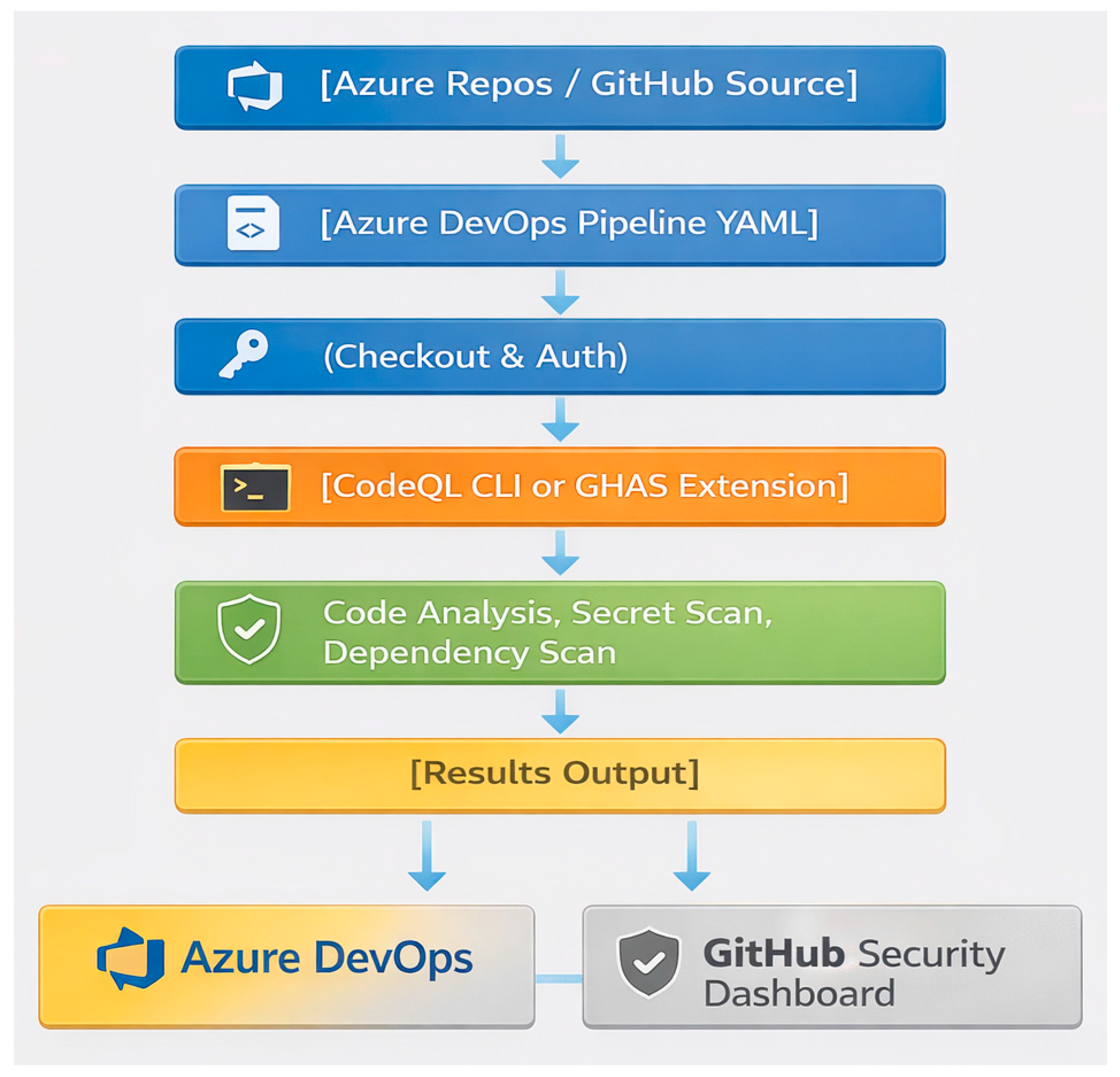
To abstract the GHAS-specific execution model into a reusable architectural perspective, the proposed solution is summarized in a layered reference architecture shown in
Figure 2. The architecture considered in this paper consists of three conceptual layers: a source control layer, a security analysis layer, and a governance layer. Source code resides in GitHub repositories or Azure Repos, where development workflows and CI/CD pipelines are defined. The security analysis layer is provided by GHAS, which performs static code analysis, secret detection, and dependency vulnerability evaluation using shared engines such as CodeQL. The governance layer aggregates results, enforces baseline policies, and provides visibility across repositories and teams [
21].
This layered separation is significant because it allows security analysis to remain consistent even when development platforms differ. In GitHub, GHAS integrates natively with pull requests and GitHub Actions, providing near-immediate feedback during code review. In Azure DevOps, GHAS operates through pipeline execution and extensions, which may introduce latency between code changes and reported findings. While the analysis engines are shared, differences in trigger models and feedback channels affect developer experience and remediation timing. These differences must be considered when evaluating GHAS as a cross-platform control rather than assuming functional equivalence [
22].
4.1. Security Scanning Workflows
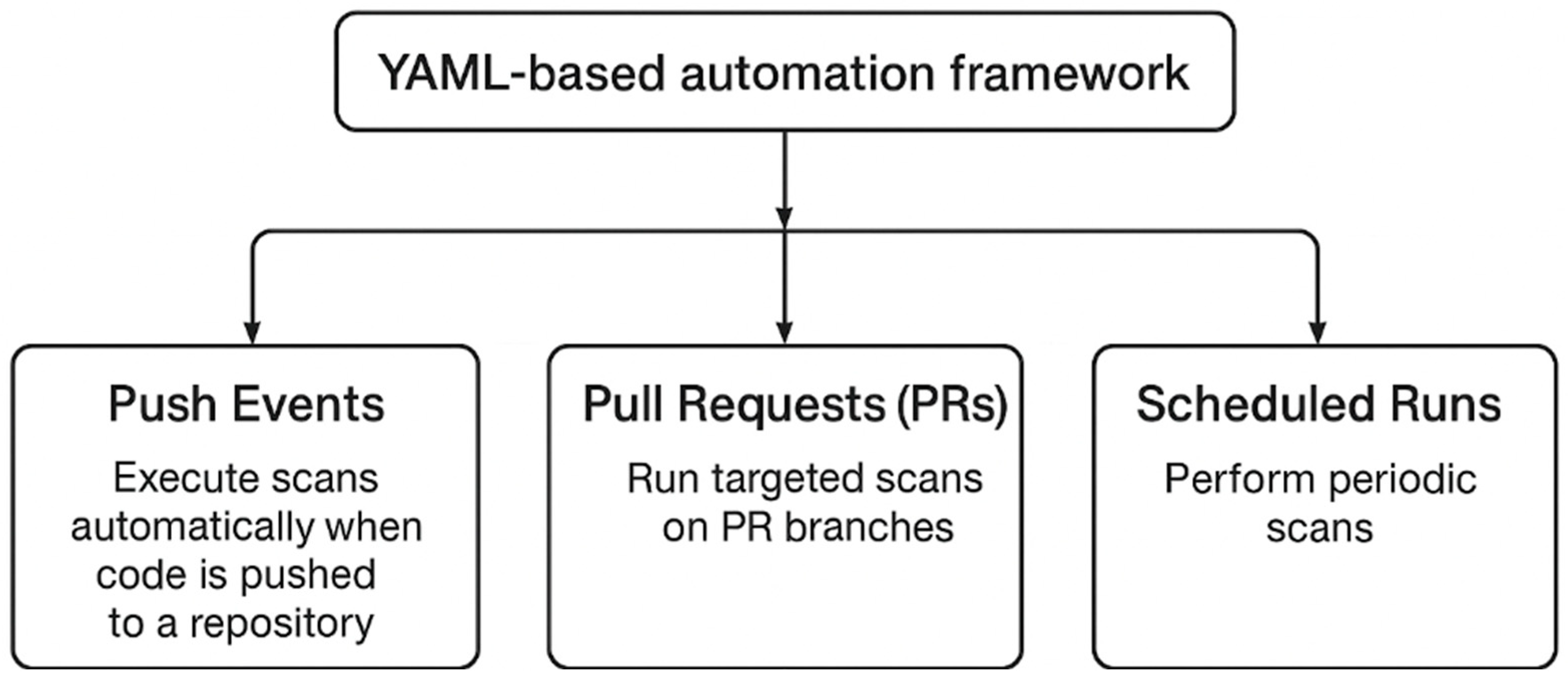
The Security scanning workflows represent the operational expression of the architecture. In this model, code scanning, secret detection, and dependency analysis are treated as independent but coordinated components. Each workflow can be triggered by pull requests, commits, or scheduled executions, depending on platform capabilities and governance requirements. Treating these scans as modular components allows organizations to adjust enforcement levels without redesigning the entire pipeline.
Code scanning based on CodeQL is typically triggered during pull requests or scheduled builds to balance early detection with pipeline performance. While early scanning supports shift-left security, frequent execution may increase build times and surface findings that lack immediate exploitability. The architecture, therefore, supports selective triggering strategies that align scan frequency with repository risk profiles.
Secret scanning operates continuously rather than as a discrete pipeline stage. This distinction is essential because credential exposure often occurs outside formal build processes, such as during local development or configuration changes. Continuous scanning reduces reliance on pipeline execution but also raises governance questions about alert-handling and credential-rotation workflows [
23].
Dependency scanning relies on accurate construction of dependency graphs and vulnerability advisory data. Architecturally, this workflow is reactive: new vulnerability disclosures can generate alerts even when no code changes occur. This behavior supports continuous risk awareness but may also produce alerts for unused or non-exploitable dependencies, reinforcing the need for contextual triage rather than automatic enforcement [
24].
A central architectural question is the degree to which security configuration and enforcement should be centralized. Highly centralized models enforce consistent baseline policies across all repositories, reducing configuration drift and compliance gaps. Excessive centralization can limit team autonomy and increase resistance, particularly in heterogeneous engineering organizations. The reference architecture supports a hybrid governance model in which baseline security requirements are centrally defined, while repositories retain limited flexibility to extend or refine configurations. This approach aligns with the principle of security-as-code, in which configuration scans are version-controlled, reviewable, and auditable. From an architectural perspective, this reduces reliance on opaque platform settings and improves traceability during audits or incident investigations. In GitHub, organization-level policies enable mandatory scanning configurations to be applied automatically to repositories. In Azure DevOps, equivalent enforcement relies more heavily on pipeline templates and organizational standards, which introduces additional operational complexity. These differences highlight that architectural consistency at the analysis layer does not guarantee uniform governance behavior across platforms [
20,
25].
4.2. Scalability Across Environmental Deployments
This architecture is designed to support gradual adoption rather than requiring immediate, organization-wide rollout. Small teams may enable GHAS directly at the repository level, benefiting from default configurations and minimal administrative overhead. In these contexts, security feedback is tightly coupled to developer workflows, and governance relies primarily on repository-level controls. Large organizations require architectural support for centralized visibility, standardized onboarding, and integration with enterprise identity and monitoring systems. Automation becomes critical to prevent manual configuration drift and ensure that new repositories inherit baseline security controls. The architecture, therefore, emphasizes reusable templates, shared configuration repositories, and API-driven reporting rather than per-repository customization. Scalability also introduces performance and cost considerations. Running comprehensive static analysis across hundreds of repositories can affect pipeline throughput and licensing budgets. The architecture accommodates selective scanning strategies, such as prioritizing high-risk repositories or scheduling intensive scans during off-peak hours, to balance coverage with operational constraints. While the reference architecture enables unified analysis across platforms, it does not eliminate fundamental limitations of automated security scanning. The architecture assumes that findings require human interpretation, particularly for complex data-flow vulnerabilities or dependency alerts with uncertain exploitability. As a result, governance processes and developer education remain essential components of effective security integration. Additionally, differences between GitHub and Azure DevOps mean that architectural symmetry does not translate into an identical developer experience. Organizations adopting this model must account for these discrepancies and avoid assuming that tooling behavior will be perceived uniformly across teams. Overall, the architecture provides a structured framework for evaluating GHAS as a cross-platform security mechanism. Its value lies not in prescribing a single deployment model but in exposing the design choices and trade-offs that influence effectiveness, scalability, and adoption. These considerations form the foundation for the configuration strategies and pipeline integrations analyzed in subsequent sections [
7,
18,
26].
7. Challenges, Trade-Offs, and Design Implications
The preceding sections examined the architecture, configuration strategies, and CI/CD integration mechanisms of GitHub Advanced Security across GitHub and Azure DevOps environments. While these sections demonstrate how GHAS can function as a unifying security layer, they also reveal a set of practical challenges and trade-offs that emerge when security automation is operationalized at organizational scale. These challenges do not arise uniformly; rather, they reflect interactions between GHAS’s technical characteristics, architectural and configuration design choices, and broader organizational constraints.
7.1. Research Questions Guiding the Discussion
The discussion in this section is structured around the following research questions:
RQ1: What trade-offs arise between security coverage and operational cost when GHAS is deployed at organizational scale?
RQ2: How do GHAS-specific architectural and configuration choices influence the balance between centralized governance and team-level flexibility?
RQ3: To what extent do automation-driven security analyses introduce interpretability and usability challenges for developers across heterogeneous CI/CD platforms?
7.2. Cost and Scalability: Coverage vs. Economic Constraints
One of the most immediate trade-offs observed in the adoption of GitHub Advanced Security at organizational scale concerns the relationship between security coverage and economic cost. GHAS licensing is based on the number of active committers, establishing a direct coupling between developer population size and operational expenditure. This licensing model represents an inherent characteristic of the tool rather than a consequence of architectural or configuration choices. As organizations grow in size and repository count, comprehensive enablement of all GHAS features across all projects may therefore become economically nontrivial.
The architectural model presented in
Section 4 does not eliminate this constraint but instead exposes it more clearly. By centralizing security analysis within a shared GHAS layer, organizations gain consistent visibility and governance across repositories, but they also concentrate licensing impact at the organizational boundary. This concentration amplifies cost visibility and forces explicit prioritization decisions. In this sense, the architecture shifts cost management from an implicit, tool-by-tool concern to an explicit governance consideration aligned with enterprise risk management.
To address this tension, organizations frequently adopt selective deployment strategies. High-risk or business-critical repositories are prioritized for full GHAS coverage, while lower-risk projects may rely on reduced scanning scopes or alternative controls. This selectivity is not imposed by GHAS itself, but emerges as an organizational response enabled by the modular configuration model discussed in
Section 5. The ability to define baseline controls centrally while tailoring enforcement at repository level allows organizations to balance cost constraints against security objectives without abandoning architectural consistency.
Scalability considerations extend beyond licensing into pipeline performance and operational overhead. Comprehensive static analysis and dependency scanning across hundreds of repositories can increase CI/CD execution times and generate substantial volumes of findings. While these effects are inherent to automated security analysis, their impact is magnified at scale. As a result, organizations often complement architectural centralization with temporal strategies, such as scheduling intensive scans during off-peak hours or adjusting scan frequency based on repository risk profiles.
Taken together, these observations indicate that the cost–coverage trade-off associated with GHAS adoption is not solely a limitation of the tool, nor solely a consequence of architectural design. Rather, it emerges at the intersection of GHAS’s licensing and execution characteristics, the choice to centralize security analysis for governance consistency, and organizational decisions regarding risk tolerance and resource allocation. Recognizing this interaction is essential for interpreting GHAS scalability not as a binary feasibility question, but as a continuous optimization problem within enterprise DevSecOps adoption.
7.3. Centralization vs. Flexibility in Cross-Platform Governance
A central governance dilemma in multi-platform DevSecOps environments is the balance between centralized security enforcement and team-level flexibility. This trade-off becomes especially visible in a GHAS-based model because GHAS combines a shared analysis layer with organization-level enablement and policy mechanisms. As illustrated in
Figure 1 and abstracted in
Figure 2, centralized governance improves consistency by reducing configuration drift and by enabling unified visibility over code scanning, secret detection, and dependency monitoring across repositories. However, the same centralization can also constrain how individual teams tune scanning behavior to local technical contexts, risk profiles, and delivery workflows.
In GitHub, organization-level policy enforcement provides native mechanisms to mandate baseline controls (e.g., required code scanning configurations, approved query packs, and secret protection settings) across repositories. This capability directly supports centralized governance and audit readiness, since configuration changes become more traceable and enforcement becomes less dependent on per-repository operational discipline. By contrast, Azure DevOps environments typically rely more heavily on pipeline templates and project-level standards to approximate similar outcomes. While GHAS extends analysis capability into ADO, governance symmetry is therefore not guaranteed by the tool alone; it depends on how organizations implement and operationalize policy controls in each platform.
The configuration model discussed in
Section 5 can be interpreted as a practical resolution of this tension. Centralized baseline configurations reduce variance and provide predictable enforcement, which is essential for enterprise compliance and for consistent risk reporting. At the same time, controlled extension points allow repositories to refine scanning behavior (e.g., adding language-specific query packs, adjusting scan cadence, or defining additional secret patterns) where justified. This hybrid model is not simply an instance of generic “security-as-code” best practice; rather, it reflects the realities of GHAS deployment across heterogeneous platforms, where identical analysis engines must be governed through different orchestration and configuration surfaces.
Centralization also influences the operational burden of exception handling. Uniform enforcement can generate friction when certain repositories have constraints that make strict scanning impractical (e.g., legacy build chains, performance limitations, or high volumes of low-actionability findings). If exception handling is not formalized, teams may disengage or adopt workaround behaviors that reintroduce fragmentation. A governance model that explicitly defines baseline requirements, acceptable deviation criteria, and review processes for exceptions helps prevent such drift. In this sense, flexibility should not be treated as the absence of control, but as a controlled governance capability that enables adoption without undermining consistency.
Overall, the centralization–flexibility trade-off in GHAS-based DevSecOps adoption is shaped by the interaction of GHAS’s organization-level capabilities, platform-specific governance mechanisms, and the configuration design choices made by adopters. Centralized governance strengthens consistency, compliance alignment, and enterprise visibility, but must be complemented with bounded flexibility to sustain developer adoption and to accommodate genuine project heterogeneity. This trade-off therefore represents both a governance challenge and a design implication: GHAS enables centralization, but long-term effectiveness depends on how organizations institutionalize flexibility without reverting to fragmented security practices.
7.4. Automation vs. Interpretability in Static and Dependency Analysis
A recurring trade-off in GHAS-based security automation is the tension between expanding automated detection coverage and maintaining interpretability for developers and security teams. This tension is not unique to GHAS, but it becomes operationally salient because GHAS embeds static and dependency analyses directly into CI/CD workflows and developer interfaces. As a result, the value of automation depends not only on detection capability, but also on whether findings can be understood, prioritized, and acted upon with limited context switching.
For code scanning, GHAS relies on CodeQL, which enables expressive data-flow and control-flow analysis across multiple languages. This expressiveness improves detection breadth, but it also increases the likelihood of findings that are technically valid yet difficult to contextualize in terms of exploitability, reachability, or real-world risk. The interpretability burden is therefore an inherent constraint of advanced static analysis, rather than a shortcoming of the architectural model. However, architectural and configuration decisions influence how strongly this burden is felt. For example, aggressive scanning cadences and broad default query packs may maximize coverage, but they can also elevate alert volumes and increase the proportion of low-actionability results, contributing to alert fatigue.
The configuration design discussed in
Section 5 can partially mitigate this trade-off. Centrally managed query packs and carefully staged customization reduce uncontrolled variability and help maintain consistent detection semantics across repositories. At the same time, incremental customization allows organizations to adapt scanning to local codebases and internal frameworks, potentially reducing irrelevant findings. Importantly, this mitigation is not automatic; it requires governance discipline to ensure that query changes are reviewed, validated, and aligned with organizational threat models. Without such discipline, customization can shift interpretability problems rather than solving them, for instance by introducing additional false positives or by weakening detection coverage in unintended ways.
Dependency scanning introduces a related but distinct interpretability challenge. Vulnerability alerts are triggered by dependency graphs and advisory data, which provide broad visibility into third-party risk but do not inherently encode runtime context. Consequently, alerts may be generated for vulnerabilities in transitive dependencies, optional components, or cases where exploitability is uncertain. This behavior reflects a general limitation of software composition analysis: automation can efficiently surface potential exposure, but it cannot fully resolve relevance without contextual triage. Design decisions again affect the operational impact. Strict enforcement policies may block delivery on the basis of low-severity or non-exploitable findings, while overly permissive policies can normalize unresolved alerts and reduce trust in the signal.
In practice, interpretability requires organizational processes in addition to tooling. Triage workflows, severity normalization, and clear remediation expectations are necessary to convert automated findings into actionable engineering tasks. This reinforces a broader implication of the GHAS-based approach: embedding security analysis into developer workflows increases immediacy, but also shifts responsibility toward governance mechanisms that manage noise, prioritize remediation, and preserve developer trust. In this sense, the automation–interpretability trade-off emerges at the intersection of inherent limits of static and dependency analyses, configuration choices that shape alert volume and relevance, and organizational practices that determine whether findings translate into meaningful risk reduction.
7.5. Platform Asymmetry: Architectural Consistency vs. Developer Experience
Although GHAS provides a shared security analysis layer across GitHub and Azure DevOps, platform asymmetry remains a persistent factor shaping developer experience and remediation dynamics. In architectural terms, the analysis engines (e.g., CodeQL, secret detection, dependency evaluation) can be applied consistently across environments. However, consistency at the analysis layer does not guarantee uniformity in how findings are triggered, surfaced, and acted upon. This distinction is critical in multi-platform organizations, where perceived usability often determines whether security automation is treated as a productivity enabler or as friction within delivery workflows.
In GitHub, GHAS is tightly aligned with pull-request-centric development, enabling near-immediate feedback through PR annotations and integrated security views. This interaction model encourages early remediation and supports shift-left practices by presenting findings at the point where code changes are reviewed and merged. In Azure DevOps, GHAS capabilities are typically mediated through pipeline execution and extensions, which can introduce longer feedback cycles and different visibility surfaces for results. Even when identical scanning rules are applied, delayed feedback can reduce developer responsiveness, increase context switching, and shift remediation toward later stages of delivery.
This platform asymmetry also affects governance enforcement. GitHub provides mature organization-level controls for applying baseline security policies and standardizing configuration across repositories. In Azure DevOps, organizations often approximate similar enforcement through pipeline templates and project standards, which can be effective but require additional operational coordination to prevent drift. As a consequence, governance outcomes may vary even when the underlying analysis engine is shared: one environment may achieve stronger uniformity through native platform controls, while the other depends more on process discipline and template governance.
Secret scanning illustrates the practical implications of this asymmetry. Preventive enforcement mechanisms are most effective when integrated early in the developer workflow and when alerts are surfaced with minimal latency. Where enforcement is less immediate or less deeply integrated into authoring and review workflows, secret-related findings may be discovered later, increasing remediation cost and expanding exposure windows. The same pattern applies to code and dependency findings: the earlier and more contextually they are presented, the more likely they are to be treated as actionable engineering work rather than as security backlog.
Overall, platform asymmetry does not invalidate the GHAS-based cross-platform model, but it constrains claims of functional equivalence. The key implication is that architectural consistency should be treated as a necessary but insufficient condition for uniform DevSecOps outcomes. Organizations adopting GHAS across GitHub and Azure DevOps must therefore account for platform-specific feedback latency, enforcement surfaces, and developer interaction patterns when defining governance expectations and when interpreting remediation performance. Addressing this asymmetry typically requires complementary measures—such as standardizing pipeline templates, aligning alert routing and triage processes, and defining consistent remediation SLAs—so that differences in platform experience do not reintroduce fragmented security practices.
7.6. Design Implications for GHAS-Based DevSecOps Adoption
The trade-offs discussed in
Section 7.2,
Section 7.3,
Section 7.4 and
Section 7.5 suggest that adopting GHAS as a unifying security layer is primarily a socio-technical design problem rather than a purely technical enablement exercise. GHAS can reduce integration friction by consolidating key security controls within development platforms, but its effectiveness depends on how organizations design governance, configuration ownership, and developer feedback loops around the tool’s constraints and platform-specific behaviors.
First, scalability should be treated as a policy and portfolio management problem, not only as a tooling capability. Because cost and operational overhead scale with developer activity and repository volume, organizations benefit from explicit strategies that align security coverage with risk. Selective enablement, staged rollout, and risk-based scan cadence are therefore not “workarounds,” but practical design choices that preserve the benefits of architectural consistency while respecting economic constraints.
Second, cross-platform governance requires a hybrid control model. Centralized baselines are essential to reduce configuration drift, ensure auditability, and enable coherent enterprise reporting, especially when repositories span both GitHub and Azure DevOps. However, bounded flexibility is equally necessary to sustain adoption and to accommodate heterogeneous project constraints. Treating flexibility as an explicit governance capability—managed through reviewed exceptions, controlled extension points, and versioned configuration artifacts—helps prevent a return to fragmented, tool-by-tool security practices.
Third, interpretability must be considered a first-class adoption requirement. Automated static and dependency analyses inevitably generate findings that require contextual judgment. As a result, organizations should design triage workflows and remediation expectations alongside scanning configurations, rather than assuming that automation alone produces risk reduction. Incremental customization of CodeQL queries, careful tuning of enforcement thresholds, and clear alert ownership models reduce noise and improve developer trust, which is often the limiting factor for sustained use of security automation.
Finally, platform asymmetry implies that uniform tooling does not produce uniform developer experience. Even with shared analysis engines, differences in workflow integration and feedback latency influence remediation effectiveness and perceived friction. Effective adoption therefore depends on compensating controls that harmonize the operational experience across platforms, such as standardized pipeline templates, consistent alert routing, and aligned service-level expectations for remediation.
Collectively, these implications reinforce the core conclusion of this study: GHAS can serve as a scalable, cross-platform security layer, but its practical value depends on disciplined architectural framing, modular configuration governance, and organizational processes that transform automated findings into actionable engineering outcomes.
8. Conclusions
This study presented a design-oriented evaluation of GitHub Advanced Security (GHAS) as a cross-platform mechanism for integrating automated security analysis across GitHub and Azure DevOps environments. Rather than treating GHAS as a standalone security solution, the analysis positioned it as an infrastructural security layer whose effectiveness is shaped by architectural framing, configuration governance, and organizational adoption strategies. By examining GHAS through architectural, configuration, and operational lenses, the paper clarifies how security automation behaves in heterogeneous DevSecOps ecosystems and why uniform tooling does not necessarily lead to uniform outcomes.
From a theoretical perspective, this work contributes to the DevSecOps literature by emphasizing the distinction between tool capability and operational effectiveness. The analysis demonstrates that GHAS’s shared analysis engines enable architectural consistency across platforms, but that governance models, feedback timing, and configuration ownership strongly mediate their impact. By structuring the discussion around explicit trade-offs—cost versus coverage, centralization versus flexibility, and automation versus interpretability—the study provides a causal framework for understanding how security automation interacts with organizational and platform constraints. This perspective aligns with socio-technical views of DevSecOps, which argue that security outcomes emerge from the interaction of tools, processes, and human decision-making rather than from technical features alone.
From a practical perspective, the findings offer concrete guidance for organizations considering GHAS-based adoption. The results indicate that effective use of GHAS requires treating scalability as a risk and portfolio management problem, adopting hybrid governance models that combine centralized baselines with bounded flexibility, and designing triage and remediation workflows alongside automated scanning. The study further highlights that platform asymmetry between GitHub and Azure DevOps must be explicitly addressed, as differences in workflow integration and feedback latency can significantly influence developer experience and remediation effectiveness. These insights help explain why organizations may observe uneven outcomes even when deploying a unified security toolset.
The analysis also reinforces that GHAS reduces integration friction by consolidating static analysis, secret detection, and dependency monitoring within native development platforms, but it does not eliminate fundamental challenges associated with automated security analysis. False positives, limited exploitability context, and alert fatigue remain inherent constraints that must be managed through configuration discipline and governance processes. Consequently, GHAS should be viewed as an enabling component within a broader DevSecOps system rather than as a self-sufficient control.
This study is subject to several limitations. The evaluation is qualitative and design-oriented, relying on architectural analysis and documented behavior rather than empirical measurements of remediation effectiveness or developer interaction. Additionally, the three primary GHAS components—code scanning, secret scanning, and dependency vulnerability analysis—were analyzed collectively, despite exhibiting different detection models and operational characteristics. These limitations point to several directions for future work.
Future research should complement this qualitative analysis with empirical studies examining developer response to GHAS findings, remediation latency across platforms, and long-term impacts on security posture. Disaggregated evaluations of individual GHAS components would further clarify their distinct strengths, limitations, and governance requirements. Such work would strengthen the evidence base for security automation decisions and support more precise guidance for organizations adopting DevSecOps practices in complex, multi-platform environments.